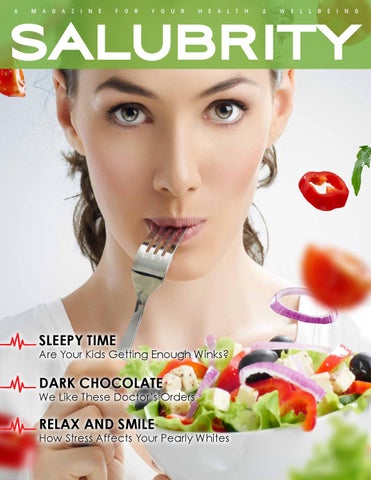
SALUBRITY A
M
A
G
A
Z
I
N
E
F
O
R
Y
O
U
R
H
E
A
L
SLEEPY TIME
Are Your Kids Getting Enough Winks?
DARK CHOCOLATE
We Like These Doctor’s Orders
RELAX AND SMILE
How Stress Affects Your Pearly Whites
T
H
&
W
E
L
L
B
E
I
N
G
Is Your Child Counting Enough Sheep At Night? Children of all ages need plenty of sleep to grow and develop. School-age kids may have trouble learning and developing socially if they don’t get enough sleep. Health problems can cause sleep trouble in children. Examples of these problems include asthma, ADHD, autism, obstructive sleep apnea, and Down syndrome. Talk to your pediatrician if your child often has trouble getting to sleep or staying asleep. Parents can help themselves sleep well by learning about sleep routines and how to reduce stress and relax.
Help your child sleep well • Set up a bedtime routine to help your child get ready for bed and sleep. For example, read together, cuddle, and listen to soft music for 15 to 30 minutes before you turn out the lights. Do things in the same order each night so your child knows what to expect. • Have your child go to bed at the same time every night and wake up at the same time every morning. • Keep your child’s bedroom quiet, dark or dimly lit, and cool. Keep TVs and computers out of their room. • Limit stimulating activities, such as playing and watching TV, in the hours closer to bedtime. • If your child wakes up and calls for you in the middle of the night, make your response the same each time. Offer quick comfort, but then leave the room. • Help prevent nightmares by controlling what your child watches on TV. • Have your child take medicines exactly as prescribed. Call your doctor if your child has any
problems with his or her medicine. • If your child sleepwalks, keep the windows and doors locked during sleep time.
Help your teen sleep well • Talk to your teen about why it’s important to go to bed at the same time every night and wake up at the same time every morning. If they are going to bed at a very late hour, suggest that your teen go to bed 15 minutes earlier each night until the best bedtime is reached. • Have your teen keep his or her bedroom quiet, dark, and cool at bedtime. It’s best to remove the TV, computer, phone, and video games from your teen’s room. • Encourage your teen to manage his or her homework load. This can prevent the need to study all night before a test or stay up late to do homework. • Offer to check to make sure your teen got up when the alarm went off. • Teach your teen to avoid caffeine (found in soda pop, energy drinks, coffee, tea, and chocolate) after 3 p.m. • If your teen is overweight, work with them to set goals for managing his or her weight. Being overweight can be linked with sleep problems. Source: WebMD Medical Reference from Healthwise
HEALTHY INDULGENCE WebMD.com
Dark Chocolate’s Hidden Heart Benefits It’s said that dark chocolate can be good for your heart, and new research may have uncovered why. Louisiana State University researchers tested cocoa powders in a model of the digestive tract and found that certain bacteria in the stomach eat dark chocolate, ferment it and then release anti-inflammatory compounds that benefit the heart. ”We found that there are two kinds of microbes in the gut: the good ones and the bad ones. The good microbes, such as Bifidobacterium and lactic acid bacteria, feast on chocolate,” Maria Moore, an undergraduate student and one of the study authors, said in a society news release. Study leader John Finley, a professor in LSU’s department of food science, said, “When these compounds are absorbed by the body, they lessen the inflammation of cardiovascular tissue, reducing the long-term risk of stroke.” Finley said he believes this is the first study to examine dark chocolate’s effects on different types of stomach bacteria. Data and conclusions presented above are considered preliminary until published in a peer-reviewed medical journal.
How Stress Affects Your Oral Health Too much stress affects your whole body, including your mouth, teeth, and gums. The potential impact includes: • Mouth sores, such as canker sores • Clenching or grinding your teeth • Eating a bad diet • Gum (periodontal) disease or worsening of existing periodontal disease Mouth Sores Canker sores appear inside the mouth, sometimes in pairs or even greater numbers. Experts aren’t sure what causes them, but they do think that stress, fatigue or allergies, can increase the chance of getting them. Canker sores are not contagious. What to do: To reduce irritation, don’t eat spicy, hot foods or foods with a high acid content, such as tomatoes or citrus fruits. Most canker sores disappear in a week to 10 days. For relief, try over-the-counter topical anesthetics. Teeth Grinding Stress may make you clench and grind your teeth — during the day or at night, and often subconsciously. Grinding your teeth can lead to problems with the temporomandibular joint (TMJ), located where the skull and lower jaw meet. What to do: See your doctor and ask what can be done for the clenching and grinding. Your dentist may recommend a night guard, worn as you sleep to help minimize the actions. Bad Eating Habits When you’re stressed, you may also develop unhealthy eating habits, such as snacking on sugary foods or drinks. This can put you at risk for tooth decay and other problems. What to do: A regular exercise routine can relieve stress, rev up your energy levels, and encourage you to eat healthier. Gum Disease Even short-term stress can mean more dental plaque. Longterm, the stress can boost the likelihood of bleeding gums, or gingivitis, which can progress to serious gum disease. What to do: Remember, eating a balanced diet, seeing your dentist regularly, and good oral hygiene help keep gum disease at bay. Brush twice a day and floss daily. Antibacterial mouth rinses also help reduce plaque-causing bacteria. Source: WebMD
Healthy Living Runny Nose, Itchy Eyes, and Scratchy Throat, Oh My! Allergy season is upon us and nothing is worse than a runny nose and itchy eyes. We might not be able to stop mother nature but there are a few household changes we can make to successfully manage allergy season. 1. Many allergy triggers — such as dust, mold, and dust mites — get tracked into your house on your shoes. Put out a large welcome mat so friends and family will wipe their shoes before coming inside. 2. A HEPA (High Efficiency Particulate Air) filter can capture 99% of the tiny particles (allergens) in the air. 3. Over-the-counter allergy medications come in pills, eye drops, and nasal sprays. 4. Dust mites — tiny creatures that live in your bed, sofa, and carpet — can cause nasal allergies. Keeping indoor humidity low helps control dust mites, which thrive in moist, warm air. 5. Housework and yard work stir up a lot of potential allergens, from dust and pet dander to pollen and leaf mold. Prevent an allergy attack by wearing an inexpensive safety mask and gloves. 6. Mold is a common allergen that loves warm, wet places like the kitchen and bathroom. To get rid of it, you have to clean, disinfect, and dry. Disinfect with a mold-killing product that has 5% chlorine bleach, or use hydrogen peroxide or vinegar. 7. You can reduce pet allergies by keeping your exposure to pet dander to a minimum. Use a mild shampoo to wash your pet often. Use plastic pet beds that can be wiped down, or wash pet bedding in hot water at least once a week. 8. Stuffed toys collect dander and dust mites as well as dirt. Check the labels when you buy toys to make sure they’re washable. Store stuffed toys on shelves or in a hanging net — but not on the bed. Source: WebMD
Extraordinary Marketing As the leader in magazinestyle newsletters Desert Lifestyle Publishing can position you as the health and wellness expert in your area. Salubrity is an informative, beautiful marketing tool designed to extend your reach and enrich your relationship with past, present and potential clients. Call us today to learn more.
Desert Lifestyle Publishing combines branding, content and relationships, as well as a myriad of innovative marketing tools to successfully market yourself and your business. Is your branding truly a reflection of you and your business? We create a professional, memorable product that provides continuity, name recognition, and top-of-mind awareness.
Relationship marketing Effective communication keeps you top-of-mind with current clients, potential customers, and will enhance your business relationships. Create anticipation with your target market and stay ahead of the competition with a superior product and unrivaled service.
Don’t just sell … entertain Provide content and imagery designed to inform, inspire, and indulge. Whether print or digital, our magazine-style newsletters along with your branding, are a package filled with gorgeous photography and valuable, relevant content for your city.
Reach It’s a big ocean. Cast your nets far and wide. We provide extraordinary marketing tools to extend your reach and enhance your presence. • High quality, printed newsletters.
Lori Anna Harrison President
• The same gorgeous products created digitally to be shared via managed eBlast accounts, links and embed codes to connect to your own website, blog, and social media. • Endless possibilities. Call today!
$200 for digital only $350 for 100 print + digital $425 for 100 pieces printed & mailed + digital
480.460.0996 Lori@DesertLifestyle.net www.DesertLifestyle.net Salubrity is Produced by Desert Lifestyle Publishing | 480.460.0996 | www.DesertLifestyle.net