The Truth About Hormone Replacement Therapy and Aging

Page 1


The Truth About Hormone Replacement Therapy and Aging by Derrick Pickering

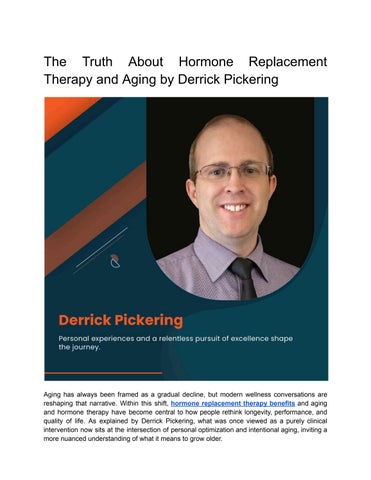
Aging has always been framed as a gradual decline, but modern wellness conversations are reshaping that narrative. Within this shift, hormone replacement therapy benefits and aging and hormone therapy have become central to how people rethink longevity, performance, and quality of life As explained by Derrick Pickering, what was once viewed as a purely clinical intervention now sits at the intersection of personal optimization and intentional aging, inviting a more nuanced understanding of what it means to grow older

Hormone Replacement Therapy (HRT) is often associated with menopause, yet its scope extends far beyond symptom relief At its core, HRT aims to restore hormonal balance as the body’s natural production declines. This recalibration can influence energy levels, mood stability, cognitive clarity, and even sleep patterns For many individuals, these changes do not feel superficial they shape how one shows up in both personal and professional environments. When the body operates with greater internal consistency, decision-making sharpens, creativity improves, and daily life feels more manageable

However, the conversation is not without complexity. The truth about HRT lies in its dual nature. While it can offer meaningful improvements, it is not a universal solution Individual biology, timing, and medical history all play critical roles in determining outcomes. For some, starting therapy earlier in the aging process may lead to better results, while others may face increased risks depending on underlying health conditions This variability makes personalization essential rather than optional.

There is also a broader cultural layer shaping perceptions of HRT Aging itself is no longer viewed solely through a medical lens. It has become a design challenge how to maintain vitality, relevance, and engagement over time In this context, HRT becomes one tool among many, not a standalone answer Nutrition, movement, stress management, and mental health all contribute to the larger system of well-being. Ignoring these factors while relying solely on therapy often leads to incomplete results

What stands out most is the shift from fear-based decision-making to informed choice. People are asking better questions, seeking tailored solutions, and rejecting one-size-fits-all narratives The discussion around hormone replacement therapy benefits and aging and hormone therapy now reflects a deeper awareness: aging is not something to resist blindly, but something to navigate with intention, data, and clarity

Turn static files into dynamic content formats.

Create a flipbook