
High Runner’s High: Marijuana and running in joint use across North Ashland

By Peter Jurich Asst. Sports Editor
Running and cannabis use have several similarities. They both challenge a person’s lung capacity, they both generally result in an increased appetite, and they can both be enjoyed indoors or outside.
Despite the overlap, the idea to participate in both simultaneously as a community is a relatively new concept. Chicago natives Anakaren Ramirez and Carlos Ramos, the founders of Runners High Run Club, became true trailblazers in both the running and cannabis communities when they created the nation’s first cannabis centric run club in June 2022.
Through a shared community, the group is attempting to “get lit, get fit and break the stigma that cannabis makes people lazy and unproductive,” according to Ramos.
“The whole lazy stoner trope is outdated,” Ramos said. “It’s incorrect, it’s not representative of who real cannabis consumers are.
“They’re family people, business people, professionals, community leaders. We have people from tons of broad spectrums of life and age groups and ethnic backgrounds, but we all share the common passion of a healthy and active life-
style in tandem with our cannabis consumption.”
The concept of a cannabis-friendly running club came to Ramirez and Ramos after they bonded over their shared passions for both marijuana and running.
“It all started with me and Carlos getting to know each other through the cannabis industry,” Ramirez said. “We had this conversation of how cool it would be to start a 420 centric run club. Carlos likes to consider it a ‘high-dea.’”
See RUNNER’S HIGH, page 16
Cannabis Over Time: What’s fact, what’s fiction?
By Spark Prunty Contributing Writer
Depending on the person, the perception of marijuana varies. Some think it does little to no harm, while others worry about the plant’s impact. But what is the real truth about cannabis and its long-term effects?
Mark Vega, a clinical assistant instructor in DePaul’s School of Nursing, specializes in psychiatric mental health nursing. He explains that there are many side effects to using cannabis products excessively or frequently.
Some of these topics are debated, but Vega said prolonged and frequent use of cannabis can impact the brain and cause conditions such as amotivational syndrome, which affects cognition and memory. Weed, if smoked frequently, can also damage the lungs.
Many believe there is no risk of dependency, but addiction symptoms are not immediate like other drugs, according to Vega, who stresses that dependency is often emotion-based.
“They hold it near and dear to them, and they’re not ready for change,” Vega said.
The American Psychological Association reports THC levels are much higher than they used to be. Dispensaries market and sell highly concentrated products, including vapes, waxes and edibles. However, Vega thinks that the blame for dependency from higher concentrations shouldn’t be put on the dispensaries.
See FACT OR FICTION, page 3
By Cristian Núñez colaborador
Dentro de SWAY, un dispensario de cannabis en Northalsted, los clientes no solo buscan productos. Están formando conexiones y construyendo comunidades que ayudan a crear un sentido de pertenencia dentro de la cultura del cannabis y más allá.
“Nuestro objetivo es ser tu dispen-
sario amigable del vecindario, donde la gente sonríe y saluda”, dijo Kevin Hauswirth, socio de la marca SWAY. “Nos esforzamos por crear ese tipo de comunidad y espacio acogedor tanto como podamos cada día”.
Ver DISPENSARIO LGBTQ+ en la pagina 10
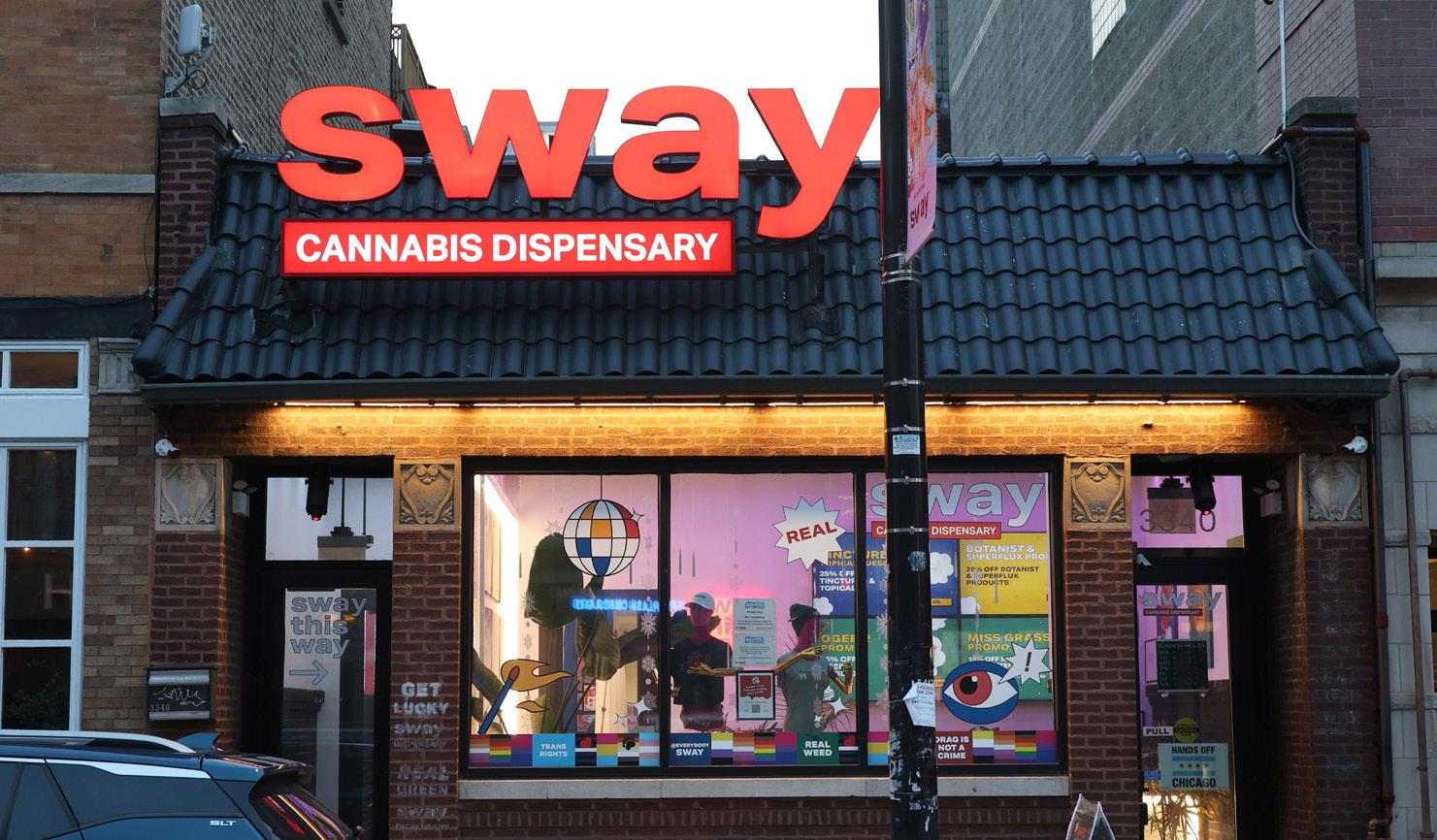
La fachada del dispensario SWAY, ubicado en 3340 N. Halsted, el 15 de abril de 2026. El dispensario abrió en 2024 después de la aprobación de la Ley de Regulación y Fiscalización del Cannabis.
CRISTIAN NÚÑEZ/ THE DEPAULIA
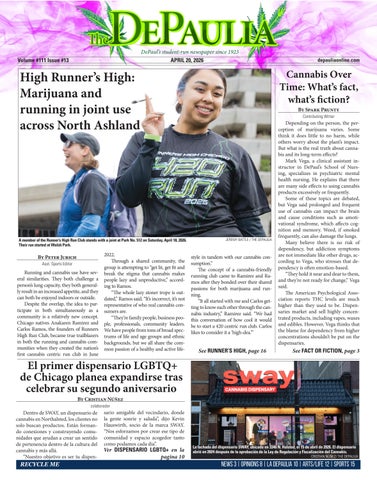
A member of the Runner’s High Run Club stands with a joint at Park No. 512 on Saturday, April 18, 2026. Their run started at Walsh Park.
JEREMY BATTLE / THE DEPAULIA

CAMPUS CRIME REPORT

April 5 - April 18,
The DePaulia is the official student-run newspaper of DePaul University and may not necessarily reflect the views of college administrators, faculty or staff.
EDITOR-IN-CHIEF LILI JARVENPA LJARVE@DEPAULIAONLINE.COM
DIGITAL MANAGING | SABRINA CASTLE SCASTL@DEPAULIAONLINE.COM
CONTENT MANAGING | BRIELLE KOHLBECK BKOHLB@DEPAULIAONLINE.COM
DIRECTOR OF PHOTO & MULTIMEDIA | JEREMY BATTLE JBATTL@DEPAULIAONLINE.COM
NEWS EDITOR | SADIE SPRINGER SSPRIN@DEPAULIAONLINE.COM
ASST. NEWS EDITOR | KHADIJA MUJAHID KMUJAH@DEPAULIAONLINE.COM
OPINIONS EDITOR ANNA BARTH ABARTH@DEPAULIAONLINE.COM
ARTS & LIFE EDITOR | ANNIE KOZIEL AKOZIE@DEPAULIAONLINE.COM
ASST. ARTS & LIFE EDITOR | LINDSAY FREIBERGER LFREIB@DEPAULIAONLINE.COM
SPORTS EDITOR | PEYTON HOPP PHOPP@DEPAULIAONLINE.COM
ASST. SPORTS EDITOR PETER JURICH PJUIRIC@DEPAULIAONLINE.COM
ILLUSTRATION EDITOR | PRECIOSA RIOS PRIOS@DEPAULIAONLINE.COM
ASST. ILLUSTRATION EDITOR MARA LOGAN MLOGAN@DEPAULIAONLINE.COM
DESIGN EDITOR | GENESIS COFFEY GCOFFE @DEPAULIAONLINE.COM
ASST. DESIGN EDITOR | JAVEN OSWALD JOSWAL@DEPAULIAONLINE.COM
PHOTO EDITOR | GIACOMO CAIN GCAIN@DEPAULIAONLINE.COM
ASST. PHOTO EDITOR ZOEY DUCHENE ZDUCHE@DEPAULIAONLINE.COM
MULTIMEDIA EDITOR GRACE LOGAN GLOGAN@DEPAULIAONLINE.COM
ASST. MULTIMEDIA EDITOR | KEIRAN STOVER KSTOVE@DEPAULIAONLINE.COM
COPY & NEWSLETTER EDITOR AMBER CORKEY ACORKE@DEPAULIAONLINE.COM
ASST. COPY EDITOR ISABELLA RUSSOMANNO IRUSSO@DEPAULIAONLINE.COM
SOCIAL MEDIA EDITOR | RILEY MOULTON RMOULT@DEPAULIAONLINE.COM
COMMUNITY ENGAGEMENT COORDINATOR | LAINE WYATT LWYATT@DEPAULIAONLINE.COM
EDITORIAL BUSINESS MANAGER | AIKO TAI ATAI@DEPAULIAONLINE.COM
AD SALES BUSINESS MANAGER | SAGE SLESSOR SSLESS@DEPAULIAONLINE.COM
FACULTY ADVISER | MARTHA IRVINE MIRVINE5@DEPAUL.EDU

La DePaulia es el noticiero oficial estudiantil en español de la Universidad DePaul, enfocado en proveer una voz para la comunidad latinx. Nuestras opiniones no necesariamente reflejan las opiniones de la administración, facultad o personal de la universidad.
EDITORA EN JEFE | SOFIA JOSEPH SJOSEP@DEPAULIAONLINE.COM
EDITORA DE CONTENIDO IZZY SIEMASZKO ISIEMA@DEPAULIAONLINE.COM
EDITORA DE NOTICIAS | TORI TREVIÑO TTREVI@DEPAULIAONLINE.COM
EDITOR DE REDES SOCIALES CRIS SALAS CSALAS@DEPAULIAONLINE.COM
MENTOR DE LA DEPAULIA | ARTURO FERNÁNDEZ AFERNÁ@DEPAULIAONLINE.COM
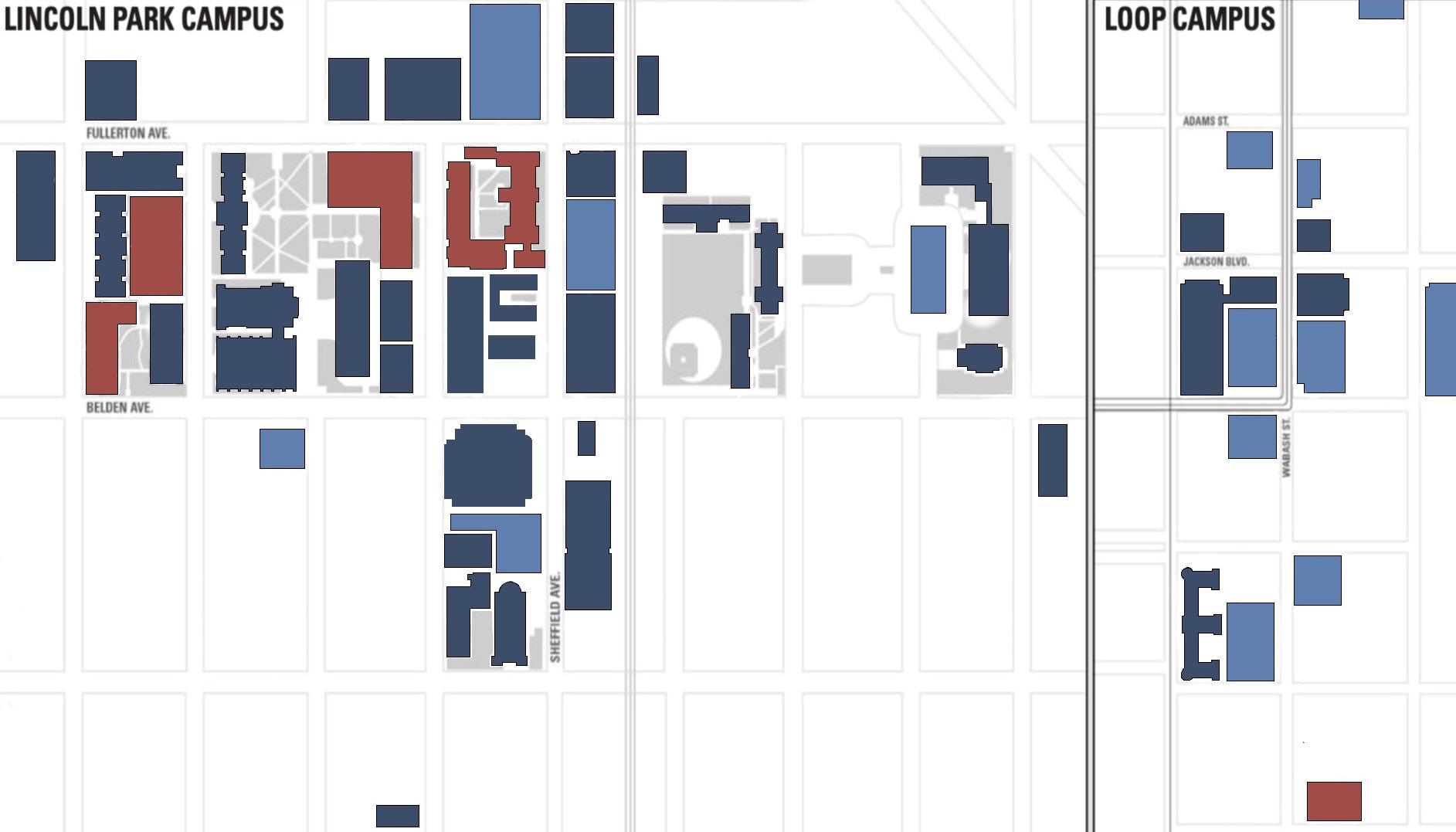
LINCOLN PARK CAMPUS
Drug & Alcohol Assault & Theft Other
Lincoln Park Campus Crimes: April. 9
A Disturbance report was filed for an incident on the 2nd floor in Student Center.
April. 9
A Battery, Illegal Consumption of Alcohol by a Minor and Controlled Substance Act report was filed for an incident in Ozanam Hall. A Chicago Police report was filed, and the subject was transported to the hospital.
April. 9
A Harassment and Threat by electronic means report was filed for an incident in McCabe Hall.
April. 10
A Criminal Trespass and Damage to Property report
was filed for an incident in Munroe Hall. A Chicago Police report was filed, and the subject was transported to the hospital.
April. 11
A Criminal Trespass Report was filed for an incident in the Holtschneider Performance Center.
April. 11
A Disturbance and Disorderly Conduct report was filed for an incident in the Holtschneider Performance Center.
April. 12
A Battery and Fondling report was filed regarding an individual inappropriately touching members of the campus community. A Chicago Police report was filed, and a Safety Alert was issued.
LOOP CAMPUS
April. 13
A Harassment report was filed for an incident that occurred on Sheffield and Fullerton near Centennial Hall. An unknown person requested to take inappropriate pictures of an individual for a project.
Loop Campus Crimes:
April. 10
A Graffiti report was filed for markings found on the Jackson side window of Lewis Center.
April. 13
A Theft report was filed for RAM modules taken from various computers in Lewis Center and DePaul Center.
Logo on Front by Mara Logan & Preciosa Rios

“Society has a problem using it responsibly,” Vega said of various weed products. “I think it’s up to the individual to be responsible with it.”
Many of these effects are related to how much a person uses. Vega says cannabis can help people medicinally to manage pain and sleep and stimulate appetite when used in moderation and with guidance.
However, Vega believes some overuse comes from people self-treating psychiatric issues where marijuana is not beneficial.
“Unfortunately, sometimes people think that it’s a cure-all for everything,” Vega said. “They may use it thinking, ‘Oh, I need it for my anxiety,’ but actually, depending on the strain, it can make your anxiety worse.”
DePaul sophomore Annie Price does not consume cannabis products recreationally or for medical reasons, as she fears certain effects that come with being high on cannabis.
“Hearing about people’s bad experiences with weed scared me a
Pot on Campus: A trip to the ‘smoker steps’
By Emma Howe Contributing Writer
Throughout the day, students gather on the steps outside the Schmitt Academic Center to have a smoke. While some only use cigarettes or nicotine vapes, others turn to cannabis for their daily smoke break instead.
Often referred to as the “smoker steps,” this location is a place of solace for students and the occasional professor. Although not every individual who frequents the steps participates in cannabis use, most are open to talking about it and don’t seem to mind its presence, even if federal law prohibits pot on any college campus.
“It’s not a big deal to me,” sophomore Rory Sullivan said as she sat on the steps. “At the end of the day, they’re going to do whatever they want.”
As a psychology major, Sullivan has her own reservations about the long-term effects of cannabis use, but having it on campus doesn’t bother her. However, not all students agree.
Steven Chang, a senior majoring in economics, said he finds the presence of weed “distracting.” He thinks cannabis can be disruptive for those who struggle with mental health, though he acknowledged that marijuana can have some medicinal
lot,” said Price, an animation major. “Just the unpredictability of it as a substance, or all substances in general, is kind of hard for me to grapple with.”
Price understands that not everyone chooses sobriety. She doesn’t think cannabis is a bad drug for people to use recreationally, but is sober because of the standards she’s set for herself.
“I feel like since I’ve abstained from using drugs or alcohol for so long, it’s a part of my identity,” she said.
Ana Ganddini, a junior at Loyola University, does consume cannabis products recreationally. She said she enjoys consuming marijuana because it makes her feel less anxious. She said she is also a strong advocate for the medicinal benefits it provides to others, including some of her family members.
Ganddini dislikes the stereotype that people who consume cannabis products are “dumb.”
“I don’t feel like I get dumber in any way,” she said of her cannabis use. “I’ve had a lot of deep conversations with people on it. It helps me open up more.”

She believes that people, especially those from older generations, also judge weed smokers more harshly than cigarette smokers.
“Why are you judging someone who takes a couple hits of a blunt when you smoke a pack a day?” Ganddini asked.
Regardless of what people believe or don’t believe about canna-
benefits. Chang suggested that a stricter approach to its presence could be taken, especially on the Lincoln Park campus.
“Being a legal state, there is not a whole lot the school can do. It would be nice, though,” said Chang.
DePaul must comply with the federal Drug-Free Schools and Communities Act of 1989, which prohibits both medicinal and recreational cannabis on school property. Even so, weed is still vastly present on campus.
According to a statement from University Communications, DePaul employs both Public Safety officers and contract security for support on campus, however,
neither group holds the authority to arrest any individual. “The university contacts CPD as necessary to address threats to the safety of our campus and community,” they said.
University Communications said reports of cannabis use on campus are referred to the Dean of Students, Housing and Residence Life, or the Office of Human Resources for further investigation of potential policy violations depending on the case.
“Smoking is not permitted anywhere on campus,” they added.
Bob Sriram, a senior political science major, emphasized that while DePaul is
bis, symptoms vary from person to person, and can easily have negative effects. However, Vega believes further research is needed to determine the extent of its medicinal purposes.
“I do think, if used responsibly, cannabis is safe,” Vega said. “When you use it too much, and it becomes a habit, then it becomes a problem.”
notable for being a Catholic institution, it is also known for its progressive foundation.
“It doesn’t matter on the policy. It matters on the culture,” Sriram said.
Sriram also shared a neutral stance on the presence of cannabis. However, while newer research has found that pot can worsen depression and other mental health struggles, he believes cannabis could help some students regulate their emotions in difficult times. Ultimately, he said, the decision is at the individual’s discretion, whether the impacts are good or harmful.
“Broadly speaking ... I don’t think it should be illegal,” Sriram said.
Many who frequent the smoker steps, including junior Julia Valderrama, said they don’t feel uncomfortable being around people who smoke pot. Valderrama hangs out at the steps to smoke cigarettes but sees others smoking weed.
“It doesn’t really affect me,” she said. “We live in peace.”
Valderrama, an English major, agrees that a specific place for individuals to smoke is a thoughtful approach. She says that the steps have become a “pseudo-designated area” with 20 to 30 people often there at one time. Students fill the air with smoke and chatter, conversing over their classes or personal lives.
Valderrama said the steps also provide a chance to meet new people. “It’s a community thing,” she said, adding that even nonsmokers are welcome.
“The steps are very much alive.”
LUCY BREWSTER / THE DEPAULIA
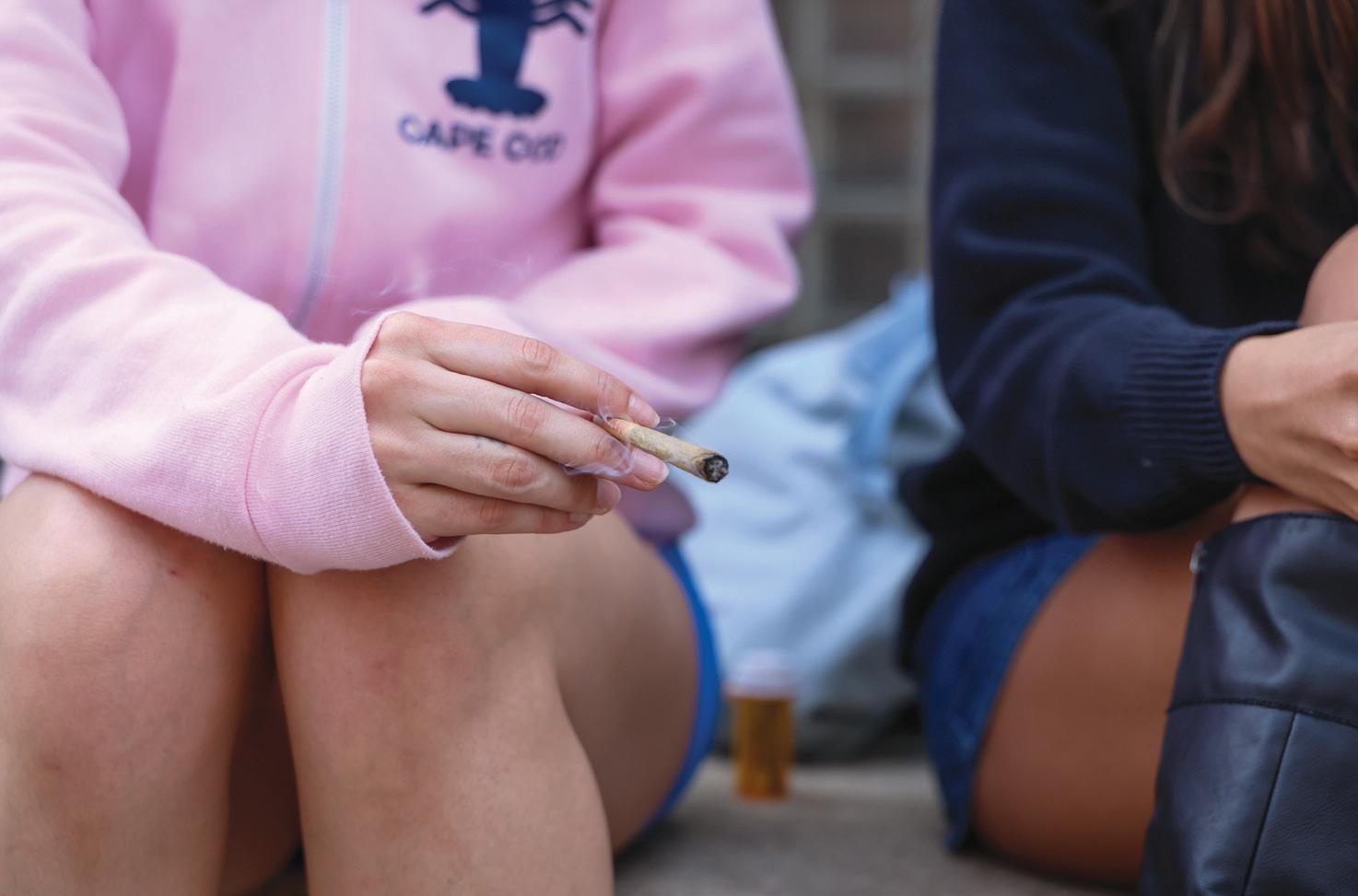
A DePaul student smokes a joint on campus outside of the SAC on April 17, 2026. The “smoker steps”are typically used for students to smoke cigarettes between classes.
ZOEY DUCHENE / THE DEPAULIA
DePaul’s cannabis studies minor draws students toward emerging industry
By Alexa Bermudez Contributing Writer
DePaul’s cannabis studies minor is attracting students from a wide range of majors, as interest in the evolving cannabis industry continues to grow.
The program, which launched in 2022, brings together courses from multiple colleges, including the school of business, communication and health sciences, to give students a broader understanding of cannabis from legal, social and scientific perspectives.
“The motivation for creating the minor had to do with the fact that cannabis became legal in the state of Illinois, and multiple colleges saw an opportunity to educate DePaul students,” said Jay Baglia, a professor in the College of Communication who teaches in the program.
As of April, 28 students have declared the minor, with nine already completing it, according to university data.
Interest in cannabis-related coursework has also increased significantly. Enrollment in these classes has grown
from 225 students in the 2019-20 academic year to more than 900 in 202526.
Students pursuing the minor come from a variety of academic backgrounds, reflecting the program’s interdisciplinary structure.
Laura Tejeda, a junior studying health sciences with a concentration in public health, said their interest in substance use research led them to minor in the program.
“With cannabis policy changing over the past several years, the minor aligned really well with my research interests,” Tejada said.
They said the program has helped open professional opportunities, particularly in research.
“A lot of my internship opportunities have come from my cannabis studies minor,” Tejeda said. “It’s been a good conversation starter and has opened doors.”
Quincy Delacretaz, a communication studies student who recently completed his coursework and is pursuing a cannabis studies minor, said he was drawn to the program after exploring different academic options.
“I was looking for a minor and nothing really sounded interesting, and then I saw DePaul had cannabis studies,” Delacretaz said. “It was something I was already interested in, and I was thinking about working in a dispensary.”
Delacretaz said he hopes to enter the cannabis industry after graduation, potentially working in a dispensary or in cultivation.
The program also addresses the historical and social context of cannabis.
“We talk about the history of racism tied to cannabis and drugs generally, including disparities in how people are charged, prosecuted and sentenced,” Baglia said.
Delacretaz said stigma surrounding cannabis still exists, “especially for Black and brown people who are using cannabis or trying to build careers in the industry.”
Tejeda added that while perceptions are shifting, long-standing attitudes remain.
“Stigma is not something that goes away overnight,” Tejeda said. “Even though cannabis has become more normalized, people still perceive it as a
drug of abuse.”
Faculty say the program is designed not only to prepare students for careers, but also to expand their understanding of the industry’s complexity. As the industry continues to evolve, new opportunities and challenges are emerging for students entering the field.
“The goal is to create knowledge about cannabis from political, legal, commercial and health perspectives,” Baglia said. “While cannabis is legal in Illinois, it is still federally illegal, which creates significant tension for businesses and entrepreneurs.”
Baglia said the industry is also expanding beyond traditional products.
“We’re seeing cannabis expand into different product streams, including non-THC products and even cannabis-infused beverages,” Baglia said.
Students and faculty said the program’s flexibility allows it to complement a wide range of career paths.
“If you’re interested in it and passionate about it, I’d say go for it,” Delacretaz said. “There are a lot of different areas you can pursue.”
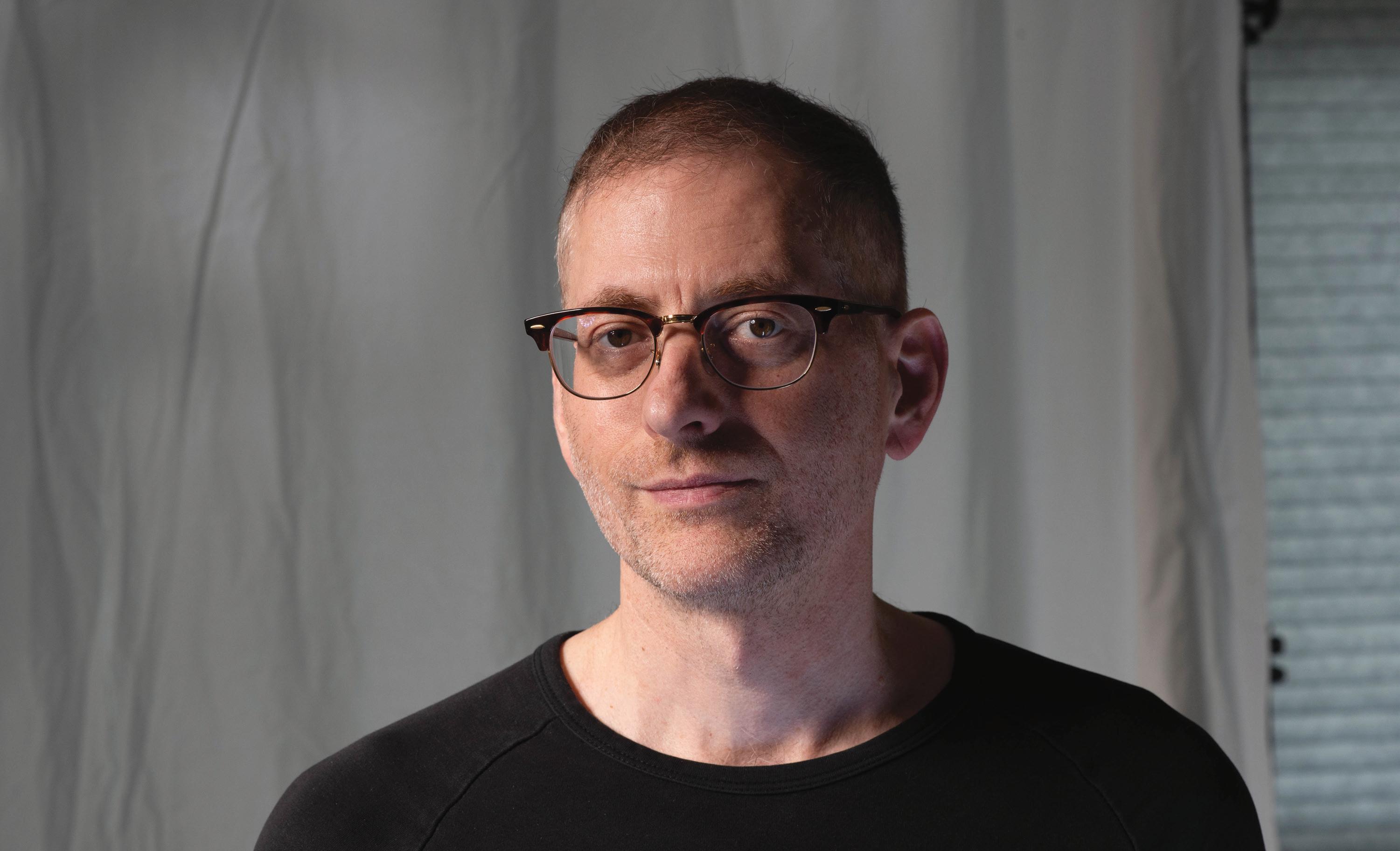
PROVIDED BY DONALD OPITZ
DePaul’s director of cannabis studies Donald Opitz stands for a photo on Saturday, March 7, 2026. Enrollment in cannabis courses has ballooned since 2020.
What to know about Chicago’s failed THC ordinance, and why Mayor Johnson vetoed it
By Sofia Mahmoud Contributing Writer
In February, Chicago Mayor Brandon Johnson vetoed a proposed ordinance that would have restricted where certain THC products could be sold in the city, rekindling the debate about how intoxicating hemp products should be regulated.
The ordinance, passed by City Council earlier this year, would have required businesses selling hemp-derived THC products to obtain a cannabis retail license. Approved marijuana dispensaries already have those licenses.
City officials proposed the restrictions over concern about the legality of selling and consuming intoxicating hemp-based products. Officials aimed to ensure safe packaging, responsible sales and protecting young people while keeping small businesses on the ground running.
This concern largely comes from the 2018 Agriculture Improvement Act, which legalized hemp and hemp-derived products as long as they don’t contain more than 0.3% THC. However, the legislation created a loophole allowing manufacturers to chemically process hemp into other intoxicating compounds, such as Delta-8 THC.
Because these products technically meet the federal hemp definition, they are often sold outside of the strict regulatory framework applied to cannabis dispensaries. They can be found in places like gas stations, smoke shops and corner stores.
Don Opitz, the director of DePaul’s cannabis studies program, explained that there is a regulatory grey area in manufacturing.
“These products are getting marketed in ways that make them look like candy or soft drinks,” Opitz said. “And there’s really no way to prevent sales to minors.”
Some Chicago alderpersons responded to those concerns by proposing the licensing requirement, and, in some cases, creating bans within individual wards. Supporters argued that limiting sales to licensed dispensaries would provide stronger oversight, age restrictions and product testing.
However, Johnson vetoed the ordinance, arguing that the outright restriction would not solve the underlying regulatory issues.
According to Opitz, the mayor and many city officials agree that intoxicating hemp products should not remain unregulated, but they disagree on whether banning them from most
stores is the best solution.
“What the mayor is proposing and what many lawmakers want is to create a regulatory framework,” Opitz said. “The concern is that a ban threatens small hemp-based businesses, many of which are minority owned.”
Johnson’s decision leaves the current system in place for now, meaning hemp-derived THC products can still be sold in a wide range of retail locations, but the debate is far from settled.
Some students at DePaul are also following the debate. Tyler Basham, a junior studying animation, said the conversation around cannabis regulation is complicated.
“The discussion around weed is actually incredibly difficult,” Basham said. “There are definitely aspects of the industry that need more restrictions and others that should be freed.”
Basham is also concerned about synthetic cannabis products that are created through chemical processes rather than grown naturally.
“Synthesized weed can be produced without oversight,” he said. “If it continues to exist, it needs much more regulation.”
Still, he believes legal cannabis markets can provide economic benefits for cities when properly managed.
Researchers point to scientific concerns surrounding synthetic THC products.
Eiron Cudaback, an associate professor in DePaul’s health sciences department and a faculty member in the cannabis studies program, said Delta-8 THC has far less scientific research behind it than traditional cannabis compounds.
“Delta-9 has many decades of research behind it in chemistry and pharmacology,” Cudaback said. “Delta-8 simply doesn’t have that history of scientific investigation.”
Cudaback added that studies examining Delta-8 products have found inconsistent concentrations and chemical byproducts that scientists do not fully understand.
He said Delta-8 is synthesized from CBD in a process that cyclizes its chemical structure by adding large amounts of acid followed by alkaline reagents, something that doesn’t happen in the plant.
“Therefore, along with Delta-8, you get a ton of byproducts of unknown structure, activity or toxicity,” Cudaback said.
After Johnson’s veto, Cityity Council failed to override the decision, which would have required additional votes that they were unable to secure.
Another likely outcome is that Chicago will develop a new regulatory framework for hemp-derived intoxicating products rather than banning them outright according to Opitz. Federal
action also may shape the city’s next steps, as new federal policies could further restrict synthetic THC products.
“Organic weed should be fully embraced, it would result in financial gain from new local businesses and for the city,” Basham said.
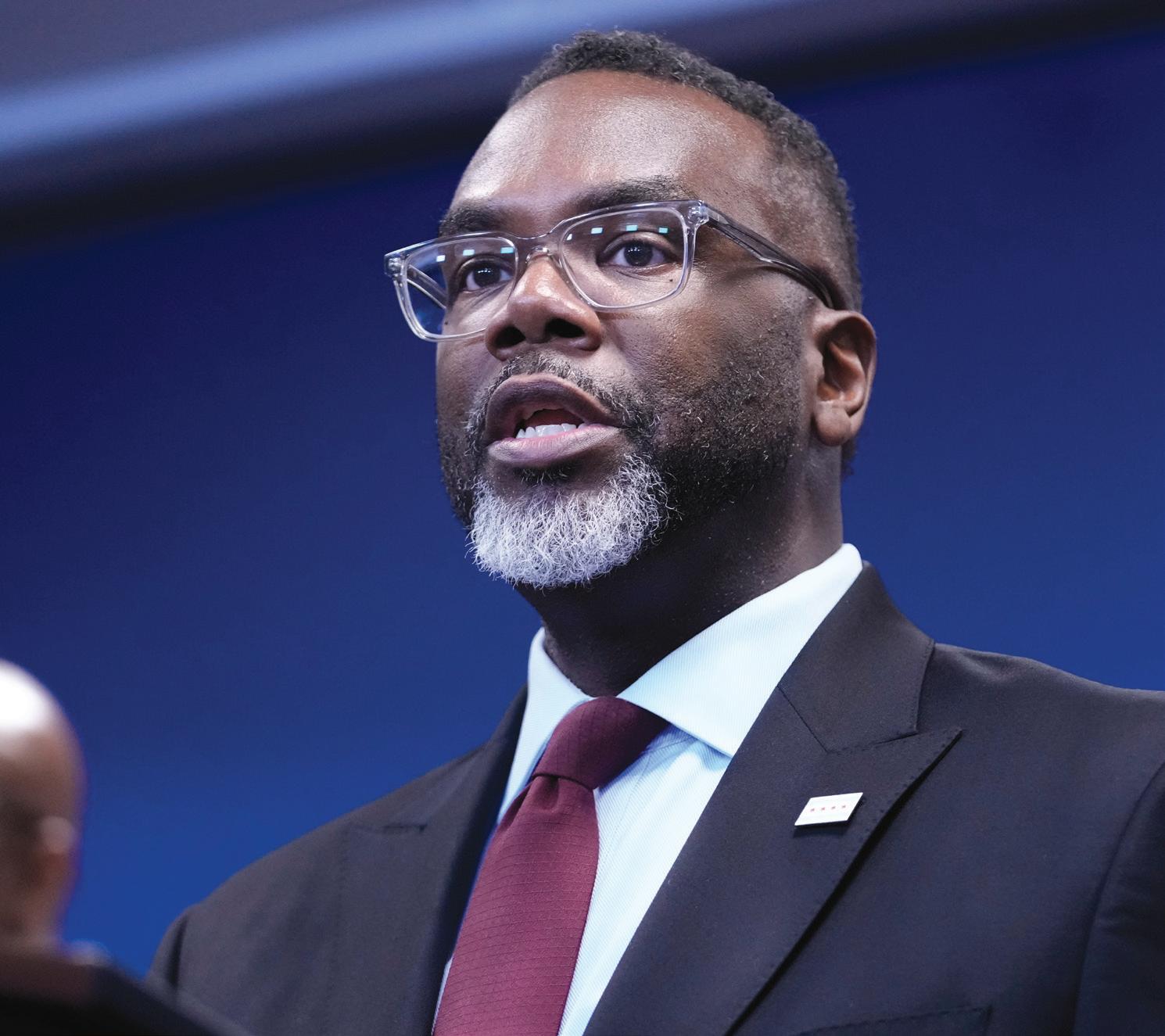
Chicago Mayor Brandon Johnson talks to media at a news conference in Chicago, Monday, Oct. 6, 2025.
NAM Y. HUH / AP

Many think cannabis is safer than other drugs, but it’s more complicated than that
By Ty Kickhaefer Contributing Writer
Studies show that many Americans believe marijuana is a healthier alternative to alcohol and tobacco. But DePaul experts say this perception is not backed by current scientific evidence.
The perspective that marijuana is safer than alcohol and tobacco is relatively new. In 2006, according to Pew Research, only 32% of Americans thought that marijuana should be legalized, compared with about 70% in their most recent 2025 survey. A past survey in 2025 also stated that one of participants’ primary reasons for legalization was the view that marijuana is safer than other drugs.
Don Opitz, an associate professor and director of DePaul’s cannabis studies, said that the public perception of marijuana is bad in a new way.
“There has been this cultural shift from seeing marijuana as this bad gateway drug and being associated with the undesirables of society,” Opitz said. “Now there is an embrace of marijuana as potentially beneficial.”
Cudaback, who has studied the impacts of cannabis, believes that a
change in the marketing of marijuana is partially responsible for the shift in perceptions.
“Now it’s fruity flavors, and it’s pot brownies, and it’s gummies, and it’s cool names …,” Cudaback said.
“You’re pushing a narrative that it is fun and safe. Even if you don’t purposefully do it, even if it’s not conscious.”
But both Cudaback and Opitz said marijuana is still a dangerous drug. It affects the body and mind in a different way than alcohol or tobacco, and the younger you are, the greater the impact on the brain.
“If you’re a 12-year-old and you go through a decade of chronic use, that changes who you are,” said Eiron Cudaback, an associate professor of neuroscience at DePaul.
Cudaback said the brain develops well into a person’s 20s and that chronic marijuana use over a long period of time can block social development.
“Essentially, some parts of your mind could be stuck at 12 years old,” Cudaback said.
But despite weed’s dangers, many like sophomore Eliran Masti, an acting major in The Theatre School,
feel that weed simply has a different impact on the body .
“I think weed is safer than alcohol and tobacco because those are both addictive,” Masti said. “Tobacco products are usually infused with nicotine, so you just have that layer of easy addiction.”
However, cannabis is classified as an addictive substance by the National Library of Medicine. According to the Cleveland Clinic, marijuana users may develop Cannabis Use Disorder, a mental health condition where a person’s repeated marijuna use causes distress and impairs aspects of their life such as fulfilling responsibilities at school, work or home.
Brianna Murray, a freshman PR and advertising major at DePaul, felt that, based on her own experience, many different influences can impact the safety of a given drug.
“It depends on the individual and their mental state, and it varies person to person and depends on your family’s health history,” Murray said. “If your family has a history of alcoholism then alcohol would be worse, or if you had contributing factors for weed then weed would be worse.”
Ultimately, there is no definitive
scientific answer on which of the three substances is safest. Each affects the human body in different ways. According to the American Psychological Association, tobacco is the most addictive of the three, and the CDC says it leaves users at higher risks of developing cancer. The CDC also states that alcohol is detrimental for liver health and leaves heavy users at risk of chronic diseases.
Cudaback believes that comparatively, weed has less of an impact on the body and a greater impact on the mind.
“There can be certain psychosocial deficits that can come about when you use cannabis,” he said. “There are certain developmental blocks, blockades and interruptions that happen that could lead to bad decision-making, poor outcomes and poor health outcomes.”
Cudaback said this means heavy weed users have a higher risk of slowing brain development and exacerbating mental health issues. Those who exhibit mental health disorders or are predisposed to developing them are at a higher risk of weed impacting their brain.
BECCA HEALY / THE DEPAULIA

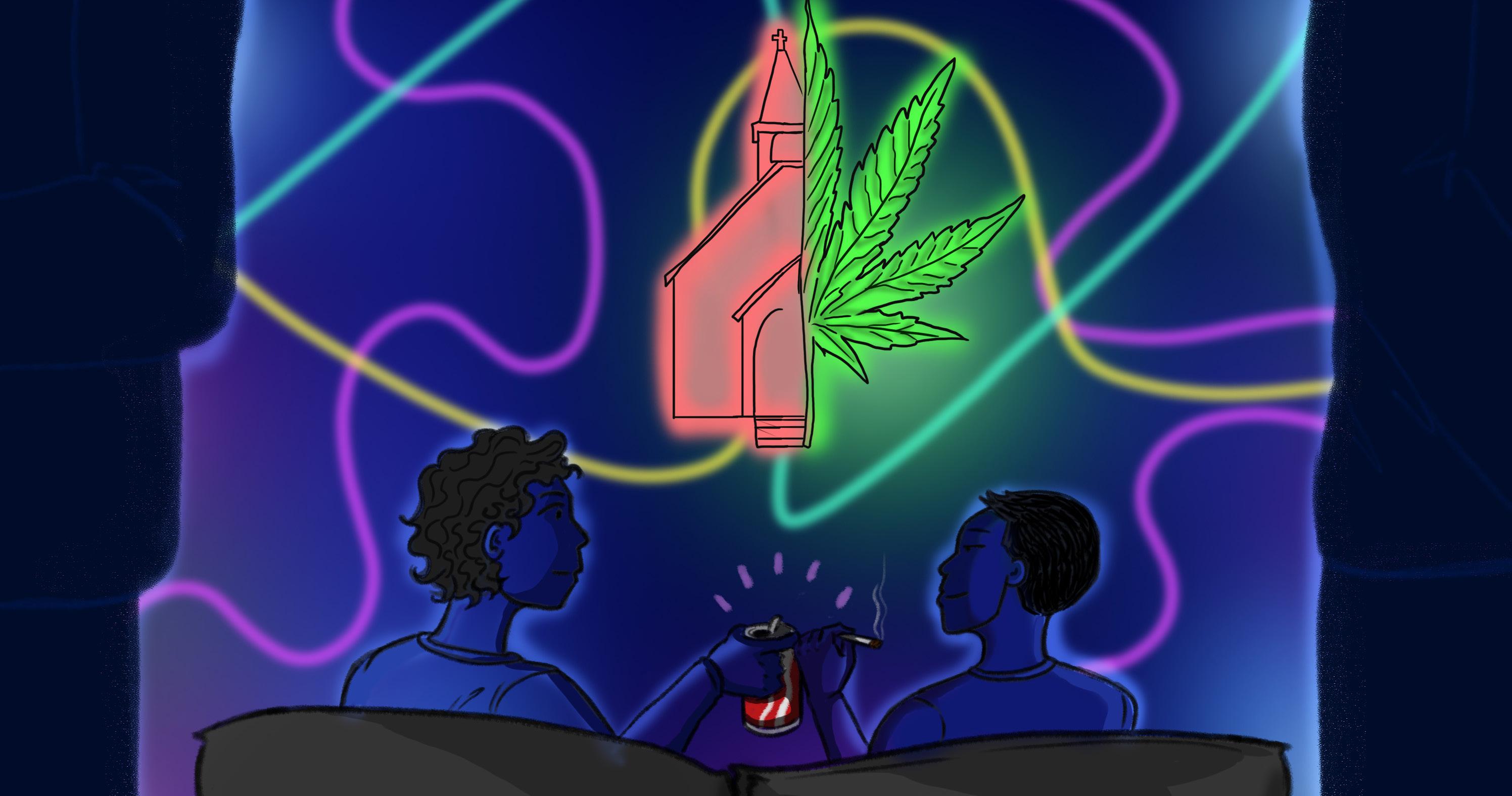
Cannabis restrictions suppress the college experience
By Abbott Lackey Contributing Writer
We’ve all smelled cannabis on campus before. Even though adults over 21 have been able to legally use it in Chicago since 2020, DePaul must follow the federal Drug-Free Schools and Campuses Communities Act, which prohibits medical and recreational cannabis anywhere on campus.
Medical users should be able to use cannabis on campus without fear. But where do recreational users fit into this? Some students say they have been able to use it recreationally on campus without backlash.
David, a film and television major whose last name is not included because he is underage, said he has never seen consequences for using cannabis on campus.
“I don’t think it’s enforced greatly because I have personally walked around our campus and have smoked and no one has batted an eye,” David said.
There seems to be a disconnect between how DePaul wants its students to handle cannabis and how it’s actually used. In theory, drugs
should have no place in a space where most of the student body is under age 21.
However, college is a crucial point in our lives where our beliefs about the world are being shaped through our experiences. We’re all figuring things out. Students will use drugs regardless of whether they’re on or off campus.
Don Opitz, an associate professor and director of DePaul’s cannabis studies program, said “students are doing what students do.”
use,” Opitz said. “Addiction to marijuana is a real thing.”
For that reason, DePaul’s health and wellness program has a dedicated page that provides information about cannabis, including a self-assessment quiz and what to do if you overuse or you have a dependency.
I do hope to see a day when medical marijuana will be OK to have on campus, as long as there’s certain guidelines to prevent misuse. Addiction to marijuana is a real thing.”
Don Opitz
Director of DePaul’s cannabis studies program
Opitz said he struggles with the idea of medical cannabis being prohibited in federal campus policy.
“I do hope to see a day when medical marijuana will be OK to have on campus, as long as there’s certain guidelines to prevent mis-
Jackson, a DePaul junior who asked to use his first name only because he fears hurting future employment opportunities, thinks current enforcement is appropriate.
“It’s probably not enforced to the extent that it could be, but I think that’s a good thing,” Jackson said.
Cannabis studies have gained traction since the substance was legalized in many states, spreading to universities across the U.S.
Opitz said his program is progressive compared to other curriculum at the university.
“DePaul being a Catholic institution, even though we’re a liberal Catholic institution, is fairly conservative when it comes to its academic curriculum. So, this is pushing the boundaries within DePaul,” he said of his program.
Paragraph 2291 of the Catechism of the Catholic Church describes the use of drugs as a “grave offense” except when used for therapeutic purposes.
By opening up academic conversation about cannabis use, DePaul is breaking new ground as a Catholic university and teaching Catholics that cannabis should not be villainized.
Experimenting with drugs is a part of coming-of-age for some college students, though not all. Curiosity is natural when thinking about cannabis.
I believe all students should have the chance to make mistakes and try new things. The best way to learn how to properly interact with substances, such as cannabis, is to use them in a controlled environment with knowl-
The opinions in this section do not necessarily reflect those of The DePaulia staff
edge and resources available. David’s own connection to the drug has been rocky, but he was able to limit his use once he realized there was a problem.
“During a quarter here, I realized that I was overusing cannabis and cut down and recognized that it wasn’t a good thing for me at that time,” David said. “I think even though it is sometimes overused on campus by students, it is necessary for them to grow.”
As long as students aren’t disturbing the peace and are being mindful of secondhand smoke, they should be able to use it on campus, particularly if they are medical users.
For students over the age of 21 who wish to participate in 420, Opitz has this advice for how to make the best of your experience.
“Don’t do it on campus. Be of age,” Opitz said. “I think it’s great to do it in the company of others. It makes a more fun experience. Listen to good music. Turn on Bob Marley.”
NOEMI ROMERO / THE DEPAULIA

Cannabis gets rebrand, but who is it really for?
By Taylor Peterson Contributing Writer
Cannabis didn’t just become legal. It became a brand. What was once stigmatized is now packaged into skincare, infused into drinks and marketed as part of a wellness routine.
That shift didn’t happen overnight, and it’s not just about legalization. It’s about narrative.
For years, cannabis was defined through stigma, especially during the War on Drugs that started in the 1970s. The movement’s messaging shaped how people understood both the substance and the people associated with it. As legalization expanded, that narrative began to shift, not just toward acceptance, but toward normalization.
Don Opitz, director and associate professor of the cannabis studies program at DePaul, sees this transformation as part of a broader change in how cannabis is understood.
“It’s not being marketed in a negative way, but in a more positive way,” said Opitz. “Not just as a drug, but it is a plant and it’s a feature of American culture.”
That shift toward a more “neutral and realistic perspective,” as
Opitz described it, reflects a move away from earlier messaging that he said was “driven by propaganda” tied to the War on Drugs.
But normalization hasn’t just made cannabis more accepted. It’s made it marketable.
As I scroll through social media or walk into a dispensary, the messaging is clear: This is wellness, and this is a lifestyle. Words like “natural,” “healing” and “calm” are everywhere.
For some students, myself included, the shift feels less educational and more like branding.
Fionnuala Quinn, a freshman political science major, said the marketing stands out immediately.
“It really makes me first think of how differently it’s being talked about, especially from a marketing perspective,” Quinn said. “Companies will pair the product with cannabis to give it this ‘all natural’ kind of feel.”
Wellness, as a concept, has become one of the most marketable identities right now, and cannabis fits into it easily — something that feels new, but is still safe enough to sell.
Quinn sees that as part of a larger pattern.
“I feel as though a lot of brands look for something new to sensationalize,” she said. “Once it’s at its peak popularity, then everyone else can catch on to the bandwagon.”
That’s where I see the tension start to show.
Cannabis has roots in counterculture, particularly among communities that were heavily policed and criminalized for using it. Now, those same associations are being repackaged and sold, often at a premium, to a completely different audience.
Opitz pointed out that while legalization has opened doors, it hasn’t done so equally.
“The industry is definitely structured in a way that is benefiting the privileged members of society,” he said, pointing to those with more resources and connections.
Meanwhile, he said, “members of communities that have been targeted by the War on Drugs are not benefiting at the same rate.”
This often includes communities of color.
Illinois has attempted to address that through equity-focused policies, like expunging past con-
viction and funding programs aimed at investing in affected communities.
DePaul’s own cannabis studies program reflects that focus, emphasizing “joining efforts to realize equity and justice in communities that have historically been disproportionately harmed by the effects of the federal criminalization of cannabis.”
There has been progress, but the gaps are still there. And those gaps aren’t just about who owns cannabis businesses. They also affect who can access them.
Legal cannabis is regulated and tested, which makes it safer. But it’s also expensive, which can limit access.
The idea of “wellness” starts to feel selective. I don’t think that’s accidental.
If wellness is tied to high-end products and curated branding, then it becomes less about health and more about identity — something you buy into rather than something universally accessible.
Quinn said she doesn’t see smaller producers benefiting from this shift.
“I don’t think it’s gonna be small cannabis farmers,” she said. “People are going to find a way to
make it cheaper, faster. It’s gonna be more mass produced.”
That raises a bigger question: what happens when something rooted in counterculture becomes part of the mainstream market? Cannabis isn’t the first thing to go through this cycle. I’ve seen it happen with trends, aesthetics and even identities that get picked up, repackaged and sold back to a wider audience. But cannabis carries a specific history, one tied to criminalization, race and inequality, that makes that transition more complicated.
Opitz described the current industry as still evolving, even calling parts of it a “Wild West,” where medical, recreational and lifestyle products are all competing for space.
Looking ahead, cannabis will likely continue to shift alongside culture. Whether it stays tied to wellness or moves into something else, its transformation already says a lot.
It’s not just cannabis being redefined. It’s what gets to count as healthy, acceptable and profitable.
And that raises a bigger question about who gets included in that vision and who gets left behind.
THC-infused drinks are displayed for sale at Foxtrot Café & Market in Lincoln Park on Thursday, April 16, 2026. A wide variety of THC- and CBD-infused drinks are available for sale at Foxtrot.
GIACOMO CAIN / THE DEPAULIA

DISPENSARIO LGBTQ+ continuado de la portada
Los dueños de SWAY planean expandir el negocio a South Shore, el barrio de la cofundadora y activista del cannabis Edie Moore, para finales de 2026. Así lo afirmó Hauswirth, quien también dijo que los dueños esperan continuar apoyando a comunidades que enfrentan castigos más severos por el uso de cannabis.
“Existe esta historia de comunidades negras y latinas siendo encarceladas de manera desproporcionada por el cannabis”, dijo Hauswirth. “SWAY está tratando de respetar las historias compartidas pero diferentes de estas comunidades y luego construir espacios físicos dentro de ellas, lo cual es muy, muy importante”.
La historia de SWAY se remonta a la década de 1980, cuando las redadas policiales en bares gay eran comunes.
En ese entonces, uno de los fundadores de SWAY, José “Pepe” Peña, era bartender en el área de Northalsted y fue llevado a la cárcel varias veces por “ser el encargado de un lugar de prostitución”, según un informe policial que cuelga en la pared del dispensario. Tras las redadas, la policía solía reunirse en el bar Town Hall Pub en Northalsted, donde ahora se encuen-
tra SWAY, justo enfrente del famoso bar Sidetrack.
Peña, un refugiado cubano, también es copropietario de Sidetrack junto a su esposo y activista gay Art Johnson.
Una foto del registro policial de Peña cuelga con orgullo en la pared de SWAY, y la tienda también vende camisetas con esa imagen.
Peña, Johnson y Moore decidieron abrir SWAY en abril de 2024 después de que se aprobara la Ley de Regulación y Fiscalización del Cannabis. Esta ley legalizó el consumo, la venta y la distribución de la marihuana en Illinois.
“Cuando se aprobó la ley, Edie y yo estábamos desayunando, celebrando, hablando de lo importante que era esto”, dijo Hauswirth. La idea de traer un dispensario a Northalsted de repente se volvió una realidad.
“¿Por qué no intentarlo? Deberíamos solicitar una licencia”, dijo.
Esta idea no estuvo exenta de dificultades. Abrir un dispensario de cannabis resultó ser costoso debido a las leyes federales que prohíben la posesión, el cultivo y la venta de marihuana. La mayoría de los bancos no querían trabajar con SWAY, dijo Hauswirth, lo que llevó a tasas
de préstamo altas cuando su equipo lograba obtener financiamiento, también conocido como un “impuesto verde”.
“Realmente estamos tratando de enfocarnos en la experiencia del cliente, el servicio al cliente, y trabajar con cultivadores más pequeños, cultivadores artesanales y de propiedad de minorías, que están en una situación similar a la nuestra, tratando de abrir y construir sus negocios”, dijo Hauswirth.
SWAY adopta un enfoque diferente para la participación comunitaria que no siempre involucra el cannabis. El negocio organiza rifas y eventos especiales de manualidades, lo que a menudo genera entusiasmo en el vecindario.
“Para Halloween, tallamos calaba zas y tuvimos un concurso de recorte de copos de nieve para los clien tes”, dijo Lauren Mi chalak, graduada de DePaul en 2012. A Michalak le gustó tanto el ambiente que ahora trabaja en SWAY como budtender.
“Creo que tiene una apre ciación diferente por su gente”, dijo Liz Hendricks, cliente habitual
de SWAY. “He tenido algunas de las mejores interacciones con los budtenders, quienes pueden hablar conmigo y crear una relación; realmente quieren lo mejor para ti”.
Michalak dijo que SWAY trabaja con los clientes para ofrecer una experiencia segura con el cannabis. “Si eres un usuario por primera vez, no te vamos a dar algo de potencia muy alta”, dijo. “Nos aseguraremos de que obtengas un producto adecuado para comenzar”.
SWAY quiere que personas de diferentes comunidades y contextos visiten la tienda, incluso si nunca han probado el cannabis.
“Ven con curiosidad, ven con preguntas, ven siendo tú mismo, tal como eres, y nos encantaría mostrarte el lu

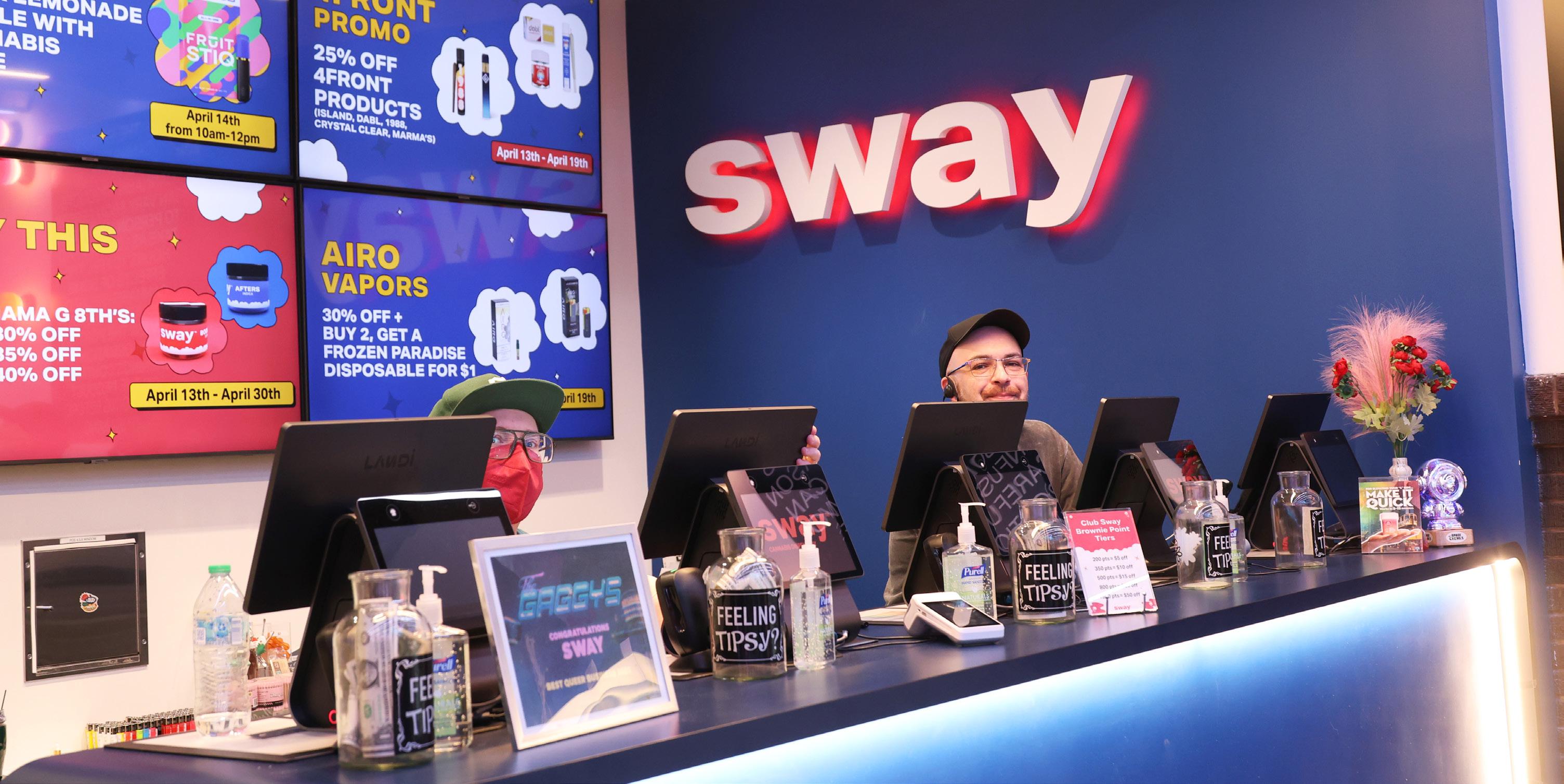
Los budtenders Sam Lenser y Dominic McEvers están de pie cerca de las cajas registradoras en la parte frontal del dispensario SWAY el 15 de abril de 2026. Los budtenders se esfuerzan por hacer que la tienda sea fácil de recorrer, incluso para quienes usan cannabis por primera vez.
CRISTIAN NÚÑEZ/ THE DEPAULIA
Más allá de la seguridad vial: Cómo un guardia de cruce en Chicago está creando conexiones comunitarias
By Kieran Stover editor asistente multimedia
El sol de la mañana se mantenía bajo sobre la tranquila intersección de North California y West Bryn Mawr. Un hombre barbudo con un chaleco reflectante amarillo sabía que la calma previa a la hora pico no duraría.
Joe Sass pasó en bicicleta frente a la escuela primaria Jamieson, en el lado norte de Chicago, y se bajó en la intersección, tomando su puesto en la esquina noroeste antes de que aumentara el tráfico.
Los guardias de cruce de Chicago como Sass desempeñan un papel esencial, y a menudo pasado por alto, en mantener seguros a los estudiantes y peatones, fortaleciendo relaciones comunitarias, en algunos vecindarios, ayudan a mantener a las familias informadas de las actividades de control migratorio.
Más de 700 guardias de cruce atienden a aproximadamente 330,000 estudiantes en uno de los distritos escolares más grandes del país, según Chicago Public Schools.
A medida que aumenta el tráfico vehicular, también lo hace el peatonal. Niños entre 4 y 14 años comienzan a llegar a la acera, algunos de la mano de sus padres, dirigiéndose hacia Jamieson. Sass los saluda con calidez.
“Hace fresco esta mañana”, dice en español, intentando comentar sobre el clima frío.
“¡No, hace frío!”, lo corrigen los estudiantes, sonriendo.
Cuando los niños llegan a la esquina, Sass extiende el brazo. Algunos le dan un ligero choque de nudillos. Otros toman impulso para dar un enérgico choque de puños.
“Si estás aquí por un par de años, es bonito porque puedes construir todas estas relaciones con la gente,” dijo Sass, quien ha trabajado como guardia de cruce de CPS desde 2021.
Antes, Sass dejaba su bicicleta en la acera durante su turno. Ahora, los vecinos lo conocen lo suficiente como para permitirle estacionarla en su jardín.
Cuando los peatones se acercan a la acera, Sass entra en acción, con que sean corredores matutinos o una familia de Jamieson. En cuanto aparece la señal de “caminar”, se coloca en medio de la intersección, levantando un gran letrero rojo de alto. Mientras detiene a los autos que giran, hace una seña indicado a las personas que crucen con seguridad.
Jamieson es una de las escuelas primarias más diversas de CPS. Según la Junta de Educación del Estado de Illinois, los grupos más grandes de estudiantes son hispanos y asiáticos.
“Es increíble conocer gente de todo el mundo a solo unas cuadras de mi casa,” dijo Sass.
Algunos guardias de cruce también ayudaron a aumentar la seguridad mediante redes comunitarias de respuesta rápida durante la Operación Midway Blitz, según el concejal Byron Sigcho-López (Distrito 25). Estaban atentos a los anuncios de estos grupos
para mantenerse informados y tomar precauciones para los estudiantes.
En algunos casos, los propios guardias informaban a las redes sobre la actividad del Servicio de Inmigración y Control de Aduanas (ICE). Aunque Sass no formaba parte de una red, siempre se mantenía atento a la presencia de agentes federales.
“Ver ese tipo de miedo en la cara de los estudiantes del no querer venir a la escuela porque tienen miedo, es desgarrador,” dijo Sass.
Sin embargo, ni la ciudad, ni el distrito escolar, ni los guardias coordinan estas redes de respuesta rápida. Se trataba de iniciativas comunitarias.
Cada vez que había actividad de ICE cerca durante las redadas migratorias del otoño pasado, la red de respuesta rápida informaba de inmediato a las escuelas cercanas, dijo Osvaldo DeSantiago, director residente de la Academia Comunitaria Orozco.
“Me impresionó mucho lo organizada que estaba la resistencia y la defensa contra ICE,” dijo DeSantiago.
Caroline Mendoza, madre de dos estudiantes de CPS en el lado oeste de Chicago, dijo que los recientes periodos de mayor control migratorio aumentaron su preocupación por la seguridad de sus hijos.
Que sus hijos caminaran por la zona después de la escuela “se sentía como una situación muy precaria,” dijo.
A pesar de su presencia constante, los guardias de cruce en la ciudad a menudo pasaban desapercibidos — hasta hace unos ocho años.
El 14 de febrero de 2018, el exalcalde Rahm Emanuel designó el periodo del 14 de febrero al 14 de marzo como el Mes de Apreciación de los
Guardias de Cruce. Desde entonces, CPS los reconoce anualmente nominando a guardias destacados para un premio por su servicio público.
El distrito otorga premios a cuatro nominados en la ceremonia anual de Guardián de Cruce del Año cada mayo. “Son miembros reconocibles y activos de cada comunidad en Chicago,” dijo la actual directora ejecutiva de CPS, Macquline King, en un comunicado de prensa.
Aunque Sass aún no ha ganado un premio, fue reconocido por CPS por ir más allá de sus funciones. Cuando una rotura de tubería inundó su intersección en enero, un helicóptero de WGN captó a Sass caminando por el agua mientras cargaba a estudiantes sobre su hombro para cruzarlos. CPS lo reconoció en la página web que anunciaba los premios de Guardián de Cruce del Año 2026.
DeSantiago coincidió en que los guardias de cruce son una parte esencial de la comunidad escolar local, pero señaló que podría haber mayor coordinación entre las escuelas y los guardias. Es el distrito, no las escuelas, es quien asigna a los guardias a las intersecciones de la ciudad.
“Me pregunto si una mejor conexión con los guardias de cruce ayudaría a que las familias se sintieran más tranquilas al caminar hacia la escuela,” dijo DeSantiago.
Sin embargo, en West Ridge, los choques de puños y las conversaciones ligeras de Sass ya están ayudando a que estudiantes y familias se sientan un poco más bienvenidos en su camino hacia la escuela primaria Jamieson.
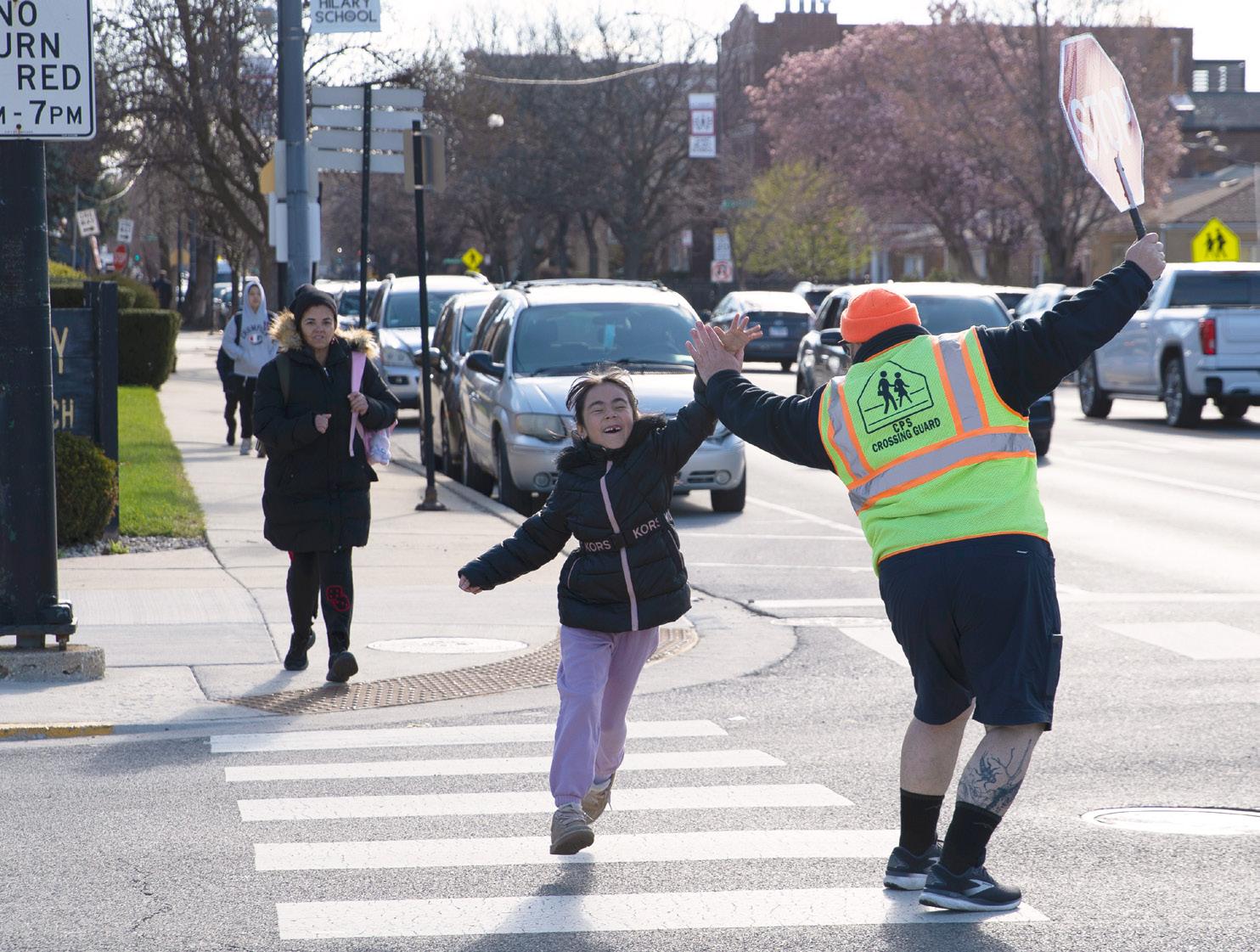
El guardia de cruce de Chicago Public Schools, Joe Sass, choca manos con un estudiante que camina hacia la escuela primaria Jamieson en Chicago, Illinois el 7 de abril de 2026. Fomentar relaciones comunitarias es solo una de las muchas funciones que desempeñan los guardias de cruce.
KIERAN STOVER / THE DEPAULIA
KIERAN STOVER / THE DEPAULIA
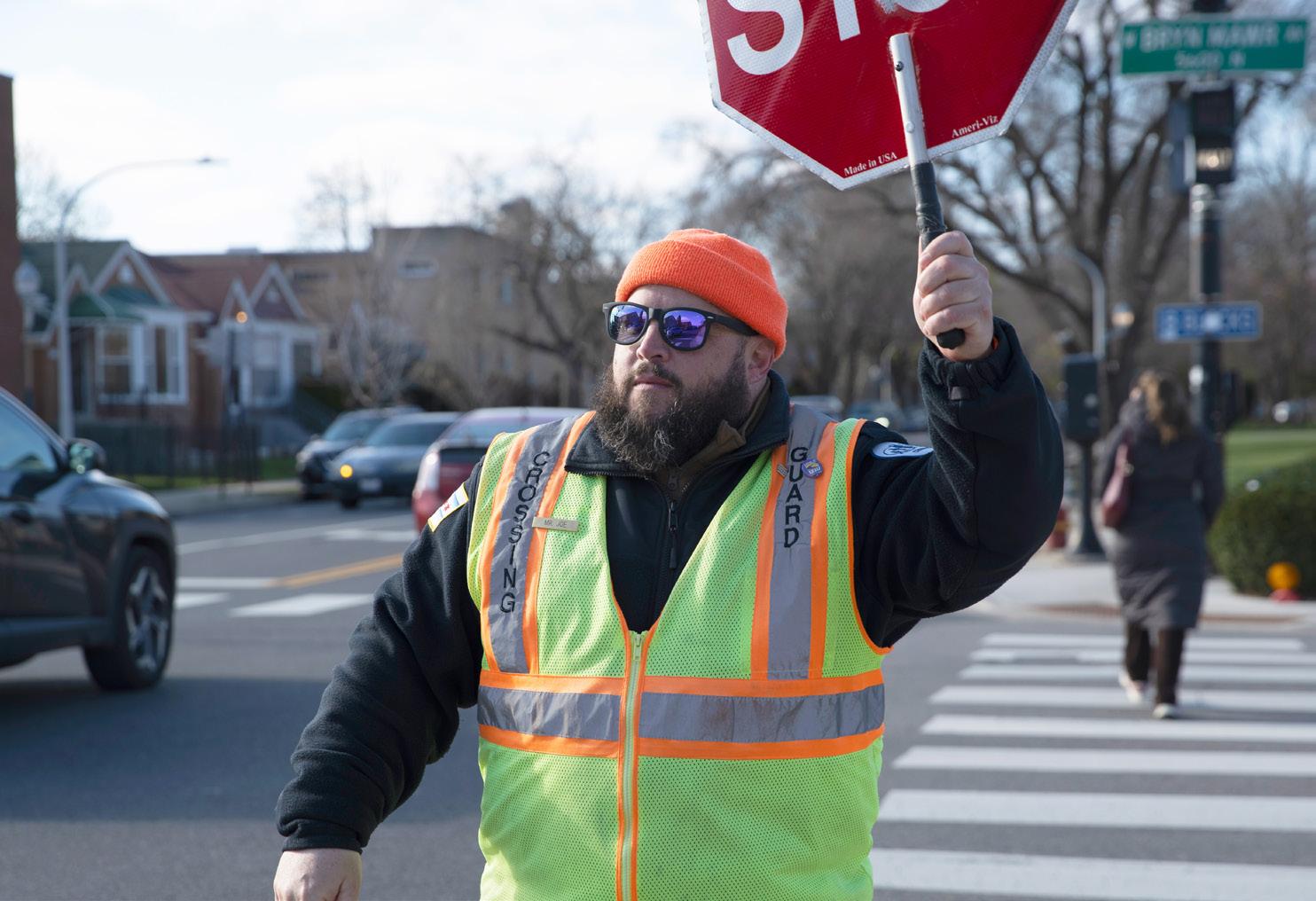
El guardia de cruce de Chicago Public Schools, Joe Sass, cruza el paso peatonal sosteniendo una gran señal de alto en Chicago, Illinois el 7 de abril de 2026. Según Sass, ayuda aproximadamente a 105 peatones a cruzar su intersección durante su turno matutino de 35 minutos.

By Ivy D. Davidson
Contributing Writer
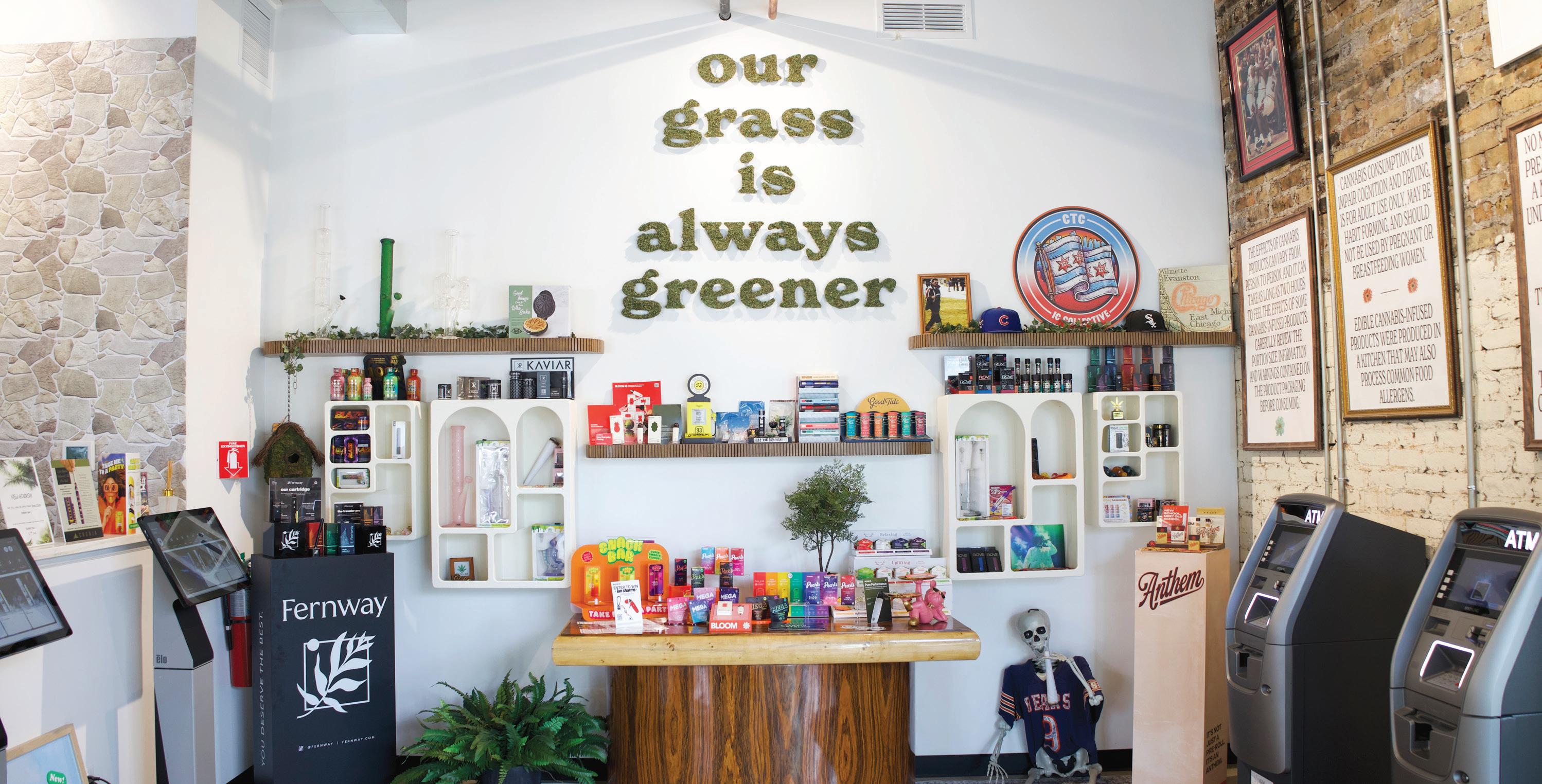
ÜMI Dispensary, a shop in Lincoln Park that opened last summer, is offering what co-owner Akemi Almeida says the industry has lacked: a safe space.
“To have ÜMI as a safe haven for people is our way of resisting the negativity of the world and channeling it into something healthy,” said Almeida, who graduated from DePaul in 2018. Inspired by the world’s current state, she added that she wants ÜMI “to remind people of the beauty of the world by gathering together.”
According to the dispensary’s website, “confidence, curiosity, and comfort” are at the forefront of the business approach, as they guide the community through their “cannabis journey.”
ÜMI’s goal of community building came partially from Almeida, who worked in various parts of the industry — from a CBD startup, living in the Colorado mountains at an organic research and development hemp farm, to an organic living soil grow in Michigan. Helping others has always been at the forefront of Almeida’s diverse experiences, which drove her to keep pursuing her practice. However, her goal was to open a dispensary of her own.
“It’s so cool to get to be a part of making people’s lives better,” Almeida said.
At DePaul, Almeida advocated with the local chapter of Students for Sensible Drug Policy to offer a way for people to use substances in a safe way, without shame for doing so. Almeida said this same goal followed her to her current role as business owner.
She says having the dispensary in Lincoln Park, at 2575 N. Lincoln Ave., “feels very full circle,” as DePaul was the place where she found her footing within the cannabis industry.
The cannabis industry in Illinois has seen its ups and downs. Cannabis sales revenue fell 13% in Illinois last year, and medical sales have declined since 2021. Many dispensaries have even gone out of business, and other cannabis business license
Reimagining the Cannabis Industry: The DePaul alum’s goal with ÜMI dispensary
holders have yet to open. According to state records, “Only 29 of 86 licensed craft growers are operational.”
However, Almeida says unlike many Chicagoland dispensaries, ÜMI has had steady growth.
Throughout Almeida’s journey in the industry, she saw independent companies being bought out by large corporations that “only care about the money.” It became important to her for ÜMI to carry “craft brands” based in Illinois that focus on quality.
Customer Kayla Conway, who recently discovered ÜMI, said she noticed the difference and quality.
Medical marijuana use is no stranger to Conway, who has been a medical patient since she was 19 years old. She had been going to another dispensary for years until she found ÜMI.
“The moment I came here, I felt like I was home,” Conway said.
Opening a business and navigating cannabis culture has not been easy for Almeida. Lucas Ewing, Almeida’s boyfriend who also works in the cannabis industry, noted that it can feel “like a boys’ club sometimes.”
But despite being a female business owner, Ewing says Almeida “hasn’t given up, and I don’t think anybody could make her.”
ÜMI sells a variety of products, including flower, edibles, vapes, topical cream, extracts and prerolls.
Almeida says there is a “better, easier and cheaper way to grow that is better for you and medical patients.” ÜMI is collaborating with an organic living soil grow in Springfield, Illinois, the first of its kind in the state. The grow is hoping to launch by the end of April, and Almeida hopes to “educate people on the organic way of cannabis.”
At ÜMI, Almeida has already met regulars at the store and is hoping it stays that way.
“I realized I have the life now that I’ve always wanted, working in the cannabis industry,” she said.
CLAIRE BUCHHEIT / THE DEPAULIA
Products are displayed inside ÜMI Dispensary in Lincoln Park Friday, April 17. Customers can order products in person on kiosks or order ahead online.
By Kahlia Williams Contributing Writer
As access to cannabis and its many forms expand, the traditional image of a “stoner” can feel outdated. What was once a stereotypical label has now become a fluid concept, defined more by individual perception than any universal standard.
“I still think there is a certain sense of negative stigma around it,” said Noah Schremser, a DePaul junior studying political science. “There could be people that are using it for legitimate reasons or recreationally, and most of the time they have their stuff together.”
Merriam-Webster dictionary defines a “stoner” as “a person who habitually uses drugs or alcohol.” Laziness, forgetfulness and a disordered image are also common stereotypes associated with the term, stemming from longstanding societal narratives and historical framing of cannabis users as a subculture tracing back to the 1920s to 1970s. Today’s limited definition and generalizations feel disconnected from reality in an era when cannabis is more accepted.
Rylie Jensen, a DePaul junior studying chemistry with a minor in cannabis studies, agrees that the term has taken on a new meaning.
Who qualifies as a ‘stoner’?

“Cannabis culture has absolutely reclaimed ‘stoner’ and now uses it to insert pride into their lives,” Jensen said. “Rather than being seen as lazy and slow, being a stoner now emphasizes creativity, introspection, curiosity and reflection.”
The way someone chooses to use cannabis also may influence their “stoner” status. From edibles and drinks to vapes and the traditional joint, there are many ways to consume marijuana.
That said, Jensen noted that there are potentially serious health risks associated with someone’s method of choice and frequency of use.
“My background in chemistry has allowed me to study the different ways people use cannabis, from edibles and wax to
traditional flower,” Jensen said. “We know for a fact that inhaling smoke carries risks for the lungs.”
Beyond that, THC taken in any form poses risks to the brain, especially for those in their teens and 20s, according to a study published in Neurology International.
Whether you have never tried cannabis, only get high with friends on occasion or make it a part of your daily routine, for some, the method of use seems to define the modern-day stoner. Schremser said smoking cannabis
is considered a stoner attribute.
“Perception definitely does matter,” he said. “If you’re smoking weed, that’s a stoner thing. If you take an edible, where it’s less noticeable and there’s no smell, you don’t get called out as much.”
For some, the casual use of cannabis has caused a divide between those who partake in it and those who do not.
Bau Lai Vang, a DePaul junior studying film and television, said the divide is noticeable.
While the frequency or method of use can define a stoner, Jensen said the classification can also come from the community it provides.
“While being a ‘stoner’ has become much more romanticized in modern-day America,” she said, “especially as cannabis has become legal in a few states, for many it remains a space for community that they haven’t been able to find elsewhere.”
“I personally do not do weed, but I have friends that do,” Vang said. “I have never felt forced into doing it, but there is a sense of separation between those who do and do not.”
The Lows of Getting High: Cannabis-induced anxiety
By Lindsay Freiberger Asst. Arts & Life Editor
As cannabis products are easily accessible in Illinois for recreational or medical use, there are a variety of reasons why people choose to get high. Some might use it to ease stress and anxiety, while others choose to stay away from it to avoid inducing these feelings.
But no matter their reason to get high, every individual’s experience is unique and can sometimes differ from the one they desired.
A DePaul student named Griffin who didn’t feel comfortable sharing his last name for employment reasons, gets high occasionally, smoking either through a joint or a vape cartridge. Although he uses cannabis to relieve stress and body soreness, he says he frequently feels anxious when high.
“It happens sometimes, I don’t exactly know why. It could be the
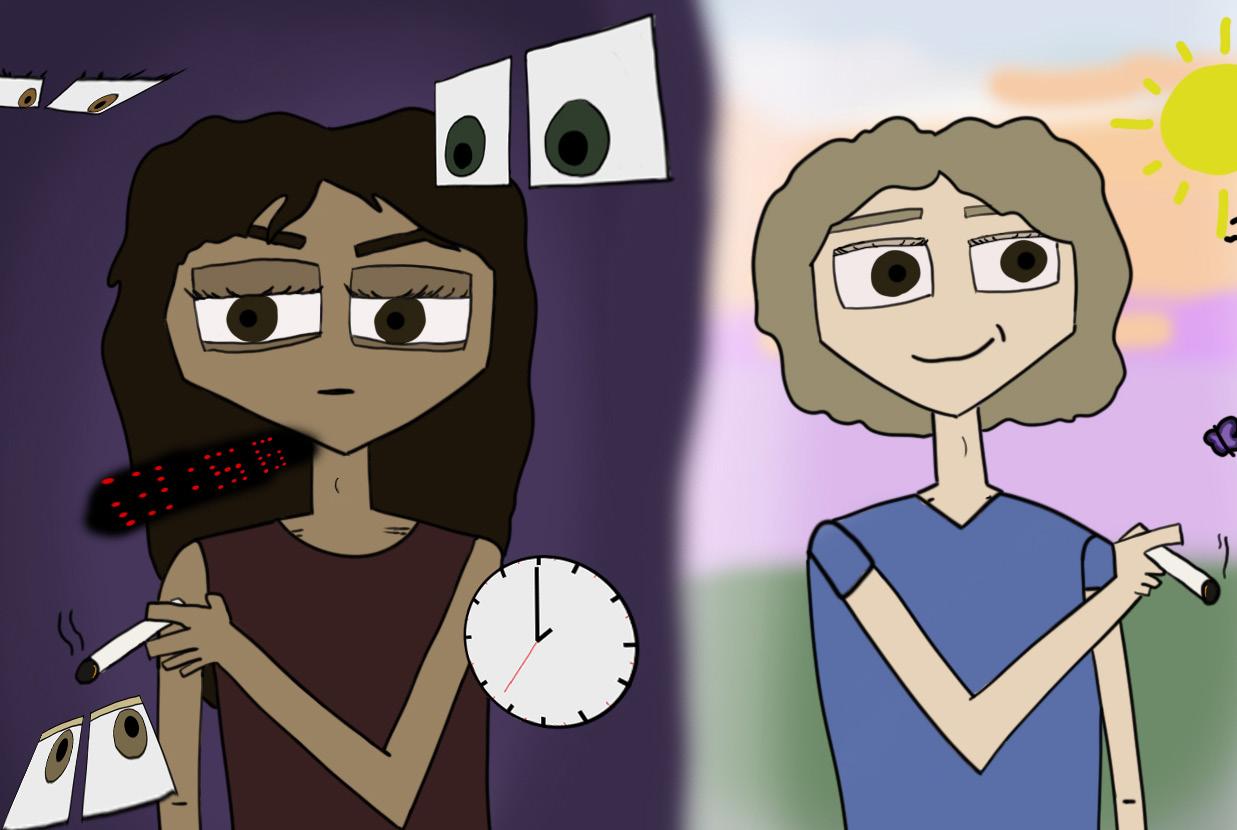
same scenario where I smoke and it’s fun, and the other day it kind of stresses me out about the work I could be doing,” he said.
To feel less anxious when he’s high, Griffin says he loves relaxing activities like “going on walks, getting out and moving or doing self care, showering, cleaning.”
A 2025 study conducted with over 460,000 adolescents aged 13 to 17 years who were universally screened for cannabis use by the Journal of the American Medical Association (JAMA) found an association between young adults using cannabis and increasing their
risk for anxiety, including psychotic, bipolar and depressive disorders by the age of 26. However, the study states that previous meta-analysis found no association between cannabis use and risk of anxiety.
Edward Bednarczyk, a clinical associate professor of pharmacy practice at the University of Buffalo, emphasizes the importance of “doing the homework” and researching before consuming cannabis for the first time.
“It’s not that dangerous of a substance but you need to be aware,” he said. “Anxiety is a real effect that people can get from cannabis.”
However, Bednarczyk said that if you’re aware that being anxious is a possibility, that’s a great start.
“The best thing to do is start at a low dosage and make sure you can tolerate the weed well and increase your dosage over time if you’re finding it favorable,” he said.
He also pointed out that any individuals who have a history or family history of psychotic disorders should not be using cannabis, saying “the risks outweigh the benefits.”
“The more you know about the risks and all the things that go along with it, the safer and better you’ll be,” he said.
The 2025 study found the strength of the association between adolescent cannabis use and depressive and anxiety disorders decreased with age, no longer significant among young adults aged 21 to 25 years. According to JAMA, “the finding is consistent with other research suggesting that adolescence may be a particularly vulnerable period for cannabis-related psychopathology and may partially explain inconsistent findings with anxiety outcomes.”
Read the full story online.
REILAN GALE / THE DEPAULIA
A DePaul student exhales smoke after taking a hit from a pen on Friday, April 17, 2026, at their apartment in Wrigleyville. The way someone chooses to use cannabis may influence their “stoner” status.
GIACOMO CAIN / THE DEPAULIA
St.Vincent’s
D e JAMZ




“Spinning freSh 1581”
By DePaulia Staff The 21+ Club
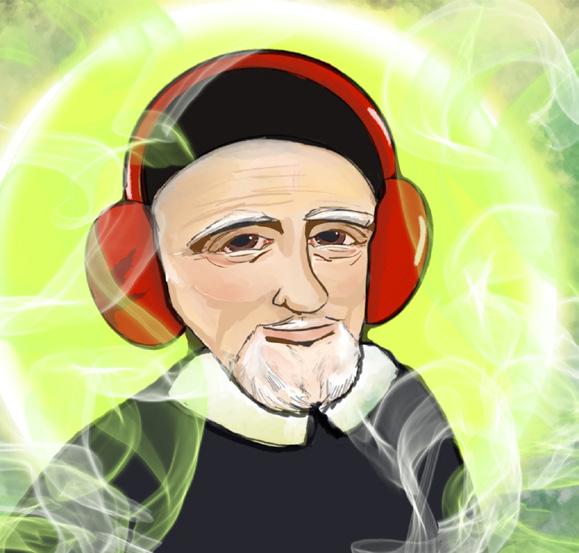
If you’re gardening some flowers this 420, there is nothing like good music to accompany your celebrations. In between snacking, napping or just sitting, enjoy this playlist, curated by DePaulia staff members over 21, during or after you “garden.” We have provided you the best songs to listen to while rolling through the day.
“HIPPIES” BY FLIPTURNLILI JARVENPA
This song sounds like going on a walk during a sunset and makes me want to cry. However, I do always have a banger queued up after this on my playlist.
“NORMAL GIRL” BY SZA - LAINE WYATT
Who wouldn’t want to listen to a SZA serenade while high?! I would! Wouldn’t you?
“HIGH AGAIN” BY HOODIE ALLENTORI TREVINO
Been listening to this song since I was 8, but now it has meaning. Shoutout Hoodie Allen and the white rapper epidemic of the early 2010s.
“PALM TREES” BY FLATBRUSH ZOMBIES - PETER JURICH
Most of Flatbush Zombies’ best songs and albums feature drug references in their titles, and this one is no exception. A pure banger regardless of your mental state.

“GUESS FT. BILLIE ELLISH” BY CHARLI XCX - SOFIA JOSEPH
Charli xcx and Billie Eilish are great performers and it really shows through this track. It’s perfect for a night out and feeling like you’re on top of the world.
“AMERICAN DREAM” BY LCD SOUNDSYSTEM - RILEY MOULTON
James Murphy shares his thoughts during a bad trip, backed by a psychedelic synth that I’m so obsessed with. If you tend to get super anxious while high, this is the song for you.


“CHERRIES & CREAM” BY REMI WOLF - SABRINA CASTLE
This song sounds like what it feels like to be the perfect amount of high: calming yet stimulating.
“SEXY VILLAIN” BY REMI WOLFLILI JARVENPA
“I can move to Pasadena just to be your serial killer.” I saw Remi Wolf when she opened for Kacey Musgraves in 2019, obsessed ever since. Also, this lyric is just … perfection.
LISTEN TO THE JAMZ ON SPOTIFY


ACROSS
2. “Indica, in the ...” (5)
4. Psychoactive cannabis compound (3)
7. 2008 film “Pineapple ---” (7)
9. Turn signal (7)
11. 3-Dimensional shape (4)
13. South-East asian fruit (5)
14. “If it weren’t for you meddling kids ...” (9)
15. Juke --- (5)
16. Artist who made “Bombastic” (1995) (6)
17. To the best of my understanding. Abbr. (5)
DOWN
1. Financially successful bakers make a lot of it (5)
3. To smoke indoors, or what an oven is (6)
5. Insect salesman Gregor in Kafka’s “The Metamorphosis” (5)
6. Organic plant aromatic (8)
8. Slang term, found on the left side of the piano (6)
10. The bitter half of a Chicago Handshake (6)
11. Color model used in printing (4)
12. Prolific shoegaze album and Greek meat skewer (8)
13. Sociopathic former television star and POTUS in “Smiling Friends”(6)
18. Potent residue (4)

Kick for the Spectrum: Futsal fundraiser for the Special Olympics
By Peyton Hopp Sports Editor
Imagine being able to participate in a futsal tournament on a roof looking out and seeing the Chicago skyline where all of the profits will be going towards a good cause: the Special Olympics.
DePaul sophomore special education major Ante Radocaj is making this vision possible with his first-ever fundraiser called “Kick for the Spectrum.” It is a one day tournament that will be happening at Skyline Pitch. Those interested in forming a team will pay a $300 registration fee and need six people on their team, with a 10 person maximum; people can also donate to the cause without participating in the event.
When Radocaj was younger, his family raised money for different organizations, inspiring him to give a kick at it as well.
He decided to support the Special Olympics after noticing special education was “underfunded.”
“So many people I know raised money for the Special Olympics, so I was like, ‘I think I’m pretty good with organizing events, so I might as well,’” Radocaj said.
Alongside that, last year he was assigned a random roommate, Elias Theo-
doropoulos, who has autism, ADHD and is obsessed with Taekwondo, having a second-degree black belt.
Theodoropoulos, a sophomore education major, said Radocaj has connected him with a lot of his current friends.
“I love them all and I love Ante,” Theodoropoulos said. “I’m grateful I met him.”
Sylvie Boughner, a junior and Radocaj’s friend, said she is passionate about causes like the Special Olympics and Autism Awareness Month, because they often get overlooked, especially by those that don’t know people with autism personally.
“I think that Ante, with his major and career path, since he is so knowledgeable about it, I think it’s so important to spread the knowledge that we do have,” Boughner said.While this tournament is just for Chicago students, Radocaj hopes to broaden it one day.
“I’ve had people from Cleveland and LA want to make teams,” Radocaj said. “I just wanted to keep it in Chicago this year, just keep it simple.”
He hopes to raise somewhere from $2,000 to $3,000. He has made merch and secured sponsors for the tournament to make sure he raises enough money.
Salvatore Primoli, a senior industrial design major, helped design graphics and

merch. Primoli said he was excited and happy to help Radocaj.
“It spreads awareness, it helps a common cause too,” Primoli said. “It’s also fun, so you kind of hit every positive nail on the head.”
Help from friends does not happen without effort and a “first step.”
“If you just take the first step, everything else is going to fall into place because at DePaul you’re going to have people who
want to help you,” Radocaj said.
“Everything I’ve done at this tournament, I’ve always had some kind of help. Even though I have to ask for it, you could do so much good in the world.”
Theodoropoulos hopes people who participate in this tournament will become more aware that “people with disabilities are worth fighting for.”
Kick for the Spectrum is set for May 2 at Skyline Pitch.
ZOEY DUCHENE / THE DEPAULIA
Elias Theodoropoulos (left) and Ante Radocaj (right) pose for a portrait at Skyline Pitch on Monday, April 13, 2026. Theodropoulos and Radocaj are friends.
Peyton’s Power Hour: The WNBA is “30, flirty and thriving”
Peyton Hopp Sports Editor
If you haven’t seen WNBA legend Sheryl Swoopes walking literal goats around New York City for the WNBA’s 30th anniversary, you’re missing out. Every time a new season starts back up, I get pumped from the excitement of the offseason.
This offseason was especially great because of the new collective bargaining agreement. Many WNBA players are finally getting the money they deserve. A’ja Wilson, for example, is staying with the Las Vegas Aces and signed a threeyear $5 million supermax deal. Napheesa Collier is staying with the Minnesota Lynx and signed a $1.4 million supermax deal.
While I’m still devastated Angel Reese is going to be with the Atlanta Dream, the Chicago Sky ended up grabbing players I never would’ve thought they would get. Seven-time All-Star Skylar Diggins and fashion icon Rickea Jackson. Courtney Vandersloot and Azurá Stevens are both re-signing. They were on the Sky’s championship team in 2021.
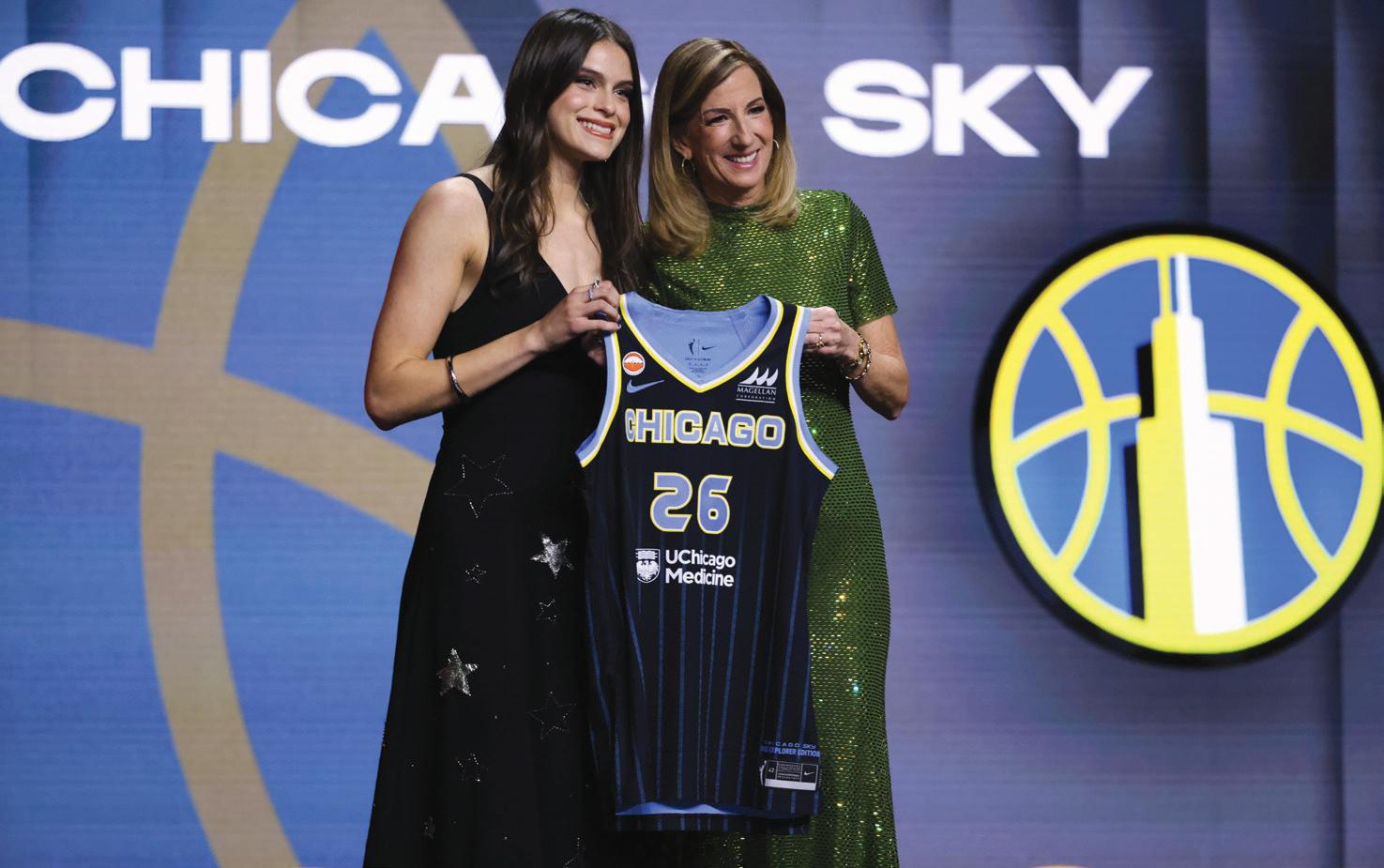
In the draft, the Sky had the fifth pick and they got UCLA guard Gabriela Jaquez. Her brother, Jaime Jaquez Jr., is on the Miami Heat and also played for UCLA.
She averaged 12.7 points during the
NCAA tournament and she scored 21 points in UCLA’s win against South Carolina in the championship game.
Many popular college players like Azzi Fudd and Flau’jae Johnson had flamboyant welcomes from their teams. Fudd was embraced by Dallas with a long pink carpet with mini tiaras on each seat at the press conference, in honor of her nickname, “The People’s Princess.” Johnson was greeted by her Seattle Storm teammates, standing by a huge sign that said “Welcome Flau’jae.”
It’s awesome to see players get the praise they deserve, especially rookies. The NCAA tournament ended on April 5, and players like Jacquez have to start practicing even though their college careers just ended two weeks ago. The transition from one league to the next is probably like whiplash for them.
I’m also inspired by many of these WNBA players. When I walk around downtown Chicago, I see advertisements of Reese with Victoria’s Secret — the first WNBA player to ever get a campaign
with them.
Indiana Fever guard Caitlin Clark was a special contributor on NBC’s debut of “Sunday Night Basketball.” She did pregame coverage for some NBA games, like when the New York Knicks visited the Oklahoma City Thunder on March 29.
Vandersloot is a mom, as many other WNBA players are, with her wife and DePaul basketball legend Allie Quigley. These WNBA players do more than just basketball. They have lives outside of the sport. Whether they stay low and out of the spotlight or absorb the stardom, it’s fun to see they can choose a life that isn’t solely dominated by basketball. Who knows if that would be possible without the icons who helped make the WNBA what it is today. Swoopes, Teresa Weatherspoon, Lisa Leslie, Becky Hammon, Candace Parker and hundreds more.
I feel like a proud mother seeing the league grow, even though I’ve only been alive for 23 years and only started watching 10 years ago.
It’s been a long but rewarding 30 years, and the WNBA will continue to grow into a successful, entertaining sport for the next 30 years and beyond. If you aren’t watching the WNBA by now, what are you doing with your life?
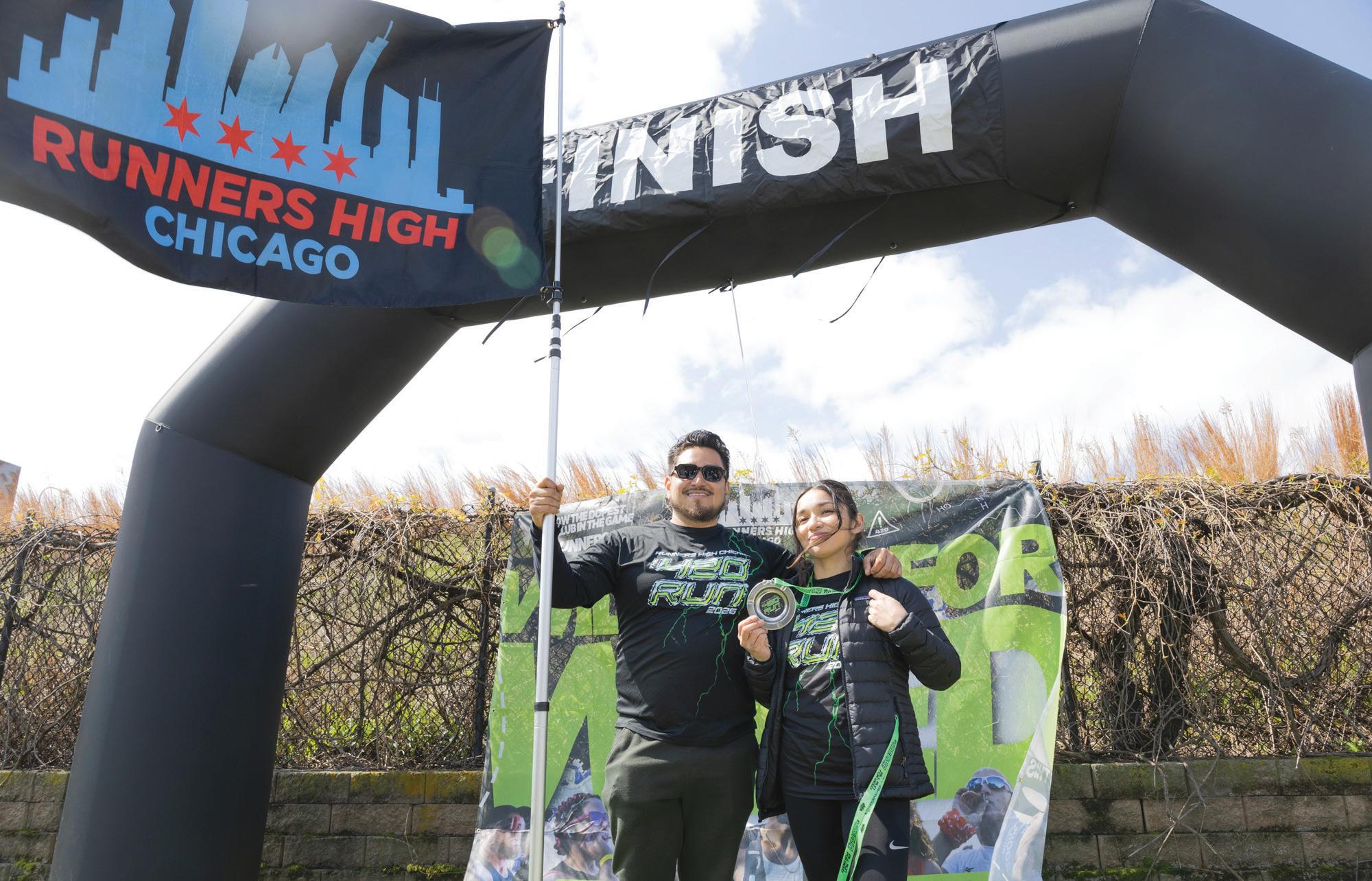
Four years later, the two have fostered a community built around regular outings, headlined by the annual 420 Run, an event that recently attracted over 200 participants from at least six states.
Unlike their weekly casual outings, the annual celebrations include specialized gear and the presence of local vendors within the cannabis industry who provide free samples after the run. This year’s event looked slightly different, however, as the participants met first at Walsh Park on North Ashland Avenue for their run before taking a chartered school bus to a nearby dispensary, where the festivities continued in a more festive setting.
Fittingly, the run itself follows a 4.20 mile course, although there is a two mile walk option available for those who prefer a lighter workout. Instead of a ready-set-go start, this year’s run had a rolling start time, where the athletes were able to gather and converse in the nearby grass and consume their cannabis however they saw fit before ripping through
the race.
Despite any athletes’ competitive inclinations, the purpose of the race is not to wax the competition and weed out the casual runners to crown a champion. In fact, there are no official times recorded, and while every racer is free to track their own progress on their personal fitness applications, each participant receives a medal at the event’s completion regardless of their results.
“It’s a fun way to come out, join the community and do some-
thing fun and also healthy during the holiday weekend,” said Corine Salgado, a first-time participant in the 420 Run.
Salgado has been a local budtender for the last two years, and while she is not an avid runner, she likes to use cannabis when doing so to get into a “more peaceful mindset.”
Like Salgado, marathon runner Flaco Navaja has worked out with the club several times, but competed in his first 420 Run this year.
“It’s a great group of people that are
coming together to break a stigma and to stay fit and to be in community,” Navaja said. “It’s important to find your allies. It’s important to find your communities, people that are like minded that agree with you and that can help also spread the word to a population that may be kind of ignorant to what we’re talking about.”
The emphasis on community is one that is shared through many of the group’s members, and as that community has continued to grow, so has its influence.
In recent years, out-of-town participants have returned to their home states to start similar cannabis centric running groups, including the Garden Runners Club in Pennsylvania, who had multiple members present in Chicago for the 420 Run.
It’s apparent that a once small group of casual smokers and runners is blossoming into something much bigger with a stronger purpose, but the original message has not faded.
These are not lazy stoners who waste away, but a budding group of passionate athletes who are loud and united in their endeavor to change the way that cannabis users are viewed in the world of athletics.
PAMELA SMITH / AP
UCLA guard Gabriela Jaquez poses with WNBA commissioner Cathy Engelbert after being selected fifth overall by the Chicago Sky in the first round of the WNBA basketball draft Monday, April 13, 2026, in New York.
RUNNER’S HIGH continued from front
Runner’s High Run Club founders Carlos Ramos and Anakaren Ramirez stand outside of Village Dispensary Bucktown on Saturday, April 18, 2026. The club was founded in June 2022.
JEREMY BATTLE / THE DEPAULIA