2 | Denver Urban Spectrum - www.denverurbanspectrum.com - October 2026
MESSAGE From The Publisher Volume 40
Number 7
October 2026
PUBLISHER Rosalind J. Harris COPY EDITOR Tanya Ishikawa COLUMNISTS Karen Davis Barry Overton Dr. Dedrick Sims CONTRIBUTING WRITERS Elena Brown T. Holt Russell GUEST CONTRIBUTORS Earl Ofari Hutchinson Joseph Williams SPECIAL PROJECTS ASSISTANT Tanya Ishikawa ART DIRECTOR Bee Harris BROADCAST COORDINATOR Karen Davis CONTRIBUTING PHOTOGRAPHER Amanda Bierman GRAPHIC DESIGNERS Jody Gilbert – Kolorgraphix Marion Boston Sekar Uthayasuriyan DISTRIBUTION Lawrence A. James
Denver Urban Spectrum is a monthly publication dedicated to spreading the news about people of color. Contents of Denver Urban Spectrum are copyright 2026 by Bizzy Bee Enterprise. No portion may be reproduced without written permission of the publisher. Denver Urban Spectrum circulates 7,500 copies throughout Colorado. Denver Urban Spectrum welcomes all letters, but reserves the right to edit for space, libelous material, grammar, and length. All letters must include name, address, and phone number. We will withhold author's name on request. Unsolicited articles are accepted without guarantee of publication or payment. Write to Denver Urban Spectrum at P.O. Box 31001, Aurora, CO 80041. For advertising, subscriptions, or other information, call 303-292-6446, email publisher@urbanspectrum or visit the Website at www. denverurbanspectrum.com.
Stories of Justice, Vision and Excellence
T
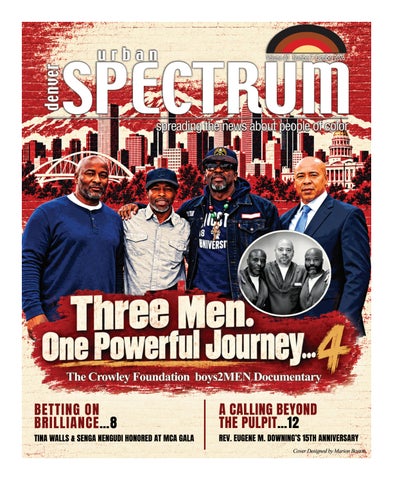
hree men. One gunshot. Thirty years behind bars. In this month’s cover story, Thomas Holt-Russell shares the journey of Brian Lee, William Lee and Eric Lightner—the “Denver Three”—whose convictions under Colorado law cost them most of their adult lives. A new Crowley Foundation documentary turns their story into a call for education, prevention and change. We also celebrate Tina Walls and pioneering artist Senga Nengudi, who will be honored at MCA Denver’s LUMINOCITY
gala. Elena Brown explores how Walls’ steadfast support helped create space for Nengudi’s groundbreaking work—and how artists and advocates strengthen our cultural community. We also look at the journey of Rev. Eugene M. Downing Jr. and his 15 years of leadership at New Hope Baptist Church and the celebrations planned in his honor. And we proudly share news of our own: Denver Urban Spectrum received
20 Colorado Press Association Better News Contest awards for 2025. These honors belong to every contributor across writing, design, advertising, marketing, digital and multimedia whose excellence keeps DUS shining. I am grateful—and tremendously proud.
Rosalind “Bee” Harris Publisher Denver Urban Spectrum
Denver Urban Spectrum
Colorado Press Association 2025 Better News Contest Awards FIRST PLACE AWARDS Best Agricultural Story: Elena Brown - Farming While Black - Freedom Acres Rance and Wild Boyd Farm Keep The Dream Alive Best Business News/Feature Story: Wayne Trujillo, Denver Urban Spectrum Ruby Jones - The Million Dollar Smile; Tending the Goal Best Cover Design: Rosalind Bee Harris, Marion Boston - Through His Eyes; Cynthia Erivo; Otis Williams; Wright & Hobson; Farrah Gray Best Data Journalism Reporting: Tanya Ishikawa - AI Queries and Cloud Computing Challenge Energy and Water Supplies Best Environmental Story: Tanya Ishikawa - AI Queries and Cloud Computing Challenge Energy and Water Supplies Best Event Promotion: Rosalind Bee Harris - Colorful Stories See Me Hear Me (Best Event Promotion) Best Headline Writing: Denver Urban Spectrum Editor - Reigning in Equity; Invisible Borders; Tending the Goal; Twenty Years Under Water; Farrah Gray Best New Media/House Ad Promotion: Rosalind Bee Harris, Cheryl Carter, Marion Boston - Colorful Stories; Expanding the Narrative; Connect & Collaborate; Brunch of Champions; Color of Change Best Newsletter: Marion Boston, Rosalind Bee Harris - Connecting People To People Newsletter
Best Sponsorship Campaign: Rosalind Bee Harris - Colorful Stories See Me Hear Me (Best Event Promotion) Best Sports or Sports Event Story: Khaleigh Reed, Elena Brown, Christen Aldridge, Ruby Jones, Wayne Trujillo - MLK Heritage Rodeo of Champions; Breaking Barriers on the Slopes; Reining in Inequality; Tending the Goal; Daring to Dream Excellence in Audio Digital Storytelling: Rosalind Bee Harris, Karen Davis, Marion Boston, Ashleigh Collins - Expanding the Narrative Podcast Network
2ND PLACE AWARDS Best Arts & Entertainment: Wayne Trujillo, Denver Urban Spectrum Ruby Jones, Denver Urban Spectrum LaTerrell Bradford - Otis Williams; Detour Takes Den; Cynthia Erivo; From the Eyes of a Child; Delroy Lindo Best News Story: Elena Brown, Denver Urban Spectrum Ruby Jones - Keeping King’s Dream Alive in Five Points; Lauren Y. Casteel Retires Best Opinion Writing: Thomas Holt Russell - Doctors without Morals (April); The State of our Nation (June) Best Page Design: Sekar Uthayasuriyan - Invisible Borders; Charlie Burrell; Tending the Goal; Emmett Till; Farming While Black Best Health Enterprise/Health: Mona Cedillo, Khaleigh Reed, Gabrielle West, Denver Urban Spectrum Ruby Jones
DUS Publisher Rosalind “Bee” Harris and award-winning writer, Elena Brown
- Keeping Motherhood; Celebrating Father’s Day; Therapy Thursday; Voices Raised Best Social Justice or Equity: Elena Brown, Denver Urban Spectrum Ruby Jones - Invisible Waters and the Walls That Divide; Remembering Emmett Till; Farming While Black; Twenty Years Under Water
3RD PLACE AWARDS Best Website - Marion Boston - Denver Urban Spectrum
EXCELLENCE IN MIXED MEDIA/ OTHER Denver Urban Spectrum
Denver Urban Spectrum - www.denverurbanspectrum.com - October 2026
| 3
NE
O tHREE MEN 30 YEARS sho
Crowley Foundation documentary explores inconsistent facts and fearful political climate that led to aggressive sentencing of three young Black men By T. Holt Russell
of the convictions, their recourse for compensation was limited.
B
rian Lee enjoys spending time with his grandchildren. Taking them shopping for school on a Monday morning is more important to him than they can understand at this stage of their lives. He wants to spend as much time with them as possible. Their father, his son Brandon, recently died. Lee, who was incarcerated from 1992 to 2022, feels the loss of Brandon more deeply, having missed 30 years of his life. “I wish I’d had the opportunity to raise my three sons,” said Lee of his children who were 4, 3, and 2 years old when his prison sentence began. A single gunshot sent Brian (22 years old), his brother, William Lee (19), and their friend, Eric Lightner (21) to prison for more than three decades – most of their adult lives, due to Colorado laws that sweep up anyone with connections to a criminal act or an accused person. The harsh application of these laws, and the omission of evidence that may have proved their innocence, made three men guilty of murder for a single gunshot that killed another young man. On June 14, 1992, the two brothers and their friend were traveling east in a 1977 Oldsmobile Cutlass on Martin Luther King Jr. Boulevard in Denver. A 1981 Chevrolet Malibu pulled up beside them, driven by Damon Roberts, with
After his release, Brian Lee visited his old friend, Kenneth D. Crowley Sr., to reconnect. The Lee brothers and Lightner had known Crowley for more than 40 years, since long before the state sent them to prison, and had followed the work of his foundation over the years.
Brian Lee, William Lee, Kenneth Crowley, Eric Lightner
passengers Tiffany Locke and Robert and James McGregor. The facts of the next few minutes are disputed, but Lightner confessed to seeing Roberts reach for a gun. Lightner took out a TEC-9 semi-automatic pistol and fired defensive, warning shots at the Malibu’s tires. When the Malibu stopped near Madison Street, Roberts was wounded in the thigh, while 23-year-old James McGregor in the back seat was mortally wounded from a shot in the heart. Later, physical testing of the TEC-9, recovered by investigators, connected the nine-millimeter weapon to shell casings and bullets that struck the Malibu. But, the 14 rounds from the pistol had not wounded anyone. Tests
4 | Denver Urban Spectrum - www.denverurbanspectrum.com - October 2026
showed that the bullets that injured Roberts and killed McGregor were from a .38 caliber gun. Though the shots fired by Lightner, accompanied in the car by the Lee brothers, were not responsible for the injury or the death, zealous prosecution and Colorado sentencing laws resulted in murder verdicts for all three men and life sentences plus 50 years. In December 13, 2018, Governor John Hickenlooper signed three commutation orders that reduced the men’s sentences to make them eligible for parole consideration. Their next parole hearings resulted in their releases on Dec. 1, 2022, but their murder convictions were not removed. The men felt their treatment was unjust, because without removal
He had founded the Crowley Foundation, a Denver-based nonprofit, in 2009, to provide mentoring, education, leadership development, and community support, with an emphasis on helping young men and families overcome social and economic barriers. Supported by its founder, the Crowley family and its board, the organization runs youth development programs designed to build confidence, responsibility, life skills, and strong pathways to education and employment. The conversation between Crowly and Lee centered on the experience and impact of being locked up for his entire adult life. “I spent all of my 20s…all of my 30s, and all of my 40s. You know, I got out at 51.” Lee continued, “Not only do people move on, but the whole state also moves on without you really knowing it.” Lightner struggled with technology and navigation after release, and had a
near-panic experience at Union Station, fearing a mistake might somehow get him in trouble. In 2017 to 2018, the Crowley Foundation had plans for a documentary involving young men in the foundation’s programs. The project was abandoned after one of the subjects was killed. Crowley had other ideas after speaking with Lee. His wife, Jean Crowley, the foundation’s chief operating officer, suggested turning the story of the three formerly incarcerated men into a film. After some reflection, he decided to reach out to the men. The foundation hired a production company and raised $145,000 for the project, with $50,000 financed to cover the initial work. Many members of the Crowley family served as directors and writers, with Nathan Letteer as producer. The project began in 2024, but political shifts in 2025 along with a tighter economic landscape caused several delays. The team finalized the film in October 2025. The documentary is designed as both an educational and preventive tool.
Anatomy of an Injustice According to forensics, the TEC-9 that was recovered after the gunfire on Martin Luther King Jr. Boulevard was not the weapon that killed McGregor. The fatal bullet was from a .38 caliber gun. So why did three men still end up receiving life in prison without parole, plus 50 years? The prosecution still argued that the TEC-9 killed McGregor. Prosecutors also claimed that the three men were looking for Roberts after a confrontation at the Arena nightclub, based on information from witness testimony about an overheard conversation about retaliation. No bullet holes were found in the Oldsmobile, and the initial search found no guns. Roberts reported that he heard two guns firing. Locke identified the Lee brothers to police and believed she saw William shooting. However, years later, she gave Gail Lee, Brian and William’s sister, a signed, notarized document stating that she believed McGregor accidentally shot himself during the incident. The prosecution labeled the groups in both cars as gang members and described the incident as gang rivalry.
Before the trial in the spring of 1992, gang violence was widespread in Denver, and that negative image was attached to the men. The defendants belonged to a group they called Gangsters of Love (GOL), but they explained that they were just a group of young guys who competed to get girls’ phone numbers, among other things, and were not a gang. The prosecution, though, associated them with the Crips and Bloods. The defendants’ attempts to seek separate trials failed, and they decided to defend together. They did not testify. The jury deliberated for a day and convicted all three of first-degree murder by extreme indifference and attempted murder.
boys2MEN documentary panel
Colorado law, found in the state’s Revised Statute § 18-3-102(1)(d), defines first-degree murder as “universal malice” and “extreme indifference to human life.” A Colorado Court of Appeals explained that this was different from intentional, premeditated murder. Murder with extreme indifference does not require a specific intent to kill one particular person, but instead, is extremely reckless conduct that threatens human life. The prosecution did not have to prove that the defendants set out to kill McGregor. Lightner already admitted firing at the other car in selfdefense. Firing into a vehicle filled with passengers was considered to have created a grave risk to multiple people that could, under state law, support a first-degree murder charge.
Eric Lightner, William Lee, Paletha Barnes, Brian Lee
Other state laws further condemned the three defendants to severe sentencing. With several facts of the case inconsistent with a guilty verdict, the prosecutors, judge, and jury still threw the book at them through the harsh execution of state law. Colorado’s complicity law, C.R.S. § 18-1-603, makes a person legally accountable as a principal for another person’s criminal conduct. This helped ensure the defendants would be sentenced together. The state’s conspiracy law, C.R.S. §18-2-201, defines when a person commits conspiracy with intent to promote or facilitate a crime or aid in its planning. Based on the testimony about the defendants’ retaliatory intent heard at a club, the two brothers were convicted of conspiracy to commit murder.
Boys2Men documentary attendees Photos Courtesy: Crowley Foundation
Lightner was convicted of three counts of conspiracy to commit firstdegree murder as well as counts of conspiracy to assault and menacing. The Court of Appeals vacated one count related to first-degree murder. Colorado’s sentencing law on menacing requires threats or physical actions that place another person in harm. Use of a deadly weapon elevates the offense. The conspiracy and menacing elements worked together for Lightner.
First-degree murder is a class 1 felony and can be sentenced to life in prison or the death penalty. The law changed for offenses committed after September 20, 1991, so that life sentences carried the extra punishment of removing the possibility of parole. As fate would have it, the incident happened in June of 1992, so all three men received life without parole plus 50 years. Continued on Page 6
Denver Urban Spectrum - www.denverurbanspectrum.com - October 2026
| 5
Continued From Page 5
The Film about the Denver Three The documentary, produced by the Crowley Foundation, leans heavily toward the men’s innocence. Regardless of whether they are considered guilty or innocent of a crime, some facts in this case cannot be ignored. Ballistics did not connect them to the murder, a witness stated that the bullet came from inside the victim’s car, and the severity and number of charges were extreme. The political climate pressured officials to take tough stances and paint Black men as vicious criminals. According to Crowley, even Denver’s first Black district attorney was among the officials making examples of the men. The subsequent costs were borne not only by the three incarcerated men, but also the lives of their entire families. The case of the “Denver Three” cannot be divorced from the mass hysteria of the tough-on-crime political environment of the early 1990s. The ravenous pursuit of a three-for-one victory fueled the prosecution. The term super predator, one of the hallmarks of President Clinton’s Administration, was quickly used to describe any Black man
who appeared in court. During Denver’s Summer of Violence, it created an appetite for justice at any cost. Crowley produced this documentary for more than just raising awareness. The foundation views the film as an educational and preventive tool to teach civil rights and a proper understanding of the law. “Telling the men’s story, educating audiences, preventing similar outcomes for younger people, and ultimately helping generate legislative change,” he added. The story of the Denver Three is a window into racism, politics, and the idiosyncrasies of the law that allow unequal and even hostile justice. Set in a period of a perceived crisis of violence, the upshot was aggressive sentencing and political grandstanding, according to many who either experienced or studied the consequences. For Brian Lee, William Lee, and Eric Lightner, that chapter cost them their youth, their parents, and the chance to be fathers to their children. Meanwhile, those who manipulated the law to send a cruel message based on a narrative built on fear, have moved on, leaving wreckage behind.
Eric Lightner, Brian Lee, Kenneth Crowley and William Lee
As Brian walks through a store with his granddaughters, he is a man learning to navigate a new world. He still carries the “sea legs” of a long-term prisoner— that sense of imbalance that comes from suddenly having a horizon after years of incarceration. To the legal system, justice was served by the original verdict. For the Crowley Foundation and the men themselves, a “scapegoat mentality” subverted it by prioritizing an airtight arrest over a messy truth. The most resonant image of this saga is not found in the courtroom or the documentary’s forensic slides, but in Lee’s school shopping trip with his granddaughters. He cannot go back
to 1992 and raise his sons, but he can make sure his granddaughters have what they need for school. As his mother once warned him, “Trouble’s easy to get in, but it’s hard to get out of.” After 30 years, the Denver Three finally found the exit, but they are discovering that walking away from the past requires a balance that the law has yet to provide. ♦ Editor’s note: Plans are being finalized for a screening on January 15, 2027 at the Aurora Fox.
Good News, Denver! COMPOST NO TRASH • NO BASURA
For the full list of accepted and not accepted items, and to learn more about this update, visit
Denvergov.org/Compost 6 | Denver Urban Spectrum - www.denverurbanspectrum.com - October 2026
Food-soiled paper is now accepted in Solid Waste Management compost carts, in addition to all food scraps and yard debris.
ALL THINGS BOYS Are Watching How We Define Manhood By Dr. Dedrick J. Sims
I
have spent more than thirty years working with boys and young men, and I have learned that boys begin forming ideas about manhood long before adults think they are ready to have the conversation. They watch how men handle frustration, treat people when they have authority, keep their word, and respond when they are wrong. They also notice what we excuse from men simply because those men are talented, powerful, or popular. By the time we sit down to talk with a boy about becoming a man, he has already studied manhood for years, in his father, grandfather, coach, pastor, and the men in his neighborhood. Today he is also studying men on a screen he carries everywhere, learning about money, relationships, respect, and what to expect from other people. The question is not whether boys are learning about manhood, but who is teaching them, and what definition they are being given.
Boys Are Learning Even When We Are Not Teaching One mistake adults make is believing that silence about manhood is somehow neutral. There is no neutral environment when a young person is forming his identity. A boy who watches a man grow louder every time he is challenged learns something about power. A boy who watches a man refuse to apologize learns something about pride. A boy who watches a father show up when he is tired, or admit he handled something poorly, learns something too. None of those moments requires a speech. The lesson is in what gets repeated.
What We Celebrate Becomes Part of the Definition I want boys to be ambitious, to achieve, build careers, lead, and experience everything their talent can create. My concern is what happens when achievement becomes the entire definition of the man. We tell boys a great deal about becoming successful, but not always enough about becoming
up, and drove me to school. He also told me something I have carried for decades: “It is not what people call you. It is what you answer to.” He was teaching me about identity, but also about manhood. He saw a young man who needed something, and he decided helping me was worth his time. He did not stand at a distance and tell me to get myself together. He got in his car and came to get me. That is what boys need to see up close, men whose lives show them that responsibility sometimes costs you time, that leadership requires service, and that caring for another person is not weakness. They need to see men apologize when they are wrong, honor commitments when circumstances change, and use whatever authority they have without needing to diminish someone else.
What Adults Must Understand Now Dr. Dedrick Sims connects with a young man during a Hey Man, We Jus Talkin’ event. Boys learn what manhood means not only from what adults tell them, but from what they experience in their relationships with the men around them.
dependable. We celebrate the athlete who dominates, the businessman who builds wealth, the entertainer who commands a stage. Boys also see what we overlook when the person producing results is talented enough. That teaches a lesson too.
“Boys need more than warnings about the kind of men we do not want them to become. They need to experience responsible manhood closely enough to recognize it, question it, learn from it, and eventually make it their own.” A man can have money and still be irresponsible. He can have influence and use it poorly. He can accomplish everything he once dreamed about and still lack the discipline to manage himself. If we teach boys to measure manhood only by what a man possesses, we should not be surprised when they pursue the appearance of success without understanding the responsibility that should come with it.
Manhood Requires More Than Performance When I wrote Hey Man, We Jus Talkin’, I wanted boys to talk about the parts of life that don’t make it into formal lessons, identity, emotion, decisions, purpose. I had seen too many young men who knew how to perform manhood without ever examining what it required. A boy can learn how to look confident without developing confidence. He can learn how to demand respect without learning how to give it. Those performances may work for a while, but eventually life asks harder questions: What happens when you realize you were wrong? What happens when nobody is watching and the easier decision is not the right one? Those are the places where manhood becomes less about appearance and more about responsibility.
Boys Need Men They Can Study Up Close When I think about the men who influenced my life, I don’t remember them for giving perfect speeches about being a man. I remember what they did when they didn’t have to do it. Sergeant Hudson was my ROTC instructor. There was a period when getting to school could have become one more reason for me to drift. Sergeant Hudson came to my house, picked me
I am less concerned with whether boys can recite our definition of manhood than whether they can see it in the environments around them. We can tell a boy to be responsible while celebrating irresponsible men, or tell him character matters while rewarding results regardless of how they were achieved. Boys notice those contradictions, in what our families, schools, teams, and communities repeatedly reward. If those structures communicate that dominance matters more than discipline, that is the definition of manhood we are helping produce, regardless of what we tell boys in conversation. We cannot control every message a boy encounters. We can make sure he has people close enough to help him examine those messages, and examples strong enough to compete with them. Our responsibility is not simply to tell boys how to become good men — it is to give the lives and environments around them something worth becoming. If this resonates and you’d like to continue the dialogue around boys, adolescent development, or designing stronger environments for young people, reach me at dedrick@djsventures.org. ♦ Editor’s note: Dr. Dedrick J. Sims is the Founder and CEO of the Sims-Fayola Foundation, creator of The Sims Framework, and author of the monthly All Things Boys column in The Urban Spectrum. His work focuses on designing systems of belonging for boys and young men of color. For more information, visit www.sffoundation.org.
Denver Urban Spectrum - www.denverurbanspectrum.com - October 2026
| 7
By Elena Brown
I
n April 2014, Museum of Contemporary Art Denver gave a rare, in-depth presentation of Senga Nengudi’s work that she had been making since the 1970s—years before her most visible round of national honors. Widespread recognition of the artist was still years away when a room full of Nengudi’s pantyhoseand-sand sculptures, stretched and knotted nylon-mesh shapes like bodies caught mid-motion, were hung for a show called ‘The Material Body.’ Her 2023 Nasher Prize Laureate and 2026 Rauschenberg Centennial Award would come years later.
“I first encountered Senga’s work through MCA Denver in 2014, and was amazed by her as an individual and her complex artistic practice,” said Tina Walls, the Denver art and culture philanthropist and investor who helped underwrite The Material Body, alongside the Director’s Vision Society and Colorado Creative Industries. Supporting a museum show is not just a gala-table gesture; it helps make exhibitions, installation, interpretation, and public access possible. It also aligned Walls with an artist whose work would gain wider recognition in the years that followed. To mark its 30th anniversary, MCA Denver’s 2026 LUMINOCITY Gala is pairing pioneering artist Senga Nengudi
8 | Denver Urban Spectrum - www.denverurbanspectrum.com - October 2026
with visionary patron Tina Walls. Held more than a decade after the exhibition that first connected them, the pairing honors two complementary forces in contemporary art: Nengudi, whose work expanded the boundaries of sculpture and performance, and Walls, whose advocacy has supported the institutional risk-taking needed to amplify diverse voices. “This museum has always been a place for artistic risk, new ideas, and the unexpected,” said Anthony Kiendl, the museum’s Mark G. Falcone Director. “I want MCA Denver to deepen its connection to Denver and Colorado while maintaining a global perspective and appetite for experimentation. LUMINOCITY embodies that spirit,” he said in a press release.
Kiendl joined the museum in December 2025, with more than 30 years of contemporary art and cultural leadership experience. His vision emphasizes an artist-centered museum that fosters exchange and experimentation while connecting Denver’s creative community to national and international conversations. “Art should land, but it should also be received,” said Miranda Lash, the museum’s Ellen Bruss Chief Curator. “When thinking of who to honor, it’s both appropriate and poetic to have someone who has stood for the mission, Tina, and a living legend like Senga.” The pairing invites a view of MCA Denver’s anniversary year through
two forms of cultural labor: making consequential art and helping institutions create the conditions for it.
who looked like me connect with my employer’s resources,” Walls told BRIC Fund.
The timing isn’t incidental. MCA Denver started in 1996, when philanthropist Sue Cannon and a handful of volunteers set up the city’s first dedicated home for contemporary art inside a converted fish market in Sakura Square. It’s a scrappy origin story for an institution that now occupies a Platte Valley building on land donated by its trustees. As anniversary celebrations begin, choosing to open the museum’s 30th year by pairing an artist with her patron is a deliberate nod to what the museum considers the foundation of its history.
At Cleo Parker Robinson Dance in Five Points, Walls has shown up on the company’s donor lists for years dating back to 2017, well before the company’s recent capital campaign to expand its Center for the Healing Arts campus. She has long supported the ensemble’s initiatives, and assisted with major fundraising efforts like the Dancing with the Denver Stars Gala that supports the dance organization’s Arts-in-Education programs.
Tina Walls
Senga Nengudi
Parker Robinson recalled Walls telling her, “I think you also have to have a theater.” The suggestion led the organization to redesign the building to create an additional performance space, Robinson told radio show host Steve Chavis on a KUVO program earlier this year.
A Second Act, Built on Purpose Before entering Denver’s arts world, Walls spent much of her career in government and corporate public affairs, including roles at Philip Morris USA, Altria, and Miller Brewing. Her career included legislative work in Colorado and corporate government-affairs roles at those major corporations. Her work involved managing relationships with public officials and community organizations, experience she later brought to board service and philanthropy in Denver, and showed her how influence and access move. When she retired from corporate life in 2010, she didn’t slow down. She redirected. “Once I retired, I decided to focus on sharing the history, arts, and culture of the U.S. African diaspora through board service, strategic thinking and planning, individual and organizational connections... and financial contributions,” she said in a 2023 interview with the Black Resilience in Colorado Fund (BRIC), the Denver-based foundation supporting Black-led and Black-serving nonprofits in Colorado, where she was the first individual donor. Her public comments suggest a throughline between her professional experience navigating institutions and her later work in philanthropy. For nearly two decades, she built one of Denver’s more consistent records of arts philanthropy, particularly in support of Black artists, Black cultural institutions, and arts access. Walls sits on the board of trustees at the Denver Center for the Performing Arts, serves on the Collections Committee at the Denver Art Museum (DAM), and sits on the advisory committee for Cleo Parker Robinson
Dance (CPRD). At DAM, Walls helped found the Black Arts Collective to support acquisitions by historically underrepresented Black artists. She was one of the donors whose gifts helped the DAM acquire Mark Bradford’s monumental 2016 painting, ‘Realness,’ for its permanent collection.
sculptor. In March of 2026, the Robert Rauschenberg Foundation in New York, N.Y. presented her with its Rauschenberg Centennial Award. The art world’s assessment of Nengudi’s importance finally caught up to what a Denver museum — and one of its patrons — had already decided back in 2014.
Nengudi trained as both a sculptor and a dancer at California State University, Los Angeles. That dual training shows up in the work with R.S.V.P. sculptures, which she began creating in the 1970s from materials such as nylon mesh and sand, exploring the body’s elasticity, endurance, and fragility. Based in Colorado Springs, the multidisciplinary artist has made an especially lasting contribution to Colorado’s artistic legacy and its present-day cultural life.
That kind of early, unglamorous support is exactly what Walls has said she thinks giving back and support should look like. “My primary focus is to help support artists and institutions who share the stories of the African diaspora, especially in the U.S., and to provide access to students who do not have or know they have access to those stories,” she said.
In 2020, the DAM hosted a leg of ‘Senga Nengudi: Topologies,’ a survey organized by Munich’s Lenbachhaus that also traveled to museums in São Paulo and Philadelphia. The show was Nengudi’s second one in Denver at another institution where Walls sits on committees or boards. Then came the wider recognition: the Nasher Sculpture Center in Dallas, Texas named Nengudi its 2023 Nasher Prize Laureate, a prominent honor in contemporary sculpture for a living
It’s worth sitting with where that instinct might come from. Walls spent her corporate career inside rooms where institutions decided who and what got resources — legislative offices, corporate government-affairs departments, and boardrooms. Her titles moved from regional manager to director to vice president of government affairs over roughly two decades at Philip Morris, work that, by its nature, involved building relationships with lawmakers and understanding how philanthropic giving functions as a tool of institutional influence. “I would like to think that during my professional life, I helped others
The connection between the two women is physically built into the infrastructure of the facility. Inside the Marcelline “Marcy” Freeman Studio (the primary development space featuring 28-foot high ceilings), two distinct observation windows peer into the dancers’ rehearsal space: one from Parker Robinson’s executive office directly above, and another on the east-facing interior wall belonging to the Tina Walls Board Room. It’s a small architectural fact, but it says something larger: this isn’t a donor whose name shows up once on a gala program and disappears. It’s a name attached to a room people walk past every day. “My wish for Denver and its citizens is that our strong arts infrastructure provides a safe space for learning about each other, sharing our stories, and inspiring conversations. We must intentionally introduce every child to the arts and culture ecosystem through our school systems and other organizations that can build on what students are experiencing through their schools,” she said. Denver-born artist Michael Gadlin said Walls encouraged him to seek a place on MCA Denver’s board when her own trustee service concluded. “The thing is, if Tina believes you deserve a seat, Michael Gadlin she will put you in the seat,” he said. Continued on Page 10
Denver Urban Spectrum - www.denverurbanspectrum.com - October 2026
| 9
Continued From Page 9
Board of trustees members can serve for three terms (about nine years), and when hers was up, she gave her seat to Gadlin, literally. Gadlin works across painting, murals, public installations, and drawing. Through mixed media, found objects, collage, and assemblage, he creates layered expressionist work exploring materiality, culture, and lived experience. His public art commissions— including works on the Cherry Creek Trail, at the District 2 Police Station, and along the River North Pathway— have helped shape Denver’s urban landscape. His work is also held in the Vance Kirkland Museum’s permanent collection and has appeared in exhibitions at MCA Denver and the DAM. Gadlin’s career offers a local example of the kind of ecosystem Walls says she wants to strengthen: artists with visible public work, institutional support, and pathways into collections, exhibitions, and community-based arts spaces. “If you’re not at the table, you’re on the menu,” he said. “She taught me
that we all serve a purpose. Community activism can be outside the door and in the room.” He has served three terms as MCA trustee, and knows firsthand what it means to be given an opportunity by someone who believed in him. Guided by the values and support that helped him earn his seat, he is now looking for someone he believes can carry that work forward and serve the community with the same commitment.
Support Beyond the Spotlight Not all of Walls’s arts advocacy happens in Denver or through the African diaspora specifically. For nearly two decades, she has also supported Save Venice, an American nonprofit organization dedicated to preserving the artistic heritage of Venice, Italy. She serves on its board and participates in Carnevale galas. “My personal journey is nourished by amazing Black artists, images, and stories no matter where I am in the world. As I travel, I make a point of seeking out the work of Black creatives. It is a powerful source of energy, pride, and connectivity,” she said.
Her early, personal connections to places and artists were followed by sustained, specific commitment, long after the initial spark of enthusiasm would have faded for most people. “Tina Walls and Senga Nengudi represent two essential dimensions of what makes an artistic ecosystem thrive,” Kiendl explained. “One has championed artists and institutions through extraordinary generosity and advocacy; the other has transformed what contemporary art can be through an uncompromising and profoundly influential practice. We are thrilled to celebrate both of them as we begin this next chapter for MCA Denver.” For Walls, that commitment is part of a pattern that has been visible for years to anyone paying attention to Denver’s museum boards, dance companies, and smaller arts organizations. “My hope for Black creatives, future donors, and our community is to find your voice, share it, help others see and understand it, and support each other,” she said. “Once your interests and passions are matched with the right organization,
share your unique talent and voice in support of the organization’s mission and goals,” she said. “Participate fully in board and committee meetings. Introduce others—including those who look like you—to the organization. Give what you can, invite others to join you in supporting the organization, and make sure the organization is serving your community.” In that sense, LUMINOCITY reaches beyond the standard gala format, celebrating the foundation of MCA Denver’s three-decade legacy: artists who challenge expectations and patrons willing to help institutions make room for them. “Whatever we can do to shine a light on their talent, their journey, their story can make a difference for those who get to experience the artist and their work,” Walls said. “I never ask others to give unless I have given myself.” ♦ Editor’s note: LUMINOCITY 2026 takes place Thursday, Oct. 15, at the Denver Design District. The evening honors Senga Nengudi and Tina Walls and will include a performance by Peaches. For tickets and sponsorship information, visit MCA Denver’s event page or contact the museum directly.
THROUGH JANUARY 31, 2027 DIVA is created by the V&A - touring the world. The Denver Art Museum presentation is made possible by premier sponsors Joy and Chris Dinsdale. Generous funding also comes from the Avenir Foundation Endowment. Presenting support is provided by Jana and Fred Bartlit and Bridget and John Grier, with additional funds from Kathie and Keith Finger, Jen and Alex Hardie, Sheila O’Brien, Tina Walls, U.S. Bank, UOVO: Art, Fashion, Wine, the donors to the Annual Fund Leadership Campaign and the residents who support the Scientific and Cultural Facilities District (SCFD). Promotional support is provided by CBS Colorado.
10
| Denver Urban Spectrum - www.denverurbanspectrum.com - October 2026
Gumbo Grits and Good Vibes
Grilled Chicken & Sausage Gumbo
Daily Specials Grilled Catfish Poboy
Shrimp & Grits
Location: 9668 E Arapahoe Rd. Greenwood Village, CO 80112 Hours: 10 AM to 7 PM - Tuesday through Saturday Phone: 720-434-5755 Email: coloradocreolecafe@gmail.com Website: www.coloradocreolecafe.com
Denver Urban Spectrum - www.denverurbanspectrum.com - October 2026
| 11
REV. DR. EUGENE
DOWNING
Marks 15 Years at New Hope Baptist Church
His path to the pulpit includes a Master of Divinity degree from the Samuel DeWitt Proctor School of Theology at Virginia Union University and a Doctor of Ministry degree from Pittsburgh Theological Seminary. He is also the author of Navigating Life with God and has participated in missionary work in Haiti and Guadalajara, Mexico. Those experiences are part of the perspective he has brought to New Hope and to his work across Denver.
By Denver Urban Spectrum
I
n October, Rev. Dr. Eugene Downing, Jr. will mark 15 years as pastor of New Hope Baptist Church in Denver. The anniversary offers an opportunity to recognize a ministry that reaches beyond Sunday worship into conversations about health, community service and the everyday demands of caring for others. Pastor Downing joined New Hope in 2011, after pastoring 11 years with the Sixth Mount Zion Baptist Church in Pittsburgh, Pennsylvania.
12
One measure of that work emerged in a 2022 Denver Urban Spectrum story as pastors and congregations faced the strain of the pandemic, Pastor Downing spoke candidly about the emotional weight carried by those called to comfort everyone else. He urged churches to make room for honest conversations about mental health and described how a contracted, Christian therapist joining New Hope’s staff became an idea people embraced as a resource in their walk of faith. In a separate interview, Pastor Downing raised the need for rest and renewal among clergy, including sabbaticals. He reflected on learning healthier rhythms in ministry while retaining the strong work ethic of earlier generations of pastors. As result he facilitated denomination-
| Denver Urban Spectrum - www.denverurbanspectrum.com - October 2026
wide, sabbatical planning classes and a sabbatical planning cohort with clergy of the American Baptist Churches, USA. His ministry extends into the local community as Board Member of Colorado’s Community Access Enterprise, housed within the Colorado Energy Office. The enterprise supports access to electric vehicle transportation by investing in EV infrastructure, incentives, and awareness statewide. He serves as Vice Chair of Habitat for Humanity of Metro Denver’s Board of Directors, a member of Denver Health’s Board of Directors, and of the Clayton Campus Activation Advisory Committee. He’s been part of the working committee in the Vibrant Denver Bond initiative regarding Parks and Recreation, led asynchronous courses for Iliff School of Theology and participated in national clergy cohorts on various subjects related to pastoral effectiveness. In his 15 years he’s grateful for additions to New Hope’s legacy through: expanded health ministry, licensed mental health counseling on site, a community clothing closet, a reading tutorial at Steadman Elementary School, partnership with
Cleo Parker Robinson Dance, annual Gospel Jazz Sunday, annual golf tournament for scholarships and the church’s 501c3 status to further serve the community. Together, these commitments show a pastor whose concern for their neighbors carries into the places where decisions about daily life are made. Ultimately, a pastor is present for celebrations and losses, private questions and public challenges. This calling asks for steady attention to people whose needs may change from one season to the next. Pastor Downing’s reflections on ministry suggest that he understands both the responsibility of that calling and the need to sustain the person answering it. As New Hope celebrates this anniversary, it can look back on years of worship and service while considering what lies ahead. The milestone honors his 15 years with New Hope and the continuing work of its congregation in Denver. ♦ Editor’s note: Pastor Downing’s 15th Anniversary will be held October 16 and 18. For more information and to register to attend, check out the ad on the inside cover of this issue.
Denver Urban Spectrum - www.denverurbanspectrum.com - October 2026
| 13
THE FIGHT FOR Vote is Already
THE BLACK
Underway
With the midterms approaching, Black organizations are pouring millions into turnout efforts aimed at young, rural and often-overlooked voters. By Joseph Williams
Overview: Black voters could help determine control of Congress in 2026. Civil rights and political groups are investing heavily in registration, organizing and turnout — particularly across the South. With seven weeks remaining before the midterm elections, some of the nation’s most influential Black political and civil rights organizations are pouring money, organizers and old-fashioned shoe leather into an unusually aggressive effort to turn out Black voters — particularly young people, rural residents and people who typically skip elections when the presidency isn’t on the ballot. The latest effort came Tuesday, when the Congressional Black Caucus Institute launched “SO VOTE,” a multimillion-dollar campaign aimed at turning out voters in some of the country’s most competitive congressional races.
But the mobilization comes amid a broader fight over who gets to vote, and how.
Supreme Court Ruling On Monday, the U.S. Supreme Court refused to allow the Trump administration to impose sweeping new restrictions on voting by mail just weeks before the Nov. 3 elections. The high court left in place a lowercourt injunction blocking a new U.S. Postal Service rule that forces states to provide information on voters requesting mail ballots — and to use federally approved ballot envelopes with unique barcodes. The Postal Service could have refused to deliver ballots from states that didn’t comply. Election officials argued that imposing the new system while voting was already underway could prevent legitimate ballots from reaching voters. The Supreme Court said the administration was unlikely to succeed in overturning the injunction.
Justice Brett Kavanaugh, concurring separately, said the Postal Service ultimately might have legal authority to regulate election mail, but imposing the rule now would violate federal administrative law because state and local election officials did not have enough time to comply. The legal fight also directly involved two organizations now working to turn out Black voters. The NAACP and Black Voters Matter joined Common Cause in challenging the Postal Service rule. For those groups, mobilizing Black voters and protecting their ability to cast a ballot increasingly look like two parts of the same job. Our youth and rural communities are too often forgotten. SO VOTE invests long-term in organizing our community’s inherent power. - Rep. James Clyburn, South Carolina Democrat The NAACP announced in July that it will spend $20 million on its largest-ever midterm get-out-the-vote campaign. The goal: recruit 20,000 volunteers to mobilize 6.5 million Black voters in 13 states and dozens of congressional districts. The organization explicitly tied the investment to what it described as attacks on voting rights and racial gerrymandering. Now, SO VOTE is entering the field with a similar argument, focusing on voters traditional political campaigns often overlook.
‘Our Community’s Inherent Power’
After Black turnout slipped in the last presidential election, advocacy groups are spending heavily to make sure Black voters — especially younger and rural voters — don’t sit out 2026. Credit: Getty images/Photo by David Walter Banks 14
| Denver Urban Spectrum - www.denverurbanspectrum.com - October 2026
Former U.S. Housing and Urban Development Secretary Marcia Fudge leads the effort with Reps. James E. Clyburn of South Carolina and Bennie G. Thompson of Mississippi, along with former Rep. Cedric Richmond from Louisiana. The initiative will target young and low-propensity Black voters, along with rural communities across the South. Organizers have raised roughly $1 million and plan to spend at
least $4.5 million during the midterm cycle. “For over six decades, the fight for the Southern Black vote has been a fight for survival,” Clyburn said in a statement. “Our youth and rural communities are too often forgotten. SO VOTE invests long-term in organizing our community’s inherent power.” The campaign will target Georgia and Mississippi statewide, along with congressional districts in North Carolina, Alabama, Tennessee, Pennsylvania, Ohio, Wisconsin, Nevada, Missouri, Indiana, South Carolina and Arizona. But instead of relying primarily on television advertising, organizers intend to invest in local groups and reach voters through churches, historically Black colleges and universities, Black fraternities and sororities and organizations like When We All Vote and Black Voters Matter. They also plan to use geotargeted advertising and local digital creators to reach people who increasingly get their news online. The message is deliberately kitchen-table simple: “Your grocery bill is too high. So vote.” Fudge said the campaign wanted to avoid “lecturing communities about civic duty” and instead give prospective voters “the tools and the support to make their voice count.”
‘We Got Us’ SO VOTE is not alone. The National Urban League launched a nationwide surge this week through its “Reclaim Your Vote” campaign, using its network of more than 90 affiliates to register and mobilize voters. Its strategy includes door-to-door canvassing, text and phone outreach, and events on college campuses, in neighborhoods and inside Black churches. Urban League organizers in Georgia have worked at Clark Atlanta
University and with churches in Columbus. Nationally, the organization is partnering with the National Baptist Convention USA as part of a faith-based strategy designed to connect Black congregations with local Urban League affiliates. Black Voters Matter, meanwhile, is organizing through its “We Got Us” campaign, which combines voter mobilization with opposition to restrictive voting laws and gerrymandering. The National Coalition on Black Civic Participation has launched Unity ’26 and a campaign whose name leaves little ambiguity about its mission: “Power of the Ballot — United We Win!” Its network includes more than 80 organizations and affiliates, with an emphasis on increasing Black turnout, providing voter-protection resources and building political participation beyond November. BlackPAC, which has spent a decade developing its own Black voter infrastructure, says it has engaged millions of voters in battleground states including Georgia, North Carolina, Michigan, Pennsylvania, Nevada and Wisconsin. Higher Heights is concentrating on another crucial part of the electorate: Black women, and mobilizing voters through its #BlackWomenVote campaign. The tactics differ. The objective doesn’t. Find Black voters. Register them. Talk to them repeatedly. Make voting easier. And persuade people who might otherwise stay home that the election affects their everyday lives.
Black Votes Matter But the more consequential question in a midterm election may be whether they vote at all. That is particularly true for younger and low-propensity voters — exactly the population SO VOTE intends to reach. And the campaign reflects a frustration among some Black political leaders that traditional campaigns arrive too late and invest too little in communities they nevertheless expect to turn out on Election Day. “For decades, as far as I can remember, there are those of us who have always complained about the fact that neither party spends the significant and requisite time with Black and brown
and poor and rural communities,” Fudge told the Associated Press. “So we finally decided to take it upon ourselves to do something that we didn’t think anybody else in the industry was doing.” That means building something intended to survive beyond Nov. 3. SO VOTE says it plans to use what organizers learn this year to develop a playbook for reaching Black voters in the 2028 presidential election. But first comes November. And for Black voting-rights organizations, the stakes extend beyond which party controls Congress. The NAACP says its $20 million investment was prompted partly by Supreme Court decisions weakening protections against racial gerrymandering. Republicancontrolled states have pursued new congressional maps that civil rights groups say dilute Black political influence. The Trump administration’s attempt to change mail voting added another front to that fight. This week’s Supreme Court decision removed that obstacle, at least for this election. But it didn’t end the larger struggle over voting rules, congressional maps and access to the ballot. Which helps explain why Thompson, one of SO VOTE’s leaders, describes turnout itself as a response. “I have watched this country try to legislate our communities out of power through redistricting, red tape and neglect,” he said. “These Southern states are trying to minimize Black political participation and, ultimately, Black political strength.” Editor’s note: A veteran journalist, political analyst, and essayist, Joseph Williams has been published in a wide range of publications, including The New York Times, The Washington Post, Politico, The Boston Globe, The Atlantic, and US News & World Report. A California native, Williams is a graduate of the University Of Richmond and a former Nieman Fellow at Harvard University. He lives and works in metro Washington, D.C. ♦ Editor’s note: This article was published September 15, 2026 by Word in Black, a national media brand innovating on the legacy of the Black Press. As ‘Black America’s Digital Daily,’ WIB builds on the historical role of the Black Press in informing, empowering, and mobilizing audiences across journalism, research and events.
MEET WHITNEY TRAYLOR A Colorado native and Denver resident for nearly 40 years, Whitney is an attorney, educator, and communicator dedicated to serving all Denver residents — not special interests. Whitney brings: Two decades as a Denver trial attorney, mediator, and small business owner 15 years teaching future business leaders at Metropolitan State University of Denver 9NEWS legal analyst since 2017 A lifetime of active involvement in the Denver community The At-Large seat serves all of Denver — not a single district.
ELECTION DAY: NOVEMBER 3, 2026 Denver City Council At-Large — Seat B
Learn more: TraylorForDenver.com Candidate for Denver City Council At-Large Paid for by Traylor For Denver
Denver Urban Spectrum - www.denverurbanspectrum.com - October 2026
| 15
WINDOW OF Opportunity Why Denver’s Market May Be Entering a Better Opening for Assumable Loans By Barry Overton
E
very buyer’s financial picture is different. An assumable mortgage is not automatically the right solution simply because it carries a 2.75% or 3% interest rate. The purchase price, loan balance, cash required, secondary financing, monthly payment and buyer’s long-term plans must all work together. That is why the best starting point is working with an experienced real estate professional and lender to build a strategy around the buyer’s needs. Still, Denver may be entering one of the more favorable periods for assumable mortgages since rates began rising. An assumable mortgage allows a qualified buyer to take over the seller’s existing loan, including its interest rate, remaining balance and remaining repayment term. FHA and VA mortgages are commonly associated with assumptions, although approval requirements and program rules apply. For buyers comparing a loan near 3% with a new mortgage near 7%, the potential monthly savings can be significant. Historically, the greatest obstacle has been the equity gap: the difference between the agreed purchase price and the balance of the assumable mortgage. If a home sells for $550,000 and the assumable balance is $400,000, the buyer must find a way to cover the $150,000 difference. That challenge has not disappeared, but Denver’s changing market may be improving the math for certain properties. Values in portions of the metro area have declined from their pandemic-era highs. Meanwhile, sellers have continued reducing their mortgage principal through regular payments. Principal reduction normally increases the seller’s equity and therefore can increase the assumption gap. However, when a property’s value falls faster 16
than its loan balance declines, the gap becomes smaller. For example, imagine a home previously valued at $600,000 with a $450,000 mortgage balance, creating a $150,000 gap. If the seller later owes $435,000 but the home’s current market value has declined to $550,000, the gap is now $115,000. The seller paid down $15,000, but the value decreased by $50,000. The result is a $35,000 reduction in the amount the buyer must cover. This will not apply to every Denver home or neighborhood. Values have not moved uniformly, and some properties have maintained or increased their value. The opportunity must be evaluated using current comparable sales, condition, location and the precise mortgage payoff. Time can create another advantage. A buyer assuming a mortgage does not receive a new 30-year term. The buyer takes over the years remaining. A mortgage originated five to seven years ago may have approximately 23 to 25 years left. That can produce a higher payment than stretching the same balance over 30 years, but it also means the buyer may own the home free and clear sooner while benefiting from the
| Denver Urban Spectrum - www.denverurbanspectrum.com - October 2026
original low rate. The analysis should consider both monthly affordability and the long-term interest saved. For buyers who do not have enough cash for the entire gap, one possibility may be borrowing against a 401(k), deferred-compensation plan or similar account, when the plan permits it. In that sense, the buyer becomes their own bank: funds are borrowed from the account and repaid, generally with interest credited back to the account. However, this is still a loan—not free money. The buyer must account for payroll deductions, lost market growth while funds are out of the account, employment-change risk and possible tax consequences if the loan is not repaid. The buyer should also avoid sacrificing emergency reserves. Secondary financing may provide another solution. Certain mortgagecompany partnerships, including options that may be available through Barrett Financial, can potentially combine an assumable first mortgage with a second mortgage up to 90% combined loan-to-value. In a qualifying transaction, the buyer may need approximately 10% of the purchase price, plus closing costs, rather than the entire equity gap in cash. Rates,
payments, appraisal requirements, credit standards and approval remain case-specific, and the assumption servicer must permit the transaction structure. The real opportunity is not merely finding a low rate. It is finding the right home, at a defensible price, with an assumable balance and financing structure that support the buyer’s longterm objectives. In Denver’s evolving market, those pieces may now align more often than they did several years ago. For buyers willing to look beyond traditional financing, assumptions deserve renewed attention. The process can require patience, documentation and creativity, but the reward may be a dramatically lower rate, faster payoff and stronger long-term affordability. ♦ Editor’s note: Barry Overton is a Denverbased real estate advisor, veteran, and mentor. He helps investors, homeowners, and agents unlock wealth-building opportunities across the country. Follow him for more insights on market trends, AI in real estate, and personal development for entrepreneurs. Contact him at 303-668-5433
PRINCESS
ASIE OCANSEY
Leads Global Peace and Leadership Program During UN General Assembly Week UNICEF estimates cited during the program, more than 150 million children worldwide remained unregistered, with more than half living in sub-Saharan Africa. The program launched 16 bilingual children’s books from the “Wonders from Ghana’s Volta River” series. The books, presented in Ghanaian and Nigerian languages as well as Swahili, Hindi, Chinese, Arabic and French, addressed children’s right to a name under Article 7 of the United Nations Convention on the Rights of the Child.
By Denver Urban Spectrum NEW YORK — International leaders, peace advocates, faith representatives and young people gathered Sept. 24 at 777 United Nations Plaza in New York City for “War, Wonders, and Women,” an intergenerational program promoting peace, servant leadership, women’s leadership and the fundamental rights of children. Held during the 81st session of the United Nations General Assembly, the program was presented by the AfricaUS Presidential Forum, World Peace Volunteers, Royal Love 777, Wonders from Ghana-Nekotech Center and the Federation of World Peace and Love. The organizations partnered with the Diaspora Affairs Office of the President of Ghana and the Ghana Tourism Authority. H.E. Rev. Dr. Princess Asie Kabuki Ocansey, executive chair of the AfricaUS Presidential Forum and a longtime advocate for education, migration reform and human development, co-hosted the program with Olufunmilola Serwa Babalola, known as Ara Ẹni, and Seth Osei of World Peace Volunteers. Ocansey was recently recognized as one of 100 iconic women leaders. The afternoon program featured an intergenerational peace and love
showcase inspired by Articles 5 and 7 of the United Nations Convention on the Rights of the Child. A ceremonial ringing of the Bell of Peace underscored the gathering’s call for unity amid continuing wars, political unrest and humanitarian crises around the world. The event also introduced the annual UNGA Global Servant Leaders for Peace Award. The inaugural honorees included H.E. Dr. Joyce Banda, former president of Malawi, for championing educational opportunities for young people, and H.E. Dr. Julius Maada Bio, president of Sierra Leone, for his leadership in human capital development.
She also emphasized the importance of ensuring that every child received a name, official birth registration and recognition of identity. According to
Presiding Bishop Jerry Ayiku Demmer of Absolute Word Church in Denver officiated, joined by Pastor William Tetteh and Yvonne Lamptey. ♦
Through the “Wonders Declaration: The Right to the Right Name,” organizers called upon Ghanaian President John Dramani Mahama to include the restoration of identity and dignity in Ghana’s reparations agenda. The declaration connected the modern struggle of unregistered children with the historic loss of names, families, communities, inheritances and property experienced by Africans during the transatlantic slave trade and colonization. Mahama was honored with the Wonders Declaration Award for his leadership on reparations. The gathering also marked the launch of the Royal Love 777 devotional and the Royal Priesthood of Global Servant Leaders for Peace, with the installation of the first 12 of 24 elders. Additional initiatives announced during the program included intergenerational showcases, church
A symbolic foot-washing ceremony emphasized humility as an essential quality of servant leadership and peacebuilding. Organizers announced plans for the ceremony to become an annual observance during United Nations General Assembly week. “We must become very intentional about women’s leadership as a peace strategy, while also growing the next generation of global leaders and planting seeds of peace in them now,” Ocansey said.
naming ceremonies, children’s book readings, African games and music programs in the United States. The activities will support preparations for the Ghana@70 Global Kingdom Pilgrimage, scheduled for March 1–10, 2027, and a mass Ghana Naming Ceremony planned for New York during Black History Month in February 2027.
Jazz by Yaz www.TDEventSpace.com
Straight-ahead jazz on alto and tenor sax for events and recordings.
12000 E. 47th Ave. Suite #403 Denver CO 80239
www.riverstonejazz.com yasuo@riverstonejazz.com
303-214-9198
Denver Urban Spectrum - www.denverurbanspectrum.com - October 2026
| 17
DENVER ART MUSEUM Spotlights DIVA DAM will be exclusive U.S. venue for acclaimed Victoria & Albert Museum exhibition
T
he Denver Art Museum (DAM) is the exclusive venue in the United States for DIVA, the acclaimed international exhibition from the V&A (Victoria & Albert) Museum in South Kensington, London, U.K. Opening at DAM on Oct. 4, the exhibition explores and redefines the role of the “diva” and how this concept has been embraced and subverted over time across opera, dance, theatre, film and popular music. DIVA celebrates the power and creativity of these iconic performers, predominantly showcasing female artists as cultural megastars. On view through Jan. 31, 2027, the exhibition will feature more than 250 objects, showcase nearly 100 divas and include nearly 60 costumes, as well as an immersive audio experience on level two of the museum’s Hamilton building in the Anschutz, Martin and McCormick galleries. The exhibition will explore how divas use fashion, performance and artistic expression to create larger-thanlife personas that empower them to influence social, cultural and political change. “To be called a diva today signals cultural relevance and influence across time, making clear that a powerful mark has been made on society through delightful performances, costume, artistry and more,” said Christoph Heinrich, Frederick and Jan Mayer Director of the Denver Art Museum. “We are honored to be the exclusive U.S. venue for this wonderful V&A show and we invite visitors, locally and beyond, to get in touch with their inner
Grace Jones 18
diva, explore the evolution of divas, feel empowered by their personal stories and awed by their talent.” DIVA unfolds across two acts, tracing the origin of the term that means “goddess” in Latin, embarking on a journey across time and history to explore and celebrate the enduring influence of these remarkable figures. Act one dives into the history of the diva, opening with the great opera voices of the 19th century such as Jenny Lind, Maria Malibran, Giuditta Pasta and Adelina Patti, among others. Themes include the origin of the diva in the opera tradition, how wealth gave women unparalleled independence and the idea of divinely talented female performers. The legacy of the opera diva continues with a look at dazzling star quality of opera voices of the 20th century, such as Maria Callas, Marian Anderson and Jessye Norman. Act one continues with Victorian Drama Queens such as Sarah Bernhardt, Eleonora Duse and more. Dancers and Showgirls include fashions worn by Isadora Duncan, Carmen Miranda and Josephine Baker, while From Stage to Screen features looks from stars such as Theda Bara, Clara Bow and Carole Lombard. Act one concludes with a look at Hollywood Divas, which explores the rise of divas as controversial figures. As female performers gained more power and visibility, the idea of the “difficult and demanding” diva was born. Featured divas of this section include Marilyn Monroe, Gloria Swanson, Mae
Whitney Houston
| Denver Urban Spectrum - www.denverurbanspectrum.com - October 2026
Lady Gaga
West and more. Exclusive to Denver Art Museum’s presentation is a display dedicated to Mexican film legend María Félix. Where Act one of DIVA provides a backdrop on the history of the term through iconic figures, Act two encourages a discussion on how the diva has evolved, with performers embracing the term today. Act two spotlights global powerhouses such as Aretha Franklin, Barbra Streisand, Björk, Cher, Grace Jones, Lady Gaga, Madonna, Lil Nas X, Rihanna and Tina Turner. Act two celebrates the modern-day diva as these stars continue to push the boundaries of artistic and personal expression, resisting and even ignoring public backlash to make a lasting influence. Opening with Run the World, this section features Beyoncé, Dolly
Parton, Rihanna, Barbra Streisand and others who not only dominate the music industry, but their impact extends into the worlds of business, entertainment and philanthropy. Joining this exploration of industry dominance is global phenomenon Taylor Swift, whose record-breaking career and business acumen redefined the modern musical landscape. Swift famously brought widespread awareness to artists’ rights by rerecording her early albums to gain control of her catalogue, while her monumental Taylor Swift | The Eras Tour generated massive economic waves, including a staggering $140 million impact in Denver alone. Taylor also made a generous donation to Food Bank of the Rockies before her first show in Denver on Friday, July 14, 2023. The exhibition will feature two
Maria Callas
costumes from her The Life of a Showgirl album and her historic 2023 TIME Magazine Person of the Year cover, marking her as the first person recognized solely for achievements in the arts. Beyoncé famously reclaimed the title for a new generation by defining a diva as “a female version of a hustla.” Known for her peerless live performances and legendary vocal virtuosity, Beyoncé’s influence stretches far beyond music into movies, business and social justice activism. Through her foundation, BeyGOOD, she actively works to bring economic equity to underserved communities. This section also highlights country music legend Dolly Parton, the self-styled “Backwoods Barbie,” whose hyperfeminine, rhinestonebedazzled look is intrinsic to her multigenerational brand. A songwriter at heart who has written over 3,000 songs, Parton transformed her ragsto-riches story into a multi-milliondollar philanthropic legacy. Her section features two stage costumes including the dress she wore for Miley’s New Year’s Eve Party in 2022, alongside her 2016 children’s book Coat of Many Colors, celebrating her global book-gifting initiative, the Imagination Library. “Behind-the-scenes, the story of sisterhood runs throughout the exhibition, which is both subtle and powerful. Throughout the years, female performers have stood together and raised one another up. Collectively, through invincible female vitality they have improved the lives of women around the world. They are our champions,” said Jill D’Alessandro, Director of the Avenir Institute of Textile Arts and Fashion and presenting curator at DAM for DIVA. I Want to Break Free explores pushing the boundaries of gender identity and traditional beauty standards through stars such as Grace Jones, Janelle Monae, Lil Nas X and Prince, as well as Annie Lennox, Lizzo and P!nk.
Shoes worn by Princes
R.E.S.P.E.C.T underscores the theme of activism and how figures such as Aretha Franklin, Ella Fitzgerald, Eartha Kitt and Nina Simone used their voices as divas to perpetuate and advocate for political change. Franklin’s song ‘Respect’ has become the ultimate anthem for social change. A global hit on release, it became an unofficial anthem of the Black freedom struggle and Feminism.
Billie Holiday
The pressures of stardom are explored in the section By Myself as stars navigate their public vs. private persona, with artists such as Adele in conversation with Tina Turner and Amy Winehouse, while Express Yourself explores artistic reinvention and presentation, featuring such figures as Billie Eilish, Björk and Lady Gaga. Through hundreds of objects, dozens of costumes and almost 100 performers, DIVA invites visitors to indulge in the atmosphere of prolific women and figures that have defined culture. Visitors are encouraged to explore how divas have used costumes to inspire, awe and delight, entertain and demand visibility in a world that does not always acknowledge the fullness of their humanity.
Tina Turner
The diva’s use of fashion to create larger-than-life personas is explored through show-stopping designs, including Tamara Karsavina as Salomé in La Tragédie de Salomé, performed by Serge Diaghilev’s Ballets Russes (1913); a stage ensemble worn by Maria Callas (1952); the fringed black dress worn by Marilyn Monroe as Sugar “Kane” Kowalczyk in Some Like it Hot (1959); and a duo of Met Gala looks worn by Rihanna, including the 2018 pope-inspired look by John Galliano for Maison Margiela. The exhibition concludes with a spotlight on Cher with elaborate stage costumes designed by legendary costume and fashion designer Bob Mackie, highlighting both artists, their longstanding collaborations and Mackie’s contribution to the contemporary concept of the diva. Interpretive Specialist Holly Harmon and the DIVA curatorial team have created opportunities for visitors to engage with the exhibition, including a personality quiz developed for the exhibition that matches them with a diva featured in the show. Visitors can also celebrate their divas
through writing or drawing about their favorite performers and the special divas in their own lives. DIVA is created by the V&A - touring the world. The Denver Art Museum presentation is made possible by premier sponsors Joy and Chris Dinsdale. Generous funding also comes from the Avenir Foundation Endowment. Presenting support is provided by Jana and Fred Bartlit and Bridget and John Grier, with additional funds from Kathie and Keith Finger, Jen and Alex Hardie, Sheila O’Brien, Tina Walls, U.S. Bank, UOVO: Art, Fashion, Wine, the donors to the Annual Fund Leadership Campaign and the residents who support the Scientific and Cultural Facilities District (SCFD). Promotional support is provided by CBS Colorado.
About the Denver Art Museum The Denver Art Museum is an educational, nonprofit resource that sparks creative thinking and expression through transformative experiences with art. Its mission is to enrich lives by sparking creative thinking and expression. Its holdings reflect the city and region—and provide invaluable ways for the community to learn about cultures from around the world. Metro residents support the Scientific and Cultural Facilities District (SCFD), a unique funding source serving hundreds of metro Denver arts, culture and scientific organizations. For museum information, visit www.denverartmuseum.org or call 720-865-5000. ♦
Denver Urban Spectrum - www.denverurbanspectrum.com - October 2026
| 19
ONE RIPPLE AT A TIME Making It Right Matters A few weeks later, she told me how deeply those words had hurt her. I apologized. No excuses. I was wrong. She forgave me, and we’ve grown closer ever since.
WHAT HURTS THE LONGEST
By Karen Davis
Lately, I’ve heard from adults who are still carrying hurt from childhood because a parent never acknowledged the pain they caused.
WHEN WORDS LAND DIFFERENTLY
Never said, “I hurt you.”
Not long ago, I found myself thinking about something my daughter forgave me for years ago.
Never said, “I’m sorry.”
When she was younger, she loved to draw. She drew on everything and everywhere. As she got older, she told me she wanted to be an artist. I loved her deeply, and in my mind, I was trying to protect her future. I wanted her to choose something practical, something that would allow her to earn a living. So, I told her that artists don’t make much money and that she might want to think about doing something else. What I meant was, “I want you to be secure.” What she heard was, “You’re not good enough.” Two very different messages.
Never said, “I was wrong.” Sometimes what hurts the longest isn’t only what happened. It’s never hearing those words.
Sometimes repair begins with four simple sentences:
Not an explanation.
“I understand why that hurt you.”
Maybe just:
“I’m sorry.”
“I was wrong.”
“Will you forgive me?”
“I’m sorry.”
Those words don’t weaken a parent’s authority. They build trust. The strongest parents aren’t the ones who never fail. They’re the ones who aren’t afraid to say, “I was wrong.”
COMING BACK TOGETHER
“I want to make it right.” One apology can’t rewrite the past. But it can change what happens next. And sometimes one repaired relationship becomes a ripple that reaches farther than we will ever know.
The healthiest families aren’t the ones without conflict; they’re the ones that know how to come back together. Our children need to see that. Disagreement doesn’t have to mean disconnection.
Children don’t need parents who never mess up. They need parents who are willing to make things right.
Thank you for allowing us to move forward.
Love isn’t proven by never hurting someone. It’s proven by what we do after we have.
Is there a child—or even an adult child—who needs to hear something from you? Not a defense.
Forgiveness doesn’t mean pretending nothing happened.
We all have moments we wish we could redo, but what we do next matters.
So here is my question for all of us:
“I was wrong.”
And forgiveness isn’t always simple. It can’t be rushed. Each heart has its own timeline. But when there is a willingness to acknowledge the hurt, apologize sincerely, and leave the door open, healing has somewhere to begin.
LOVE KNOWS HOW TO REPAIR
ONE QUESTION WORTH ASKING
Years later, I still find myself saying thank you. Thank you for forgiving me.
Thank you for giving our relationship room to grow beyond one painful moment. I still wish I had chosen different words all those years ago. But I’m grateful the story didn’t end there.
Every child deserves someone who believes in them before they believe in themselves. Be that someone. ♦ Editor’s note: For more information or to reach One Ripple At A Time Founder Karen Davis, call 720-767-0253, email hello@ onerippleatatime.com or visit https:// onerippleatatime.com/.
Your retirement... DREAM or NIGHTMARE? Myra Donovan, CFP Financial Adviser*
2000 S. Colorado Blvd., Tower 2, Suite 1100 - Denver, CO 80222 303-871-7249 Office • www.myradonovan.com
Call today for a free consultation! *Registered Representative for NYLIFE Securities LLC (Member FINRA/SIPC), a Licensed Insurance Agency. Financial Adviser for Eagle Strategies LLC. a Registered Investment Adviser. Eagle Strategies, LLC and NYLIFE Securities, LLC are New York Life companies.
20
| Denver Urban Spectrum - www.denverurbanspectrum.com - October 2026
Eye Sore Scrap Removal
Do you have a site for sore eyes that need to be removed?
Eye Sore Scrap Removal
is here to help.
Ready to remove those unwanted appliances? For a quote or to schedule a pickup:
Call Lawrence at 303-359-4412 Washers • Dryers • Stoves • Refrigerators • AC Units • Water Heaters • and more
Denver Urban Spectrum - www.denverurbanspectrum.com - October 2026
| 21
New Economic Impact Study Shows Denver Taxpayers’ Investment in Student Success Will Generate $1.25 Billion in Increased Earnings Prosperity Denver Fund and its nonprofit partners are helping thousands of Denver residents build futures that generate returns for the community
A
new economic impact study finds that Denver taxpayers’ investment in helping students pursue education and career training after high school will pay substantial dividends and is on pace to result in $1.25 billion in higher wages over the course of student careers. This is a 716% return on investment, or nearly $7 in student earnings for every $1 spent. The study, conducted by the Metro Denver Economic Development Corporation, measured the impact of Prosperity Denver Fund, the nonprofit
that manages Denver’s voterapproved sales tax investment in organizations that provide college and technical school scholarships, career credentials and postsecondary education support in high school. The study also finds that increased earnings will result in significant fiscal benefits for Denver and the state of Colorado totaling $217.3 million. This total includes additional sales and income tax payments and decreased use of public services, including health care and public safety.
Impact to date (2018–2025) • $65.4 million invested through more than 100 local nonprofit partners • More than 15,000 students served through more than 63,700 opportunities
Projected by 2030 • $153.1 million total taxpayer investment in students, from 2018 through 2030
Impact of the $153.1 million investment in student futures: • Earnings Impact: $1.25 billion in projected additional lifetime earnings for Denver students • Fiscal Impact: $217.3 million in projected additional tax revenue and reduced use of public services for Denver taxpayers • Return on Investment: A 716% return — nearly $7 in student earnings for every $1 invested “Denver taxpayers are investing in students, and this study shows how far that investment can go,” said Rebecca Arno, chief executive officer of Prosperity Denver Fund. “When students can afford education after high school, they build careers, contribute to our local economy and prosper in the city they call home. Together, we are funding Denver’s future.” The stakes behind those numbers are real. Without financial assistance for tuition, fees and training costs, college or career training would be unaffordable for many bright and motivated Denver students, which could limit them to lower-wage jobs with fewer paths for advancement.
22
| Denver Urban Spectrum - www.denverurbanspectrum.com - October 2026
A partnership, not a program Prosperity Denver Fund doesn’t deliver services directly. Instead, it partners with more than 100 Denver nonprofits dedicated to providing financial assistance and support to help students successfully navigate postsecondary education. These nonprofits work in high schools, on college campuses, in trade programs and across community organizations citywide. It’s a shared accomplishment, not a top-down initiative, and the study’s results reflect the work of that entire network. That network spans a variety of career paths that give students options and help build Denver’s talent pool — from trade credentials to certification programs to two or four-year degrees.
Trades and Credentials At the African American Trade Association, Prosperity Denver Fund’s support has helped a five-week renewable energy pre-apprenticeship scale from 20 students in 2023 to serving over 300 in two years, with a waitlist of over 400. “Prosperity Denver Fund isn’t just investing in training. It’s investing in generations. For many of our students, this is their first real opportunity to turn education into a career, a livable wage, and long-term economic mobility. By removing financial barriers and connecting students directly to hands-on training, employers, and career pathways, we’re not just changing the trajectory of one student — we’re strengthening families, neighborhoods, and the future of Denver,” said Drew Jackson, field director for the African American Trade Association.
College For students pursuing a college degree, the Latin American
Educational Foundation, Colorado’s oldest Latino nonprofit, sees the same dynamic play out across generations. “For more than 75 years, the Latin American Educational Foundation has believed in the promise and potential of Colorado’s Latino students — and we know that cost should never be what stands between a student and their dream of earning a college degree,” said Nick Lopez, president and chief executive officer of the Latin American Educational Foundation. “This study reinforces what we see through our scholars every day: when we remove financial barriers and invest in students, the impact extends far beyond earning a degree. Students graduate, launch meaningful careers, strengthen their families, and contribute to their communities. Prosperity Denver Fund’s investment helps make generational change possible for Denver families.”
from Prosperity Denver Fund, allows students to explore their options and find the best path for them,” said Dr. Joseph Sanders, chief executive officer of Colorado UpLift.
How the study measured impact Using U.S. Census Bureau data, the study compared what students are likely to earn after completing a degree or credential with the typical earnings of someone with only a high school diploma. It counted only the share of increased earnings connected to
Prosperity Denver Fund’s investment. The study also measured the additional sales and income tax revenue expected from those higher-earning jobs, along with the reduced use of public services these students are likely to need over their lifetimes. Read the full 2026 Economic Impact Study at prosperitydenverfund. org/2026-economic-impact-report.
About Prosperity Denver Fund In 2018, Denver voters passed a ballot initiative known as Prosperity
Denver. The ordinance called for a 0.08% sales tax — less than one cent on a $10 purchase — dedicated to supporting Denver students as they pursue college and career opportunities after high school. Prosperity Denver Fund, a 501(c)(3) nonprofit, manages and distributes this funding, contributing millions each year to eligible organizations. Prosperity Denver Fund is unique in the local landscape and is one of only a few models of its kind in the country. Learn more at prosperitydenverfund.org. ♦
High School Supports Often, students need a guiding hand to navigate what comes after high school. Colorado UpLift offers support through campus visits, college enrollment, scholarship applications, career fairs and more that helps students form a concrete plan for what comes next. Colorado UpLift reports that 86% of its students enroll in college, trade certification or career programs after high school. “Year-round programming, supported by funds
Denver Urban Spectrum - www.denverurbanspectrum.com - October 2026
| 23
COLORADO
STORIES Take Center Screen at the 49th Denver Film Festival
Nineteen Colorado-connected films bring local voices, urgent issues and bold imagination to DFF49 By Denver Urban Spectrum
C
olorado filmmakers and Colorado stories will command the spotlight when the 49th Denver Film Festival returns Oct. 22 through Nov. 1 at venues across the Denver metro area. This year’s Colorado Spotlight program features 19 films with direct ties to the state: eight feature-length selections and 11 documentary and narrative shorts. Together, the films travel from Denver’s neighborhoods and Colorado’s rural communities to the summit of Mount Kilimanjaro, the Colombian Amazon and the Korean Demilitarized Zone. Along the way, they explore migration, environmental change, sexual harm and healing, Indigenous land dispossession, incarceration, family, grief, ambition and second chances. Festival screenings will take place at the Sie FilmCenter, Ellie Caulkins Opera House, Denver Botanic Gardens, Denver Museum of Nature & Science and MCA Denver at the Holiday Theater. “The feature films in this year’s Colorado Spotlight are an especially strong reflection of the ambition and range of filmmaking connected to our state,” said Denver Film Festival Artistic Director Matthew Campbell. He described the selections as funny, personal, visually striking and sometimes challenging, united by curiosity, humanity and filmmakers 24
willing to take on big ideas through intimate and authentic stories.
Colorado stories with local impact Among the feature documentaries, Good Help brings one of Denver’s most recent humanitarian challenges to the screen. Nearly 40,000 Venezuelan migrants arrived in the city between 2023 and 2024, placing enormous pressure on local systems. Denverbased directors Rebekah Henderson and Lilah Park document the network of neighbors who organized food, rides, warm clothing and temporary shelter during the winter cold. The world-premiere film also examines the harder questions that emerged as grassroots compassion met financial strain, accountability concerns and burnout. Henderson and Park previously brought Running with My Girls to the festival in 2021. Their new film offers a timely portrait of civic responsibility, community power and the difficult work of caring for one another when institutions fall short. In Watch You Rise, Boulder filmmaker Isabella Grace Cohn turns an inquiry into preventing sexual harm into a personal reckoning after she is assaulted. Conversations with her mother, who is also a survivor, join the experiences of LGBTQ+ and BIPOC youth from across the country. The documentary uses personal archives,
| Denver Urban Spectrum - www.denverurbanspectrum.com - October 2026
expert insight and artistic interludes to examine consent, intergenerational trauma, healing and collective justice. The River, directed by Colorado filmmaker Mara Gasbarro Tasker, looks at families confronting the crisis facing the Colorado River. Human consumption, industrial growth and climate change have placed the ancient waterway and its depleted reservoirs under increasing threat. Through striking cinematography, the locally produced documentary considers resilience, community and the fragile relationship between human activity and the natural world. Science and art meet in Ideas of Order, created by Boulder filmmaker and University of Colorado professor Erin Espelie. The film grew from a six-year
artist residency inside a Colorado biochemistry laboratory. It combines 35mm cellular imagery and the study of aggressive cancers and programmed cell death with reflections on poetry, mortality and human wonder. Art, Not As Usual: The Story of the Artnauts, directed by Denver-based Annie Eastman, follows a collective that has taken contemporary art to communities often overlooked by the elite art world. Over 30 years and 256 exhibitions, the Artnauts have worked in places including the Colombian Amazon, Rwanda’s Kigali Genocide Memorial and the Korean Demilitarized Zone. The collective, composed largely of University of Colorado Boulder artists, was founded by professor Dr. George Rivera, whose experiences with
racism and classism inspired its guiding question: How can love help stop hate? The Ascent follows Colorado Springs mountaineer Mandy Horvath, a bilateral above-knee amputee, as she attempts to crawl on her hands to the summit of Mount Kilimanjaro. The SXSW Audience Award winner connects her recordbreaking physical effort with a deeper journey toward trust after she lost both legs at age 21 under circumstances that remain unanswered. Horvath is an eight-time world record holder and a 2026 TIME100 Sports honoree.
Road trips, reinvention and second chances
Office of Film, Television & Media to encourage production in the state.
Short films widen the lens The Colorado shorts program moves easily between serious reflection, intimate character studies and unexpected comedy. The documentary selections include Talking to the Sun, director Megan Sweeney’s portrait of Farmer Frank and a life rooted in organic food, healthy eating and care from seed to harvest. Freddie Gluck’s Gatorville follows two
siblings in a forgotten Colorado valley as they face alligators and the ache of leaving youth behind. In Brendan Young’s The Meloneers, Rocky Ford’s celebrated high school wrestling program gives young athletes direction and community in a rural town that has endured decades of decline.
follows Richard Williams, who is Oglala Lakota and Northern Cheyenne, as he examines the findings of Colorado’s Truth, Restoration, and Education Commission. The film presents legal and historical evidence of Native land dispossession while offering a model for Indigenous leaders elsewhere.
Daniel Wright and Brendan Young’s Family Strings connects a young musician with the donor of a World War II-era violin, whose family is confronting its Nazi past. People of the Sacred Land, directed by Dewi Sungai and Sarah Ortegon HighWalking,
The narrative shorts include Preston Tompkins’ zombie comedy 28 Kegs Later and Jack Cosgriff’s darkly comic Tapioca Esophagus. Traven Rice’s Lay Lefty Down brings two women together through grief and laughter Continued on Page 26
Colorado also provides the landscape for two narrative features. Denver-born filmmaker Sheryl Glubok’s Welcome to the Fishbowl follows Elizabeth, a 40-year-old Denver mother, wife and aspiring writer whose dreams have nearly slipped away. When her former boss, a legendary New York literary agent, asks her to chauffeur a notoriously difficult bestselling author from Denver to Telluride, the drive becomes an unpredictable journey through ambition, self-discovery and second chances. The comedy stars Natalie Gold of Succession and Jeremy Swift of Ted Lasso. Director Ramzi Bashour’s Hot Water centers on Layal, a tightly wound Lebanese American professor who takes her delinquent teenage son on a cross-country drive to deliver him to his father. The road-trip dramedy blends sardonic humor with cultural conflict, parental anxiety, rediscovery and buried family bonds. It was made in Colorado and produced by Colorado-born filmmaker Max Walker-Silverman. Both narrative features received support through the Colorado Film Incentive, facilitated by the Colorado
Denver Urban Spectrum - www.denverurbanspectrum.com - October 2026
| 25
Continued From Page 25
at an unexpected memorial. In Alessandra Mesa’s We’re All Sorry Souls, a Vail ski-lift operator caring for her neurodivergent brother must face grief, guilt, financial instability and unresolved pain. Bruce Tetsuya’s End of Things follows an ex-military pilot troubled by a vision of the world’s end. Keenan O’Reilly’s Reentry follows two young men after their release from prison. Although they have promised to
Award returns and students gain access The True Grit Award returns this year to honor the best Colorado-produced feature film. Established in 2014, the juried award celebrates films that reflect the state’s creativity, spirit and distinctive voices. Sponsored by the Colorado Office of Film, Television & Media, it includes a $2,500 cash prize. Denver Film is also partnering with Amazon to launch a Student Access Program. Approximately 1,600 Denver-
26
| Denver Urban Spectrum - www.denverurbanspectrum.com - October 2026
get out and stay out, systemic barriers, fractured families and old ties threaten their efforts to rebuild their lives. Programming Manager Ambriehl Turrentine said the shorts reflect the variety of voices, places and experiences found across Colorado. “There’s a wonderful mix of humor and heart in this year’s lineup,” she said, noting that the program welcomes both returning DFF filmmakers and artists presenting their work at the festival for the first time.
area high school students will receive free admission to four special festival presentations at the Denver Museum of Nature & Science. The initiative is designed to introduce young people to independent film, the festival experience and the creative collaboration behind screen storytelling. ♦ Editor’s note: The full DFF49 program will be announced Oct. 3. Individual tickets go on sale to Denver Film members Oct. 4 and to the public Oct. 5 at 10 a.m. Ticket packs and passes are available now at denverfilm.org.
Sundance Institute Names Jovita Schiffer Director,
Colorado Community Outreach and Government Relations County’s Climate Equity Fund grant program using a community-led model. She also directed, a CU Boulderfunded research project on racism in K–12 systems and partnered with CU Boulder’s Renée Crown Wellness Institute to codesign the Compassion and Dignity for Educators courses. In 2023 and 2024, Schiffer ran for Colorado State Senate District 18 as the first Black Latina candidate for that seat, building broad, cross-sector coalitions across nonprofit, labor, advocacy, and civic networks. Since 2025, she has written “Dear Boulder,” a weekly civic column in the Boulder Daily Camera focused on belonging, human connection and what it means to live in community.
T
Schiffer serves as co-founder and treasurer of the Sanchez Foundation board and previously served on the Colorado Department of Education 21st Century Grant Advisory Board, contributing to a statewide redesign of grant administration and access. She lives in Superior, Colorado.
he nonprofit Sundance Institute announced the appointment of Jovita Schiffer as Director, Colorado Community Outreach and Government Relations. Schiffer’s appointment is effective immediately.
community. Her ability to build trust across community, government, and institutional lines will be an enormous asset to this Institute,” said Trista Schroeder, Sundance Institute General Counsel & Chief Operating Officer.
In the role, Schiffer will lead the Institute’s efforts to build and strengthen relationships with local communities, stakeholders, and government partners in Colorado, working closely with the COO & General Counsel, and the Managing Director, Festival to advance strategy and represent Sundance’s interests across civic and public landscape. She will oversee community programs, serve as a liaison to key community and constituency groups, and manage the Institute’s relationships with Colorado state and local representatives to build the organization’s state and local government strategy.
Schiffer joins Sundance Institute from Boulder Valley School District, where she has served since 2012 as Program Director of the 21st Century Learning Centers, an independently operated, grant-funded department supporting underserved children and families In that role, she has secured and stewarded millions of dollars in funding through federal grants, philanthropy, and strategic partnerships, and built one of the district’s first sustained community partnership models, often generating more than $500,000 annually in services for students and families.
“Jovita brings thirty years of experience convening diverse stakeholders around shared goals and translating that work into durable and mutually beneficial partnerships — exactly the skill set this moment calls for. As we deepen our roots in Colorado, Jovita will be critical to building and sustaining our connection to the Boulder and wider Colorado
She is also the founder and principal of Jovita Schiffer Consulting, LLC, advising elected officials, political organizations, and community leaders on communications strategy, stakeholder engagement, and collaborative governance. Her civic work includes leading a transparent hiring process for the Boulder County Democratic Party and contributing to the collaborative design of Boulder
Sundance Institute As a champion and curator of independent stories, the nonprofit Sundance Institute provides and preserves the space for artists across storytelling media to create and thrive. Founded in 1981 by Robert Redford, the Institute’s signature labs, granting, and mentorship programs, dedicated to developing new work, take place throughout the year in the U.S. and internationally. Sundance Collab, a digital community platform, brings a global cohort of working artists together to learn from Sundance Institute advisors and connect with each other in a creative space, developing and sharing works in progress. The Sundance Film Festival and other public programs connect audiences and artists to ignite new ideas, discover original voices, and build a community dedicated to independent storytelling. ♦ Editor’s note: For more information or to donate to support Sundance Institute’s commitment to uplifting bold artists and powerful storytelling globally, visit https:// store.sundance.org/Support/Donations. Join Sundance Institute on Facebook, Instagram, TikTok, YouTube, X, and Bluesky. Denver Urban Spectrum - www.denverurbanspectrum.com - October 2026
| 27
Juror X in the Clancy Trial Will Catch Even Holier Hell Once Identified — And It’s all about Race By Earl Ofari Hutchinson
M
alcolm X once famously said about Blacks and racist oppression. They make the victim the criminal and the criminal the victim. If any African American aptly fits that characterization, it’s Juror X in the Lindsay Clancy trial, the lone African American juror in the case. He did the Henry Fonda number in the classic film Twelve Angry Men Like Fonda Juror X doggedly suffered the ridicule and abuse of other jurors by sticking to his guns and being the lone juror to hold out for possible acquittal in an emotionally charged case. Juror X is the perfect clone of Fonda. But in his case the wrath that is falling on his head for his unswerving vote to convict Clancy is about race — his race. How else to explain this. When in anyone’s memory has a battalion of attorneys, many in the media, and legal analysts publicly splashed that Juror X was an alleged domestic violence abuser. That he was hauled into court on abuse charges. That he allegedly
lied to the court about the abuse history by not disclosing that fact. From that dubious allegation they quickly proceed to the not so faint hint that he should be charged with a felony for his failure to disclose the prior legal action against him. The assault against Juror X took this turn too. His motive and even intelligence are roundly assailed. To the critics, he didn’t understand the high legal bar a prosecution has to scale to convince the jury beyond a reasonable doubt to win a conviction. In the Clancy trial much time, ink, and verbiage have spewed from defense, jurors, and much of the media speculating that the juror didn’t get or understand that legal standard. The implication is that the prosecution didn’t meet that high bar in proving its case against Clancy. There is almost zero mention that several of the jurors had had no reservation about airing their own pro Clancy bias in expressing sympathy and supposed understanding of her mental health breakdown. To them this is more than ample explanation
and justification for her murdering her three children.
was all white. The Simpson jurors were near majority Black.
Said one juror there was lots of crying, lots of tears. Lots of yelling and then hugging.” Huh? That doesn’t sound like a jury that’s going about its business with impartiality and objectivity and weighing nothing but the facts in the case.
When they brought back they’re not guilty verdict of Simpson, they were battered from pillar to post by much of the public and the media. The charges flew hot and heavy that they were racially biased against white, emotionally swayed by Simpson’s alleged racist victimization by the LAPD, and that the prosecution did not meet the high bar beyond a reasonable doubt standard.
But since the Juror X is supposedly so ill informed about the legal process or a just plain stupid Black man, that is more than sufficient grounds for the verdict of a mistrial to be overturned. Motion after motion will be made, appeal after appeal will be filed to get Juror X booted after the fact from the jury and for Clancy to be acquitted. The ruthless, naked, and borderline racist pillorying of Juror X also stands in sharp contrast to another racially charged trial three decades earlier. That is the O J Simpson murder trial. The Clancy trial jury except for Juror X
No matter how much the jurors when interviewed made that point clear, and that was the only reason that they voted to acquit, it didn’t matter. The Black jurors were still called, variously, dumb, ignorant, and Black racists. There’s only the barest scintilla of that juror flagellation of the eleven white Clancy jurors that voted to acquit. The rage and vilification are almost solely from many quarters reserved for Black Juror X. His identity will be publicly revealed. The moment that happens he will be a marked man. He will be hounded, harassed, picked at, bullied, more dirt on him dug up and media sensationalized and name called for his alleged dumbness and implicit racial tinged bias. Juror X will catch even holier hell. And again, it will all be about race. ♦ Editor’s note: Earl Ofari Hutchinson is an author and political analyst. His forthcoming book is The Garbaging of America” (Amazon ebook and Middle Passage Press)
28
| Denver Urban Spectrum - www.denverurbanspectrum.com - October 2026
What Does the Allegation of Abuse Have to do with
Michael Desronvil’s Vote to Convict Clancy? By Earl Ofari Hutchinson
I
f lone holdout Clancy trial juror Michael Desronvil is indeed the domestic violence abuser as some allege he should have been, no should be, behind bars not on the Clancy Trial jury. Let’s go even further. If Lindsay Clancy had been the victim of domestic violence and her abuser was on trial. And the evidence was overwhelming of his guilt and eleven jurors voted to convict him but not Desronvil. He was the lone holdout for acquittal. Then an arguable case could be made that an allegation of domestic violence abuse against him was a reason to scream that he should have been excluded, or even that his vote to acquit should be tossed. Of course that was not the case. However, the issue is still whether a juror’s alleged prior bad conduct is reason enough to toss a juror’s vote in a trial as hopelessly tainted. To bolster this assertion, much has been made that he supposedly lied on the
preselection jury questionnaire about a prior arrest. A check showed he did disclose an arrest. He was adamant about it stating publicly “I did not lie.” If he had lied and failed to disclose an arrest that could have easily been checked and given the rush to discredit him, it would have been, Whatever real or manufactured prior bad conduct glitch he may have been guilty of he would not have been an isolated case of a tainted juror who slid through the juror background check cracks. In fact, one estimate is that in some jurisdictions more than thirty percent of jurors have prior felony arrests for any range of crimes. Yet their record did not automatically exclude them from jury consideration. In Massachusetts, where Clancy was tried, felons can serve on a jury. They are eligible “post sentence.” There’s more that debunks the endless slander that Desronvil somehow waltzed on to the Clancy
trial jury despite bad conduct. Jury service is extremely limited. The number of those who actually wind up on juries versus those who are called minuscule. The estimate is that less than ten percent of those called and that show up for jury service make the final cut. Juries, then in all cases, are truly an elite bunch. That’s to say they are the near best and brightest. Their near impeccable credentials tag them as impartial arbiters of the legal facts of a case as well as the morals arbiters in American society.
Editor’s note: Earl Ofari Hutchinson is an author and political analyst. His forthcoming book is The Garbaging of America” (Amazon ebook and Middle Passage Press)
If Desronvil had not been the lone holdout, in a spectacular, highprofile trial, and Black, he would not have drawn the slightest attention. He certainly would not have had every nit-pick of his background waved before the world. But that doesn’t change an immutable fact. He is still the embodiment of the standard American juror. His alleged prior bad conduct will not change that. ♦
Denver Urban Spectrum - www.denverurbanspectrum.com - October 2026
| 29
The Late Bloomer Edible Gardens to Close 2026 Workshop Season With
“Garlic, Greens & Garden Goodbyes”
T
here is still plenty of life—and important work—left in the garden after summer ends.
The Late Bloomer Edible Gardens will close its 2026 workshop season with “Garlic, Greens & Garden Goodbyes: An Outdoor Fall Gardening Workshop” on Saturday, Oct. 17, from 11 a.m. to 1 p.m. The intimate gathering will take place in a private backyard garden in Southeast Denver’s Hampden South neighborhood. Designed for new and developing gardeners, the hands-on workshop will help participants make the most of the final weeks of Colorado’s growing season while preparing their gardens for winter—and getting a head start on next spring.
30
“People often think gardening ends when summer does, but fall is actually one of the most important times in the garden,” said Tracy Williams, certified garden consultant and founder of The Late Bloomer Edible Gardens. “There’s harvesting to do, soil to care for, herbs and plants to protect and, of course, garlic to plant. I want people to leave knowing that saying goodbye to one growing season is really the beginning of the next.” Participants will learn how to: • Harvest and extend the growing season through early frosts; • Plant garlic for next summer’s harvest; • Protect perennial herbs;
| Denver Urban Spectrum - www.denverurbanspectrum.com - October 2026
• Prepare and nourish the soil for winter; • Save seeds from vegetables, herbs and flowers; and • Reflect on this year’s garden while planning for the next.
A Workshop You Can Take Home Unlike a traditional classroom-style gardening workshop, “Garlic, Greens & Garden Goodbyes” will include a hands-on planting experience. Each participant will receive a pot, soil, garlic cloves and planting instructions—and will leave with garlic they planted themselves. The gathering will also feature a Garden Mocktail & Juicing Bar, offering fresh, garden-inspired beverages for participants to enjoy as they learn, mingle and take in the outdoor setting.
The workshop is part of The Late Bloomer Edible Gardens’ growing effort to make gardening approachable for people who may believe they started too late, do not have enough space or simply do not know where to begin.
Workshop Details What: “Garlic, Greens & Garden Goodbyes: An Outdoor Fall Gardening Workshop” When: Saturday, Oct. 17, from 11 a.m. to 1 p.m. Rain date: Saturday, Oct. 24 Where: Southeast Denver’s Hampden South area; the address will be provided upon registration Cost: $30 per person, including a pot, soil, garlic cloves and planting instructions Registration: Reserve your seat at thelatebloomer.net. Space is limited.
THRIVE AND FLOURISH
OPENING FALL 2026
Melior Adult Day Care 1555 S. Havana, Unit W Aurora, CO 80012
A Holistic Day Program for Active Seniors
OUR PROGRAM SERVICES Health & Well-Being Education and Lifelong Learning Safety, Protection and Fraud Prevention Daily Enrichment and Joyful Engagement Accepting Medicaid and self-pay customers FOR INFORMATION AND ELIGIBILITY
1-720-535-6378 info@meliorhealth.com www.melioradc.com
Presented in partnership with the Ruth Boyd Elder Abuse Foundation Denver Urban Spectrum - www.denverurbanspectrum.com - October 2026
| 31
POET. PLAYWRIGHT. MUSICIAN. ACTIVIST. ICON. ALWAYS AHEAD OF HIS TIME.
OBJ
aka OSCAR BROWN JR.
100 YEARS OF COOL A CENTENNIAL CELEBRATION
SCREENING:
MUSIC IS MY LIFE, POLITICS MY MISTRESS A film by Emmy Award-winning director donnie l. betts SPECIAL GUESTS:
OSCAR BROWN JR.
In partnership with
MUSIC IDEAS PEOPLE CHANGE STILL RELEVANT.
Grammy nominee René Marie Award-winning poet & social change artist Panama Soweto Musician Bob Schessinger
NOVEMBER 7 • 6 PM CLEO PARKER ROBINSON CENTER FOR THE HEALING ARTS
2025 N. Washington St., Denver, CO 80205
$15 • ALL AGES TICKETS: cleoparkerdance.org
College of Arts & Media UNIVERSITY OF COLORADO
man Future A More Hu Arts. Through the