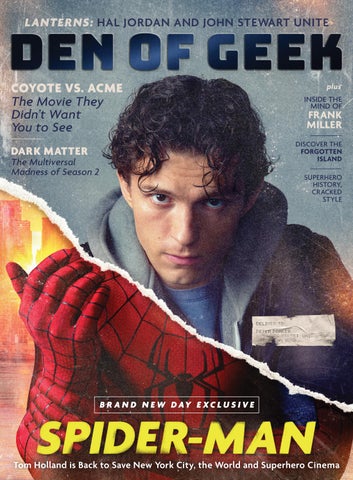
LANTERNS: HAL JORDAN AND JOHN STEWART UNITE
COYOTE VS. ACME The Movie They Didn’t Want You to See
plus INSIDE THE MIND OF
FRANK MILLER
DISCOVER THE FORGOTTEN ISLAND
DARK MATTER
The Multiversal Madness of Season 2
SUPERHERO HISTORY, CRACKED STYLE
B R A N D N E W D AY E X C L U S I V E
Tom Holland is Back to Save New York City, the World and Superhero Cinema
4
DEN OF GEEK
NEW SEASON AUG 28
DEN OF GEEK
5
6
DEN OF GEEK
INSIDE THE ISSUE
Q& A: FRANK MILLER
LANTERNS
The Dark Knight Unplugged: The mind behind some of the most iconic storytelling in comics history takes you on a journey through his unbelievable career. PG. 38
The team behind HBO’s Lanterns offers a glimpse at the first liveaction team-up between two beloved Green Lanterns and the mystery that could forever change the DCU. PG. 32
J. ALLEN HYNEK
IMAGE CREDITS: MARVEL/WARNER BROS./ JESSE KORMAN (@JESSE-KORMAN), NICK MORGULIS, SANDY MORRIS/APPLE TV, COURTESY OF SONY PICTURES
Long before Disclosure Day, Close Encounters of the Third Kind and E.T. the Extra-Terrestrial upended alien moviemaking, Steven Spielberg learned the secrets of UFOs from an unlikely source. PG. 52
DARK MATTER
One of TV’s smartest sci-fi shows returns. Here’s what to expect from season two of Dark Matter. PG. 46
SPIDER-MAN
It’s a brand new day for Marvel’s most important hero. Stars Tom Holland and Jon Bernthal tease what to expect from the game-changing next chapter in the Spider-Man mythos. PG. 20 DEN OF GEEK 7
The Webs of Your Life
SPIDER-MAN was always my favorite superhero growing up. Either Batman or Superman was the first I came across on TV and the printed page, and X-Men were definitely the most popular Marvel characters in my day. But it was Your Friendly Neighborhood Web-Head who truly captured the imagination at the ripe old age of seven. There are a few obvious reasons for this. Whereas the Dark Knight and Wolverine brooded, and the Man of Tomorrow glistened like a wellpolished marble statue in the morning sun, Spidey had the jokes. He brought a wiseacre, devil-may-care attitude that paired oh, so nicely with a flamboyant power set that let him swing between the urban canyons where we mere mortals walked, instead of hovering above them or glowering in their shadows. On a certain level, he’s Bugs Bunny with a bit of that 1960s Youth in Revolt 8
DEN OF GEEK
optimism, which likewise seeded the Flower Power generation of his roots. When you get down to it, it’s really the youthfulness and that human element which I think has made the wallcrawler so enduring, from the first generation of readers to discover him to the newest crop who line up with their parents in Hall H to sometimes get a glimpse of Tom Holland, the latest and best-cast actor
to don the mask in live action. If you strip away everything I mentioned above—the humor, the powers, the aerial ballet splash pages, or CGI fight scenes—Peter Parker is just a young dude trying to do right, even when the world never seems to care. He might have radioactive spider blood, but he’s more human than just about any other Marvel or DC creation. He’s the voice in your head telling you what the right, just, and kind thing to do is, no matter how much it hurts. Or whatever authority figures could conspire to say otherwise. It’s a refusal to be corrupted by the cynicism that comes with age. That voice is something I suspect most folks holding this magazine have listened to and tried to follow in their ordinary lives, and even in the days that might feel extra-ordinary, such as those spent at San Diego Comic-Con. But even those of you simply picking this off a shelf in a brick-and-mortar
PHOTO CREDITS: COURTESY OF SONY PICTURES
FROM THE DEN
Yaniv Ben-Atia CEO
Matthew Sullivan-Pond PUBLISHER
Chris Longo
CHIEF CREATIVE OFFICER
E DITORIAL
PROD UCT ION
David Crow
Kyle Christine Darnell
SENIOR EDITOR-AT-LARGE
Alec Bojalad
Spider-Man patrols the city in Spider-Man: Brand New Day.
store are doing something special. Trust us, if you’re still going to shops in-person, you’re a hero! For those reading this in San Diego, you’ve probably come for the events, the panels, the activations, and maybe the chance to meet some of your real-life faves. But you’ve also come out of a sense of community and camaraderie. There is a belief we’re better when we’re together; respectful of one another; happy; kind; tethered by a web of fellowship. So be like Pete and swing on that web while keeping an eye out for each other. Climb those walls with good cheer. And maybe sneak in a wee bit of smartass mischief.
David Crow, Senior Editor-at-Large
MAGAZINE PRODUCTION
Rosie Fletcher
MANAGING EDITOR
MAGAZINE SUB EDITOR
Michael Ahr
Sarah Litt
NEWSLETTER EDITOR
MAGAZINE COPY EDITOR
ART
PHOTO & VIDE O PRODUCT ION
Lucy Quintanilla
CREATIVE DIRECTOR
Jessica Koynock ART DIRECTOR
Tamar Sukenik
Nick Morgulis
SENIOR VIDEO PRODUCER
Andrew Halley
HEAD OF VIDEO PRODUCTION
Serena Tara
GENERAL MANAGER
SOCIAL MEDIA MANAGER
Keegan Kelly
Sylvester P. Smythe
MANAGING EDITOR
Michael Strauss HEAD OF VIDEO
INTERN
SPECIAL THANKS TO CRACKED ARCHIVAL EDITOR CHET REAMS.
Literally Media is a network of legacy, iconic internet brands, boasting the #1 humor network on comScore, and creating content daily in the meme, comedy and entertainment space. COVER PHOTO CREDIT: SONY PICTURES | ISSUE 22 ©2025 LITERALLY MEDIA ALL RIGHTS RESERVED
DEN OF GEEK
9
NEW RELEASE
The Power of Friendship
Directors Joel Crawford and Januel Mercado bring ’90s nostalgia and their real-life BFF history to DreamWorks Animation’s Forgotten Island. BY RENDY JONES
DREAMWORKS ANIMATION has transported viewers to countless magical realms since 1998 and introduced us to many aspirational friendships, from Shrek and Donkey to Hiccup and Toothless. Now it seeks to do both things in the singular Forgotten Island, an original fantasycomedy set in the 1990s Philippines and following the lives of two soon-tobe-loved besties, Jo (voiced by H.E.R.) and Raissa (voiced by Liza Soberano). Only this duo’s journey to a magical realm may cost them the friendship at the heart of the movie. Friends and connection have long been the secret sauce for the makers of Forgotten Island, beginning with the writing-directing team of Joel 10
DEN OF GEEK
Crawford and Januel Mercado. “For two decades, we have put so much of ourselves into every movie we do together,” Crawford shares. “That can be just jokes, things that make us laugh, or themes about being in the moment that we both really value in our own lives.” Crawford and Mercado have been real-life BFFs since working together as story artists on Kung Fu Panda 2. And after recently working on two sequels, The Croods: A New Age (which Crawford helmed with Mercado as head of story) and the Oscar-nominated Puss in Boots: The Last Wish (co-directed by the two), the pair were eager to take on an original project.
“We wanted to do something original, but really original in every sense of the word. So building a story around friendship, and our friendship, seemed the best place to start,” Crawford says. That onscreen friendship also involves similarly creative spirits as personified by Jo, a livewire, and Raissa, a smartypants. They’re introduced as almost instant besties after bonding during a trip to the principal’s office in grade school. Jo even gives Raissa a friendship bracelet as a token of their newfound connection. In the totally tubular era of gifted mixtapes, they get close while imitating Arnold Schwarzenegger and Carl Weathers’ iconic Predator handshake at the video store, accidentally operating a retro jeepney, chronicling their canon moments through Polaroids, and adding matching charms on their bracelets. But most of all, they obsess over a tale from Jo’s grandmother (Dolly de Leon) about Nakali: a fantastical realm of monsters, spirits, and demons.
MAGIC WITH AUTHENTICITY The directors drew inspiration for their heroines from the Filipino
L-R: Jo (voiced by H.E.R.) and Raissa (voiced by Liza Soberano) share precious memories in Forgotten Island.
women in their own families. “For Jo and Raissa, they are heavily inspired by the strong women in our lives, especially my sister and my cousin,” Mercado says. Even their mannerisms and features would be incorporated and used in the animation. Crawford attributes Raissa’s often irked expressions to his wife, who is Filipino. Meanwhile, Mercado’s sister’s facial scar became part of Jo’s character model. But the film is ultimately brought to life by H.E.R. and Soberano, who imbue passion and naturalism in their performances. Forgotten Island also marks the first Western animated film to be set in the Philippines, not just for DreamWorks but for all of Hollywood. To tackle the setting, Mercado, who is FilipinoAmerican, drew from his memory and experiences of visiting the country in the ’90s for family vacations, growing up with Catholicism, and attending parties. He and Crawford wanted to make sure the culture was naturally illustrated, detailing its gags, lifestyle, and wardrobe without overexplaining any of it. “It’s one of those things where [you don’t stop] the movie to say, look, this is Filipino, we got karaoke,” Crawford
explains. “There is an existing world, and the audience is just invited into that party.” In addition to the nostalgia, the filmmakers’ decision to set the movie in the ’90s was motivated by the fear of being forgotten, which was much more profound in the era before digital connectivity. The setting raises emotional stakes for Jo and Raissa as their longtime friendship faces its greatest challenge: Raissa is leaving for college in the U.S., while Jo wants her to stay. “There’s something about the ’90s in particular where it’s about two friends who have grown up together, but now one is leaving and going off a far distance. In the ’90s, before you had cell phones and FaceTime, it was something that felt more permanent if someone was going to go,” Crawford considers.
TO ANOTHER WORLD
On the night before Raissa’s departure, there’s natural tension and unspoken resentment between the leads, but then they discover a key that activates a portal resembling the Southeast Asian sun and are transported to Nakali. Nakali is a gorgeous realm full of tropical terrains and day markets. It’s also filled with creatures rooted in Filipino culture, which add a liveliness to the fantasy. Here the duo encounters the mythical Raww (Dave Franco), an explosive weredog; and Batiba (Jenny Slate), a fuzzy agoraphobic beastie who is the heroes’ only shot of getting back home; they also have to avoid the dreaded Manananggal (Lea Salonga), a vampire-like woman who can split in half. Each creature incorporated was chosen to benefit the film’s themes. Mercado points out Manananggal’s ability to separate her body ties into the girls being separated. At the same time, the filmmakers took liberties with the folklore of other characters. Batiba, for example, is derived from the Batibat, a magical demon that delivers nightmares, a bit like Freddy Krueger, as Crawford enthuses. But for the film, its abilities were altered to
stealing memories. Fatefully, this comes down to demanding that the girls trade the core fabric of their friendship, their memories of the prized matching bracelets, with the creature. With Puss in Boots: The Last Wish, Mercado and Crawford introduced a fresh watercolor background that complemented the storybook backdrop. For Forgotten Island, they’re switching to maximalist mode, doubling down on the visual storytelling and dynamism in every action scene. They apply a dazzling manga style to their visual storytelling, matching the isekai setup of the story and the Filipino realms, which is amplified by prominent ’90s colors (purple and teal from Jazz designs make up the film’s color palette). Some ’90s media and anime influenced other techniques, from split-second black-and-white dynamic action shots enhancing the epicness of set pieces to Street Fighter II as a reference for hand-drawn 2D flashback scenes. And yes, you can expect an Akira slide homage in there too. “We’re trying to get on that super cut of 30 years of Akira slides in animation!” Mercado laughs. The film’s soundtrack also plays a huge role in the story’s emotional core, blending influences from the ’80s and ’90s with deep roots in Filipino and American musical culture to trace the shifting emotions of the central friendship. The needle drops don’t just authenticate the era; they amplify the exuberance the duo share with Sir Mix-a-Lot’s “Baby Got Back,” Montell Jordan’s “This Is How We Do It,” and DMX’s “Party Up (Up in Here).” But beyond the ’90s nostalgia and nods to Filipino artists, the film finds its voice in Jo and Raissa, quite literally, during a powerful end credits duet from H.E.R. and Liza Soberano. “It was written from H.E.R.’s heart,” Crawford teases. “It’s like Jo and Raissa singing a song,” adds Mercado. Together, these songs don’t just accompany the story; they become key to its emotional DNA. Forgotten Island arrives in theaters on Sept. 25. DEN OF GEEK
11
COMEDY
IN COLLABORATION WITH
L-R: Lana Condor, Wile E. Coyote, and Will Forte in Coyote vs. Acme.
Coyote vs. Acme’s Dave Green takes the stand for the movie you were never supposed to see. BY ROSIE KNIGHT
SITTING IN A DARKENED ROOM, TALKING TO DIRECTOR DAVE GREEN about a movie we never thought we’d see, and he never thought anyone could see, is a surreal thing. That goes double for the folks who worked on Coyote vs. Acme. “It’s an absolute miracle,” Green shares. “We honestly have the fans and every single person in the world who spoke up on behalf of the movie to thank.” Green is referring to the strange irony of how Coyote vs. Acme became a Hollywood legend in only a handful of years. It’s the movie that was apparently so amazing, so groundbreaking, that, due to real-life industry situations that mirror the film, almost didn’t get released. And its escape from a fate in a deep, dank Warner Bros. vault occurred only because of public support and passionate testimonials from filmmakers and Hollywood insiders who were able to see the film—and their own industry reflected back in it. Telling the story of a David vs. Goliath legal battle, Coyote vs. Acme is inspired by the satirical 1990 New Yorker article of the same name that producer James Gunn (yes, that one) discovered years ago and had been trying to adapt ever since. When 12
DEN OF GEEK
the titular Wile E. Coyote decides to sue Acme for their years of dodgy products, he and local billboard attorney Kevin Avery (Will Forte) and his eager, idealistic assistant/niece Paige Avery (Lana Condor) uncover a shocking conspiracy that goes all the way to the top. Just like Who Framed Roger Rabbit? before it, the film balances live-action performances with fully animated characters in a beautiful dance that instantly takes you back to the feeling of being an awe-inspired child, mesmerized at the movie theater. “Roger Rabbit is the gold standard. It’s a masterpiece. So we don’t take it for granted anytime someone mentions us in the same sentence,” Green says. The movie feels like the sort that doesn’t get made anymore, and that’s
PHOTO CREDIT: KETCHUP ENTERTAINMENT
DAVID VS. GOLIATH
WHERE COMEDY & CULTURE COLLIDE something Green and his collaborators instantly recognized. “When I first started showing the movie to filmmaker friends, they would tell me, ‘I can’t believe you got away with this. I can’t believe you got away with making a Looney Tunes movie that is also a courtroom thriller; it feels like you robbed the bank!’” Green laughs. It wasn’t just Roger Rabbit’s game-changing combo of animation and live action that inspired the film, however. “I think the thing that made Roger Rabbit so special was those counterweights of tone. It was very stupid, and it was very serious,” Green observes. “It was the noir universe of that movie that grounded all of the cartoon antics. So in the earliest days of putting this movie together that was a tonal north star: how can we take this very silly idea, which is Wile E. Coyote suing Acme, and ground it in a reality and give it emotion?” Luckily, that was all in the source material. The New Yorker article by Ian Frazier was a fictional court report of Wile E. Coyote’s legal filings against Acme. But how do you adapt an article into an epic animated legal dramedy that also features cartoon characters? “I think the goal and the challenge at the same time was keeping the flame alive from what made the original stuff so special, and Ian “I say, I say,” Foghorn Leghorn takes a big swing.
Frazier really picked up on the subversiveness and the intelligence of what made Looney Tunes work,” explains the director. “Looney Tunes was always the subversive, wicked stepchild to Silly Symphonies and what Disney was doing. It was punk. It was making jokes on moments in pop culture in the ’40s, and that was something Disney would never do. It was like the original Simpsons of its time.” Green and the team were inspired not only by that history and Frazier’s article but also all the other incredible creatives who have shaped the cartoons over their many decades on screen. Says the filmmaker, “As one of many custodians of the IP and the brand— and there will be many more, I hope—my goal was to try to foster an environment that was filled with as many people who understood that ethos, that sense of humor, that irreverence, that sarcasm, and that outlook that made Looney Tunes work since the beginning.” That included finding a leading man who can play both the seriousness of the legal drama and corporate nightmare, and the comedy of starring alongside the Looney Tunes’ most famous fall guy. That man was Will Forte. “Will is a brilliant comedic talent; he
can make anything he says hilarious, he is so honest and straightforward,” Green marvels. “I think what was really important to us in the casting process was finding someone who had honesty and earnestness, and was also not ever going to be saccharine. What is brilliant about Will is he’s able to play Kevin Avery in a way that makes his shagginess and his laziness affable and likable. He’s not a cold, dismissive cynic in any way. He also, as a writer and performer, constantly understands how every single comedic beat is supposed to work, and from take to take can just give you so many detailed colors and adjustments and changes that you are just overburdened with great choices.” The film is also filled with easter eggs and deep cuts from the immense archive of WB animation, something that was another delicate balance for the filmmakers. “I think from the beginning we were kind of allergic to jumping on pop culture trends from now, if that makes sense,” Green says. With that said, the film does reflect our current timeline while still having some blasts from the past, including a very cool riff on Peter Lorre. That makes sense, though, since Lorre himself made a huge impact on Green as a child. “I became aware of animated Peter Lorre before I even knew who real Peter Lorre was,” says the director. “Like I was just a ’90s baby watching Tiny Toons, Pinky and the Brain, and Looney Tunes shorts. But you start to see this character who speaks kind of weird and think ‘who is that guy?’ And I just thought he was an animated character at first, and then learned that he was a real actor and a real weird guy.” If Coyote vs. Acme hits as hard as we hope it will, it’ll also likely be some other kid’s introduction to Peter Lorre and the wild history of Hollywood animation! That’s miracle work. Coyote vs. Acme opens Aug. 28. DEN OF GEEK
13
COMEDY
IN COLLABORATION WITH
WITH GREAT POWER COMES GREAT PARODY A history of superhero satire throughout Cracked history. BY KEEGAN KELLY
1
DID YOU KNOW that Cracked is older than both the Justice League and the Fantastic Four? Cracked also predates the debuts of the X-Men, Spider-Man, Hulk, Iron Man, and even Robert Downey Jr. Since the first Cracked issue hit shelves in March 1958, the world of superheroes that had just begun its Silver Age has evolved, exploded, and radically reimagined itself over and over again, and Cracked was there to comically chronicle the colorful history of the genre firsthand.
1. CHILLIN’ WITH B-B-BATMAN Artist: John Severin Print Date: Oct. ’97
2. BRUCE WAYNE’S WORLD Artist: Walter Brogan Print Date: March ’94
3. SUPERMAN SYLVESTER
Artist: John Severin Print Date: July ’79
4. SUPERMAN FT. RAIDERS Artist: John Severin Print Date: Dec. ’81
14
DEN OF GEEK
5. SPIDER-MAN APPRECIATION MONTH Artist: John Severin Print Date: Jan. ’91
6. SUPERMAN RETURNS FROM THE DEAD
Artist: Walter Brogan Print Date: Summer ’93
7. FED X-MEN
Artist: John Severin Print Date: Jan. ’98
2
3
WHERE COMEDY & CULTURE COLLIDE
6
4
7
5 DEN OF GEEK
15
WHEN YOU'RE ON A MISSION TO HAVE FUN BREWING DELICIOUS CRAFT BEER FOR GEEKS SINCE 1913
Visit our 2,500 sq.ft. Tasting Room just a short walk from the Convention Center! 13114th Street, Downtown San Diego We are dog friendly, family friendly, bring-your-own-food friendly and a whole lot of fun.
COURTESY OF DEN OF GEEK YOUR FIRST PINT IS ONLY $2
Valid between July 23-26, 2026
MISSION BREWING 13114th Street, Downtown San Diego
FIVE THINGS TO KNOW ABOUT…
Maddie Ziegler After getting her start as a twirling young phenom on Dance Moms, Pretty Lethal star Maddie Ziegler is ready to waltz her way to Hollywood heights. BY ALEC BOJALAD PHOTOGRAPHY BY NICK MORGULIS
1
Maddie Ziegler was born on Sept. 30, 2002, in Pittsburgh, Pennsylvania, and her artistic career began soon after. She started ballet lessons when she was just two and joined the Abby Lee Dance Company at age four, where she trained in jazz, ballet, acro, and modern styles of dance, with her favorites being lyrical and tap.
2
Alongside her younger sister Mackenzie and her mother Melissa, Maddie became the breakout star of Lifetime reality series Dance Moms, in which she appeared from ages eight through 13. “I’m not always going to be that little girl. Obviously, I have my feelings about that [show], but if I didn’t do it, I would not be where I am right now,” she told Teen Vogue in 2024.
18
DEN OF GEEK
3
Acclaimed Australian singer Sia tapped Ziegler to star in the music video for her 2014 hit “Chandelier.” The clip racked up nearly 3 billion views, leading to further video collaborations, multiple award nominations, and Ziegler joining Sia for the North American and Australian legs of her “Nostalgic for the Present” tour.
4
Ziegler’s acting career began with a role in the 2012 Lifetime series Drop Dead Diva. She has since appeared as Christina Sickleman in The Book of Henry (2017), Velma in Steven Spielberg’s West Side Story (2021), and as Ruthie in My Old Ass (2024).
5
In her latest role as the ballerina Bones in Pretty Lethal, Ziegler told Den of Geek that her dance training came in handy. “We were calling it ‘ballet fu,’ which was really fun because I think, realistically, we wanted it to feel like you put a bunch of feral cats in a box to see what they do to survive.”
THE BEST OF GEEK
Say What?
“NO COMMENT.”
PHOTO CREDITS: NICK MORGULIS, STEVE JENNINGS/GETTY IMAGES
Quotes of the month from Den of Geek exclusive interviews. BY DEN OF GEEK STAFF
— Lifelong Gilmore Girls
fan Eiza González on whether she was happy with Rory’s ending.
"No one sees me as refined. It’s because they know I’m not.”
“The thing I always enjoyed about watching Bogart, especially in movies like The Big Sleep, is that he seemed amused by other people’s bad behavior. He would start to laugh at other people’s wickedness, he got tickled by it.”
— Charlie Day on playing a dirtbag.
— Nicolas Cage on his favorite noir performances.
“I told her doing this scene with Chris Farley, nothing will ever beat that. It was a joy from the beginning to the end.” “YOU HAVE TO BE QUITE FEARLESS TO WANDER AROUND IN A GIMP SUIT. NO QUESTION!”
— Bob Odenkirk on telling his daughter about creating the "Matt Foley, motivational speaker," sketch.
“I’M NOT SCARED OF SHARKS, I DON’T KNOW WHY I SAID THAT. I EVEN SWAM WITH SHARKS!” — Gaten Matarazzo on briefly lying about his biggest fear.
"He’s a talented kid and he made a stupid comment that he’s going to regret. And that’s okay. In today’s marketplace, where every single word we say is recorded, it’s going to happen to all of us." — Jamie Lee Curtis on Timothée Chalamet's poorly-received opera and ballet comments.
— Andy Serkis on the first day of filming as Gollum on a mountaintop for The Lord of the Rings. V I S I T D E N O F G E E K . C O M F O R T H E L AT E S T I N T E R V I E W S , R E V I E W S , N E W S , A N D F E AT U R E S . DEN OF GEEK
19
Above: Peter Parker (Tom Holland) is in a lonelier place in Brand New Day. Right: Spidey battles mystery villain Boomerang.
20
DEN OF GEEK
It’s a Brand New Day for Spider-Man as director Daniel Destin Cretton and stars Tom Holland, Zendaya, and Jon Bernthal chart Marvel’s next chapter. BY JOE GEORGE
A
LMOST FIVE FULL YEARS AGO, Spider-Man: No Way Home ended on a triumphant note when Peter Parker swung over Rockefeller Center in a homemade suit. Certainly, No Way Home gave Spidey lots to savor in that moment. He’d just defeated the Sinister Six in all but name, cured his arch-nemesis, the Green Goblin, and got to rub shoulders with Tobey Maguire and Andrew Garfield on their own meta victory laps. Oh, plus, it was also the highest-grossing Spidey flick so far. Yet for all its success, No Way Home also saw Peter lose both his beloved Aunt May (Marisa Tomei) and his identity as magic wiped the memory of Peter from everyone on Earth, including his best friends MJ (Zendaya) and Ned (Jacob Batalon). To star Tom Holland, those darker points left No Way Home feeling unresolved and the story unfinished. In his core, Holland knew the character still needed a Brand New Day. “I always felt like Peter got over Aunt May’s death too easily,” Holland tells us. “The loss of Aunt May should be devastating. It should take up the entire third act of the movie. But we were trying to make something fun and exciting, so he meets these two other Spider-Men, the most
CAUGHT IN A DARK WEB
PETER PARKER DIDN’T JUST LOSE his friends and his aunt in No Way Home. He also lost his childhood, as the film ended with MJ and Ned’s graduation. Peter got a GED. Now, five years later, Brand New Day finds the trio at the end of their college careers, ready to enter adulthood. And as far as Peter’s concerned, it’s not going well. “The first half of this movie is a really good example of someone handling his problems poorly,” Holland says. Zendaya agrees, describing Peter to us as “more vulnerable and intense than we’ve seen before. We’ve never seen him have to face all these challenges alone.” So desperate is the situation that the kid from Queens
Spectacular Spidey Suits
Peter Parker isn’t always confined to just red and blue. Here are some of Spider-Man’s boldest alternative fashion choices from over the years.
22
DEN OF GEEK
⊲ SYMBIOTE SUIT
Even if it never went on to spawn its own diabolical life as Venom, the symbiote suit would be one of the all-time greats. With its clean design and (initially harmless) relationship with Peter, the symbiote gave Spider-Man an intergalactic upgrade, painted black.
PHOTO CREDITS: COURTESY OF SONY PICTURES
iconic Spider-Men. We couldn’t have Tobey and Andrew having the time of their lives while my character’s crying all the time. It wouldn’t have worked.” For that reason, Spider-Man: Brand New Day, directed by Destin Daniel Cretton, is not just a new beginning; it’s an expansion on the lingering traumas of a Peter we’ve watched grow across six movies. In between dealing with baddies like Scorpion (Michael Mando) and Tombstone (Marvin Jones III), meeting the Punisher (Jon Bernthal) and the Hulk (Mark Ruffalo), reuniting with MJ and Ned, and dealing with a mysterious newcomer played by Sadie Sink, Peter has to work on himself. As Holland puts it, “Brand New Day deals with some of those things we had to gloss over in No Way Home.” In short, Peter Parker is finally finding the time to grow up.
turns to an unlikely ally: Frank Castle, a.k.a. the Punisher. For actor Bernthal, his gritty Punisher fits in the world of Spider-Man not because Castle has become lighter, but because Peter has become heavier. “We’re dealing with a dark version of Spider-Man, where he’s closing himself off and trying to figure out who he is,” Bernthal observes. That situation means the Punisher treats Spider-Man differently from most superheroes. “Frank doesn’t buy into all this stuff. He’s a level guy, and he gets frustrated with all this superhero stuff. But there’s a sense of mutual respect with Spider-Man. Frank knows that Spider-Man can do things that he can’t. “Spider-Man’s embracing darkness in his life, and, as someone who’s been down that road, Frank doesn’t love that for anybody. It cracks open Frank’s heart. He’s begging
Spider-Man takes on criminal ninja assassins known as The Hand. We've seen this lot before in Daredevil.
Spider-Man not to go to the places he goes.” The bond between Punisher and Spider-Man isn’t the only surprising personal shift in Brand New Day, as the pessimistic MJ has done her own maturing in the intervening years. “In this moment, she’s juxtaposed against Peter’s situation,” Zendaya explains. “It’s a transformative point in a young person’s life where you finish college or start a new job and realize, ‘I am an adult now.’ You have to start making adult decisions and being responsible for them in a way that feels different. MJ’s trying to figure out who she is while retaining her relentless pursuit of the truth. She has these core values, and that’s where she and Peter connect. In his optimistic way, Peter’s always trying to stay true to who he is, and MJ’s trying to do the same.” Such an emphasis on growth might be why director Cretton doesn’t completely accept Bernthal’s assessment. “Brand New Day has a more mature Spider-Man, but I don’t like the word ‘darker,’” he counters. “Spider-Man isn’t Batman.” In the filmmaker’s mind, Peter is experiencing the same daunting big choices most young adults face. “When I graduated from college, I had a communications degree and no job prospects. I struggled through my 20s, sharing an apartment with three to eight guys, all of us looking for work. The reality of the world hit me in the face. In that stage, I learned what it really feels like to lose someone, to go through sadness and darker times, and I learned what was important in life for the first time. That’s the stage that Peter Parker happens to be going through. Does that make the movie darker? Maybe in moments, but it’s more a reflection of where Peter’s at.”
THE WORLD OUTSIDE YOUR WINDOW
IT’S NOT JUST PETER AND MJ’S lives that are changing. Holland and Zendaya have come a long way in their careers and experiences since Spider-Man: Homecoming released almost a decade ago, to say nothing of the five-year gap between No Way Home and Brand New Day. Holland explains, “One of the reasons we took a big break between No Way Home and Brand New Day was to
⊲ BOMBASTIC BAG-MAN
Upon suspecting that his alien goo suit might be evil, Peter did what any Marvel hero would do and took it to Reed Richards of the Fantastic Four. But when called into action before getting to change, the Web-Head had to don a spare FF suit and a brown paper bag to become the Bombastic Bag-Man.
MJ (Zendaya) and Spider-Man are reunited, but in this world she doesn't remember who he is.
allow the characters to grow up off-screen. Audiences who love the original franchise will see a different version of these characters from the outset. These movies have nods to my own personal life. After what I’ve been through as a young man, it felt right for the character to leave high school.” Zendaya puts a finer point on it, suggesting her previous MCU movies with Holland represent “the college experience that we never got to have.” Even Bernthal, a more established actor several decades senior to his co-stars, sees parallels between his life and that of the Punisher. “I would never have been able to play Frank if I weren’t a father and a husband,” he acknowledges. “You can’t play him until you love people so much more than you love
⊲ SIX-ARM SPIDEY
We’re cheating by calling this a new costume, but Peter Parker certainly got a new look when he suddenly sprouted four extra arms. Pete kept his usual blue-and-red outfit, though with a few alterations to accommodate his added limbs. 24
DEN OF GEEK
yourself, and you’d happily give your life for them. Then, you can try to understand what it would be like if they were taken from you.” As Bernthal’s description makes clear, Punisher comes from a drearier place than Spidey. That’s especially true of the MCU version of Frank Castle, last seen in the first season of Daredevil: Born Again and in the recent special The Punisher: One Last Kill, both decidedly R-rated projects. Yet Bernthal believes that his friendship with Holland helped find a place for Frank in a PG-13 Spider-Man movie. “Frank and Spider-Man have a big brother/little brother relationship, reminiscent of my friendship with Tom,” Bernthal reveals. “It’s really a testament to Tom and Destin for making that work.”
⊲ CAPTAIN UNIVERSE
When a science experiment went awry in Spectacular Spider-Man #158 (1989), Spidey briefly gained the cosmic powers of Captain Universe. His Captain Universe phase lasted only a few issues, just long enough to get a cool new look and to punch the Hulk into space.
— ZENDAYA Cretton knew to look for those real-world relationships while making a big superhero movie because he was doing the same thing, examining Peter’s loneliness through the connections in his own life. “I think the human brain has a tendency to spin bigger problems from the issues in front of you,” he muses. “So exploring that tendency in the context of Peter Parker is therapeutic. I watch him go through this journey that reminds me of my personal experiences.” More accurately, Cretton understands the devastating effects of Peter’s isolation because the director has lived his entire life in a community. “I grew up in a family with six kids, living in a small house in Haʻikū, Maui,” he says. “A two-bedroom house with a loft and one shared bathroom. My whole existence was communal. I shared a room with someone until I was 26. Even through college, because I was an indie filmmaker who had to save money, I shared a bunk bed with another person.” The emphasis on community drives everything from his independent films Short Term 12 and Just Mercy to his Marvel projects Shang-Chi and the Legend of the Ten Rings and Wonder Man. Communal thinking also helps Cretton accept the scrutiny he’s under as a person telling the story of the most popular superhero in the world. “There’s nothing like working with Marvel,” he says with a smile. “There’s nothing like the response you get from the fans, the good and the bad. They look at every frame and look for every little decision we made. It’s fun to have that type of participation in the movie we’re making,” Cretton says with the air of a confessional. “It really does feel like you’re participating in a big conversation. To me, that’s what cinema is all about.” Yet for that conversation to continue in a satisfying way,
Spider-Man movies need to have something to say, and that was the challenge coming out of the definitive ending posed by Spider-Man: No Way Home.
A NEW WAY HOME
BEYOND ITS NOSTALGIA PLAYS, No Way Home worked because it finished the arc running through the previous MCU Spider-Man trilogy, all of which were directed by Jon Watts. From his first appearance in 2016’s Captain America: Peter awakens in some sort of cocoon in Spider-Man: Brand New Day.
⊲ SPIDER-ARMOR
On their own, the Eel, Plantman, and Madame Menace hardly pose a problem. But when they and a bunch of other C-listers teamed up in Web of Spider-Man #100 (1993), Spidey had to create swinging silver armor to take on the horde. It was so nifty that it became a power-up in the PS1/ N64 Spider-Man game. DEN OF GEEK
25
Civil War, Holland established his Web-Head as something different from what we’ve seen before, with a hip young aunt and a billionaire benefactor. No Way Home stripped all of that away from Peter, essentially turning him into a new character with endless storytelling options—so many, in fact, that Holland and company weren’t sure where they wanted to go next. Holland divulges, “We asked ourselves why we should make another one. The third was so fantastic in its nostalgia and its success that it felt like the perfect sign-off for Spider-Man as we knew him. It wasn’t enough to say that these movies do great business. We needed a reason to tell a story beyond the business of making another SpiderMan movie. So there were lots of conversations between [Sony Pictures Motion Picture Group CEO] Tom Rothman, [Marvel Studios President] Kevin Feige, and [producer] Amy Pascal. Once we figured out the movie’s message, everything started falling into place. Suddenly, it felt like we had a movie that was worthy of fans’ time, something fulfilling and satisfying.” Holland’s description of the process brings to mind Spider-Man himself, swinging with ease past every obstacle. But the reality is that wallcrawler movies are exceptionally hard to make, if only because they involve both Sony Pictures, which has held film adaptation rights to the character since 1999, and Marvel Studios. Add to the mix actors such as Holland and Bernthal, who feel a sense of ownership over their characters, to say nothing of the legions of fans who have been following these heroes for decades, and the potential for conflict only grows. Yet everyone making Brand New Day felt that the additional voices only made for stronger conversations and, in the end, a better movie. “I found this group of people to be entirely egoless,” observes Bernthal. Even though he demurs when the issue of ownership comes up—“Frank belongs to the comic book fans, members of the military, and first responders,” he insists—Bernthal allows he’s invested in the Punisher, and that mattered to those making Brand New Day. “They were open to my ideas. Destin appreciated that I’ve been with Frank for a long time and knows how much I care about the character and the fan base.” Zendaya remained similarly cognizant of the fans, even
⊲ SENSATIONAL SPIDER-SUIT One of the most infamously convoluted comic book storylines of all time, The Clone Saga did little good to the Spider-Man mythos. But at least we got a cool new costume to go with our new Spider-Man (who might have been the old Spider-Man, but was actually a different SpiderMan… now we’re confused). 26
DEN OF GEEK
though her character differs from the Mary Jane Watson of the comics. “I want to pay homage to the character that people know,” she admits before disclosing, “I even tried to find a way to make her hair a little reddish” to match Mary Jane’s flaming locks. But she, too, prioritized good storytelling. “Ultimately, it was important that I didn’t neglect the character we’ve built over the years. She has this quirkiness and pessimism that complements Peter’s quirkiness and optimism. They brought these things out of each other, and it seems that their personalities have swapped because of the absence of the other person.”
⊲ IRON SPIDER
As in the MCU, Tony Stark welcomed Peter Parker into the superhero civil war with a shiny new suit. Unlike the movie version, the comics’ Iron Spider outfit hews more closely to Iron Man’s color scheme.
“It was a lot of fun!” Cretton adds. “I worried that making the movie would be a disaster, with all these giant opinions battling each other and me right in the middle of it. Thank goodness that wasn’t how it went. It’s not as complicated as you’d think. I want each actor to own their character. Because then, they can teach me about that character.” Foregrounding collaboration allowed the team to navigate the expectations of a huge superhero movie filled with beloved characters. Moreover, it enacted the communal spirit at the heart of Spider-Man: Brand New Day.
Spidey and Frank Castle, a.k.a. Punisher (Jon Bernthal) become unlikely pals.
SPIDER-MAN AND HIS AMAZING FRIENDS
“SPIDER-MAN: BRAND NEW DAY is about the power of human connection,” states Holland. “It’s about love and the power of friendship, the power of community. And it’s about the importance of asking for help when you need it.” The movie couldn’t explore that theme without bringing back the two people Peter needs most, even if they don't remember him anymore and have spent the last five years living their own lives. “It was a challenge, but both Destin and I were adamant that these movies don’t exist without Zendaya and Jacob,” Holland contends. “We wanted to make the audience miss MJ and Ned while still making their presence known. You still get all the fun of their presence, and there are some fun moments where Peter’s interacting with them, even though they don’t know who he is.” “Honestly, we felt bad for Tom,” laughs Zendaya. “Jacob and I are just having a good time, minding our business. And Tom, bless him, is standing off in a corner alone, staring at us from afar! It was like an acting exercise, to play as if you’ve never met this person before. We had to imagine this life that Ned and MJ had without Peter’s presence.” As befitting his character Frank, Bernthal takes a more serious approach to the film's central theme. He explains, “The movie shows what happens when you build a wall around your heart. Essentially, being human means that light will shine through the chinks in your armor, and we’ll see that Peter and Frank, like all human beings, need companionship. They need friendship and love.” Bernthal finds that theme not just in the movie, but also in the process of making it with Tom Holland. “I’ve known Tom since he was 17 years old. I’m so proud of him, and I love working with him.” Zendaya goes further, stating that her reason for returning for a fourth movie as MJ can be summed up in two words: “Tom Holland.” Even after laughing off her confession and insisting that she returned because she found the character compelling, she cites his enthusiasm as a driving force. “It was really important to Tom that we didn’t just make another Spider-Man movie for the sake of
⊲ SUPERIOR SPIDER-MAN
In Amazing Spider-Man #700 (2013), Doctor Octopus achieved the ultimate victory over Peter Parker, swapping his mind with that of his enemy. For a few years, Doc Ock got to run around in Peter’s body, wearing a high-tech new take on the classic Spidey suit. DEN OF GEEK
27
— JON BERNTHAL
making another movie.” “Tom Holland has mastered the art of acting behind a mask,” Cretton says. “It’s a bit of Buster Keaton, a bit of Charlie Chaplin, a bit of Kabuki theater. I never worried about working with an actor who kept his face hidden, because Tom expressed it all with his body.” Yet Holland himself shrugs off the praise to point out, “Spider-Man is one of the most beloved characters. It has nothing to do with me and everything to do with the fact that he’s just a young kid going through all the things
⊲ SPIDER-MAN: NOIR
In another part of the Spider-Verse, Peter Parker lives a hard-boiled life fighting gangsters in 1930s New York City. Accordingly, he ditches the primary colors for a black costume, complete with a dark trench coat and a more intimidating mask. 28
DEN OF GEEK
we go through.” So if Spider-Man’s loved by so many, and Spider-Man is the central draw, why does Brand New Day also have Hulk and Punisher and legions of villains, to say nothing of the various other characters who will pop up along the way? Will Brand New Day make Spider-Man a supporting character in a Spider-Man movie? Cretton laughs off the question. “Oh, you’re going to get so much Spider-Man,” he insists. “Every one of these characters exists because they serve Peter Parker’s journey.”
⊲ FUTURE FOUNDATION
Spider-Man has always wanted to be part of the Fantastic Four. So when his best friend Johnny Storm, the Human Torch, died heroically, Mister Fantastic invited Peter to join the team under its new name, the Future Foundation, and even gave him a sleek black and white suit as a welcoming gift.
Marvel recreates the iconic first Spider-Man image drawn by Jack Kirby in Amazing Fantasy #15.
.
Holland concurs, urging, “Watch the movie, and you’ll see. Spider-Man fans won’t be disappointed.”
SWINGING THROUGH THE SUFFERING
IN THE PAGES OF MARVEL COMICS, Spider-Man accidentally killed his girlfriend Gwen Stacy and countless allies, had his best friends turn into supervillains, was
replaced by clones and arch-enemies, and was forced to choose between his aunt and his wife. With all that in mind, the MCU Peter, with his friendship with Tony Stark and his acceptance by the Avengers, has had a pretty charmed life. But Holland would disagree. “There’s no shortage of trauma in Peter Parker’s life,” Holland observes. “He’s lost his mentor, his aunt. We don’t know what happened to his uncle in my universe, but we know he’s not in the picture. He’s lost the love of his life and his best friend.” Such is the case for every incarnation of Spider-Man, not just the one in the MCU. Across the comics, cartoons, movies, and video games that make up the Spider-Verse, Spider-Man loses the people he loves again and again. Thus, Brand New Day starts in a familiar place for poor Peter Parker. But for most fans, that’s where the hope of Spider-Man shines through. “I connect with so much about Peter Parker,” Cretton says. “His eagerness to be a good person, his fumbling through it, but there’s so much joy in Spider-Man at the same time. It’s a lot of fun being a Spider-Man fan.” Zendaya finds that joy and chaos in perhaps her character’s most iconic moment from the franchise when the otherwise unflappable MJ loses her cool while swinging across the city with Spidey. “Jon Watts came up with the idea MJ should be afraid of heights,” she remembers. “So we figured out how to realistically wrap yourself around someone swinging around a building. You’d just grab onto them with all your limbs. We’ve all wondered what it would be like to do that.” The fantasy of spinning webs and swinging through the city is, of course, one of Spider-Man’s central appeals. But for Holland, it comes down to Peter’s perseverance. “The suffering grounds Peter. It reminds you that he’s human,” Holland states. “I always thought that Peter Parker was special because of Spider-Man. Making this movie, I realized that Spider-Man is special because of Peter Parker. The grief that he experiences resonates with people.” So even though Brand New Day brings Peter lower than he’s ever been before, the depths only make the joyful moments more ecstatic. Swinging through the suffering is what Spider-Man, and growing up, is all about. Spider-Man: Brand New Day opens on Friday, July 31.
⊲ ADVANCED SUIT
Gamers will recognize the SpiderCostume with silver highlights as the one that Peter wears in the hit PS4 and PS5 games. But before it came to consoles, the Advanced Suit appeared in Peter Parker: The Spectacular Spider-Man #305 (2018) on an alternate-reality Peter. DEN OF GEEK
29
Hal Jordan and John Stewart share the Green Lantern mantle (and little else) in HBO’s Lanterns, the next chapter of a growing DC Universe. BY ALEC BOJALAD
S
ince the coalition of intergalactic space cops known as the Green Lantern Corps first debuted in the pages of DC Comics in 1959, more than 7,200 individuals have donned a construct-conjuring green Power Ring to protect their corner of space from those who would seek to do it harm. The first question, then, that any Green
Lantern story must answer is “what Lanterns are we talking about here?” It turns out that was never much of a question at all for Chris Mundy, co-creator of the HBO series Lanterns. “It was always going to be John and Hal,” Mundy says. “There was never a doubt.” Of all the men, women, and vegetables (more on that in the sidebar) who have recited the Green
Lantern oath over the years, none are more iconic than Hal Jordan and John Stewart. Created by John Broome and Gil Kane and debuting in 1959, Hal Jordan is a handsome fighter pilot with a penchant for rubbing people the wrong way. His eventual replacement, the steady John Stewart, was created by Dennis O’Neil and Neal Adams and followed in 1971. Hal and John have appeared together on countless occasions in comics and animated media. But Lanterns represents the first time they will team up in live action. In fact, Hal hasn’t been seen in the flesh since Ryan Reynolds portrayed him in 2011’s poorly received Green Lantern film, and John Stewart has never made it to the three-dimensional world at all, with Wayne T. Carr’s John Stewart having been cut from Zack Snyder’s Justice League. The creators of Lanterns—which consist of an HBO drama veteran
Guardians of the Universe have divided all of THE WEIRDEST The space into 3600 sectors, assigning at least two Green
GREEN LANTERNS BY JOE GEORGE
32
DEN OF GEEK
Lanterns to each. Sure, some Green Lantern rings go to handsome humans like Hal Jordan and John Stewart. But more often than not, the rings go to aliens, and sometimes, they go to absolute weirdos. Here are five of the strangest to ever sling a ring.
PHOTO CREDIT: HBO
IT’S NOT EASY BEIN’
(True Detective writer Mundy), a comic book mastermind (Supergirl: Woman of Tomorrow scribe Tom King), and a combination of them both (HBO’s Watchmen creator Damon Lindelof )—didn’t pair Jordan and Stewart together simply as a hat tip to comic book fans. The duo’s strained, bickering dynamic operates as the series’ creative backbone.
“It’s brand new inside the story of Green Lanterns, but there’s a real tradition of ‘buddy cop’ [storytelling],” Mundy says, comparing the show’s vibe to the film Midnight Run. “There’s affection, but there’s also some aggression back and forth. The series was written to be in the rhythm of the banter of those two guys.”
Taking place over two modern timelines, Lanterns’ eight episodes follow Kyle Chandler as grizzled veteran superhero Jordan and Aaron Pierre as Green Lantern-in-training Stewart. As the two head off to Rushville, Nebraska, to investigate a murder with potential extraterrestrial implications, Jordan can’t help but wonder if the student hoisted upon
L-R: Aaron Pierre as John Stewart and Kyle Chandler as Hal Jordan in HBO’s Lanterns.
MOGO
⊲ Over on TV, science fiction will once again loom large in 2025 with season 2 of Apple TV+’s trippy workplace thriller, Severance premiering in January, followed by fresh outings for The Last of Us, Andor, The Rig, and the final season of Netflix’s epic Stranger Things.
⊲ The story “Mogo Doesn’t Socialize,” by Watchmen ⊲ Of late, director Yorgos Lanthimos creators Alan Moore and Dave Gibbons, introduces a ton of is “on one” and we are there for it. great Lanterns, including the superintelligent smallpox virus So learning that Bugonia, starring Leezle Pon and the sentient mathematical equation Dkrtzy Emma Stone and Jesse Plemons, is a RRR. But the best is the title character Mogo, a living planet sci-fi comedy about conspiracy who wears his ring as a band around his equator. theorists who kidnap a CEO thinking she’s a deadly alien is a win. Coming in November.
DEN OF GEEK
33
him by his Guardians of the Universe bosses isn’t, in fact, his replacement. “We felt like none of us had ever seen a superhero show that dealt with someone aging,” Mundy says. “You’re going to hit a time where you’re like LeBron. Do you retire? You’ve got good years left in you. They might not be the exact same as your early years, but you’re still one of the best players in the game. What do you do? We thought that tension was interesting.” Providing the more seasoned half of that tension is Chandler, a TV legend best known for his fiveseason run as the sagacious Coach Eric Taylor on NBC football drama Friday Night Lights. Chandler proved a perfect fit for the role, and not only because the Nebraska crime scene Jordan and Stewart investigate happens to be on a high school football field. “We had this idea of Hal as a real Chuck Yeager type,” Mundy says, referring to the famous real-life fighter pilot and sound barrierbreaker. “[Hal] was going to be hazing John a lot, so you need somebody who is able to do that but is also likable. Once Kyle bubbled
We felt like none of us had ever seen a superhero show that dealt with someone aging. You’re going to hit a time where you’re like LeBron. Do you retire? CHRIS MUNDY CO-CREATOR Hal Jordan is a grizzled veteran superhero, a real “Chuck Yeager type” according to Chris Mundy.
ROT LOP FAN
⊲ Members of the Green Lantern Corps must be honest and brave… and they should probably understand colors. Yet the alien Rot Lop Fan still answered the call, despite living completely without light or color. Another Alan Moore creation, Rot Lop Fan uses sound instead of color, describing himself as a member of the F-Sharp Bell Corps.
34
DEN OF GEEK
A moment of calm for the Lantern duo who are often seen bickering in the show.
up, he seemed obvious. Now it seems funny that we ever threw out another name.” Finding the right John Stewart was a bit trickier for Lanterns, which is understandable given the character’s ever-changing comic book history. Physically modeled after actor Sidney Poitier by his creators, John
Stewart was introduced in the ’70s to present a Black superhero who better reflected the racial makeup of the world’s population. Early iterations of the character made him an explicitly political figure participating in the Black Power movement. He was then made an architect in the 1980s and fully
retconned into having U.S. Marine origins in 2001. Lanterns borrows from all of these sources to create the most fullyrealized iteration of the steadfast Lantern yet. The show also introduces its own fascinating (and spoiler-y) update to John’s backstory that better explains his motivations.
DRIQ
⊲ Driq died defending his planet from the renegade Sinestro, but that doesn’t keep a good Lantern from doing his duty. Driq’s ring kept him alive in a zombie state, allowing him to shine his light indefinitely. Well, at least until Hal Jordan went nuts and became the villain Parallax (he got better), destroyed the Central Power Battery, and rendered all rings ineffective, killing Driq for good.
DEN OF GEEK
35
The pair head to Nebraska to investigate a mysterious murder.
Entrusted to capture all of these disparate elements is young actor Aaron Pierre, whose quiet intensity turned Netflix actioner Rebel Ridge into an unexpected hit. “The list [for John Stewart] was probably 50 people long at the beginning,” Mundy reports. “John is a Marine but he’s also an artist. There are very few people as physically intimidating and also gifted as Aaron. He’s a very sort of quiet and thoughtful human, and that artist side is there. It’s a bit of a magic trick.” Serving as a mediating influence between Jordan and
MEDPHYLL
Stewart’s bickering is Sheriff Kerry Kane, played by Scottish actress Kelly Macdonald. Once a resident of a lil’ city called Gotham, the pragmatic lawwoman has retired to a quieter life in Nebraska to be with her husband Billy Macon (Jason Ritter), son of the town’s powerful ranch boss William Macon (Garret Dillahunt). Or at least it was a quieter life until two Green Lanterns rolled in. “She’s got a bit of history,” Macdonald teases. “Kerry is sort of in the middle, she can get on with everybody. She can clearly see how irritating Hal Jordan is, so she
⊲ Green Lanterns fight evil by turning willpower into light. Vegetables fight malnutrition by turning sunlight into nutrients. The two combine in the form of the vegetable man, Medphyll. Medphyll had a distinguished career as a hero… until he turned traitor in an issue of Starman, proving to kids once and for all that vegetables can’t be trusted.
36
DEN OF GEEK
Kelly Macdonald plays lawwoman Sheriff Kerry Kane.
“John is a Marine but he’s also an artist,” says Mundy, who felt that Pierre embodied those traits.
sympathizes with John. At the same time, Hal’s got a very winning personality. He’s fun to bicker with.” As Kerry’s Gotham origins suggest, Lanterns is very cognizant of the fact that it’s part of a larger shared storytelling universe that kicked off with James Gunn’s Superman last summer. With that comes the opportunity to not only drop some deepcut Lantern easter eggs (comic fans will perk up at the mention of the phrase “Mogo doesn’t socialize”) but also introduce figures from other projects in the burgeoning DCU. This is all to say that, yes, Nathan Fillion’s offensively bowl-cutted Green Lantern Guy Gardner stops by for a cameo. “Oh my god, it was great!” Mundy gushes about Fillion’s appearance. “He’s in a handful of scenes and is so funny and so good, and so dead-on. He’d done his part in Superman already, obviously, but it was kind of like he had been around all of us for months and had been in rehearsals. He has so much fun with it. He just knows the line of how far to go and how far to push it.” Among Hal, John, and Guy, that’s three Lanterns down for the new DCU. Only approximately 7,200 more to go. Lanterns premieres Aug. 16 on HBO.
ARKKIS CHUMMUCK
⊲ Arkkis Chummuck might look like a wolfman, but he’s nothing to fear. A pacifist from a planet of warriors, Arkkis shows honor to even his enemies. Did we mention that his people honor their enemies by devouring their bodies? The Guardians made Arkkis a Green Lantern but demanded he stop honoring other sentients. So much for the tolerant Corps.
DEN OF GEEK
37
IN THE DEN WITH...
FRANK MILLER The writer, artist, and filmmaker who changed our perception of Batman, Daredevil, and noir itself looks back on a career that shook pop culture to its core. BY DAVID CROW • PHOTOGRAPHY BY NICK MORGULIS
the page. But by the time he was himself in Hollywood, whether to co-direct movies based on his own hardboiled works like Sin City—or to see what filmmakers did with his 300 graphic novel—he had come to a more nuanced view on the virtues of cinema versus comics. He considers both at length in his new memoir, Push the Wall, which just hit bookshelves this month. In advance of its release, Miller also took the time to visit us at the epicenter of his fantasies, and the backdrop of the Gotham and Metropolis of his mind: New York City. Here is that conversation, edited for length.
ords and pictures. They’re what sum up Frank Miller’s life. He’s labored on them since he first walked into a New England kitchen at five years old and handed his mother a folded piece of paper. It was his earliest comic book. Since then, Miller has known he was destined to be a storyteller in the medium of Jack Kirby and Steve Ditko, Will Eisner and Bill Finger. Not too long afterward, he would move to the big city and work both in the industry of those idols and with characters they created. Yet when Miller got his hands on them, he had a penchant for making the stories his own, transforming superheroes into often haunted, complex figures whose appearances in stories like Daredevil: Born Again, The Dark Knight Returns, and Batman: Year One influence popular culture to this day. In those early years, Miller dreamed of bringing the prestige and muscular storytelling of cinema to 38
DEN OF GEEK
In your new book, you describe your childhood in Vermont as an American Eden. Do you think this Emerson-esque beginning made city life seem especially seductive?
It certainly did. The other thing I’ve got to admit is that this was where Spider-Man lived, and I love the way artists like Steve Ditko drew the big city. It had a romance. I would say that New York became my Oz when I was a child. You say romance, which is a word you use to describe certain characters, including Daredevil, in “the classical sense.” What does that mean to you?
To me, romance is a wonderful genre best personified by characters like Robin Hood where you would see a hero who encapsulated all the best virtues of masculinity. He would fight for right, protect the weak, and fight for justice. At the same time, it involved what we now associate with romance, which would be romantic love. All of these things were part of one genre. My whole fictional life has been in that genre. Your father grew up in Hell’s Kitchen. Did he ever have back-in-the-day stories about the neighborhood?
My father was a classic World War II vet who was rather tight-lipped about anything that was tough. He grew up poor in Hell’s Kitchen. He saw some very rough times in World War II, and I never heard much of anything about them.
So when you were reading early Daredevil then, were you making that connection as a kid about Hell’s Kitchen?
Yeah, but less so, because Spider-Man was just the intoxicatingly brilliant comic book of its time. Daredevil really was always the also-ran. But to take it further, if you look at the superhero genre, it’s always been about New York. The American superhero comics have always been there. In the case of Marvel Comics, it was called New York City. In the case of the stuff down at DC Comics, Superman and Batman, say, they dressed up New York as Metropolis or Gotham City, which are both nicknames for New York. When you got to New York, you said it was both Gotham and Metropolis for you. How so?
Breaks down pretty simply. Below 42nd Street, it’s Gotham. Above 42nd, it’s Metropolis. [Laughs] The buildings get taller, the people dress better, and things are a lot cleaner.
It was huge. It actually was passed around over a campfire in Boy Scouts, and I swiped it because I had to have it. What it showed me, more than anything, was a lost era of comic books. I knew nothing about what had happened in the 1950s to the comic book medium. I didn’t know that there was really a genuine golden era that existed before of much higher quality artwork and story, and that comics were moving out of the realm of just being kid-lit into 40
DEN OF GEEK
IMAGE CREDITS: NEON
One thing that struck me about your childhood memories is when you were in the Boy Scouts, a friend handed you a copy of Tales of the Incredible, which is an EC sci-fi comic. Could you talk about the impact that had?
MY FIRST PROPOSAL HAD BATMAN DYING AT THE END… THEY WERE RIGHT ABOUT NOT LETTING HIM DIE. SOMETIMES PUBLISHERS CAN BE RIGHT. something that was at least charging into adolescence. This was before all of that was shut down in the early 1950s during the McCarthy era as part of that entire censorious period where parents essentially became afraid of their own children. You mention that period of self-censorship. Do you think that if that hadn’t happened, the comic book medium would be in a drastically different place?
I think we would’ve gotten forward a lot faster. You can see how the moviemakers made their own truces with the censors by developing their rating system with the MPAA. Comics accepted their role as being kids’ stuff and essentially allowed themselves to be shut down just as they were exploding. So what survived were the superheroes. They took over comics and still maintain their command over them to this day. So New York City. You were drawn to the city of SpiderMan, but you were mugged in the 1970s. Did that experience change your perception of the city at all, or did it maybe even add to the seduction?
It didn’t make it more attractive to me. That was New York during a very bad time. It was certainly a deeply traumatic moment, and I went into a profound rage. I did what any cartoonist would do. I took it out on the page. And that was a lot of my inspiration for my Dark Knight: to transform Batman into this massive nighttime avenger. What was the comic book scene like in the 1970s when you got here?
Frank Miller’s grizzled and mythic image of Batman in The Dark Knight Returns.
The best thing I could compare it to would be almost a scattered, broken tribe. It was a lot of people who dearly believed in these characters they’d grown up with, but an industry that was living in fear of the forces that had brought them to their knees. And they certainly lived in fear of the comics code. But people were determined to do really good work, and among them was an idol of mine, who became a mentor, DEN OF GEEK
41
Neal Adams, who ran a small studio in Manhattan that produced mostly advertising work but comic book work as well. It became almost a clubhouse where comic book people would gather and show work, and where Neal would meet people aspiring to get in. Were Marvel and DC writers meeting up at restaurants and sharing story ideas? No “across the street” division?
That developed. Early on, the rivalry between the publishers had affected the social lives of the freelance artists to the point where you tended to be part of one camp or the other. But that faded before my eyes as we all ended up having parties together, having dinners together, and so on. As time went by, I was one of the ones who sort of pushed this idea of us becoming more free agents and getting better terms, and also more opportunities for the kind of work we could do.
“IT’S PART OF MY JOB TO EVOKE THAT KIND OF EMOTIONAL REACTION. AND IT CAN’T ALWAYS BE A HAPPY, REASSURING ONE.”
With Daredevil, you started as an artist, but then became a writer, and in your first issue, you created Elektra. How did that change your perception of what you did?
It’s what I wanted to do all along, but at the time it wasn’t done. You see, the old way of doing things—and I believe this was related to the way things were broken down legally—is they didn’t want any one person to be an author of anything. It was considered almost an ethical code that someone who drew didn’t write, and since none of the people who could write could draw, that wasn’t even an issue. Luckily, I had in particular [editor-in-chief ] Jim Shooter at Marvel, who was an artist and a writer, so he was open to the notion. And he knew my story sense was good. Elektra is a wonderful character, and she won readers over immediately. What was it like when you went to Shooter a year later and said, “I want to kill her”?
Well, he was not my editor, and therein lies the tale. My editor was Dennis O’Neil, and I presented it to him as a fact. I said, “Elektra’s gonna die.” And he went, “You can’t do that, she’s more popular than Daredevil!” And I said, “No, that’s the way the story’s gonna end.” To me, it was as simple as could be; it wasn’t a matter of question. And Denny just said, “Shooter will never allow it.” So Jim Shooter was right in the corner of our office, so I just walked down to his office and I sat in front of his desk, and I said, “I’ve worked out a story. Elektra’s gotta die.” And he went, “She’s more popular than Daredevil!” I said, “Yeah, but it’s the only way.” He leaned back with a kind of sad look on his face and he said, “Tell me a story, Frank.” So I told him the story in detail, and his face brightened up, and he said, “Oh, that’s great! We’ve gotta give that a double-sized issue, and we’ll make it the biggest thing we release!” So that’s the way it proceeded. I believe you received hate mail and death threats for this. Was that a first in comicdom?
I think the death threats were. They hadn’t seen it before at Marvel. 42
DEN OF GEEK
In your memoir, you say there’s a pact between reader and writer where the story the writer tells can and must piss off the reader. Do you think readers are aware of that contract going in?
I think not consciously, no. Not most of them. But I don’t think that anybody picks up any piece of fiction expecting to have no emotional reaction. To me, it’s part of my job to evoke that kind of emotional reaction. And it can’t always be a happy, reassuring one. Your run on Daredevil eventually leads to another superhero, the Dark Knight. What was the perception of Batman like in the 1980s?
In the 1980s, I would say there’d been a long stretch of time where a series of talented people worked to pull away from that god-awful TV show from the ’60s, which had really dominated people’s perceptions of the character. Most notably, Neal Adams and Denny O’Neil on Batman had established a very different look and tone, more highadventure and spooky atmospheric artwork. New York was really crashing into the 1980s; it was the time of Martin Scorsese, and New York had really become nightmarish— and also, by the way, comic book readership had gotten older—I wanted to really take Batman somewhere new and old at the same time. So I gave the physical stature I remembered him having
when I was a little boy. The big-shouldered, brawny Dick Sprang drawings, but I gave him a touch of Dirty Harry and Death Wish. So along the way, it got more and more epic, and I eventually dragged half the other DC characters into it, and it turned into a massive project. Right before you did Dark Knight Returns, you did another story for DC, Ronin, which you said you had total freedom on. But on Dark Knight, it was only “near total freedom.” What wouldn’t they let you do?
There were just certain things that were just way over the top. My first proposal had Batman dying at the end, and there were some other things, like places where I used too DEN OF GEEK
43
much profanity. They were right about not letting him die. Sometimes publishers can be right. But they embraced Robin being replaced by a girl, and all of that, and the very bold reinterpretation of the Joker. I mean, even the questionable role of Superman. Once it took off and once it was rolling, they stood by it. You talked about the Joker a moment ago. I feel like yours was a real transition in how we saw the Batman character as well as the Joker. How did you see their relationship?
There’s a real Janus-like relationship between the two. It’s almost like one can’t exist without the other. Batman is most profoundly someone who, at five years old, his life stopped making sense. And he’s been forcing it to make sense ever since. So he’s someone who’s imposing order and logic onto the world. The Joker is the dead opposite: he’s imposing chaos on the world. I added to that by giving Joker unmistakably sexually perverse sides and just played it out.
Not after the first one. [Laughs]
Do you have a favorite interpretation among all those movies?
There was one I really liked. I don’t remember the names of all the movies because as they go on, the titles are kind of redundant… Which is the one with [Heath] Ledger in it? Nolan. The Dark Knight.
I remember that Joker was about as good as you could ask for. I think many people would agree with you.
And I’ve got to say, even though there have been some really good performances as Batman, I think there’s something not quite there convincing me [about those interpretations]… Also, one that I can’t leave out, because it’s my favorite of the bunch, is the one that was put together by Paul Dini and Bruce Timm, which is the animated adaptation of Dark Knight Returns. I think it’s an extraordinary work, and you really should study it next to all the others because it’s really, really a wonderful, top-tobottom adaptation. The Dark Knight Returns eventually leads to the offer to come out to Hollywood for RoboCop 2. Was there any hesitation when the offer was broached about LA?
Ah no. [Laughs] I was like, “This’ll be fun!”
What are the advantages of a film versus a comic book?
Film has so many of the advantages that I might as well list those first. The reason it is the dominant story form of at least the last century and the foreseeable future is that it completely envelops and consumes the viewer and the 44
DEN OF GEEK
Above: Bruce Willis and Jessica Alba star in Sin City, co-written and co-directed by Frank Miller. Below right: Frank Miller invented Elektra in the first issue of Daredevil he wrote. She became more popular, but he still killed her off to complete her “Greek tragedy” arc.
listener. It’s complete immersion, or as close as we have to it. Comic books have different virtues, which are much closer to those of prose. Because of their portability and for a number of other reasons, they are, on the surface, more in the control of the reader. At the same time, they are engaging the reader’s mind in very different ways. Just as when you’re reading a prose novel, you are making pictures constantly. In a comic book, you’re basically looking at marks on paper, and you’re making three-dimensional images out of them. Also, there are blank spaces between static images, in which you’re making up a thousand images to fill in the spaces between them. So, I submit that while both engage the audience on a creative level, the comic book is more what Marshall McLuhan would refer to as a high-participation medium. It’s activating different parts of the brain more acutely. I guess this is also a cartoonist trying to make up for the fact that we don’t have that kind of power. There’s nothing as overwhelming as a movie; there’s nothing like having a real-life actor staring at you from the screen. But we do have other virtues that I think make us a decent sister to movies. Your response to being out of LA and Hollywood is to go back and make something that’s purely the comic book medium, something you thought would be unfilmable: Sin City. So what’s going through your mind when you’re on a plane going down to Texas because a guy named
IMAGE CREDITS: PICTORIAL PRESS/ ALAMY
Intriguingly, almost every Batman movie made after 1989 pulls from your books one way or another. Did that surprise you?
Robert Rodriguez wants to prove you wrong with a screen test?
[Laughs] I’m open. I’m open at that point, because I met him and he wouldn’t let go of the idea. He’s an irresistible guy and an intensely creative one. So I thought, what the hell? Let’s see. And in one day, he proved he was right. You said in the book that it was something specifically in Marley Shelton’s performance in the screen test that changed your mind. What was it?
Before we started shooting, Marley convinced me. She came up to me and stared at me with those impossibly beautiful blue eyes of hers and said, “Um, Robert tells me I hired this guy to kill me. Why?” So there I was, talking to my character, telling her her backstory. I told her the whole story that I had in my mind, all these years, about why she did that. And then she nodded and went out and gave just a killer performance, and I shook hands with her and said I’m in. Would you care to share any of that backstory you told her?
Essentially, she had broken out of a bad marriage, and the husband had told her that he was going to kill her, but she wouldn’t know when and wouldn’t know where, and she could just live with that until eventually he got to her. So she couldn’t stand it anymore. Is the Sin City in the title more New York or LA?
Great question! I really appreciate that question, believe me. It started out as New York. If you look at the first Sin City, the Marv story, it looks like New York. But halfway through it, it starts to grow palm trees and terracotta-tile rooftops, because I moved to LA. So it turned into LA, and it pretty much stayed there. It’s an LA with a big downtown. You describe Marv as your id. Do you think that’s why you kind of make him the antithesis of a noir hero? He’s virtually fearless and cannot be killed.
I started out really thinking of Mickey Spillane’s Mike Hammer and just took it further. And then at one point, I jotted down the phrase, “Conan in a trenchcoat,” and that locked him in my mind. He is virtually superhuman. I mean, he goes through something that’s a steel door, that’s Conan [the Barbarian]. That’s not noir.
Why do you think you cast yourself opposite Marv in the movie as one of several priests who need to be corrected along the way?
Because my co-director has a sense of humor, he just tossed me in there! [Laughs] You want to die. If you’re in a movie and you’re a bit part, you want to die. What would you like your legacy to be?
It’s always a tough one for me. I always like to say legacies are for dead people. But I guess the legacy I’d like to have is, “Remember that cool thing when…?” Just for somebody to remember something really cool in one of the books, or a really good ending to a story. DEN OF GEEK
45
FROM WHAT IF TO WHAT NOW? Dark Matter will go beyond its happy ending to explore what people do when they finally control their own fate.
46
DEN OF GEEK
IMAGE CREDITS: APPLE TV
BY MICHAEL AHR
Center: Daniela (Jennifer Connelly) and Jason (Joel Edgerton) are on the run in season 2. From top: Blair and Leighton make an unlikely pair; Jason and Leighton meet again; and Ryan and Amanda hatch a strategy. DEN OF GEEK
47
48
DEN OF GEEK
IMAGE CREDITS: APPLE TV
HEN JASON DESSEN AND his reclaimed family left a world full of turmoil for an unknown alternate reality at the end of Dark Matter season one, that could easily have been the end of the story for Apple TV’s ambitious sci-fi series. As Jason closes the door behind him, the quantum tunnel stretches off into forever, allowing the audience to decide what future lay in store for the Dessens after the ostensibly happy ending. “I loved the notion of leaving the audience in the corridor, because we didn’t know at that point if we would do a second season or not,” admits showrunner Blake Crouch. “We’ve left these little cookie crumbs for what might happen, but now you’re in the infinite corridor with doors leading to all possible realities of what this story could become.” Based on Crouch’s bestselling novel of the same name, Dark Matter follows physics professor Jason Dessen (Joel Edgerton) after he’s kidnapped by an alternate version of himself and thrust into a labyrinth of parallel realities. As
Jason searches for a way back to his wife Daniela (Jennifer Connelly), and son Charlie (Oakes Fegley), he discovers other lives he might have lived and learns more about the giant Schrödinger’s box that makes the journey possible. In season two, Dark Matter will move from themes of regret and reunion to survival and fulfillment. “I think season one in some ways is a very idealistic story,” Crouch says. “This man who’s in love with his life but has some dissatisfaction is thrust through this wild sci-fi journey where he learns that the things that bugged him about his life are actually what make it special. But now what? How do you keep your family when all of the idealistic trappings fall away, and you have nothing, and you’re stuck trying to find a world that’s safe enough to settle in?” Edgerton agrees that season two has a deeper morality to explore. “Season two has this feeling of what happens next when you release technology,” he says. “It’s like a gun: a gun could sit on a table and not hurt anyone for a hundred years, but what hand holds the gun? Season two is watching different hands hold the gun and what they do with it. How does it influence ego? How does it become a tool to help the world? How does it become destructive? How does it become a selfish, personal tool?”
Opposite page: Agent Mack (Chris Diamantopoulos) investigates the many deaths of alternate Jasons. This page: Charlie (Oakes Fegley) tries to have a normal life in the Dessen family's latest universe.
After all, the Dessens weren’t the only ones traveling to different worlds through the box last season. Venture capitalist Leighton Vance (Dayo Okeniyi), who financed the quantum physics project that built the reality-bridging technology, was also seen confidently skipping between worlds. “The Leighton that we see at the very end of season one is ‘hedonistic Leighton,’” Okeniyi explains, referring to the fancy-free playboy version of his character who wasn’t originally involved with the project. “That Leighton is a Leighton who’s traversing the multiverse. He’s having the time of his life, he fully knows how to do it, and when you’ve done every space drug possible, what’s at the end for that person? I think there’s a full-circle, transcendent thing that will happen with a human being like that.” Crouch points out that the original Leighton took a broader view of what the box could be used for, and that vision might coalesce in season two: “He had a big dream of what this box could help them achieve. There are worlds out there where cancer has been solved. There are worlds out there where global conflict has been sorted out. There’s a part of him that is idealistic in terms of what the box could possibly do. So I think we’re going to see in season two Leighton pursuing his original dream for what the box was.” Taken together, Crouch and Okeniyi describe a man
whose desire to change the world is inseparable from his desire to leave his mark on it. “He thinks about it from a very industrialist, capitalist place,” Okeniyi says. “His intention was, ‘I want to change the world,’ but I think he wanted to be awarded the medal of changing the world rather than really wanting to change the world. Those are two different things… I think there’s a certain level of ego for people who want to be the savior.” There’s also Jason 2, the inventor of the box who seemed to have seen the error of his ways in the final moments of season one. Edgerton explains that there’s still plenty to explore for the version of his character who started this whole mess. “What is Jason 2’s experience of guilt?” Edgerton posits. “How does that amplify as the walls of the narrative around his deception start to fall and he goes, ‘I shouldn’t have done this, and I always knew it was the wrong thing to do, and how do I try and at least atone for it in some way?’ I started to feel like Jason 2 was maybe as interesting or perhaps an even more interesting journey than Jason 1.” All of the characters’ journeys were much more openended for Crouch and his writing partner, Jacquelyn BenZekry, in season two since the entirety of the novel upon which Dark Matter is based was adapted in the first season. “It was one of the biggest challenges I think I’ve ever faced creatively,” Crouch admits. “The entire book had been exhausted of content… we left ourselves in that DEN OF GEEK
49
Despite their best efforts to hide, Jason and Daniela are under constant scrutiny.
“WHERE dO YOU GO WHEN YOU’RE LITERALLY WRITING ABOUT THE MULTIVERSE WHERE ANYTHING CAN HAPPEN?” — BLAKE CROUCH 50
DEN OF GEEK
corridor as well [with] wide open choices. Where do you go when you’re literally writing about the multiverse where anything can happen? We had to come up with what that was from scratch, which I’d never done before, and it was exhilarating and terrifying.” The fresh narrative opportunities also allowed Crouch to address concerns some Dark Matter fans had about how Jason was able to pay for food and hotels in all of the multiverses he visited in season one. “It was all people could talk about on Reddit: ‘Where are you getting money?’” notes Crouch. “One of the very first things we wrote on our whiteboard was ‘going to answer the money question.’ We heard the questions and the curiosity from fans… and, alright, lesson learned. People want the details.” Edgerton explains that the more embedded the Dessen family becomes in the multiverse, the more important such matters will become. “There was real care and attention in season two put into this idea of documentation and things like money… the idea of trying to enroll Charlie in a high school and then find out you need his records,” the actor considers.
“How do you explain that? ‘Oh, wow, our house burnt down!’ But you need ID, so then how do you get ID? And Jason having to go to somebody who can make him a fake ID, and then what can of worms does that open?” Despite efforts to stay off the grid, the Dessens can’t help but run into Leighton, Ryan, Amanda and the other characters from season one, and that’s by design. “One of the big themes of season two is this notion of entanglement,” says Crouch. “There’s a reason why this group of characters seems to keep finding each other, why they seem to keep crossing paths in a seemingly infinite universe of different realities, and playing with that was sort of the thing that unlocked the season for us.” Ultimately, Dark Matter may be all about choosing between countless realities, but season two appears determined to explore the consequences that follow once that choice has been made. Dark Matter season two premieres Aug. 28 on Apple TV. DEN OF GEEK
51
52
DEN OF GEEK
ALIEN WHISPERER
SPIELBERG’S
logical astronomer certainly expanded his horizons as to what he accepted was within the realm of possibility. Explains Harley Peyton, a writer and executive producer on History Channel’s fictional Project Blue Book series, “Hynek was bringing a scientific method to something that not a lot of people believed in, but when you read those stories it’s hard to ignore it. That’s clearly what happened to him. Over time, it was just impossible for him to not enter into certain belief systems based on what you’re seeing with your eyes and hearing with your ears.” For Hynek, the line between scientific truth and convenient theories began to blur. As he became a more prominent mouthpiece for the Air Force in debunking sightings for Sign—which evolved into Project Grudge, then the infamous Project Blue Book—the explanations got more far-fetched. When Air National Guard pilot Thomas F. Mantell died chasing down an unidentified object above the Franklin, Kentucky skies in 1948, Hynek chalked it up to Mantell seeing light from Venus. In 1957, a bright hovering craft reportedly shut down the engines of
J. ALLEN HYNEK WAS THE GOVERNMENT’S REAL UFO CHASER WHO CHANGED ALIEN INVESTIGATION, AND STEVEN SPIELBERG, FOREVER…
BY MAX EVRY
IMAGE CREDITS: COLUMBIA TRISTAR, SUNSET BOULEVARD/CORBIS, SCREEN ARCHIVES/GETTY IMAGES
W
hat if I told you that one man might be (technically) responsible for the existence of both Close Encounters of the Third Kind and E.T. the Extra-Terrestrial… and it is not Steven Spielberg? While the Disclosure Day filmmaker has had a yen for UFOs since his dad first took him to a New Jersey meteor shower as a child, astronomer J. Allen Hynek had already been examining the phenomenon for the government since 1948… the year after the term “flying saucer” was coined by pilot Kenneth Arnold. In my upcoming book Stranded on Earth: How Night Skies Became E.T. the Extra-Terrestrial, I trace the evolution of how Spielberg’s 1982 classic came to be. And it truly begins with Professor Hynek, a civilian scientist who, after aiding the U.S. Navy during the Second World War, would see his life changed forever by the government and questions about inexplicable lights in the sky. Following the war, Hynek found himself teaching in the Department of Physics and Astronomy at Ohio State University when the Air Force first approached him about Project Sign, a new study tasked with examining various sightings of unidentified flying objects. While the stated intent was to use the scientific method to determine whether or not there was a known/mundane explanation for any given case, his real job was to debunk first and ask questions later. “Dr. J. Allen Hynek was initially a UFO skeptic when they enlisted him,” says Dan Harary, a co-founder of Hollywood Disclosure Alliance. “He’s like, ‘Oh, this is silly. This is nonsense.’ Then the more he researched it, the more he spoke to people on the ground who had remarkable encounters, he realized it was a real phenomenon, not people who are batshit crazy.” Although he did not prefer the term “believer,” the
DEN OF GEEK
53
“THE MORE HE SPOKE TO PEOPLE WHO HAD ENCOUNTERS, HE REALIZED IT WAS A REAL PHENOMENON.” at least 10 vehicles in Henry Thomas as Elliott Taylor in E.T. Levelland, Texas, and Hynek told the press it was “ball lightning.” He was mocked in political cartoons by explaining away a 1966 mass sighting in Dexter, Michigan as resulting from will-o'-thewisp, or “swamp gas.” “The turning point was when he had to tell the world a UFO sighting was swamp gas,” says Harary. “He got incredibly criticized for it. He knew it wasn’t swamp gas, but the Air Force told him, ‘You have to debunk it, that’s your job.’ He became very, very conflicted.” “For my father, I think there was an accumulated frustration at his role of tamping down hysteria as a PR exercise,” son Paul Hynek says. “In 1952, they started the Air Intelligence Service Squadrons. They would have been the ones dispatched to Emily Blunt in Disclosure Day. crash retrieval sites; that was their charter. It wasn’t originally for UFOs, but for any kind of crash landing. They had Russian speakers and all that, probably got the pick of the litter for cases, and Project Blue Book got the ones they thought they could explain easily enough.” Even by 1958, over a decade before Blue Book was finally shut down, Hynek expressed his resentment at the “completely negative and unyielding attitude of the Air Force. They wouldn’t give UFOs the chance of existing, even if they were flying up and down the street in broad daylight. Everything had to have an explanation.” He also was startled by “the caliber of the witnesses… quite a few instances were reported by military pilots.” He began to think maybe there was something to all this. A few years after Blue Book was officially shuttered, all while the space program was in full swing, Hynek would publish his 1972 tome The UFO Experience: A Scientific Inquiry. This was a Divine Comedy-esque settling of scores 54
DEN OF GEEK
Director Steven Spielberg filming the 1977 sci-fi movie Close Encounters of the Third Kind, by Devils Tower National Monument in Wyoming.
Max Evry's book is out in October.
with the Air Force’s bad faith endeavor to rubber-stamp dismissals of any experiencer’s possible close encounter. Deriding government efforts as “totally inadequate,” Hynek founded his own investigative group in 1973 called the Center for UFO Studies (CUFOS) in Evanston, Illinois. It was intended as a place where people could report their sightings without fear. Hynek became a beacon for destigmatizing the phenomenon. As journalist Leslie Kean says in the documentary UFOs: Investigating the Unknown, “He would go on lots of TV shows and radio interviews. He was a public figure advocating for official recognition and study of UFOs.” And as luck would have it, CUFOS came about at the same time a hot young filmmaker named Steven Spielberg was hatching a big screen take on UFOs at Columbia Pictures. Produced by the Oscar-winning team behind The Sting, Michael and Julia Phillips, the film was initially scripted by Taxi Driver’s Paul Schrader from Spielberg’s own story. It was about a government debunker not unlike Hynek. In the first draft, the fictional government coat was named J. Paul VanOwen, a skeptic who becomes a true believer in the UFO phenomenon. After this dark and unwieldy take, Schrader was shown the door, and focus shifted to the everyman Roy Neary, played by Richard Dreyfuss in the finished film. The project was at various times titled Watch the Skies, Kingdom Come, and eventually Close Encounters of the Third Kind. The final title is derived from The UFO Experience, where what became known as the Hynek Scale was introduced to classify the intensity of any given report. It goes as follows: 1. Nocturnal lights 2. Daylight discs 3. Radar-visual 4. Close encounters of the first kind (CE1, aka “Sightings”) 5. Close encounters of the second kind (CE2, aka “Physical Evidence”) 6. Close encounters of the third kind (CE3, aka “Contact”) After adopting that latter name, Spielberg bought the rights to use it from Hynek for $1,000. He then brought the scientist on board as the project’s official UFO consultant. Hynek also had a cameo as a pipe-smoking scientist during the 1977 movie’s finale. Explains son Paul Hynek, “He had a lot of calls with Spielberg, met several times, and my father gave him accounts of real reports. A lot of things in the movie came from reports, like that toll booth on the border of Ohio and Pennsylvania, or the sunburned face.” As Dr. Hynek himself explained in 1978’s Starlog #12, “Anyone who has investigated the UFO phenomenon will realize that Steve Spielberg did his homework, indeed, very well. There isn’t anything in the picture that isn’t rooted or based on actual reports. The public is going to look at this as a science fiction movie, and it really is not. The various effects, the sunburn, the physical effects of the vibrations and so forth, the precognition, have all been reported. At DEN OF GEEK
55
56
DEN OF GEEK
Delaney Anne Cuthbert plays a young version of Emily Blunt's character in Disclosure Day.
complimentary about my dad.” Night Skies remains one of Hollywood’s most enticing unmade films, and the myriad ways it influenced E.T., along with other projects, makes for a fascinating story. If not for the efforts of J. Allen Hynek to legitimize the study of UFOs, we might never have had Close Encounters, E.T., or even Disclosure Day—a movie where Spielberg plays with famous cases like the crash in Roswell, the fireball in Kecksburg, and the abduction of Betty Andreasson. Building off the public’s awareness of the work of Hynek, the Hollywood Disclosure Alliance seeks these days to provide “a more unified voice in the media leading up to, and following, the impending revelation of the presence of extraterrestrial life—disclosure—through storytelling in feature films, documentaries, and TV programming.” It
IMAGE CREDITS: © UNIVERSAL STUDIOS
the Center for UFO Studies, we have a computerized data bank with over 60,000 reports… going on 2,000 reports of encounters of the third kind.” Nearly half a century later, the impact of the film is still tangible. Pointing to Contact in the Desert, an annual conference for UAP enthusiasts, Harary tells us, “If you asked 3,000 people there, most of them would say Close Encounters was their favorite movie, including myself.” While many of the case files in The UFO Experience were translated directly to the screen, a few did not match up to CE3K’s depiction of the extraterrestrials as essentially benign. One such case in August 1955 involved a group of hostile aliens reportedly attacking the Sutton family at their Kentucky farm. The clan apparently huddled in fear throughout one long night as they warded off the invaders with shotguns and rifles. Known as the “KellyHopkinsville” or “Hopkinsville Goblins” incident, Hynek described the event in The UFO Experience as “another classic Close Encounter of the Third Kind.” Though his boots were not on the ground at the Kelly farm, Hynek coordinated a Blue Book investigation with two associates, a local Kentucky radio man named Bud Ledwith and New York-based UFO investigator Isabel Davis. Both conducted extensive interviews with the witnesses, primarily the Sutton family, and found their sketched descriptions and testimonies did not waver. Spielberg contemplated including a terrifying alien invasion scene at a remote farmhouse for a CE3K scene involving Melinda Dillon and Cary Guffey, then decided the dramatic encounter at Kelly-Hopkinsville would make an ideal follow-up to his 1977 hit. A script was developed with writer John Sayles, initially titled Watch the Skies. As Spielberg told Entertainment Weekly in 2011, “It’s a story that’s well-known in the world of ufology, and we based our script on that story, and Rick Baker actually started developing some of the grays.” The project, later called Night Skies, took the essential elements of the Kelly Goblins while modernizing the family, as well as making the aliens more active and terrifying. They invade the outside and inside of the home, all while perpetrating several animal mutilations. Even with renowned production designer Ron Cobb set to direct, a young Kathleen Kennedy coordinating, and Baker already building the creatures with incredible detail, Spielberg eventually got cold feet. He cherry-picked elements of Sayles’ script, including a nice alien’s friendship with a small boy, and wildly re-imagined it from a horror movie to a kid flick called A Boy’s Life, then E.T. and Me, and finally E.T. the Extra-Terrestrial. In 1982, it became the most financially successful movie ever made up to that point. In 2009, Paul Hynek was working for Giant Studios as it did motion capture on The Adventures of Tintin when he was summoned by Spielberg to reminisce about his father: “Kathy Kennedy said it was Close Encounters that got her into movies, and then they both told me that Spielberg had been working with her for a year trying to do a movie about Kelly-Hopkinsville. He was very friendly, very
IMAGE CREDITS: SUNSET BOULEVARD/CORBIS VIA GETTY IMAGES
On the set of Close Encounters of the Third Kind.
was founded by Harary, alongside Washington D.C.-based disclosure advocate Stephen Bassett. Says Harary, “In May 2023, Stephen came to L.A., and we had lunch. At the end he said, ‘Dan, I'm a disclosure guy. You're a Hollywood guy. What can we do together?’ Now we are a 501(c)(3) nonprofit with 250 members around the world, including some famous people. It’s a group where UAP and ET experiencers, researchers, and disclosure advocates can network with Hollywood writers, producers, directors, and performers to share ideas and story pitches.” One of the founding members was writer/producer David O’Leary, who in 2018 created the two-season TV drama, Project Blue Book. The original pitch was “Ufology meets Mad Men.” It centered on a highly fictionalized version of J. Allen Hynek played by Game of Thrones’ Aidan
Gillen. It is appropriate that Hynek was transformed from the full-time professor/part-time UFO guy he was in real life into a Carl Kolchak-type paranoid supernatural investigator. After all, executive producer Robert Zemeckis got his start writing Kolchak: The Night Stalker. “Kolchak is a great reference, one we talked about in the writer’s room,” says Harley Peyton, a Twin Peaks vet who served as a writer on the show. “Aidan’s such a good actor and he did the usual research one does when you’re portraying a real person, whether that’s certain habits or the pipe he smokes. Aidan’s bringing some of himself to that as well, particularly when the character is a little more active in the world than the real person was, so you try to find a good middle ground. You’ve got family members looking at your work. Paul would sometimes say, ‘Yeah, my dad would never do that.’” Paul looks back fondly on the experience of consulting on the series, along with his brother Joel. “We talked with our family and said, ‘Look, this is going to be most likely a positive portrayal of our parents,’” Paul says. “We got all the scripts and had a good relationship. Both actors who played my mom and dad talked to us quite a lot about what they were like so they could get a sense of their real emotional core. I think my dad would have thought, ‘Oh, it’s a damn good yarn.’ My mom would have said something like, ‘Oh, it’s a waste of time.’” The TV version of Hynek’s adventuring even extended to a Project Blue Book episode in which he is actually in Kentucky uncovering Kelly-Hopkinsville conspiracies, while wife Mimi Hynek (Laura Mennell) does her own investigation, standing in for real-life Isabel Davis. As the episode’s writer Peyton says, “Close Encounters was fairly benign, even beautiful, but the fun thing about Hopkinsville was you were doing a horror story. That was one of the things I brought to the episode, looking for that tension.” He adds that Hopkinsville and all the other real cases explored in the show exist within the sphere of folklore that “has become a consistent part of our culture.” While folks like Harary speak adoringly of Hynek, framing him as a pioneer in ufology, Paul views his father as a scientist first and foremost. Now a professor in his own right at Pepperdine University, Paul has been developing an offshoot of the Hynek Scale, a classification system to characterize evidence from close encounters. “Our father was an astronomer; that's how we thought of him,” Paul says. “He had a side gig of UFOs. He wasn’t a UFO guy to us, so I’m very comfortable with the scientific method. I’m a grant reviewer for the National Science Foundation, and I’m very comfortable with scientists. To me, it is an effort to help experiencers have better conversations with scientists so we don’t have to worry about the table scraps the government gives us.” J. Allen Hynek’s ultimate legacy was to show that not only does science have a place in ufology, but it is also unscientific to dismiss the possibility of other life in the universe so long as there is a fragment left for us to explore. Max Evry’s Stranded on Earth: How Night Skies Became E.T. the Extra-Terrestrial publishes in October. DEN OF GEEK
57
10
Down to quiz-ness! Test your wits with our movie and TV quiz. BY ALEC BOJALAD
1
With a brief, sparsely attended event at a nearby hotel in 1976, which film is believed to be the first major movie to have a preview showcase at San Diego Comic-Con?
Star Wars
Alien
Superman: The Movie
The Exorcist
4 2
The Walking Dead: Dead City stars which two Walking Dead characters? Rick and Michonne Daryl and Carol Maggie and Negan Alpha and Beta
3
Which of the following is NOT the name of a book in Sarah J. Maas’ fantasy romance series A Court of Thorns and Roses? A Court of Mist and Fury A Court of Wings and Ruin A Court of Wine and Gold A Court of Thorns and Roses
What year did Wile E. Coyote first appear in the theatrical short “Fast and Furry-ous?” 1921 1934 1949 1966
6
What is the name of the United States Air Force-led investigation into UFOs from 1952 to 1969? Project Blue Book Project Red Book Project Green Book Project Black Book
7
What color is associated with fear in the Green Lantern canon? Green Yellow Black White
8
In Homer’s The Odyssey and Christopher Nolan’s film adaptation, the main character Odysseus hails from which Greek city? Athens Syracuse Olympia Ithaca
In Spider-Man: Brand New Day, Peter Parker will attend what fictional New York university? Hudson University Liberty College Empire State University Xavier University
11
Legendary comic book writer Frank Miller created which iconic Daredevil character? Kingpin Elektra Bullseye Karen Page
12
What is the name of Cracked’s mascot? Sylvester P. Smythe Arthur G. Roscoe Brunson F. Dogg Gerold G. Homan
5
Including Zach Cregger’s Resident Evil set for release on Sept. 18, 2026, how many live-action Resident Evil films have there been? Five films Six films Seven films Eight films
9
Adult Swim’s animated comedy Rick and Morty began as a parody of which sci-fi franchise?
Bill & Ted’s Excellent Adventure
Back to the Future
Star Trek: Resurrection
Doctor Who
1 A, 2 C, 3 C, 4 C, 5 D, 6 A, 7 B, 8 D, 9 B, 10 C, 11 B, 12 A
58
DEN OF GEEK
PHOTO CREDITS: ROLF KONOW, WARNER BROS., ADOBE STOCK IMAGES, JOSE PEREZ/BAUER-GRIFFIN/GC IMAGES
FUN & GAMES
©CAPCOM ©Aniplex Inc. ©JOYCITY Corp.
Download PC
ⓒⓒⓒⓒⓒ JOYCITY CORP. ALL RIGHTS RESERVED. ⓒⓒⓒⓒⓒ, ⓒⓒⓒⓒ HARMONY GOLD USA, INC. ALL RIGHTS RESERVED.
F R IXATIO E P Y Y OUR N E X T H N R E E H S T R A T S Discover fanfiction, original fiction, and a global community of readers and writers who can't stop talking about them.
Stories to obsess over
START READING FOR FREE