![]()


Jan. 19-Apr. 3, 2026


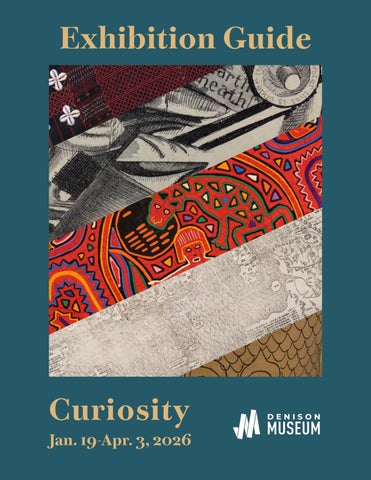
Step into a modern-day Wunderkammer, or cabinet of curiosities, drawn from the Denison Museum’s permanent collection. Originating in sixteenth-century Europe, these “rooms of wonder” brought together art, nature, science, and artifacts to inspire curiosity and reflection, long before museums emphasized classification, chronology, and authority. Today, when knowledge is frequently gauged by certainty, this exhibition returns to curiosity as a practice of discovery rather than conclusion.
At their core, Wunderkammern were formed by wonder. Philosophers have long understood curiosity as the beginning of knowledge, a way of learning that starts in questioning, embraces uncertainty, and remains open to discovery rather than fixed answers. Building on that idea, this exhibition favors curiosity over completeness and questions over conclusions.
So much of what we know, or do not know, guides how we interpret the objects around us. Our assumptions, training, and lived experiences shape what we notice and what we overlook. In organizing this exhibition, Denison faculty, staff, and students from across disciplines were invited to set aside their expertise. Instead, they selected objects based on instinct, aesthetics, and personal fascination. What happens, then, when a biologist, philosopher, musician, or artist encounters an unfamiliar object and simply follows their sense of wonder?
Begin with what catches your eye, then follow the questions that emerge. Through the selection of objects by people you know, unfamiliar works reveal unexpected connections and stories. We invite you to make your tour of our collection personal, let your curiosity lead the way, and contribute your own discoveries.

Shiri Noy
Eloul, Kosso 1920 - 1995
Shalom
Lithograph
Israel
20th Century 1967
DU1969.115
Denison University Purchase
Associate Professor of Sociology, Latin American, and Caribbean Studies
How did this object catch your attention?
I am normally drawn to more intricate, shiny art and objects, but I was struck by the starkness and clean lines of this print. I love the sculptures by this artist, who is Israeli and whose work is really stark. In a time of turmoil, I was drawn not only to the aesthetics of the object, but also its name: shalom, in Hebrew: peace.
What memories or emotions does the object evoke?
It evokes mixed emotions: a yearning for peace, a curiosity, sadness. It reminds me of how struck I was by Eloul's sculpture at Yad Vashem, the Holocaust memorial in Jerusalem.
What does this object remind you of?
It reminds me of an open door, crisp paper folds, and more comically, upside-down shorts.
What questions does the object raise as you look at it closely?
As an Israeli sculptor who participated in WWII and Israel's war of independence, I wonder what peace meant to Eloul. I imagine it must have meant a lot. I wonder why he chose red, when we associate blue more strongly with peace, and whether these sharp, clean lines are suggestive of peace to him.
What does this experience say about me?
While I have no expertise in art, I have curiosity, interest, and lots of ideas and questions. This experience reaffirms the importance of sitting with and thinking about an object, both as an aesthetic piece, and within its historical and other context.

Brick (case)
Italy
DU1945.59.49-56
Gift of Mary Hunt
Keith Spencer Chair, Visual Arts
How did this object catch your attention?
This thick and bulky piece, crowding up the museum painting stacks, felt out of place and imposing. I do prefer to think about this object as an abstract painting or even as random rocks encased for their own protection. I understand the significance of the entire object as it functions like a time capsule, but I’d rather think about its insignificance. I’m less interested in the bricks per se and more in how these items have been obtained, preserved, and presented. Bringing back bricks from Pompeii to me feels like trying to acquire and protect a piece of Elvis Presley’s first lock of hair. It seems silly, but it is a good thing art can afford to be absurd.

Berger
Abstract
Oil on canvas
United States
20th Century FIM2014.363
Paige Revering Student Engagement Coordinator, Knowlton Center
How did this object catch your attention?
The bright blocks of colors caught my eye and drew me to this painting. I felt like the painting spoke to me.
What memories or emotions does the object evoke?
I feel unexpected joy emerging from the bright colors in contrast to the calmness of the blue in the painting.
What does this object remind you of?
It reminds me of those days that you don't anticipate being wildly fun, but then a couple of surprises fall into place and all of a sudden you've had a day that is electric.
What questions does the object raise as you look at it closely?
I ask more questions about how the artist composed this visual symphony. Did they layer the paint? How so? How long did this take to make?
What does this experience say about me?
This experience shows that art is for everyone (even me)!
Is there anything else you would like to say about the object?
Thank you all for this fun experience! I really enjoyed it!

Slavin, Neal 1941Capitol Wrestling Corporation, Washington, D.C.
United States
20th Century 1979
DU1984.2.13
Gift of Mr. and Mrs. Lawrence Blau
Ron Abram
Professor of Visual Arts & Queer Studies,
John & Christine Warner Professorship, Visual Arts & Queer Studies
How did this object catch your attention?
As I've been exploring tropes of masculinity and Queer spectacle and erotica in Americana in my own etchings, Neal Slavin's Capitol Wrestling Corporation, Washington, D.C. (1979) photograph of wrestlers posed as a group in the shower immediately caught my attention.
What memories or emotions does the object evoke?
As the photograph was made in the 1970s (my teenage years), the image doesnt necessarily illicit the brutness of the wrestling sport, but a similar innocent charm and glee to photographs of men seen in 1970s Playgirl magazines and Bob Mizer's earlier Physique Pictorial publication celebrating bodybuilding culture as a Queer means with which to share homoerotic male males and evade charges of obscenity in the 1950s & 1960s.
What does this object remind you of?
The photograph reminds me of my own imagery of wrestlers found in my own etchings! My "Wrangler" series of prints, are "Tondi" (circular shaped) copper intaglio prints that draw from historical gay erotica source materials to not only explore intimate sexual relationships but offer commentary on power dynamics, gender roles and toxic masculinity in our current American political landscape. Drawing wrestling cowboys and vaqueros in these etchings, my goals are to reveal popular masculine mythologies and tropes, as Slavin does as well in his photographs.
What questions does the object raise as you look at it closely?
What are the stereotypes of masculinity in society? How are these identities performed? In what ways does Queerness inform our interpretation of the photograph from a contemporary perspective? In what ways does the space of the locker room shower and 70s wrestling costumes hint at other realms of kitsch, fetish, and gay erotica?
What does this experience say about me?
My studio practice is informed by seeking out photographic references and archives of imagery centered around the Queer themes of my work, often equally revealing my aspirations to connect the dots of sexuality, identity, and culture, past and present.

Cuna Woman with Child photograph
Republic of Panama Guna 20th Century
FIM2016.199.10
Andrea Lourie Assistant Professor, Global Health and Lisska Center for
Intellectual Engagement
How did this object catch your attention?
My eye was immediately drawn to the baby central to the picture. I was intrigued by the details of the women's clothing and jewelry. My curiosity was deepened by her pensive facial expression and reserved body posture.
What memories or emotions does the object evoke?
The baby's posture evokes a sense of comfort and security
What does this object remind you of?
I am drawn to photographs because they evoke nostalgia and I experience them as windows into or connections to the past. In this case, the photograph allows a glimpse of a mother and child in 1950s Panama.
What questions does the object raise as you look at it closely? The object raised several questions for me. I was interested in the relationship between the two subjects and the circumstances surrounding the image's creation. Specifically, I wondered if the woman was the baby's mother, a sibling, or another caretaker (the labeling does say mother with child). The baby's relaxed appearance suggests a close and familiar bond with the person holding them. This led me to question the woman's demeanor, as she appears apprehensive perhaps hesitant or uncomfortable being photographed which prompted me to consider who was behind the camera and what the original purpose of taking this specific picture might have been.
What does this experience say about me?
I am curious about connections and glimpses of "real life" in art. I find photography to be a meaningful medium for exploring the past. I am drawn toward themes related to mother-child relationship and the universal experience of human life across different eras and in different cultures.
Is there anything else you would like to say about the object?
It was interesting to learn that the photographer was a behavioral genetics researcher and Denison alumnus, Dr. Clyde Keeler '23, who studied albinism in Panama in the 1950s.

Hokusai, Katsushika 1760 - 1849
Badger (Reproduction)
Woodblock
Japan
19th Century
DU1948.9
Gift of Dr. Gwladys Spencer, Denison University Class of 1922
Joshua Gory
Assistant Director, Career Exploration and International Student Support, Knowlton Center for Career Exploration
How did this object catch your attention?
I love ukiyo e, animals, and tea so it naturally grabbed my attention!
What memories or emotions does the object evoke? It feels very warm and natural. I also lived in Japan so it stirs up memories of my time there.
What does this object remind you of? It reminds me of a cozy, midwinter day.
What questions does the object raise as you look at it closely? Was this a badger that shapeshifted into a human to steal food and tea? What inspired the artist to choose the setting and a badger?
What does this experience say about me? It shows some interests of mine: animals, food, Japanese culture.

Matt Tanney
Vice President and Director of Athletics
Neiman, LeRoy 1927 - 2012
Archie, Ohio State Buckeye Serigraph
United States
20th Century DU1984.5
Gift of Harris G. Gorab, Denison University Class of 1970 and Michele Hallier Gorab, Denison University Class of 1971
How did this object catch your attention?
Connectivity to Sport.
What memories or emotions does the object evoke?
My father coached HS football for 25 years; we spent lots of time together on a football field.
What does this object remind you of?
The intensity of rivalries.
What does this experience say about me?
Lived a life in sport!

Stained Glass Doors
Wood frame and two stained glass FIM2014.236a-c
John Soderberg Associate Professor, Anthropology
How did this object catch your attention?
Generally, I love ways that stained glass tells stories and sets atmosphere. But, this object also has additional stories to tell as people have altered an "ancient" item to fit into a "modern" window setting. Windows upon windows...
What memories or emotions does the object evoke?
Medieval art was an important intellectual beginning for me. I remember learning in one of my first art history classes about Pseudo-Dionysius the Areopagite, a mystic who believed that light is a divine force transforming the world, an idea that fueled thinking how windows make space sacred. Something clicked for me about how art transforms by directing attention and feeling.
What does this object remind you of?
Beyond whatever the original intent of the windows, they were found by someone who thought the windows were valuable and expressive. That led to the windows being reset and brought across the Atlantic. The object clearly has so many layers of story to tell. The windows remind me how many lives objects live and how much we can learn by knowing those lives.
What questions does the object raise as you look at it closely?
I first saw that an ecclesiastical figure was a focal point in both windows, so assumed that the animal in the circular setting above the figures would be a lamb (symbol of Christ). The animal looks more like a dog. I'd love to know why/how a dog ended up in that unusual spot.
What does this experience say about me?
Lord only knows. My wife would say it explains why our house has so much clutter.
Is there anything else you would like to say about the object?
Based on a quick glance at the records, my impression is that we don't know much about the stories this object has to tell. It is so easy for them to be lost. Thanks for all the work curating them.

Min Ji Kang
Mask Paper mache 20th Century Korea
FIM2015.211
Visiting Assistant Professor, Women’s and Gender Studies
How did this object catch your attention?
I was surprised to see objects from South Korea and this one particularly caught my eye due to its vibrancy.
What memories or emotions does the object evoke?
It brought back memories of seeing traditional Korean masks in museums and performances.
What does this object remind you of?
It reminds me of other Korean traditional masks like the Hahoetal.
What questions does the object raise as you look at it closely? What performance was this mask used for and what were the roles of this character?
What does this experience say about me?
This object brought me back to my home culture of South Korea and childhood memories of going to see similar objects in museums and performances. I remember the performances to be very emotional, and also ways for civilians to make social and political commentary, so I found them to be very engaging. Thank you for giving me the opportunity to see this object!
Is there anything else you would like to say about the object?
Here's some more info I found on the label on the back of the mask! This is a 강령탈(姜嶺脱) Gangryeong Tal, a traditional Korean mask used in 강령탈 춤 (Gangryeong Talchum), a folk mask-dance drama from the Hwanghae Province region. Gangryeong Talchum is one of Korea’s most important mask-dance traditions and is recognized as National Intangible Cultural Property No. 34 (중요무형문화재 제34호). So, this isn’t just a decorative mask; it’s connected to a nationally recognized cultural heritage performance tradition.

Cristina Dorda Soriano
Kimono
Japan
20th Century circa 1960
FIM2015.259
Academic administrative assistant, Departments of music, dance, and theatre
How did this object catch your attention?
It caught my attention because it’s the only Japanese kimono in the Museum’s collection. I’ve always been fascinated by Japanese textiles and fashion, so seeing this piece immediately drew me in.
What memories or emotions does the object evoke?
This kimono makes me think of all the textile artists and the ancient techniques applied to finalize this piece. I feel a lot of admiration to the craftspeople that applied their knowledge to create this piece. It is much more complicated than it looks, and learning how to weave, dye or sew requires years of experience and mastery.
What does this object remind you of?
It reminds me of sakura (桜), the cherry blossom. Even though this kimono is a hitoe (unlined and typically worn during the summer months), the lightness of the fabric and its crepe-like texture evoke the feeling of cherry blossom petals gently falling on a sunny spring day.
What questions does the object raise as you look at it closely?
I wonder how a 60s Japanese woman would have styled this kimono. Like in Western fashion, Japanese kimono is styled differently over the decades.
What does this experience say about me?
Fashion and art are deeply interconnected, and that’s my professional background as well. Since childhood, I’ve felt a strong attraction to Japanese traditional arts and, as a result, to Japanese fashion. I’m a strong advocate for textile arts, which have often been created by women working anonymously, and I believe they deserve as much recognition as any visual art form. This piece brings together three of my greatest passions, and I hope you enjoy it as much as I do!
Is there anything else you would like to say about the object?
This kimono is considered a komon, meaning it features an overall pattern design. That makes it suitable for casual occasions. The pink tones and sleeve length suggest it was designed for a young woman. What I love about Japanese kimono is how each one tells a story: about the season, the theme, and the person wearing it. It’s a beautiful form of non-verbal communication.

Puppet and Box
Wood, paint, cotton, velvet, beads, sequins, cardboard Republic of Indonesia
20th Century
DU2010.5.116a-f
Gift of Selina Large in memory of Ronald K. Large Republic of Indonesia
Alan Miller Professor of Practice, Journalism
How did this object catch your attention?
This puppet looks like those my wife and her parents collected when they lived in Indonesia in the 1970s. We still have some of them, and I have always been intrigued by them.
What memories or emotions does the object evoke?
I was drawn to it instantly because it is so familiar, but it also generated curiosity about the role and purpose of this particular puppet in Indonesian art and culture.
What does this object remind you of?
It reminds me of family stories about travels to fascinating places -- and the importance of learning about other cultures.
What questions does the object raise as you look at it closely?
What is the role of this particular puppet and such puppets overall in Indonesian culture? I've seen similar puppets mainly as artwork in our house, but I should know and would like to know more about their larger purpose.
What does this experience say about me?
I appreciate art and learning about other cultures -- and I have a lot to learn.

Bean, Augustus 1850-1926 Walton, Rudolph 1867- 1951
Seal Effigy Bowl
Carved wood with abalone and bone
United States Northwest Coast, Tlingit
Late 19th Century - early 20th Century c.1870
DU1967.118
Gift of Dr. James Grimes
Julia Lerner
Managing Editor,
The Reporting Project Journalism
How did this object catch your attention?
This object caught my attention because of how ornate and detailed it is. The carved bowl includes abalone and bone, and is decorated with traditional Tlingit and Haida designs.
What memories or emotions does the object evoke?
I used to live on the far west coast of Alaska and interacted with Indigenous communities across the state. This bowl reminds me of my time working in remote villages with people who have been there from time immemorial.
What does this object remind you of?
It reminds me of the cultural seal harvests in western Alaska.
What questions does the object raise as you look at it closely?
I want to know when it was used, and why. This isn't always clear with effigy bowls, and I'd like to know more about their history.

Buddha Myanmar
DU1969.227
Gift of Captain Ralph McCoy
Andy McCall
Associate Professor, Biology
How did this object catch your attention?
I have studied and practiced Buddhist meditation for many years, and I knew that the museum had a extensive collection of Buddhist-related work. Megan took me on a tour of the collection and this particular object stood out because I am used to seeing the image of the Buddha that is more upright, more slender, and without a hat or cap. It made me wonder where the carving was from, for whom it was made, and how it got to Granville Ohio.
What memories or emotions does the object evoke?
It reminds me of a large Daoist sculpture that I visited in my youth in the St. Louis Art Museum - the same calm serenity is seen in this Burmese work, and it makes me feel more grounded, just by looking at it. I immediately wanted to pick it up and take it home! I later learned that these sculptures were not for monasteries but were placed in peoples' homes to protect against fires.
What does this object remind you of?
The Daoist sculpture from St. Louis, as well as a small painting of Buddha that my brother made for me many decades ago.
What questions does the object raise as you look at it closely?
I wondered how it was made and what type of wood it was made from. The traditional wood is from the fig tree, but I read that this is hard to come by. I also wondered what the people who owned the piece were like - were they farmers, city dwellers, were they a family, were they happy in their life? Also, did they adorn the Buddha with flowers or offer incense, and was Buddha in a home shrine? I also was very curious about the lotus leaf 'cap' that is on top of the Buddha's head and his apparent lack of a neck. After research, I found that the cap refers to a time when the Buddha was
suffering under intense sunshine, and was given the hat as protection; he is shown bending his neck down or lower because of the sun. So it was good to learn that he still had a neck!
What does this experience say about me?
I think I learned that I really like wood images, even though I don't have any - most artwork that I have are paintings or drawings. There is something really palpable about a small wooden statue - and because it is made from a tree, I think it resonated with me as I am plant ecologist who spends a lot of time in the forest.
Is there anything else you would like to say about the object?
I wish I could take him home!

Guna
Birth of Snakes Mola
Cotton appliqué and reverse appliqué with embroidery Republic of Panama Guna 20th Century DU1972.366
Gift of Dr. Clyde Keeler, Denison University Class of 1923
Camille Lerner
Theatrical Designer - Eisner Center

Snuff Bottle Japan 20th Century DU1987.192
Gift of Martha H. O'Dell and Anne H. Turner in memory of their parents William Thomas Halligan and Mary Louise Clements Halligan
Meghan Ulsh Vice President for Enrollment Management
How did this object catch your attention? This item's delicate, yet intricate design caught my eye
What memories or emotions does the object evoke? appreciative wonder
What does this object remind you of?
Floral design on porcelain always makes me think of "grandma coffee." Growing up, my grandmother maintained a tradition that early risers could join her and my grandfather for coffee. She kept small tea cups and saucers that she would serve us coffee, which actually consisted of a thimble of coffee with sweetened milk. My adult self still much prefers this version.
What questions does the object raise as you look at it closely?
My questions primarily focus on the idea of snuff bottles and the practical use vs the ornamental decoration of the small work of art.
What does this experience say about me?
I'm not sure. I'm just a sentimental woman who enjoys porcelain.

Julia Kolchinsky Assistant Professor, English
Miebach, Nathalie (b.1972, Zeven, Germany, lives Boston, MA)
Riding the Deluge
United States
early 21st Century 2019
DU2020.1.1
Denison University Purchase
How did this object catch your attention?
I loved the unrestrained mixed-media elements of this piece. Its threedimensional taking up of space, dynamic movement, and combination of language, measurements, and sculpture caught and held my attention.
What memories or emotions does the object evoke?
It made me think back to my son's childhood when I would call him Hurricane for his unrestrained impulsivity. I didn't know then that it was due to his neurodiversity. It also reminded me of experiencing the F3 tornado in Little Rock, AR, during which I sheltered in my basement and witnessed the outer ring of the storm take out all the hundred-year-old oaks in my backyard.
What does this object remind you of?
The piece reminds me of a question in and of itself. From just looking at it, I wouldn't have known it was meant to be a storm, but the effect, upon seeing it, is certainly one of overwhelm since the piece seems to be kind of incomprehensible with its array of information and the way the information is in motion. I really didn't want to stop looking at it and delving deeper into its questions.
What questions does the object raise as you look at it closely?
What is a storm? How can something that is both literal and figurative be captured in a material way? How can we capture or portray its effects which are so far reaching and varied?
What does this experience say about me?
Perhaps that art which most compels me asks more questions than provides answers. I really appreciate things that inspire feelings first, and then I have to sit with them a bit longer for a deeper understanding. This, of course, makes sense, given that my art of practice is poetry, which for me is just that, a question that makes us feel something, and then that feeling leads us to ponder over meaning.

Diana Mafe Professor, English
Face Plaque Nigeria 20th Century DU1976.1
Gift of Richard W. Tucker, Denison University Class of 1962
How did this object catch your attention?
I grew up in Nigeria, where my father was from, and own a few Nigerian masks and sculptures. So I was looking specifically for Nigerian masks in the Denison collection and was delighted to find this one.
What memories or emotions does the object evoke?
Nostalgia and memories of childhood, including visiting markets where artisans sold woodcarvings.
What does this object remind you of?
Other famous Nigerian pieces include the Bronze Head from Ife and the Benin ivory masks.
What questions does the object raise as you look at it closely?
Who was the model for this plaque? Was the plaque intended only for display and carved in order to be sold? Or did it have another function? Is the facial expression blank or almost smiling?
What does this experience say about me?
I was looking for something familiar and connected to my Nigerian heritage.

Buddha cast
Myanmar
P67.280
Denison University Purchase
Myanmar
Abbey Nickerson Collections Manager, Denison Museum
How did this object catch your attention?
I immediately noticed this object because its head was missing.
What memories or emotions does the object evoke?
I felt a familiar sense of dread, wondering how an object like this could lose its head. I thought immediately of what I have heard about statues that are missing limbs or parts.
What does this object remind you of?
It reminds me of the footless Khmer sculpture on the cover of Christie’s 2011 auction catalogue. It reminds me of the headless Parthenon Marbles and the armless Venus de Milo. It reminds me of the disembodied arms, legs, and feet that litter the floor of the Rembrandt House Museum.
What questions does the object raise as you look at it closely? What brought this statue here? How was the head lost? I think back to last spring’s exhibition, and I am reminded of the work of Carey Newman and the questions it asks of the viewer. What is present in the absence? What is absent in presence?
What does this experience say about me?
I don’t know what this says about me. I think these are the questions anyone would ask when faced with an object that is so clearly severed from such a necessary context, like its head.
Is there anything else you would like to say about the object?
Museums ask their visitors to consider the past lives of their objects. To imagine their context and to pose questions. This object lends a visitor the opportunity to question the relationship between the object and the museum.

Mosaic Fragment mosaic
Italy
DU1945.59.2, DU1945.59.7
Gift of Mary Hunt

Jessica Kirsner Assistant to the Director, Annual Fund, Institutional Advancement
How did this object catch your attention?
I have been fascinated by Pompeii since I was a teenager, and when learning we had mosaic pieces from Pompeii made me so excited!
What memories or emotions does the object evoke?
It definitely makes me think of the Pompeii song by Bastille (and now I *will* have it stuck in my head the remainder of the day). I always feel a sense of reverence when I think of Pompeii: not exactly mourning, since the folks killed in the disaster would be long -dead by now, but a sadness for how scared they must have been in their final moments, and a deep respect for all we have been able to learn about their society because of the disaster.
What does this object remind you of?
How connected humanity is to our past: zooming in to these small fragments, and if just looking at the front, it almost looks like something that could have come off of my kitchen wall instead of something made almost 2,000 years ago. It is easy to think of people in the past as fundamentally different from humans today: driven more by instinct and base need, more violent or cruel. But we are more connected to folks in the past than that, and more similar to them: and one of those ways is we've always been driven to create and live in beautiful spaces, however we can.
What questions does the object raise as you look at it closely?
How did they get the tiles so regular? How big was the full mosaic - and where was it? Maybe a bathhouse or a home, or a temple of some sort? Did the same person who made the tiles design the mosaic? Did they lay it themselves, or with a group?
What does this experience say about me? It shows a little bit of what's important to me and mostly what excited me that day.

Wheatstone Bridge Wood, plastic, brass United States early 20th Century S2009.1.104
Heather Rhodes Professor Biology, Neuroscience, and HESS
How did this object catch your attention?
I wanted to touch it right away - to move the pegs around the blocks, to read the labels and think about how it was used.
What memories or emotions does the object evoke?
This object evokes the feeling I often get around scientific equipment that I don't know how to use yet - curious and excited, but also a little anxious and unsure. Scientific equipment can be intimidating, even though I'm a trained scientist.
What does this object remind you of?
I like the way the columns of blocks are labelled "tenths, hundreds, thousandths" and the rows then have numbers on them to form a grid of measurements. It reminds me of how old balances work, where you slide the weights across. I like the efficient, analog means of organizing numbers.
What questions does the object raise as you look at it closely?
There's a little equation engraved at the bottom center, and some variables are represented elsewhere on the box. I want to puzzle out how it works, and I feel like I almost can, but I don't quite have enough information.
What does this experience say about me?
I'm a tinkerer in lab, and looking at some of the older pieces of scientific equipment was really fun. You can see each objects' purpose more than you can with modern equipment, wrapped in a metal box with a digital screen.

Meagan Tehua
Lacquered Myanmar
20th Century DU1968.60a-f
Academic Administrative Assistant, International Studies
How did this object catch your attention?
The beautiful and useful stacked containers were almost hidden at first glance.
What memories or emotions does the object evoke?
The idea of transporting food in a stacked container reminded me of picnics or taking workers lunch.
What does this object remind you of?
It reminds me of a modern bento box or Tupperware set, easily transported with a handle!
What questions does the object raise as you look at it closely?
What is happening among the figures around the piece?
What does this experience say about me?
I appreciate functionality.

Rank Badge (buzi)
Embroidered, metallic leaf China
late 19th Century - early 20th Century late Qing Dynasty - early Republican Period DU1972.966
Gift of Dr. Robert and Juanita Fischelis
HyeKyung Lee Associate professor, Music
How did this object catch your attention?
It caught my attention immediately because it was simply beautiful with its shapes and colors.
What memories or emotions does the object evoke? To me, it symbolizes freedom and confidence.
What does this object remind you of?
It reminds me of something superior, existing between clouds and waves, controlling over other existences in the sky.
What questions does the object raise as you look at it closely? It gives me rather answers than questions, "don't worry, be free".
What does this experience say about me? If there is any, it would be "believe in yourself".
Is there anything else you would like to say about the object? Not really; it’s the pure beauty of the art object that attracted me. But it's a story that husband and wife wore the same badge (but mirrored), so when they sat together (wife sat on her husband's left), their creature would be facing each other, moving.

Meredith Klinzing ‘26
Museum Intern
Bottle Cloisonne enamel on metal China
18th Century DU1989.13a-b
Gift of William Hensley China
Economics and Sustainability & Environmental Studies double major
How did this object catch your attention?
The bright colors immediately caught my attention. I also loved the details and patterns within the piece.
What memories or emotions does the object evoke?
The bottle evoked a feeling of peace and freedom. I generally view birds as a symbol of freedom, but the colors added another dimension by making it more ornate and beautiful, and ultimately elevating its appeal beyond a symbolic one.
What does this object remind you of?
The object reminds me of stained glass by incorporating bright colors and detailed designs.
What questions does the object raise as you look at it closely?
I wonder how function and beauty relate in this piece. Its function is as a bottle, yet its outward beauty suggests that it may have been valued for its aesthetics as opposed to its purpose. I wonder what the bottle was actually used for.
This experience has shown me that I tend to gravitate toward brightly colored, detailed art pieces. I also value emotional connection and associated symbols when I feel particularly drawn to a piece.

Robin Brown
Rivera, Reverend Atilio Nuchu
Hand carved; painted Republic of Panama Guna 20th Century DU1972.51
Gift of Dr. Clyde Keeler, Denison University Class of 1923
Retired Academic Administrative Assistant, Women's and Gender Studies
How did this object catch your attention?
This uchu was donated by Dr. Clyde Keeler '26, a geneticist who studied the high prevalence of albinism amongst the Guna on the San Blas Islands off the coast of Panama. I remember Dr. Keeler visiting my parents, Michael & Marilyn Jung '58, in Granville on our porch at 220 Thresher St. My dad, art professor and director of the art museum at the time, proposed a sabbatical to film a Guna menstruation rite. In 1973, my family drove to Panama, flew to the island of Narganá, and spent a month with the Guna. On March 9, 1973, we took an outrigger canoe from Narganá to an island where we met the Nelle, the Medicine Curer, who told us all about her uchus. This uchu reminds me of ones she had in her palm-thatched hut.
What memories or emotions does the object evoke?
This uchu represents power (Uncle Sam with an American eagle on his head) and evokes memories of witnessing the westernization of Guna culture on the island of Narganá.
What does this object remind you of?
Symbolically, the uchu reminds me of my great-great-grandfather, Albert Berger, who worked as a carpenter on the Panama Canal from 1905 to 1926.
What questions does the object raise as you look at it closely?
I wonder who made the uchu and how the person who created it used its power.
What does this experience say about me?
I am grateful to my parents for their adventurous spirit and for the experience of living close to nature with the Guna peoples on the San Blas Islands when I was twelve years old.

Canoe dugout canoe Republic of Panama Guna 20th Century DU1971.675
Gift of Dr. Clyde Keeler, Denison University Class of 1923
Amy Butcher Associate Professor, English
How did this object catch your attention?
It is, admittedly, difficult for a life-size canoe not to catch one's attention, especially when placed among rows of paintings, photographs, and pastels. To see an enormous boat is to see mostly possibilities: to float, to fish, to flee. Each offers its own suggestion, its own implication on how next to move.
What memories or emotions does the object evoke?
When I was a child, my mother and I got caught in a rainstorm in the middle of a lake, our red canoe a rental and already overdue. Despite each stroke of our paddles, we remained motionless in that storm's wind. The rain fell hard and heavy. But mostly I remember my mother: her face, her exasperation, and then her gradual surrender to what would be, and remains, one of her daughter's core memories.
What does this object remind you of?
A Panamanian canoe, known as a cayuco, is a traditional dugout canoe carved from a single tree. But it reminds me of our bodies: how many trees, by contrast, each one of us are carved, shaped, from.
What questions does the object raise as you look at it closely?
This Panama canoe despite contributing very minimally to global emissions, Panama is disproportionately vulnerable to its effects—its people, land, and ways of life are threatened by ongoing and extreme droughts, rising sea levels, and more intense and damaging storms, forcing the relocation of communities and threatening coastal areas, ecosystems, and traditional ways of life.
What does this experience say about me?
I will always be the one who floats.

Micaela Vivero Professor, Visual Arts
Ceremonial Hat (Kurkin)
Reeds woven and painted Republic of Panama Guna 20th Century DU1971.652a-c
Gift of Dr. Clyde Keeler, Denison University Class of 1923
How did this object catch your attention? It caught my attention because of its intriguing shape connected with an unexpected use. The scale is also remarkable, in particular thinking that the object becomes an extension of the body.
What memories or emotions does the object evoke? Of familiarity.
What does this object remind you of? It reminds me of something handmade. It also reminds me of the birds the used feathers come from.
What questions does the object raise as you look at it closely? What significance does the object have for the people who used it?
What does this experience say about me? I'm intrigued by objects.


Spindle
Republic of Panama Guna 20th Century
DU1972.131
Gift of Dr. Clyde Keeler, Denison University Class of 1923
Tunic (Sandoway)
Myanmar Chin early 20th Century
P67.34
Gift of Reverend L.W. Spring and children
Myanmar
Discussed but not on view
Breton, Jules 1827 - 1906
Brittany Girl Oil on canvas France
19th Century 1872
DU1946.442
Gift of Edmund G. Burke
Rhodora Vennarucci
Assistant Professor Ancient Greek and Roman Studies
How did this object catch your attention?
I work on ancient crafts production and have a special interest in the textile industry, where women, who were marginalized in Roman society, were especially visible. As a spinner myself, I was drawn to Jules Breton's Brittany Girl (1872). While her humble status is reflected in the workspinning flax - and her barefeet and clothes, she is regal. Enthroned in the coastal landscape, she teases flax from a distaff leaning against her left shoulder like a scepter or a spear, and as she spins the flax into thread with the drop spindle in her right hand, she stares into the distance with the cool disinterest of a classical Greek sculpture. Inspired by the Brittany Girl, I asked the director if there were textile tools in the collection, and selected a cotton spindle, weaving bat, and back -strap loom from Guna, along with a
photo of a Guna woman spinning cotton with a thigh spindle. I knew nothing about Guna before this, but was surprised to learn that they are a matrilineal society and that textile production is key to their cultural identity and economy. I also selected a gorgeous early-20th-century Burmese tunic hand-woven from cotton and silk, and a 19th-century photograph of two women weaving silk on a traditional multi-heddle loom. The photograph emphasizes the co-crafting and social nature of textile production. The Burmese tunic echos the colorful patterns on the Brittany Girl's clothes.
What memories or emotions does the object evoke?
These objects invoke a lot of embodied memories of spinning. When I look at Brittany Girl or the Guna spindle, I can feel my own wooden spindle in my hand, the weight and rotation of it as it turns, the repetitive movements of spin, pull, spin, pull, spin, wind, spin, pull. The emotion I feel most strongly is pride - pride in learning a craft that weaves women together across cultures. And maybe a sense of loss. The materials of the toolswood - and cloth - cotton, silk, wool - underscore their impermanence, as organics decay and rarely leave a trace in the archaeological record.
What does this object remind you of?
I am currently studying an assemblage of loomweights from the Roman minor center of Podere Marzuolo in Tuscany, Italy, and so can't help but draw connections back to the ancient Mediterranean World. While looking at the Brittany Girl, I thought immediately of a Latin epitaph commemorating a Roman woman names Claudia (c. 135 -120 BCE) (CIL 1.2.1211):
Hospes, quod deico paullum est; asta ac pellege. Heic est sepulcrum hau pulcrum pulcrai feminae.
Nomen parentes nominarunt Claudiam.
Suom mareitom corde deilexit souo. Gnatos duos creavit, horunc alterum in terra linquit, alium sub terra locat.
Sermone lepido, tum autem incessu commodo. Domum servavit, lanam fecit. Dixi. Abei.
Friend, what is written here is short stop and read it. This is the ugly tomb of a beautiful woman. Her parents named her Claudia She loved her own husband with her whole heart. She had two sons and leaves one of them On the earth, but placed the other beneath it.
[She was] charming in conversation; but proper in behavior. She served her house, she made wool. I have spoken. Go Away.
The phrase "domum servavit, lanam fecit" (She served her house, she made wool) represents the idealized roles of Roman women - domestic industry. But in the ancient Mediterranean world, textile skills could also be a form of female agency and resistence. I think of Penelope from Homer's Odyssey, who holds off a gaggle of suitors for 20 years by weaving and unweaving a burial shroud for her husband Odysseus or a letter from Roman Egypt in the 2nd century CE that complains about enslaved female weavers striking for higher wages (P. Brem. 63, transl. R. S. Bagnall – R. Cribiore).
What questions does the object raise as you look at it closely?
In these objects, we can see representations of textile production in Central America (Panama), Europe (France), and Asia (Myanmar) in the 19th and 20th centuries. I am interested in comparing traditional textile production practices across cultures - I see, for instance, similarities in the drop spindle (Brittany Girl and Guana spindle) but differences in the loom (back strap vs. multi-heddle). There is evidence for cross-craft interaction here: who carved the wooden spindles, weaving bats, and loom beams? Did textile workers also have woodworking experience? I am also curious what insights the tools, photos, and finished products can reveal about women's labor. Supposedly, it takes ~5 hours of spinning to produce enough thread for 1 hour of weaving. Could we work backwards from the Burmese tunic on display to estimate the number of weaving, dyeing, and spinning hoursin short, the amount of women's labor - that went into producing this garment? How did textile work shape women's bodies (e.g., carpal tunnel from spinning or back injury from backstrap loom weaving)? While Brittany Girl is shown spinning alone in an isolated landscape, the women from Amarapura weave in a pair, which is more typical - textile work was communal labor. When you look closely at the tunic, can you tell the difference in the material (cotton vs. silk)? Can you learn anything about how the cloth was made from the fabric's details?
What does this experience say about me?
The experience of selecting objects for this exhibit? I think this experience reflects my personal and professional interests as a female archaeologist whose research focuses on the socio-economic history of the Roman world with a commitment to a "bottom-up" approach to reconstructing past narratives. I guess these objects say that I am a woman who seeks connection with other womena cross time, space, and cultures through
shared craft.
Is there anything else you would like to say about the object?
Only that in selecting these objects from the collections, I was inspired to go learn more about the cultures that produced them. I hope the viewers are inspired to do the same

Lens
Wood, glass
Demonstrative Physics Equipment early 20th Century S2009.1.51
Bevin McGuire Peppard
Academic administrative assistant, Women’s and Gender
How did this object catch your attention?
I think it is a combination of my love for vintage/antique scientific objects, as well as vintage/antique hand mirrors (preferably Victorian and either ebony or wood, painted black. There are currently 27 hanging in my bathroom. I am a collector of many different types of objects, and I find myself, more and more, attracted to objects I have not seen before.
What memories or emotions does the object evoke?
It reminds me of my parents - my father is a retired biology teacher and my mother has a background in fashion design, specifically time period accurate dress. Going to flea markets was (and still is) a regular occurrence, as was camping and hiking. Exploration and education were instilled from an early age. It is the excitement of the hunt for new or previously overlooked aspects of our surroundings in a lived experience manner.
What does this object remind you of?
A large, strangely shaped, magnifying glass.
What questions does the object raise as you look at it closely?
What is it and what was it used for? I believe this is part of a Zograscope, which was used to create the optical illusion of dimension on flat images (old school 3-D glasses?). Early versions date as far back as the late
1700's. In modern terms, this would likely not be considered a "scientific instrument." Historically, however, it may have been considered so or considered an "act of magic."
What does this experience say about me? I think it says that I am still curious and hungry to know more.

Chris Weingart Associate Professor, Biology
Hot Pepper Nuchus Republic of Panama, Guna 20th Century DU1972.168
Gift of Dr. Clyde Keeler, Denison University Class of 1923
How did this object catch your attention?
As a microbiologist, I’m especially interested in diseases caused by microorganisms. I found it interesting to see wooden idols historically used to prevent microbial diseases.
What memories or emotions does the object evoke? Curiosity, respect, fascination
What does this object remind you of? A protective talisman or doll.
What questions does the object raise as you look at it closely? What plant was used to create the carving? How is red pepper involved?
What does this experience say about me?
I'm interested in learning new things.

Collar (child) embroidered China early 20th Century DU1947.164
Gift of Mary Thresher Beaver
Marla Krak Arts Engagement Coordinator & Vail Series Assistant Director, Arts/Vail
How did this object catch your attention?
How colorful and beautiful this would have looked on a small child.
What memories or emotions does the object evoke?
I remember my mom creating all kinds of things with her hands when I was young - crocheting, cross stitch, sewing, macrame, embroidery - and her work was just so calming, beautiful, and perfect. Knowing this piece was created for a child, perhaps my a mother's loving hands, reminded me of my mom creating beautiful things for me to wear.
What does this object remind you of?
It reminds me of a loving mother creating something beautiful for her child. In my childhood time, that may have been a bib, or a handkerchief.
What questions does the object raise as you look at it closely?
I'm wondering if this was created for a boy or girl? The insects would indicate a little boy, but the beautiful floral patterns would indicate this might have been for a little girl.
What does this experience say about me?
I often don't take the time to ponder over my emotional response to viewing art, and this experience guided me through that, for which I'm grateful.

Dugout canoe model Republic of Panama Guna 20th Century DU1972.143
Gift of Dr. Clyde Keeler, Denison University Class of 1923
Margaret Simpson ‘26 Museum Intern International Studies
How did this object catch your attention?
The canoe which this is a model of- has always caught my attention due to its large size and vibrant color.
What memories or emotions does the object evoke?
Because this is a miniature canoe or a model canoe it reminds me of childhood. I would craft a makeshift boat out of pieces of wood glued together and place it on the water to see if it floats.
What does this object remind you of?
It reminds me of the small colorful sailboat that the child sails in "Where the Wild Things Are".
What questions does the object raise as you look at it closely?
Why was a model replica of the larger canoe made? Was it made for the collector? How many years are these ulus or canoes meant to last. Do the colors have any significance. How and why is the Denison Museum in possession of the larger ulu?
What does this experience say about me?
I am a very curious individual. I am fascinated by different cultures and woodworking/ wood carving. Objects/designs carved of wood were not created to be permanent. Wood naturally decays overtime- this fact sometimes seems to stand in direct opposition to the goal of preservation. I think that contradictions like these are interesting.

Hand carved; lacquer; glass inset
Thailand 19th Century
DU1974.38
Gift of Sarah Bekker and Konrad Bekker
Thailand
Kris Leichtenberg Desktop Support, ITS
How did this object catch your attention?
There were so many objects to choose from, but this carved sculpture jumped out at me, with it's piercing eyes and intense mouth and teeth. It's kind of creepy! Also, the glittering objects on the sculpture itself are eye catching.
What memories or emotions does the object evoke?
For some reason when I first saw the sculpture it reminded me of the opening scene in the Exorcist 1973, when Father Merrin the priest is part of an archeological dig in Northern Iraq and he sees and evil spirit apparition rise up above the landscape.
What does this object remind you of?
I did not know the name of the evil spirit from the Exorcist, so I looked it up, and it's called Pazuzu, the king of the demons of the wind.
What questions does the object raise as you look at it closely?
Why is the sculptures hands and feet bound so tightly together? What is the deal with the tail that is wrapped around the sculpture.
What does this experience say about me?
I'm guessing the scene from the movie the Exorcist has some lang lasting memories for me, probably because I thought the movie was horrifying when I was a kid.

Brick clay, ceramic, mold made and sun-dried United States 18th Century DU1945.59.11
Gift of Mary Hunt
Jessica Hall Director, Industry Partnerships, Knowlton Center
How did this object catch your attention?
When we were touring the museum collection, I was drawn to the various bricks, tiles, and stones/blocks -I was surprised that we had these types of objects in our collection. This object is just a small part of a larger building/ structure. It made me wonder - what did it look like, where was it located? I was particularly drawn to this object because it represents an important time in our nation's history - Colonial America & the Revolutionary War.
What memories or emotions does the object evoke?
Joy! I have very fond memories from my childhood of traveling with my aunt and uncle to Boston (where my uncle grew up), and of my maternal grandparents taking my cousin and me to many cities with deep roots in the founding of the United States of America.
My grandfather loved American History. He was always reading about different countries, cultures and communities which instilled in me a passion for learning about history as a way to better understand our world today.
On our trips we didn't visit traditional museums like the Smithsonian but we visited historical places like Fort Sumpter in Charleston and Plymouth Rock Massachusetts, and homes like Mount Vernon and Monticello. I enjoyed all our trips and seeing historical sites in person. Hearing stories about real people from the docents and witnessing original artifacts in the buildings brought history to life for me; not just stories in my social studies text book but in real life.
What does this object remind you of?
This object reminded me of a house we visited in Philadelphia that was not
restored but it was an old brick row house in downtown Philly. All the brick was exposed so it was a much different type of home tour than those that are restored/preserved. Rather than viewing it as it was in the 1700s or 1800s, we were viewing materials they excavated from the home and how archeologists were finding and preserving colonial artifacts. It was raw and memorable to see where they were uncovering pieces of history.
What questions does the object raise as you look at it closely?
I wonder about the people that lived in the house or worked in the building that was built with this brick. Why did they come to America, what did they sacrifice to get here and how did feel about Revolutionary War?
What does this experience say about me?
It seemed odd to pick such a simple object, not a typical work of art, but I was surprised by how quickly I connected to the object because of my own personal experiences. It reminded me how I came to love history and why I value understanding the historical context of current events. Learning about the past, especially when we push ourselves to understand it from multiple perspectives, increases our capacity to broaden our view of current events.
I try to approach any topic, issue, idea with an open mind - asking many questions to understand multiple perspectives and to better understand the complex historical context. The issues we face in our society today are messy, complex and complicated - which is the same as it was for the colonists in the 1700s.

Justin Rodriguez
Media Technology Specialist ITS
Guna
Adam and Eve Mola
Cotton appliqué and reverse appliqué with embroidery Republic of Panama Guna 20th Century Before 1968
DU1972.358
Gift of Dr. Clyde Keeler, Denison University Class of 1923
How did this object catch your attention?
I loved the color scheme and also the story of Adam and Eve's creation. The artwork is from Central America, specifically Panama, which is my country's neighbor (Costa Rica). I loved the design and the story behind the creation of the artwork.
What memories or emotions does the object evoke?
It made me feel curious and full of wonder. I have not had the chance to see too much artwork from the region that I grew up in since I left at such a young age. It made me feel happy and to see something that is vibrant and full of soul that is hard to put into words.
What does this object remind you of?
The piece reminds me of Perus crafted stitch sweaters, but with more of a story to tell. Central American countries are usually roman catholic, and this piece depicts one of the first stories told in Genesis, and that's the fall from the Garden of Eden.
What questions does the object raise as you look at it closely?
My question would be what was the inspiration to depict this story in particular? It's theme is so widespread throughout the world and it is well known. Why did the artist choose this scene out of all the other stories depicted in the bible?
What does this experience say about me?
That no matter how far away I am from my home country, I still have roots that connect me to my homeland.
Is there anything else you would like to say about the object?
Even though this is a piece of clothing, you can tell the artist took their time to weave the piece into one of the most recognized stories from the bible. To me, this artwork is, in a way, an act of faith, but also a warning against temptation and evil.

Table Mat
Sweetgrass, coiled and sewn United States Chippewa 20th Century DU1980.87
Gift of Ruth Merhab, Denison University Class of 1931
Kristina Slagle
Visiting Assistant Professor, Sustainability and Environmental Studies Program
How did this object catch your attention?
It was a very modern-looking piece of braided sweetgrass crafted by someone from the Chippewa tribe.
What memories or emotions does the object evoke?
I think many folks tend to think of Native Americans as existing sometime in the past, but they're very much still here. The freshness and modern look of it make it feel new and recent--a good reminder that Native American peoples persist and deserve a seat at the table.
What does this object remind you of?
Robin Wall Kimmerer's book Braiding Sweetgrass. It is such an important contribution to the conversation on how to intertwine Western science and indigenous ways of knowing to better address sustainability and environmental challenges we face in the here and now.
What questions does the object raise as you look at it closely?
It makes you wonder if it was purchased at a big box store up the road, right?! Are we all just making copies of what is already there, and if so, are we taking the right lessons from the originals?
What does this experience say about me?
I'm very interested in looking around at the things we already have instead of always coming up with or buying something new, be it a household item, data to answer a research question, or a better way to relate to the natural world.

Coffee Pot
Myanmar 20th Century
DU2010.5.201
Gift of Selina Large in memory of Ronald K. Large
Anneke Mason
Senior Associate Director, Knowlton Center for Career Exploration
How did this object catch your attention?
I was immediately struck by the delicate intricacy of the designs. Even as a functional household item, it feels intentionally crafted to be visually stunning and felt like it was inviting me to slow down and really look.
What memories or emotions does the object evoke?
It reminds me of the many times I’ve been invited to sit at someone’s table, often as a guest, sometimes as a newcomer, and how those moments of hospitality made me feel seen and included. There’s a deep comfort in that kind of welcome.
What does this object remind you of?
It reminds me of moments in my own life when gathering around food or drink and how that has opened space for connection, conversation, or reflection.
What questions does the object raise as you look at it closely?
What stories traveled with it before it ever arrived at Denison? Why do certain objects endure (both physically and emotionally) while others fade from our individual and collective memory?
What does this experience say about me?
It highlights how much I value connection and shared experience, even in small, everyday rituals. I’m someone who believes meaning often reveals itself in the details.

Incised Tablet (Babylonian) Iraq
circa 2350 BCE. DU2006.1.1
Gift of Olive Lee Hart in memory of her grandfather, Edward Ransom Johnstone, Iraq
Cuneiform inscription translates as a receipt for one grain-fed ox. (From the Johnstone Collection)
John McHugh Associate Professor, Philosophy
How did this object catch your attention?
At first, it was the small size. Of course, it could have been a chunk from a larger tablet. But the translation confirmed that, nope, it was not. I simply like thinking about something so old, displaying a totally unrecognizable form of writing, that is as mundane as a receipt that likely went into someone's pocket.
What memories or emotions does the object evoke?
Oddly enough, solidarity. One might think that an ancient Babylonian is as different from me as a Martian would be. But like me, these people had to run errands, buy stuff, and keep track of their purchases.
What does this object remind you of?
Honestly, the kind of thing that I might find underneath the seat of my car when I annually clean it out. That's why I dig it.
What questions does the object raise as you look at it closely?
Obviously, the object invites questions about the particular people involved in this transaction. But the object also invites questions about the relationship between the development of language, writing, and abstract thought and our most basic material and social needs.
What does this experience say about me?
Perhaps that I'm not all that interesting! More substantively, I hope that it conveys my interest in everyday life. There is truth in the ancient cliche that
philosophers walk around with their heads in the clouds. But most of are also--if not more---interested in the kinds of difficult questions that emerge from sustained reflection on features of ordinary existence.

Hana Chu
Harp Myanmar 20th Century DU1980.15a-b
Gift of John F. Holterman and Jeannemarie Holterman
Visiting Assistant Professor of Piano, Music
How did this object catch your attention?
Its striking form immediately drew me in; the long, curved shape reminded me of a boat or even a swan, and the combination of gleaming gold details with the deep red textile fringe made it stand out even more. As a musician, I also found myself wondering what kind of sound this beautiful instrument would produce.
What memories or emotions does the object evoke?
When I first saw it, the strong curves and bold colors gave me an impression of solidity and formality, almost like a majestic vessel. Later, after watching a performance online, that perception changed. The way the player held it on their lap made the instrument seem much more approachable and elegant.
What does this object remind you of?
Its curved silhouette and elongated body remind me of a boat or a swan.
What questions does the object raise as you look at it closely?
It makes me wonder what the red cord symbolizes and why the upper hook is shaped so long and curved. I’m also curious whether the colors (red, gold, and black) carry specific cultural meanings. In addition, I find myself asking whether there is a notated system for learning this instrument, how Burmese musical notation differs from Western notation, in what contexts it
is typically played, and whether it is used mainly by trained musicians or can be played more informally as well.
What does this experience say about me?
It shows that the more I look at something, the more questions and curiosity it brings out in me. I realize I have a strong interest in cultural contexts, and as a musician, my attention naturally gravitates toward how the instrument is used and understood.

Vessel
Thailand
1000 BCE - 300 BCE
DU1997.79
Gift of Laurie Kelly, Denison University Class of 1974 and Steve Kelly
Sallie Sistare Associate Vice President, Alumni and Family Engagement, Institutional Advancement
How did this object catch your attention?
I was struck by the many broken places in the vase and how it had been put back together. The cracks are visible, but the vase is whole.
What memories or emotions does the object evoke?
It reminded me of an experience that left my heart shattered into a million pieces, but today, I've been able to heal much of the brokenness and see beauty and feel joy again.
What does this object remind you of?
Resiliency: Creating beauty out of brokenness
What questions does the object raise as you look at it closely? How did it get broken? Who were the hands that put it back together piece by piece? Can others see the beauty as it is now?
What does this experience say about me?
It's a blessing to be able to see beauty in something that has been broken.
Is there anything else you would like to say about the object?
Thankful it's survived to share its story with us.

Alexandros Fragiskatos
Visiting Assistant Professor of Percussion & Music Theory
How did this object catch your attention?
Physically, it caught my attention due to its imposing size it's the longest drum I've ever seen. Also, the fact that nothing is yet known to the museum about it or its origin piqued my curiosity.
What memories or emotions does the object evoke?
The drum evokes memories of my studies in non-Western music, particularly West-African drumming. Its unknown origins inspire curiosity, and I am in awe of its uniqueness. Its size is a bit intimidating, but the nature of it as a musical instrument is simultaneously alluring.
What does this object remind you of?
The drum reminds me of the universality of music and particularly percussion. Though in many aspects cultures can be vastly different from one another, there is a shared concept of music that can create connections.
What questions does the object raise as you look at it closely?
Loads! Where was it made? When was it made? Who made it? What are the exact materials and tools used to make it? Are there more like it, or is it unique? What kind of music is it used for? Does it signify something? I want to know about its journey. How did it get to Denison University, Ohio, or even the United States, for that matter? What are the playing techniques? Does it have a specific role in the type of music for which it is played?
What does this experience say about me?
I am a curious person by nature, and I embrace the unknown as a means to discover more!
Is there anything else you would like to say about the object?
I plan to research it and hope to find the answer to all my questions!

Basket Myanmar 20th Century DU1968.182
Gift of Abbot Low Moffat and Marion Moffat
Lori Kumler Associate Director, Educational Technology Services
How did this object catch your attention?
It seemed different from many of the other art objects, and in fact, utilitarian in a way that art commonly is not.
What memories or emotions does the object evoke?
There is satisfaction in a well-made, attractive, functional item like this basket. Its use is timeless, transcending fads, schools, eras.
What does this object remind you of?
I brought several nested baskets back from my time living in Brazil, and they are lovely in both form and function. On a visit to South Carolina last spring, I bought another handwoven basket sold by a Gullah artist as a gift for my daughter.
What questions does the object raise as you look at it closely?
Who made this basket and why/for what purpose(s)? Of what is it made? I imagined it to be a woman, perhaps creating functional art was an acceptable outlet for the time/place...but why do I imagine this?
What does this experience say about me?
I appreciate handmade objects, natural fibers, and subtle but intentional design in everyday items that we might overlook. The basket represents a patient skill development and nurturing that sometimes seems lost in our fast-paced world. It is the type of art piece that I could imagine being able to make, given a mentor and a lifetime devoted to learning the craft.
Is there anything else you would like to say about the object? It represents archaic yet very relevant technology.

Carol Miller Library Associate, Doane Library
Spectrometer
Demonstrative Physics Instrument
Metal, glass early 20th Century S2009.1.135
How did this object catch your attention?
I love old scientific instruments. Some of them were remarkably accurate and it reminds me how early some scientific discoveries were. Because they are simpler, it is easier to understand how they worked compared with today's models.
What memories or emotions does the object evoke? Nostalgia for the past.
What does this object remind you of?
The creativity, persistence, and skill that early (and current) researchers have to make scientific advances possible.
What questions does the object raise as you look at it closely? What objects were they measuring the wavelength of? Exactly how did it work?
What does this experience say about me?
I used to work in a chemistry lab with more advanced instruments. I am always impressed when I learn about scientific advances made with more rudimentary instruments and how dogged the researchers had to be to make them.

Spectrometer
Demonstrative Physics Instrument
Metal, glass early 20th Century S2009.1.135
Steve Krak Director, Red Frame Lab
How did this object catch your attention?
I was an engineer in research and development for 25 years, and light was my specialty.
What memories or emotions does the object evoke?
I spent years in laboratories 'taming' light, if you will, using it as a tool for so many applications. The challenge was always fascinating, beautiful, and fun. And maybe really, really hard. We take light for granted, and it's kinda fun to be among those who see light very differently, both in terms of its universality, but also in terms of its beautiful and amazing traits.
What does this object remind you of?
This spectrometer mainly reminds me of the amazing characteristics of light and the way we'd use instruments to 'tame' it, from leveraging light's properties to measure mass, temperature, chemistry, biology, fluidics, and so many other physical properties with incredible sensitivity, to how I'd get light into microscopic channels on integrated optical circuits.
What questions does the object raise as you look at it closely? Where does the beauty of science end and the beauty of art begin?
What does this experience say about me?
I suppose it says that I almost feel like I have secrets about the beauty of the universe that I prize. I see light in ways many others due not, in the same way others see paintings, in ways I do not, or hear music in ways I do not.
Is there anything else you would like to say about the object?
Thank you for the opportunity to have this reflection (also a light reference).

Flute
Republic of Panama Guna 20th Century DU1972.249
Gift of Dr. Clyde Keeler, Denison University Class of 1923
Adam Weinberg President
How did this object catch your attention? It captures so many aspects of Denison that I admire and love.
What memories or emotions does the object evoke?
Clyde Keeler was a Denisonian who understood that knowledge and appreciation of art was a foundational aspect of a transformative liberal arts education. He was a passionate academic and devoted humanitarian with a passion for travel as a way to explore and better understand other cultures. So much of the work we have been doing at Denison is devoted to providing students a life-shaping liberal arts education that unlocks students potential to be the architect of their lives and to encourage students to do this in ways that contribute to the world. Core facets of our work have focused on the arts, international study, and curiosity and creativity. His story and this object capture this work.
What does this object remind you of?
Why I love Denison and believe so much in the importance of what we do and the role the arts and international study play in a transformative education.
What questions does the object raise as you look at it closely?
How do we expose more students to the arts and international study. How do we help students launch into meaningful lives filled with curiosity, creativity and life-long learning.
What does this experience say about me?
My passion for and belief in the liberal arts and my love for Denison.

Tricia McEldowney
Archivist & Special Collections Librarian
Funerary Seal/Funerary Cone
Egypt
2200-600 BCE
DU1945.59.34
Gift of Mary Hunt
How did this object catch your attention?
The hieroglyphs were what first caught my eye. I know the world is still full of diverse languages and scripts, but Egyptian hieroglyphs just fascinate me in a different way.
What memories or emotions does the object evoke?
The hieroglyphs made me think of my grandma. When I was a child, my grandma gifted me an Egyptian cartouche of my full first name (Patricia, which was her first name as well). She had a friend who periodically traveled to Egypt, and each time a new granddaughter was born, my grandma requested that her friend return with a cartouche of that child's name. Growing up, I was fascinated that this group of symbols meant my name.
What does this object remind you of?
The funerary cones reminded me of an Egyptian ancestor (a young woman, circa 320 BCE) I encountered at a previous place of employment.
At this institution, the art collection housed the remains of an Egyptian ancestor. She came to the United States in the late nineteenth century and was unwrapped and then rewrapped upon arrival. Her coffin was repainted shortly after, and she was on display in various locations in harsh lighting and unstable environmental conditions until 2009. (As far as I'm aware, she currently resides in the climate-controlled art storage room.) During my time
there, I encountered too many people speaking of her (not just the coffin) as an object and forgetting that she is an ancestor a person.
The funerary cones remind me of the afterlife she was likely meant to have, and it has not been the one she or at least her body has experienced.
What questions does the object raise as you look at it closely?
I'm curious about the individual for whom these cones were made. Who were they? What was their life like? What would they think of our fascination with their culture?
What does this experience say about me?
I'm every bit as curious about the items others chose as I was when selecting an object myself. I can't wait to see what everyone selected and learn what caught their attention.

Carved teak
Myanmar
20th Century circa 1900
DU2025.1b
Gift of Jim Starkley
Tyler Grambling Assistant Professor, Earth and Environmental Science
How did this object catch your attention?
The intricate woodwork and subject matter jumped out at me. Not only did this take an enormous amount of time and skill, but it required so much thoughtful dedication.
What memories or emotions does the object evoke?
This piece made me feel awestruck. Storytelling is such an essential part of the human experience. To dedicate the energy needed to capture nuance in pillars of wood is absolutely mind-boggling and demonstrates how impactful oral, written, and graphic stories can be on individuals.
What does this object remind you of?
The intricate, but generalized, carvings remind me of comics. Utilizing a visual piece to tell a story that requires some abstraction and interaction to understand brings up the memory of being inspired to try to create comics in my late teens, but not having the skillset or time to succeed in visual story telling.
What questions does the object raise as you look at it closely?
How long did it take to create this piece? Was it commissioned, or was it conceptualized by the artist? How was the story of the Buddha's enlightenment first conveyed to the artist? Were they influenced by prior pieces or did they arrive at their interpretation of each character on their own?
What does this experience say about me?
This is a difficult question to answer. For me, this experience highlights that
while I'm broadly curious in most parts of life, the importance of storytelling and understanding the motivations of storytellers is a core part of that curiosity.

Leiden Jar Glass, metal, wood
Demonstrative Physics Collection early 20th Century
S2009.1.21
Veve Lele Assistant Coach, Women's Soccer
How did this object catch your attention?
Dark wood, metal, and glass remind me of Scandinavian design, which I like, even though this object is ungainly.
What memories or emotions does the object evoke? wonder and bemusement.
What does this object remind you of?
A French press coffee maker.
What questions does the object raise as you look at it closely?
While there is no direct teleological line from the Leyden Jar to the iPhone, it does make me wonder about where our near-invisible electrical infrastructure and dependency began, and if 'modern technologies' began in a jar. Does electricity have an aesthetic?
What does this experience say about me?
I'm interested in the relationship between the material and the seemingly immaterial.
Is there anything else you would like to say about the object? It is electric.

Kim Pinkerton Laboratory Manager, Biology
Hanging Textile Panel
Japan fabric is taken from Japanese priest robes DU1989.69
Gift of William Hensley
How did this object catch your attention?
I thought that the combination of various fabrics and patterns was beautiful!
What memories or emotions does the object evoke?
I'm a bit in awe of the details of this piece.
What does this object remind you of?
My love of Japanese art and embroidery.
What questions does the object raise as you look at it closely?
Because of its size, I wasn't able to see this panel in person - I'm anxious to see the full piece!
What does this experience say about me?
I fell in love with Japanese fabrics when I lived in Hawaii. I've found that when I quilt or embroider, it often tends to have Japanese lean or feel to it.

Selection of slides from the museum master files
Eli Lishack ‘26 Museum Intern Anthropology and Music Performance
How did this object catch your attention?
While looking through the Denison Museum's archives for my Edmund Burke video, I came across the Museum's wonderful collection of archival photos. There are images of objects for the physical record system, students interacting with the collection, and museum events throughout our 80+ year history. The photos serve as a thoughtful window into our past, and these slides of objects and the people whose culture they belong to paint a humanistic picture of the lives these objects had before their time in the Denison Museum collection.
What memories or emotions does the object evoke?
I was exposed to photo slides at a young age. I always enjoyed the tactile aspect of interacting with these photos, holding the small frame and then holding it up to the light to reveal the memory it held. You have to get physically close to the small photo. There is a sense of privacy or exclusiveness to this action since generally only one person can view the image at a time. You feel just a little closer to the people in the image, and can have a moment with them to yourself.
What does this object remind you of?
The slides remind me of the complex and often troubling history of how we learn about others. The history of Anthropology is tied to exploitative, colonialist ventures that sought to sort people into groups and maintain a sense of Western superiority. As an Anthropology major at Denison, it is a reality that we are taught early on in our courses. These slides are the product of missionaries from Denison in the 1940s through 60s who were interacting with what are considered third-world countries-- places that were deemed to have required missionary work. We can see a journey
through the photos, lives lived, and lives captured through a lens of novelty and objectification. These stories are as important as the story of the creation of each object, and seeing the faces of the people whose culture and history we steward was extremely striking.
What questions does the object raise as you look at it closely?
For many of these slides, looking closely at them brings you closer to the faces of the people and makes me wonder, "What are their stories?" I grew up on Saturday afternoon NPR and with a mother who loves to tell stories, creating a constant desire to hear and tell stories. These have certainly influenced my decision to pursue a degree in Anthropology, as well as my understanding that memories contained in physical objects, such as photographs, have stories associated with them. Countless little clues can be found in photos, much like artists who paint subliminal messages into their work, hinting at a deeper meaning. I invite you, the viewer, to find the (extra) small details in these slides and to be curious about the stories within.
What does this experience say about me?
I love the Denison Museum. It has been a privilege to work here for my four years at Denison. I have had a chance to work with incredible people who have challenged and guided me through life as a student and as a person. I have also had such a rich, hands-on experience with our collection through my video work and countless other projects. I am thankful for my time with these objects and for having a window into material culture in this way. These slides are a frankly outdated way of sharing photo media, yet their inclusion in this exhibition is important to me because it sheds light on a richly complex and important part of what we do at the Denison Museum.

5, 10. Rim fragments, Food cover
Lacquered
Myanmar, 20th Century
DU1969.228
Gift of Captain Ralph McCoy
6, Fabric scrap, China 19th-20th century
Daniel Sheets Dye, class of 1907
7. Fragment, Vegetable dish
China DU1967.276
Gift of Dr. Robert and Juanita Fischelis
8. Envelope with finger, Found in Museum (FIM)
9. Resistor cap, Electroscope
Wood, metal, plastic early 20th Century S2009.1.89
1. Fingerless arm, Nat sculpture
Myanmar
P67.165
Denison University Purchase
2. Durer, Albrecht 1471 - 1528
Page, Untitled (Illus. From "A Ship of Fools")
Woodcut, Germany late 15th Century -early 16th Century
DU1947.260
3. Duck and Figure, Green-glazed watchtower
China, 206 BCE - 220 CE Han Dynasty DU2005.1.3a-c
Denison University Purchase
4. Head, Buddha Thailand
DU1969.279a-b
Denison University Purchase
Justin Coleman Associate Professor, Visual Arts
How did this object catch your attention?
These objects captured my attention because they all represent a mystery or lost pieces of a whole
What memories or emotions does the object evoke?
Impulse to understand and to mend
What does this object remind you of?
Found Poetry
What questions does the object raise as you look at it closely? Through these pieces evoke questions of "what" and "how"
What does this experience say about me?
In my ceramic work, I am interested in broken ceramic sherds. I use the forms, textures, and marks of these broken ceramic pieces to help tell a story and create a narrative in the vessels and sculptures I create. The implied and underlying question of what happened to or what is this, makes the broken piece of an object become an entry point and a signifier into the greater narrative given in the work. My curiosity about these items in the museum collection points to how I read objects, and to how I use broken ones and lost pieces in the same way.

Yoshida, Hiroshi 1876 - 1950
In the Botanical Garden
Woodblock
Japan
early 20th Century 1926
DU1946.436
Gift of Emma Martin
Jonathan Walley Associate Professor, Cinema
How did this object catch your attention?
I wanted to look at classical Japanese landscape prints, particularly with vertically- oriented compositions (as is relatively common in Japanese painting and illustration generally). This one leapt to my attention as I perused the Museum's collection. On the one hand, it bears many of the hallmarks of this painterly tradition - the emphasis of landscape over human figures, the use of negative ("empty") space as a critical compositional element, and the strong vertically-layered composition (trees at the top, then fields, then water's edge with figures, then various layers of reflected landscape in the water). On the other hand, the work reflects the influence of Western painterly conventions, which Yoshida incorporated into his work, and extended to his use of European pigments, Western techniques for representing three-dimensional space, and a blend of realistic and impressionistic approaches to color and spatial depth. Historical interest aside, it is also a strikingly beautiful work, at once modern and traditional in its appearance.
What memories or emotions does the object evoke?
The image is serene, contemplative, quiet. There is no sense of a narrative -One could imagine a story to "fit" the image, but I would rather take it as embodying a sort of state of affairs without a strong sense of temporality: a timelessness or "presentness." This is an interpretation of much classical Japanese visual art, which sometimes aligns works like this with a "Zen" worldview, but I don't necessarily have in mind any strict correspondence between this image and Zen philosophy.
What does this object remind you of?
It almost looks like an image from a comic book - especially in its use of strong dark outlines (not something one usually seen in paintings, but probably related to the fact that this is a woodblock print). There is an almost casual quality to the execution of some of the forms. But this abstraction is accompanied by a striking optical realism in the reflections on the water. It's a unique and quite strange (pleasantly) visual experience.
What questions does the object raise as you look at it closely?
The only instance of warm colors in this image is the orange "obi" (sash) on the kimono the figure on the right is wearing. This bit of color stand out against an otherwise cool and muted color scheme (the green of the grass is yellowish and so could be called "warm," but certainly not to the same degree as the "pops" of orange). This could be seen as a way to emphasize the human figures, which are also centrally placed in the composition. On the other hand, thanks in part to the vertically-oriented composition, those figures are dwarfed by the space and, given this and our distance from them, reduced almost to abstractions - recognizable as people but with practically no specifics that might humanize them. This diminishment of human form corresponds, I think, to the "timelessness" evoked by the piece that I attempted to describe before. The passing of people through the space of the botanical garden is fleeting, momentary, while the space itself remains. This is evoked both by the temporality implied by the image and the spatiality of the composition - both are on a "non-human" scale.
What does this experience say about me?
Recently, I have become interested in artworks that, whether in their imagery, materials, or making processes, decenter the human (as both subject matter and maker) in favor of representations of space, time, and experiences that transcend human scale. Art is probably human by definition, but if it can make us think and imagine beyond the limitations of our own experience and de-center human ego, ambition, etc., I think that would be great.

Snyder, Joan 1940FMSWNL (For My Son Who Never Lived)
Lithograph
United States
20th Century 1980
DU2023.92
Laura Robinson Coordinator of Mindfulness, Wellness Education and Health Promotion
How did this object catch your attention?
The color palette of neutral earthy colors, along with the pop of white, purple, pink, and blues, initially caught my attention. Additionally, the spilling of color across the border, almost like it was bleeding out of the frame, piqued my interest.
What memories or emotions does the object evoke?
I feel sadness when I look at this piece of art, but at the same time, hope. I find strength in this art. The dark colors evoke heaviness, and the lighter colors evoke calm and peace. It reminds me of the more upsetting (darker) events that occur in life, set side by side to the lighter, happier experiences, and how those experiences blend together and form who we are. You can't erase experiences; rather, they blend together to form who we become.
What does this object remind you of?
This object reminds me that beauty can be found in the mess of life.
What questions does the object raise as you look at it closely?
Is there a reason for the darkness on one side vs. the lighter colors on the other side of the painting? Is there a reason for the sharp lines, almost like one is being boxed in? It feels like two separate paintings for two separate events in life, but that spills over even though we want to keep them separated by sharp borders. Was that the intention of the artist?
What does this experience say about me?
I arrived at this object due to my own curiosity around betrayal, whether that be to the self or by another. With that said, my curiosity sits more with the idea of finding hope after betrayal searching for that light in a darker/ heavier time in life.

Amy Ventura
Hiramatsu, Teruko 1921Low Moon Oil on canvas Japan
20th Century 1966
DU1968.365
Gift of Arthur and Beatrice Ross
Wellness Coordinator, Wellness Education & Health Promotion
How did this object catch your attention?
The colors & texture
What memories or emotions does the object evoke?
Calm, time spent in the quiet of nature.
What does this object remind you of?
The mountains, the sound of wind passing through the trees.
What questions does the object raise as you look at it closely?
What was the inspiration behind the piece? How was it constructed?
What does this experience say about me?
Time in nature is essential to my wellbeing.

Seher Kuyuldar
Visiting
Manuscript leaf India 19th Century DU2017.2.1
Gift of Robert Hellerson, Denison University Class of 1967
Assistant Professor, Chemistry and Biochemistry
How did this object catch your attention?
It has an intriguingly colorful, composite style I hadn’t seen before.
What memories or emotions does the object evoke?
It seems to me that the horse carries marks of his encounters with other beings. As a child, I used to ride horses with my father. Our horse is a warm powerful giant in my memory. I never imagined that the giant’s legs could remember the fish in the rivers we crossed, or that its neck could recall the field mouse it got spooked by, or that its lips could remember the sweetness of the sugar cubes my small hands fed it, long after we sold it.
What does this object remind you of?
That the horse's body remembers what it lived through. In the painting the focus is on the horse, but perhaps the same is true for us too. Does that mean our memories are coded along with the place of the sensory input? Probably.
What questions does the object raise as you look at it closely?
The man on the horse is likely a royal, heading out to hunt with full fanfare. Yet the eye immediately shifts to the horse. If this was a commissioned painting, why would the patron allow the focus to be on the horse? Is he humbling himself, suggesting that what matters is the horse’s experience? Or does the horse stand in for the vastness and the collection of his kingdom instead? And, why does he have a spear and arrows but no bow in view?
What does this experience say about me?
I’m drawn to the hidden stories, the things that aren’t immediately visible but still shape a life. I hope to be mindful of the quiet traces that experiences leave behind in people and animals.
Is there anything else you would like to say about the object?
This painting feels like a reminder that even grand scenes depend on the quiet strength of a creature often taken for granted (even if that creature represents a collection of beings under someone's rule/control, maybe especially if). The horse seems to hold the entire story in its body, as if the painting is asking us to read its life rather than admire a moment.

Curran, Charles Courtney 1861 - 1942
April 29th 4:45 P.M.
Oil on canvas
United States
late 19th Century 1894
DU1945.55. 1-10
Gift of Edmund G. Burke
Gena Grant
Associate Director, Healthcare, Clinical Research and Wellness Career Community, Knowlton Center
How did this object catch your attention?
I have always loved impressionism for its ability to capture the movement and emotion of a moment in time in nature. I also grew up visiting historical sites and am endlessly curious about the history of places and the people in them (Colonial Williamsburg is one of my favorite vacation spots, if that tells you anything). This series captures my fascination with how time, light, and the unpredictability of nature can change a setting in its physicality and emotionality, and how art can make someone feel connected and present to a moment in time that happened over a hundred years ago.
What memories or emotions does the object evoke?
When I look at these pieces, I'm reminded of my childhood and driving up the long and winding gravel driveway up to "the farm," my grandma's place in rural Southern Ohio. I remember the sound of cicadas in the summer heat, and the leafy, overgrown branches sweeping the side of our van as we made our ascent to the top of the hill. I think of all of the seasons--not just summer and winter but of life that the land has seen. How my mom and her six siblings ran through the holler, just as decades later, my siblings and I stained our fingers picking wild blackberries. And how that land never belonged to any of us in the first place, and someday might belong to no one.
What does this object remind you of?
It reminds me to slow down and be present and connected to the world around me. And that each of us is so small and insignificant in the grand scheme of life, and at the same time, that isn't a sad thing; it's incredible that we have the privilege to experience a sliver of the wild and wonderful
world that will still be here (I hope) long after we're gone. This artist captured a moment in March where the land was icy, and the trees were bare, and then another moment that same month where you can just see the branches and grasses come back to life with new growth. So much can change so quickly, and completely outside of our control. While this usually fills me with a sense of dread, this series reminds me that change is natural, and when you embrace it, you find a sense of peace.
What questions does the object raise as you look at it closely?
Does the scene the artist painted still exist as it did in 1894, or has it been paved over with modernity and sterilized? What emotions did the painter feel as he captured these moments? Did he feel he was capturing something magical, or mundane?
What does this experience say about me?
That I am sentimental about the past and I feel most present when I'm in the natural world. That I am drawn to imperfection, complexity, and authenticity in people and art.
Is there anything else you would like to say about the object? I wish I had copies of these to hang in my own house!

Ross, Charles 1937 -
Starspace Nightlight Sun Center by Earth Degree
Silkscreen
United States
20th Century 1980
DU2023.70a-b
Ellie Martin ‘26 Museum Intern
Psychology and Education double major, Visual Arts minor
How did this object catch your attention?
I was most drawn to the shape of this piece, its colors, and its abstraction. The spider-like shape intrigued me most, along with the use of all colors of the rainbow and the large blue splotch in the center. The title also fascinated me and raised several questions about the piece's subject.
What memories or emotions does the object evoke?
This piece reminds me of looking through a telescope or the dome of a planetarium. In a way, it also felt like I was looking through a kaleidoscope as a kid, where I would see a range of colors, patterns, and shapes that overlapped.
What does this object remind you of?
This object reminds me of a galaxy and an abstraction of the night sky.
What questions does the object raise as you look at it closely? What was the intention behind the black shape? If you were to fit the black shape together, would it form a larger, different shape? Is the blue splotch and red line on the right a reference to a particular sky? What is the title referencing? Is this piece a part of a larger work?
What does this experience say about me?
I am intrigued by how something physical (the night sky) is translated into an abstraction. I am curious about learning about how elements of our world that aren't necessarily tangible (the universe) are translated into artwork.
Is there anything else you would like to say about the object?
I have taken printmaking at Denison and am familiar with screen printing, which is the medium of this piece.

Pourbus, the younger, Frans 15691622
Portrait of Margaret of Austria Oil on canvas Belgium late 16th Century - early 17th Century DU1945.53
Gift of Edmund G. Burke
Kathy Peter Eisner Center Managing Director, Eisner Center for the Performing Arts
How did this object catch your attention?
This painting had a striking presence when I walked into the collections area. The sheer size and oval-shaped gold frame were hard to miss.
What memories or emotions does the object evoke?
Not exactly memories or emotions, but I was initially curious about who the woman was. As the history of the piece and the questions surrounding it emerged, I became intrigued by the story of the shape being changed and even the possibility that another individual was originally in the painting and was removed as the painting transitioned from a rectangular to oval work.
What does this object remind you of?
Oddly enough, I am reminded of an episode of This Old House. Norm Abram visits the longest continuously operating mill site in the US. Beginning in the 1600's as a gristmill, they transitioned in the mid-1800's to a woodworking shop specializing in oval frames. The Old Schwamb Mill in Arlington, MA, still makes oval frames with traditional tools. (This episode lives rent-free in my head!)
What questions does the object raise as you look at it closely?
Aside from wondering about all the unanswered questions about its history, including the artist, the original form, I was left wondering about who
exactly was Margaret of Austria. Turns out to be quite a remarkable woman, with a large collection of art herself. - Worth a Google!
What does this experience say about me?
For me, the provenance of the object is often as interesting as the aesthetic choices made by the artist. The complexity of the work lies as much in its ongoing story as in its creation.

Sam C. Smith
Senior Arts Administrator, Denison Museum
How did this object catch your attention?
Right Kimura, Risaburo 1924Buenos Aires
Left
Kimura, Risaburo 1924Geneva
Lithograph
United States
20th Century DU1981.10, DU1982.17
Gift of John Edward McConnaughy, Jr., Denison University Class of 1950
The vibrant, city-specific color palettes and intricate details immediately drew me in. Kimura’s ability to capture the essence of a place through bold color and simplified forms felt both imaginative and deeply intentional. Each print felt like an invitation to explore another world, and I found myself wanting to see every cityscape he envisioned.
What memories or emotions does the object evoke?
These prints spark a strong desire to travel. I haven’t been to Geneva or Buenos Aires, but the colors and energy make me feel like I’ve stepped into the idea of those places. They bring up that mix of curiosity and excitement that comes with imagining a new destination. They also leave me with a hopeful feeling, like there’s so much of the world still waiting to be explored.
What does this object remind you of?
The prints remind me of old travel posters and colorful maps that capture the feeling of a place in just a few details. They also feel like the way memories work, more about colors and impressions than exact accuracy. They bring back that excitement of imagining a trip before you actually get to go.
What questions does the object raise as you look at it closely?
As I study the prints, I wonder how Kimura chose the defining colors and shapes for these imagined cities. What parts of each real city inspired him,
and what elements came entirely from his imagination? I also wonder how his experience moving from Japan to Manhattan shaped his view of cities as layered, colorful, and full of energy. The more I look, the more curious I am about how he balances accuracy, memory, and invention.
What does this experience say about me?
It shows that I’m really drawn to color, detail, and a strong sense of place. I tend to pay attention to the feeling or atmosphere of things, whether it’s a city, an artwork, or an experience, and I like understanding them more deeply. It also says a lot about how much I value travel and connecting with different cultures, even though I haven’t had many chances to do it yet. These prints reflect my curiosity about the world and my hope to experience it firsthand.
Is there anything else you would like to say about the object?
Kimura’s work feels joyful, curious, and expansive. Even though the cities are fictionalized, they capture something true about the diversity and personality of real places. These prints deepen my desire to explore the world, not just the landmarks, but the people, the food, the textures, and the everyday rhythms that make each place unique. They make my eyes happy and remind me how art can spark a sense of possibility.

United States
20th Century 2005
DU2010.3.2
Gift of Steven Rosen in memory of AMK
Ching-Chu Hu
Professor of
Music, Director
Left
Hu Hung-shu (ChineseAmerican, 1935-2015)
Untitled, 1999
Oil on canvas
Courtesy of Ching-Chu
Hu
Right
Compoline, Anne Brandt
Transition #1
Acrylic on wood panel
of the Vail Series, Music
How did this object catch your attention?
Its clear lines, its subtle hues. It also immediately reminded me of a piano keyboard.
What memories or emotions does the object evoke?
There's a sense of calm, a sense of "waves" with the shading.
What does this object remind you of?
It immediately reminded me as a contrast to my dad's black and white paintings. (left)
What questions does the object raise as you look at it closely? What does "order" mean?
What does this experience say about me?
I appreciate movement. I think both pieces show movement in very different ways. I also appreciate the "colorfulness" of black and white paintings.

Weder, Jakob 1906 - 1990
Air from Orchestra Suite #3 in D dur by JS Bach Silkscreen Switzerland
20th Century DU2023.103
Paula García Visiting Artist, Visual Arts
How did this object catch your attention?
This object caught my attention because of the composition of the work, which evokes restraint and structural silence, as if time had been compressed and reorganized into a visual plane. The composition does not impose itself immediately, but rather reveals itself progressively, demanding a slow and attentive gaze. The blue-green fields operate as temporal units, generating a visual cadence that suspends perception and places the viewer in a state of listening rather than observation.
Exploring the work from a conceptual perspective, it captured my interest with its rigorous translation of a specific musical composition, the Air from Johann Sebastian Bach's Suite No. 3 in D major. This is not an intuitive abstraction, but rather the application of a system of correspondences between sound and color, through which Jakob Weder transcribes the musical structure into pictorial language. The repetition of geometric shapes functions as a visual score, where color replaces the note. This operation turns the work into a device for thought: an attempt to materialize the immaterial, to give visible form to a temporal and sonic phenomenon without losing its internal complexity.
What memories or emotions does the object evoke?
The work evokes a constant sense of movement, generated by the
repetition of geometric shapes and subtle chromatic variations that activate the gaze. This movement is not perceived as agitated, but rather as a continuous and sustained shift, similar to the flow of time. At the same time, this visual rhythm conveys a stillness akin to the calmness of moving water, where action and serenity coexist. The emotional experience offered by the work thus strikes a balance between dynamism and restraint, which personally invites me to prolonged and attentive observation.
What does this object remind you of?
This object reminds me of observation exercises, also known as optical illusions, where small variations in shape and color gradually activate perception. The repetition of shapes and the arrangement of colors create a dynamic visual effect that keeps the eye moving, inviting it to travel across the surface without a fixed point of rest. This geometric organization does not feel distant, but rather close, as the rhythm created between the elements provides a sense of continuity and fluidity.
The work also refers to a silent musical score, in which each chromatic block seems to occupy the place of a note. The relationship between rhythm, repetition, and variation transforms the image into a visual experience based on the movement of the gaze and the perception of time.
What questions does the object raise as you look at it closely?
The work raises fundamental questions about the limits of artistic language:
Can painting “interpret” music faithfully? Is it possible to tune color in the same way that sound is tuned?
To what extent does the aesthetic experience depend on prior knowledge of the original musical work?
It also raises questions about the visibility of the method: although Weder's “chromatic tuning” system is documented, the viewer does not perceive it directly, creating a tension between hidden structure and sensory perception.
What does this experience say about me?
This experience reveals my inclination toward works that operate at the intersection between disciplines, where art is not limited to subjective expression, but is articulated through systems, processes, and translations. It highlights my interest in artistic practices that transform invisible elements, such as sound or time, into a visual experience.
Likewise, this experience speaks to a sensitivity toward visual languages that are not immediately imposed, but rather discovered progressively, requiring time, attention, and a form of active listening, even from the visual. It also reveals an affinity for works that combine order and play, allowing for an open experience, where interpretation arises from the journey of the gaze and a direct relationship with the body and perception.
Is there anything else you would like to say about the object?
A particularly interesting aspect of this work is its status as a peripheral piece within the history of modern art. Despite the complexity and coherence of his research (Weder produced around 51 works in the Farbsymphonien series), he remained relatively unknown outside Switzerland. This makes the work an example of how certain deeply innovative research projects remain on the margins of the major artistic narratives. His work does not seek expressive gesture, but rather structural translation, which brings it closer to an almost experimental practice, where painting functions as just another instrument in an expanded orchestra of media.
Another curiosity, and perhaps one of the most curious things about this work, is that each color was not chosen at random, but rather Weder developed a system of “tuning” colors inspired by music. That is, he assigned specific tones and shades to each musical note in Bach's composition, so that the painting functions as a visual score translated from sound to color. This means that, in theory, someone familiar with his method could “read” the music through colors and shapes.

Emily Noel Studio Instructor, Music
Bonheur, Rosa 1822 - 1899 Study, Diligence with Galloping Horses
Graphite on paper France
19th Century DU1948.37 Gift of Leona Henderson

Ariadna Abadal Lioret Visiting Artist, Visual Arts
Miro, Joan 1893 - 1983
Escultor, Great Britain
Lithograph
Spain
20th Century 1974
DU1982.1
Gift of Dean Hansell, Denison University Class of 1974
How did this object catch your attention?
This print caught my attention because its author, Joan Miró, was from Catalonia like me, and I was especially excited to see this piece, which is part of the Denison Museum collection. It’s not large in size, but the deep blacks and bright colors — so characteristic of his work — make it truly captivating.
What memories or emotions does the object evoke?
It makes me feel nostalgic because I once taught a wood lithography workshop at Miró’s atelier, and this piece is also a lithograph. At the same time, it makes me happy, as it feels like a thread connecting me to the present — I am now at Denison University, teaching alternative lithography.
What does this object remind you of?
It reminds me of my origins, my country, and my family, and it also connects to my artistic practice, which is printmaking.
What questions does the object raise as you look at it closely?
My questions are about the process he followed to create this piece. I look at it closely to see whether it is hand-signed — which it seems not to be — and to observe whether he hand-painted the colorful areas after printing.
What does this experience say about me?
I’m happy to see that art can travel all over the world and connect people. I’m also traveling as an artist myself, sharing my practice and exploring new ways to create and make art.
Is there anything else you would like to say about the object?
This year, Palma (Mallorca) celebrates Joan Miró with a special exhibition honoring his lifelong artistic journey and his profound connection to the
island. Spread across four iconic venues — including the Fundació Pilar i Joan Miró and La Llotja — the show presents around 117 works from 1916–1981, encompassing paintings, sculptures, works on paper, and personal objects. This piece, from the same period, forms part of a subtle dialogue, creating a tangible connection among all the works and offering a glimpse into Miró’s creative universe.

David Snider Sr. Associate Director, Knowlton Center
Moore, Wayland 1935 -
Home Run
Oil on canvas
United States
20th Century 1972
DU1974.115
Gift of John Lowenberg, Denison University Class of 1964
How did this object catch your attention?
Hammerin' Hank is a legend, a true one of one. As a baseball fan, this piece drew me in immediately because of the portrayal of someone who occupies a significant piece of baseball and social history in the United States.
What memories or emotions does the object evoke?
To see the history, to see Hank's signature, to think about the life he lived, brings just pure admiration.
What does this object remind you of?
Baseball will always remind me of my grandpas first. It was their love of the game that really started my fandom. Beyond that, it reminds me of games of catch, watching games with friends, sharing the highs and lows of sports with others, and the appreciation of the connectedness of moments, both big and small, through the sport.
What questions does the object raise as you look at it closely?
I can't help but wonder what it must have been like to watch him play live. What did watching his record-breaking home run feel like? Did the moment feel larger than life for those in it?
What does this experience say about me?
I believe it says that I appreciate how sports have impacted us culturally. Whether that is seeing someone achieve something thought impossible, representing a community and causes larger than themselves, or carving
out a legacy through the highest levels of physical and mental skill, there is just something about our sporting heroes that I find great satisfaction in celebrating and seeing how we each interpret and enjoy the moments and people that connect us.

Matthew Hrehocik ‘27
Museum Intern History
Ohara Koson 1877 - 1945
Egret in the Rain Woodblock Japan
20th Century DU1948.33
Gift of Dr. Gwladys Spencer, Denison University Class of 1922
How did this object catch your attention?
I really like long-necked birds like herons and egrets; I find them very beautiful.
What memories or emotions does the object evoke?
I think of going fishing with my dead and seeing herons fly across the lake. I think of hunkering down in my raincoat in much the same position as the heron as I walk outside in the rain.
What does this object remind you of?
The object reminds of what its like to walk in the rain. You kinda withdraw into yourself or your coat to shield yourself from the rain, but not because you hate the rain.
What questions does the object raise as you look at it closely?
I wonder if the rain is supposed to be a bad thing or perhaps a good thing for the heron. The heron's expression is neutral. Was this based on a bird the artist saw or made from memory? Is any subtext intended or was it just made to depict a beautiful bird?
What does this experience say about me?
I really love birds, and I love rain. I think this piece combines the two in a way that makes me really identify with the heron. I can picture myself in its
shoes (claws?), and the scene being depicting is delightful.
Is there anything else you would like to say about the object? I think the egret's face is pretty funny looking.

Gerome, Jean-Leon 1824 - 1904
A Collection of the Works of J.L. Gerome in one hundred and three photogravures (Section 4) The Camp Guard Photogravure France, 19th Century DU1947.320.4
Margot Singer Professor, English
How did this object catch your attention?
I was struck by the way Gerome poses these three regal dogs in the foreground of an image of an Egyptian desert camp. He gives them equal stature to the mythical and heroic figures portrayed in many of his other works The dogs are supremely alert, tautly muscular, sleek, graceful The white dog in the center is looking straight at the viewer, as if to say, "I know what you're up to. Don't even think about it."
What memories or emotions does the object evoke?
I'm interested in how Westerners traveling in the East in the mid-1800s perceived the "exotic" world they discovered there. They saw that world through a lens colored by ideas taken from the Bible, ancient myths, and romantic tales like the Arabian Nights. I'm interested in the history of how Europeans thought about the East and the "other" in earlier periods, many aspects of which persist today, conditioned as we may be to criticize "Orientalist" ideologies as contributing to colonialist oppression.
What does this object remind you of?
The dogs makes me think of the ancient Egyptian god Anubis, the jackalheaded god of the dead and guide to the Underworld. Anubis was usually shown as having black fur; he was associated with another canine god, Wepwawet, usually depicted with white or gray fur. (Of course, I'm also reminded of my own dog, although he is not nearly as noble as these noble guards!)
What questions does the object raise as you look at it closely?
I notice the patterns of black and white imagery in the scene, the ways the dogs' coloring repeats the colors of the tents in the encampment behind them. I assume the camp is the artist's traveling party, organized by a "dragoman," or tour guide. The round white tent would likely have been their dining room. The large black tent was likely a temporary stable. Bedouin tents were typically black. On the left side, in the distance, you can see a group of people huddled around a campfire, a long plume of smoke rising straight up, and one slender figure of a turbaned Arab standing by it. He seems as watchful and attentive as the dogs. Did Gerome regard the Egyptian and Bedouin natives, on some level, as similar to dogs meaning, animal-like, instinctual, wild, wily, but also noble and skillful and intelligent?
What does this experience say about me?
I'm working on a novel partly set in the Middle East in the 1860s, so I'm very curious about how I might have experienced the place had I traveled there as my characters do. Most of what I know about the period is based on paintings, drawings, photographs, and texts (e.g., travel guides, memoirs, letters, etc.) written or translated into English. These are all biased accounts, of course, but they also reflect the way my British characters would have seen the world. Gerome's dogs remind me to look closely at the underlying ideologies and assumptions behind every image.
Is there anything else you would like to say about the object?
In text that accompanies the image, the editor explains that "the Arab prizes this intelligent four-footed companion" as a guard and hunter, even though "it is the dweller in the cities, accustomed the vagabond and mongrel curs that haunt the streets, that entertains the proverbial Eastern contempt for the canine race, and whose superlative of contempt and hatred, next to 'Yahood,' is "dog." The casual antisemitism of this remark ("Yahood" means "Jew") shocked me, even though I knew the history, and further complicates our ideas of "breed" and "race.

Irvine, Wilson Henry 1869 - 1936 Landscape Oil on canvas United States
20th Century DU1962.1
Gift of Jan S. Irvine United States
Jeremy King Director of Sustainability & Campus Improvement
How did this object catch your attention?
This painting jumped out at me because it felt like it was taken from a landscape right here in Central Ohio. The view of a forested area next to a farm made an immediate connection with me.
What memories or emotions does the object evoke?
This painting felt familiar to me - like a farm I might have passed on my way to Columbus or some other location.
What does this object remind you of?
It reminds me of Granville and the farms and communities between Granville and Columbus.
What questions does the object raise as you look at it closely?
While this painting is decades old it felt like it could have been painted yesterday based on the subject. As we face development pressure here locally will this continue to stand the test of time?
What does this experience say about me?
I love to explore landscapes, natural areas, and how these blend into areas impacted by humans. I'm not sure what that says about me.

Zachery Meier
Ruvolo, Felix 1912 - 1992
The Atavist Oil on canvas
United States
20th Century 1947
DU1950.1
Gift of Edmund G. Burke
Music, written and performed by Zachery Meier

How did this object catch your attention?
I've always been a huge fan of abstract artistic expression seen through many different lenses (Music, Theatre, Dance, and Visual Art). Working with the Museum team was such a joy, and stumbling upon this piece and its intense and vibrant use of color and markings was so provocative and attention-grabbing. We looked through so many images in the database, but I kept coming back to this one.
What memories or emotions does the object evoke?
The piece feels both dark and light at the same time, a juxtaposition of fantasy and horror.
What does this object remind you of?
The piece reminds me of depth and searching - simultaneously lurking, powerful, evolving, and breaking.
What questions does the object raise as you look at it closely? What might the artist want to convey about us when looking at the painting?
What does this experience say about me?
I think I'm drawn to art that plays with contradictions and what we considebe "beautiful art." Traditional aesthetics might tell us the jagged and misshapen lines, mixing of murky hues behind splashes of vibrant colors with no clear subject are reasons to discredit any beauty in this work. I often approach art through a queer lens–one that softens my gaze and opens me to the beauty in its shapes, colors, and deliberate departures from reality. This painting opens up so much for the observer to discover.

Rick Boyages Professor of Practice, HESS
Braque, Georges 1882 - 1963
Le Cygne Volant
Lithograph, Pochoir France
20th Century Circa late 1950s
DU1967.35
Gift of Arthur and Beatrice Ross
How did this object catch your attention?
When I first saw the image online, I thought it might be a paper cutout from the 1950's. Although Georges Braque is most commonly referenced with Picasso in the development of Cubism, I was curious about his connection to Matisse. I didn't realize it was a lithograph until I saw the print in-person.
What memories or emotions does the object evoke?
It took me back to my college days studying modern art at Bowdoin College in the early 1980's.
What does this object remind you of?
It reminded me of the simplicity of Matisse cutouts during the same time period.
What questions does the object raise as you look at it closely?
I'm taken by how simple abstract shapes can convey the essence of flight, but all of my questions swirled around the relationship between Braque, Picasso, and Matisse.
What does this experience say about me?
I love this period in modern art and am inquisitive about what influences its creation - who are these artists (traits, families, personal relationships, education, work, location/travel)? What was happening at the time (postwar intellectual, social, political, economic, and media culture)?
Is there anything else you would like to say about the object?
Birds became a major focus of Braque's work from 1949 until his death in 1963, including a monumental ceiling painting in the Louvre entitled "The Birds" (1953).

Davis, Warren 1865 - 1928
Idle Moments
Etching
United States
20th Century
DU1946.191
Gift of Emma Martin
Marian Frazier Sr Asst Dir of Consulting Projects, Red Frame Lab
How did this object catch your attention? The lack of background or color is very striking.
What memories or emotions does the object evoke? relaxation, envy
What does this object remind you of?
My all-time favorite painting is probably Alexandre Cabanel’s 'The Birth of Venus' (NOT Boticelli's version!), and the woman in this drawing has a very similar pose and vibe.
What questions does the object raise as you look at it closely? Who was this drawing modeled on?
What does this experience say about me?
I am often drawn to works of art (painting, drawing, sculpture, photography) that depict women playing or relaxing: unencumbered by work, children, housework, or the presence of men. This woman does not (currently) have a care in the world -- she is not beholden to anyone or anything at this moment. She is simply appreciating the natural beauty around her.

Currier and Ives A Midsummer-Night's Dream: Act IV, Sc 1 Lithograph
United States
19th Century 1865 circa DU1946.424
Gift of Emma Martin
United States
Stephanie Kays Fine Arts Liaison Librarian
How did this object catch your attention?
I was a bit surprised to see a Currier & Ives print in the collection, particularly one depicting a Shakespeare scene. I usually associate Currier & Ives with Americana.
What memories or emotions does the object evoke?
It reminds me of old prints my grandmother used to have framed in her home. I don't know for certain if those were Currier & Ives prints, but I do like the idea of art being accessible to everyone. Everyone should be able to have art in their lives and in their homes. We should all be able to live with art.
What does this object remind you of?
It reminds me of the beautiful hand-painted children's book illustrations I encountered while working at the University of Oregon's Special Collections and University Archives about 10 years ago.
What questions does the object raise as you look at it closely?
Who are the unnamed artists who make these prints? Is it part of a set of Shakespeare prints? Was it created for a special event or occasion?
What does this experience say about me?
Not sure. Maybe I'm prone to nostalgia.
Is there anything else you would like to say about the object? The colors, the detail, the light, it's just really lovely.

Valdi, Antoine 1935Cardplayer
Oil on canvas France
20th Century DU1985.18
Gift of Dr. and Mrs. Andrew Sterrett France
Raj Bellani
Vice
President,
Career Outcomes & Chief of Staff, Office of the President, Director of Knowlton
How did this object catch your attention? the love of cards
What memories or emotions does the object evoke? My dad playing cards with his friends.
What does this object remind you of? Family memories.
What questions does the object raise as you look at it closely? Who is he playing with, and what kind of hand does he have?
What does this experience say about me?
I love looking at art and writing my own story about what is going on.

Davis, William Steeple 1884 - 1961
Afterglow
Linoleum Block with color wash
United States
20th Century
DU1962.35
Gift of William Steeple Davis
Laura Romano Associate Professor, Biology
How did this object catch your attention?
I was captivated by the tranquil scene and the yellow, orange, and pink colors of the sky in the background.
What memories or emotions does the object evoke?
The print evokes a calm, nostalgic feeling as well as a desire to plan my next paddling adventure!
What does this object remind you of?
The tree in the foreground reminds me of tall evergreens in front of my house north of Granville, but the overall scene reminds me of hikes and canoe trips along the Shenandoah near my childhood home in VA.
What questions does the object raise as you look at it closely?
I was left wondering about three things: 1) the actual location of the scene, 2) whether it is sunrise or sunset, and 3) the techniques involved in creating the print (with vague memories of doing something similar in an art class as a college student).
What does this experience say about me?
I think my choice of this piece reveals that I am drawn to tranquility and simplicity, often finding peace in the beauty of our natural world.

Meyerowitz, Joel 1938Bay Sky Series and Porch Series (Portfolio)
United States
20th Century 1977
DU1984.1.14
Gift of Mr. and Mrs. Lawrence Blau
Liv Gjestvang VP & Chief Information Officer, Information Technology Services
How did this object catch your attention?
The quality of light is what caught my attention about this piece. I love the time of evening when the light shifts from day to night.
What memories or emotions does the object evoke?
My parents live in Portland, Oregon. I have so many memories at the coast with my parents, my brother, our kids. It evokes a sense of intimacy and calm for me.
What does this object remind you of?
After my dad died, my mom and I went to the coast to spread his ashes in the ocean. I took some pictures of my mom at the edge of the water. She was a dark figure against the sky and the colors that night were very similar. This photograph has an ethereal feel that I love.
What questions does the object raise as you look at it closely?
I wonder what this porch looks like when it's filled with people. I wonder what the sky and the light look like at other times of day. I wonder what memories people have of this place
What does this experience say about me?
I love the outdoors and taking time to rest and reflect. It is something I am trying to do more in my life. This photograph has a sense of calm and rest that draw me in.

Stok, Hendrik Gerhard Anton van der 18701940
Circe
Block Print, Linoleum Cut
Netherlands
late 19th Century - early 20th Century
DU1946.118
Gift of Emma Martin
Anne Sokolsky
East Asian Studies Visiting Associate Professor Modern Languages (Japanese)/ East Asian Studies, Intl Studies, WGST
How did this object catch your attention?
The image. I have several block prints like this in my home. The block prints I own are souvenirs from my travels to Indonesia and Thailand when I was living in Japan. One block print I own was a gift from a colleague who traveled to Cambodia, a country I have yet to visit. The other reason this block print caught my eye is that it is a confluence of several of my interests. The artist is Dutch. I spent a wonderful six months living in Leiden where I was a visiting scholar at Leiden University. So, the painting reminds me of my time in the Netherlands. When I was there, the Rijksmuseum had a special exhibit on the Dutch colonization of Indonesia, so the print reminds me of this visit. The woodblock print is Asian and is from a country I visited while living in Japan. Finally, the woodblock print was created during the Dutch colonization of Indonesia. My research focus has been on colonialism in Asia: Japan's colonization of other parts of Asia, as well as European colonization of countries in Asia.
What memories or emotions does the object evoke?
Fondness. Happiness. Excitement. Curiosity.
What does this object remind you of?
The art I have in my home.
My eight years living in Japan, including a trip to Bali. My six months living in the Netherlands, which included my visit to the Rijksmuseum to see the exhibit "Revolusi!" which was about the Dutch colonization of
Indonesia. As I look at this woodblock print, I can see in my mind the photographs that I was looking at in the "Revolusi!" exhibit. The photographs were of the revolution so Indonesians fighting against the Dutch. A very different image from this woodblock print.
What questions does the object raise as you look at it closely?
I would love to know more about the artist. Who made the woodblock print? What were the circumstances of the artist who made this print? Who bought it originally and how? Was it a commissioned piece or a souvenir bought in a street market, the way I bought my woodblock prints. How did the object get to the Denison Museum? It says it was a gift from Emma Martin. Who is Emma Martin? What is her connection to this print?
The art object is a story of European colonialism in Asia. It brings up a host of scholarly questions: issues about Orientalism, essentialism, and how this object got from Indonesia to a museum in Granville, Ohio. The last question is the type of research I now focus on: the story of an object's travels from one place to another. Such a story of an object's travels is inevitably a history lesson. In this case, a history lesson about the Dutch colonization of Indonesia. In my classes now, I like to teach about the travels of an object. How an object is not an inert, lifeless thing. The stories about how an object was made, who owned (or possessed) the object, the value of an object (monetary as well as personal), and how an object gets from one place to another are inevitably a human story. We put meaning into objects. The relationship between humans and the objects they value is a fascinating story to me.
What does this experience say about me?
My reaction is both personal (memories of my life overseas in Asia and in Europe) and professional (my research and teaching).

General Douglas MacArthur Hand-carved Republic of Panama Guna 20th Century ca 1942 DU1971.1
Gift of Reverend and Mrs. Leon S. De Smidt
Karen Spierling Director, Center for Learning and Teaching, Professor, History
How did this object catch your attention?
I loved the fact that it presents a vision of General MacArthur, a really famous figure in the U.S. at the time, that is significantly different from contemporary photos and images of him. It immediately piqued my curiosity about why the creators would have chosen him, what was the purpose of the sculpture, and what factors shaped the specific decisions they made in how to present this figure.
What memories or emotions does the object evoke?
As a historian, it connects to my deep curiosity about the connections and distinctions in how people and societies across time and place understand the world and see each other. As someone who grew up in the 1970s and 80s, this piece brought back memories of the TV show M*A*S*H*, which I used to watch with my family. I remember an episode that satirized General MacArthur in the Korean War. My first instinct was that this sculpture also had an element of satire, so I was really interested to learn about its very different purpose.
What does this object remind you of?
It makes me think about other examples of the ways that art, science, politics, military power, and religion intersect in many time and places. I love the original description that explains how the sculpture is dressed in military markings from the Soviet Union and Germany as well as the US--it has so much to tell us about the variety of ways that people have experienced and viewed historical events and developments.
What questions does the object raise as you look at it closely?
Where was the statue placed at the feast in 1942? How did people interact with it? Did they shout at it? Offer food to it? Cry in front of it? What happened to the statue after the feast? Was it still seen in public? Did the way that people treated it change over time? What is particular about the way that the human figure was depicted in Uchu sculptures as opposed to other forms of Panamanian art?
What does this experience say about me?
First and foremost, I think it says that I love colorful objects that I haven't seen before and that make me wonder about what they mean, how they came to be, and how knowing they exist can make my life more interesting.
Is there anything else you would like to say about the object? I really wish that this sculpture could talk and tell us its own story.

Michael Supp Director, Facilities
Operations
Guna Noah's Ark Mola Cotton appliqué and reverse appliqué with embroidery Republic of Panama Guna 20th Century DU1972.312
Gift of Dr. Clyde Keeler, Denison University Class of 1923
How did this object catch your attention? The pattern was interesting to the eye.
What memories or emotions does the object evoke? It reminds me of trips I have taken to Central America.
What does this object remind you of? Warmth of a Central American sun.
What questions does the object raise as you look at it closely? It made me think of what inspiration the artist was pulling from.
What does this experience say about me?
I enjoy artistic works that have a practical function.

Turtle Box
Lacquered Myanmar
20th Century
DU1976.34a-b
Gift of Ruth S. Stormer
Debbie Boissy Academic Administrative Assistant, Data Analytics
How did this object catch your attention? I think initially it caught my eye because it was shiny and beautiful.
What memories or emotions does the object evoke? Playing outside as a kid and helping turtles cross the road.
What does this object remind you of? Strength and perseverance.
What questions does the object raise as you look at it closely? I think it raised questions about the artist and their process.
What does this experience say about me? It reminds me to slow down and appreciate the journey.

Kati Bear
Bear Figurine
Carved mahogany
United States Cherokee
20th Century
DU1980.97
Gift of Ruth Merhab, Denison University
Class of 1931
Programs Manager, Internships & Career Community, Knowlton Center
Career Exploration
How did this object catch your attention?
Bears hold a special meaning for me, as my name is Bear. This piece stood out to me because it was carved by the Cherokee people. I felt it was important to include representation of Native American culture in this exhibition, and I hope it inspires curiosity about the people who first called this land home.
What memories or emotions does the object evoke?
The bear evokes feelings of strength, protection, and resilience, reminding us of the power to endure and overcome. It also carries a sense of wisdom and nurturing, reflecting the deep bonds of family and the quiet courage found in love and connection.
What does this object remind you of?
I chose the smaller bear from the two presented in the packet. The smaller bear reminded me of a baby bear. Baby bear was a name I was often called as the youngest child. It is something that I called and continue to call my children. This object reminds me of family.
What questions does the object raise as you look at it closely?
I wonder at the hands that carved it. Were they young and nimble, carving a piece for their little one? Were they old and weathered as they carved this piece of their heritage? What significance did the bear represent for the Cherokee people? How was this piece used in their story? What is this piece’s history?
What does this experience say about me?
Bears often symbolize strength, courage, and resilience, as well as
wisdom, healing, and nurturing. Qualities I’ve drawn upon throughout my own life.
Is there anything else you would like to say about the object? It is tiny but mighty.

Reclining Buddha
Mirror, glass, wood, and paint Myanmar 20th Century DU2010.5.101
Gift of Selina Large in memory of Ronald K. Large
Melanie Murphy Executive Director, Knowlton Center for Career Exploration
How did this object catch your attention?
I’ve been moving through a busy and chaotic season of life where I really value stillness, reflection, and moments of quiet clarity, and this object radiates that energy. I really appreciate anything that reminds me to slow down and breathe, and this piece does that.
What memories or emotions does the object evoke?
It makes me think of times when I’ve been able to slow down and take in everything around me. It brings up that feeling of being present and calm, like when life pauses for a moment, and I can really breathe. There is a peacefulness to it that reminds me of those small, quiet moments that help me reset.
What does this object remind you of?
It reminds me of times of fun and being with my family. It brings up those moments when we are relaxed, laughing, and just enjoying being together without rushing or planning the next thing.
What questions does the object raise as you look at it closely?
Since reclining Buddhas represent a moment of complete peace and freedom from suffering, it makes me wonder what it takes to let go, be present, and feel that kind of calm in everyday life.
What does this experience say about me?
It says that I’m in a place where calm and grounding really matter to me. I’m paying more attention to what makes me pause and breathe instead of rushing past things. I’m trying to find meaning and moments of peace in the middle of a lot going on, and I’m open to noticing what speaks to me and encourages me to slow down and breathe.

Hegelung (lute)
Republic of the Philippines
FIM2016.2.1
Gift of Dr. Henry Waters
Adam Schlenker
Studio Instructor and Director, American Roots
How did this object catch your attention?
When I saw it on the shelf, it looked like a very ornate Mountain Dulcimer at first. At a closer look, it appeared to be a predecessor.
What memories or emotions does the object evoke?
I get a feeling of community or extended family from this lute. Thinking of it as an ancient relative to the mountain dulcimer, which is considered a primitive Appalachian instrument, reminds me of the diverse groups of people who helped shape roots music in America.
What does this object remind you of?
Structurally, it reminds me of a Mountain Dulcimer, but I am also reminded that our instruments have traveled the world from person to person, slowly evolving into what we now know them to be.
What questions does the object raise as you look at it closely?
It makes me wonder who played it, what music they made, and if any of my own music can be traced back to this instrument.
What does this experience say about me?
I believe it showcases not only my love of instruments and music but also my interest in and connection to the people who help pave the way. A good friend of mine has always said that we don't purchase instruments to own; we pay for the right to be caretakers for a while.

Netsuke, Owl
Carved ivory with pigment
Japan
20th Century
DU1987.118
Gift of Martha H. O'Dell and Anne H. Turner in memory of their parents William Thomas Halligan and Mary Louise Clements Halligan
Ashley Hughes Associate Director, Data Strategy and Institutional Advancement
How did this object catch your attention?
My daughter loves owls, so this little guy piqued my curiosity.
What memories or emotions does the object evoke?
After learning a bit about it, it made me happy and nostalgic for the years I lived in Okinawa, Japan. I was excited to have chosen a Japanese object without initially knowing its origin.
What does this object remind you of?
It reminds me of the costumed interpreters at Shuri Castle dressed in their beautiful kimonos and other traditional Japanese clothing.
What questions does the object raise as you look at it closely? I wonder who may have worn it? And, what did it mean to them?
What does this experience say about me?
I think it demonstrates how I'm connected to the places I've been. I have a deep respect for the Japanese people and their culture. I'm always looking for new ways to experience history. Curiosity is what makes me a lifelong learner!

Bracelet
Silver and turquoise and stainless steel
United States Zuni; Pueblo 20th Century DU1980.66
Gift of Ruth Merhab, Denison University Class of 1931
Ginny Sharkey Director of institutional communiations, University Communications and Marketing
How did this object catch your attention?
For me, this sterling silver bracelet is indicative of artistic and cultural adaptation. The artist combined a traditional Native American theme and technique with what appears to be a modern watchband.
What memories or emotions does the object evoke?
The bracelet evokes both nostalgia for past art forms and admiration of artistic adaptation.
What does this object remind you of?
It reminds me of my Grandmother, who gifted me a turquoise and sterling brooch.
What questions does the object raise as you look at it closely?
What holds a higher value in the viewer's eye? A purely historical art object or an art object that shows the intersection of old and new?
What does this experience say about me?
It's important to be open to and learn from many interpretations of an object or circumstance.
Is there anything else you would like to say about the object?
I appreciate that this bracelet is both a beautiful item and a reflection of the artist's ingenuity in a changing world.

Wooden helix
Wood
Demonstration Physics Instrument early 20th Century S2009.1.23
Mark Pinkerton Director of Marketing & Design, University Communications & Marketing
How did this object catch your attention?
The shape of this object is iconic — its silhouette could work as a logo.
What memories or emotions does the object evoke?
I'm impressed by the craftsmanship. I appreciate the unintended aesthetic quality of mechanical or industrial parts, especially in isolation.
What does this object remind you of?
It could be an auger, drill bit, mathematical equation, or a noodle!
What questions does the object raise as you look at it closely?
It would be an easy task for a 3D Printer, but how was it carved so perfectly so long ago? What was it actually used for? Who made it, and were they proud of it?
What does this experience say about me?
It could be symbolic of the intersection of some of my interests: Visual design, craft, and an appreciation of tools/industry.
Is there anything else you would like to say about the object?
I'm surprised and conflicted about not having chosen a piece of art.

Small Gray Pottery Horse (mingqi) China
206 BCE - 220 CE Han Dynasty
DU2005.1.1
Denison University Purchase
Ravyn Jones ’29
Museum Intern
How did this object catch your attention?
When I was first browsing the catalogue, I was looking for an ancient object- early history and prehistory has always been a fascination of mine. When I first saw this small horse sculpture, it piqued my interest. It was a reminder to me that creating art in forms we see around us is something so incredibly human. Reading that it was an object that would be buried with someone made me even more intrigued. Death rituals are such a huge part of pretty much every culture in some way going back thousands of years. In some way, we all interact with the question: what happens after we die?
What memories or emotions does the object evoke?
This makes me feel incredibly melancholic. This sculpture was buried with someone whose loved ones placed it there, hoping to give them strength in the afterlife. The love this person’s family had for them was so incredible that we have a physical reminder of it with us today, thousands of years later.
What does this object remind you of?
This object reminds me of my own experiences with death. When I was a child, I was close with my great-grandfather. I made him scarves that he loved to show off to his friends at the nursing home. At his funeral, my aunt brought me aside and handed me those same scarves. She told me he loved them so much that she knew he would want to be buried with them, to have in eternity. Before they closed the casket and we proceeded to the graveyard, she walked up with me as I placed my scarves by his side. Seeing this object makes me picture a young child, so similar to me,
placing this statue in a loved one’s grave.
What questions does the object raise as you look at it closely?
I wonder about the person who this object was buried with. This object is a symbol of high status and achievement; I wonder what they achieved in their lifetime, what accomplishments have been lost to history. We will always have questions about the lives of those who came before us, but no matter what we don’t know, what we do know is that they were loved and mourned.
What does this experience say about me?
This experience speaks to my fascination with death as a part of the human experience. I myself often think about death. No matter how far our society advances, I believe we will never be able to definitively know what happens after death. And so, we wonder about it. We think about it often. And that is reflected in the art we create, from modern day to this small horse sculpture that is over a thousand years old.

Marcus Morris
Epstein, Jacob 1880 - 1959
Portrait of Iris Beerbohm Tree
cast bronze
United Kingdom
20th Century 1915
DU1947.315
Gift of Edmund G. Burke
United Kingdom
Cast bronze. United Kingdom, 20th Century
1915. Gift of Edmund G. Burke
Visiting Assistant Professor, Visual Arts
How did this object catch your attention?
I first noticed the bust on the tour of the archive of the Denison Museum by Director Megan Hancock. It was gleaming and begged to be seen.
What memories or emotions does the object evoke?
The bust feels like a liberated woman. I think of her as a warrior.
What does this object remind you of?
The bust of Iris Beerbohm Tree looks like Maria from Metropolis or Beyonce opening the Renaissance.
What questions does the object raise as you look at it closely?
I wonder about the decision to have the figure have a rough texture and the helmet/helmet of hair be smooth and glossy.
What does this experience say about me?
I think this object reflects my love of strong women in art and the reflective, shiny aspect of the piece is something I'm always interested in. The gold or the reflective is like armor.
Is there anything else you would like to say about the object?
Through this work, I discovered Iris Beerbohm Tree's poetry. This untitled work is my favorite:
And afterwards, when honour has made good, And all you think you fight for shall take place, A late rejoicing to a crippled race; The bulldog’s teeth relax and snap for food, The eagles fly to their forsaken brood, Within the ravaged nest. When no disgrace Shall spread a blush across the haggard face Of anxious Pride, already flushed with blood.
In victory will you have conquered Hate, And stuck old Folly with a bayonet And battered down the hideous prison gate? Or will the fatted gods be gloried yet, Glutted with gold and dust and empty state. The incense of our anguish and our sweat?

Tamain(Wrap-around skirt)
Myanmar Kachin 20th Century
P67.40
Gift of Helen Hunt, Denison University Class of 1910
Emily Laube Pelphrey Pre-Law Advisor; Asst. Director Visual, Written, and Performing Arts Career Community, Knowlton Center
How did this object catch your attention?
The tamain first caught my attention because of its origins in Myanmar. Its rich colors and careful weaving drew me in even more, hinting at a life and purpose beyond its surface. But what makes it truly meaningful is knowing that the type of garment and its regional origin matters to someone close to me. What drew me in wasn’t just the object itself, but the realization that it holds meaning for someone I care about, letting me feel a small connection to a part of their past I did not fully experience myself.
What memories or emotions does the object evoke?
The tamain becomes more than an object it evokes the emotion of feeling like a connection to the women who came before me, their resilience, their daily routines, and their hopes for the future. The emotions it brings up create a sense of continuity, as if the past, present, and future are all woven together. In that way, the tamain becomes a living thread linking my own story to the stories of those who walked this path long before I did.
What does this object remind you of?
This object reminds me of the quiet weight of memory. When I look at its handwoven threads and traditional patterns, I’m reminded of the stories, customs, and people who shaped earlier generations. The fabric makes me feel as if the past is still present in my in front of me. Seeing the tamain brings forward a sense of continuity, showing how traditions don’t fade; they move with us. It reminds me that who I am today is tied to those who came before, and that the choices I make will leave traces for the future, just as this garment carries the traces of the past.
What questions does the object raise as you look at it closely?
This object raises questions about my own mortality—how briefly we move through the world, yet how much meaning everyday objects can carry long
after we’re gone. The tamain makes me wonder what pieces of myself will endure for future generations, and whether something I leave behind might one day evoke the same sense of continuity, memory, and quiet permanence.
What does this experience say about me?
I believe that this experience suggests that I am someone who thinks deeply about connection, meaning, and the passage of time. My emotional response to the tamain shows that I am reflective and emotionally attuned — I don’t just see an object, I sense the lives, histories, and intentions woven into it. It also shows that I am aware of my place in a larger continuum, willing to confront questions of legacy and what it means to leave something behind. In short, this experience reveals that I value memory, heritage, and the threads that tie people and generations together.

Guna
Eagle with Snake Mola Panel
Cotton appliqué and reverse appliqué
Republic of Panama Guna
20th Century
DU1972.1068
Gift of Dr. Clyde Keeler, Denison
University Class of 1923
Kim Byce Senior Associate Director, Advancement Marketing and Communications, Institutional Advancement
How did this object catch your attention?
This object caught my attention like many things often do: through words. As I toured the museum collection with Megan, she mentioned the presence of artifacts from the Guna people, and how there is a high incidence of albinism among that population. Earlier that same morning, I awoke from a dream that caused me to journal the word "albino" as I sat in candlelit contemplation. The coincidence of such a word appearing twice to me in a matter of hours was all the encouragement I needed to know I would be selecting a piece of Guna art.
What memories or emotions does the object evoke?
As I perused the colorful, intricate molas on Megan's laptop, the creation stories and archetypes of the natural world evoked curiosity about the Guna people. She said they are sometimes called "children of the moon" because of their sun-sensitive skin. I initially felt sadness for them, thinking of their need to stay indoors and miss out on daylight, but then I realized this was a judgment. There is quiet yet intense beauty in the moonlight, just as there is vivaciousness in the sunlight, and both are necessary to achieve balance and appreciate the opposing qualities inherent in all of nature.
What does this object remind you of?
In my dream the night before selecting this piece, I interacted with a dying albino snake. It was weak and clearly at the end of its life, but I appreciated all the stages of shedding it must have endured. Seeing this mola, "Eagle
with Snake," reminded me not only of my dream just hours earlier but also the personal shedding and subsequent growth I have experienced during 2025, the year of the snake in the Chinese zodiac.
What questions does the object raise as you look at it closely?
How was this piece created? How long did it take? How were the colors selected? Who made it? Who wore it? Are there any others like it? As a piece of textile art, it stands in sharp contrast to mass-produced pieces of clothing and is a reminder of the creative power inherent in human hands.
What does this experience say about me?
The fact that I selected art in this manner -- led by synchronicity and inspired by a single word was a fun exercise in not overthinking. I was more interested in where the chain of events and subtle signs were taking me than in picking the perfect piece or anticipating how my choice would round out the rest of the collection. Art, at its best, should spark, and I certainly felt that inspiration kindle and lead me to my selection.
Is there anything else you would like to say about the object?
Thank you for the opportunity to participate in curating the collection!

Electric Generator
Wood, metal, plastic
Demonstrative Physics Equipment early 20th Century S2009.1.11
Karem Said Visiting Assistant Professor, Anthropology
How did this object catch your attention?
In general, I am curious about machines that generate electricity. There are many possible forms. I like the idea of using manual effort to produce something shocking yet ephemeral. It's an access point. This one looks like a spinning wheel for sewing. It reminds me of the sewing machine that pricks the finger of Sleeping Beauty. Looking at this machine, my memory of that prick begins to resemble an electronic shock.
What memories or emotions does the object evoke?
See above.
What does this object remind you of?
See above.
What questions does the object raise as you look at it closely?
I wonder how much electricity you could generate with this machine, what that could power, and how much human strength would be needed to keep turning that wheel. Whose strength? Which bodies? Taking what kind of collaborative form?
What does this experience say about me?
It speaks to my own fascination. I am preoccupied with electricity as a natural and bodily force. Our bodies are electric. A growing roster of machines depends upon electricity to work. Machines that generate electricity reverse the terms of the electric experience. These generators are also an access point for awareness that electricity is in the air, so to speak, and as immediate as your beating heart.

Christo Vladimirov Javacheff (1935–2020) and Jeanne-Claude Denat de Guillebon (1935–2009)
Computer
Lithograph with Collage Elements
United States
20th Century 1985 DU1985.34
Gift of Dr. and Mrs. Laurence G. Crocker, Denison University Class of 1951
Luz Bañón
Visiting Artist, Visual arts
Professor at Universidad Murcia, Spain,

Painted Wood Panel
Myanmar 20th Century
DU2010.5.187
Gift of Selina Large in memory of Ronald K. Large
Liz Skovron Director, Marketing and Communications - Knowlton Center Career Exploration

Amanda Folk Director of Libraries
How did this object catch your attention?
Photographs of Burma Myanmar late 19th Century - early 20th Century FIM2016.73.30
Rev. E.N. Harris Shwegyin, about 1900
Digital Images of the Album

I learned about Denison's connection to Burma and Burmese Studies only a few weeks after I arrived, and I was really curious to learn more about that connection - it's very specific! Even though I studied South Asian religions in college and graduate school, Burma/Myanmar was not a country that came up in any of my classes. I love learning about different places, people, culture, and language - both contemporary and historicalso this was such an interesting object to me. To see what life was like in this community during that time period and what the photographer decided to capture is fascinating to me.
What memories or emotions does the object evoke?
When I look at this object, I feel nostalgic, inquisitive, critical, reflective, and cautious. On the one hand, I want to look through them, examine them, and learn from them. On the other hand, I feel somewhat like a voyeur - do the people of this community want for me to be examining these aspects of their lives, community, culture, bodies, or religion in the way that I am? I want to approach this object with respect and appreciation, but I'm not certain if that is fully possible.
What does this object remind you of?
I used to love to page through National Geographics as a child - looking a images of far away places and people who did not look like me in a variety of ways. I could immerse myself in these magazines and get lost for hours and hours. And I could return to the same pictures and notice new and exciting details. But it's also a reminder of colonization in all of its forms. I reflect on how National Geographic and other resources seemed to open
up worlds to me that would otherwise have been inaccessible - but what was the cost for the people whose lives were being documented? Were they given a choice to participate or how their lives, communities, cultures, religious, etc. were going to be portrayed? Or were these images that I found to be beautiful and awe-inspiring just another think that was taken from them and commodified?
What questions does the object raise as you look at it closely?
How did the people in the pictures feel about the photographer taking pictures? Was the photographer taking pictures of aspects of life that were meant to be private, or would these people have been comfortable with this photographic artifacts of their lives being share in the US? How would the experience of viewing this photo album be different if the pictures were in color - as color is so prominent and important in many Southeast Asian cultures? How did the photographer decide what to take pictures of, especially when film was probably a very limited resource? How did the photographer explain or describe what was in these pictures when they returned home, and how would the people in the pictures feel about those explanations or descriptions? Was there any form of reciprocity involved - it feels like the photographer was receiving a gift of being able to take, share, and preserve these pictures, but was anything given back to the people in the pictures (that they wanted or needed)?
What does this experience say about me?
I really love getting to know new places, new people, new cultures, new languages. I experience a sense of wonder in thinking about how there is so much beauty in this diversity, but also that we often share many of the same core values in spite of being so different. However, even when there are positive intentions, this kind of learning can be harmful. I think this experience highlights just how much I love to learn, but also that part of that learning is realizing that knowledge can be taken - and we need to ask questions about whether or not we are sharing or are we taking and who ultimately benefits.

Chorale leaf
Hand illuminated sheet in black with red and blue DU1948.54
Gift of Dr. Gwladys Spencer, Denison University Class of 1922
Stephanie Byes Office Administrator, Knowlton Center
How did this object catch your attention?
This piece caught my attention because it highlights music. The fact that it’s a song written in another language and preserved on vellum makes it feel rare and meaningful. It’s more than just a piece of music, it is a connection to the past, showing how people once recorded and shared sound before modern technology or printing.
What memories or emotions does the object evoke?
It evokes a sense of wonder and curiosity about the people who created and experienced it. There’s something moving about realizing how music has always been a bridge between emotion, spirituality, and community, even hundreds of years ago.
What does this object remind you of?
It reminds me of the origins of music and how art has always been a part of human expression. It reminds me of how music has always played a role in storytelling and emotion, even before recordings or instruments we know today.
What questions does the object raise as you look at it closely?
How did it sound when it was first performed? Was it sung by a choir, a solo voice, or accompanied by instruments? What was the occasion or purpose
that it was written for? How did people respond to it in its time?
What does this experience say about me? I have an appreciation for music not just as sound, but as a form of human connection.

Chorale leaf
Hand illuminated sheet in black with red and blue DU1948.54
Gift of Dr. Gwladys Spencer, Denison University Class of 1922
Philip Rudd Associate Professor, Director of Orchestra
How did this object catch your attention?
I love looking at old print materials, and I have lots of experience with Gregorian chant and the liturgical traditions around it. This artifact is a beautiful "illuminated manuscript"; I was drawn to it because of its beauty, its use of color, and its (uncertain) age. I had immediate questions about the texts involved, its origin, and how it would be used in liturgical contexts.
What memories or emotions does the object evoke?
Since I can easily read the neumes and mentally hear the melodies, it strongly evokes memories of cathedral spaces and choral singing experiences I have had. It is always powerful to me to sing very old tuneslinking us across time and space with untold, unknown people who experienced this music as part of their daily routines.
What does this object remind you of?
It reminds me of chant-singing experiences I have had, as well as other very old musical scores I have investigated before.
What questions does the object raise as you look at it closely?
I need practice reading text in this handwriting style, so I immediately
wondered about the text and its translation, as well as where it fits into the annual liturgical cycle of texts. It is not a text from the Mass Ordinary, so I wondered if it is from a particular feast day or other service. If it came from a larger volume, what collection or missal is it from?
What does this experience say about me?
I guess I love chant music and the history it represents, and I like the challenge of taking a fragment like this and doing the detective work to correctly place it into a historical, geographical, and cultural lineage to which it belongs.
Is there anything else you would like to say about the object?
Based on some initial digging, it seems this is from a Vespers service, maybe for the Feast of St. Anne. It is a beautiful artifact in amazing condition- a joy to behold!

Zach Joachim
Assistant Professor, Philosophy
How did this object catch your attention?
Rubbing
Ink on paper rubbing China
DU1972.453.1, DU1972.454.1
Gift of Dr. Daniel Sheets Dye, Denison University Class of 1907
My wonderful advisee (and Denison Museum intern) Eli Lishack brought it to my attention from a fantastic course he took with Professor Catherine Steuer (AHVC).
What memories or emotions does the object evoke?
I find the dynamism and vibrant energy of the horse striking, done in a style seemingly based on Classical Chinese aesthetics yet integrating a Western aesthetic to produce something modern and new.
What does this object remind you of?
It reminds me of the "White Horse Discourse" (⽩⾺論) attributed to Gongsun Longzi 公孫⿓⼦ (c. 320 250 BCE). He was a prominent representative of the School of Names ( 名家) during the classical period of Chinese Philosophy, which focused on puzzles and paradoxes of language, perhaps sophistically so. ⽩⾺⾮⾺, or "white horses are not horses" is what this text famously ludicrously! defends. Yet it's not easy to spot where the flaw in the argument is, and what ultimately Gongson Longzi's intentions are.
What questions does the object raise as you look at it closely?
To me it raises the question of old and new, and the renewal of culture via intercultural encounter.
What does this experience say about me? It says that I'm always thinking about philosophy.
Is there anything else you would like to say about the object?
Ask Catherine Steuer about it! Or Eli!

Cezanne, Paul 1839 - 1906
Hillside in Provence (Reproduction)
France
FIM2016.3.1
Gift of Denison University Class of 1939
Vicki Yoho Communications Officer, Division of Student Life, Campus Safety Office
How did this object catch your attention?
The colors Tranquil and Serene and the view.... I envisioned the artist seeing this hillside and then carefully creating the mood of it through color—
What memories or emotions does the object evoke?
Peace--Appreciating the beauty of life.
What does this object remind you of?
A relaxed, warm afternoon. Comfort.
What questions does the object raise as you look at it closely? Is this where the artist lived....? How fabulous!!!!!
What does this experience say about me?
How very much I appreciate the Arts; and, how Grateful I am for the Artists...
Is there anything else you would like to say about the object?
Breathe deeply,... Absorb the View...

Wallpaper design
United States
20th Century FIM2016.40.17
Denison Visiting Artist, Director of the IEA (Institute for Electronic Arts), Alfred University, New York
How did this object catch your attention?
Repeat patterns, intricate detailing, embellishments, and elaborate yet sophisticated printing techniques have consistently captivated both artists and printmakers alike. These elements not only reflect a deep research interest but also exemplify the enduring appeal of wallpaper within the industry. Historically resilient, the wallpaper sector has successfully navigated shifting trends and continues to thrive, demonstrating a remarkable resilience and adaptability over time.
What memories or emotions does the object evoke?
I frequently engage with British Pathé videos on YouTube—informative, miniature documentaries that explore the processes behind various innovations. These insights are valuable for understanding the evolution and rationale behind contemporary manufacturing techniques. The process itself is inherently captivating, emphasizing craftsmanship without reliance on technology. The transformative power of paper manipulated through color theory and thoughtfully integrated design elements —has the ability to evoke a vast spectrum of moods, effectively shaping spaces and influencing atmospheres.
What does this object remind you of?
I remember seeing a type of wallpaper installed that was 'scratch and sniff,' which was a clever way to make you smell a full-course meal and consume without actually eating. It makes you wonder why more advertisements and print materials don't use more than just our eyes to get our attention.
What questions does the object raise as you look at it closely?
As is typical among printmakers, my approach to looking is intensely technical and analytical. I prioritize understanding the process the 'how'—
before engaging with the conceptual 'why.' This means meticulously analyzing details like the sequencing of color (first, second, third) and intelligent layering for effective secondary color formation.
What does this experience say about me?
Creators view the world with a critical eye. They quickly spot problems and question purpose. This unique insight lets them instantly see how to improve things and find ways for them to evolve.

How did this object catch your attention?
Fantin-Latour, Ignace Henri
Jean Theodore 1836 - 1904
L'Deuvre Lithographique de Fantin-Latour
Lithograph
France
20th Century 1907
DU1946.633
Gift of Emma Martin
Ksenia Un & John Un
AHVCAssistant Professor / Independent ScholarArt History and Visual Culture
Henri Fantin-Latour (1836-1904) announced his artistic ambitions by painting group portraits of the most iconic artists of his time. This volume of lithographs explores questions around artistry and legacy through wellknown musicians and writers.
What memories or emotions does the object evoke?
Many memories of listening to Brahms or Berlioz, ephemeral experiences of artistry that feel impossible to commemorate.
What does this object remind you of?
Monuments that celebrate the so-called “great men” of modern culture. These lithographs are large and might require two hands to turn each page in the volume, but do not impose on public space or unassuming viewers in the same manner as statues do.
What questions does the object raise as you look at it closely?
How is one remembered? These pieces suggest that one’s memory is the provenance of others, a community of people who labor to preserve something from another. This is suggested by both his references as well as his artistic practice: He depicted the literary and artistic groups of the time while joining his own, writing to a friend that “We form a group and make noise because there are many painters and one is easily forgotten. When we come together... we grow in numbers and become more
What does this experience say about me?
French artists such as Fantin-Latour made an intractable mark on contemporary understandings of modern artistry, authorship, and expression. In our studies of the modern cultures of this vast empire, among others, we’ve found it empowering to question how the dominance of French and European modernity instills certain assumptions about artistic greatness, thereby generating a eurocentric hierarchy.