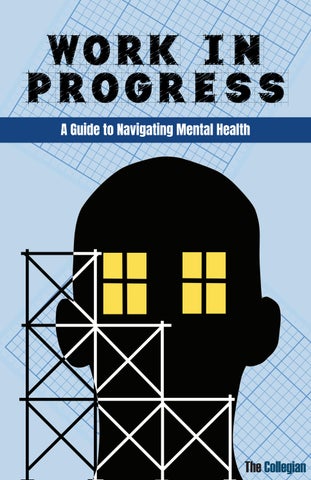
WORK IN PROGRESS
A Guide to Navigating Mental Health


n recent years, the average person’s understanding of the topic of mental health has evolved rapidly. This has led to more visibility for those suffering from mental health issues and a growing concern for
According to the U.S. Centers for Disease Control (CDC), the United States is in the midst of a mental health crisis that has worsened since the COVID-19 pandemic. Data from 2021 notes that while 82 percent (four in five U.S. adults) “felt they received the social and emotional support they needed,” in 2024 adult depression was at about 19 percent of the surveyed population, according to CDC numbers.

Drug overdose and suicide deaths remain leading causes of death as an indicator of the prolonged mental health crisis in the United States.
“These deaths, often associated with mental distress, continue to impact families and communities socially, emotionally, and economically long after they occur,” according to a June 2025 CDC article.
In psychology, the treatment gap is the deficit between the amount of people who need treatment for a mental health issue and the amount who actually receive it.
“There are a lot of reasons why that happens,
and there are different disorders where that treatment gap is more pronounced [substance abuse and depression],” said Melissa Neal, a professor of psychology at San Joaquin Delta College. “But overall, it just means that for the amount of people who do/would qualify as having a psychological disorder, there are only a tiny amount of those people actually getting any help.”
According to an article posted in the Winter 2020 edition of Focus, the American Psychiatric Association’s journal, the treatment gap for disenfranchised people is higher than average. This includes not only People of Color (POC) but also LGBTQIA+ individuals and those experience homelessness. Increasingly, people who belong to minority groups face increased strain from mental health and less access to support due to a variety of factors.

For members of the Delta College community, the concept of mental health is often the last thing on their mind, as students are often juggle work and at-home responsibilities on top of school. Delta College is host to a diverse population including groups who have in the past been at disproportionate risk for the development of and exacerbation of existing mental health issues. This zine highlights mental health of resources for individuals in two of these groups who may be struggling.

Delta College offers counseling through UWill. Scan the QR code for more information.

ne population of students facing the compounding effects of mental health stress is immigrant students —especially those who are undocumented. These students are on the receiving end of negative political rhetoric and in some cases state violence and thus are often under a heightened amount of pressure. According to an article published in Social Science & Medicine, a jorunal dedicated to the publication of social science research on health, in October 2013, racial discrimination could play a part in issues of mental health.
“Of the 461 associations examined in these studies, mental health outcomes (e.g. depression, anxiety) were most commonly reported, with statistically significant associations with racial discrimination found in 76 percent of outcomes examined,” the article notes.


On top of the heightened risk of negative mental health outcomes, it can be a challenge for undocumented individuals to find culturally sensitive therapists if they do reach out for support, which can lead to individuals not reaching out in the first place.
According to a February 2023 article from the Annual Review of Clinical

Psychology: “A growing body of research suggests that clinicians’ explicit discussions of racial, ethnic, and cultural concerns in the lives and experiences of clients of color enhance therapist credibility, the depth of client disclosure, client willingness to return for
One resource that is often utilized by students struggling on campus is that of the Dreamers Success Center in the Holt Center, a hub of support for students of any immigrant status to be surrounded by a supportive community that is willing to assist with issues a student might be having, both logistical and support related. The Dreamers Success Center also serves as a hub for the outreach events that help students find their community on campus.




On top of the UWill services provided to all Delta College students, there are mental health resources specifically for students who are undocumented. The Immigrants Rising Mental Health Connector is an online resource that can connect undocumented students with affordable and culturally sensitive therapists when they are not already available to them.

Find out more about the resources offered through Immigrant Rising by scanning the QR code.

lack of competency from providers can lead to members of the LGBTQIA+ community being unwilling to reach out for assistance.

The Delta College Pride Center, located on the second floor of Danner Hall, offers a place for community and support. The Pride Center plays host to events and informational sessions throughout the year. The Pride Center has hosted numerous on-campus events, including Trans Day of Visibility outreach on March 31.
Among the resources for outreach for young people (ages 13 to 24) is The Trevor Project, which provides crisis services and peer support to individuals in addition to advocacy. The organization offers services through chat on its website, phone (866) 488-7386 or text 678678.



Find out more about the resources offered by The Trevor Project by scanning the QR code.
Work in Progress is a project of the Mass Communication/ Journalism program at San Joaquin Delta College under the direction of Zack Kirk-Newton, Editor at Large for The Collegian. The project is part of Collegian’s Solutions Journalism Network Student Media Challenge project for the 2025-26. The project, Beyond the Border, examined support and services available to the immigrant population at San Joaquin Delta College on campus and beyond. The topic of mental health was explored within the series. As part of the reporting, Collegian student editors noted a need to dig deeper into mental health as it relates to the college’s most vulnerable populations, including our LGBTQIA+ community. Mental health matters are serious. While we are all a work in progress, we encourage those who need someone to talk to dial 988 and reach out for help.

Read stories in Collegian’s solutions journalism series by scanning the QR code.