Special Report
New York Times details sexual abuse committed by Cesar Chavez
BY ANDREA BALTODANO Editor-in-Chief
Newly reported allegations of sexual abuse committed by late labor leader Cesar Chavez are sending shockwaves through Latino communities, including at Delta College, where one of his closest allies — and a victim — once studied.
A New York Times investigation, based on interviews with more than 60 people and supported by documents and archival records, details allegations from multiple women, including some who say they were minors at the time of the alleged abuse in the 1970s.
Ana Murguia and Debra Rojas, who were 13 and 12 at the time, allege Chavez abused them over several years while they were connected to the United Farm Workers movement.
DOLORES HUERTA SPEAKS OUT
In a public statement released March 18, Dolores Huerta, now 96, said she remained silent for decades out of concern for the farmworker movement, but chose to speak following the Times’ investigation.
She described experiencing “two separate sexual encounters” with Chavez in the 1960s, both non consensual.
“I can no longer stay silent and must share my own experiences,” Huerta said. She added that she identifies as “a survivor of violence, of sexual abuse,” and emphasized that Chavez’s alleged actions “do not reflect the values of our community and our movement.”
For communities like Delta College, where Huerta’s legacy as both a civil rights icon and alumna is part of the institution’s history, the revelations present a complex and deeply personal reckoning, one that forces a confrontation between Chavez’s contributions to farmworker rights and the harm he is now accused of causing.
Delta College student Peter Espitia, a digital media major, said they first learned about the allegations in class
and described the news as “shocking.”
“We all just kind of stopped,” Espitia said. “It sucks, because I know that Dolores Huerta said she didn’t want to speak out because she didn’t want it to affect the movement. That’s devastating to me.”
Chavez is widely recognized for co-founding the United Farm Workers and leading national efforts to improve wages and working conditions for farmworkers. Through boycotts, marches and hunger strikes, he became one of the most prominent figures in the Latino civil rights movement.
Chavez died in 1993, and his legacy is commemorated through schools, streets and an annual state holiday in California.
United Farm Workers Foundation and the Cesar Chavez Foundation condemned the alleged actions in public statements, calling them “shocking” and “indefensible.”
EVENTS IN CHAVEZ’S HONOR CANCELED
The allegations have prompted im-
mediate fallout, including the cancellation of Cesar Chavez Day events by the United Farm Workers Foundation.
The UFW Foundation said it has canceled all Cesar Chavez Day events this month.
The Cesar Chavez Foundation said it was “deeply saddened” and is working with movement leaders to support those who may have been harmed, including establishing a confidential process for individuals to share their experiences.
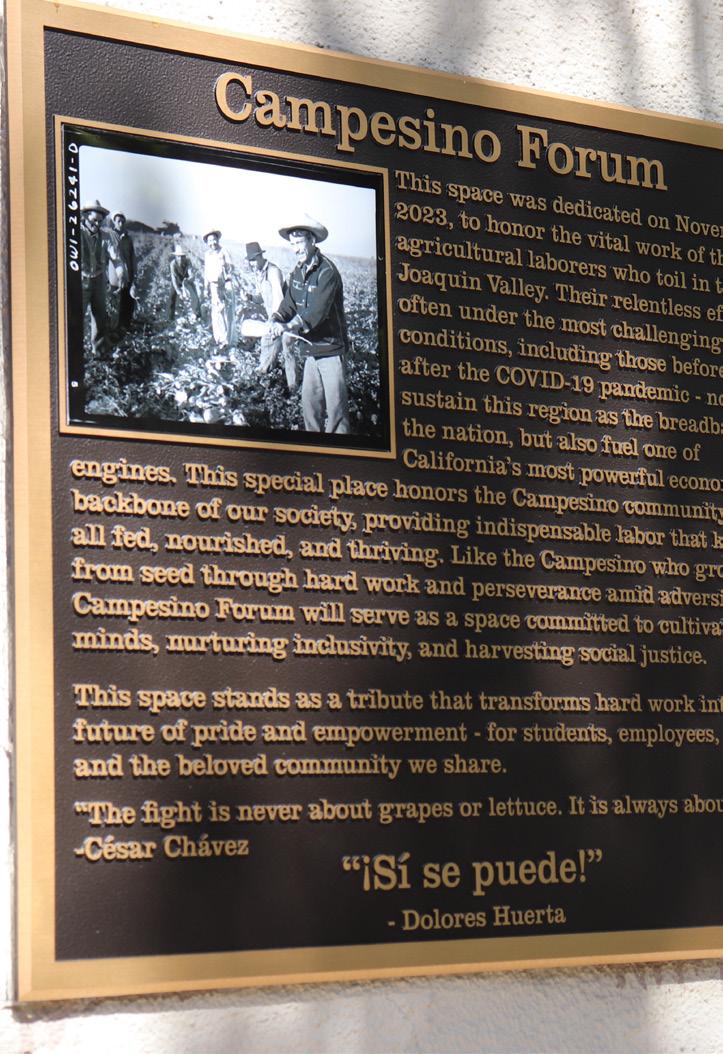
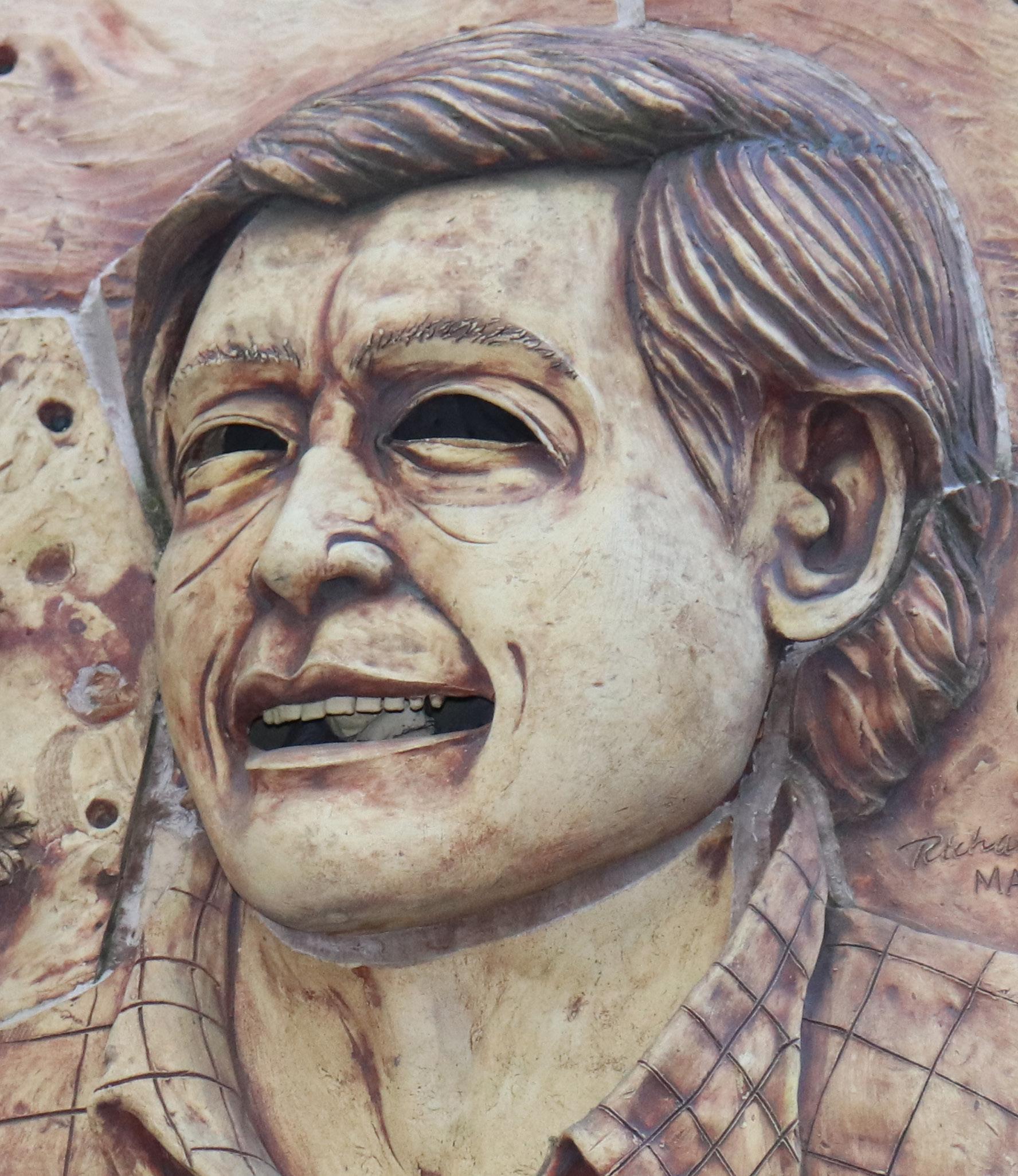
At Delta, Chavez’s legacy is visible across campus. A metal relief of Chavez is installed outside the bookstore, along the side of the Goleman Library facing the bookstore. His words are also featured in the Campesino Forum and a mural honoring him is displayed inside the Goleman Library.
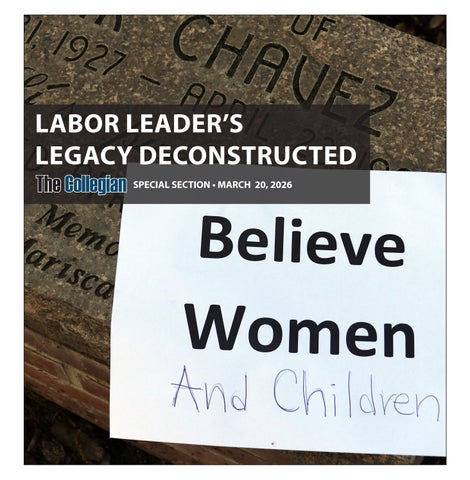
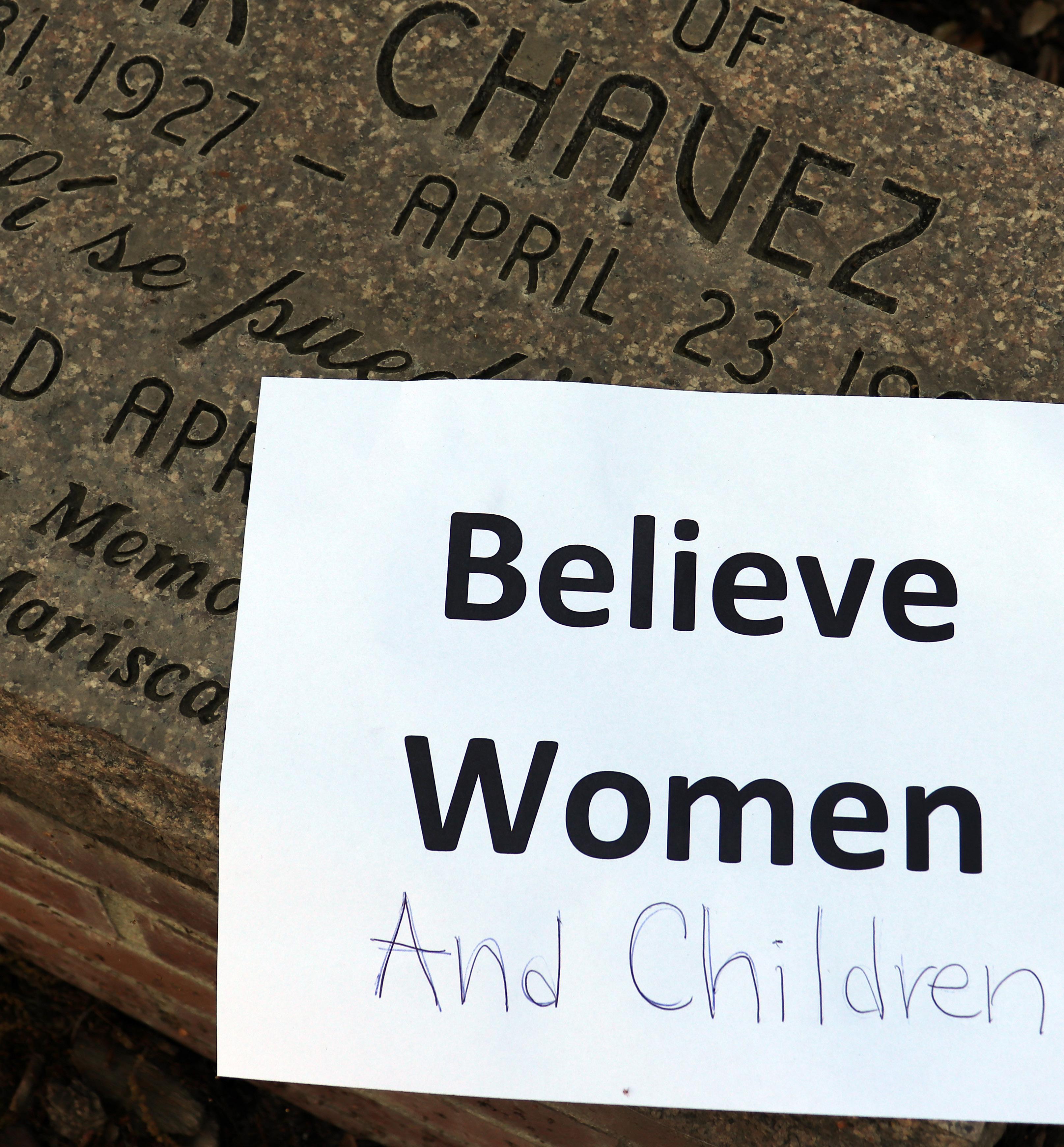
On Wednesday morning, a white piece of paper reading “Believe wom-
en and children” was placed over the plaque beneath the relief, appearing to reflect a response to the allegations.
MOVEMENT EXTENDS BEYOND SINGLE PERSON
Professor Adriana Brogger, a Digital Media faculty member at Delta College and part of the Chicanx/Latinx Faculty group, said the allegations have left many in the community grappling with grief and reflection.
“There is devastation and sadness,” Brogger said. “People are struggling with this information.”
She said there is also a strong sense of support for those coming forward.
“There is a profound sense of standing with victims and believing women and children,” she said.
Brogger emphasized that the farmworker movement extended beyond
Two highly visible tributes to Cesar Chavez exist on campus. A relief sculpture is on the north side of the Goleman Library, above. Chavez is also mentioned in the Campesino Forum plaque. PHOTOS BY COLLEGIAN STAFF
CHAVEZ NAME THROUGHOUT SAN JOAQUIN COUNTY
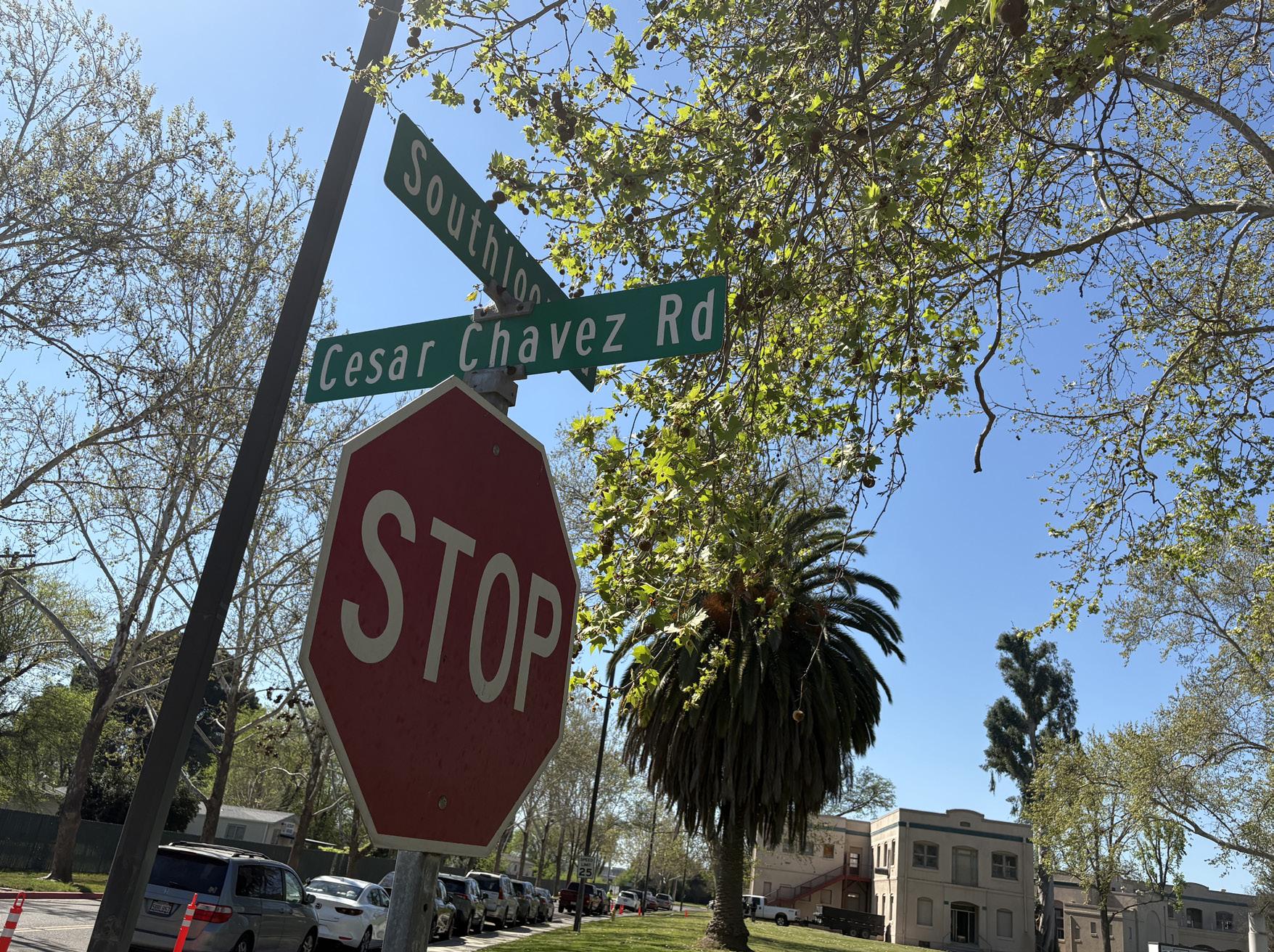
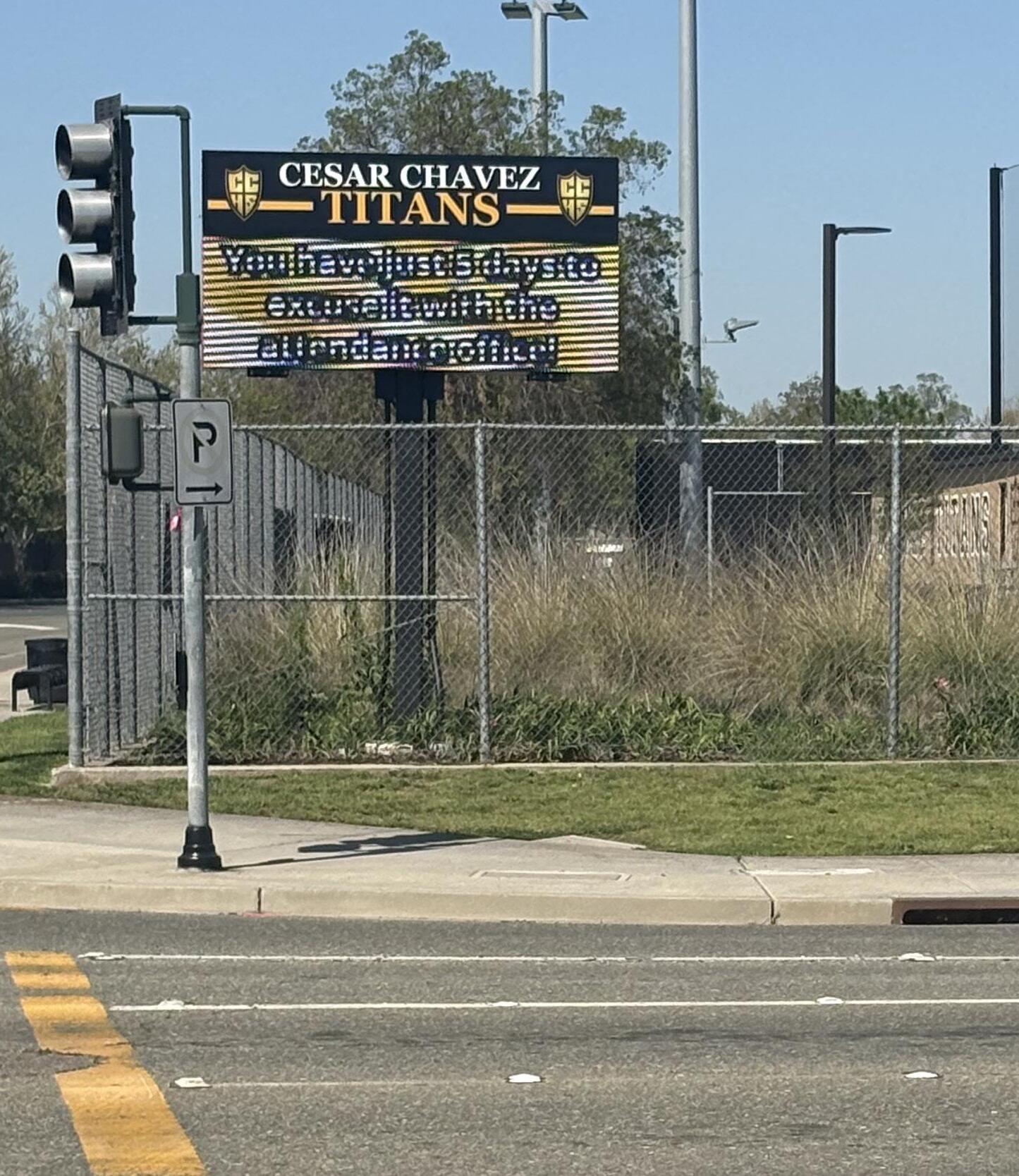
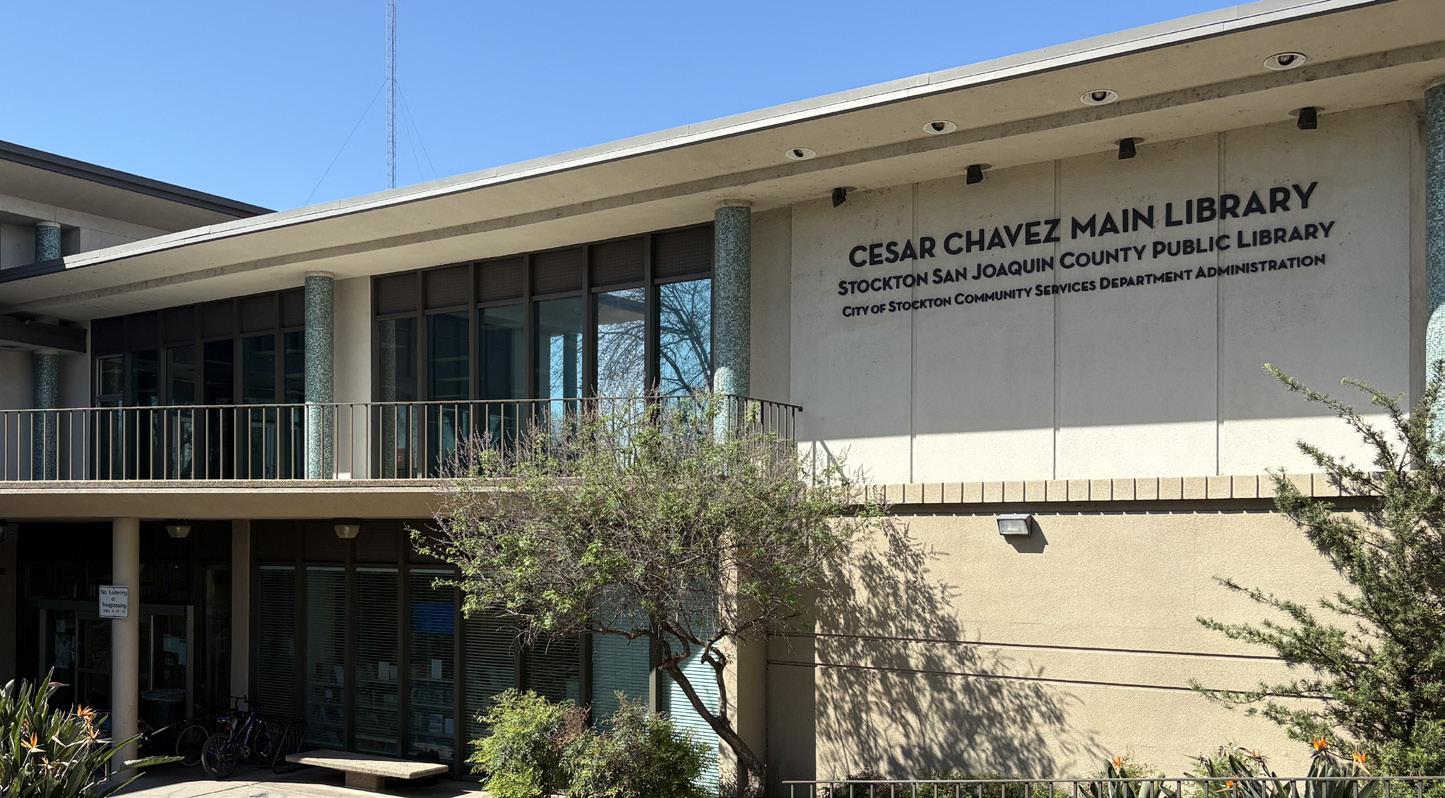
Several sites across the county bear Cesar Chavez’s name, reflecting his longstanding recognition in the region. These include a high school in Stockton, a road in French Camp and the county’s main public library in downtown Stockton.
any one individual.
“The movement was comprised of many people,” she said. “It was never about one person.”
She added that the moment may prompt institutions like Delta College to reflect on how historical figures are represented.
“As information becomes available, we need to thoughtfully review how people are represented,” she said.
ALLEGATIONS PROMPT INTERNAL DISCUSSIONS AT DELTA, CONVERSATIONS ELSEWHERE
Delta College officials said the allegations have prompted internal dis -
cussions and acknowledged the impact on the campus community.
In a campuswide message, college leadership described the allegations as “deeply troubling” and said the news may be “upsetting, confusing, or painful” for students and employees. The college also expressed support for those affected, including Dolores Huerta, who visited campus in recent months.
“We know this is the beginning of important and difficult conversations on how best to move forward,” the statement said.
Alex Breitler, director of marketing and Communications, said the college is aware of the reports and has begun preliminary discussions. While it is too
early to determine specific outcomes, he said there is an established process for reviewing campus naming and memorials.
According to college policy, students or employees may request changes to facility names or monuments through a formal application reviewed by the Heritage Committee.
Breitler added that while Cesar Chavez Day remains on the calendar as a state holiday, the college will monitor any potential action at the state level regarding its designation.
Across the country, institutions and officials are beginning to respond to the allegations. Fresno State University draped black fabric over a statue of
Cesar Chavez, while the U.S. Department of Labor removed his portrait and covered his name at its Washington headquarters. In California, the state Legislature canceled its annual celebration honoring Chavez, which had been scheduled for next week.
State leaders are also reconsidering how Chavez is publicly commemorated. Gov. Gavin Newsom said he is in discussions with lawmakers about the future of Cesar Chavez Day on March 31.
“Every year, the governor of California proclaims Cesar Chavez Day in the state,” he said, shaking his head. “None of us knew. We’re going to have to reflect.”
Top left: Cesar Chavez Road, located in French Camp. Top right: Chavez High School, founded in 2005, part of the Stockton Unified School District. Bottom: Stockton’s central library, opened in Sept. 1964. Named after Chavez, it serves as the county’s public library system headquarters. PHOTOS BY ELENA CANDELAS
MOVEMENT DOESN’T BELONG TO CHAVEZ
Theallegations against Cesar Chavez are painful and disorienting. For many in Latinx communities — including here at Delta College — they feel deeply personal, not just because of who Chavez was, but because of what he has come to represent for generations.
EDITORIAL
For decades, Chavez has been seen as a symbol of sacrifice, dignity and resistance. His name is embedded into campuses, classrooms and even a state holiday. That is why these allegations are not just about one individual. They challenge a legacy that many people grew up admiring.
But confronting that discomfort is necessary, because the farmworker movement was never just Cesar Chavez, and it should not rise or fall with him.
The fight for farmworker rights — for fair wages, humane working conditions and basic dignity — has always been a collective effort. It was built by workers, organizers and families whose names are often not remembered, but whose labor and sacrifices shaped the move-
ment long before Chavez became a national figure. Allowing these allegations to discredit that broader cause risks erasing the very people the movement was meant to uplift.
At the same time, this moment demands that we listen.
Not just to the allegations themselves, but to the voices behind them, especially Dolores Huerta, whose leadership has long been central to the movement’s moral foundation.
Her statement is one of the most difficult parts of this moment to process, not only because of what she alleges, but because of what it reveals. That she felt she had to remain silent for decades in order to protect the movement reflects a painful reality: even movements rooted in justice are not immune from protecting power at the expense of individuals.
“It is devastating,” said Adriana Brogger, professor of Digital Media at Delta College. “To understand that Dolores Huerta has been living with this… the weight that they’ve been carrying all these years.”
That weight extends beyond individuals. It resonates within
communities where silence, survival and sacrifice are often deeply intertwined. Brogger noted that for many, this moment may bring up “familial traumas… and problems that have not been addressed,” particularly in migrant and farmworker families.
Yet alongside that devastation, there is also a sense of clarity in people speaking out.
“There is a profound sense of standing with victims and believing women and children,” Brogger said.
Acknowledging that truth does not weaken the movement but strengthens its integrity. The values the farmworker movement stands for — dignity, justice and respect — cannot exist without accountability.
That is why it is important to remember that Chavez, while widely recognized, was never the movement itself. “The movement was comprised of many unnamed people: women, children, other leaders,” Brogger said. “It was never about one man.”
That perspective is reflected in how many are responding right now, trying to hold space for painful truths without losing sight of the larger cause.
At Delta, that tension is visible. The message placed over Chavez’s plaque reading “Believe women and children” reflects a community that isn’t willing to stay silent.
We can hold two truths at once: that Chavez played a role in advancing farmworker rights, and that he may have caused harm that must be acknowledged. What we cannot do is allow one truth to erase the other in a way that diminishes the people still fighting for justice today.
Because the farmworker movement did not end with Chavez. It continues in the lives of workers and communities who still carry its mission forward.
And as Brogger emphasized, this is not a moment for shame, especially for students.
“We do not need to carry the shame of Cesar Chavez,” she said. “That is that individual.”
If anything, this moment calls for a deeper commitment to the values the movement was built on. Not blind loyalty to a name, but accountability, justice and the courage to face uncomfortable truths.
Because protecting a movement should never mean protecting harm.
Officials, organizations react to allegations
CONGRESSIONAL HISPANIC CAUCUS
MARCH 18, X
“A movement stands on its values, not the misconduct of one individual. The strength of a movement is defined by its constituency, by its achievements, and yes, by its willingness to hold its leaders accountable.”
GOV. GAVIN NEWSOM
MARCH 18, INSTAGRAM
“The farm workers movement and a labor movement are much bigger than one man… We’re for justice. We’re for truth. We’re for transparency. And we will have the backs of these survivors.”
EL CONCILIO CALIFORNIA
MARCH 18, PRESS RELEASE
“The safety, dignity and wellbeing of women, children, workers and families are non-negotiable.”
CALIFORNIA TEACHERS ASSOCIATION
MARCH 18, FACEBOOK
“We will continue to advocate for justice for survivors and for women and girls to be safe in every space.”
ASTRONAUT JOSE HERNANDEZ
MARCH 18, FACEBOOK
“Cesar Chavez represented the movement, but the movement does not necessarily represent him.”
VICE MAYOR JASON LEE
MARCH 18, OFFICIAL STATEMENT
“I stand with Dolores, with farmworkers and with every individual who has survived unimaginable pain. Your stories matter. Your healing matters. And your courage is changing the world.”
COUNCILMEMBER MARIO ENRIQUEZ
MARCH 18, OFFICIAL STATEMENT
“These are difficult truths, and they must be taken seriously. Survivors deserve to be heard, supported, and treated with dignity. I stand with survivors and support their courage in coming forward.”