The Collegian - Published Feb. 27, 2026

Page 1


HEATING FAILURE CLOSES CAMPUS THREE DAYS

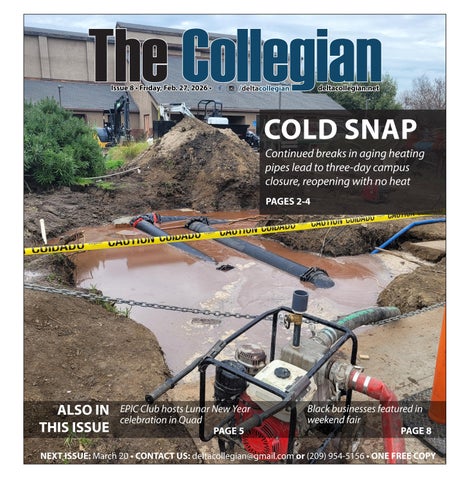
Delta College again has heat after the fourth pipeline-related failure since the beginning of 2026. A pipeline issue resulted in the closure of the Stockton main campus for three business days.

As of the afternoon of Feb. 25, there is heat on campus.

“What I can tell you is that the heat is on, it was turned on earlier today,” said Alex Breitler, director of Marketing and Communications, on Feb. 25. “We’re monitoring it just to see how it goes.”

That wasn’t the case on Feb. 24 when campus reopened. Work was still being done on a large section of pipes along North Burke Bradley Drive. At one point Tuesday morning the system was turned back on and water erupted from the pipelines, flooding the hole dug out to reach the failing pipes.

At the time of publication, it remains unclear how the issues were resolved.

The prolonged closure was on the heels of a five-day weekend, meaning campus was only open for one day, Wednesday, Feb. 18 during that week.

College officials sent out a notice to reopen campus late Monday, Feb. 23, but encouraged staff and students to dress “warmly.” The intent was to have the system running by the start of the business day on Feb. 24.

“Unfortunately, the repair completed yesterday to an underground heating pipe on the north side of campus did not hold. Heat remains unavailable in most buildings, and we are actively exploring alternative solutions,” read an email to students from Feb. 24.

The lack of heating did not result in further campus closures, with the email citing improving weather as a reason.

“With outside temperatures rising into the mid-to-upper 60s — and possibly topping 70 degrees later this week — the weather is considerably warmer than when the campus closure began last week” said the email.

The past two months have been tumultuous for the Delta College campus as continuous HVAC issues have led to lack of heat and campus closures.

The issues began in early January with HVAC being unavailable for a period of three days, this outage led to campus being closed Jan. 6-9. Jan. 9 marked the beginning of the semester. Faculty were encouraged to move coursework online temporarily.

The issue was initially isolated to the Shima building on Dec. 30, but efforts to repair the issues led to the discovery

of a larger issue.

“It snowballed,” said Stacy Pinola, the college’s director of Facilities, Planning, and Maintenance. “The Facilities team assembled on Friday, Jan. 2 to make the repair only to find that we had a larger problem at the Central Plant and that the entire campus had no heat.”

This issue was resolved after the County Superintendent of Schools Troy A. Brown approved an emergency contract to conduct repairs on Jan. 15, which the board unanimously voted to approve during a Jan. 20 meeting.

This remains one of three instances when HVAC was discussed at board since issues began, with the second and third being related to Measure K. Problems persisted.

Another outage occurred on Friday, Jan. 23 following damage to the outgoing line that occurred after previous

repairs. Heat was restored by Monday, Jan. 25 in that instance.

Pinola cited the age of the pipes as the source of the issues, with most being installed more than 30 years ago.

The vintage pipes would also cause the next outage which occurred on Feb. 3, following damage to the intake pipe in the same area as the Pinola told Collegian staff that an effort to replace the line was to be made during the five-day weekend that began on Feb. 13.

“We’re shooting to have the work done over the five-day break in a week and a half, to do it over that holiday break,” said Pinola on Feb. 3.

It is unclear if that work took place, and campus was closed on the evening of Feb. 18 after a single day back and remained closed for the following five days. This left a period of two weeks where only one day of on-campus instruction was held.

Following repairs done during the first break, the outgoing pipe is

Left, crews survey the scene on Tuesday after water starting pouring out of the pipes when the heating system was turned on. Above, a close up of the pipes under construction. PHOTOS BY ZACKARY KIRK-NEWTON

Students return to cool classroom temperatures

With Delta College’s recent HVAC issues many students have questioned operations at the college while expressing annoyance at problems the lack of heat has caused for already tight schedules.

“I’m a little bummed because we’re a week behind and that’s especially a problem for us since we’re done before finals week,” said ceramics student Ari Burnette.

For some students campus closures not only stalled progress in classes, but actually impeded them.

Ceramics student Kasey Montano had a project crack because of the low temperature in their classroom.

“I have to rebuild it now a week behind and I have a whole other project to build and I’m

going to be behind, and I’m leaving this semester,” said Montano.

best they can do is a phone call and get back,” said ceramics student Giselle Saliot.

Student organizations were also affected even if they don’t rely on the HVAC system for heating.

The Horticulture Club’s pollinator garden was located where the pipes ruptured.

“It did create two huge mansized holes in our pollinator habitat,” said Dayanna Ramirez, Horticulture Club member.

The club specifically lost native grass and their desert willow tree. Some of the damage came after the initial break, as holes were dug to access the pipes and construction equipment driven over the plants.

“Professors and people who are actually in the rooms have no control if it works or not, and

Other students noted how even without the pipes breaking, the heat system was already problematic. The only way for the temperature in a room to be changed is if a staff member submits a ticket.

Through all of this, some students aren’t even sure what is going on.

The confusion extended beyond the repair work. Delta College attempted to open Danner 107, also known as the Mustang Room, for students as a warming zone on Feb. 25. When Collegian reporters arrived the room was locked.

According to Delta College Director of Marketing and Communications Alex Breitler, said staff were unaware that this space was supposed to be open to students and had closed the door.

The other two warming zones on campus, dedicated to faculty and staff use, were both empty on Tuesday midday. Luckily, the HVAC system returned to functionality partway through Feb. 25, rendering the spaces not needed.

“I honestly don’t know what happened, it just blew up one day,” said Digital Media student Scott Benigno.

Flooding unrelated to pipeline damages Holt, Budd buildings

Heavy rainfall earlier this month caused flooding in multiple buildings at Delta College, prompting at least one classroom relocation and affecting several offices, according to college officials.

Director of marketing and communications Alex Breitler said exceptionally wet conditions on Tuesday, Feb. 17 led to drainage problems in the Budd, Holt and Locke buildings.

In Holt and Locke, malfunctioning drains were the cause.

“In Holt the third floor drain was cracked which caused flood-

ing on the second floor,” Breitler said. “The drains have been fixed, so that should help alleviate future flooding in Holt and Locke.”

One classroom in Locke was affected and instruction was relocated, Breitler said. No equipment was damaged aside from carpet replacement, and no other classrooms in that building were impacted.

A number of offices in multiple buildings also experienced flooding, though the college is not aware of damaged equipment in those spaces.

In Budd, the issue was not a drain but the slope of a walkway that caused water to pool against

FEB. 3

the building during heavy rain, Breitler said.

Breitler said the flooding was not related to the ongoing HVAC issues that have affected campus operations in recent weeks.

Facilities Manager Stacy Pinola did not respond to a request for comment by press time.

In Holt, Professor Aaron Garner said he was informed Tuesday, Feb. 23, that his classroom, Holt 317, had sustained damage to carpet and part of a wall. His class was relocated to Holt 113 and is expected to remain there for three to four weeks.

“It hasn’t impacted us at all. We moved to a comparable

Damage to the return line for the HVAC system leaves the system off until 7:55 p.m. Stacy Pinola cites aging pipes and poor insulation as a cause for this and previous break

room,” Garner said.

Some music students, however, said the disruption added to recent challenges caused by heating problems earlier this month, which led to the cancellation of the department’s annual Choir Festival.

The festival brings high school students to campus and serves as a recruitment event for the music program. Students said they had been preparing for weeks before it was called off shortly before it was scheduled to begin.

Music major Irene Calimlim said her music theory class was moved from Holt 317 to the second-floor choir room, which

FEB. 18

lacks desks.

“It’s a music theory class, so it is good to have desks to be able to write and take notes,” Calimlim said. “We haven’t heard anything other than that there was flooding in Holt.”

Music major Aubrey Bristow said students were notified of the classroom relocation by their professor rather than through a campuswide communication.

“For music students who come to in-person classes, it isn’t as simple as just having online class,” Bristow said. “We rely on being able to connect with our peers. We need rehearsal time in order to be prepared.”

UNPLANNED 5-DAY WEEKEND

Students return from five-day break to another heating failure. Campus is closed on Feb. 18 and doesn’t reopen until Feb. 24. Heat returns on Feb. 25 with no stated reason.

Digital Media students left without heat in their classroom on Feb. 24.
PHOTO

FUNCTIONAL FACILITIES A PIPE DREAM

Thelast two weeks at Delta College have exposed something students have quietly known for years: the campus infrastructure is aging, and when it falters, learning falters with it.

EDITORIAL

First came the heating failure that forced the campus to close and move instruction online. Then came flooding in multiple buildings after heavy rainfall, including classroom relocations in Holt and damage reported in Budd and Locke.

College officials have explained the causes — cracked drains, walkway slope, outdated systems — and have emphasized that equipment damage was minimal. The flooding, they said, was not related to the HVAC issues.

But the broader pattern is harder to ignore.

Delta’s HVAC systems date back decades. Facilities have required patchwork maintenance. Measure K, approved by voters in November, prioritizes

long-overdue infrastructure upgrades including HVAC modernization.

The question is not whether Measure K is necessary. It clearly is.

The question is why it took this long.

Students today are navigating closures, relocations and canceled academic events in buildings that have been aging for years. Music students lost their annual Choir Festival due to heating failures. Music Theory classes were relocated without proper classroom setups. Offices flooded after heavy rain.

These are not abstract inconveniences. They affect preparation, recruitment, morale and trust.

To be clear: infrastructure projects are expensive and complex. State approval processes move slowly. Administrators do not control the weather.

But institutions are responsible for anticipating risk, especially when systems are decades old.

Measure K represents a commitment to modernization. That commitment should now move

The Collegian

The Collegian is the student newspaper of San Joaquin Delta College in Stockton, Calif. The paper is published six times a semester.

As a First Amendment newspaper we pride ourselves on a commitment to the students of Delta College while maintaining independence.

We reinvigorate the credo that the newspaper speaks for the students, checks abuses of power and stands vigilant in the protection of democracy and free speech.

with urgency and transparency. Students deserve regular updates on timelines, approvals and contingencies. They deserve confidence that what happened in the last two weeks will not become a recurring reality.

Community colleges exist to expand opportunity. When facilities become unreliable, that mission weakens.

EDEN ATTWOOD

ELIAS BARRERA DANI CARMACK

LEAH CUVILLIER-CALLEROS AZRIEL DRUMHELLER

FARFAN

The past two weeks should serve not only as a reminder of aging infrastructure, but as a turning point. Delta has acknowledged the need for investment. Now it must ensure that investment translates into visible, timely change.

Students should not have to build resilience around broken systems.

RYCKIE HEREDIA ELIJAH PROSSER
The scene along North Burke Bradley Road where the heating system sprung a leak after repairs that closed campus for three business days. Photo by Azriel Drumheller ON THE FRONT:
Pipeline failures and the resulting dig out have decimated the Horticulture Center’s pollinator garden, seen above on Wednesday, Feb. 25. PHOTO BY LEVI GOERZEN

EPIC HOSTS LUNAR NEW YEAR CELEBRATION

EPIC hosted its third annual Lunar New Year celebration on Feb. 12 featuring student activities, performances and food.

The event included activities for students to create their own variety of ornaments that were representative of the Lunar New Year. The ornament designs were trees and lanterns.

After the students have completed creating their ornaments they were given a stamp and were given food for participating in the celebration. This year’s celebration was the biggest one to date, according to attendees.

“Previous events weren’t as big. I’m going to compare it to last year’s Lunar New Years, there’s a difference between the attendees. We always strive for more people to participate. From last year to this year, I would say this has been one of the biggest events,”said Mikyla Cargo, one of the volunteers with EPIC.

my culture, I’m really honored about that. So I think an opportunity to learn about someone else’s is really good,” said attendee Joshua Martinez Leva. “I saw the dancers, and I really like the way they dress and the way well, obviously, they dance.”

Despite the efforts of the Trump administration cutting funding to programs that are under the blanket of DEI (Diversity, Equity and Inclusion), the event was not impacted by cuts.

“The budget that we utilize for this event comes from the state. So it’s a different stream of money,” said Vang. The cuts, however, are still affecting EPIC’s allocations of funds.

There were a variety of performances for the students to enjoy with a new addition of lion dancers this year.

“This year we have dancers, and we’re just hoping that every single year, it just gets bigger. We bring in more communities to showcase our students, and to show them what type of different groups and communities celebrate Lunar New Year,” said EPIC Director Susan Vang. Students from all backgrounds attended the events.

“I saw the event and was interested in all the activities. I would always like to learn more about other cultures because for me, when someone asks me about

“We just have to watch out, now that the budget for EPIC itself has been cut. We just have to make sure that a lot of our programs are streamlined with learning outcomes that we want for our students, to learn about our culture and the communities. EPIC within itself, we had to cut down on some events, but I would say for this bigger amount, we know that it’s a big event that we want to hold annually. So we did save the budget for this already. So I would say not really, but we just have to be more conscious, ” said Vang.

There are misconceptions on which communities celebrate the Lunar New Year.

“I think a lot of people think, lunar new year is just the Chinese new year. It’s not, there’s a lot of people who celebrate Lunar New Year. You’ll see different folks out here wearing different attires because they’re from different communities, who all celebrate Lunar New Year,” said Vang.

The district also celebrated the Lunar New Year holiday on Tuesday, Feb. 17. Campus was closed for the occasion.

The EPIC Club celebrated Lunar New Year in the Quad on Thursday, Feb. 12.
LEFT, TOP RIGHT, ABOVE RIGHT PHOTOS BY PHOTOS BY ARLO OROZCO

Horticulture Center water fountain approved

Students started petition noting distance between north campus location, nearest filler

The purchase of a water fountain was approved for the Horticulture Center on campus following a club-led petition that highlighted the distance that students had to travel to get water.

“The new fountain is ordered. We are expecting delivery at the end of next week.” said Stacy Pinola, director of Facilities, Planning and Management on Feb. 12.

This approval comes after the Horticulture Club began gathering signatures for a petition to formally request a water fountain, which they had announced in an Instagram post on Feb. 1.

The petition which was set to end on Feb.13 was never formally submitted, with Horticulture Club President Dayana Ramirez speculating that they had probably just caught wind of it.

“They just happened to hear about it,” Said Ramirez

The petition was written by Ramirez after repeated complaints about the distance that students and staff had to travel to get water.

“So I’ve been here at Delta since 2024, and since then I have struggled with heat exhaustion out at Mustang Acres,” said Ramirez. “I just love my classmates and the people I work with so I feel like this new addition would be great. It would also benefit the future generation of horticulture.”

Mustang Acres is the name given to the plot of land across from the SCMA building maintained by the horticulture department, including students and staff, even into the summer. That

maintenance often takes hours at a time.

“Last semester I was working here, we had been working on mustang acres on the tractor, planting stuff and weeding,” said Arthur “Art” Valenzeula, a member of the Horticulture Club who is studying for his associates degree in horticulture. “The closest drinking fountain, like water refill station, is in Shima. From here it’s over 800 feet and from Mustang Acres it’s over 900 feet.”

“That’s a long way to go to refill your water, especially if you’ve been out working all day,” said Valenzeula.

“I’m here from 9 to 5, so it could be a full day that I’m out on the farm,” said Ajani Young, an instructional support aide, when asked about how long they spent at Mustang Acres. “It’s a few hours at least.”

During the summer, members of the horticulture club would carry extra water bottles with them just to cut down on trips to the fountain. Young had three water bottles to use through that period.

“I have three of these,” said Young gesturing to his water bottle.

Concerns over hydration weren’t the only motivator, some voiced concerns about the time it takes to get water and come back.

“We’ll be in the middle of activities and then students will say ‘oh can I get a drink of water’ and then they have to walk really far,” said Tina Candelo-Mize, associate professor of Horticulture. “So they miss 15 to 20 minutes of activities because they have to go into

The Horticulture Center is now in the process of getting a water filler after starting a petition noting the distance to the nearest one. ILLUSTRATION BY ZACK KIRK-NEWTON

campus to get water.”

The shortest route to a water fountain from the horticulture center, using officially marked walkways and crosswalks, was an eight minute round-trip that sent students to the back of the SCMA building.

However, the shortest route from Mustang Acres was an 11 minute round-trip which led to the DeRicco building and included crossing a street at a minimally protected crosswalk.

The new water fountain is expected to be installed by March 12.

Stockton gets approval for grant to curb tobacco sales to minors

On Feb. 3, the Stockton City Council unanimously approved a grant from the California Department of Justice to fund operations preventing the sale of tobacco to minors.

The grant awards $976,853 to be used for police operations that minimize or prevent the sale of tobacco to minors, as well as enforcing the ban on flavored cigarettes. This grant is entirely state funded, requiring no matching funding from the city.

Captain Jonathan Swain of the Stockton police department stated that efforts will be focused at retailers near schools first, targeting the growing problem of vaping in schools, before expanding to other retailers in common areas. Educational activities for retailers and officers are funded under this grant, however the funds cannot be used for school patrols, media campaigns or to “enforce actions related to tobacco use and possession,” according to the grant. Over the next three years, the Stockton police will be obligated to conduct 12

Minor Decoy operations, Shoulder Tap operations, and Undercover Buys, testing 175 retailers.

Stockton Mayor Christina Fugazi asked Swain, “My concern is, do we have enough resources to do it… We’re down some officers, how are we gonna dedicate people to doing this?”

Swain said, “we’re trying to use tools and resources like this to provide overtime… We are confident that we are able to meet the needs of the grant over the three year period.”

The minor decoy and shoulder tap operations are conducted through the

Stockton police department, with the decoys selected through either the SPD cadet program, or the family of department members. These operations consist of the minor either walking into the store and asking to buy, or through approaching adults outside the store to ask them to buy. Businesses properly refusing the sale to minors will be issued a letter stating they have passed a decoy test, and businesses selling to the decoy will be given a citation and will have an inspection conducted.

Delta College community sends letters to immigration detainees

Butterfly-decorated paper and envelopes covered tables at Delta College’s Dreamer Success Center on Tuesday as students and staff wrote letters of encouragement to immigrants held in detention.

By the end of the four-hour event, organizers collected 119 letters. The messages, along with donated books and Bibles, will be sent to Chaplain Ronald Seidl at the CoreCivic detention center in California City, according to organizers.

For Tina Leal, who coordinates the Dreamer Success Center, the activity was designed to do something simple but specific: make sure someone sitting in detention hears — in writing — that they are seen.

“It might seem small, but it’s so big,” Leal said. “It’s just letting those in the detention centers know that they’re not alone.”

Trinidad Araya, a chemistry lab technician at Delta College, contacted Leal to ask whether the Dreamer Success Center had books available to donate for detainees.

Leal said that conversation prompted her to expand the effort into a drop-in letter-writing event, where students and staff could write messages of support and learn more about what detainees are facing.

The center stayed open from 10 a.m. to 2 p.m., with participants encouraged to write one letter or dozens. Leal said people came and went throughout the day, and some participants texted her asking if she could include specific messages.

The butterfly theme wasn’t accidental. Leal described the envelopes as a symbol of hope and transformation — “the coming out of the cocoon,” she said — and she kept returning to the image of a person in detention receiving something soft and intentional, something bilingual, something they could hold.

“I just imagine someone opening that envelope and knowing somebody thought of them,” she said. “We’re not blind to what’s happening.”

The gathering included not only students, but also campus employees and students.

Leyla Perez, an administrative assistant for Student Services focused on Access and Equity, said she attended to help counter what she described as the isolation of detention.

“It might be an isolating experience,” Perez said. “To let them know there’s people out there that are advocating for them and really thinking about them, and they’re not forgot-

Perez said reports about conditions in detention facilities are difficult to read and “upsetting,” adding that writing letters felt like a way to take action even without political power.

“I think it’s a way for people to take action, even if the smallest gesture of a letter,” she said.

Student Carol Martinez, a Delta drama major, said she was motivated by national news about immigration enforcement.

“I saw the government separating families,” Martinez said. “I hope the letters make them feel good.”

Top left: Delta community shows up to write letters for ICE detainees. Top right: Delta community shows up to write letters for ICE detainees. Bottom left: Tina Leal talks to a crowded Dreamers Center. Bottom right: A table with supplies for the letter writing session, provided by the Dreamers Center. PHOTOS BY ANDREA BALTODANO

The local effort comes as immigration detention numbers have risen nationally. As of Jan. 25, 2026, ICE was holding 70,766 people in detention, and 74.2 percent had no criminal conviction, according to the Transactional Records Access Clearinghouse, a Syracuse University-based research center that tracks federal im-

migration enforcement data.

Organizers said the letters, books and Bibles will be mailed to the California City facility in the coming days. For Leal, the goal is simple: to reach people who may feel forgotten.

“It’s not them or us,” she said. “We all matter.”

BLACK BUSINESSES UNITE IN SHOWCASE

On Feb. 21. Black Students Union hosted the third annual event of Black Businesses Unite in Danner Hall.

The event highlighted small business products, services and artists in the community. From music, clothing, artwork, sweet treats, financial advice, health, skin care and wellness were featured

Many businesses and services at this event were centered on creating wealth and prosperity in the black community through products, education, and services.

Valerie Gnassounou said the event was special because of the celebration of the centennial of Black History Month this year. Black Businesses Unite celebrates Black entrepreneurship within the community.

“For the Black Student Union [BSU], it’s important to bring the black community together to show we are prosperous. It’s about promotion, it’s about networking, showing pride and showing creativity among our community. Showing we have a presence,” said Gnassounou.

Gnassounou mentioned the importance of this event being 100 years of black history commemorations.

“It was a wonderful and successful event. I wanna thank BSU because it’s a BSU event. I think it’s important that the education system at Delta college is educating through entrepreneurship shows students there are different avenues to showcase their passion and skills,” said Gnassounou.

Delta Student, Mia Blount, 20, was showcasing her art which she started in high school with inspiration from her

mother at a young age.

“To start drawing I started mostly because of my mom. My mom is an artist herself and sometimes in elementary she would come teach us how to draw and paint. That’s what inspired me to keep being creative. I started taking art classes in high school and since then you have been really deep into art,” said Blount.

Blount said the effect of systemic racism in black communities and the impact on business.

“I think it’s important to support black businesses because of systemic racism. Society is built to support white pools instead of people of color. We don’t always have the opportunity to showcase our talents or what we sell,” said Blount.

When asked about Blount’s biggest accomplishment and challenge with her artwork. Blount noted proud moments but also the difficulties of being an artist.

“My biggest accomplishment is like having finished all of these artworks because some of these took me a few years to create. And they took a lot of hard work. I feel like that fact that I go to the point where I actually finished, I feel proud of that,” said Blount. “My biggest challenge I would say as an artist is actually finishing things because I’m a procrastinator and perfectionist so it is really hard for me to be satisfied with pieces I have been working on.”

Janelle Fontenot, 38, is a local business owner. Fontenot has had her business for four years but this was her first pop up event.

“So my whole business is about wellness and mindfulness. It’s about what we put in our body, our temples. And so I create all of my products with the intention to put the body and to help the body

and mind be more balanced,” said Fontenot. “Products include sea moss which is my top selling, hair, body oils and body butters. Using natural herbs to reset your body and rejuvenate my body. That’s what Khaya means rejuvenated. That’s how it was founded. I wanted to help others, my family and myself, I want to share that. ”

Fontenot noted the importance of supporting black owned businesses in our community.

“On a scale of 1-10, I think it is a 20 because we are quick to go to Target, Safeway or online but I think when we invest in ourselves it takes away from outsourcing from other companies that don’t really care about our health and wellbeing as a community. I find that when we do that it sparks for the community to work together and be built,” said Fontenot.

Angileena Hayes, 36, who is an educational consultant has a goal to bring healing to the black community through educational teachings of protecting their peace. Her goal is helping black people through their trauma.

“So basically when I was an undergrad I read this article that said that Sacramento has the one of the highest suspension rates for black and brown boys. So that kind of sparked a thing for me. That basically told me that I need to do research about why,” said Hayes. “I think it is because teachers are uneducated about black and brown boys in the educational system. And giving the students tools to deal with teachers who refuse to

go through these training sessions. And giving teachers the tools to learn and specifically their cultural competency training.”

Hayes shared her biggest accomplishment or biggest challenge as a black woman small business owner.

“My biggest accomplishment is that I stood in rooms with about 30 white people and I got them to listen as a black woman business owner. They actually believed and understood that I knew what I was talking about. The biggest challenge is honestly believing that I’m good enough, even though I’m confident in what I do I struggle with having faith. That I’m doing exactly what I’m supposed to be doing,” said Hayes.

Stephen Omondi, 48, is a financial educator. His goal is to educate people on different strategies to get financial security and protect their wealth.

“Most people work hard for money but don’t know where to put that money. The mission is to educate families on money. At the same time we have a responsibility to pass this on to our future generation. Our children notice how we earn and spend money. Here to break the generational misinformation that is passed down. It’s not about how much you earn but how much you save,” said Omondi. “It’s extremely important because as a community. African Americans we are behind financially. We need to help our business to strengthen and help each other build our businesses so that we can finally bridge the financial gap.”

Business Triple Treats Seaux Sweet accepting donations for sweet treats at event.
PHOTO BY JEWELS ESTRADA
Business owner Janelle Fontenot of Khaya Botanicals selling her wellness products at event.
PHOTO BY JEWELS ESTRADA

Meat-free recipes just in time for Lent

Whether you’re observing Lent this year or just want to consume less meat it can be hard to find easy to understand recipes for people who are just starting out their culinary journey so here are some foods I’ve learned to cook from family, friends, and social media.

A recent viral recipe started by food influencer Carleigh Bodrug, who goes by Plantyou on Instagram, with a few modifications I made to better suit it to my own flavor palate. This dish is a fun blend of simple and delicious flavor. It’s filling and easy, only taking about an hour and a half. I know the time seems daunting — but half that cooking time is done in the oven.

Tomato orzo soup/sehriye corbasi, above and vegetarian pozole verde, below. PHOTOS BY

The rest of recipes on the Collegian website, deltacollegian.net

• Pasta of your choosing (I enjoy rotini)

• 2-4 yellow onions (amount depends on the size of your produce if small go 3 or 4 medium or large 2 will do just fine)

• 1 bulb of garlic

• Sun dried tomatoes (optional — it adds a bit more flavor, but can be pricey)

• 1 tbsp of paprika

• 1 tsp of Italian seasoning

• Garlic salt

• Salt and pepper to taste

• 1 Lemon

• Mushrooms (baby bella or white work, however bella tend to have a richer flavor)

• Olive oil

• 1 13.66 fl. oz can unsweetened coconut milk

Nopal Salad

A recipe from my Aunt Lourdes Candelas, Nopal (cactus) salad is a family favorite during the summer or lent. It is delicious, refreshing and shockingly easy (seriously I asked her if she was sure she wasn’t forgetting something). Note this is one of many nopal salad recipes so your families might look a bit different.

Ingredients:

• 2 lbs nopal

• 2-3 cloves garlic

• 3 roma tomatoes

• 1 white onion

• 2 chiles serrano

• ¼ bunch of cilantro

• Salt

• Water

Step 1: Preheat oven at 375, while that heats begin thinly slicing your onions. For greater ease cut the onion in half then slice as it reduces the risk of cutting yourself while attempting to slice the whole onion. Lightly line the bottom of a baking dish with olive oil, as you cut put the onions in the dish.

Step 2: Cut off the top of the bulb of garlic, wrap from the bottom with foil leaving the top exposed drizzle with olive oil and sprinkle a bit of salt and pepper.

Step 3: Before placing in the dish, drizzle olive oil on the onions then season with 1 tbsp paprika and 1 tsp of Italian seasoning.

Step 4: Add sun dried tomatoes if using. I’m not the biggest fan, but it’s a matter of taste -- a drizzle of olive oil inside the tomatoes provides great flavor. Mix with tongs leaving a small part of the center empty and place your garlic.

Step 5: Cover with foil and pop in the oven for an hour, stirring briefly at the half way mark.

Step 6: At 20 minutes begin boil-

ing your pasta.

Step 7: Slice your mushrooms before placing them in a separate sauce pan to sweat your mushrooms on medium heat to remove the excess water. Once tender add olive oil, about 1 tsp garlic salt, paprika and pepper.

Step 8: At this point your pasta should be al dente. Save a bit of water (less than a ¼ a cup) and strain. Add the reserved water to the mushrooms then add your coconut milk, mixing in then letting it come to a simmer then let rest.

Step 9: Once the hour mark hits on your onions and garlic they should both be tender if not leave in for 5 minute increments until they are malleable. Use the tongs to pick up the garlic in its foil, squeezing it with the tongs to release the now soft garlic (you’re looking for the texture of softened butter) into the dish, dispose of the peel and foil.

Step 10: Pour the mushroom sauce in, then stir in your spinach before combining the pasta into the dish as well. Then enjoy!

Step 1: Rinse and dice nopales (if purchased diced just rinse) before placing them in a pot with half an onion and 2-3 cloves of garlic. Cover with water then add about 1½ tbsp of salt over medium heat checking in 5 minute increments giving a stir if certain parts begin muting in color faster than others.

Step 2: While you wait, begin dicing your veggies,chopping up your cilantro, removing the seeds from the serranos, using the other half of your onion, and roma tomatoes.

Step 3: Once the nopales have changed color into a muted green and become fork tender (this takes about 20 minutes), turn off the heat and let sit for 3-4 minutes then drain.

Step 4: Add all your diced veggies to a bowl then add the cooked nopal stir then add salt to taste let marinate for 3-5 minutes. Serve on a tostada and garnish with avocado or queso fresco if you like. Yes, it’s that easy!!!

ELENA CANDELAS

Fierce Mustang reflects on ‘Year of the Horse’

Delta’s famed mascot answers questions about what a year celebrating equine traits of ‘strength, endurance, independence, and forward motion’ means for students

Lunar New Year, celebrated across East and Southeast Asia and by diasporic communities worldwide, marks the beginning of a new year based on the lunar calendar.

Unlike Jan. 1 on the Western calendar, the holiday typically falls between late January and mid-February and centers on renewal; a time for family gatherings, honoring ancestors, sharing symbolic foods and welcoming prosperity.

Each year corresponds to one of 12 animals in the Chinese zodiac, a repeating cycle that includes the rat, ox, tiger, rabbit, dragon, snake, horse, goat, monkey, rooster, dog and pig.

“OK, let’s get one thing straight right away: I’m a mustang,” said Fierce, the college’s longtime mascot. “Yes, a mustang is a horse, of course, but don’t you forget that I am wild and free, bold and unstoppable, and prone to be dramatic.”

After joking that he has been waiting for this zodiac moment “since 2014,” Fierce framed 2026 as more than a punchline.

“You pace yourselves. You grind. You show up again the next day, and the next. That’s horsepower.” -Fierce Mustang about Delta students

According to Chinese folklore, the order of the zodiac animals was determined by a legendary race organized by the Jade Emperor, a central figure in traditional mythology.

In the story, the emperor invited animals to cross a river, promising that the first 12 to arrive would earn a place in the zodiac. Their finishing order — influenced by strategy, cooperation and even trickery — established the sequence that repeats every 12 years. The traits associated with each animal are believed to influence the tone and energy of the year ahead.

In 2026, that spotlight turns to the horse, a symbol often associated with strength, endurance, independence and forward motion.

At Delta College, that symbolism carries an extra layer of personality.

“It feels like the universe finally looked down at Delta College and said, ‘You know what? It’s your year.’”

Beyond the theatrics, Fierce drew connections between the symbolism of the horse and the reality of community college life.

“We work our tails off,” he said. “Delta students are juggling classes, work, maybe kids. You’re up and at ‘em before I’ve even had my morning oats. We’re endurance animals, built for the long haul — and you’re just as tough.”

Unlike the stereotype of short bursts of energy, Fierce emphasized persistence.

He also challenged students to embrace what he called authenticity — not performance.

“I’m no show pony. What you see is what you get,” Fierce said. “The secret in life is you gotta be authentic and just be who you are. Be your authentic selves in honor of the Year of the Horse, and everything else will start falling into place.”

For students who celebrate Lunar

Fierce, Delta College’s mascot, poses on campus and takes a photo with a student.

PHOTOS

COURTESY

DELTA COLLEGE MARKETING AND COMMUNICATIONS OFFICE

New Year, Fierce offered wishes of strength, prosperity and momentum and, in classic campus fashion, “the good fortune to find a reasonable parking spot at 11 a.m. on a Tuesday.”

To those less familiar with the holiday, he encouraged curiosity.

“One of the grooviest things about Delta College is the chance to learn about new cultures and meet new people,” he said. “Our herd is really diverse. The more we learn about

each other, the stronger our herd gets.”

If the Year of the Horse promises momentum, Fierce said Delta students already embody it.

“You don’t really need luck,” he said. “You’re grinders and fighters.”

And if 2026 is, in fact, the mustang’s year, it may also be a reminder of what defines Delta itself: resilience, movement and the quiet determination to keep going, even when the road feels long.

Delta percussion hosts jazz performance

On Feb. 25, the Delta Jazz Percussion performed at Atherton Auditorium.

The first group, directed by Michael Rocha, an adjunct associate professor at Delta, performed a total of five songs: “A Night in Tunisia,” “C Jam Blues,” “Famous Don’t Pay the Rent,” “Mack the Knife,” and “Mercy, Mercy, Mercy.”

Due to a recent illness of one of the trumpet players, Michael Rocha filled in and played with the ensemble.

With one of the longest solos of the night, trumpet player Osi Latu, a freshman at Delta College, gave us his thoughts on his performance and the concert in general.

“I’m not going to lie, at first, it was a little nerve-racking, cause of school being out for the heat, and then we just had all kinds of stuff, hiccups and stuff, and we had four or five weeks to rehearse, not too long,” said Latu. “So I was a little nervous going into it, but I trust everyone in the band, so I think we did well tonight. When you look at it on paper, it doesn’t look that long, and then you play, and it feels like it’s dragging on forever… Honestly, performing it for the first time live, I think I could do better, but I mean, we have three more shows to do.”

The second jazz ensemble that was played that night was

by Brian Kendrick,

The second group performed a total of six songs, before closing out on a surprise addition by Kendrick: “Belly Roll,” “Opus De Funk,” “Body and Soul,” “A Mis Abuelos,” “Cottontail” and closing with “Just Kidding.” More than 100 people attended the performance.

One of the audience members, Aliyah Martinez, a freshman at Delta College was there to support her sister, who was the bassist.

“They did really good tonight. Expectations are always really high, and they always exceed them. I thought it was really cool today,” said Martinez.

Before the concert ended, Kendrick took the time to call the names of every student on stage to acknowledge their hard work and how proud he was to have worked with them.

He also stated that the Jazz Percussion would be performing for College Hour in the quad or by the koi pond, if anyone wanted to stop by and listen.

“Over the years, we just had so many great percussion. I have to admit, there’s a lot of great ones here, and I’m really excited of the outcome of the school here,” said Kendrick. “Thank you so much again for all being here tonight. Really appreciate it, and I know that we had a great time playing music for you.”

Top: Adjunct Professor Michael Rocha showing off freshman Osi Latu during his big trumpet solo at the Jazz Percussion concert on Feb. 25, at Delta College Atherton Auditorium. Middle Left Top: Freshman Osi Latu performing his trumpet solo at the Jazz Percussion concert on Feb. 25, at Delta College Atherton Auditorium. Middle Left Bottom: Eric Rodriguez stands up to perform his woodwinds solo at the Jazz Percussion concert on Feb. 25, at Delta College Atherton Auditorium. Right: Adjunct Professor Michael Rocha announces the next song at the Jazz Percussion concert on Feb. 25, at Delta College Atherton Auditorium. Bottom: Steven J. Cole Jr. stands up for his big trombone solo at the Jazz Percussion concert on Feb. 25, at Delta College Atherton Auditorium.

PHOTOS BY RYCKIE HEREDIA

COMPETENCY, AN APPEALING TRAIT

Daily life is full of stress — whether it be work, school or relationships— and how we manage that stress is often, ironically, another source of stress. For many, the go-to way to assuage this stress is through media — books,TV shows and movies — however the things that bring us comfort aren’t always, at a glance, comforting.

For some the panacea for this stress is found in watching people who are good at what they do — so-called “competence porn.”

The term “competence porn” was originally coined by “Leverage” screenwriter John Rogers to describe a phenomenon where viewers engaged with scenes that were seen by writers as purely for exposition.

“For the audience, watching competent people banter and plan was a big part of the appeal. “Competence porn” as we started calling it,” wrote Rogers in

a production blog from 2009. “For we writers, it was always X pages of pipe we tried to make as entertaining as possible and move past to get into the plot.”

While the term floated around with occasional usage over the years, it gained renewed interest in 2026 to describe media that specifically highlighted talented people doing their jobs well.

One example of this new era of “competence porn” is a procedural medical drama on HBO Max, “The Pitt.”

“The Pitt” is a medical drama that follows a cast of ER doctors as they tackle the challenges of a single shift in emergency medicine with each episode being a single hour in their shift.

Since its premiere, “The Pitt” has captivated audiences with its grounded, grisly and often harrowing depictions of the daily lives of medical professionals.

As you watch any given episode, you’ll see doctors use their honed skills to address problems as they arrive. Even in the naturally chaotic and

stressful circumstances there is something cathartic about watching a job being handled well.

While the term has its roots in scripted content it has grown beyond it.

If you open up any short form content platform — Tiktok, Instagram Reels, or Youtube shorts— you’ll experience a flurry of content that is just people doing their jobs.

Whether it’s a man effortlessly leading a customer on a wild goose chase for an ice cream cone or someone cleaning a carpet that was previously more dirt than rug.

Under these you’ll find hundreds of comments calling these videos and “satisfying” and “therapeutic”.

Online content is providing people with more content that satisfies this itch for highly skilled content.

“I think it feels good to be good at something,” said Mac Her, a student at Delta College, who watches videos of high level players playing his favorite game in his free time. “I think I do it because it’s like it helps me get better at the game. I feel like seeing someone who’s good at a game teaches me to get better at it.”

‘Wuthering Heights’ film stoops to new lows

On Feb. 13, “Wuthering Heights” was released in theaters. The film, directed by Emerald Fennel, is explained as a modern take on the eponymous 1847 novel by Emily Bronte.

The book and film couldn’t be any more different. Fennell’s film is a Wattpad teenage fanfiction remake, with only the names and location being accurate in the story. It seems like so many plot lines, characters and events simply disappeared in the new remade story.

“I think it’s a lot of things but I think that primarily because the book means so much to me and it means so, so much to so many people ... But the thing for me is that you can’t adapt a book as dense and complicated and difficult as this book. I can’t say I’m making ‘Wuthering Heights.’ It’s not possible. What I can say is I’m making a version of it. There’s a version that I remember reading. That isn’t quite real,” said Fennell in an interview with Fandango.

One such change is casting Jacob Elordi, an Australian actor who is not a person of color, in the lead role of Heathcliff.

Reading this book through the lens of white privilege so the racism, abuse and discrimination Heathcliff experienced did not exist to the director. Fennell made what she wanted to happen in the novel so it was easier to digest for the audience who didn’t understand the complexities of the novel.

The Hollywood Reporter, in an in person interview, asked Fennell about the controversy around casting a non-person of color for the role of Heathcliff.

“I think that thing is everyone who loves this book has such a personal connection to it and so you can only ever kind of make that movie that you sort of imagined yourself when you read it and then you can,” said Fennell. “I don’t know, I think I was sort of focusing on a kind of sadomasochistic elements of it. And so, but that’s the great thing about this movie is it, it could be made every year and it would still be so moving and so interesting. There are so many different takes. So, you know, I just, I just welcome every, I think every year we should have a new one.”

In fact, the only film adaptation of the book where Heathcliff is actually a person of color is “Wuthering Heights

2011” directed by Andrea Arnold starring James Howson and Kaya Scodelario.

Being a white woman, reading this and missing everything in the plot of the book — purposely ignoring key texts in the novel describing what Healthcliff’s background is and instead whitewashing the film.

These are not hard to miss in the book, which directly states things like: “Who knows but your father was Emperor of China, and your mother an Indian queen;” “if you were a regular black;” and “I wish I had light hair and a fair skin.”

Fennell went as far as to change other strong female leads like Isabella Linton, a character in the novel love interest for Heathcliff — and domestic violence victim — who is turned into a joke and complicit with the actions of Heathcliff in the movie. Fennell’s adaptation makes Linton’s character a young fool who is sexually trapped, but is there by choice, even going so far as to help Healthcliff in trying to win back the affection of Catherine Earnshaw.

The trailer and imagery of this film is appealing in clips of montages and music videos — which is what Fennell should stick to instead of adapting

@To read the full review of Emerald Fennel’s “Wuthering Heights” visit our website at deltacollegian.net

books. It was stylish but it’s a smoothbrained version that lacks the hardship and darkness of the original book.

While the trailer and imagery of this film is very appealing in clips for montages and music videos. Something Fennell should just stick to instead of adapting books into films. It was stylish but it’s a smooth-brained version. It lacks the hardship and darkness of the plot of the original book.

This film created this way it was stripped away shows that media literacy is dead. Films are made to please pop culture and to become a Tiktok clip to get the most views. While the book had so much substance to draw from, it is much more style over substance.

Fennell should have created her own original film and plot, because this film was completely different from the book. There was no need to name it after the classic if it was going to be nothing alike but in name.

Amidst DEI attacks, representation matters

Diversity, equity and inclusion (DEI) are three words that are under attack right now.

In a time where seeing yourself represented is seen as “woke ideology,” it’s important to fight against the attack on representing minority populations.

“Imagine growing up in a time frame when people who look like your family and you are not regularly seen on television or the Big Screen, and when they do appear, they are represented as stereotypes. When advertisements with people in magazines, newspapers and other media are exclusively white. When the world of politics, business, science, and nearly every aspect of American society is mostly absent of people of color,” notes the The American School Counselor Association Resource Hub.

We should be looking for representation in all parts of our society including the workplace, education and media.

But what does that look like in each part of society?

EDUCATION

Diversity in education is being attacked by President Donald J. Trump’s administration as of right now, with DEI policies and programs in K-12 schools as well as post secondary institutions being the main targets.

The U.S. Department of Education described DEI initiatives as “harmful” and “wasteful spending” in a press release about taking action to eliminate DEI.

This is far from the truth, as DEI programs have been shown to enhance education.

According to The National Society of High School Scholars: “At it’s most basic function, DEI programs allow for healthy debates around race, gender identity, income-inequality, and other forms of

discrimination. These programs open students’ eyes to different cultures, and they allow students to have a voice in their education where before they were made to feel silenced.”

Delta College strives to be “a student-centered, anti-racist, equity focused college,” according to the Delta College website, but does Delta really practice this?

According to Superintendent/President Dr. Lisa Aguilera Lawernson, Delta College and California Community Colleges (CCC) plan to comply with federal and state law concerning funding for DEI programs as of Feb. 18.

On Jan. 21, The Trump Administration withdrew its appeal against a federal court ruling that blocked the letter nicknamed “The Dear Colleagues Letter,” which campaigned against funding for schools and post secondary institutions that used DEI in all aspects of student and campus life.

New York State based law firm Bond, Schoeneck & King warns that "institutions should not assume the absence of the DCL eliminates all legal

concerns with respect to DEI programs and policies.”

WORKPLACE

The workplace is another part of our society that needs representation and diversity. Having a diverse team in the workplace brings a variety of perspectives to the table and creates more innovative solutions to problems in an ever-changing world. One career field that desperately needs diversity to function is the medical field.

Dr. Ciciley Littlewolf, a Native American physician from the Northern Cheyenne reservation said that a diverse physician workforce is essential to serving patients.

“It’s so important that patients see doctors who look like them, come from the same cultural background, because it increases trust,” said Littlewolf

In California, a study done by the UCLA Latino Policy & Politics Institute shows Latino physicians are severely underrepresented.

“In California, Latinos compromised 39 percent of the state’s population, yet just

be represented in the scenes that they dedicate so much to.

Representation in our local Central Valley music scene is important, said vocalist of Sacramento pop-punk band Pseudopropheta Alex Rosich.

“As a woman who fronts a band of mostly queer people, I've found that it really helps build community and can make people feel like they can identify with someone else and feel empowered to pursue their passions,” said Rosich.

Lucas Sanchez, singer and pianist for Elk Grove based Alternative Rock duo Matthew Ferguson Andrews said we can improve diversity in the scene “just by being ourselves.”

6 percent of physicians were Latina/o. Latinas made up less than 3 percent of California’s physician population,” states the study.

The American Society of Mechanical Engineers gives us multiple ways we can diversify the workplace, which includes strengthening anti-discriminatory policies, celebrating employee differences, conducting diversity training, and offering diverse mentorships for under-represented groups.

MEDIA + ENTERTAINMENT

The amount of representation and diversity you see differs depending on what form of media you consume. In the case of the alternative music scene, there isn’t much. Even though according to guitarist Vernon Reid and journalist Greg Tate, “Rock n’ Roll is black music and we are its heirs,” the scene stays very white male dominated.

We should be highlighting diverse artists because representation matters.

Music fans put so much time and energy into their favorite artists, so they should

“Our scene serves as a place where they don’t have to do any of that [apologize for being themselves] so by following a ‘come as you are’ mentality, we set an example for them to do the same,” Sanchez said.

WHERE IS DIVERSITY CELEBRATED ON CAMPUS?

For students at Delta College, the best places to find places where diversity is celebrated are minority focused clubs and belonging groups.

Xochitl Hernandez, officer of the Lavender House Club, said that seeing themself represented as a queer student “means a lot” to them.

“Seeing people like me in media, in job fields, or anywhere makes me feel more motivated to keep moving forward with whatever I’m doing,” said Hernandez.

“We've seen how representation impacted so many different communities such as black and brown communities, and it’s the same for queer representation. Seeing anyone like you in any position is very empowering. Look at Barbie being a role model for so many young women, she can do anything and do it all in pink,” said Hernandez.

PHOTO FROM FREEPIK.COM

Planning ahead part of path to safe protest

Inthis day and age, it’s ever more important to be well informed and clear about what you can do to bring about change in your country as a citizen.

With the increasingly violent and illegal methods this presidential administration is using on its citizens, it can be difficult to know where to direct resentment. Protests have erupted all over the country to oppose ICE’s illegal actions and the administration that’s encouraging them.

According to Reuters, a British news agency, ICE has detained more than 4,400 legal citizens during the second President Donald J. Trump administration. These are people who have all their immigration and citizenship papers in order, and who ICE has no jurisdiction to detain. TRACreports, a nonpartisan organization that analyzes U.S. federal government enforcement data, found that more than 50,000 out of the 68,000 people who are currently in ICE detention facilities have little to no criminal

record.

Even without frequently checking the news, you likely know about the murder of Renee Nicole Good and Alex Pretti, two citizens who were exercising their rights in a perfectly legal matter. Good was killed by Immigrations and Customs agents and Pretti was killed by federal immigration

agents, both without a trial or due process.

Participating in protests now is even more dangerous than it ever was and thus, it’s even more important to know how to stay safe when doing so.

The National Association for the Advancement of Colored People (NAACP) said “no matter the political climate,

it’s important to amplify your message peacefully and safely.”

Before protesting it’s important to have a plan.

Always go with a group of friends or people you trust.

NAACP recommends planning routes in and out of the protest area before even preparing to go. Remember to carry identification and tell close friends how to unlock your phone if you are detained. You should also make sure your loved ones know exactly where you’re supposed to be during the protest.

The main concern is that things can go wrong in the blink of an eye. Stay vigilant at all times and keep a bag with the essentials on you. This should include extra protection, first aid supplies, high calorie food (like protein bars) and lots of water.

PHR, or Physicians for Human Rights, recommends dressing for the worst-case scenario. Don’t wear any kinds of casual clothes like flip-flops. Instead bring thick clothing and proper face protection. If you wear contact lenses, you should instead bring a pair of

glasses, as contacts can trap tear gas against your eye.

In cases like the Los Angeles “No Kings” protests in June 2025, police used tear gas and non-lethal firearms on crowds of people.

“Police began shooting stun grenades and rubber bullets, then turned to tear gas, after ordering a crowd to disperse following a demonstration outside the downtown Federal Building late Saturday afternoon,” wrote Maria Luisa Paul of the Washington Post.

Most importantly, in all situations, remember your rights.

Activist organizations like the American Civil Liberty Union (ACLU) and NAACP tell you to stay calm and collected if law enforcement approaches you during a protest. You are required to show identification, but you do have a right to remain silent and refrain from answering any more questions.

The ACLU says to “get contact information for witnesses” and “take photographs of any injuries” if you believe your rights are being violated, or wrongfully detained.

After protest: Getting involved means reaching out

Soyou just got home from the protest, now what?

There are other ways to get involved with a movement that go beyond just going to a protest to show your solidarity. Under the current presidential administration, when law enforcement officials are arresting and killing protesters in broad daylight, it’s crucial to not take your foot off the gas and continue to put pressure on your representatives to further the message.

No matter your cause, whether it be ICE Out, BLM, the Gaza genocide, or No Kings it’s important to have your voice heard.

One big way to get involved is to stay informed.

Know what's happening around you, local events, organizations, or grassroots movements. Keep up to date with your

local news, whether it be The Collegian, Stocktonia, or The Record. It’s important to get factual stories and not spread misinformation.

It’s also important to know your rights. Make sure others around you do too. The Immigrant Legal Resource Center gives resources on how to order red cards and has a downloadable document available so you can make your own. Having a couple on your person to hand out or use when needed is a helpful way to aid your community.

Another way to help in Stockton and the ongoing ICE issue is by calling and reporting sightings of agents to the Valley Watch Network, (559) 206-0151. Be as precise on the location as possible and give as much information as you can.

Attending non-protest events is also a good way to show your support to your cause. The recent event by the Dreamer’s Center, where members of the campus

community wrote letters to the detainees at the Stockton ICE detention center is one of many events that you can attend to show support.

Be sure to keep up with events that are happening on campus and in town to see what you can do to help.

Calling or emailing your representative is another good way to get your message through.

5 Calls is a non profit that helps you get connected with your representative to tell them about whatever issue you are having. The organization gives you the number to call and a script to follow to make it as easy as possible.

For example, 5 Calls has a guide on how to call to keep ICE out of your DMV data, and another one to help stop ICE from building camps in our state. These calls take less than 10 minutes to do each.

To find your representative you can

also go to www.house.gov/representatives/find-your-representative to look up your congressmen. Stockton resides in District 9, and our representative is Josh Harder, and you can call him at (202) 225-4540.

California’s U.S. Senators are Alex Padilla, (202) 224-3553 and Adam Schiff, (202) 224-3841.

The most important way to help support your movement is by voting.

You have until 15 days before an election to register to vote, and the upcoming deadline is May 18 for the June primary election. You can double check that you are registered to vote, or sign up at https://registertovote.ca.gov. To register in person you can do so at the library, the DMV or the U.S. post office. Make sure you stay informed on elections and what is up on the ballot.

Your vote does matter and it is important to make sure it is heard.

Jake Buus holding a sign and a flag at a Jan. 31 protest in front of Delta College. PHOTO BY LEVI GOERZEN

Solutions Journalism

Dreamers Center provides wraparound support

When Manjot Singh first arrived at San Joaquin Delta College, he spent months sleeping in his car. An international student who entered the United States alone, Singh said he didn’t know where to ask for help, what resources he qualified for or how to navigate campus life.

“I slept seven months in the car,” he said. “Nobody told me about the Dreamer [Success] Center.”

His experience is not isolated. Across California, undocumented and mixed-status students can face barriers to higher education, including uncertainty around legal services, limited access to federal financial aid and unfamiliar campus systems.

At Delta, staff say those barriers can affect whether students stay enrolled or continue on transfer pathways. The college opened the Dreamers Success Center in October 2022 as a centralized hub for legal, academic and personal support.

A CAMPUS RESPONSE DESIGNED TO FILL CRITICAL GAPS

Located in Holt 201 and run by resource specialist Tina Leal, the Dreamers Success Center connects students with free immigration legal aid through the statewide Higher Education Legal Services partnership, along with academic support, scholarship guidance and referrals to mental health and basic needs programs.

Students described the center as a consistent point of contact in a system that can feel difficult to navigate. Marisa Vicente, a business student who first visited the center in 2023, said she arrived unsure how to enroll as a Dreamer student and submit the documentation needed for financial aid review.

“For me, this is like my second home,” she said. “When I need something I don’t know, or I’m afraid, I come here.”

The center’s development was supported by years of student advocacy and grant-funded investment. In 2018, the district expanded Dreamer support with a $125,000 California Campus Catalyst Fund grant, which trustees said was intended to broaden services — including behavioral health support, financial literacy workshops, notary services and family preparedness programming — toward the goal of establishing a Dream resource center.

In a February 2022 presentation to trustees, the college reported it acquired the grant in July 2018 for a three-year period, established the Dreamers Success Center in August 2019, and said the grant ended in June 2021.

In a December 2024 resolution reaffirming sanctuary college status, the Board of Trustees directed the district to maintain and expand resources such as the Dreamers Success Center and to limit cooperation with immigration authorities, including restricting campus access without a valid warrant and not releasing student immigration information without a court order, according to the resolution language provided to The Collegian.

EVIDENCE OF IMPACT ON CAMPUS

Students said the Dreamers Success Center provides stability and direction at moments when they feel unanchored.

For Singh, the center provided access to basic-needs resources he didn’t know existed. After meeting with Leal, he said he learned how to use Delta’s food pantry, obtain a parking permit and connect with staff who could help him apply for housing assistance.

“[Leal] gave me some resources, like you have to go there and go there,” he said. “Nobody over here was my friend … she helped me a lot.”

Singh said the center’s consistency — especially during a period when his housing was uncertain — helped him remain enrolled.

“Every day was hope for me,” he said. “After two, three months, when I got the miracle, I was thankful.”

Vicente said the center guided her through early graduation paperwork, counseling appointments and academic planning. When she discovered she could not work with a certificate because she lacked a Social Security number, she said the center helped her schedule an appointment with an attorney through the legal services partnership.

“They give us importance,” Vicente said, adding that wait times for legal appointments elsewhere could stretch longer than what she experienced through the center.

She also emphasized the center’s role in community-building.

“I didn’t have friends since I graduated early,” she said. “This is my place to come study, and I meet a lot of people here.”

WHY THE APPROACH WORKS

Across the state, support for undocumented and mixed-status students varies widely among community colleges. Some campuses meet the requirement primarily by designating an UndocuLiaison or Dreamer liaison as a point of contact, including Mission College, which publishes an undocumented-student resource hub, and Gavilan College, which lists an UndocuLiaison on its undocumented-student resources page. Others operate full Dreamer or undocumented student centers with legal clinics, staff coordinators and educational programming.

The California Community Colleges Chancellor’s Office says districts are encouraged to create “safe, welcoming places” for undocumented students and that campus practices have led many colleges to create Dreamer Resource Centers and host “know your rights” clinics. Within that landscape, Delta is among the colleges that have established a more comprehensive approach, maintaining a dedicated physical center and consolidating academic, legal and basic-needs guidance in one location.

Delta’s structure mirrors practices described by more comprehensive undocumented-student programs statewide, based on campus program descriptions. Delta’s Dreamers Success Center legal-services page describes free, confidential legal services, in-

cluding help with DACA renewals, immigration consultations and know-your-rights workshops. Similar centers describe pairing immigration legal support with broader student services — including Santa Monica College’s DREAM Program, which lists counseling and referrals to free immigration legal services as part of its support model.

Alonso Garcia, a senior equity program manager with the Foundation for California Community Colleges, works with campuses and the California Community Colleges Chancellor’s Office to help build and sustain undocumented-student support services across the state.

Garcia said the goal is to move colleges from shortterm or ad hoc efforts to consistent, integrated support systems that students can find and trust.

“Our goal is to ensure undocumented student support isn’t dependent on one champion or onetime funding, but embedded into the fabric of student services,” he explained. “Dedicated staff or clearly defined leadership, integration into existing student services like counseling, financial aid, basic needs and transfer support, and consistent legal service partnerships with vetted providers. Those are the characteristics we see in the strongest models.”

LIMITATIONS AND ONGOING NEEDS

Leal said the center has served students “in the hundreds,” but she declined to provide specific totals, citing the sensitivity of the population. She said capacity remains a challenge because the center is understaffed.

“I am so understaffed, I’m only one person.” Leal said.

She added that “there’s thousands on campus,” and that she has “only touched hundreds.”

A PLACE TO MOVE FORWARD

Singh said the center’s support helped him regain stability and focus academically. He said he now has housing, a 3.5 GPA and multiple certifications, and hopes to give back in the future.

“Whenever I can be a doctor in life, I will pay (Leal) back what she did for me,” he said.

For students navigating uncertainty, the Dreamers Success Center remains a place to ask questions, find guidance and stay enrolled. “If you don’t know what to do,” Vicente said, “they will guide you step by step.”

SOFTBALL BEATS BUTTE COLLEGE 4-0

On Feb. 22, the Mustangs played on home turf, the Bucky Layland Softball Complex, and beat Butte College 4-0 in a doubleheader.

The Mustangs were off to a rough start to the game, but No. 15, Freshman Alexis Adolph No. 15 started the team’s scoring streak in the second inning.

“Everything was a big rush, but me, personally, I had a clear mind. I wasn’t trying to focus on anything, but I was really excited that we had scored, because it was a close game at first, and I was glad that we finally put a number on the board,” Adolph said.

The Mustangs defense held strong, preventing Butte from scoring. Delta came through in the fifth inning, scoring the last three points of the game.

No. 17, Sophomore, Kiana (KiKi) Mazza said her main goal was to score for her team, so the Mustangs could have more courtesy runs, to have something to fall back on.

“Definitely, we had a lot more communication, and just playing tougher with my friends, all the friends, we’re all friends here,” said Mazza.

While the Mustangs led for the majority of the game, certain players, such as No. 5 Freshman Suae Beatty, had a different mindset.

Beatty said she had been sitting on the bench for the majority of the games, so this was her chance to show the team and coaches what she could do so she could be on the field more frequently. Her resolve and drive to score in the sixth inning helped the squad.

“I always say to myself, basically, stay on my toes, never get too comfortable. Basically, keep it simple, don’t do too much. Just trust in yourself, and that’s really it,” Beatty said.

The Mustangs went 6-1 in the first game of the doubleheader.

“It did help that we got to see who they were the first game, so we had, inside, onto their offense,” said Head Coach Jim Fisher. “You know, we had a couple of opportunities, and we took advantage of them. A couple more that we missed, but overall, we played pretty good. We capitalized on our opportunities.”

Freshman, Suae Beatty attempts to steal second base during the game against Butte at the Bucky Layland Softball Complex on Feb. 22.

Freshman,

the game against Butte at the Bucky Layland Softball Complex on Feb. 22.

Alexis Adolph, prepares to field while playing second base, during the game versus Butte at the Bucky Layland Softball Complex on Feb. 22.

Freshman pitcher Natalie Trujillo waves to the crowd after their win during the doubleheader softball game versus Butte at Bucky Layland Softball Complex on Feb. 22.

Top:
Right:
Natalie Trujillo, pitches during
Middle Left: Freshman
Bottom Left:
PHOTOS BY RYCKIE HEREDIA

Turn static files into dynamic content formats.

Create a flipbook