

![]()


BY ANDREA BALTODANO Editor-in-Chief
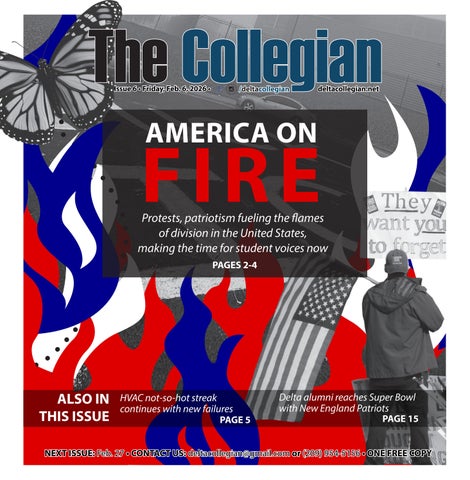
As the United States moves deeper into 2026, the political climate feels unsettled in ways that go beyond normal election-year turbulence.
Public trust in institutions is eroding, federal agencies are shifting direction, and civil liberties concerns are rising, all while the country heads into a midterm season viewed by analysts as one of the most consequential in recent history.
For students at Delta College, these national shifts are not theoretical. They shape access to federal financial aid, determine the stability of immigrant families, and influence the conditions under which faculty and staff teach, and according to political science experts at Delta, the combination of weakened institutions and heightened enforcement has created a political moment that students cannot afford to ignore.
One trend is unmistakable: Americans are losing trust in their political institutions.
According to Gallup’s latest surveys, public confidence in major institutions remains near historic lows. As of mid-2025, only about 29 percent of Americans say they have a “great deal” or “fair amount” of confidence in Congress, a steep drop from the early 2000s, when that figure was closer to 40 percent. Confidence in the Supreme Court has also declined sharply, falling from around 50 percent in 2001 to the mid-30s today, while trust in the presidency has hovered around 30 percent for much of the past decade.
Pew Research Center data shows a similar trajectory: overall trust in the federal government to “do what is right most of the time” has slipped to about 17 percent in 2025,
down from roughly 44 percent in 2003 and about 24 percent in 2015. The decline underscores a long-term erosion of institutional confidence rather than a sudden shift.
Dr. Joel Blank, co-chair of Delta’s Political Science department, said this moment reflects a deeper structural problem.
“You’re seeing the checks and balances aren’t working the way they’re supposed to,” he said, describing a Congress that has grown increasingly reluctant to assert oversight.
Blank added that the shift is not driven by a single branch of government but by a broader pattern of weakened accountability.
“The system can still function,” he said, “but when people stop believing it’s accountable to them, that’s where democracy gets shaky.”
Experts note that concerns intensified in 2024 when the U.S. Supreme Court issued a 6-3 ruling in Trump v. United States that presidents and former presidents have broad immunity from criminal prosecution for official acts conducted while in office, a decision widely seen as reshaping limits on executive accountability.
“That immunity decision absolutely shocked judicial conservatives,” Blank said, adding that the ruling signaled a shift in how the Court interprets executive authority.
Federal immigration enforcement has sharply intensified in recent weeks, particularly in Minneapolis, where a large federal operation known as “Operation Metro Surge” deployed thousands of agents to the Twin Cities and drew sharp criticism after the fatal shootings of U.S. citizens Renée Nicole Good and Alex Pretti during enforcement actions.
“In the last 6 weeks, our brave DHS law enforcement have arrested 3,000 criminal illegal aliens including vicious murderers, rapists, child pedo-
philes, and incredibly dangerous individuals. A huge victory for public safety,” Secretary of Department of Homeland Security Kristi Noem said in a Jan. 19 press release.
Civil rights groups including the ACLU, its Minnesota affiliate, and local advocacy organizations have condemned the operations as “dangerous” and called for independent investigations and accountability, warning that aggressive tactics and lack of federal oversight undermine public safety and constitutional protections.
Dr. Cirian Villavicencio, cochair of Delta’s Political Science department, said these trends are not isolated to undocumented immigrants.
“Immigration enforcement is affecting more than just undocumented students,” he said. “It impacts mixed-status families.”
He noted that even students who are U.S. citizens often carry the stress of knowing that parents, siblings or relatives could be targeted. That climate, he said, directly influences academic performance, enrollment decisions and mental health.
“When families are scared,” Villavicencio explained, “students stop showing up. They stop enrolling. They focus on survival.”
A 2024 report by the Presidents Alliance on Higher Education and Immigration estimates that 408,000 undocumented students are enrolled in U.S. colleges and universities, with community colleges serving as the primary entry point for many. In California — home to the largest undocumented student population in the nation — federal enforcement actions ripple through classrooms in real time.
National political shifts are also reshaping the landscape of higher education.
Villavicencio pointed to ongoing disruption inside the U.S. Department of Education,
where the agency has been undergoing significant shrinkage and reorganization as part of broader federal policy shifts.
In March 2025, the department announced a major reduction in force that cut nearly half of its workforce, a move officials said was meant to streamline operations but that critics argue undermines federal oversight and capacity. Since then, the Education Department has begun moving some of its core grant programs and administrative functions to other federal agencies as part of an effort described by the administration as “breaking up the federal education bureaucracy,” raising concerns among education leaders about continuity, expertise and accountability in delivering federal support to schools and colleges.
“The federal Department of Education has been gutted,” he said, explaining that funding streams essential to community colleges are now stalled or uncertain.
One example is Delta’s federally funded AANAPISI (Asian American and Native American Pacific Islander-Serving Institutions) grant, which has been frozen amid ongoing litigation over federal higher-education programs, leaving student services and support programs like EPIC “in limbo” until the case is resolved.
“Our AANAPISI grant is frozen,” he said. “Even with the lower court ruling in our favor, we still can’t access the money.”
He added that proposed changes to Pell Grant eligibility — including a push to require 30 credits per year to receive the full award — would pose a real barrier for students who work, care for family members or attend part-time.
According to a May 2025 letter from the American Association of Community Colleges to the Senate Health, Education, Labor and Pensions Committee, the Pell Grant changes in the One Big Beautiful Bill Act could significantly harm community college
students nationwide.
David Baime, AACC’s senior vice president for government relations, warned that the new credit requirements would “make it extremely difficult for thousands of working students to continue to enroll in community college.”
Baime added that the risk of students stopping out is real because “we are, by definition, talking about the lowest-income students on our campuses.”
These pressures, combined with federal uncertainty, create what Villavicencio described as a “trickle-down effect” that directly impacts Delta students.
Despite the turbulence, Blank and Villavicencio emphasized one clear point: students have power.
Blank said local political outcomes often hinge on young voters far more than they realize. He pointed to Measure K, the 2024 facilities bond, as an example of what student mobilization can accomplish.
“Measure K passed because the students promoted it,” Blank said. “Students have a lot of power. They may not realize it, but they do.”
That influence carries extra weight in San Joaquin County, where turnout is modest even in major election years. Only 34.9 percent of registered voters cast ballots in the 2024 presidential primary, and just 70.7 percent turned out for the 2024 general election, according to county election results — meaning close races are often decided by slim margins.
“Elections are being decided by a couple hundred votes,” Villavicencio said. “Students come out and vote in great numbers, they’re the difference.”
Both professors said that in a political moment defined by uncertainty, student civic engagement matters more than ever.
“If students don’t vote, someone else is going to make those decisions for them,” Blank said.
BY LEVI GOERZEN Sports Editor
In the wake of growing anger related to Immigration and Customs Enforcement (ICE) raids and the direction of the country, protestors have gathered on the corner of Pacific and Yokuts every Saturday since June 2025.
Every week there seems to be a new policy or action by the Trump administration to protest. This past weekend, protesters gathered in support of Renée Good and Alex Pretti. Good was killed by ICE agents on Jan. 7. Pretti, whose death was ruled a homicide earlier this week, was killed during an interaction with ICE officers on Jan. 24.
In total, ICE agents have been
involved in the deaths of 34 people since the start of 2025.
“I try to come down as many Saturdays as I can because I gotta protest what’s going on,” said protester Craig Anderson. “There is so much he[Trump] is corrupting.”
Protesters gathered from 10 a.m. to 1 p.m. sporting signs detesting the Trump Administration and ICE.
This long-standing protest was one of two this week, with students from local high schools walking down Pacific Avenue on Friday, Jan. 30 as part of the National Shutdown demonstration.
One protester noted at the weekly event how division has been a long standing issue in the United States even before the Trump administra-
tion.
“The country has been divided,” said protester Mike Garcia. “Back in the 70s with Watergate and Vietnam, and we’re still divided today.”
Protesters plan to continue gathering every week until the Trump administration has ended its time in the White House.

BY DANI CARMACK Staff Writer
As the Trump Administration ramps up Immigration and Customs Enforcement (ICE) activity in Minnesota, several Native Americans have been reported to be victims of unlawful stops and arrests made by ICE agents.
Among the most noteworthy is Red Lake Nation descendant and U.S. citizen, Jose Roberto Ramirez, 20, who was detained by ICE agents in Robbinsdale, Minnesota, on Jan. 8.
Ramirez’s mother, Raelyn Duffy, is an enrolled tribal citizen of the Red Lake Nation. Ramirez was born in Minneapolis and has been a U.S. citizen since birth.
Ramirez was on his way to his aunt, Shawnite Sosa-Clara’s house in Crystal, Minnesota when he noticed he was being followed by a federal agent’s vehicle. He began to panic and pulled over at a nearby grocery store and waited for his aunt. Sosa-Clara began videoing the interaction as ICE agents surrounded the car.
The video from Sosa-Clara’s phone shows ICE agents reaching into the car to start repeatedly hitting Ramirez and dragging him from his aunt’s vehicle.
“I was complying with them and they just started acting crazy,” Ramirez told ICT, the non-profit IndiJ Public Media’s multimedia outlet.
Ramirez was detained and held at the B.H. Whipple Federal Building in Minneapolis. He was denied food, water, and access to a bathroom for the entirety of his detainment.
“I felt like I was kidnapped,” Ramirez told ICT.
His mother said she had initially brought his passport and birth certificate as proof of his U.S. citizenship to the B.H. Whipple Building, but claims she was turned away and was not allowed to contact her son for hours. Ramirez claims that once agents finally questioned him, they told him that he had “assaulted an officer who had been sent to the hospital and that charges against him were pending.” At no point did agents explain why he was being followed by their vehicle in the first place, according to ICT.
Ramirez is facing federal charges for allegedly assaulting an officer while detained. Ramirez is being represented by a Minneapolis-based attorney.
The Native American Rights Fund, or NARF, is a legal advocacy group dedicated to protecting Native American rights.
NARF had issued a statement after Ramirez was detained, addressing all unlawful ICE activity but focusing on Native Americans being unlawfully detained by ICE.
“Native Americans, the first peoples of the land, are among those who are being detained. These arrests blatantly violate the treaty, as well of the constitutional and civil rights of the Native Americans being apprehended,” reads the NARF statement.
Native American officials believe this is racial profiling.
“It’s indicative of the racial profiling that is happening, and we refuse to stand by while the United States government abducts Native people,” said NARF Executive Director and enrolled Pawnee Nation citizen John Echohawk.
This is concerning, because citizens of sovereign tribal nations are dual citizens of their respective tribal nations and the U.S. under The Indian Citizenship Act of 1924.
Nia Gregory, a professor of ethnic studies at Delta College and a Cherokee Nation citizen, said ICE’s current behavior towards tribal citizens is no surprise to her.
“We know this administration is racist, so profiling is
one thing, but detaining and charging is another. When ICE started to organize and we started to see them pop up, tribal governments reminded their citizens to carry tribal ID, but that won’t matter, they are showing us that they are doing what they want and that unfortunately native people in this country are still an Indian problem, and they are still settlers,” said Gregory.
Gregory is not wrong, as the U.S. federal government has a long history of getting rid of Native nation’s sovereignty as apart of the genocide of Native American people.
“I believe if people learned Native history we would all benefit, because Native ways weren’t oppressive, we limited harm intentionally. American history isn’t Native history, but Native history is American history. Let that sink in, think about how our story is ongoing and not a history at all,” said Greogy. This serves as a reminder that Native American people are still here and still fighting colonialism and threats to tribal sovereignty, and ICE overstepping their jurisdiction and racially profiling Native Americans is a part of the ongoing colonialism Native Americans are still facing today.
As of Jan. 29, Ramirez has
not been the only tribal citizen to be arrested and detained by ICE. According to a press release by Arizona House Democrats, a Navajo Nation citizen, Peter Yazzie, was arrested and detained by ICE despite having government-issued identification on him. The Navajo Nation Council has since put out a statement asking federal agencies to respect tribal identification during ICE operations. “Indigenous people are the first people of this country and hold inherent rights. Any enforcement action that disregards valid tribal identification places Navajo citizens at risk of wrongful questioning, detention, or separation from their families,” says Navajo Nation Speaker Crystalyne Curley. Other tribal governments have put out statements reminding tribal citizens of their rights such as the Saginaw Chippewa Indian Tribe of Michigan, and some have even banned ICE agents from entering their reservations, including the Oglala Sioux Tribe and the Yankton Sioux Tribe of South Dakota. Each federally recognized tribal nation is a sovereign nation, and has the right to determine if U.S. federal agents are allowed on their land.
On Friday, Jan. 30, students across the country walked out of class in protest, showing that young people are paying attention, even when the rest of the nation seems determined to look away.
The students, including groups from Stockton high schools that marched down Pacific Avenue in front of campus, were responding to something far deeper than a news cycle: Our democracy feels less stable today than a year ago.
Consider the most jarring example: three U.S. citizens — Renée Nicole Good, Alex Pretti and Keith Porter — were killed during federal immigration operations. No warning. No national emergency. Routine enforcement ended with Americans dead.
It forces a difficult but necessary question: What does it mean when people can be killed by federal agents in the course of everyday enforcement and the system labels it business as usual?
lander students — remains in legal limbo, leaving services stalled at the moment students need them most.
These developments paint a picture of a democracy under pressure: structurally, politically and culturally.
One of the groups affected, and most underestimated, is students.
ganized, showed up and changed the outcome. That is power. Real, measurable, local power.
It’s tempting to think national politics is something happening far from Stockton. It’s abstract: A storm rolling over Washington while Delta students are trying to get through the start of the semester, keeping up with assignments or figuring out rent.
The events unfolding across the country show otherwise.
They reveal, with startling clarity, that what happens “out there” has already reached “right here.”
If that can happen on the streets of Minneapolis, it’s not unreasonable for students in Stockton to wonder where those lines are
The strain isn’t limited to policing. The U.S. Department of Education is undergoing deep disruption: workforce cuts, program transfers and uncertainty that affects everything from Pell Grant processing to campus funding.
Delta’s AANAPISI grant — a support system for Asian American and Native American Pacific Is-
The Collegian is the student newspaper of San Joaquin Delta College in Stockton, Calif. The paper is published six times a semester.
As a First Amendment newspaper we pride ourselves on a commitment to the students of Delta College while maintaining independence.
We reinvigorate the credo that the newspaper speaks for the students, checks abuses of power and stands vigilant in the protection of democracy and free speech.


Students are navigating frozen grants, new financial aid barriers under the One Big Beautiful Bill, and immigration pressures that destabilize mixed-status families. These are policy debates that determine whether people stay in school, transfer, access resources or feel safe on campus.
Here’s what’s overlooked: students also have political power.
In San Joaquin County, only 34.9 percent of registered voters turned out for the 2024 primary. In a landscape of low participation, any group that mobilizes — consistently and collectively — becomes decisive. Delta students proved that two years ago. The passage of Measure K didn’t happen in a vacuum; students or-
That’s why this moment matters. Young people are often told to “wait their turn.” To get older. To get more experience. But decisions being made right now — around education, immigration, federal authority — will shape the world students inherit long before they’re ever invited to the table.
So here’s the invitation, and the challenge: Don’t erase yourself from the narrative. Raise your voice in support, in dissent. Make yourself heard. Silence won’t protect anyone in moments like this. Power doesn’t shift on its own, but because people decide they’re done being quiet. If this moment feels heavy, it is. Heaviness is a signal. Don’t ignore it. Talk to your peers. Ask questions. Register. Vote. Because if students don’t show up this year, someone else will decide what our future looks like, and most of the time, they don’t have us in mind.
BY ZACKARY KIRK-NEWTON Editor-at-Large
Crews were once again out on North Burke Bradley Drive on Feb. 3 fixing a pipe that was damaged following a shutdown of the HVAC system in January. This comes less than 2 weeks after a break in the same area left the campus without heat on Jan. 23, and an earlier failure shut campus before the start of the spring semester.
“We had a break on our HVAC return line,” said Stacy Pinola, director of facility planning for San Joaquin Delta college, also noting that the Jan. 23 break had been the outgoing line.
According to Pinola, the pipes were nearly 30 years old and not particularly well insulated, which led to them expanding and contracting over time. This eventually lead to the breaks that cause the last two incidents

“We’re looking to replace the steel line that’s breaking. We’re looking to replace it all so that we stop having these breaks,” said Pinola, who said that the work would be done over the upcoming five-day weekend for President’s Day and Lunar New Year holidays.
For the time being, the current break has been patched and campus remains heated.
The most recent break comes on the heels of a series of HVAC issues that begin in early January, the initial issue leading to an campus being closed for several days.
At a Jan. 20 meeting, the Delta Board of Trustees unanimously voted to approve an emergency exception for the bidding process for work needed to fix the HVAC issues.
Issues with the HVAC system were first reported in the Shima building on Dec. 30 with efforts to repair those issues leading to the discovery of a larger issue in the central plant on Jan. 2.
“It snowballed,” said Pinola. “The Facilities team assembled on Friday, Jan. 2 to make the repair only to find that we had a larger problem at the Central Plant and that the entire campus had no heat.”
The vote was an emergency ratification of a Jan. 15 agreement that ap-
proved a budget not to exceed $150,000 to be used from the capital projects fund to cover the repairs done by contractor, Iron Mechanical.
California public contract codes (PCC) state that expenditures over $50,000 are subject to a bidding process to avoid misuse of funds. Delta’s own administrative procedures set that number at over $15,000.
However, in the event of an emergency, PCC allows the bidding process to be skipped with superintendent approval and a unanimous board vote.
The repairs conducted on Jan. 23 and Feb. 3 did not exceed this $15,000 threshold and thus did not require an agreement to bypass the bidding contract.
While the vote approved the emergency repairs, the board questioned whether the work could assist in future plans.
“Since they’ve opened it up to fix things, can they look at it and help out with what we’re doing for the bond?,” asked Shelly Swanson, trustee for area 1, during the meeting.
Swanson highlighted plans by the board to prioritize HVAC improvements in legacy buildings on campus using bond money, which was decided in a meeting from February 2025.
“Anytime you open it up you see the condition of the pipe, that will let us know and we will let the firm for the HVAC project know,” said Augustine Chavez, vice-president of Administrative Services.
While Chavez said that the information might be used going forward the vice-president of Bond Programs, Daniel Banowetz, said that the scope of the bond project was not the same as the repairs.
“A majority of the scope is everything above ground that’s in the building themselves…To replace all these original parts and pieces, the piping in the walls, and the air handlers.” said Banowetz.
Banowetz added that they would also do an evaluation of the system as a part of the bond project.

Board members also noted that the HVAC system often experienced issues following the two weeks off during the holidays.
“This is not the first time that we’ve been unable to heat campus following Christmas break,” said Charles Jennings, board president and Area 4 trust-
ee. “And my recollection is that it’s been lots and lots and lots of times.”
Banowetz confirmed that addressing issues like the one raised by Jennings would be tackled in the evaluation process.
Six more NARCAN training sessions to be held during the spring semester, all are welcome
BY GUADALUPE FARFAN Staff Writer
Delta College is hosting six free NARCAN training sessions on campus in partnership with the Stockton-based Native Community Outreach Resource and Education (C.O.R.E).
The trainings, which began last semester, are hosted in partnership with the Health and Wellness Offices of Student Services.
Native C.O.R.E. is providing the Naloxone, fentanyl testing strips and instructors, while Delta College provides the location and promotion for the events.
Native C.O.R.E. is a nonprofit that covers San Joaquin, Stanislaus and Tuolumne counties.
The organization provides educational outreach for a variety of things from youth assistance, housing placement, and the NARCAN training. Native C.O.R.E is one of nine Narcan distribution centers in Stockton, through its Community Opioid Intervention Prevention Program awarded by the Indian Health Services.
This semester’s trainings started on Feb. 3 and teaches students how to recognize signs of overdose and administer NARCAN, a name brand nasal spray of Naloxone, a prescription medicine
If you or someone you know is struggling with an opioid addiction you can call 988 or online at 988california.org.

To register for future NARCAN trainings, scan the QR code
that blocks the effect of opioids and reverses an overdose.
It is a one day, 90-minute training event that provides lunch for its attendees.
“It is a great place to educate people on something they may not be familiar with entirely,” said C.O.R.E. administrative assistant Mathew Garcia.
The sessions are relevant given the impact of fentanyl in the community.
“Our youth are mostly affected by fentanyl,” says Louis Sandoval, an outreach assistant at C.O.R.E. “Over three quarters

of overdoses among youth are by fentanyl.”
The first training of the semester was attended by students and professors on the second floor of Danner. Sandoval led the training with Garcia.
“I think it [NARCAN training] should be part of CPR training,” said Delta Chicano Ethic Studies professor Dr. Alberto Gutierrez. “Addiction has become such a big part of our lives; we can’t ignore it.”
The Naloxone Distribution Project (NDP) started in 2018
by the Department of Healthcare Services (DHCS) to combat the current fentanyl and opioid epidemic. It was expanded by Gov. Gavin Newsom in 2023, budgeting $79 million dollars to make the distribution of Naloxone more accessible to the public.
In 2024, there were 130 overdose deaths in San Joaquin County, according to the NDP data.
Any school, college, university, hospital or native center can apply to be a part of the NDP and
receive NARCAN and fentanyl test strips to distribute for free.
Delta College has no current plans to become registered with the NDP to become a distribution center according to Vannessa Plaza, the student program specialist at Health and Wellness Office.
The next training day for this event is on Feb. 23.
Others will be held on March 3, 4, 23 and April 7, 27. The campus community is invited to attend.
BY EDEN ATTWOOD Staff Writer
The Career Ready Closet, a resource that provides Delta College students with free professional attire, recently put out a campus wide announcement asking for donations.
This is following a pop-up event they had in the Shima building where they gave out a large sum of supplies to students in the courtyard.
This is the first pop-up the closet has ever had since its creation in spring 2023. Cecilia Orejel and Sarah Maimone, two
administrative assistants, helped wheel out two racks and a full table of clothes to the courtyard of the Shima building.
Orejel said the event was meant to bring attention to the fact Delta College has a Career Ready Closet available for students. She said it would be a good idea to host a similar event.
“We absolutely should. We’ve been having a lot of movement in the department and things have been changing, so when we get settled we’ll be able to plan more things like that,” she said.
Staff also plan to roll out a pop-up event bi-monthly, but that’s not yet con-
firmed.
The closet itself is located in the SCMA building on the second floor. About 15 students per month used the closet last semester and the people behind it are hoping to bump those numbers up with collaborations and events in the future.
It was created to give students a steady supply of professional clothes for job interviews or public speeches.
“We want that student to match their confidence appearance wise,” said Maimone.
Orejel and Maimone said many stu-
dents from the Speech and Debate Club have used the service.
The closet is open during regular Delta College business hours from 8 a.m. to 5 p.m. To donate or ask for clothes, those interested can either schedule an appointment or walk into Shima 217 and ask to be escorted to the closet.
“I wish we had more coming in. We’ve had about 15 a month at least, which is pretty nice, but we really want more students to know about what we offer. Not just our internships and resume or career development but also that clothing aspect,” Orejel explained.
BY ELENA CANDELAS Social Media Editor
In case you forgot the California Governor race is underway with 11 candidates gunning for the spot. The primary election on June 2 is set to be a difficult decision for the usual straight ticket voters as nine of the candidates are Democrats and two wear the Republican title.
The two highest voted candidates in the primaries will advance to the General Election. Seeing as Gov. Gavin Newsom is in his final term and is ineligible for reelection due to term limits, it’s likely you have yet to familiarize yourself with the names that will be on the ballot.
The San Jose mayor is the most recent person to throw his hat into the ring. Mahan joined the race on Jan 29.
A Democratic candidate Mahan has publicly criticized Newsom in the past as Newsom’s “leap into meme land” as Mahan wrote in San Francisco Standard back in August 2025 failed to provide tangible change.
“It might be a winning strategy for his presidential campaign, but it’s a losing one for improving the lives of Californians,” wrote Mahan.
With 35 years of service under his belt Becerra has served in Congress, as California Attorney General and was the U.S. Secretary of Health and Human Services under the Biden administration. In that time he brought up 122 court cases against Trump where in his own campaign page he claims to have won “most lawsuits on behalf of California families.”
Becerra is running on the platform of lower healthcare costs for Californians also tackling the cost of living crisis in the state.
“We will prosecute, we will investigate independent of the federal government anyone who tries to step on California and our rights and our Constitution and we will do this together…” said Becerra in a short clip of his Jan. 22 California Community Foundation gubernatorial forum appearance posted to his Instagram on Jan. 30.
A Democrat who previously served California in Congress, she is known for
her advocating to hold corporations accountable. Porter is running on a similar platform hoping to assist in the affordability in the state, including building affordable housing, and advocating for healthcare.
She has every intent to battle the Trump administration.
“The biggest threat to our health care in California will be from Trump and his allies in Washington,” her campaign page said.”As your Governor, I will fight these cuts with every fiber of my being and work to fortify our health care system at the state level so we can protect, expand and improve health care for all of our residents…”
Porter’s approach is aggressive as she stated in a press clip posted to her Instagram on Jan. 28.
“ …If you are not willing to stand up and keep people safe you have no business running for government because that is the most important thing that people need.”
One of the two Republican candidates gunning for governor, Hilton is an English immigrant who moved to California in 2012. He’s a regular on Fox News segment “The Next Revolution with Steve Hilton.”
“The home of free spirits and rebels has become plagued by endless rules and regulations, bossing everyone around, telling people what to do and how to live,” his official website reads.
Charlie Kirk had provided Hilton with an endorsement prior to his death. Hilton reposted the endorsement on Feb 2.
Hilton has taken on a familiar slogan “Make California Golden Again” making the claim he’d work with the president, no matter who was in power.
The Riverside County Sheriff is the other Republican contender, and a heavy critic of how California is currently run. Bianco is campaigning on the basis of small business assistance, affordable living and criminal justice reform.
Bianco believes the government has appeased activists (environmental) far too much, a stance he made clear at the Governor Candidate Forum at the Economic Summit in October 2025. Bianco claims that it prevents the fire departments (Cal Fire) from removing the obstacles that pose a threat to California areas.
“The government has its boot on our backs keeping us down with over regulation activism, appeasement of activists instead of taking care of the majority of Californians as a whole. And it’s an agenda it is a complete agenda of… making sure that government is in control of all of our lives instead of us being in control of government…” said Bianco in a message when referring to the issues that face California on a clip posted to the right page “Real America’s Voice News” posted in August 2025.
A billionaire Democrat and environmental activist Steyer like many others in this race has vowed to fight for an affordable California, making mentions of investments into education and building affordable housing. He is devoted to making sure that the billionaires and corporations of California contribute to the state.
“It’s time for billionaires like me and big corporations to buy into the future of California and be willing to pay more…,” said Billionaire Steyer in a campaign post on Jan 26.
The current Superintendent of Public Instruction, Thurmond is a Democrat who is running on the prioritization of the youth’s education as well as tackling the homeless crisis. He cites his upbring as to why he feels so passionately for these topics.
Thurmond has worked on several actions in his time as superintendent that help provide students with education. He notes Transitional Kindergarten as one of his solutions, as well as free preschools and free lunches.
A Democrat and the former mayor of Los Angeles, is running on the platform of the cost of living, climate change, and homelessness.
When introducing himself at the 2025 California Economic Summit, Villaraigosa made his positions clear.
“The issue at hand is the issue of affordability people can’t afford this state can’t afford to buy a home can’t afford to buy gas utilities the second highest in the country gone up 60 percent we need a proven problem solver…,” said Villaraigosa, citing his qualifications as a former mayor of a large city as his own reasons as to why he would be the one for this job.
Democratic candidate former California state controller, Yee says she has the experience to to focus on the state’s budget, curating her campaign slogan to match: “Let’s make California add up for all of us+”
Yee has built her campaign on tackling all forms of affordability in the state including housing, health care and the cost of living itself.
“As a large global economy I still find myself questioning, where’s our ambition?... How we’re gonna build middle class jobs is this, we’ve got to center everything that we do with an economic outcome,” said Yee when asked about the plan for developing California’s workforce at the California Economic Summit.
A bitcoin enthusiast, Democrat Ian Calderon was the first millennial elected to state legislature, becoming the youngest majority leader in the state’s history in 2012. Leaving to raise his family, now he’s back and running for governor on the platform of affordability of everyday needs such as food, housing and childcare costs.
Calderon has some “outside of the box” thoughts on how to increase the budget suggesting Bitcoin as a possible solution, “What if we had some money that was actually tied to an asset that would grow up and grow our revenue over time so that we can lower the cost and reduce tax burdens and investment burdens on people in the state? And if bitcoin could be there, then why not?” was what Calderon said to some effect (as the interview was edited slightly for clarity) in an interview with The San Francisco Examiner published on Feb 1.
A Democrat candidate and Congressman serving as the U.S. representative for California’s 14th congressional district since 2023, helped lead the charge of Trump’s second impeachment when he was appointed as an impeachment manager on Jan. 12, 2021. He runs on the platform of California’s affordability, housing and unemployment issues.
He is sure to make it known he will fight against the current administration as he was one of the individuals in congress at the time of the Jan. 6, 2020 insurrection.
BY LEAH CUVILLIER-CALLEROS Staff Writer
Jan. 22 through Feb. 12 Delta College’s art faculty are showcased in the Art Faculty Exhibition in the L. H. Horton Jr. Gallery.
The exhibit features work by full-time and part-time art instructors at Delta College.
Artists include Hailey Ashcraft-Fimiani, Jesus Barela, Cameron Brian, Gary Carlos, Shenny Cruces, Michael Leonard, Luz Lua, Taryn McCabe, Mario Moreno, Jess Peña, Kirstyn Russell, Ruth Santee, Robert Schumacher and Taylor Wick.
The work includes ceramics, drawings, paintings, sculptures and many other types of arts such as sculptures, 2D and 3D art and photography.
“A huge majority of students have never been to an art gallery until they come in here and so my goal is to make it very educational and very welcoming, make it a good experience for them so they feel comfortable, because I really want students to be able to go into any gallery because it’s a public space and you can go into public spaces, and you can hold your own….you can be apart of that,” said Gallery Director Jan Marlese. “The educational component really comes into play in the gallery guide where we provide the artist statements, and we provide along with all the artist statements a vocabulary list of studio art terms.”
Taylor Wick, a multi-media artist who teaches Graphic Arts at Delta is an alumni of the program, she has her own take on the exhibit.
“I think people should visit the exhibit because again it kind of humanizes you know, who we are as instructors, people just hear about us.. they know we teach stuff like that but they don’t really seek out the work we’ve done. They don’t know if we actually have backing to what we’re saying, when it comes to rules in art


especially. So I think this, you know, seeing your professors work or they don’t even have to be your professor you just know they’re a teacher here. It just kind of brings us as a community together and kind of again gets rid of that dynamic,” said Wick.
Wick’s artwork on the 2024 remake of Silent Hill 2, a 2001 horror game released originally on the PlayStation 2, is one exhibit piece you can find in the gallery. Wick’s artwork shows James, the protagonist gazing into his own reflection in deep denial.
All three pieces, made with colored pencil, tell their own
story unique to the game.
“I chose to do pieces on ‘Silent Hill,’ specifically on ‘Silent Hill 2’ because I recently played the remake of it, it’s a game from I believe 2001 on the original PlayStation 2 and I played the remake and I absolutely loved it, I’m usually not a horror kind of person or horror game person I should say but it wasn’t horror just for the sake of being horror it actually touched on the psychology of horror and what some people go through that is horrific,” said Wick.
Ceramics Professor Shenny Cruces also has two pieces on display. Both pieces are


an homage to Goblin Market, a poem written in 1862 by Christina Rossetti.
“It’s really about the perils of sexuality with women and all of these standards we’re held to and it’s just a really interesting poem when you read it from a more feminist kind of perspective,” said Cruces.
Cruces’ piece includes knick-knacks from the thrift store that she recycles and turns into molds.
“These are all things I find at thrift stores that people have clearly passed away and there’s like 50 different bun-
nies, because somebody had a bunny collection, so I recollect things that other people have collected and I make molds out of them, and I can then make these piles of this work and it’s meant to feel heavy but recognizable and It’s supposed to bring up emotions in the viewer that I can’t predict,” said Cruces.
The faculty exhibit runs through Feb. 12
The gallery is open Monday through Thursday 11 a.m. to 5:30 p.m. and Friday 11 a.m. to 1 p.m.
BY ELIAS BARRERA Staff Writer
“Mom, what do you want me to say?!” asked Professor Mario Moreno.
“Give them hope,” his Mother responded.
On Feb. 4, an artist talk was held by Moreno in the Campesino Forum for his twin portraits of the Mexican Revolution freedom fighters Pancho Villa and Adelita alongside the two twin Huehuetl Drums constructed in the Aztec/Nahuatl traditional fashion. The artist talk was held in conjunction with the Art Faculty Exhibition running through Feb. 12 at the L.H. Horton Gallery where Moreno’s work is on display.
“The places I went too, the spirit of resistance, of revolution were every place I went,” said Moreno about his time traveling and learning in Columbia, Mexico, Costa Rica and Panama.
A faculty member of 32 years, Moreno has been an active participant of Delta College’s various arts and cultural groups, being an advocate for student voice, Chicano/a arts and student expression.
The two portraits were created as a result of his sabbatical trip where he says “it took on a special importance as things started to happen and as hostilities started to erupt and you began to see these hostilities spill into every living room — it wasn’t something you could dismiss especially if you are being profiled.”
The figures depicted are José Doroteo Arango Arámbula “Pancho Villa” and Adela Velarde Peréz “Adelita,” two Revolutionaries that became symbols and ideas greater than themselves. Moreno used canvas and acrylic paint to create “Francisco ‘Pancho’ Villa y Adelita”.
He said that he made them in a similar style
to how brands like Coca-Cola make images that are memorable and stick in your head.
The Huehuetl drums are made from the logs of a tree which over the period of several days were sanded and dried in the sun to allow them to bleed out their sap.

“I tried to create the drums in the essence of our ancestors, - and you see that drum is a reminder of that beat, that heartbeat of our people is still there,” Moreno said when asked about what the drums mean.
Moreno’s talk in the Campesino Forum welcomed a nearly full crowd.
“We are from this continent we did not travel through any oceans or any seas; we are from here and so that persecution goes on we have made it through these hundreds of years and we are gonna continue,” said Moreno.
Digital Media Professor Adriana Brogger attended the talk. She noted Moreno’s impact in his time at Delta College in reflection of his upcoming retirement.
“Professor Moreno has represented so much work, when we walk around this campus there are so many things that he has literally touched; I think it’s so important for us to be mindful of the fact that what he’s bringing us is revolution from the historical context, but what I hope people walk away with is the fact that he is a revolutionary, you are a revolutionary, we are revolutionaries,” said Brogger.

BY RYCKIE HEREDIA Senior Staff Writer
On Feb. 4, Delta’s academic advisors of the Social Science, Education, and Public Service Division Office hosted an open house to help students understand the help and support that is available to them.
Signs guided attendees through campus to the open house. Cristie Bryant, Ariana Paniagua and Aerika Angelotti — all Academic Advisors from the Social Science, Education and Public Service Division Office — welcomed students and faculty. They informed guests about the help Delta College provides and the many ways
advisors can guide them.
“As an academic advisor, our goal is to connect students to resources that will guide them to success,” said Bryant, an academic advisor with the Social Science, Education and Public Service Division Office.
While many individuals are perplexed and misunderstand the functions of academic advisors and councils, this event provides some clarity to help people distinguish between the two so they may locate the appropriate educational or even campus navigation assistance.
An academic advisor can address basic questions regarding programs and direct you to resources that may be useful -- for example, borrowing a laptop or
hotspot for online classes. Each Transfer and Career Pathway (TrAC), or field of study, has its own academic advisor.
“I think our goal as academic advisors is to make sure that students feel connected and supported. And that they use their energy for their education, not for a process or any other stressors. We are here to support them and make them feel like they’re not alone. We’re here to connect with them,” said Aerika Angelotti, an academic advisor from the Social Science, Education and Public Service Division Office
The TrAC success team, which is designed to help members define, plan and achieve specific
personal or professional goals at Delta College, set up a welcome booth on campus at the start of every semester to provide additional assistance.
Educational packages, business cards, a variety of food, water, icebreaker questions and a PostIt wall where attendees may put their 2026 objective were included in the open house.
“I think hosting events like this is very important for the college, but also for the staff, faculty to know exactly where all the academic advisors are located, because we’re not the only ones, there’s different ones. So having these kinds of events just helps, let people know that we’re here, and
where we’re located. So I think more of these events is great. ...We’re all very different, but we all have a lot to offer for our students,” said Ariana Paniagua, an academic advisor from the Social Science, Education, and Public Service Division Office.
Every Wednesday of the week, Transfer and Career Pathway (TrAC) posts some new information regarding them, but also a new tip of the week about guidance around Delta College, which they call “What’s Up Wednesday,” on the Delta College website, under student services, “Need Help? Ask An Academic Advisor.”
BY AZRIEL DRUMHELLER Staff Writer
Since, the Student Food Pantry opened in 2019, it has worked to address growing concern among the student population at Delta College.
The now six-year old location continues to also grow in use and quality, no longer storing only canned foods and drinks, but instead shelving cereals, boxed food, microwave meals and basic supplies like soaps and razors. The quality of the foods has grown as well, with a variety of drinks from energy drinks to Capri-Sun.
Since 2023, several improvements have been made, both to food quality and to the pantry’s shelving. Well there’s more healthier foods in there, and like canned foods” said Amanda Reyes, who’s used the food pantry for the last three semesters, “I’d like some fruits, like fresh foods like bananas.”
The program struggled to keep up with demand in late
2024, when there were more than 600 returning students and 1,425 total students, however the Food Pantry has since adapted and served 2319 individual students in 2025, with 1,515 students during the fall semester according to Student Programs Assistant Valerie Valera.
This school year the food pantry was prepared for long lines and new applicants. “This is my first time here, I applied last week,” said student Frank Williams. “I was surprised they got back so fast.”
At noon on a recent Thursday, more than fifteen people were standing in line for the Food Pantry. This has become a common scene during the days the pantry is open, particularly as more students learn about the critical resource.
“We implemented PantrySoft in Fall 2024, which helps streamline check-ins, track usage more accurately, and make sure access is fair and consis-
tent,” said Valera. PantrySoft is a service that helps manage inventory, accept volunteers, and is how students are able to sign up online.
The Food Pantry has also partnered with the Associated Students of Delta College on the Mustang Pass program, allows the students with a current Mustang Pass sticker to receive an additional three-point item.
“We also redesigned the pantry layout to make it easier to navigate, less overwhelming, and more like a grocery store than a handout,” said Valera.
This school year the food pantry is also offering an additional two-point item, or two one-point items if you bring your own reusable bag. Students can sign up for the food pantry through the PantrySoft tile on the Okta dashboard.
The current open times for the food pantry are from 10 a.m. to 4 p.m. Tuesdays and Thursdays, with a short break from 1 p.m. to 1:30 p.m. for staff lunch.

BY HARMAN RAI Staff Writer
Social media has been making its way through many aspects of our daily lives.
Adults are using their phones to check news, post pictures and listen to music. Children are catching up that this is a new way of life and now we are seeing learning difficulties in the classroom.
In an article published by National Public Radio, Rhitu Chatterjee describes how the Adolescent Brain Cognitive Development (ABCD) Study has been following preteens since their adolescence as their brains develop. Dr. Jason Nagata, lead researcher and his colleagues classified 6,000 children from this study into three categories from high social media usage to low. Nagata found that the children who used a low amount of social media ranked one to two points lower on the oral reading recognition and picture vocabulary test than those who used no social media.
The children that were grouped as using social media all the time showed results of four to five points lower than non social media users. This study exemplifies that the children who have used social media from adolescence to preteen had lower test scores than those who had no social media use.
Psychologist Sheri Magan at the University of Calgary said that “it’s problematic at really high uses, but it’s also problematic at even in small doses,” according to National Public Radio. Though these scores seem minuscule, these results will continue to create larger gaps between these two groups.
According to the American Psychological Association from June 9, 2025 the APA reviewed 117 studies that analyzed more than 292,000 children worldwide finding that the more children engaged with screens, the more likely the children were to develop psychological problems like depression or anxiety.
“I don’t think kids should be on social media until high school, until they
find themselves,” said Melnin Retutar, an 18-year-old Delta student. Retutar said kids can be wrapped in the attention and self esteem of being online as well as weak Artificial Intelligence (AI) restrictions and potential grooming.
“I never posted and had restrictions but was still able to find things I wasn’t supposed to,” said Retutar.
When asked about how she feels about technology utilization in schools Retutar, said “technology should not replace basic writing and there can be an overwhelming amount of options like for my brother who is autistic and should be slowly approached.”
Professor Kirstyn Russell, who teaches photography at Delta College, restricts her own 14-year-old daughter from social media, fearing self esteem issues may surface.
Russell does allow access to Pinterest and Lockit stating this is because “those apps are locked down and you cannot be contacted.”
Russell also comments on technolo-
gy utilization in schools, stating “some technology, like spell check, helps my daughter, who deals with dyslexia.”
Professor Nena Bush, who holds a masters degree in child development and has been teaching child development at Delta College since 2016.
“Young children are tactile, handson and concrete learners,” said Bush. “Children are going to get way more benefits playing with things, touching things, playing outside, building things and still having adult engagement and facilitation.”
Studies like these have opened up conversations to limit the use of social media. According to CalMatters Digital Democracy the “Protecting Our Kids from Social Media Addiction Act,” was signed by Gov. Gavin Newsom in September 2024 which protects minors from addictive features on online platforms, including social media that keep them scrolling.
This act is supposed to go into effect January 2027 by limiting access to addictive apps during certain hours.
BY ELENA CANDELAS AND JEWELS ESTRADA Social Media and Feature Editors
director Brett Ratner makes his return to the big screen with what is set to be a box office flop in “Melania.” A documentary story following the first lady Melania Trump in the twenty days leading up to President Donald J. Trump’s second inauguration, the film has been skilfully released on Jan. 30 — a year after the event.
Ratner’s last directed film before he was accused of several accounts of sexual misconduct towards women was 2014’s “Hercules.” He was never formally convicted, but the 2017 accusations — and his recent cameo in the Epstein files — led him to be shunned by Hollywood until now.
“Melania” $75 million budget has raised many eyebrows, as $28 million of that was just for Mrs. Trump’s role in the film. Many have even gone as far as to call it a corruption scheme. Ratner denies these rumors claiming that the movie and the three part docuseries — that has yet to announce a release date — will speak for themselves.
“When you see the movie, you’ll go, ‘Oh, we see where the money went now,’” said Ratner according to The Hollywood Reporter article “‘Melania’ Doc Premieres in D.C. as Director Brett Ratner Says $75 Million Price Tag ‘Wasn’t About Corruption’” by Carita Rizzo on Jan. 29.
After having sat through the hour and forty-eight minute movie I must say I do not see where this $75 million dollar budget went.
The film feels like an overpriced attempt at a home movie. It follows the first lady as she goes over her duties with unsteady camera work and extremely close-up shots that could quite honestly make any viewer nauseous.
This direction may call attention back to Rattner’s previous works, this includes action packed films like the three “Rush Hour” films, “X-Men: The Last Standing,” and “Red Dragon.” Though he does have producer credits in other genres including documentaries, it’s clear where his skills lie.
His strong suit is apparent from the opening sequence of the film: rock music plays while Melania delivers a monologue of her self importance. As the camera pans across the Mar-a-Lago estate in Palm Beach, Fla., and takes you from her police escort to the airport going to Trump Tower in New York City, you almost expect a car chase to ensue.
Then you are met with Michael Jack-

son’s “Billy Jean” and you wonder if they even knew what part of the film this was supposed to go to.
The timeline and pacing of the film felt confusing. Has a day passed? A week? Many moments seem like Melania was thrown into the scene instead of capturing natural moments of her life included by music that never suited the scene.
The film constantly casts Melania as a behind-the-scenes mover of important decision-making moments, but never actually shows her putting in any work.
In one instance her decor and stylist team mention her eye for decor — but conveniently that decision was made off-screen, with small clips of “planning” prior were shown as she points at already created boards with design concepts.
Melania’s personality became more apparent during a detailed fitting for her already designed outfit for the second inauguration, but rather than showing the process or collaboration it took for the final product. Instead, Melania’s opinions and expressions were more prominent during the slight adjustments on the outfit compared to her demeanor for the rest of the film’s topics of responsibilities being FLOTUS.
Outside of a heartfelt moment with the effects of Melania commentating on the grief of her mother Amalija Knavs having passed a year prior. The moment centers around her having to continue on even though the one year anniversary of her mothers death falls on the funeral of 39th president Jimmy Carter. Following her private flight to her mothers favorite church in New York City, after attending the funeral. It showed a more compassionate and somewhat expressive side that we had not seen the entirety of the film
after the fittings.
This grief, however, was expressed like most of the film is: in a voice-over monologue. The documentary is supposed to give a glimpse into the life of the First Lady as she transitions from a private citizen to a public figure once more. Except it never allows the viewer to actually see who Melania is, the voice over tells you her emotion, and the way she handles things. Nothing is left to visual interpretation because you as the viewer never see or feel any of these moments. You are just told this is it don’t worry if it appears true just know its there behind the botox I swear.
Typically one would expect the score of the film to express what cannot be seen but each moment is simply monologued or paired with ill-fitting music that feels as though you hit shuffle on the free version of spotify.
The attempt to build an understanding of her relationship with others is again cut short by her monologues about the relationship rather than letting that individual speak.
When speaking with the Queen of Jordan, Rania Al Abdullah’s conversation is covered with monologues where Melania refers to her organizations for change “Fostering the future for American Children and Families” and “Be Best” initiative, Melania never shows her actual plans of action for these movements at any point. Just discusses them with foreign dignitaries, never giving actual explanations as to what she herself is doing.
Similar to the Queen Abdullah, a conversation with Brigitte Macron, first lady of France, gets a voice over.
Even Melania’s father Viktor Knavs is cut short after briefly reflecting on his wife Amalija in English. Less than a minute into him speaking in his native language the moment is covered with — you guessed it — a monologue from Melania once again.
They later attempt to have some type of homage to her father’s love of film, with vintage Super 8 film roll cuts, going from the modern day scene in clarity to the roll of the same moment but in blurred film with the film roll sound effect.
One would think when mentioning how much a man loved to film they might actually debut the footage they claim inspired the cuts.
But who would expect anything to make sense from a film about a woman who says, “No matter where we come from we are all bound by the same humanity,” while her husband, displaying no sense of humanity, tears apart immigrant families while wearing a wedding band that binds him to an immigrant.
Watching this film felt like a betrayal to humanity, trying to find sympathy in a community that lacks sympathy for anyone they deem less human. It was an hour and forty eight minutes of trying to not roll my eyes every time they played the perfect family, as she spoke of her son being reserved because of the public’s eye. Yet children fear for the safety of their parents under the Trump DHS regime.
“Melania” the film is a perfect mirror to the current administration: A walking contradiction with no sense of direction, attempting to deflect any and all need for understanding with glamour shots and pretty words that in the end are strung together to mean nothing.
Don’t have time to get your partner, loved one, or best friend a Valentine? We know it’s challenging in times of inflation and five-day weekends, so the staff at Collegian made up some fun holiday missives for you to share with your favorite folks for the holiday of love.
You can cut out your own from a copy of the paper (or a few, we don’t mind) or download this page to print at deltacollegian.net/valentine.

Unlike Delta administration I won’t leave you on read
My love for you is HOTTER than the STEAM rising from a broken HVAC pipe. I miss you more than I miss the
Are you from the Dreamers Success Center? Because you make me feel so supported. Like the


BY JEWELS ESTRADA Feature Editor
how to be a people pleaser or pushover to those who take advantage of your kindness in 2026. Strap in and get ready to enter your villain era. While this doesn’t mean to live a negative lifestyle, prioritising yourself needs to come first — even if it may seem like a foreign concept to some.
People deem those who value their own time and energy as selfish. But sometimes it’s OK to be selfish because only you are going to accomplish your goals and necessities.
For a long time you were so selfless. In order to help others you have to help yourself first, there are going to be moments of yourself before others.
“People pleasers are super vigilant. They are constantly constantly reading, assuming, and guessing what other people are doing. What people pleasers don’t have is the ability to actually experience their own full scope of emotions, bodies, reactions, and things.” According to NPR Book of the Day “‘F*** Approval, You don’t need it!’makes the case against ‘people pleasers’” podcast by Chloe Veltman interviewing author Lizzie Moult on Oct. 2, 2025.
Moult shares her own personal experiences of priori tization of the needs of others before her own. She set up a women’s event and didn’t have a slot for her own

speaking because she was focused on others more than herself.
“It’s not that, you know, when we end people-pleasing, we become selfish. It’s actually about fulfilling some of the things that we need to do as humans to thrive,” said Moult.
Empaths especially feel this one feeling bad hurting others feelings or constantly putting their feelings after others. Take responsibility, don’t get lost in other people’s lives because you lose yours.
After an interview with psychotherapist Meg Josephson from San Francisco about the feelings of insecurity in rela tionships.
“When we sense dan ger, our nervous systems can respond in three ways:fight, flight or freeze. But some psychologists, like Ms. Jo According to the New York Times article “How ‘Fawning’ Is tionships”

as a single mom with no partner. I can’t keep pouring into my son and myself if I’m not taking care of myself. There may be days when I just sleep, because I need it or there may be days when I am busy and making things happen.” said By Goytia. “Or I might go get myself a coffee and sit in my car and just listen to music to feel the energy flowing through my body. Self care is making sure you feel better than what you are actually feeling.”
Prioritizing those who priori- tize your time equally If you’re not invited, then don’t invite either Not apologizing for filling your time or rearranging your schedule for others if they don’t plan ahead. You are not just open availability for others. Stop asking for permission to be yourself, if your personality isn’t liked then you don’t need to surround yourself with those people. Don’t chase people just to be the problem in their story. If you have to beg to explain your point of view then they didn’t really care to hear what you had to say in the first place.
StartsayingNO,yourtime isaprivilegenotaright.PuttingworkintogoalsthatbetteryouTakingtimetodothings YOUliketodotofillyour time.Burnbridgeswithpeople whocompareyourlivesto eachother,everyonerunsa raceattheirownpace. Give as much of what’s giventoyou.Showingup for those who wouldn’t do thesameforyoujustoverexhaustsyou.
By Goytia shares the meaning of to accomplish that.

you only for the person you try to be instead of your true self. You start to lose yourself and the reasons why you chose people starts to feel less.
Delta College student Belen By Goytia, 30, sets the ways she uses self-care methods in order to better her life and herself.
“Self-care has become a very important part of my life now

Being grateful for the littleNotthingsapologizing for choosing yourself in situa- tions where you weren’t Doing things with peo- ple who make you happy and get happy for you Pursuing your interests even if it’s different from the rest, you will be sur- rounded with people who understand or appreciate thoseYoudifferences. have one life, just live it how you want.
“Entering my villain era means I am not letting anyone or anything stop me from becoming what I want to become or achieve what I want to do. I am becoming unapologetic and I will not be sorry for what I may or may not say to someone.” said By Goytia. “That era of being nice and letting things slide has sailed away. I am a 30 year old woman, who’s also a mom to a handsome boy, and I will not tolerate anything that disrupts my peace, my happiness or my energy.”
Delta college student, Neilani Newsome, 23, sets boundaries in her life so she can prioritise her goals by creating plans to hold herself accountable.
“I set boundaries and prioritize my own goals by making conscious decisions by asking myself things like do I really want to do this or does this align with my goals? And I try to hold myself accountable, which includes sticking to my boundaries.” said Newsome.
Newsome shares her steps of protecting her goals in order to accomplish and achieve them.
“Entering my villain era means putting myself first more. I love helping people and doing things for others but there are things I haven’t done for myself that I’ve done for others. There are things I want to do for myself, that I have not done, and I want to do them. This year I am definitely doing more things I want to do and doing things that make me happy, as well” said Newsom. Don’t let others make you feel like you have to cater or be the side character in their story. Be the villain. You’re the main character, so treat yourself like it. Be ready to reclaim your boundaries and your power.
BY ELENA CANDELAS Senior Staff Writer
PresidentDonald J. Trump’s increased yearning for Greenland displays the idiotic and unfocused mindset of this administration.
With the changing name of the Department of Defense back to the Department of War on Sept. 5, 2025, the change in tone and priority of this administration has become increasingly obvious.
Section one of the executive order states: “The name ‘Department of War,’...ensures peace through strength, as it demonstrates our ability and willingness to fight and win wars on behalf of our Nation at a moment’s notice, not just to defend.”
It’s not just changing titles to feed their own egos but threatening another nation with takeover.
“If we don’t take Greenland, Russia or China will, and I’m not gonna let that happen,” said Trump to reporters. As though he had not been cozying up to these leaders his last time in office but none the less he NEEDS Green-
land.
“I would love to make a deal with them that would be easier. But one way or the other we’re gonna have Greenland.,” said Trump. Threatening invasion of a territory that belongs to another nation (Denmark) is ridiculous.
While his nation falls apart under his regime he simply can’t take his eyes off the shiny new toy that is Greenland.
His lack of care for the communities that suffer under his administration and his lack of willingness to care for anything other than the numbers debuted on his bank account is clear.
Made more apparent by his AI obsession portraying that he knows nothing of the nation he wishes to conquer.
The White House’s official Instagram account posted an AI image of the president and a penguin trudging through snow with Greenland’s flag in the distance and the penguin donning an American flag in his left wing.
“Embrace the penguin,” read the Jan. 23 post.
A simple Google search will tell you that Greenland has an amazing level of biodiversity, with polar bears to seals and more than 230 bird species. However, among those birds no penguins will be found in Greenland — at best you’ll find a puffin, but not the emperor penguin that seems to be beside the AI president.
His eagerness to deepen his pockets reflect the stereotypical idiotic American that half of Europe has come to associate with the Stars and Stripes.
This is not about protecting Greenland from other conquering nations; this is greed, plain and simple.
The Center for Strategic and International studies reports on Greenland’s potential for oil and rare earth metals ranking eighth in the world for these rare earth reserves.
While our nation collapses and some wonder if they will be able to afford groceries the only thing that some of the people on the Hill can think about is a territory across the way that has no need for America.

BY RYCKIE HEREDIA Senior Staff Writer
Theglobal community is dealing with a number of critical environmental issues that require immediate attention and action. From climate change-induced catastrophes, biodiversity loss, and plastic pollution to the rise of artificial intelligence, the most pressing environmental issues of 2026 provide a harsh picture of the critical need for climate change mitigation and adaptation, or else future generations will end up suffering.
Global temperatures are rising quickly and steadily due to increased greenhouse gas emissions. This is having terrible effects everywhere, from Australia to the United States, with some of the worst wildfire seasons ever documented.
“The heat trapped by CO2 and other greenhouse gases is turbo-charging our climate and leading to more extreme weather. Reducing emissions is therefore essential not just for our climate but also for our economic security and community well-being,” Ko Barret, Deputy Secretary-General of the World Meteorological Organization, quotes for an article from Earth.org.
Earth.Org is an independent environmental news website and non-profit organization founded in 2018. It focuses on providing high-quality journalism, data analysis, and educational content regarding climate change, biodiversity, and sustainability.
Barrett was appointed as World Meteorological Organization (WMO) Deputy Secretary-General in January 2024 and served as the Senior Advisor for Climate at the US National Oceanic and Atmospheric Administration (NOAA). She provided strategic advice and direction within NOAA to enable the agency to align, integrate, and extend its capabilities to provide the climate services needed to address the climate challenge. All information was found on the World Meteorological Organization’s website.
The WMO is a specialized agency of the United Nations responsible for promoting international cooperation on atmospheric science, climatology, hydrology, and geophysics. The WMO was founded in 1873 as a forum for exchanging weather data and research.
The detrimental consequences of climate change on food production and availability will likewise be more pronounced for future generations.
Growing, producing, transporting, distributing, purchasing, and storing food will become more challenging as temperatures rise; this tendency is expected to disproportionately affect the poor. Depending on future policies and climate and adaptation efforts performed, the number of people suffering from hunger in 2050 will range from 8 million to up to 80 million people. You can find support for these numbers on the Intergovernmental Panel on Climate Change (IPCC) website.
The Intergovernmental Panel on Climate Change (IPCC) is the UN agency responsible for evaluating climate change science. Without carrying out original research, it gives policymakers frequent, impartial, and scientific evaluations of climate risks, adaptation, and mitigation tactics.
By decreasing their carbon footprint through energy efficiency at home, adopting sustainable transportation, limiting waste (Refuse, Reduce, Reuse, Recycle), and pushing for systemic reforms like renewable energy regulations and carbon pricing, our future generations don’t have to suffer as much.
Something that has started to take effect is that California has imple-
mented mandatory, standardized three-bin garbage systems. Regulations require specific colors: Green for organics (food/yard waste), Blue for recyclables, and Gray/Black for trash. This is designed to reduce landfill methane emissions. The Town of Hillsborough, California’s official website, provides data to support this statement.
“Senate Bill 1383: Short-lived Climate Pollutants is part of a statewide effort to reduce the emissions of shortlived climate pollutants (like methane gas) in various sectors of California’s economy. SB 1383 establishes specific statewide targets:”
Reduce the amount of organic waste going to landfills (50% reduction by 2020 and 75% by 2025).
Reduce at least 20% of edible food that is currently going to landfills by 2025 and redirect it to people in need.
With the hopes of reducing climate change and increasing composting by dividing organic trash, which accounts for half of landfill waste.
But will there be any sort of change, and when will they start to reinforce these rules for those who don’t follow the Refuse, Reduce, Reuse, and Recycle so our future generation doesn’t have to suffer?
BY ELIJAH PROSSER Senior Staff Writer
Sophomore guard Aaliyah Youngblood is showing off an incredible performance for the Mustangs basketball team in her last season at Delta. The team is currently sitting at an 18-4 record, with six games left until the playoffs.
On Dec. 23, 2025, Delta’s women’s basketball Instagram page announced that Aaliyah has committed to Indiana State University.
So far during the season, Youngblood has started every one of the Mustangs’ 22 games, resulting in 12 more starts than she had last season.
Youngblood is currently averaging 17.4 points, 45.5 field goal percentage, 72.6 Free throw percentage, 2.0 rebounds and 30.4 three-point percentage per game.
Coach Gina Johnson provided a well-detailed analysis of Aaliyah’s game as a whole, which helps the
team improve as the season progresses.
“Early on in the season including in the preseason, when she got that student athlete of the month or whatever, her offensive game really improved this past year. She put a lot of time in personally training and getting her footwork together. She plays now very fluidly, like she can attack the rim to score and avoid defense,” said Coach Johnson
Johnson also mentioned that Aaliyah has started to improve on her defense from last year.
I asked Aaliyah how much work she puts in outside of her practices.
“I would say that there’s a lot more room for improvement, like how much work I put in but I’ll say I’m pretty active like even when I have offdays like I’m still in the gym like I make sure I get at least one day, like on a weekend so I feel like I’m never sitting still,” said Youngblood.
Youngblood then explained the reason why she chose to play basketball and who gave her that drive to get better at it.
“My brother played, and then I was seeing how my dad was training with him and I kinda just wanted to try it out, see if I like it, and now I’m stuck with it. But pretty much my dad motivated me he’s the one that kept pushing me to get better,” said Youngblood
I asked Aaliyah’s teammate, Mia Warren, about how she and Aaliyah work so well together on the court.
“So, Aaliyah, she’s just a hard worker. She comes in before practice, getting extra reps. She helps us a lot, big time, on offense and defense with playing the top row, which is a lot of work. She’s always active when I look to pass it to her, or she looks to pass it to me, it’s like our connections are really good, and that’s like with everyone on the court,” said Warren.
BY LEVI GOERZEN Editor-in-Chief
On Jan. 16 Delta College women’s basketball beat Diablo Valley college 94-22, however this wasn’t a normal win, this win signified Head Coach Gina Johnson’s 800th win at the community college level.
Johnson has been a community college basketball coach for 33 seasons, four at foothill and the remaining 29 at Delta, the only 3C2A coach currently ahead of Johnson in wins is Ventura’s Ned Mircetic at 935 wins in 35 seasons.

“The basketball community has taken notice,” said Dean of Athletics, Tony Espinoza, “you can tell these young ladies want to play for her.”
Johnson’s trophy case is just as impressive, in her time as coach at Delta the women’s basketball team has yet to miss playoffs, and is projected to make playoffs
again, she has 15 conference championships, including nine straight from 2001 to 2009, four state runner ups, 15 final eight appearances, was NorCal coach of the year in 2002, 2015 and 2020, and was even inducted into the Stockton Hall of Fame.
Johnson believes that coaching should be approached like teaching and cited teaching as an inspiration of hers.
“It’s like teaching a class but so much deeper,” said Johnson.
Unlike in a normal class where you may learn a couple classmates’ names but for the most part you may never see them again, a coach has to support their players to create lasting bonds and be a unit when gametime comes.
Espinoza noted even her work in the classroom goes beyond learning.
“She is not only supporting them here but when they transfer too,” said Espinoza, “Her work ethic is second to none”
Another inspiration of Johnson’s is the players themselves.
“This level is the best because they are so hungry,” said Johnson, “you can get so much out of a player.”
While Johnson is one of the most decorated coaches in the 3C2A she is still searching for a state championship, however this year’s team seems poised to accomplish that currently sitting second in the Big 8, but on a ten game win streak.
Delta’s next game is Feb. 6 at 7:30 p.m. against Modesto Junior College.

BY ANDREA BALTODANO Editor-in-Chief
Delta College alum Jeremiah Pharms Jr. will take the NFL’s biggest stage this Sunday, suiting up for the New England Patriots in Super Bowl LX, a milestone he credits to his time at Delta.
During a recent visit with the Mustang football team, Pharms told players that his path to the league started in Stockton and inside Delta’s own program.
“If I never went here, I would never have made it to Friends University. I would never have made it to the NFL,” Pharms said in a video shared by Delta College Athletics.
Pharms, a 2014 graduate of Stagg High School, he began his collegiate career at Sac City before he played at Delta then earning a fullride scholarship to Friends University in Kansas.
Delta officials say that scholarship — and the exposure that came with it — was a turning point that eventually led to multiple NFL looks and his signing with New England in 2022.
“We couldn’t be prouder of Jeremiah as he represents Delta College at the highest level of the game. His journey reflects the grit and perseverance we see in so many of our students,” Delta College posted across social media platforms.
Pharms becomes the second former Mustang to appear in a Super Bowl, following Amini Silatolu, who played in Super Bowl 50 in 2016 with the Carolina Panthers.


Far Left: Members of the Delta College baseball team in the dugout at the Nick Cecchetti baseball field on Jan. 29. Middle: Outfielder Ny’Zaiah Thompson batting against Cerritos college at the Nick Cecchetti baseball field on Jan. 29. Left: Pitcher Nathan Luehs pitching against Cerritos college at the Nick
cchetti baseball field on Jan. 29.
Below:Utility player Trent Keys and Catcher Tyson Reis celebrat
ing gainst Cerritos college
Jan.
