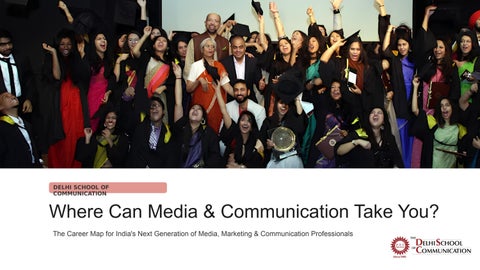
DELHI SCHOOL OF COMMUNICATION
Where Can Media & Communication Take You? The Career Map for India's Next Generation of Media, Marketing & Communication Professionals
What Can You Actually Do After Studying Communication is no longer one career. It is an entire professional ecosystem — and media and communication courses are Communication? your entry point.
Advertisi ng
Public Relations
Digital Media
Journalis m
Brandi ng
Event s
Marketi ng
Conte nt
Media Planning
Entertainm ent
From "Media" to the Communication Communication skills now cut across every major sector. The question is no longer which industry — it's which direction you Economy want to take.
Why This Shift Matters Every sector now needs people who can communicate clearly, think strategically, and create compelling content. • Brands need storytellers, not just advertisers • Companies need communicators, not just marketers • Platforms need creators, not just users • Every industry needs people who understand audiences
Which Communication Path Fits You? Your strengths already point toward a direction. Match what you naturally enjoy to where it leads professionally. 💡 If You Love Ideas
🤝 If You Understand People
📱 If You Love Digital Platforms
Public Relations · Consumer Insights ·
Digital Media · Social Media · Digital
Brand Communication
Marketing
Advertising · Creative Strategy · Content Creation
📖 If You Love Stories
🎪 If You Love Experiences
Journalism · Content Writing · Scriptwriting
Events · Entertainment · Experiential Communication
What Skills Make a Communication Professional Valuable? 1
Thin k Research · Critical Thinking · Audience Understanding
2
Creat e Writing · Storytelling · Visual Communication
3
Strategi se Brand Strategy · Campaign Thinking · Media Planning
4
Execut e Presentation · Digital Tools · Project Management
5
Ada pt Technology · AI Literacy · Continuous Learning
A Degree Gives You Knowledge. Experience Gives It Context. The gap between learning and working is bridged through structured practice. Every stage builds on the last.
Classroo m theory Foundational and concepts
Proje Appliedct learning
and hands-on work
Industry Exposure Live briefs and professional interaction
Internsh ip Real workplace experience
Portfol io Documented
professional work
Classroom learning provides the foundation. Projects and industry exposure add context. Internships and apprenticeships build realworld readiness. A strong portfolio is what opens doors.
What Should You Look for in the Best Mass Communication Colleges in India? When evaluating best colleges for mass communication in India, these eight criteria matter most.
01 — Curriculum Relevance
02 — Faculty Expertise
Updated regularly for current industry demands
Academic credentials and industry experience
03 — Industry Exposure
04 — Practical Projects
Live projects, guest lectures, and industry visits
Hands-on campaigns, not just theory
05 — Specialisation Options
06 — Internship Opportunities
Flexibility to focus your strengths
Structured placements with real organisations
07 — Portfolio Development
08 — Career Support
Graduate with documented, presentable work
Guidance, networks, and placement assistance
One Communication Foundation. Multiple Career Directions. A strong communication education does not lock you into one path. It opens several — and you can specialise as you grow.
Specialise as You Grow Many students begin with a broad foundation and narrow their focus through projects, internships, and short-term programmes. For instance, an Event Management Course in Delhi can deepen expertise for those drawn to experiential communication — one of many directions within the wider ecosystem.
Before You Choose a Communication Programme, Ask These 8 Questions 01
02
Does the curriculum reflect today's industry?
Can I explore multiple communication disciplines?
03
04
Will I work on practical, real-world projects?
Is there meaningful industry exposure built in?
05
06
Can I build a professional portfolio before graduating?
Are internships or apprenticeships available?
07
08
Does the programme develop creative AND strategic skills?
Can the learning adapt to changing media technologies?
Don't choose only a course name. Choose the learning ecosystem behind it.
Your Communication Career Starts With the Right Questions. Communication education is not about choosing a single path. It's about building the skills, experience, and clarity to navigate many. Ask which future you want to build — then find the programme that helps you get there.
Explore Programmes
Research DSC
Short-Term Options
Media & Communication Cours es
Mass Communication Institute
Specialised Short Courses
Delhi School of Communication 321/2, IGNOU Road, Neb Sarai, New Delhi – 110068 📞 +91 9810696475 · +91 9810474269 ✉️admissions@dsc.edu.in · r.lahiri@dsc.edu.in · info@dsc.edu.in 🌐 www.dsc.edu.in