Vol. 24, No. 4
Delaware
May/June 2017
Farm Bureau News Local Farmers Feeding Your Family
5K Milk Run success not diluted by downpour
Delaware Farm Bureau 3457 S. Dupont Highway Camden, DE 19934
More than 90 runners took off in torrential rain at a cool 50 degrees on Saturday, May 13, at Middletown High School to compete in the 5th annual 5K Milk Run/Walk held by the Delaware Farm Bureau Foundation and the New Castle County Farm Bureau. State Sen. David Sokola led the race on his bicycle, as he has every year. There was a great turnout from the Alfred G. Waters FFA and the Everett Meredith Middle School FFA. While final figures are not yet in, organizers are certain that the goal of raising at least $10,000 to meet the annual needs of The Ministry of Caring’s “Milk For Children Fund” will be met. Net proceeds from the event will go to help MOC’s Emmanuel Dining Room serve a nutritious glass of milk to every child in need who walks through their doors. A secondary beneficiary is The Neighborhood House Inc. in Middletown, a United Way partner agency which helps struggling families get back on their feet. More than 30 agribusinesses, dairies and farm families provided spon-
sorship for the race. Major sponsors included Land O’Lakes, Syngenta, New Castle County Farm Bureau, Willey Farms and Hy-Point Dairy. Stewart Ramsey, NCCFB president, said, “After five years I continue to be amazed at the support from the agriculture community for our event – everyone from FFA groups and small dairy farms to large milk processors and everyone in between, they rise to the cause!” In the past, the race has been staged at the Appoquinimink High School in Middletown, but a new location was necessitated by DelDOT’s Route 301 construction. Middletown High School made its grounds available. Laura Simpson, DFBF project coordinator, said she liked the new venue because there was more room. “We appreciate being able to use Middletown High School.” Next year’s venue has not been determined.
“Despite the pouring rain, runners were in great spirits,” Simpson said. “Ninety-four runners finished the race, all within an hour, which I feel was impressive.” The winner, Rick Short, finished in 20 minutes, 11.2 seconds. Only seconds behind him were Gerardo Rivas, Jay Fenton and Godfrey Thuku. Jonathan Fitch came in under 22 minutes. Leaders among female runners were Lissy Haney and Casey Hagy at under 23 minutes. Missy Lipscomb, Heather Guerrieri and Annika Roberts were third through fifth, respectively, all in less than 26 and a half minutes. Runners ranged in age from 5 to 67, and included a great turnout from the FFA. Some participants were from Maryland, Pennsylvania and Virginia.
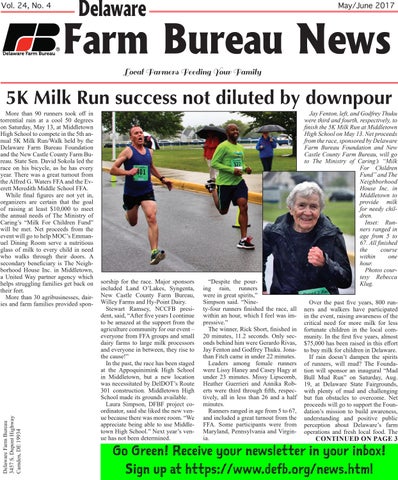
Jay Fenton, left, and Godfrey Thuku were third and fourth, respectively, to finish the 5K Milk Run at Middletown High School on May 13. Net proceeds from the race, sponsored by Delaware Farm Bureau Foundation and New Castle County Farm Bureau, will go to The Ministry of Caring’s “Milk For Children Fund” and The Neighborhood House Inc. in Middletown to provide milk for needy children. Inset: Runners ranged in age from 5 to 67. All finished the course within one hour. Photos courtesy Rebecca Klug.
Over the past five years, 800 runners and walkers have participated in the event, raising awareness of the critical need for more milk for less fortunate children in the local community. In the first five years, almost $75,000 has been raised in this effort to buy milk for children in Delaware. If rain doesn’t dampen the spirits of runners, will mud? The Foundation will sponsor an inaugural “Mad Bull Mud Run” on Saturday, Aug. 19, at Delaware State Fairgrounds, with plenty of mud and challenging but fun obstacles to overcome. Net proceeds will go to support the Foundation’s mission to build awareness, understanding and positive public perception about Delaware’s farm operations and fresh local food. The
CONTINUED ON PAGE 3
Go Green! Receive your newsletter in your inbox! Sign up at https://www.defb.org/news.html
2
Delaware Farm Bureau News, May/June 2017
From the President’s Desk As Delaware officials struggle to balance the state budget and encourage economic development, we hope they will not overDelaware Farm Bureau look the First President Kitty Holtz State’s No. 1 industry, agriculture. In a report by the University of Delaware College of Agriculture & Natural Resources entitled “The Impact of Agriculture on Delaware’s Economy,” the total economic contribution of all categories of agriculture in 2008 was $7.95 billion. The ag industry con-
tributes $2.5 billion in value-added activity, and $1.6 billion in labor income. Agriculture is responsible for approximately 30,000 jobs within the state. The poultry industry alone, in 2014, was estimated at $4.6 billion in economic value to Delaware. Sussex County remains the largest county-level producer of broilers in the nation, if not the world. There are approximately 2,500 farms in Delaware, covering some half a million acres, or 41 percent of all the state's land. The average farm size in Delaware is 200 acres. More than 124,000 acres of Delaware farmland are now permanently preserved for future generations. The overwhelming majority of
the market sales is poultry (77 percent), followed by corn (6 percent), soybeans (3 percent) and milk and other dairy products (2 percent). The Fruit & Vegetable Growers Association of Delaware estimates the state’s fruit and vegetable acreage to vary between 45,000 to 55,000 acres. About one-third of that produce goes to the fresh market, while the balance is processed by freezing, canning or pickling. All of this economic impact is not reflected — at least, not directly — in the state budget or by the Delaware Economic Financial Advisory Committee, which tracks revenue from Personal Income Tax, Franchise Tax (LLC’s/ LP), Corporate Income Tax, Bank Franchise Tax, Gross Receipts
Tax, Lottery, Abandoned Property, Public Utility Tax, Cigarette Tax and other Revenues. Therefore, economic forecasters do not include agriculture in their strategic plans for growth for economic stability. Representing all Delaware farm families, I encourage the Governor, General Assembly and the new Delaware Prosperity Partnership to take into consideration the very important economic contribution Delaware agriculture provides for all citizens through taxation, labor opportunities, water quality initiatives and a safe, affordable food supply. Delaware agriculture is certainly part of the “vibrant economic landscape of the future.”
YF&R's 8th strawberry festival a hit with children and adults Nearly 150 children and many more adults enjoyed the Delaware Farm Bureau Young Farmers & Ranchers Committee’s Strawberry Festival May 27 at Bobola Farms and Florist in Dover. The weather was beautiful and sunny, about 75 degrees. “We had our most successful year to date raising funds for the YF&R,” reported Jacob Urian, state chairman. “This was the 8th Strawberry Festival hosted at Bobola Farms and Florist, and we owe much of our success to their diligent work and generosity.”
YF&R member turnout was just enough to man the games, food and parking, Urian continued. “We look to grow the festival as the organization grows. “We sold strawberry ice cream, thanks to Woodside Creamery and Jimmy Mitchell,” he added. Homemade strawberry shortcakes tasted good, for those who had room after pulled pork sandwiches. There were games, a petting zoo, face painting, live music and a bounce house for the kids. "Everyone seemed to have a good time," Urian said.
The weather couldn't have been nicer for the Young Farmers & Ranchers' Strawberry Festival on May 27 at Bobola Farms in Dover. Delaware Farm Bureau News Editor Carol Kinsley carol.kinsley@defb.org Graphics/Production Designer Heather Kline heather.kline@defb.org 302-697-3183 Delaware Farm Bureau News (ISSN 10770798), published in Camden, DE, bimonthly, by Delaware Farm Bureau. Production by Delaware Printing Company. Periodicals postage paid at Camden, DE and additional offices. Business and Editorial Offices: 3457 S. DuPont Highway, Camden, DE 19934, 302-697-3183. Any editorial material may be reproduced with credit to this publication. POSTMASTER: Send address changes to Delaware Farm Bureau News at the office above. Subscription price to members (paid as part of Farm Bureau membership dues) is $1.60. All other subscriptions are $6.50 per year.
Delaware Farm Bureau News, May/June 2017
3
Marketing campaign focuses on health benefits of state's specialty crops Delaware Farm Bureau is putting the focus on locally produced fruits and vegetables this summer, thanks to a $48,880 Specialty Crop Block Grant from Delaware Department of Agriculture awarded in October 2016. Entitled “Did you know? The Health Benefits of Specialty Crops in Delaware,” the media campaign began May 21 with ads running until September 3, 2017.
Milk Run ...
Using USDA research, Delaware Farm Bureau seeks to educate consumers on the health benefits of fresh fruits and vegetables and encourages them to buy locally, while highlighting local restaurants and grocery stores where DFB members sell their product. DFB teamed with the Delaware Restaurant Association to feature their members that sell fresh, local crops and also partnered with Del-
aware Food Industry Council and Delaware U-Pick farms For 16 weeks, WDSD is running 30-second radio commercials, and The News Journal is running a print ad in the Sunday edition. Ads will also run on Social Media and be posted on Delaware Farm Bureau’s website. Each week is a different crop. Each week, consumers (and farmers, too!) will be directed to
www.defb.org to take the survey about the advertising. At the end of the campaign in September, one winner will be chosen from the surveys to win a $100 American Express gift card. Consumers will have 16 chances to win if they take all 16 surveys. Consumers will also have the chance to download the “database” of restaurants that serve local crops from the website.
CONTINUED FROM PAGE 1
Foundation also raises funds to provide educational materials, grants, scholarships and to feed hungry Delawareans. For information about the mud run or if you wish to be a named sponsor, contact Laura Simpson at the Delaware Farm Bureau at (302) 697-3183 or via email at laura.simpson@defb. org. Register for the event at www.trisportsevents.com.
At left, it takes determination to complete a race in the rain, whether you run or walk, especially when you're only 5 or 6 years old, but 94 participants in the annual 5K Milk Run finished the course at Middletown High School on May 13 despite the downpour.
Advertise with us! Place your ad in the Delaware Farm Bureau News and reach more than 8,400 members! Contact Heather Kline at (302) 697-3183 or heather.kline@defb.org for more information!
Local Farmers Feeding Your Family
Ready, set, go! At right, State Senator David Sokola prepares to lead off the race on his bicycle. A veteran of 25 years in the Senate, Sokola has started each of the five 5K Milk Runs.
4
Delaware Farm Bureau News, May/June 2017
Envirothon helps students learn about ag and environment
The Charter School of Wilmington Team A took first place in the Delaware Envirothon held April 27 at the University of Delaware’s Web Farm in Newark, marking the school’s 18th win in the event’s 22-year history. Middletown FFA finished second and Charter School of Wilmington Team B placed third. Delaware Farm Bureau and New Castle County Farm Bureau each donated $1,000 to support the event which helps high school students learn more about the interaction between agricultural activities and the environment. New Cas-
tle County Farm Bureau President Stewart Ramsey also served as a judge. Twenty-one teams competed, identifying samples, taking measurements and answering questions on topics dealing with aquatic ecology, soils/land-use, wildlife, forestry, air quality and the agricultural soil and water conservation stewardship. Teams also had to give an oral presentation on a scenario utilizing the nine steps of conservation planning to identify resource concerns and best management practices of a cropland and poultry farming operation. Each member of the winning team earned a $500 scholarship, a $100 gift card and other prizes. The winning team will represent Delaware at the National Conservation Foundation North American Envirothon at Mount St. Mary’s University in Emmittsburg, Md., at the end of July. Since its inception, the Delaware Envirothon has awarded $55,000 in scholarships to 110 students. It is hosted by the Delaware Association of Conservation Districts. For more information of Delaware Envirothon, visit www.delawareenvirothon.org .
Taking first place as 2017 Delaware Envirothon champion was Charter School of Wilmington Team A, whose members, from left to right, were Ashley Pennington, Allen Wang, Connor Sweeney, Catherine Yu and Siddharth Gangrade. Team advisors were Rose Lounsbury and Greg Darone.
Connect with us!
5
Delaware Farm Bureau News, May/June 2017
U.S. needs common sense regulatory reform By Robert Giblin AFBF Writer In mid-May, a Senate committee advanced its version of the Regulatory Accountability Act, a bill that will benefit U.S. agriculture by making federal agencies more accountable and transparent in rule-making. Under the RAA, federal agencies must provide the public with more information regarding the most costly regulations before initiating rule-making; undertake a cost/benefit analysis; select the most cost-effective approach; consider reasonable alternatives to proposed rules; and use the best scientific, technical and economic information. RAA would prohibit agencies from using social media or engaging in propaganda to lobby the public, as the Environmental Protection Agency did when introducing its Waters of the U.S. rule. If enacted, this bipartisan legislation would be the most significant regulatory reform to the Administrative Procedure Act since it was first passed in 1946. The APA drives federal rule-making but was enacted prior to the creation of federal agencies and laws that have profound effects on agricul-
ture, including the Environmental Protection Agency, Clean Water Act, Clean Air Act, Endangered Species Act, Occupational Health and Safety Act, and the Food Safety Modernization Act. The needs, magnitude and impacts of federal regulations are strong reasons for reform of the APA, as are other social factors, including the roles of activism, court litigation and social media in influencing regulations. Some critics have said that the legislation will be too cumbersome and, ultimately, would prevent agencies from issuing rules. On the contrary, the RAA will apply only to major new rules that have more than a $100 million yearly impact. It also requires hearings on rules with more than a $1 billion annual impact, but limits the scope of hearings to genuinely disputed facts. To look at the RAA in context of past regulations, its standards would have applied to about 2.2 percent of the more than 47,500 rules put in place since 2001. Another analysis conducted by the U.S. Chamber of Commerce showed that of the 32,882 agency regulations issued between 2008 and 2016, less than one-half of 1 percent would have been subject to
any RAA provisions, and only onetenth of 1 percent would automatically be subject to RAA because they would impose more than $1 billion in costs. Ironically, with current political pressure to eliminate or roll-back regulations, RAA doesn’t discriminate or differentiate between regulation and deregulation – it applies to both. It potentially could reduce the likelihood of regulatory swings that could be created by policy preferences of ever-changing political majorities. Even with changing political majorities, the need for transparency, sensibility and consideration of the economic costs have been recognized and reflected in executive orders about regulatory planning, regulation and review issued by
Presidents Reagan, both Bushes, Clinton, and Obama. RAA codifies many of the best practices for analysis in rule-making enunciated by presidents from both major parties. Farmers and ranchers believe regulations are needed to protect public health, food safety, worker safety, environmental quality and market fairness. They also believe the regulatory system needs to be fair, transparent and faithful to the will of Congress, cost-effective and respective of freedoms. The voices of those affected by rules should be heard and respected in the rule-making process. Reform is long overdue. Robert Giblin writes, speaks and consults about agricultural and food industry issues, policies and trends.
6
Delaware Farm Bureau News, May/June 2017
DFB's P&E Committee presents 'Book Barns' to elementary schools Four Delaware schools were recent recipients of “Book Barns,” specially made barn-shaped bookshelves complete with a set of ag correct children’s books, presented by Delaware Farm Bureau’s Promotion and Education Committee as part of its Ag Literacy Program. Book barns were placed in Lake Forest North, North Georgetown, Lord Baltimore and Claymont elementary schools. While the book barns were initially sponsored by an individual
teacher at each school, they will be located in the school libraries, where all students will be able to check out the b o o k s and learn f r o m t h e m about agriculture and life on a farm. The library at
Connie Fox reads to students at Lake Forest North Elementary.
North Georgetown Elementary is being renovated this summer, noted second grade teacher Meg LawJulie Murphy had students fill the Book Barn shelves at North Georgetown.
son. Teachers will roll up their sleeves and do the painting themselves, she said. The book barn will be moved from her classroom to the library in the fall. Included in each set of books was “Sleep Tight Farm” by EuCONTINUED ON PAGE 7
Jan Cartanza shared a book at the library at Lord Baltimore, where the Book Barn had a place of honor on the bookshelves.
7
Delaware Farm Bureau News, May/June 2017
King family donates $1,500 to Delaware Farm Bureau Foundation
The four daughters of Catherine and Reese King, founders of King Crop Insurance in Georgetown, Del., recently donated $1,500 to the Delaware Farm Bureau Foundation from the Catherine D. King and Edwin Reese King Fund, part 7of the Delaware Community Foundation. Donna, Bonny, Nancy and Jackie King presented the check to Kitty Holtz, chair of the DFB Foundation, and Laura Simpson, foundation manager. The funds will be used to help stage the “Mad Bull Mud Run,” a fundraiser for the DFB Foundation, at the State Fairgrounds in Harrington on Aug. 19. The fun event, which includes live music and food vendors, will challenge runners with mud and other obstacles on a course less than 5K long. The first full-time college student across the finish line wins a $500 scholarship. The Kings opened their crop insurance company at their farm in Laurel in 1967, and Catherine continued the business after her husband died in 1972. Daughter Jackie entered the family business in 1987, and with her mother expanded it to include all of Delaware and several counties in Maryland. Her sister Nancy joined the firm in 2006, and Donna became part of the business in 2011. Catherine retired in 2003 after 36 years in the crop insurance company but maintained part ownership of the company until her passing in October 2015. She was also active in many organizations including the Delaware Farm Bureau. “We appreciate this donation,”
xx
Kitty Holtz and Laura Simpson, center, hold a $1,500 check donated to the Delaware Farm Bureau Foundation by the King sisters — Donna, left, Bonnie, Nancy and Jackie — from the Catherine D. King and Edwin Reese King Fund, part of the Delaware Community Foundation. The King family members are carrying on their parents’ service to the farm community through King Crop Insurance Agency in Georgetown, Del. Simpson said. “The King family always has been and continues to be a blessing to this organization. It is families like theirs that ensure our success.” The Delaware Farm Bureau Foundation is a 501 (c) 3 non-profit organization that started in 2013 and aims to build awareness, understanding and positive public perception about Delaware’s farm operations; promote fresh, local food, and sponsor the Ag Education Mobile Classroom.
'Book Barns' presented ... CONTINUED FROM PAGE 6 gene Doyle, which was presented the American Farm Bureau Foundation for Agriculture’s 10th annual Book of the Year award in 2017. Annually, a copy of AFBF’s latest Book of the Year will be added to each school’s book barn by Delaware Farm Bureau. Fourteen barns were previously placed in elementary schools, in addition to one at Seaford High School which the FFA members
there use to read to young children, and one at Fifer Orchards which is used at public events. More barns are being built by Smyrna and Milford High School FFAs. It is hoped that 20 barns will be completed and ready for delivery in the next school year. Elementary school teachers who are interested in receiving a barn for their school library may contact Heather Kline, marketing administrative assistant, at (302) 697-3183.
8
Delaware Farm Bureau News, May/June 2017
Rep. Rochester learns challenges, opportunities on Delaware farms do for Delaware?” At her request, Delaware Farm Bureau Executive Director Pam Bakerian arranged tours of three Delaware farms during the Congressional Easter recess. Rochester visited Fifer Orchards Farm and Country Store in Camden on April 17, and, on April 20, the farms of Roland and Laura Hill in Lewes and the Vanderwende family in Bridgeville. Bakerian has offered to arrange a tour of a farm in New Castle County at a later date. Rochester said, “As a new member of the House Agriculture committee, I was pleased to visit some members of Delaware’s farming community last week. As we begin crafting the new farm bill, it was helpful to have them shed some light on their operations and provide some insight into challenges they’re facing, as well as the opportunities there are to ensure their future success. Delaware’s agriculture community is integral to our economy and I’m honored to be able to represent their voices in Congresswoman Lisa Blunt Washington.” Rochester visited a packing house A downpour kept Rochester with Curt Fifer during a visit to from visiting the fruit orchards or Fifer Orchards in April. strawberry and asparagus fields at
After a well-attended “ag meet and greet” arranged by Delaware Ag Secretary Mike Scuse, Congresswoman Lisa Blunt Rochester wanted to know, “what can we
Fifer’s but she toured the packing shed where workers were taking a lunch break from packing asparagus fresh from the fields. Then she sat down with Curt Fifer and other members of his family for a conversation — not a one-time sitdown, she said, but the beginning of a dialogue. Rochester began her professional career as a problem-solver and an advocate, working as a caseworker for then-Congressman Tom Carper. She served in the cabinets
of two Delaware governors as Delaware’s first African-American woman Secretary of Labor, and as Delaware’s first African-American Deputy Secretary of Health and Social Services and State Personnel Director. Her bid for election in 2016 was the first time she had run for office. Her first committee assignment was the House Committee on Education and the Work Force. “I really wanted to be on a comCONTINUED ON PAGE 9
Rochester helps pass 'NPDES pesticide fix'
A big vote of thanks is due Lisa Blunt Rochester, Delaware’s new Congresswoman, who voted with a majority of House members to pass H.R. 953, the “NPDES Pesticide Fix” legislation. On behalf on the Delaware State Farm Bureau farm families, Executive Director Pam Bakerian had urged Rochester to support the legislation, which clarifies Congressional intent regarding regulations of the use of pesticides in or near navigable waters and codifies longstanding interpretation of the statute — correcting duplicative requirements associated with NPDES requirements. Under the bill, anyone lawfully applying a pesticide that the Environmental Protection Agency has approved under the Federal Insecticide Fungicide and Rodenticide Act would no longer require a Clean Water Act “general permit.” “This legislation will reduce red-tape and legal liabilities for Delaware farm families,” Bakerian said. She reminded Rochester, “We have tax ditches constructed through almost all Delaware farms, and they could be considered "navigable waters."
9
Delaware Farm Bureau News, May/June 2017
Rep. Rochester learns challenges ... CONTINUED FROM PAGE 8 mittee where stuff gets done,” she said. “Delaware is used to doing things in a bipartisan way. Things need to happen.” She advocated hard to get on the Ag Committee, and was the last person to be selected. Curt Fifer said fruit and vegetable growers want to see a better guest worker program. There is an imbalance in the pay scale required for Delaware growers compared to Southern growers. “There’s a big time difference even at one dollar an hour,” he said. At 400,000 seasonal hours per year, that amounts to quite a bit. Curt’s brother, Bobby, noted the amount of paperwork involved also adds to the expense. Farmers
must apply in December for arrival dates in March, and can’t change the date if there is an early spring, so then they have no help. Or, if there’s a late spring, then workers sit around with nothing to do. Paperwork must go through the Delaware Department of Labor to Chicago then Homeland Security, then California, then to the Mexican Consulate… and it’s not done electronically but actual paperwork. And if there’s one error, they mail it back and you start over, he complained. The Fifers are the fourth generation to run their farm. There has been a lot of discussion about the future, they agreed. “As long as there’s a profit, the generations will continue,” Bobby said. “But
After a discussion with Fifer family members about some of the challenges of farming, Congresswoman Lisa Blunt Rochester took a few minutes to shop in the Fifers' Country Store.
DELAWARE FARM BUREAU FOOD BOOTH SCHEDULE Monday, July 17 Cleaning booth and set up at 8:30 a.m. Wednesday, July 19 All Farm Bureau members, 9 a.m. to closing Thursday, July 20 Sussex County Farm Bureau Friday, July 21 Kent County Farm Bureau Saturday, July 22 New Castle County Farm Bureau Sunday, July 23 Young Farmers & Ranchers Monday, July 24-Friday, July 28 4-H and FFA Youth Groups Saturday, July 29 All three County Farm Bureaus Monday, July 31 Cleaning & close up at 8:30 a.m. Anyone wishing to help, please call your County Women's Chair: Kent County - Sandy Virdin (302) 242-9071 New Castle County - June Unruh (302) 559-9459 Sussex County - Connie Fox (302) 242-7596
we won’t work for free.” Medium-sized farms are in trouble. On very small farms, the owner typically has another job and does all the work himself. A medium-size farms needs 2,000 acres to sustain and to afford the equipment necessary. Rochester asked if there was anything she could bring to discussions about the next farm bill. Bobby suggested the school lunch program. Curt added that their farm used to ship apples to schools, but with no controlled atmospheric storage and the government buying apples out of season, they could no longer participate. Out-of-season buying caters to big businesses with storage systems, noted Mike Fennemore, a cousin involved in the business. “Washington State apples in August are a year old. They rapidly degrade. Apples purchased in spring are from Argentina, New Zealand and Australia.” The definition of “local” is confusing. “A big grocery chain with distribution centers, such as Walmart, defines local as ‘in your state.’ But we might be closer to a Virginia population center than Southwest Virginia,” Fennemore said. Rochester continued with questions on crop insurance, new technology and the effects of climate change. “What adjustments do we need to make for the future of farming?” Curt answered, “The big scare is labor costs. For fruit and vegetable growers, labor is one of the biggest costs.” Fennemore said one of their advantages is the proximity to a quarter of the nation’s population, and the ability to get product to market now.
Curt added, “We have excellent soil, water to irrigate, but maybe being a small state hurts. New Jersey has critical mass.We don’t have cooperatives and economy of scale here.” Bobby interjected, “But there are benefits, too. I’ve got (Secretary) Scuse’s cell phone number.” Estate tax was the final topic of discussion at Fifer’s. “It is critical to be able to pass on your farm to family,” they agreed. Rochester assured the farmers, “I’m trying to do my best for you. I believe farmers are the backbone of who we are. I want to establish relationships — it’s important to know what’s happening at home.” Before a shopping spree in Fifer’s Country Store, Rochester quoted a campaign slogan: “When Lisa goes to Washington, we all go to Washington.” Rochester headed for Sussex County on April 20, meeting Jesse Vanderwende, Sussex County Farm Bureau President, in his farm’s ice cream store on Route 404, Vanderwende’s Creamery. Jesse is part of the third generation on the dairy farm begun by his grandparents, William and Ellen Vanderwende, in 1954. The family farms 3,000 acres. “We talked about the farm bill and some of the programs in it,” Vanderwende said. “We discussed the importance of establishing trade overseas, and how important that is to our business. And, about the cost of healthcare, making that more affordable for farm families.” Vanderwende led Rochester on a tour of the ice cream shop and then the dairy. “We talked about crop production and watermelon CONTINUED ON PAGE 10
10
Delaware Farm Bureau News, May/June 2017
Improve indoor air quality with HVAC inspection, duct cleaning Did you know your ventilation system is often the biggest culprit in poor indoor air quality? Inspecting the ductwork in your facility or home should be a high priority. In most cases, the HVAC system has been operating for some time without much attention. Dirty ducts can circulate odors, contaminants such as mold, and irritating dust throughout your home or building. A routine part of your local SERVPRO Franchise Professional’s service is inspecting the HVAC system. Keeping the system and the ductwork clean can potentially extend the life-span of the equipment by allowing it to operate at peak condition, which may help you save money. Duct cleaning may not always be necessary. SERVPRO will recommend the best way to address any indoor air quality concerns. This inspection can help provide peace of mind on
the health of your HVAC system and ductwork. In some circumstances, such as after a fire, smoke or suspected mold growth, duct cleaning becomes an essential part of the cleanup process. In these cases, SERVPRO can often restore the HVAC system and ductwork to pre-damage condition. If you have a fuel-burning furnace, stove or fireplace, the U.S. Environmental Protection Agency recommends they be inspected for proper functioning and be serviced before each heating season to protect against carbon monoxide poisoning. The SERVPRO Duct Cleaning System is proven and cost effective. It uses a portable ventilation and air duct cleaning system to examine ductwork and make a clean sweep, removing years of dust and grime.
CLEANUP & RESTORATION ■ Commercial and Residential ■ Trained, Uniformed Professionals ■ Complete Move-Outs ■ Restoration Vendor for Insurance
Companies Nationwide
SERVPRO® of Dover/Middletown
302-697-9776 Independently Owned and Operated
24 Hour Emergency Service.
Like it never even happened.®
In an additional optional process, For more information on duct a sealant or coating product may cleaning, or to schedule an appointbe sprayed to address odor or mi- ment, contact your local SERVcrobial concerns. PRO Franchise Professional.
Rochester... CONTINUED FROM PAGE 9 harvest, and about nutrient management and the strides farmers are making to improve water quality through the cover crop program and other Best Management Practices.” Rochester continued on to Lewes to visit with Laura Hill, first vice president of Delaware Farm Bureau. She told Hill she chose the ag committee because it covers not just farming but the SNAP program and rural development, both areas she is interested in. “I gave her a history of our operation and the challenges we are up against,” Hill said. “In our area, that includes development and loss of farmland. “We discussed the fact that people are so far removed from farm now. They do not know where food comes from. And their expectations when they move to the coun-
try do not include the smells and dust of farming.” She added, “I stressed the importance of crop insurance as a safety net.” The Congresswoman asked about communication with Rural Community Insurance Service (RCIS). “We deal with King Crop Insurance Agency,” Hill answered. “They are good about promoting farmers’ side of things and trying to make improvements.” “What needs to be improved?” Rochester asked. “We need to get into the 21st century. They overload us with paperwork, with stuff that could come in email rather than on paper,” Hill responded. She recalled that the first year the family had to go back 10 years to prove production. Fortunately, her husband’s father had kept all the records.
11
Delaware Farm Bureau News, May/June 2017
The future of the farm Our attention is pulled in a lot of different directions, and that is especially true in our busy seasons. Finding time to talk to your famiMargie Chase, ly about the future Nationwide of the farm may Senior Business be difficult. You Consultant may also be uncomfortable with the thought of selling your farm or handing over control to family members. Just as you plan every spring so that your farm can have a successful year, you should consider planning long-term so your farm can be successful for years to come. Developing a solid transition plan for your farming business will help ensure that your family’s wishes are met, and emotional stress is minimized. Here are a few things you should
know about transition planning: • Transition planning is different from estate planning. Estate planning is concentrated on tax liabilities and ways to lessen your tax burden. Succession plans have a broader focus, and that is on planning for the future of the farm. Estate planning can be just a piece of a larger succession planning effort. • At retirement a farm succession plan can include many things. This can include an arrangement to sell or transfer ownership to a family member, and a plan to liquidate farm assets like equipment, livestock or land at auction. A transition plan may also include other options for your land like renting or leasing. • You can plan for your desired result. By concentrating on the desired outcome you can feel comfortable and confident in the plan to achieve that outcome. The proper transition plan puts you in control
now of the decisions that may be needed in the future. You can plan for your own retirement by deciding what involvement you’d like to continue to have and what income you may need as your retirement age nears. You can also gain assurance that the needs of your spouse, your children and your farm are considered down the line. • An effective transition plan is able to identify the next generation of operator. If you have a family member who could and may want to take over the operation, you should be comfortable that they have the knowledge and skills to run it profitably. If it’s being passed down to children, you may ask yourself if they all have an interest in having an active role, and if not, how should they be considered. • Getting it right the first time. Succession plans sometimes fail because certain risks were not considered during the planning stages. These can include inadequate cash flow, liquidation of some assets to County Farm Bureau, bringing in provide for retirement, poor farm more than $10,000. Net proceeds estate planning and unresolved iswill buy milk for needy kids. An inaugural “Mud Run” will be held Aug. 19 at the Delaware State Fairgrounds. Sponsors so far include $2,500 from IGBurton Automotive Group; $2,500 from Farm Credit, $1,500 from the King sisters of King Crop Insurance; $1,000 from Delaware Electric Cooperative; $1,000 from Dover Federal Credit Union; $1,000 from Hoober Inc.; and $250 each from Chick's Saddlery; Belfint, Lyons and Schuman; Mountaire; and ServPro. WDSD also will sponsor a $2,500 hazard with an in-kind donation.
Foundation at work fulfilling mission The Delaware Farm Bureau Foundation has been busy in recent months, both in fund-raising and fulfilling its purpose of building awareness, understanding and positive public perception about Delaware’s farm operations, promoting fresh local food and sponsoring the Ag Education Mobile Classroom. The “Ag Lab” launched a pilot program this spring and visited Phillis Wheatley Elementary in Bridgeville; Star Hill Elementary in Camden; Nellie Stokes Elementary, Dover; and Benjamin Banneker Elementary, Milford. Additional visits will be made while school is out to summer camps. The sale of a Blue Hen print signed by seven living governors raised $5,100 for the foundation, and a Legislative Hall water color by a local artist, signed by Delaware’s Congressional delegation, raised $525. A Delaware Farm Bureau license tag sold for $425, and two Farm Vehicle tags raised a total of $3,000. A successful Fifth Annual 5K Milk Run was held in May in conjunction with New Castle
Don't miss the Mud Run Aug. 19 at the fairgrounds!
sues between family members or a successor who’s not prepared to lead and manage the farm business. It’s important to enlist the help of qualified professionals who don’t have a stake in the final decisions. They can help you make sound, unbiased decisions for your farm estate. Qualified professionals may include your banker, your accountant, your personal attorney or a financial or estate planner who specializes in farm estate planning. If you have questions about transition planning or would like to help in finding a qualified professional to speak with, contact the Nationwide® Land As Your Legacy® team at LAYL@nationwide,com or toll-free at 1-855-529-2729.
Neither Nationwide, nor its employees, its agents, brokers or registered representatives gives legal or tax advice. Nationwide, the Nationwide N and Eagle, Nationwide is on your side and Land As Your Legacy are service marks of Nationwide Mutual Insurance Company. © 2017