health
defendernetwork.com
JULY 21 | 2016 | DEFENDER
1B
Defender Special Edition
The truth about Blacks & skin cancer By MARILYN MARSHALL Defender
A
t first glance, it would seem that African-Americans have little to worry about when it comes to skin cancer. The risk of contracting melanoma – the most serious type of skin cancer – is much higher for whites than African-Americans. There is, however, cause for concern. In order to shed light on the subject, the Defender spoke with Valencia Thomas, M.D., a dermatologist and associate professor in the Department of Dermatology at MD Anderson Cancer Center, and a dermatopathologist at
the UT Houston School of Medicine. Defender: What is the number one thing AfricanAmericans should know about skin cancer? Dr. Thomas: That African-Americans can get skin cancer. [Though] our pigment gives us a natural sun protection factor or SPF of about 13.4, compared to the average white person who has a natural SPF of about three, we are not immune. About two percent of cancers that African-Americans get come from the skin. So we still need to recognize what is abnormal in our skin and what is normal. Defender: What are the most common skin cancers? Dr. Thomas: We have two major categories of skin cancer – melanoma and non-melanoma. Even though melanomas are fairly rare in the African-American population, we have a tendency to be diagnosed at a more advanced stage. Melanoma is the type of skin cancer that killed Bob Marley. He discovered a tumor on his foot – and African-Americans tend to get these lesions on their soles – but by the time it was diagnosed it was more advanced. It is often diagnosed at a later stage in African-Americans which means we have a poorer outcome so we have a higher chance of dying from the cancer. On the flip side, the other large category of cancers is the non-melanoma skin cancers. This year alone we’re going to have a million cases of people who have skin cancers in the United States. African-Americans are going to see squamous cell carcinoma more commonly. The squamous cell carcinomas tend to be a bump of skin that’s fairly hard and they have a clear border and firm top. It’s almost like you’re growing a wart but can grow
much more rapidly. There is a form of this which is often seen in African-Americans called squamous cell carcinoma insitu. It is a very early form of squamous cell carcinoma and tends to arise in the settings of chronic scarring, burn scars, radiation and chronic inflammation, like lupus. It can also be seen in people who have hepatitis B, HIV or organ transplants. We tend to grow these most commonly in our fifties and sixties. It will show up as a scaly patch that doesn’t go away and has a little bit of pigment. Defender: What is the treatment for skin cancer? Dr. Thomas: The treatment depends on the type of cancer. For melanomas the treatment is fairly consistently excision where we remove the abnormal tissue. Once we determine how deep the tumor is, if it’s thin, sometimes the excision is all we need. If it’s thicker we can use other therapies like chemotherapy or radiation. With non-melanoma skin cancers we have a lot more options because in general they’re easier to kill. We can sometimes use special chemotherapy creams that alter the immune system and selectively destroy the abnormal cells. You can sometimes destroy them through freezing them or scraping them or burning them off. We can use a laser to destroy them, and we can excise them. If they tend to be more evasive or aggressive, additional surgery is necessary and we will have chemotherapy or radiation available. Concerning prevention, in melanomas, we have not been able to figure out the relationship between sun exposure and melanomas and people of color. In the white population we have been able to associate melanomas with episodic, intense sun. Until we know otherwise it is important to use sunscreen of SPF 30 or greater, wear protective clothing such as long sleeves and hats, avoid being outdoors during the peak hours of the sun and seek shade whenever possible.
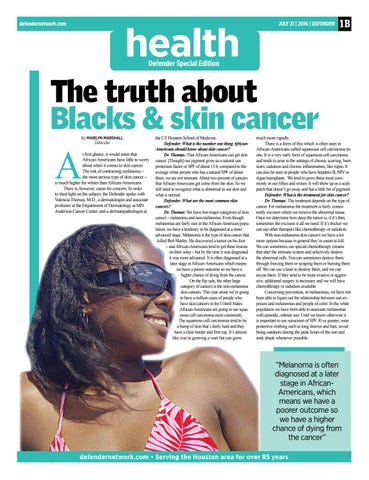
“Melanoma is often diagnosed at a later stage in AfricanAmericans, which means we have a poorer outcome so we have a higher chance of dying from the cancer” defendernetwork.com • Serving the Houston area for over 85 years
2B
DEFENDER | JULY 21 | 2016
Treating teenage acne Acne is a skin problem that often affects teenagers. Jia-Yen Chi, M.D., a board-certified physician specializing in dermatology at Kelsey-Seybold Clinic, said teens with an acne problem should be encouraged to gently hand-wash their faces with a mild facial cleanser and warm water twice a day. “This sometimes helps with mild breakouts,” he said. “For more significant acne conditions, practicing good hygiene may not be sufficient.” For moderate to more serious acne, Chi said there are over-the-counter and prescription treatments available. “Using an over-the-counter product such as benzoyl peroxide is a common treatment for clearing up acne and removing dead cells from the skin.” Acne occurs when pores in the skin become clogged. “During puberty, excess oil is produced,” he said. “Pores can become blocked, accumulate bacteria and cause breakouts. In most cases, acne blemishes occur on the face, neck, back and shoulders.” Though acne does not present a serious health risk, Chi said that severe acne can result in permanent scarring. “Left untreated, the effects of teenage acne can be more than skin deep,” he said. “Acne can also have psychological consequences, such as causing a poor self-image and social anxiety.” If over-the-counter products aren’t successful, it may be time to see a dermatologist. “A knowledgeable dermatologist will usually consider several factors, including the severity and type of acne, as well as the patient’s overall health, skin type, age and lifestyle and recommend an appropriate treatment or regimen,” he said.
defendernetwork.com
health Common skin disorders in kids
Y
outh skin problems can span from birth through adolescence. According to Dr. Raegan Hunt, a pediatric dermatologist at Texas Children’s Hospital, the following diseases are particularly common among African-American children: ECZEMA is a chronic, relapsing and remitting skin disease characterized by localized episodes of dry, rough, itchy skin. The itch is often severe and may result in lost sleep or torn-open, bleeding skin. Sometimes the skin affected by eczema thickens significantly from scratching and, even after treated, as lesions resolve they may leave light or dark marks that persist for many more months. Excellent skin hydration is critical for disease control. Generally, a brief bath/shower daily to every other day using a bland, fragrance-free soap and also applying fragrance-free moisturizing cream at least twice daily to all skin is recommended. In most cases, a primary care provider or dermatologist will prescribe specific topical corticosteroid ointments and may have other treatment recommendations. VITILIGO is an autoimmune skin disorder. Pigment producing cells are reduced in number and subsequently color in specific areas decreases as there is less production of skin pigment (melanin). This skin condition affects all skin types equally but it is more noticeable in darker skin types. Vitiligo can often result in bullying and social distress in affected children. Additionally, affected skin which has lost its color is very susceptible to sunburn and should be protected by sunscreen. Vitiligo can be treated by a dermatologist with a variety of topical medications as well as phototherapy or laser. RINGWORM is a superficial fungal skin infection which can involve skin, nails or hair. The infected areas of scalp tend to be very flaky and
Inside Take good care of your nails 3B Texas Children’s
Zika 101: What families should know 4B Secrets to healthy hair; causes of hair loss 6B MD Anderson
Sun safety tips: Sunscreen is essential 8B Memorial Hermann
hair may break or fall out in bald spots. Sometimes scalp swelling occurs in affected areas and nearby lymph nodes may seem swollen as well. Treatment generally requires 8-10 weeks of oral antifungal medication prescribed by a pediatrician or dermatologist. TINEA VERSICOLOR is a common rash that affects many children and young adults, primarily in the summer months. It is characterized by small scaly discolored round to oval areas of skin on trunk and neck. Rash colors may range between darker brown, pink, lighter than skin color, and tan. This rash is caused by harmless yeast on the skin surface and does not cause itch or pain. A doctor can offer treatment with anti-yeast/ anti-fungal medication.
Summer safety for kids and adults 10B Kelsey-Seybold Clinic
What Black women should know about health 12B
Message from the Publisher
W Sonceria Messiah-Jiles
hen it comes to pampering ourselves, many of us focus attention on our hair, skin and nails. We go to the beauty shop for a new hairdo, visit a spa for a facial or massage, and stop in a nail salon for a mani-pedi. There’s more to our hair, skin and nails, however. Our hair helps protects us from the elements. Our skin is the largest organ of the body, and protects our internal organs from injury while serving as a barrier to germs. Our nails help protect the tips of our fingers and toes. As part of the Defender’s commitment to our read-
ers, we are pleased to feature hair, skin and nails in this special health edition. We provide insight about Blacks and skin cancer. We explore skin disorders common in children and teens. We offer tips on hair and nail care. We are also pleased to include valuable information from our partners – Kelsey-Seybold Clinic, MD Anderson Cancer Center, Memorial Hermann Health System and Texas Children’s Hospital. We trust that you will benefit from this health edition, proudly presented by Houston’s Leading Black Information Source.
defendernetwork.com • Serving the Houston area for over 85 years
defendernetwork.com
JULY 21 | 2016 | DEFENDER
health Take good care of your fingernails, toenails
Nails reflect our overall health, which is why proper nail care is so important. Here are dermatologists’ tips for keeping your nails healthy: 1. Keep nails clean and dry. 2. Cut nails straight across. Use sharp nail scissors or clippers. Round the nails slightly at the tips for maximum strength. Keep nails shaped and free of snags by filing with an emery board. 3. Do not bite fingernails or remove the cuticle. Doing so can damage the nail. 4. Do not use your nails as a tool, such as opening soft drink cans. 5. Trim toenails regularly. Keeping them short will minimize the risk of trauma and injury. 6. When toenails are thick and difficult to cut, soak your feet in warm salt water. Mix one teaspoon of salt per pint of water and soak for five to 10 minutes. 7. Avoid “digging out” ingrown toenails, especially if they are infected and sore. If you are suffering from an ingrown toenail, see a dermatologist for treatment. 8. Wear shoes that fit properly. Also alternate which pair of shoes you wear each day. 9. Wear flip flops at the pool and in public showers. This reduces the risk of infections caused by a fungus that can get in your toenails. 10. If your nails change, swell, or cause pain, see your dermatologist because these can be signs of serious nail problems. If you have diabetes or poor circulation, it’s especially important to seek treatment for any nail problems.
Artificial nails require special care Acrylic nails, gel nails and nail tips can make your nails look flawless. This is what dermatologists recommend for keeping them healthy. 1. Go only to salons and nail technicians that are licensed. Be sure technicians wash their hands and sanitize tubs before each client. 2. Bring your own manicure supplies, especially nail files. Salons may not sterilize their files and other tools adequately to prevent infections. 3. Return to the salon for maintenance every two to three week since artificial nails loosen and grow out. 4. Apply artificial nails only to healthy nails. Covering brittle or diseased nails only makes matters worse. 5. Test for a skin reaction first. The chemicals used to create artificial nails can cause a
skin reaction. 6. Take steps to help prevent infections. Wash your hands with soap and water, using a nail brush to clean gently around your nails. While cleaning your nails, check for loose ones. Dry your hands and nails thoroughly. 7. If you have a loose or damaged nail, stop in at your nail salon for a repair or repair it safely at home by using glue made specifically for artificial nails. Never bandage a broken nail. 8. Get touch-ups every two to three weeks to help keep nails attractive and prevent problems like infections. 9. Wear gloves when washing dishes, cleaning or gardening to protect your artificial nails. 10. Let your natural nails breathe every six to 12 months by having artificial nails removed. Wait a few days before you get new artificial nails.
Beware of fungal nail infections Fungal infections of the fingernails or toenails can cause the nail to become discolored, thick, and more likely to crack and break. Infections are more common in toenails than fingernails. According to the CDC, a fungal nail infection usually isn’t painful unless it becomes severe. Some people who have toenail infections also have an infection on the foot, especially between the toes, commonly called “athlete’s foot.” Anyone can get a fungal nail infection but some may be more likely to get a fungal nail infection, including older adults and people who have a nail injury or nail surgery, diabetes, a weakened immune system or blood circulation problems. To prevent infection, keep your hands and feet clean and dry, clip your nails short and keep them clean, don’t walk barefoot in locker rooms or public showers and don’t share nail clippers with others. Fungal nail infections can be difficult to cure, and typically don’t go away without antifungal treatment.
defendernetwork.com • Serving the Houston area for over 85 years
3B
4B
DEFENDER | JULY 21 | 2016
Zika 101:
health
defendernetwork.com
What families should know
W
By DR. STAN SPINNER Texas Children’s Hospital
ith all of the coverage in the news about the Zika virus, it is understandable that parents have questions. Here are the facts you need to know about this virus. Treatment for Zika virus infection is supportive only, consisting of rest and fluids for hydration. One can treat the symptoms of the virus with acetaminophen (Tylenol) and antihistamines, but aspirin is not recommended due to the risk of Reye’s syndrome in children. Also, nonsteroidal anti-inflammatory drugs such as ibuprofen (Advil/Motrin) or Aleve are not currently recommended as a first line treatment, except if by the direction of your physician. Symptoms usually clear up in less than a week, are mild and rarely require hospitalization. Only 1 in 5 (20 percent) of those infected will have symptoms. The odds are, you will never even know if you were infected.
How does Zika spread?
Mosquitoes can carry Zika from person-toperson. If a pregnant woman is infected, the Zika virus can be transmitted to her baby while she is pregnant or around the time of birth. Mosquitoes that spread Zika virus bite both indoors and outdoors, mostly during the daytime. As the weather becomes warmer, more mosquitos will circulate. Parents should take steps to protect their children and themselves from mosquito bites, and make sure anyone else who cares for their children do the same.
Texas Children’s helps develop nation’s first hospital-based rapid test for the Zika virus
• Stay and sleep in screened or airconditioned rooms, or use a mosquito bed net (a permethrin treated bed net is best). • Cover crib, stroller and baby carrier with mosquito netting. • Do not use insect repellent on babies under 2 months of age. Zika is a virus that What parents can do • Do not use Protect your family from can cause the products containing oil of lemon mosquito bites. The best way following symptoms: eucalyptus or para-menthaneto prevent getting infected with • Rash diol on children younger than 3 the Zika virus in areas where it • Fever years old. is found is to take the following • In children older than 2 • Pink eye steps to avoid mosquito bites: months, do not apply insect (conjunctivitis) • Wear long sleeve shirts repellent onto a child’s hands, and long pants or clothing made • Joint pain eyes, mouth or to irritated or of permethrin. When possible, broken skin. choose clothing made with • Never spray insect thicker fabric as mosquitos can repellent directly on a child’s bite through thin cloth. face. Instead, spray it on your hands and then apply • Use insect repellents containing DEET sparingly, taking care to avoid the eyes and mouth. (such as OFF). Pregnant women and women who • For children with Zika symptoms of fever, are breastfeeding can and should choose EPArash, joint pain or red eyes who have traveled to registered insect repellents and use them according or resided in an affected area, contact your child’s to their product labels.
What is Zika?
health care provider and describe where you have traveled. • Fever (greater than 100.4° F) in a baby younger than 2 months old always requires evaluation by a medical professional. If your baby is younger than 2 months old and has a fever, call your health care provider or seek medical care. Again, it is important to understand that while the risk to your child of any problems from infection remains quite low, an infected individual may serve as a source of infection if bitten by a mosquito capable of carrying the virus. As a parent, you can reduce the risk to all of us by protecting yourself and your children from mosquito bites. Dr. Stan Spinner is chief medical officer of Texas Children’s Pediatrics and Texas Children’s Urgent Care.
defendernetwork.com • Serving the Houston area for over 85 years
defendernetwork.com
JULY 21 | 2016 | DEFENDER
Quality health care for $50 or less a year. What a relief.
Texas Children’s Health Plan covers children from newborns to teenagers. We even cover adults and pregnant moms through STAR Medicaid. Families with children who qualify for CHIP pay $50 or less a year. Those who qualify for Medicaid pay nothing. CHIP and STAR Medicaid offer a wide range of benefits including checkups and shots, dental services, medications, and more. With Texas Children’s Health Plan you also get: ■ Over 2,100 doctors. ■ A 24-hour nurse hotline. ■ Transportation to doctor visits at no cost. ■ Pregnancy support program and classes. ■ Help losing weight through the Keep Fit Program. ■ Learn how to play soccer from the Houston Dynamo coaches. ■ Fun member events!
For more information, to receive an application, or to find an event in your area, visit us online or call today.
MK-1208-007
1-800-990-8247 | TexasChildrensHealthPlan.org
5B
6B
DEFENDER | JULY 21 | 2016
SECRETS TO
HEALTHY
HAIR
cente
Use the right products, tec
Is your hair healthy, shiny and moisturize Whether you wear it natural, permed or press care from the American Acade 1. Wash hair once a week or every other week. This will help prevent build-up of hair care products, which can be drying to the hair. Let your hair air dry when possible. 2. Use conditioner every time you wash your hair. Be sure to coat the ends of the hair, as the ends are the oldest and most fragile part of your hair. 3. Use a hot oil treatment twice a month. This adds additional moisture and elasticity to your hair. 4. Use hair care products that contain natural ingredients, such as olive oil, shea butter, aloe vera juice or gel, or glycerin, because they help dry hair maintain moisture. 5. Use caution with relaxers. To minimize damage, always see a professional hair stylist to ensure that the relaxer is applied safely. Touch-ups should only be done every six weeks to three months and only to newly grown hair. 6. Use ceramic combs or irons to press hair and only do so once a week. Use a straightening device
wi low sty
too the
on los
so ex sca
mo fla itc ap an sca
e h t o m e h c h it w g in Cop ng ch ent w ho is un de rg oi tie pa er nc ca a r Fo re al . of ha ir lo ss is ve ry ce an ch e th , py ra m ot he n Ca nc er as of M D A nd er so D r. Va le nc ia Th om ir de pe nd s ha s se a pa tie nt lo er th he w id sa er Ce nt at m en t. on th e ty pe of tre at pe op le pe s of ha ir lo ss th “T he re ar e tw o ty ca nc er th ey ’re un de rg oi ng ex pe rie nc e w he n th e ki nd is st fir as sa id . “T he tre at m en t,” Th om el f. its e in w ith th e m ed ic th at w e as so ci at e he n th e w s it’ d flu vi um an ef en ag an d lle ca It’s in g rig ht in ur ha ir fro m gr ow yo ps sto n io at ic m ed rio d of fa lls ou t ov er a pe ir ha e th d an s ck its tra te lo ge n tim e. ha ir lo ss is ca lle d “T he ot he r ty pe of ro ug h a e it af te r w e go th se e w d an um vi efflu ic at io n or er y or he av y m ed rg Su t. en ev ul sf str es a re sti ng ill pu t th e ha ir in w t en ev ul sf es str an y .” fa ll ou t an d re gr ow sta te . Th en it w ill ed by us ca ss lo th at ha ir Th om as str es se d fo r pa, er ev ow po ra ry. “H m te is py ra he ot ch em
tie nt on th hair
canc
hea
app
ve
or
ha ri
c p
defendernetwork.com • Servin
erfold
t chniques
ed? Or is it dull, dry and damaged? sed, here are some tips on Black hair emy of Dermatology
ith a dial to ensure the device is not too hot. Use the west possible temperature setting that gives you the yle you want. 7. Make sure braids, cornrows or twists are not o tight. If it hurts while your hair is being styled, ask e stylist to stop and redo it. Pain equals damage. 8. Avoid long periods of wearing a style that pulls n the hair such as a ponytail, or braids, to prevent hair ss or damage. 9. Wear weaves and extensions that are light, o they do not pull. Wear a professional weave or hair xtension for two or three months at most. Maintain alp hygiene. 10. Keep dandruff in check. Dandruff is a comon scalp condition in which small pieces of dry skin ake off the scalp, and it may also make your scalp ch. Researchers are still studying the causes, which ppear to be complex. The most effective way to treat nd control dandruff is to use dandruff shampoo and alp treatments.
herapy & hair loss
n, ei th er lo ss af te r ra di at io ts w ho no tic e ha ir leg, that or m ar e an eyebrow, he scalp or areas lik ,” she said. may not come back vice for ides the following ad MD Anderson prov cer patients: ing your ur hair short or shav • Consider cutting yo gins. ad once hair loss be hes. os and soft hair brus • Use mild shampo her hot ot d an curling irons • Avoid blow dryers, pliances. to prean and moisturized • Keep your scalp cle ent skin problems. ts, wigs from the sun with ha • Protect your scalp s or r sunscreen. lorful scarves, turban • Be creative. Use co or irht tig o to t headwear is no ats. Make sure your . itating to your scalp -quality wigs tion, although good op an e ar s ig •W nce comra su eck with your in can be expensive. Ch e co st. th r plan will help cove pany to see if your
ng the Houston area for over 85 years
defender network.com
Hair loss
Know the causes, treatment Hair loss is a condition that impacts millions a woman is 40 years of age or older, she should not of Americans. Here are 20 things to know from the expect her hair to have the fullness that it did when American Academy of Dermatology. she was younger. 1. The most common cause of hair loss is 11. Experiencing a traumatic event, such as the hereditary thinning or baldness, also called androge- death of a loved one or divorce, can cause hair loss. netic alopecia. It affects men and women. 12. Some people see hair loss after losing more 2. Male pattern baldness is related to genes and than 15 pounds. The hair loss often appears three male sex hormones. to six months after losing the weight. The hair re3. When men have hereditary hair loss, they grows without help. often get a receding hairline. Many men see bald 13. Not getting enough iron can lead to hair patches, especially on the top of the head. In rare loss. Vegetarian sources of iron are iron-fortified cases, men see noticeably thinning hair. cereals, soybeans, pumpkin seeds, white beans, 4. Women tend to keep their hairline. They see lentils and spinach. Clams, oysters and organ meats noticeably thinning hair. The first sign of hair loss are among animal sources of iron. for many women is a widening part. In rare cases 14. Some prescription medicines can cause hair women can see a receding hairline or bald patches. loss, including blood thinners, high-dose vitamin A, 5. Other forms of alopecia include alopecia birth control pills, anabolic steroids and medicines areata, which that treat arthritis, decauses smooth, pression, gout, heart round patches of problems, and high hair loss on the blood pressure. scalp and other ar15. Frequent eas of the body, and bleaching or permacicatricial (scarnents can cause the ring) alopecia, a hair to break. Regular rare disease which or improper use of destroys a person’s dyes, gels, relaxers, hair follicles, causand hair sprays also ing scar tissue to can cause hair breakform. age. 6. Central cen16. Treatment for trifugal cicatricial hair loss can include (scarring) alopecia the use of topical is a type of hair loss minoxidil (for men that occurs most and women; availoften in women of able over-the-counter African descent. It as Rogaine) and oral begins in the center finasteride (for men of the scalp. As it only; prescription progresses, the hair only). loss radiates out from 17. Topical or the center of the scalp, injectable cortisone Dealing with razor bumps and the affected scalp medications have been becomes smooth and shown to accelerate the shiny. regrowth of hair in some 7. Hair loss can also be the first sign of a distypes of hair loss. ease. About 30 diseases, including thyroid disease 18. Topical or oral estrogen or other femaleand anemia, cause hair loss. By treating the disease, specific hormones are sometimes prescribed for hair loss often can be stopped or reversed. women experiencing hair loss. 8. Significant hair loss can occur after an ill19. Hair transplantation is a permanent form ness. A major surgery, high fever, severe infection, of hair replacement utilizing surgery that involves or even the flu can cause hair loss. moving some existing scalp hair to bald or thinning 9. After giving birth, some women have notice- parts. It may benefit men with male pattern baldness able hair loss. Falling estrogen levels cause this type and some women with thinning hair. of hair loss, which is temporary. 20. Restoration surgery is another treatment op10. Hair loss is common during menopause tion, and can include scalp reduction surgery, scalp and is often temporary. Hair re-grows with time. If expansion surgery and scalp flap surgery.
defendernetwork.com
7B
8B
DEFENDER | JULY 21 | 2016
health Sun safety tips:
defendernetwork.com
Sunscreen is essential
W
meaning carbon containing) sunscreen ingredients form a thin protective film that absorbs UV radiation before it penetrates the skin.
By MD ANDERSON CANCER CENTER
hen it comes to sunscreen, the benefits outweigh any potential risk. Studies show that sunscreen can help prevent skin damage, which can lead to skin cancer. One in three cancers diagnosed worldwide is skin cancer, according to the American Cancer Society. And up to 95 percent of malignant melanomas are caused by excessive sun damage, according to a study by the International Agency for Research on Cancer. Regardless, says Saira George, M.D., a dermatologist at MD Anderson Cancer Center, many patients still ask about the necessity or safety of sunscreen. “I understand the concern. What’s more natural than sunlight? But we have to understand that there are carcinogens in nature, and too much UV radiation from the sun is an example of that,” she says. “Our bodies have amazing protective mechanisms in place to handle sun damage, but they haven’t evolved to overcome damage from the excessive sun exposure many of us rack up in our lifetime.” Studies show that the chemical and nonchemical sunscreens available today all appear to be safe. “We have lots of evidence to support sunscreen’s protective effects and very little that show any dangers or risks from sunscreens use, but I can sympathize with concerns about chemicals in everyday products,” George says. “I advise my patients who are still worried about sunscreen safety to stick with the simple mineral sunscreens. They should also stay out of the sun during peak hours and wear protective clothing.” Sunscreen should be applied liberally and reapplied every two hours. It’s important to keep in mind that sunscreen is just one way to protect your skin from the sun. “I think the biggest danger of using sunscreen may be the false sense of security it provides”, says George “Just because you use sunscreen doesn’t mean you can’t get sunburned or get skin cancer. Those who use it tend to be in the sun more, and we all tend to under apply sunscreen,” George says. There are so many different options for sunscreens nowadays that there’s one out there for everyone.
Types of sunscreen
Sunscreens combine different ingredients to help
Is one type of sunscreen better than the other?
There are benefits to both types of sunscreens. In fact, many sunscreens that you find at the store are a combination of the two types. Physical sunscreens generally do not cause irritation, stinging or allergic reactions. But they can be white and greasy. The chemical sunscreen ingredients are usually clear and easy to apply. But these are more likely to cause irritation and allergic reactions. So, many sunscreens contain a combination of the two to maximize the benefits but minimize the downsides. And many broad-spectrum coverage sunscreens need a combination of ingredients to protect against both UVA and UVB rays, the two types of rays that cause skin damage.
How to choose a sunscreen
When looking for a sunscreen, be sure to choose one that: • Provides SPF 30 or higher • Has broad-spectrum protection (protects against both UVA and UVB rays) • Is water-resistant
Skin cancer screening exams
stop UV rays from damaging your skin. There are two categories of sunscreen ingredients: • Physical blockers: The physical blockers – titanium dioxide or zinc oxide – are minerals that are ground into fine particles. They sit on the surface of the skin and reflect UV rays away from your skin, “a lot like a shield or mirror would,” George says. • Chemical absorbers: Chemical (or organic,
Skin cancer screening exams are the best way to catch melanoma and other skin cancers early, when they’re easiest to treat. If you’re at increased risk for skin cancer, you may need an annual skin cancer screening exam. You may be at increased risk if you have: • Red or blond hair, fair skin, freckles and blue or lightcolored eyes • More than 50 moles • History of frequent or intense sun exposure • One or more blistering sunburns • Family history of melanoma • Personal history of basal cell and/or squamous cell skin cancers Even if you aren’t at increased risk, it’s a good idea to keep an eye on your skin. If you notice an irregular mole or spot, schedule an appointment with your dermatologist for a diagnostic exam. If you’re going to be out in the sun, sunscreen is a great way to protect your skin. Learn more at MakingCancerHistory.com
defendernetwork.com • Serving the Houston area for over 85 years
defendernetwork.com
JULY 21 | 2016 | DEFENDER
“I have other plans, cancer” Gail Morse | Cancer Survivor People in families with a history of cancer are perfect candidates for MD Anderson’s early detection and prevention programs. The earlier we can find cancer, the better the chances of getting rid of it. Call 1-855-894-0145 or visit MakingCancerHistory.com.
Ranked one of the top cancer centers in the nation for 27 years by U.S. News & World Report.
9B 9B
10B
DEFENDER | JULY 21 | 2016
health
defendernetwork.com
Summer safety for kids and adults
H
By MEMORIAL HERMANN
ouston has seen its fair share of rain this spring, leading to a lot of time spent indoors. Naturally, kids and adults alike are excited to spend some long overdue time outside. To help everyone enjoy their summer to the fullest, experts affiliated with Memorial Hermann Red Duke Trauma Institute and Children’s Memorial Hermann Hospital have plenty of tips for a safe summer. Summer is a great time to soak up some rays, but too much sun exposure can be harmful. Even just a few serious sunburns can increase a child’s risk of developing skin cancer later in life. Here’s how to protect yourself and your children from the sun: • Avoid being in the sun for prolonged times when the sun is strongest – typically mid-day 10 a.m. until 4 p.m. If kids are exposed during these hours, be sure to apply and frequently re-apply protective sunscreen. • The American Academy of Dermatology recommends that all children, regardless of their skin tone, wear sunscreen with an SPF of at least 30. • Wear sunglasses when outdoors. Cumulative exposure can lead to cataracts later in life. Wear sunglasses that block 100 percent of UVA and UVB rays.
HEAT SAFETY
Heat exhaustion and heat stroke are very real dangers. Protect yourself when outside by: • Wearing light-colored clothing. • Drinking plenty of fluids before and during activities in the hot weather. • Take frequent breaks to cool down and hydrate. Never leave kids in unattended vehicles during hot summer days. Temperatures inside your vehicle can rise 20 degrees within the first 10 minutes of turning off the vehicle. On average, 38 children die annually from heat-related deaths after being left inside motor vehicles. According to Robert Lapus, M.D., director of the Pediatric Emergency Center at Children’s Memorial Hermann Hospital and McGovern Medical School at UTHealth, there are four common situations where children are left in cars: • When a parent or caretaker is doing something or going somewhere outside his or her normal routine. • When a parent or caretaker is distracted while driving. • When a child finds his or her way into a parked car while playing.
• And when a parent or caretaker intentionally leaves a child in the car, cracks the windows and thinks they “will only be a minute”… “Children can overheat four times faster than adults,” said Lapus. “And these risks don’t only apply to children; they can apply to your pets as well. This is why we always advise to ‘look before you lock.’ It’s a reminder to drivers to always check the backseat before leaving their cars.”
WATER SAFETY
According to the Centers for Disease Control, between 2005 and 2014 there were 3,536 fatal unintentional drownings annually – roughly about 10 deaths a day. One in five people who die from drowning are children aged 14 and younger. Some additional statistics from the Memorial Hermann Red Duke Trauma Institute injury prevention team include: • On average, 75 percent of all pediatric drownings occur during the summer. • In 2015, 90 percent of all drowning patients were children; nearly 75 percent were under the age of five.
• In 2015, eight out of every 10 drownings occurred in a swimming pool. Other locations include bayous, creeks, lakes, oceans and bathtubs. Remember these tips when going for a swim: • Designate an adult whose responsibility is to watch kids in or around the water. • Stay within arm’s length of toddlers and children who can’t swim well. Many tragic pool accidents can happen in just a few minutes. • Put a safety gate around your pool with a lock for when it is not in use. • Note and obey when diving is not permitted.
OTHER SAFETY TIPS
• Grilling: Avoid cleaning your grill with a wire brush. The bristles can break off and get cooked into the food. If ingested, the bristles can cause serious internal injury. Keep children and pets a safe distance from the grill at all times. • Wildlife: Watch where you place your hands and feet when near high grass where snakes could be hiding. Avoid any contact with wild or stray animals. Wear long pants or sleeves to avoid biting or stinging insects. Use repellents to protect against mosquito bites. • Road trips: Make sure all passengers are wearing seat belts and you should set the example by wearing yours. Change drivers when you feel drowsy. Resist the urge to check the phone while driving. And of course, never drink and drive.
defendernetwork.com • Serving the Houston area for over 85 years
defendernetwork.com
JULY 21 | 2016 | DEFENDER
FEELING SICK BUT NOT SURE WHAT TO DO? SPEAK WITH A REGISTERED NURSE FOR ANSWERS TO YOUR HEALTH QUESTIONS. When you or a family member is feeling sick, but you’re not sure if you need to see your doctor or go to the hospital, call the free Nurse Health Line. Experienced nurses will help you decide when and where to go for medical care. These trained nurses are available around the clock, seven days a week to answer your health questions by phone. Anyone living in Harris or the surrounding counties can use this free service. Funded through the Centers for Medicare & Medicaid Services and the Texas Health and Human Services Commission.
Free 24/7 Nurse Health Line 713.338.7979 (Toll-Free) 1.855.577.7979 Individuals with life-threatening conditions and emergencies should call 9-1-1.
sponsored by Memorial Hermann Community Benefit Corporation
11B
12B
DEFENDER | JULY 21 | 2016
health
defendernetwork.com
What Black women should know about health and vegetables as well as lean protein and healthy fats while keeping an eye on sodium and sugar intake. Talk with your doctor about a healthy exercise routine. By keeping your weight and overall health in check with a good diet and regular exercise, you may be able to avoid other health issues as you age.
By ABBY SOKUNBI, M.D. Kelsey-Seybold
K
eeping your health top-of-mind is vitally important and as a Black woman, there are certain things that may affect you more. Knowing these puts you ahead of the game in taking charge of your own health.
Screenings are imperative
Higher risk for certain diseases
I cannot say this enough: Get your As an African-American woman, you recommended health screenings. Many are statistically at a higher risk for certain of the high-risk, chronic illnesses Black diseases. Diabetes, asthma, cervical cancer, women face later in life are preventable or hypertension, heart disease and stroke are more easily treatable with early detection. Dr. Abby Sokunbi all conditions Black women suffer at a It’s imperative that you have regularly higher rate than other races. It’s important scheduled health screenings to stay healthy. to start prevention for these early, which means becoming Here are some of the major ones you need: familiar with their causes. • Preventive visit: Every three years starting at 18 and yearly after 40. Preventive measures • Blood pressure: Yearly starting at 18. Simple preventive measures may help ward off many • Blood sugar: Yearly starting at 18 if patient is of these diseases. For example, a major contributing factor to overweight or has other risk factors for diabetes. heart disease, hypertension, stroke and diabetes is obesity. To • Mammogram: Yearly beginning at age 45 unless prevent obesity and its associated health issues, be mindful otherwise directed by your doctor due to high-risk factors. of your diet. Make sure you’re incorporating plenty of fruits
M O R E
W A Y S
T O
C O N Q U E R
• Pap test: Every three years starting at 21. Every five years with HPV testing after 30 unless otherwise directed. • Pelvic Exam: Yearly starting at 21.
Know the symptoms of high-risk diseases
When tracking your health, it is helpful to be aware of symptoms that accompany some of these diseases you’re predisposed to getting. Here are some to keep in mind: • Diabetes: Frequent urination, fatigue, feeling very thirsty, blurry vision, weight loss, numbness in hands or feet. • Hypertension: Headaches, nausea, visual disturbances. • Heart disease: Pain in neck, jaw or shoulder, shortness of breath, sweating, lightheadedness or dizziness, unusual fatigue. By knowing what you’re up against health-wise and striving to prevent problems before they start, you’re putting yourself in charge of your own health. And if you do have any health concerns, don’t write them off: See your doctor immediately. Dr. Sokunbi is a board-certified Internal Medicine physician at Kelsey-Seybold’s Katy Clinic. To schedule an appointment, call 713-442-0000.
C A N C E R
Exceptional Cancer Care Just Got Even Better In our beautiful facility, everything is under one roof – from our connected team of experts to state-of-the-art technology for radiation therapy and radiosurgery.
Kelsey-Seybold’s nationally accredited Cancer Center is focused on not only treating patients, but providing personal, coordinated care that encourages healing. Now, with state-of-the-art technology in our beautiful and spacious facilities, we’re better equipped than ever to help our patients be victorious over cancer. It’s just one more way our exceptional cancer care has gotten even better.
Kelsey-Seybold.com/CancerCenter | 713-442-1080
Defender-Cancer Center-0516-AK.indd 1
5/20/16 4:45 PM