FA L L 2 0 2 5 //////
THE HOWES / RESIDENTIAL LIFE / SECOND HELPINGS: 25 YEARS
DE E R F I E LD MAGAZI NE
volume 81/1
greetings from deerfield
As I look back on the fall term—and ahead to the winter— I’m reminded of how much I have to be thankful for at Deerfield. I am especially grateful for my talented and dedicated team in the As the last of the autumn leaves gave way to frost, and the campus settled (briefly) into the quiet of Thanksgiving break, I found myself Communications Office, whose creativity and hard work bring this magazine and so many other projects to life, and for colleagues reflecting on what a remarkable fall term it was at Deerfield. From across campus who give so much of themselves to our students the energy and optimism of opening days back in late August, to a and to one another. It is their partnership and good humor that picture-perfect Fall Family Weekend, to the spirited traditions make our campus not just a workplace but a community. leading up to Choate Day, the term offered every reminder of why One interesting anecdote from Choate Day lingers with me. Deerfield is such an extraordinary place to work, learn, and live. As 2025 draws to a close, we look ahead to an exciting milestone: According to Campus Stores Manager Sandy Yager, throughout the day our school stores—both Hitchcock House and the Athletic On January 5, we will gather for our very first sit-down meal in the new dining hall—The Brick. It is difficult to overstate what this Store—bustled not only with Deerfield alumni and families but with Choate visitors looking to buy Deerfield merchandise. Maybe space means to Deerfield. The dining hall has always been more it was the overlap between our communities—siblings, cousins, than a building—it is the center of campus life, the heart and soul of our shared experience. It is where students and teachers connect and friends split across schools—or maybe it was something more: an acknowledgment that Deerfield is a place people want to across tables, where friendships develop, and where traditions belong to, even for an afternoon, and even if you’re a sworn rival. endure. As we prepare to step into this magnificent new space, Now, as we turn the page on the fall and step with anticipation we also honor everything the dining hall has symbolized about into the winter term, I am grateful for the people who bring the Academy for generations. Deerfield to life, for the traditions that carry us forward, This issue of Deerfield Magazine explores how that spirit of and for the new chapters yet to be written. With my best wishes community, exemplified by and within the dining hall, reaches to all of you for the holiday season and New Year— beyond Albany Road through programs such as Second Helpings, Deerfield’s long-standing partnership with our neighbors in Franklin County. You’ll also find an engaging “tête-a-tête” with Director of Athletics and Cocurricular Program Bob Howe and his wife Amanda, who has helped so many students as a learning support specialist in the Academic Affairs Office; the Howes Jessica Day Director of Communications/Editor-in-Chief reflect on nearly a decade at Deerfield as they prepare to retire this coming June. And “Home at Deerfield” shines a light on the residential life program that is at the heart of the boarding school experience. For students, the dormitory is more than a building: it is a home away from home, and the adults who teach in our classrooms are the same ones creating community on the corridor. Their presence, guidance, and care shape daily life in profound and lasting ways.
Production Manager
Steve Berman
Director of Communications/ Editor-in-Chief
Jessica Day
Junior Graphic Designer
Jojo Delgado
Digital Engagement Manager
Dave Fraser
Design & Art Director
Social Media and Email Manager
Academy Archivist
Brent M. Hale
Spencer Kruse-Melfi
Anne Lozier
FALL 2025 | volume 81/1
Associate Director of Advancement Communications/ Managing Editor
Carly Nartowicz
TA B L E O F C O N T E N T S
2
p.
20
p.
Albany Road Remarks from the HoS
Behind the Bench: Hannah Goodrick-Armstrong
40
34 Home at Deerfield
46
The Howes Retire
p.
p.
p.
30
p.
25 Years of Second Helpings
76
p.
The Common Room
In Memoriam
80
p.
Object Lesson
“Assistant Coach” Osa Bicknell
ON THE COVER:
Produced by the Deerfield Academy Communications Office: Deerfield Academy, Deerfield, MA 01342. Telephone: 413-774-1860 communications@deerfield.edu
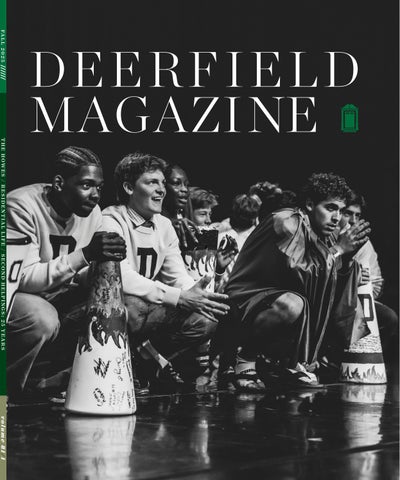
Captain Deerfield Jarron Crosbie ’26 (right) and the Cheerleaders share legends at the 2025 Deerfield Magazine is published three a year. Schooltimes Meeting Choate Day Rally.
Brent Hale
Publication Office: Cummings Printing, Hooksett, NH. Third class postage paid at Deerfield, Massachusetts, and additional mailing office.
Deerfield Academy does not discriminate against any individual on the basis of race, color, religion, sex, sexual orientation, transgender status, marital status, national origin, ancestry, genetic information, age, disability, status as a veteran or being a member of the Reserves or National Guard, or any other classification protected under state or federal law. Copyright ©2024 The Trustees of Deerfield Academy (all rights reserved)
1
ALBANY ROAD / HOS
This Keeps Me Awake at Night
FALL FAMILY WEEKEND REMARKS
Brent Hale
Head of School John Austin
2
Good morning. I love this weekend, and we are so excited that you are here to see your children in action: thinking, competing, performing. You won’t get the full Deerfield experience—that is exclusively reserved for students—but I do hope you will experience some of what your children experience. I have given my remarks this morning—a revised, abbreviated version of some thoughts I shared with faculty at our opening faculty meeting—a title: “This Keeps Me Awake at Night.” But before I go there, I want to say this: I am grateful to you for sharing the lives of your children with us. We have had a wonderful start of the Fall Term and that has everything to do with your children and you. Monica and I recently welcomed our proctors and peer counselors to the Manse after a Tuesday sit-down meal. Their energy, their affection and friendship for one another, and their love of Deerfield was inspiring. And then earlier this week we had the ninth grade over. Very different group: goofy, giddy about being in the head of school’s home, full of energy, and happy. I left both evenings buoyed, energized, and optimistic about the future, knowing that we have extraordinary students and exceptional student leadership in our dorms, on our teams, and throughout the school. Mr. Boyden liked to say that Deerfield works because everyone here does their part, and that’s still true. But there is also another dynamic at work. Each year, our older students pass down to younger students the spirit, the ethos, and the goodness of this school. This happens everywhere across campus, and it matters. Because this is what great schools do: they create cycles of virtue that successively regenerate and strengthen the culture of the school. When it works, as it does here at Deerfield, it is amazing and humbling to behold. I was speaking to a former president of the Dartmouth College board of trustees earlier this fall—John Rosenwald, Deerfield Class of 1948. He just celebrated his 95th birthday. Before each board meeting, he would meet with the president of the college over breakfast and they would discuss what John called the “KPAN agenda”—the “What Keeps the President Up at Night” agenda.
To be honest—and at the risk of jinxing myself—I sleep pretty well, in part because of what I just described: the care our students consistently express for one another. But also because of our faculty and staff, the leadership of our Board, the strength of the greater Deerfield community, and your belief and trust in us. But we do face—and like all schools, will continue to face—many challenges, and we can’t be complacent about those: an ambient climate of increased political and social division; concerns about the viability of a financial model that depends on endowment return, philanthropic engagement, and tuition revenue; heightened economic uncertainty and a predicted demographic decline in the number of school-age children; well-documented declines in the health, happiness, and well-being of young people; a digital and media revolution—Gutenberg-like in its dimensions and impact—that touches on virtually every aspect of life. I believe that Deerfield’s mission, values, and commitments are uniquely suited to meet these challenges—as much any school in the country. But there is one thing that does keep me up at night, and you might find the answer surprising. Reading. Reading keeps me up at night. No—not because I’m reading late into the night—though that does sometimes happen. What keeps me up is my worry about the slow, steady, and increasingly well-documented collapse of literacy; basic literacy, recreational literacy, and most importantly, deep, long-form literacy. A few data points: According to the National Assessment of Education Progress, the reading skills of American high school students are the worst in almost four decades. Reading for pleasure is in steep decline. According to a study from the University of London, the share of people who reported reading for pleasure fell to 16 percent in 2023—a drop of about 40 percent since 2004. Roughly 50 percent of US teenagers report “hardly ever” reading in their leisure time, and parents, according to timeuse surveys, read less and less to their children.
We see similar trends among young people attending colleges and universities. The title of a much-talked about article in The Atlantic captures this problem well: “The Elite College Students Who Can’t Read Books.” A recent study of students at two highly regarded Midwestern American universities found that undergraduates were unable to understand the first paragraph of Charles Dickens’ Bleak House. These were not, mind you, just college students; they were students majoring in English literature. A January report by a committee of Harvard faculty, based on numerous surveys and hundreds of interviews with students and faculty, reports that (and I quote): “students often don’t do most of the assigned reading”— that at a college, one of the most selective in the world, where 79 percent of students receive a grade of A or A minus. This report is worth reading. It finds that students are hesitant to speak in class because someone will disapprove of their opinions; that they write to align their work with the perceived political and ideological preferences of their instructors in order to get the desired grade; that they pick classes that align with their preexisting beliefs and opinions; that they pick classes more on the basis of perceived easiness, both in terms of the hours of work they require and the likelihood of receiving high grade; and that they tend to segregate into social groups with like-minded opinions. And then the kicker: They don’t go to class. As enrollments decline in the humanities, colleges cut programs. This is happening across the country, even in universities such as the University of Chicago, that have long-standing and storied commitments to the study of the humanities. Johns Hopkins University has an English department of 21 professors. Last year a friend told me they had eight students graduating with a major in English. The economics of three professors for each English major aside, this is not good. College faculty report that students are turning to YouTube, podcasts, and ChatGPTcrafted summaries rather than actually reading their assignments for class. Faculty adjust accordingly, assigning fewer books, cutting back on the reading, relying on excerpts. This too keeps me up at night.
3
ALBANY ROAD
I hope you won’t think of this as simply the rantings of a cranky 61-year-old, one-time English major who has not—and never will be—on social media, and still reads three newspapers a day. Cranky and old—yes, fair enough. But this is happening. We are witnessing a massive shift in the media landscape, in technology, in how we communicate, and in how we think. And it has huge implications for schools. One observer has argued that we are on the dawn a post-literate society. Historians of technology and of the media have long recognized that there is a powerful relationship between school and the dominant media environment. There is no Nobel Prize for education. If there were, my nomination (posthumously) would be the educator, historian, and media theorist, Neil Postman. Writing in 1979, at the dawn of the digital revolution we find ourselves in today, he argued that the media environment in which young people grow, learn, and come of age is, outside of the family, the single most powerful shaping influence in their lives. His great insight, taken up by others including Sherry Turkle of MIT, authors and journalists Nicholas Carr and Ezra Klein, and the social psychologist Jonathan Haidt, is that this media environment constitutes a kind of “second curriculum.” This curriculum, Postman said in words that now seem prophetic, “has more money spent on it, commands greater attention, is more pervasive, and is less carefully monitored than the school curriculum.” In its competition with the school curriculum, he further said, “this electronic curriculum is an ungracious and merciless adversary.” He recognized it as a substantial threat to the life of the mind, and he advanced what he memorably called “the thermostatic view of education.” What he meant here was simple: Schools exist to provide a countercultural alternative to this “second [media] curriculum.” It has been said that reading is the skill that makes all other learning possible. This dramatically understates the role that deep, long-form literacy has played in the development of civilization—and specifically of schools, colleges, and universities. Reading is the DNA of higher learning, and we re-engineer it—or allow it to whither—at our own— and that of our children’s—peril.
4
Long-form literacy, and the powers of sustained thought and concentration that it requires, creates, builds, and augments human intelligence, and this is especially true of young people. The writer Mary Harrington, writing this summer in the New York Times, summarized the research on this. She wrote: “Long-form literacy is not innate but learned, sometimes laboriously. As the neuroscientist Maryanne Wolf has demonstrated, acquiring and perfecting a capacity for long-form, “expert reading” is literally mind altering. It rewires our brains . . . honing our capacity for concentration, linear reasoning, and deep thought.” She concludes: “the presence of these traits at scale contributed to the emergence of [the ideals of open inquiry and expressive freedom], modern science, and liberal democracy, among other things.” Postman understood the formative power of print before the neuroscientific evidence arrived. He celebrated print media—what he called the typographic mind—because print gives priority to the rational use of the mind and “encourages forms of public discourse with serious, logically ordered content.” Describing a similar media revolution—the ancient shift from orality to print—Postman noted: “Print makes it possible to subject thought to a continuous and concentrated scrutiny. [It] freezes speech, and in so doing gives birth to the grammarian, the logician, the rhetorician, the historian, the scientist— all those who must hold language before them so that they can see what it means, where it errs, and where it is leading.” So, the loss of deep literacy and all of the intellectual capacities that come attached to it—for hundreds of years the absolute core and soul of liberal learning—really, really keeps me awake, and I suspect that AI, which is moving with tremendous speed and with consequences that are difficult to anticipate, will only accelerate this loss, since there is already evidence that AI use among children and the young can stunt development of critical thinking—especially when introduced prematurely and before young people have developed the core competencies of thinking, discernment, and judgement.
5
ALBANY ROAD
We know the brain is like a muscle. To develop fully it needs to work; it needs to exercise with what educators call “desirable difficulties.” To build neural networks, the brain needs to encounter appropriately pitched resistance (what in fitness training is known as “time under tension”). You might think of this, as Harrington describes it, as “the ascetic approach to cognitive fitness.” The danger, the terrible seduction of AI, is that it’s effortless, without friction, or resistance. It provides the illusion of greater agency. It can read for students, provide quick summaries of anything they give it, and do it quickly and clearly. It can prepare questions for class, it can code, it can pass the bar exam. And that’s the problem. It’s too easy. As the writer Nicholas Carr remarks of these new forms of tech in his new book Superbloom: How Technologies of Connection Tear us Apart: “Mastery is [virtually] immediate (even for a child).” So given what we have learned about the impact of social media in the lives of children, and emerging evidence about AI on the emotional, cognitive, and intellectual growth of young people, there is, I think, a powerful argument for caution. It may well be that the best way to foster “AI competency” is not to encourage “early exposure to AI concepts and technology” [as the recent executive order, “Advancing Artificial Intelligence Education for American Youth” puts it] but to delay exposure to AI until students mature. We should, therefore, resist educational FOMO and slow the rush to AI integration— even as we keep an eye on new applications and study the efforts of new initiatives—like the Austin-based Alpha schools who are taking an AI-forward approach to teaching and learning—and talk to the best minds in the field. In many ways, we need to move in two directions at once. That is why our Dean of Academic Affairs Anne Bruder and her team created a summer institute for faculty on AI at the end of last year; why we have opened an AI lab—we want to provide space for thoughtful, faculty-guided experimentation within our curriculum—and why, at the same time, we prohibit the use of AI unless students have the explicit permission of their teachers.
6
Our brains—I mean yours and mine, I am sorry to say—have stopped growing, but those of our children have not. We have a fleeting and brief developmental window of opportunity to cultivate the capacities, habits, and abilities that matter: deep literacy, attention, intellectual resilience and vitality, and the social skills that we know are so important to human flourishing. We cannot waste that. As I look to a future that seems to be approaching at warp speed, I take inspiration from many places and people. I take inspiration from our faculty—and their deep commitment to the printed word—and I am proud of the structures and practices we put have put in place to support healthy adolescent development: • A long-form academic schedule that slows the pace of school and provides opportunity to foster sustained attention, deep learning, and cognitive endurance; • Small classes and low student-teacher ratios that allow for mentorship, coaching, and intellectual and artistic apprenticeships; • The micro-communities we create across campus—on our teams and ensembles, our dorms and hallways, our sit-down tables and advisories—and the way we come together collectively as a school community on Wednesdays and during formal meals; • A nd an approach to technology and screens that centers human relationships, thickens connections across campus, and fosters community. Each of these, and much of that we do every day here at Deerfield, is the expression of an essential, time-tested, enduring educational fact: that healthy adolescent development— emotionally, intellectually, and cognitively— is social and relational. I take inspiration from all of those who seek to protect the human dimension of school communities: my colleagues in summer camps who understand the need for play—for fun— and intentionally and unapologetically limit screens and phones, and scholars like the political scientist Robert D. Putnam, who see schools as engines for the creation of social and civic capital.
7
ALBANY ROAD
We can take inspiration from a new generation of scholars, teachers, and librarians—I think of them as the new humanists—who have brought renewed attention to the power of the great books and those time-tested teaching practices that deepen attention, enrich our capacity for slow thinking, and support the habits of disciplined inquiry. Many educators are reverting to screenfree classrooms, blue-book exams, oral defenses, and screen-free assessments. I recently connected with Chris Bradford, president of the Morehead-Cain Foundation at the University of North Carolina, one of the most selective and competitive scholarship programs in the United States. When students arrive on campus for the final stage of the Moorhead-Cain selection process, they are given three things: a prompt, a pen, and paper. And then they write. Finally, and perhaps most importantly, we can take inspiration from our own history, traditions, and values. Deerfield has always been countercultural, and it will continue to be so: a pro-social school for an anti-social era, a pro-thinking school for an anti-intellectual age. I made a wonderful discovery this summer: that we had an earlier school motto, abandoned by Mr. Boyden for the excellent “Be worthy of your heritage.” I admire our school motto since its imagines our past, and the accomplishments of earlier generations, as a source of strength and inspiration, and no school can endure if it cannot take pride in its history and heritage. Yet this earlier motto—Non est vivere, sed valere vita est— from the Roman poet Martial is no less excellent. Elegantly translated by our own Dr. Houston, it reads: Life isn’t living, but flourishing. Perhaps my greatest fear is that the loss of deep literacy threatens to deprive young people of thousands of years of wisdom— those rich traditions of literature, philosophy, and poetry, in so many languages and from so many civilizations—that for so long have provided the world with consolation, inspiration, hope, and meaning.
8
So, I end with a poem by Emily Dickinson:
Jamie Malcom Brown
There is no Frigate like a Book To take us Lands away Nor any Coursers like a Page Of prancing Poetry— This Traverse may the poorest take Without oppress of Toll— How frugal is the Chariot That bears the Human Soul—
9
ALBANY ROAD / GUEST SPEAKER S
During School Meeting on September 24, Deerfield welcomed Alison Wood Brooks—Associate Professor at Harvard Business School, founder and CEO of TALK Studios, and author of TALK: The Science of Conversation and the Art of Being Ourselves. Her central message to the community was clear: conversation is everything. It can be joyful, awkward, enlightening, confusing, nerve-wracking, and even life-changing—and it is a skill that should be practiced and strengthened. Brooks shared her research on the surprising power of conversation to shape relationships, learning, and decision-making. She encouraged students to think not only about their own goals in conversation but even more about the goals of the other person. Success, she noted, looks different depending on context: sometimes it’s about making a decision, other times it’s simply about connection, care, or enjoying each other’s company. She went on to outline several practical “micro-skills” for becoming a better conversationalist. Don’t linger too long in small talk, she advised, but instead move confidently into deeper or more meaningful topics. Preparing a few topics in advance can reduce anxiety and keep conversations flowing. Asking more—and better—questions, especially follow-ups and open-ended “what” questions, can deepen connection, while avoiding “boomerasking” (asking a question and then quickly answering it rather than attentively listening to a conversation partner’s response) helps prevent awkwardness. Brooks also emphasized the importance of levity, noting that warmth and humor can keep interactions engaging without requiring anyone to be a comedian. Just as critical, she said, is demonstrating that you are truly listening: use your words to reflect back what you’ve heard and validate someone’s feelings before jumping in with advice or opinions. These small but intentional moves, she explained, can transform ordinary exchanges into meaningful moments of trust and connection. In closing, Brooks reminded the community that every relationship is built on a series of conversations over time. By practicing curiosity, kindness, and courage—one “messy, brilliant, complicated, and wonderful talk at a time”—we can make conversation our superpower. //
ALISON WOOD BROOKS AUTHOR / PROFESSOR / CEO of TALK Studios
Dem on st rat i n g t h at you a re t r u ly l i s t e n i n g : u s e yo u r wo rd s t o re f l e c t ba c k w hat you’ve he a rd a nd val i d at e som eon e’s feel in g s be f o re j u m pi n g i n w i t h a dv i c e o r o p i n i o n s . Th e s e s ma ll but inte ntiona l m oves . . . can t ran sfo r m o rd i n a r y exc h a n g e s i n t o m e a n i n g f u l m o m e n t s o f t r u st a nd c onne c tion.
10
JEFFREY ROSEN
PRESIDENT AND CEO / National Constitution Center
Brent Hale
On November 5, the Deerfield community welcomed National Constitution Center President and CEO Jeffrey Rosen to campus. The National Constitution Center brings together people of all ages and perspectives, across the United States and around the world, to learn about, debate, and celebrate the “greatest vision of human freedom in history, the US Constitution.” At School Meeting, Mr. Rosen spoke about how interpretation of the Constitution has evolved throughout the United States’ history. He also joined students in US History classes, and concluded his visit by being interviewed by Dr. Austin for Dialogue: The Deerfield Podcast. Among other topics, Mr. Rosen and Dr. Austin discussed the premise for Mr. Rosen’s new book: Pursuit of Liberty: How Hamilton vs Jefferson Ignited the Lasting Battle Over Power in America. //
11
ALBANY ROAD / GUEST SPEAKER S
CRICKET WHITTON ’04
Spencer Kruse-Melfi
DEERFIELD TRUSTEE / CEO of SPANX
In late October, students in the Academy’s LEAD program enjoyed an opportunity to learn from current Deerfield Trustee and SPANX CEO Cricket Whitton ’04. Ms. Whitton shared stories from her “non-linear” path to leadership and the lessons that helped to shape her management style. She noted, “Leadership is a practice, not perfection.” While initially developed for students who serve in leadership roles on athletic teams, the LEAD program is open to all Deerfield students, and
12
aims to provide the skills and training necessary to be an effective leader on and off the field. The overarching goal of the LEAD program is simple: to “be worthy.” Students utilize their leadership skills throughout their time at Deerfield and well beyond; LEAD provides important opportunities for leadership education and self-evaluation to help prepare Deerfield students to be leaders for life. //
I n t rod u c i n g
DI A LO G U E : T he Deer fiel d P o d c a st Hosted by Head of School Dr.John Austin, each episode dives into conversations about learning, leadership, and life at Deerfield and beyond. The inaugural episode featured Harvard Business School Professor Alison Wood Brooks as she and Dr. Austin chatted about what makes a great conversation and why it matters. Listen now on podcast platforms (Apple and Spotify) or visit the Head of School’s page: deerfield.edu/admin/head-of-school
13
ALBANY ROAD / NEW TRUSTEES
T RUST E E
NICK ACQUAVELLA ’96 P’25,’27
When Nick Acquavella ’96, P’25, ’27 reflects on what led him to join Deerfield’s Board of Trustees, his answer is rooted in family and gratitude. “It’s the opportunity to give back to a school that has meant so much to me personally and even more broadly to my family,” he explains. A Deerfield alumnus himself, Acquavella is also the brother of a fellow graduate and the father of one Deerfield alumna and another current student. Serving as a trustee feels like a natural way for him to contribute to a place that has shaped his own life and the lives of his closest family members. Acquavella brings a thoughtful and wide-ranging approach, having served on educational boards at the University of Virginia—his alma mater—where he focused on initiatives related to the arts and athletics. He also held a traditional board role at the Buckley School in New York, where his son is a student. Still, he characterizes himself as more of a generalist than a specialist. “As with most alumni trustees, I bring institutional knowledge of the place,” he says. “But more than anything, I’ll be paying close attention to the culture—the intangibles that make Deerfield special—and looking for ways to support and sustain that.” His focus is on helping the school continue to evolve. “I think things are going well at Deerfield,” he says. “And the goal of a really good board is to make sure things are always improving and we’re not just satisfied with where we are.” Acquavella is co-owner of Acquavella Galleries, a renowned family -run art gallery based in New York. It’s a legacy business: his grandfather founded it, and today, Nick runs the gallery alongside his brother and sister, with their 88-year-old father still contributing daily. “It’s a true family business,” he says. “We pride ourselves on creating a place where people, even beyond the family, like to work.”
14
A FULL LIST OF CURRENT DEERFIELD ACADEMY TRUSTEES can be viewed at: deerfield.edu/admin/board-of-trustees
/// b y K a t e G o d i n ///
As with most alumni trustees, I bring institutional knowledge of the place . . . But more than anything, I’ll be paying close attention to the culture—the intangibles that make Deerfield special—and looking for ways to support and sustain that.
His career in the art world has given him unique insight into a range tennis team for three years—an experience of personalities and perspectives— especially in his dealings with top he remembers fondly—and hosted his own collectors and artists. “One minute you’re talking with someone who radio show: “Street Jams with Nick Acquavella,” wants to make a quick decision; the next, you’re deep in a 20-minute a Saturday morning all-rap program. “I was 15, discussion about an artist’s philosophy,” he says. “You’ve got to be from New York City, and I thought I was super ready to meet people where they are.” This experience, he believes, cool,” he laughs. allows him to bring agility and nuance to the Board’s work. After Deerfield, Acquavella went on to the Acquavella also still has the perspective of a current parent, and University of Virginia, a school he describes what he sees on campus today pleases him. “The students really as sharing a similar “spirit and pride of place.” support each other,” he says. “People seem just as excited about the He sees a common thread between the two debate team winning something as they are about the football team. institutions: both steeped in tradition, both That wasn’t always the case when I was there.” He credits the school’s with communities that span generations. evolving communications—especially through social media—for “There’s this instant bond that ties you to helping to widen appreciation for the range of activities and achieve- people who came before and those who will ments happening across campus. “Not all social media is horrible,” come after,” he says. he says. “It’s helped open people’s eyes to the full range of the DeerNow, as a trustee, Acquavella is focused on field experience.” sustaining that bond and strengthening the Asked what traditions still stand out to him, Acquavella is quick to community that welcomed him decades ago. name sit-down meals. “They’re one of the all-time great things,” he “At its best,” he says, “Deerfield is a real says. “I know I didn’t necessarily love them when I was a student, but community—one that includes everyone from they’re such a powerful way to ensure that no one is left behind.” the Head of School to the children of dorm His own Deerfield experience was marked by a rich balance of residents. That’s what I’ll be working to academics and extracurricular life. He played on the boys’ varsity preserve and enhance.” //
15
ALBANY ROAD / NEW TRUSTEES
T RUST E E
JOE BROWN P’18,’23
Joe Brown’s path to the Deerfield Academy Board of Trustees began shortly after he became a Deerfield parent. “Six weeks into our eldest son’s first year at the School, I said, ‘How’s it going?’ and he said, ‘Dad, I think I’m experiencing a masterclass in leadership,’” he recalls. At that moment, Brown knew his son was in the right place, and that Deerfield was reinforcing a view of the world that he and his wife Kristen hoped their children would embrace, one rooted in character, responsibility and sound ethics. “We figured Deerfield would be an academic experience, a social experience, and an athletic experience,” Brown says, “but my son’s early impression was that he was surrounded by talented and compelling leadership.” When Brown was invited to serve on the board, he responded with an enthusiastic yes. “Deerfield is doing critical work in a very special way,” he says, “I knew it would be rewarding to support and reinforce its distinctions with volunteer time.”
A FULL LIST OF CURRENT DEERFIELD ACADEMY TRUSTEES can be viewed at: deerfield.edu/admin/board-of-trustees
16
Courtesy of Siris Capital
/// b y K a t e G o d i n ///
With decades of experience in the aviation industry, Brown brings a combination of business acumen, institutional stewardship, and a commitment to finding and fostering common ground. As partner and chief operating officer of Tailwind Technologies, a diversified holding company in the aerospace sector, he helped lead the acquisition and operation of multiple manufacturers that serve the commercial, military and general aviation markets. In 2023, he co-founded Ghost Riders Asset Management to invest in a range private companies, real estate, and buyout opportunities. His trustee philosophy is shaped by an appreciation for institutional legacy and longterm thinking. “There have been many boards before us, and many boards will follow,” Brown says. “Our job is to keep the flywheel spinning in this specific period of time while taking on its challenges.” Always, for Brown, it comes back to supporting and sustaining a campus culture that teaches students to think deeply and live intentionally. “I see Deerfield encouraging young people to build dutiful, industrious, and meaningful lives. The school invites them to settle for themselves the ethics and foundations of their personal code,” he says. “I know both my boys very much experienced that: Who are we? What do we stand for? What can we contribute?’” Brown looks forward to supporting Deerfield leaders who have been so successful in answering these same questions at the institutional level: “Deerfield is on a run, and truly differentiated. It’s getting both the big things right and the details that follow. As a new board member, I want to learn and join the effort to build on our strengths.” At Deerfield, Brown serves on the Compensation and Personnel Committee and the Academic Affairs Committee. Beyond Deerfield, he is an active board member at his alma mater Middlebury College, where he has served for ten years, as well as various aviation and business ventures. He and Kristen co-founded and serve on the board of the Yellow House Community, a nonprofit residential home for adults with special needs—a mission they consider one of their most meaningful commitments.
I see Deerfield encouraging young people to build dutiful, industrious, and meaningful lives. The school invites them to settle for themselves the ethics and foundations of their personal code.
Brown’s personal and professional journey across regions and industries has given him the hopeful view that people naturally seek unity, shared values and community when given the chance. “My career was very nomadic, and I spent lots of time all over this country,” he says. “What I found is that people from all backgrounds gravitate to authentic interactions if given the opportunity. There is so much common ground.” In this cultural moment, Brown sees Deerfield’s role as more important than ever: “Deerfield is encouraging deep thinking at a time when society is operating at a very shallow level, a binary level, a hashtag level. We’re quick to pivot and shift from one thing to the next, and I think we can lose sight of the things that bind us together,” he says. It is his belief that Deerfield offers something different— a place to cultivate shared values, common experience, and high expectations of oneself and one another. “At a time of polarization, institutions like Deerfield can model cohesion, character, and connection. That’s a responsibility I take seriously.” //
17
A L B A N Y R O A D / FA L L T H E A T E R P R O D U C T I O N
BLUE STOCKINGS
More pho
s on bigg
re
otos
/// p h o t o g r a p h s b y M a t t h e w C a v a n a u g h ///
aph
.ph
18
gr
en
to
Set in 1896, Blue Stockings by Jessica Swale is an ensemble drama set at Girton College, Cambridge, which follows four pioneering women who fight for the right to earn degrees at a time when female education is fiercely contested. The play centers on an idealistic first-year student torn between academic ambition and societal expectations, as she and her classmates confront sexism, institutional resistance, and the emotional complexities of love, loyalty, and intellectual awakening. Through moments both humorous and heart-wrenching, Blue Stockings illuminates the courage required to challenge the status quo and claim a place in a world determined to exclude them, celebrating the women whose persistence paved the way for future generations.
Brent Hale
FALL FAMILY WEEKEND SHOWCASE
19
ALBANY ROAD
I think the combination of challenging my athletes and getting them to push their limits, while also showing them consistently that we support them— high expectations combined with high support— encompasses my coaching philosophy.
BEHIND THE BENCH / VARSITY FIELD HOCKEY
HANNAH GOODRICK-ARMSTRONG
/// b y D a n i e l l a Vo l l i n g e r ///
13-4 20
Brent Hale
fall season results
When former field hockey head coach Kristen McVaugh stepped down from coaching and teaching at Deerfield Academy, Dean of Faculty Patrick Andren and Director of Athletics and Cocurricular Program Bob Howe put together an intensive search for McVaugh’s replacement. “We went looking for a person who could teach and coach at a very high level, and someone who really wanted to be in this position,” says Howe. “What we found in Coach Hannah Goodrick-Armstrong was someone who would care deeply about success, working with young people and making them better, and a person tough enough to see these goals through.” Coach Goodrick-Armstrong returns to the Valley directly from Loomis Chaffee where she taught chemistry and coached water polo and field hockey. Her first job out of Williams College (where she studied pre-med and music) was as a science teacher and coach at Eaglebrook School. Though she had attended an independent day school, Greenwich Academy, Coach Goodrick-Armstrong found the boarding school experience to be an entirely novel one. “It was different from anything I had experienced before. And in a lot of ways, it felt kind of magical,” she says, emphasizing how much she enjoyed the close-knit community that campus life nurtures—something she missed when she subsequently went to work in clinical research for Brigham and Women’s Hospital before finding her way back to a day school (Dexter Southfield School). But the boarding school life beckoned, and once again she was off to Loomis. “I just really missed the boarding environment: being able to have touch points with students and colleagues, not just during the academic day but also after hours and on the weekends,” says Coach Goodrick-Armstrong, also joined by her husband who has taken a new position teaching and coaching up the hill at Eaglebrook School. Though the field hockey season may have officially begun in September—with a successful 8-0 start to the season as of this writing—the players might say that the season really began in the spring when Coach Goodrick-Armstrong interviewed for the head coach position. “It started all the way back in the spring of 2025 when I first met [the captains], and one of my questions was about what their goals were,” recalls Coach Goodrick-Armstrong. Finding their answers inspiring, she began working toward these goals even before arriving at Deerfield. “I connected with a lot of players and families over the summer, just over Zoom and phone calls. And then at the beginning of this year, we did quite a bit of goal setting and kind of building culture on the team.” Assistant coaches Ellie Bicknell and Muffy Mazambani ’20 highlight the “palpable energy” Coach Goodrick-Armstrong brings, as well as how she encourages accountability, asking the players to hold themselves to their own targets. “At the start of the season, Hannah brought the team to the Innovation Lab in the Boyden Library where she had them write out their short-term and long-term goals on poster boards,” says Bicknell. “Those posters now hang in the entryway of their locker room, reminding the players of their goals every time they walk in—she continually refers to the goals the girls set for themselves.” Coach GoodrickArmstrong refers to her players as team “members” which pivots the dynamic of the traditional coach/player relationship, positioning the players more as stakeholders. “She gives significant agency to the team’s captain and assistant captains, recognizing how essential their leadership is,” continues Bicknell. “Her guidance and leadership have allowed the students to take ownership of their goals,” adds Mazambani. Coach Goodrick-Armstrong has a well-defined coaching philosophy, the four tenets of which are: Belonging, Mattering, Service to Others/Teamwork, and Commitment to Improvement. Belonging and Mattering are the core principles around which the team is built. “The most important thing,” Coach maintains, “is that all the people involved with the program feel like they belong there, that they truly matter and that no matter what their role is on the team— whether they are a senior and a starter or a newcomer to the team—they know they matter
to the program.” From that core value, each player takes away the understanding that they are an integral part of the team, and naturally, a dedication to teamwork and self improvement builds from there. With that foundational support and camaraderie among the players, the expectations and challenges Coach sets for the team should not feel too daunting. “I think the combination of challenging my athletes and getting them to push their limits, while also showing them consistently that we support them—high expectations combined with high support— encompass my coaching philosophy.” Though team sports might be one of the best ways for adolescents to develop confidence and personal habits and values such as self-sacrifice, goal setting, and self discipline, Coach Goodrick-Armstrong acknowledges that there are other areas outside of academics and athletics that offer avenues for growth and exploration. “Something I appreciate is that [Deerfield student athletes] are often not known only as a player of ‘X’ sport,” she observes. “They’re known as people first and students. We try and make sure to celebrate the well-roundedness of our students.” Coach Goodrick-Armstrong’s own high school field hockey coach and one of her “biggest inspirations” was instrumental in encouraging her to pursue the violin, steering her toward Williams College’s Division III program (which she captained during her senior year) so that she could study music and explore her varied interests. “She understood that I would get a lot out of playing collegiate field hockey, but that maybe playing Division I wouldn’t be the right fit for me, and directed me toward some decisions that fit so well with my personality,” says Coach Goodrick-Armstrong. “She was only able to do that because she knew me so well, and that’s something I try to do now as a coach and a teacher: really understand my students and my players so that I can support them in the way my teachers and coaches supported me.” //
21
C H O AT E D AY
22
2025
s on bigg
re .ph
otos
More pho
aph
Brent Hale
gr
en
to
RESULTS
The Big Green split the day with Choate posting a collective 5-5-1 record. Deerfield cross-country teams provided a boost as each team bested Choate at the New England Cross-Country Championships to bump DA’s record to 9-5-1 vs. Choate on the day.
23
A L BA N Y R OA D / A NAT O M Y O F A N O F F I C E
ERIKA SHELBURNE Director of International Advancement
1
Office location: Ephraim Williams House Design aesthetic: Early American Primitive
When Erika Shelburne isn’t traversing the globe to meet with alumni and families who live outside of the United States to engage them with Deerfield and to secure philanthropic resources for the Academy, she often welcomes visitors to her cozy office in Ephraim Williams House. Decorated with mementos from her travels and antiques purchased by Erika and her husband at shops and the famous Western Massachusetts Brimfield Antique Flea Market, every object has a story! Here are a few of Erika’s favorites, described in her own words.
24
2
3
4
1 C ozy Corner
Early 19th c. ladies dressing table—my favorite piece! 2 T ravel Tchotchkes
from places I have visited (with a few aspirational locations thrown in). I love collecting these! 3 Landscape Paintings
mid to late 19th c. 4 N eedlework Sampler
Early American—19th c.
5
5 P ainted Firescreen
from a New Jersey antiques dealer—there’s a great story about how I tracked it down! 6 T icket from Jordan
from a visit to the Jerash Archaeological Museum in Jordan—what an impressive place! 7 T rusty Travel Notebooks
7
Brent Hale
6
for notes, lists, and more—I bought two of these years ago in Seoul, Korea, and then couldn’t find them again. I finally tracked down the maker and bought more notebooks that were shipped to my home. I visited their small store in a less traveled area of Seoul (Mapo-gu) a few years later, and they immediately knew who I was! I love that. //
25
ALBANY ROAD / THE BRICK
NEARLY COMPLETE
26
On schedule and on budget, the new dining hall, “The Brick,” will open its doors to students on Monday, January 5, for sit-down lunch. Excitement grew throughout the fall term as the exterior of the building neared completion; as this issue of Deerfield Magazine goes to press, construction crews are hard at work, putting the finishing touches on interior spaces. Dining hall staff will move into their new facilities over the Winter Break, and employees are looking forward to two opportunities to enjoy “test run” lunches before students return to campus. The Brick will be officially dedicated in March during a special Saturday night sit-down dinner, at which time leadership donors, including Mrs. and Ambassador Robert W. Johnson IV and their family, will be recognized for their extraordinary generosity and support of the building that has been called the “heart and soul” of campus.
27
AUTUMN VIBES
/// p h o t o g r a p h s b y S p e n c e r K r u s e - M e l f i ///
28
29
tête-à-tête / T H E H O W E S
with•
A Tête-à-Tête Bob and Amanda Howe
/// I n t e rvi e w b y D a ve Fr as e r ///
For decades, Deerfield has been defined by the people whose work and warmth shape daily life on campus. Bob and Amanda Howe, who will retire in June of 2026, exemplify the best of what the Academy has to offer. Dave Fraser from the Communications Office interviewed the Howes this past fall, and what follows are excerpts from their conversation.
DF:
Bob, tell me a little about your role and what you enjoy most about it.
BOB:
I serve as Director of Athletics and the Cocurricular Program. What I love most is working with kids—it’s different every day, and that keeps me energized. This marks my twentieth year as an athletic director and my thirty-fifth in schools— first at Loomis and now here at Deerfield.
30
DF:
Amanda, how about you?
AMANDA:
I’m a learning support specialist in Academic Affairs, working under the Director of Academic Support. My background was in classroom teaching, but when our children were young, I shifted into one-on-one learning support. I love helping students navigate every aspect of their academic lives— time management, organization, self-advocacy. No two days are ever alike, and the best part is connecting with students and faculty.
“No two days are ever alike—and connecting with students and faculty is the best part.” —Amanda Howe 31
tête-à-tête / T H E H O W E S
DF:
DF:
BOB:
AMANDA:
What drew you both to Deerfield?
I actually grew up at Loomis— my parents worked there for over forty years. When Deerfield reached out to see if I knew anyone interested in the athletic director role, I passed along some names at first. But then I looked more closely at the energy and momentum here, and I realized that I wanted to be part of it. I called John Taylor, (then dean of faculty), joined the search, and the rest is history.
AMANDA:
For me, my work was portable—I could do it anywhere. I was grateful to find that Deerfield valued what I brought to the table. It offered professional fulfillment and the flexibility that fit our family life.
“Deerfield students are remarkable— motivated, curious, and willing to try new things.” —Bob Howe
32
What’s made Deerfield home?
The people—students, colleagues, everyone. There’s a true sense of community and tradition here. I love that Deerfield values face-to-face connection in an age when that’s becoming rare. The setting doesn’t hurt either—the river, the mountains, being able to bike.
BOB:
I agree completely. Deerfield students are remarkable—motivated, curious, willing to try new things. What keeps me here is that we talk about the right things: balance, wellness, character, multi-sport participation. Those conversations matter—and they keep me growing as an educator.
DF:
Bob, your role extends well beyond athletics.
BOB:
Absolutely. I live the ‘triple-threat’ model— coaching, advising, dorm duty, committee work. Those multiple contact points keep us deeply connected to students. It’s immersive, and that’s what makes Deerfield so special.
DF:
What about sit-down meals?
BOB:
They’re one of my favorite traditions. I meet students I might never otherwise cross paths with, and the conversations are always rewarding. Sit-down embodies Deerfield—it’s how we build community, one table at a time.
“Sit-down meals let me meet kids I’d never otherwise know— and that’s the heart of this community.”
Howe kids, left to right: Samantha, Erin ’20, Camryn ’22, and Kelly ’22
DF:
DF:
Amanda, your daughters attended Deerfield. What was that like?
Amanda, your turn.
AMANDA:
Bob writes dozens of handwritten notes to students each year. It’s something he learned from his own mentors, and it means so much to the kids—especially those who don’t always get the spotlight. In an age of quick emails, that personal touch is pure Deerfield.
We have four daughters—three attended Deerfield, and the oldest pursued ballet elsewhere. This place encouraged each of them to stretch—to try, to lead, to grow as scholars, athletes, and artists. The teachers saw them as individuals and stayed connected to them long after graduation. That care means the world to us as parents.
BOB:
Watching our daughters thrive here confirmed that coming to Deerfield was the right decision. Their experience embodies everything this community stands for.
DF:
Bob, tell me something about Amanda people might not know.
BOB:
DF:
Bob, you’re planning to retire soon. How did you make that decision?
BOB:
I feel fortunate to retire while I still love what I do. There’s still a lot I want to experience—things on my bucket list— and I want to be healthy enough to do them. Deerfield has given us so much; now it’s time for our next chapter, whatever that may be.
AMANDA:
Leaving a prep-school community takes courage, but it also broadens your world. We’ll carry Deerfield with us always— the friendships, the memories, the lessons.
DF:
Do you have a favorite spot on campus?
BOB:
Old Main Street. I’ve ridden my bike up and down that road countless times— morning, midnight, every season. It’s steeped in history and always reminds me how lucky we are to have lived and worked here.
AMANDA:
For me, it’s our house. Living on campus blurs the line between work and home— in the best way. Our home has been a haven for our daughters’ friends and students alike, a true extension of the Deerfield community. //
BOB:
She began as a classroom teacher and was terrific at it. After raising our daughters, she’s poured that same energy into her students here. Seeing her find joy and purpose in her work again has been wonderful.
Watch the Howes’ full interview here:
33
Home at
Deerfield <<< by Emily Gold Boutilier >>>
34
It’s 7:45 p.m. on a typical Monday, and the first-floor common room in Rosenwald-Shumway is buzzing. Juniors and seniors filter in and out, sharing snacks, doing homework, and talking about their day. Some are girls who live in the dorm. Others—boys and girls from around campus—are here to study and socialize. In the middle of the action is Bea Giraldo, associate director of the Center for Service and Global Citizenship. She lives down the hall with her family. Tonight, she’s one of the resident faculty members on duty. Giraldo finds a seat on the couch and opens her laptop. Soon, a student approaches with a question about a Spanish assignment. Another cues up a song she thinks Giraldo will like. All of a sudden, a two-year-old bounds into the room in pajamas and a cape, his hair damp from the bath. This is Antonio, Giraldo’s son, who’s arrived to say goodnight to his mom, and to the students who treat him like a little brother. All around campus, scenes like this play out daily—and none of it is accidental. Under the guidance of teachers, staff members, and student leaders, dorms at Deerfield are designed to be loving, educational homes away from home. They’re places where students learn to be good roommates, good students, and good citizens. This learning happens through structured programming, as well as through moments of spontaneous connection. Over the past decade, both have increased. “We’ve put considerable resources into this component of the student experience, because we know how critical it is,” says Amie Creagh, associate head of school for student life. “Now, each grade has its own dean who works regularly with dorm faculty. Residential heads ensure there’s coherence and consistency to the residential program, and that students have yet another adult in their lives whom they can lean on.” And while students and alumni may not always think about these investments, they feel the lasting results.
Tom Kates; Spencer Kruse-Melfi
left:Bea Giraldo, associate director of the Center for Service and Global Citizenship, Spanish teacher, and “RoSho” faculty resident with her dog, Yuca, her husband, Ben, and son Antonio (below).
Take Lila Keir ’26, who moved onto Giraldo’s hall on Shumway 1 last year— and not entirely by choice, as most of her friends had been placed elsewhere. “It was such a good experience,” says Lila, who is from North Carolina. “I didn’t know a lot of the girls in the grade above me on the hall, but we clicked right away. There were inside jokes immediately.” Giraldo and her husband, English teacher Ben Gulla, set a welcoming tone that made it easy to nurture friendships. “We did everything together,” Lila says of the girls on her hall. “It was ideal. When you think of a boarding school movie, my hall was what you think of.” There are many ways to measure the success of Shumway 1: the number of open doors, study partners, shared clothes, TV nights. Girls who were strangers in September cheer each other on at games and performances. They offer to walk Giraldo and Gulla’s terrier mix, Yuca, and to babysit Antonio. Gulla says that living on the hall makes him a better teacher, because it offers informal ways to build familiarity and comfort with students. He sees how much Deerfield students appreciate and benefit from that. But perhaps the strongest proof of success is that Lila chose to live in the exact same room again this year. “Now,” she says, “I’m trying to foster the same environment that the seniors last year helped create for me.”
“Living on the hall makes me a better teacher...”——Ben Gulla
35
Today’s residential experience at Deerfield traces back to 2015 and the creation of the Ninth Grade Village, which placed all ninth grade boarding students together in Johnson-Doubleday, with girls in one wing, boys in the other, and the shared Crow Common in between. The Village emerged from an observation. Faculty had noticed that girls at Deerfield were mostly friends with other girls and boys with other boys. When asked why that was the case, students gave a simple answer: they socialized with those they lived with. So, the leadership team at that time, which included Creagh, decided to place all ninth grade boarding students in the same dorm. Day students were also included in the process, and encouraged to make use of the common spaces and hang out with their friends in the evenings and on weekends. “If they start to form friendships as ninth graders, the hope— and what we’ve seen—is that these friendships continue to grow over time,” says Dean of Residential Life Becca Melvoin. Melvoin has noticed a marked increase in mixed-gender friendships over the past decade. “We see kids having fun with really dynamic friend groups,” she says. “If it’s a nice night, you’ll see kids on the quad playing volleyball and Spikeball, having a great time living together.”
I think the biggest benefit is that, when things aren’t going so well, they have a built-in community of peers. When they get a bad grade on a test, for example, they have peers to lift them up. — History teacher, football and lacrosse coach, and Ninth Grade Village faculty resident Hayden Fox
36
Tom Kates; Joe Gaylor
In his first weeks as a proctor, Jesse focused on helping the boys on his hall in Doubleday find their classrooms and get up for breakfast. He taught them how to tie their ties. He strongly encouraged them to wear socks with their shoes.
The benefits extend far beyond gender dynamics. With ninth graders housed only with other ninth graders, faculty and staff affiliated with Johnson-Doubleday can tailor programming to younger students’ developmental needs. “It’s a consistent, shared experience,” Melvoin says. Today, residential education across all grades centers on the three themes of the Academy’s Community Pledge: care, respect, and integrity. Ninth graders learn to care for themselves and others. Tenth graders focus on daily habits of community respect. Juniors and seniors, including postgraduates, explore ideas around integrity, especially as it relates to college readiness, through conversations about leadership, mental health, ethical decisionmaking, and drugs and alcohol. “Talking to a postgraduate is different from talking to a 14-year-old,” Melvoin says. “We want to have the right message at the right time during the year, delivered by someone who knows the student well.” Tenth graders live in the “twin” dorms of John Louis (for girls) and Louis Marx (for boys). For ninth and tenth graders, phones are locked away from evening until morning, and students spend the two-hour evening study hall in their rooms. Ninth graders typically have roommates, while other students live in singles. “You see their independence grow almost daily,” says history teacher Hayden Fox, who moved into the Ninth Grade Village this year. “Ninth graders come in trying to figure out who they are and what this place means to them. We’re trying to build a foundation for the kind of community members they’ll be down the road. But I think the biggest benefit is that, when things aren’t going so well, they have a built-in community of peers. When they get a bad grade on a test, for example, they have peers to lift them up.” They also have older students—seniors who serve as proctors, living alongside ninth graders and helping them adjust. Just as Lila came back to the first floor of Shumway, these proctors choose to return to Johnson-Doubleday. “I feel like the kids on my hall are my own kids,” says proctor Jesse Gachago ’26, who is from the eastern part of Massachusetts. “I wanted to be a proctor because, my freshman year, I had two great proctors. Every time I had a problem, they greeted me with energy and positivity.” In his first weeks as a proctor, Jesse focused on helping the boys on his hall in Doubleday find their classrooms and get up for breakfast. He taught them how to tie their ties. He strongly encouraged them to wear socks with their shoes. He let them know they could knock on his door at any hour. One day, Drake Okpokwasili ’29 took him up on the offer, waking Jesse in the early hours to say he’d hurt his leg. Jesse grabbed his student ID, called Safety and Security to ask for a ride, called the health center to say Drake was on his way, and escorted Drake outside.
COMMUNITY PLEDGE
At the Academy, residential education centers on the three themes of the Community Pledge: CARE, RESPECT, AND INTEGRITY ////////// Ninth graders learn to care for themselves and others. //////////
Tenth graders focus on daily habits of community respect. //////////
Juniors and seniors, including postgraduates, explore ideas around integrity, especially as it relates to college readiness, through conversations about leadership, mental health, ethical decision-making, and drugs and alcohol.
37
“It’s moments like that that make a proctor’s day,” says Jesse. “You never know when the kids might need you.” “It’s like a big brother thing,” adds Drake, who is from New Jersey. “We joke around with him, but we can also be serious with him and go to him when we need to.” For Jesse, the big brother role includes sharing lessons he’s learned. “I want to help them be the best versions of themselves,” he says. He also wants to help them find their voices. He advises the boys on his hall: “Carry yourself in a way that would make your friends and family happy. Try to make someone’s day every single day. Whenever something bad happens, make sure you reflect on it deeply and try to be better the next time. But most importantly, be yourself and don’t let anybody change who you are.”
have a good time with one another. Some of that joy is organic, and some of it is in the way we put students together to share the delight of one another.” These “moments of magic,” as Dean of Students Sam Bicknell thinks of them, take place regularly—both during school-wide events and on a smaller scale, such as when faculty plan movie outings, ice skating trips, and homemade pasta nights for the students on their halls. “I think a lot of younger alums look back on these moments and don’t realize all that went into them, and how purposeful the adults in our community have been in setting the stage for that magic to happen,” Bicknell says. Just as often, students create magic for the dorm faculty too. In Shumway 1, they invite Antonio to play with their stuffed animals and join him in Giraldo and Gulla’s kitchen for popsicles. “I can’t think of a better context in which to bring up a family,” Giraldo says. Housing assignments are another form of magic. The residential life team acts In the decade since the opening of the Ninth Grade Village, as matchmakers, intentionally placing Deerfield has further boosted the educational mission of residential students on floors with potential new friends. life. The number of faculty involved in the dorms has increased, And yet another kind of magic happens and the Student Life Office has expanded in size and scope. in the daily habits developed in the dorms. “That’s in recognition of how important the experience outside As a teacher in the Ninth Grade Village, the classroom is,” says Creagh. Fox’s goal is for students to learn “how to This year, Deandre Ortiz ’20, joined the Student Life team as belong to a community, care for others, be Director of Student Engagement, a role that integrates inclusion accountable, and find joy in shared spaces. work—with student Alliances, for example—weekend activities, If they can carry that with them, then we’ve and sit-down meals. done our jobs,” he says. Indeed, Lila still One Friday night this fall found Ortiz working with the thinks about what she learned in the 14 student alliances to host the annual school-wide outdoor Village. “My time management is 1000 “block party.” “We gave each alliance a table and said, ‘Show the percent better than if we hadn’t had study community who you are,’” Ortiz says. “Some did that through food, hall in ninth grade,” she says. “I would not others through games or art. The Latin American Student Alliance be the same person I am without study hall had a pork butt roasting in my apartment for two days.” and without having a roommate.” The evening continued with a Deerfield-themed game of Family These days, Lila always makes her way Feud. “The goal was that if you’re not competing, you have a friend to Rosenwald-Shumway by 9:45 p.m., on stage to support,” Ortiz says. “We paired alliances and when all students need to be in their own cocurriculars, so we had the football team and members of our buildings. In the common room, Giraldo theater program competing against two alliances.” The Family might open a bag of Trader Joe’s snacks for Feud idea came from students and brought the whole school the girls on her hall as they catch up on the together—students across grades, interests, and friend groups, as past 12 hours of their lives. Then, Giraldo well as staff, faculty, and their children. heads to her apartment, where Gulla, Yuca “We have, with real intention, sought to create environments of the dog, and a sleeping Antonio await, and joy and levity,” Creagh says. “Even though we are a rigorous school the girls head to their rooms to rest up for with high-achieving students, they’re still kids. They laugh and tomorrow’s moments of magic. //
— Director of Student Engagement Deandre Ortiz ’20
38
Tom Kates; Spencer Kruse-Melfi
The Family Feud idea came from students and brought the whole school together—students across grades, interests, and friend groups, as well as staff, faculty, and their children.
Even though we are a rigorous school with high-achieving students, they’re still kids. They laugh and have a good time with one another. Some of that joy is organic, and some of it is in the way we put students together to share the delight of one another.
— Associate Head of School for Student Life Amie Creagh
39
“The heart and meaning of the program is to be in relationships, to be in community, and to have a better appreciation for all walks of life... Everybody needs to eat and everybody needs to be in community.” —Sts. James and Andrew Reverend Heather Blais
40
Feeding Bodies, Feeding Souls 25 YEARS OF
Second Helpings
<<< by Megan Tady >>>
“From the Deerfield side, one of our core values is connection and face-to-face interactions.” And she points to Deerfield’s dining hall as training.“So much of community is built over shared meals.” —Erin Donnally Drake
In April 2000, Maggie Sweeney, then Deerfield’s community service coordinator, was driving back from a student service trip to New York City when a thoughtful ninth grader named Olivia asked, “Why can’t we do something like this in Franklin County?” Franklin County, which includes the Town of Deerfield and the Academy, has one of the highest poverty rates in Massachusetts. Sweeney and Olivia approached Florrie Paige, former head of food services at the Academy, about the possibility of donating leftover food. “She was very receptive to the idea,” Sweeney recalls. “And the rest is history.” Sweeney’s being modest—the rest is not history. She and others—including former faculty member and alumna Mara Whalen ’95—worked tirelessly to launch “Second Helpings,” a Monday night community meal program in partnership with The Episcopal Church of Saints James and Andrew in nearby Greenfield (MA), where Sweeney was a member. Twenty-five years later, Second Helpings is still going strong, with Deerfield providing the food and the student volunteers, and the church hosting the meal in its parish hall and supplementing additional volunteers, particularly in the summer months. “It’s surreal that this is still thriving 25 years later,” Sweeney says. “It speaks to Deerfield Academy’s commitment to being rooted in place—something Frank Boyden emphasized a century ago: That the school should be anchored in its people, its location, and its community.” Over time, the program added wraparound support: a prayer corner, an essentials pantry once a month offering toilet paper, coffee, and laundry soap. Leadership is shared among several church volunteers to prevent burnout and ensure continuity. Still, the core mission remains: to foster connection between Deerfield Academy and the wider community, and to feed bodies with food and souls through dialogue. “The heart and meaning of the program is to be in relationships, to be in community, and to have a better appreciation for all walks of life,” says Sts. James and Andrew Reverend Heather Blais. “Everybody needs to eat and everybody needs to be in community.” Rev. Blais notes how rare it is for outreach programs to last this long; currently part of a weekly series of community meals in the county, Second Helpings is one of the longest running in the area. “The graciousness of Deerfield over the years has been incredible,” she says. Academy Chief Financial Officer Matt Sheehy also applauds the effort behind the program’s longevity, saying, “What’s most impressive about hitting a 25-year milestone isn’t the fact that we’ve hit it; it’s the fact that it’s been maintained, even with institutions that have such long arcs.”
41
More Than a Meal Second Helpings offers both in-person dining and to-go meals, Student volunteer Carson Belaire ’23 feeding about 100 people and welcoming everyone, regardless of leaned into what it meant to connect with background or economic status. For some, it will be the only meal strangers at Second Helpings. Each they’ll eat all day. Others come for the company. Monday, he arrived determined to learn the Students typically volunteer through Deerfield’s community names of everyone he served and sat with, service program or with athletic teams and advisee groups. As a writing notes on a piece of paper to help jog Second Helpings volunteer, Fiona Howes ’23 was introduced to his memory: “Long sideburns. Takes the reality of food insecurity in the surrounding communities. Taekwondo.” Over time, he formed genuine “Oftentimes community members pick up around a dozen meals friendships. to bring to nearby parks or areas where there is a large homeless “Learning someone’s name shows you population, who may not have a way of transportation to the care,” Belaire says, who is currently studychurch,” she wrote in a Deerfield blog post about her experiences ing international business at Georgetown with the program. “Although the Second Helpings program is University. “And then people reciprocate small, its outreach is huge, as is its impact on the Greenfield that care.” Belaire himself recalls a small community.” but impactful moment when, as a tenth Dining at the church is encouraged, and student and faculty grader at Deerfield, a senior once called volunteers eat with guests—a format that fosters conversations, him by name. “That moment taught me how and mirrors Deerfield’s own sit-down community orientated powerful it is to be recognized.” meals. “When we started, we believed service needed to be about Now co-founder of the nonprofit working with, not for,” Sweeney explains. “That kind of connec- Amazolar (amazolar.org), which supports tion wasn’t going to happen unless people could sit down and talk.” schools and teachers in Ecuador, Belaire When Sweeney stepped down, she passed the baton to Erin says his time at Second Helpings helped to Donnally Drake P’29, who now coordinates Second Helpings for shape his understanding of service and also the church—and also manages student information systems at helped him avoid a “savior complex.” Deerfield. She understands how Second Helpings upholds the “Second Helpings taught me that service values of both the church and the school. isn’t about showing up thinking you know “From the church’s perspective, we’re welcoming all to the table, what’s best for other people,” he says. “It’s providing radical hospitality, and acknowledging humanity in a give-and-go. When you build real relaeveryone,” Donnally Drake says. “From the Deerfield side, one of tionships, you work together toward the our core values is connection and face-to-face interactions.” And future you both want to see.” she points to Deerfield’s dining hall as training. “So much of community is built over shared meals,” she says.
—Carson Belaire ’23
“Learning someone’s name shows you care,” Belaire says, who is currently studying international business at Georgetown University. “And then people reciprocate that care.”
42
Service is at the center of what we do with our students . . . Additionally, we inhabit a space that has both places of privilege and places where privilege doesn’t exist. It’s important that we give students an opportunity to engage with a part of society that requires support, and to learn about some of the reasons why that’s the case. —Matt Sheehy
43
Not Missing a Beat As Director of Food Services Mike McCarthy explains, Second Helpings is made possible in large part by the operational backbone of Deerfield’s dining hall. A typical Second Helpings meal includes a main entrée, a vegetable, a starch, and a fresh salad. “We repurpose food,” says McCarthy. “When you work with the volume we do, there are always leftovers. But we’re careful about food safety—everything is cooled, inventoried, and reheated to the right temperature.” Deerfield’s logistical support is not just about efficiency—it’s a form of stewardship. “With great resources comes great responsibility,” McCarthy adds. “Second Helpings is one way we honor that. I’m really proud of the long-term commitment that Deerfield has had and the real dedication of the folks who have sustained it for such a long time.” When Covid upended routines, the dining services team behind Second Helpings deliberated: How could they continue providing Monday meals? “When you’re in this business, the drive to cook for people gets in your blood,” McCarthy says. The team quickly pulled ingredients from campus and cooked in their own homes. McCarthy recalls boiling water ten times in a row to make pasta in his kitchen with a “little home colander.” On Mondays, team members met at a local gas station to combine meal components, which they then delivered to the church and distributed through a temporary walk-up window. When Covid restrictions eased, Deerfield asked its pandemic health and safety consultants to help configure the church’s interior for safe indoor dining. “During the pandemic, it was really important that we not miss a beat,” Rev. Blais says. “People still needed food. It didn’t matter that the world was shutting down. DA was incredible at sharing their resources and helping us figure out how to do it safely.”
I’m really proud of the long-term commitment that Deerfield has had and the real dedication of the folks who have sustained it for such a long time.” —Mike McCarthy
44
Expanded Worldviews
Rory Hartblay ’26 (above), who volunteered through the food insecurity cocurricular, recognized this disparity. Despite being surrounded by farmland, for instance, many local families can’t afford fresh produce. With the support of a grant from Deerfield’s Center for Service and Global Citizenship last summer, Hartblay procured produce from Natural Roots, a farm located northwest of the Academy in Conway (MA), and turned it into beautiful,
Matt Sheehy describes Second Helpings as a powerful local opportunity for students to engage with the community in a thoughtful way. “Service is at the center of what we do with our students,” Sheehy says. “Additionally, we inhabit a space that has both places of privilege and places where privilege doesn’t exist. It’s important that we give students an opportunity to engage with a part of society that requires support, and to learn about some of the reasons why that’s the case.” Rory Hartblay ’26, who volunteered through the food insecurity cocurricular, recognized this disparity. Despite being surrounded by farmland, for instance, many local families can’t afford fresh produce. With the support of a grant from Deerfield’s Center for Service and Global Citizenship last summer, Hartblay procured produce from Natural Roots, a farm located northwest of the Academy in Conway (MA), and turned it into beautiful, fresh salads for Monday night dinners. “It was fulfilling to know that one action could feed so many,” Hartblay says, who was presented with the Academy’s Charles Piper Cost Award last year for his commitment to service. Over the past twenty-five years, students like Hartblay have helped to shape and enhance Second Helpings through their own initiatives. Some students have performed music at the meals, while others have organized clothing donation drives in their hometowns, returning from school vacations with much-needed items in extra suitcases. Along with gaining empathy and a broader perspective, Hartblay says Second Helpings allows students to break out of the “Deerfield bubble.” “Participating in Second Helpings expanded my worldview and helped me see how diverse and big the world actually is,” Hartblay says. “It’s good to see another side of Greenfield. You can have your first impressions when you just drive through town, but you don’t really get the full story unless you actually interact with the people who live there.” Indeed, many people in Franklin County are living on the margins and the homeless population has increased in recent years. “Affordable housing, affordable groceries—everything has gotten harder for people in the last five years,” Rev. Blais says. Donnally Drake acknowledges that the 25-year anniversary of Second Helpings is bittersweet in that food insecurity persists. “The reality is that people still need to be fed and people are still hungry in Franklin County,” she says. Yet Sweeney returns to the program’s deeper mission: fellowship. “There are lots of people who are lonely,” she says. “They come because on Monday night they do not want to sit at home and stare at the television as they eat. They want to see their Second Helpings family. Even if hunger were wiped out, the need for something like this would not go away.” //
fresh salads for Monday night dinners. (photos by Rory Hartblay)
45
ARCHIVES
19 93
46
the Common Room 20 25
47
THE COMMON ROOM
1949 “John Kranz Notz Jr., a distinguished Chicago attorney, historian, and preservationist, passed away on July 22, 2025, at the age of 93,” reported his brother Edward Notz ’53. “Known for his deep civic leadership, scholarship in architectural and landscape history, and lifelong connection to Geneva Lake, WI, John led a life rooted in intellectual curiosity, public service, and love of family.”
1954 ’54
48
Holmes Jacobs informed us of the passing of his father, Travis Beal Jacobs. Travis was 89 and he died at his home in Bridport, VT, on September 16, 2025 surrounded by his loved ones. Born in New York City in 1936, Travis was the son of Albert C. and Loretta Beal Jacobs. During WWII, his family lived in Alexandria, VA, and after the war lived in Ann Arbor, MI, the family hometown, until his father returned to Columbia University as a professor of law and then provost under President Dwight D. Eisenhower. Travis loved taking the subway up to the Polo Grounds for New York Giants games, especially when they played to Brooklyn Dodgers with Jackie Robinson. After Deerfield, Travis attended Princeton University, graduating in 1958. Initially, he planned to attend Columbia Law School, but at the last minute, he pursued a PhD in American History at Columbia under William E. Leuchtenburg. In 1965, he joined the faculty at Middlebury College and soon began teaching a popular twosemester lecture course on 20th-century American History. He served as department chair for seventeen years. A College Review Committee asserted: “He was one of the first department chairs to embrace the College’s aspirations in minority recruiting, and he is certainly the most conspicuously successful.” His publications include America and the Russo-Finnish Winter War, 1939-1940; co-editing Navigating the Rapids, 1918-1971, the diaries of Adolf A. Berle, an FDR Brain Truster; Eisenhower at Columba; and Dwight D. Eisenhower and the Founding of the American Assembly. He also edited the Middlebury College General Catalogue: Bicentennial Edition, 2000, a “Who Was Who” and “Who’s Who” of the college. He received several Earhart Foundation Fellowships; taught in Tunis on a Fulbright; served on the Presidential Studies Quarterly editorial board; and attended many Salzburg Seminars on American Studies. He was president of the Henry Sheldon Museum in Middlebury during the capital campaign that led to the Paris Fletcher Community Center, and he established the J. Robert Maguire Fund for its research center. He retired as Fletcher D. Proctor Emeritus of American History in 2008. From 1983 to 1986, he served as president of the Chappaquiddick Island Association. In the early 21st century, he and his traveling companion, Constance Carroll, made a series of trips to Europe, ranging from France to Hungary, from Spain, Italy, Sicily, and Tunisia to Russia and Finland. During the past decade, Travis spent time throughout the year at Chazy Lake in the Adirondacks. He leaves unfinished a study of the late Vermonter Robert T. Stafford, former governor, US congressman, and US senator.
His family is grateful for assistance from Addison Home, Health, and Hospice, and UVM Oncology. Besides his parents, he was predeceased by his older sisters Loretta J. Edwards and Sarah J. Edwards, and Lulu M. Lindemann, a dear family companion for nearly seventy years, and two former wives, Judith A. Hasselbrack and Eleanor T. Morison, the mother of his sons T. Beal Jacobs, Jr., and Holmes M. Jacobs, who own Two Brothers Tavern in Middlebury, VT. Besides his sons, he is survived by three grandchildren, Jackson, Piper, and Sally Jacobs, and long-time partner, Connie Carroll. A memorial service was held at Saint Stephen’s Episcopal Church in Middlebury, VT, on October 18.
1959 Sabin Chase Streeter, age 84, of Chappaqua, NY, died on Sunday, Septem-
ber 28. Born in Hartford in 1941, Sabin grew up in Bloomfield, CT. He spent summers at Camp O-AT-KA in Lake Sebago, ME, where he developed his skills and passion for baseball. After Deerfield, he attended Middlebury College and served as a trustee from 1984 to 1989. He was instrumental in encouraging the College to adopt the Posse program and dramatically increase the diversity of its student body. Sabin served in the US Army Signal Corps from 1964 to 1966 at Fort Bragg, NC. In the summer of 1961 he met Beverley Hamilton, the great love of his life. They were married in 1964 and in 1966 they moved to New York City, where Sabin attended Columbia Business School. After graduation, Sabin joined the investment banking division of Blyth, Eastman Dillon. He moved to Dean Witter in 1972 and then joined Donaldson, Lufkin & Jenrette in 1976 as a senior vice president. Sabin made his most enduring legacy at DLJ. He was passionate about creating and sustaining the positive culture of the firm he loved. In 1992, Sabin was named an executive-in-residence at Columbia Business School, where he taught and advised students for more than two decades. He also served on Columbia’s Board of Overseers and then as a trustee emeritus. In 2014, he was awarded the Alumni Medal for Distinguished Service by the University. Throughout his career, Sabin was a forceful advocate for women in investment banking and for greater diversity both in higher education and on Wall Street. His most lasting professional and personal legacy is the mentoring and inspirational support that he gave at DLJ, at SEO (Sponsor for Educational Opportunity), and as an executive-in-residence at Columbia Business School. A resident of Chappaqua for more than 50 years, Sabin served as treasurer and head of ushers for many years at the family’s beloved Church of St. Mary the Virgin. He coached all his sons’ baseball teams with boundless enthusiasm and served on many boards and local organizations. It is hard to overstate the magnitude of Sabin’s impact on the lives of his family and friends. He had so much exuberant positive energy for all the things he did. Sabin is survived by his wife Beverley; his three sons Sabin Jr., Gordon, and George Streeter; his three daughters-in-law Krista Whetstone, Rebecca Streeter (Petrush) and Kristina Howard, his five grandchildren Otis, Hazel, Cornelia ’23, and Delphine Streeter, and Nathaniel Appelt; and his two sisters Anita Smith and Alice Brooks.
49
THE COMMON ROOM
1960 John Thorndike shared that his fifth novel has been released: The
Passionate Sister. Adding that, “In real life, my mother, Virginia Thorndike, died of an overdose at the age of 57. In the novel, she survives and fights to stay clean. Her fictional sons, Jamie and Rob, both need her help after Jamie’s gay partner comes down with Lou Gehrig’s Disease, and Rob’s wife jumps ship, leaving him to care for their one-year-old twins. Ginny pitches in but also hopes for a life of her own. And although in her family she was always the ‘passionate’ sister, now she struggles to open up to her first lover in years. Slowly, she does. Passion returns, and they grow close. Members of the Class of ’60 will recognize one of the characters in the book as a flamboyant Deerfield faculty member of our day.”
1963 ’61 Doug Gortner writes, “A month ago, I slipped a diamond ring on the left hand of Mary ‘Sissy’ Leach, whom I have known for the better part of a decade. We are having more fun than any two old farts should be allowed to have. Thank you, Lord!”
50
”My wife and I are retired teachers in Westford, MA. I have recently returned to the pool to swim 45 minutes a day or six miles per month. I want to thank Larry ‘Lala’ Boyle for making me the swimmer I was then and am now.”– Bob Kniffin
1965 Bruce MacLeish shared that he is in Cooperstown for the third time. “Patty and I are once again living in Cooperstown, NY. The first time was for graduate school, where we first met; the second time was during the 1980s and 1990s, when I was working for The Farmers’ Museum, Fenimore Art Museum, and Cooperstown Graduate Program; and most recently we landed here in 2018. During the early 2000s we lived in Newport, RI, where I was in charge of the museums of the Newport Restoration Foundation, retiring in 2015. Newport was a delightful place to live, but as often happens with islands, the various costs of living tend to rise to an alarming degree. Hence, back to upstate New York. Our older son is a professor at Vanderbilt University, and our younger son worked at Deep Springs College, where he worked his way up to the position of vice president. Through no effort on our part, he and his family moved here three years ago, after he had secured a position as director of operations for The Clark Foundation. I keep busy with a couple of low-pressure volunteer tasks in our village, and the occasional pro bono consultation for museums. I have maintained a lifelong interest in sportscars and racing (the latter, only as a spectator) in such venues as Lime Rock and Watkins Glen; some say, ‘It is never too late to have a happy childhood!’”
’65
“After Reunions, a few of us had the idea to possibly adopt some folks into the class. Deerfield told us that this was okay. Andy Steele shared: “After Reunions, a few of us had the idea to
possibly adopt some folks into the class. Deerfield told us that this was okay. We have recently adopted the following folks into our Class of 65: former teacher Bob Hammond, former teacher / Headmaster Bob Kaufmann, former football Coach Jim Smith, Karen Flickinger, the widow of Ed, and Anne Lozier, Deerfield’s Archivist. They will proudly wear the H ’65 designation on any future nametag for any Deerfield events that they might attend. We are now a coed class, too!”
Andy added that fourteen “brave souls” made it back to the 60th Reunion in person. Another ten zoomed in on a wet Saturday afternoon for the class meeting. “We enjoyed having both former teachers, Bob Kaufmann and Bob Hammond, join our meeting. We also had a wonderful architecture tour with golf carts, led by our own Richard Gluckman. After our class photo, we took another group photo at Flick’s bench, which is prominently positioned near the front of the Main School Building. We hope to see a larger crowd at our ‘Golden Reunion’ in 2030: Class of ’65’s 65th!”
51
THE COMMON ROOM
’71
“What are the chances? While enjoying an end-of-season breakfast with John Mills in our little berg here in Maine (South Bristol, population 1100), we turned around to see Frank Donnelly!
1971 “What are the chances? While enjoying an end-of-season breakfast with John Mills in our little berg here in Maine (South Bristol, population 1100), we turned around to see Frank Donnelly! Both John and Frank are in fine fettle! John is living in Damariscotta and is volunteering to make Maine an even more special state. Frank is still punching the time clock and racing sailboats in the ‘Senior’ class–both in the Gulf and on the East Coast. I continue to explore this wide world of ours and have just completed a five-year term on the Board of Trustees at King’s Academy in Jordan, a/k/a ‘Deerfield in the Desert.’ I also see Barclay Rockwood and Charlie Sincerbeaux with some regularity.”—Rory Cowan
’66
1966 Ronald Battocchi visited Don Abbey at his beautiful home in SoCal. “We went to the Rose Bowl to see Penn State play UCLA (see photo). A very disappointing outcome for Penn State boosters. We also had a delightful time reminiscing about our year together on the Plunkett corridor 60 years ago, our adventurous lives since then, and our hope to return to campus for our Reunion in the spring and see other classmates.”
52
Send in a note—it’s easy! deerfield.edu/alumni/submit-class-notes
’73
1973 The Class of 1973 held mini-reunion at the Mt. Washington Resort in Bretton Woods, NH. It was wonderful to see old friends! above: Adam Narva, Tuck Whitehurst, Peter Van Oot, Lee Stempel, Bob Prior, Sam Wardwell, Peter Finley, Tom Snell, Noel Rubinton, Bob Opel, Dan Ehrgood, Hamilton Throckmorton, Stew Read, Doug Rogers, Larry Jerome. (Nigel Newton had not arrived yet.) right: (l to r) Karen Prior, Bob Prior, Adam Narva, Paula Narva Lee Stempel, Sam Wardwell, Maria Wardwell, Peter Van Oot, Debra Dohrman, Jennifer Opel, Bob Opel, Larry Jerome, Macon Finley, Peter Finley, Cindy Whitehurst, Amy Rubinton(partially hidden), Dan Ehrgood, Noel Rubinton (partially hidden), Linda Gifford, Tom Snell, Doug Rogers, Gina Snell, Stew Read, Mary Throckmorton, Hamilton Throckmorton, Tuck Whitehurst Missing in this photo: JoAnn Blanchette, Nigel Newton
53
Brian Higgins ’89 Brian Higgins ’89 keeps a Van Gogh above a gray cabinet. It’s not genuine. Nor is it a print. It’s a replica of Café Terrace at Night that Brian himself painted in his first year at Deerfield, an assignment from art teacher Caleb Bach. “I had never painted before,” Brian says. “I remember my teacher asking, ‘What do you see?’” Bach did not want students to make an exact copy. Instead, he instructed them to paint “what you want the artwork to feel like,” Brian recalls. As a young child, Higgins had been drawn to bright colors and had sketched cartoons for his friends. The Deerfield class marked the beginning of his formal art education. It also marked the end— at least for a while. Life took him in other directions. Higgins moved to the San Francisco and built a career as a commercial real estate analyst. He met his future wife, who saw the Van Gogh replica, and thought it was a print. She was surprised to learn he’d Brian Higgins, Golden Gate Blues, 2021 painted it, which as an Art History major and Van Gogh enthusiast, Gamblin oils on canvas 20 × 24 in | 50.8 × 61 cm made it even more of a surprise. For Christmas, she enrolled him in an introductory painting class at the San Francisco Art Institute. That class led to another. left the gallery. “It was kind of like a Polaroid,” he says. “It starts Before long, Higgins had sold his first painting. Soon, he very gauzy and then develops by the end of the day.” was showing his work in Dubai, Miami, San Francisco, and Each work in the show represented a moment in his life. New York City. Take “The Deerfield Boy,” a 2025 oil-on-canvas that, as he wrote Now, he’s reached another milestone: his first solo exhibition. in the exhibition label, “bids farewell to the cozy confines of prep Titled “Ascend: The Evolution of Identity,” it ran for two weeks school tradition while welcoming the bright white pages of this fall at the Alessandro Berni Gallery in New York City’s a boundless future not yet written.” Or consider the tawny Chelsea neighborhood. “Son Kissed,” which depicts his son, now age seven, splashing in “This is who I’ve always been,” says Brian, “but it was below the the shallow surf. The viewer can almost smell the ocean. surface.” The show also includes “Lights Go Down in the City,” Brian’s The exhibition featured 26 paintings—some as large as 5 feet first work of abstract impressionism, which he created in 2013. long—“my life as an artist packed up into a van and shipped across “It portrays San Francisco the way that I saw it, with luminous the country.” The opening reception drew about 200 friends, lights and neon colors,” he says. “I remember adding lines where family, former Deerfield classmates, and curious strangers. the rows of residential buildings would be. All of a sudden, that As part of the show, Higgins also created a live painting, created a depth that unlocked the painting. It was the first moment spending six hours capturing a fall city scene as visitors came and in my life when I felt, I can belong in the art world.”
54
/// b y E m i l y G o l d B o u t i l i e r ///
Courtesy of Brian Higgins
ARTIST
If the live painting was a Polaroid, he sees others as symphonies. “The first movement is a wash on the canvas—you’re establishing the temperature, the mood. If you’re too heavy and go straight for the pallet knife, that can be overwhelming,” Higgins says. “I try to incorporate different energies so that, if it’s in your home, you can bring whatever you’re feeling back into the painting. It will do something different for you today than it did for you last week.” And every painting in the show was an answer to Bach’s question all those years ago: “What do you see?” That’s part of why Higgins keeps the old Van Gogh replica above his gray cabinet. It brings him back to the first time he picked up a brush and knife and considered the unique prism through which he viewed the world. “It reminds me to take chances,” Brian says of the painting. “It reminds me that there’s more to awaken in me. And it reminds me to paint what I see.”
When he reflects on that art class— and on his Deerfield education as a whole—he most values how it helped him become “the most authentic version” of himself later in life. It’s a lesson he believes matters now more than ever. When he reflects on that art class—and on his Deerfield education as a whole—he most values how it helped him become “the most authentic version” of himself later in life. It’s a lesson he believes matters now more than ever. “We’re in an age where everything is becoming much more artificial,” Higgins says. Social media algorithms, he worries, narrow our perspectives by feeding us what is already familiar and comfortable. He fears losing art’s ability to provoke, to show us something that we may not love but still want to understand. “And that’s terrible,” Higgins says. “Everybody’s just going to be in their little silos. We need art to continue to open our eyes. It’s how we stay alive as humans, how we continue to inspire each other.” //
Brian Higgins After the Apple, 2024 Oil and Gesso on canvas with gold and copper shavings 60 × 48 in | 152.4 × 121.9 cm
55
THE COMMON ROOM
’75
1975 “Yes, it was the Class of ’75’s 50th Reunion. Swimmers rule! We had a great time. Friday dinner was a heart-warming gathering for all the ’75-ers. Peter H. gave a wonderful speech! We had a small swimmers’ gathering—all Reunion years welcome—in the “old pool,” now the wrestling room, in honor or Coach Boyle and Coach Tyler. It’s true, you talk to your classmates about the moments you shared 50 years ago, my goodness, but you are fascinated by discussing what they’ve been doing since. You share in their accomplishments and they in yours. You realize that you graduated with all of these guys, and you are very proud of them.”—Colin Hampton
56
’78
1978 Fourteen members of the Class of 1978 had a wonderful time reconnecting in New York City on October 27, at Club Macanudo. Thank you to Gavin Murphy ’81 for hosting. There’s more to come as we start gearing up for our 50th Reunion in 2028! Pictured (from left to right): Rob McCollum, Ken Zimmerman, Garry Shumway, Jay Wheatley, Steve Quazzo, Jack Scott, Mike Graney, Al Sawyers, Devin Murphy, Mark Kates, Scott Vallar, Fritz Siebel, Peter Phelan, and Jim Gray. During an “epic” fall foliage tour, Mark McIntyre stopped by campus and met with wrestling Coach Dan Houston. They snapped a photo under Mark’s name on the boards, and Coach Houston was thrilled to meet Deerfield’s first-ever wrestling champion!
1980
’78
“Managed to pull off my second post-stroke non-therapy goal for the year with a road trip to Portland, OR. Saw Carlsbad Caverns, Taos, Arches, Salt Lake City, and Twin Falls on the way up, and Yosemite and Sequoia on the way back. By happy coincidence, two other Deerfield boys were in Portland, and we got together for dinner at Jake’s Grill. Mike Nash ’81 was in town on business, and Brian Nelson was in town handling family matters. Mike and Brian were corridor mates in Chapin their first year at Deerfield (Mike’s freshman, Brian’s sophomore).”—Rob Sartin
1984 Stephen Briones delivered the keynote address in microfinance at the Asian Development Bank in Manila recently. Congrats, Stephen! Red Cat Holdings, Inc., a US-based provider of advanced all-domain drone and robotic solutions for defense and national security, recently announced that Barry Hinckley, a third-generation marine industry veteran and entrepreneur, was appointed president of a new division, Blue Ops, Inc, focused on developing a family of battle-tested USV weapons systems that meet the rapidly evolving demands of the modern battlefield. The announcement read in part: Barry Hinckley is a seasoned entrepreneur, technology executive, and former US Senate candidate with a diverse background that spans decades as a Coast Guard-certified Merchant Mariner, in the aviation industry, offshore sailing, and in enterprise software.
’80
’84 ’78
57
THE COMMON ROOM
’86
Sean Keller brought a bit of Deerfield to the summit of Trollsteinen, near Longyearbyen, Svalbard (Norway) when he hiked to the peak this past June.
’88
1987 “Hi, DA friends! A feature film I co-wrote and produced, A Spartan Dream, concluded its theatrical run in theaters in NYC, LA, SF, Chicago, and Detroit, and it can be streamed now on AppleTV and Prime Video. It’s a romantic adventure based on life in my ancestral home, Sclavahori, a small village in Greece. The name of the village translates as “slave town,” derived from the Turks making slaves of the villagers during the Ottoman Empire. Also, as an actor, I have a recurring role on a new HBO comedy series titled The Chair Company with Tim Robinson of SNL. The shoot for the first season was a blast, and it promises to be a very funny (and unusual) show! It premieres in October. I hope the new school year is going well in Pocumtuck Valley.”—George Demas
1988 “Enjoying the Texas life and racing cars for fun these days. I’m here with my oldest son, Fred, who is a mechanical engineer at Oklahoma State, aspiring to be an F1 race car designer one day. If you are ever in Dallas, let me know.”—Eric Presbrey
58
’88
’88
“I have made music for fun for most of my life, but this last year I stepped up my game and produced an album of electro-pop with a female singer. The project is called Echo Royale, and the album is Thanks, Man. It is getting great reviews and making all the money that you can imagine in the era of streaming (ha!) Maybe Taylor Swift will reach out to me to produce her next album!”—Dakkan Abbe
Gordie Spater, Chris Jaynes, Sean Kelly, John Leggett, Peter Hyde, Scott Samuels, Seth Brennan, and Chuck Ramsay gathered at the home of Chris Jaynes for a Boston
Class of 1988 gathering in July.
1990 Alejandro Poma was thrilled to share
some exciting news: “This year, my team achieved a remarkable victory by winning the US Open Polo Championship. This prestigious event is not only the most important polo competition in the US but is also regarded by elite players as one of the three most significant tournaments in the world. I am particularly honored to share that I scored four goals during the finals and was named the Most Valuable Player (MVP) of the US Open finals. This recognition is incredibly meaningful to me, and I am delighted to celebrate this achievement with my Deerfield family. Thank you for being a part of my journey, and I look forward to sharing more accomplishments with you in the future.”
’90
59
I do the work that I do so that Native communities and tribal nations can live in a way that respects their values and priorities, is in alignment with their culture, and enables them to make decisions from a place of self-sufficiency, not desperation.
Jordan Montour ’13 ADVISOR
Courtesy of Jordan Montour
/// b y E m i l y G o l d B o u t i l i e r ///
60
When Jordan Sha:karónia Montour ’13 typed “best US prep schools” That course, combined with Emerson’s AP environmental into a Google search, he discovered his future and his past. science class, introduced Montour to his two academic passions. Jordan grew up on the Kahnawake Mohawk reservation near He went on to pursue Native American studies and environmental Montreal. As a young teenager, he set his sights on becoming science at Dartmouth College. Upon graduation, he moved to New a first-generation college student and playing hockey at an York City to work at Deutsche Bank, then attempted to co-found American university. He saw boarding school in the United States a consultancy for Native communities. “I quickly realized I had as the best way to prepare. plenty of passion but not enough experience,” Montour says—so Jordan applied to the Academy and scheduled an interview. he joined Cambridge Associates, an institutional investment That’s when his father said the name “Deerfield” was familiar— management firm serving schools, foundations, and a few tribal and explained why. nations. From there, he was recruited by a nascent investment Centuries earlier, on February 29, 1704, French and Indigenous office in San Francisco as one of its first full-time hires. Montour earned his MBA from Yale in 2024, which positioned forces—including Mohawk warriors from Kahnawake—raided the English settlement of Deerfield, killing 47 colonists and captur- him for the role he had always envisioned: helping Native tribal ing 112 in what became known as the Deerfield Massacre. One of nations shape their own financial futures. the captives was seven-year-old Eunice Williams. Adopted by a Today, he is a private wealth advisor at Goldman Sachs, helping Kahnawake family, Eunice assimilated into Mohawk culture and to lead a team that manages institutional investment portfolios spent her life in Kahnawake. for tribal governments, endowments, foundations, and nonprofits. As far as Jordan’s father knew, that was the whole story. “There’s a longstanding mistrust between Indigenous nations But Jordan’s grandparents added an intriguing detail: They said and financial institutions,” Montour says. “As a result, many tribal oral tradition placed Eunice on their family tree. Jordan’s father groups have been slow to benefit from investing in financial investigated, and sure enough, genealogical research showed markets.” His work aims to change that. Based in Boston, he travels Eunice to be Jordan’s ninth great-grandmother. often to Native communities. “I’ve learned so much about different Arriving on campus as a new tenth grader, Jordan was surprised tribes—how they govern, how they exercise their sovereignty, how to encounter that family history at every turn. Walking through they think about their financial future.” Too often, he says, tribal nations are financially dependent on the Old Burying Ground, he came across the headstones of his tenth great-grandparents. He learned that John Williams the US or Canadian government. “We’re sovereign in our heads, dormitory was named for Eunice’s father. In those moments, he hearts, and minds, but often not on the balance sheet,” he says. thought about how Eunice was taken away from all that she knew “Money is not inherent to our traditional ways. But it’s necessary and brought to a strange land. in order to be sovereign in the modern day. I do the work that I do “When I got to Deerfield, I was out of my element culturally. so that Native communities and tribal nations can live in a way It was wildly different from growing up on the reservation,” that respects their values and priorities, is in alignment with Montour says. “It felt like Eunice and I were doing an identity swap, their culture, and enables them to make decisions from a place of self-sufficiency, not desperation.” 300 years apart.” At the same time, he faced another kind of identity shift. “I went All of this serves to amplify Native voices—which, he says, is to Deerfield to play hockey and lacrosse,” he says. “Well, I got cut especially important given how little most Americans know about from both teams all three years.” contemporary Indigenous life. Montour credits his JV hockey coach, Toby Emerson, with That’s one reason Jordan is so proud that the class he helped helping him move past that “identity-shattering” setback. “I found create at Deerfield is thriving today. In fact, Flaska leads regular a team and a community in JV hockey,” Montour says. “They’re field trips to Kahnawake—he and current Deerfield students will my best friends to this day. Mr. Emerson was a central part of that.” head north over Long Winter Weekend 2026—and Montour has At Deerfield, Montour kept this family history and Native identity returned to the Academy to speak as well. somewhat private at first. “Gradually and incrementally,” he says, In that way, his story again echoes Eunice’s. She, too, came back “I was able to wear my culture with a lot more pride.” As a junior, to Deerfield as an adult. Those visits bridged her two communities. Montour served as co-president of the then newly-formed Native Three centuries later, Montour is continuing the family tradition. // American Cultural Alliance, which presented the school with an Iroquois Confederacy flag that hung proudly in the dining hall alongside the flags of other students’ nations. And during his senior year, Montour helped Dean of Spiritual and Ethical Life Jan Flaska create the Academy’s first Native American studies course. They included a unit on the ties between Deerfield and Kahnawake.
61
THE COMMON ROOM
’93
1993 Retired faculty at celebration of life gathering for Gordon MacLeod P’93,’95,’99.
See page 76 for Gordon’s obituary.
1994 “Some fun news from Nashville, TN: I recently released a fulllength, throwback, instrumental surf rock album with my new musical project, The Chi-Tones™. With a strong Baja, Mexico, and desert rock influence drawing from my own personal surf travels and misadventures over the years, it is titled Salsipuedes. The album was written, recorded, and produced in my home studio here in Nashville, TN; mixed by Buckley Miller (Big Art); and mastered by Ryan Smith (Sterling Sound) for digital and vinyl formats. Featuring twelve original songs, the limited edition 12” eco-vinyl record is available for purchase at thechitones.bandcamp.com, while the digital album is now available worldwide on all streaming platforms, wherever you prefer to listen to music online. The record has been picking up steam on Roots Radio, as well as the college circuit and specialty radio, and I’m excited to keep the momentum going through year-end. Coming up for the 2025 holiday season, The Chi-Tones will be releasing a five-song Christmas EP featuring some of my favorite, classic Christmas songs with a surfy twist. I’ve always wanted to record and release some Christmas music, and this project turned out to be the perfect excuse to make it happen—super fun! The Christmas EP, titled “A Christmas Wave” dropped worldwide on Friday, November 21—just in time for the holidays! Find it online wherever you
62
listen to music, give it a spin, and spice up your holiday season with a fresh take on some festive Christmas classics! Apart from the music, I’m looking forward to a hopefully snowy winter in Colorado and Utah for some powder turns and as many waves on the coast as I can get a hold of after a few years in and out of knee and shoulder surgeries. I’ve got a lot of lost time to make up for out there! If any Class of ’94 folks happen to be in Nashville, TN, at any time in the next few months, or if any of you are looking for a ski or surf pal, be sure to look me up! I’d love to see you and reconnect! Otherwise, visit me at TheChiTones.com and say ‘Hello!’”—Chi McClean
1998 “In June 2025, I graduated from the US Naval War College in Newport, RI. Still in private practice in Augusta, ME, but had the wonderful opportunity to go back on active duty for a year. I went down with my wife and our two young boys, and we had an absolute blast! Such a great family adventure with lots of memories. Hope all’s well with classmates and friends.”—James Bass
1999
’99
Career Girls (careergirls.org) the global nonprofit dedicated to providing girls with real-world career guidance and role models, today announced a new chapter in its leadership as the organization welcomes Elizabeth (Lizzie) Hunt as its new executive director. Elizabeth is determined to overcome gaps in education, leadership, and opportunity facing women and girls. She believes role models help girls of all backgrounds envision what’s possible for their futures. With more than two decades of experience in nonprofits, digital inclusion, and education programs, she applies strategic vision and disciplined execution to expand educational opportunity and improve lives at scale. Her work spans digital innovation, community engagement, and cross-sector collaboration, weaving technology, equity, and learning access across the
US and around the world. She has built multi-sector partnerships, led marketing strategies, and shaped programs for global and local organizations, including TechSoup, Tostan, Internews, Call of the Sea, and USAID. She builds lasting donor relationships and has established multi-year major gift programs rooted in deep engagement. As executive director, Elizabeth will lead strategic vision and operations, including expanding Career Girls’ digital programming to serve more girls globally. She will expand and strengthen Career Girls Clubs, which have tripled the number of schools they serve over the past three years, to inspire more girls across the US, and she will attract partners and funders committed to amplifying role models’ voices and scaling curriculum reach for long-term, mission-aligned growth and impact.
’94
63
Kathleen (Kulis) Dailey ’93
I feel like the lessons I learned... at Deerfield have enabled me to live a life guided by the joy of discovery and the pursuit of authenticity and impact in all that I do.
The process is nothing like the digital photography Dailey explores with students at Reading Memorial High School, where /// b y L o r i F e r g u s o n /// she has taught for the past twenty years. “Digital photos can be shot quickly and manipulated in a myriad of ways. With a tintype, though, you take your shot and go with what you’ve got. There’s no viewfinder, and no chance to edit once it’s done, so you must As Kathleen Dailey stood on the weathered stone floor of an slow down and enjoy the process.” And this, Dailey insists, is where the joy resides. “The wet-plate ancient Italian church, developing photographs of contemporary subjects captured through the historical wet-plate collodion collodion process is difficult, but also incredibly rewarding. process, she sensed past and present collide. “Feeling the press of Nothing is perfect—there are always artifacts in the image—but stones laid in the tenth century beneath my feet, seeing images that’s part of the beauty of the medium.” The process of capturing I had just captured on metal plates emerging from the fixing contemporary images through a 19th-century process—a veritable agent . . . it took me to a whole different place,” she confesses. intersection of past and present—is both thrilling and instructive, “Experiencing such a physical connection between past and present continues Dailey. And she’s not done plumbing the medium’s potential. “I left hundreds of dollars’ worth of materials behind in was absolutely incredible.” Indeed, it was a desire to probe this temporal intersection that Italy because I fully intend to return and shoot more images,” she drew Dailey to Italy last summer. A photographer and fine arts says in a burst of enthusiasm. “The whole exercise was a good teacher, she traveled to Tuscany for a month-long international lesson for me, and I’m still learning.” The same holds true for Dailey’s students. “I teach digital artist-in-residence program. Her mission: reimagine the complex 19th-century wet-plate collodion photographic process in a modern photography, which doesn’t require a darkroom. My students context. She dubbed her project Echoes of Time: Reviving the don’t understand how you can create a photograph using Wet-plate Collodion Process in Contemporary Contexts. “The idea chemicals and a metal plate, so sharing my work gives me the was to challenge and expand my own artistic practice while also opportunity to teach them the history of their chosen medium and contributing to a broader conversation about time, memory, and demonstrate the importance of moving forward thoughtfully. the evolving role of photography in our lives,” she observes. So many things in today’s world can be manipulated—I believe it’s The experiment was a success, says Dailey, though it unfolded beneficial to get back to basics.” Embracing the fundamentals through a strong liberal arts in a manner completely different from what she had expected. “I learned a lot about the process and even more about patience,” education is also important, Dailey believes. “I double majored in she admits with a chuckle. The frustrations were considerable. studio art and Italian at Middlebury College, and I feel like the Although she carried three hundred plates to Italy, Dailey devel- lessons I learned there and at Deerfield have enabled me to live a oped a grand total of just five. Supplies shipped from the U.S. were life guided by the joy of discovery and the pursuit of authenticity delayed in customs, shaving two precious weeks off her time in and impact in all that I do.” For Dailey, returning to Italy felt like a wonderful elision of her Italy; chemicals ordered in-country were lost in transit en route to Milan; and when they did arrive, they were not pre-mixed as own past and present, reuniting the love for the visual arts that they had been in the States. “I had to learn how to be a chemist in sprang from her years at Deerfield with the study of Italian very short order,” she confesses. that began at Middlebury as well as her current artistic pursuits. But despite the hiccups, Dailey emerged from her residency “My passion for photography truly began at Deerfield in my studies with even greater love for her art form and renewed respect for with Timothy Engelland. I walked into his class as a junior, not those artists who have gone before her. “Creating a photographic knowing a thing about drawing or photography, and he taught me tintype is a painstaking, time-intensive process,” she explains. how to draw so well that I got a five on my AP exam and was able “You start with a clean, black, aluminum plate, which you coat with to jump right into photography classes at Middlebury. And the collodion and slip into a silver nitrate bath for three to five minutes medium continues to bring me joy to this day; the darkroom is my to iodize. Once that’s done, you slip the plate into the camera and happy place. The way I feel there is unlike anything else in my life. prepare to make your exposure by opening the dark slide, which “Deerfield provided me with the opportunity to grow as an artist,” is a manual shutter. You expose the plate for four to eight seconds, Dailey concludes. And as her ongoing exploits reveal, it’s growth then close the slide and head to the darkroom where you develop that continues to this day. // and fix the image.”
64
Courtesy of Kathleen(Kulis) Dailey
PHOTOGRAPHER / TEACHER
With a tintype, though, you take your shot and go with what you’ve got. There’s no viewfinder, and no chance to edit once it’s done, so you must slow down and enjoy the process.
65
FIRST PERSON: BURR RUTLED GE ’90
ONE WAY TO BE WORTHY Will you join other classmates and me to free Tom? Not the kind of question one expects at a Deerfield Reunion, but one of our own needed help. Anything is possible when a Deerfield class decides to be worthy, and in this case, ‘anything’ meant a group project to free an old friend and classmate from a foreign prison. A few of us had been following the news of our classmate Tom Lembong. I had not. It came as a shock during Reunions 2025 to learn that Tom had been held in detention in the Republic of Indonesia since October of 2024. David Douglas rallied us to the cause. If you knew Tom like we did, you knew there was no way he had committed any crimes. It was absurd. This must be a political hit job. Before we scattered back to our homes, David organized a small group of us who had agreed to do something about it. I personally didn’t know what to do, but I committed to David—and to Tom—to do whatever I could. Class Agent Jeb Armstrong had already compiled an email list from our Reunion efforts. We put that list to work, and David soon made sure the whole class knew about Tom’s situation. Tom’s story was well known in Indonesia, the fourth most populous nation in the world, but there seemed to be very little awareness or coverage of his situation otherwise. Tom graduated from Harvard in ’94, went into finance in the US, and later moved back to Asia. Morgan Stanley. Deutsche Bank. When the tech bubble burst a few years later, he made a name for himself helping the industry restructure and recover. He co-founded a private equity firm that specialized in southeast Asian investment opportunities, and he continued to grow his international reputation. 2008 global crisis. Rinse and repeat. In 2015, Tom was asked to fill the role of Trade Minister in Indonesia’s recently elected ‘reformist’ government. The country of his birth. He filled that role for a year and moved on to become the head of Indonesia Investment Coordinating Board, while also serving as senior speechwriter and economic advisor to President Joko Widodo, a position he had held since his tenure as Trade Minister through 2019. In
66
that role, he improved Indonesia’s economy by creating trade partnerships with other economic powerhouses, including South Korea and Australia. He won international awards for his work. In 2019, Tom left his government position and returned to the private world. Up to this point, it was a resounding success story. Professional financial expert becomes a political advisor to help his developing nation and then returns to the private sector. Leading up to the Indonesian election in 2024, Tom vocally supported Anies Baswedan, an opposition candidate running against the incumbent political party. After Tom started supporting the opposition, the incumbent attorney general opened an investigation into sugar trades Tom had authorized as trade minister ten years earlier. The timing of the investigation was perceived to be an effort to dissuade Tom from getting involved with the opposition, but he would not be silenced. In fact, it had the reverse effect: Tom became Baswedan’s campaign manager, one of his speech writers, and an economic and international relations advisor for the campaign. Baswedan then lost to the incumbent party’s presidential candidate, Prabowo Subianto. Subianto is a former military officer with a long list of human rights accusations against him going back decades, but for which he has never been charged. Within weeks of President Subianto being sworn into office, Tom was arrested on fraud charges. The government never presented any evidence that Tom had enriched himself or his family, and yet his trial was not dismissed. It was moving slowly through the legal system.
David set up a secure group chat for our ‘Free Tom Task Force,’ and he set Zoom calls to regroup and discuss every Tuesday night.
Tom Lembong ’90 returning home after being held in detention in the Republic of Indonesia since October of 2024.
WEEK 1: Mobilization (June 10-17, 2025)
Due to David’s efforts, Tom’s story was other class years. David had compiled a With Rob’s guidance, Our domestic strategy draft ‘fact sheet’ on Tom’s background, coalesced around several key points: now getting shared with our Deerfield •E levate Tom’s case to classmates, most of whom hadn’t seen him and Atif Hussain and I started to edit and international incident status in 35 years. As David invited classmates update it. •A pply maximum pressure on the to join the effort, he also set up a first While we were each introducing ourselves Indonesian government to halt a Zoom call on June 17 to strategize. on the call, one voice calmly said, “In my politically-motivated prosecution Twelve classmates answered David’s previous job, I helped free two political • Ensure Tom’s safety call for volunteers, and eight of us were prisoners in China. [pause] I also know the able to dial in to the first Zoom meeting. current President of Indonesia. [pause]. David set up a secure group chat for our By the end of the call, we had the frame- I helped him to get his US visa restored a ‘Free Tom Task Force,’ and he set Zoom calls to regroup and discuss every Tuesday night. work of a plan in place. few years ago.” Although David’s attempts to that point Our collective silence was finally broken As a group, we vowed to pursue every path we had been unsuccessful, he was going to when somebody spoke up incredulously, could think of that might lead to Tom’s freecontinue to try to get in touch with Tom’s “Wait, what?!” dom, no matter how slim the odds of success. family and his lawyers. Jeb would reconRob Wasinger had been the State DepartAs for me, with no prior PR experience, nect with his contacts within DA to see ment’s White House liaison during the first I volunteered to raise awareness of Tom’s what support we might be able to leverage. Trump administration. Now a lobbyist in situation through the press. What I lacked Duke Beecher, Shawn Dornan, and DC, Rob remained well-connected with in experience, I promised to make up for Andrew Stone led the effort to enlist those in Washington circles. with tenacity: ‘I’m too stupid to know better What are the odds? and too stubborn to be stopped.’ support from key Deerfield alumni from
67
FIRST PERSON: BURR RUTLED GE ’90
WEEK 2
too responded to my persistent emails.
(June 18-23, 2025)
WEEK 3
Every day the Free Tom Task Force was exchanging updates via chat or emails, and our group of classmates kept expanding as we reached within our network. By the end of week two, we had 29 classmates on the group text. We vowed to pursue every path we could think of that might lead to Tom’s freedom, no matter how slim the odds of success. Cindy Alcivar set up an AI bot to scour the internet each day and summarize any new articles that appeared regarding Tom’s trial; the bot also provided translations from Indonesian so we could stay informed. David kept trying to get a response from Tom’s team and his family. Duke was similarly unsuccessful I started reaching out to western media outlets with offices in southeast Asia, including New York Times and Reuters journalists who had reported on Tom’s case last October. Rob McCarthy used his contacts to get me in touch with writers for the WSJ, and Rob Wasinger did the same. Every morning and evening I’d put in a couple hours of research and outreach. While I made no immediate breakthroughs, I followed up every couple of days until I did. Rob’s efforts in DC, on the other hand, quickly showed results. Indonesia was going to realize that Tom had some friends in the US looking out for him. Rob’s colleague Erik Finman posted about Tom on X, and tagged President Subianto in a message, reaching tens of thousands of readers within minutes. Rob also convinced a member of Congress to send a letter to the Indonesian embassy inquiring about Tom’s wellbeing. Interesting factoid: the Indonesian government had no ambassador to the US since November of 2023, so the correspondence was addressed to the Chargés d’Affaires. Also at Rob’s urging, another member wrote to the Secretary of State, and the East Asia Pacific desk started to track
68
Tom’s situation for the State Department. I reached out to one of my best friends and classmates from Deerfield: Doug Peterson. Doug had recently been promoted from Commander of Naval Air Station Lemoore to Naval Attaché at the US Embassy in Germany. And although he had a lot on his plate, Doug made some discrete inquiries on Tom’s behalf. Overall, we were determined and hopeful. David Schmidt said it best in our group chat: ‘I’m just getting back from vacation and reading through this. My god! You guys are animals! Amazing.’ Teamwork, baby. Rob encouraged us to come to DC for meetings he’d arranged on the Hill. The target date was July 8. While my progress seemed slow (no media attention yet!), David got a breakthrough. On June 20, just two weeks after our Reunion, David had a response from Tom’s wife, Ciska. They scheduled a call for a few days later and continued to exchange messages on Signal; she was suspicious that her communications were being monitored. Ciska was overwhelmed and touched that we were organizing on Tom’s behalf, but she had concerns that our campaign could potentially be twisted by the government into ‘outside influence.’ We also needed to find out whether she and Tom would be willing to relocate outside of Indonesia if that was a requirement to secure his freedom. Several of our contacts had suggested that relocation would vastly improve his chances to be released; Ciska thought it was unlikely. Our group texts were flying fast as we brainstormed and pursued different ideas and avenues. ‘Free Tom!’ was our rallying cry, with a few ‘Days of Glory’ and ‘Be Worthy’s!’ thrown in. As I continued to pester the media, I finally got my first response from the Times’ Southeast Asia bureau chief: a brush-off. I had my foot in the door! I continued to update her on our group’s findings, and did the same for the Reuters and WSJ contacts, as they
(June 24–30, 2025)
Doug shared some advice for the task force: Be cautious. His contacts in Asia emphasized Indonesia’s fierce nationalism, and any efforts to free Tom from the US could be spun by his adversaries as ‘foreign interference’ in the court of public opinion; a reminder of Ciska’s concern. Cautiously, Rob raised awareness of Tom’s cause in an op-ed on the website American Greatness, a conservativeleaning opinion and news website with almost 2.5 million visits per month. In it, he placed the blame for Tom’s persecution on the attorney general, not on President Subianto. And he suggested that Subianto’s economic balancing act between China and the United States could be harmed by Tom’s ongoing political prosecution. We had our second weekly Zoom call that night, and 20 classmates were able to join. The mood was focused but hopeful—we now had a direct line to Ciska. We needed to move quickly but carefully. George Dewey had reached out to his contacts in Southeast Asia, and they confirmed that Tom’s case was a political hit job. It didn’t look good, and they repeated the precaution to avoid anything that could be perceived as foreign interference. Rob’s colleague Erik continued his social media campaign, reminding the Indonesian government that friends in the US were watching. Rich Andriole started pursuing a press contact at the Boston Globe, where Tom’s story might appeal to its Harvard audience, as well as with the Catholic angle. I discussed with my wife the possibility of going to Indonesia, where I could meet with my media contacts and catch up with Ciska and Tom’s team in person. However, after learning about President Subianto’s alleged history with human rights violations, my wife convinced me that going to Indonesia added too much personal risk. But Singapore could work. Using a couple vacation days, I booked the trip with time to return to DC by July 7 to storm the Hill
WEEK 4 (July 1-7)
Storming the Hill: from l to r: Ragnar Group lobbyists Ryan Caudelle and Cole Ginther; influencer Erik Finman; Deerfield ’90 classmates Rob Wasinger, Burr Rutledge, and David Douglas
On the 25th, Ciska put David in touch with Trip to Singapore canceled. David and Tom’s team. With that connection made, we Rob crafted our narrative for DC carefully: could start to coordinate our efforts. ‘We’re high school classmates looking out The word back from Tom’s team was to for our friend’s well-being.’ stay away. Again, the concern was that an We also learned that a judgment in Tom’s in-person visit from US classmates or advo- case could be expected no later than the end cates could attract unwanted government of July. Probably sooner. Time was tight, attention, making Tom’s situation more and in anticipation of a guilty verdict, Rob precarious. They noted that surveillance planned for a protest at the Indonesian around the family was high, and that such embassy, and Duke began a fundraising a visit might backfire. Ciska’s recommen- campaign within our class to support the dation was to continue supporting from efforts in DC. abroad and to focus on diplomatic/media pressure rather than on-the-ground meetings that might escalate risk.
In Jakarta, Tom’s prosecutors made their sentencing recommendation to the court: a fine of Rp 750 million (about $50,000) and seven years in prison. The severity of the recommendation shocked Tom and his team, but a sentence of that length would sideline Tom from participating in the next election cycle, so it made sense from that perspective. Rob’s lobbying firm, Ragnar Group, was prepping for our visit. David booked an Airbnb near the Capitol and was going to fly up from Miami on the 7th. I would come down from Princeton on the train, and we’d all meet for dinner to review the plan with Rob’s ground team. Atif updated Tom’s Wikipedia page to provide current information about the ongoing trial, including local press coverage documenting its political nature. As I was riding on the Amtrak down to DC, I texted my wife that I felt like Mr. Smith going to Washington. Maybe a bit less naive, but then again, maybe not. News from Jakarta: the Subianto administration was moving to fill the vacant Ambassador position in DC. We had to wonder if our campaign was beginning to affect Indonesian policy. Probably not. But maybe. David and I met at the Airbnb that afternoon. It was just a month since we’d seen each other at our reunion, and what an astounding month it had been. David told me that I was the first person he’d asked to join in the effort to free Tom, and my immediate and unconditional agreement gave him the confidence to ask the others. We grabbed an Uber to join Rob, his Ragnar team, a couple of Rob’s adult kids, and we were joined by Ravi Dahiya, who lived in town but could not blitz with us the next day. The dinner served as a pre-briefing— reviewing the packets, finalizing who would take which congressional offices, and making sure everyone was aligned on talking points. We were going to split up and cover more ground that way.
69
FIRST PERSON: BURR RUTLED GE ’90 STORMING THE HILL (July 8)
(July 19)
Rob’s team, David, and I had meetings with 29 congressional offices. We also left informational packets with additional offices where meetings weren’t scheduled. Rob had us focus on members of the Foreign Affairs/Foreign Relations committees, Appropriations committees, and an Indonesia caucus in the House. We emphasized our personal connection with Tom, and we asked for their help.
• Personal note. He spoke about public We Zoomed with Tom’s team; they expected service, his family, and Indonesia’s rule to appeal the verdict. There were two of law, asking the judges to acquit and appeals possible in their court system, and “not criminalize policy differences.” the process could take up to six months. They were prepping the YouTube channel Interestingly, Tom included in his state- with the video content to make their case ment a reference to AI, and told the judges to the public in Indonesia, and they that within just a few years, AI would be intended for influencers to use the informaable to watch all the videos of the trial, and tion to create their own content as well. would be able to confirm his innocence.
(July 9)
(July 10)
It was a big day in Indonesia: Tom and his lawyers presented their rebuttal to the prosecutors’ case. Tom made a personal statement to the judges, laying out his defense. His team sent us a copy, and I ran it through Google Translate and sent it out to my press contacts and the class. It was powerful! The highlights:
Tom’s team expected the verdict would come within one or two weeks. We doubled our efforts.
(July 21)
• No personal enrichment. He argued there was no evidence he received money or any benefit from the sugar-import decisions; the case criminalized a policy call, not graft. • Lawful, collective policy process. The import steps were taken within his authority and through normal inter-agency procedure to stabilize supply / prices—i.e., not a one-man, off-books move. • No proven state loss. The prosecution’s ‘loss’ figures were speculative/ contested, not a quantified harm tied to his actions. • Witness and expert support. Testimony from officials / economists backed that the measures were policy-driven in the public interest, not to favor any private actor. • Due-process defects. He flagged selective prosecution, novel/retroactive legal theories, and discovery gaps, asking the court not to set a precedent that punishes policy judgment. • Political context. He noted the post-election timing and his opposition alignment as context for why the case advanced, while emphasizing respect for the court.
70
(July 11)
The protest permit was issued finally in DC. Using donations, Rob and Erik amped up the publicity for the protest in front of the Indonesian embassy, and they made sure the embassy knew about it. The date was set for August 10.
Tom’s team asked us if we could create a YouTube channel in the US so they could (July 22) upload videos without censorship or inter- Tom’s lawyers formally appealed the ference from Indonesia. Atif set it up and verdict in Jakarta; Tom would remain in the password to control it was relayed to prison, and the trial would move into its Tom’s team through a one-time encryption first appeal phase. The next week was spent regrouping as cipher. Within two days of their initial request, Tom’s team was uploading videos we prepared for six months of Maximum from the trial, outside the reach of Effort. No idea would be too crazy to pursue. Indonesian censors. From our ‘DC blitz,’ we followed up again with our contacts on the Hill to update (July 12) them on the developments, and tried to gain David set up a Zoom call with Ciska for the bipartisan support for more pressure on next day and invited the whole class as a the Embassy. show of support. We still didn’t have our permit from DC for the Indonesian embassy (July 29) protest, but Finman ramped up the social The task force had another Zoom, and the mood was somber. It was just seven weeks media campaign regardless. since we’d ramped up this effort, and while (July 18) we continued to press for media coverage, The Jakarta Corruption Court found Tom we started to cast a wider net to find more guilty and sentenced him to four and a half avenues to pursue. We begin laying the years in prison plus the fine. Significantly, groundwork for ‘serious’ fundraising. Many they also found that he did not act with of our discussions with experts reached the any criminal intent, nor did he enrich same conclusion: money opens doors. himself or his family and friends. We asked With anywhere from $50k to $500k, we ourselves: How could Tom be guilty of fraud might get more accomplished: We could while being found innocent of those hire social media influencers to elevate elements of the case? Tom’s case was Tom’s story. We even had a lead for a trending on X and Google. retired Senator turned Washington insider Darryl Freni captured our spirit best in who had access to Rubio, Vance, or even the group chat: ‘Obviously, not what we President Trump. Though he wasn’t on that were hoping for, but it seems it could have evening’s Zoom call, we volunteered Joe been much worse—easy for me to say. Well, Gross, Tom’s freshman year roommate, to lead the new fundraising effort. it’s the end of the beginning. Free Tom!’
(July 30)
A mini-breakthrough with our efforts in DC! There was a strong chance that we could gain bipartisan support around a new letter to the Indonesian Embassy from House members of the Indonesian caucus. (July 31)
Tom’s team reached out to us on Signal: ‘Breaking news: Pak Tom got Abolition.’ I immediately messaged back, ‘Thank you! I’m not familiar with the term abolition in this context. Can you clarify, please?’ ‘It is equivalent to being granted a pardon.’ ‘Holy moly!’ I thought, ‘Can that be real? Did we really do this?!’ (That’s the version suitable for print.) Our group chat exploded with exhilaration (and more unprintable exclamations). Some Googling and AI searches yielded these details: Under Article 14(2) of Indonesia’s 1945 Constitution, the president can grant amnesty and abolition with the House of Representatives’ consideration. Amnesty is an administrative act that halts prosecution / enforcement without overturning a court’s ruling, whereas abolition halts prosecution or enforcement by closing the case and nullifying or overturning any previous rulings. On July 30, 2025, President Prabowo sent the abolition request to the House; on July 31, House leaders signaled approval and the government announced it would proceed. On August 1 Prabowo signed Presidential Decree No. 18/2025, granting abolition and ending Tom’s case. Because both the prosecution and the defense had appealed the initial verdict, the president granted abolition which meant that Tom’s verdict was also expunged—clearing Tom’s record and restoring honor to his name. We watched Tom walk out of prison online. The Indonesian press was live streaming. So amazing. Hard to believe. Rob and Erik called off the protest at the embassy in DC. We held our last Tuesday night Zoom call on August 5. The past two months were unimaginable at Reunions. We had come together as a class in unexpected ways, and we took a moment to bask together in relief and in joy. We had formed a team determined to help Tom, and we coalesced as a class. Rob McCarthy summarized it for all of us when
he quoted his father: In life, there are too few truly good times. This is one of them.
akan terus mengabdi pada Indonesia: I will keep loving Indonesia and will continue to serve it. So many contributions were made through our class’ teamwork, and my retelling excised EPILOGUE far too many to keep this short enough for publiWe may never know what caused the cation. So many moving parts. So many people. change in Tom’s fortunes and President Everyone encouraged each other and helped in Subianto’s intervention. Certainly Tom’s whatever way they could. lawyers and PR team in Indonesia are at the To paraphrase Babe Ruth: Get in the game and top of the list. I expect Rob’s efforts with take your hacks. Don’t be afraid of failure, the State Department and Congress were because each strike brings us closer to our next brought to President Subianto’s attention, homerun. Thank you to all the members of the Deerfield family who got in the game and took too. I know I did everything I could to reach some hacks, including my ’90 classmates (with our desired outcome. That’s satisfying. sincerest apologies to anyone I’ve missed): I feel the same way about our class effort. Brooks Addington, Cynthia Alcivar, Ging Eight weeks of a group project, and I have Amornvivat, Rich Andriole, Jeb Armstrong, made connections anew with my class- Duke Beecher, Chris Boyle, Jim Clarkeson, mates. I am so grateful to have been a part Mark Coady, Ravi Dahiya, George Davis, Matt of this effort; for me, it became bigger than Day, George Dewey, Shawn Dornan, David Tom. Togetherness. Belonging. I feel closer Douglas, Curry Ford, Darryl Freni, Mark Gally, to my class than ever before. Joe Gross, Justin Killian, John Lane, Alex I also keep thinking this was as close as Lehnen, Adam Liegeot, Joshua Lipman, Atif I’m likely to ever come to international Hussain, Manoj Massand, Rob McCarthy, Jay politics. Tom Clancy novels were my McCloy, Bowman Neely, Alan Nelson, Roger favorite when I was at Deerfield. Did Jack Newton, Douglas Peterson, Meg Pickelhaupt, Ryan feel this sense of euphoria when a Alejandro Poma, Jim Richard, Geordy Richards, crisis was averted? But this was a team Matthew Ripperger, David Robinson, Guy effort! Is that why the A-Team theme kept Robinson, Sharif Saifi, Mike Scagliotti, David going through my head? Schmidt, Daniel Schwenk, Kendra Stitt Robins, The class had a Zoom with Tom on Andrew Stone, Erich Suitor, Mughith Sukhtian, August 28. I couldn’t join, because I was Chris Ward, Rob Wasinger, Lars White, Ken traveling with my cousin in a mobile phone Worthington, Steven Yang, Chris Ziebarth dead zone in the Black Hills of South Dakota. I heard that Tom led an amazing conversation about the state of the world Burr Rutledge ’90 is an architectural lighting designer in New York City. He is a third-generand international politics. Having witnessed injustice up close, Tom ation legacy at Deerfield: His grandfather Orrin has vowed to fight for all Indonesians. He’s was Class of 1927, his father Clark was Class of more determined than ever to advocate for 1955. His uncles Brad and John were classes of truth. There’s a high likelihood that he’ll be 1960 and 1963. Burr hopes to see David, Rob, involved in the next political campaigns. Atif, Duke, Andrew, Jeb, Cindy, Shawn, George, In the meantime, Tom is eager to return and all his other classmates—especially Tom— to business and share what he’s learned. at Reunions in 2030, if not sooner. // True to his bottom-up philosophy, he aims to help local entrepreneurs build their capabilities—strengthening financial resilience and the broader foundations of local enterprises. He has also pledged to stand by justice and truth, undaunted by the ordeal of his ten-month detention. As he often says: Saya terus mencintai Indonesia dan
71
THE COMMON ROOM
’11
’06
2006 Cristina (Liebolt) Foran shared that Eugenia Lee Foran joined the
family on March 29 of this year. “She loves trying on her Deerfield jacket, just like her sister Susanna did!”
“She loves trying on her Deerfield jacket, just like her sister Susanna did!”
2011 Visual and performing arts teacher Tim Trelease met with some former students and Deerfield alumni to discuss arts-related degree programs and jobs in NYC. It was a great opportunity to catch up and network. See photo on page 71— l to r:, Kendal Duff ’21, Sophia Do ’17, Veronica Houk ’12, Lukas Trelease ’20, Mandy Xiang ’23, Julian Gonzalez ’11, Julian O’Donnell ’18, and Carolina Conzelman ’18
2019 In August, Nadia Jo started her first year at Harvard Law School. After spending a few years in California, including a graduation from Stanford in 2024, Nadia is excited to return to Massachusetts for a new chapter! She will be a part of Harvard Law School’s Class of 2028. She sends special thanks to all her teachers and mentors at Deerfield who fostered a love of learning.
72
Young alumni gathered for dinner at Middlebury College with Ned Reade ’71 and Win Smith ’67.
’19
Many thanks to Kiki, Sydney, and Deandre from the Academy’s Office of Advancement for helping to make the dinner happen! alphabetical order: Allegra Alfaro ’25, Jack Brennan ’25, Joseph Brown ’23, Lila DeLuca ’24, Juan Del Valle ’25, Tasman Hancock ’24, Ana Holmes ’23, Edith Huffard ’25, Andrew Lewis ’25, Hudson McGuinness ’23, Sawyer Ramey ’24, Natalia Sanders ’24, Charlotte Steffensen ’25, Thomas Spater ’23
’25 Family and friends celebrated Leila Hawkins at her graduation party this past summer, including several Deerfield alumni; from left to right: Jennifer Turnball ’98, Felicia Hawkins ’99 (Leila’s mom), Brigitte Anderson ’98, Leila Hawkins ’25, Penley Day ’25, Genesis Gill ’25, Alexander Jean ’99, and Gigi Parris ’99.
73
All three credit the Academy for encouraging them to embrace the courage of their convictions and honor commitments to community. “Deerfield gives you room to grow as an individual while at the same time teaching you the importance of community. The sense of family and shared values is pervasive.”
Ocean Feng
Jeff Kamil
Kai Darrell FILMMAKERS /// b y L o r i F e r g u s o n ///
Jeff, Ocean, Kai : Glory Days
“Team meeting” / Avalanche Lake, Glacier National Park
As they headed into the summer of ’25, former Deerfield class- new adventure. Their charge: create a short film highlighting mates and close friends Kai Darrell ’24, Ocean Fang ’24, and Jeffry Cottonwood’s ongoing lawsuits surrounding clean water act Kamil ’24 each had a plan in place. Ocean, having just completed violations in Montana’s Gallatin River. Two months later, the trio his first year at Harvard, was set to intern at the Massachusetts had completed an arresting six-minute video, reframed their views State House. On the opposite side of the state Kai, a rising of what the future might hold, and reinforced their love sophomore at Williams, was searching for a banking internship. for Deerfield. And Jeff, after making plans to transfer from Skidmore to Cornell, had secured a finance internship in Montreal. Then suddenly PIVOTING TOWARD PASSIONS everything changed. “It was kind of a funny process that got us the job with Cottonwood,” Ocean lost his internship due to budget cuts, setting a cascade recalls Ocean. “I was really into environmental issues while at the of events into motion. With assistance from the Deerfield network, Academy, and when my internship fell through, I decided it would he soon secured a new internship in Bozeman, MT, with the be a good opportunity to explore career options in the field. So, Cottonwood Environmental Law Center, an environmental protec- I reached out to Rich Calhoun, one of my favorite teachers at tion nonprofit. And within days, he had recruited Kai and Jeff— Deerfield, a trusted advisor, and a great friend. I told him what had whose summer plans had also gone awry—to join him in this happened, and he said he would see what he could do.”
74
Courtesy of Ocean Feng
’24
Cottonwood stills
It wasn’t long before Calhoun was back in touch with an intriguing proposal, says Ocean. “He asked, ‘Are you willing to go out to Bozeman for the summer?’ He explained that he had spoken about potential opportunities with several friends at Cottonwood including Alex Weinman ’19, a former communications and policy intern at the firm who now serves on their advisory board. They said they could put me to work, so I decided to take a leap of faith, and just like that, I had a new internship.” Certain that summer in Montana would be more fun as a shared adventure, Ocean immediately reached out to Kai. “I’m on the soccer team at Williams and it’s filled with finance majors, so I was looking for a banking internship like everyone else was doing,” says Kai. “But when Ocean called and told me about Cottonwood, I decided the opportunity was too good to pass up.” There was a little issue, adds Ocean with a chuckle. “I was the only one Cottonwood had hired as an intern, so I had to convince them to hire Kai, too. I told them, ‘As a communications and media guy, I always work with another person,’ so they agreed to interview Kai.” Kai admits the process was a bit unorthodox but happily notes that it all worked out. “I’d been vetted by Mr. Calhoun, Alex (Weinman) and Ocean, so they agreed to allow me to come out as well.” The two arrived in Bozeman after a 37-hour cross-country drive eager to get to work. Neither was prepared for how quickly they would land in the deep end of the pool. “The office is a single room, and the staff is a small, tight-knit group led by John Meyer, the firm’s executive director and lead attorney,” Ocean explains. “He does incredible work, spearheading environmental litigation pro bono against big corporations with just himself, a deputy director, and a handful of interns. The attitude is all hands on-deck. We were told we’d have to manage ourselves and could create whatever we wanted to fulfill the mission. It was a bit overwhelming but also incredibly exciting.”
Cottonwood has an impressive history of law school after completing my degree in going up against forces that are damaging environmental science and public policy,” or destroying Montana’s natural environ- observes Ocean. “At Deerfield, we learned ment, Ocean observes. “It’s amazing to see firsthand how short films can be used to how they use the law to do good. It was inspire action,” agrees Kai. “We simply the perfect opportunity to gain firsthand transferred those lessons to the real-world experience with how a public-interest problems that Cottonwood is addressing. environmental law firm works.” Kai I enjoyed the work so much I’m thinking of concurs. “It’s one thing to say you care pursuing a concentration in environmental about the environment and another to studies together with my major in economics.” demonstrate that commitment. John Meyer Jeff also found the project a natural fit for does that every day.” his interests. “At Deerfield, we learned a lot Ocean and Kai were asked to assist with about the importance of building a sense Cottonwood’s ongoing Clean Water Act of purpose around your passions. I love lawsuit. Specifically, the duo was tasked editing, so helping Ocean and Kai transwith creating a short film to explain the form hours of interviews and film footage damage being done by pollution and illus- into a tight persuasive narrative was trate its impact on the environment. Then, incredibly rewarding. Now I’m thinking less than two weeks after arriving, Ocean about combining an economics major with and Kai learned that Jeff’s finance intern- a minor in advertising.” All three credit the Academy for encourship with a Canadian firm had been derailed by work visa holdups. Eager to have their aging them to embrace the courage of their friend and gifted video editor on-site, they convictions and honor commitments to convinced the Cottonwood team to make community. “Deerfield gives you room to room for one more Deerfield alum in the grow as an individual while at the same internship program. The band was back time teaching you the importance of together again. community. The sense of family and shared values is pervasive,” observes Ocean. ILLUSTRATING TO INSPIRE “Deerfield is the perfect size with just the Making short films to influence public opinion right ratio of students to teachers,” asserts was something Ocean, Kai, and Jeff knew Kai. “You know all your classmates, but it well from their days at Deerfield, having doesn’t feel confined. Everyone’s involved previously collaborated to create motiva- in a variety of activities, following individual tional videos for Deerfield’s Triathlon and passions while at the same time supporting Race to the Rock. And with environmental one another.” causes a subject near and dear to each of Developing discipline and individual them, the Cottonwood project was easy to interests while also honoring community embrace. Ocean and Kai spent their days is a hallmark of the school, agrees Jeff. traveling around the state interviewing “Deerfield helped me find a sense of fulfillcommunity members united in a grassroots ment. It was tough academically, but it effort to fight against big corporate inter- prepared me well for college and future lopers. And Jeff brought his formidable endeavors—the work ethic I honed at the editing skills to bear on their raw footage, Academy was incredibly helpful during winnowing down hours of footage into six those long days at Cottonwood.” compelling minutes. “Even though we’ve graduated, Deerfield “Working on the Deerfield videos taught made our amazing summer possible,” us the power of film and good storytelling, concludes Kai. “That’s just the kind of place lessons we could easily apply in service of it is.” // Cottonwood. In fact, the experience was so compelling, I’m now considering going to
75
From the 1993 Pocumtuck.
IN MEMORIAM
GORDON MACLEOD Family and friends—including many Gordon began his teaching career at Loretto School before moving to Deerfield, former colleagues from Deerfield— MA, in 1977. At the Academy, for 21 years he was a math teacher at all levels, includgathered in August for a celebration of ing Advanced Calculus, golf coach, and administrator with a focus on financial aid life for Donald Gordon MacLeod, who both at Deerfield and with NAIS (the National Association of Independent Schools); passed away on New Year’s Day 2025 at he also served as director of studies and academic dean. Originally living in Mather, the age of 76 at his home in Pocasset, MA. his and Sue’s children graduated from Deerfield in 1993, 1995, and 1999; daughter A lifelong educator and devoted family man, Jane was born on September 11, 1977, excusing Gordon from his first faculty Gordon’s life was one of kindness, wisdom, meetings. He also served as a trustee at Falmouth Academy for nearly a decade. and generosity. In 1998, Gordon became Head of School at Tampa Preparatory School, a role he Born on December 15, 1948, in Glasgow, held for nine years, which involved building a new campus that opened in 2001. In retirement, he and Sue spent their time in Bradenton, FL, and Pocasset, MA. Scotland, Gordon was the only child of Roderick and Gladys MacLeod. He attended He cherished time with family, including eight grandchildren. He enjoyed traveling, Glasgow Academy, where he developed a reading, and solving crosswords. He was also a dedicated volunteer with AARP, deep love for mathematics. He went on to helping individuals navigate their taxes. study mathematics and education at the He found joy in simple moments—sharing stories and caring for others. University of York, where he met Sue, his His warmth and humor made every gathering special, and his legacy will live on in future wife. They enjoyed 53 years of the hearts of those who knew him. Not too long ago, Sue received a letter from an marriage and raised three children. Gordon Emma Willard student who took part in a term-long exchange at Deerfield in 1981. later earned a master’s degree in mathe- Unaware of his passing, she was writing to Gordon to say, “Over the years, I’ve told matics from Brown University. many people how you single handedly made math not only tolerable but joyful for me, and it seems only right that I should tell you, too!” //
76
IN MEMORIAM
1947
1956
1961
J. Heywood Alexander
Hans C. Wurster *
Roger W. O’ Neil Jr.
June 15, 2024
September 3, 2025
June 27, 2025
1949
1957
1966
Edson L. Bridges II *
Herbert L. Camp *
Alan G. Hassenfeld
July 15, 2025
October 8, 2025
July 8, 2025
John K. Notz Jr.
Stephen E. Chase
July 22, 2025
September 12, 2025
1950
Richard I. Freedman * July 23, 2025
B. Robert Wood August 1, 2025 1953
Arville V. Wheeler September 2, 2025 1954
Richard H. Campbell August 3, 2025
William A. Davidson October 30, 2025
W. Landon Dennison Jr. * October 10, 2025
Bradford C. Gooch June 16, 2025
Harris L. Kempner Jr. August 9, 2025
1971
1958
Frederick Stein February 17, 2024
Mark W. Marcoplos
J. Jeffrey Urstadt July 25, 2025
1974
David Field Willis
August 13, 2025
August 17, 2025 1959
John Mackin Finn September 18, 2025
Sabin C. Streeter September 28, 2025 1960
William Taggart
John Robert Glennie
August 15, 2025
October 26, 2025
October 24, 2025
Patrick C. Graney III August 29, 2025 October 19, 2025
July 13, 2025
Charles G. Thebaud
Duncan H. Christy
Roger D. Kennedy Jr.
September 16. 2025
September 19, 2025
1970
September 29, 2025
John M. W. Coughlin
Michael D. Grant Jr.
Karl F. Muster July 28, 2025
July 17, 2025
Travis Beal Jacobs *
1955
1968
Robert M. Bilder Jr. 1977
James S. Gable July 14, 2025
Garret A. Gifford Jr. July 2, 2025 1979
Richard M. McKelvey October 16, 2025 2016
Justin Hsu July 25, 2024
Francis X. Hanlon August 15, 2025
W. Andrews Kirmse June 30, 2025
Dwight E. Lowell October 3, 2025
John H. Moller Jr. February 7, 2025
* Boyden Society Member In Memoriam as of November 10, 2025. Please go to: deerfield.edu/edu/commonroom for the most up-to-date information on classmates, including obituaries.
77
T H E B O Y D E N S O C I E T Y: Gratitude for the Past, Commitment to the Future
Ways to Join the Boyden Society • Make a bequest in your will • Name Deerfield as a beneficiary of a retirement account or life insurance policy • Give a gift of appreciated assets (such as stock or real estate) • Establish a life income gift (charitable gift annuity or charitable trust) 78
Long before joining the Deerfield community as a teacher, coach, advisor, and dorm parent, I was deeply moved by the portrait of Frank Boyden in John McPhee’s The Headmaster. The book beautifully recounts how Mr. and Mrs. Boyden, through steady leadership and dynamic teaching, built Deerfield as we know it today. The Academy’s values and traditions, rooted in the residential educational model exemplified by the Boydens, offer us a powerful response to the challenges facing schools like Deerfield. Now, I am honored to steward the society that bears their name. The Boyden Society recognizes alumni, parents, and friends who have chosen to include Deerfield in their estate plans. Membership is not about a giving level— it is about making a commitment to Deerfield’s future. Joining is simple. Most people join by making a bequest to Deerfield in their will. Others choose to name Deerfield as a beneficiary of a retirement account or life insurance policy, establish a charitable gift annuity or trust, or make a gift of appreciated assets. Every legacy gift helps to ensure that Deerfield continues to attract inspiring teachers, provide access through financial aid, and sustain the traditions that define the Deerfield experience for generations to come. I would love to hear your Deerfield story and share more about how a legacy gift might carry your values forward at the Academy. I look forward to connecting and to learning what Deerfield has meant to you. With appreciation,
Matt Westman Director of Planned Giving
1 S& 6 S
J U N E 5-7, 2026
GET EMAIL UPDATES
DEERFIELD ALUMNI
Reunion communications are mostly electronic. If you have not received a Deerfield email in a while, please update your email address at: alumnirecords@deerfield.edu Deerfield Academy Office of Advancement 413-774-1474 reunions@deerfield.edu
REUNITE! We are excited to welcome you back to campus for Reunions 2026. Start making plans NOW! Information is online:
DEERFIELD.EDU/ALUMNI/REUNIONS 79
OBJECT LESSON: MR. B OYDEN’S INNHOLDER’S LICENSE
“INNHOLDER’S” LICENSE
80
This innholder’s license, granted to Mr. Boyden in 1922, marks the early era of the boarding department at Deerfield—today known as the residential life program. Note Chas H. Ashley’s signature—father of Tom Ashley ’11.
81
Deerfield Academy | PO Box 87 | Deerfi eld, MA | 01342
FROM THE ARCHIVES
’84/’85