


FINEEZEE - A forum that delves into understanding the universe of finance, from deals and strategic changes for our finance wizards to basic terminologies for our beginner finance aspirants We are here to simplify the finance world for you Our only objective is to share the knowledge of finance and see our friends face competition without self-doubt.
Lets build a strong financial story together and get rich quicker.
Sanskar Tanna
Jyothi D
Surya C
Chandni Bhanushali
Arpan K.

Tax planning in corporate taxation refers to the process of arranging a company’s financial affairs in a way that minimizes the tax amount to be payable while staying within the bounds of tax laws and regulations The goal of corporate tax planning is to reduce the tax bill and increase its profits legally.
The corporate tax planning strategies include using the available loopholes and either reducing or delaying the tax payments by deferring revenues. Say a firm is in the business of exporting CNC machines. In the month of March, the firm received an order of Rs 1 crore but till then if the net profit is already above Rs. 10 Crores, the company can forward that same order to next financial year. By this, the company will be paying surcharge of 7% upto amount of Rs 10 crores and avoid paying other 12% on amount above Rs. 10 crores.
By Sanskar Tanna
This is just one of many strategies of tax planning. The strategies are mainly classified into four heads namely:
Permissive tax planning offers businesses a strategic way to minimize their tax burden by leveraging legal deductions and incentives. This can involve maximizing deductible expenses like interest payments on business loans, like Capex, general corporate purposes, etc. are deductible from the gross income resulting in lower taxable income. Hence, the company can strategize acquiring debt for servicing the operations rather than equity dilutions, after considering the after-tax cost of debt to have a clearer picture.
Companies can also utilize Section 80-C deductions by investing in instruments like PPF(Public Provident Fund), ELSS(Equity Linked Saving Schemes), and EPF(Employee Provident Fund) contributions, further lowering their tax liability.
Additionally, significant tax breaks are available for investments in research and development, promoting innovation while reducing the tax burden. Furthermore, skill development initiatives can offer tax deductions while creating a more skilled workforce, benefiting both the company and its employees. By employing these permissive strategies, businesses can optimize their tax situation and achieve better financial health.
Businesses seeking a more aggressive approach to tax optimization can leverage purposive tax planning strategies. Unlike permissive strategies, which simply maximize existing deductions, purposive planning utilizes legal loopholes and structures to achieve specific financial goals while minimizing taxes. This might involve restructuring operations, investments, or even corporate entities.
One strategy involves crafting an efficient dividend policy. By strategically distributing profits as dividends, companies

can reduce their taxable income compared to retaining all earnings and paying higher corporate taxes. This can also create a positive image for investors who value consistent returns. Additionally, establishing strategic subsidiaries in low-tax jurisdictions can significantly reduce tax burdens. These subsidiaries can then conduct business activities and channel profits back to the parent company with minimal tax implications. Finally, selecting the most advantageous inventory valuation method, like LIFO during inflationary periods, can further minimize taxable income by reducing the reported cost of goods sold. By employing such well-crafted purposive strategies, businesses can achieve their financial objectives while optimizing their tax liabilities.
Businesses can leverage short-term tax strategies to achieve immediate tax benefits within the current financial year. These strategies focus on either delaying tax payments or reducing taxable income. One tactic involves prepaying certain deductible expenses, such as repairs or rent, effectively lowering the current year ' s taxable income. Alternatively,
businesses can delay issuing invoices for completed work until the next financial year, thereby deferring the recognition of revenue and its associated tax burden. Finally, selling off any underperforming assets or investments that have incurred losses can offset capital gains from other sales, ultimately reducing the overall capital gains tax liability. By implementing these short-term strategies, businesses can achieve significant tax savings within the current financial period.
For businesses seeking long-term tax optimization, a strategic approach is crucial. Unlike shortterm tactics, long-term strategies focus on sustainable tax reduction over multiple years, considering factors like employee benefits, capital expenditures, and future financial risks. This proactive approach unlocks significant tax savings throughout a company ' s lifecycle. An ideal strategy involves establishing operations in a Special Economic Zone (SEZ). SEZs offer substantial tax breaks, duty-free imports, and income tax exemptions, significantly reducing a company ' s overall tax burden for the long term. Additionally,
selecting the optimal business entity structure, such as a Limited Liability Partnership (LLP) or a corporation, based on projected revenue and future plans, can minimize tax liability due to differing tax slabs for each entity type. Furthermore, leveraging tax-efficient investment vehicles like municipal bonds, Unit Linked Insurance Plans (ULIPs), and insurance policies can strategically divert taxable income, lowering the overall tax bracket and reducing tax payments. leveraging tax-efficient investment vehicles like municipal bonds, Unit Linked Insurance Plans (ULIPs), and insurance policies can strategically divert taxable income, lowering the overall tax bracket and reducing tax payments.
In conclusion, corporate tax planning isn't just about saving money on taxes, it's a strategic tool for business growth. By using a variety of legal tactics, companies can minimize their tax burden while staying compliant. This frees up valuable resources to invest in the future and maximize profits. Remember, a tax professional can tailor a plan to your specific business for optimal results.

When embarking on a new business venture, the selection of a business structure with legal and tax implications is a crucial decision. The choice of business structure is not just a formality, but a strategic move that can significantly impact ongoing costs, liability, and the composition of your business team. This decision becomes even more critical during tax season, as your business structure directly influences your tax obligations. However, with the right knowledge and guidance, you can navigate this complex terrain. Below, we provide a comprehensive overview of the most common types of business structures and their respective tax implications, empowering you to make an informed choice.
By Jyoti D
A business structure is a type of legal organization of a business. When starting a new business, it's important to take time to decide on the correct type of business entity. The business structure you choose has little impact on the day-to-day operation of your business, but it is essential in defining ownership, limiting personal liability, managing business taxes, and preparing for future growth.
Unlike personal transactions, businesses necessitate a formal structure to operate within the bounds of the law and safeguard your assets. Engaging in contracts without a registered business exposes you, as an individual, to personal liability for any mishaps. This means that lawsuits stemming from client errors or product/service injuries could potentially jeopardize your savings, investments, and even
your home. However, by registering your business with the state, you establish a legal entity (sole proprietorship by default) that assumes contractual obligations, effectively shielding your assets. Moreover, forming an LLC, corporation, or partnership creates a separate legal entity, further fortifying the liability shield. Beyond protection, certain business structures offer tax advantages upon reaching specific income levels, making formal registration a strategic advantage for serious entrepreneurs.
Sole proprietorships offer a simple yet crucial first step for many aspiring entrepreneurs. As the most common business structure, it allows individuals to run their businesses under their names, enjoying full ownership of profits. However, this simplicity comes with a significant trade-off: unlimited liability. This means the owner is personally responsible for all business debts, losses, and legal judgments. If the business cannot meet its obligations, creditors and lawsuit plaintiffs can access the owner ' s assets, like savings accounts
and their home. Examples of sole proprietorships include freelancers consultants, and caterers.
In terms of taxation, sole proprietorships and partnerships are classified as 'pass-through entities.' This term, also known as a 'flowthrough entity' or 'fiscally transparent entity,' means that the business itself does not pay taxes. Instead, the owner or partners report all profits and losses on their personal tax return under ordinary income tax rates. This setup eliminates the issue of double taxation, a benefit that traditional corporations do not enjoy. Tax returns for these entities are typically due on the fifteenth day of the third month after the end of the entity's tax year, which is usually March 15 (or March 16 in 2020).
In a business structure, a partnership is "the relationship existing between two or more persons who join to carry on a trade or business." Partnerships have three standard classifications: a general partnership, a limited partnership or a limited liability partnership.
General partnership: Consists of two or more partners who share all liability and responsibility equally. This means both the
partners take part in the business's day-to-day operations. It also means the partners are equally liable for any debts the company generates. All partners are considered "general partners."
Limited partnership (LP): Has at least one "general partner" and one "limited partner." A general partner assumes ownership of the business operations and unlimited liability. A limited partner, also known as a silent partner, invests capital in the business. However, limited partners are not involved in the day-to-day operations and don't have voting rights; therefore, they have limited liability.
Limited liability partnership (LLP): In this arrangement, all partners have limited personal liability, which means they are not liable for wrongdoings (i.e. acts of malpractice or negligence) committed by other partners. All partners in an LLP can be involved in managing the business. It tends to be more flexible than the previous partnership forms because partners can determine their own management structure.
Like a sole proprietorship, partnerships are considered a passthrough entity regarding taxation.
In many ways, a partnership is like an expanded sole proprietorship but with the advantages and disadvantages that come with a partner. A partner can provide expertise, skills and capital for the business. However, while they can affect the company positively, they can also impact it negatively. Partnership tax returns are due the fifteenth day of the third month after the end of the entity's tax year, typically March 15 (or March 16 in 2020). However, while the taxes are filed in March, partners tend to wait to pay taxes on the business until the April deadline (July 15, 2020) since it passes through to their tax return. Limited liability Company or Corporations
Now, a limited liability company (LLC) is where things get dicey. The IRS states that an LLC is a “business structure allowed by state statute.” That means it is formed under state law, and the regulations surrounding LLCs vary from state to state. Depending on elections made by the LLC and its characteristics, the IRS will treat an LLC as either a corporation, partnership or as part of the LLC’s owner’s tax return (i.e. a “disregarded entity(opens in new tab)” with many of the characteristics of a sole proprietorship).
An LLC is considered a hybrid legal entity because it has traits of numerous other business structures, depending on the elections made by the owners. This lends it more protection and flexibility than some of its business structure counterparts. From a protection perspective, members of an LLC are not personally liable. Because the LLC is an entity created by state statute, it has flexibility regarding federal tax treatment. For instance, a single-member LLC(opens in new tab) can be taxed as a sole proprietorship or a corporation. A multi-member LLC(opens in new tab) can be taxed as a partnership or a corporation.
As mentioned earlier, the flexibility causes some discrepancies regarding the federal tax due date. An LLC that chooses to be viewed federally as a sole proprietorship or C corporation (find more on C corporation types below) will typically have a federal tax filing and payment due date of April 15. However, an LLC being taxed as an S corporation or partnership will typically have a federal tax filing due date of March 15 and a payment deadline in line with their income return.
Corporations are a company or group of people authorized to act as a single legal entity. This means the company is considered separate and distinct from its owners (i.e. there's no personal liability here). However, a corporation is eligible for many of the rights that individuals possess, hence why it is sometimes referred to as a “legal person.”(opens in new tab) For instance, a corporation can sue or be sued, enter into contracts and is entitled to free speech.
The IRS splits corporations into two separate classifications: the "C corporation" and the "S corporation."
C corporation (C corp): A corporation is considered the default corporation designation. All corporations start in the "C" classification when filing articles of incorporation with the state's business filing agency. Unlike our preceding business structures, C corporations are not a passthrough entity. They are taxed twice at a corporate and personal income level, double taxation.
S corporation (S corp): An S corporation is distinctively different from a C corporation because it is a pass-through entity, allowing it to avoid double taxation.
However, the IRS institutes strict standards(opens in new tab) for companies looking to qualify for S corporation status, particularly around shareholders. For instance, an S corporation can only have 100 shareholders and must be U.S. citizens/residents. (It's not unusual for startups to issue 100,000 shares of stock(opens in new tab) at their outset.)
Like partnerships, an S corporation must always file its annual federal tax return by the fifteenth day of the third month following the end of the tax year, generally March 15. The income is then passed down to its members' returns, which adhere to the regular April Tax Day.
Corporations are the only business tax structure allowing for perpetual existence. This means that its continuance is not affected by the coming and going of shareholders, officers and directors.
No corporate business taxes
Flexibility to choose tax structure
Limited liability
Unlimited number of shareholders
Preferred for IPO and outside investors
Perpetual existence
Limited liability
Pass-through entity
Perpetual existence
No corporate business taxes
No perpetual existence
Not recognized on a federal level dictated by state statute
Double taxation
More difficult and expensive to start
Increased regulation and oversight
100 shareholders permitted
Strict qualification standards
Only recognized inside the U.S.
Not recognized by all states
The best business structure for your company depends on your longterm goals, ownership, plans to hire employees and legal risk. While some tiny businesses and side hustles may operate safely as a sole proprietorship, most businesses are better off registering a company with their state. The best business structure for businesses that avoid outside investments is often an LLC, which works for one or more owners with
lower startup and maintenance requirements than an entire corporation. If your business employs one or more owners fulltime, it could make sense to register as an LLC and opt for taxation as an S Corporation.
If you plan to bring in outside investment rounds and may grow into a publicly traded company, the best business structure is a C Corporation, which allows for 100 or more shareholders. Because of the necessary tax and
legal implications, it's often well worth the cost to consult an attorney or tax expert for the best business structure for your needs and goals.
Business entities are not free. Every state requires different fees to start and maintain a business. You may be able to file the registration paperwork on your own, but many people hire a lawyer to ensure the business is created correctly and complies with local, state, and federal laws. Because every business and business owner is unique, consulting with a legal or tax professional for advice on choosing the best business structure for your long-term goals may be worthwhile.
Choosing a legal business structure is critical in your business's lifecycle. It affects everything from the ability to attract investors to personal liability and government paperwork.
Business owners should weigh their personal circumstances and long-term business goals against the costs to pick the best legal structures. Once you have that critical decision locked in, it's back to focusing on what's most important: running your day-to-day operation for maximum business profits.


In the intricate world of finance and taxation, understanding corporate taxes in India is pivotal for businesses aiming for sustainable growth and profitability. This insight endeavours to dissect the layers of corporate taxation, spotlighting deductions and credits that can significantly lighten your tax load. With this knowledge, companies can navigate the fiscal landscape more adeptly, ensuring they are not merely surviving but thriving by making informed financial decisions.
A corporate tax is a tax on the profits or net income of a corporation. Corporate tax is paid on a company’s taxable income, which includes the company’s revenue after deduction of expenses. Careful management of these expenses can be a useful aid to save corporate tax and minimize the loss of income through taxation. Company tax or corporate tax is an Income Tax for income earned by corporations
By Arpan
The Corporate Tax Framework in India
India's corporate tax landscape has evolved, aiming to foster a conducive environment for business growth while ensuring equitable contribution to the nation's revenue. For companies with a turnover not exceeding 400 crores in the fiscal year 2020-21, the tax rates have been meticulously structured. The introduction of additional rates under sections 115BA – 25%, 115BAA- 22%, and 115BAB- 15% further diversifies the tax regime, catering to different segments within the corporate sphere.
A noteworthy aspect of India's tax system is the surcharge - an additional levy for higher earners. For taxable income above ₹1 crore and up to ₹10 crore, the surcharge rate stands at 7%. This escalates to 12% for incomes exceeding ₹10 crore, underscoring the progressive nature of India's taxation. Opting for taxability
under specific sections also attracts a surcharge of 10%, highlighting the tailored approach to corporate taxation.
Ex- ABC Ltd. has a taxable income of ₹8 crore and a basic income tax liability of ₹2 crore. Since the taxable income exceeds ₹1 crore but is less than ₹10 crore, a surcharge of 7% is applied. The surcharge is 7% of ₹2 crore, which equals ₹14 lakh. Therefore, ABC Ltd.'s total tax liability is ₹2 crore (basic tax) + ₹14 lakh (surcharge) = ₹2.14 crore.
Corporate deductions are expenses that a company can subtract from its gross income to reduce its taxable income, serving as a powerful tool for corporations. By capitalizing on allowable expenses, companies can significantly reduce their tax obligations. Key deductions include operating expenses, depreciation, interest expenses, employee benefits, and research and development costs. These deductions not only lower taxable income but also encourage businesses to invest in growthoriented activities.
Understanding and leveraging these deductions is crucial for effective tax planning. It ensures compliance with tax laws while minimizing tax
liabilities, thereby enhancing the financial health of the corporation.
Common deductions as per the Income Tax Act, 1961 include:
Operating Expenses: Day-to-day costs of running a business, such as rent, utilities, salaries, and office supplies.
Depreciation: Deduction for the depreciation of tangible assets like machinery, vehicles, and buildings as per Section 32. Depreciation is calculated based on rates prescribed by the Income Tax Act.
Interest Expense: Interest paid on business loans is deductible under Section 36(1)(iii).
Employee Benefits: Costs associated with employee benefits, such as gratuity and provident fund contributions, are deductible.
Research and Development: Expenses on scientific research are deductible under Section 35, including in-house R&D expenses.
Deductions directly impact a corporation's net income and, consequently, its tax liability. Efficient tax planning and proper documentation are essential to maximize allowable deductions and ensure compliance with tax laws.
In contrast to deductions, tax credits offer a direct reduction in tax owed. Notable credits under the Income Tax Act of 1961 encompass incentives for employment generation, credits for minimum alternate tax (MAT), and foreign tax credits (FTC). These provisions are designed to encourage specific economic activities, such as job creation, innovation through research and development, and international business operations.
Unlike deductions, which reduce taxable income, credits directly reduce the amount of tax owed. Key tax credits under the Income Tax Act, 1961 include:
Section 80JJAA: Deduction for employment of new employees, aimed at encouraging job creation.
Tax Credit for Minimum
Alternate Tax (MAT): Under Section 115JAA, if a company pays MAT, it can carry forward the tax credit for up to 15 years to offset future tax liabilities.
Foreign Tax Credit (FTC): Credit for taxes paid in foreign countries, preventing double taxation for companies operating internationally.
Furthermore, the government provides tax holidays alongwith –
Weighted Deduction for R&D: Companies can claim a weighted deduction for R&D expenditure, incentivizing innovation.
Tax Holiday for Startups: Eligible startups can enjoy a tax holiday for a limited period.
Deductions for Donations: Donations to charitable organizations can be partially or fully deducted, depending on the nature of the organization.
Total Turnover or Gross Receipts during the previous year 2020-21 does not exceed ₹ 400 crores 25% If opted for Section 115BA
Source: Domestic Company for AY 2024-25 | Income Tax Department https://www.incometax.gov.in/iec/foportal/help/company/return-applicable
All taxes (tax, duty, cess, or fees by whatever name called) relating to business (other than income tax) incurred during the tax year are usually deductible only in the year of payment. The Finance Act, 2022 has clarified that the term ‘tax’ includes surcharge and education cess, with retrospective effect from 1 April 2005.
Payments to foreign affiliates - As long as they are not capital in nature, Indian businesses are eligible to deduct payments for royalties, interest, and fees for technical or managerial services rendered by overseas affiliates. In the year when the required withholding tax is deposited into the government treasury, these payments are deductible.


A tax audit, a systematic examination of a business or individual's financial records and tax information, is a crucial tool in maintaining financial transparency. This comprehensive review is designed to verify the accuracy and completeness of tax returns, promoting trust and confidence in financial reporting. Tax audits also play a key role in identifying instances of tax evasion and noncompliance with tax regulations, ensuring a level playing field for all taxpayers. Moreover, they contribute to efficient tax administration by allowing authorities to assess taxpayers' adherence to tax laws. In some cases, a tax audit might even reveal opportunities for tax planning and potential tax savings for the taxpayer
It's important to note that failure to comply with tax audit thresholds can have serious consequences A taxpayer is required to conduct a tax financial year.
By Chandni
However, there are other circumstances where taxpayers may also be required to get their accounts audited. Non-compliance with these thresholds can lead to penalties and legal repercussions.
The threshold limit for 3CD i.e., the 'Tax Audit' limit under Section 44AB is Rs 5 crore (the threshold limit is Rs 10 crore, where a minimum of 95% of business transactions are done in digital mode).
1. Pre-Audit Stage: This is the tax audit planning stage and consists among others the following activities: selecting taxpayers; notifying taxpayers of tax audit exercise and selecting tax audit teams. These are all done within FIRS premises.
2. Field Audit stage: This commences on the agreed date in the Taxpayers premises and signifies the beginning of the tax audit cycle. The activities at this stage are highlighted in the table
below: The service of the Assessments and Demand Notices on the Taxpayer signifies the end of the audit cycle.
3. Post Audit Stage: This consists of activities relating to collection and appeal procedure which is not part of the audit cycle and include among others: payments, objections and appeals by taxpayers based on the provisions of tax laws.
The tax audit cycle has been reduced from 90 days to 63 days.
The tax auditor shall furnish his report in a prescribed form, which could be either Form 3CA or Form 3CB, where:
·Form No. 3CA is furnished when a person carrying on business or profession must get his accounts audited under any other law.
·Form No. 3CB is furnished when a person carrying on business or profession is not required to get his accounts audited under any other law.
In the case of either audit, as mentioned in earlier reports, the tax auditor must furnish the prescribed particulars in Form No. 3CD, which forms part of the audit report.
If any taxpayer is required to get the tax audit done but fails to do so, the least of the following may be levied as a penalty:
0.5% of the total sales, turnover OR gross receipts of Rs 1,50,000
However, if there is a reasonable cause of such failure, no penalty shall be levied under section 271B.
A tax investigation is an inquiry into the tax activities of a taxpayer by the tax authorities to recover undercharged taxes from previous years, triggered on suspicion of fraud or willful default of the taxpayer concerning non-compliance with tax obligations. It can be described as an advancement from a tax audit. It entails more detailed examinations by relevant tax authorities to recover Undercharged taxes in previous years due to information/suspicion that the taxpayer might have evaded tax. There is no time limit or time bar to tax investigation as it can go as far as the date the business started.
Carrying on business (not opting for presumptive taxation scheme*)
Total sales, turnover or gross receipts exceed Rs.1 crore in the FY (or)
If cash transactions are up to 5% of total gross receipts and payments, the threshold limit of turnover for tax audit is Rs.10 crores (w.e.f. FY 2020-21)
Carrying on business eligible for presumptive taxation under Section 44AE, 44BB or 44BBB
Carrying on business eligible for presumptive taxation under Section 44AD
Claims profits or gains lower than the prescribed limit under the presumptive taxation scheme
Declares taxable income below the limits prescribed under the presumptive tax scheme and has income exceeding the basic threshold limit.
Carrying on the business and is not eligible to claim presumptive taxation under Section 44AD due to opting out for presumptive taxation in any one financial year of the lockin period i.e. 5 consecutive years from when the presumptive tax scheme was opted
Carrying on business which is declaring profits as per presumptive taxation scheme under Section 44AD
If income exceeds the maximum amount not chargeable to tax in the subsequent 5 consecutive tax years from the financial year when the presumptive taxation was not opted for
If income exceeds the maximum amount not chargeable to tax in the subsequent 5 consecutive tax years from the financial year when the presumptive taxation was not opted
Carrying on business which is declaring profits as per presumptive taxation scheme under Section 44AD
If the total sales, turnover or gross receipts does not exceed Rs 2 crore in the financial year, then such business have the option to declare the profits as per section 44AD on presumptive basis.
Carrying on profession
Total gross receipts exceed Rs 50 lakh in the FY Profession
Carrying on the profession eligible for presumptive taxation under Section 44ADA
1. Claims profits or gains lower than Rs. 75 Lakhs and declare the profits as per 44ADA under the presumptive taxation scheme
2. Income exceeds the maximum amount not chargeable to income tax
Business loss
In case of loss from carrying on of business and not opting for presumptive taxation scheme
If taxpayer’s total income exceeds basic threshold limit but he has incurred a loss from carrying on a business (not opting for presumptive taxation scheme)
Total sales, turnover or gross receipts exceed Rs 1 crore
In case of loss from business when sales, turnover or gross receipts exceed 1 crore, the taxpayer is subject to tax audit under 44AB

Beyond federal taxes, navigating the complexities of state and local tax regulations is crucial for both individuals and businesses. Unlike centrally administered taxes, state governments have the authority to levy, collect, and retain a variety of taxes within their jurisdictions. This creates variations in tax burdens across the country, as evidenced by the differing fuel prices you encounter when traveling from state to state. For instance, on May 16th, a liter of petrol cost Rs. 107.44 in Madhya Pradesh compared to Rs. 104.89 in Maharashtra. This seemingly small difference is entirely due to the varying Value Added Tax (VAT) and local taxes imposed by each state on fuel sales.
This is just one example of the diverse state and local taxes you might encounter. These can include Entertainment Tax on movie tickets, Luxury Tax on high-value goods, Professional Tax levied on salaried individuals, Stamp Duty on property transactions, and of course, VAT, which is a tax on the value added at
By Surya C
each stage of production and distribution. Understanding these state-specific taxes is essential for businesses operating in multiple locations and for individuals making informed decisions about residency or travel. By staying informed about the state and local tax landscape, you can ensure compliance and avoid any unexpected financial burdens.
Major Taxes included under state and local taxes.
State and local taxes typically encompass a variety of taxes levied by state governments, municipal governments, and other local authorities. Some major taxes included under state and local taxes are:
Entertainment Tax: Prior to July 1, 2017, entertainment across India was subject to a tax levied by individual state governments. This "Entertainment Tax" encompassed a broad spectrum of activities, including movie tickets, sporting events, concerts, theater productions, amusement parks, arcades, and even video games. Essentially, any commercial activity offering entertainment fell under its purview. The tax rate itself varied significantly depending on the state, contributing to the diverse pricing you might encounter for entertainment across the country. This state-by-state control was authorized by Article 246 of the Indian Constitution, granting legislative power over entertainment tax to state authorities. However, with the introduction of the Goods and Services Tax (GST) on July 1, 2017, the Entertainment Tax was superseded. The GST offers a more unified tax structure across India, streamlining the taxation of various goods and services, including entertainment.
Vehicle Tax: Owning a vehicle in India goes beyond just navigating the roads. It requires responsible ownership, including regular maintenance, budgeting for fuel
costs, and adhering to traffic laws. But a crucial, and often overlooked, aspect of car ownership is vehicle tax. This mandatory levy, imposed by individual state governments, plays a vital role in funding road development and infrastructure upkeep, ensuring a smooth driving experience for all. However, unlike traffic rules, vehicle tax regulations aren't uniform across India. Each state has its own set of rates and structures, making it essential for car owners to understand the nuances specific to their location. Whether you ' re a first-time buyer or considering a pre-owned vehicle, familiarizing yourself with the vehicle tax regime in your state is paramount. This knowledge empowers you to make informed financial decisions, ensuring you budget appropriately and remain compliant with legal requirements. By staying informed about your state's vehicle tax regulations, you can avoid any unexpected financial burdens and contribute to the development of a robust road infrastructure in your region.
Stamp Duty: Acquiring property in India involves not just the purchase price but also an additional mandatory tax – stamp duty. Governed by the Indian Stamp Act of 1899, this tax goes directly to the
state government and serves as a crucial revenue source for funding public infrastructure. The amount you pay in stamp duty is directly tied to the property's value, location (state and region), and whether it's a new construction or an existing property. This highlights the importance of factoring in stamp duty when budgeting for your property purchase. Remember, it's an additional cost on top of the property's price. To ensure a smooth transaction and avoid penalties, ensure the complete stamp duty amount is paid within the stipulated timeframe.
Typically, the buyer shoulders this responsibility, although in property exchange scenarios, both parties share the cost equally. Late payments attract hefty fines, with penalties accumulating at a rate of 2% per month, capped at a maximum of 200% of the outstanding amount. To streamline the process and avoid legal complications, ensure the stamp duty payment is completed either before signing the legal documents, at the time of signing, or within the following working day. By staying informed about stamp duty regulations, you can navigate the property acquisition process smoothly and contribute to the development of essential public
infrastructure. Suppose you bought a property worth Rs 50 Lakh in Delhi. She will have to pay 5% of Rs 50 Lakh as the stamp duty. Considering the stamp duty on property registration for men in the national capital, you will pay Rs 3 Lakh as stamp duty (6% of Rs 50 Lakh) for property registration in Delhi.
It is an indirect tax levied on the incremental value of goods and services at each stage of production, distribution, and consumption. It plays a crucial role in generating revenue for the government, contributing significantly to a nation's Gross Domestic Product (GDP). In India, VAT implementation falls under the purview of individual state governments, leading to a diverse landscape of regulations and procedures.
The specific mechanisms for VAT implementation, rates, deadlines for payment, and filing returns can vary considerably across different Indian states. This necessitates researching the specific regulations applicable to your location. Despite these variations, VAT in India can be broadly categorized into four main types:
Exempt Goods: Certain essential items, such as salt, khadi (hand-woven cloth), and condoms, are exempt from VAT when sold by the unorganized sector in their natural form.
Low Rate Goods: To avoid excessively high taxation on valuable items, a lower VAT rate of 1% often applies. This typically includes gold, silver, precious stones, and jewellery.
Essential Goods: Many daily necessities, including oil, coffee, and medicines, fall under a moderate VAT rate, ranging from 4% to 5% in most states.
Standard Rate and Higher Rates: Goods not categorized above are subject to a general VAT rate, which can vary between states. Products like liquor and cigarettes typically attract higher rates, ranging from 12.5% to 15%.
Additionally, some states utilize a standard VAT rate for unclassified goods, with variations between 12%, 13%, and 15%.
Understanding these diverse VAT categories and the specific rates applicable in your state is crucial for both businesses and consumers. Businesses must factor VAT into pricing strategies and ensure timely payment and filing of returns.
Consumers, on the other hand, can use this knowledge to budget effectively and understand the final price they pay for various goods and services.
The dynamic landscape of state and local taxes in India presents a significant challenge for businesses operating across multiple regions. These diverse tax structures introduce complexities that can impact everything from operational costs to market competitiveness.
Compliance becomes a major hurdle. Consider the stark contrast in Entertainment Tax rates: Maharashtra levies a hefty 45%, while Tamil Nadu exempts certain entertainment categories entirely. This non-uniformity necessitates meticulous financial planning and constant adaptation to comply with regulations that vary state by state. This not only increases administrative burdens but also hinders efficient resource allocation. Furthermore, these varying tax rates distort market dynamics and influence consumer behavior. Take Stamp Duty, a tax on property transactions, as an example.State-tostate variations significantly
impact the real estate sector. Investors may gravitate towards states with lower Stamp Duty rates, affecting property prices and overall economic activity in different regions. Similarly, Vehicle Tax, a state-level levy on vehicle ownership, adds a layer of complexity for businesses with large fleets. Managing logistics and transportation costs becomes more challenging due to the discrepancies in tax rates across various states. The ubiquitous Value Added Tax (VAT) also presents hurdles. Differential VAT rates across states necessitate adjustments in pricing strategies, supply chain management, and inter-state trade. Businesses must account for these variations to remain competitive and manage administrative burdens effectively. In conclusion, navigating the complexities of state and local taxes requires careful planning and a deep understanding of the diverse regulations across different regions. By staying informed and strategically adapting their operations, businesses can mitigate the challenges posed by this fragmented tax landscape. The disparate state and local tax rates in India have a profound impact on businesses operating across multiple states. These taxes add to the operational costs of companies,
affecting pricing strategies, profit margins, and overall competitiveness. Moreover, compliance with diverse tax regulations becomes a challenging task for businesses with operations spread across different states.
Take, for example, the Entertainment Tax, which varies widely across states. While some states like Maharashtra levy a 45% tax rate, others such as Tamil Nadu have a 0% tax rate for certain categories of entertainment. This non-uniformity in tax rates not only complicates financial planning for businesses but also influences consumer behaviour and market dynamics. Similarly, Stamp Duty, a tax imposed on property transactions, varies from state to state, impacting the real estate sector significantly. The differential rates of Stamp Duty across states can influence investment decisions and property prices, thereby affecting the overall economic landscape.
Vehicle Tax, another state-level levy, adds to the cost of vehicle ownership and operations for businesses. With rates varying across states, fleet management becomes a complex endeavour, affecting logistics and transportation businesses.
Value-Added Tax (VAT), perhaps
one of the most prevalent state-level taxes, also presents challenges for businesses. The differential VAT rates across states influence pricing strategies, supply chain management, and inter-state trade, posing administrative burdens on businesses.
31% VAT + Rs.4/litre
VAT+Rs.1/litre Road
Development Cess and Vat thereon 22.25% VAT + Rs.4/litre
VAT+Rs.1/litre Road
Development Cess and Vat thereon
21.95% or Rs.16.80 per litre whichever is higher 20.88% OR Rs. 13.60 per litre whichever is higher
23.58% or Rs 16.65/Litre whichever is higher (30% Surcharge on VAT as irrecoverable tax)
Chandigarh
Rs.10/KL cess +15.24% or Rs.12.42/Litre whichever is higher
16.37% or Rs 12.33/Litre whichever is higher (30% Surcharge on VAT as irrecoverable tax)
Rs.10/KL cess + 6.66% or Rs.5.07/Litre whichever is higher
air ambience charges + 16.75%
Gujarat
Haryana
Himachal Pradesh
13.7% VAT+ 4% Cess on Town Rate & VAT
18.20% or Rs.14.50/litre whichever is higher as VAT+5% additional tax on VAT
14.9% VAT + 4 % Cess on Town Rate & VAT
16.00% VAT or Rs.11.86/litre whichever is higher as VAT+5% additional tax on VAT
17.5% or Rs 13.50/Litre- whichever is higher 13.90% or Rs 10.40/Litrewhichever is higher
Jammu & Kashmir
Jharkhand
24% MST+ Rs.2/Litre employment cess, Rebate of Rs.4.50/Litre
Kerala
Ladakh
Madhya Pradesh
22% on the sale price or Rs. 17.00 per litre, whichever is higher + Cess of Rs 1.00 per Ltr
16% MST+ Rs.1.00/Litre employment cess , Rebate of Rs.6.50/Litre
22% on the sale price or Rs. 12.50 per litre , which ever is higher + Cess of Rs 1.00 per Ltr
30.08% sales tax+ Rs.1/litre additional sales tax + 1% cess, social security cess Rs.2 per litre
15% MST+ Rs.5/Litre employment cess, Reduction of Rs.2.5/Litre
22.76% sales tax+ Rs.1/litre additional sales tax + 1% cess, social security cess Rs.2 per litre
6% MST+ Rs.1/Litre employment cess, Reduction of Rs.0.50/Litre
29 % VAT + Rs.2.5/litre VAT+1%Cess
19% VAT+ Rs.1.5/litre VAT+1% Cess
Maharashtra –Mumbai, Thane & Navi Mumbai
(Rest of State)
Meghalaya
13.5% or Rs 13.50/Litre- whichever is higher (Rs.0.10/Litre pollution surcharge)
5% or Rs 9.00/Litrewhichever is higher (Rs.0.10/Litre pollution surcharge)
Nagaland
25% VAT or Rs. 16.04/litre whichever is higher +5% surcharge + Rs.2.00/Litre as road maintenance cess , Rebate Rs. 5.5 per litre
16.50% VAT or Rs. 10.51/litre whichever is higher +5% surcharge + Rs.2.00/Litre as road maintenance cess , Rebate Rs. 5.1 per litre
Rajasthan
Rs.2050/KL (cess)+ Rs.0.10 per Litre (Urban Transport Fund) + 0.25 per Litre (Special Infrastructure Development Fee)+15.74% VAT plus 10% additional tax or Rs.14.32/Litre whichever is higher
Rs.1050/KL (cess) + Rs.0.10 per Litre (Urban Transport Fund) +0.25 per Litre (Special Infrastructure Development Fee) + 12.00% VAT plus 10% additional tax and or Rs.10.02/Litre whichever is higher
29.04% VAT+Rs 1500/KL road development cess 17.30% VAT+ Rs.1750/KL road development cess
Uttar Pradesh
Uttarakhand
West Bengal
19.36% or Rs 14.85/Litre whichever is higher 17.08% or Rs 10.41/Litre whichever is higher
16.97% or Rs 13.14 Per Ltr whichever is greater 17.15% or Rs Rs 10.41 Per Ltr whichever is greater
25% or Rs.13.12/litre whichever is higher as sales tax+ Rs.1000/KL cess – Rs 1000/KL sales tax rebate (20% Additional tax on VAT as irrecoverable tax)
(As per details provided by OMCs)

17% or Rs.7.70/litre whichever is higher as sales tax + Rs 1000/KL cess – Rs 1000/KL sales tax rebate (20% Additional tax on VAT as irrecoverable tax)


An IPO, a significant event in the life of a company, is a key indicator of its performance. The benefits investors derive from an IPO can be measured by analyzing the dividends declared by the companies that chose to go public. This study aimed to identify specific factors, such as market conditions, companyspecific factors, and industry trends, that can help predict the long-term performance of IPOs. Investors often expect to make quick money on premium listing when they invest in an IPO. Companies with a strong financial track record and bright growth opportunities often experience a 'big bang' on the listing day, which is a significant surge in demand for their shares. This surge is a result of the market's anticipation of the company ' s future growth and profitability
By Chandini & Jyoti
After an IPO, the stock's price can be highly volatile, meaning it can fluctuate significantly due to the market's demand and supply conditions, i.e., as investors buy and sell. This volatility can present both opportunities and risks for investors. For company management, employees, and investors, the aftermarket performance of the stock is significant. If the company sustains a higher market valuation than the IPO price, equity funding may be more reliable than other sources of capital.
An IPO may only represent a small percentage of the total shares outstanding, with the rest retained by the promoters and private investors. These remaining shares, also known as 'float ' , can be used to
raise capital as the company grows and enters new markets. The sale of these shares in the secondary market can provide additional funding for the company ' s expansion and development.
The following is the summary of IPO performance since 2006, presented via a comparison of the IPO price with the current market price to find the success/failure of IPOs.
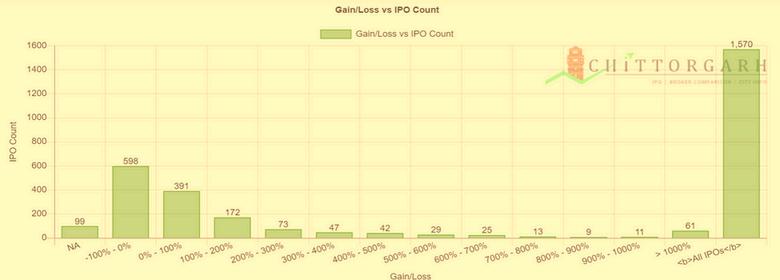
The aftermarket performance of a stock, often listing key metrics, helps analysts and investors evaluate the stock during its first days and months of trading. Aftermarket reports are not mandated by a regulatory body but are generated and reviewed by companies to understand the demand and liquidity of newly issued shares. The report may include:
·Exchange on which the stock trades
·Ticker symbol
·Bid and ask price at the close of the prior day's trading session
·Historical information on previous trading sessions.
·Summary of analyst coverage
·Information on the stock's earnings
·Company-specific or industry-specific news
(Dec 18, 2023)
80 (Apr 03, 2023)
(Dec 18, 2023)
80 (Apr 03, 2023)
(Dec
(Mar 20, 2024) Below are some of the best-performed IPOs since the day they were issued. These companies have consistently performed due to strong financial management, innovative business strategies, and favorable market conditions.
(Apr 03, 2023)
05 (Apr 03, 2023)
00 (Aug 22, 2023)
4,334 00 (Apr 03, 2023)
(Aug 22, 2023)
(Apr 03, 2023)
(Mar 05, 2024)
(Apr 03, 2023)
80 (Mar 05, 2024)
00 (Apr 03, 2023)
00 (May 16, 2023)
05 (Mar 20, 2024)
(May 16, 2023)
Market conditions and company-specific factors play a crucial role in determining the success or failure of an IPO. These factors, including the company ' s business model, management team, industry trends, and market conditions, are not uniform for all establishments. Despite their potential, many companies needed help to navigate the journey they embarked on at their inception
3-Apr-08
3-Apr-08
(Mar 06, 2023)
(Mar 06, 2023)
(Mar 06, 2023)
1.22 (Mar 06, 2023)
(Feb 23, 2024)
5 80 (Apr 03, 2023)
(Feb 09, 2024)
15 05 (Apr 03, 2023)
2 10 (Sep 09, 2022)
0 50 (Jul 31, 2023)
(Sep 09, 2022)
(Jul 31, 2023)
(Jan 08, 2024)
(Apr 03, 2023)
9 95 (Apr 03, 2023)
5 80 (Feb 19, 2024)
2 25 (Jul 31, 2023)
Whenever there are mentions of IPOs, we see them as a tool for companies to raise funds to accomplish their requirement of funds to capitalize on various capex opportunities, expand the business via integration routes, or, say, any investment purposes. From an educational or theoretical perspective, IPOs are an equity route of fundraising that involves the dilution of stake by company promoters to various prospective shareholders, including Domestic or International Institutions, High Net worth Individuals, Retailers, etc., in return for funds required by the company.
Well, the above-mentioned is true, but only to a certain extent. With the rise in the number of investors directly participating in the Indian primary and secondary market in the aftermath of the crash of 2020 due to COVID-19, the number of companies going for IPOs has also increased significantly. Witnessing the response and the liquidity in the market, companies rushed to go public and that too at staggering valuations. With the trend of going public, promoters of many companies exercised stake selling via the offer for sale (OFS) route as a part or whole IPO, benefitting from the rising trend and response from investors.
To simplify, the IPO's issue size, the amount the company is asking from the market, is a total of 'Fresh Issue' and 'Offer for Sale (OFS)'. Fresh Issue is the amount the company directly uses for expansion or general corporate purposes. Hence, Fresh Issue is the amount that the company uses to generate wealth for the investors by paying off debt to reduce interest cost and thus improving profit margins or, say, investing in a new plant or expanding production capacities to yield more revenue and profits and hence, create value for the investors. On the other hand, there is an Offer for Sale (OFS). Offer for sale is the portion of the issue size that will be handed over to the existing investors or promoters of the company as proceeds of their stake sale. This raised amount won't contribute to the growth or expansion of the company; the stake will be handed over from existing shareholders to new shareholders.
Moreover, there is a rise in the market about startups and private equity fundsbacked companies going public. There are instances where PE-backed companies go public at exaggerated valuations, eventually shifting the risk of cash-burning companies onto retail investors. PE funds will get a comfortable exit. Once public, the market brings the company to its actual value, resulting in losses for retail investors.
For instance, Paytm, one of the pioneers of the fintech industry of India, went public in November 2021 with its INR 18,300 crore issue size comprising INR 8,300 crores of fresh Issue and INR 10,000 crore of OFS. The IPO was issued at a market valuation of INR 1.39 lakh crores with a negative PE ratio (as the company is lossmaking). Fast forward to June 2024, the company ' s market capitalization has dipped to nearly INR 24,000 crores, a plunge of more than 80% since listing. So, high liquidity from retail investors through direct and indirect sources lets these IPOs make it to market with unjustifiable valuations. Retail investors can yield better results if they analyze the IPOs from documents like DRHPs and RHPs to understand what risks the company possesses and what the company needs regarding the amount asked.
Hence, far away from reality, IPOs are also being used to exaggerate valuations and take exit from the company along with its primary purpose to raise funds for operational purposes. So, retail investors need to dive deep into the core of the purposes of raising money by any enterprise to avoid falling prey to unjustifiable valuations and below-par fundamentals
The Draft Red Herring Prospectus is an initial document filed with regulatory bodies by a company intending to launch an Initial Public Offering (IPO) or a public issue. The DRHP contains essential information about the company ' s business, operations, financial performance, and prospects. This document provides preliminary insights into the company ' s fundamentals but only discloses some information required for investors to make investment decisions. It offers insights into the company ' s fundamentals, operations, and prospects but needs the offer price and the number of shares or securities to be offered. It is usually circulated to potential investors for initial assessment and feedback before finalizing the offering details in the subsequent stages, such as the Red Herring Prospectus (RHP) and the final Prospectus. SEBI mandates that companies planning to go public must file a Draft Red Herring Prospectus (DRHP) with them. SEBI reviews the DRHP to ensure it complies with all the regulatory requirements, including disclosure norms and investor protection guidelines.
For mainboard IPOs, SEBI provides an observation report on the draft offer documents within 30 days from receipt of the draft offer documents. The observation letter issued by SEBI is valid for 12 months. The issuing company has to clarify the comments and initiate the IPO within 12 months from the date of the SEBI observation letter. SEBI requires 15 days to issue an observation report on the clarifications/responses received from the commercial banks on the original observation letter.
The issuer and a merchant banker conduct the DRHP application process. Below are some guidelines and standards for filing the offering document: Companies can only issue an IPO if they file a draft offer document with SEBI/Exchange through a merchant banker (lead manager).
The issuer company or the lead manager should make the changes in the draft document based on the observations made by SEBI/Exchange before filing the prospectus with the Registrar of Companies (RoC).If SEBI has sought clarifications from a regulator or other agencies or authorities, the amendments or observations (if any) may depend on the comments or responses of the regulator/agency.
SEBI issues observations or specifies changes on the draft offer document only after receipt of a copy of in-principle approval from the exchange/s where the issuer intends to list the proposed Issue.
DRHP helps potential investors study the IPO details to gauge their interest before deciding. It allows investors to gauge the company ' s growth potential, competitive edge, financial governance, etc. Companies issue DRHP as a marketing tool to test market interest before launching an IPO.
Companies also use DRHP as a marketing tool to evaluate potential market interest in their company. By releasing a DRHP, companies can test their business model and the viability of their proposal.
DRHP is an option for companies to understand market interest before undertaking the complex, expensive, and time-consuming process of releasing the final, legally compliant RHP prospectus.
The DRHP is an initial document, but it contains sufficient information for interested investors to decide whether or not to invest in the IPO. Investors can use the information on the DRHP to understand the potential for growth of their investment and the risks and hazards of investing in the company.
The draft red herring prospectus is a powerful instrument that carries all the critical information about a company, thus helping investors make an informed decision. The document must be examined thoroughly, and all the factors should be weighed. Moreover, doing some additional research on the performance of other companies and IPOs in the same domain can help you, as an investor, compare options and come to a well-researched conclusion. If the DRHP carries any incomplete or incorrect information, a complaint can be registered with either the merchant banker in charge or SEBI.
India has a varied environment regarding initial public offerings (IPOs), with chances available for businesses of all sizes and phases of development. Small and Medium Enterprises IPOs (SME IPOs) offer a unique route to the public markets, tailored to smaller businesses and very different from conventional mainboard IPOs. This article explores the characteristics of SME initial public offerings (IPOs), their regulatory environments, and their effects on financial markets. Small and medium-sized businesses can acquire cash from the public and get listed on specialized SME platforms of stock exchanges through SME IPOs designed explicitly for them. Smaller firms can receive public investment through SME IPOs, which promotes growth and innovation, unlike mainboard IPOs, which are intended for significant, more established enterprises.
Capital - One of the primary distinctions between SME IPOs and Main Board IPOs lies in the eligibility criteria. SME IPOs typically target companies with a post-issue paid-up capital of up to ₹25 crore, requiring a track record of at least three years and specific criteria related to net tangible assets and net worth. In contrast, Main Board IPOs cater to companies with a post-issue paid-up capital exceeding the amount of ₹25 crore, typically prominent and more established, with extensive operational and financial Track records.
Regulator- The regulatory framework governing SME IPOs is relatively relaxed, per the SEBI (Issue of Capital and Disclosure Requirements) Regulations, 2018, specifically tailored for SMEs, aiming to encourage smaller businesses to access public capital. On the other hand, Main Board IPOs are subject to more stringent SEBI ICDR regulations, mandating comprehensive disclosures and compliance reflective of the scale and impact of these larger companies. Disclosure requirements also differ between SME IPOs and Main Board IPOs. SME IPOs feature simplified and relaxed disclosure norms, focusing on basic financial and business information to accommodate the capabilities of SMEs. In contrast, Main Board IPOs demand detailed and extensive disclosures, including in-depth financial records, business strategies, risk factors, and management vision for going concern and growth analysis.
For SME IPO, the company should have a track record of operations of a minimum of 3 years. If not, banks or financial institutions should have funded the company, the central government or state government, which should be listed for a minimum of 2 years on either the main board or SME board of BSE. It should have positive accruals or EBDT (earnings before depreciation and taxes) in any year in the last three years.
SME IPOs are listed on specialized SME platforms of stock exchanges, such as BSE SME and NSE Emerge, while Main Board IPOs are listed on the BSE and NSE leading platforms. Moreover, SME IPOs have higher minimum application sizes and trading lot sizes, typically around ₹1 lakh, to attract serious and informed investors, compared to Main Board IPOs, which feature lower minimum application sizes and lot sizes to appeal to a broader base of retail investors. These IPOs also attract different market participants. SME IPOs generally draw institutional investors, high net-worth individuals (HNIs), and informed retail investors who understand the higher risks associated with investing in SMEs. In contrast, mainboard IPOs appeal to many investors, including retail investors, institutional investors, mutual funds, and foreign institutional investors (FIIs).
Main Board and SME IPOs have a significant effect on the financial markets. Main Board IPOs contribute to market diversity by bringing in more extensive, established businesses from several industries, stabilizing the market, while SME IPOs increase market diversity by bringing in a variety of small and medium-sized companies with distinctive business models and development prospects. Due to smaller investor bases and bigger trading lot sizes, SME IPOs may initially have less liquidity; however, as the business expands and draws in more capital, liquidity may improve. Because of increased trading volumes and greater investor involvement, Main Board IPOs are often more liquid.
Regulator- The regulatory framework governing SME IPOs is relatively relaxed, per the SEBI (Issue of Capital and Disclosure Requirements) Regulations, 2018, specifically tailored for SMEs, aiming to encourage smaller businesses to access public capital. On the other hand, Main Board IPOs are subject to more stringent SEBI ICDR regulations, mandating comprehensive disclosures and compliance reflective of the scale and impact of these larger companies. Disclosure requirements also differ between SME IPOs and Main Board IPOs. SME IPOs feature simplified and relaxed disclosure norms, focusing on basic financial and business information to accommodate the capabilities of SMEs. In contrast, Main Board IPOs demand detailed and extensive disclosures, including in-depth financial records, business strategies, risk factors, and management vision for going concern and growth analysis.
For SME IPO, the company should have a track record of operations of a minimum of 3 years. If not, banks or financial institutions should have funded the company, the central government or state government, which should be listed for a minimum of 2 years on either the main board or SME board of BSE. It should have positive accruals or EBDT (earnings before depreciation and taxes) in any year in the last three years.
SME IPOs are listed on specialized SME platforms of stock exchanges, such as BSE SME and NSE Emerge, while Main Board IPOs are listed on the BSE and NSE leading platforms. Moreover, SME IPOs have higher minimum application sizes and trading lot sizes, typically around ₹1 lakh, to attract serious and informed investors, compared to Main Board IPOs, which feature lower minimum application sizes and lot sizes to appeal to a broader base of retail investors. These IPOs also attract different market participants. SME IPOs generally draw institutional investors, high net-worth individuals (HNIs), and informed retail investors who understand the higher risks associated with investing in SMEs. In contrast, mainboard IPOs appeal to many investors, including retail investors, institutional investors, mutual funds, and foreign institutional investors (FIIs).
Main Board and SME IPOs have a significant effect on the financial markets. Main Board IPOs contribute to market diversity by bringing in more extensive, established businesses from several industries, stabilizing the market, while SME IPOs increase market diversity by bringing in a variety of small and medium-sized companies with distinctive business models and development prospects. Due to smaller investor bases and bigger trading lot sizes, SME IPOs may initially have less liquidity; however, as the business expands and draws in more capital, liquidity may improve. Because of increased trading volumes and greater investor involvement, Main Board IPOs are often more liquid.
The truth of the matter is: historically, the Indian stock market has generated positive returns post-election results 16.1% in 2004, 38.7% in 2009 and 14.7% in 2014, data indicated. A second term on the cards for the present government in 2019 also soothed the nerves on the stock market, with traders being overjoyed at the thought of another round of economic reforms and developmental programs. If the market gets post-2024 election results in line with those forecasts, it might have the chance to move higher as it did post-1993 or 2013, should the pro-reform parties or the pro-reform coalitions manage to perform similar election feats. However, the aftermath of a result that catches the markets and the pollsters off guard will likely cast a wide net over their impacts as investors redraw their political battle lines to determine how their holdings and strategies must be repositioned based on the new political calculus. The 2024 elections in India are expected to affect multiple major sectors through its numerous proposed schemes and policies. Here's a general summary of the industries that would be impacted:
·Construction: Construction companies and contractors would benefit from heavy investments in infrastructure projects such as roads, highways, and urban development.
·Real Estate: The markets for developers and building companies are promising with upcoming housing and urban projects. Sectors such as manufacturing and industry Manufacturing: Measures to support domestic manufacturing, like incentives for local production, will help sectors like automotive, electronics and heavy machinery.
• Textiles and Apparels: Domestic production-based inputs will likely get support to compete with cheaper imports.
• Defense Manufacturing Increased defence budget and Atmanirbhar's mission in defence manufacturing shall benefit companies of this kind: Social Welfare Programs Technology and the Banking sector fintech: widening DBT confluence and digital payments. The region's technology and financial technology sectors will expand as payments go up this year, meaning companies that provide digital infrastructure and payment solutions are poised to benefit, said CIMB.
·Healthcare and Education: This will be positive for healthcare providers and, to a lesser extent, for pharmaceutical companies with increased public spending on healthcare infrastructure, which includes hospitals and clinics. Schools/Colleges/Educational Institutions: Government spending on education is expected to increase, leading to high growth in the schooling/colleges and educational service business.
·Agricultural Sector - Farmers and agribusiness could be the key beneficiaries of reforms, including loan waivers, crop prices and irrigation. It will also be a good sign for companies providing agricultural equipment and services.
• FMCG (Fast-Moving Consumer Goods) – Demand for consumer goods in rural areas will increase if economic conditions for farmers improve.
Utilities · Power and Water Supply: In power, subsidies and infrastructure augmentation, fast delivery of electric and water supply services will encourage companies involved in these sectors to grow.
Financial Services
•Banking: Banks with sound fundamentals will benefit from increased lending prospects due to economic growth and possible interest rate cuts.
• Low hanging fruit – Insurance: The increased opportunity and government support for health and crop insurance will lead to the development of new products and infrastructure investments that will benefit existing and new health and crop insurance providers.
Consulting and Compliance
Consulting Firms: Auditing, compliance, and consulting firms will have more demand as there is a push for tighter governance and transparency. The fortunes of these industries will change dramatically as and when various political parties introduce the schemes they promise. So basically, in the end, one thing that is for sure is the 2024 Indian general elections are going to shape several industries with the rise of the centre's emphasis on economic growth and manufacturing as well as new initiatives in sectors like agriculture, health care and IT a focus that the World Bank has supported.
Investors could also weigh election results against the stock market as they sue the political landscape for future economic implications. Then, there are specific stocks to watch in the market of multiple sectors as per details of the anticipated impact on them as per the overview of 2024 elections in India in the various industries:
Infrastructure -Larsen & Toubro (L&T) and DLF Limited.
Manufacturing and defense: Tata Motors and Bharat Electronics Limited (BEL) HDFC Bank and Infosys are in the financial technology and banking industry. Apollo Hospitals and NIIT Limited represent the healthcare and education sectors, respectively.
Mahindra & Mahindra and ITC Limited are expected to become stocks to watch in the agricultural sector. Under the utility space, NTPC Limited and Tata Power are substantial. Besides, financial services can be watched by the State Bank of India (SBI) and ICICI Lombard General. These stocks are expected to gain from different government schemes and policies scheduled for implementation by political parties.

Elections are among the most important, debatably, and influential events for a democratic economy. The elections decide what economic policies or reforms the country will see over the next five years, how the businesses will be impacted, what sectors the coming government will focus on, and whether it is regulations or subsidies; everything in the business world depends upon this event. With mention of the business world, even the stock market watches this event cautiously, especially if the elections are of the largest democracy in the world. Elections in India are not just events for businesses and institutions that have a domestic presence but also for overseas stakeholders that play a significant role in India's business portrait and financial markets in the role of Foreign Institutional Investors (FIIs). The Indian stock market, being a significant player in the global economy, attracts attention from investors and market analysts worldwide.
By Sanskar
Elections are such an important factor for investors around the globe, as they bring uncertainty and, hence, volatility in the market. This is because different governments can use other strategies to execute their respective agendas for the betterment of the nation In the case of India, a country with a diverse political landscape, the impact of elections on the stock market is particularly significant. This can be from several different perspectives, which can change the position of businesses and the business landscape. The impact of elections on the stock market is a crucial aspect that all investors and institutions should be aware of and consider in their strategies. Overall, investors around the globe and institutions look for stable government and business-friendly policies.
In case of a change in the ruling party, the stock market turns negative in the short term as there is uncertainty on how the new administration will adopt the previous government's policies, what changes it will make to the existing policies, and what will be the effect of all these processes on the business. If the new government brings in favorable reforms to the companies and the financial markets, it will rebound and show a positive trend in the long term. On the contrary, if the same government gets elected for a repeated term, the market will show an uptrend in the short term because investors usually pretend the current government's policies are stable. Their re-election to power shows citizens' confidence in those policies. For instance, during the 2014 elections, the stock market saw a significant surge leading up to the results, reflecting the market's anticipation of a new government and its potential policies.
Once the market enters the year of election, investors and institutions start exercising their strategies. Based on the expectations about the results of the polls, people change and define their approach to the market.
Due to investors exercising their stance in the market, there is significantly higher volatility during the months of elections in the stock market. Let us understand this by analyzing trends in India VIX during the election months. India VIX is an index showing implied volatility in the market. But, the higher the India VIX, the higher the chances of volatility in the market. For instance, say India VIX is quoted at 20 points at any period, which means the market expects a movement of about 5.77% over the next 30 days. (VIX value/Square root of 12). Let us see India VIX spots during the past three Lok-Sabha elections.
Further, considering various sectors under scan, it is observed that volatility rises specifically in industries that have significant government intervention or government spending. The sectors like Railways, PSUs, Infrastructure, Power Transmission, etc., remain volatile during the election period because these sectors significantly impact government spending and are highly sensitive to government interventions. For these sensitive sectors, the stance of the elected government on the policies affecting the respective sectors is a deciding factor in their fate.