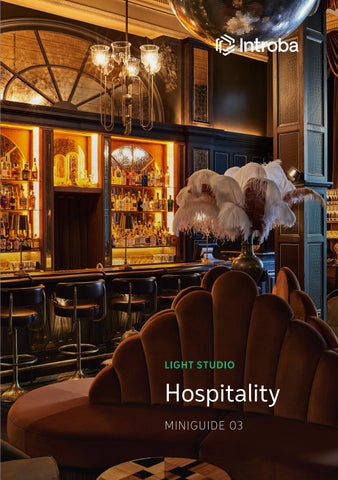
LIGHT STUDIO
Hospitality Earth Night View - ©PIO3
MINIGUIDE 03
W Hotel Edinburgh © Whitewall Marketing
LIGHT STUDIO MINIGUIDE 03 | HOSPITALITY
WARM HOSPITALITY Lighting shapes how people feel the moment they step into a space. In hospitality environments: hotels, restaurants, bars, and lounges, it does far more than illuminate. Lighting defines atmosphere, enhances brand identity, and influences how guests experience every detail. Lasting impressions start from the very first visual of the structure and transcend through each space to create a memorable experience. Warm, inviting tones can create intimacy and relaxation, while dynamic, layered lighting adds energy and visual interest. From statements to subtle architectural accents, each element plays a role in telling a cohesive story about the space and the people it serves. This guide explores the principles, possibilities, and creative approaches behind exceptional hospitality lighting. Whether enhancing a boutique hotel, elevating a fine dining experience, or energising a social venue, lighting is transformational in the lived experience of spaces, creating memorable destinations for all the right reasons.
Kimberly Bartlett, Head of Lighting Design Introba Consulting UK
4
LIGHT STUDIO MINIGUIDE 03 | HOSPITALITY
Room 2 - Sustainability Visioning ©Andrei Botnari
Project Brief Every successful hospitality lighting scheme begins with a clear and well-defined project brief, shaped by the unique vision of the client and the specific demands of the space. Client expectations may range from dramatic visual statements to prioritising comfort, efficiency, or flexibility for different events and times of day. Equally important is the context and location of the project: cultural influences, architectural character, local regulations, and even the surrounding environment all inform the design response. By carefully interpreting the various layers of requirements, lighting design becomes a tailored solution that enhances both the guest experience and the identity of the space. 6
LIGHT STUDIO MINIGUIDE 03 | HOSPITALITY
Setting the Scene First impressions are formed long before a guest steps inside. These early experiences subtly shape expectations for what follows, signaling the quality, character, and attention to detail that will extend into the guest rooms.
Geelong Library & Heritage Centre, Australia © Emma Cross
8
Facades and Exteriors The exterior forms the first impression long before a guest steps inside. At night, lighting becomes the medium through which the building is presented, welcoming and visible from a distance, drawing people in whilst subtly connecting to the brand identity through feelings of familiarity and comfort. Architecture benefits from light that reveals rather than flattens. Subtle contrasts and carefully placed illumination can draw out key elements such as columns, cornices, textures, and entrances, allowing the building’s character to emerge after dark. Light can articulate its rhythm and hierarchy.
Exchange Hotel, Canada © Michael Sherman Photography
LIGHT STUDIO MINIGUIDE 03 | HOSPITALITY
Kimpton Fitzroy, United Kingdom © Tom Mannion
A balanced approach ensures presence without excess. Controlled intensity, thoughtful shadows, and attention to detail create a sense of depth and refinement, helping the hotel stand out while remaining visually comfortable within its surroundings. In this way, exterior lighting becomes both invitation and experience, quietly guiding arrival while reinforcing the architecture’s intent.
10
The Lobby The reception space is the moment of arrival, the point where perception shifts from the exterior presence of a building to the lived experience within. More than any other space, the lobby becomes the true expression of a place. It holds the character, atmosphere, and energy that define how the building is understood and remembered. It is often open and accessible, allowing anyone to enter, pause, observe, or pass through. A layered approach allows the space to feel both functional and inviting, combining ambient light for overall clarity with more focused illumination to guide movement and highlight key elements such as the reception desk, circulation routes, and architectural features. Vertical surfaces benefit from gentle illumination, helping the space feel brighter and more open, while accent lighting can introduce depth and emphasis without overwhelming the environment.
LIGHT STUDIO MINIGUIDE 03 | HOSPITALITY
151 City Centre, Exchange District © IBI Group
12
Circulation Circulation spaces carry the guest experience beyond the lobby, extending the character into corridors and stairs. These play a continuous role in shaping perception, guiding movement while maintaining a sense of cohesion and identity throughout the hotel. Lighting in these areas benefits from an indirect and integrated approach. Linear details can be used to trace routes and reinforce direction, creating a subtle visual rhythm that supports wayfinding. Vertical illumination is particularly important, allowing walls to carry light and preventing corridors from feeling oppressive or enclosed.
Tulare County Courthouse (The Darling Hotel) United States © Ryan Krauter
LIGHT STUDIO MINIGUIDE 03 | HOSPITALITY
By lifting the light onto vertical surfaces, such as through Lighting artwork on walls, spaces appear more open, and proportionate. In this way, circulation lighting becomes both connective and atmospheric, quietly linking spaces together while sustaining the tone established at the lobby and preparing guests for the next part of their journey.
W Hotel Edinburgh, United Kingdom © Whitewall Marketing
14
LIGHT STUDIO MINIGUIDE 03 | HOSPITALITY
Lounges Lighting in lounge spaces tends to favour a soft, ambient approach, creating a cooler, relaxed atmosphere that encourages people to linger and unwind. The focus is less on brightness and more on mood, using gentle layers of light to shape a calm and comfortable setting. At the same time, lounges offer an opportunity for greater expression. Decorative and sculptural fittings can introduce character and individuality, aligning with the spirit of the hotel.
W Hotel Edinburgh, United Kingdom © Whitewall Marketing
16
Guest Rooms Guest rooms are where the hotel experience becomes personal. Lighting here is not only functional but atmospheric, shaping how the space is used. A layered approach allows for flexibility, combining ambient light with softer accents and focused task lighting to create a space that can shift from active to restful. Custom fittings are often used to reinforce the character of the hotel, adding detail and individuality while contributing to the overall composition of light. Where colour and textures play an important role, a high colour rendering index ensures that finishes, fabrics, and tones are perceived accurately and with richness.
LIGHT STUDIO MINIGUIDE 03 | HOSPITALITY
Room 2 - Sustainability Visioning © Adam Firman
18
LIGHT STUDIO MINIGUIDE 03 | HOSPITALITY
Guest Rooms Alongside this, practical lighting remains essential. Bedside luminaires support reading and relaxation, while desk lighting provides clarity for work. Lighting control ties these elements together. A clear and consistent system across the hotel allows guests to intuitively understand how to adjust their environment. Scene-based controls are commonly used, offering pre-set conditions such as a night setting, while still allowing individual adjustment. The aim is to provide flexibility without complexity, giving users a sense of control over how the room feels and behaves through a simple and legible interface.
W Hotel Edinburgh, United Kingdom © Whitewall Marketing
20
LIGHT STUDIO MINIGUIDE 03 | HOSPITALITY
Bars At the countertop, functional lighting ensures clarity for both staff and guests, supporting the preparation of drinks while allowing menus, textures, and finishes to be seen comfortably. Carefully integrated detail lighting elevates the experience, such as illuminated shelving bringing depth and sparkle to displayed bottles or under bar lighting bringing out the colour and texture of the material used.
W Hotel Edinburgh, United Kingdom © Whitewall Marketing
22
Dining Dining environments carry a wide range of identities and tones, from casual cafés and all-day restaurants to highend fine dining experiences. Each requires a different balance of intimacy and clarity, largely shaped by light. Across all settings, surface illuminance at the table is a key consideration. Guests need enough light to read menus, see food clearly, and feel comfortable, but without harshness or glare. This balance allows the table to become the visual focus, supporting both function and experience. Afterall, we eat with our eyes. Beyond task clarity, lighting also plays a strong atmospheric role. Decorative fittings contribute to the character of the space, introducing warmth, visual interest, or a sense of intimacy. A gentle build-up of light across the space helps define zones and depth, ensuring the room feels composed rather than flat.
Room 2 - Sustainability Visioning, United Kingdom © Lamington Group
LIGHT STUDIO MINIGUIDE 03 | HOSPITALITY
1515 Douglas, Blue
e Water Cafe, Canada © Leanna Rathkelly
Room 2 - Sustainability Visioning, United Kingdom © Adam Firman
West Hastings Restaurant, Canada © Martin Tessler
24
LIGHT STUDIO MINIGUIDE 03 | HOSPITALITY
1515 Douglas, Blue Water Cafe, Canada © Leanna Rathkelly
Commercial Kitchens Lighting in commercial kitchens is driven first and foremost by function, where clarity, safety, and efficiency are critical to daily operations. Bright, uniform illumination across work surfaces ensures that food preparation can be carried out with precision, supporting hygiene standards and reducing the risk of errors. Durability and ease of maintenance are equally essential, with fixtures designed to withstand heat, moisture, and frequent cleaning.
26
Amenities Amenities form a significant part of the overall guest experience. Lighting helps define the atmosphere appropriate to each setting. In spas and wellness areas, for example, softer, lower levels of light support calm and restoration. In contrast, gyms and fitness areas require brighter, more energising light that supports activity, focus, and clarity. In swimming pool areas and areas of high humidity, the fittings also need to be suitable for wet or submerged conditions, with appropriate protection ratings to ensure safe and reliable long-term performance. Together, these spaces extend the experience of the hotel, with lighting playing a key role in shaping how they feel, function, and connect back to the overall environment.
LIGHT STUDIO MINIGUIDE 03 | HOSPITALITY
The Butterfly (First Baptist Church), Canada © Westbank
UHealth SoLe Mia Ambulatory Care Center, United States © Miami in Focus
28
Conference and Event Spaces Conference spaces demand clarity, flexibility, and comfort in equal measure. Lighting should support a range of activities, from presentations and meetings to larger events, without drawing attention to itself. A balanced ambient layer provides even, comfortable illumination across the room, avoiding harsh contrasts that can cause visual fatigue over time. This can be complemented by adjustable lighting that responds to different modes of use, allowing the space to shift easily between brighter settings for note-taking and softer conditions for presentations, ceremonies and events. Vertical illumination ensures faces are well lit, supporting communication and engagement. At the same time, careful control of glare is essential, especially in environments where screens and projections are used. In more dynamic settings, integrated colour changing lighting can introduce subtle shifts in tone, supporting branding or creating atmosphere for events. Automated, controllable luminaires enable the room to transform for different functions with minimal physical intervention. The overall aim is to light the space so that attention stays on the content and the people, while still allowing the room to evolve when needed.
Canadian Nuclea
LIGHT STUDIO MINIGUIDE 03 | HOSPITALITY
ar Laboratories, Canada © Kevin Belanger
UC Berkley Hass School of Business Chou Hall, United States © Blake Marvin Photography
UBC Neville Scarfe Lecture Theatre Renovation, Canada © Kevin Jamieson
30
1700 Webster Mixed-Use Residential High Ris
LIGHT STUDIO MINIGUIDE 03 | HOSPITALITY
Roof Terraces Rooftop and terrace lighting sits between architecture and landscape, creating spaces that feel open and atmospheric as well as safe and usable. These areas are often used for dining, socialising, or as a quiet retreat, where light helps define both mood and orientation without overpowering the night sky. Combining subtle ambient light with discreet pathway and edge illumination ensures safe movement across routes and changing levels. Weather exposure is an important consideration, with fittings needing to withstand wind, rain, and temperature change while continuing to perform reliably over time. Limiting upward light spill and overall brightness is key to reduce light pollution and preserve the surrounding nightscape. In many cases, a secondary lighting scene is introduced after curfew, lowering levels further and simplifying the composition to support quieter, environmentally conscious use.
se, United States © Abraham & Paulin Photography
Upper Plaza Renovation at The Muny St. Louis, United States © SWT Design
32
Modelling and Visualisation Modelling and lighting calculations are essential tools in transforming a design concept into a reliable and effective solution. While initial ideas may focus on atmosphere and visual impact, calculations ensure that light levels, uniformity, and glare control meet the functional requirements of each space. Through digital modelling, we can accurately simulate how light interacts with materials, surfaces, and spatial geometry, allowing testing and refinement of ideas before installation. This process reduces uncertainty, helps avoid costly adjustments on site, and ensures compliance with relevant standards and regulations. Ultimately, modelling and calculations bridge the gap between creativity and precision, ensuring that the final lighting scheme not only looks compelling but also performs exactly as intended.
LIGHT STUDIO MINIGUIDE 03 | HOSPITALITY
DialuxEvo Render © Pablo Temboury 34
Case Study: Bishops Avenue Feature Lift For this prestigious project, Introba designed the lighting installation for a feature lift which connected three floors via a central atrium. Conceived as a central focal point, the lift takes on the presence of a lantern, emerging as a bold and expressive statement piece within the space. Through a series of detailed calculations and on-site mock-ups, our vision was realised.
DialuxEvo Render © Pablo Temboury
LIGHTING CALCULATIONS Model and rendering LIGHT STUDIO MINIGUIDE 03 | HOSPITALITY
Riverstone Living © Bowler James Brindley, Interior Design © RG+P Architect
INTERIOR DESIGN CONCEPT Feature Lift
Photo © Pablo Temboury
MOCK-UPS Mock-ups are a vital stage in the lighting design process, allowing ideas to be tested and experienced in real conditions before final implementation. While drawings and simulations provide valuable guidance, physical mock-ups reveal how light truly interacts with materials, demonstrating nuances of reflectance, refraction, texture, and finish that are often difficult to predict digitally. This hands-on approach reduces risk, builds confidence in decision-making, and ultimately leads to more refined, precise, and successful lighting outcomes. 36
LIGHT STUDIO MINIGUIDE 03 | HOSPITALITY
Compliance Every assessment or design needs to be in accordance with various standards, regulations and guidelines which differ all around the world. It is important to make sure that lighting designs and calculations are from qualified lighting engineers and designers. That’s where we come in.
Kimpton Fitzroy, United Kingdom © Tom Mannion
38
Our Team We have every type of light and lighting covered and we thrive in collaborative environments. Kimberly Bartlett HEAD OF LIGHTING DESIGN
With nearly 20 years experience in light and lighting, I provide the backbone of technical expertise underpinning our designs, supporting our team in doing what they do best.
Aliz Sanduj ASSOCIATE LIGHTING DESIGNER
The team’s creative powerhouse in lighting design, I oversee the transition of beautiful thoughts to incredible reality.
Christopher Harrison INTERMEDIATE LIGHTING CONSULTANT
A specialist in external lighting, I bridge the gap between inside and out, creating seamless movement.
Pablo Temboury INTERMEDIATE ENGINEER
Combining creative experience in the arts with technical lighting and electrical expertise, I transform conceptual ideas into realised environments.
LIGHT STUDIO MINIGUIDE 03 | HOSPITALITY
Transforming the Built Environment with Curiosity, Ingenuity, and Accountability Introba is a global engineering and consulting firm with more than 1,000 specialists across the United Kingdom, Europe, the United States, Canada, Australia, and Singapore. We help clients improve the performance, reliability, and sustainability of the built environment through mechanical, electrical, technology, security, and fire systems engineering, supported by digital advisory, systems integration, and sustainability consulting services. Guided by curiosity, ingenuity, and accountability, we work with the public and private organisations across healthcare, aviation, education, science and technology, transportation, and commercial development to deliver solutions that meet today's needs and adapt to tomorrow's demands.
Contact hello@introba.com
40
150 Holborn, London, EC1N 2NS
|
020 3697 9300
|
introba.com