LIGHT STUDIO
Heritage and Culture Earth Night View - ©PIO3
MINIGUIDE 06
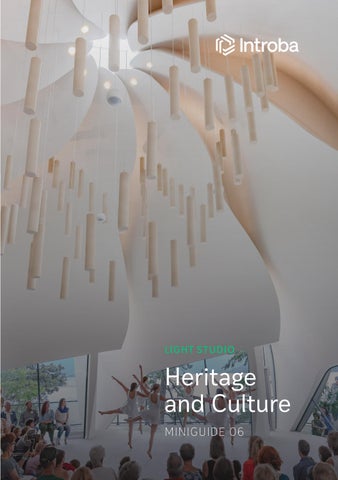
Mingei International Museum Renovation, United States © NIC LEHOUX
LIGHT STUDIO MINIGUIDE 06 | HERITAGE & CULTURE
TIMELESS CARE, AGELESS BEAUTY Lighting is no longer a quiet backdrop in heritage projects; it has become a vital medium for revealing the character, history, and meaning embedded in a place. The way we illuminate our historic environments now shapes how they are understood, felt, and remembered. As conservation practices evolve, so too must our approach to light. Heritage sites demand lighting that is sensitive and deeply considered — illumination that honours original architecture while enhancing visibility, atmosphere, and public engagement. Light must do more than brighten a space; it must support storytelling, safeguard fragile materials, and strengthen the long-term integrity of the site. It is not just about seeing clearly, it is about revealing significance, creating emotional connection, and enriching cultural value. When we design with intention, light becomes a bridge between eras. It can transform a silent corridor into a place of wonder, or a weathered façade into a canvas of memory. This guide explores how lighting can enrich heritage spaces — making them more accessible, more meaningful, and more alive. With care and imagination, light becomes a guardian of history and a beacon for the future.
Kimberly Bartlett, Head of Lighting Design Introba Consulting UK
4
Jeddah Site Visit - Kimberly Bartlett
LIGHT STUDIO MINIGUIDE 06 | HERITAGE & CULTURE
DialuxEVO Render - Pablo Temboury
Statement Heritage lighting is the careful illumination of historic buildings, monuments, and sites in a way that both enhances their visual impact and respects their cultural significance. Lighting is not just about brightness or spectacle; it is about storytelling, preservation, and guiding the viewer’s eye to the most meaningful elements of a structure or space. The central principle in heritage lighting is the creation of focal points. Historic architecture often contains layers of detail: columns, carvings, arches, cornices, and façades, that can be lost in darkness or flattened by uniform lighting. Selectively illuminating key features creates a visual hierarchy that reveals the building’s character.
6
Jeddah Fish Market Concept - Aliz Sanduj
LIGHT STUDIO MINIGUIDE 06 | HERITAGE & CULTURE
Concept A lighting concept is the initial creative framework that defines how light will shape a space both functionally and emotionally. It establishes key ideas such as mood, hierarchy, focal points, and the relationship between light and architecture. The concept acts as a guiding vision informing all technical and aesthetic decisions throughout the project.
Jeddah Fish Market Concept - Aliz Sanduj
8
Setting The Scene Creating focal points within the space can guide movement and create experience. In heritage sites open to the public, illuminated pathways, entrances, and key viewpoints help visitors navigate while subtly directing attention to significant architectural features. This creates a curated nighttime experience, a visual narrative unfolding as one moves through the space. Heritage lighting integrates conservation concerns. Fixtures are often discreetly installed to avoid visual intrusion during the day, and systems are designed to minimise heat, ultraviolet light, and energy consumption. Colour temperature is another important consideration. Heritage lighting typically favours warm white tones, which complement the warmer tones present in traditional materials like limestone, sandstone, and wood. The goal is to enhance, not reinterpret the original appearance. Ultimately, heritage lighting is about revealing identity. It allows historic structures to maintain their presence after dark, honouring their past while making them accessible and meaningful in the present.
LIGHT STUDIO MINIGUIDE 06 | HERITAGE & CULTURE
Jeddah Gate © Kimberly Bartlett
Jeddah Gate © Kimberly Bartlett
DialuxEVO Render © Kymoya Maxwell
10
Circulation
Lighting within a heritage city requires a careful balance between modern func Streets, roads, and footpaths are not just routes for movement, they are part o Thoughtful lighting design helps maintain this identity while ensuring safety, ac
Creating a hierarchy of light is essential. Main roads require higher illumination while secondary streets and footpaths are lit more softly to preserve atmosph walkways or plazas, lighting is designed to be human-scale, lower in height, wa walking and social interaction while maintaining a sense of calm and authentic
LIGHT STUDIO MINIGUIDE 06 | HERITAGE & CULTURE
ctionality and the preservation of historical character. of a cultural landscape shaped over centuries. ccessibility, and visual coherence after dark.
n levels to support vehicle movement and visibility, here. In pedestrianised areas, especially along historic armer in tone, and focused on comfort. This encourages city.
Jeddah Site © Kimberly Bartlett
12
Open Spaces & Squares Heritage lighting in open urban spaces, such as historic squares, plays a vital role in shaping how these places are experienced after dark. These squares are often defined by their architectural edges, monuments, and layered histories, requiring lighting that enhances their character. A sensitive approach ensures that light reveals form, texture, and spatial hierarchy while maintaining the dignity and authenticity of the setting. Understanding the historical and cultural significance of these open spaces is essential, bringing heritage squares to life in a way that respects their past while also supporting their role within the contemporary city. Well-designed lighting can reinforce the identity of a square, subtly guiding movement, improving safety, and encouraging social interaction. By carefully balancing illumination levels, contrast, and colour temperature, designers can highlight key features such as façades, statues, and paving patterns, while preserving darker areas that contribute to atmosphere and depth.
LIGHT STUDIO MINIGUIDE 06 | HERITAGE & CULTURE
Jeddah Renders - Aliz Sanduj
Jeddah Renders - Aliz Sanduj
Jeddah Renders - Aliz Sanduj
14
Monuments & Statues Lighting for monuments is less about visibility and more about interpretation. Each piece carries a specific intent, and the character of the light can quietly reinforce that meaning. Form emerges through contrast rather than uniform illumination. Light arriving from an angle allows shadows to describe depth, revealing the texture and detail that define the sculpture. When light is too direct or even, this sense of relief is often lost. Material qualities also shape the outcome. Stone, bronze, and marble each respond differently, and the choice of colour temperature can either support or change their natural character. Lower light levels, balanced with carefully controlled contrast, preserve atmosphere and allow the monument to hold its presence within the wider nightscape. Whether situated in a landscape or an urban setting, the monument benefits from a lighting approach that connects it to its surroundings without introducing glare or unnecessary spill. At its best, monument lighting allows the subject to remain dignified and legible after dark, extending its presence without overwhelming it.
Three Watchmen,
LIGHT STUDIO MINIGUIDE 06 | HERITAGE & CULTURE
Waltzing Matilda Centre
Audian Art Museum © Andrew Latrielle
Glockenspiel Restoration Regina © michaelbellphotography
16
LIGHT STUDIO MINIGUIDE 06 | HERITAGE & CULTURE
Massey Hall Revitalization
Listed Buildings Lighting design for listed buildings requires a careful balance between conservation, functionality, and visual impact. These structures are often protected for their architectural and historic significance, meaning any intervention must be reversible, minimally invasive, and respectful of original materials. 18
Listed Buildings Beyond the building itself, lighting designers must also consider the wider environmental context. Light pollution can significantly alter the character of dark landscapes, diminishing the natural night sky and affecting local ecosystems. Sensitive lighting strategies: low-level illumination, careful aiming, shielding, and warm colour temperatures help to minimise spill light and preserve the surrounding environment. Bat conservation adds another layer of complexity, as many historic buildings provide habitats for protected species. Lighting must be designed to avoid disturbing roosting and foraging patterns, often requiring detailed ecological assessments and strict control of light levels, timing, and spectral output. Fixing luminaires in listed buildings can be particularly challenging, as drilling into façades or decorative elements is usually restricted, or even prohibited, requiring creative solutions such as using existing joints, secondary structures, or remote mounting positions. Similarly, routing cables demands sensitivity. Concealment is essential, yet interventions must avoid damaging historic fabric, disrupting the building’s integrity or impacting safe movement around the site. In this context, successful lighting design is not only about aesthetics, but about stewardship, protecting both heritage and biodiversity for the future.
LIGHT STUDIO MINIGUIDE 06 | HERITAGE & CULTURE
Aynhoe Park © RH England
Aynhoe Park © RH England
20
Modelling Calculation models offer opportunities to predict how light works in specific areas and to test strategies for design or mitigation.
LIGHT STUDIO MINIGUIDE 06 | HERITAGE & CULTURE
Realistic models offer a visual clue to how a new installation will behave and how users might experience the space DialuxEVO Render - Aliz Sanduj
22
Modelling
LIGHT STUDIO MINIGUIDE 06 | HERITAGE & CULTURE
Using false colour, nuanced changes in light levels are clearer to see. DialuxEVO Render - Aliz Sanduj
24
LIGHT STUDIO MINIGUIDE 06 | HERITAGE & CULTURE
Modelling Realistic models offer a visual clue to how a new installation will behave and how users might experience the space. Adding texture to lighting models helps light interact more realistically with surfaces, improving the accuracy of reflections and highlights.
DialuxEVO Render - Pablo Temboury
26
Site Visits Site visits are essential, allowing designers to experience the architecture, materials, and atmosphere firsthand rather than relying solely on drawings or photographs. Understanding the site ensures that lighting enhances key features, respects cultural significance, and avoids visual intrusion, resulting in a design that feels authentic and contextually appropriate.
LIGHT STUDIO MINIGUIDE 06 | HERITAGE & CULTURE
Jeddah Site Visit - Pablo Temboury
28
LIGHT STUDIO MINIGUIDE 06 | HERITAGE & CULTURE
Jeddah Site Visit - Pablo Temboury
Site Visits In addition to appropriate PPE and safety measures, specialist tools and equipment are essential for lighting surveys and site visits. A comprehensive site kit includes plans and paper for note-taking, a camera or 360° camera, a lux meter, and a laser distance measurer. It may also be useful to bring lighting equipment for testing and mock-ups. The aim is to create a visual record, take detailed notes, document the context, and capture accurate measurements. 30
LIGHT STUDIO MINIGUIDE 06 | HERITAGE & CULTURE
Playful & Controllable Theatre lighting extends beyond the stage, playing a vital role in shaping the relationship between a building’s interior and its façade. The external lighting of a theatre can act as a visual prelude to the performance within, expressing energy, anticipation, and identity while remaining rooted in the architectural character of the building. A well-considered façade creates a dialogue between inside and outside, where glimpses of interior light and activity draw people in and extend the theatrical experience into the public realm. Light at Play, Queen Elizabeth Theatre © Martin Knowles
Dynamic, colour-changing lighting can enhance this connection when used with restraint and purpose. Rather than constant spectacle, it is the timing and context that give these effects meaning. Subtle transitions, carefully chosen colour palettes, and moments of stillness are often more powerful than continuous movement, allowing the building to breathe and maintain its presence within the city. In this way, theatre lighting becomes a storytelling device at an urban scale. It bridges architecture and performance, ensuring that the experience of theatre begins before entering the auditorium and lingers long after, through a façade that is both expressive and respectful of its surroundings.
Light at Play, Queen Elizabeth Theatre © Martin Knowles
32
Compliance Every assessment or design needs to be in accordance with various standards, regulations and guidelines which differ all around the world. It is important to make sure that lighting designs and calculations are from qualified lighting engineers and designers. That’s where we come in.
LIGHT STUDIO MINIGUIDE 06 | HERITAGE & CULTURE
Michigan State Capitol Heritage Hall © Dave Thompson
34
Our Team We have every type of light and lighting covered and we thrive in collaborative environments. Kimberly Bartlett HEAD OF LIGHTING DESIGN
With nearly 20 years experience in light and lighting, I provide the backbone of technical expertise underpinning our designs, supporting our team in doing what they do best.
Aliz Sanduj ASSOCIATE LIGHTING DESIGNER
The team’s creative powerhouse in lighting design, I oversee the transition of beautiful thoughts to incredible reality.
Christopher Harrison INTERMEDIATE LIGHTING CONSULTANT
A specialist in external lighting, I bridge the gap between inside and out, creating seamless movement.
Pablo Temboury INTERMEDIATE ENGINEER
Combining creative experience in the arts with technical lighting and electrical expertise, I transform conceptual ideas into realised environments.
LIGHT STUDIO MINIGUIDE 06 | HERITAGE & CULTURE
Transforming the Built Environment with Curiosity, Ingenuity, and Accountability Introba is a global engineering and consulting firm with more than 1,000 specialists across the United Kingdom, Europe, the United States, Canada, Australia, and Singapore. We help clients improve the performance, reliability, and sustainability of the built environment through mechanical, electrical, technology, security, and fire systems engineering, supported by digital advisory, systems integration, and sustainability consulting services. Guided by curiosity, ingenuity, and accountability, we work with the public and private organisations across healthcare, aviation, education, science and technology, transportation, and commercial development to deliver solutions that meet today's needs and adapt to tomorrow's demands.
Contact hello@introba.com
36
150 Holborn, London, EC1N 2NS
|
020 3697 9300
|
introba.com