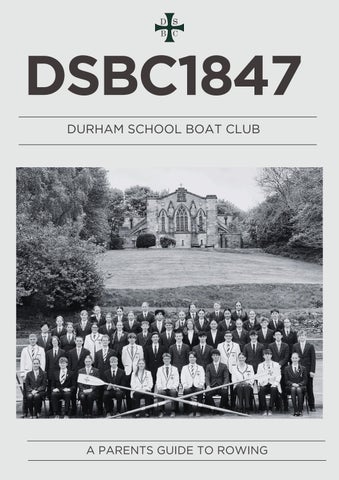
DSBC1847
DURHAM SCHOOL BOAT CLUB

A PARENTS GUIDE TO ROWING


INTRODUCTION
Rowing is not just a sport; it becomes a way of life. I have been part of this life for over 25 years and my aim as Durham School’s Director of Rowing is to foster that same excitement and passion for rowing that I experienced during my own schooldays Rowing requires commitment, dedication and organisation. It is not an easy sport to master, and the early starts and cold winter days are a test of one’s mettle but for the determined, the personal rewards can be great While it is satisfying for all the hard work to result in achievement at competition level, the real reward from rowing comes from being part of the Club, part of a team and working with that team to develop your skill to the very best of your ability Rowers often excel in other areas of school life We have seen glittering arrays of A*s in the classroom from our Boat Club members over the years, with many moving on to world class universities. I believe that’s what makes Durham a very special place to row Both inside and outside the classroom, there is a sense of purpose to pupils’ lives, a belief that they can and should aim high, supported by staff who are dedicated to helping them reach their potential If you are interested in finding out more about Rowing at Durham, and how you might become part of our Club, please do get in touch Eddie Bryant e bryant@dcsf org uk


Mrs Higgins has a BSc in Sport Coaching and holds a Level 2 in Rowing Coach and Level 2 in Strength and Conditioning She has coached juniors and seniors over the last 10 years at Durham Amateur Rowing Club from Learn to Row through to high level of competitive rowing with a number of crews racing at National events including Henley Women’s Regatta
MISS SLIPMAN
MRS HIGGINS


MR KINGHORN
MR DOBSON
GETTING STARTED
Rowing is one of the major sports at Durham School which offers students an opportunity to challenge themselves, be part of a club, become self-disciplined, improve their time management skills, and become a valuable member of the school community.
Safety is paramount at Durham School Boat Club, so for the safety of all potential rowers, students are to complete a swim test before taking part in the sport so that coaches are confident with individuals swimming ability. Rowers will also complete capsize drill training and will be informed of all safety precautions and procedures before going afloat. During the introduction to rowing the pupils will be taught how to use life jackets, throw lines and how to conduct themselves in a safe and proper manor when around the boathouse and when using the equipment.
The rowing programme at Durham School is structured in such a way that the pupils progress through a programme which has specific features at each level The year 7 and 8’s learn new skills and safety aspects of the sport whilst having fun and building their confidence on the water. The year 9 and 10’s develop the concept of team work and working in crews, training sessions begin to be more performance based and training becomes more challenging In the senior squad (years 11, 12 and 13) training increases in volume and technicality, focussing on performance at regional and national levels.
Although the programme is based on year groups and is progressive throughout these, Durham School Boat Club welcomes anyone who wishes to try rowing or wants to be involved in the club in different aspects of the sport.

HISTORY OF DURHAM SCHOOL BOAT CLUB
Durham School Boat Club (DSBC) was founded in 1847 and many of the traditions are still in practice today However, history tells us that there was rowing at Durham School in the early 1830’s, making it the oldest club at the school and one of the oldest clubs on the River Wear.
The first reference to a School boat was to the four oared wherry Argo in 1838, a large boat traditionally used for carrying passengers and cargo. The first Club rower to win a blue for Oxford or Cambridge rowing in The Boat Race was W. King who rowed for Oxford in 1854. The club itself is said to have won its first Challenge Cup in 1865
DSBC were also a founding member of Durham Regatta in 1834, helping to establish the largest regatta in the North-East. The regatta is often referred to as the Henley of the North, with high performance athletes who travel from afar.

THE BOATHOUSE
The Boat House is an old and traditional building which is owned by the Cathedral. This picturesque and peaceful place allows the pupils to be outdoors, in a natural environment, whilst still being within school surroundings Our fleet of boats is extensive and includes singles, pairs, doubles, fours and quads, which offers a range of sculling and rowing opportunities for the students.
The boathouse is a short walk from the bottom of Pimlico Street which is accompanied by a member of staff before and after games. There is a gap in the wall where there are a few steps leading into a path that goes down to the boat house.
Address:
Durham School Boat Club
Quarryheads Lane
Durham DH1 4SZ

GAP IN THE WALL BOATHOUSE

ROWING, TRAINING AND WORK

Rowing is one of the most physically demanding sports. This is due to the rowing stroke utilising all the major muscle groups within the body Rowing is an endurance sport which therefore means that most of the training is aerobic based. However, other athletic attributes are needed; such as balance, flexibility, and power, which will be developed throughout the training process. Not only is the sport highly physical, rowing is also a technical sport which requires precision, determination, timing, posture and team work
The number of training sessions and the content they involve are set appropriately according to age group, specific squads, and ability, in order to be competitive and safe. Additional training before and after school is programmed throughout the week to encourage the athletic development of pupils Training days and camps are also vital for success in rowing and take place in school holidays, again based on age and ability. Easter holidays often include a week away on training camp for the senior squad and/or racing crews
Rowing demands a significant amount of time and commitment which can be a concern to both pupils and their parents regarding academic work. Please be assured that at Durham School our first priority is a pupil’s academic commitments, and the coaches will do their outmost best to see each pupil achieve in both their sporting and academic ability. Past and present members of the boat club have consistently achieved, and continue to achieve, some of the best exam results at both GCSE and A Level Alongside channelling academic success, the sport helps increase fitness and athletic ability, students learn self-discipline, self-motivation and time management skills so that our rowers benefit both physically and academically
If your son or daughter has any concerns with the demands of academic work and rowing, please encourage them to share them with their coach; the more understanding we have of a pupil’s situation, the more help can be given to ensure that pupils succeed in both areas of their school life.
NUTRITION, HYDRATION AND HYGIENE
Good nutrition, hydration and hygiene are crucial aspects of training and can make a huge difference to athletic and academic performance. Rowing is a highly active sport in terms of duration and intensity, and therefore requires pupils to pay attention to their nutrition, hydration and hygiene throughout their day to day lives. Hygiene is vital in an outdoor sport, especially on and near a river where waterborne illnesses are contractible To allow full recovery from training sessions and the demands of school, good eating habits, enough sleep, and staying hydrated will keep the body healthy and help the brain maintain concentration.
NUTRITION AND HYDRATION
Have regular meals and NEVER miss breakfast.
· Make sure about two-thirds of your energy is supplied by carbohydrates (starchy foods) for example bread, potatoes or pasta
Avoid foods that are high in fat, especially saturated fat.
· Eat plenty of fresh fruit and vegetables.
· Replenish energy supplies by eating within 30 minutes after exercising
Drink plenty of water throughout the day Carry a water bottle with you at all times and remember to take a water bottle in the boat with you and drink small amounts regularly to keep yourself hydrated.
If you are thirsty, you are already dehydrated!


HYGIENE
Disease and infection are easily picked up for the river, so hygiene is essential to reduce the risk of picking up an infection from your hands Never put your fingers in your mouth, or touch/rub your eyes during or after rowing and ALWAYS wash your hands after rowing, especially before eating Special attention to this is important due to your immune system can be depressed slightly after strenuous exercise so contracting an illness, infection or disease is increased. Rowers often obtain blisters on their hands, especially when beginning the sport as the skin is softer and more susceptible to blisters. It is essential that rowers maintain the highest level of hygiene and any open cuts, blisters or grazes need to be covered to prevent infection from river water. Rowers are also recommended to wear trainers or wellies and NOT to walk barefoot when boating.
o Additional safety rules are displayed in the boat house.
PROGRAMME STRUCTURE, BOAT TYPE AND RACING CATEGORIES
STRUCTURE:
Year 7 and 8: these year groups start rowing by having a thorough introduction to the sport. Due to the age group not being fully physically developed the pupils focus on sculling (which is with two oars) to minimise the pressure on their backs The introduction includes basic lifting of boats, getting afloat, technique, and water skills.
Year 9 and 10: in years 9 and 10, pupils start to have more of a performance outlook and start focussing on technique and how to make the boat move efficiently, and work as a team In year 10 they may have the chance to progress to sweep rowing which is with one oar instead of two.
Year 11, 12 and 13: these years are classed as the senior squad. Training becomes performance based and pupils are expected to attend morning and afterschool sessions to focus on regional and national level events
STRENGTH AND CONDITIONING

Strength & Conditioning (S&C) refers to specialized physical training, including resistance training, cardiovascular conditioning, and injury prevention ("prehab"). The goal of S&C is to help athletes improve their rowing performance by developing neuromuscular strength, power, mobility, and cardiovascular capacity, while reducing the risk of injury.
At Durham School, S&C starts with learning to move well. This includes mastering techniques for squatting, hinging, lunging, pushing, pulling, and bracing, while teaching students why these movements are essential for sport. Alongside this, we introduce cardiovascular training to help athletes build their bodies' ability to handle the demands of sport.
As athletes progress, training becomes more specialized, focusing on rowingspecific movement patterns For example, when a rower reaches the ‘catch’ position, their legs and hips adopt a squat-like stance, which they extend during the stroke Thus, more emphasis is placed on squatting patterns in training. The volume of cardiovascular work also increases to build a strong fitness foundation
At the senior level, training becomes more specific to the physical requirements of rowing, with a focus on developing attributes necessary for success in the sport
We aim for athletes to enjoy S&C and understand that progress takes time The improvements they make are the result of consistent effort and a foundation of hard work. Ultimately, we want all rowers to enjoy learning what it takes to become an athlete.


Termly Charge
COSTS
There is an associated cost with rowing and hopefully this section explains the costs involved . For rowing all specialised equipment is provided at school. The equipment is incredibly expensive and it takes a lot of time to maintain and keep water ready. Pupils in years 9-13 will be charged £35 per term that they choose to help with the associated costs of maintenance
British Rowing Membership
As pupils develop in rowing they may choose to race and represent the school at local, regional and national competitions Before any pupil races they have to become a member of British Rowing which enables them to race and provide insurance There are other membership benefits that British Rowing provide such as cheap entry to certain amusement parks and other family days out. The cost of British Rowing membership is £40 per annum
Competition Fees
When the school races we generally race in events that are orgnaised by local clubs and external groups. Race fees can range from £5 - £12 per seat. These fees are added to a pupils bill at the end of each term
OLD DUNELMIANS

Jodie Cameron OD went on to study at St. Andrews University where she was President of the boat club During her time at St. Andrew’s she was part of the GB Rowing Beach Sprint Academy Jodie undertook a Masters degree at Cambridge University, where she raced in the University Boat Race, winning the lightweight race with a new course record. Jodie now works at World Rowing in Switzerland as apart of the event management team.

Johanna Debus rowed at school and went on to represent Germany at the U19 World Championships in the coxless quad Since then Johanna joined the German U23 team and has raced for the last three years. The coxless quad at the 2022 U23 World Championships, the single at the 2023 U23 World Championships and most recently the coxless quad at the 2024 U23 World Championships in Canada

Alice Bradley joined the school for A-Levels on a Sports Scholarship Alice went on to win numerous races at school, medal at national events and making the 1/4 finals at HWR in the 1x in 2021 Alice accepted a full scholarship to Michigan State University to study kinesiology Alice made the 1st Varsity 8 in her freshman year and continues to be success at MSU as she moves into her third year in USA

James Purves Liddell (aka JPL), former Head of House and Boat Club Captain has a very successful time at school, culminating with a silver medal at the U19 Beach Sprint World Championships. James was part of the crew that qualified for Henley Royal Regatta in the Princess Elizabeth Challenge Cup. Since then James has continued his studies at Newcastle University, where he is now president of the boat club and currently in the GB U23 trials process
COMPETITIONS
Durham School train for numerous competitions throughout the year with the main focus being on the Schools Head of the River Race, National Schools Regatta in Nottingham, Henley Royal Regatta and the GB junior trials Crews will be chosen at the coaches’ discretion and can change on a weekly basis. Crew selection will be based on a number of facts including; attendance, ergometer information, seat racing on the water, technical strengths and weaknesses, leadership or teamwork abilities and the best interest of an individual or group of rowers The races that we enter vary in length and the level of ability that is required. Therefore, it depends on the suitability of crews and squads and where they are in their programme development. Please note that although coaches may enter crews, entries are often only finalised by the race organisers a couple of days in advance Information on events will be on the school calendar and an email will be sent to you in advance and relevant web pages of organising clubs will be attached. However we do advise you to check the website a few days before a race so you know exactly where you are going (transport may not always be available) Please note that crews will not be permitted to enter a race if a member of their crew is late, so please do not let the team down It is also recommended that you check the website again for any last minute news before leaving home, it is not unknown for races to be cancelled on the day Parents, families and friends are welcome to join us at all the events, so please feel free to come along to any event to show your support
TYPES OF COMPETITION:
There are two parts to the rowing year and two basic types of competition:
HEADS
Head races run in winter from the end of September to the end of March. A head race or time trial is a timed processional race Distances can be from 2 5km to 7km (the boat race course) but can also be longer Each boat lines up one behind the other and races one at a time with short intervals between each other. When all the competitors have finished, the time for each crew to complete the course is calculated and the fastest in each category is the winner Some events are able to issue results in real time and others will release results 24 or even 48 hours after the race. The head season culminates in London at the Schools Head of the River Race (SHORR), on the Oxford-Cambridge boat race course
REGATTAS
Regattas run in the summer from mid-April to the end of August involve side-by-side racing with up to 7 abreast Course lengths usually vary between 500m and 2000m, with Henley Royal Regatta being 2112m Regattas involve heats, semi-finals and finals held over the course of a day However, due to many new oversubscribed events, some regattas may use a time trial instead of a side by side heat to determine the semi-finalists Losing crews in the earlier rounds may get another chance to advance to the next round in an extra race known as a Repêchage.
EVENTS LIST 2025-26
Proposed Events Schedule: These dates and Events will be confirmed as the year progresses. Certain Events will only be for certain age groups and abilities
13th September
27th September
4th October
Tyne Scullers Head
South Hylton LDS
Tyne LDS
2nd November Head of the Don
8th November
15th November
Durham LDS
Junior Fours Head
29th November Rutherford
24th January
7th February
14th February
13th March
14th March
25th March
19th April
25th April
9th May
16th May
22nd May
Tyne New Years Head
Durham SBH
Tyne Head
SHORR
JIRR Trials
Ponteland Junior Head
Scottish Spring Regatta – TBC
CLS Spring Regatta
Durham City
Tees Regatta
National Schools Regatta
6th June Scottish Champs
13th June
19th June
26th June
17th July
Durham Regatta
Henley Women’s Regatta
Henley Royal Regatta Qualifiers
British Championships
ROWING KIT
STITCH ROWING KIT SUPPLIERS

PARENTS OF DURHAM SCHOOL BOAT CLUB
The Parents of Durham School Boat Club Association was set up to allow past and present parents and family the opportunity to support the boat club. The fund continues to enhance the boat club in equipment, facilities, camps, trips and events which enriches the experience throughout their time in the club and for other students in the future. We are appreciative of all contributions to the fund and any other support or help from parents through the time where your child is attending the boat club and/or after their time at the school.
The association are very active in supporting the boat club and it has made positive changes to our fleet of boats, events, and organisation within the club. Along with the support we receive for the club, we also fundraise for ourselves and other charities through a variety of social and sponsored events which are organised throughout the year. Information on events, fundraisers, socials and general boat club information is regularly sent to family, friends and other supporters with other information on the Durham School website.
ROWING COLOURS
ROWING BLAZERS
Rowing blazers have been kept true to the original jackets Traditionally white with a dark green trim and the DSBC logo on the right hand chest pocket. Blazers are allowed to be worn at school by all racing members of the senior squads on the day before a race. Pupils may purchase a blazer by permission of the Head of Rowing if they have earned the right to wear the historical white and green. These are then ordered individually and are yours to keep
COLOURS
Boat club colours are awarded at the discretion of the Head of Rowing and the Head of Boats They are awarded to individuals that compete at the highest of standards and those who row in the 1st boats of the respective boys’ and girls’ senior squads. Colours can also be awarded to those who work extremely hard off the water. This could be helping out at the boat house or boat club events, volunteering to help with junior sections on a regular basis, being a good role model to others in the club.

BOATS
Sculling boats come in 4 sizes: octuples (octos), quadruples (quads), doubles and singles
Rowing boats come in 4 sizes: eights, fours and pairs.
*See illustrations to follow.
Boat classifications specify the gender, age and/or the experience of a crew, the number of rowers, whether they are rowing or sculling and if they have a cox or not. Most commonly, boats have 1, 2, 4 or 8 rowing seats
Abbreviations are as follows:
o M = Men
o W = Women
o J = Junior
o Band 1/2/3 = Which group of boats they are racing
o 14 = The number after J indicates what age group they are in, the same as their school year
o 2/4/8... = No. of people in boat
o x = Sculling - no x depicts a sweep rowing boat
o + = Coxed boat
o - = Coxless boat
For example:
J15 4x+ would mean a Junior under 15 quadruple sculling with a cox
W4-(Band 1) would mean a women’s sweep four with no cox racing band 1
SCULLING BOATS

8X / OCTO / OCTUPLE SCULL (COXED)


4X / QUAD / QUADRUPLE SCULL
2X / DOUBLE SCULL
1X / SCULL / SINGLE SCULL
ROWING BOATS


VIII / 8+ / EIGHT (COXED)
IV / 4+ / COXED FOUR
IV / 4- / COXLESS FOUR
PAIR / 2- / COXLESS PAIR
POSITIONS IN A BOAT

THE COX
The cox steers the boat and gives instructions to the crew A cox can either be positioned at the stern (back) of the boat facing the crew (as seen in the diagram above) or at the bow (front) facing forward. At the stern, they can see the crew and therefore oversee exercises and correct any errors in timing or technique Sitting at the front however, the cox has a clear sight of where to steer.
THE STROKE
The stroke man/women sits at the stern end of the boat (facing the cox in a stern-coxed boat). He/she sets the rhythm of the stroke, which the rest of the crew have to follow. A good stroke can maintain a steady rhythm, keep the right ratio, and raise or lower the number of strokes per minute as instructed by the cox or dictated by the conditions BOW
The bow man/woman sits at the front (bow) end of the boat. They are essential on finishing the crew’s movement through every stroke and should notify the cox of any hazards which may be blocked from his/her view. In a coxless boat, the bowman often steers using one of their feet to turn the rudder
THE REST OF THE CREW
The rest of the crew are numbered from bow to stern with bow being number one (see above diagram).
TERMINOLOGY
OVERHEAD VIEW OF A BOAT

CROSS SECTION OF A BOAT


CROSS SECTION OF AN OAR

FREQUENTLY ASKED QUESTIONS
Where can I get more information about rowing at Durham School Boat Club?
The best means of getting more information on specific areas is to email Mr Bryant or Miss Slipman
e.bryant@dcsf.org.uk
c slipman@dcsf org uk Will rowing affect academic performance?
Rowing does demand a significant amount of time and commitment, however, please be assured that at Durham School our first priority is a pupil’s academic work. Rowers learn valuable life skills such as self-discipline, motivation and time management which are of great benefit to them Members of the boat club have consistently achieved some of the best exam results at both GCSE and A Levels.
What is the difference between sculling and rowing?
Sculling is with two oars and rowing is with one
What is the difference between the various boats: eights and octos, fours and quads, doubles and pairs and singles?
The boats are named in relation to how many rowers there are seated in the boat (excluding the cox) and whether the rowers are sculling (using two oars) or rowing (using one oar) Sculling boats are: octuple/octo (eight rowers), quadruple/quad (four people), double (two people) and single (one person). Rowing boats are: eight (eight people), four (four rowers), and a pair (two rowers).
Does a child have to row every term to be in a team?
No, as many rowers also represent the school in the teams of other sports such a rugby and hockey they do not have to do the one sport. However, if your child w to be competitive, and to gain a realistic chance of a seat in a top boat they will n to row for the winter and summer terms during which there are the national rowi events and training camps.
Is a rower likely to fall in the river?
Yes, rowers can capsize and fall in the river Please note however, that health and safety policies as well as risk assessments have been carried out for all activities a as an affiliated rowing club, the Boat Club adheres to the safety requirements as out by British Rowing. Swim tests are compulsory when a child joins the school a capsize drills are completed Safety precautions and navigation on the river are a explained to all participants at regular intervals
If a person is small, but strong – can they be a part of the A or 1st team?
Yes. Some places in a boat lend themselves more to types of rowers and skills the might have: good technique and mental toughness to name but two As with all rowers in a squad, teams and positions are selected according to a rower’s performance and their success in gaining a place will also be determined by the competition from within a squad.
inform their coach immediately so that a replacement can be found. Their crew w be able to compete otherwise.
Why is the final confirmation of competing crews only a few days before an eve
Entry forms are submitted by the coaches, but it is only when the draw is made b organisers of a race that we know if a crew is racing. This is usually less than a before the event. It is advisable therefore to make a note of all potential race which can be found in the school calendar or published events list.
How are the teams chosen?
Crews are selected at the coach’s discretion and selection is based on ability success being a reflection of a pupil’s commitment and training.
Why do crews have to arrive at an event up to 1 1/2 hours before the race?
There is a lot of pre-race organisation involved within the sport of rowing: boats need to be unloaded from the trailer and rigged (assembled), coaches are briefed on safety and crews are briefed on race tactics and rules. Also, in head races the crews often have to row up to 7km up to the start to then race back down Organisers often insist on boating up to one hour before an event so that all competitors are in position and their opposition are present, otherwise the team may not be able to row.
How do I get to the race location?
The week before the race information will be emailed out with the relevant internet links for directions, maps, start times etc.
What food and drink should the rowers take to an event?
Plenty of water to drink throughout the day is very important to keep hydrated, always remembering to take a water bottle in the boat with you. Food that is high in carbohydrates is advisable and plenty of snacks e g malt loaf, flapjacks and cereal bars are also recommended
Where is the best place to watch rowing races?
Races are located in various different locations so it is advisable to look at the individual location maps referred to on our website or ask one of the coaches for advice