An Annual Publication of Washington Coalition of Sexual Assault Programs
Volume XVIII
SUMMER 2014
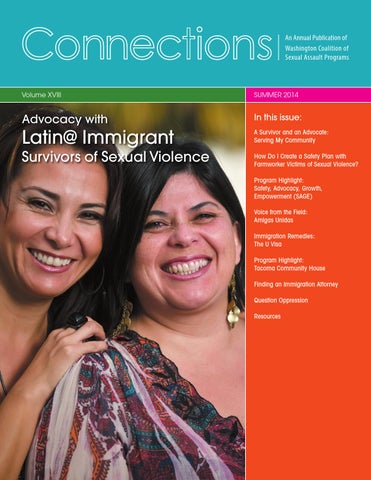
Advocacy with
In this issue:
Latin@ Immigrant
Survivors of Sexual Violence
A Survivor and an Advocate: Serving My Community How Do I Create a Safety Plan with Farmworker Victims of Sexual Violence? Program Highlight: Safety, Advocacy, Growth, Empowerment (SAGE) Voice from the Field: Amigas Unidas Immigration Remedies: The U Visa Program Highlight: Tacoma Community House Finding an Immigration Attorney Question Oppression Resources
Letter from the Editors Kelley Amburgey-Richardson – Advocacy Specialist, WCSAP Amy McIntyre – Bilingual Advocacy Specialist, WCSAP
T
his is a special issue of Connections. It is our first bilingual issue! WCSAP chose to prioritize and allocate resources for a bilingual issue of Connections for a variety of reasons. Washington has a large Spanish-speaking population and many of these monolingual Spanish speakers are also immigrants. This population has different needs and experiences different barriers when accessing sexual assault advocacy services. Community programs in our state have seen this and have responded by hiring bilingual advocates, offering materials in Spanish, and seeking training and resources. We have heard that more resources in Spanish and information about working with this population were needed, and we wanted to respond to that need. Although both editors of this publication have lived and worked in Spanish-speaking immigrant communities and have heard the stories of survivors in these communities, neither editor identifies as a member of this community. WCSAP strives to operate within an anti-oppression framework and values individuals and communities having the opportunity to speak from their own experiences, rather than having others speak for them. This led us to convene a working focus group of bilingual advocates from across Washington State. This group identified the topics covered in this issue of Connections as important to their work with Spanish-speaking immigrant survivors. In a few cases, these advocates also wrote or were interviewed for an article. Since one priority for the focus group was to elevate the voice of the Spanish speaker, we are presenting both the Spanish and English versions of the publication in the same issue and we have done minimal editing to the original words of the advocates. We hope that if you work for a culturally specific service provider, that the words in this issue ring true for you and the information presented helps
Since one priority for the focus group was to elevate the voice of the Spanish speaker, we are presenting both the Spanish and English versions of the publication in the same issue and we have done minimal editing to the original words of the advocates. you in your work. We hope that if you are a bilingual advocate at a community program, you see that you are not alone in your work and that your work is essential and valued. Finally, we hope that if you are a community program that wants to serve this population, this issue strengthens your efforts and supports your work to provide culturally relevant services. We thank America Figueroa, Patricia Flores, Marisol Melendez, Gricelda Ohrazda, and Maria Verdin for their work on this publication. Without you, it would not have been possible. [Editor’s Note: In the Spanish language, there is an international movement to use the “@” symbol as the preferred method to be gender inclusive when referring to people of Latin@ descent. WCSAP uses the “@” symbol in that way in this publication. Similarly, WCSAP sometimes uses “they” as a singular pronoun in our publications. Language is a powerful tool. It is ever evolving to reflect our culture. In this publication and throughout our work, we use the Spanish word “intercessor@” as the preferred term for the English word “advocate.” We create new words and use words in new ways to reflect our lived experiences and identities. WCSAP strives to reflect this cultural progression when discussing the experiences of survivors and advocates of all genders.]
Volume XVIII SPRING 2014
TABLE OF CONTENTS A Survivor and an Advocate: Serving My Community............. 1
4317 6th Ave SE, Suite 102 Olympia, WA 98503 (360) 754-7583 (360) 709-0305 TTY (360) 786-8707 FAX
An Interview with America Figueroa – Bilingual Advocacy Specialist, Crisis Support Network
How Do I Create a Safety Plan with Farmworker Victims of Sexual Violence?...................... 3
The Farmworker Sexual Violence Technical Assistance Project Southern Poverty Law Center, California Rural Legal Assistance, Inc., Líderes Campesinas, Victim Rights Law Center
Program Highlight: Safety, Advocacy, Growth, Empowerment (SAGE)................. 9
Advocacy with Latin@ Immigrant Survivors of Sexual Violence The mission of the Washington Coalition of Sexual Assault Programs is to unite agencies engaged in the elimination of sexual violence through education, advocacy, victim services, and social change. Connections Magazine is published annually and mailed to subscribing members of WCSAP. For membership information and to view articles online visit: www.wcsap.org Editors: Kelley Amburgey-Richardson Amy McIntyre Design © Debi Bodett www.DebiBodett.com
Voice from the Field: Amigas Unidas. . ............................... 11
An Interview with Maria Verdin – Founding Director and Advocate
Immigration Remedies: The U Visa.. ................................. 12
Northwest Immigrant Rights Project
Program Highlight: Tacoma Community House........................................... 13
Finding an Immigration Attorney: A Resource for Survivors....... 16
Washington Coalition of Sexual Assault Programs
Question Oppression................................................... 21
Resources............................................................... 21
A Survivor and an Advocate:
Serving My Community An Interview with America Figueroa Bilingual Advocacy Specialist, Crisis Support Network [Editor’s Note: America Figueroa is a bilingual advocate who also identifies as a survivor. When she sought advocacy services, she received them at the same program where she later worked. She wanted to share her experiences in receiving services as a Spanish speaker and working as an advocate for the program that helped her.]
WCSAP: As a survivor receiving services, what about the organization created a safe space? America: One of the things that they explained to me was the confidentiality and also knowing that they were not going to do anything without my permission. It was also very important to me that the decision to report was mine, and that they were not going to do anything more than what I wanted to with the information I gave them. WCSAP: How did you feel like you could talk to people about your experiences? America: Through the person that referred me, who I trusted, I knew that that person was not going to refer me to anything that would do me wrong. The person was Latin@ and told me that it was okay and that they would help me. She was a volunteer with Crisis Support Network (CSN) and also a friend of mine who I trusted. One of the very important things is to have someone who not only speaks Spanish but who also knows our history and culture. WCSAP: What made the program welcoming? America: One of the things that made me feel good was that they listened to me and sat down and had sympathy for me. They felt for me and heard what I was telling them.
1
CONNECTIONS
One of the very important things is to have someone who not only speaks Spanish but who also knows our history and culture.
WCSAP: Were there any symbols, significant things, or simple visuals that made you feel invited/ welcomed? America: At that time I didn’t see any. The only thing I do remember that made me feel comfortable was a sofa with a blanket. I remember the advocates told me “come here, sit down, and rest.” I relaxed and I actually slept a little while. I came to feel as if the office were my home because of the nice welcome that they gave me and my daughters. WCSAP: What services did you most need? America: I needed a place to live because I lacked housing. I also needed support with my divorce and with immigration. They also assigned me a therapist for counseling to deal with my history of childhood sexual assault along with sexual and domestic violence I experienced from day one with my husband.
www.WCSAP.org
SPRING 2014
WCSAP: What were the biggest barriers you experienced?
WCSAP: What does your self-care look like?
America: Sometimes it was language. My friend that referred me was a volunteer and wasn’t there much of the time. At that time they didn’t have interpreters and many times I didn’t have a way to communicate in order to ask for help. Now it’s much better for the clients. WCSAP: What were your feelings when thinking about your experience? America: I had mixed feelings. Fear because I didn’t know what I was going to do in this country without family and with my girls. With fear also came the feeling of financial insecurity. At the same time having support made me feel loved and understood. It’s very important as advocates to know how to support someone beyond just filling out forms. At the same time I felt sad about the reality that I couldn’t change what already happened. Another thing was the impatience because I felt things were never going to end, I felt stuck. I also felt hopeless sometimes. There were a lot of mixed feelings because I was happy to receive the help and that things were going to change but desperate because they weren’t happening quickly or easily. WCSAP: What is it like to work for the same place you received services? America: It’s an honor. It has helped a lot with my self-esteem. WCSAP: What is it like to be a survivor doing this work? America: The truth is it’s a challenge. It’s been a challenge because sometimes you are giving what you already received. Sometimes it’s traumatic because you remember exactly what you experienced. Sometimes the stories can suck you in and you want to help more because you can identify with what someone is going through.
America: The only thing I do is take a break. By taking a break I mean that in the moment I feel a need I do it. If in that moment I need to cry, I take a break and cry. If in the moment I feel the need to do something different, I take a break and do it. I don’t have any one thing that I do rather I do what I feel I need in the moment. One of the things I’ve learned is to not push myself when I feel I can’t any more. WCSAP: What do you want advocates who are survivors to know and learn through your story? America: Sometimes we lose our place and we forget that it’s not only about filling out papers but to have and give a welcome. But also at times we do too much because we were there before and we know how we got out and sometimes we make them become dependent on us instead of empowering them to independence. Sometimes we have histories and stories of how we came to survive and we want and think that the way we did things is the best or only way for the clients to do so. It’s important to not fall into either of these situations of giving too much and of not lacking empathy. We also need to not fall into the frustration and need to have patience when a person doesn’t follow what you recommend that they do. WCSAP: What else would you like to share with fellow advocates? America: Simply that I understand that it’s difficult and that day to day it’s a challenge in this field because sometimes when we work with the victims it can detonate a button and we remember our story. And at that moment we fall into that we remember that we are no longer giving 100% as advocates. We need to identify how we are responding to victims as advocates and to stay present for them.
We need to identify how we are responding to victims as advocates and to stay present for them.
www.WCSAP.org
2
How Do I Create a Safety Plan with Farmworker Victims of Sexual Violence? The Farmworker Sexual Violence Technical Assistance Project - Southern Poverty Law Center, California Rural Legal Assistance, Inc., LĂderes Campesinas, Victim Rights Law Center Reprinted with permission from the Southern Poverty Law Center
C
reating a plan that will enable victims to be safe from the perpetrator and from potential future harm is vital. Safety planning involves working with victims so that they will know how to react in the moment if confronted with violence. Creating a safety plan does not mean that the victim will not face violence again. Rather, the primary goal is to aid individuals in protecting themselves when and if they are in danger in the future. Some victims may they feel constant fear and anxiety over a possible future assault by the perpetrator. Safety planning can reduce fears by providing victims with safeguards that will permit them to feel safe even when they are not directly confronted with a violent situation. Safety plans may also instill a greater sense of calm, and reduce victim reaction time when responding to future incidents of violence. A planned response may also help to prevent future 3
CONNECTIONS
incidents of violence and reduce the level of harm inflicted. Planning for safety may reduce overall fear and restore a sense of control in victims’ lives; this can empower victims and aid their healing.
Farmworker-specific plans should address the life and work circumstances distinctive to farmworkers, and take into account the limited resources available to them.
www.WCSAP.org
SPRING 2014
Safety planning with farmworkers is a unique process. Existing safety plans for nonfarmworker victims may not be appropriate for farmworkers. Farmworker-specific plans should address the life and work circumstances distinctive to farmworkers, and take into account the limited resources available to them. Safety planning with farmworkers may require lengthier discussions, additional questions and more detailed explanations about resources, institutions, legal remedies and processes than safety planning with non-farmworker victims of sexual assault. For example, a non-farmworker client may need to know the location of the nearest bus stop when seeking the best route to safety. A farmworker client, however, may also need to know how to ride the bus, including understanding the routes, the cost, and transportation time. In most cases, the communities that farmworkers work in do not have public transportation systems. Therefore, it is necessary to consider additional methods of transportation and discuss how, where and when to access this transportation. You may need to not only determine what transportation assistance is available but also what assistance the farmworker victim will need in order to learn the process of using public transportation or finding other transportation. Safety planning means assisting victims in thinking through their response if confronted by the perpetrator in various settings, such as at home, work, in transit or in public. Additionally, it involves helping victims to think through their options related to responding to the violence, including reporting to law enforcement, seeking healthcare, seeking legal assistance, changing employers or moving to a new location. Most safety plans are oral or written, though they can take any format which is most helpful to the victim.
Safety planning at the outset may help to interrupt ongoing violence and give victims new tools to help protect themselves and their families.
ADDRESS SAFETY AS SOON AS POSSIBLE. It is critical to discuss safety planning as soon as possible. For some organizations, this could be during the intake process while for others it is at the first meeting. Take the time to address safety planning at the first possible moment. The first time you meet with a farmworker victim of sexual violence, including sexual harassment or assault, may be the only opportunity you have to create a safety plan as victims may not return for services or there may be another incident or an escalation of violence between your meetings. Safety planning at the outset may help to interrupt ongoing violence and give victims new tools to help protect themselves and their families. An important first step will be to ask victims if it is safe for them to have evidence of their meeting with you, such as your business card or the safety plan itself. Ask if there is a safe place away from the perpetrator to keep this information. Giving victims physical materials may place them in greater danger. DISCUSS SAFETY. To help explain safety and safety planning to a farmworker victim, consider using the Spanishlanguage fotonovela created by and for farmworkers that is available in Spanish at www.crla.org/svi. Through photos, the fotonovela tells the story of a young farmworker woman experiencing sexual violence at work and how she reaches out for help to address the violence and feel safe. Use the fotonovela as a discussion piece to begin the conversation and to build trust with victims. Also, convey that every individual has the right to be free from violence and to be safe in their housing, at work, at school and in the community at large.
www.WCSAP.org
4
CUSTOMIZE THE SAFETY PLAN. Aim to customize a safety plan based on the farmworker’s unique circumstances and available resources. Each person will present distinctive safety needs and require an individualized safety response. The more knowledgeable you are about farmworkers lives and the barriers they face in accessing resources, the more success you may have at building trust and presenting appropriate safety options. Be aware of the types of employment, housing and transportation available to farmworkers. Similarly, the more knowledgeable you are about the resources available that are appropriate for farmworkers in your area, the more successful the safety plan is likely to be. For example, know where the nearest sexual violence shelter is located, and if it has language, cultural and transportation capacity to assist farmworkers. Where capacity is lacking or minimal, it is important to work with local shelters to build capacity. Safety plan with farmworkers who voice concerns about sexual harassment and sexual assault of others so that they have a plan if confronted by the perpetrator.
As individuals know their own circumstances best, they are in the best position to make decisions for their lives. BE A GUIDE. Remember that you are only a guide in the safety planning process. Present farmworkers with options to address safety concerns and then help them think through the options and make choices that are best for them. As individuals know their own circumstances best, they are in the best position to make decisions for their lives. Be cognizant of any of your own expectations that may arise about how victims “should” respond and focus instead on ways to empower your clients to make their own choices.
5
CONNECTIONS
CONDUCT A SAFETY ASSESSMENT. After explaining safety generally, assess the risk the perpetrator poses to the victim. The level of danger and likelihood of additional harm will influence your response and the safety plan itself. Evaluate the nature and severity of risk by asking questions about the: bb Threats to victim’s physical safety bb Other threats, such as threats to report a victim to immigration or the police bb Threats to harm others, such as family members, friends or pets bb Violence that has already occurred bb Frequency of incidents bb Last occurrence bb Perpetrator’s use of weapons bb Perpetrator’s mental health history bb Perpetrator’s use of drugs and alcohol USE SAMPLE QUESTIONS TO GUIDE YOUR DISCUSSION. Below you will find questions designed to help guide your discussion with a farmworker victim to create a safety plan. They help illustrate some of the appropriate topics, questions and options for your discussion on safety with a farmworker under the broad categories of housing, workplace, community, transportation, communication and emergencies. Every question may not be relevant or necessary, nor are the questions exhaustive of all the possibilities. Additional questions may be required to address your client’s situation; however, these questions serve as examples and a starting point for your work.
Is the perpetrator your landlord? The property manager? A roommate? A work supervisor who lives with you or has access to your housing? A coworker who lives with or near you? SAFE HOUSING bb What kind of housing do you live in (labor camp, apartment, house, trailer, motel, outdoors)? bb With whom do you share your housing? Do you know the people with whom you share your housing? How do you know the people with whom you share housing? bb How close are you to the nearest town/city?
www.WCSAP.org
SPRING 2014
bb What state is your housing located in? What city is your housing located in? What street is your housing on? At what number? What directions would you give to someone to find your home? Are there any landmarks to help someone find your housing? bb Is the perpetrator your landlord? The property manager? A roommate? A work supervisor who lives with you or has access to your housing? A coworker who lives with or near you? bb Are you safe inside your housing? Do you have windows and doors? Do your windows and doors lock? Do you have lights at your home? Are the lights outside and inside your home? How could you make your housing safer? Can you move something in front of the doors and windows to keep the perpetrator out of your housing in an emergency? Can you speak to the landlord, farmer, or housing owner about helping you to make the housing safer by installing locks and lights? bb Who are your neighbors? Do you feel comfortable talking with your neighbors? Which of your neighbors would you feel comfortable asking for help? bb How could you get out if the perpetrator shows up at your house? Is there a back door? Are there windows you could escape through? bb What transportation is available if you need to leave your housing immediately? bb Who could you stay with if you need to leave home? Do you have friends or family nearby? Who else in the community do you know and trust? How would you contact them? bb Where is the nearest shelter for women and children in your area? How would you contact the shelter? Can they come to your house to pick you up in an emergency? bb If you had to leave your home quickly, what would be important to take with you? What would be hard to replace if you left it there e.g. birth certificate, driver’s license, consular identification (matrícula o cedula), voter registration card, passport, money, children’s records, work records? bb What would your children do in case of an emergency/if they need help? Do they know how to use the telephone and call for help? bb Do you feel that you could contact the police? How would you contact the police? What could they do to help? bb Would it be safer to move to new housing? Is this possible? Do you need help finding a new place to stay?
Can you avoid being alone at work? How? Do work with any family members? Who could you work alongside? Is there anyone who can accompany you to the car or bus, bathroom, lunch break, tool sheds, supply closet? Who can you tell if you are being assigned to work in a remote area so that they can know to look for you if you do not return within a reasonable amount of time? Who can you check in with at a certain time each day? SAFE WORKPLACE: bb Where do you work? In what state? In what city? What’s the name of the company? What is the name of your crewleader, contractor or supervisor? Do you have a pay statement or check stub with you that includes the company name and address? Do you have any other papers that the company or your boss has given you that includes the company or contractor’s name and address on them? bb Does the perpetrator work with you? bb Do you still work there? Does the perpetrator still work there? Do you want to continue working there? What options for alternative work do you have? bb Does the perpetrator have authority over you (owner or supervisor)? bb Who else at work knows that you are being sexually harassed/assaulted? How do they know? bb Did you tell your employer (boss, supervisor, someone in the office)? If not, how would making a report to the employer make you safer or less safe? If yes, what did they say? Did anything change? Do you feel safer or less safe? bb How often do you see the perpetrator at work? Where do you see the perpetrator? bb Can you avoid being alone at work? How? Do work with any family members? Who could you work alongside? Is there anyone who can accompany you to the car or bus, bathroom, lunch break, tool sheds, supply closet? Who can you tell if you are being assigned to work in a remote area so that they can know to look for you if you do not return within a reasonable amount of time? Who can you check in with at a certain time each day?
www.WCSAP.org
6
SAFE COMMUNITY bb Do you see the perpetrator when you are in the community? Where (at the grocery store, church or school)? bb Can you avoid seeing the perpetrator in the community? How? How could you change your routine so that you avoid seeing the perpetrator? Could you use different laundromats or grocery stores? bb Who can go with you when you are out in the community? bb How else can you keep yourself safe when you are out in the community? bb How can you ask for help if you are in the community? What language would you use? What words would you use to call out for help? bb Where could you go to be safe?
Is the perpetrator involved in any way in your transportation to work, from work, or at work? SAFE TRANSPORTATION bb How do you get from one place to another? How do you get home? How do you get to work? How do you get from one job site to another? How do you get to the store, religious services and laundromat in the community? bb Is the perpetrator involved in any way in your transportation to work, from work, or at work? bb Can you drive? Do you have a driver’s license? Do you have a vehicle? Do you always have access to your vehicle? bb Who can drive you in case of an emergency? bb Who is a safe person who could drive you to work? to the store? to the laundromat? bb Is there any public transportation where you live, like a bus or a train? Where is the nearest bus/ train? Do you know bus/train routes and how to ride the bus/train? Do you know how much it will cost to take the bus or the fare? Do you have a bus/train pass? Do you know how to get a bus/ train pass? Do you know the bus/train schedule? Do you know how to call for help at the bus/train stop? bb What is the number for a taxi or car service in case of emergency? bb Do you have money set aside to pay for a taxi/ bus/driver in an emergency? bb Have you considered going to your work, housing and the community by taking different routes? 7
CONNECTIONS
SAFE COMMUNICATION bb Do you have a cell phone? (Can you get one by donation?) Do you know how to use it? Do you know how to retrieve messages from your phone? Can you be sure to keep your battery charged? Could you carry a phone to use for emergency purposes only? bb Who has a cell phone that you can use near home? At work? In the community? bb Do you have credits/minutes for your cell phone? Do you have a pre-paid phone card? bb Do you know what a public telephone looks like? Where is the nearest public telephone to your home, work, or job site? Do you know how to use it? bb Can you keep a cell phone with you and on at all times, even at work? bb Do you have cell phone reception at home? At work? In the community? bb Do you have a list of all the important phone numbers you need (police, shelter, attorney, advocate, taxi, friend)? bb Are you aware that 911 will call the police? How do you think the police could help you? Would you feel comfortable calling the police? EMERGENCIES bb Who would you call? bb Where would you go? bb How would you get there? bb If you need medical attention where would you go? How would you get there? MODIFY THE PLAN FREQUENTLY. Conduct safety planning with farmworkers on a regular basis —even every time you meet—to evaluate any changes in circumstances that may endanger the victim. Modify the existing safety plan to accommodate changes in work, home, transportation, family and other circumstances as they arise. Victims’ safety concerns may change, for example, if they take steps to distance themselves from the perpetrator, pursue civil or criminal legal remedies or disclose to employers, landlords, friends or family. When safety planning, discuss with victims whether or not it is safe for them to have a copy of the safety plan in their possession.
www.WCSAP.org
SPRING 2014
ASSIST WITH IMPLEMENTING THE PLAN. Farmworker victims may need assistance in implementing their safety plans. Take time to ensure that your client understands the plan and that the information is captured in a way that makes the most sense to the victim. Victims who do not read or write may need an alternative to a written safety plan, such as an oral recording of the information.
Educate social service, legal service and healthcare providers on overcoming barriers to providing services to farmworkers.
The following are ways in which you might further support victims’ safety:
EXERCISE bb How might safety planning be different with farmworker victims of sexual violence than with non-farmworker victims? bb What training is available or steps are necessary to ensure that everyone within your organization is able to safety plan with farmworker victims? bb What referrals do you need to have in place to help farmworkers implement their safety plans?
bb Offer transportation assistance; bb Accompany them on public transportation to learn the process and routes; bb Provide a list of resources, e.g. sexual violence shelters, taxi/car services, legal services organizations, farmworker organizations, healthcare providers, law enforcement, public benefits, etc.; bb Find an advocate/service provider who can help secure related services; food, crisis intervention, and victim witness assistance; bb Help them to obtain a cell phone or pre-paid phone cards for emergency purposes; bb Help them learn how to use the cell phone and retrieve messages. bb Give them a folder in which to store important documents (e.g. birth certificate, driver’s license, passport, matrícula, cedula, money, children’s records and work records) in a place that is safe from the perpetrator; bb Explain the purpose and process for obtaining a protection orders and help determine if one is available or advisable under the individual’s circumstances (or refer to an appropriate attorney); bb Refer them to an attorney who can help them protect their employment, housing, education, immigration, public benefits and privacy rights; bb Advocate with landlords for increased safety measures in housing; bb Advocate with employers for increased safety measures at work; and bb Educate social service, legal service and healthcare providers on overcoming barriers to providing services to farmworkers.
From Sexual Violence Against Farmworkers: A Guide for Social Service Providers. A link to the complete guide can be found on the Resources page.
www.WCSAP.org
8
PROGRAM HIGHLIGHT
Safety, Advocacy, Growth, Empowerment (SAGE) Gricelda Ohrazda, Bilingual/Legal Advocate WCSAP: For those who are not familiar, can you tell our readers about your organization, SAGE, and what you do? Gricelda: SAGE (Safety, Advocacy, Growth, Empowerment) serves the areas of Chelan and Douglas Counties. All of our services are free and confidential. They are victim-centered, accredited, outcome-focused, and provided by specialists fully trained in the unique issues of domestic violence, sexual assault, and crime victim services. Services that are available include: counseling, advocacy, emergency shelter, information and referral, safety planning, emergency cell phones, community education, professional training and inservices, volunteer opportunities, and a 24hour crisis line. SAGE also offers help with orders of protection, support groups, the Child and Family Advocacy Center, and the local Crime Victim Service Center.
WCSAP: What is your role in working with Latin@ survivors of sexual assault? Gricelda: My role as the Bilingual/Legal Advocate is to assist clients in providing them with support before, during, and after legal proceedings. I assist them with the preparation of the proper protection orders, walk through the legal processes and casespecific timelines. I appear in court with the victim and/or the victim’s parent(s), and I make sure that the interpreting is accurate and correct. I refer the clients and/or the family members to our therapists and I do the interpreting for them when in session as needed. I advocate for the client for services in other agencies. If the person is undocumented I assist them with gathering the initial documents to refer them to Northwest Immigrant Rights Project (NWIRP) for assistance. WCSAP: How do you advocate for survivors with multiple barriers? Gricelda: I listen, write down the barriers, and assist the client in prioritizing each barrier from the most important and urgent to the least. I know that they are all important to the client, but if we don’t work on identifying and prioritizing, the client will continue to be in a cloud as to where to start breaking down the barriers, and/or learning how to live with some barriers that will always be challenges. WCSAP: What have been your successful outreach strategies to Latin@ survivors of sexual assault? Gricelda: I use the Latin@ Support Group “La Charla” as a tool to engage both domestic violence (DV) and sexual assault (SA) survivors. The invitation to this group is all Latin@ women of our community. It is when the women become involved, and feel empowered through education and support of the women in the group that they will divulge; and, therefore, begin a new phase for therapy and the path to healing.
9
CONNECTIONS
www.WCSAP.org
SPRING 2014
I think that it is important to really know what generation of Latin@ the client is, because customs are also based on if the person was born in the US or not.
WCSAP: What is the most important thing you have learned about working with Latin@ survivors? Gricelda: One of the most important things that I have learned reminds me of the phrase, “Don’t judge a book by its cover.” This phrase comes to me every time that I remember this particular young woman. She came into SAGE seeking help for the very first time because of what she described as “a mild DV issue” in her home. She was very loud and outspoken, and seemed to be angry with the world; she would fight to have things her way. She was very strong-minded, hated men, and did not talk about her family much. I could see the anger, frustration, and desperation, and she was not quiet about it! I could see that she was going in so many directions that she hit dead ends. Many times she felt like giving up because, due to her legal status, doors were closing on her and she was not able to provide the financial support her and her children needed. And this, what I have just described to you, is what I saw with my eyes. But after weekly sessions of advocacy and weekly Latin@ Support Group meetings she finally said, “I had lived in an abusive home and lived a severely traumatic sexual assault experience as a child and I hate men and I hated my mother.” So when I heard her make that statement, I was not surprised but I was reminded that empathy also means patience; understanding when we don’t have a clue what we are supposed to understand. Because until the butterfly can honestly break out of its cocoon and show its beautiful colors, she feels the spiritual support from her advocate, the staff, and from her support group of women survivors as well. “There is more to all of us than meets the eye.”
WCSAP: What do you think would be important for advocates to know about working with Latin@ survivors of sexual assault? Gricelda: I think that it is important to really know what generation of Latin@ the client is, because customs are also based on if the person was born in the US or not. You have to really listen to the person’s story, because their story will tell you what they believe to be fact, and that can give you direction on where to start to provide adequate services. WCSAP: What would you tell a program in a similar community to yours that may be struggling with providing sexual assault advocacy services in the Latin@ community? Gricelda: Where there is a will, there is a way! It might be useful to contact and dialogue with other agencies that have struggled with the same issues and strategize.
www.WCSAP.org
“There is more to all of us than meets the eye.”
10
Voice from the Field:
VOICE FROM THE FIELD
Amigas Unidas An Interview with Maria Verdin Founding Director and Advocate
WCSAP: For those who are not familiar, can you tell our readers about your organization, Amigas Unidas, and what you do? Maria: Amigas Unidas is a nonprofit organization that works with the Latin@ community talking about sexual assault and domestic violence and providing community resources. We provide two support groups in Spanish: one group is closed and talks about sexual assault specifically and one group is open in which we talk about all kinds of violence and provide more community resources. We are all volunteers, and four of us are trained by all of the coalitions for domestic violence (WSCADV), sexual assault (WCSAP), and victims of crime (WCCVA). WCSAP: As an advocate working with sexual violence among rural farmworking Latin@s, what do you think is the most important thing you, as an advocate and as a Latin@, can share with others who are doing similar work? Maria: First is to talk to people relating to our culture; it’s not easy to talk about sexual assault. It’s important to work with people on the rights that they have as people. We talk about healthy relationships and risks and diseases. What we do is give information and referrals and support on how to receive services in other places, such as where to receive medical checkups. We also have a few videos that were given to us from Mexico that help us to educate women on how to take care of themselves and talk about health. WCSAP: What do you want advocates who are survivors of sexual violence themselves to know about working with rural farmworking Latin@s?
11
CONNECTIONS
Maria: First and foremost, to know that we as survivors were damaged and injured at some point, and that we got out and through it. We must understand them, but give them the correct information and we need to respect their decisions. We, as victims of sexual assault, know what it is to get out and through it – but by “get through it” I mean in a way that no longer hurts you to talk about it even though the history is there. We must not control or demand things of the survivors, but rather give them a comfortable place to feel safe and valuable. That as advocates all need to know how to respect the choices of all people. WCSAP: What have been your successful outreach strategies to Latin@ survivors of sexual assault? Maria: The success we have had has come from being creative in our own way in the distribution of information. One way has been to pass around a basket among a group of people, for example in a church, where all questions are anonymous. Another strategy is to give other organizations’ information, such as the newspaper “The Faro,” but at the same time our brochure is included which talks about us and our sexual assault and domestic violence services. Also, when we put information tables at fairs, we give out poems and at the bottom is our information and our contact numbers. WCSAP: What else would you like to share with fellow advocates? Maria: That we should work united. We must work hand in hand and get to know other agencies. That we share among all what has benefited us. That we share all the information we have and that we support each other. I think that the movement we have is big and that it’s by working together and we must continue working together.
www.WCSAP.org
SPRING 2014
Immigration Remedies:
The U Visa Northwest Immigrant Rights Project Reprinted with permission from the Northwest Immigrant Rights Project
Western Washington Office 615 Second Avenue, Suite 400 Seattle, Washington 98104 PHONE: 206-587-4009 FAX: 206-587-4025 WEB: www.nwirp.org
The U Visa The U Visa
What is Visa? the U Visa? What is the U The Violence Against Women Act of(VAWA) 2000 (VAWA) created new visa for nonThe Violence Against Women Act of 2000 created a newavisa for non-citizens of certain certaincrimes, crimes,including includingthe thecrime of domestic citizenswho whohave have been been victims victims of crime of domestic violence. violence.
What are the requirements? What are the requirements?
You have have beenbeen the victim of one of the crimes listed in the law. • must You must the victim of one of the crimes listed in the law. The list The list includes: domestic violence, rape, assault, torture, traffickincludes: domestic violence, rape, assault, torture, traffick-ing, incest, kidnapping, ing, incest, kidnapping, homicide and others.
You must show that you suffered “substantial physical or mental • You show you suffered “substantial physical or mental abuse” as a abuse” as must a result of that the crime.
You must have information about the crime, and must have helped, or of information help to the about policethe or prosecuting attorney the or in the • in the Youfuture must be have crime, and must have in helped, investigation processing of theorcrime. future beand of help to the police prosecuting attorney in the investigation and “”If the victim is younger than 16, the person who provides informaprocessing of the crime. **Ifbethea victim than 16, the person who tion and help to authorities can parentisoryounger guardian**
You must obtain a “certification” with the signature of the authority • isYou must obtainthe a “certification” with the signature of the who is who investigating crime. This certification declares thatauthority the person applying forthe thecrime. U Visa has been helpful or is likely to person be investigating This certification declares that the applying for the helpfulUwith investigation. Visathe hascriminal been helpful or is likely to be helpful with the criminal investigation. **A lawyer can help you get this certification**
homicide and others.
What benefits do do I get from What benefits I get from a a UUVisa? Visa? If you receive the U visa, it gives If you receive thestatus U visa,and it gives you provisional legal you provisional legal status you can apply for a work permit.and Afteryou having visa 3 years can the apply forfor a work permit. you can forthe Permanent Afterapply having visa for 3 years Residency (Green Card).
you can apply for Permanent Residency (Green Card).
result of the crime.
provides information and help to authorities can be a parent or guardian**
**A lawyer can help you get this certification**
Do I have be married to the to person that committed the the crime Do Ito have to be married the person that committed crime or does this person have to be a US Citizen or legal or does this person have to be a US Citizen or legal resident? This document is not a substitute for resident?
legal advice. It is important to talk with an immigration attorney or Thisaccredited document isrepresentative not a substitutebefore for legal advice. It is important to talk submitting anything to immigration with an immigration attorney or authorities. accredited representative before submitting anything to immigration Created by: authorities
No. The law does not require that you be married to the person accused of the
No. The law does not require that you be married to the person accused crime, and it does notrequire requirethat thatperson persontotohave have legal legal status. status. of the crime, and it does not
Can my family members be included in my application? Can my family members be included in my application? Depending on the case, some can becan included such as Depending on the case,family somemembers family members be included such as husband husband or or wife, wife,children, children,parents, parents,and andbrothers brothers & sisters. & sisters.
Northwest Immigrant Rights Project Created Does this cost For more by: information call Does thismoney? cost money? Northwest Immigrant Rights Project (206) 587-4009 or For more information call Yes. There is an application fee, but in some cases that fee can be 1-800-445-5771 (206) 587-4009 or waived. Yes. There is an application fee, but in some cases that fee can be waived. 1-800-445-5771
Granger Office 121 Sunnyside Avenue, 2nd Floor Granger P.O.Office Box 270 121 Sunnyside Avenue, 2nd Floor Granger, Washington 98932 P.O. Box 270 Granger, Washington 98932
Moses Lake Office 1405 South Pioneer Way Moses Lake Office Suite A 1405 South Pioneer Way Moses Washington 98837 SuiteLake, A
Moses Lake, Washington 98837
www.WCSAP.org
NWIRP is a 501( c)(3)non -pro f it or gan iza t ion
Tacoma Office 402 Tacoma Avenue South Tacoma Office Suite 300 402 Tacoma Avenue South Tacoma, Suite 300Washington 98402
Tacoma, Washington 98402
12
PROGRAM HIGHLIGHT
Tacoma Community House Marisol Mel茅ndez, Coordinadora de Intercesi贸n WCSAP: For those who are not familiar, can you tell our readers about Tacoma Community House, and what you do? Marisol: Tacoma Community House (TCH) is a multiservices agency serving low income individuals in Tacoma and Pierce County. TCH has been serving immigrants in the Pierce County area for over 104 years. It began as a settlement house which welcomed immigrants and helped them integrate into our community. TCH provides ESL and GED classes, and employment assistance to low income adults and youth. It also it has an immigration department with accredited representatives to provide citizenship and other immigration assistance to low income immigrants. In addition, TCH assists immigrants experiencing domestic violence, sexual assault, and those who have been victims of a crime. All of our advocates are bilingual in English and Spanish or other languages. I work as the manager of the Client Advocacy Program at Tacoma Community House. I oversee the bilingual advocates who serve immigrants who have or are currently experiencing domestic violence and/or sexual assault, as well as those who have been victims of crime. Our bilingual advocates provide assistance to immigrant survivors in many areas, such as: general advocacy, medical advocacy, safety planning, court support, civil legal information, criminal advocacy, systems navigation /education, and assistance in gathering the necessary documents to apply for immigration relief under Violence Against Women Act. Most of our participants are Latin@; and primarily from Mexico. However, we have participants from many other countries, such as Sudan, Kenya, Ivory Coast, Korea, Vietnam, Cambodia, Germany, and many other countries from South America.
13
CONNECTIONS
WCSAP: What is your role in working with Latin@ survivors of sexual assault? Marisol: We have multiple roles. To start, we focus on what the person wants to work on at the speed they want. This could be accompanying them to the hospital or clinic, or even accompanying them to file a police report. At each step we explain the existing options and the participants make a decision. Our advocates provide all types of vital information. For example, they are provided information regarding the medical process, judicial (criminal, civil and immigration), their civil rights as immigrants in the United States, and education and access to programs that provide therapy to survivors of sexual assault for adults and children. We also offer information regarding community resources available in order to minimize existing barriers. We serve as cultural consultants interpreting multiple systems in a way that is easier for someone to understand. Lastly, we collect the necessary documents for those who qualify for immigration relief. We work with the legal staff of The Northwest Immigrant Rights Project (NWIRP), who represents our families. We celebrate every success at each level and remain with the person for a very long time, because each process for collecting documents, the judicial processes or personal processes may take years.
www.WCSAP.org
SPRING 2014
What has functioned has been creating collaboration with the clinics that see low income immigrant patients. We provide information of our services and they refer patients who are immigrants and refugees who have been sexually assaulted.
COLLABORATION
WCSAP: How do you advocate for survivors with multiple barriers?
WCSAP: What have been your successful outreach strategies to Latin@ survivors of sexual assault?
Marisol: Our advocates concentrate on the safety and what the person wants to do. At the same time we enter a process to mutually gain and create trust. Every person that we work with has multiple barriers. For example, I would say that a great majority of the people do not speak English, they are undocumented, are low-income or unemployed, do not have medical insurance, they are isolated, they are unaware of community resources, and they live in fear of being deported at any moment. Our services are different than other services of mainstream programs due to the fact that our participants continue receiving services for a very long time, even years, because we fight against not only the consequences of the sexual assault but also the person’s circumstances and barriers. Each barrier is minimized over time with the person making each decision. We continue providing them information, supporting and celebrating each success. Usually, after working with them over time we see that they are learning English, they have obtained their documents, they have safe housing, and improve when they have access to a counselor and finally are able to obtain employment. Their outcome improves as their situation improves.
Marisol: I want to mention first that our organization is located in an urban center and this is not going to be the same for programs that are in rural areas. We have tried a variety of strategies that have not been the most effective but what has functioned has been creating collaboration with the clinics that see low income immigrant patients. We provide information of our services and they refer patients who are immigrants and refugees who have been sexually assaulted. Also, in our community word of mouth is the best referral. We have been working with immigrant communities for a very long time and that’s how we get immigrants impacted by sexual assault. Recently, we began developing contacts to organize conversations with those who work in the farms in Puyallup.
CONVERSATIONS
A great majority of the people do not speak English, they are undocumented, are low-income or unemployed, do not have medical insurance, they are isolated, they are unaware of community resources and they live in fear of being deported at any moment. www.WCSAP.org
14
WCSAP: What is the most important thing you have learned about working with Latin@ survivors? Marisol: The majority of Latin@s like personal service and for the most part do not like speaking with someone over a hotline. This means that they like to work with a person who speaks their language, who always maintains confidentiality, and they can count on them for their support, and the information provided is reliable. The skillful advocate is respectful, they develop a trusting relationship with people, and they understand the different cultures that make up the Latin@ community. We need to remember that Latin@s are from different countries, and that each country has its own culture, customs, and language. The people that work as advocates to survivors of sexual assault have to maintain a spotless reputation as a provider of trustworthy information because, whether good or bad, this reputation of the advocate is passed through word of mouth throughout the Latin@ community. WCSAP: What do you think would be important for advocates to know about working with Latin@ survivors of sexual assault? Marisol: The advocates who work with people who have been sexually assaulted have to remember that they should treat them with respect and humility to build trust. Providing sexual assault services is a lengthy process. When we offer services to the community you have to remember that the person you have in front of you has personal resources and that they are disconnected from them, they no longer remember this, and we are here to help them rediscover them. The advocates should not isolate sexual assault and only concentrate on this; they must work hard to minimize the barriers that the person has that are preventing them from access to their rights, to the correct information, and the resource that will assist them. Also, remembering that we are there to provide support and not making the decisions in regards to the person’s life is important. This is the responsibility of the person we are serving.
15
CONNECTIONS
Make a long term commitment with the Latin@ community. This means that they should have conversations with the Latin@ community to find out their needs and work with them to develop their services. WCSAP: What would you tell a program in a similar community to yours that may be struggling with providing sexual assault advocacy services in the Latin@ community? Marisol: The programs wanting to provide sexual abuse advocacy should consider the following: bb Make a long term commitment with the Latin@ community. This means that they should have conversations with the Latin@ community to find out their needs and work with them to develop their services. bb They should develop a profile of the Latin@ community in their city, town, or area. bb The program should hire bilingual personnel with experience in helping the Latin@ community, and train them in sexual assault services and provide the necessary experience. bb Create opportunities and a process for Latin@ community members to volunteer in the agency. bb Train the whole organization on how to provide services to the Latin@ community and other immigrant communities so that they feel welcome. bb Evaluate the compensation for bilingual Latin@ advocates, because the work is more complex, extensive and requires specialized skills when compared with other sexual assault services provided for the mainstream community.
www.WCSAP.org
SPRING 2014
Finding an Immigration Attorney: A Resource for Survivors This document was developed with the invaluable review and assistance of several individuals. WCSAP would like to thank Patricia Flores, Jessica Grosz, Laura Contreras, Carol L. Edward, and Ankita Patel.
How do I know if i need an immigration attorney?
If you are not a citizen of the United States, and/ or if you wish to file any sponsorship papers for anyone else, or if you are having legal problems with immigration, it is a good idea to speak with an attorney first to make sure you are filing the proper documents, to make sure you are eligible to file the applications, and to make sure you understand the immigration process.
www.WCSAP.org
16
How can I find an immigration attorney?
Some examples of the types of legal problems an immigration attorney may be able to help with are: • Citizenship - Applying for naturalization/citizenship • Green card - Renewing or applying for your green card • Family Visa - Filing a petition for a visa for you or your family member, including for yourself if you are married to a Lawful Permanent Resident or U.S. citizen and have been subject to domestic violence. • Request to stay in U.S. - Asking to stay in the United States if you came here as a child (Deferred Action for Childhood Arrivals) • Humanitarian Visas - Such as temporary protective status, asylum, visas for victims of certain crimes (U visa), visas for persons that have been trafficked (T visa), visas for juveniles who are in dependency proceedings. • Removal or Deportation Proceedings - If you receive a letter or document, such as a Notice to Appear, from United States Citizenship and Immigration Services (USCIS) or Immigration and Customs Enforcement (ICE), it is important to speak with an attorney so that you know all options available to you. The government will not appoint an attorney to represent you. You must find one yourself. It is important to consult with an attorney BEFORE you file an application with USCIS where you have ANY criminal history.
You can ask other people about the immigration attorneys they have used and if they would recommend using that attorney. On the Washington State Bar Association website, https://www.mywsba.org/LawyerDirectory.aspx, you can look for an immigration attorney by searching for attorneys who practice immigration law in your area. ¤¤ In the search form, type in your city ¤¤ Under “Area of Practice,” click on “Immigration & naturalization” ¤¤ You can leave the rest of the form blank ¤¤ Click on SEARCH and you will have a list of attorneys in your area who practice immigration law If you want to find an immigration attorney in another state, you can look on that state’s bar association website. The American Bar Association (ABA) has a list of state bar associations: http://www. americanbar.org/groups/bar_services/resources/ state_local_bar_associations.html. You can also search for an immigration attorney on the American Immigration Lawyers Association (AILA) website. Most attorneys who regularly practice immigration law are members of AILA; although is not required to be a member to legally practice immigration law. You can also search for attorneys who speak Spanish: http://www.ailalawyer.com/.
You may be able to file for citizenship or other help on your own, but it’s important to consult with an immigration attorney before you file, especially if you have ever been charged with a crime or offense even if the Judge said it would not count against you. Immigration looks at crimes differently. For free naturalization clinics, run by AILA (American Immigration Lawyers Association) attorneys and OneAmerica, you can also look on line at http://www. weareoneamerica.org/become-citizen.
17
CONNECTIONS
www.WCSAP.org
SPRING 2014
How do I know if the attorney is licensed to practice law?
Northwest Immigrant Rights Project (NWIRP) helps with some immigration legal problems. Due to their limited resources, they can only represent lowincome people and they consider some other factors when they decide if they can take someone’s case. If you think you have an immigration problem, find out if you are eligible by calling a NWIRP office:
¤¤ Asotin, Benton, Columbia, Franklin, Garfield, Kittitas, Klickitat, Walla Walla Whitman & Yakima counties – (888) 756-3641
To practice law, an attorney must: • Graduate from law school. • Have a license to practice law from a state bar association. • Before a license to practice law is granted the person must take a multiple day exam to make sure they can be sworn in as a lawyer. • Swear an oath in front of a clerk or judge and agree to follow certain ethical rules including keeping confidences and providing competent legal services. The state bar association is responsible for disciplining an attorney if they make mistakes.
¤¤ Adams, Chelan, Douglas, Ferry, Grant, Lincoln, Okanogan, Pend Oreille, Spokane & Stevens counties – (866) 271-2084
Immigration law is federal law, so an attorney who wants to practice immigration law must also have been licensed to practice in federal court.
¤¤ If you or a family member is detained at the Northwest Detention Center in Tacoma – (253) 383-0519
If you are thinking about hiring an attorney, you can ask questions to help you make sure the attorney has a license: 1. What states are you licensed to practice in? 2. What is your bar license number? 3. Can you practice in federal court?
¤¤ Western Washington – (800) 445-5771
NWIRP also has a list of private immigration attorneys in Washington on their website: http://www.nwirp. org/Documents/AttorneyList.pdf. The list says what languages the attorneys speak. They may also offer classes or other assistance for people representing themselves.
Notarios are not the same as attorneys. It is important to know that if someone calls themselves a “notario” or “notario publico” it usually means that they are not an attorney.
You can also ask the attorney for a business card with their name on it. The Washington State Bar website has a lawyer directory where you can search for attorneys who are licensed to practice in Washington by name or bar number: https://www.mywsba.org/ LawyerDirectory.aspx. You can also find out if the lawyer has ever been disciplined by the WSBA. If the attorney is licensed in another state, you can find that state’s bar association here: http://www.americanbar. org/groups/bar_services/resources/state_local_bar_ associations.html Notarios are not the same as attorneys. It is important to know that if someone calls themselves a “notario” or “notario publico” it usually means that they are not an attorney. In other countries a notario publico is an attorney. This is not true in the United States. In the United States, a notary or notary public cannot represent you in court or give you legal advice. This person can only notarize signatures on important documents or administer oaths.
www.WCSAP.org
18
How do I know that the attorney I found is reputable?
Immigration Businesses not run by an attorney. There are also people who say they are notarios who are not notaries public. They may promise you an easy fix or say that they have connections with people in the government or the immigration department. They often take your money and don’t do anything to help you. There are no shortcuts in the immigration system, so don’t believe someone who tells you they know an easy way to do something like get a green card. Make sure that someone is an attorney before you give them money or sign any documents. If you seek help from a non-profit organization, you may encounter someone who is an “Accredited Representative.” Although an Accredited Representative is not an attorney, they have been authorized to practice law in a limited manner under the supervision of an attorney. An Accredited Representative is a person who is approved by the Board of Immigration Appeals (the Board) to represent aliens before USCIS and/or the Immigration Courts and the BIA and USCIS. They must work for a specific nonprofit, religious, charitable, social service, or similar organization. The organization must be authorized by the Board to represent aliens.
You can ask the attorney for a list of references of clients they have helped if those clients have given the attorney permission to release their information. You can look at the attorney’s website or google their name to see what others have to say about their work. Or you can go on-line to certain websites to see how other clients or attorneys have rated their work. A few such websites are Martindale Hubbell (www. martindale.com), bestlawyers.com, superlawyers. com, avvo.com. A REPUTABLE ATTORNEY WILL: • Give you a business card and/or contact information • Have you sign a written contract clearly stating what service they agree to provide you and how much it will cost • Give you a receipt when you pay their bill if you ask for one • Give you copies of all work they do on your behalf A REPUTABLE ATTORNEY WILL NOT: • Have you sign a blank document or a document that has not been filled out completely. • Have you sign a paper that you don’t understand or that has not been translated or interpreted for you prior to your signing the document. • Guarantee a specific result. Only the government can make the final decision on a case. • Have you sign a document that has false information on it.
There are no shortcuts in the immigration system, so don’t believe someone who tells you they know an easy way to do something like get a green card. 19
CONNECTIONS
You can ask the attorney for a list of references of clients they have helped if those clients have given the attorney permission to release their information. www.WCSAP.org
SPRING 2014
What questions can I ask an immigration attorney before hiring them?
What paperwork or documents should I take to my first appointment with the attorney?
It is very important to hire an attorney who has experience practicing immigration law. Even though any attorney who follows the steps above can be allowed to practice immigration law, an attorney who normally works on other types of legal problems is not the best person to help you with an immigration problem. Immigration law is complicated and the attorney you hire should have experience practicing it. YOU CAN ASK THE ATTORNEY: • Where are you licensed? • How long have you been practicing immigration law?
Sometimes an attorney will tell you what documents to bring to your first appointment. If the attorney does not, you may want to bring: 1. Any letter/document you have received or that was filed by you or on your behalf at any time from any immigration agency including: USCIS, ICE, or the Immigration Court. 2. Your green card or “mica”, or work permit, if you have one. 3. Your social security card, if you have one. 4. Your driver’s license, if you have one.
• How many cases like mine have you handled?
5. Your birth certificate, if you have one.
• What action would you take on my case?
6. Any paperwork you have about any traffic or criminal matters you have been involved in.
• How long will my case take? • What result would you expect based upon your experience?
7. Your passport, if you have one 8. For VAWA Self-Petition, U Visa Petition, or T Visa Petition (if applicable): »» Evidence that your spouse is documented (if your U.S. Citizen or LPR spouse abused you and you want to complete a VAWA Self-Petition to obtain status) »» Evidence that you are a victim of a crime »» Evidence that you are a victim of trafficking
It is very important to hire an attorney who has experience practicing immigration law. An attorney who normally works on other types of legal problems is not the best person to help you with an immigration problem. Immigration law is complicated and the attorney you hire should have experience practicing it.
The attorney can make copies of your original documents for their file and should return the originals to you. The attorney should also give you a copy of any documents that they prepare for you.
www.WCSAP.org
20
Question Oppression Exploring the Connections Between Sexual Violence & Oppression Use these questions to explore the connections between sexual violence and oppression with staff, volunteers, or board members. Try discussing one or more at a staff meeting, in-service, volunteer training, or board retreat. Campesinas, female farmworkers, are 10 times more likely to experience sexual assault and harassment at work. What does this say about institutionalized oppression? How does this affect your work in addressing barriers that immigrant survivors face?
What barriers do Latin@ survivors face to seeking and accessing services from a community sexual assault program? What does your outreach to the Latin@ community look like? How can you conduct outreach in a culturally relevant way that reduces the barriers the Latin@ community experiences in accessing your services?
Have you heard from Latin@ survivors that language surrounding legal status affects them, such as illegal vs. undocumented? Do the Latin@ survivors you work with prefer to be called Latin@ vs. Hispanic? Consider having these discussions as a way to allow survivors the choice for self-identification.
Resources Did you know . . . that WCSAP members have access to check out our library items? It’s true. We mail them to you, you mail them back. • Northwest Immigrant Rights Project / Proyecto Para El Inmigrante www.nwirp.org • El Centro de la Raza / The Center for People of All Races www.elcentrodelaraza.com • Crossing Borders Online / Proyecto Cruzando Fronteras www.cbonline.org • ArteSana www.arte-sana.com
• ALIANZA www.dvalianza.org • Sexual Violence Against Farmworkers: A Guide for Social Service Providers http://www.splcenter.org/sexual-violence-againstfarmworkers-a-guidebook-for-social-serviceproviders • Research & Advocacy Review - Cultivating Fear: The Vulnerability of Immigrant Farmworkers in the US to Sexual Violence and Sexual Harassment http://www.wcsap.org/immigrant-farmworkerssexual-violence
• Casa de Esperanza www.casadeesperanza.org 21
CONNECTIONS
www.WCSAP.org
SPRING 2014