WELLBEING
T R AV E L L I F E S T Y L E R E T I R E M E N T
YOURS FREE #73 September/October 2026
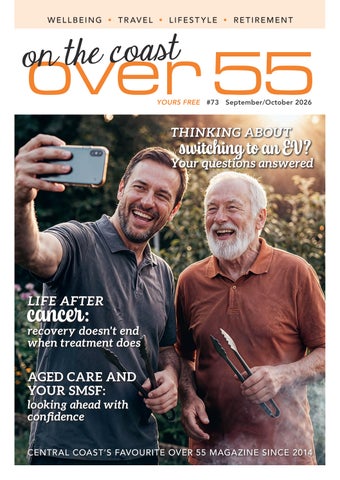
THINKING ABOUT
switching to an EV?
Your questions answered
LIFE AFTER
cancer:
recovery doesn't end when treatment does
AGED CARE AND YOUR SMSF: looking ahead with confidence CENTRAL COAST’S FAVOURITE OVER 55 MAGAZINE SINCE 2014
Welcome
Inside
Hello, Spring! A very warm welcome to the sunshine and brightness – bring on daylight saving and those glorious longer days! I don’t know about you, but this Winter felt extra long. Even without freezing temperatures or torrential rain, the energy just felt a little heavy. Now that the sun is hanging around past 5:30pm, I feel like a kid at the starting line ready to burst into a sprint. Bring it on! And with Father’s Day this weekend, what better way to kick off the new season than with a weekend of celebrating? Wishing a wonderful day to all the Dads, Granddads, Uncles, and Father figures across the Coast. It’s time to shake off the Winter cobwebs and get out and about. Enjoy every moment of the Spring delights! Happy Spring time Coasties =)
Tanzi e x x
4
The six most common mistakes in Wills
7
Life after cancer: recovery doesn't end when treatment does
8
Is it food allergy, intolerance or coeliac disease?
10 Aged care and your SMSF: looking ahead with confidence
13 Thinking about switching to an EV? Your questions answered
14 Keeping your family memories alive with John Ralph's Camera House Erina
16 Short–term funding to Art Director/Editor Tanzie Carpenter tanzie@onthecoastpublications.com.au Production Luke Carpenter luke@onthecoastpublications.com.au Editor Karen Pentland editor@onthecoastpublications.com.au Publisher Tanzie Carpenter / 0414 611 851 Luke Carpenter / 0405 449 339
Imagery magnific.com Contributors Carin Clegg, Sophie Doyle, Blake Gray, Dorian Mode, Lydia Thorpe, Tara McKenzie, Sam Woods and Jordi Woods. onthecoastpublications.com.au
help older Australians regain confidence and independence at home
18 Memories from home: Origin stories from 'Coasties'
20 Holiday on track
Subscribe to our online magazine here!
22 Building a stronger body: getting exercise right after 55
trading as On the Coast Publications ABN 52 212 212 482 PO Box 3251, Bateau Bay NSW 2261
24 Reliable home care on
For advertising enquiries advertising@onthecoastpublications.com.au
28 Your style: celebrating
For article contribution enquiries hello@onthecoastpublications.com.au
the Central Coast individuality after 55
30 Dementia Action Week: connecting our community
proudly supported by
WARRANTY & INDEMNITY Advertisers and/or advertising agencies upon and by lodging material with the Publisher for publication or authorising or approving of the publication of any material INDEMNIFY the Publisher, its servants and agents against all liability claims or proceedings whatsoever arising from the publication and without limiting the generality of the fore–going to indemnify each of them in relation to defamation, slander of title, breach of copyright, infringement of trademarks or names of publication titles, unfair competition or trade practices, royalties or violation of rights or privacy AND WARRANT that the material compiles with all relevant laws and regulations and that its publication will not give rise to any rights against or liabilities in the Publisher, its servants or agents and in particular that nothing therein is capable of being misleading or deceptive or otherwise in breach of Part V of the Trade Practices Act 1974. The views expressed in On the Coast – Over 55 are not necessarily those of the editor or publishing staff. While every effort has been made to insure accuracy of the information in this publication, no responsibility will be accepted by On the Coast – Over 55. No part of this publication may be reproduced without permission of the publisher.
Check out past articles at onthecoastover55.com.au @onthecoastover55 SEPTEMBER/OCTOBER 2026 – ISSUE 73
3
THE LAW OFFICE OF CONRAD CURRY
THE SIX MOST COMMON MISTAKES IN WILLS Making a Will is one of the most important things you can do to protect your family and ensure your wishes are carried out after you’re gone. Surprisingly, a 2023 survey found 60% of NSW residents do not have a Will! Throughout my career I’ve helped many people protect their family and plan for the future. A carefully prepared Will can provide certainty and peace of mind, while simple mistakes or outdated documents can lead to unnecessary stress, expense and even costly family disputes. Most of these issues are avoidable. Here are six of the most common
4
ON T H E C OA S T – OVER 5 5
mistakes and some tips to avoid them. 1. Waiting too long to make a Will Life doesn’t always go according to plan and many people leave it too late. Without a Will, your estate will be distributed according to a Government formula, which may not be what you or your family expect.
Geoff Brazel, Estates Lawyer, The Law Office of Conrad Curry
2. Forgetting to update your Will After you’ve made a Will, major life events can change your intentions and your family’s circumstances. Marriage, divorce, blended families, retirement, arrival of grandchildren, buying or selling property or the loss of a loved one can all affect your estate planning. TIP: Review your Will every three to five years, or when circumstances change.
Making a Will is one of the most important things you can do to protect your family and ensure your wishes are carried out after you’re gone. Surprisingly, a 2023 survey found 60% of NSW residents do not have a Will! 3. Choosing the wrong executor Your executor carries out your wishes, manages your estate and deals with what can sometimes be complex administration processes. Choose someone trustworthy, organised and willing to accept the responsibility, and also whether they have the time and ability to perform the role for you. 4. Thinking estate planning is just about a Will A comprehensive estate plan includes
an Enduring Power of Attorney and Appointment of Enduring Guardian. These important documents allow someone you trust to make financial, legal, medical and lifestyle decisions if you’re no longer able to make those decisions yourself. These documents provide invaluable peace of mind for you and your family. 5. Using a DIY Will kit With online templates and DIY Will kits readily available, it can be tempting to prepare your own Will. These appear very straightforward, but often don’t properly address blended families, business interests, superannuation, trusts or complex family arrangements. Drafting errors are common, like not understanding some assets don’t form part of your estate (eg jointly owned property, family company’s property, superannuation), not having default beneficiaries, not disposing of residuary estate, or not properly signing the Will. 6. Not talking to your family Many family disputes arise because
family members are surprised by the Will contents. You don’t need to discuss every detail, but letting family know you’ve prepared a Will, where it’s stored and explaining significant decisions can help avoid confusion and misunderstandings. Planning today brings peace of mind tomorrow Preparing or updating your Will isn’t simply about deciding who receives your assets. It’s about protecting the people you care about most and making things as straightforward as possible for them during what will already be a difficult time.
A professionally prepared estate plan can help provide certainty, minimise the risk of future disputes and give you confidence that your wishes will be carried out. Find out how our experienced team can help. www.conradcurrylaw.com.au
SEPTEMBER/OCTOBER 2026 – ISSUE 73
5
6
ON T H E C OA S T – OVER 5 5
LIFE AFTER CANCER: recovery doesn’t end when treatment does Celebrating nine years of helping Central Coast residents regain strength, confidence and quality of life after cancer.
For many people, ringing the bell at the end of cancer treatment is a moment of enormous relief. Family and friends celebrate, appointments become less frequent and life begins to return to normal – or at least that’s the expectation. But for many Australians, particularly those over 55, the end of treatment is the beginning of a different challenge. Months after surgery, chemotherapy or radiation therapy, many people continue to experience fatigue, pain, swelling, stiffness, reduced mobility and a loss of confidence. Everyday activities like gardening, walking the dog, travelling, swimming, playing golf or simply lifting the grandchildren can suddenly become much harder than expected. “Many people believe these challenges are simply something they have to live with. The reality is there is support available, and the sooner people seek help, the better their recovery can be.” THE MISSING PIECE OF RECOVERY Cancer rehabilitation is one of Australia’s fastest–growing areas of healthcare, yet many people have never heard of it until they need it. Specialised rehabilitation helps people manage the physical side effects of cancer treatment, improve movement, reduce pain, address lymphoedema and regain independence. FIVE SIGNS YOU SHOULDN’T IGNORE Persistent swelling in an arm, leg, breast or other area.
Ongoing fatigue that limits everyday activities. Muscle or joint stiffness following surgery. Pain, tightness or reduced movement around scars. Difficulty returning to normal hobbies, exercise or daily tasks. A TRUSTED LOCAL TEAM For almost a decade, Cancer Rehabilitation & Lymphatic Solutions (CRLS) in Erina has been helping Central Coast residents recover from the physical effects of cancer. The clinic has become a trusted referral partner for surgeons, oncologists, breast physicians, breast care nurses, GPs and allied health professionals who recognise the value of specialised rehabilitation as part of comprehensive cancer care.
Many people believe these challenges are simply something they have to live with. The reality is there is support available, and the sooner people seek help, the better their recovery can be
Leading the team, Cancer Rehab specialist and Occupational Therapist, Kate Perkins, one of Australia’s most recognised clinicians in cancer rehabilitation and lymphoedema management. Through national and international education, innovation including the OncoLaser™ treatment model, and the use of advanced technologies such as SOZO® bioimpedance spectroscopy and MLS Laser Therapy, Kate has helped shape the way cancer rehabilitation is delivered locally and beyond.
people recover well, maintain their independence and enjoy the things that matter most.
NINE YEARS OF MAKING A DIFFERENCE This year marks nine years since CRLS first opened its doors. While much has changed in cancer care, the clinic’s purpose has remained the same: helping
ABOUT CRLS Cancer Rehabilitation & Lymphatic Solutions (CRLS) is a specialised cancer rehabilitation and lymphoedema clinic based in Erina on the NSW Central Coast. Working closely with medical specialists and healthcare professionals, the team provides evidence–based rehabilitation supported by advanced technology and compassionate care. Learn more at www.crls.au or phone (02) 4312 7033
SEPTEMBER/OCTOBER 2026 – ISSUE 73
7
IS IT FOOD ALLERGY, INTOLERANCE OR COELIAC DISEASE? BY CARIN CLEGG, ACCREDITED PRACTISING DIETIAN
These days it seems very common for people get various symptoms from the foods they eat. It is important to know whether it is a case of food intolerance, food allergy or Coeliac Disease, as all differ from each other and have different dietary management. Let’s get a better understanding on what the three conditions are.
COELIAC DISEASE Coeliac Disease is an auto immune condition that often presents as gut symptoms such as bloating, diarrhoea or nutrient malabsorption such as iron deficiency with associated symptoms (poor concentration, fatigue, poor sleep) In the case of Coeliac Disease gluten (a protein found in wheat, rye, barley
8
ON T H E C OA S T – OVER 5 5
and oats), causes damage to the small bowel and this is why food labelling laws in Australia state that any food product containing gluten must have it declared on the label.
usually be considered safe. Reactions can range from mild to life threatening (anaphylaxis requiring adrenalin treatment).
It is very important if Coeliac disease is suspected that tests are done with adequate amounts of gluten in the diet to confirm or rule it out. This is usually about 1–2 serves of wheat foods consumed daily for 6 weeks. More information about Coeliac Disease can be found at http://www.coeliac.org.au/. The management of Coeliac disease is a strict gluten free diet.
Skin prick tests or RAST blood tests can be done to indicate the likelihood of allergy. An Allergy Doctor (eg immunologist) is usually required to interpret the results with knowledge of a detailed history and identify the likely cause of the symptoms or reactions. Information about allergic disease can be found at www.allergy.org.au. Food labelling laws in Australia require foods common to cause allergic reactions to be declared on the label.
FOOD ALLERGY The word ‘allergy’ gets thrown around a lot, usually in substitution for the word ‘reaction.’ However, not all reactions are allergies. A food allergy is usually (but not always) an immediate reaction to a specific protein in the food and is the IgE antibodies in one’s immune system over–reacting to something that would
The management of food allergies is usually strict avoidance. But in some cases, such as when children outgrow their allergies, an allergy specialist and Dietitian will give advice on how to safely include foods one is allergic to following assessments and tests.
The word ‘allergy’ gets thrown around a lot, usually in substitution for the word ‘reaction.’ However, not all reactions are allergies FOOD INTOLERANCE Food Intolerance encompasses a number of conditions and affects people uniquely in different ways. Food components a person is intolerant to can be consumed without symptoms occurring depending on their tolerance level, how much is eaten and how often it is eaten. Food chemical intolerance Usually occurs when there is a delayed reaction to one or more natural or artificial food chemicals or components common to many different foods. People who are sensitive react to more than one chemical and those really sensitive also react to cows milk, soy or wheat. There is often a strong family history of food intolerance. There is a large range of possible symptoms. Symptoms can change through different stages of life and tolerance levels can be affected by stress, hormone changes, infection and inflammation (such as reacting to aero allergens) in the body. Food chemical intolerance can affect
more than one body system and can look like an allergy. Some symptoms of food chemical intolerance include: Skin – unexplained rashes, hives, itchiness, skin swellings (angioedema). Gut – reflux, abdominal pain, bloating, diarrhoea, constipation. Respiratory – hay fever symptoms. Central nervous system – fatigue, muscle aches, sleep disturbance, altered mood, poor concentration, hyperactivity, headaches/migraines, anxiety, depression. Unfortunately, there are no reliable medical tests for food intolerance. Food triggers can have a build up effect in the body, symptoms can be delayed for up to three days after eating the trigger and they can last for up to three weeks. The RPAH Elimination Diet with Challenges is the best test method to identify food triggers. After the test diet and challenges are complete, diet variety and food chemical tolerance levels can be increased. More information can be found at the Royal Prince Alfred Hospital Allergy Unit’s Website http://slhd.nsw.gov.au/rpa/ allergy/contact.html
FODMAPS INTOLERANCE FODMAPS stands for Fermentable –Oligo–Di–Mono–sacharides And Polyols. FODMAPS are digested by the microbes in our gut and create gas which is usually reabsorbed by the gut and breathed out. However, in some individuals this gas causes an array of lower gut symptoms: bloating, distension, pain and diarrhoea, especially when there is underlying irritation by the food chemicals discussed above. Whether it is a confirmed case or in the process of diagnosis of Coeliac Disease, food allergy or food intolerance an experienced Accredited Practising Dietitian (APD) can: provide a nutrition assessment. give dietary education on the diet–disease relationship and testing methods for diagnosis. advise on appropriate dietary modification according to medical advice or evidence based practise. ensure foods are not avoided unnecessarily. ensure nutritional adequacy, preventing deficiencies and chronic disease. provide ongoing support with dietary changes.
0413 774 411 | brightdiets.com.au Bright Diets
brightdiets
Carin Clegg is a Paediatric Dietitian and Fitness Professional at Bright Diets with an interest in sustainability. Carin wants everyone to be clever about their eating to feel happy, healthy and vibrant! Reach out at 0413 774 411, www.brightdiets.com.au or on our socials.
SEPTEMBER/OCTOBER 2026 – ISSUE 73
9
AGED CARE AND YOUR SMSF: looking ahead with confidence BY SOPHIE DOYLE, RETIREMENT AND FINANCIAL AGED CARE SPECIALIST
For many people, the years after 55 are a time of planning for freedom, family and the future. They can also bring conversations that are less comfortable, including what might happen if residential aged care becomes part of the journey. While aged care may not be relevant today, understanding your options early can make a significant difference later, both financially and emotionally. If you have a Self–Managed Super Fund (SMSF), there are additional considerations worth thinking about before decisions become urgent. A little planning today can provide greater flexibility, more choices and peace of mind in the future. Why longevity matters Australians are living longer than ever. According to the Australian Bureau of Statistics Cohort Life Tables (2022–24), a man who reaches Age Pension age today may live to around 87, while a woman may live to around 90. For many couples, there is a strong probability that at least one partner will live into their 90s. This is wonderful news, but it also creates new financial challenges. Retirement is no longer a stage that lasts 10 or 15 years. For many Australians, it may span 25 to 30 years or more.
As a result, decisions about retirement income, investments, aged care and estate planning are becoming increasingly important. The choices made today can have consequences for many years to come. The cost of care is only part of the picture One of the biggest surprises for many families is the cost of residential aged care accommodation. Most aged care providers offer several ways to pay. Some people choose a lump sum payment known as a Refundable Accommodation Deposit (RAD), while others pay a Daily Accommodation Payment (DAP), or a combination of both. The right approach will depend on factors such as cash flow, asset position, income needs and broader financial objectives. The challenge is that these decisions rarely occur in isolation. What appears to be a simple funding decision can affect investments, estate planning, Age Pension entitlements and long–term financial security. That is why it is important to consider the wider picture before committing to a particular strategy. Could your SMSF help? For many Australians, their SMSF represents one of their largest financial assets. It is common for people to consider using superannuation money to fund
The best aged care decisions are often made well before they become urgent aged care costs rather than selling other investments or assets. Depending on your circumstances, this may be an option worth exploring. However, it is important to think beyond the immediate need. While accommodation deposits are generally refundable when you leave care, money withdrawn from superannuation is often much more difficult to replace. In many cases, once funds leave the superannuation environment, they may not be able to be contributed back. For this reason, the decision should be considered carefully and in the context of your broader retirement and estate planning goals. “The best aged care decisions are often made well before they become urgent.” Thinking about family and your legacy Aged care planning is not only about meeting your own future needs. It is also about protecting the people you care about. One area often overlooked is what happens to superannuation after death. Although super can be highly tax–effective during your lifetime, tax may apply when benefits pass to some beneficiaries, including adult children. This may influence decisions about whether retaining funds within superannuation or using some of those funds for aged care is the most appropriate outcome. It can also be an ideal opportunity to review your estate planning arrangements, including beneficiary
10 ON T H E C OA S T – OVER 5 5
nominations, wills and other legal documents, to ensure they still reflect your wishes. Who would manage things if you couldn’t? Perhaps one of the most important questions is also one of the easiest to avoid: Who would manage your SMSF if you were unable to do so? Many people take pride in managing their own affairs. However, illness, injury or declining capacity can affect anyone. If this occurs, having appropriate legal arrangements in place becomes essential. An Enduring Power of Attorney can allow a trusted person to step in and manage important responsibilities when required. Choosing the right person matters, particularly when they may have responsibility for overseeing one of your most valuable assets. While these conversations are not always easy, having them early can provide reassurance for both you and your family.
The earlier these conversations begin, the more options are usually available. Is your SMSF still the right fit? A SMSF can be an effective structure for the right person at the right stage of life, but circumstances change. As aged care planning becomes more relevant, it may be worth reviewing whether your SMSF still aligns with your goals, needs and lifestyle. For some people, maintaining an SMSF continues to make sense. For others, alternative arrangements may offer greater simplicity, support or flexibility. The important question is whether the structure continues to serve your needs rather than remaining in place simply because it always has. Planning brings choices When it comes to aged care, most people
are not looking for complexity. They are looking for confidence. Confidence that they can afford the care they may one day need. Confidence that their financial affairs are organised. And confidence that their family will not be left making difficult decisions under pressure. The earlier these conversations begin, the more options are usually available. Seeking specialist advice can help you understand the choices, avoid unnecessary mistakes and make informed decisions that support both your lifestyle and longer–term goals.
THINKING AHEAD ABOUT AGED CARE? If aged care planning is on your horizon, or if you simply want greater clarity around how your SMSF may fit into future decisions, now could be a good time to start the conversation.
A little planning today can often make tomorrow feel much less overwhelming. Call us: 02 4325 0884 | Email: erina@morgans.com.au | Visit us: 4/168 The Central Coast Hwy, Erina morgans.com.au/branch/Erina Sophie Doyle is a Retirement and Aged Care Specialist based on the Central Coast. She works with individuals and families over 55 to navigate superannuation, retirement planning and aged care decisions with clarity and confidence. Sophie Doyle (AR No. 000470612) is an Authorised Representative of Morgans Financial Limited (AFSL 235410, ABN 49 010 669 726). The information in this article is of a general nature only and has been prepared without taking into account your objectives, financial situation or needs. Before making any financial decisions, you should consider whether the information is appropriate to your circumstances and seek professional advice where necessary. Information current as at 1 August 2026.
SEPTEMBER/OCTOBER 2026 – ISSUE 73 11
CENTRAL COAST AUTOMOTIVE
Thinking about switching to an YOUR QUESTIONS ANSWERED
EV?
Thinking about making the switch to an electric vehicle but not sure what to expect? For many retirees, an EV can offer a quieter, smoother and more economical way to drive. Here are some of the questions we hear most often. Will an EV really save me money? EVs can be cheaper to run than petrol vehicles. Charging at home can cost less than filling up with fuel, while fewer moving parts can mean lower servicing costs. There are also no oil changes, and regenerative braking can help reduce brake wear. Is an EV difficult to drive? Not at all. EVs are automatic, smooth, quiet and responsive. Many first–time EV drivers find them surprisingly relaxing and easy to drive. Can I charge an EV at home? Yes. Most EV owners simply plug in overnight. You can use a standard power outlet or install a home wall charger for faster charging. What about longer trips and holidays? Modern EVs offer good driving range, while Australia’s public charging
network continues to grow. Built–in navigation and charging apps can help you plan your journey and locate charging stations. What if the battery runs low? Your EV will provide plenty of warning and can help direct you to a charging station. Like any long trip, a little planning makes things easier. How long does the battery last? EV batteries are designed to last for many years, with many manufacturers offering an 8–year battery warranty. Is an EV right for me? That depends on your lifestyle, driving habits and what you want from your next vehicle. The best way to find out is to experience one for yourself. Come and explore your options!
Join us at Central Coast MG’s EV and Hybrid Discovery Day and explore the latest MG electric and hybrid vehicles. Our friendly team will be available to answer your questions, explain the technology in plain English and help you find the option that suits your lifestyle – with no pressure. You can also check out the MG4 Urban, named Wheels’ Best Electric Small Car of the Year. Central Coast MG 10 Central Coast Highway, West Gosford | Open 7 days
SEPTEMBER/OCTOBER 2026 – ISSUE 73 13
JOHN RALPH’S CAMERA HOUSE ERINA
Keeping your family memories alive WITH JOHN RALPH'S CAMERA HOUSE ERINA
As we get ready to retire and downsize, the question of how to preserve family history may arise. The older recordings are bulky and can now be replaced by digital copies at a fraction of the size. Camera House can help with this transition. The generations born in the late 1940s and the 1950s have seen family history go from Brownie Box cameras to 35mm cameras with slides, then prints, and now to digital. In those years, films have also changed from early 8mm, Super 8 to various forms of tape and now to hard drives and removable media. Each of these older forms of recording has rapidly evolved into the next leaving the family with boxes of slides, tapes, prints, negatives and older media cards. These generally take up space around
14 ON T H E C OA S T – OVER 5 5
the house and are in danger of being lost, particularly on the Coast, as mould eats its way through these precious records. Camera House owner, John Ralph, has experienced this problem himself with damaged slides and tapes. This has motivated him to expand the services of the Fountain Plaza store, to provide increased archiving services with lower prices for bulk orders. Slides are prepared in a carousel and then copied using modern digital equipment, sourced from overseas, giving higher resolution than previously commonly available. By customers filling the carousels themselves, the price is kept to a minimum. Greatest popularity has been for transferring tapes to DVD and once digitized, conversion to files that can be stored on USB or computer and viewed on current Smart TVs. Tape conversion was so popular that the store now has
quadrupled the number of transfer stations to keep waiting times down. People are finding that many older photos have been damaged through the years. Either damp and mould have allowed fungus to grow or exposure to light has caused the colours to fade. This has created demand for local restoration services.
The generations born in the late 1940s and the 1950s have seen family history go from Brownie Box cameras to 35mm cameras with slides, then prints, and now to digital Pictures of all sizes can be improved. They are scanned or re–photographed and then digitally enhanced to fix colours, physical damage and even add or remove people and items from the final picture. The new picture can be enlarged from the original to produce wall art and canvases. Frequent questions asked of the store involve film. “Do you sell film?” – Yes. “Do you develop film?” – also Yes. “Do
John Ralph’s Lab Staff – Kat, Karen and Leanne are ready to help with all family archive projects.
you scan film to digital?” – Yes. Whilst film is harder to get nowadays the store searches far and wide to keep stocks up. Also the in–store film developing is very popular especially with young people wishing to try out “Grandpa's camera”. The film can be developed and either printed or scanned to USB or
Dropbox. And with more people travelling again, the number one question that is asked –“Do you do Passport Photos?” – Yes. They are done in the in–store studio, from baby to adult, including all overseas passports and are generally ready in about 10 minutes.
To restore your old memories, contact the team at John Ralph’s Camera House Shop 15, Fountain Plaza / 148 The Entrance Rd, Erina / phone 4365 2656 erina@camerahouse.com.au / erina.camerahouse.com.au
SEPTEMBER/OCTOBER 2026 – ISSUE 73 15
ADSSI IN–HOME SUPPORT
SHORT–TERM FUNDING to help
older Australians regain confidence and independence at home
A fall, an illness, a hospital visit, or a change in mobility can make it more difficult for you to carry out everyday activities and can put your independence at risk. As part of the Australian Government’s Support at Home program, the Restorative Care Pathway is a short–term service designed to help you improve your wellbeing, build your confidence, and continue living in your own home. The Restorative Care Pathway offers you concentrated support for up to 16 weeks, helping you achieve practical goals that matter to you. These goals might include improving your strength and balance, recovering after a hospital stay, adjusting to a new medical condition, or boosting your confidence in everyday activities. A team of allied health professionals and nurses will
work with you to develop a personalised plan and provide ongoing clinical advice. Restorative care, unlike ongoing aged care services, focuses on developing your abilities and independence. It aims to provide support as early as possible, before challenges become more serious, so you can recover your skills, maintain your abilities, and continue doing the things you enjoy. Adssi is an approved provider of the Restorative Care Pathway, offering services in the Central Coast, Hunter, and surrounding regions. With a person–centred approach, Adssi will work with you to help you set goals, plan strategies to achieve them, and make meaningful improvements in your daily life. If you think the Restorative Care Pathway might be for you, you’ll first need to have an aged care assessment through My Aged Care. During the assessment, an assessor will discuss your situation, goals, and the support
It aims to provide support as early as possible, before challenges become more serious, so you can recover your skills, maintain your abilities, and continue doing the things you enjoy you need to determine if restorative care is right for you. The Restorative Care Pathway represents a significant change in aged care, focusing on your recovery and independence rather than simply managing decline. With the right support at the right time, you can experience a real improvement in your confidence, wellbeing, and ability to stay safely at home.
If you’d like to find out more about the Restorative Care Pathway, contact My Aged Care on 1800 200 422 or visit myagedcare.gov.au to arrange an assessment. For more information about restorative care services through Adssi In–home Support, call our team on 1300 578 478 or visit adssi.com.au Adssi In-Home Support
adssi.inhomesupport
ABOUT ADSSI LIMITED: ADSSI Limited is a leading provider of aged and disability home care services in the Hunter and Central Coast regions. It operates multiple community care brands committed to delivering high–quality, personalised care. ADSSI Limited trades as Adssi In–home Support, Beresfield Community Care, Dungog and District Neighbourcare, and Maitland Community Care Services.
16 ON T H E C OA S T – OVER 5 5
SEPTEMBER/OCTOBER 2026 – ISSUE 73 17
MEMORIES FROM HOME Origin stories from 'Coasties' BY BLAKE GRAY, PRINCIPAL AT APEX ESTATE AGENTS
QUESTIONS
Wow. It’s Spring. I thought it would be fitting to begin the seasonal change by hearing from some of our ‘Coasties’ again, and in so doing, capture a glimpse of what drives and entices people to move to the Central Coast. 1. Where were you born and what was your childhood home like? 2. What is something you recall about your childhood home? 3. Favourite memory from Spring/Summer as a child/adult? 4. When and why did you move to the Central Coast? 5. One sentence to describe the suburb in which you live now? 6. What is your favourite Spring/Summer activity on the Central Coast? 7. Favourite room/space in your home and why? 8. Advice for anyone thinking of moving to the Central Coast? 9. Name a few things to do/places to visit/experiences to try on the Central Coast in Spring/Summer? 10. When I say, ‘home’ where does your mind go; what does the word mean to you, and has its meaning changed as you’ve moved through life?
Doug from Terrigal – age 79 1 I was born in Burwood, in 1947. We moved to Davistown around 1949 into a two–bedroom property built by my grandfather. The home is still there to this day – now it’s a cafe called The Little Teapot. We lived there as a family of four. 2 I remember the old coke fire heater and crawling around on the floor as a very young child, and playing with the foot pedal on the treadle sewing machine. We had a family get–together there about 15 years ago. I’m a pilot and to this day I still fly over the cafe, as a kind of nod to the past. 3 Every year from about 1950 or so, there used to be a little carnival at the waterfront, near the RSL club, held in honour of returned members of the
Defence Forces. Us kids loved it because they used to play practical games – nail hammering contest; knocking over cans with tennis balls etc. A man named C.Stewart used to organise a band which would play from atop a flatbed truck, and at the end of the day a man named Mr Hutton would let off flares attached to parachutes – we would all admire them as they fell with unpredictability. Everyone always stayed for the flares. 4 After Davistown, we moved to Green Point when I was in my teens. My father was a Flight Sergeant Engineer in the RAAF (working on the B–24 Bombers) and later worked as a painter/ decorator, and was a talented double bass player. He met my mother at Bundaberg Airfield during the war. My
mother was also a professional piano player. 5 Peaceful and convenient. 6 Well I’m a pilot, so flying over it and taking family and passengers for joyrides. 7 I don’t watch television or the news, so my favourite spot is relaxing in my bedroom while talking to friends all around the world. Speaking of technology, we were the first family to get a television in Davistown. 8 I would encourage them to move here. 9 Check out all the beaches; beautiful estuaries. 10 First thing that comes to mind is “safe”. Green Point from around 1960– 1970, that was “home”. Mary from Blue Bay – age 67 1 I was born in the Eastern Suburbs of Sydney. My childhood home was one of those large, single–story, brick ones, with lead–lined windows and really big rooms inside. We were a family of eight. I was one of six children. 2 Our home was always full of people. My grandmother lived across the road from us and my best friend also lived in
18 ON T H E C OA S T – OVER 5 5
the same street, so there were always people coming and going. The door was never locked at our house in those days. We had two peach trees in the backyard. 3 My grandfather built one of the first homes in Bateau Bay – along Reserve Drive. Bateau Bay was our second home all through the holidays and weekends. We loved it so much that half of us kids eventually ended up moving nearby. 4 In the early 1990s, we (my husband,
child, and I) were living in Maroubra, near the beach. I was pregnant with my second child and was feeling the pull of the Bateau Bay vibe, and the fact that many friends and family were already here meant that I/We soon moved here too. 5 It’s known to the surfers because of its left–hand break. It’s about lifestyle and being connected to the ocean. 6 I love swimming at the beach – Bateau Bay is my favourite; cycling
Blake Gray | Principal APEX Estate Agents – Blue Bay 0448 822 123 | bg@apexestateagents.com | apexestateagents.com bg_mylifeinrealestate
The Coast has the most beautiful beaches and lifestyle. It’s quiet compared to Sydney. If you’re looking to raise a young family too, then the Central Coast is the place the Tuggerah Lake Walking Track and Cycleway; and living outdoors. 7 The sunny East–facing balcony and the openness of my living space with its outlook to the ocean.
@unlockedwithblake
APEX Estate Agents are a team of avant–garde real estate specialists, marketing experts, and consummate professionals absolutely obsessed with challenging the status quo. We exist to be the ultimate custodians for our clients, thus improving their quality of life through property – that’s our raison d’être.
8 The Coast has the most beautiful beaches and lifestyle. It’s quiet compared to Sydney. If you’re looking to raise a young family too, then the Central Coast is the place. 9 You need to visit Terrigal and Avoca; Crackneck Lookout for whale watching; Norah Head Lighthouse; The Entrance Ocean Baths for a swim with great views. 10 For me “home” was growing up in a family of eight, then it was raising a family of four, and now it’s about welcoming friends and family into my own place that I’ve created with its unique ambience and vibe. Photo Credit: Photographer – Chris Osborne Business – Defiant Kind Productions Location – The Entrance Ocean Baths SEPTEMBER/OCTOBER 2026 – ISSUE 73 19
HOLIDAY
on track
WORDS BY DORIAN MODE PHOTOGRAPHY BY LYDIA THORPE
Sunset at Mount Panorama Bathurst
When I was at school, you were one of two things: Ford or Holden. Like being Catholic or Protestant — and like religion, determined entirely by what your father drove. Dad always had Fords. Righteous, dependable Fords. Then one day he turned up in a baby–poo brown Holden Kingswood station wagon. When I quizzed him on this betrayal, he shrugged with the theological confidence of a man who has made his peace with God. “It was cheaper.” I stared at my Scalextric Bathurst Fords and wondered who I was anymore. These days my tribal loyalties have softened – I drive a Kia, which is essentially conscientious objection – and I haven’t watched Bathurst in years. So why am I staying at Rydges Mount Panorama, a hotel that sits so close to the racetrack you half expect the ghost of Peter Brock to come thundering past the window? Because they’ve recently opened the most fabulous dog–friendly rooms. And when you’re an empty– nester in your late 50s, the dog is the child. Full stop. My wife – a travel photographer with excellent taste in both lenses and mini schnauzers – imagines our hairy boy at home, slumped on the couch, slowly licking his coat into a state of mournful disarray. I’m fairly confident he enjoys the break. But any chance she has to bring him along, she takes. Most of you will know the Mt Victoria Pass is closed, which means the Bells Line of Road, locals will tell you it’s often faster anyway, and for once, the locals are right. Rydges reception is a beautiful nostalgia ambush – black and white portraits of 1970s Bathurst racing line the walls, and there’s a glass cabinet of the exact model cars I once raced across
20 ON T H E C OA S T – OVER 5 5
carpet. My wife is initially suspicious of the hotel’s proximity to the track (“yep, it’s on the track”), but the dog– friendly room disarms her completely. Ground floor. Opens straight onto a strip of wee–inviting grass, complete with doggie bags and bin. Inside, the room is lovely and generously sized, with – naturally – paintings of a Holden and a Ford facing each other like old rivals at a school reunion. The kitchen is properly equipped, tempting enough to suggest you could cook one night and feel virtuous about it. The bathroom is fine, though those with less agile knees may regard the tall bath/shower with the same wariness one brings to unsolicited advice. Note too: the dog rooms are accessed via stairs. Next door, the National Motor Racing Museum is a shrine to everything that made Sunday afternoons sacred in this country. I drool over immaculate machines from my childhood – old rubber and polished metal, the weight of all those close finishes and famous crashes. Trophies, race suits, leathers, footage dating back to the 1920s. Not dog–friendly, so we leave our man in the car, his tail doing the sort of slow, philosophical wag that means he’s fine but wants you to know he noticed.
That evening we head to Church Bar and Wood Fired Pizza in Ribbon Gang Lane – named, satisfyingly, after the area’s notorious bushrangers. A revamped brick schoolhouse, loud with colour and the scent of charred dough and wood smoke. Cocktails arrive in shades that suggest someone experimenting with natural dyes. Toppings inventive; wine list solid. Dog–friendly courtyard, where we enjoy the food and curse, with the
Because they’ve recently opened the most fabulous dog–friendly rooms. And when you’re an empty–nester in your late 50s, the dog is the child. Full stop weary resignation of people our age, the complete absence of chair backs. What is it with the youth and their enthusiasm for furniture liberated from building sites? We would absolutely go back.
Church Bar and Wood Fired Pizza
Rydges Mount Panorama – Our Dog
The following morning we drop into the Bathurst Visitor Centre – always worth doing. These are the people who know about the thing that opened last week, the hidden gem that isn’t on any app yet. Then it’s into Vintage Vibes Emporium, where mid–century objects glow like artefacts from a better– dressed era. We trawl happily, the way one does when the clock has briefly been suspended. High tea at the Tea House follows. A big pot of tea and scones for $17.50, dog–friendly, and enough teapots for sale to satisfy even the most committed collector. The kind of place that makes you slow down and mean it. Then, the Chifley Home and Museum. Walking through it is like opening a drawer in your grandmother’s house and finding
Chifley Home and Museum
it hasn’t been touched since 1948. Remarkably, most of the original furniture and artefacts are still here – the modest belongings of one of Australia’s finest prime ministers, preserved with quiet dignity. At $15 a head, a genuinely moving window into Bathurst’s most famous son. We end the afternoon at Bathurst Grange Distillery, a historic estate that – should you need the credential – once received Charles Darwin. My wife and I have been writing travel yarns for over twenty years, which means revisiting places, and what’s lovely is seeing the growth. The last time we were here was for NRMA Open Road Magazine; since then, the place has blossomed. A new kitchen opening imminently. Their gin is exceptional, their whisky has won international awards, and the place is full of people working through a gin
AND LINKS HANDY WEBSITES Rydges Mount Panorama Bathurst Address: 1 Conrod Straight, Bathurst NSW 2795 Phone: (02) 6338 1888 Website: https://www.rydges.com/accommodation/ regional-nsw/mount-panorama-bathurst/ Style: Contemporary 4–star hotel overlooking the iconic Mount Panorama racetrack Rooms: 131 rooms and apartments, including studios, spa suites, and multi–bedroom options – many with balconies and racetrack views Facilities: • Outdoor pool (seasonal) • Gym and tennis court • Chicane Bar & Grill (modern Australian) • Free Wi–Fi and complimentary parking Dog–Friendly Rooms (The Good Bit) Pet Policy Highlights: • Dogs welcome (no size limit) • Up to 2 dogs per room
High tea at the Tea House follows. A big pot of tea and scones for $17.50, dog–friendly, and enough teapots for sale to satisfy even the most committed collector. The kind of place that makes you slow down and mean it paddle with the focused contentment of excellent decision–making. We join them, the afternoon light going golden over the hills, a dog asleep under the table, and all thoughts of Fords and Holdens finally, mercifully, at rest.
• No additional fee (in most cases) • Dedicated dog–friendly rooms (approx. 5 available) • Ground–floor access with nearby grassed areas for easy walk–outs In–Room and On–Site Perks: • Food and water bowls provided • Off–leash exercise area on site • Spacious studio layouts with patios and racetrack views A Few House Rules (fair enough): • No dogs in pool, gym or indoor dining areas (bar outdoor area OK on lead) • Guests must bring their own dog bedding One of the few proper hotel options in regional NSW where the dog isn’t treated like an afterthought. Ground–floor rooms open straight onto grass, meaning fewer awkward elevator negotiations and more dignified exits for your travelling companion. Add uninterrupted views of Conrod Straight and you’ve got a stay where both driver and co–driver are catered for.
SEPTEMBER/OCTOBER 2026 – ISSUE 73 21
BUILDING A STRONGER BODY: getting exercise right after 55 BY TARA MCKENZIE, SENIOR PHYSIOTHERAPIST AT CENTRAL COAST PHYSIOLATES
By the time we reach 55 and beyond, most of us know we need to move. We know strength matters. We know our bones need load. And we know fitness, balance and coordination become increasingly important as we age. KNOWING THAT ISN’T THE HARD PART. KNOWING HOW TO PUT IT ALTOGETHER CAN BE. What if you have osteoporosis and a prolapse? Your bones need load, but you're worried lifting will make your prolapse worse.
and impact exercise provide the stimulus needed to maintain bone strength and improve bone density.
That doesn’t mean women with pelvic floor symptoms should avoid lifting.
Walking is brilliant for our physical and mental health. But when it comes to building bone density, we need more.
What if you’ve had prolapse surgery and you’re still following a 10kg lifting restriction years later?
This matters because the advice to “just keep walking” can leave women believing they’re doing everything they need for their bones when they’re not. Resistance needs to progress. The body has to be challenged enough to adapt.
There isn’t a magic starting weight. If you’re weak, leaking or experiencing prolapse symptoms, you may need to start with less gravity and less load, then progressively build towards standing, movement and resistance.
What if you’re going through cancer treatment and nobody has told you how much you should be exercising? This is where generic exercise advice starts to fall short. The problem isn’t a lack of effort. It’s that generic exercise advice doesn’t always match what your body actually needs. Three areas come up again and again: bone, pelvic floor and cancer. Each has strong evidence behind it. The challenge is knowing what to do when one or more of these issues arise. BONES Bones needs load. Progressive resistance
22 ON T H E C OA S T – OVER 5 5
Then comes the next question: can your pelvic floor manage that increasing load? PELVIC FLOOR Lifting for your bones doesn’t automatically train your pelvic floor. Women can have strong squats and deadlifts and still experience pelvic floor dysfunction. The pelvic floor has its own job: it needs to contract, relax and respond to changing pressure and movement.
Walking is brilliant for our physical and mental health. But when it comes to building bone density, we need more We also need to rethink blanket lifelong restrictions after prolapse surgery. A universal 10kg limit isn’t supported by strong evidence. Once healing has occurred, the question should become how to safely rebuild capacity, rather than how to avoid load forever.
Lift. Walk. Run. Swim. Bowl. Do Pilates or Tai Chi. Dance. Garden. Play golf. Keep the movement you love. Add what your body needs Your bones need load. Your pelvic floor needs the capacity to manage it. CANCER Cancer can change both. Exercise during and after cancer treatment is now recognised as an important part of cancer care, yet fewer than one in seven Australians with cancer receive exercise guidance. Treatment may affect strength, fitness, balance, sensation, joints and
bone density. Surgery can change movement. Fatigue and lymphoedema may also affect where you start. And cancer treatment happens to the body you already have. You may also have osteoporosis, pelvic floor symptoms or an old injury. The need to move hasn’t disappeared. The starting point may have changed. PUTTING IT TOGETHER This is why expertise matters. There are levels of understanding in every profession. When health issues overlap, look for physiotherapists and exercise physiologists who have gone deeper into the areas relevant to you and can see how the pieces fit together.
progress. Then take that knowledge back into your life.
That guidance shouldn’t create dependence. It should help you understand your body, find the right starting point and learn how to
Lift. Walk. Run. Swim. Bowl. Do Pilates or Tai Chi. Dance. Garden. Play golf. Keep the movement you love. Add what your body needs.
Tara McKenzie is an APA Women’s Health Physiotherapist and Owner/Director of Central Coast Physiolates, with more than 20 years’ experience across women’s health, cancer rehabilitation and lymphoedema.
SEPTEMBER/OCTOBER 2026 – ISSUE 73 23
SIMPLY HELPING CENTRAL COAST
RELIABLE HOME CARE ON THE CENTRAL COAST At Simply Helping Central Coast, care is shaped through clear communication and a local, personal approach. For Manager Rodney Lewis, good care is about improving quality of life in a way that feels right for the individual, and should reflect the standard we would expect for our own family. Rodney shared how his journey into care began when he was just 18 years old, after his mother was diagnosed with Parkinson’s disease. That experience stayed with him and influenced how he understands support today. “The impact this had on her and our family was significant,” he said. “It showed me the difference the right support can make to someone’s life.”
After leaving school, Rodney began working in residential care before moving to a support worker role for people with disabilities, while completing his degree in social work. “That was over 30 years ago now,” Rodney said. “Each role helped me understand what good support should look like, and what people need in their day–to–day lives.”
2026 Mingara Orchid Club
SPRING ORCHID FAIR AND SHOW Australian Native Orchids and Exotic Orchids on display from around the world. Judging by AOC and ANOS Judges FREE ENTRY Saturday 12 Sept | 9am to 4pm Sunday 13 Sept | 10am to 3pm Anglican Church – Brooke Ave, Bateau Bay ORCHID VENDORS: Kawana Gardens, Ivan’s Orchids, Susan’s Succulents, Members sales table (orchids), Mingara Orchid Club Pot Shop with bark and accessories BBQ Display and Sales by Tuggerah Lakes Art Society Market stalls Great food Display by The Entrance Knitters’ Guild Tea and coffee For information: email secretarymoc08@gmail.com or call Marie 0404 041 803 www.mingaraorchidclub.com.au | Facebook: Mingara Orchid Club
24 ON T H E C OA S T – OVER 5 5
Rodney Lewis – Central Coast Manager
It showed me to never underestimate how dedicated families are. Support works best when everyone involved is working together
When I’m looking to bring someone into the team, I think about my mother,” he said. “Would I feel comfortable with this person supporting her? If the answer is no, then it’s not the right fit Rodney went on to run his own home care business for more than 10 years, supporting many people and working closely with families to provide ongoing care. He has since relocated to the Central Coast, where he now focuses on supporting people in a community he knows well. “We are local people, looking after other locals in our community,” he said. “Being a smaller provider allows us to keep things personal and consistent.” Rodney also recognises the growing need for care in the region. “The Central Coast has one of the highest ageing
populations in New South Wales,” he explained. “People need support that is based on relationships and a clear understanding of what matters to them.” His experiences have also created a clear approach to care. “Communication is key. Honest, open communication,” says Rodney. “People need to understand what support is available and what it means for them. It’s about being respectful, being clear, and following through on what you say.” One experience that stayed with Rodney involved supporting a couple living with dementia. They had returned home from residential care and required ongoing support during the week, while their children provided care on weekends. “At the time, we weren’t sure how long the arrangement would last,” he said. “But we worked alongside the family, and the support continued for three years” For Rodney, this reinforced the importance of working closely with families and building trust over time. “It showed me to never underestimate how dedicated families are. Support works best when everyone involved is working together.”
Stepping into the role of manager at Simply Helping Central Coast felt like a natural next step. “I enjoy meeting people, hearing their stories, and building relationships,” Rodney said. “People are trusting us during important times in their lives, and that matters.” Rodney’s mindset to care is simple. “When I’m looking to bring someone into the team, I think about my mother,” he said. “Would I feel comfortable with this person supporting her? If the answer is no, then it’s not the right fit.”
If you or a loved one could use some extra support at home, contact Rodney and the Simply Helping Central Coast team on 0418 559 038, or email ccenquiry@simplyhelping.com.au or visit our website at simplyhelping.com.au simplyhelpingptyltd simply.helping
SEPTEMBER/OCTOBER 2026 – ISSUE 73 25
VIBRANT CONCEPTS
Your Style:
celebrating individuality after 55 BY SAM & JORDI WOODS
After 55, you’ve probably had plenty of experience with clothes and fashion. You may also have a much clearer sense of what you like, what suits your lifestyle and more importantly what you don’t want to wear anymore. The joy of personal style isn’t about becoming someone else, dressing to a particular age, or fitting into an idea of what someone over 55 is “supposed” to look like, it’s about discovering what feels right for you. Understanding your personal style can make getting dressed easier and more enjoyable. Instead of standing in front of your wardrobe wondering what you should wear, you begin to recognise what you want to wear. Dressing becomes less about rules and more about feeling comfortable, confident and at ease in your own skin. There is no single way to dress after 55. We all have different personalities, cultures, backgrounds, body shapes, lifestyles, interests and life experiences – and that diversity and individuality is something to celebrate. We also have different relationships with clothing. Some people love fashion and enjoy experimenting with new looks and dressing up while others see clothes as primarily practical and prefer relaxed, comfortable and casual pieces. Style has no rule book and for too long fashion has often been divided into
rigid categories of what men, women or particular age groups or genders “should” wear. However, personal style isn’t a “one size fits all” it is a “what fits you” and feels most authentic to your individuality. At 55 and beyond, there is no reason to become less curious about your appearance or image. If anything, knowing yourself better can give you greater freedom to decide what feels authentic and comfortable. By the time we reach our mid–50s and beyond most of us have accumulated decades of experience with clothing. We know which fabrics we enjoy wearing, what feels comfortable, which colours make us feel good and which garments spend most of their time unworn in the wardrobe. We may also have experienced significant changes in our lives — new careers, retirement, travel, relationships, family life, changing bodies, heath issues, different priorities or simply a desire to do things differently. These things can all contribute to where we find our style today. The exciting thing is our
style doesn’t have to be defined by these events or changes, it can evolve alongside them. SO, WHERE DO YOU BEGIN? Here are six simple ways to start — or refresh — your personal style identity. 1. Notice the colours that make you feel good: Notice the colours you naturally reach for. Perhaps you feel wonderful in rich jewel tones, soft neutrals, earthy shades, navy, black and white, or bright pops of colour. Look through your wardrobe and notice the colours you wear most often and the ones that make you feel particularly good. If colour confuses you, have a professional personal Colour Analysis to eliminate the confusion and possibly help you embrace colours you may never have thought of or would like to try but never knew if they worked for you. 2. Look for inspiration everywhere: Explore fashion, art, travel, architecture, different cultures and people with a variety of ages, body types, genders and personal styles. You don’t have to copy an outfit, simply notice what catches your attention and utilise this inspiration to help you discover your own preferences. 3. Identify your style words: Choose three to five words that describe how you would like your clothes to feel.
28 ON T H E C OA S T – OVER 5 5
These might include comfortable, sophisticated, creative, relaxed, colourful, modern, timeless or playful. You may even find you are a combination of a few style categories. For example, maybe your style is classic with a creative edge or relaxed but polished. Let your “style words” guide you without restricting you to just one genre for every occasion. 4. Dress for your real life: The best wardrobe is one that supports the life you actually live. If comfort matters, make it part of your style. If you love dressing up, don’t save it all for special occasions. 5. Work with what you already have. Before buying something new “shop” your existing wardrobe with fresh eyes. Try combinations you haven’t worn before and mix formal and casual pieces together to make the most of all your items in your wardrobe. Also try experimenting with colour, different
fabric textures and statement accessories. You may discover that your personal style is already there it simply needs a little attention and some creative time put to good use. 6. Give yourself permission to evolve: Your style isn’t something you have to complete and keep the same forever. In fact, it can (and will) change as you do. You might discover new colours, different silhouettes or completely new ways of dressing as you experience different life stages and you may find that something you once loved no longer feels right. That’s not losing your style, that’s developing and evolving it. Your style is part of your story, but it doesn’t have to tell the same story at every stage, it can change, surprise you and evolve with every new chapter.
Perhaps the most important thing to remember is that there is no single definition of what a person over 55 should look like and there is no dress code for being yourself – at any age. We are not one demographic with one wardrobe, we are individuals with different genders, identities, cultures, bodies, abilities, lifestyles, budgets, personalities and experiences and that truly needs to be expressed and celebrated – everyday! Stylish yours, Sam & Jordi xx
Understanding styling and fashion is one thing. Having a super natural flair for making everyday people look incredible is another. Once you’ve met Sam and Jordi Woods, it’s hard not to catch their infectious passion for dressing to match your own lifestyle, personality and charisma. Through their consultancy ‘Vibrant Concepts’, Sam and Jordi have transformed the lives of thousands. Let Sam and Jordi show you how to look and feel fabulous everyday – learn the art of illusion dressing, colour matching, styling, translating fashion trends and savvy shopping with their unique VC Signature Styling Systems and services that are truly personal and really work! To contact Vibrant Concepts phone 0425 221 676
SEPTEMBER/OCTOBER 2026 – ISSUE 73 29
DEMENTIA ACTION WEEK: connecting our communit y
Following the wonderful response from the Central Coast community, we are excited to bring our Dementia Action Week Community Event & Expo back for a second time this year. Taking place on Thursday 24 September 2026 at Mingara Recreation Club, this free community event brings together people living with dementia, carers, families, health professionals and the wider community to connect, learn and discover the support available locally. The morning will feature expert talks, practical advice, local support services, free health and wellbeing checks, resources for carers and families, new ideas for dementia care and a complimentary morning tea. After the success of our previous event, we are looking forward to once again bringing the Central Coast community together for a morning focused on knowledge, connection and innovation.
THURSDAY 24 SEPTEMBER 2026
DEMENTIA ACTION WEEK FREE COMMUNITY EVENT & EXPO Supporting people living with dementia, their carers, families and the wider community through knowledge, connection & innovation Expert talks and simple, practical advice New ideas for dementia care Connect with local support services Help and resources for carers and families Free health and wellbeing checks Free morning tea REGISTER TODAY
MINGARA RECREATION CLUB
THURSDAY 24 SEPTEMBER
REGISTER HERE Supported by
9:00AM - 1:00PM
SHOWCASING THE CCDA DEMENTIA Information stalls open until 1:30pm SERVICES APP EVENT PROUDLY BROUGHT TO YOU BY A special highlight of this year’s event will be the RSVP: Friday 11 September 2026 opportunity to discover the Central Coast Dementia Alliance (CCDA) Dementia Services App, developed For more information from the Central Coast Dementia Resource Booklet. P: 02 4344 8432 E: CCLHD-WoyWoyCHC@health.nsw.gov.au The app brings together valuable information about dementia services and supports across the Central Coast in an easy–to–access digital format, helping people living with dementia, carers, families and professionals connect with local information and support. Come along, meet local service providers, hear from experts, explore the latest resources and discover how the new CCDA Dementia Services App can help make navigating dementia support easier for our community. THURSDAY 24 SEPTEMBER 2026 Register for the Dementia Action Week Event with the QR code. (right)
DEMENTIA ACTION WEEK
DEMENTIA ACTION WEEK This event is proudly brought to you by the Central Coast Dementia Alliance Community Event & Expo FREE COMMUNITY EVENT & EXPO and supported by Central Coast Council. Thursday 24 September 2026 Supporting people living with dementia, 9am – 1pm their carers, families and the wider community Recreation Club through knowledge, connectionMingara & innovation Free community event Expert talks and simple, practical advice New ideas for dementia care Free morning tea Connect with local support services Registrations Help and resources for carers and families are essential. RSVP by Free health and wellbeing checksFriday 11 September 2026. Free morning tea REGISTER TODAY
MINGARA RECREATION CLUB
THURSDAY 24 SEPTEMBER 9:00AM - 1:00PM 30 ON T H E C OA S T – OVER 5 5
REGISTER HERE Supported by
Information stalls open until 1:30pm EVENT PROUDLY BROUGHT TO YOU BY
RSVP: Friday 11 September 2026