All rights reserved. No part of this publication may be reproduced, copied or transmitted in any form or means, or stored in any information storage or retrieval system without the written permission of the Dean Forest Railway Society.
Views expressed within this publication belong to their individual authors and are not necessarily those of the editors, the Dean Forest Railway family of organisations, the Society or its Trustees. The Dean Forest Railway Society accepts no liability or responsibility for any loss resulting from information provided in this publication.
How to submit an article
We prefer articles in electronic format (preferably Word) and high-resolution images to be emailed to the editors at: magazine@deanforestrailway.co.uk
Or by post to:
The Editors, DFR Magazine
Dean Forest Railway Society Norchard Forest Road, Lydney, GL15 4ET
This issue has been edited and produced by a team of volunteers and Trustees of the Society.
Laid out in Adobe InDesign & printed by Solopress.com. Copy Deadline
Please send your reports, letters, comments, photographs and any other content for Issue 75 by, at the absolute latest: 2nd May 2026
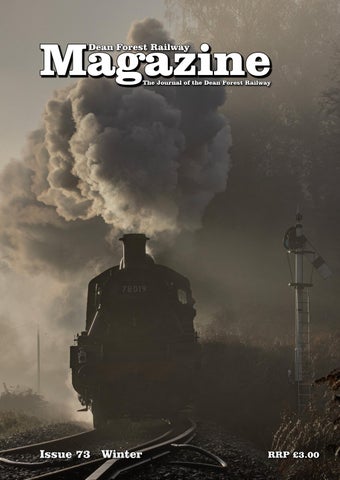
Front cover: Robert Green was on hand to capture No. 78019 at the head of a goods-train charter, the locomotive emerging through the early-morning atmosphere on the climb to Norchard High Level.
Rear Cover: Renowned landscape and railway photographer Don Bishop captured a timeless scene at Parkend during an evening charter with No. 9681.
All DFR Society post (donations, membership renewals and general correspondence) should be sent to: DFRS Honorary Secretary (Mrs. S. Williams) 109 Victoria Street Cinderford Gloucestershire GL14 2HU
From the Editors
Dear Society Members,
Before we begin, we would like to take the opportunity to remind everyone that we are still seeking willing volunteers for several roles within the Charity:
• Publicity Officer
• Social Media Lead
• Volunteer Liaison Officer
These roles are currently filled on an ad hoc or temporary basis and we would be interested in hearing from anyone who would be willing to pick up the mantle, and perhaps even lead a team (or teams) going forward.
The charity raffles are an important source of income, and winners for those held in 2025 are detailed below:
Prizes Spring Draw Autumn Draw
1st of £250 Bernie Haylock Simon Phelps
2nd of £100 Alex James Alex Wright
3rd of £50 Oliver Brighton Alan Musker
4th of £25 David Channon Bernard Baldwin
The magazine is scheduled for publication around a month after each deadline (allowing for major events and holidays). Although the deadline for Issue 74 has already passed, the remaining deadlines for 2026 are as follows:
• Issue 75, copy date: 2nd May
• Issue 76, copy date: 1st August
• Issue 77, copy date: 31st October
All members with a valid email address will be sent an electronic copy, with hard copies mailed out to all members at least a week later (except for those who have opted to receive electronic copies only).
To maintain the standard that you have grown to know and love – we use the same fonts, sizes, and styles throughout: Title: Clarendon Blk BT, size 36pt
Body: Gill Sans MT, size 11pt
For anyone writing content you can use those parameters, otherwise, please use the regular font in your chosen software, set at size 11pt. Images need to be high quality. If you're unsure or need any advice, please get in touch! Please make every effort to submit articles and high-quality photos – we simply cannot publish what we do not have!
Letters to the Editors should be sent either by email to magazine@deanforestrailway.co.uk or by post to the DFRS Honorary Secretary – letters received by the copy date that can be published will be passed on for an answer and then included near the rear of the issue. As always, we value your support, and we remain dedicated to keeping you informed and connected within the railway family.
With best wishes
Adam W, Ian & Tim
Your editorial team
Left to Right: Adam Williams, Tim McLennan, Alastair Clarke, Alex Davies, Adam Dickinson, Ian Pope
Chairman’s Platform
Forest of Dean Railway Limited Chairman, Ian Pope reflects on the 2025 season.
And so, another operating season draws to a close. There have been some good events and some that we would rather forget. On the plus side has been the work done at Middle Forge to improve the drainage, new trackwork and, to top it off, a lovely new bracket signal.
Work commenced north of Parkend to stabilise a boundary retaining wall and clear vegetation towards Travellers Rest Level Crossing. Again at Parkend, new trackwork has been installed too – much improving matters. Whilst at Whitecroft we finally have the new level crossing gates; who would know that they are not of timber construction?
For all of these works we have to thank the volunteers who have put in many hours of (often hard) labour in less than ideal climatic conditions. To everyone, I say thank you.
Thank you to all volunteers and staff who turn up for every operating day to perform a plethora of tasks to keep the railway running, locomotives and stock in good order and, most importantly, to keep our travelling public safe and happy, and to live our motto, ‘The Friendly Forest Line’. I am proud to have heard reports from many very happy passengers who look forward to returning to the railway.
However, there are the often unseen and unheralded jobs that go on behind the scenes to keep all of our stations neat, tidy and clean, the toilets functioning, rubbish and waste removed, and flower beds tended – the list goes on. Thank you too to all of the groups connected with the railway – the Museum, the DFLG, the DMU Group and the Friends of Parkend, just to name a few.
Perhaps, if in reading this you realise that you have not considered volunteering, then please give it some thought. A warm welcome would await you, and you can see from the contents of this magazine just how many opportunities there are. You can put in as much or as little time as you can afford. Even just covering a couple of weekends as a Travelling Ticket Inspector or raffle ticket seller can bring much satisfaction and greatly ease the workload of others.
We can also provide new skills, with professional training being given in some instances, so if you fancy a change from the day job then get in touch. I certainly have enjoyed days tidying the site up, especially around Lydney Junction, where I found great satisfaction can be had in hurling a broken rail chair into a skip – who needs a stress ball? Well, towards the end of the year many of us did need a stress ball with the destruction of St Mary’s Bridge. As a result, a number of people have spent many hours sorting out paperwork for the enquiries being held by the Rail Accident Investigation Branch (RAIB) and the Office of Rail and Road (ORR).
As seen later in this issue, the Safety Digest published by the RAIB has been issued and its findings accepted.
We were reviewing and updating our policies and procedures before the contents of the RAIB report were known; hopefully these will all help to prevent a repeat. However, until the ORR report is published, we are still squeezing that stress ball. It was not only the two investigations that have taken up time, but also dealing with our insurers, our solicitors, the council over a listed structure, and a footpath diversion.
We have had an assessment of the remains carried out by a structural engineer and we are now mulling over their report. The diversion of the footpath has not been appreciated by some, even though the distance is not great. We have had numerous examples of trespass, mainly by children, who have broken down barriers, fencing, etc. We have evidence on camera and will be pressing for prosecutions for railway trespass, carrying a fine of £1,000.
I must remind volunteers to follow Health & Safety regulations, our own Rules & Regulations, and to ensure that all competencies are up to date and current. If they are not, then please do not undertake any task for which you have not received training and been passed as competent. We were lucky with St Mary’s – if anybody had been injured, or worse, then railway management would be looking at charges of corporate manslaughter
However, as management we rely on volunteers doing the right thing. Ultimately, if any volunteer is not happy with doing something, or knows that they have not done it before, then do not be afraid to stand up and say no. In the same vein, if you are told to stop what you are doing, or not to do something, please do not go off and do it anyway.
I will finish on a much happier note.The two galas towards the end of the year were well worth attending. I could not have imagined, back when the Dean Forest Railway started and I attended the first ever open day with Uskmouth I on the siding at Parkend, that the completely restored station would one day host a Deltic in its platforms.
Along with the Class 50, they made the weekend a joy. So too was the steam gala, and for me the highlight was the visiting Hunslet. Thank you to all concerned with the galas, which have certainly generated a lot of interest in the Dean Forest Railway through the many photographs and video clips posted online and in magazines.
Hopefully 2026 will allow us to proceed with our development plans rather than taking steps backwards. We really do need to press on with Lydney Junction, as personally I am ashamed that so many newer heritage railway projects have managed to build carriage sheds to protect the stock that so much work goes into restoring So, as we move towards the 2026 season, let us make it as successful and enjoyable as 2025. See you soon!
Society News, and...
Dean Forest Railway Society Chairman, Tim McLennan updates on some changes within the Charity.
Over the course of 2025, following communication and advice from the Charity Commission, the Trustees of the Dean Forest Railway Society have reviewed their policies regarding conflicts of interest, particularly given the close relationships between the various railway organisations.
In December, in order to ensure that the Society’s decision-making process is as effective as possible, it was agreed that Officer positions should be held by Trustees who are not also Directors (except where appointed by the Society) or who hold employed positions elsewhere within the DFR. For those wondering, there are four Officer positions in the Dean Forest Railway Society:
• Chairman
• Vice Chairman
• Treasurer
• Secretary
As such, James Graham – who is a paid employee of Dean Forest Railway Company Limited (DFRCL) and Adam Williams who is a Director of DFRCL have resigned their positions as Chairman and Vice-Chairman respectively.
I would like to thank them for the work they have done in these roles, and welcome their continued support as Trustees. I would also like to thank Adam for drafting a rule book for the Society based on best practice and in accordance with our constitution. This will need to be approved at an AGM, but will be a great step forward.
To fill these vacancies, the Trustees have appointed me as Chairman and Doug Johnson as Vice-Chairman.
For those who don’t know me, a little background: after graduating from university in 2014, I joined Bank of Ireland within Credit Risk, working in Bristol. I joined the Dean Forest Railway in 2015 with the intention of volunteering in the Steam department, having had previous experience operating smaller-scale locomotives at Trago Mills and Evesham Vale. A visit to the DFR two years earlier had also piqued my interest in volunteering.
I offered myself as Treasurer of the Society in 2017 and, since then, have helped the Society become a charity in 2019 and contributed to a number of projects that have transformed its finances and assets. Separately, between 2018 and 2023, I was also Commercial Director on both the Forest of Dean Railway Limited (FoDRL) and the DFRCL boards, and later co-chaired the DFRCL board.
More recently, my time has been occupied by the arrival of my son,Tobias, in December 2024. In addition, with living in Weston-super-Mare, popping up to the Forest of Dean is a commitment of at least half a day at a time. However, with the position of Chairman becoming vacant, I offered my skills to the Trustees, for the benefit of the whole Society.
Since 2017, I have also chaired several meetings when required. I can sometimes be seen on the footplate of a steam locomotive as a member of the Steam department, or with the Development team wielding a set of loppers.
Doug was more recently elected as a Trustee but is a very active volunteer and a regular presence at the DFR. He often volunteers within the Diesel or Signalling departments and has helped out in the Lineside and Development teams since joining the Railway.
Doug is also a qualified chainsaw operator, and both of us are qualified 360-degree excavator operators.
There is plenty to be positive about in 2026 for the DFRS. After receiving Midland brake van No. 732268 following its full restoration by David Turnock, we have sent away a second brake van (BR Standard 20T No. 955224) for similar treatment. Significant progress has been made on Andrew Barclay No. 2221, with a very good chance of seeing this locomotive return to steam this year to partner Uskmouth 1 and complete our small locomotive fleet. Both of these projects represent significant investment in our heritage assets, and all donations are extremely welcome.
Speaking of Uskmouth 1, I am keen to ensure that our Peckett gets more use this year. Early in the season, I will be looking to organise trials to run her with the Saloon, so that the Railway can offer a unique experience of locomotive plus inspection saloon alongside the usual service train, as well as proposing other initiatives. Finally, I would like to stress the importance of working together across all areas of the Railway. In recent years, I have witnessed first-hand a number of unpleasant interactions, misunderstandings, and the spread of misinformation, all of which can be damaging to morale and to the reputation of the organisation as a whole. It is entirely reasonable not to agree with certain decisions or individuals, and healthy debate is a natural part of any volunteer-led organisation. However, it is important to remember that everyone involved – including those making the decisions – are volunteers who give their time freely because they care about the Railway.
This is ultimately a hobby. At the same time, operating a railway is safety-critical, and the focus on compliance (both internally and externally) will continue to increase, particularly following the unfortunate event at St Mary’s last August. We all need to work together, ensure that we are doing things in the right (safe) way, and do our best to improve! The Dean Forest Railway has great potential, but real progress can only come from unity.
If you have any suggestions, comments, or issues you would like to raise, I would encourage you to get in touch via the Society email address: society@deanforestrailway.co.uk
Ways to Support Us
The work of the Dean Forest Railway Society in supporting the preservation and development of the Dean Forest Railway does not happen without the generous support of our members. We have a wide range of ways to support the railway, and if every member gave perhaps the price of a pint of beer or a takeaway coffee each month, we could achieve so much more. Take a look at the options below, can you help?
• Gift Aid
The DFR Society is a registered Charitable Incorporated Organisation (CIO), allowing us to claim Gift Aid on donations and memberships where a signed declaration has been received from those of you who are UK taxpayers, increasing the value of those donations by a whopping 25%! If you’ve not completed your form yet, please do. Gift Aid forms are on the cover letter with this magazine, or can be completed through our website: dfrsociety.org.uk, from the shop at Norchard on request or whenever a membership is purchased online via: dfr.hops.org.uk/membership
• Regular Saver
Why not consider a regular monthly donation? We have already had a number of generous donors sign up, but every extra penny is greatly appreciated. As mentioned above, you can now boost your donation by 25% if you apply Gift Aid to your application! Even the smallest donation on a regular basis can add up to a generous amount at the end of the year. Find out more on our website page: www.dfrsociety.org.uk/regular-saver
• Forest Lottery
Alternatively, if you’d like the chance to win a prize in return for donating to the DFRS, you can now join the Forest Lottery. The top prize for this weekly lottery is £25,000, with much better odds of winning than the National Lottery...plus 50% of your ticket goes directly to the DFRS! You can sign up using this link below: www.forestlottery.co.uk/support/dean-forest-railway-society
• EasyFundraising
If you prefer, you can raise money when you buy almost anything online! Go to www.easyfundraising.org.uk and search ‘Dean Forest Railway’ – you can choose either the DFR Society or the Dean Forest Railway Carriage & Wagon Workshop Appeal as your preferred cause. More information is available on the website!
• Text to Donate
You can donate £10 by texting DFRS to 70191. For this service, donations are processed and administered by the National Funding Scheme, operating as DONATE, a charity registered in England and Wales (1149800) and Scotland (SC045106). In addition to any text donation, you will incur your standard network message charge (based on your service provider rates). For Terms & Conditions, see: www.easydonate.org
• Cash, cheques and bank transfers
Regardless of the new channels detailed above, we are always more than happy to receive donations directly. If you would like to send cash or cheques to us, please address them to:
Alternatively, if you would like to transfer funds to us directly via BACS, our details are as follows: Lloyds Bank, Sort Code: 30-91-87, Account number: 01931161
Finally, a sincere thanks on behalf of the Trustees for your generosity in supporting the railway! Here’s to 2026!
Valley Rail Update
Valley Rail Preservation have made huge strides at Lydney Junction during 2025. By mid-June, the repaint of OCA 112000 was complete and, along with OCA 112013, both vehicles then had their air brakes reinstated.This was done ready for the rideable air-braked freight train scheduled for Saturday 15th June. One of the visitors was specifically complimentary about the new colour scheme on 112000!
Whilst this feedback was great motivation, it was perhaps not as motivating as the gentleman who arrived at Lydney Junction for a round trip behind 09 106 after arriving in his hire car from Bristol Airport… He had flown in from Belgium that day, but with no early return flights after his enjoyable day out, he drove to Exeter to return home.
The following week saw the commencement of the repaint of 09 106 in to Railfreight (Red Stripe) from the HN Rail orange livery for Road and Rail Steam Services. Work has also progressed with bodywork repairs and a repaint of VCA 200419 for the National Wagon Preservation Group.
At the start of August, 08 288 Phoenix arrived from Ropley on the Mid-Hants Railway for some repairs to the power unit. At the same time work continued on replacing missing pipework and valves on 09 006, whilst 09 106 had a replacement exhauster fitted, which allowed bodywork repairs to take place before continuing with the repaint. Mid-August of course saw the unfortunate destruction of St Mary's footbridge, of which 08 769 was directly involved.
After the site was handed back to the DFR by the authorities, 08 769 was released from the wreckage and returned to Lydney Junction for checks and assessment.
One of the exhausters was found to be damaged and was isolated – apart from that, the damage was superficial. The locomotive was returned to service, but it looks like it will be carrying some battle scars for a while yet.
The following week saw the only notable failure during a running day… On Saturday 23rd August, 08 769 shut down at Whitecroft whilst hauling a service train during the steam ban and failed to restart. The diagnosis from the driver was rather simple: "engine turns but does not fire".
With the basic fault charts followed, and the engine still not running, those on duty scrambled 08 288 to rescue the train. On arrival back at Lydney Junction, 08 769 was shunted onto the depot in disgrace and 08 288 continued with the rest of the service for the weekend.
Investigations the following week found the source of the problem: a link had failed on the diesel engine’s timing chain. This chain synchronises the crankshaft and camshaft, ensuring that the valves open and close precisely for combustion. Thankfully, the valves are fail-safe, allowing enough clearance so that they do not come into contact with the tops of the pistons. We have never seen a timing chain on one of these locomotives fail, so this was a first for me… but where to obtain a replacement chain?
Martyn Normanton gives an update on the work and progress at the Lydney Junction Diesel Depot.
Opposite Page: Freshly repainted OCA 112200 basks in the sun at Lydney Junction whilst being shunted to the West Loop. (Photo: D. Winter)
Above: 09 106 leads a short freight on the Railfreight day. (Photo: K. Jones)
Left: 08 288 arrived from Ropley during early August. (Photo: M Normanton)
Below: 09 106 with the engine and generator compartment doors removed so that they can be cleaned and repainted. (Photo: A. Williams)
Above: After rescuing the service train, 08 288 shunts the disgraced 08 769 off of the train and in to the Depot.
(Photo: A. Williams)
Left: The new timing chain ready to be fitted to the engine. (Photo: M Normanton)
Below: One half of the failed link from the timing chain. (Photo: A. Dickinson)
After some rather frantic phone calls, there was a growing anticipation of a long drive or an expensive shipping bill in order to get a replacement back to Lydney.
However, after an off-hand comment of "why not try soand-so", we hadn’t secured just one timing chain… but three! With the engines for 09 006 and 09 015 being completely overhauled, this worked out quite well...
Even better was that the chains could be collected the next day from Acorn Industrial Services – a small business in Cinderford, based on Forest Vale Industrial Estate.
By Friday 29th August, the new timing chain had been fitted. Although there were outstanding jobs to finish off, the new chain was monitored for a while and 08 769 lived again! It had initially been written off as being unavailable for the Diesel Gala in the middle of September but, apart from failing to create sufficient air pressure one morning (which was later resolved), it performed really well.
October saw some more drastic changes around the site at Lydney Junction. During the first half of the month, a new concrete pad was laid outside the workshop container.
The plan being that the pad would eventually be boxed in and become our covered machine shop. This would save us from the challenge of having to drag everything to Norchard and back just to use the equipment there.
With the site cleared, over a three day period towards the end of the month a new building was erected.
So, apologies to all of the photographers who frequent Lydney Junction to see diesel era locomotives and stock!
However, an insulated shed and a large space heater (which could easily be mistaken for a jet engine from a small aircraft) – makes working conditions more favourable. It will be interesting to see what the working conditions are like throughout the rest of the year, but the results are promising already. We have already benefited by the reduced the number of instances of "rain stopped play".
Above: The new concrete pad ready for the machine shop.
Below Left: Day one and the frame of the building was up! (Photos: A. Williams)
Below: After three days, the roof, sides and roller shutter doors were fitted. 08 288 quickly became the first guest. (Photo: M. Normanton)
View from the Box
Adrian Copley, DFR Operating Manager, looks back at 2025 and forward to
Well, that didn’t last long! No sooner than we tried steam on that Wednesday back at the end of July, then there was a ban on all steam due to the fire risk in the forest, this lasted until the beginning of September. The hoped for use of Sapper for ‘running in’ didn’t take place either, she went away to fulfil the contract.
Time was ramping up towards the Diesel Gala with the arrival of Class 50 50021 Rodney, also known as ‘Dave’ (an Only Fools and Horses reference) on 26th August.
I remember my first encounter with the class when D400 arrived at Bristol Bath Road Depot in October 1972 and all the maintenance staff went on strike in the December. This was because of the enforced arrival of the class and the relocation of our Class 47s (the D1000 Westerns, now known as Class 52, had already been re-allocated to Plymouth Laira and were only seen on depot occasionally).
This was the first time that apprentices were allowed out on strike and as a member of the Amalgamated Union of Engineering Workers... I was there, even making the photo that made the front page of the Bristol Evening Post!
The Class 50s were being transferred from Crewe to operate the Bristol to London services until the introduction of the new High Speed Trains (HSTs) and were a bit worn from thrashing up and down the West Coast main line whereas the Class 47s had been fettled to a high degree after the Westerns had left for Devon.
There was a rumour that the Deltics could have been sent to Bristol for this job, but the introduction of the HSTs was later than planned and Bristol to London would now be the first route in service anyway… now that would have interested a young apprentice fitter!
Politics were at work in the background with rumours that a ‘midland’ man was in charge at the Derby Head Quarters who was in charge of the locomotives now that their maintenance was the responsibility British Rail Engineering Limited (which was formed in 1972 and owned all main works and maintenance depots).
This was the excuse for the enhanced need for withdrawal of the now non-standard Western Region hydraulics (there was always some sort of competitiveness between regions as there had been with the original railway companies). All of the withdrawals caused a traction crisis at the time, and I remember condemned Warships and Hymeks being patched up, engines changed, or whatever was required to provide locomotives for weekend engineering trains, something never noted in the Railway Observer! The last class of hydraulics to go were the Westerns (or Class 52) in late 1977 (roughly a year after the introduction of the HSTs). However, six were kept for possible refurbishment for Mendip Rail (Foster Yeoman) at Merehead Quarry.
the 2026 season.
The solution instead was the Class 59 in 1985 with the interim period covered by whatever was available at Westbury. Although there were a couple of fitters from Bath Road who moved to Merehead to help the project.
The diesel gala with 50021 and Deltic 55009 Alycidon as our visitors, was a great success although yet again there was a lot of last minute organisation but not as bad as 2024 when we had our own traction crisis! What sights and sounds as the visitors climbed the Lyd valley. Then a cunning plan was hatched. ‘Dave’ was going home by rail and was probably being collected by another Class 50, so why not ‘borrow’ the other Class 50 for a mini-gala day!
50008 Thunderer arrived on the Friday afternoon and a mini gala Class 50 day took place on Saturday 18th October. My camera couldn’t make it that day as the NHS wanted to stab me in both arms at 1300 hours, and I couldn’t change the appointment! A successful day again with lots of grinning faces… apparently.
Both Class 50s left DFR metals on the Monday. Meanwhile just around the corner in a couple of weeks was the steam gala and five photo charters all requiring some sort of organisational planning. In the end one charter was cancelled, the main reason was the later than planned guest loco arriving about a week later than hoped. The locomotive booked for the charters and gala was No. 78019, a BR Standard Class 2 based at the Great Central Railway in Leicestershire, which arrived by road to Lydney Junction and then tripped to Norchard.
After test running, the first public day with No. 78019 was on Saturday 25th October and it was used on all running days until the end of the charters on 8th November. I heard most crews having positive opinions and "can we keep it?" being the most common comment! The next visitor was an 0-6-0 Hunslet saddle tank Newstead which arrived on Wednesday 29th October again by road and tripped to Norchard before the service train.
This engine before recent restoration was found in a barn in a Nunnery. We used the locomotive during the gala and paired in the afternoons with Uskmouth 1 which caused a lot of interest.The weather was fair on the Saturday of the gala which meant I could use my camera for a couple of quick grab shots. However, the Sunday was full of beautiful sunshine and typically – I couldn’t be there!
Many pictures and clips adorned the internet and there were lots of people commenting that they had enjoyed the weekend of entertainment. Yet another success!
The gala weekend was preceded by both a shunting and cleaning day and the Monday was shunting it all back! Many, many thank-yous go to all the staff who have helped out to make our events a success this year, especially as we have had one or two small problems to overcome!
I mentioned photo charters, the first was on the evening of Wednesday 22nd after the service train with a small goods train and 9681 at Parkend. Running the charter in the evening was a bit of an experiment as we haven’t done anything like that for well over twenty years!
The rain did not end up being as bad as was forecast and the photographers were happy with the final results!
That was a long day for me, booking on at 1 p.m. for shunting and arriving home just before 1 a.m. the following morning. However, there was a catalogue of problems (thanks to delayed buses and mainline rail services!).
The second charter on Monday 27th was with No. 78019 and a short passenger train re-creating the local train on the Nailsworth branch. The sun was about in the morning but played hide and seek in the afternoon.
The last two charters were on Friday 7th and Saturday 8th November with a small goods train and No. 78019. What a difference a day makes! The Friday was overcast to start with, but there was a flash of sunshine during the late morning for an hour or so, then (as expected) the rain arrived in the afternoon which led to an earlier finish.
Below: 9681 prepares to shunt in Norchard Yard, whilst 78019 passes on the High Level with the goods train.
(Photo: M. Tattam)
The next morning as I crossed the old Severn Bridge I could see the coast hugging fog amid sunshine. Now this could go one of two ways!
As the train departed Norchard Yard, the sun started to break through resulting in some super pictures for an hour or so, but it didn’t end there, the sun shone all day which meant that there were lots of happy photographers!
There was an added bonus in that Pannier 9681 was in steam shunting Norchard Yard in order to prepare to lift the repaired boiler back in to WD152 Rennes.
Some of the lucky visitors managed to get shots of steam working on both the high and low levels simultaneously.
After all that activity we had a short breather for some maintenance jobs and then it was time for the annual visit of the bloke with a white beard and a red suit!
Meanwhile 2026 has to be organised, the running days have been ‘put to paper’ but an idea has been put forward, so I await the changes before amending and issuing! A bit like measure twice, cut once – I only want to print once!
I wish you all seasons’ greetings and best wishes for 2026!
RAIB Incident Report
Adam Williams introduces the Safety Digest from the Rail Accident Investigation Branch (RAIB).
The RAIB investigates UK railway accidents and incidents to establish why they happened, with the sole purpose of improving safety and preventing future occurrences –never to assign blame or liability.
Information is shared publicly through Investigation Reports (in-depth analyses of major accidents or serious incidents), Safety Digests (brief reports, particularly where similar incidents have already been the subject of an Investigation Report), or Urgent Safety Advice (issued where a new or emerging risk is identified during an investigation and immediate action is required).
We have not been in a position to publicly discuss the details of the incident until now due to restrictions placed on us by the Railways (Accident Investigation and Reporting) Regulations 2005. However, on 26 November 2025 the RAIB published their Safety Digest 05/2025 for the incident at St Mary’s Bridge.Whilst it is readily available online, the report has been reproduced here in full.
1. Important safety messages
This accident demonstrates the importance of heritage railway staff and volunteers:
• Only undertaking safety-critical tasks for which they have been trained and assessed as competent
• Being aware of any loading gauge restrictions when transporting large or unusual loads by train.
This accident also underlines the importance of heritage railways undertaking appropriate risk assessments for their activities and implementing effective controls.
2. Summary of the accident
At around 10:55 on Thursday 14 August 2025, part of a 360-degree excavator being transported on a train struck the footbridge which carries a public footpath over the Dean Forest Railway at St Mary’s Halt station, Lydney, Gloucestershire.The train was travelling at around 10 mph (16 km/h) when the accident occurred. The footbridge collapsed as a result of the collision, with parts of it falling onto the station platform and the moving train.
There were no injuries caused by the accident. No pedestrians were using the footbridge when the accident occurred, and the railway was not open to the public.
The train, operated by Dean Forest Railway volunteer staff, was transporting an excavator owned by the railway from Lydney Junction to Whitecroft, a distance of around 3 miles. The train consisted of a class 08 diesel-electric shunting locomotive propelling two 4-wheel well wagons and a bogie brake van, which was at the leading end. The excavator was on the wagon nearest the locomotive, but the train driver was unable to see it as the locomotive’s driving cab was at the rear.
The brake van was carrying six volunteers, including a shunter who was riding on the leading veranda. The shunter was responsible for keeping a lookout and giving movement instructions to the driver by radio. When the shunter heard a loud bang, they immediately instructed the driver to stop.
3. Cause of the accident
The accident occurred because the 360-degree excavator was stowed on the wagon with its bucket resting on the wagon’s raised deck. This increased the excavator’s height and meant that the upper part of its dipper arm, attached to the boom, was too high to pass under the footbridge.
The Dean Forest Railway is a 4.2 mile (6.8 km) long heritage railway that runs between Lydney and Parkend in the Forest of Dean. The Dean Forest Railway was established in 1970 and started operations in 1971. It is operated by paid staff and volunteers.
The lattice girder footbridge at St Mary’s Halt was opened in 1892 and constructed of wrought iron beams supported on cast iron columns. It spanned the tracks and platform and carried a public footpath providing access to a lake and a residential area. In 2022, following refurbishment, the height of the underside of the bridge was measured at 4.35 metres above rail level.
The railway owns three ‘Loriot’ well wagons which were built by British Railways in the 1950s. This type of wagon has a carrying capacity of 20 tonnes and was designed for transporting plant and machinery on a lowered central deck situated between the wheels. When carrying the type of excavator involved in the accident, the lower deck sits 0.36 metres above rail level. The upper deck is 0.8 metres above the lower deck.
The railway also owns two 360-degree excavators. These are a 6-tonne excavator purchased in 2009 and an 8-tonne excavator purchased in 2024. Some railway staff and volunteers had passed an external accredited training course to operate the excavators. This course included both theoretical and practical tests. The Dean Forest Railway maintains a list of qualified excavator operators.
Above: The train in the position in which it stopped.
Qualified operators require additional railway-specific training for loading, unloading, and stowage of an excavator on a rail wagon. This training was undertaken with the smaller 6-tonne excavator, but emphasised that, when stowing an excavator on a Loriot wagon, the bucket should rest on the lower deck. This requirement was not recorded as a written instruction. The 6-tonne excavator was regularly moved up and down the railway by train to undertake maintenance tasks, but the 8-tonne excavator was moved less often.
The task of moving the 8-tonne excavator on 14 August 2025 required a qualified excavator operator (excavator operator 1) to load the excavator onto the wagon at Lydney Junction and off-load it at Whitecroft. When excavator operator 1 was delayed, another volunteer (excavator operator 2) was asked by a railway manager if they would be willing to load the excavator. Excavator operator 2 agreed to this.
Excavator operator 2 had some experience operating the 6-tonne excavator and had passed an external excavator operator’s theory test in 2022. At that time, they had insufficient practical experience to pass the practical test. This meant that they did not become a qualified excavator operator and did not progress further. This also meant that they did not attend additional training arranged by the railway to cover loading and unloading an excavator from a rail wagon.
Despite not being qualified in the role, excavator operator 2 had previously loaded and unloaded the 6-tonne excavator from a Loriot wagon on several occasions. After loading, they always rested the bucket on the raised deck at the end of the wagon and this excavator, which is smaller than the 8-tonne excavator, would remain within loading gauge (maximum permitted height) in this configuration. Excavator operator 2 had once off-loaded the 8-tonne excavator from a wagon, about 5 months previously, but had never loaded the larger excavator onto a wagon.
Excavator operator 2 loaded the 8-tonne excavator onto the wagon and stowed it with its bucket resting on the raised upper deck at the front, as they had previously done with the 6-tonne excavator. During the loading, the train driver and shunter went to inspect a different wagon in another part of the station yard and did not witness the loading activity. There was no requirement for the driver or shunter to check the load before the train departed and there is no equipment to allow out-of-gauge loads to be detected at Lydney Junction.
Above: Following the accident, a reconstruction showed that the top of the 8-tonne excavator’s dipper arm was 4.61 metres above rail level when the accident occurred. This meant that it was 0.26 metres higher than the underside of St Mary's footbridge, making a collision inevitable.
Below: Post-accident testing also showed that the 8-tonne excavator could be positioned on the wagon, so the highest part of the boom was 3.12 metres above rail level.
Therefore, the 8-tonne excavator had been loaded onto the wagon by a volunteer member of staff who was not qualified to operate it, and who had not received the specified training for loading excavators onto wagons.
The railway also did not have a written instruction to indicate the correct location for an excavator’s bucket when stowed on a Loriot wagon. Its generic risk assessment relating to digger operation, prepared in 2010 and reviewed in 2013, 2014 and 2016, did not address transporting an excavator by train.
In addition, since acquiring the 8-tonne excavator in 2024, Dean Forest Railway had not checked its loading gauge against structures on the railway, including the footbridges at St Mary’s Halt and at Parkend station. This risk was intended to be managed by training operators to correctly stow the bucket on the lower deck.
There was also no method, or requirement, for staff or volunteers to check the height of loads on trains departing Lydney Junction which meant that out-of-gauge loads could not be identified.
4. Previous similar occurrences
RAIB’s investigation into the 2014 runaway and subsequent collision near to Loughborough Central station (RAIB report 04/2015) made a learning point that safety-critical activities (such as the movement, shunting and stabling of trains) on heritage railways must be undertaken by an adequate number of staff holding the correct competencies.
Left: CCTV showed the incident train leaving from Lydney Junction and travelling towards St Mary's footbridge.
New Year, New You?
Whilst temporarily covering the role of Volunteer Liaison Officer - Anne Hayes (with the assistance of Dave Lease) takes a look at how to get beach body ready through volunteering at the railway!
The DFR is the cheapest gym membership on the planet. When you join the railway as a volunteer you will definitely increase your fitness levels and therefore your health, without even noticing. Plus, you will make many new acquaintances from a kaleidoscope from all walks of life, and the value of friendships has long been documented as being beneficial by gerontologists (experts of aging).
You may be interested to know how volunteering at the railway can help to keep you fit… So, broadly speaking, there are two types of exercise:
1. Endurance exercise is beneficial to the heart and lungs. Activities such as walking or jogging at a rate at which you can maintain a conversation. The oxygen you breathe does the work, this is aerobic exercise.
2. Exercise which makes you tired very quickly such as running up steps, climbing on to locomotives, or shovelling coal at a rapid rate. These activities use up oxygen faster than can be assimilated and frequent short rests are required. This is anaerobic exercise (without oxygen), and results in muscle building.
Both forms of exercise are of huge benefit to those that undertake them, and you may be surprised how working on the railway encourages a level of fitness beyond what you might anticipate.
• From a Guard's fitness app
Duty: Working Timetable A
Description: Steam Service, 3 Round Trips
Total Steps: 8,694
Walked Distance: 3.1 miles
Note: 161 Calories were burned above and beyond those required for just existing. Calories burned did not include other work such as using the handbrake (genuinely hard work), lifting wheelchair ramps, hanging lamps on the end of the train, platform and dispatch duties.
Duty: Working Timetable S4
Description: Santa Specials, 4 Round Trips
Total Steps: 15,425
Walked Distance: 5.5 miles
• From a Crossing Keeper’s fitness app
Duty: Working Timetable GD
Description: Diesel Gala
Total Steps: 13,005
Walked Distance: 4.7 miles
Note: The gates were operated twenty-eight times!
• Footplate Expectations
People contemplating joining the DFR steam department with a view to working on the footplate as a cleaner, progressing to fireman and then perhaps to driver, should understand what is required physically.
The working day is usually between eight to ten hours long, but some shifts can reach the legal limit of twelve hours! Throughout this period the physical work never stops, essentially making it a continuous workout!
The footplate is six feet above the ground, and during the 2025 Working Timetable A (consisting of three round trips) it is not possible to climb up and down less than forty times ready to get into a position for further work. That works out as 240 feet of vertical climbing, in order to change points or to couple or uncouple the locomotive.
Other duties require you to climb on top of the locomotive, which is 13 feet above the ground, this includes cleaning and putting water in the tanks. There is also the need to get under the locomotive whilst it has a fire in the firebox for cleaning and shovelling out the ash. Not forgetting that during the day a Fireman will shovel over a ton of coal. Couplings weighing up to 25 kilograms need to be lifted to shoulder height and hooked on fifteen times. Don't forget that the brake hoses need to be linked together too, which requires nimble hands and wrists of steel.
The fire-irons, needed to clean the firebox and ash pan, can weigh up to 10 kilograms each and are likely to be used for up to around half an hour at a time.
The gap for accessing the footplate is only 14 inches wide, so you need to small enough to squeeze through, but you also need to be fit, agile and strong enough to catch or pull up your own bodyweight just in case if you happen to slip.
You need to have a desire for continuous learning and great concentration. After all, you will be responsible for the safety of around five hundred people per day and for the safe keeping of over £1,000,000 worth of equipment.
• Elsewhere on the railway
In addition to the above, there are those who ensure the track is suitably maintained in order to ensure the safety of trains which operate along up and down the line. These are the members of the Permanent Way Department, however they will attest to how Permanent it actually is!
Rails are normally 60 feet long and weigh over 1 tonne, each, with approximately 24 sleepers per length 60 foot length. Hardwood sleepers weigh around 100 kilograms, whilst concrete ones can weigh up to 300 kilograms. The rails are secured to each sleeper by a chair or baseplate, these alone can weigh upwards of 20 kilograms each.
If you do the maths for when the track is altered, a single 60-foot panel of track can weigh anywhere between 4.5 and 10.9 tonnes.The overall weight is ultimately dependent on the type of sleepers and rail that are used.
Even when there isn’t heavy work to do, the regular line walks (which amongst other things includes checking that the rails are secure) is an essential and frequent activity, and our line is just over four miles long…
Then, there is the Lineside Team who keep the track clear of encroaching vegetation, plus felling overhanging and diseased trees. They use loppers, strimmers, brush cutters, and chainsaws and work a shorter (but perhaps more intense) six hour day, usually on a Tuesday. They also have a great view from their office!
The Signalling department has an added fitness bonus as well as all of the levers which have to be manually manipulated. The nature of a signal box requires that the operating floor is usually elevated in order to give it good sight lines of approaching or passing trains.
As a result, the stairs at both Lydney Junction and Parkend have thirteen steps, which have to be negotiated every time a token is exchanged. So, a two train timetable means that there at least twelve descents and ascents.
Signalling and Telegraph is also a busy department as their members are responsible for maintaining (and sometimes assembling) point operating equipment and signals, some of which can hold multiple arms of differing sizes.
To be able to plant a signal, a very deep hole needs to be dug in order to ensure the stability of these sometimes huge structures. Only recently an auger was purchased for the RRV to help mechanise the work, before that it was picks, shovels, and willpower that were relied upon!
We could also go on about all the other unseen aids to fitness… both platforms at Norchard are around 100 metres long in order to accommodate four or five coaches of just over 64 foot in length. Just to get there and back, the distance from the car park to the High Level platform is approximately a quarter of a mile!
We have missed out many other departments; Telecoms, Carriage & Wagon, the Wagoneers, Civils, Mechanical Engineering, the Shunters, Diesels, the DMU Group, the DFLG, the list goes on! If you are a member of any of these groups, we would be interested in seeing some statistics of your day's activities for inclusion in another magazine.
Remember though, this is not a competition of who works hardest, but just examples of how the railway helps each and every one of us stay fit and healthy.
So, if you’re still reading this and know someone who might benefit from joining us, please encourage them to get in touch. That way, they too can have tremendous fun being involved in one of the many facets that contribute to maintaining a very important piece of history – one that is an intrinsic part of the fabric that is forms the Forest of Dean and the lives of people who live and work here.
Above: Matt Griffiss couples up at Lydney Junction.
Below: Ollie Sainsbury watering Newstead at Parkend. (Photos: G. Matthews)
The Youth of Today
This year we have welcomed many new young volunteers. This is very important to us, as many of our older volunteers are now leaving us to join new departments.
As a group we have enjoyed many activities, such as helping at events, helping with the gardening but also with the occasional train ride to thank them for their commitment to helping the railway. We take those from age eight up to eighteen, with many leaving the group from age sixteen to venture off into different departments within the railway.
The group loved helping at the Bluey event meeting visitors face to face at our station at Parkend. During the event we provided colouring activities and guided our passengers from the train services to see Bluey. We also loved watching the magician entertaining us as we waited for the trains to arrive. The Youth Group members really enjoy helping at events and can’t wait for the next one.
At our last meeting we helped tidy around Norchard, by sorting through rail insulators for flat bottom track (referred to as “biscuits”) and bricks from outside the ski hut. These simple tasks have provided some much needed space in the limited area of disabled parking along with making a more pleasant experience for our visitors.
We were able to do this due to departments reaching out to us with jobs that are suitable for us to undertake. We always like an adventure away from Norchard, along with any chance to get our boots muddy or our hands dirty!
Working with other departments also helps our older members understand the opportunities within the railway’s departments as they move up from Youth Group.
We helped at the Forest Railway Stories event, where some of our smaller members dressed up. We ran games for passengers and listened to the author read his books. We enjoyed our two days of Youth Group with some members attending on separate days which meant that we weren’t overcrowded. We would like to say thank you for being invited to join in and to play our part with the event.
We have been painting the plant pots this year in Norchard which has been great fun for many of us! Projects like this take less time meaning we can see the results in one go instead of taking multiple sessions to complete. We loved this job and are looking forward to the next task.
We try to get members of the Youth Group to make friends and enjoy their time with us. We always love seeing them happy and outside learning practical skills which they can use in their day-to-day lives, from learning to communicate with the public or painting a bench. We aim to teach them to be practical members of society. We try to meet once a month (but some of us don’t like getting cold and wet!).
If you (or someone you know) would like to join the Youth Group or get involved with our projects, then please do get in touch with us via society@deanforestrailway.co.uk – we’d love to hear from you.
Ruairi Clarke introduces some of the activities that have been undertaken by our Youth Group.
Below: The Track Insulators ("biscuits") are all sorted and packed up ready for the Permanent Way team to collect. (Photos: R.
Above: Members of the Youth Group take a short break from entertaining visitors to meet the star of the show – Bluey!
Left: Looking much tidier next to the Ski Hut at Norchard.
Clarke)
Opposite Page: Will, Kai and Ruairi are justifiably proud of their successful litter pick around the Norchard station site. (Photo: L. Clarke)
Diesel Development...
Adam Dickinson updates on a change to the diesel fleet for the upcoming season...
As I have mentioned in previous magazines – we have been looking to steadily increase our diesel locomotive fleet. This is not only as back-up for any steam bans that we have to impose due to sustained periods of dry weather (something which is becoming more frequent over the years), but also as an attraction in its own right.
We can confirm that our fleet will be bolstered for the 2026 season and beyond by the addition of a Class 73 locomotive. E6003 (73 003) Sir Herbert Walker will be relocating from the Swindon and Cricklade Railway.
The owners, the Electro Diesel Locomotive Group, kindly lent us the locomotive back in 2024 for our Diesel Gala.
During this event it worked as a brake translator for the air-braked-only visiting Class 37s that were attending courtesy of our colleagues at the Rail Operations Group (ROG), as well as hauling vacuum-braked trains on its own.
Being a dual-braked locomotive means that it has both vacuum and air train braking systems available.
Therefore it will be equally at home with our vacuumbraked coaches and goods wagons, as well as our growing and popular collection of air-braked goods wagons.
For those unfamiliar with the class, the locomotives were designed as medium-power, mixed-traffic machines for use on the third rail. The design also included a 600hp diesel engine for use on non-electrified lines, or for when the traction current was switched off during engineering work.
Built in 1962 by British Rail at Eastleigh Carriage and Wagon Works to the narrow Hastings Line gauge, this narrower body profile meant that the locomotives had wide-reaching access to the Southern Region and beyond.
The Class 73 itself has a cab at each end with driving controls on both sides – ideal for shunting. However, in preservation dual controls are also ideal for crew training and our popular driver experience days.
Class 73s are no strangers to the DFR in preservation, with E6001, E6005, E6006 and 73 101 The Royal Alex operating on our line during the early 2000s and 2010s.
For the upcoming 2026 season, our diesel fleet will consist of diesel-electric shunters 08 769 and 09 106, the soon-toarrive E6003, as well as Class 14 diesel-hydraulic D9521.
Below: E6003 approaches Platform 2 at Lydney Junction. (Photo: O. Hiscox)
and Gala De-Brief
along with a quick summary of both of the 2025 gala events, both of which were well attended!
Our plans for our 2025 galas were very well advanced by the time the 2024 galas were taking place. Thankfully there were less locomotive dramas this year, as during 2024:
1. The Class 25 locomotive that was due to be visiting from the South Devon Railway sadly suffered from an electrical fire which couldn’t be repaired in time.
2. The newly arrived Class 09 locomotive was found to have an axle box related issue the day before the gala.
3. The 94xx Class locomotive that was due to be visiting from the West Somerset Railway had to be withdrawn after a historical repair in the smokebox failed.
• Diesel Gala
With 2025 being centred around Railway 200 we had focussed on a pair of visiting locos and a mainline theme.
Class 55 009 Alycidon was built in 1961 for hauling express trains up and down the East Coast Main Line, and visited courtesy of the Deltic Preservation Society. It had a brief visit in 2013 on the way to and from the Swanage Railway.
(Photo: A. Williams)
Class 50 021 Rodney was built in 1961 for hauling express trains on the then non-electrified section of the West Coast Main Line between Crewe and Scotland. Once the electrification from Crewe to Glasgow was completed they were moved to the Great Western Main Line out of Paddington. The engine visited courtesy of Paul Spracklen. Despite some awful weather we had strong sales reported in the café, shop, DFLG sales coach and the ticket office.
• Royal Forest of Steam
In a plan very similar to the Diesel Gala, a pair of visiting locos were booked. BR Standard Class 2 No. 78019 was built in 1954 primarily for work in the north of England and visited courtesy of the Loughborough Standard Locomotive Group. Hunslet No. 1589 Newstead was built in 1929 for use in the West Yorkshire coalfield. Preserved at a secret location in the 1970s, it was later believed to have been scrapped. The visit was courtesy of Alex Alder.
Both No. 1589 and No. 78019, worked alongside No. 9681 and Uskmouth 1 and performed well for the passengers who joined us making it a very successful weekend, again with strong sales were reported in the café, shop and DFLG sales coach in addition to the ticket sales.
Below: Adam Dickinson at Norchard with the diesel visitors.
2025 Gala Gallery
2025 was another excellent year for Galas at the Dean Forest Railway, with the September Diesel Gala and the Royal Forest of Steam event in November. We saw another wide range of visitors to our line.
The diesel gala was attended by Class 50 021 Rodney courtesy of Paul Spracklen and Class 55 009 Alycidon courtesy of the Deltic Preservation Society. Whilst the steam gala was attended by BR Standard Class 2 No. 78019 courtesy of the Loughborough Standard Locomotive Group and Hunslet No. 1589 Newstead courtesy of Alex Alder.
Here are a selection of the images from this year!
Centrepiece: No. 78019 casts long shadows as it departs Norchard with the ‘B’ set during the Steam’ gala.
(Photo: A. Copley)
Below: 08 769 and 55 009 on shed at
(Photos: R. Latham)
Above: A young enthusiast braves the rain in the Brake Van! (Photo: M. Lamoon)
Left: Headboards are changed over at Lydney Junction.
Norchard.
Above: 55 009 departs Parkend with the 'A' set.
Right: 50 021 leads 55009 departing Whitecroft. (Photos: K. Jones)
Below: 09 106 approaches Norchard with the 'B' set. (Photo: D. Carruthers)
Above: 55 009 and 50 021 wait at Lydney Junction. (Photos: J. Hart)
Below: 55 009 makes an attempt to block out the sun whilst departing from Lydney Junction with the 'A' set. (Photo: D. Carruthers)
Above: No. 78019 nears Upper Forge with the goods train.
Right: No. 78019 passes New Mills foot crossing. (Photos: G. Dobbs)
Below: Uskmouth 1 and Newstead wait at Lydney Junction. (Photo: H. Pitcher)
Below:
Above: Newstead nears Middle Forge with the goods train.
Left: No. 78019 passes the stone abutment at New Mills.
No. 9681 departs Norchard with the 'A' set. (Photos: M. Tyack)
Above: Uskmouth 1 and Newstead wait at Lydney Junction.
Right: Newstead passes Uskmouth 1 with the goods train.
Below: No. 78019 arrives at Parkend with the 'B' set. (Photos: J. Cleevely)
Carriage & Wagon
Dave Chappell and Ollie Young update on the latest activities of the team on Mark 1 TSO – 4862.
• Framing
The last pieces of timber framing for the panelling in the seating area have had their second coat of preservative and have been fitted between the body girders.
Each piece is customised to accommodate the differences in the carriage body and each has been numbered and identified to ensure that they can be refitted where they are designed to go if any have to be removed.
This, of course is not the end of the timber framing construction. There is still the framing round the doors, the North end vestibule, as well as the previous toilet area in the South end vestibule.
At one stage it had been suggested that this could become a buggy storage area, but that has not yet been decided.
• Windows and Quarterlights
The main glazing towards the North end is being fitted into the sub-frames which support the decorative surrounds inside the windows. These sub-frames have been created as larger framing sections of timber, much like the smaller inset sections in the seating area and all the sub-frames so far have received two coats of preservative. Attention could then turned to the quarterlights...
The aluminium strips which surround the quarterlights, retain the rubber sealing strip. Most of this rubber had perished or been damaged and obviously no longer able to provide an effective environmental seal.
Removing the aluminium strips to replace the rubber strips is not an easy task since corrosion has meant that the majority of the brass screws shear off and those that have already been replaced in the past had unfortunately been substituted with steel screws which were even more corroded making them nigh-on impossible to remove...
The only way to fit new screws was to carefully drill out all the damaged thread. Peter devised a jig to accurately centre and support the drill bit for this task.
As long as there were two usable holes in the window frame the jig could be attached to the frame and a bolt with a centre 2mm hole could be screwed in to the jig to align with the damaged area to guide the drilling.
A threaded tap was used to finally clear the remains of the broken thread and restore the correct thread for a new screw. This is a very labour intensive and time consuming task and with two quarterlights for each main window it will continue to consume an inordinate amount of time.
At some stage, someone had the bright idea of using a wire brush in a drill to clean round the quarterlights. This quite successfully remove all the anodising and imparted lots of scratches both on the aluminium and the glass.
Some metal polish and a rag would have done the job, but it’s no use complaining about mistakes in the past... So, the refurbished retaining strips have been polished up as best we can to remove the scratches, and hopefully as the aluminium oxidises it will impart a nice uniform mattgrey finish. Quite what we will do about the scratched quarterlights, and the glass is up for debate.
With the main window frame surrounds created and treated with preservative, the individual window panes are being fitted with their respective sealing strip to provide the waterproof seal between the glass and the frame.
The window sealing strip comes as a long length of U-channel rubber which fits around the edge of the glass. Each window has to have the rubber carefully contoured to fit the rounded, bottom corners and then chamfered to fit the right-angled, top corners under the quarterlights.
Above Right: The window glass ready for cleaning and fitting.
Below Right: Members of team are adjust the fit of the rubber channel round the 90 degree corner of the window glass.
Below: The quarterlight rubber seals are installed. (Photos: D. Chappell)
The Rolling Mary
The recent reinstatement of air brakes on the Heritage Wagon Group’s Queen Mary brake van 56303, has created a new interest (and a twist on an existing revenue stream) for visitors keen to ride behind air braked only locomotives and the air braked tank workings. It spurred me into researching some histories as it is unfortunately a rather sparse and an incorrectly reported topic.
• Cause and Effect
The story begins in the early 1930s when the Southern Railway decided to abolish loose coupled freight operations and make all their freight, fully vacuum braked. Part of this plan involved raising the speeds for freight to attract new business and reduce delays to passenger services from the slower moving trains. The existing Southern Pillbox brake vans were unsuitable for the higher speed operations, so a new fleet of express brake vans was required.
The Southern Railway inherited the AC Electrified suburban railway from its predecessor the London Brighton and South Coast Railway in 1923. However, with a preference to operate a DC third rail powered railway the AC system was progressively converted to DC, and the incompatible rolling stock withdrawn.
• Conversion of Motor Luggage Vans
Within this surplus stock were twenty-one Motor Luggage Vans and being only five years old when displaced, the Southern stored this new stock pending a fresh use. With an overall length of forty-two feet and a central guards and luggage van, these vehicles represented the perfect donor from which to create a new bogie brake van.
One van was taken to Eastleigh where they removed the driving cabs and equipment cubicles at each end and replaced them with open verandas. The electric motors were removed underneath and vacuum brakes were installed. Completed in September 1933 the prototype was released for trials which proved successful, so the remaining twenty vans were taken to Eastleigh and converted, creating a new series numbered from 56261 to 56281. These new brake vans were soon nicknamed Gondolas due of their smooth riding characteristics.
But twenty-one Express Brake Vans was insufficient for the Southern’s needs so an order was placed for an additional twenty-five to be newly built from scratch to a similar design.These had shorter under frames (at forty feet long) and were fabricated at Lancing in Sussex.
They were mounted on heavy duty standard Southern bogies, with rolling chassis transferred to Ashford which constructed the bodies in a style like the existing SR Pillbox brake vans. The enclosed guard’s area was larger than in previous vans, but the verandas were massively stretched to ensure the access doors were above the bogie centres.
• The Queen Mary
The new brake vans were numbered from 56282 to 56306 with the first example emerging in July 1936. On 27th May that year, the Queen Mary (known as the Rolling Mary and later the Grey Ghost), captured the public imagination undertaking the maiden voyage to New York.
These new builds became known as the 'Queen Marys' due to their vast size and smooth riding characteristics as they settled down on the premier freight traffics of imported perishables, milk, mail, and boat train workings.
Hidden in plain sight, the next report is of their use on a Brake Van special to Wenfordbridge in October 1958 which was hauled by the former LSWR Beattie Well Tank 2-4-0WT No. 30587. By this time, they were all painted in BR Bauxite with S prefixes added to their numbers, but they were also lettered ‘Not in Common Use’.
The 1960s however would be a decade of change for the Queen Mary vans.With air braked locomotives arriving on the Southern, six vans were fitted with air brakes in 1961 so they could be utilised on the train ferry workings from Dover up to London with imported perishables. 56303 was one of the few that were converted and was lettered ‘To work between Hither Green and Dover only’.
Chris Thorn gives a history of the Queen Mary brake van, of which 56303 is one of fifteen survivors.
The 1960s saw off region adventures, with them spotted in Barry, Severn Tunnel Junction, Cambridge, Bescot, Princes Risborough, Wadebridge, Seaton, and Newton Heath. One was seen at Gloucester in 1962 behind 5014 Goodrich Castle on a BP working to Llandarcy Refinery. They were still lettered ‘Not in Common Use’ at this time, so either rules were relaxing, or standards were slipping!
Storm clouds were building though. The general decline in rail freight saw the last of the Gondolas withdrawn in 1964 and four of the Queen Mary vans were withdrawn before the decade was out. The infrastructure engineers were waiting for surplus vans though and by 1969 there was already an example transferred to Departmental use.
The 1970s saw continued contraction of rail freight and removing brake vans from fully fitted freight trains did little to help the gloomy outlook. A visit to Ashford in late 1971 found a dozen dormant Queen Mary vans dotted around the local yards with no work for them.
• Departmental Work
The engineers readily snapped them up for Departmental use. Some went to the Midland for the electrification up to Glasgow. This saw them adorned with yellow and black wasp-striped ends, a diagonal blue stripe and large ‘Electrification’ lettering on the body sides.
Some were overhauled and received Engineers Olive livery for use on the Southern.Those survivors in early BR Bauxite were in a poor condition and were disposed of.
Left: On 24th August 1979, 56303 was captured at Bedford wearing the Electrification colour scheme. The vacuum brake pipe is seen hanging and not secured on the dummy coupling.
Below Left: 56303 was repainted in Engineers Olive Green on 22nd June 1982 and was captured on 15th December 1982 at Eastleigh. Both the air and vacuum brake pipes hang freely!
(Photos: P. Bartlett)
For the survivors, the 1980s brought mixed fortunes. Electrification examples still in Bauxite were used on the St Pancras and Norwich electrifications including 56303. Others were claimed and overhauled by local engineering departments, such as 56300 which was utilised by the S&T in the 1985 Crewe remodelling. 56292 even made it to Fort William where it spent its last days as the brake van for the West Highland line.
It was a decade of many colours with several vans gaining unique paint schemes. 56305 carried Satlink Red and Yellow, 56286 and 56289 wore the turquoise top Departmental livery, 56283 and 56296 were painted in Dutch and 56303 gained Triple grey Railfreight Construction.
• Privatisation
Many returned to traffic duties in the 1990s, as hand-held radios meant they could be used on propelling movements. These old, fast vans were a valuable commodity for the modern railway with several utilised on the Channel Tunnel contract. A pair were based at Llandudno for Nuclear traffic, and the Redland self-discharge ballast train had another. 56303 worked on the A13 Road contact, Redland, and Channel Tunnel workings.
EWS was formed in the late 1990s, and three vans gained red repaints for propelling in Plymouth, Walsall, and Ayr. These retired by 2006 ending the seventy-year careers of the last pre-nationalisation stock on the mainline railway.
• Preservation
56287 was snapped up by the Bahamas group and was operating at the Dinting Railway Centre freshly painted in SR Brown as early as 1981. All examples that survived the 1980s eventually made their ways in to preservation, where they have found popularity giving brake van rides.
Below: 56303 arrives at Parkend behind Class 09 106.
(Photo: S. Warr)
Extra! Extra!
Adam Williams gives a pictorial summary of the additional running done with our gala visitors.
Most would tend to think that galas are just the event, but surprisingly there is much more to be considered. There are usually a few key questions that have to be answered:
• What locomotives are coming?
• How are they being delivered?
• What extras money-makers can be scheduled in?
Class 55 009 Alycidon arrived at Lydney Junction via the Network Rail connection. However, plans for using the locomotive on our ever popular driving experiences were shelved early on, due to operating restrictions.
Class 50 021 Rodney arrived from the Gloucestershire and Warwickshire Railway by road ahead of the Diesel Gala and it was used on a tanker train day beforehand. After the event it was used on normal service trains before culminating with a special running day on Saturday 18th October. This special day was organised in cooperation Hanson & Hall who were using Class 50 008 Thunderer to haul sister locomotive Rodney back to Eastleigh.
Newstead had a very short stay and by contrast No. 78019 was used on our normal passenger services the week before the steam gala. It then had three additional photographic charters, and all were very well patronised!
50 008 passes Oakenhill Wood No. 3 crossing as an ex-Royal Navy, 1947-built Ariel motorcycle waits to cross?
Above: Dan Winter at the helm of 50 021 as the tanker train passes Radway's Tump, south of Whitecroft. (Photo: S. Bolingbroke)
Opposite Page: With the sun making a break, No. 78019 rounds the curve from Tufts Bridge towards Radway's Tump. (Photos: A. Ponsford)
Great Spread: Basking in glorious winter sunshine, No. 78019 rounds Goatfield Curve with a chartered goods train.
(Photo: M. Tattam)
Membership Matters
Adam Williams gives a quick update on the upgrades being made to the membership system.
• Heritage Operations Processing System
Membership records have been migrated to Heritage Operations Processing System (HOPS), memberships can now be purchased via: dfr.hops.org.uk/membership
The page is titled "Become a Member", but the same process is now used for both New Purchases and Renewals.
• "New User Account Created"
Members with an email address on file were sent details of their HOPS account, giving access to personal data and memberships renewals via: dfr.hops.org.uk/account
For Working Members who already have a HOPS account, the same login details are used between the two websites.
DEAN FOREST
• Wait... Two Different Websites?
1. "HOPS Retail" used for online sales which among other this can handle memberships and donations
2. "HOPS Compliance" used by Working Members for Rostering, Management, etc. At present memberships cannot be renewed through this site, but personal data can be updated via: www.hops.org.uk/user
• "Expiry Approaching" Emails
Emails are automatically sent out 30 days before, 7 days before, and on the day that a membership expires.
However, some individuals have received these messages even after renewing. The cause of this is being investigated.
RAILWAY SOCIETY CIO TRUSTEE VACANCIES - Can YOU help?
The Dean Forest Railway Society is a registered charity, whose charitable aims are to preserve, develop and operate the Dean Forest Railway. We raise funds, recruit volunteers, promote the railway and also have an educational remit regarding both skills training and the history of the line.
The charity currently has 12 Trustees, so whilst the constitution allows for 12 elected Trustees, we do have the ability to co-opt additional trustees with relevant skills and abilities.
In particular, we are looking for assistance with development of Grant Funding income, educational work, recruitment of members and volunteers. The role of is not onerous – the basic commitment is one meeting (held online) per month, plus whatever time you can spare for particular projects or tasks.
If you are interested in becoming a Volunteer Trustee, please contact: society@deanforestrailway.co.uk
FOREST OF DEAN RAILWAY LIMITED DIRECTOR VACANCIES - Can YOU help?
Forest of Dean Railway Limited is the company that looks towards the future of the railway, planning the long-term strategies, further improvements and the extension. Volunteer candidates also assist the Directors on the Board of the Dean Forest Railway Company who look after the day-to-day running of the railway.
Health & Safety Director
A very necessary post to oversee the H&S across the entire railway. Preferably the candidate will possess current H&S qualifications but they do not need to be railway specific.
Company Secretary
We are looking for a volunteer Company Secretary who, preferably, has some knowledge of Company Law.
If you are interested in becoming a Volunteer Director, please contact: fodrchair@deanforestrailway.co.uk
Don’t miss out! A pictorial celebration of the DFR’s first five decades, containing many previously unseen photographs. £16 for members. Pick up your copy from the shop at Norchard or online (with discount code DFRSMEMBER20) from: www.dfrsociety.org.uk/shop
Who’s Who at the DFR
Forest of Dean Railway Ltd
Overall strategic management of the railway Chairman: Ian Pope
Vice-Chairman: Adam Dickinson
Funding Director: Freddie Huxtable
Commercial Director: Clive Stainton
Development Director: Adam Dickinson
Health & Safety Director: vacant
Society Appointed Directors: Adam Williams, Dave Churton
David Hurd Appointed Directors: Martin Hillier, Chris Bull
Company Secretary: vacant
Dean Forest Railway Company Ltd
The day to day running of the railway
Chairman: Adam Dickinson
Operations Director: vacant
Finance Director: Cecile Hunt
Civil Engineering: vacant
Lineside Director: Chris Bull
Support Director: Adam Williams
Chief Mechanical Engineer: Adam Dickinson
Signal & Telegraph: Steve Harris
Carriage & Wagon: John Clarke
Electrical: vacant
Permanent Way: Alex Davies
Telecoms: Rick Gillingham / Charles Bristow
Dean Forest Railway Society
Registered Charity 1183538 dedicated to the preservation and development of the DFR.
Chairman: Tim McLennan
Vice-Chairman: Doug Johnson
Treasurer: Tim McLennan
Secretary: Sue Williams
Membership Secretary: Adam Williams
Website Lead: Doug Johnson
Publicity Officer: vacant
Volunteer Liaison: vacant
Other Trustees: Dave Churton, Adrian Copley, Ed Dyer, Alan Grant, Martin Hillier, Richard Taylor, Lynne Wentworth