Magazine
The Journal of the Dean Forest Railway
Dean Forest Railway
The Journal of the Dean Forest Railway
About this magazine
The Journal of the Dean Forest Railway is a quarterly publication.
© Dean Forest Railway Society CIO, 2025
All rights reserved. No part of this publication may be reproduced, copied or transmitted in any form or means, or stored in any information storage or retrieval system without the written permission of the Dean Forest Railway Society.
Views expressed within this publication belong to their individual authors and are not necessarily those of the editors, the Dean Forest Railway family of organisations, the Society or its Trustees. The Dean Forest Railway Society accepts no liability or responsibility for any loss resulting from information provided in this publication.
How to submit an article
We prefer articles in electronic format (preferably Word) and high-resolution images to be emailed to the editors at: magazine@deanforestrailway.co.uk
Or by post to:
The Editors, DFR Magazine
Dean Forest Railway Society Norchard Forest Road, Lydney, GL15 4ET
This issue has been edited and produced by a team of volunteers and Trustees of the Society.
Laid out in Adobe InDesign & printed by Solopress.com.
Copy Deadline
Please send your reports, letters, comments, photographs and any other content for Issue 74 by, at the absolute latest: 31st January 2026

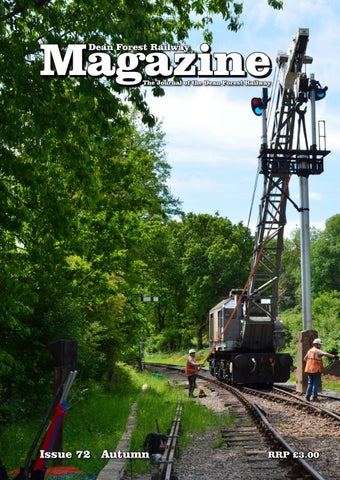
Front Cover: Adrian Copley was on site at Middle Forge to cover the erection of the new signals, the day of lifting is covered in depth within this issue.
Rear Cover: Gareth Dobbs captured the changing seasons as 9681 approaches Upper Forge during the Royal Forest of Steam Gala. A full write-up of both the steam and diesel galas will be in Issue 73.
All DFR Society post (donations, membership renewals and general correspondence) should be sent to: DFRS Honorary Secretary (Mrs. S. Williams) 109 Victoria Street Cinderford
Gloucestershire GL14 2HU
From the Editors
Dear Society Members,
Before we begin, we would like to take the opportunity to announce that we are seeking willing volunteers for several roles within the Charity:
• Publicity Officer
• Social Media Lead
• Volunteer Liaison Officer
These roles are currently filled on a part-time basis and we would be interested in hearing from anyone who would be willing to pick up the mantle, and perhaps even lead a team (or teams) on a more permanent basis.
As always, sometimes it is very difficult to make a choice between what goes in and what gets held over to the next issue, but we try to leave as little as possible on the cutting-room floor. Issue 71 promised an article about the VEA box vans that arrived from MOD Marchwood; however that article (and a few others) has been held over so that the destruction of St Mary's bridge can be covered. Please make every effort to submit articles and high-quality photos – we simply cannot publish what we do not have! We’ve set the copy dates for next year, with the plan that the magazine will be published during the following month (please allow for major events and holidays, though)!
All members with a valid email address will be sent an electronic copy, with hard copies mailed out to all members at least a week later (except for those who have opted to receive electronic copies only).
The deadlines for 2026 are as follows:
• Issue 74, copy date: 31st January
• Issue 75, copy date: 2nd May
• Issue 76, copy date: 1st August
• Issue 77, copy date: 31st October
To maintain the standard that you have grown to know and love – we use the same fonts, sizes, and styles throughout:
Title: Clarendon Blk BT, size 36pt
Body: Gill Sans MT, size 11pt
For anyone writing content you can use those parameters, otherwise, please use the regular font in your chosen software, set at size 11pt. Images need to be high quality. If you're unsure or need any advice, please get in touch!
Letters to the Editors should be sent either by email to magazine@deanforestrailway.co.uk or by post to the DFRS Honorary Secretary – letters received by the copy date that can be published will be passed on for an answer and then included near the rear of the issue. As always, we value your support, and we remain dedicated to keeping you informed and connected within the railway family.
With best wishes
Adam W, Ian & Tim
Your editorial team

Left to Right: Adam Williams, Tim McLennan, Alastair Clarke, Alex Davies, Adam Dickinson, Ian Pope
Chairman’s Platform
Forest of Dean Railway Limited Chairman, Ian Pope reflects on a busy time... for the wrong reasons!
The railway has recently suffered a major incident, which resulted in the Grade II-listed footbridge at St Mary’s being accidentally destroyed. I can say no more until investigations by both the Office of Rail and Road and the Rail Accident Investigation Branch have been completed. Needless to say, the incident has required many volunteers and staff to put in countless hours of work liaising with official bodies – not only the two mentioned above, but also our insurers, the loss adjuster, the Council’s Conservation Officer (responsible for listed structures), and the Footpaths Officer. In the latter case, we have had to secure a Footpath Closure, which is likely to remain in place for the foreseeable future. To say that stress levels have been high would be an understatement!
Whilst the investigation continues, our thoughts are turning to how we might replace or rebuild the footbridge. I would like to take a moment to thank the many organisations and heritage railways that have generously offered us a replacement bridge. However, until the extent of the damage to the components has been assessed and discussions with the Conservation Officer have taken place, we will not know what course of action to take.
One thing is certain: whatever the outcome, the work will not be cheap! Network Rail had a similar incident occur with Codsall Station footbridge in 2005; the major repair and replacement work took two years and cost £850,000. That prospect is rather galling, given that the bridge had been fully restored by Mabey Bridge in 2018/19, after being out of use for several years due to its dangerous condition. However, until matters such as the insurance claim are settled, the surviving components assessed, a structural engineer consulted on what is possible, and a civil engineering firm engaged to carry out the necessary work, we are unable to say what the final cost will be.
When we have the costings, we will work on a plan to raise the necessary funding. Suffice it to say, a bridge will be going back at St Mary’s.
On behalf of the Board of Forest of Dean Railway Limited, I would like to say a big thank you to everyone involved in the clearance work in the wake of the incident, as many hours were put in over the following weekend to safely clear the line and allow services to recommence.
The care and skill shown in dismantling as much as possible, so that parts might be reused, demonstrate the professional nature of the staff and volunteers at the Dean Forest Railway. To you all — and especially to our General Manager, Peggy — a very big thank you. I have singled out Peggy, as throughout all of this she has been the first port of call for every agency involved, and she will continue to be until the investigations are completed. She is also the one liaising with our insurers and the legal teams.
Our volunteers must now undertake a thorough review of all Risk Assessments, Operating Procedures, and the role-specific accreditation, particularly where engineering trains and plant are involved. In the meantime, we wish to reiterate that all volunteers should be fully aware of the skill level to which they have been trained and assessed. If you are asked to carry out a task beyond that level, or one you have never done before, please speak up and say, "No – I cannot do that."
In this case, we must be thankful that no members of the public were on the footbridge at the time, or the railway could have been facing a much worse scenario.


Photo: The bridge re-opening on Saturday 9th March 2019.
(Photo: R. Harris)
View from the Box
Adrian
Copley, DFR
Operating
Manager,
gives the 2025 summer season a warm reception!

What a summer we’ve had! The hot, dry spell that began at the start of the season carried on until the end of July. This caused a few operating headaches as we tried different options to keep steam in charge of our services: taking off a coach to reduce the load by some thirty tons, instructing drivers not to drive too hard, and, at times, adding a diesel to ease the strain of acceleration. The thinking was simple: most people visit us for a ride on a steam-hauled train!
Advice was given by Lineside Director Chris Bull, and we made our decisions based on that guidance as and when required. We also kept a close eye on Network Rail and what was happening with main line steam activity on their tracks, as well as the activity on other heritage railways.
The main tool in the box for managing the situation was rostering a diesel to assist the train. However, this involves extra work for the roster clerk and, of course, requires volunteers willing to crew the diesel. Many thanks to all the crews who stepped up and helped keep us moving.
Naturally, at the first sign of rain, people think we can relax the emergency measures. But that isn’t the case: it takes a couple of days of steady rainfall before such a decision can be made. It all depends on ground conditions and the risk of a lineside fire. On Wednesday 30th July, we ran our first steam-only hauled train for many weeks, and all went well with no intervention from the Fire Service!
Meanwhile, the other proverbial thorn in our side that is Middle Forge Junction reared its ugly head yet again...
Above: Uskmouth passes New Mills foot crossing. (Photo: A. Pace)
A small mishap damaged the point (which is due for renewal) meaning that the point could not be locked mechanically or detected electrically, so remote monitoring of its position was not possible. Thus, none of the signals or indicators could be operated.
This meant the point had to be manually moved and then clipped, padlocked, and scotched in position before use, and checked every time a train passed over in the facing direction – i.e. towards Parkend or Norchard.
This gave the signalman at Lydney Junction extra work, as each down-direction train had to be ‘cautioned’, with the driver reminded each time before proceeding that way.
There were further complications, as the track layout at Lydney Junction does not fit neatly into the scenarios covered by the Signalling Regulations, owing to the position of the signal box, level crossings and signals. We managed – and, luckily, it wasn’t raining, which would have made life much harder for both the Lydney Junction signalman and the staff operating the junction at Middle Forge!
While all this was going on, the S&T Department was also able to make progress with installing the new signals at Middle Forge. A Special Operating Notice covering the change will be issued soon, and hopefully we can then look forward to a return to normal operation at track level.
The usual rounds of shunting in Norchard Yard continued to take place every week throughout the summer... as the age-old phrase goes, ‘it’s like trying to get a quart into a pint pot’ (I don’t think that one can be converted into metric!). It proves that we desperately need the carriage shed at Lydney to help ease the load. My thanks go to the team for sorting this most weeks.
Manning the yard and providing extra crews are a heavy burden at this time of year, when it is difficult enough to fill the rosters.The same applies to works trains, which are required to move all sorts of items around the railway as needed – for example, the Telecoms Group are installing fibre-optic cable along the line (and people are already starting to mention networks and computers!).
Part of the operating nightmare this summer was the absence of our usual second steam locomotive. On the two occasions it was needed, we used Uskmouth with a load of two coaches for the main service train, while the trusty pannier worked the Driver Experience course. It turned out that, if handled carefully and with coal available, Uskmouth could manage the full length of the line.
We had Sapper with us for a few weeks following some work. It first ran in the yard during the Bluey children’s event at the beginning of August. This allowed some maintenance to be carried out on 9681, and the hope was that Rennes would be available soon after its boiler work.
August was, as always, the annual challenge of filling the rosters! Again, we managed without cancelling anything. The difficulty came when the fire-risk measures had to be reapplied, as staff were already away during the holidays.
September brings the Diesel Gala, and the end of November brings the Steam Gala. There have also been charter requests, so my camera will be armed and ready!
It is the best time of the year for colours in the forest, just as winter approaches all too soon, bringing that season of the white-bearded bloke dressed in a large red suit!

Above: The view from Parkend Signal Box as 9681 departs with a steam-only hauled train on Wednesday 30th July. This two-train day was one of the few over the summer that was not substituted with a diesel due to a steam ban.
(Photo: N. Cooper)
Below: 9681 looks on as Sapper is prepared at Norchard, ready to undertake steam tests before returning to Kent.
(Photo: B. Thomas)


Above: Just one of the many paraffin lamps still in use! (Photo: A. Williams)
Above Right: A well-worn chair in Norchard Signal Box. (Photo: A. Copley)
Below: Sapper is coaled up by the telehandler ahead of some mid-week trial running between Norchard and Whitecroft. (Photo: B. Thomas)

We are in search of someone with upholstery experience, to assist with either the repair or replacement of three chairs that are currently in use in our signal boxes.
There is a also volunteer vacancy in the Operating Department for a Lampman (or Lampwoman). The role involves managing the oil-lit lamps on the railway including the tail and side lamps for trains, as well as the lamps for the level crossing gates at Norchard, Whitecroft, and Parkend. Training will be provided, and applicants should will need to travel between locations and work with paraffin.
If you think you could help with these tasks, please do get in touch via operationsmanager@deanforestrailway.co.uk – we’d love to hear from you.

DMU Group Update
Alan Pace gives an update on Railway 200, and the continuing work on vehicle E50619.

• Railway 200
The peak summer running period was a busy time for the group. Forest Flyer 200 services ran on some summer Tuesdays, journeys took passengers from Norchard to Parkend, with the return journey via Goatfield near Lydney Town. There were activity booklets, colouring sheets, a raffle, cakes and a Railway 200 display in the buffet. With the train suitably decorated with bunting and headboards. We were pleased to be able to support Railway 200.
DMU services ran as part of the peak season two-train service on Wednesdays, as well as during the Forest Railway Story and Bluey events. A two car set of M51914 and M56492 was used, with M51566 and E59387 being added to provide additional capacity for the Bluey weekend.
• E50619
Work to repair the rear end of E50619 has continued, with a lot of effort spent shaping the aluminium to make it fit. This included cutting the sheet in two and getting the right-hand half to fit, before removing excess material from the centre in order to reduce the width, before welding the two halves back together. The left-hand side was then adjusted, with some more welding required to extend the area that wraps around the corner of the vehicle.
The supply of iroko timber for the wooden block proved difficult, so an alternative hardwood block was obtained and initial cutting done at a local sawmill before leaving it in the DMU to acclimatise prior to further shaping.
Thanks to those who helped with the supply of this. The main steelwork frame for the corridor connection was taken to a firm in Lydney Industrial Estate for shot-blasting. Routine servicing and maintenance have continued on the other vehicles, a new set of batteries has been fitted to M51914 and more interior work done in E59387.
On a very hot June day a start was made in cutting up two scrap bogies that have been stored beside the East Loop headshunt at Lydney Junction for many years and were surplus to our requirements. Wheelsets have been sold to help other groups keep their railcars running. DMU group members also do various jobs to support the DFR.
• Supporting Us
The group has now been able to purchase a suitable scissor lift and arrange for training; this machine has proved very useful during the work on the rear end of E50619.
Our thanks go to those who donated towards this cause!
If you would like to receive more information through our newsletters then annual membership of our group is available for £8.00 for Adults and £6.00 for Senior Citizens, we would welcome your support. If you would like to know more about our DMUs or perhaps even join our friendly team of volunteers, there is normally someone at Norchard on most Wednesdays – so come along for a look around and a chat. Otherwise please do not hesitate to get in touch via dmugroup@deanforestrailway.co.uk –we’d love to hear from you.

• Donations
Any donations towards the ongoing work on our DMUs would be gratefully received by Bank Transfer to:
Dean Forest DMU Fund
Sort code: 30 – 99 – 78
Account No.: 00724630
For details on other ways to support us, please get in touch!
Opposite Page: M51914 and M56492 with a Forest Flyer 200 service at Parkend on 22nd July 2025.
(Photo: A. Pace)
Right: Chris Blakemore works on E50619 using the scissor lift.
(Photo: R. Thomasson)
Below: Andrew Woodrow and Gill Christopher on board a Forest Flyer 200 service during a Parkend layover.
(Photo: A. Pace)


Museum Developments
• Parkend Goods Shed
In Issues 66 and 70 the developments towards the restoration of the Parkend Goods Shed as an extension of the DFR Museum were outlined, this included a plan of how our historic Goods Shed would be adapted. We have photographs that show that the earlier use of the Goods Shed by the DFR was indeed as both Museum and Shop when all was centred on Parkend. While this project has taken a considerable amount of the Trustees’ and Curator’s time, things elsewhere have not been neglected.
Planning for which items should be displayed at Parkend in due time, and the work FOPS have put in to clear the Shed, resulted in the discovery of a pair of cast-iron Crossing Braces. Does anyone know their history? I have found a photograph of crossing gates at Hamstead Crossing in the Encyclopaedia of the Great Western Railway. The article was presented by Adrian Vaughan, an acknowledged expert and writer on GWR signalling and they look identical.
An article by Mike Christensen in Issue 53 of the Great Western Railway Journal also utilises Vaughan’s photographs and shows crossing braces identical to ours at Parkend. We would be grateful to know the story of how we acquired them; does anyone have their history?
Our theory is that the Midland/LMS were responsible for track and signalling as far as Parkend and the GWR beyond, but what about the crossing gates north of Parkend?
However, photographs of Travellers Rest Level Crossing show a simple brace and not the intricate version we have in the Goods Shed. However, photographs of Speech House Road Level Crossing do show a matching design…
We have been told on good authority that when the line was truncated at Speech House Road the gates were taken down and were left around for some time. Did someone rescue these braces for the then-fledgling DFR?
However, these are all mere guesses on our part... so, can anyone confirm our theory for us at all, please?

• Norchard
Meanwhile at Norchard the developments continue. Thanks to the work of Stephen Howard, a new volunteer, means that the interactive touch screen is now fully working. This is centred around the Engineer’s Drawings of the line (the originals are held in the Museum) but with the addition of ‘hot-spot’ photographs along the line.
Other features include jigsaws of the bridges on the old line, two of the Severn Bridge and one of the Lydbrook Viaduct and several quizzes. Visitors are commenting favourably on this new facility. Our sincere thanks must go to the Society for awarding another grant for this project.
In addition, the Museum has purchased at auction the Sharpness Swing Bridge Signal Box diagram, covering from Severn Bridge Station to Sharpness South. The layout had no points, only the running line and the swing bridge but is still a worthy addition to our collection.
The diagram was not cheap and the Trustees express gratitude to donors who helped with the purchase, leading to the establishment of a ‘Friends of the Museum' who will be alerted by e-mail when we wish to purchase artefacts.
A purchase at a recent auction was the late-19th-century Engineer’s Drawings of the Mineral Loop. This completes our collection of Engineer’s Drawings for the Forest of Dean: the Severn & Wye, the GWR Forest of Dean Branch and the otherwise ill-fated GWR Forest of Dean Central Branch. Some of these will be on display shortly, but the Severn & Wye drawings can be inspected virtually on the Interactive touch screen mentioned earlier.
If anyone is interested or has suitable suggestions or ideas, please do get in touch via dfr.museum@outlook.com – we’d love to hear from you.
Below Right: A thrilling exhibit of Hand Lamps during 1975.
Below: Some of the displays then were rather basic. (Photos: DFR Museum Collection)

Chris Hill gives an update on the activities undertaken by the small Museum team.

Below: Sheet 1 of 4 of the 1898 Survey drawings of the Loop Line (the Mineral Loop) covering the area around Pillowell. The full set of drawings is a leather-covered volume, with gilt title, covering the route from Tufts Junction to Drybrook Road (including New Engine Colliery, Moseley Green Tunnel, New Fancy Sidings and Colliery Branch, Lightmoor Colliery, Foxes Bridge Colliery, and Crump Meadow Colliery). These detailed plans also include annotations relating to land acquisitions and disposals. (Photo: M. Quartermain)

Above: The Sharpness Swing Bridge Signal Box diagram that has been purchased for the museum by a consortium. (Photo: S. Turner)
Membership Matters
Membership Secretary Adam Williams, reports on the membership figures and a system upgrade!

The normal 2025 season is now firmly behind us and from looking at my notes – it has been quite a while since my last article, so I think it's time to get out the old writing gear again. Overall, 2025 has been quieter year for projects. As a marked change to the previous years, the only large projects were the relaying of the points at Lydney Junction and the clearing of the track bed north of Parkend – removing dangerous, diseased, and dead trees. August, unfortunately, saw the destruction of the Grade II listed footbridge at St Mary’s Halt, the immediate aftermath is covered elsewhere in this issue. I think that it is fair to say that it has set us back a good deal, in my personal opinion it has set us back a few years at least!
Most of the development plans have had to be put on hold, with efforts being diverted elsewhere. Not only have we had to recover the remains of the structure, but also handle investigations with regulatory bodies, liaise with our lawyers, work on the insurance claims for the damage and prepare for the eventual rebuilding. All of these key items will appear in coming issues.
None of any of the development plans, nor the rebuilding of St Mary's, will happen without the generous support and donations from YOU – the member!
We are currently at 1,404 members, so our goal is to maintain that. This will undoubtedly fall due to those that haven’t renewed and the current global financial climate may make our aims seem even more difficult than ever.
There are a few recurring themes, however there are a couple of key points that I would like to reiterate…
1. Renew online: https://dfr.hops.org.uk/membership
2. We still do accept payments via Cheque, Postal Order, and Standing Order, if this preferable to you
3. Cash should only be used at Norchard, in person, so please do not send cash in the post! Some members still do this, and sadly the contents do disappear...
4. If you are paying by Cheque or Postal Order, or completing a Standing Order mandate, processing can be made easier if you please complete all of the details. Some banks are quite particular and will actively look for a reason not to process them. Please do not write blank cheques and do not post-date them either!
5. We cannot accept responsibility for any renewals that go astray in the postal system on the way to or from us. We are aware that there difficulties within the postal systems locally, but importantly if you haven’t heard anything after 28 days – please do get in touch
• Gift Aid
Half of our members are in our Gift Aid scheme, increasing the value of their donations and membership subscriptions to us by 25% (courtesy of His Majesty’s Treasury). However, if you haven’t signed up (and you’re eligible to do so) then please do – a Gift Aid Form is included as part of the cover letter that comes with your magazine.

Opposite Page: The new HOPS membership landing page accessible at: https://dfr.hops.org.uk/membership
Above: Purchasing memberships for others was not an option that was available through ZoHo, but is through HOPS!
Above Right: The sale of the correct age-specific type of membership is now confirmed using Date of Birth.
Right: The membership purchase has to be identified as either a New Purchase or a Renewal.
Below Right: Once the details are confirmed, the sale can be added to the basket, it is remembered for fifteen minutes!
(Photos: A. Williams)
• Heritage Operations Processing System
The railway has been using HOPS for a quite a while, initially for calendar planning and rostering before moving in to competence management, among other uses.
The DFRS’s membership system has now moved away from ZoHo and is now integrated into HOPS too, bringing Society membership in line with the rest of the organisation’s digital infrastructure, hopefully ensuring smoother communication, simpler handling and keeping of records, and a more connected experience for everyone involved. It also provides instant confirmation of sales and automated reminders, reducing manual input.
New members can join and renewals can be made directly online, with payments handled securely through the integrated Stripe online payment processing platform. The result is a faster, more reliable, and more sustainable way to manage the growing membership base.
There are some upcoming changes too – rather than being rounded up to the nearest half-year, from 1st January 2026, the membership expiry dates will be the last day of the month of purchase rather than 30th June or 31st December.


With membership expiry dates becoming monthly, we plan to move away from using the plastic cards and return to the peel-and-stick style cards that had been used in the past. The key difference is that the cards will then be produced and posted by HOPS rather than by ourselves.
A development on the horizon will allow members to view their records, supplementing the existing options to update addresses, contact details, and so on. As renewals are processed HOPS accounts will become live, and access links will be sent out to members with an email address.
Members who already volunteer can log in using their existing HOPS account in order to renew their membership.The Company Health & Safety Policy requires all volunteers and employees to be members, and using the same system will help ensure that requirement is met.
• Working Member’s Identity Cards
If you are volunteering, then you require a Working Member’s Identity Card which means that we require an up-to-date digital passport style photo of you or a ‘selfie’ providing that it is against a light-coloured background. If you need an Identity Card – then please get in touch.
Above: The online shopping basket showing the space for a discount code, the subtotal, and the checkout button.
Below: The checkout page shows the purchase and, among other things, asks about volunteering and making a donation.
(Photos: A. Williams)
• Standing Orders and Cheques
If you wish to renew your membership by Standing Order (and you do not currently use this method) or you already do and wish to change the value. Please complete and return the Standing Order mandate in full. I have to take the details from the form and forward it to your bank for processing. If the mandate is not completed properly then your bank will most likely reject it, without returning it.
I cannot finish-off partially completed Cheques or Standing Order mandates. Before you ask, it happens regularly… In addition, please ensure that you do put on the correct year and please do not post-date them. Overall, it ends up delaying the processing of your membership because the bank will not accept the payment.


Above: The Gift Aid section prompts users to confirm their eligibility as UK taxpayers, before continuing to payment.
Below: The payment page accepts Visa, Mastercard, and Amex and allows for the possible future use of voucher codes.
(Photos: A. Williams)
• Privacy Statement and Data Protection
The DFRS holds personal information for the provision of goods and services, renewals of membership, distribution of formal documents, newsletters, appeals for financial support and volunteer labour.
The DFRS complies with its obligations under the Data Protection Act and the General Data Protection Regulation in relation to the keeping of, and provision of access to, the registers of its members. Following Brexit, the EU GDPR and the Data Protection Act 2018 were combined to form the UK GDPR, which has been in force since 2021.
So, if you notify us of any change in address or circumstances, unless you instruct us to pass these changes on to other groups within the railway, we cannot share them!
This might appear callous in difficult circumstances, but this applies even when dealing with bereavements. Sadly, that is the nature of the regulations, and we would be on the wrong side of the law if we acted otherwise.
So, just because you have informed me (as the Membership Secretary for the Society) does not mean that I can inform, say, the DFLG, the DMU Group or even the Company Secretary – unless you specifically instruct me to do so.
By the same token, none of those other organisations cannot share your personal data with us unless you specifically instruct them to do so. The instruction doesn’t need to be an essay – just a simple endorsement:
“Please share my change of details or circumstances with all organisations operating under the DFR umbrella.”
• Member's Discount Code
Members are entitled to a 50% travel discount on normal operating days, on the production of a valid membership card. If booking via the website, use the discount code DFRSMDX4892 when checking out to claim the discount but don't forget to bring your membership card!

Beneath Your Wheels
Alex Davies reflects on work at Lydney Junction and Parkend, and prepares for work at Middle Forge.

The thud of the envelope containing the DFR Magazine on the doormat can only mean one thing – it’s time to start writing the article for the next issue.
Last time, as you may recall, we had just completed work on the Platform 1 track at Lydney Junction and were starting to investigate the drainage issues found at Parkend. I also mentioned that May is a chance for us to take a break, and that’s exactly what I did – my first overseas holiday in twelve years. On my return, one of the first jobs was to continue investigating the Parkend drainage. Despite the dry weather, water was still flowing through the ballast in mid-May, and we were starting to suspect a leaking pipe.
Our investigations turned up many stories about how the drainage was thought to work but very little in terms of detailed maps etc.The one thing we did know was that the system hadn’t been cleaned out in years and we had no idea what state the pipework was in.
The first step was to call in the professionals to conduct a camera survey of the system.The team from a local survey specialist arrived on 22nd May and began their investigation. As we suspected, there was a lot of silt in the system, and much of it could not be examined. The recommendation was to jet the system and clear out as much silt as possible before attempting another survey.
It sounds simple, but there was a problem. The drainage runs down the centre of the platform tracks from the level crossing to a point close to the old ground-frame hut, at which point it leaves DFR land and joins the highway drainage, ultimately flowing into the river. Obviously, any silt that was cleaned out couldn’t simply be flushed through the rest of the system without risking further blockages, so it would need to be sucked out of the manholes.
Above: The old sleepers were lifted out by the RRV and plate grab, the bed was then graded using the 8t excavator.
Opposite Page: The first panel is roughly laid in to place. (Photos: D. Johnson)
Easy, you may think... but the survey company’s truck could not reach the manholes, the majority of which are located in the six-foot (the space between the two tracks through the station). Time to call in our friends Quattro and the RRV-mounted vacuum excavator, the Tinbin TC2.
We’ll return to this later in the article – at least we had made a start, and there were a few things we did know.We knew that the original drain ran down the six-foot from the level crossing to a point near the old ground-frame hut. We knew that towards the south end this drain had become blocked, and a diversion had been installed.
So instead of simply going to the ground-frame hut and making a right turn toward the outfall, the line now went right, then left, and then right again before reaching the outfall. More recently, the main drain had become blocked before that first right turn, and a second diversion had been installed just south of the yard gates. This carried the bulk of the water from further north, but camera footage showed the pipework was damaged and heavily silted up.
Closer to the station area, we knew that several feeds had been added over the years, and several inspection points had been dug, and not always to a high standard. In one, location we discovered that the main drain had simply been punched in and a perforated pipe inserted. Not only did this severely restrict the flow through the system, it was also so heavily silted up that when it was exposed, water jetted out of the perforations under pressure.

We removed some of the perforated pipe and repositioned it so that it just entered the main drain, making a note to construct a proper manhole and junction in the future. With this initial work out of the way, it was back to routine inspections and maintenance – at least for a few days.
Generally speaking, you won’t find me around the railway on days when trains are running. Most of the work we do requires unrestricted access to the line (so we tend to work on Mondays and Thursdays) when things are quiet. However, there are times when it is necessary to carry out emergency track inspections and repairs.
Late in the day on the Sunday of the late-May bank holiday, I was notified of an incident at Middle Forge which would require a track inspection the following morning...
Some minor damage to the ageing pointwork had occurred and, while it did not prevent trains running, an inspection was necessary to ensure the line was safe to run on, and special operating procedures had to be put in place.
In early June we embarked on the next phase of our relaying programme at Lydney Junction. This time, the target area was the Network Rail connection at the end of the west loop. Whilst not part of the main running line, this section is key to the railway’s operation, as it provides a headshunt for our locomotives to run round in, and it allows visiting locos and trains to come in off the national network. Because some visiting trains are carrying passengers, it needs to be maintained to a passenger-carrying standard.

The connection was last relayed about thirty years ago as part of the DFR rebuilding of Lydney Junction. At the time, timber sleepers were used because it was envisaged that track circuits might be installed at some point.
Timber is used in preference to concrete where bullhead rail is fitted with track circuits, as the reinforcing bars in concrete sleepers might conduct electricity, giving a false track-circuit indication. Anyway, track circuits were never installed, and a preference for using axle counters means that we don't need to worry about conduction through the sleepers, so we have relayed these two panels of track (around 120 feet or 40 metres) using concrete sleepers.
Drawing from the experience gained in relaying work earlier in the year, we were able to move quickly. The old track was lifted, the bed graded, and the new track laid in just three working days. The final ballast packing and levelling work was carried out a week later.
In mid-June, we managed to acquire a second-hand portable compressor to go with our stone-blowing lance. The lance had been purchased a while ago, but the supplier was unable to supply a compressor to work with it. Most portable compressors are designed to produce maximum pressure through the use of a reservoir, but stone-blowing requires airflow, not pressure. Trailer-mounted portable compressors for use on construction sites are quite common, but finding something small enough to be easily transported by rail was difficult.
Opposite Page: The Tin Bin TC2 on show at RailLive 2025. (Photo: A. Williams)
Below Left: The relaid section of the Platform 2 headshunt is packed and levelled ahead of reopening to traffic.
Below: 9681 makes the first move over the new track. (Photos: A. Davies)

We were tipped off about the existence of a nearly-new compressor located in London, and set about purchasing it. Fortunately for us, the man selling it was going to RailLive at Long Marston and agreed to meet me en route.
We met in the car park of a garden centre just off the M5 in Tewkesbury, and just about managed to get it to fit into my van to complete its journey to the DFR. Although we have tested the system, the weather in June and July has been too hot for joint packing, and it has yet to be used in anger, so look out for more on this in a future article.
By late June, all the surface water at Parkend had finally disappeared, proving that the problem was groundwater and not the feared leaky pipe. So, we needed to clean the system and enhance it to better handle the surface water.
On 17th July the Tin Bin and the RRV to carry it arrived at Parkend very early in the morning, and the team began work. Initially, the Tin Bin was used to empty the various catch pits and manholes – in one case around 2 feet of silt was removed from a catch pit. Then the Just Surveys team began using high-pressure water jets to flush the silt out of the pipes and into the catch pits, where the Tin Bin could suck it out and dump it south of the station limits. Finally, more camera survey work was carried out.
Another benefit of having the Tin Bin on site for the day is that it is very effective at excavating ballast and can achieve in a matter of minutes what it would take a gang with shovels a whole day to accomplish.
We put this capability to good use exploring some suspect areas, including the section of the second bypass drain between the Platform 2 road and the yard connection (where 2 feet of the pipe have collapsed), and the main drain between the second bypass and the first one.
This section turned out to be a narrow stone gully that was too small for the surveyor’s camera crawler to pass through. We are planning to replace around 20 metres of this with 300mm perforated drain to improve flow.
We also explored the feasibility of using the Tin Bin to excavate trenches between the platform facings and the running lines to allow us to install fin drainage.The concept was proven and will be progressed as funding allows.
There is still much more analysis of the survey footage to be done, and, potentially, more jetting and surveying before we have a final picture of the whole system and can come up with a cost-effective remedial plan. Ideally, we would like to rip the whole system out and replace it, but the cost would be astronomical, so a cheaper solution must be found.Whatever solution we opt for, regular jetting and cleaning of the system (every 3 to 5 years) is a must, and that is now being factored into the railway’s running costs.
On the subject of costs, planning for the renewal of Parkend level crossing is progressing, but whether the work happens in February 2027 will depend on the current estimate for the work of around £250,000 being available... money we simply do not have at this time.

Work has progressed slowly on the removal of the up headshunt at Parkend. Although we cannot take the point out and relay the line until the November closed season we have disconnected the headshunt and will soon be removing the redundant rails. These will be redeployed in various locations between Parkend and Whitecroft.
At the end of July, we began work on what will be our major project for the winter closed season – replacing the point at Middle Forge. The initial phase of this work involves laying out the new point at Lydney Junction. The majority of parts for this point have been in storage for many years, and we don’t know how complete it is (we know some things are definitely missing). Even locating the parts we do have is extremely challenging, as much of it is buried deep in the summer foliage, and the team sometimes resemble orange-clad jungle explorers as they hack and chop their way through the undergrowth. It is now time to assemble it so that we have plenty of time to acquire any missing parts before we install it in February. People who have been around for a few years may remember something similar at Parkend in 2016/2017.
The Permanent Way team meets regularly on Mondays and Thursdays throughout the year, and on other days during the closed seasons.We normally start the day at Norchard around 9am before heading to whatever worksite we have targeted for the day, and we usually finish our day between 3pm and 4pm. Why not join us and get a different perspective on the railway and its workings?

We’re always on the lookout for new volunteers, and you don’t have to be out in all weathers or in the middle of the week to help! There are plenty of jobs that can be done at weekends and under cover in our dry containers.
We are still looking for mechanically minded people to help our back-office team repairing and refurbishing tools and materials. We urgently need to refurbish a number of hand-point-lever mechanisms so that we can replace failing ones in the yard at Norchard and elsewhere.
We are also looking for people to help sort and catalogue the Permanent Way materials that the railway has. In the early days, we (like most infant heritage railways) acquired anything we could from the various railways and engineering firms that were closing at the time. Most was 'stored' along the line in case they were ever needed.
Now, as a more mature railway, we have a much clearer idea of what we will and will not need going forward. The development team is progressively tidying up the railway (ultimately making it more attractive to our visitors) by recovering materials from various locations and moving them to Lydney Junction.The items are then inspected and either stored for reuse or disposed of responsibly. This is the sort of activity that could be done on sunny weekend days during the summer, between service trains.
If you think you could help us with any of these tasks, please do get in touch via volunteering@deanforestrailway.co.uk – we’d love to hear from you.
Below Left: One of the rails for the Middle Forge point is found... as always, it's underneath everything else!
Below: Welcome to the jungle, where other rails are found. (Photos: J. Sharpe)

FOPS Update
Stuart Bearne reports on the summer activities of the Friends of Parkend Station group.
Since the last magazine went to press, the FOPS have continued their endeavours to keep Parkend Station looking its best during the utterly glorious weather. Track weeding by hand, followed by weed-spraying, has meant that the trackbed looks presentable, and sections south of the station have also benefited from strimming.
Outside painting has continued, with the loading gauge and several parts of the perimeter fence having been rubbed down, primed, and given a coat of black gloss. This will continue later in the year, as attention is turned to the main station building and Goods Shed, which has stood up well to the Parkend weather, but now needs some care.
As usual, the station signage, tables, gates, and benches have been touched up. Martin Baker used his skills to replace rotten timber on the platform trolley and crossing gates. Internal work progresses when the weather is poor for outside tasks, and the Gents' toilet walls and floor have been repainted, as has the waiting room chimney breast.
Ken Robertson has thankfully been able to eliminate a leak from the Gents' toilet roof. We have also turned our attention to the internal timber in the Platform 1 shelter, with Creocote being applied to the rafters, and undercoat and gloss to the beams and interior wood panelling.

The sale of railway and other transport books from the waiting room continues to go well, and a request was recently received for possible funding for a new gate and posts for the entrance to Parkend siding.
Thanks to good book sales, we have agreed to fund the posts and gate, which will be installed by the Parkend Monday Gang. As always, donations of railway books are welcome, with all proceeds used for maintenance items.
As we move closer towards the Museum extending into the Parkend Goods Shed, FOPS are preparing an inventory of all items in the shed. This will assist in the lengthy clearance process which must be undertaken before the conversion into a Museum can take place.
We meet on Tuesday mornings at Parkend Station, and a warm welcome is guaranteed for anyone who would like to come and join our friendly group of FOPS.
Below Left: The weeded trackbed through the platforms.
Below: The materials, tools and equipment in the Goods Shed that will need re-homing before the Museum arrives! (Photos: S. Bearne)

Signalling Summary
Steve Harris reports on the continued work that has taken place at Middle Forge.
In Issue 71 of the magazine the renewal of the existing ground frame at Middle Forge (which was severely worn) was covered, along with the assembly of a signal using parts from one that was recovered from Paignton South (including a newly fabricated and riveted bracket).
On Monday 19th May, the team was back at Middle Forge with the RRV and using the auger attachment – the holes in which the new signals would be planted were excavated. The hole for the bracket signal, needed to be eight feet deep and was technically complicated due to the proximity of surface cable troughing, various buried services, and the need to square off the hole using long-handled tools.
Even though the excavation had to be located between the modern ten-inch plastic gas pipe, the old redundant cast-iron gas pipe, and the new track drainage (detailed in Issue 70 of the magazine), progress was steady. It was easier to prepare than the hole for the straight-post signal.
Thankfully, the tungsten teeth of the auger came into their own when an outcrop of Old Red Sandstone was discovered approximately three feet below the surface. Inch by inch, the strata were chiselled and broken out to reach the required depth of five feet.
On Tuesday 20th May, the works train – hauled by 08769 and containing the diesel crane, the Crocodile wagon (a bogie well trolley) loaded with the signals in the preceding weeks, and the Loriot wagons – made its way out to Middle Forge. The train was split just clear of the foot crossing, and the team began preparing the bracket signal for the lift. Meanwhile, the crane and its runner were shunted towards Norchard, clear of the work area, before the Class 08 retreated to a safe position towards Lydney.
The crane was rigged for lifting and moved into position to remove the bracket signal from the Crocodile wagon. With a delicately balanced lift, it was lowered onto packing blocks placed across the rails. On paper, there was just enough height available for the signal to be stood upright and clear the railhead, so the lifting slings were repositioned for the carefully calculated lift-and-carry operation.
With the signal vertical, the crane was moved back slowly under its own power, with height adjustments made while passing over rail joints. The lifting radius had already been calculated, allowing precise positioning alongside the hole that had been prepared the previous day, before the crane slewed over and lowered the signal into place.
The signal was a snug fit, which meant there wasn’t much material to be backfilled and compacted, while minor adjustments to the levels were made. Once the post was secure, the crane was derigged and attention turned to the straight-post signal, which, owing to its significantly shorter height, was a much simpler lift by comparison.
Elsewhere, the replacement fabricated steel gates for Whitecroft level crossing have now been delivered after being painted by a firm on the Lydney Harbour Estate. They now need to have the fixtures and fittings attached, which, of course, must first be recovered from the old wooden gates before they can be installed later this year.
We are always on the lookout for help, whether for heavy or light work, metalworking, woodworking, or electrical tasks – there will be something to take an interest in! If you think you could help us with any of these tasks, please do get in touch via volunteering@deanforestrailway.co.uk – we’d love to hear from you.


Opposite Page: The S&T team prepare for the lift.
Above Left: The first of two lifts before planting.
Above: Inch by inch, the signal makes its way upright.
Below Left: The vertical is achieved – a well-calculated lift.
Below: The hole beckons, and the signal is gently guided in. (Photos: A. Copley)


Photo: With all of the levels checked and correct, the crane eases off, and the bracket signal settles into its final position.
(Photo: A. Copley)
Team Project Forest
Dave Hugglestone introduces the team, how they came about, and what they do!

You may have seen us out and about the railway, perhaps silently at work – measuring, surveying, photographing, filming, risk assessing, mapping or, even just sitting in the café with a cup of tea and a bacon or sausage bap!
• So... who are we?
The team consists of myself (Dave Hugglestone), Paul Ley, and Andrew Long – three retired railway souls with a little spare time and a wish to use our vast knowledge of the railway and its operations to benefit others (with a little coercion from Adam Williams!). Between the three of us, we have over ninety-one years of railway experience.
Our knowledge spans areas such as driving trains; training, assessment, and competence management of train drivers and guards; depot management; signal sighting, route mapping, and route filming; Safety Management System (SMS) documentation and risk assessment; vegetation reporting; health and safety management and facilities management; RSSB collaboration; and training material production – just to name a few!
• What have we done?
We set up the team initially to create a route map of the Dean Forest Railway and other training aids for staff and volunteers to use in the course of their work. But soon more “projects” came our way, and to date we have produced the route map, signal guides, and route-learning videos, as well as updating the site inspection reports, user surveys, and risk assessments for all of our level crossings.
Working volunteers can find the material on HOPS by typing in the name or reference into the search bar:
Reference Name
DFR/OPS/TR/001 Norchard Signals Guide
DFR/OPS/TR/002 Lydney Junction Signals Guide
DFR/OPS/TR/003 Parkend Signals Guide
DFR/OPS/TR/004 Route Map Guide
We have also produced and published route training videos for both the Up and Down directions. At present, these are available only in disc format: three DVDs may be borrowed from the office. Unfortunately, the file size and format prevent them from being uploaded to HOPS.
• What are we doing now and going forward?
We are continuously updating the route map, and the new version should become available once the Middle Forge Junction re-signalling has been commissioned.
We recognise that DVDs are somewhat limited in this day and age, so we are launching a dedicated YouTube channel to host our training videos, along with other useful and relevant content. So watch this space (quite literally) for when the new channel goes live!
By the time this magazine reaches you, we will already have begun work at the stations – updating Risk Assessments, Site Surveys, User Surveys, and Site Inspections. These are key steps in keeping our railway both safe and welcoming.
• Why are we doing this work?
We like to think that we are contributing to the health and safety of all volunteers (and the public) by helping to ensure that everyone can work in a safe manner and environment. This may be through training documents and procedural guides (updated as necessary) or through assessments and inspections.
Although we are relatively “new volunteers” in terms of membership, over the past twelve months we have experienced the warm and friendly nature of the many staff and volunteers we have met.We are very approachable and enjoy meeting all of you – whether it’s having a chat about what we are doing, answering questions, or hearing about the activities that you have all been up to!
Opposite Page: Team Project Forest (left to right – Paul Ley, Andrew Long and Dave Hugglestone) at Norchard.
Above: Andy Long and Paul Ley discuss the next move while completing the site survey at Upper Forge foot crossing.
Right: Andy Long assesses the damage from a tree that came down during the winter storms adjacent to Oakenhill Wood. (Photos: D. Hugglestone)
Below: Andy Long and Dave Hugglestone take measurements at Whitemead Park foot crossing, just outside Parkend.
(Photo: P. Ley)


Carriage & Wagon
Dave Chappell gives a quick update on the latest activities undertaken by the team.

•
4862 – Mark 1 TSO
Now that the window framing has been sorted and the production and assembly route planned, design thoughts turned to the possible mounting methods of the seating and panelling. As reported in Issue 71, Peter’s visit to the Gloucestershire Warwickshire Railway did not yield a mounting method that could be copied. With no timber framing to fix the seats into position, the best option was to use a bracket spanning the carriage wall framework to support the side of the seats between each window.
There was evidence of some structural fixing brackets, threaded pillars, and support members on the carriage wall structure for the wall panelling. Therefore, in the absence of any better alternatives, these fixing methods were copied and reproduced to maintain the consistency of the panelling anchorage mountings.
A variety of right-angle and straight brackets were created along with threaded bosses, almost like a style of the children’s engineering toy Meccano; however, these will be welded to the carriage framework to create a robust and reliable anchor for the wall panelling, independent of the seat-mounting angle bracket.
A mounting rail was created as a template to allow the creation of the timber struts to anchor the wall cladding onto the carriage framework. These struts were machined on the router to conform to the curvature of the carriage wall, and grooved to fit onto the wall framework.
Sixteen windows with two struts per window, plus vestibule and partition areas, meant a production run of thirty-eight pairs was a drawn-out task. The carriage walls are now marked with letter codes corresponding to the rails, brackets, or stud locations to fix everything in place.
Professional advice was sought from a retired BR carriage electrician who is still involved in restoration and rewiring. He indicated that current standards require that modern cable with low-smoke zero-halogen (LSZH) fire-resistant insulation should be used to minimise the danger of toxic fumes in the event of fire. This is standard in modern transport vehicles and also in public buildings, so we will therefore comply with this standard and avoid the use of PVC insulated wiring during the carriage rewiring process.
During the last major carriage rebuild, the fluorescent lighting was upgraded to LED, so we contacted the same supplier. Unfortunately, that firm has been taken over by an international company in Sweden, and the LED tubes are no longer stocked in the UK. The minimum order quantity is now twenty-five pieces of each of the two sizes of tube we require, with the order shipped from Asia. This resulted in a quotation of more than £2,000, giving us enough LED tubes for around three carriages, plus many spares of the smaller size. This was not viable for a single carriage restoration. We are aware of a UK supplier that supplies LED tubes for marine use, and we have already successfully trialled one of them, so we will be contacting them for quantity, price and delivery information.

Opposite Page: The seating support bracket spans the framework that supports the carriage wall panelling.
Above: The selection of fixings for the wall cladding.
Below: The locations for the wall cladding fixings. (Photos: D. Chappell)

A Mechanical Marvel

There is no denying that we’re living in a changing world, and social media now plays a huge part in everyday life, including establishments that have been around much longer, such as heritage railways. In fact, it is a very powerful tool for promoting, advertising and engaging with the public. I’ve spent the last seven years creating online content on YouTube to help promote heritage vehicles by showcasing museums and societies to a new worldwide audience, and inspiring people to get involved by breaking down some of the perceived barriers around volunteering.
I am an enthusiast wanting to share my love of old vehicles with the world, and I was hugely excited when the Dean Forest Railway reached out to me to ask if I’d like to film a feature with 9681 and the DFLG. Much of my content so far has been with industrial or narrow-gauge locomotives, so being able to work with an ex-BR locomotive is always hugely exciting, and I was well overdue for a return visit to the railway. A pannier tank is so iconic, especially one that is so intertwined with the history of the railway. From my point of view, it’s very rewarding and exciting when an organisation reaches out to me, so plans were excitedly created for shooting a video at the DFR.
The day before shooting, I headed over from Suffolk and felt welcomed with open arms, and a lot of enthusiasm and pride for the railway. We’re all enthusiasts to be involved with a preserved railway, but it is so invigorating to be surrounded by like-minded people who are passionate about what they do and their railway. It is quite infectious!
I was hugely impressed with the facilities and the quality of the work that is being undertaken by the volunteers during my tour, and then there was 9681 glistening on the pit. It’s a really good sign to see an engine that looks so well looked after – especially when it’s before the cameras have even been pulled from the bag.
Filming is a long, hard day, and I need to extend my thanks to all the volunteers who put up with this slightly unusual way of operating for a day. The days take much longer than everyone expects. Trying to get enough shots to illustrate what I’m talking about, and being able to show the work that goes into preparing a steam locomotive is exhausting, not to mention trying to keep an idea in one's head of how it’s all going to look in the edit. Once we had steam, and had filmed the preparation, it was time for my favourite part of the day: filming the drive-pasts. For me, this is one of the most important aspects of the day, showing off the railway in the best possible light, and for this I rely heavily on the volunteers to tell me where the best shots are.
The railway is so pretty, which makes it even harder to choose the best locations. Around every bend, there’s another shot! It made it a challenge to choose which frames to actually use. We made several runs up the line – some filming from outside, some from the air, and some with the engine adorned with cameras. This has all come together and hopefully shows the railway, the DFLG, and 9681 in a hugely positive light. I hope you all enjoy seeing the resulting video, which was released in October!
Lawrie Rose of Lawrie's Mechanical Marvels on YouTube recalls his day filming with 9681 along the DFR.

Opposite Page: Lawrie introduces his YouTube audience to DFLG pannier 9681 at the site of Tufts Junction
Above: Ollie Sainsbury cleans the tank rails on 9681.
Right: Ollie Sainsbury cleans tank supports on 9681.
Below Right: Lawrie tours the restoration shed at Norchard. (Photos: L. Rose)
All being well, I hope to be back at the DFR for the November steam gala to do some more filming!
One of the things that struck me from my visit was seeing the cleaning parties that are being organised.
Bringing younger people together to work on getting the locomotives spotless is superb. It gives those involved a sense of pride and ownership, and a real sense of involvement with what’s happening at the railway. It is so important to encourage and pass on skill sets to the next generation, which is vital to any railway’s future. I only wish more railways would take the initiative to do similar activities, and I must congratulate the steam department on this enthusiasm, and encourage anyone who is considering it, to get involved!
If you want to find out more about the content that I produce, please check out the channel here (and why not watch our review of 9681): www.youtube.com/@lmm


Is It An Austerity?
Matt Sexton introduces Gunby – a Hunslet locomotive from which the Austerity was later derived.

A number of people have asked me about the ‘Austerity’ locomotive Gunby, which is being restored at Norchard.
Well, actually... it's not an Austerity locomotive but a lesserknown precursor – the Hunslet 50550 class. In essence, this locomotive is equivalent to a Rolls-Royce Austerity, as many of the design features were carried forward to the later Austerity locomotives. However, due to the cost and availability of materials, the components were simplified (with more fabrications used rather than cast). It also has smaller wheels making it more powerful and compensating beams give a smoother ride.
To give a brief history, ‘Gunby’ is a member of an eightstrong class of locomotives ordered in 1941 from the Hunslet Engine Company of Leeds for Stewarts & Lloyds.
The order was placed as part of the Islip Orefield Development Scheme, a Government sponsored scheme to modernise and increase production of Iron Ore from the Islip quarries in Northampton. However, the scheme was cancelled after locomotive HE2411 had been delivered. This locomotive became No.24 and was put to work at the Corby Steelworks and now also resides at the Dean Forest Railway waiting its turn for restoration.
The remaining seven locomotives were offered for sale by Hunslet, and HE2413 ‘Gunby’ was purchased by the Stanton Iron Company along with locomotives HE2417 and HE2418. Subsequently ‘Gunby’ was put to work at the Buckminster Iron Ore Quarries in Leicestershire.
In 1950 the Stanton Iron Company was absorbed by Stewarts & Lloyds, who had originally ordered the engine. ‘Gunby’ remained at Buckminster until October 1955 before moving to Harlaxton in Lincolnshire where she was re-united with sister locomotive HE2418 ‘Grantham’. ‘Gunby’ remained at Harlaxton until November 1959 before returning to Buckminster, before going back to Harlaxton seven years later, where it stayed until 1971. By this time the locomotive was surplus to requirements and passed into preservation, at the Stour Valley Railway at Chappel and Wakes Colne (now known as the East Anglian Railway Museum). It remained and operated there for several years until a major overhaul became necessary.
‘Gunby’ moved to the Gwili railway in 1999 where an overhaul began. However, in 2002 ‘Gunby’ was sold and moved, via the Swindon and Cricklade Railway, to the Dean Forest Railway for restoration under the expert supervision of Tom Halford.
Gunby has had quite a few bumps and bruises from its quarry use. Also, it hasn’t steamed for around fifty years, and time has taken its toll. However, a lot of work has been done and the restoration continues apace.
The back end has been rebuilt with new buffer-beam quarters, floor, running boards and a bunker fabricated to the original design. After the cab has been renewed, attention will then turn to the cylinder block which will have to be removed for new slide valve faces to be fitted.

Opposite Page: HE2413 masquerades as J94 No. 68067 after entering preservation at the Stour Valley Railway.
(Photo: M. Sexton Collection)
Above: Tom Halford welds together the beading that will eventually adorn the edges of the cab side panels.
Right: Tom Buffin carefully checks the alignment of the cab panel joints before they are bolted together.
(Photos: A. Williams)
Below: With the cab assembled and in primer, HE2413 is shunted by HE3163 Sapper masquerading as J94 No. 68032.
(Photo: B. Thomas)


Putting the AI in Train
Ken Hirst, a retired Technology Engineer at Rank Xerox and an early member of the Society, takes a fascinating foray into Artificial Intelligence to creatively re-imagine a 1930’s rural railway scene.

• Attempt No. 1
My foray began simply enough. I asked Gemini, Google’s Artificial Intelligence (AI), to generate an early-20th-century postcard image of a Great Western Railway station set in a quintessentially British village.
What it produced was a single-line track with a curved platform. Although the image possessed a certain quaintness, its numerous errors quickly revealed that my initial prompt lacked sufficient detail.
• Attempt No. 2
My next efforts involved adding specific requests, such as image size, twin tracks branching from the single-line, and a fictional village name. Yet these additions merely underscored the necessity for even greater specificity.
Gemini also consistently failed to render point systems accurately, often displaying breaks in the tracks. Deciding to omit any requests for switching points, I tasked Gemini with creating the image again…
• Attempt No. 3
Still not satisfied, I entered yet more detail.
I asked Gemini to create a 1920 × 1080-pixel picture of an early- to mid-20th-century British rural village with a Great Western Railway (GWR) twin-track station. No points or crossings were to be visible in the image, and the imaginary village should be named Sweethaven.
The fascia boards at the ends of the station building were to be in the traditional GWR daggerboard style.
Then I had a thought...
"Why not actually use Google Gemini to rewrite my entire input prompt with even more detail?"
So, I ended up with the following, and I asked Gemini to picture a charming, early- to mid-20th century British rural village. The Great Western Railway (GWR) line runs through it, featuring a twin-track station for the fictional village of Sweethaven. The platform is long enough to accommodate five coaches plus a steam engine.
As trains approach "Sweethaven", the single-line gracefully switches out to two tracks for the station, but you won't see any complex points or crossings there – just a simple, elegant turnout.
The station building itself boasts traditional GWR daggerboard fascias at its ends, a signature touch. Guarding each end of the platform, a classic GWR signal stands tall. The overall image should be sized at 2280 × 1080 pixels.
The result was that Gemini was still struggling with specific details. It just wasn't grasping the nuances of the platform end, particularly the signal and its semaphore arm, or how passengers would cross to the other platform. Given these persistent errors, I decided to try naming an actual station. I chose Longhope, a place I was familiar with, having helped acquire many items from there back in the late 1970s.

• Attempt No. 4
So... once again, I altered the prompt, asking for an image set at Longhope village railway station in the British county of Gloucestershire in the mid-1930s. With a distinctive Great Western Railway (GWR) Manor Class steam engine number 7800 approaching on the right-hand track, and the train consisting of five chocolate-and-cream coaches.
There are no complex points or crossings, the platforms are parallel on both sides of the track, and the ends of the station buildings boast traditional GWR daggerboard fascias, a signature touch. A few villagers await the arrival. The overall image should be sized at 2280 × 1080 pixels. Protecting the train, a single classic GWR semaphore signal stands tall. Importantly, the signal is not on the platform but just beyond it, next to the track...
Above Left: Attempt No. 1, the postcard image.
Above Right: Attempt No. 2
Right: Attempt No. 3
Below: Attempt No. 4, the penultimate attempt.
Opposite page: Attempt No. 5, the final iteration
(Photos: All images and scenes are computer-generated by Gemini, Google's Artificial Intelligence)

• Attempt No. 5
For the fourth attempt, Gemini failed to recognise the location and struggled to place the semaphore signal correctly, so for the fifth (and final) attempt I rephrased my request and omitted any mention of it. I have paused my image-generation experiments for now, anticipating that future improvements in this field will yield better results.
For any enthusiasts with a detailed knowledge of the Manor class, yes – I am aware these locomotives were not built until the late-1930s; Gemini, however, did not recognise that fact. I suspect this AI is not programmed to correct such errors, but rather to respond with suggestions. Overall, this was an interesting exercise and clearly showed me that I need to improve my own prompt-crafting skills.


Salvaging St. Mary’s...
Williams gives an account of the immediate aftermath of this serious incident.

Thursday 14th August began just like any other. My weekly nine o’clock video call with colleagues from work was followed by putting on a second load of washing before turning to the usual stream of emails. Then, whilst brewing coffee at eleven o’clock, my phone burst into life…
Another volunteer was on the line: “There has been an incident... the bridge at St. Mary’s has been hit... nobody has been injured, but as a Director – can you come, please?”
I quickly changed my clothes and headed straight there. After parking along the A48, I made the short walk to the Bypass level crossing. As I turned to look down the line, nothing could have prepared me for the scene of devastation that lay before me...
Once I had ensured that everyone was unharmed, the train secured, and the public footways closed, the volunteers were gathered up and taken back to Norchard. Meanwhile, I handled the requisite notifications to the Office of Rail and Road (ORR) and the Rail Accident Investigation Branch (RAIB), while our General Manager dealt with the alerts to other external bodies, such as the local councils.
It wasn’t long before both organisations responded, confirming that they would be sending staff to investigate. A few hours later, I found myself guiding ORR and RAIB inspectors through the incident site before they formally handed it back to us. From there, they were taken to Norchard to begin interviewing those involved.
With the site returned to our control, Ed Freeman joined me to survey the wreckage. Together, we carefully extracted the locomotive from the twisted remains of the Grade II listed bridge and moved it to Lydney Junction, ready for a full damage assessment as the daylight faded.
Friday arrived, a day I had booked off work weeks earlier to prepare for my school friend’s wedding. Instead, I spent it arranging an alternative service with the DMU Group, rallying volunteers for the recovery, and, most importantly, liaising with the council's Conservation Officer.
It was simple: the span had to be cleared with a cutting torch. However, accidental damage could all too easily have crossed the line into wilful destruction – a criminal offence. By the end of the working day, permission was obtained and, with the team ready to go, I put my phone on “Do Not Disturb” and gave the order to cut up the one hundred-and-thirty-three-year-old bridge span...
On Saturday evening, whilst enjoying the festivities, I checked my phone – and burst into tears of relief. Whilst some work was still needed to tidy up, the line was clear! My thanks must go to Callum Bayliss, Ed Freeman, Doug Johnson, Craig Morris, Alex Rennie, Rob Sanders, Rauffe Shirley, Huw Thomas, Mike Theophilus, and Andrew Walker. Out of forty-eight hours available, some worked two twelve-hour shifts.The recovery was not only efficient, but above all, safe – a credit to everyone involved. Well done!
Adam

Opposite Page: Nothing could have prepared me for the scene that greeted me when I arrived on site.
Above: Looking back towards the A48 Bypass Level Crossing.
Below: The span wrapped around the front of the Class 08. (Photos: A. Williams)


Above Left: Not only was the span wrapped around the front of the Class 08 but it was jammed against adjacent wagons.
Above: The 8t JCB excavator with the boom still raised.
Below: RAIB and ORR staff arrived on site in the afternoon. (Photos: A. Williams)

Above: With the site handed back, the opportunity was taken to release the Class 08 from the mangled wreckage.

Below: With a small amount of persistence and ingenuity, the Class 08 was freed and returned to Lydney Junction, so that the damage it had received could be properly assessed.
(Photos: A. Williams)


Above: The now J-shaped span was self-supporting, leaving one difficult question – where do we start cutting?
Below Left: The last sections of the span are lifted out.
Below: The RRV, trailer, and ballast box earned its keep! (Photos: D. Johnson)


Above: At Lydney Junction, all of the smaller components were laid out along the side of the west loop. Unfortunately, very few of the parts shown have survived unscathed.
Below: The mangled bridge span was carefully cut into five distinct sections before being moved to Lydney Junction. (Photos: D. Johnson)


Opposite Page: With the remaining landing and staircase secured, the 15-ton crane is prepared to lower them down.
Above: The landing and balustrades meet the ground.
Below: The last of the treads and risers are detached. (Photos: D. Johnson)


Opposite Page: All of the decorative cast-iron columns on the lake-side were broken, making their removal difficult.

Above: The last of the lake-side columns is lifted out.
Below: At last, the line is cleared – phew! A job well done. (Photos: D. Johnson)

Letters to the Editors
Dear Sirs,
It is great to see Uskmouth 1 back in steam, and a wonderful celebration of the DFR’s first steam locomotive.
I can’t help but wonder, though – on the occasions it has run with the 'B' set, would it have been better to operate an additional passenger set alongside?
The two carriages always seem very full. Do the passengers appreciate being crammed in? Perhaps running the DMU, or maybe Uskmouth 1 with the Saloon, and the 'A' set with 9681 or a diesel, would help?
Staying with small locomotives, I was interested to read about the plans to restore the Andrew Barclay, as reported in Issue 71. Shouldn’t the DFR be putting its resources into more powerful motive power – or even, dare I say, a larger diesel than the shunters and ‘Teddy Bears’?
Mr. C. Neighbour (4591), Caldicot
Response:
Thank you for the feedback.
When Uskmouth 1 has been rostered this year, it has generally been working in conjunction with one of our diesel shunters, or on a shortened set opposite an all-day Driver Experience course or similar, which has had to utilise 9681.
As the locomotive has already been operating as part of the two-train timetable, there is currently little scope to introduce a third set. In addition, comparable weekends in previous years have not shown the necessary levels of demand.
Hopefully, it is Uskmouth 1’s operation that is attracting the additional passenger numbers which is one of the reasons I have been campaigning to see the locomotive used more frequently as part of the 2026 operating season and beyond.
The decision to restore Andrew Barclay 2221 was influenced by several factors – chiefly the interests of the volunteers involved and the funding available, both of which suited that particular locomotive. Dedicated funding is in place for the project, allowing work to continue and maintain volunteer engagement while support for other schemes is developed.
Once back in steam, the Andrew Barclay will be a valuable asset in its own right, as well as being able to work in multiple with Uskmouth 1, enabling coaches to be added to a 'B' set and helping to address the capacity issue that has been raised.
It is also worth noting that the "more powerful motive power" owned by the railway comprises 3823 Warrior and 3806 Wilbert – both are long-term, high-cost restorations requiring resources and funding that are not currently available.
Given existing hire contracts and the number of privately owned (and funded) locomotives already under restoration at the railway (including the imminent return of WD152 Rennes), there is no immediate need for additional large engines.

Increasing the frequency of two- or three-train days would naturally raise the number of available steamings, but we must build towards this in a sustainable way, developing our roster of operational staff across all departments and investing in the infrastructure needed to support increased running.
With regard to diesel traction – whether main line or shunters, none are presently owned by the railway. Our current priority (as mentioned briefly in the last magazine) is to improve facilities for diesel locomotives, enabling us to attract privately owned examples to be based on long-term hire.
The diesel staff roster also needs to be developed sustainably – one aim of tanker days, goods-train days, and similar events – ensuring we can maintain flexibility during fire bans and expand operations as further locomotives become available.
While it would, of course, be ideal to have every locomotive – steam and diesel – available for service, our current train paths are balanced against the stock we can operate and the facilities available to stable and maintain it. For example, regular two-train operation from Norchard remains challenging due to space and layout constraints – one of the many reasons behind the ongoing development of Lydney Junction.
Adam Dickinson, Chief Mechanical Engineer
Above: Uskmouth 1 sits in Platform 2 at Lydney Junction at the head of the two-coach 'B' set on Sunday 5th October. (Photo: C. Saywood)


Don’t miss out! A pictorial celebration of the DFR’s first five decades, containing many previously unseen photographs. £16 for members. Pick up your copy from the shop at Norchard or online (with discount code DFRSMEMBER20) from: www.dfrsociety.org.uk/shop
Who’s Who at the DFR
Forest of Dean Railway Ltd
Overall strategic management of the railway Chairman: Ian Pope
Vice-Chairman: Adam Dickinson
Finance Director: Freddie Huxtable
Commercial Director: Clive Stainton
Development Director: Adam Dickinson
Health & Safety Director: vacant
Society Appointed Directors: Adam Williams, Dave Churton
David Hurd Appointed Directors: Martin Hillier, Chris Bull
Company Secretary: vacant
Dean Forest Railway Company Ltd
The day to day running of the railway
Chairman: Adam Dickinson
Operations Director: vacant
Finance Director: Cecile Hunt
Civil Engineering: vacant
Lineside Director: Chris Bull
Support Director: Adam Williams
Chief Mechanical Engineer: Adam Dickinson
Signal & Telegraph: Steve Harris
Carriage & Wagon: John Clarke
Electrical: vacant
Permanent Way: Alex Davies
Telecoms: Rick Gillingham / Charles Bristow
Dean Forest Railway Society
Registered Charity 1183538 dedicated to the preservation and development of the DFR.
Chairman: James Graham
Vice-Chairman: Adam Williams
Treasurer: Tim McLennan
Secretary: Sue Williams
Membership Secretary: Adam Williams
Website Lead: Doug Johnson
Publicity Officer: vacant
Volunteer Liaison: vacant
Other Trustees: Dave Churton, Adrian Copley, Ed Dyer, Alan Grant, Martin Hillier, Richard Taylor, Lynne Wentworth
Dean Forest Railway Museum
Registered Charity 1178157
Chairman: Ian Pope
Curator: Christopher Hill
Dean Forest Locomotive Group
Registered Charity 1164847
Chairman: Matt Sexton
Treasurer: Ian Fawcett
Secretary: John Metherall
Dean Forest DMU Group
Chairman: Chris Bull
Treasurer: Malcolm Harding
Paid Staff
General Manager: Peggy Römer
Finance Assistant : Pat Graham
Commercial Manager: James Graham
Administrative Assistant: Rachel Tovey
Catering: Terris Prottey