The Real Reason Sales Teams Ignore Marketing Leads
Why Sales Ignore Marketing Leads & How to Fix It
By Kawal Kour | March 11, 2026
Executive Summary
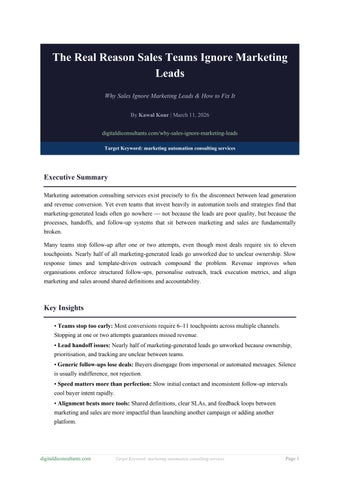
Marketing automation consulting services exist precisely to fix the disconnect between lead generation and revenue conversion. Yet even teams that invest heavily in automation tools and strategies find that marketing-generated leads often go nowhere — not because the leads are poor quality, but because the processes, handoffs, and follow-up systems that sit between marketing and sales are fundamentally broken.
Many teams stop follow-up after one or two attempts, even though most deals require six to eleven touchpoints. Nearly half of all marketing-generated leads go unworked due to unclear ownership. Slow response times and template-driven outreach compound the problem. Revenue improves when organisations enforce structured follow-ups, personalise outreach, track execution metrics, and align marketing and sales around shared definitions and accountability.
Key Insights
• Teams stop too early: Most conversions require 6–11 touchpoints across multiple channels. Stopping at one or two attempts guarantees missed revenue.
• Lead handoff issues: Nearly half of marketing-generated leads go unworked because ownership, prioritisation, and tracking are unclear between teams.
• Generic follow-ups lose deals: Buyers disengage from impersonal or automated messages. Silence is usually indifference, not rejection.
• Speed matters more than perfection: Slow initial contact and inconsistent follow-up intervals cool buyer intent rapidly.
• Alignment beats more tools: Shared definitions, clear SLAs, and feedback loops between marketing and sales are more impactful than launching another campaign or adding another platform.
1. The Real Problem: Leads Don't Convert After They Arrive
Marketing has done its job. The pipeline is filled with names, companies, and clear signals of intent. Yet revenue still stalls. This is not just a marketing problem — it is a structural failure in the revenue process. Research consistently points to the same pattern: sales teams fail to follow up on leads, follow up too late, or reach out with messages that lack relevance.
• Many teams make only one or two contact attempts, even though most deals require 6–11 touches before they close.
• Around 50% of leads are never properly worked — ownership of the handoff and follow-up sequence is unclear.
• When follow-up is slow, inconsistent, or irrelevant, buyer interest fades — not because the buyer rejected the offer, but because the system quietly failed to act when it mattered most.
For CMOs and CROs working with marketing automation consulting services, this is an important distinction: when sales ignores marketing-generated leads, it is not just a lead problem — it is a revenue execution problem.
2. Where Revenue Slips Through the Cracks
2.1
No Enforced Follow-Up Standard
Pipeline opportunities are often lost because of neglect, not rejection. Without a defined follow-up standard, sales reps default to the minimum: one email, one call, then the lead gets labelled 'unresponsive.' Buyers are busy — they miss emails and delay decisions. Stopping follow-up too early turns 'not right now' into 'never.'
System-level fixes:
– Set a non-negotiable follow-up baseline (e.g., at least 8 touches over 21 days).
– Build multi-channel outreach: email, calls, LinkedIn, and other relevant channels.
– Treat early drop-off as a process issue, not a rep preference.
2.2 Broken Ownership and Handoff
In many organisations, the MQL-to-SQL transition is where momentum fades. Without clear ownership, no one is responsible for response time, lead quality, or next steps. Nearly half of leads never receive structured follow-up. Lead status becomes vague labels — 'New,' 'Contacted,' 'Later' — offering no real insight. Marketing blames sales for being slow; sales blames marketing for poor leads. Trust breaks and pipeline metrics become unreliable.
System-level fixes:
– Establish a clear SLA: who owns the lead, how quickly they must act, what qualifies as a valid first response.
– Create shared lead stages — both teams must align on the same definitions and pipeline progression.
– Track 'no action taken' as a critical metric. Leads without follow-up must be visible and reviewed.
2.3 Low-Relevance, Template-Driven Follow-Up
Buyers recognise templates immediately. Silence is rarely rejection — it is a signal that the message was not relevant. Follow-ups fall flat when they lead with the product instead of the outcome the buyer cares about, ignore buyer context, or offer no new insight.
System-level fixes:
– Reference buyer context in every outreach — behaviour, trigger events, and specific use cases.
– Train teams to focus on outcomes and business risk, not just product features.
– Reframe follow-up as value delivery, not repeated persistence.
2.4 Slow or Inconsistent Timing
When first outreach happens hours — or days — after a lead shows intent, connection rates drop sharply. Random follow-up intervals make it harder for buyers to remember your message. Both issues weaken momentum and reduce conversion likelihood.
System-level fixes:
– Respond to high-intent leads within 5 minutes of their action wherever possible.
– Use structured cadences — e.g., day 1, day 3, day 7, day 12, day 18.
– Analyse timing performance; standardise intervals that drive the best response rates.
2.5 Sales–Marketing Misalignment
When sales does not trust the leads, they stop pursuing them. When marketing does not trust the follow-up process, they push for more volume. Both reactions create a hidden cost to revenue. Misalignment appears as unclear MQL definitions, emotion-driven instead of data-driven feedback, and pipeline metrics nobody fully trusts.
System-level fixes:
– Agree on shared qualification criteria — both teams must define what a qualified lead looks like.
– Review wins and losses together regularly to understand what works in the pipeline.
– Give sales input into lead scoring models; give marketing visibility into follow-up execution data.
2.6
Bandwidth Without Coverage Control
When reps are stretched too thin, they focus only on the easiest leads. Long-tail follow-up gets ignored and the middle of the funnel quietly stalls — precisely where most pipeline value is built.
System-level fixes:
– Use marketing automation to support sequencing and reminders — not to replace thoughtful outreach.
– Develop clear playbooks to reduce decision fatigue and ensure consistent process adherence.
– Measure coverage, not just conversions: track whether leads receive the full follow-up sequence.
3. Metrics That Actually Predict Revenue Execution
If the only metric tracked is closed deals, the problem is visible too late. Effective marketing automation consulting services focus on the execution metrics that occur before deals close — the leading indicators of revenue health.
Time to first contact
Avg. touches per lead
Leads with 0–1 outreach
Reply rate by message type
Stage where leads stall
A delay beyond 5 minutes drops connection rates by up to 80%
Fewer than 6 touches almost always means premature drop-off
The core measure of team neglect — should trend toward zero
Identifies which outreach formats and tones actually convert
Pinpoints the exact funnel step where process is breaking down
Review these metrics weekly. When execution — not just outcome — is tracked, patterns surface quickly, making it far easier to identify exactly where the process needs improvement.
4. The Truth Most Teams Ignore
Most companies do not have a lead problem — they have a follow-up system problem. The breakdown occurs because teams avoid the discipline required to follow through consistently.
Effective follow-up is repetitive by design. It means communicating the same valuable idea in slightly different ways to buyers who are busy, distracted, and evaluating multiple options. That is precisely where revenue is created and where the right marketing automation consulting services deliver their highest return.
When marketing appears to be working but sales is not closing, the issue is rarely the lead. It lives in the space between the first touch and the second, third, or even eighth conversation. Fix the system, and conversion rates improve — often without generating a single additional lead. Ignore the problem, and you will keep paying to refill a leaking bucket.
Conclusion
Revenue execution is a shared responsibility. Marketing can only do so much — the real multiplier lies in how consistently and intelligently sales follows through. By enforcing structured follow-up cadences, clarifying ownership, personalising outreach, and aligning both teams around shared metrics and definitions, organisations convert more of the opportunities already inside their pipeline.
The question is not whether to fix the follow-up system — it is how quickly the fix is implemented before more opportunities slip away quietly.
Need help building the systems, cadences, and alignment that convert more leads into revenue?
Explore our marketing automation consulting services at digitaldiconsultants.com/why-sales-ignore-marketing-leads
Book a strategy call and start closing more deals.