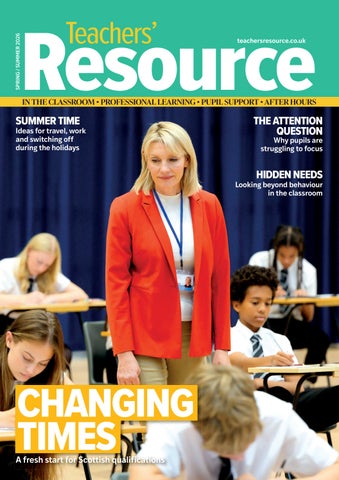
Teacher's Resource Spring / Summer 2026

Page 1


SUMMER TIME

Ideas for travel, work and switching o during the

CHANGING TIMES

PUBLISHER

Denise Connelly denise@dcpublishing.co.uk

STAFF WRITER

Kate Stevenson

EDITORIAL CONTRIBUTORS

Melissa Holmes Ananya Patankar

DESIGN AND PRODUCTION

Lucy Baillie lucy.baillie@dcpublishing.co.uk

SALES

Marian Mathieson marian.mathieson@dcpublishing.co.uk

Editor’s Letter

SPRING / SUMMER 2026

DC Publishing Ltd, 198 Bath Street, Glasgow, G2 4HG Tel: 0844 249 9007

©DC Publishing Ltd 2026. All rights reserved. No part of this publication may be reproduced or used in any way without prior written permission from the publisher. The views expressed in this magazine are not necessarily those of DC Publishing Ltd. The publisher takes no responsibility for claims made by advertisers within the publication. Every effort has been made to ensure that information is accurate; while dates and prices are correct at time of going to print, DC Publishing Ltd takes no responsibility for omissions and errors.

www.teachersresource.co.uk

ResourceMagScot

The end of the school year may be approaching, but supporting your students both inside and outside the classroom has never been more important. From helping them build study routines to guiding them through their next steps, your role is key in shaping their learning and wellbeing.

In this issue, we explore the challenges and opportunities teachers face today, discover how arti cial intelligence is changing the classroom, why maintaining

Resource

What’s

Pupil support

4 USEFUL DATES

Stay on track with our helpful calendar.

10 SUPPORTING STUDY

students’ attention spans has become increasingly di cult, and how to spot the hidden needs that some pupils keep to themselves. We also take a closer look at ways you can nd purpose outside the classroom, from fostering to volunteering during your summer breaks.

Plus, we speak exclusively to Edvin Zuckovs, the UK’s youngest teacher, and look at what Quali cations Scotland means for schools and pupils. All this and more inside.

Inside

Work together to develop e ective study routines.

12 BEYOND THE CLASSROOM

How to support your students through their next steps.

In the classroom

6 CHANGING TIMES

What Quali cations Scotland means for teachers and learners.

14 TOOL, THREAT OR TURNING POINT?

The impact of AI on learning, teaching and assessment.

17 THE ATTENTION QUESTION

Maintaining your students’ focus is harder than ever.

18 HIDDEN NEEDS IN THE CLASSROOM

Why some pupils struggle unnoticed and how to support them.

After hours

21 GIVING YOUR TIME

Ways to get involved in your community and encourage pupils to support others.

14

24 COULD FOSTERING BE RIGHT FOR YOU?

You could make a di erence to a young person’s life.

28 SUMMER TIME

Ideas for travel, work and switching o over the holidays.

30 WHAT WE’RE READING

Treat yourself to a cup of tea and a good book.

Professional learning

8 TEACHING SMARTER

Boost your skills with a CPD course.

Interview

26 MEET THE UK’S YOUNGEST TEACHER

Edvin Zuckovs proves that age is just a number.

DATES FOR YOUR DIARY

Support pupils and plan ahead with our helpful calendar MAY

START OF EXAM TIMETABLE

The exam diet begins today for pupils across Scotland.

MAY DAY HOLIDAY

A day o for many schools during the rst May bank holiday.

IN-SERVICE DAY

Some schools will have an in-service day due to the Scottish Parliament election.

MAY WEEKEND HOLIDAY

Many councils around Scotland will be o for the May weekend holiday. 22 4 7 22-25 APRIL

END OF EXAM TIMETABLE

The exam diet comes to an end.

SCHOOL’S OUT FOR SUMMER

AUGUST JUNE

EXAM RESULTS DAY

Time for a well-earned break before the new term.

Pupils receive their National 5, Higher and Advanced Higher results.

IN-SERVICE DAYS

Sta return to school to prepare for the new term.

PUPILS RETURN TO SCHOOL

The new school year begins. 2 4 26 10-11 12

Road Safety Scotland are delighted to announce the arrival of a new, digital road safety learning resource for Secondary Schools.

Linked to CfE, Mechanimals offers a new, innovative way to teach road safety, incorporating the use of powerful imagery, progressive lesson plans and engaging activities to support children and young people to help prepare them for a lifetime of safe road use.

Mechanimals comprises of six, simple, structured, ready to use road safety lessons. Designed by teachers for teachers. Launched in March 2026, Mechanimals is ready to be used and can be found at www.roadsafety.com

Changing Times

We learn what the

change from SQA to Qualifications Scotland will mean for teachers and learners

On 1 February 2026, Scotland’s national qualifications body entered a new phase. The Scottish Qualifications Authority (SQA), which was responsible for awarding National Qualifications such as National 5s, Highers and Advanced Highers, was formally replaced by Qualifications Scotland. This new public organisation was created through the Education (Scotland) Act 2025.

So, why replace the SQA? There are several reasons, including a drive to modernise the education system, the need to move away from a ‘one-sizefits-all’ exam model towards more continuous assessment, and a desire to improve trust in the system, particularly after the controversy surrounding exam grading during the Covid-19 pandemic.

For teachers across Scotland, the transition raises questions. Is this simply a rebrand, or does it represent genuine reform? What changes will schools see in practice? And – most importantly – what will it mean for young people working towards their qualifications?

MORE THAN A REBRAND

The answers are still evolving, but the shift to Qualifications Scotland signals a reset in the way the qualifications system works with teachers, learners and schools. The organisation aims to support every learner to realise their potential. Embedding values of openness, collaboration, and forwardthinking, Qualifications Scotland’s purpose is to: “deliver the Education (Scotland) Act 2025 by designing, delivering and awarding qualifications that provide all learners with fair and equal opportunity to fulfil their potential.”

Chief Executive Nick Page explains: “Qualifications Scotland is not and can never be a rebrand of SQA. It is

a new organisation designed from the ground up to work differently, to engage more deeply and to put learners and educators at the very heart of everything we do.”

CULTURAL SHIFT

As part of that cultural shift, the new board of Qualifications Scotland – which will provide oversight and strategic direction to Qualifications Scotland – has representation from professionals in schools, colleges and universities, as well as individuals who represent the interests of learners, employers and employee relations. And additional new governance structures aim to bring teachers, lecturers and learners closer to decision-making. For example, the roll-out of the new School Partnership Team, led by Kinross High School headteacher Sarah Brown, hopes to ensure Qualifications Scotland is closer to the classroom than SQA was.

Qualifications Scotland will also develop a Learner Interest Committee and Teacher and Practitioner Committee to create charters for both learners and educators, listening to their views and involving them in decision making. So, for those teachers who have perhaps felt national qualifications were shaped at a distance from classroom realities, this commitment to collaboration is a key element of the changes. And, by involving learners more directly in the governance of the new organisation, Qualifications Scotland also aims to ensure that the student voice becomes a more visible part of the qualifications system.

CLASSROOM CHANGES

For teachers, students and learners, not much will change in the short-term. Qualifications Scotland has taken over the responsibilities previously held

by the SQA, including setting exams, awarding National Qualifications and accrediting vocational awards. This means the courses currently taught in schools – and the assessments students are preparing for – remain unchanged and will remain recognised by colleges, universities and employers. Existing materials, guidance and assessment frameworks continue to apply while the organisation transitions to its new identity. This gradual reform will enable schools to maintain stability while longer-term changes to curriculum and assessment are developed. Looking ahead, a young person currently entering S1 later this year (2026), can expect to be in the first group to experience the evolved technical framework in the third year of secondary school.

According to planning documents

by the Scottish Government, new approaches to assessment and revised qualifications will be introduced over the coming years, leading up to new qualifications linked to an evolved curriculum framework being rolled out during the early 2030s. Policymakers hope that future developments will create a system that better reflects the

“New governance structures aim to bring teachers, lecturers and learners closer to decision-making”

diverse ways young people learn and demonstrate achievement.

TEACHERS’ VOICES

Within the teaching profession, the response to the changes in Scotland’s qualifications administration has been mixed. Education leaders have long argued that teachers should have a stronger voice in shaping the assessment system, so stronger collaboration between the national agency and classroom practitioners is welcomed.

Yet some critics remain sceptical about whether the new organisation will lead to meaningful change. When the legislation to create Qualifications Scotland was debated, some politicians and commentators suggested the reform risked becoming “little more than a rebrand” if deeper cultural

changes did not follow. Andrea Bradley, general secretary of the EIS, told the BBC: “There has to be demonstrable willingness from Qualifications Scotland to engage with teachers as professionals now.”

The tension between hope for change and concern about continuity continues to shape conversations about the shift to Qualifications Scotland. The success of the new organisation will not only depend on legislation and organisational structures, but on the extent to which it builds trust with the teachers and learners it serves. So, rather than representing a finish line, the launch of Qualifications Scotland marks the beginning of a longer journey for Scotland’s qualifications system.

Learn more at qualifications.gov.scot

TEACHING SMARTER

CPD courses to strengthen your skills

Boost your skills and con dence with CPD through professional learning opportunities covering leadership, inclusion, languages and sustainability

SSERC Leadership in STEM Education sserc.org.uk

This professional learning programme is aimed at secondary teachers with leadership responsibilities in STEM subjects. It supports the development of leadership practice in curriculum design, pedagogy and departmental improvement. Participants engage with structured learning and apply their learning within their own school context as part of the programme.

SCOTLAND’S NATIONAL CENTRE FOR LANGUAGES (SCILT)

1+2 Languages Leadership Programme scilt.org.uk

Delivered in partnership with Education Scotland, this programme supports teachers with responsibility for, or an interest in, leading languages education. It focuses on developing leadership practice and supporting implementation of the 1+2 Languages Policy across secondary settings. The programme includes structured learning, re ection and practical application within schools, with places o ered at set points during the year.

SIGNPOSTS FOR GLOBAL CITIZENSHIP

Learning for a Better Future signpostsglobalcitizenship.org

A year-long professional learning programme focused on Learning for

Sustainability and Global Citizenship.

Open to secondary teachers across subject areas, the programme includes online sessions, professional enquiry and mentoring. It supports participants to embed sustainability and global citizenship within curriculum planning and wider school practice.

DYSLEXIA SCOTLAND

Dyslexia and Inclusive Practice

dyslexiascotland.org.uk

This programme supports secondary teachers to develop inclusive classroom practice for learners with dyslexia. The course focuses on the experiences of dyslexic learners, understanding barriers to learning, practical classroom approaches and whole-school inclusive practice. It is suitable for teachers looking to strengthen inclusive approaches within subject teaching and across departments.

OPEN UNIVERSITY SCOTLAND

Scots Language Teacher Professional Learning Programme open.ac.uk

This GTCS-recognised professional learning programme supports secondary teachers to develop knowledge and con dence in teaching Scots language. The course focuses on classroom practice, curriculum planning and assessment, and supports teachers to embed Scots across subject areas in line with Curriculum for Excellence.

Most programmes run annually, with applications opening at di erent points during the year, so it helps to check dates early and plan professional learning in advance.

Use the GTCS course search at gtcs.org.uk to check accreditation and Professional Recognition status.

the classroom

Science-fuelled Day Visits that challenge and inspire, by getting students hands-on with STEM.

Extended Learning Lab programmes with training, resources, real scientists and everything you need to teach amazing STEM in school and beyond.

Glasgow Science Centre is ready to support you and your pupils to become the next generation of scientists and engineers. Together we’ll show them what’s out there!

Visit our website for more information and to book: glasgowsciencecentre.org

SUPPORTING STUDY

Helping students build strong study habits. A few simple reminders can help pupils make the most of their revision

With exams just around the corner, many pupils will be stepping up their revision.

A few practical reminders in class can help them stay organised, make the most of their study time and feel more confident about the weeks ahead.

So how can you help them achieve this?

KEEP IT PRACTICAL

You can start by reminding students that studying doesn’t need to be complicated. Short, focused sessions with regular breaks are far more effective than long evenings of cramming, which can leave students feeling exhausted and unproductive. Encourage them to start with the basics: a quiet place to work, a cleared table and putting phones out of reach. These small changes can make it easier to concentrate.

It can also help to point students towards trusted revision resources.

BBC Bitesize, for example, provides clear explanations across a wide range

of subjects and levels. Revisiting key topics and practising questions can help reinforce what they already know.

CREATE BENCHMARKS

As exams approach, students often feel more at ease when they know exactly what they should be focusing on each day. Whether they are preparing for National 4s, National 5s, Highers or Advanced Highers, it’s important to encourage conversations about upcoming assessments, deadlines and revision plans, and how they plan to organise their study time.

Encourage students to set small, realistic goals for each session, such as revising one topic or completing a few past paper questions. Breaking revision

“Encourage students to set small, realistic goals”

into smaller tasks can help pupils approach their study sessions with a clearer focus.

Asking students to explain their plan out loud can help them organise their thinking and reflect on what they still need to cover. This can help them feel more prepared as exams approach.

SHARE DIFFERENT APPROACHES

Not every pupil revises in the same way. Some prefer flashcards and retrieval practice, while others find mind maps, summary notes or talking through topics more helpful.

Remind students that they should use methods that suit them best. At this stage, the most useful revision involves actively testing what they know rather than simply rereading notes.

One of the most helpful messages you can share is this: small wins matter. Finishing a topic, sticking to a weekly plan or completing one past paper can all help to build their confidence.

BUILD CONFIDENCE

The run-up to exams can feel intense, so reassurance from teachers can make a real difference. Encouraging pupils to balance revision with rest, sleep and time away from their notes is just as important.

A simple weekly timetable can also help pupils organise their time. Setting out when they plan to revise, complete homework and take breaks can make their workload feel more manageable. You can support this by sharing clear timelines and breaking larger tasks into smaller steps.

Regular check-ins can also help pupils reflect on what they feel confident about and what they want to spend a little more time on before exam day.

Pupils can find revision guides, study tips and exam advice at bbc.co.uk/bitesize, sqa.org.uk/pastpapers and young.scot.

Get Work Ready

Build your students’ digital skills and spark career inspiration

Introducing the Work Ready programme, brought to you by BT Group, which helps to prepare young people in Scotland for the tech-driven world of work. We’re actively supporting 11–14-year-olds in developing the practical, technical and humancentric skills that future careers demand through interactive content and engaging sessions.

Through the programme, students will learn more about the workplace and help build the digital skills they need for a confident and successful future. Discover how Work Ready fits perfectly into the Technologies area of the Curriculum for Excellence.

We’re offering free, engaging virtual bootcamps and in-person workshops to Scottish schools. To find out if your school is eligible for an event, email btworkready@wecommunications.com.

Continue the learning

In addition to our events, check out our Digital Hub to discover inspiring, curriculum-linked content on AI, Cybersecurity, Healthcare and the Internet of Things for your students.

You’ll also find new Parent and Carer content to expand the learning at home, along with lots of useful information that’s aligned with the Digital Learning and Teaching Strategy for Scotland.

Beyond Classroomthe

For many students, the future can feel both exciting and uncertain. Your role is not to decide for them, but to help them understand the options available and support them in making informed choices about what comes next.

KEEP OPTIONS OPEN

One of the most helpful messages we can give students is that there is no single “right” path. Some will choose further education, others will move into apprenticeships or employment, and many will combine different routes over time. What matters most is that they understand their choices and how each pathway can support their longterm goals.

For those considering further education, encourage students to research courses carefully, check entry requirements and attend open days where possible. Websites such as ucas. com and prospects.ac.uk can help them compare courses and explore where different qualifications might lead.

Students applying through UCAS should be aware that a set of structured questions has now replaced the traditional personal statement. These allow applicants to explain their interests, experiences and motivation for their chosen course, so they still require preparation well before application deadlines.

EXPLORE APPRENTICESHIPS

Apprenticeships are becoming increasingly popular. They allow young people to earn a salary while gaining industry-recognised qualifications and hands-on experience. This pathway can be particularly appealing to students who prefer practical learning and want to enter the workforce straight away.

Modern apprenticeships exist across a wide range of sectors, from engineering and construction to healthcare, business and digital technology. Students can explore opportunities through services such as apprenticeships.scot, who provide

“Career journeys are rarely straightforward, and pathways can change over time”

listings and information about available roles.

It is important to explain that apprenticeships still involve structured learning. Students will have to balance work with study, and even attend college or training sessions alongside their employment. Researching the role before applying can help them decide whether this route suits them.

OTHER PATHWAYS

Not every student will want to move directly into study or work. Some choose to take time to gain experience through volunteering, travel or temporary employment. A structured gap year can help young people build

Conversations about life after secondary school can often feel overwhelming for many young people. Here are some practical and supportive ways to help guide them

confidence and independence while giving them time to reflect on their longer-term goals.

Regardless of the route they choose, students will benefit from developing transferable skills. Communication, teamwork, problem-solving and time management are valued in every sector. Part-time jobs, volunteering, leadership roles and extracurricular activities can all help build these qualities.

The best thing you can do is help students reflect on their strengths and interests. Conversations about what they enjoy and what they are good at can help them see how their current subjects might connect to future opportunities.

Many students worry about “getting it wrong,” but career journeys are rarely straightforward. By reminding them that pathways can change and develop over time, you can help them approach the future with greater confidence.

For more information and support about student pathways, visit ucas.com, apprenticeships.scot and myworldofwork.co.uk

50 MILES* | 10 CODES | 1 MONTH

CALLING ALL CODEBREAKERS!

Operation Bletchley is a virtual walking and codebreaking challenge. Participants take part by logging their miles, solving ciphers and uncovering secret messages along the way.

Your school or classroom can take part in any way that works for you: a whole class together, small groups, or a teacher-led puzzle session!

JULY’S MISSION: LONDON.

(More missions are available throughout the year.)

Give your students the chance to become a secret agent!

A thrilling mission of codes and covert encounters – can you solve the puzzles and deliver the message to Winston Churchill before it’s too late.

Scan the QR code to watch the teaser video ➔

PERFECT FOR THE CLASSROOM – YOUR STUDENTS WILL:

● Test their maths, english and science knowledge by cracking codes to uncover hidden messages.

● Work as a team to solve problems under pressure.

● Explore Cold War history in an interactive, memorable way.

● Get active by walking up to 50 miles*

Since 2019 over 14,500 people have taken part worldwide, walking over 1,000,000 miles and raising over £650,000 for the Army Benevolent Fund. Class discounts available – please get in touch. Standard registration is £20 per mission (£20 with fundraising or £45 with no obligation to fundraise). Registration opens 1st May. Your mission must be completed between 1 – 31 July 2026. To find out more visit armybenevolentfund.org/operationbletchley, email events@armybenevolentfund.org or scan this QR code. * Distance can be adjusted to suit your students ability.

The Army Benevolent Fund is a registered charity in England and Wales (1146420) and Scotland (SC039189) and registered as a company limited by guarantee in England and Wales (07974609).

Tool, Threat or Point?Turning

Artificial intelligence is becoming part of everyday school life, raising new questions for teachers about its place in the classroom

Across Scotland’s secondary schools, artificial intelligence is beginning to influence how students revise, write assignments, and prepare for life after school.

Mrs Suzanne Oram is a maths teacher and pastoral support officer in Glasgow. She says the shift has been subtle but unmistakable. “It’s still in its infancy,” notes Mrs Oram. “But in the past year it’s become more common.”

THE NEW TOOL

Students are often the first to experiment with emerging technology, and AI is no exception. Since the public release of ChatGPT in 2022, students have adopted

the tool at a remarkable speed. A 2024 survey found that more than half of UK university students were already using AI tools. For teachers working with pupils preparing for higher education, this offers a clear indication of the habits students are already developing and the importance of teaching them to use technology appropriately.

Mrs Oram told us that one of her pupils had turned AI into a revision partner. “One of my students uses AI to revise,” she explains. “She puts in questions that could possibly be asked and asks it to test her.”

It’s a clear example of how, if used carefully, AI can generate practice questions, summarise difficult concepts or offer alternative

“We’re starting to see less original work and more computergenerated work”

explanations when a student is stuck. For pupils revising independently at home, it can serve as an at-home tutor.

And it’s not just students who are experimenting with the technology. Teachers are beginning to explore its capabilities too.  “I used it to create a policy document recently,” Mrs Oram admits. “I couldn’t believe what came out. It was amazing.”

Many other educators are also using AI to draft lesson outlines, summarise resources or produce administrative documents more efficiently. Of course, in an industry where workloads and burnout are major issues, the appeal is obvious.

THE ORIGINALITY PROBLEM

But the technology brings questions alongside the benefits. One concern among teachers is the effect AI may have on students’ originality.

“We’re starting to see less original work and more computer-generated work,” says Mrs Oram.

That’s because you can enter a prompt and receive a structured answer in seconds: “It’s just so easy to use.”

However, what students are not realising is that if they’re all entering similar prompts, the responses they’re receiving will look remarkably alike. This raises particular concerns around UCAS applications: “Universities are finding it harder to determine who they’re letting in when they read personal statements,” states Mrs Oram. “The applications are too polished and similar.”

THE ABILITY DILEMMA

Teachers also have concerns that AI could blur the distinction between students who understand and those who don’t – making it hard for Mrs Oram and her colleagues to spot who needs help and who doesn’t.

“It’s closing the gap between higher-attaining and lower-attaining

students” adds Mrs Oram, raising concerns about how teachers assess ability.

But it can be really difficult to spot who’s using the technology and who is not in some subjects: “If a pupil puts a maths problem into AI and takes the result, there’s not much you can do,” she admits. “In the end, they just lose the opportunity to work it out themselves.”

The danger here is not simply academic dishonesty, but the gradual removal of the thinking process that learning depends on. “It’s making people lazy,” Mrs Oram shrugs.

THE WAY FORWARD

Despite the concerns, she believes schools should work with the technology rather than ban it.

“It’s permeating everywhere, in workplaces and most industries,” reveals Mrs Oram. “I don’t think we can avoid it.”

From marketing to engineering, employers are already integrating artificial intelligence into everyday tasks. So if pupils are going to encounter these systems in the workplace, then schools must eventually teach them how to use the technology responsibly.

However, Mrs Oram says that the challenge is that “every subject will face the issue differently.” Creative subjects such as art, drama and music may experience less disruption because performance and practical work remain central. In other areas, like English or History, the impact could be more significant.

Even physical education may eventually see change as emerging technology begins analysing sports performance and technique. For now, however, the biggest task facing schools is helping pupils understand the difference between using AI as a support tool and allowing it to replace their own thinking.

“There’s nothing else to it. We have to educate young people on how to use it,” finishes Mrs Oram. “But more importantly, how not to use it.”

Because the reality is that the question is no longer if AI will affect the classroom, “it already is”.

Free support materials for secondary school staff are available on GOV.UK. Search “generative AI in education”.

Quality Meat Scotland School & Community Engagement

Would you like to help your school community learn more about where their food comes from? At Quality Meat Scotland (QMS) we offer engagement in a variety of ways, all designed to help young people learn more about the Scottish red meat sector.

School In-Class Sessions

Classroom sessions linked to Curriculum for Excellence, with a variety of engaging activities designed to meet subject benchmarks.

Cookery Demonstrations

Our QMS Scotch Ambassadors can help your young people to explore cooking with Scotch red meat and learn how to easily include it in a healthy, balanced diet.

Eat to Compete

Nutrition focused sessions with coaching session built-in, designed to help young people learn how diet can enhance performance and recovery in sport, linking learning across the curriculum.

Learn online with Farming Foodsteps

Scan here to explore the six lessons on our online interdisciplinary-learning platform ‘Farming Foodsteps’ – covering everything from farm to fork!

Want to have a chat with us?

Contact Abby Goldie, Community Engagement Coordinator agoldie@qmscotland.co.uk

The attention question

Across UK classrooms, teachers say sustaining genuine focus among pupils in lessons has become one of the toughest parts of the job today

Recent surveys show that many educators believe attention spans among their pupils are shorter, which is making it harder to teach them. A Cambridge International survey of more than 3,000 teachers found that 88 % believe students’ attention spans have shortened, making it harder for them to tackle complex topics or longer assignments. The survey also found that 72 % of teachers say students struggle to maintain focus on demanding material, while 64 % report that pupils find it difficult to complete extended tasks without distraction.

THE PROBLEM

A separate survey of 1,800 teachers conducted by educational platform Kahoot! revealed that 35 % of teachers rank short attention spans and constant distraction from phones, social media and life outside school as one of their biggest challenges this academic year. Many of those surveyed said the barrage of digital distractions makes it harder to get pupils to engage with sustained academic tasks.

Rachel, a secondary school teacher, says she sees the impact of social media on concentration every day: “It’s getting worse and worse… pupils

struggle to concentrate on anything for longer than a few minutes.” She also added that resilience has dropped, with many children giving up before they have really begun a task.

Another teacher agreed with Rachel but felt that many of her pupils now tune out within minutes of entering the classroom, not because they are uninterested in learning, but because they are “used to constant novelty and instant responses,” making sustained focus feel alien to them.

CLASSROOM IMPACT

This pattern matches wider behaviour issues. Four in ten teachers report misbehaviour as disrupting most of their lessons, and many estimate that about seven minutes of every half hour of lesson time is lost to distraction or disruption.

Teachers point to a range of reasons,

“Pupils struggle to concentrate on anything for longer than a few minutes”

from the impact of smartphones to the pace of online content, which encourages rapid shifts in attention and instant rewards that don’t translate easily to the sustained effort required in a classroom. Ofsted’s chief inspector, Sir Martyn Oliver, has warned that social media is “chipping away at attention spans”, and eroding the patience learners need for deeper study.

Many teachers are noticing a difference in their classrooms. As one teacher told her colleagues online, “they’re physically here but mentally checked out”: present in body, absent in focus.

One teacher suggested many pupils now rely more on structure and regular prompts to maintain focus during longer tasks. Without that, she said, attention can drift more quickly, particularly during quieter or less interactive parts of a lesson.

For teachers, the question is not just whether attention spans are changing, but how the habits shaped by constant digital stimulation are influencing learning in the classroom.

For more information, visit cambridgeinternational.org kahoot.com

Hidden needs in the classroom

Not all pupils who are struggling show it. We look at hidden needs in the classroom, the signs to look out for, and ways to make a difference

In most classrooms, there are pupils who keep their heads down and get on with it. They turn up, follow instructions and don’t cause problems. For some, though, that takes a lot of effort. Difficulties that are not obvious can be missed in busy classrooms, even when pupils are struggling.

Hidden needs can include autism, ADHD, dyslexia, dyspraxia, speech and language difficulties, sensory processing differences, anxiety and mental health issues. Some pupils will have a diagnosis and support in place, but many will not. Some might be waiting for assessment, or might not yet understand why school feels harder for them than it does for their friends. In secondary school, where fitting in matters, many pupils work hard to hide their difficulties.

Figures suggest that around one in six children in the UK experience a mental health condition, while neurodivergent conditions such as autism and ADHD remain underidentified, particularly among pupils who do not present with obvious behavioural difficulties. In practice, this means most teachers will be supporting pupils with hidden needs, whether they are aware of it or not.

WHY HIDDEN NEEDS ARE MISSED

Secondary schools are fast-paced environments. Pupils move between classes and teachers throughout the day, which makes it difficult for any one adult to see the full picture. Quiet pupils who do not cause disruption can easily be overlooked, particularly when time and attention are focused on behaviour and attainment.

There is also a tendency to assume that academic progress means a pupil

is coping. One secondary teacher described a pupil who consistently achieved well and appeared confident in lessons. Concerns only emerged when attendance began to drop. At home, the pupil was spending hours rewriting work to avoid mistakes, becoming increasingly anxious and exhausted. In school, she rarely asked for help and worked hard to keep up appearances.

IMPACT ON LEARNING

Hidden needs can affect learning in ways that are not always obvious. Some pupils find it extremely difficult to concentrate when there is background noise or flickering lighting in the classroom. Even low-level distractions can make it hard to follow instructions, leading to mistakes or unfinished work. Pupils might understand the subject content but mishear what they are meant to be doing and feel uncomfortable asking for clarification. Other aspects of classroom learning can also present challenges. Group work, presentations or activities involving unfamiliar materials can increase anxiety and reduce participation. Sensory sensitivities can make busy classrooms, bright lighting or crowded corridors difficult to manage, affecting concentration and confidence.

Anxiety is particularly common and often misunderstood. It can affect memory, organisation and recall, meaning assessments feel much harder than everyday classwork suggests. Some pupils become very focused on getting everything right, while others avoid tasks altogether, particularly tasks involving speaking in front of peers or working under time pressure. Over time, these pressures build and begin to show in behaviour.

BEHAVIOUR AS COMMUNICATION

Behaviour linked to hidden needs is frequently misunderstood. Withdrawal, refusal or disruption are often responses to feeling overwhelmed rather than deliberate defiance. A pupil who repeatedly asks to leave class could be trying to manage anxiety, while another who becomes angry could be reacting to sensory overload or frustration.

When behaviour is treated as a sign that a pupil is struggling, teachers are more likely to respond in ways that prevent the same issues coming up again. Looking at what is causing a behaviour can help deal with the issue properly, rather than seeing the same problems repeat.

MAKING A DIFFERENCE

Supporting pupils with hidden needs does not always require specialist knowledge or large changes. Small,

consistent adjustments can make a noticeable difference. Clear communication matters. Breaking instructions down and providing written guidance alongside verbal explanations can support pupils who need more time to process information.

For some pupils, written instructions are essential. Being able to refer back to what they are meant to be doing can reduce anxiety and support independent working, particularly in busy classrooms where verbal instructions are easily missed.

Clear routines and expectations also help. Letting pupils know what a lesson will involve, and flagging changes in advance, can reduce stress. Where possible, offering alternatives to group work or presentations can make it easier for some pupils to take part.

“Small, consistent adjustments can make a noticeable difference”

In practice, small, agreed arrangements tend to work best. Allowing a short break or time in a quieter space can prevent situations escalating and reduce time out of class.

WORKING WITH FAMILIES

Families often see a very different picture at home, particularly where pupils are holding things together during the school day. Speaking with parents or carers can help teachers understand what a pupil is dealing

with outside school. Sharing concerns between guidance and learning support colleagues is especially helpful when the same issues are appearing across different subjects.

Hidden needs can be easy to miss. When teachers look beyond behaviour and attainment, young people are less likely to struggle without anyone noticing. Picking things up early, and making small changes where possible, can make a real difference to their experience of school and beyond.

Visit nasen.org.uk for guidance on supporting neurodivergent learners in the classroom, or youngminds.org.uk for information and resources to support young people experiencing mental health difficulties.

START THE SCHOOL YEAR WITH AN INSPIRING EDUCATIONAL ADVENTURE

Unlock more learning for less! Book two activities at Edinburgh’s only Science Centre and Planetarium and get a third absolutely free – with our unmissable 3-for-2 offer available exclusively in Term One*.

Bring science to life through our hands-on experiences:

• Discover our immersive galleries

• Experience an incredible 360� Planetarium show

• Take part in curriculum-linked workshops exploring planet Earth and space.

TRANSPORT SUBSIDY AVAILABLE for schoolseligible **

BOOK NOW

Explore

GIVING YOUR TIME

Ways to volunteer in your community and involve pupils in supporting others

The summer term brings a change of pace. Alongside the usual rush of deadlines, it can also be a chance to think about what comes next, including how you might use your time in and beyond the classroom.

Giving back doesn’t have to mean taking on something huge. It might be a few hours over the holidays, a oneoff event, or a small project in school that helps pupils see beyond their own world. Even small efforts can make a real difference. If it’s something you’re interested in, here are a few ways to get involved.

START LOCAL

Food insecurity remains a reality for many families across Scotland. Figures from The Trussell Trust (trussell.org. uk) show food banks are still in high demand, particularly during school holidays when free lunches aren’t available.

Volunteering at a local food bank is practical and immediate. Sorting donations, packing parcels or helping with distribution offers a clear sense of the difference you’re making. It’s also a reminder of the challenges some pupils may be facing at home.

If you’re Edinburgh-based, initiatives

like Empty Kitchens Full Hearts (emptykitchens.co.uk) prepare and deliver meals using surplus food. Across Scotland, The Food Train (thefoodtrain. co.uk) supports older people through shopping and befriending services. Most roles are flexible, and even the occasional help is valued. The key is to choose something manageable, whether it’s a morning a week, or a short summer block.

THINK GLOBAL

To connect your work to the wider world, consider supporting Mary’s Meals (marysmeals.org.uk). The

charity provides daily school meals to children in some of the world’s poorest communities.

One of the best ways to get involved is through the Backpack Project. The idea is to fill a rucksack with basic school supplies and everyday items for a child who may otherwise go without. It’s straightforward, tangible and powerful. Better yet, why not get your students involved, too? They’ll love picking out different items for a student who will benefit from it.

It can also lead to useful classroom discussions about global inequality, educational access and the UN Sustainable Development Goals.

USE YOUR SKILLS

As a teacher, you’ve developed strong organisation, safeguarding and communication skills over the years. These are all useful when volunteering with many organisations.

If literacy is your passion, the Volunteer Tutors Organisation (vtoscotland.org) supports young people who need extra help with learning. A weekly tutoring session can have a lasting impact, particularly for pupils affected by disadvantage.

There are also environmental routes. The Scottish Wildlife Trust (scottishwildlifetrust.org.uk) runs practical conservation volunteering opportunities across the country. It’s physical, outdoors and a complete contrast to classroom life.

Youth organisations such as Scouts Scotland (scouts.scot) and Girlguiding Scotland (girlguidingscotland.org.uk) are often keen to welcome adults who can commit even a few hours a month.

“A few hours a month is often enough to feel connected and useful”

SUPPORT REFUGEES

Scotland continues to welcome people seeking safety and a fresh start. Organisations such as the Scottish Refugee Council (scottishrefugeecouncil.org.uk) and Refuweegee (refuweegee.co.uk) rely on volunteers to help new arrivals settle into their communities.

This might involve sorting donations, packing welcome kits, supporting language groups, or assisting at community events. Even helping to gather toiletries, school supplies, or winter clothing can make a practical difference. As a teacher, it can also deepen your understanding of the experiences some pupils and families bring into the classroom.

FIGHT ISOLATION

If you’re looking for something more people-focused, consider volunteering with Chest Heart & Stroke Scotland (chss.org.uk) or the British Red Cross (redcross.org.uk). Both organisations offer flexible roles, from community support and fundraising to befriending services.

Spending time with people recovering from illness or experiencing isolation can be a reminder of the

challenges many people face in their daily lives. It can also sharpen your empathy and patience skills, which are key in the classroom. A few hours a month is often enough to feel connected and useful, without stretching yourself too thin.

BACK MENTAL HEALTH

Senior pupils are often motivated by causes close to home. Fundraising for SAMH (samh.org.uk) or YoungMinds (youngminds.org.uk) can open up constructive conversations about wellbeing and mental health.

A simple bake sale, sponsored walk, or staff-versus-pupils challenge can work well. Keep it time-limited and clearly structured. Afterwards, discuss what was raised and what pupils learned from the experience.

WHY IT MATTERS

Seeing teachers involved in their communities sets a clear example to pupils. When given structured opportunities to contribute, pupils will often surprise you with their commitment and empathy.

Whether it’s packing a backpack for Mary’s Meals, volunteering at a food bank, planting trees with a conservation group, or running a small in-school fundraiser, these actions connect learning to real life.

After a long term, doing something practical for others outside the classroom can be a welcome change.

Visit volunteerscotland.net or doit.life, to find volunteering opportunities near you.

Scottish Wildlife Trust
Mary’s Meals

At Outward Bound, we’re not just transforming the lives of pupils, we’re supporting the wellbeing and growth of teachers too.

Our residential programmes empower you to reconnect with your ‘why’, build stronger relationships with pupils, and return to school more energised, resilient, and inspired.

Teachers who join our courses say they feel valued, recharged, and more confident in their role. Beyond the breathtaking locations, it’s the shift in perspective, the time to reflect, and the shared experiences with students that create lasting impact, for everyone.

Teaching staff reported benefits from... Scan

81% SPENDING TIME OUTDOORS

73% THE OUTDOOR ACTIVITIES

Could fostering be forright you?

Teachers already support children in many ways. For some, fostering can be another way to offer stability and care outside the classroom — one that is both rewarding and ful lling

Working in education develops a wide range of skills that are also important in foster care. Foster carers support children and young people who can’t live with their families, o ering a safe and stable home during what can be an unsettled time. There continues to be a need for more people to consider fostering, with options that can t around di erent lives and commitments.

Foster Care Fortnight takes place each May and is led by The Fostering Network (thefosteringnetwork.org.uk). This year, the campaign theme is “This Is Fostering,” highlighting what fostering

“Short or long term, fostering offers stability and care when young people need it most”

involves and sharing the experiences of foster carers and the children and young people they support. The campaign shines a light on the everyday experiences of fostering, raising awareness of the positive impact foster carers have.

EXPERIENCE

Teachers spend their working lives supporting children with a wide range of needs and experiences. This background can be helpful in a fostering setting, where patience, clear boundaries and reassurance are often needed. Listening carefully, staying calm under pressure and working alongside other professionals are all part of life in schools — and they’re just as important in helping a child settle into a new home.

NEXT STEPS

applications from people from all backgrounds and family situations, focusing on what you can o er rather than your personal circumstances.

After applying, you’ll take part in an assessment process that helps you think through whether fostering is right for you and how it might t alongside your teaching role and home life. It also helps agencies make suitable matches.

Foster Care Fortnight runs from the 11th-24th May

Fostering doesn’t always involve long-term placements. Some carers o er short breaks, emergency care, or support during weekends or school holidays.

Once approved, foster carers receive training and ongoing support to help them meet children’s needs. Whether short or long term, fostering o ers stability and care at times when young people need it most.

To foster, you must be aged 21 or over, have a spare bedroom, and be able to o er time and consistency to a child or young person. Agencies welcome

To nd out more visit Barnardo’s (barnardos.org.uk), Action for Children (actionforchildren.org.uk), or visit the Scottish Government website (gov.scot).

You don’t need to be perfect. (And we certainly don’t expect you to be.) You just need to be you.

Because fostering isn’t about fitting a mould. It’s about bringing your own way of caring whatever shape that takes. And if you can do that, we can help you with the rest.

We’ll be with you every step of the way and we offer fantastic training all year round. We also support you financially so you can dedicate your time to a child. We pay a fee (incl allowances) up to £840 a week.

So if you ’ ve ever wondered whether fostering might be for you, we’d love to hear from you.

Meet the UK’s youngest teacher

At just 13, Edvin Zuckovs stepped from publishing his first book into the classroom. Now 18, and known as the UK’s youngest teacher, he’s proving that age doesn’t limit what you can achieve

While most teenagers are thinking about exams and career choices, Edvin, from Lincolnshire, has already spent years working in classrooms, delivering lessons and speaking to younger students. We chat to him about how it all began and what he’s learned along the way.

Q: Most people are worrying about GCSEs at 13. You were already teaching. How did that happen?

A: It still sounds strange when I say it out loud. I actually started out as an author. I published my first book when I was 13 because I felt there was a gap in books written by young people, for young people. A primary school invited me in to talk about my journey, and that turned into assemblies, then lessons, then covering PSHE. Before I knew it, I was properly in the classroom.

Q: When did you realise teaching wasn’t just a one-off, but something you really wanted to do?

A: The moment I realised I was making an impact. Standing in front of Year 5 and 6 students and seeing them genuinely listen, ask questions, and feel inspired was massive for me. I loved that feeling of helping someone understand something or believe in themselves a bit more. That’s when teaching stopped being an opportunity and became a passion.

Q: You’re often called the UK’s youngest teacher. What’s that label like to live with?

A: Surreal, honestly. It’s a title I’ll probably carry forever. At first it felt overwhelming, but now I see it as a conversation starter. It gets people talking about age, experience, and whether they really go hand in hand. I like being able to show that age shouldn’t be a barrier to success.

Q: How do students react when they realise you’re not much older than them?

A: There’s definitely surprise at first. Some test the boundaries, especially older students, but that happens to every teacher. I think being closer in age helps me relate to them more. I focus on respect rather than authority. I want them to enjoy learning, not be scared of the person at the front of the room.

Q: You’ve taught everything from primary school to GCSE classes. What’s your teaching style?

A: Very interactive. I love class discussions and real-life examples.

Worksheets have their place, but students remember conversations more. When they can connect a topic to real experiences, it sticks.

Q: Looking ahead, what’s next for you?

A: I’m finishing my A-levels and deciding between university and other routes. I might step away from full-time teaching for a while, but I don’t think I’ll ever leave it completely. Teaching is a huge part of who I am. Who knows, maybe one day I’ll be known as the youngest headteacher instead.

Follow Edvin on Instagram @edvin_zuckovs

Edvin

Residential and day experiences for Scottish secondary schools supporting wider achievement and inclusion.

Financial support available.

Darvel, Ayrshire

Find out more and enquire online classroomoutdoors.org.uk/gowanbank gowanbank@suscotland.org.uk

Summer time

Looking for the right way to spend the summer? From travelling and short-term work to UK breaks and time at home, there are plenty of options to choose from

The summer holidays are almost here and, after a busy year in school, it’s time to think about the perfect way to fill your summer. Whether you want to get away, earn a bit of extra money, try something new or simply just slow things down.

THE MINI GAP

With a longer stretch of time off, summer can be a good opportunity to do something that wouldn’t normally fit around term time. Short placements and overseas projects don’t have to mean a full year away, and many are set up to work around school holidays

Projects Abroad (projectsabroad.co.uk) offers short-term volunteering placements in areas including education, conservation and community support. Trips can last from two weeks upwards, so you

can take part without giving up your whole summer. It’s a practical way to use your skills while experiencing life somewhere new.

Short TEFL courses followed by summer placements are another route many teachers consider. i-to-i TEFL (i-to-i.com) runs accredited courses that can be completed online, along with advice on finding paid teaching roles overseas during the holidays.

Closer to home, summer schools, residential camps and outdoor activity centres often recruit temporary staff. Roles range from tutoring and mentoring to sports coaching and pastoral support. Contracts are usually short-term and can offer a welcome change of pace while still making use of your skills.

If you like the idea of keeping busy and meeting new people, a short placement or project can add something different to the break while still feeling like time off.

STAYCATION

A break doesn’t have to mean airports and long journeys. From coastlines to countryside escapes, the UK offers plenty of ways to recharge without travelling far. Sometimes, a few days somewhere new is all it takes to feel like you’ve had a proper break.

Hipcamp (hipcamp.com) is a great starting point if you’re looking for campsites, cabins or glamping spots across the country. From shepherd’s huts in the hills to small coastal sites and woodland clearings, there’s plenty to suit a long weekend or a few nights away.

If walking is more your thing, The Ramblers (ramblers.org.uk) shares route ideas and longer trails that can be broken into manageable sections. You might tackle part of a national trail, explore a local nature reserve you’ve never visited, or spend a day wandering

along the coast with a packed lunch.

For something a bit more comfortable, Canopy & Stars (canopyandstars.co.uk) features cabins and huts to converted barns. Many are tucked away in quiet corners of the countryside and feel miles from everyday life, even if they’re only an hour or two from home.

TRAVELLING SOLO

Travelling alone doesn’t have to mean doing everything by yourself. Group trips aimed at solo travellers are increasingly popular, particularly if your time off doesn’t line up with friends or family.

Exodus Adventure Travels (exodus. co.uk) runs guided trips across Europe and beyond, with itineraries and accommodation sorted in advance. Groups tend to be small, which suits people who want company without feeling part of a large tour.

“After months of packed timetables, sometimes the best thing you can do is very little”

Much Better Adventures (muchbetteradventures.com) focuses on active breaks built around walking, cycling and the outdoors. Options range from short European escapes to longer trips further afield, with different comfort levels depending on what you prefer.

Boutique hostels and smaller guesthouses can also be a good base, offering private rooms alongside shared spaces where it’s easy to chat to other travellers. A simple city break or a train journey to somewhere new can be just as enjoyable as a big trip.

TIME TO UNWIND

Not every summer needs a plan. After months of early alarms and packed timetables, sometimes the best thing you can do is very little.

Staying at home can be exactly what you need if you treat it like proper time off rather than catching up on chores. Slow mornings with a coffee in the garden, reading books you’ve been meaning to start, meeting friends midweek, pottering around local shops or heading out for an early evening walk can all help you switch off.

If you’d prefer a change of scenery for a couple of days, choosing somewhere quiet and screen-free can make it easier to unwind. Unplugged (unplugged.rest) offers off-grid cabins across England and Wales where

phones are locked away, and there’s no Wi-Fi — just a bed, a kitchen and time to yourself. In Scotland, the National Trust for Scotland (nts.org.uk) rents remote cottages and coastal stays with limited connection, ideal if you want to switch off for a few days.

Or you might book a one-night hotel stay, a spa afternoon or a quiet midweek escape somewhere nearby, all easy ways to relax without much organising.

Summer is one of the few times in the year without a timetable — do as much or as little as you like.

For more ideas, visit VisitScotland (visitscotland.com), VisitBritain (visitbritain.com) or National Trust (nationaltrust.org.uk).

What we’re reading

Whether you’re in the mood for a laugh, a mystery or to reflect on life, these books offer something for everyone

The Appeal

This cleverly constructed mystery unfolds through a series of emails, messages and documents as readers piece together what really happened within a small amateur theatre group. When a tragic death leads to a murder investigation, two law students are tasked with reviewing the case, and quickly discover that everyone involved seems to be hiding something.

If you enjoy solving puzzles alongside the characters, this book is hugely satisfying. The format keeps things moving, and the twists keep you guessing. It’s perfect for switching off during the holidays while still keeping your brain busy.

Sapiens: A Brief History of Humankind

If you’re curious about where we come from and how we ended up living the way we do, then this is for you. Harari takes readers from early humans to modern society and explores how belief, money, empires, and science have shaped the world.

Make Time to Read Term time can be busy, but even a few pages before bed or over a quiet weekend can help you switch off. Getting lost in a good book is a simple way to recharge.

Willingham breaks down cognitive science in clear, practical terms and explains how students really think and learn. The chapters are short, focused and packed with examples you’ll recognise instantly. It’s ideal for a quiet weekend when you want something that sharpens your practice without drowning you in jargon or policy talk.

It’s not a simple read, but it’s written in a clear, engaging style. If you love context and connecting dots across subjects, then this book is great for rich, stimulating reading.

Why Don’t Students Like School?

Looking for professional reading that doesn’t feel like a chore? Then this book is for you.

Anxious People by

Part crime, part comedy, this novel begins with a failed bank robbery and a group of strangers stuck at a flat viewing. As the police gather outside, the anxious strangers huddled within try to make the best of a very

sticky situation – but could it be that they have a whole lot more in common than meets the eye?

Backman blends humour with genuine warmth and empathy to remind us that you don’t always know what someone is going through. It’s a comforting, funny and moving read.

Where the Crawdads Sing by Delia Owens

A beautifully written novel about isolation, resilience and the natural world. Where the Crawdads Sing blends coming-ofage storytelling with mystery and a lyrical landscape. Kya’s life in the marshes becomes a powerful backdrop for themes of belonging, survival and love.

Moving between quiet moments in the wild landscape and the mystery surrounding a local death. This is an absorbing read that’s easy to get lost in.

to Orkney and Shetland

Your holiday in the beautiful Northern Isles begins as you set sail with NorthLink Ferries.

The comfortable and reliable service offers sailings from Aberdeen to Lerwick, Shetland, with regular calls into Orkney’s capital of Kirkwall.

Alternatively travel from Caithness to Orkney’s port of Stromness. This 90 minute journey on MV Hamnavoe is the only sailing to Orkney which passes the iconic sea stack, the Old Man of Hoy.

Shetland

Orkney

Skara Brae, Orkney – A settlement of houses which were occupied 5,000 years ago.
Mousa Broch, Shetland – One of the best-preserved Iron Age brochs, built 2,000 years ago.

Turn static files into dynamic content formats.

Create a flipbook