AUTUMN / WINTER 2026
teachersresource.co.uk
IN THE CLASSROOM • PROFESSIONAL LEARNING • PUPIL SUPPORT • AFTER HOURS
RECOGNISING BULLYING
Spot the signs and know when to step in
AI READY
Your guide to getting up to speed
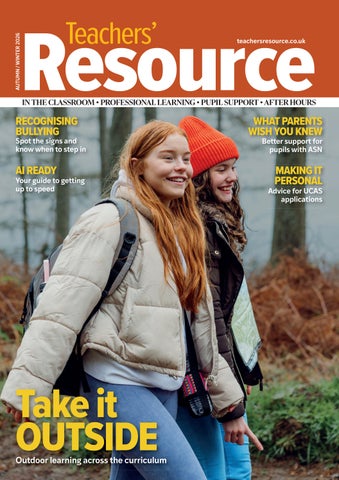
Take it OUTSIDE
Outdoor learning across the curriculum
WHAT PARENTS WISH YOU KNEW
Better support for pupils with ASN
MAKING IT PERSONAL
Advice for UCAS applications
Write-in Practice Workbooks to support S1-S3 students achieve second level maths RRP £11.99
Covers all the second level mathematics and numeracy CfE Benchmarks Straightforward questions written in clear and accessible language Save 30% using the code RESMAG30 until 31st Dec 26
www.leckiescotland.co.uk
Editor’s Letter
AUTUMN / WINTER 2026
This issue, we’re looking at some of the conversations happening in schools right now. AI is one of them. With new tools appearing all the time, it can be difficult to know what’s useful, what isn’t and where to start. On page 6, we look at what teachers need to know. We also turn our attention to bullying. It isn’t always obvious, particularly when comments are passed off as jokes or banter. With Anti-Bullying Week Scotland approaching, we look at prejudice-based
PUBLISHER
Denise Connelly
bullying, what to watch for and when to step in. And if you fancy getting out of the classroom, turn to page 18. Outdoor learning isn’t just for primary pupils or residential trips, we look at how secondary schools are making it part of everyday learning. There’s plenty more too, from UCAS and volunteering to CPD, fostering and our Watch, Listen, Try picks. All this and more inside.
Resource
denise@dcpublishing.co.uk
EDITORIAL CONTRIBUTORS Eilidh Hamilton Heather Tracey Kate Stevenson Melissa Holmes DESIGN AND PRODUCTION Lucy Baillie
lucy.baillie@dcpublishing.co.uk
SALES Marian Mathieson
marian.mathieson@dcpublishing.co.uk
What’s Inside Pupil support 4 DATES FOR YOUR DIARY Key dates for the months ahead. 10 MAKING IT PERSONAL Helping pupils with the new UCAS personal statement. 12 RECOGNISING BULLYING Spot the signs and know when to step in. 14 WHAT PARENTS WISH YOU KNEW Better support for pupils with ASN.
DC Publishing Ltd, 198 Bath Street, Glasgow, G2 4HG Tel: 0141 212 8913 ©DC Publishing Ltd 2026. All rights reserved. No part of this publication may be reproduced or used in any way without prior written permission from the publisher. The views expressed in this magazine are not necessarily those of DC Publishing Ltd. The publisher takes no responsibility for claims made by advertisers within the publication. Every effort has been made to ensure that information is accurate; while dates and prices are correct at time of going to print, DC Publishing Ltd takes no responsibility for omissions and errors.
www.teachersresource.co.uk ResourceMagScot
18
17 TIME WELL SPENT Helping pupils get more from volunteering.
In the classroom 06 AI READY Your guide to getting up to speed. 18 TAKE IT OUTSIDE Outdoor learning across the curriculum. 21 CHANGING ATTITUDES Addressing misogyny in schools. 30 WATCH, LISTEN, TRY Ideas to take into the classroom.
After hours 25 GETTING IT RIGHT FOR YOURSELF Why looking after yourself matters too.
28 28 WHERE YOU’RE NEEDED MOST Could you make a difference through fostering?
Professional learning 8 CPD FOR THE TERM AHEAD Find your next CPD opportunity.
www.teachersresource.co.uk
3
PUPIL SUPPORT
DATES FOR YOUR DIARY
Keep track of the deadlines, campaigns and events coming up over the school year
OCTOBER
10
WORLD MENTAL HEALTH DAY
A reminder to check in with pupils and make sure they know where to turn for help.
15 EARLY UCAS DEADLINE
Applications for the universities of Oxford and Cambridge, and most medicine, dentistry and veterinary courses, need to be with UCAS by 6pm.
NOVEMBER
9-13
SCOTTISH CAREERS WEEK
Organised by Skills Development Scotland, the week includes events and resources covering different jobs, employers and routes into work.
16-20
ANTI-BULLYING WEEK
Led by respectme, Scotland’s antibullying service, this year’s theme is prejudice-based bullying. Turn to page 12 for advice on spotting the signs of bullying and dealing with it in your classroom.
30
ST ANDREW’S DAY
From Scots language to local history, there are plenty of ways to bring Scotland into the classroom.
4
DECEMBER
3
INTERNATIONAL DAY OF PERSONS WITH DISABILITIES
Take a fresh look at accessibility around the school and the barriers disabled pupils still face.
5INTERNATIONAL
VOLUNTEER DAY
A good day to share local volunteering opportunities and remind pupils that their hours can count towards a Saltire Award. Turn to page 17 for more.
JANUARY
13
UCAS DEADLINE
Applications for most undergraduate courses need to be with UCAS by 6pm.
FEBRUARY
1-7
CHILDREN’S MENTAL HEALTH WEEK
Free activities and materials for schools will be available from Place2Be.
25
UCAS EXTRA OPENS
Pupils who used all five choices but don’t hold an offer can add another course through UCAS Extra.
Scotland’s Island Classroom Millport combines the power of residential outdoor learning trips with the reassurance of working with Field Studies Council, one of the UK’s most trusted educational providers. Primary, secondary & university trips. Curriculum for Excellence led. Outdoor adventure options. Exceptional support. Explore Millport: Ease of organisation. Approved framework providers for 8 counties, registered on PCS: Quick Quotes and PEF.
“It was all fantastic. The tutors paced activities well and made adjustments for everyone.”
Email: enquiries@field-studies-council.org Phone: 01743 852100
www.field-studies-council.org
A AI READY From worries around its impact on the environment to concerns that people are losing critical thinking skills, the surge in AI is causing some apprehension. But ignoring AI isn’t an option. We learn more about using AI responsibly in the classroom, with our teacher’s guide to getting up to speed
6
www.teachersresource.co.uk
rtificial intelligence can feel like yet another thing teachers need to understand. But, with AI developing at remarkable speed, ignoring it isn’t an option. For teachers, AI readiness is about developing enough knowledge and confidence to understand what these tools can do, where they can go wrong, and how to use them responsibly. In March 2026, the Scottish Government published its first national guidance on the use of AI in schools, developed with the EIS, Education Scotland, local government, and other education stakeholders. The guidance emphasises that AI should be used in a fair, safe and ethical way, alongside professional judgement.
IN THE CLASSROOM school child, for a high school pupil, or a post-graduate student, for example. Ask it to rewrite something in a different tone. Give a vague instruction on purpose, then really detailed directions, and compare the results. Exploring in this way will help you understand how AI behaves. It may also quickly show you one of its biggest drawbacks – AI can sound confidently correct while being completely wrong. Scottish Government guidance highlights the importance of understanding AI’s limitations, reliability and potential bias, stressing that outputs need to be carefully checked, rather than automatically trusted.
CRITICAL THINKING
As Education Secretary Jenny Gilruth explained: “For pupils, that means using AI as a tool to support creativity, critical thinking and personalised learning, while protecting their rights and privacy. For teachers, it means having the confidence, professional autonomy and practical support to decide when and how AI adds value in their classroom.”
THE KNOWLEDGE
Being able to make that decision depends on teachers getting a deep enough understanding of AI. It’s important to arm yourself with knowledge. Start small, by experimenting with a reputable generative AI tool, like ChatGPT or Claude. Ask it to explain a topic at three different levels – for a primary
The need for critical thinking can be passed on to your students too. Hand in hand with that goes the idea that we must get the basics right so we’re able to spot AI’s mistakes. As Daniel Susskind recently wrote in The Guardian: “We should be focusing intensely on teaching literacy and numeracy… Getting back to basics is what an economist would call a ‘no-regrets’ strategy – we will never regret improving these basic skills, however the future turns out to be.” When it comes to writing prompts, getting better, more accurate results happens when you get better at telling AI what you want. Learning how to write concise prompts is important. Specifying the target audience, age range, level of prior knowledge, learning objective and lesson length will give you a more rounded lesson plan than simply saying ‘Give me a lesson about climate change’. Add in your own critical thinking along with some safeguards, like asking the AI to give you alternatives, asking it to identify weaknesses in its response, and telling it to provide sources for its factual claims, which you can then cross-reference.
KNOW THE RULES
It’s also vital to understand privacy, data protection, and your school’s policies around AI use. Scottish Government guidance makes clear “all AI users should understand how to protect data and safeguard pupils’ and teachers’ sensitive and/or personal information”. Be careful about what you upload – a seemingly harmless document might contain names or other identifying
“One of its biggest drawbacks? AI can sound confidently correct while being completely wrong” information, so check your local authority’s or school’s policies around what is and isn’t acceptable when it comes to data protection and AI. Working with your colleagues can be helpful here: other staff may have been learning or teaching with AI, so ask them to show you something useful or, better still, make AI part of professional learning. AI tools change quickly, so developing a culture of curiosity around the technology will be more manageable than trying to produce a definitive list of tools and terminology for every staff member to master.
TIME SAVER
There’s already evidence that AI can reduce some teacher workload. An Education Endowment Foundation trial involving 259 teachers in 68 secondary schools found that teachers using ChatGPT alongside an implementation guide spent an average of 56.2 minutes a week on lesson and resource preparation, compared with 81.5 minutes among teachers who did not use generative AI – a 31% reduction. The report found: “Quality did not appear to be affected based on an expert panel reviewing the quality of lesson resources, without knowing which had been produced using ChatGPT.” The results of the trial were described as “promising”, saying: “With minimal support, teachers could save time without reducing the quality of their lessons and also being able to reallocate time to other aspects of their day-to-day teaching.” However, the teachers weren’t handing their workload over to a chatbot. They were using it as a tool, checking its output, and applying their own expertise. Because one of the most important elements of becoming AI-ready is recognising that AI can’t replace professional judgement. As a teacher, you don’t need to know everything about AI. But you do need to be willing to learn, question and experiment, so you can become confident enough to ask: what can AI do, what can’t it do, and how do I know? www.teachersresource.co.uk
7
PROFESSIONAL LEARNING
CPD for the term ahead Looking for useful CPD you can fit into a busy term? These autumn courses cover assessment, neurodiversity, careers, financial education and STEM
EDUCATIONAL INSTITUTE OF SCOTLAND (EIS) Neurodiversity and restorative practice eis.org.uk Understanding Neurodiversity in the Classroom is an online session on 28 October, with tools and ideas teachers can use with neurodivergent learners. Conflict Resolution and Restorative Practices follows in Glasgow on 30 October and looks at ways to respond to conflict and strengthen relationships in school. Check the course page for eligibility and booking details.
SKILLS DEVELOPMENT SCOTLAND
Career education workshops skillsdevelopmentscotland.co.uk A free online programme runs throughout the term, with short sessions after school. Topics include helping pupils identify and record their skills on 27 October, Scotland’s Learner Profile on 3 November, using skills in the classroom on 10 November and 8
www.teachersresource.co.uk
understanding job opportunities and what employers need on 24 November. The December session looks at how young people can learn about careers and future opitions through real-world experience.
QUALIFICATIONS SCOTLAND Assessment Literacy understandingstandards.org.uk Open to teachers across all curriculum areas, these sessions look at effective assessment, learner responses, assessment language and how the design of a task can affect outcomes. Events take place in Lowden on 29 and 30 October, in Glasgow on 2 and 21 November, and online on 12 and 14 November. There are also subjectspecific events for National 5, Higher and Advanced Higher teachers.
YOUNG ENTERPRISE
Financial education training young-enterprise.org.uk The free, CPD-certified Level 2 Certificate in Financial Education
supports secondary teachers to bring money into classroom learning. The secondary pathway runs on 21 October, while a session on supporting SEND and diverse learners takes place on 4 November. Teachers receive ready-touse resources and evidence of their CPD hours. Secondary schools should contact Young Enterprise to register.
SSERC
Technology Early Career Teacher Course sserc.org.uk A two-day course in Dunfermline on 2 and 3 December for student, probationer and early career technology teachers. Hands-on sessions cover woodworking, metalworking, machining, workshop safety and approaches to teaching practical STEM. The course costs £70 without accommodation or £200 residentially. Applications close on 6 November. Course details and availability can change. Check the organiser’s website before booking.
School & Community Engagement
Make it Scotch is proud to offer a variety of resources and initiatives to help support educators bring the journey of red meat, from farm to fork, to life for pupils in an engaging and informative way.
School In-Class Sessions Classroom sessions linked to Curriculum for Excellence, with a variety of engaging activities designed to meet subject benchmarks.
Make It Scotch Ambassadors Our Make It Scotch Ambassadors can help your young people to explore cooking with Scotch red meat and learn how to easily include it in a healthy, balanced diet.
Eat to Compete Our Eat to Compete sessions have been designed to help young people learn more about the nutritional benefits of red meat and its role in helping to fuel performance and aid recovery for the sport that you play.
Learning Resources from Make it Scotch Scan here to explore six lessons available to download covering everything from farm to fork!
Want to have a chat with us?
Scan here to book a learning session or cookery demonstration:
Keep updated by joining our educator mailing list here:
Contact Abby Goldie, Community Engagement Coordinator agoldie@qmscotland.co.uk
QMS0103520 QMS Teachers Resource Magazine Advert R3_216mm x 303mm.indd 1
10/08/2026 13:55
PUPIL SUPPORT
Making it
personal W
ith the October UCAS deadline approaching, personal statements will already be taking shape. There’s a little more time for other applications, but the challenge is the same: deciding what is worth including and putting it into their own words. The personal statement is now split into three questions covering subject choice, studies and experience outside the classroom. The content pupils are expected to provide has not changed. They developed the new format after consulting more than 1,200 students, 200 teachers and advisers, and 100 universities and colleges. They found that 79% of students struggled to complete the previous format without support. Each answer needs at least 350 characters, with 4,000 available across the three.
START WITH A CONVERSATION
Some pupils will know exactly what they want to say in their UCAS personal statement, while others won’t know where to start. Here’s how you can help them get it right
Some pupils will know what they want to say. Others will say they have nothing worth including. Ask what interests them about the subject and what they have done to find out more. A book, school project, job, placement, volunteering or caring responsibility could be relevant. Talking about it first can help them find a starting point and use their own words.
“Talking about it first can help them find a starting point”
LOOK FOR THE DETAIL
A list of activities tells an admissions team very little. If a pupil mentions a placement, ask what they learned. If they include a part-time job, ask which skills they developed and how these will help on the course. The University of Strathclyde advises: “Your personal statement needs to set you apart. It tells us why you’d make a good student and why we should offer you a place.” The three answers are read as one statement, so pupils should plan them together and avoid using the same example twice. They do not have to divide the character count equally. The statement must make sense across all their course choices.
IN THEIR WORDS
You can question a vague claim, ask for an example or flag repetition, but the words should belong to the pupil. If an answer sounds too polished or unlike them, ask them to read it aloud and put it back into their own words. UCAS advises pupils not to submit AIgenerated copy as their own work. Before the application is sent, read the three answers together. Check that the pupil has answered each question, backed up their points and kept their own voice. One final chat could bring out something they had forgotten to include.
KEY DATES
Applications for Oxford and Cambridge and most medicine, dentistry and veterinary medicine or science courses must reach UCAS by 6pm on 15 October 2026. The deadline for most other undergraduate courses is 6pm on 13 January 2027. Find personal statement guidance and classroom resources at ucas.com/advisers 10 www.teachersresource.co.uk
PUPIL SUPPORT
Recognising bullying Bullying can be obvious, but it can also be much harder to recognise. This November, schools are being encouraged to look more closely at prejudice-based bullying and the difference an early response can make
B
ullying has changed with the way young people communicate. Problems that once ended at the school gates can now continue through group chats, social media and gaming, while exclusion can be as deliberate as something said face to face. For staff, that can make it difficult to know what is happening between pupils, particularly when behaviour is dismissed as a joke or banter.
MORE THAN A JOKE
Prejudice-based bullying is the theme of this year’s Anti-Bullying Week in Scotland. It can be directed at someone because of their actual or perceived identity, background or characteristics. It isn’t always overt. A pupil might be repeatedly mocked for the way they speak, have assumptions made about them or find themselves excluded because they are seen as different. A single comment and repeated bullying aren’t the same thing, but prejudiced language still needs to be challenged when it happens. The online world can add another 12 www.teachersresource.co.uk
ANTIBULLYING WEEK 16–20 November 2026
layer. A comment can quickly reach a much wider audience, while screenshots, images and messages can be shared long after they were first posted.
SPOTTING A CHANGE
There isn’t one sign that tells a teacher a pupil is being bullied. Instead, it might be a change from what is normal for that young person. They could become quieter in class, stop spending time with their usual friends, avoid particular places or people, or become anxious about coming to school. Attendance or schoolwork could change too. There can be many reasons for any of these, but noticing a change creates an opportunity to check in.
SPEAKING UP
Telling an adult what has been happening can be a big step. Giving a pupil time to explain things in their own words and listening without making assumptions can help staff get a clearer picture of what has been going on. It is also important that pupils know
what will happen next. Following the school’s anti-bullying policy, keeping a record of what has been reported and checking back in afterwards can reassure them that speaking up has made a difference.
WHAT CAN SCHOOLS DO?
Pupils need to understand what bullying looks like, including the less obvious forms, and know how to report something that is happening to them or someone else. Bystanders have a role too. Young people can feel under pressure to laugh along or stay quiet, especially within a friendship group. They don’t have to confront someone themselves: walking away, checking in with the pupil afterwards or speaking to a member of staff can all help. For schools, consistency matters. Pupils are more likely to speak up when they know who they can go to and that what they say will be taken seriously. Find information and resources for schools at respectme.org.uk
Road Safety Scotland are delighted to announce the arrival of a new, digital road safety learning resource for Secondary Schools. Linked to CfE, Mechanimals offers a new, innovative way to teach road safety, incorporating the use of powerful imagery, progressive lesson plans and engaging activities to support children and young people to help prepare them for a lifetime of safe road use. Mechanimals comprises of six, simple, structured, ready to use road safety lessons. Designed by teachers for teachers. Launched in March 2026, Mechanimals is ready to be used and can be found at www.roadsafety.com
00666008_TRA Mechanimals_Teacher's Mag 297 x 210mm.indd 1
11/03/2026 11:28
What parents wish you knew How can teachers better support students with additional support needs?
I
n Scotland, 43% of pupils are identified as having additional support needs (ASN) – a figure that’s risen sharply over the past decade. But behind every statistic is a child trying to get through the school day, and a parent trying to help them. Nicola Hughes, a parent of two neurodivergent children and author of the book SENT: The Emails I Sent, the Silence That Followed, has firsthand experience of navigating the education system as a SEND (Special Educational Needs and Disabilities) parent. When it comes to how to support ASN kids in the classroom, Nicola wants teachers to be curious, open, and willing to change.
can all point to unmet needs. Other signs might be more subtle, like a child chewing their pen until it breaks, or a pupil who rocks on their chair. This behaviour doesn’t mean the child is misbehaving. They may be sensory seeking, and regulating their emotions and reaction to their situation. The good news is, there are steps you can take to make your classroom more inclusive. Instead of correcting low level behaviours, like rocking on a chair, they can be understood and included. “A lot of teachers might say, ‘Put your chair down’,” explains Nicola. “Instead, put the chair next to a wall so they can rock and not fall.”
THE WHOLE PICTURE
Teachers don’t need to overhaul everything – small, deliberate changes can transform a child’s day. “If a teacher writes that lesson’s three main tasks on the board, the student knows what’s expected of them. Everybody benefits from that,” says Nicola. Practical suggestions might include movement breaks every 20 minutes, letting a child who needs to move around work at a sit-stand table, and ensuring children who struggle with lining up can use a class pass system to leave early for lunch, for example. She also suggests: “Write your register down. Who’s the child you keep forgetting or you don’t notice? Why is that?” The compliant, high-achieving pupil – your quiet role model – may be working so hard to hold it together that they’re on the verge of collapse.
One of the most important things a teacher can do is recognise that what they see in the classroom is not the whole picture. Many neurodivergent children mask their difficulties during the school day, only to collapse when they get home. Nicola’s son “shows big overwhelm in little ways” – like chewing the inside of his mouth and becoming very shy – and appears fine at school. The meltdowns happen at home, out of sight of teachers. Nicola urges teachers to: “Stop using surface behaviour as evidence of coping” because, when a parent says their child is not managing and a teacher responds, ‘But they look all right’, it dismisses years of lived experience. Teachers have a lot to do both in and out of the classroom, but recognising if a child may have unmet needs – particularly when they’re academically able and don’t fit the stereotypical picture of a child who needs support – can help create a more harmonious learning environment. Frequent lateness, forgotten equipment, and difficulty following long instructions 14 www.teachersresource.co.uk
SMALL CHANGES
STAY CURIOUS
Talking of registers, it’s also important to stay curious when it comes to children who are frequently late or who have poor attendance. As a teacher, your response matters, so ask the parent what the barrier is, and
what’s making attendance difficult. Nicola’s advice is practical: sometimes removing the barrier – such as letting a child drop a subject they can’t engage with – can transform attendance. The parent-teacher relationship is important too. Trust is earned through action, so see all concerns as valid, listen, and try to get ahead of any issues: “What gives me most delight is when a teacher or professional understands and knows my child and gets ahead,” says Nicola. So, if you know a student struggles with change, give them a heads up. ‘We’ll be in a different classroom next week, let me give you a tour around’ might transform a neurodivergent student’s
PUPIL SUPPORT
“Trust is earned through action, so see all concerns as valid, listen, and try to get ahead of any issues”
experience of what can be a routine change for other learners. Nicola urges caution when it comes to responding to a parent’s concerns. The worst responses are minimisation and comparison – “It’s dehumanising to be spoken to in that way, being told there are children with worse needs, or that your child isn’t ‘that bad’,” explains Nicola – along with dismissal. “That’s been said to me before: ‘Are you sure this isn’t just triggering your anxiety?’,” reveals Nicola. Parents also value honesty: if a child needs an intervention the school can’t provide, they’d rather hear that than be dismissed.
As Dr Muna Abdi wrote: “It’s not inclusion if you invite people into a space you are unwilling to change.” And those changes don’t have to be dramatic. They can be as simple as chunking instructions, putting tasks on the board, or checking in on the child you haven’t noticed this week. As Nicola puts it: “Some of this shouldn’t be hard. Some of it is just getting into the pattern of doing it.” And getting into that pattern can change everything for children with additional support needs. You can buy Nicola’s book, SENT: The Emails I Sent, the Silence That Followed, from Amazon. www.teachersresource.co.uk 15
the classroom Science-fuelled Day Visits that challenge and inspire, by getting students hands-on with STEM. Extended Learning Lab programmes with training, resources, real scientists and everything you need to teach amazing STEM in school and beyond. Glasgow Science Centre is ready to support you and your pupils to become the next generation of scientists and engineers. Together we’ll show them what’s out there!
Visit our website for more information and to book: glasgowsciencecentre.org
PUPIL SUPPORT
Time well spent Volunteering can give pupils experience, build their confidence and give them plenty to talk about in future applications and interviews. International Volunteer Day is a good time to encourage them to get involved
I
nternational Volunteer Day takes place on 5 December, putting volunteering in the spotlight. It’s a chance to introduce pupils to the Saltire Awards and get a few more of them interested in volunteering. The awards are open to young people aged 11 to 25 and recognise the time they spend volunteering. There are different awards depending on what they do and how many hours they give. Some pupils might already be clocking up volunteering hours through DofE, while others will be starting from scratch.
GETTING STARTED
Volunteer Scotland lets pupils search for opportunities close to home and filter the results to show roles open to their age group. They can search by interest too, from animals, sport and the environment to arts and fundraising. There is also a filter for one-off volunteering if they can’t commit every week. It doesn’t have to match their career plans. Someone heading to university to study engineering could volunteer at a music festival, while a pupil applying for a business apprenticeship might enjoy helping at an animal charity. Finding something they actually want to do matters more.
WHY DO IT?
At 16 or 17, many pupils won’t have much work experience to put on an application or talk about at an interview. Volunteering gives them something else to talk about. They might deal with members of the public, work alongside people of different ages, help organise an event or be trusted with a particular job. When an interviewer asks for an example of teamwork, dealing with a problem or taking responsibility, they have a real example to give. It can also be a chance to try out a career idea before making any big decisions. They might decide they love it. Finding out they don’t is useful too.
“Volunteering gives them something else to talk about” COUNT IT UP
Saltire starts with The Challenge for young people volunteering together as a team. The Approach recognises 10 and 25 hours, while The Ascent marks 50, 100, 200 and 500 hours. The Summit is for an outstanding contribution to volunteering. Pupils can log their volunteering through their My Saltire account as they go and apply for certificates when they reach each stage. They can also
earn Young Scot Reward Points for the Saltire Awards they achieve. For pupils doing DofE, volunteering already forms part of Bronze, Silver and Gold. Saltire gives them another way to record those hours, while pupils volunteering independently can have what they are doing recognised too. Teachers don’t need to find placements for pupils. Introducing them to Saltire, showing them where to search or sharing opportunities that come into school can make finding the right role a little easier.
Find out more about the Saltire Awards at saltireawards.scot and visit volunteer.scot to search for local volunteering opportunities. www.teachersresource.co.uk 17
Take it outside From science and geography to maths and English, taking a lesson beyond the classroom can help pupils see a subject differently
M
ention outdoor learning and it’s easy to think of primary pupils pulling on wellies or a school residential involving canoes, climbing walls and several sleepless nights for the teachers. But it doesn’t have to involve a minibus, specialist equipment or even leaving the school grounds. It could be a maths class gathering measurements, biology pupils recording species or geography pupils investigating what happens after heavy rain. In Scotland, outdoor learning forms part of Learning for Sustainability (LfS), an entitlement for all learners within Curriculum for Excellence. The Scottish Government’s Target 2030 action plan has also set an ambition for every 3–18 education setting to become a Sustainable Learning Setting by 2030.
BEYOND PRIMARY
Despite that, outdoor learning can become less common as pupils get older. The 2025 Scottish School Grounds Survey, which heard from more than 1,000 schools across all 32 local authorities, found that just 7% of secondary schools regularly use their
grounds for learning outside PE. And it’s not hard to see why. When you have limited time with a class and plenty to get through, taking everyone outside can feel like more trouble than it’s worth, especially when the Scottish weather gets involved. But it doesn’t need to take up a whole period. Education Scotland describes the outdoors as a setting that can “bring the whole curriculum to life”. The school grounds themselves are a good place to start.
GEN ALPHA GOES OUTDOORS
For a generation that has grown up with smartphones, apps and screens, outdoor learning doesn’t necessarily mean switching technology off. NatureScot has been looking at how digital technology could encourage Generation Alpha, generally the name given to those born from 2010 onwards, to pay more attention to the natural world around them. At Braes High School in Falkirk, an S1 Religious, Moral and Philosophical Studies (RMPS) class recently tried NatureScot’s Nature Discovery Map Scotland, a digital toolkit designed
to help young people record and understand the nature around them. Using iPads, pupils headed into the school grounds to record and photograph what they found. Back in class, that information became the starting point for conversations about biodiversity, ecosystems and how the grounds could be improved. What makes the project interesting is that this wasn’t a biology or geography lesson. RMPS is rooted in values, ethics and debate, and the project allowed pupils to think about their relationship with nature while picking up digital, scientific and critical-thinking skills. It didn’t take long to get started either. Dr Wilson-McCaw, a teacher at Braes High, says the class was up and running with the app after just 10–15 minutes. “The app is a fantastic tool for teachers who may not be confident working in STEM and helps change how young people see the world around them.” One pupil agreed: “It helps you notice what’s round about you in your local area. It shows how much detail is actually around you – more than you actually see.”
START WITH YOUR SUBJECT
The Braes project shows how outdoor learning can fit into a subject rather than sit alongside it as a separate activity. Maths pupils could gather measurements or data to analyse back in class. Biology could look at habitats and biodiversity, while geography classes investigate drainage, land use or weather. English pupils could use the local area as a starting point for writing, while art and design classes have shapes, textures and architecture right outside the door. Climate change can also become less abstract when pupils look at how their own school is affected by heavy rainfall, heat or a lack of biodiversity. The 2025 Scottish School Grounds Survey found that more than half of schools were already reporting challenges including flooding, overheating and high winds. 18 www.teachersresource.co.uk
IN THE CLASSROOM
GIVE THEM A SAY
Nature Discovery Map Scotland
There’s another useful lesson from Braes: pupils weren’t just following instructions. What they found led to their own ideas about what could change. Your pupils could investigate litter, biodiversity, an underused part of the school estate or how their surroundings cope with extreme weather. It brings research, data, communication and problem-solving into the lesson while giving them something real to work on.
KEEP IT DOABLE
“The app is a fantastic tool for teachers who may not be confident working in STEM”
Of course, not every lesson lends itself to going outside, and there’s no point forcing it. Ten or 20 minutes can be enough if there is a reason for being there. Use somewhere familiar, know what you want your pupils to do and think about what they will bring back into the classroom. For activities away from school grounds, Scotland’s Going Out There (sapoe.org.uk) framework provides
guidance on safe practice for off-site visits. If you’re looking for ideas, Education Scotland has outdoor learning resources and examples, while NatureScot’s Nature Discovery Map Scotland includes activities covering STEM, digital literacy and interdisciplinary learning. Outdoor learning doesn’t have to become another thing to squeeze into your timetable. Sometimes it can just be another place to teach what you were going to teach anyway. Not every pupil will become enthusiastic because you’ve opened the classroom door. But the Braes project is a good reminder that digital and outdoor learning don’t have to be opposites. Sometimes a screen can be the thing that gets pupils to look more closely at what’s happening beyond it. Find outdoor learning guidance and resources at education.gov.scot. NatureScot’s Nature Discovery Map Scotland toolkit is available at nature.scot www.teachersresource.co.uk 19
School offers available Please contact Box office for details Wed 20 - Sat 23 January 2027
Scottish Ballet
Cinders!
A dazzling Cinderella story.
Tue 16 & Wed 17 February 2027 DANCE CONSORTIUM PRESENTS
São Paulo Dance Company Tue 9 - Sat 13 March 2027
The King’s Speech Adapted from the Oscar-winning film.
Tue 23 - Sat 27 March 2027
The Curious Incident of the Dog in the Night-Time
Box office 01224 641122 aberdeenperformingarts.com
START THE SCHOOL YEAR WITH AN INSPIRING
EDUCATIONAL ADVENTURE Unlock more learning for less! Book two activities at Edinburgh’s only Science Centre and Planetarium and get a third absolutely free – with our unmissable 3-for-2 offer available exclusively in Term One*. Bring science to life through our hands-on experiences: • Discover our immersive galleries • Experience an incredible 360� Planetarium show • Take part in curriculum-linked workshops exploring planet Earth and space.
TRANSPORT SUBSIDY AVAILABLE
for eligib le schools* *
BOOK NOW
Explore our full programme today: *£8.00 per pupil. Available until December 2026
**T&C’s apply
IN THE CLASSROOM
CHANGING
attitudes C
oncerns about misogyny in schools have grown in recent years, with teachers reporting an increase in sexist language, gender stereotyping and the influence of harmful online content. Much of the discussion has focused on the so-called “manosphere” – a collection of online communities that often promote traditional gender roles and, in some cases, hostility towards women. While some content centres on self-improvement and men’s issues, critics argue that parts
of the manosphere can reinforce harmful attitudes towards women and girls, accelerating gender-based violence. According to the United Nations: “Violence against women and girls is ‘one of the most widespread, persistent and devastating human rights violations in our world today.” And this is playing out in the classroom. This year, NASUWT reported a rise in teachers reporting misogyny from pupils – up to 23.4% from 17.4% in 2023. One respondent to the teaching union’s research said:
Misogyny can show up in the classroom in many ways, from sexist comments and stereotypes to attitudes picked up online. So how can schools challenge it and help pupils understand the impact it can have? “Boys have confronted me, shouted at me. Have had boys joke about raping girls in front of me and laughed about it when challenged.”
THE RESEARCH
UK Feminista has carried out extensive research into sexism, sexual harassment, online misogyny and pornography among young people. Its report, System Change, sets out practical steps schools can take to prevent misogyny and create a culture of respect and equality. www.teachersresource.co.uk 21
IN THE CLASSROOM
According to Nina Humphries, director of UK Feminista, the issue requires urgent action. “Sexism, sexual harassment and misogyny in schools and colleges constitute a national emergency, and require urgent, whole school approach action and teaching embedded throughout the curriculum,” she says. Research carried out by UK Feminista and the National Education Union found that more than a third of female students at mixed-sex schools had experienced sexual harassment at school, yet only 14% reported it to a teacher. “It’s absolutely critical that all schools and colleges are taking action to prevent and respond to sexism and sexual harassment,” explains Humphries, “including identifying opportunities across the curriculum and throughout the school or college day to embed meaningful learning about the problem.” Similar concerns emerged in research published by the University of York in 2025. Among the teachers surveyed, 76% of secondary teachers and 60% of primary teachers said they were concerned about the influence of misogynistic online content in their schools. The study also found that 44% of secondary teachers and 40% of primary teachers had witnessed female pupils being subjected to misogynistic comments or behaviour.
ONLINE INFLUENCE
Humphries says social media can often act as a gateway to harmful content. “We are very aware of the deeply harmful impact of misogynistic online content and pornography on young people, and how social media can often be a platform or gateway to this content.” The issue also gained wider attention following the release of Netflix drama Adolescence. The series prompted discussion about the influence of online content on young people, and the role schools can play in promoting respect, equality and healthy relationships.
IN THE CLASSROOM
UK Feminista’s guidance highlights several ways schools can address sexism and help create a culture of respect, while the Scottish Government’s publication – Preventing and responding to gender-based violence: a whole school framework – offers targeted approaches to gender 22 www.teachersresource.co.uk
“Challenging gender-based violence is everyone’s responsibility” based violence in line with GIRFEC. Schools should operate a zero tolerance policy towards sexual harassment by making students and staff aware of the school’s stance on this behaviour. Report every incident and ensure the consequences are clear. Always follow through on disciplining any incidents, so students know it is serious. Anti-sexism activities can be integrated into lessons to teach about misogyny and raise awareness. A whole school approach to tackling sexism, that’s not restricted to one off workshops or single lessons, will help foster systemic change. Use gender stereotyping as a teaching moment, call it out when you hear it and explain it to the class. This can help pupils identify gender stereotyping themselves, and learn from everyday examples. Challenging sexist language when it occurs can help pupils understand the impact their words have on others, and reinforce expectations around respectful behaviour. When engaging in class discussions, promote equal participation. UK
Feminista research reported that boys are more likely to shout out when answering in class, while girls are more likely to put their hand up. Make sure that, when choosing a pupil to answer, there is balance, and reiterate that all opinions and voices are valued equally.
CHALLENGING ATTITUDES
The Mentors in Violence Prevention (MVP) programme has been delivered in secondary schools across Scotland since 2012, using a peer education method to provide young people with the language and framework to explore and challenge the attitudes, beliefs and cultural norms that underpin gender-based violence, bullying and other forms of abuse. And it’s effective. According to Smithycroft Secondary School: “Pupils are not only learning about gender-based violence but are also gaining practical active bystander skills, from challenging sexist language to looking out for peers in risky situations.” Taking a comprehensive, long-term approach involving all members of the community will transform the institutional policies, practice and culture across the educational setting to reduce the likelihood of sexual harassment and sexist behaviours from occurring. Because challenging gender-based violence is everyone’s responsibility. MVP: equallysafeatschool.org.uk/about-mvp UK Feminista: ukfeminista.org.uk
Developing the skills needed to thrive in a digital world Bring your students to Sky Up Academy Studios Livingston for a free, curriculum-linked immersive experience for ages 8-18
100%
of teachers rated the educational value as good
New
for 2027, exciting upgrades are coming to our studios
100%
of teachers recommend the visit to a colleague
Register your interest to receive booking release dates, programme updates and the latest news
Register your school today
Find out more about The Edit, our in-classroom programme
www.skyup.sky/academy-studios
www.skyup.sky/the-edit
school trips to uk, europe & beyond Educational trips to destinations such as:
The Gateway to Your Next Residential Adventure
Opal Coast
London
Isle of Wight
Geneva
Paris
Disneyland® Paris
P i a y ch Sec da y ch U i g
Tried, tested, and trusted by teachers
Re ide ia Adve e i A -yea d
GET A FREE QUOTE TODAY
Secure your dates with FREE Quote
s
nt
nt
ll
r
r ro
ls
tr ps n
r m
n
r
s
ools
on
r
orm
ro
01384 398 893
01384 398870
info@theschooltravelcompany.com
info@acornadventure.co.uk
www.theschooltravelcompany.com
www.acornadventure.co.uk
s
ools
ps
AFTER HOURS
Getting it right for yourself How to protect your own wellbeing so you have the time, energy and headspace to give your students the best learning experience
G
etting it right for every child asks a lot of the person standing at the front of the classroom. Teachers are expected to notice when a pupil is struggling, adapt when something is not working, manage different needs, and still have time for the conversations that matter. Much of that depends on something you’ll rarely include in a lesson plan: having enough energy and headspace left to give.
CLASSROOM PRESSURE
Capacity is being stretched for many teachers. Research published in 2024, based on time-use diaries from 1,834 teachers across Scotland, found that teachers worked an average of 46 hours – around 11 hours beyond the 35-hour contractual week. And it’s no surprise that working beyond www.teachersresource.co.uk 25
AFTER HOURS
contracted hours was also the strongest predictor of reported stress. The latest EIS workload survey found that 44% of the almost 11,000 teachers asked were working more than seven additional unpaid hours each week, while around 11% worked 15 hours or more. 73% said their preparation and correction requirements could rarely or never be completed within their normal working week. When the working week stretches this far, it can be tempting to keep adding to it. Another resource. Another adaptation. Another hour after school making sure tomorrow’s lesson is ready. But you need to keep something in the tank for yourself.
SUSTAINABLE WORKLOAD
Teaching asks for patience, attention, and emotional energy. None of those are unlimited. Looking after your own capacity helps ensure you still have something to draw on when a pupil needs you. That might mean becoming more selective about where your time goes. Not every task needs the same preparation, and not every lesson needs another layer adding to it. If a resource works, use it again. If an approach works with one class, there’s no reason it can’t work with another. Where several pupils need similar support, you may be able to build that into the lesson, rather than creating a separate version for everyone. It can also help to leave a little breathing space in your lesson plans. Classes rarely go exactly as expected – a pupil may need more time, an explanation might need revisiting, or something unexpected may take priority. When every minute is accounted for in advance, there’s little space to deal with any extras without feeling as though the lesson has gone wrong. Your working day itself deserves some thought. When there’s always another task waiting, it becomes difficult to know what genuinely needs to be finished tonight and what can wait until tomorrow. Workload issues can’t be solved with better time management but, where there is some flexibility, having a point at which work stops can help keep the school day from taking over your evening.
IMPACT ON WELLBEING
The Scottish Government’s 2024 26 www.teachersresource.co.uk
“Having a point at which work stops can help keep the school day from taking over your evening” Education Workforce Health and Wellbeing Support report identified workload and working patterns, organisational support and workplace relationships among the factors affecting staff wellbeing. It concluded that the wellbeing of education staff needs a national focus if Scotland is to achieve its ambitions for children and young people. The number and range of needs within classrooms emphasises this. In 2025, 43% of pupils in Scotland were recorded as having an additional support need, which reflects the wide range of circumstances teachers are working with. Teachers know how important it is to respond to those needs; the challenge is finding ways to do it without every new demand becoming another piece of work to take home. It’s also worth recognising when your own reserves are running low. Constantly thinking about school after leaving, becoming more easily frustrated, or feeling that everything needs to be handled immediately can all be signs that something needs to change. Sometimes that means asking a colleague for help instead of taking everything on yourself, talking through a difficult situation rather than carrying it alone, sticking with an approach that already works rather than spending another evening looking for a better one, or simply deciding what can wait. There will always be something else that could be done – knowing when to stop is part of making the job sustainable.
RIGHT FOR YOU
It’s easy to think of looking after yourself as something that happens outside of teaching, once everything else is finished. But teachers bring
WHERE TO TURN Breathing Space: breathingspace.scot / 0800 83 85 87 For people who are struggling with their mental wellbeing and need somewhere to talk. Education Scotland: education.gov.scot Resources and guidance covering wellbeing, inclusion, additional support needs and professional learning. Education Support: educationsupport.org.uk This charity offers confidential support, counselling and wellbeing resources for education staff. GTC Scotland: gtcs.org.uk The Health and Wellbeing Hub has advice and resources to help when work is taking its toll, from dealing with stress to finding a better balance. Your local authority/school wellbeing support Check what occupational health, employee assistance, counselling or staff wellbeing support is available through your employer. Your union / The EIS: eis.org.uk Unions can provide advice around workload, working conditions and professional concerns, as well as representing members where workplace pressures become difficult to manage.
their energy, patience and attention into the classroom with them. When those reserves are running low, there’s less to give to the pupil who needs an extra explanation, a difficult conversation, or a teacher who has the space to listen. Getting it right for every child also means getting it right for yourself too. Protecting some of your own time, energy and headspace means you’ll have more of it available when your students need you.
Can you give a child a loving home? The care you show already changes young lives every day. Now it could change one forever. Foster with Aberlour Children’s Charity. Experience you can trust. Support you can count on. Our friendly team can’t wait to hear from you. aberlour.org.uk/fostering
Scottish Charity no: SC007991 Company Reg no: SC312912
Save or borrow easily through your payroll
Scotwest.members
Enjoy cashback, vouchers and exclusive offers with Scotwest Choice
ScotwestCU
ScotwestCU
Find out more and join today
0141 227 2390 scotwest.co.uk Scotwest Credit Union is a member-owned not for profit offering fair and ethical finance available to anyone living or working in the west of Scotland*, Dumfries & Galloway, Perth & Kinross, Stirling or Highlands. *This includes: Argyll & Bute, East Ayrshire, East Dunbartonshire, East Renfrewshire, Glasgow, Inverclyde, North Ayrshire, North Lanarkshire, Renfrewshire, South Ayrshire, South Lanarkshire and West Dunbartonshire.
Authorised by the Prudential Regulation Authority and regulated by the Financial Conduct Authority and the Prudential Regulation Authority (FRN 213616) Teachers Half Page 190 x 137.5 - Feb 26.indd 1
13/02/2026 15:38
WHERE YOU’RE NEEDED MOST
Every day, teachers provide stability, encouragement and support to children who need it most. With Scotland facing a shortage of foster carers, could your skills make a difference?
A
lthough teaching and fostering seem like very different roles, there is considerable overlap between the qualities needed to succeed in both. “Post-COVID, we recognised that we need more foster carers who actually understand child development,” explains Nicola Fearon, from Aberlour Children’s Charity. “Teachers have a really good understanding of the needs of a young person, and there are so many transferable skills.” One of the most valuable qualities you bring is your ability to look beyond 28 www.teachersresource.co.uk
behaviour. In schools across Scotland, it’s becoming more common to work with students experiencing additional support needs, trauma, anxiety and social challenges. That experience can be invaluable when caring for a child in foster care. “For us, it’s really important that someone can see beyond behaviour,” continues Nicola. “There is a real shift towards trauma-informed practice, especially in Scotland, and education plays a really big part in that.”
MAKE A DIFFERENCE
Many children entering foster
care have experienced disruption, uncertainty or trauma. For them, consistency and routine are not simply helpful: they are essential. “It’s crucial,” says Nicola when asked about the importance of structure. “It’s the only way a child feels safe.” In fact, you probably understand better than most how routines help children thrive. Whether it’s the structure of the school day, clear expectations in the classroom or predictable boundaries, these foundations help young people feel secure. Children in foster care often need the same things.
AFTER HOURS
“Our children need love and empathy,” reminds Nicola. “They don’t need sympathy. They need people whose routines are in place. They need to know what’s happening in their life.”
PROVIDE STABILITY
The ability to establish boundaries is another strength that you probably already possess. Managing relationships, resolving conflict and creating positive environments are everyday parts of school life. “A lot of the day for a teacher is managing children’s relationships,” adds Nicola, “not just with them, but with their peers.” That experience can help you support children who may struggle with trust, friendships or emotional regulation.
A NATURAL FIT
Of course, fostering requires a deeper level of emotional commitment than teaching. Foster carers welcome children into their homes and family lives, and support them through some of the most challenging periods of their childhood. “We give people permission to love children,” Nicola smiles. “When you’re a teacher, you can’t offer all of yourself and your love. When it’s in your home, it’s different.” Nicola also believes the motivation that draws many into teaching is often the same motivation that can lead them to fostering: “The majority of people who choose a career in education do it because they genuinely want to help children,” she continues. “You have the same opportunity to do so with fostering.”
BE A VOICE
You also have experience working alongside parents, carers and professionals – something that is increasingly important within Scotland’s care system. “I think teachers make fantastic advocates,” adds Nicola. “They know how to speak for, and be the voice of the child.” That ability to navigate meetings, communicate effectively and keep children’s needs at the centre of decision-making is a significant asset.
“We need more foster carers who actually understand child development” ANSWER THE CALL
Scotland urgently needs more foster carers. A shortage of carers means some children must move far from their communities, schools and support networks to find a suitable home. “The big issue for me is the displacement of children,” explains Nicola. “There aren’t enough local foster carers.” As a result, Nicola says children are experiencing repeated disruption to their education and friendships: “It’s a real issue because education is such a big part of a child’s social development.” Some children may move schools multiple times. Others face delays in securing school places after moving into care, and miss months of education. They also lose important social connections along the way. If you choose to foster, you could
help address that challenge while bringing valuable educational insight into children’s lives: “You can help to navigate the educational system much better than we can,”says Nicola.
WHAT’S HOLDING YOU BACK?
More importantly, fostering today may be more flexible than many people realise. Nicola told us that there are still outdated assumptions about needing to give up work, which no longer reflect the reality: “We don’t insist that one carer has to be at home the whole time now,” she explains. “We understand the complexities of the world, and are very flexible around people’s working patterns.” If you’re curious about fostering, the first step is to reach out: “Just pick up the phone,” encourages Nicola. “You’re not committed to anything. It’s a call for information.” So, if you’re looking for a meaningful way to continue supporting children beyond the classroom, fostering could be an opportunity to make a lifechanging difference. You already have the skills; all you need to do is take the next step.
For more information contact Aberlour Children’s Charity on 01786 437330 or visit aberlour.org.uk www.teachersresource.co.uk 29
IN THE CLASSROOM
Watch, Listen, Try From thought-provoking documentaries and podcasts for teachers to pupil-led projects, these recommendations give you plenty to think about and ideas to take into the classroom
WATCH
Educating Yorkshire
(Channel 4) The cameras returned to Thornhill Community Academy, once again following pupils and staff through another school year. It captures the humour and pressure of school life and the relationships between pupils and staff.
Swiped: The School That Banned Smartphones (Channel 4) Pupils at an Essex secondary school give up their smartphones for three weeks while researchers monitor their sleep, concentration and wellbeing. The results give teachers plenty to think about as schools decide what place phones should have in the classroom.
Mr Nobody Against Putin
(BBC iPlayer) This Oscar-winning documentary follows a teacher who secretly films his Russian school after the invasion of Ukraine. A powerful look at education, propaganda and what can happen when teachers are expected to deliver a political message. This is one for teachers rather than pupils.
LISTEN
The SecEd Podcast
Made specifically for secondary school teachers and leaders, this podcast looks at the issues affecting schools each day. Recent episodes cover highattaining pupils, behaviour, attendance and school leadership, with advice and examples from teachers and education specialists. 30 www.teachersresource.co.uk
Pick one of the TRY ideas, and see where your pupils take it
Evidence into Action
Produced by the Education Endowment Foundation, this podcast brings teachers and researchers together to discuss what the evidence says about learning. Topics include attendance, literacy, feedback and additional support needs, and what the findings could mean in school.
Mr Barton Maths Podcast
Secondary maths teacher Craig Barton holds conversations with teachers, researchers and education writers. Despite the name, many episodes go beyond maths, covering behaviour, lesson planning, motivation, memory and how pupils learn.
TRY
Turn your pupils into data detectives
Ask pupils to choose a claim they have seen online and trace it back to its source. Who collected the
information, how large was the sample and does the headline give the full picture? Scotland by Numbers has free activities to help secondary pupils question statistics (ed.ac.uk).
Hold an Authors Live session
Choose a secondary event from Scottish Book Trust’s free Authors Live archive and build a lesson around it. Pupils could complete a writing challenge, discuss an author’s work or prepare questions before watching (scottishbooktrust.com).
Investigate where litter goes
Start with a piece of litter found near your school and ask pupils to map where it could travel through drains, burns and rivers. Keep Scotland Beautiful’s Upstream Battle resources include activity sheets, litter surveys and ideas for outdoor learning (keepscotlandbeautiful.org).
Who is just what they need.
If you’ve been thinking about fostering but aren’t sure where to start, or you’re just curious to find out more about it, then we’d love to hear from you. We’re looking for people who can provide love and support to young people who need it. You don’t need to be perfect to foster, you just need to be you. We’ll support you with everything else. For more information visit actionforchildren.org.uk/fostering
Or scan the QR code to get it touch
Action for Children, whose registered address is 3 The Boulevard, Ascot Road, Watford WD18 8AG and registered as a charitable company limited by guarantee in England & Wales under number 04764232. Registered charity numbers 1097940/SC038092. Action for Children 2026.