The UK’s leading disability and lifestyle magazine
enablemagazine.co.uk
September / October 2026
AN UNBREAKABLE BOND
ALL-CONSUMING
Emily Katy shares her experiences of living with OCD
We learn more about life as a sibling carer
THE FULL PICTURE
TURNING OVER A NEW LEAF
Focus on the rise of ADHD in adults
The best accessible outdoor hobbies to enjoy this autumn
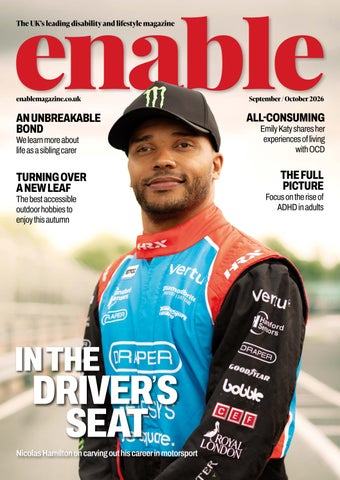
IN THE
DRIVER S SEAT ’
Nicolas Hamilton on carving out his career in motorsport
R IN E A T R OO ER C -T Y S LL IT A IL B O M
THE ALL-TERRAIN MOBILITY SCOOTER
Available in Fury Red Harley Black
Don’t Let Rough Ground Stop You. Discover the Invader, the powerful all-wheel-drive mobility scooter built for country paths, uneven ground and everyday journeys.
• • • •
All-wheel drive for added grip and going up hills Up to 25 mile range on a full charge* Road legal and no driving licence required Free home demonstration with no obligation
Ready to reclaim your adventure?
Watch the Invader in action
Scan the QR Code
Book Your Free Home Demo
Call: 0800 254 5367
* Range may vary with battery charge/condition/option, terrain type, tyre condition & vehicle loading.
Brighten your day
www.scooterpac.com
Welcome PIC: © RHIANNON LOUDEN
to the September/October 2026 issue of Enable
PIC: © ALEXANDRA HERON
I
COVER PRICE £3.00
PUBLISHER Denise Connelly denise@dcpublishing.co.uk EDITOR Melissa Holmes melissa.holmes@dcpublishing.co.uk STAFF WRITER Kate Stevenson kate.stevenson@dcpublishing.co.uk EDITORIAL CONTRIBUTORS Eilidh Hamilton Jane Hatton Gianni Mastrangioli Samantha Renke Tim Rushby-Smith Alisdair Suttie DESIGN AND PRODUCTION Lucy Baillie lucy.baillie@dcpublishing.co.uk SALES Marian Mathieson marian.mathieson@dcpublishing.co.uk SOCIAL MEDIA Alexander Broad ENABLE MAGAZINE www.enablemagazine.co.uk
t’s that time of year when I’m feeling the excitable urge to buy a new pencil case (although I haven’t been to school in decades), while at the same time experiencing a little anxiety about the busyness of the months to come, and the onset of winter. September feels like a reset button – a time when many of us reassess our routines, look back over what we’ve achieved this year, and refocus on our goals. In this issue, we’ve got plenty to inspire you. Cover star Nicolas Hamilton talks honestly about his extraordinary career as a professional racing driver, the barriers he’s faced, and what it takes to keep pushing when other people have already decided what you can and can’t do. As much as he tried to convince me he’s just an ordinary guy, his story is a brilliant reminder that disability doesn’t have to define the size of your ambitions. We also look at careers in healthcare, explore thriving with young onset dementia, learn more about OCD recovery, uncover autumn-friendly outdoor hobbies, and speak to some inspiring interviewees. This issue feels awash with possibility. So here’s to a new term, new potential, and a season of discovering what we can do. Till next time,
Melissa
EDITOR’S PICKS... 12 AN UNBREAKABLE BOND We learn more about being a sibling carer, from the emotional impact to the effect being a sibling carer can have on every aspect of life. 18 THE UNTHINKABLE Samantha Renke on why she’s raising awareness about an unthinkable crime – the murder of Disabled people by parents, relatives and trusted carers.
WIN
Get in touch
£69 Sony headphones! Turn to page 34
@enablemagazine
Melissa Holmes | Editor editor@dcpublishing.co.uk
Subscribe to
DC Publishing Ltd, 198 Bath Street, Glasgow, G2 4HG Tel: 0141 212 8913
READ ONLINE! SCAN THE QR CODE TO READ THIS ISSUE IN FULL ©DC Publishing Ltd 2026. All rights reserved. No part of this publication may be reproduced or used in any way without prior written permission from the publisher. The views expressed in this magazine are not necessarily those of DC Publishing Ltd. The publisher takes no responsibility for claims made by advertisers within the publication. Every effort has been made to ensure that information is accurate; while dates and prices are correct at time of going to print, DC Publishing Ltd takes no responsibility for omissions and errors.
Subscribe today and get the UK’s leading disability and lifestyle title delivered right to your door every two months £15 for one year £25 for two years
Call 0141 212 8913 or visit: enablemagazine.co.uk/subscribe enablemagazine.co.uk
3
What's inside
66
8
29
Interview
08 IN THE DRIVER’S SEAT Nicolas Hamilton chats exclusively with Editor Melissa Holmes about carving out a bright career in motorsport. 10 A VOICE FOR CHANGE Eilidh Morrison MSYP discusses her work to make a difference for disabled people through politics. 29 ON AIR Andy Stevenson has become one of Britain’s most recognisable disabled sports broadcasters. He talks to Kate Stevenson about his work as a reporter, presenter and commentator. 40 THE QUIET EAR Award-winning poet and author Raymond Antrobus on what happens when we stop seeing
4
enablemagazine.co.uk
deafness as something missing, and start seeing it as another way of experiencing the world. 66 DRESS TO IMPRESS Fashion designer Kaci Horseman is working to ensure disabled people don’t have to choose between style and practicality.
Health
36 MENOPAUSE UNMASKED World Menopause Day takes place on 18 October. For disabled women and people living with long-term health conditions, recognising the menopause can be complicated. 39 MORE THAN FORTY WINKS Sleep is vital for good health. But, as Editor Melissa Holmes knows, a decent night’s kip doesn’t always come easy.
53
Life
50
15 MIND YOUR BRAIN Think dementia only happens when you’re old? Think again. How can we look after our brains – and what should we know about dementia at any age? 21 ALL-CONSUMING OCD To mark OCD Awareness Week, Emily Katy – bestselling author of Girl Unmasked – shares her experiences of living with the chronic and serious mental health condition. 24 THE FULL PICTURE Thanks to increased awareness, more adults are coming forward for assessment for ADHD – people like Alice, 43, who shares her experience of being diagnosed with ADHD in midlife. 43 PRODUCT PICKS Featuring everything from tools to reduce children’s screen time to AI smart glasses, these are the best new products that are going straight in our basket this season.
WIN
39
SONY NOISECANCELLING HEADPHONES SEE PAGE 34
47
44 THE DIARY Our choice of events, exhibitions and goings-on for your diary. 46 IT’S BEHIND YOU! The days of inaccessible panto are behind us, thanks to inclusive productions and refurbishments that are breathing new life into the nation’s favourite theatrical format. 49 FURRY FRIENDS FOR LIFE Ask any pet owner, and they’ll probably tell you: life is better with a furry friend around. We learn more about the benefits of having a pet. 50 TURNING OVER A NEW LEAF Whether it’s nature photography, gardening, a local weekly 5k run, or a global treasure hunt, we check out the best accessible outdoor hobbies to enjoy this autumn.
Voices
18 THE UNTHINKABLE Samantha Renke on why she’s raising awareness about a crime that’s rarely discussed – the murder of Disabled people by parents, relatives and those entrusted with their care. 26 WE VALUE YOUR OPINION Columnist Tim Rushby-Smith reflects on the pitfalls of provision and cons of customer service when you’re a disabled tourist.
Care
12 AN UNBREAKABLE BOND We learn more about life as a sibling carer, from the emotional impact to the effect being a sibling carer can have on every aspect of life.
Finance
31 WINTER-PROOF YOUR FINANCES From heating bills to Christmas spending – these are our top tips to help you manage the extra financial pressures of the season.
Motoring
53 HYUNDAI INSTER EV Hyundai’s cheeky Inster EV doesn’t offer a huge battery range, but it’s fun to drive and cost-effective.
Employment & Education
56 THE WORK OF BEING UNDERSTOOD Reducing the burden of having to explain your disability and needs in the workplace. 59 WHAT MY SON TAUGHT ME ABOUT INCLUSION Mykhailo Kalitkin on how his autistic child inspired the creation of an education support platform. 62 GET CONNECTED Careers specialist and founder of Evenbreak Jane Hatton answers a reader’s query about joining LinkedIn. 64 HEALTHCARE REIMAGINED We chat with two disabled people involved in the healthcare sector, and learn how a career in this widereaching industry could work for you.
enablemagazine.co.uk
5
enable news
News
National Care Service pledge PRIME MINISTER ANDY BURNHAM has pledged to create a National Care Service, putting adult social care back at the centre of the political agenda. Planned changes include ‘lifting up’ the social care workforce, by integrating it with the NHS workforce, and creating routes for progression, better pay, training and job security, as well as launching a new ministerial group to accelerate the government’s response to the health and social care crisis. Baroness Casey’s Independent Commission on Adult
Social Care has also announced a Big Conversation on Care, to ensure people all over the country can feed in their views on adult social care. Amy Little of Leonard Cheshire said: “We welcome the launch of a national conversation on social care and the Prime Minister’s commitment to act. It must be the start of a serious effort to ensure that people of all ages can access the care and support they need, when they need it.” Take part in the Big Conversation: caseycommission.co.uk/take-part
PIP IN CRISIS
THE GOVERNMENT’S FIRST FULL review of Personal Independence Payment (PIP) has found the benefit is “no longer fit for purpose”. The Timms Review received 38,713 responses, with more than 90% describing negative – including “dehumanising”, “degrading” and “stressful” – experiences of the claiming process. Recommendations for reform are due this autumn.
FREE BUS TRAVEL
DISABLED PEOPLE IN ENGLAND will be able to use their concessionary bus passes 24 hours a day from 1 April 2027. Currently, weekday use is restricted to between 09.30 and 23:00, although some councils already offer wider access. The change, announced in August and backed by £60 million funding, aims to make travel more affordable and accessible. The change applies to England only – Scotland, Wales and Northern Ireland have their own schemes. Meanwhile, new research from the Institution of Mechanical Engineers has found that removing public transport accessibility barriers could unlock up to £176.4 billion in economic growth. Researchers estimate around 2.8 million disabled people are effectively locked out of the workforce, partly because of transport barriers.
6
enablemagazine.co.uk
Reform proposes £50bn welfare cuts
REFORM UK HAS UNVEILED plans it says could cut the welfare bill by £50 billion a year. The proposals would abolish PIP for working-age adults and replace it with a new Health Security Allowance, with cash support focused on people with severe disabilities. Reform UK says the changes would encourage more people into work, but disability campaigners have warned that millions – including those with anxiety, depression, ADHD and MS – could lose support. Analysis suggests up to 2.89 million people could see their benefits reduced or removed, with mental health charity Mind calling the proposals “deeply misguided”.
MORE CHOICE.
MADE EASY. THE CHERY TIGGO 7 AND SEVEN-SEAT TIGGO 8 COMBINE STYLE COMFORT AND EVERYDAY PRACTICALITY. BOTH ARE AVAILABLE ON THE MOTABILITY SCHEME.
From £799 Advance payment*
From £2,499 Advance payment*
WITH THE MOTABILITY SCHEME.*
BOOK A TEST DRIVE
*Offer available on selected Chery TIGGO 7 and TIGGO 8 models through the Motability Scheme. Advance Payment of £799 applies to the Chery TIGGO 7 1.6T Aspire 5dr DCT. Advance Payment of £2,499 applies to the Chery TIGGO 8 1.6T Aspire DCT. Advance Payment amounts may vary across other models and specifications. Prices are correct at time of publication but may be subject to change. Available to eligible customers receiving the Higher Rate Mobility Component of Personal Independence Payment (PIP), Disability Living Allowance (DLA), War Pensioners’ Mobility Supplement (WPMS), or Armed Forces Independence Payment (AFIP). Vehicles are supplied through participating Motability-accredited dealers and are subject to availability. The Motability Scheme lease is for a fixed period of 36 months. Weekly mobility allowance payments are made directly to Motability Operations Ltd. The lease package generally includes insurance for up to two named drivers, servicing, maintenance and repairs, road tax, breakdown assistance and tyre replacement. Terms and conditions apply. Vehicles shown are for illustrative purposes only and may not reflect the models available at the advertised Advance Payments. Features, specification and appearance may differ. Optional extras and premium paint may incur additional cost. Not available in conjunction with any other offer.
NICOLAS HAMILTON
IN THE DRIVER’S SEAT
As the first disabled driver to compete in the British Touring Car Championship, Nicolas Hamilton is carving out a bright career in motorsport. He chatted exclusively with Enable magazine’s Editor Melissa Holmes about mental resilience, how he races alongside non-disabled drivers, and living his childhood dreams
I
t all started on 2 April 2011. It was Nicolas Hamilton’s first ever race, the Renault Clio Cup, and an unforgettable day for Nic, now 34. “From wheelchair to racing driver, the journey it took to get to that point was difficult and challenging,” he recalls. “It didn’t matter whether I was first, last, or whatever. It’s the fact I was in the car and I was there – it was a huge achievement.” Taking part in his first professional race was Nicolas’s proudest moment… until this May, when he lifted the Jack Sears Trophy, a
championship for drivers who have not stood on a British Touring Car Championship podium in previous years. It’s even more impressive when you consider that, just 18 years ago, Nicolas decided to get out of his wheelchair with the goal of becoming a racing driver. He explains: “It’s such a personal thing for me, because I’d been following Lewis my whole life” (Nicolas’s older half-brother is F1 champ Lewis Hamilton). “I was always there in my wheelchair, clapping him underneath the podium, and he was spraying the champagne. I was never thinking that would ever be me.”
TOUGH QUESTIONS
Nicolas relaxing at home with his dog, Tippi
8
enablemagazine.co.uk
To get to where he is now, Nicolas has had to face some tough questions: “First of all, how would I get into a car? Second, how do I make myself competitive? Third, will I be talented enough to get on a podium of any race? And then – can I actually get up onto the podium?!” Nic feels that getting up to the narrow podium on the day he lifted the Jack Sears Trophy showed people the magnitude of what he does. “In the car I don’t seem disabled at all,” he says. “But when I’m out of the car, doing things that ablebodied people do really easily takes me ages to do.” Walking to the podium was part of the emotion of that day, admits Nic, “Because people were seeing my disability in its most vulnerable state.”
NO LIMITS
Nicolas was born with spastic diplegia cerebral palsy, used a wheelchair from age 11 to 17, and was told it was unlikely he’d ever be able to walk. “I don’t really care what people tell me in terms of what my limitations may be,” he reveals. “I’m the person that lives with the disability, so I know my own personal limitations. I make my own mind up.” Nic is the first disabled driver to compete in the British Touring Car Championship. He drives an adapted racing car, explaining: “Having the car adapted is the only way I can compete against able-bodied people.” Nicolas’s car has two pedals instead of three, with a hand clutch on the steering wheel and a clutch lever to the side.
MENTAL STRATEGY
Those are the adaptations people might not see when they’re watching him race, but what about the mental strategies he employs when he’s behind the wheel? “I don’t necessarily have a mental strategy,” Nic says. “It’s knowing where my weaknesses are mentally and working on them, whether that’s doing it on my own or through therapy.” Having learned to be resilient from a young age, therapy has played a role in helping Nicolas understand himself and his disability. “I’m always open to talking about it, because it’s super important,” he reveals. “Motorsport is a very exposing industry and it can be quite difficult. Even though people might see me as this person that has overcome a lot physically – from a wheelchair to a racing driver – I’m
enable interview
I’m the person that lives with the disability, so I know my own personal limitations also very vulnerable and can be emotionally highly strung as well.”
PIC: © ALEXANDRA HERON / NICOLAS HAMILTON
SIMPLE PLEASURES
Nic calls himself a “really simple guy – I don’t really require much or expect much.” When he’s not racing or training, he likes to relax by spending time at home. “I have a hot chocolate and a cookie and watch some TV in a nice cozy place with my dog and my girlfriend,” he says. Gaming is the thing that helps him switch off completely: “Connecting with people through online gaming has always been really powerful for me. I stay connected with Lewis through gaming and other friends I’m not able to see often. When you’re playing online and you’re all together, it’s like going to the pub with your mates.” So how does Nicolas feel about being a role model for other disabled people? “If I’m being brutally honest, I don’t see myself as anyone special,” he reveals. “I’m just a normal kid trying to deal with his disability and life in the best way that he can.” And, as much as he doesn’t see himself as a role model, he’s happy that people who’ve followed his journey are inspired by it. “The whole point of the journey is it’s up and down,” he reflects. “I’m not this beaming, shining light of joy and positive energy. And I don’t do things perfectly; I believe I’m a flawed person who’s made lots of mistakes – just like everybody else.” To Nic, being authentic is key, as he says: “The people that want to be inspired by you and see you continue on your journey will always stand by you.”
FOR MORE INFORMATION
Nicolas’s website: nicolashamilton.com
enablemagazine.co.uk
9
enable interview
A VOICE FOR CHANGE As the voices of the future, the more young disabled people who get into politics, the louder our voices are heard. Scottish Youth Parliament’s Gianni Mastrangioli speaks to Eilidh Morrison MSYP, who’s already making a difference
SYP AS A PLATFORM
Eilidh joined the Scottish Youth Parliament (SYP) nearly six years ago, when she was elected as an MSYP to represent the Royal National Institute of Blind People (RNIB) and Haggeye, RNIB Scotland’s youth forum. “At my second SYP Sitting, I had to stand up in front of everyone and explain, using a microphone, how my guide dog worked. That’s where my confidence really sparkled,” she says. During her time at SYP, she and her peers have secured significant victories, such as the incorporation of the United Nations Convention on the Rights of the Child into Scots 10 enablemagazine.co.uk
law in 2024. Eilidh was also involved in an education reform project last year, speaking directly to the Scottish Government about how to make schooling more accessible for young people with sight loss. She adds: “I was let down when I was in school because there wasn’t that support there. Now young people can speak up and say, ‘Hey, this isn’t meeting Article 28. Do something about it!’.”
advocacy has blossomed. In 2020, she passed a motion challenging the ongoing barriers guide dog users faced when travelling abroad following Brexit. “I told my local MSP about it, and she got it into Westminster. Now you can take your guide dog on the plane between the UK and Northern Ireland. Before that, you couldn’t take it with you at all.” Most recently, she launched Scan for Truth, calling for NaviLens – an app which translates a scannable code into useful audio – to be applied to every food package, so that blind and visually impaired people can hear ingredient lists. The campaign has featured on BBC Radio 4 and reached the Cabinet Secretary for Health and Social Care. “What’s next for you?” I ask, knowing her time as an MSYP is coming to an end. “The skills I’ve learned at SYP, like public speaking and time management, are things that make a good teacher…” Eilidh smiles, signalling that her work is far from over.
CLOSE TO HOME
Scottish Youth Parliament: syp.org.uk
A few years ago, I would sit in the corner and not make eye contact with anyone. Now I’m probably the loudest person in the room
As an MSYP, Eilidh’s passion for
FOR MORE INFORMATION
PIC: © JACK DONAGHY
E
ilidh Morrison’s early years taught her that society can turn a blind eye to realities it doesn’t understand. However, if you’d told her that her experiences as a young person with a sight impairment would one day help bring the unseen barriers of everyday life into public view, she wouldn’t have believed you. Fast forward to today, and Eilidh will soon complete her PGDE (Professional Graduate Diploma in Education), while working tirelessly to raise awareness of issues impacting people with struggles like her own. “A few years ago, I would sit in the corner and not make eye contact with anyone. Now I am probably the loudest person in the room – it’s hard to shut me up sometimes!” she says, laughing.
FORD_RSF2026_Motability_Puma_UK_press_Enable_210x297_V2.indd 1
29.07.2026 14:20
An unbreakable BOND
We learn more about life as a sibling carer, from the emotional impact to the effect being a sibling carer can have on every aspect of life
W
hen we talk about carers, we often picture parents, partners or spouses. But thousands of brothers and sisters quietly take on caring responsibilities too. For some, like Hannah, caring starts in childhood. “At around age five, I would choose a TV show I knew Sally would like, rather than one I liked, because she’d get anxious and I knew TV would calm her down,” explains Hannah. Hannah always let her older sister Sally, who is autistic and has ADHD and OCD, choose what she wanted first – whether that was music, a game, or what toy the pair played with. This became more intense as they grew up. “Everything revolved around Sally’s needs,” reveals Hannah. “There were many rules in the house to follow; strict timings and routines to live by.” Half of young carers in the UK are
siblings of disabled children – part of the nation’s army of 5.8 million unpaid carers, who save the economy £184 billion per year.
DRAINING
Sibling carers often miss out on aspects of childhood as they take on tasks like feeding, personal care, or communicating on their sibling’s behalf. Hannah “had to grow up faster than normal,” and would often find herself supporting her parents emotionally as well. “Whatever I did never seemed to be enough to make things better – it was really draining,” she reveals. Some sibling carers become the ‘easy child’, so their parents can focus on the child with additional needs. That’s something Hannah can relate to. “I wouldn’t complain or say no, because this made it harder for my
parents who were also struggling to cope,” she says. “I learnt to suppress what I felt, which led to me feeling totally lost.” She also put pressure on herself to do well at school so she didn’t need any extra support. Hannah struggled to explain her situation to teachers, and didn’t share her problems with friends for fear of judgement. “I kept it to myself. I didn’t want to be a problem to anyone, and held myself to very high standards,” admits Hannah. “This left me feeling anxious and stressed all the time.” It wasn’t until Hannah started university that she realised how different her childhood had been: “I was very surprised when people said they didn’t contact their siblings often. I was used to being in contact multiple times a day, every day.”
SACRIFICES
The sacrifices Hannah’s made throughout her life have had an impact. She struggles to put her own needs first, and carries heavy emotions. “I feel a mixture of love, responsibility, frustration and guilt – it’s something I’m working through,” explains Hannah. She’s developed a trusting relationship with a counsellor, and adds: “They’ve helped me establish more of my own identity. For so long I would make every choice and decision based off what would make life easier for everyone else around me – I totally lost touch
I learnt to suppress what I thought or felt, which led to me feeling totally lost 12
enablemagazine.co.uk
enable care
Hannah and Sally
with what I wanted, felt or needed.” Hannah is keen for people to understand how being a sibling carer can affect each stage of life. “As a child it impacts your childhood experiences,” she says. “It affects transitioning from teenage years to adulthood and trying to navigate exams, life decisions, and relationships while being a carer. It makes finding work and thinking about your future more complicated too.” Hannah has benefitted from support from Sibs, the only UK charity representing the needs of siblings of disabled people. Your local Carers Centre can also provide a wide range of support, and remember that local authorities have a duty to assess eligible care needs – community support services should continue whether family members are involved or not. Siblings should never feel they have to shoulder everything alone.
JUGGLING LIFE
Some sibling carers find themselves stepping into a caring role much later in life. As parents age or become unable to care, adult siblings – already juggling responsibilities including their own children and career – often become advocates, care coordinators, legal guardians and emotional anchors for their disabled brother or sister. As Hannah puts it: “This has a big impact on them being able to live their own life fully.” Many siblings worry about what will happen when their parents can no longer provide care. Concerns about housing, finances, guardianship and long-term support can begin decades before they’re needed. The greatest gift any parent can give their offspring is to make detailed plans for their disabled child’s future care, covering medical decisions, care plans, and wills and trusts, for example.
Sibling carers often spend years putting someone else’s needs first, but burnout benefits no one. Finding opportunities to maintain friendships, pursue hobbies and take breaks is essential. Hannah’s found relief through counselling, journalling and self-exploration, and adds: “I’ve always used sport as an outlet and escapism, in particular going for a run and riding my bike.” Connecting with others who understand can also make a huge difference in knowing you’re not alone. As Hannah says: “Sibling carers are more than a sibling. They’re their own person with their own identity, emotions, needs, and own life. They are deserving of being seen and celebrated.”
FOR MORE INFORMATION
Carers UK: carersuk.org Sibs: sibs.org.uk
enablemagazine.co.uk
13
AS YOU LIKE IT 26 SEPTEMBER - 7 NOVEMBER
Handheld Captioned Performance CHILL
MIDDLEMARCH 1 OCTOBER - 16 JANUARY
THE THREE MUSKETEERS 28 NOVEMBER - 9 JANUARY
Handheld Captioned Performance
CHILL
CHILL
▲
Relaxed Performance
enable life
MIND YOUR BRAIN Think dementia only happens when you’re old? Think again. Editor Melissa Holmes speaks to someone living with young onset dementia, and asks: how can we look after our brains – and what should we know about dementia at any age?
D
ementia is often thought of as something that happens in later life. But dementia does not have an age limit. For people who develop it before 65 – known as young onset dementia – getting a diagnosis can be a long, frustrating journey. “It actually took me over five years to get a diagnosis,” says Julie. Now 63, Julie was diagnosed at 54. She started noticing symptoms in her late 40s, while working as a social worker on an older person’s team. “I was in a paperless office, so we were relying completely on computers,” she explains. “Sometimes I would go into the office, sit at my desk, and look at the computer. It’d take me a while to figure out how to turn it on.”
SYMPTOMS DISMISSED
Initially, Julie’s doctor dismissed her symptoms as depression, then menopause. Her experience highlights one of the biggest misconceptions surrounding young onset dementia: that it’s an
older person’s condition. But more than 70,800 people in the UK are living with young onset dementia, according to Dementia UK.
NOT AGE-RELATED
“It’s not age-related. Anyone can get dementia,” says Gina Awad, whose second book, drawing on her experiences of advocating for and supporting people and families living with dementia, is due to be published in October. Dementia is an umbrella term for symptoms caused by damage to the brain, and symptoms depend on which areas of the brain are affected. “You can develop dementia at any age, and the symptoms are not always memoryrelated,” says Julie. Gina explains: “I’ve got a friend who’s living with a rare dementia called posterior cortical atrophy, which she was diagnosed with in her early 60s. It gives a different presentation, because it doesn’t start with memory loss.”
For younger people, early symptoms can include changes in language, behaviour, personality, vision, movement or coordination, as well as memory problems. Because these symptoms can be mistaken for stress, depression, relationship difficulties, work pressures or, in some cases – like Julie – the menopause, diagnosis can be delayed. There is no single test for dementia. A GP may take a detailed medical history, carry out cognitive tests, and arrange blood tests or other
Staying mentally and socially active is a key part of living well with dementia enablemagazine.co.uk
15
enable life
investigations before referring someone to a memory clinic. For Julie, finally having a diagnosis brought an unexpected feeling. “It was actually quite a relief,” she admits. “Once you’ve got a label, a diagnosis, you can decide what you’re going to do.”
LOOK TO THE FUTURE
That sense of being able to make plans is important. A diagnosis of young onset dementia can have implications for employment, relationships, finances and family life. Younger people may also find that dementia services are not always designed around their needs. Getting the right support, and making plans for the future are something Gina strongly recommends: “Planning ahead is really important.” But the future is only part of the picture. What happens every day – even right now – can make a difference to how we look after our brains. For Julie, staying mentally and socially active has become a key part of living well with dementia. “Keeping your brain active and getting involved with other people acts like a mental gym,” she says. That doesn’t have to mean doing complicated braintraining exercises. Reading, learning something new, pursuing hobbies, having conversations, volunteering, and maintaining friendships can all provide opportunities for mental and social engagement.
LISTEN UP
Gina takes a similarly broad approach: “Hearing checks, staying socially connected, movement and exercise, purpose and belonging, managing health conditions, getting quality sleep – all these contribute to supporting our brains throughout life.” Exercise supports cardiovascular health, which matters because conditions affecting the heart and blood vessels can also impact the brain. Regular hearing and eyesight checks can identify problems that may affect communication and social participation. Staying connected with other people can provide stimulation, companionship and a sense of belonging. And managing conditions such as high blood pressure and diabetes is an important part of protecting long-term health. 16
enablemagazine.co.uk
None of this means that dementia can always be prevented. Some risk factors, like age and genetics, can’t be changed, and many people who develop dementia have no obvious explanation for why it happened.
LIVING LIFE
Perhaps the most important message is not to let fear of dementia stop you from living your life. Julie, who has no immediate family support, is particularly aware of the importance of community. “It’s assumed that everybody has an informal carer, but that’s not always the case,” she says. She’s recently moved to sheltered housing, and is involved with DEEP – the Dementia Engagement and Empowerment Project – which helps her connect with other people who understand the experience of living with dementia. Julie says: “If you receive a diagnosis, please don’t be put off by all the negative ideas. People tend to have a very dated view of dementia.”
Meanwhile, Gina emphasises the importance of “Seeing the person with dementia as a person – focusing on what they can do, not what they can’t do.” She also places value on the importance of planning ahead and “having the important conversations, so you can get on with living!” Keeping your brain healthy isn’t simply about reducing your risk of developing dementia. It’s about staying connected, curious, and active – and making the most of the life you have, at every age.
FOR MORE INFORMATION
Alzheimer’s Society: alzheimers.org.uk / 0333 150 3456 Dementia UK: dementiauk.org / 0800 888 6678 DEEP: dementiavoices.org.uk Gina Awad’s latest book – When Time Aligns: Stories of Care From a Dementia Companion – is released on 15 October and available from all good booksellers.
A Toothpaste Without Barriers
oraNurse Unflavoured Toothpaste is specially formulated for people sensitive to strong flavours. Developed in response to the needs of individuals with sensory sensitivities, oraNurse removes common barriers to effective oral hygiene. oraNurse enables people to maintain oral hygiene without discomfort, improving adherence and long-term outcomes. Ideal for individuals with: • Autism Spectrum Disorder (ASD) • Sensory processing sensitivities • Learning disabilities • Burning mouth syndrome • Lichen Planus • Head & neck cancer (post-radiotherapy) • Sjögrens syndrome • Behcets disease • Kawasaki disease • Parkinson’s disease • Intolerance to Limonene • People who simply don’t like the taste of mint or experiance a burning sensation
www.oranurse.co.uk w.oranurse.co.uk
enable voices
Samantha Renke Samantha is a broadcaster, actress, disability activist and the author of You Are the Best Thing Since Sliced Bread. Follow Samantha on Instagram @samantharenke
Samantha Renke on why she’s raising awareness about a crime that’s rarely discussed – the murder of Disabled people by parents, relatives and those entrusted with their care
THE UNTHINKABLE I
DIFFICULT TOPIC
The murder of Disabled people by parents, relatives and those entrusted with their care is a difficult topic. Yet every year, on 1 March, Disabled communities around the world mark the Disability Day of Mourning, remembering Disabled people who have been victims of filicide. When I first learned about the Day of Mourning, I couldn’t stop thinking about it. Not just because of the lives that have been lost, but because of the stories we often tell afterwards. Think about the documentaries you’ve watched or the headlines you’ve read. How often have you heard phrases like “They were under so much pressure”, or “They’d reached breaking point”? How often does the conversation focus on
18
enablemagazine.co.uk
the perpetrator’s circumstances rather than the Disabled person whose life has been cut short? Without realising it, we begin to understand the killer before we’ve taken time to know the victim. That should make all of us uncomfortable. As a Disabled woman, I know ableism isn’t always loud or obvious. Sometimes it’s hidden in the assumptions society makes about our lives: that we’re burdens, that our lives are somehow less fulfilling, that caring for us is an extraordinary sacrifice. Those narratives don’t just affect how Disabled people are treated while we’re alive. They can also shape how we’re remembered after we’re gone.
Ableist narratives can shape how we’re remembered after we’re gone
victim deserves equal dignity, then we’ve achieved something worthwhile. True crime has the ability to highlight injustice. I hope this conversation helps shine that light somewhere it hasn’t been before. Book your ticket at If you also love true crime, I’d crimecon.co.uk – love you to join us. CrimeCon SHINE A LIGHT use code ENABLE has offered Enable readers That’s why this panel feels for 10% discount. a 10% ticket discount. Come so important to me. I can’t for the fascinating speakers, pretend we’ll answer every and stay for what I hope will be difficult question in 60 minutes. one of the most thought-provoking But if we can encourage people to conversations of the weekend. I’ll see think differently about the stories they you there. I’ll be the tiny woman asking consume, question the language used some very big questions. in headlines, and remember that every
PIC :© NICKY JOHNSTON
’m 40, have two cats, love garden centres and am a fan of true crime. A total cliché... But frankly, I don’t care. Because my love of all things true crime has just landed me a gig I’m not only incredibly excited about, but deeply passionate about. This October, I’ll be chairing a panel at CrimeCon UK in London. But I won’t be talking about serial killers, cold cases or forensic breakthroughs. Instead, I’ll be leading a conversation on a subject that – as far as I’m aware – has never had a platform at an event like this before.
Rated ‘Excellent’ with over 1,900 reviews
M AD E TO M E A S U RE
Rise & Recline Chairs and Adjustable Beds HALF PRICE SALE NOW ON Plus £350 discount when you trade in your old furniture DON’T JUST SETTLE FOR STANDARD
STYLE AND COMFORT, TAILORED TO YOU
Every Grosvenor Mobility Rise and Recline Chair and Speciality Adjustable Bed is handmade in Britain to your exact specification, supporting your comfort, posture and independence. We take great pride in what we do, and we are extremely proud of our ‘Excellent’ 5 stars customer rating on Trustpilot.
✔
Made to measure, right here in the UK
✔
White Glove Delivery & Installation
✔
Choose from large range of styles
✔
Host of optional extras, including reading lamps, built-in heat and massage and usb chargers
✔
Free home demonstration available
Free Home Demonstration
Made In Great Britain
White Glove Delivery
Comprehensive Warranty
Choice Of Materials
VAT Exemption Eligible
For a FREE brochure call FREE on 0808 291 1477 or visit GrosvenorMobility.co.uk
2026_08_12_MOTABILITY_ADVERT_SINGLE_V3.pdf
1
12/08/2026
14:50
Provided by
Home insurance was complicated. Uinsure redesigned it. We know finding the right home insurance can be stressful and it's not always easy to feel confident a policy will really look after you. We have partnered with Uinsure to give disabled people, their family and friends, access to competitively priced, comprehensive home insurance cover designed to give each customer peace of mind. Gary Parker | Director, Motability Enterprises Limited
Why we chose Uinsure Protection you can trust 5 Star Defaqto rated for 10+ years
Service that delivers Rated 5 stars on Trustpilot by real customers
A fair price, every year A panel that competes to give your their best price at renewal
No hidden fees No cancellation or adjustment fees*
*Please note that there is an annual fee of £36 for Uinsure to arrange and administer your Home Insurance policy (correct as of 13/08/2026).
C
M
Cover that supports everyday life
Y
CM
MY
CY
CMY
K
Carers included Loss of or damage to property caused by carers you’ve employed is covered with contents insurance. Plus, costs incurred due to injuries to carers caused by you or your family are covered up to £5m*.
Scooters, wheelchairs & other mobility aids Mobility scooters, wheelchairs and other mobility aids are covered in a contents policy when inside your home. Also, they’re covered under personal liability when outside the home*.
A friendly UK team
Support on your terms
Real people that take the time to understand your needs and support you. Uinsure advisers are there to help guide you towards the best outcome - no pressure and no upselling.
Uinsure is contactable online and through email, text, post and over the phone. And, if you would prefer to have a family member or friend speak on your behalf you can nominate them to do so.
*All policy covers are subject to limits and conditions, please see policy documents for full details.
Ready when you are | Get a quote online in about 60 seconds. Speak to the friendly team at Uinsure or scan the code to get a quick, no obligation quote online. 0161 524 1157 Monday to Friday 9am–5pm https://motability.uinsure.co.uk Uinsure Limited will pay a commission of up to 16% to Motability Enterprises Limited for each policy sold. These funds are used by the Motability Foundation to help disabled people with their personal mobility.
Motability Enterprises Limited (Registered No. 1786053 England and Wales) is a wholly owned subsidiary of Motability (a Registered Charity in England and Wales No. 299745 and in Scotland No. SC050642), both of which have their registered office at Warwick House, Stadium Way, Roydon Road, Harlow, Essex CM19 5PX. Motability operating as Motability Foundation. Motability Enterprises Limited is an Introducer Appointed Representative, registered at the Financial Conduct Authority (No. 538055), of Uinsure Limited. Uinsure Limited is registered in England and Wales with company number 06046870 with a registered office at XYZ Building (1st Floor), 2 Hardman Boulevard, Manchester M3 3AQ. Uinsure Limited is authorised and regulated by the Financial Conduct Authority and is registered on the Financial Services Register under number 463689.
enable life
ALL-CONSUMING OCD To mark OCD Awareness Week, which takes place from 12 to 18 October, Emily Katy – bestselling author of Girl Unmasked – shares her experiences of living with the chronic and serious mental health condition
W
hat do you wish people understood about OCD? I wish people understood that living with OCD is like being tortured by your own mind. OCD bombards you with constant, distressing intrusive thoughts, images or impulses known as ‘obsessions’, and convinces you that you have to complete certain compulsions to alleviate the anxiety caused by those obsessions. Often the intrusive thoughts are completely at odds with the individual’s morals or values. I wish people understood that OCD is all-consuming. It feels like being trapped in a mental hell from which there is no escape. It’s a constant cycle of fear, doubt, compulsions, anxiety and exhaustion. Mostly, I wish people understood that OCD isn’t a personality trait or an adjective to describe being tidy or clean. It’s a serious mental illness that takes away freedom, quality of life, ability to work, and the ability to trust your own mind. But with the right treatment and support, recovery is possible – it’s important to remember that too. You’ve spoken openly about experiencing both OCD and psychosis. How did those experiences interact with one another? My OCD became so severe that my obsessions evolved into delusions – fixed, false beliefs that felt completely real – and I began experiencing auditory hallucinations. Delusions and hallucinations are both symptoms of
psychosis, a mental health condition where you lose touch with reality. It was the most frightening experience of my life. I believed I’d committed a crime and the police were coming to arrest me, so I would dress in ‘disguise’ (with a raincoat fully zipped up, sunglasses and a hat), because I thought I was being followed. At night, I heard burglars trying to get into my house.
I believed people wanted to harm me and my family because of what I thought I had done. Trying to distinguish between what was real and what wasn’t was impossible because, to me, those experiences were reality. As I began to recover, it became a daily battle trying to separate what was false from what was real. At the same time, I was trying to process the trauma my
enablemagazine.co.uk
21
enable life
It’s the most terrified I’ve ever felt, and it’s so difficult to describe what it’s like to anyone who hasn’t experienced it brain had put me through. It’s the most terrified I’ve ever felt – completely losing control over your own brain and losing trust in your own experiences. What have been the biggest challenges in your journey to recovery, and what’s helped you keep moving forward? The biggest challenges were when I was so deep in psychosis that no one could convince me that my thoughts weren’t true or the voices I was hearing weren’t real. When I started to come out of psychosis, my OCD was so strong that I still felt terrified of my own brain. Some incredible mental health professionals helped me keep moving forward by never giving up on me and by helping me to see there was hope. My family was a constant source of support and the reason why I fought to get better.
What made you decide to tell your story publicly, and what kind of response have you received? Mental illness takes people’s lives daily. I never want anyone to feel alone with their struggles, and I want people to see that there is hope of things getting better. I receive messages all the time telling me I’ve had an impact on someone’s life, helped them to see 22 enablemagazine.co.uk
hope, or that my book has changed their life. That never fails to amaze me. If someone reading this article recognises some of your experiences in themselves but is afraid to ask for help, what would you say to them? To anyone who is struggling, please reach out for help. You are never alone battling your own brain, even when it feels like you are. There are people who will understand and there are people who can help you. You are not a lost cause, and you deserve to get better and get back to living a full life filled with joy and goodness. As we mark OCD Awareness Week, what change would you most like to see to make life better for people living with OCD? I’d like to see the public have a better
understanding of intrusive thoughts and for the world to understand that having ‘bad’ thoughts doesn’t make you a bad person. And finally – what are some of the most helpful things friends, family members or carers have done to support you? Having people believe in me and believe that I could get better, even when I didn’t believe that myself, gave me the smallest bit of hope, and I clung to that every day in order to fight to get better.
FOR MORE INFORMATION
Emily Katy’s website: authenticallyemily.uk International OCD Foundation: iocdf.org/programs/ocdweek Mind: mind.org.uk OCD UK: ocduk.org
PICS: © EMMA FLETCHER PHOTOGRAPHY
You were recently sectioned under the Mental Health Act. Tell us more about how LEGO has played a role in your recovery. LEGO became a lifeline for me when I was in hospital. My autistic ability to fixate on things meant I could fixate my thoughts onto LEGO. It gave me a distraction from the terrifying intrusive thoughts I was experiencing and voices I was hearing. Each brick I put together gave me a small sense of satisfaction. It gave me a reason to get out of bed in the morning.
Com pa ct
Swift Lift
ot Bo ur o
to Save Space gn in i s y De
EA
SY
FOL
DING OPERA
TI
ON
ELEVATE YOUR EXPERIENCE THE LATEST PRODUCT INNOVATION FROM DES GOSLING MOBILITY HAS ARRIVED! Designed to Suit Almost Every Vehicle Effortlessly Loads Any Mobility Device up to 6Okg Easily Transferable, No Matter Which Car You Choose Next Optimised Design to Minimise Distractions During Your Drive Zero Power Drain to Protect Your Vehicle’s Battery Available on the Motability Scheme
O1332 863742
sales@desgosling.co.uk
www.desgoslingmobilityltd.co.uk
Station Yard Yard, Station Road Road, Melbourne, Derby, DE73 8HJ
THE FULL PICTURE
ADHD – attention deficit hyperactivity disorder – is everywhere… Or so it seems. But the neurodivergent condition, which affects 3 to 4% of adults and around 5% of children and young people, has been chronically underdiagnosed. Thanks to increased awareness, more people are coming forward for assessment – people like Alice, 43, who opened up to Enable’s Editor about her experience of being diagnosed with ADHD as an adult
24 enablemagazine.co.uk
enable life
L
ooking back now, what were the signs of ADHD that you can clearly recognise in your childhood and adult life, but were missed? So many. The school reports about how I could do better if I tried harder. The fact I could focus more on the subjects I enjoyed. Getting distracted and forgetting what I was doing. Constantly people pleasing to feel worthy enough to be loved. Being more awake at night but finding mornings impossible. Always being made to feel like or told that I’m too much or not enough. The fact my brain works better with a fixed deadline – but even then I work through the night to complete stuff instead of doing it during the day before. I’ve found out a lot of my mental health struggles and how I managed them are common with undiagnosed ADHD and ASD (Autistic Spectrum Disorder), which I think I also have, but keep forgetting to organise Right to Choose for an assessment.
WHAT IS ADHD?
Attention Deficit Hyperactivity Disorder – ADHD – is a neurodevelopmental disorder (like autism spectrum disorder, Tourette syndrome, and dyslexia), which is characterised by a persistent pattern of inattention and/or hyperactivity-impulsivity. It impacts day-to-day life, with symptoms ranging from excessive talking and restlessness, to regularly losing things and making big decisions without much consideration. According to the NHS, ADHD is thought to be recognised less often in women than men. Many women realise they have the condition during perimenopause, when oestrogen levels decline and affect dopamine regulation, amplifying ADHD symptoms. Support for ADHD can include medication, psychological support, and lifestyle changes, such as regular exercise, consistent sleep schedules, and help with daily functioning.
Being diagnosed with ADHD didn’t feel like finding the missing puzzle piece – it felt like finding the lid of the puzzle box Can you describe what finally led you to seek an assessment at the age of 41, and what it felt like to receive the diagnosis? A friend of mine said she thought she might have ADHD after seeing some Reels about it, and she thought I had it too. Realising I have ADHD and then it being confirmed didn’t feel like finding the missing puzzle piece – it felt like finding the lid of the puzzle box. There are still lots of pieces in the wrong place or that I need to find, but at least I can see the picture now, rather than relying on what others have told me it should look like. What do you feel you’ve lost because your ADHD wasn’t recognised sooner? Though I’m glad to finally have the diagnosis and to understand myself better, I can’t help grieving who I could have been with support from a younger age. Being told for decades that you’re lazy, useless, weird, not good enough, a failure and so on until you internalise those thoughts has an impact on your mental health. To function and regulate my emotions, at different points in my life I’ve relied either on self-injury, including starving and hurting myself, or binge eating and drinking alcohol. Despite now knowing why I’m struggling with something simple like leaving on time or doing housework, I can’t help telling myself that I’m ‘useless’ or ‘a failure’. I also have financial struggles – after escaping an abusive relationship which left me with debts, I became a mature student. I’ve been paying back student loans for
15 years and my debt has only risen because I’ve never earned enough to even cover the annual interest. Because of things like my consistent lateness, lack of confidence and fear of failure, I’ve felt unable to push myself to get better jobs. This has led to me struggling financially for years, alongside ever-increasing student debt. I finally have a job with a supportive boss and a good wage, but much of my wage goes on clearing past debts. How has receiving treatment and understanding your ADHD changed your life? Starting ADHD meds has made a significant difference. My focus is a lot better, my aches, pains and fatigue are less, my period became regulated again, and I now only have one or two migraines a month as opposed to one or two a week. I’ve lost weight because my body/ mind isn’t demanding junk food and alcohol just to manage life. I used to drink nearly every day – a bottle of vodka that would have lasted less than a week now lasts me nearly six months. After years of pushing my feelings down and minimising myself to be more tolerable to others, I’ve realised how numb I was before. Since starting meds, I’m feeling my emotions a lot more and dealing with feelings and hurt I’ve ignored for decades. If anyone recognises themselves in your story but has never thought they might have ADHD, what would you want them to know? Don’t let anyone deter you from seeking an assessment. The press and social media are full of claims that having ADHD is a trend because of the high numbers currently getting diagnosed, but that’s rubbish. I know it’s hard, but advocate for yourself. Waiting lists can be years long, so sign up ASAP, even if you’re not sure. Better to have the choice to turn it down than the desperation of starting from the bottom when you need support.
FOR MORE INFORMATION
ADHD UK: adhduk.co.uk
enablemagazine.co.uk
25
enable voices
Tim Rushby-Smith Originally from London, writer, artist and paraplegic Tim RushbySmith is based in Australia. He is the author of two books: Looking Up and Beyond the Break. Follow Tim on Instagram @dealingwithwheeling
We value your opinion A
h, the customer satisfaction survey. It’s become an unavoidable element of any interaction with a business. I’ve even had a customer satisfaction survey asking about an interaction before the response to my enquiry. Maybe they want to know how I think they’re about to perform… I’m preparing to respond in some detail to the latest survey request, as it has been sent by a car hire company that supplied the vehicle we rented during a trip in the UK. Spoiler: they will not be getting a favourable review.
ON REQUEST?
The company in question has a market value of £2.5 billion. This makes them one of the top four car hire firms globally. The other three offer hand controls on request, with the controls typically fitted on demand by Lynx. Any Motability customer who uses hand controls and who has had their vehicle repaired or serviced will likely remember the controls being fitted to the supplied 26 enablemagazine.co.uk
courtesy car. The process is very straightforward, and the request to use them routine. Or so it should be. In my case, repeated emails and telephone calls over two months left me feeling that – while no one was prepared to confirm that hand controls would be fitted – it was a formality the branch manager would be able to organise. So it was that I found myself at the car hire desk, only to be told that hand controls were not an option on hire cars in the UK with their company. This disappointing scenario came on the back of a long fight with the airline I chose to fly with because they had an
Their claims of inclusivity are nothing more than virtue signalling
Columnist Tim RushbySmith reflects on the pitfalls of provision and cons of customer service when you’re a disabled tourist
aisle seat available during the 13-hour flight.
DISAPPOINTING
While the airline eventually delivered and the car hire business did not, there are clear parallels. Neither of these requests could be interpreted as optional extras; without them I can’t access the service I’ve paid for. For global companies to fail in this is profoundly disappointing. It also makes their claims of inclusivity nothing more than virtue signalling. And it’s bad for business, since the disabled tourism market is worth £44 billion worldwide. Disabled customers obviously have different needs. But we also need certainty, as there’s rarely an alternative. When companies fail to understand this – and instead make vague promises like ‘subject to availability’ – they add unnecessary stress. There is a simple solution: if you don’t want my business, just say so – because there are other companies that do. And now you have failed me, those are the ones I shall be using in future.
The Acticheck life-saving wristband
Keep living your best life Unique I’m OK checks The easy way to confirm you’re ok in the morning and before bed
SOS Alert Just squeeze to call for help
24/7 protection Uninterrupted cover in your home, garden and beyond*
Fall alert Monitors for severe falls
NEW Predictive Analytics Detect possible health issues before they escalate
> From just 55p a day > 30 day money-back guarantee
0345 25 75 080 | acticheck.com * 'Beyond' when connected to free smartphone app
4.8 (900 reviews)
Low Sensory Sessions Tuesday 24 November
Reduced sound, softer lighting and limited capacity for a calmer experience.
A magical trail, where light brings stories to life
BOOK TICKETS Windsorllluminated.com
Carers go free - T&Cs apply. Visit our website for full accessibility details.
ON AIR
enable interview
Andy Stevenson has become one of Britain’s most recognisable disabled sports broadcasters. At 45, the reporter, presenter and commentator is challenging perceptions of disability, while inspiring the next generation
What advice would you give disabled people who want to work in the media? Ask for whatever assistance you require. Don’t be shy or embarrassed about it. For my first BBC football matches, I insisted on trying to do everything alone: carrying my own
Andy live on BBC Final Score
bags, plugging in radio kit, and managing food and drink. Eventually I realised, ‘This is stupid, Andy’. Once I asked if an assistant could join me, everything was out in the open and I could fully focus on how I sounded on air, rather than practical concerns.
Why should media companies hire disabled people? We generally tend to be good problemsolvers and pretty resilient people. We have a whole host of different qualities and personality traits that can improve any workplace.
How do you define independence? Independence means having whatever support, equipment or adaptations allow you to do what you want to do.
What keeps you motivated? I love the idea of somebody seeing me walking into a football ground and assuming I can only be there to have a nice day out. Then later they turn on BBC One and realise I’m the reporter. That’s brilliant. The more familiar disabled people become in these spaces, the less remarkable it seems – and that’s exactly how it should be.
You’ve become increasingly visible on screen. Has that changed anything? Covering the Paris Olympics was a significant moment for me because I reported on the Olympics as well as the Paralympics. After one boxing broadcast, some people online questioned how someone with no hands could cover the sport. I responded with a bit of humour, pointing out I also cover golf, tennis, snooker and football while wearing a prosthetic leg. The post went viral. If anything, the experience motivated me even more. The more disabled people who are visible in mainstream sport, the better – we can’t allow people to think disabled presenters should only cover the Paralympics.
The more disabled people who are visible in mainstream sport, the better FOR MORE INFORMATION
Follow Andy: instagram.com/andystevenson81
enablemagazine.co.uk
29
PIC: © HELEN MURRAY; NIALL GRAY
D
id you ever question whether a career in sports broadcasting was possible? Not really. Looking back, I was incredibly lucky. My family, teachers and friends never made me feel like I couldn’t do something. There was probably a nice bit of naivety there too. I just thought, ‘I’d love to do that job, so let’s have a go’.
2-Bedroom Apartments Shared Ownership Homes
Shaped by the water. Defined by the city. Find your new home at The Waterside - with a limited collection of just six wheelchair adaptable 2-bedroom homes. Designed to support flexible, comfortable canalside living in Bromley-by-Bow, East London with Shared Ownership*
Wheelchair Adaptable 2-Bedroom Homes SCAN FOR PRICING
watersideldn.co.uk | 0208 1315 458
Guinness Homes terms and conditions apply. Images used for illustrative purposes only. Computer generated images for indicative purposes only. Prices correct at time of going to press. Shared Ownership – Terms and conditions apply. This scheme is subject to status and fitting criteria. Minimum and maximum share values will apply and rent is payable on the unsold share. Please speak to a member of our Sales Team for more information. August 2026.
enable finance
WINTER-PROOF YOUR FINANCES
As the nights draw in and temperatures fall, many households start thinking about heating bills, Christmas spending, and the rising costs of everyday essentials. Winter might feel a while away, but it always helps to be prepared, so here are our top tips for disabled people and carers to help manage the extra financial pressures of the season
BENEFITS CHECK Ensuring you’re receiving all the benefits you’re entitled to is one way of reducing financial stress at this time of year. From higher energy usage to increased travel costs, it all adds up. Over seven million UK households miss out on an estimated £24 billion in unclaimed benefits and social tariffs every year. Like many people, you may not know you’re eligible, or you may be worried about filling out complex application forms. Your benefit entitlement can change if your health has changed, you’ve got a new diagnosis, or your caring
responsibilities have increased. So it’s worth reviewing things like PIP, Employment and Support Allowance, Universal Credit and Pension Credit – even if you’ve been turned down before, you might be entitled to these benefits now if your circumstances have changed. Check out the Turn2us benefits calculator or contact Citizens Advice for support. Your local authority may offer a benefits advice line; they can also help you identify grants or local support you may not have considered. It can also be helpful to review your direct debits to ensure you’re not paying for subscriptions or services you no longer need.
enablemagazine.co.uk
31
enable finance
HEATING UP Disabled people face higher energy bills in winter due to the costs of keeping homes warm and running or charging equipment. Support like the Winter Fuel Payment for older people in England and Wales, the Warm Home Discount, the Cold Weather Payment, and – in Scotland – the Pension Age Winter Heating Payment and Child Winter Heating Payment can help. Many of these payments are triggered automatically so you don’t need to apply for them. It’s also worth adding your details to the Priority Services Register which supports people who are disabled, chronically ill, or elderly. This offers priority support during power cuts, advance notice of planned interruptions, and extra help if your energy supply is disrupted. If you’re worried about paying your bills, don’t wait until you’ve fallen behind. Energy suppliers have obligations when it comes to supporting customers who are in financial difficulty. They might be able to arrange affordable repayment plans, signpost grant schemes, or offer hardship funds. Remember – the sooner you ask for help, the more options are usually available.
SEASONAL SCAMS It’s surprisingly easy to fall victim to scams and fraud – especially at this time of year, when we’re all trying to cut costs and bag a discount on gift shopping. Be aware of scams like fake parcel delivery texts, emails claiming you’ve missed an energy rebate, and callers pretending to be from your bank, the DWP, or your energy supplier. Remember to never share your bank details, especially if you receive an unexpected text, call or email. If you’re not sure, contact the organisation directly using their listed phone number, or via their website. They’ll be able to confirm whether any correspondence was official or not. 4.2 million incidents of fraud were recorded in England and Wales in 2024-25. Don’t become part of the statistics – check out the Report Fraud website for advice and current scams to look out for.
32
enablemagazine.co.uk
THINK FESTIVE
STAY SMART
The festive season can be expensive, so planning ahead can prevent money struggles in January. Set a realistic budget if you’re buying gifts, agree spending limits with family and friends, and spread out your gift buying so you don’t find yourself short of money. Although they can be tempting, don’t use buy now, pay later deals if you can’t realistically afford them. And remember, handmade gifts or simply time spent together can be enough of a present!
It’s helpful to know where to turn if things get tough. There are plenty of free, confidential sources of financial advice, including StepChange and Citizens Advice. These organisations can help you with budgeting, payment plans and personalised support. Your local authority may also offer hardship funds or welfare assistance. Seeking advice early helps prevent small financial problems becoming bigger.
BE PREPARED Winter can bring bad weather, making it harder to get out and about. If you rely on medication, use continence products or need specialist supplies, make sure you stock up, and avoid leaving repeat prescriptions until the last minute. It can help to prepare your home for winter, as well as yourself. Bleed your radiators if you can, test your boiler, and make sure everything is working before temperatures drop. It’s useful to know where your nearest food bank and warm hub are (some local libraries and similar spaces offer a warm space and free hot drinks over winter). And keep important information to hand – make a note of emergency contact numbers, NHS details, your energy supplier’s helpline and key medical information, and keep them together somewhere easy to find.
IN CASE OF EMERGENCY It can be very hard to save money, especially during a cost of living crisis. But setting aside a small amount of money each week can provide a buffer for any unexpected expenses that may occur. Some bank accounts offer a ‘round-up’ pot which automatically tops up every time you spend, or you could consider contacting your local credit union – check out findyourcreditunion. co.uk – to see if you’re eligible to start saving with them.
FOR MORE INFORMATION
Citizens Advice: citizensadvice.org.uk Priority Services Register: thepsr.co.uk Report Fraud: reportfraud.police.uk StepChange: stepchange.org
Meadowsweet Bungalow Chipping Campden’s history in stone is the Cotswolds’ hidden gem - an idyllic centre for easy access to the local towns and villages, Stratford, Cheltenham, Gloucester, Oxford, Warwick & Worcester, etc.
Beautifully presented modern self-catering bungalow in Scotland with spectacular views. Fully accessible for wheelchair users, with specialist equipment. Sleeps 5.
George Barn is within no more than a 7 to 8 minute walk to the curved High Street, its inns, restaurants, shops & attractions.
Meadowsweet is near Kilmartin Glen, in the Moine Mhor National Nature Reserve in Argyll. Heating and linen is provided. Full fibre broadband and WiFi. • Level drive and ramp • Alerta Low profiling bed • Oxford Mini 140 hoist
• Freeway Tilting Shower Chair • Fully adapted wet room • Wide doors, spacious rooms
Michael Haines George Barn, Blind Lane, AA 4—Star Self catering
T: 07813 321731
Chipping Campden, Glos. GL55 6ED Mobile/Text: 07889 649812 Email: info@cotswoldcharm.com Visit our website: www.cotswoldcharm.com
Ruth Bebb ruthbebb@btinternet.com
www.meadowsweetbungalow.co.uk
19 November 2026 – 03 January 2027
Festive fun for everyone Enjoy access to low-sensory sessions on the Ice Rink, audio guides in the Magical Ice Kingdom, and more. Essential Companion tickets available for members of the Nimbus Disability Access Card Scheme. Visit hydeparkwinterwonderland.com for more details.
ADVANCED BOOKING REQUIRED HydeParkWinterWonderland.com
enable competition
NOISE-CANCELLING SONY HEADPHONES
This issue, one lucky Enable reader will win a pair of noise cancelling headphones
HOW TO ENTER Simply send us your name, contact details and where you picked up your copy of Enable magazine. All entries must be received by Monday 26 October 2026. Good luck!
BY EMAIL competitions@dcpublishing.co.uk quoting ‘Sony 2026’ ONLINE enablemagazine.co.uk/Sony2026 BY POST Competition, DC Publishing Ltd, 198 Bath Street, Glasgow, G2 4HG TERMS AND CONDITIONS: All entries must be received by Monday 26 October 2026. The prize is a pair of black Sony WH-CH720N headphones, which will be delivered by post to the winner. The prize is non-transferable, non-refundable, there is no cash alternative and it cannot be sold to another party. UK entries only. The contents of the prize may differ from the images and descriptions included here. One entry per household. The publisher’s decision is final. If you do not wish to receive further communications from Enable magazine, include ‘opt-out’ in your entry.
34 enablemagazine.co.uk
PIC: © SONY CORPORATION
S
ome days, all you want is peace and quiet, or the chance to listen to your favourite music, audiobook or podcast with no distractions. Whether you’re out for a walk or roll, in the gym, or simply relaxing at home, these Sony WH-CH720N headphones are the perfect fit. Lightweight, comfortable, stylish, and simple to use, the Sony overear headphones are designed for long listening sessions, delivering 35 hours of battery life on a single charge. Dual noise sensor technology captures and cancels unwanted noise, or you can switch to ambient sound mode to stay aware of your surroundings. Bluetooth connection means they link seamlessly to your device – whether that’s your phone, laptop, or even vinyl turntable. And the sound quality delivers natural vocals and clear sound, including crystal clear calls thanks to the inbuilt microphone. Worth £69, these high quality headphones could be yours. One lucky Enable reader will win a pair of black Sony over-ear noise cancelling headphones. So don’t delay – enter today for your chance to win!
SUMMER VOYAGE: TRAVEL AND TRADE Pre-book now at
jorvikvikingcentre.co.uk
Discover the real history that helped inspire the Viking world of the books.
Book now at digyork.co.uk
World Menopause Day takes place on 18 October – but for disabled women and people living with longterm health conditions, recognising the menopause can be complicated
MENOPAUSE UNMASKED H
ot flushes. Night sweats. Irregular periods. We tend to think we know what menopause looks like. But the reality can be much messier – particularly when you already live with a disability, chronic illness, or neurodivergence. For some women and people born with ovaries, menopause symptoms – caused by a reduction in estrogen and testosterone levels – can be mistaken for their existing condition. For others, menopause symptoms can make an established disability much harder to manage. And sometimes, the hormonal changes of perimenopause can bring previously hidden symptoms – including those of ADHD – sharply into focus.
36 enablemagazine.co.uk
MANY SYMPTOMS
Menopause (which is medically determined when it’s been 12 months since your last period) and perimenopause (when there are symptoms of menopause, but periods haven’t yet stopped) can cause a surprisingly long list of symptoms. These might include fatigue, sleep problems, anxiety, low mood, brain fog, headaches, palpitations, muscle and joint pain, changes in weight, and urinary problems. Symptoms can fluctuate, and start years before periods stop… Plus they may even continue afterwards! For someone who’s already living with a long-term condition, menopause symptoms can create a
frustrating problem: what is causing what?
WHAT’S WHAT?
If you already experience fatigue because of ME/CFS, for example, an increase in exhaustion might make you think your condition is getting worse. Intensifying joint pain could be attributed to arthritis. Poor, broken sleep might be blamed on chronic pain. And forgetfulness, difficulty concentrating and struggling to find the right words can be symptoms of menopause – but they can also be associated with many neurological, psychological and long-term health conditions. Sometimes, of course, there’s no single – or simple – answer.
enable health
Menopause symptoms can make an established disability much harder to manage physically and emotionally. And, if you’ve spent years developing strategies and figuring out medication to manage your condition, it can be scary to suddenly find that those things aren’t working as well as they used to. You may feel as though you’re going backwards, when your body is actually going through a big transition.
IS IT ADHD?
SUCH A PAIN
For people living with chronic pain, there can be another layer to the story. Hormonal changes during perimenopause may increase pain sensitivity in people who already have a long-term pain condition. What’s more, according to Dr Lucy Ward, Consultant in Pain Management at the Royal Free Hospital in London, common menopause symptoms can: “appear very similar to musculoskeletal pain or symptoms of fibromyalgia.” Poor sleep, fatigue and mood changes might then add to the impact on quality of life. In other words, menopause doesn’t necessarily replace your existing symptoms – it can pile more on top. That can be exhausting, both
For some, this big transition has another effect: unmasking or even intensifying the symptoms of a lifetime of ADHD. As estrogen levels drop, this impacts the brain systems involved in attention and dopamine, so some women report worsening difficulties with concentration, working memory, organisation, emotional regulation and motivation. Suddenly, the diary systems, routines, lists, and sheer effort that used to help hold everything together aren’t enough. Someone who’s always been able to juggle work, family, and everyday life may find themselves overwhelmed by tasks that previously felt manageable. All of that can lead to a surprising revelation: perhaps it’s not just menopause. For some women, investigating the changes that come during perimenopause ultimately leads to them seeking an ADHD assessment and diagnosis. Not every episode of brain fog or forgetfulness means you have ADHD and, equally, menopause symptoms shouldn’t automatically be blamed for every cognitive change. So if something feels new, persistent or significantly different, it’s worth discussing it with your GP or healthcare professional.
BIG IMPACT
Menopause symptoms can have a major impact on daily life, relationships, social life and work. Research by the Chartered Institute of Personnel and Development showed 67% of working women aged 40 to 60 who experienced menopause symptoms reported that the symptoms had a mostly negative impact on them at work. Menopause is not a specific protected characteristic under the Equality Act 2010, so it’s not classed as a disability. But, according to the Advisory, Conciliation and Arbitration Service: “If an employee or worker is put at a disadvantage and treated less favourably because of their menopause symptoms, this could be discrimination.” That means if the symptoms that come with your experience of perimenopause – like anxiety, memory loss, or fatigue – meet the legal threshold for a disability, employers have a legal duty to implement reasonable adjustments to accommodate your needs.
LISTEN TO YOUR BODY
If you’re in midlife and have noticed your symptoms have changed, become more severe, or started affecting your ability to work, socialise, sleep, or manage everyday life, it’s worth booking an appointment with your GP to discuss what might be going on. Don’t be embarrassed to talk about personal issues like vaginal dryness, bladder problems or changes in sex drive, which are recognised menopause symptoms. You deserve support with every aspect of your health. Menopause is a natural life stage, but that doesn’t mean you have to put up with symptoms that are making life harder. For disabled women in particular, recognising the menopause can be the first step towards understanding why a familiar condition suddenly feels unfamiliar – and getting the right support to make life manageable again.
FOR MORE INFORMATION
NHS: nhs.uk/menopause Wellbeing of Women: wellbeingofwomen.org.uk/menopause
enablemagazine.co.uk
37
nationalcarerscard.org.uk
Proof of carer status with the UK’s first National Carers Card TRUSTED BY LOCAL GOVERNMENT
Exclusively for unpaid & professional carers
Easy to carry - fits in your wallet
Get help & understanding faster
Advanced security features
Fast recognition of your caring role
Emergency contact QR code
Save hundreds every year with exclusive shopping discounts
Lanyards & RADAR Keys available exclusively to card holders
Discounts on leading brands
APPLY FOR YOUR CARD TODAY SCAN TO APPLY
nationalcarerscard.org.uk
enable health
MORE THAN FORTY WINKS Sleep is vital for good health. But, as Editor Melissa Holmes knows, a decent kip doesn’t always come easy
A
HI / OHI 35 events per hour: according to the letter I received from the sleep clinic last year, I was stopping breathing every two minutes during an average night’s sleep. I knew something wasn’t right – I woke every morning with a headache and dry mouth, and struggled with brain fog, poor short-term memory and indecision. I was diagnosed with obstructive sleep apnoea, where the throat muscles relax and block the airway. A change in medication, along with a CPAP machine to keep my airway open at night, has been life-changing. I’m less tired during the day, wake up fewer times overnight and – most importantly – I’m getting longer, better-quality sleep.
A ROUGH NIGHT
Poor sleep can be caused by conditions such as sleep apnoea, insomnia, acid reflux or chronic pain, as well as lifestyle factors like alcohol. Mental health also plays a part: depression can cause poor sleep, while lack of sleep can make depressive symptoms worse. It can weaken the immune system too, and research suggests long-term poor sleep may increase dementia risk. For disabled people and carers, quality sleep can be even harder to achieve. Joint pain, breathing difficulties and problems regulating body temperature are some of the challenges those with chronic conditions can face. As Alyson O’Brien, Head of Service at charity Sleep Action, explains: “Pain keeps us awake. It generates cortisol, which is our stress hormone. To sleep, you have to be comfortable.”
Instead of the traditional bath before bed, we might suggest deep pressure massage, or a shower in the morning Good sleep hygiene – such as following a relaxing bedtime routine and avoiding screens before bed – can help, but it’s not suitable for everyone. Alyson says: “We might be working with somebody who uses their tablet as a communication tool. The last thing you want to do is take that away from them in the hour before bed.”
FINDING BALANCE
Similarly, a warm bath before bed can be overstimulating, so finding the right routine may mean thinking differently. “Instead of the traditional bath before bed, we might suggest deep pressure massage, or a shower in the morning,” says Alyson.
If you’re struggling with insomnia, NICE recommends CBT-I, and many GPs can provide access to digital programmes such as Sleepio. This evidence-based treatment helps change the thoughts and behaviours that contribute to poor sleep. Meditation, yoga nidra and, for some people, medication may also help, so speak to your GP about the options available. Alyson also recommends keeping a sleep diary and seeking help early. As she says: “We often hear families saying, ‘You’re my last resort. I’ve tried everything’. It’s important to reach out sooner – the longer a sleep issue persists, the more challenging it becomes to address.” After years of poor sleep, I’ve finally found what works for me. Life feels brighter, more energised and easier to cope with. We know that good sleep is vital for good health so, if you’re living with poor sleep, speak to your GP or specialist about getting the support you need for a better night’s sleep.
FOR MORE INFORMATION
Sleep Action: sleepaction.org The Sleep Charity: thesleepcharity.org.uk / 03303 530 541
enablemagazine.co.uk
39
THE QUIET EAR When Raymond Antrobus talks about deafness, he rarely talks about what has been lost. Instead, he talks about what has been found
T
he award-winning poet and author Raymond Antrobus spent much of his childhood being told that his deafness was a deficit to overcome: doctors measured it, teachers tried to correct it, and hearing people explained it to him. It took years before he felt able to define it for himself. “I live with the aid of deafness,” he writes in The Quiet Ear, a memoir that explores identity, language and belonging through what he calls an “investigation of missing sound.” Rather than arguing for one approach to deafness over another, the book asks a different question entirely: What happens when we stop seeing deafness as something missing, and begin to see it as another way of experiencing the world?
BETWEEN WORLDS
Growing up in East London in the late 1980s and 1990s, Raymond slipped between worlds. Born with high-frequency deafness that went undiagnosed until he was six, Raymond got hearing aids at age seven. He spent his early childhood constantly being told
he had misunderstood instructions without knowing why. Teachers assumed he was inattentive, while others thought he was slow. It was only after Raymond’s mother noticed he couldn’t hear the family’s exceptionally loud telephone that the truth emerged. After his diagnosis, he attended a deaf school, but still never quite felt he fully belonged anywhere. Perhaps, he reveals, this was because he was the son of an English mother and a Jamaican father, which meant navigating questions of race alongside disability. In the end, he often felt caught between identities – rather than fully accepted by any of them. For years, the language surrounding deafness reinforced that feeling: “I was constantly told that what I was hearing was wrong without understanding why, which meant I couldn’t trust myself or the world around me.” Labels such as “hearing impaired” or “hearing loss”, never seemed to fit his experience either. What finally shifted his perspective was discovering the idea of ‘deaf gain’, a term coined by artist Aaron Williamson. Instead of asking what deaf people lack, it asks what deafness makes possible. “It isn’t just about empowerment,” says Raymond. “It’s an invitation to be curious.”
LESSONS TO LEARN
That curiosity runs through every part of his work. Whether writing poetry, children’s books or his memoir, Raymond returns to what he calls “missing sound”. It’s a phrase that extends far beyond hearing alone. Missing sound can mean misunderstanding, miseducation or the stories that have never been told. What frustrates Raymond most today is not deafness itself, but society’s limited imagination around disability: “I’m so bored and disheartened by the lack of imagination people have around accessibility,” he shakes his head.
40 enablemagazine.co.uk
“Representation isn’t simply enough.” Accessibility, he argues, is too often treated as a legal obligation or an afterthought, instead of an opportunity for creativity. In his own work, he experiments with subtitles, British Sign Language, visual poetry and performance. He sees access not as a compromise but as another artistic language. “I think of accessibility as a creative opportunity,” he says. “To connect, to make, to invent.”
We don’t have to live by our ears alone
SOUNDS OF OUR LIVES
That same lack of imagination is evident across the education system. Despite years of campaigning, British Sign Language has still not secured the place in mainstream education that many campaigners hoped for. Raymond points to the failure to introduce a GCSE in BSL as one example of how deaf young people continue to be overlooked. He also worries about the continued closure of deaf schools and the increasing number of children being placed into mainstream education without adequate specialist support. Had he been born today, he believes he probably would “not have attended a deaf school at all.” Instead of viewing this as progress, he sees it as a consequence of shrinking resources, along with a misunderstanding of what deaf children actually need: “It’s a lazy, cruel lack of understanding and funding,” he says,
speaking passionately about the issue. Sadly, the consequences extend far beyond the classroom. Raymond describes meeting hearing parents whose children have recently been diagnosed as deaf. Many are convinced that their child’s future has suddenly become smaller. “I’m basically meeting grieving parents,” he explains. His role is not to dismiss those emotions, but to offer another possibility. Through workshops in schools and conversations with families, he introduces parents to deaf history, deaf culture and successful deaf role models they may never have encountered before. Time and again, he says, parents leave with a “different vision of what their child’s future might look like.”
THE DANGER OF SILENCE
Raymond has become one of Britain’s most visible deaf writers, and acts as an advocate for many charities.
However, he’s cautious about the change representation makes: “They invite us to stand in Parliament, we take a bow, have a little round of applause. And then we go home, and nothing has changed.” Recognition, he argues, means very little without policy changes that tackle the big issues like employment, education, and the countless structural barriers disabled people continue to face every day. His memoir closes many of the questions he carried as a child, while opening new ones as a father raising a hearing son. But he does not dwell on the sound he cannot hear. “We don’t have to live by our ears alone,” he concludes.
FIND OUT MORE
Follow Raymond: instagram. com/raymond_antrobus The Quiet Ear: A Story of Deafness is out in paperback on 3 September (W&N; £10.99).
enablemagazine.co.uk
41
PIC: © NEO GILDER; LILY BERTRAND-WEBB
enable interview
Afex Quarter Page_09.02.2021.indd 4
THE ONE TO TRUST 11/02/2021 10:13
Portable Platform Lift
Making Every Stage Accessible
C
M
Y
CM
MY
CY
CMY
9 award-winning luxury accessible lodges in the beautiful East Neuk of Fife, Scotland
K
Make Accessibility Part of Every Event The Terry Portable Platform Lift provides a practical solution for wheelchair access to stages and raised platforms up to one meter high, helping venues create more inclusive events. Its portable design means it can be used where and when access is required, without the need for a permanent installation.
14a Links Road, Lundin Links Leven, Fife, KY8 6AT Scottish Charity No. SC047615
info@homelands-fife.co.uk 01333 329039 www.homelands-fife.co.uk
Also available for short-term event hire.
Get in touch for a free, no-obligation quote
PROU DLY
MADE IN BRITAIN
enable life
INDEPENDENCE TIME
WANDERING FREE
SEE THE FUTURE
£224.07 (exc VAT) / storyandsons.com
£2,374.21 (exc VAT) / jorviktricycles.com
from £1,230.00 (requires subscription) / mavistech.uk
Designed to enhance personalised care and reinforce routines, the Idem Digital Dementia Clock enables family, friends and caregivers to transmit updates, messages, and reminders directly to the clock face via a dedicated app. The clock also offers reassuring messages, prescription reminders, and calendar notifications to help users stay focused throughout the day.
The newest model from Jorvik Tricycles, the VANDRA+ combines stability and support with a compact, lightweight design built for convenience and life on the go. VANDRA+ (meaning “to wander”) is nimble, foldable and designed to navigate city streets and fit easily into cars, caravans and other tight spaces. With a low step-over frame and 14” tyres, the foldable travel trike is available in black, red, green, and teal.
PICS: © RESPECTIVE OWNERS
Product picks
Visually impaired computer scientist David Sikharulidze has developed Mavis Viaro and Itero – AI smart glasses for blind and low vision people. Features include obstacle detection, navigation with turn-by-turn instructions, reading printed text aloud, and facial recognition. The glasses include a camera, distance sensor, microphone, speaker and vibration motor, offering handsfree use via buttons and voice commands.
Send us details of your products to
editor@dcpublishing.co.uk
LOOK FOR GLIMMERS
CAP IT OFF
JUST GLIDE
£24.99 / glimmerpad.co.uk
£15 / intotumfashion.com
£539.99 / able2.uk
Created by Zack George (Steel from Gladiators), the Zactiv Glimmer Pad supports children’s health and wellbeing. Taking a holistic approach, the Glimmer Pad combines journalling, creative activities, and positive habit building to support mental and physical health. Building on the success of the Zactiv programme for school kids, Glimmer Pad aims to reduce screen time and encourage more mindful activities.
Designed by and for disabled people, Intotum makes ethically manufactured fashion for ‘every body’, including those who need tube/port access, people with limb difference, and ostomy users. From jumpsuits to jeans in both standing and seated options, and even a collection designed for children, Intotum bridges the gap between function and fashion. Make a statement and opt for this Chronic but Iconic cap in blue or pink.
The Glide 2-in-1 Rollator and Wheelchair combines the functions of a premium rollator and transport wheelchair in a single product. The Glide 2 in 1 has been designed by British mobility brand Uplivin for people who alternate between independent walking and assisted transport throughout the day. Converting between modes easily with no tools, it has a lightweight, compact, folding design.
enablemagazine.co.uk
43
The diary London Podcast Festival King’s Place, London N1 / From £11
Podcast fans can pod together at King’s Place and online to enjoy one-of-a-kind live shows with brilliant podcasters. Live recordings include Jordan JarrettBryan with The World’s Coolest Disabled, and Shaping Tomorrow: Hear Art’s BSL-interpreted video podcast which spotlights deaf and hearing creatives, leaders and changemakers.
kingsplace.co.uk/london-podcast-festival
12 SEPTEMBER
OHMI 15th Anniversary Celebration Royal Birmingham Conservatoire, Birmingham / £15
Music and disability charity The OHMI Trust marks its 15th year with a celebratory anniversary concert bringing together OHMI Music-Makers and hirers of OHMI adapted instruments alongside students and alumni from the Royal Birmingham Conservatoire. The event promises an inspiring evening of celebration, reflection and outstanding music-making. Rebekah Goulston
ohmi.org.uk/15-for-15
16 - 20 SEPTEMBER
British Science Festival Southampton / Free
What role does virtual reality have to play in complex surgery, who can we trust when it comes to science reporting, and is influencer culture hijacking our health? These are just some of the questions being asked at the British Science Festival’s talks, exhibitions, workshops, performances and films. All events are designed for adult audiences aged 16+, with each venue’s accessibility listed on the website.
britishsciencefestival.org
44 enablemagazine.co.uk
Send your upcoming events to editor@dcpublishing.co.uk
13 - 20 SEPTEMBER
Heritage Open Days UK-wide / Free
From stunning churches to decadent private homes, historic theatres to places you’ve always wanted to explore, Heritage Open Days sees hundreds of amazing places in England open their doors to the public from 13 to 20 September. Accessibility information for each location is listed on the website. Wales offers Open Doors throughout September, Doors Open Days run each weekend in September in Scotland, and Northern Ireland’s European Heritage Open Days take place from 12 to 13 September.
heritageopendays.org.uk
15 SEPTEMBER
Kidz to Adultz Scotland SEC, Glasgow / Free
With more than 80 exhibitors, Kidz to Adultz provides access to equipment, products, support, advice, information on services, and much more. Alongside a wide range of support for children and young people with disabilities and additional needs, there’ll be resources for teenagers transitioning to adulthood, as well as a programme of free CPD-accredited seminars.
kidzexhibitions.co.uk
17 - 20 SEPTEMBER
Turning the Tide
Blackfriars Railway Bridge, London, SE1 / Free This video installation by Turner Prize-nominated artist Catherine Yass will show films of disabled young performers projected onto the columns of the iconic Blackfriars Railway Bridge, as part of Totally Thames festival. Created in partnership with disabled-led theatre company Graeae, and driven by Yass’s experience caring for her daughter, who has cerebral palsy, the installation celebrates and makes visible Deaf/deaf and disabled people who are often marginalised in public spaces.
thamesfestivaltrust.org
PICS: ©CLAIRE_NAYLOR_ICKWORTH; CATHERINE YASS & BECKY BAILEY
3 - 13 SEPTEMBER
enable life
We want everyone to be able to access and enjoy all that Aberdeen Performing Arts has to offer.
• Audio described performances • BSL interpreted performances • Captioned performances • Relaxed performances • Hearing assistance • Touch tours • Essential companions Find out more at aberdeenperformingarts.com/access
THe THEaTre Is fOr eVerYoNe
Theatre Royal
King’s Theatre
*
*
Sun 25 Oct 3pm
Thu 29 Oct 2.30pm
Theatre Royal
King’s Theatre
Sat 5 Dec 2.30pm
Sun 29 Nov 1pm & Wed 9 Dec 7pm
* Sat 28 Nov 2.30pm Fri 27 Nov 7.30pm
*
Thu 10 Dec 1pm & 7pm Tue 15 Dec 7pm Thu 17 Dec 1pm
atgtickets.com/access
*All Audio Described performances include the option of a touch tour
IT’S BEHIND YOU! The days of inaccessible panto are behind us thanks to innovative, inclusive productions and refurbishments that are breathing new life into the nation’s favourite theatrical format
T
here’s nothing quite like the childlike wonder of a pantomime performance – the colourful outfits, the imaginative stage sets, and the boos, hisses and panto songs that have the whole audience joining in. “Panto does something special – it takes you back to being a child,” says Claire Swanson, Director of Creative Engagement at Capital Theatres Edinburgh.
SLAPSTICK MAGIC
Panto is an integral part of the British Christmas experience – from the Dame and the trusting sidekick, to the glorious choreography, slapstick moments, and in-jokes that only local people will get. But soaring ticket costs and inaccessible theatre venues leave many of us cut off from this magical form of festive entertainment. Thankfully, theatres across the country are working hard to improve access
for disabled people. And, although Christmas may seem a while off, panto tickets always sell fast – so it’s worth doing your research now if you want to be part of the fun this winter. Capital Theatres has just completed a three year refurbishment of the iconic King’s Theatre, Edinburgh. The changes mean that more people than ever will be able to access productions, including this winter’s panto offering – The Adventures of Pinocchio. With performances from 28 November 2026 to 17 January 2027, the show’s run will include two audio described performances (with touch tours before the show, which enable visually impaired guests to familiarise themselves with the set and costumes before the action begins), two BSL performances, and a relaxed performance with fewer pyrotechnics, adjusted light and sound levels, and dip-out spaces.
TRULY DELIGHTFUL
Refurbishments at The King’s Theatre, Edinburgh
46 enablemagazine.co.uk
But that’s not all The King’s is offering when it comes to access. Like many Edwardian venues across the country, The King’s wasn’t built with access in mind. “There were stairs for days, everywhere you looked,” gasps Claire. “It also didn’t have any lifts.” Improving access was key to the multimillion pound redevelopment, and the venue now boasts a step-free journey from street to seat and stage. With two frontof-house lifts, increased wheelchair spaces, new end of row seats with transfer arms, additional wider seats, accessible toilets on every floor, and even a Changing Places toilet that’s open to all, the transformation has been dramatic. Patrons can also access the social areas, with lowered spaces at bars making them more
Allan Stewart and company in Jack and the Beanstalk
suitable for wheelchair users. The changes will accommodate disabled actors and staff too, with the installation of a back-of-house lift, the replacement of the old raked stage with a fully level stage floor, and the addition of accessible dressing rooms. “The redevelopment of the theatre means it’s now genuinely a theatre that can include everybody,” explains Claire. “It’s a place where everybody can find something to be delighted by.” Across the country, theatres are working hard to enable access. Why not head north to Aberdeen to see Goldilocks and the Three Bears at His Majesty’s Theatre? For five weeks, the venue will transform into a sensational circus packed with riotous comedy, extraordinary special effects, hairraising stunts, and amazing circus acts. Or, for the star-studded West End experience, the London Palladium plays host to Cinderella, with French and Saunders as the Ugly Sisters, plus
Julian Clary, Nigel Havers and Dex Lee taking to the stage. As well as audio described and signed performances, there’ll be a Galapro captioned performance of Cinderella. The Galapro app enables guests to enjoy the show with subtitles, audio description and closed captioning, all in real-time. For something a little different, head to Storyhouse in Chester for Rapunzel, running from 4 December to 3 January. This modern retelling promises big hair, pop hits, and the usual panto mischief. Better still, every performance is captioned, while dedicated performances include audio description with a touch tour, a relaxed performance, and a BSL-interpreted performance. The whole building is accessible by lift, with wheelchair access throughout, accessible toilets on every floor, and a Changing Places toilet. Assistance dogs are welcome, and hearing assistance is available. It sounds just the ticket!
Panto does something special – it takes you back to being a child PRICED OUT
The cost of theatre can be prohibitive for many, so it’s worth checking if any discounts are available for disabled people and carers. Many theatres offer a free ticket for essential carers – you may need a specific ID card for this, so check on the theatre’s individual website for details. At the recently refurbished Citizens Theatre in Glasgow, for example, deaf, disabled, and neurodivergent people can sign up to the theatre’s Access Pass, which
gives a 50% discount off ticket prices, plus a free ticket for your essential companion. Don’t ignore smaller local productions either. Theatre companies across the land are putting on panto productions in school halls, community centres, village halls and even shopping centres. Ticket prices are often lower, production values can be just as high as more mainstream options, and you’ll be supporting homegrown talent and your local economy. For many disabled people, having accessibility options at the theatre can make the difference between watching everyone else go to the panto and being part of the Christmas magic yourself. So, check out what’s on near you and speak to the box office to ensure they can accommodate your needs – that way, you can shout out “Oh no it isn’t!” with the rest of the audience, watch the villain get their comeuppance, and groan at the terrible panto jokes.
enablemagazine.co.uk
47
PICS: © CAPITAL THEATRES: ANNELEEN LINDSAY; DOUGLAS ROBERTSON
enable life
disabilityid.co.uk
Make access easier with easy to carry proof of disability
TRUSTED BY 300,000+ CARD HOLDERS
Exclusively for disabled people
Easy to carry - fits in your wallet
Get help & understanding faster
Advanced security features
1,000+ venues and discount partners
Emergency contact QR code
Save hundreds every year with exclusive shopping discounts
Lanyards & RADAR Keys available exclusively to card holders
Accepted by leading brands
APPLY FOR YOUR CARD TODAY disabilityid.co.uk
SCAN TO APPLY
enable life
Furry friends for life Ask any pet owner, and they’ll probably tell you: life is better with a furry friend around. We learn more about the benefits of having a pet BIG DECISION
Before welcoming a pet into your life, think carefully about what type of animal best suits your circumstances. Consider the time, energy and finances involved, from food and vaccinations to insurance and unexpected vet bills. If your condition fluctuates, it’s also worth planning ahead. Who would care for your pet during a hospital stay, or if you’re temporarily unable to meet their needs? After being forced to stop work due to ill health, Louise Froment (pictured below) got Oscar, a chocolate Labrador. He gave her purpose and, after taking him to basic obedience training, she realised he might make a suitable assistance dog so applied for a training programme with Support Dogs. Since graduating, Louise and Oscar are putting what they learned into practice at home. Louise, who has Ehlers-Danlos syndrome, explains: “Support Dogs is amazing – it helps so many people.” Oscar can pick up dropped items, help Louise get undressed, open doors, give an alert bark if Louise needs help, push access buttons on lifts and doors, fetch her medication, and loves to load and unload the washing machine.
ALL PAWS ON DECK
Since completing his training, Oscar has transformed Louise’s confidence. She’s confident enough to enjoy theatre trips again and has moved into accessible accommodation. “My
If I didn’t have him, I’d probably struggle with things like doors new home is more accessible and Oscar enhances that,” she says. “If I didn’t have him, I’d probably struggle with things like doors, or I’d be trying to bend down – things I shouldn’t be doing for safety reasons. Oscar makes everything easier.” Pets aren’t a miracle cure for poor mental or physical health, and they require time, commitment, and money. But for millions of people, the routine, joy and companionship pets bring outweigh the muddy paws, early mornings and vet bills.
FOR MORE INFORMATION
Assistance Dogs: assistancedogs.org.uk PDSA: pdsa.org.uk Support Dogs: supportdogs.org.uk
enablemagazine.co.uk
49
PIC: © SUPPORT DOGS
W
hether it’s a dog greeting you when you get home, a cat curling up on your lap after a long day, or a fuzzy house rabbit making you smile with its cuteness, pets have an amazing way of lifting our spirits. And science backs this up. Research has linked pet ownership with a host of health benefits, including lower blood pressure, reduced stress, improved cardiovascular health, and better mental wellbeing. Stroking a pet helps release oxytocin, dopamine, and serotonin, helping us feel calmer in challenging times. The average dog owner is more likely to achieve recommended daily activity levels, plus getting out with your pet can reduce feelings of loneliness and isolation. For many disabled people, the benefits can be even greater. A pet provides routine, purpose and companionship. On difficult days, the responsibility of caring for another living being can be the motivation you need to get out of bed, open the curtains, or venture outside.
TURNING OVER A NEW LEAF A
s the leaves start to turn and the summer crowds disappear, autumn becomes one of the nicest times of year to spend time outdoors. Crisp mornings, colourful trees and cooler temperatures make it easier to enjoy the fresh air without battling the heat. Time spent in nature reduces stress, improves mood and boosts confidence, plus regular movement – whatever that looks like for you – can improve cardiovascular health, sleep quality and energy levels. Thankfully, you don’t need expensive equipment, specialist skills or peak fitness to enjoy the outdoors. Whether you have limited mobility, live with a chronic health condition, or want a new way to spend your free time, there are plenty of hobbies that are accessible, affordable and easy to continue throughout the year. 50 enablemagazine.co.uk
WALK AND ROLL
Walking is one of the simplest forms of exercise, and it doesn’t have to mean tackling steep hills or going on long hikes. A gentle stroll through your local park or a wander by the coast can be just as rewarding. And autumn offers something different every week, from fiery red leaves to migrating birds and misty mornings. Many nature reserves, country parks and forests offer routes with firm surfaces, accessible toilets and disabled parking. Walk Wheel Cycle Trust (formerly Sustrans) is improving access to the National Cycle Network by removing or redesigning every physical barrier. Visit their website to find Paths for Everyone, and see where your nearest route takes you. In England and Wales, mobility scooter users can join Disabled Ramblers on accessible rambles. They also offer a
From nature photography to a local weekly 5k run, we check out the best accessible outdoor hobbies to enjoy this autumn database featuring hundreds of ramble routes for all, from Penrose in Cornwall to Craster in Northumberland.
GLOBAL TREASURE HUNT
Geocaching is a global treasure hunt that gamifies the great outdoors. There are more than three million cleverly hidden containers called geocaches all over the world, just waiting to be found via coordinates listed on the geocaching app. They contain a log for you to sign, along with trinkets that can be swapped for the next person to find, or trackables you can move to another geocache. Some geocaches are more accessible than others – many locations are ranked for accessibility on handicaching.com. If you’re looking to up the pace and want a sociable hobby, why not try parkrun? You don’t have to run – you can walk, jog, or roll five kilometres at your local parkrun every Saturday
enable life
DO A RUNNER
There’s no time limit, so you can go as fast or slow as you like, and parkrun is free – register once online, take your barcode each week, and you’re ready to go. Assistance dogs are welcome, many of the routes are fully accessible, and volunteers are on hand with encouragement. Research by parkrun partner Specsavers found that nearly a third of people with support needs want to do parkrun events. A pilot project is addressing the barriers that prevent people from feeling like they belong at the weekly meet-ups, to help more people make it to the start line and encourage a sense of community. Participant Fiona, who has hearing loss, says: “The idea of turning up in an environment where I am alone can be overwhelming and has kept me from attending previously. I’m looking forward to seeing how the pilot helps people like me find our stride at parkrun.” Whether your goal is improving your fitness levels, meeting new people, or simply getting out of the house on a Saturday morning, parkrun offers a
Nature photography encourages you to slow down and notice details friendly community atmosphere where everyone is celebrated, regardless of speed.
GET SNAPPY
If you love being outdoors but aren’t keen on breaking a sweat, why not consider nature photography? You don’t need an expensive camera – most smartphones take excellent photos. And autumn is one of the best seasons to start – dramatic skies, golden leaves, berries, fungi and wildlife offer endless subjects, even in your local neighbourhood. Photography can be a mindful activity too, since it encourages you to slow down and notice details you might otherwise miss. You may find yourself spotting birds, insects or interesting plants while searching for the perfect photograph – it may even lead to an additional new hobby, like birdwatching. As the seasons change, your photos will evolve too, from frosty
winter landscapes to spring blooms and summer wildlife. Get your snaps printed, or turn them into a calendar to enjoy all year.
HARVEST TIME
Talking of flowers, you might like to get involved in a community gardening project this autumn: many offer raised beds and accessible pathways. You could find yourself planting spring bulbs, harvesting autumn veggies, or preparing the ground for winter – as well as benefiting from gentle physical activity and getting to know new people. Gardening can reduce stress, improve mood and increase feelings of wellbeing. Community garden projects also help combat loneliness, and it’s a hobby you can enjoy in every season, providing enjoyment and connection all year round. So, what are you waiting for? Wrap up warm and get ready to embrace the great outdoors with a new, accessible hobby that will boost your wellbeing in every season.
FOR MORE INFORMATION
Disabled Ramblers: disabledramblers.co.uk Geocaching: geocaching.com Good to Grow: goodtogrowuk.org Parkrun: parkrun.org.uk Thrive: thrive.org.uk Walk Wheel Cycle Trust: walkwheelcycletrust.org.uk
PIC: © PARKRUN
morning. Each week, more than 250,000 people take part in parkrun events in 1,300 locations across the UK. There’s even a 2km event for kids – junior parkrun.
enablemagazine.co.uk
51
Over 37,000 Homelifts Installed
Why have a stairlift when you can have a real lift? Stay in the home you love with the UK’s best-selling homelift. Reconnect your home
Regain access to all areas of your home with a stylish, cost-effective homelift. Save the cost and upheaval of moving and maintain your independent lifestyle with a Stiltz Homelift. It allows you to travel easily and safely between floors without any of the hassles of a stairlift.
Peace of mind
Buy with confidence directly from Stiltz, the UK’s largest homelift provider and you can sit back and let us reconnect all the areas of your home.
Free, no obligation home survey
Rated ‘Excellent’
Fit in any home Quick & easy installation Low energy use Quiet as a whisper Safety as standard We handle everything
Have a chat with our friendly UK-based team about your Homelift
0808 231 5948 stiltz.co.uk
enable motoring
REVIEW
Hyundai Inster EV Hyundai’s cheeky Inster EV doesn’t offer a huge battery range, but it’s fun to drive and cost-effective
DRIVE IT
INSIDE It may be compact on the outside, but the Hyundai Inster is anything but on the inside. Helped by its tallsided design, it means you sit quite upright to maximise passenger room. Four adults can fit in the Hyundai, though the rear seats are more likely to be occupied by kids so there are Isofix child seat mounts on both rear benches. If you skip the base 01 model, you also get a sliding rear bench seat, which moves forwards and backwards by 16cm. This lets you vary luggage capacity from 238 to 351 litres, so you can fit a wheelchair in the boot with the parcel shelf removed. The rear seats and the
front passenger seat all fold flat too, to carry longer items. In the front, access is easy through doors that open wide and seats set at an easy height. There’s two-way movement for the steering wheel, though taller drivers might find it’s not quite sufficient. A height adjustable driver’s seat is welcome, though more side support would be appreciated. However, all-round vision is excellent, the dials and controls are easy to read and reach, and the infotainment controls are simple to use. We also like the brighter upholstery fabric options and the large twin cupholder in the centre of the front seats.
The Hyundai Inster 01, 02 and Cross models are available through Motability, with two options available in each model. Advance payment is from £0 to £1,399, and all options use the total mobility allowance of your PIP. To find out more, visit motability.co.uk
enablemagazine.co.uk
53
enable motoring
On faster stretches, the Inster feels confident and capable
EQUIPMENT
Hyundai offers three Inster trims, beginning with the 01 which has 15 inch alloy wheels, blind spot monitoring, lane keep assist, rear parking sensors, and traffic sign recognition. It also comes with keyless entry and start, cruise control, air conditioning, a 10.25 inch infotainment touchscreen with Apple CarPlay and Android Auto, and a battery heat pump to prime the battery when you need to charge up. You have a choice of 42 or 49kWh batteries, but it’s best to take the larger one with longer range as it requires no Advance Payment, while the smaller battery version does. The 02 model has the larger battery as standard, sliding rear seats, heated front seats and steering wheel, rear privacy glass, adaptive cruise control, front parking sensors, and 17 inch alloys. The top-spec Cross model offers a slightly off-road look and has an electric sunroof, surround view parking camera, blind spot view monitor, and parking collision avoidance assistance.
54 enablemagazine.co.uk
DRIVING The lower power 42kWh Inster is not that much slower off the mark than the 49kWh battery used in the other versions. However, it’s worth having the added pep for easier overtaking and pulling out of busy junctions. In town, the Hyundai is brilliantly easy to slot into tight spaces thanks to light steering with a compact turning circle. It provides a well-controlled ride that soaks up lumpy streets and, on faster stretches, the Inster feels confident and capable. A Renault 5 is more fun to drive, but not by much, and the Hyundai is very refined at higher speeds.
With a full charge, the larger battery claims a 223 mile range, which is more like 150 miles of usable driving. Choose the smaller battery and that drops to 203 miles, though both recharge from 10% to 80% on a 50kW charger in less than an hour.
Summary
The Hyundai Inster brings a dash of fun and character to the small EV sector that makes it easy to overlook its few shortcomings.
Woodcombe Lodges & Cottages
Hoe Grange Holidays Wheelchair accessible self-catering log cabins in the stunning Derbyshire Peak District
New: alternating air mattress & tilt-in-space shower chair
Mobile & gantry hoists Specialist equipment Roll-in wetroom shower
Dogs welcome Off-road wheelchair hire Autism-friendly
Set in 3 acre gardens on a quiet country lane on the edge of the Exmoor National Park yet within 1 mile of shops, pubs and restaurants with the beach and promenade beyond. Dog friendly. Sleeping for 2 to 10, Games room, free wifi, laundry room, children’s swings. Three disabled access single storey lodges with wet rooms, shower wheelchairs, ramped access and adjacent parking.
01643 702789
www.hoegrangeholidays.co.uk
woodcombelodges@outlook.com
woodcombelodges.co.uk
Or call us on 01629 540262
Specialist distributors of all batteries
BATTERY
Deep Cycle & Lithium Batteries in Stock. We’ll match you with the Perfect Power Solution. Bristol 0117 955 0535
Exeter 01392 254 418
Plymouth 01752 338 501
WWW.BBLBATTERIES.CO.UK
Swindon 01793 616 646
Truro 01872 270 011
SALES@BBLBATTERIES.CO.UK
The work of being understood For many disabled and neurodivergent people, accessibility means more than removing physical barriers. It can also mean repeatedly explaining and advocating for needs that others don’t have to think about. But could responsibility for inclusion become something we all share?
S
ome people become experts at explaining themselves. They learn to describe why a noisy room makes concentrating impossible, why a change in routine can be disproportionately tiring, or why a meeting can leave them exhausted. They learn how much to disclose, when to speak up, and how to make their needs sound reasonable enough to be heard. Then the person who’s listening changes, and the individual must begin again. It might happen in a doctor’s surgery, at university when a different tutor takes over, or at work when a new manager arrives, and an adjustment that once felt settled needs to be re-explained. None of these conversations are difficult in isolation, but the accumulation of them can become exhausting. For many disabled and neurodivergent people, accessibility involves invisible work: explaining, correcting assumptions, and advocating for the conditions that allow them to participate on an equal footing. Yet the emotional energy required to continually make yourself understood is rarely part of the accessibility conversation. Organisational psychologist and founder of Genius Within Dr Nancy Doyle has worked in disability
56 enablemagazine.co.uk
employment support for more than 25 years. When she began, many neurodivergent people didn’t have the language or understanding to identify what they needed. Since then, an increase in awareness has created a different type of work. “We’re processing this for ourselves, while also having to educate the people around us,” says Dr Doyle.
HIDDEN WORK
For someone experiencing explanation fatigue, however, greater awareness doesn’t make the immediate burden disappear. Feeling drained by repeated self-advocacy is not a sign you’re poor at it, nor does asking for help mean that you’ve failed to become independent. Finding
We’re processing this for ourselves, while also having to educate the people around us
enable employment
people who understand – whether through a trusted colleague, peer network, disability organisation or supportive manager – can mean not having to do all the explaining alone. That matters – particularly at work.
SHARING THE BURDEN
Natalie Leister leads the Advice Service at Business Disability Forum (BDF), which predominantly supports employers, HR teams and line managers. Her team has seen an uptick in enquiries about neurodivergence, with around half of current enquiries relating to it. This is encouraging, showing that employers are increasingly asking how to support their staff. But better awareness does not automatically make a workplace inclusive. One of the biggest barriers the BDF’s service encounters is the process for workplace adjustments. Where an organisation does not have an inclusive system, employees can end up repeatedly asking for support, or having to explain what they’re experiencing. The solution begins with culture. Managers don’t need to become experts in every disability. But they do need to create an environment where someone can say that something isn’t working, without fearing that disclosure will change how they are perceived. Natalie suggests moving towards conversations about what enables someone to do their best work: what helps them be productive, what gets in the way, and whether the organisation could do something differently. Crucially, the employee doesn’t need to have all the answers. A joint conversation allows employer and employee to work out what’s possible together. That can make asking for support feel more collaborative, rather than leaving the employee to navigate the process alone.
INCLUSIVE BENEFITS
It also changes what inclusion can achieve. Dr Doyle describes this as “neurodiversity gain”: the idea that, when workplaces become more inclusive, everyone can benefit.
Flexible lighting, quieter spaces, fewer interruptions and more thoughtful communication may remove barriers for neurodivergent employees, but they can also improve concentration, wellbeing and productivity across the wider workforce. Neurodivergent people, Dr Doyle suggests, can be like “canaries in the mine shaft”: they’re often the first to experience the effects of sensory overload, poor working practices, or unnecessary bureaucracy. If those problems are addressed, the benefits don’t have to stop with the people who identified them.
BREAKING BARRIERS
However, support should remove barriers without placing a ceiling on what someone can achieve. Dr Doyle warns that well-intentioned employers can sometimes remove opportunities because they assume something will be too difficult for their staff. In this case, an employee may be shielded from giving presentations or doing challenging projects – rather than being supported to develop those skills. “When people are doing things for you,” she says, “that’s not an adjustment. That’s taking part of the job away.”
The aim is not to lower expectations, but to remove unnecessary barriers so someone can meet them. If you’re feeling the strain of explanation fatigue, there’s no single correct way to advocate for yourself. Some days, asking directly for what you need will be the most useful thing you can do. On others, you may not know what would help. That doesn’t make your needs any less valid. What matters is having people around you who are willing to work it out with you. Self-advocacy is important, but it shouldn’t be the only form of advocacy we talk about. If disabled and neurodivergent people are continually expected to explain the barriers they face while everyone else waits to be told what to do, the burden remains in the same place. The next step is making those conversations easier to have, so asking for support doesn’t become another source of exhaustion.
FOR MORE INFORMATION
Business Disability Forum: businessdisabilityforum.org.uk Genius Within: geniuswithin.org
enablemagazine.co.uk
57
www.motomed.com
Medimotion A4 Ad Loop.indd 1
03/02/2022 13:05
enable education
What my son taught me about inclusion When Mykhailo Kalitkin talks about inclusive education, he doesn’t begin with policy papers, technology, or government reform. He begins with his son
N
early a decade ago, Mykhailo was standing in the street with his young son Kirill during a meltdown. Following advice from specialists, he knew the best course of action was to wait calmly with his autistic child, and allow the moment to pass. Yet strangers stopped to tell him he was handling the situation incorrectly. Some accused him of being uncaring, while others offered unsolicited advice. This moment exposed a wider problem to him: “Society is not ready to accept all needs from diverse children.” That realisation would eventually lead him to create MIKKO, an educational support platform designed to help schools better support children with special educational needs and disabilities (SEND).
A GROWING CHALLENGE
The issue is becoming increasingly urgent. According to the latest figures
from the Department for Education, more than 1.7 million pupils in England have special educational needs. That represents nearly one in five schoolaged children, and autism remains one of the most common conditions among pupils receiving support. At the same time, demand is placing enormous pressure on schools, local authorities and families. There are long waiting lists for assessments in many areas, and families often report having to fight for support. Mykhailo remembers moving between specialists, trying to find real help. “The hardest part wasn’t accepting the diagnosis. It was working out what to do next. The biggest challenge was the gap between the issue I could see and the support we needed.” It’s a situation many families can relate to. A child may receive an autism diagnosis or be identified as having additional needs, but translating that
Mykhailo
My son is the reason I understand any of this, and the reason I keep at it information into meaningful classroom support is often another matter entirely.
THE REALITY OF INCLUSION In recent years, inclusion has become a central principle of education policy. One of the fastest growing arguments is that inclusion can’t be measured by physical presence in mainstream education. Another, Mykhailo says, is that children with SEND require completely different educational content. “There’s no special maths for autistic children,” he adds with a shrug. “The maths is the same.” The difference lies not in the curriculum itself but in the methods enablemagazine.co.uk
59
enable education
“It’s essential we involve parents in the school setting,” says Mykhailo
used to help pupils access it. Research has consistently shown that teachers want more practical SEND training. While awareness of autism, ADHD and other neurodivergent conditions has improved significantly, translating that understanding into everyday classroom practice remains challenging. Mykhailo has encountered the same issue while working with schools internationally. “Teachers and specialists do not know how to help. They have no real instruments,” he reveals. His argument is not that teachers lack commitment. Rather, they often lack immediate access to practical guidance when problems arise. “Inclusive education is like a special forces army team. They have the same goal as the regular units, but they need better tools and instruments to help.”
A COMPREHENSIVE APPROACH
Another lesson emerging from SEND research is the importance of partnership. Parents often possess a 60 enablemagazine.co.uk
depth of knowledge about their child’s needs, triggers and strengths that others don’t understand. “Most conversations about inclusion begin with the child,” explains Mykhailo. “I’ve come to think they have to begin with the family as well.” He argues that schools, families and specialists should operate as a “single team.” Effective support can only begin when you understand the whole child – not just their behaviour in a classroom. “It’s essential we involve parents in the school setting, because it’s important that we act as one team,” he asserts.
A BRIGHTER FUTURE
Earlier this year, MIKKO received the Best Special Needs and Inclusion Solution award at the ETIH Innovation Awards 2026. But Mykhailo says success is measured less by industry recognition and more by the outcomes for children. His son’s personal journey informs his optimism: “One of my proudest moments is seeing Kirill stand in front of his classmates and explain autism
through his own eyes. When we began this journey, he was non-verbal, relied on alternative communication systems, and faced significant sensory challenges,” Mykhailo smiles. “Today, he attends an international school in Portugal, has adapted to learning in different languages, and is thriving.” “Other parents often ask me, ‘How can I help my child achieve what Kirill has achieved?’. For me, the award is proof that when children receive the right support, they can succeed in mainstream education, participate fully in everyday life, and reach outcomes that once seemed impossible.” What started as one family’s struggle to find the right support has come to reflect a bigger challenge: how to turn the promise of inclusion into a reality for neurodivergent pupils. “My son is the reason I understand any of this, and the reason I keep at it,” concludes Mykhailo.
FOR MORE INFORMATION
Find out more: mikko.world
Celebrating
Scotland
25
Years! Tues 15 Sept 2026 9:30am - 4:00pm The Scottish Event Campus
Join us... For this special edition of the Kidz to Adultz exhibition highlighting essential support, services, and equipment for people of all ages with disabilities or additional needs. It brings together support networks, including parents, carers and healthcare professionals - reflecting real lives, real journeys, and meaningful guidance from early childhood through to adulthood and throughout life.
Free entry 80+ exhibitors
Scan to register...
Fun zone CPD seminars Accessible facilities Everyone welcome
kidzexhibitions.co.uk
enable employment
Jane Hatton Jane is the founder of Evenbreak, a social enterprise run by and for disabled people, with a specialist job board and a career hive. Send your questions to editor@dcpublishing.co.uk
EMPLOYMENT Q&A
GET CONNECTED Careers specialist and founder of Evenbreak Jane Hatton answers a reader’s query about joining the professional networking and career development platform, LinkedIn
Q
I’m disabled, and have been looking for work for a long time. My family say I should have a profile on LinkedIn, but I don’t really see why, and I wouldn’t know where to start.
A
I’m inclined to agree with your family, to be honest. Many recruiters look on LinkedIn for likely candidates, and sometimes approach them directly. If your profile isn’t on there, they won’t find you. And, when you do apply for jobs, recruiters may check LinkedIn to see your profile. It’s an opportunity to impress them before they even meet you. Creating a profile is quite straightforward. Just follow these steps for a basic profile: Add a picture First, you need a picture. You don’t need to go to a professional photographer – a recent, clear head and shoulders shot in front of a plain background will be fine. Smile – it’s not a passport photo, and you want to look friendly. Headline This is usually your current job title, 62 enablemagazine.co.uk
but if you don’t have a job right now, describe what you do. For example, ‘Experienced social media manager’, ‘Qualified accountant specialising in tax efficiency’, or ‘Professional executive assistant’. This immediately tells the reader what kind of role you would be suitable for. About section This is your chance to sell yourself. Talk about any relevant achievements you’ve made in the workplace, highlight successful projects you’ve been involved in that demonstrate your skills, and include feedback from previous employers or clients. Skills, education, etc Add any skills and qualifications in the relevant sections. Work experience List these from the most recent going backwards. For each role, don’t just put a list of tasks you performed – talk about successes and achievements, and the impact your work had. Request recommendations Ask previous employers, colleagues or customers to leave you a recommendation. This is often easier if you leave them one first!
Build your network Connect with people you know, and people in the industry you’re looking for work in. Then be active on their content. Leave comments displaying your knowledge or demonstrating your interest. Produce your own posts, making them positive – less “no-one will employ me”, more “looking for an employer who needs someone experienced in x, y or z”. Comment on industry news. Repost other posts, and add your thoughts. Doing this will give you a presence on LinkedIn, and enable you to showcase your skills and knowledge. It costs you nothing, and may well help you into your next role. Good luck! Take a look at Evenbreak (evenbreak.com) for jobs with employers who are actively trying to attract disabled candidates, and set up alerts for the kinds of role you are interested in. For career support, visit Evenbreak’s Career Hive (hive. evenbreak.co.uk). These services are free of charge, and designed and delivered by people with lived experience of disability.
FOR MORE INFORMATION
Evenbreak: evenbreak.com Evenbreak Career Hive: hive.evenbreak.co.uk
Support to work in the way that’s right for you Flexible working patterns, different office locations, working from home Work that makes a difference
Want to work in Digital, Data or Technology? Registers of Scotland is hiring Join an award-winning public sector organisation recognised for its technology and innovation. • Inclusive and supportive workplace • Flexibility • Great benefits and competitive salary • Work with purpose • Professional development • Innovative work culture
www.audit.scot/about-us/work-with-us
Put your career on the map at ros.gov.uk/about/careers
A place of possibility We are Derwen College. A specialist day and residential college for young adults with special educational needs and disabilities (SEND). We offer a variety of pathways and programmes, including:
Work and Independence
Performing Arts
Nurture (PMLD/CLD)
Learning for Life (Pre-vocational)
Retail and Enterprise
Enable - Aug 26.indd 1
Horticulture
Open Days
Find our upcoming open days on our website. Scan the QR code to book as spaces fill up fast!
Hospitality and Food
www.derwen.ac.uk | 01691 661234
Contact our admissions team: 01691 661234 | admissions@derwen.ac.uk
Derwen College, Whittington Road, Gobowen, SY11 3JA
Gobowen
Telford
Ludlow
Walford 12/08/2026 15:24:40
Healthcare REIMAGINED Rather than being the ones receiving care, disabled people can make a huge difference by working in healthcare. We chat with two disabled people involved in the sector, and learn how a career in this wide-reaching industry could work for you
T
he healthcare sector is one of the UK’s largest employers, but many disabled people still assume the careers it offers are out of reach. Think of a doctor rushing through A&E or a paramedic lifting a patient onto a stretcher, and you probably think every role in healthcare demands peak physical fitness. However, the NHS and wider healthcare sector offer hundreds of roles, many of which can be adapted to suit different disabilities and longterm health conditions. Disabled healthcare professionals bring real value to the workplace: lived experience. They understand how it feels to navigate healthcare systems, advocate for themselves, overcome barriers, and communicate with compassion. Those experiences make them exceptional colleagues and mean they often provide a level
Martin
of empathy that can’t be taught. Emergency care assistant Martin Corey says: “The patient can be a lot more open, because they know I’ve been through something similar.” This connection can lead to better patient outcomes as trust and understanding are established more quickly.
FIRST RESPONDER
Martin has a spinal condition which causes chronic pain. He began his career in the healthcare sector at just 15 years old, volunteering as a first aider at events, and has progressed through the ranks. “It was extremely hard on me to go through my training,” he explains, “but I got there. I just needed a wee bit of extra time in exams.” Now working for the private firm Hibernian Medical Services Group, Martin attends emergency situations and provides medical support at events such as concerts, as well as training other people in First Response Emergency Care. He’s able to assess situations and provide either hands-on support to the patient or alongside the patient, by passing medics the correct
There may be times where reasonable adjustments aren’t practical, but I’m always there to back the other crew up Martin 64 enablemagazine.co.uk
instruments or talking colleagues through what to do. “The companies I work for have organised reasonable adjustments to help me carry out my role,” he says. “There may be times where reasonable adjustments aren’t practical – if it’s going to harm me or the patient, then I would step back, for example. But I’m always there to back the other crew up.” During study or training and employment, you’re entitled to reasonable adjustments to help you carry out the required work – this might mean adapted equipment, additional rest breaks, or modified clinical duties. According to the Health and Care Professions Council: “Many disabled people complete approved education and training successfully, register with us, and go on to practise safely and effectively with or without adjustments to support them.” It’s worth bearing in mind that some roles – such as an NHS paramedic – might not be open to everyone because they don’t meet what’s called ‘standards of proficiency’. If you’re unable to carry out physical tasks such as lifting people or performing CPR in tight spaces as a paramedic, for example, you could instead become an emergency dispatcher, clinical advisor, or control room coordinator.
WIDE SCOPE
The NHS alone offers more than 350 different careers, ranging from clinical positions to laboratory science, administration, digital technology, psychology, pharmacy, research and management. What’s more, many roles – like speech and language therapist, counsellor and administrator – offer flexible working patterns, hybrid roles or opportunities to specialise in
enable employment
Lucy with her family
Lucy working as a paramedic during the pandemic
areas that suit your strengths. Representation matters too. Seeing disabled people working successfully throughout healthcare helps to challenge outdated assumptions about what disability looks like and what disabled people can achieve. In 2022, Lucy Gatward was months away from qualifying as a paramedic. She’d spent three years at the University of Surrey and completed unpaid placement hours working on the frontline with the ambulance service throughout the Covid pandemic. “Then I caught Covid myself,” she says, “and my life changed completely.” Lucy now lives with ME/CFS, POTS, and irreversible small fibre dysfunction, and requires a reclining powered wheelchair, which she’s currently fundraising for. But she’s not given up on her dream to work in healthcare. “Since 2023 I’ve been studying for an MSc in Psychology, which I’m due to complete this September, and in October I’ll begin training as a counsellor,” she explains.
When you’re disabled or chronically ill yourself, you have a lot more compassion and patience Lucy LIVED EXPERIENCE
When she qualifies as a counsellor, Lucy plans to work on a self-employed basis, so she can work flexibly around her own needs and those of her son, who is autistic. She knows her lived experience will make a difference to clients, and explains: “When you’re disabled or chronically ill yourself, you have a lot more compassion and a lot more patience – because you have to.” To anyone else considering a job in
the healthcare sector, Lucy says: “Do it. You can find a way; there is always a way. It might not be the straightest or easiest of paths, but there will always be a route to do it.” She recommends researching options when it comes to roles and training. She also suggests speaking to organisations and training providers about how they can meet your needs to enable you to complete your studies or carry out the role you want to do. The healthcare sector needs people with different talents, experiences and perspectives, and disabled people have all of these in abundance. With the right support, reasonable adjustments and an employer willing to focus on ability rather than limitation, healthcare can offer a rewarding career where your lived experience is a great asset.
FOR MORE INFORMATION
Follow Lucy: instagram.com/lulabelleschronicals Health and Care Professions Council: hcpc-uk.org NHS Careers: healthcareers.nhs.uk
enablemagazine.co.uk
65
enable interview
Dress to impress For millions of disabled people, getting dressed often means choosing between style and practicality – a compromise Kaci Horseman believes shouldn’t exist
POWER DRESSING
The Leeds-born designer didn’t set out to become an advocate for adaptive fashion. She always wanted to work in fashion, but a job in orthotics changed her perspective. While making straps and components for orthotic devices, she began noticing a glaring – and ugly – disconnect between medical functionality and personal expression. “There was – and still is – a massive gap in the market,” Kaci points out. “People need to start putting both together.” Instead of accepting the status quo, she got creative. Her label combines adaptive clothing with bold, fashionforward designs. Think magnetic closures, clever drawstrings, and functional details. But all of this is done with a twist: the adaptive features are hidden inside garments that look just as at home on the catwalk as they do in everyday life. Every design is tested, refined and challenged by real-world feedback. Kaci remembers one piece – a poncho – that looked perfect... until 66 enablemagazine.co.uk
it got caught in the wheel of a wheelchair. Where most designers would have seen a problem, Kaci saw an opportunity. She added a drawstring that created a flattering silhouette, but solved the practical issue. “It looks fashionable,” she explains, “but Ayuna Berbidaeva and Benita Mubiru-Lwanga it was actually for a model for Kaci Kemp functional purpose.” That philosophy has become her trademark. “Everyone wants to be stylish, and keep up with trends,” she says. “That includes disabled people. They want to wear bright colours and pretty clothes too.”
RUNWAY READY
Kaci has since showcased her line at London Fashion Week. And, despite the city’s reputation for innovation and self-expression, she was the show’s only adaptive fashion designer. When Ayuna, her disabled model, entered the runway, the audience response caught even Kaci by surprise: “Everybody was clapping. You could tell they were thinking, ‘Wow, this is amazing’.” Not because the clothes were adaptive, but because they were fashionable. And that’s the point – Kaci isn’t asking for a separate space for disabled people within the industry.
Disabled people want to wear bright colours and pretty clothes too
She’s asking why they’re not included in the first place. Her ambition is simple: bigger runways, broader representation, and an industry that finally reflects the people it serves. As she puts it: “It’s time to break the boundaries a little.”
FOR MORE INFORMATION
Follow Kaci: instagram.com/kaci_kemp Buy the collection: kacikemp.co.uk
PIC: © JOANA LÍRIO
W
hy are disabled people still an afterthought in fashion? It’s a question that sits at the heart of everything Kaci Horseman does. The fact adaptive clothing remains unusual says less about her and more about an industry that still isn’t designing for everyone. “Everybody has to wear clothes,” adds the founder of Kaci Kemp. “So why can’t everybody just wear clothes without struggling?”
ADVANCE PAYMENT FROM £849
Subject to T&Cs on jaecoo.co.uk.
Price based on standard/entry level model. Advance Payment offer valid for Motability applications from 1st July 2026 until 30th September 2026 at participating dealers and subject to vehicle availability. Advance Payment varies according to model grade.
Scan for more