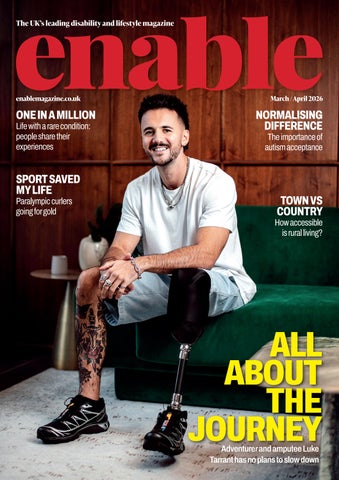
Enable March / April 2026

Page 1


ONE IN A MILLION

Life with a rare condition: people share their experiences

SPORT SAVED MY LIFE

The importance of autism acceptance

TOWN VS COUNTRY

Paralympic curlers going for gold NORMALISING DIFFERENCE

How accessible is rural living?

COVER PRICE £3.00

PUBLISHER

Denise Connelly denise@dcpublishing.co.uk

EDITOR

Melissa Holmes melissa.holmes@dcpublishing.co.uk

STAFF WRITER

Kate Stevenson kate.stevenson@dcpublishing.co.uk

EDITORIAL CONTRIBUTORS

Jane Hatton

Samantha Renke

Tim Rushby-Smith Alisdair Suttie

DESIGN AND PRODUCTION

Lucy Baillie lucy.baillie@dcpublishing.co.uk

SALES

Marian Mathieson marian.mathieson@dcpublishing.co.uk

ENABLE MAGAZINE www.enablemagazine.co.uk

DC Publishing Ltd,

198 Bath Street, Glasgow, G2 4HG

Tel: 0844 249 9007

Welcome

very time our team sends Enable to print, I’m astounded by the people I get to interview. From household names like Heston Blumenthal, Ellie Goldstein and the late John Stapleton, to ‘ordinary’ folks like the disabled people, carers, and professionals who kindly give their time and share their experiences to help raise awareness, reassure others, and make Enable a great read – every issue.

This edition is no exception. I got the chance to speak to Luke Tarrant, the adventurous spirit whose amputation hasn’t put the brakes on his wanderlust. Parents Rhiannon and Tracey opened their hearts about raising children with rare conditions, while Glasgow Disability Alliance’s Tressa Burke had me rapt while discussing her dedication to fighting for disability rights. Enable reader Siobhan poured her soul onto the page by sharing her MS diaries with us. And, having been editing her column for years, I finally ‘met’ Enable columnist Samantha Renke when she gave me her thoughts on moving from the big smoke to rural life. It’s people who make this magazine something to be really proud of: the readers who contribute to our articles, our columnists, and our contacts within disabled people’s organisations. And you – the person who wants to live in a more inclusive, accessible world, and who supports our mission towards achieving that.

Until next issue –

20 NORMALISING DIFFERENCE

We learn more about how people with lived experience are working to improve society’s understanding of neurodivergence.

38 SPORT SAVED MY LIFE I chat to ParalympicsGB’s dynamic wheelchair curling duo, Jo Butterfield and Jason Kean, on the eve of the Winter Paralympics.

What's inside

Interview

08 ALL ABOUT THE JOURNEY

Adventurer Luke Tarrant talks about adapting to life after amputation: from survival mode after surgery and sepsis in Colombia, to excitement and adrenaline-fuelled fun all over the world.

10 HACK-CESS ALL AREAS

Every day, disabled people navigate a world that wasn’t built for them. Jenni tells us more about the tips and tricks she uses to beat the system.

26 PUSHING FOR CHANGE

Tressa Burke, CEO of Glasgow Disability Alliance, explains why she publicly declined an MBE.

66 ART OF MY OPTIMUS

Illustrator and photographer Jijo Das is taking the world by storm. He shares why he believes anything is possible.

Health

23 LIVING WELL WITH PARKINSON’S

To mark Parkinson’s Awareness Month in April, we learn more about the condition, which impacts around 166,000 people in the UK.

Voices

18 ABLEISM DOESN’T TAKE HOLIDAYS

Columnist Samantha Renke shares her experiences of a recent holiday to Mexico. It turns out, it’s not all sunshine and cocktails.

44 AISLE BE BACK?

Columnist Tim Rushby-Smith's thoughts on the perils and pitfalls of attempting a shopping trip when you’re a wheelchair user.

Life

12 ONE IN A MILLION

Parents and individuals dealing with the rare conditions Rett syndrome and Usher syndrome share the challenges they face.

15 BRIDGING THE GAP

Turning 18 is a doorway into freedom. Yet, for many disabled young people in the UK, it feels more like entering a world that no one has fully explained.

20 NORMALISING DIFFERENCE

We learn more about how people with lived experience are working to improve society’s understanding of neurodivergence.

28 LIFE AFTER DIAGNOSIS: SIOBHAN’S DIARY

Enable reader Siobhan Fennell reflects on the personal diary she wrote when she was first diagnosed with MS.

33 TOTALLY DATE-ABLE

Two sisters turned one frustrating conversation about dating into an app designed for disabled people. They talk about their goal to help users find connection without stigma.

36 IT’S GOT TO BE PERFECT

Imagine making a theatre show that was just for you... That’s exactly what theatre director Flo O’Mahony has done alongside her sister, Rachel. Flo chatted with our Editor about Perfect Show for Rachel

47 THE FUTURE IS NOW

Disability is not static, and neither are our lives. Thinking ahead about housing, money and support can help you stay in control and live independently for longer.

50 CROWDFUNDING FOR HOPE

With new treatment options emerging and the NHS under pressure, many people are raising their own funds for private treatment. Rose Moore shares how crowdfunding raised thousands of pounds for her daughter’s surgery.

53 THE DIARY

From sport to art to motoring, our pick of the best disability events over the next two months.

54 PRODUCT PICKS

The latest products to make life easier, support disabled business owners, and raise awareness.

Sport

38 SPORT SAVED MY LIFE

On the eve of their journey to Italy to compete in the Paralympic Winter Games, ParalympicsGB’s dynamic wheelchair curling duo, Jo Butterfield and Jason Kean, chatted to Editor Melissa Holmes about life on – and off – the ice.

Housing

41 TOWN VS COUNTRY

For many people, the idea of living in the countryside sounds like a rural idyll. The reality can be quite different though. We take a look at the pros and cons of rural living for disabled people.

Motoring

56 FORD PUMA GEN-E

Ford’s brilliant Puma now comes with all-electric Gen-E power. Here’s our review.

Employment & Education

61 HOW DO I REASSURE INTERVIEWERS?

Our careers expert responds to a reader’s concerns.

63 OPENING DOORS

Person-centred training is changing disabled people’s lives by getting them ready for the world of work.

Education plans laid out

WIDE REACHING REFORMS

to the special educational needs and disabilities (SEND) education system have been laid out in the Schools White Paper.

The government has announced it will spend £4 billion over the next three years to make mainstream schools in England more inclusive for children with SEND. From 2035, only children with the most complex needs will be eligible for EHCPs, new levels of support will be introduced, and “national inclusion standards” will be in place by 2028. Charities had a mixed response to the proposals. James WatsonO’Neill of Sense said: “We welcome

both the additional investment and the ambition. Earlier intervention, closer collaboration across education, health, and care, and the proposed ‘Experts at Hand’ initiative could make a huge difference for disabled children with complex needs.”

However, charities and parents are concerned about staffing levels, schools being properly resourced, and how “complex needs” are defined when it comes to EHCPs. Jolanta Lasota of Ambitious About Autism said: “We do not want autistic pupils to miss out on support, or have their needs redefined, to fit budgets.”

ENERGY CRISIS HITS VULNERABLE HOUSEHOLDS

64% OF PEOPLE FACING energy debt are more likely to report a disability, according to financial support portal Lightning Reach. Falling behind on energy bills is one of the clearest warning signs of households struggling with deeper financial troubles. These households are twice as likely to have difficulty keeping up with loan repayments, and more than 50% more likely to fall behind on housing costs. Lightning Reach enables financially vulnerable individuals to find and apply for personalised support from a range of organisations.

PARKING BAY MISUSE SEND pupils avoid tech

LEADING MOBILITY RETAILER CareCo has highlighted growing concerns around access to disabled parking. Research shows that, in 2024, more than 45,000 penalty charge notices were issued across the UK for vehicles parked in accessible bays without the required valid Blue Badge. That’s 123 instances per day where UK Blue Badge holders, disabled people and the elderly may be missing out on a parking space they need. The data revealed Birmingham, Bournemouth and London are the top three hotspots for accessible parking misuse.

CHILDREN WITH SPECIAL

EDUCATIONAL needs are withdrawing from classroom learning because the technology meant to support them is letting them down. Research by computer manufacturer ASUS found 55% of secondary school teachers see SEND pupils becoming frustrated or anxious about using technology after it fails, while 38% watch pupils lose confidence in their ability to complete tasks.

The government recently announced a £200 million SEND teacher training programme, to include instruction in assistive technology like speech-to-text dictation tools.

All about the journey

Adventurer Luke Tarrant on adapting to life after amputation: from survival mode after surgery and sepsis in Colombia, to excitement and adrenaline-fuelled fun all over the world

Some people are born thrillseekers. For Luke Tarrant, working on the trading floors of London’s financial markets seemed like the ultimate thrill… Until it wasn’t. “I quickly realised I didn’t have a passion for that at all,” he admits. After the pandemic, he quit what he thought was his dream job, and used his savings to travel the world on his motorbike for two years. He ventured through Asia and Europe then south through the Americas, before what he calls a “weird twist of fate” – a crash in Colombia in which he lost his leg.

Since becoming an amputee, Luke now travels for a living, and a world of adventure has opened up to him. “I find it weird to brand myself as disabled,” Luke admits. “I am disabled, like the dictionary definition, but I see myself as just happening to have one less limb. It’s just normal life but a bit different.” Considering his accident only happened a year and a half ago, Luke has adjusted astoundingly well – and quickly – to life as an amputee.

IT HIT ME LIKE A TRAIN

But that’s not to say he doesn’t face challenges. Enduring multiple

surgeries and sepsis in Colombia left him in survival mode. When he returned to the UK, his first visit home was tough. In his NHS standard wheelchair, he struggled with heavy doors and narrow spaces in his flat, and recalls: “I got home and it hit me like a train – I had this realisation that I’d become disabled.” Feeling “miserable for that weekend,” Luke got back into the swing of things when he returned to hospital: “Over the course of a week, I shed that feeling of despair. The next time I came home, it happened again, but it was less severe.” Luke finds that scenario still repeats, but the frustration gets less each

time: “I’ll find a way around whatever the problem is and carry on, and that feeling is gone.” However, he still acknowledges: “Living life with one leg is harder than I think I make it look! Sometimes it is hard.”

AN INTERESTING LIFE

The learning curve of adapting to being disabled hasn’t stifled Luke’s adventurous spirit: “I’ve always had this desire to have an interesting life,” he shares. From adaptive skiing in France to jet skiing in Portugal, walking the Great Wall of China, bungee jumping at Victoria Falls, a New Year’s

I see myself as just happening to have one less limb. It’s just normal life but a bit different

Day swim off the Welsh coast, scaling rock faces in Yosemite, and going on safari in Botswana, Luke’s wanderlust knows no bounds.

But he’s keen to remind people this is what he was doing before he became an amputee. “No one called me a hero before when I was riding my motorbike around the world,” he admits. “Now everyone’s like ‘he’s so inspirational’. But I was doing that anyway – the reason I’m still doing it now is because I don’t want to live my life any differently.”

Despite having more than half a million social media followers, Luke never set out to be a role model. But, while recently in an airport in Malta, he met a couple who’d been inspired by him. “The husband had his leg amputated, and he’d lost himself,” explains Luke. “He refused to go on holiday, and was worried he wouldn’t be able to do what he used to.” The couple had seen a video of Luke going

in the sea wearing his prosthetic, rinsing it off and heading for dinner, and booked themselves a holiday that same day.

“He’d realised he was holding himself back, but it was still possible. That’s the message I try and put out there.”

A BUMPY ROAD

As someone who’s recently become disabled, what’s Luke’s advice to others dealing with a similar life change? “Just roll with it,” he says. “There’s no point pretending it’s not gonna be hard, because it is. And when you think you’ve got over the hard bit, there’ll be another hard bit. Be aware it won’t be easy, and make peace with it.”

Luke visited 21 countries in 2025 alone, and 2026 has already seen plenty of new stamps added to his passport. But there’s a bigger journey to come: “My plan later this year is to finish the bike trip I crashed on, because I feel like I’ve been in limbo since. Part of that will be going back to where I crashed in Colombia and trying to work out what happened. Until that trip is done, I can’t really think about much else.”

The 30-year-old has only been on a motorbike once since losing his leg. At a track meet in New York, he was “nervous to be getting back on a bike. Before my accident, I’d be on my bike all day every day, in that flow state which I love so much.” He found his first time back on a motorbike emotional and had planned to take it slowly. “The next day I let it rip,” he laughs aloud. “The idea of tootling along carefully was out the window – I didn’t even think about my leg. I was absolutely sending it around the track, it was wicked!”

As Luke says: “Four wheels move the body, two wheels move the soul.” We can’t wait to see where his adventures move him next.

HACK-CESS ALL AREAS

Every day, disabled people navigate a world that wasn’t built for them. Jenni, known online as Chronically Jenni, says that’s why disabled people have some of the most creative minds she knows. She tells us more about the tips and tricks she uses to beat the system

For Jenni, disability is not one single obstacle. It’s hundreds of small ones layered into everyday life.

“It’s the little things – like tiny lips on doors, different slopes in pavements. I notice and feel everything,” she explains, “especially when I’m using my manual wheelchair.”

These details might not register for non-disabled people but, for disabled people, they shape where you can go, how long you can stay, and how much energy it takes to get there.

ENERGY BUDGETING

Jenni lives with an energy-limiting condition, which means even basic tasks require careful planning: “Simple things like having a shower can take my energy for the whole day,” she says.

The sad reality is, the world hasn’t been built around the needs of disabled bodies and minds. As a result, disabled

people are forced to adapt and create ‘hacks’ to make life easier. Jenni says it’s important not to confuse these with ‘lifestyle upgrades’: her hacks are simply tools for getting through the day.

“My house is full of little gadgets. Everyone loves my electric tin opener,” Jenni laughs, adding that heated blankets help manage pain, mobility aids reduce strain, and accessible clothing removes unnecessary barriers. “But honestly, it all makes such a difference.”

One of the most important ‘hacks’ in Jenni’s life is not a product at all: it’s her support team. She relies on support workers who help with personal care, daily tasks and running her business. “They kind of run my life,” she says honestly. “They see the whole spectrum of how my disability affects me, physically and mentally.”

But that level of reliance can be hard to accept in a society which values independence above all else. Learning to ask for help, she thinks, is essential, but that doesn’t make it easy. “You’re kind of beholden to other people sometimes,” reveals Jenni. “You have to work on their schedule instead of your own.”

ACCESS HACKS

What makes it even harder is the lack of clear guidance. “No one gives you a handbook and says, ‘You’re disabled now, here’s everything you need to

know’,” she continues.

Accessing care, equipment, and financial support can often be complicated and slow… By discussing her experiences online, that’s the gap Jenni’s trying to close.

The best part about sharing her tips and tricks? They’ll probably benefit your non-disabled friends too. “The electric toothbrush is a brilliant example,” explains Jenni. “But if that had been called an adaptive toothbrush, people wouldn’t have used it.”

The problem, Jenni says, is that disability is still treated as a niche, which means it’s priced that way too. “I think I paid around £16 for an adaptive white T-shirt in Primark, which you can pick up for a fiver anywhere else in the store,” reveals Jenni. “Disabled people already face higher living costs, so those extra price tags make a real difference. We need to change that.”

With her thousands of online followers and a growing voice in the advocacy space, Jenni is certainly doing her bit to create change.

JAECOO proudly introduces the all‑new JAECOO 5 on Motability, offering bold design, premium technology and advanced driving aids. With adaptable vehicles and Motability accredited staff, JAECOO helps you get mobile.

ADVANCE PAYMENT FROM £699

Subject to T&Cs on jaecoo.co.uk.

Price based on standard/entry level model. Advance Payment offer valid for Motability applications from 1st January 2026 until 31st March 2026 at participating dealers and subject to vehicle availability. Advance Payment varies according to model grade.

Scan for more

ONE IN A MILLION

If you have a rare condition, or you’re the parent of a child with a rare condition, life – everything from first symptoms and securing a diagnosis, to treatment and support, communication and education – can come with a whole set of challenges. We find out more from people with lived experience

Rhiannon and Paul have two daughters – Charlotte and Poppy – and are expecting their third child soon.

“Everything was going as expected until just after Poppy’s first birthday,” explains Rhiannon. “Her development seemed to stall, then we noticed a big change in her temperament – our content, easy going, sociable daughter was suddenly angry, frustrated and extremely unsettled. Things progressed from there, and the journey to find a diagnosis began.”

FACING GRIEF

After a long and complex process, the family received Poppy’s diagnosis: Rett syndrome. A genetic disorder affecting one in 10,000 girls born each year (it’s rarely seen in boys),

Rett impacts brain development, leading to severe physical and communication impairments. “We felt immense grief, pain, helplessness, loneliness, worry – it was the hardest time of our lives,” admits Rhiannon.

Tracey, whose daughter Audrey has Usher syndrome – meaning that she was born deaf, and will lose her sight in future – experienced similar feelings. “You grieve for what they won’t have,” she explains.

Audrey and her family have devised a visual bucket list, with events to attend and places to visit, so Audrey can absorb everything life has to offer while she can still see. “It’s like living with a ticking time bomb of uncertainty,” reveals Tracey. But being able to make memories – like seeing Coldplay live, going up the Eiffel Tower, and eating a

Karolina and Bosley
Rhiannon, Poppy and Charlotte

Cornish pasty in Cornwall – is proving to be hugely positive for Audrey, and her siblings and parents (Audrey’s dad is also visually impaired). That doesn’t mean Tracey doesn’t struggle though: “Some days when I think too deeply about it, it’s like I’m screaming on the inside. I know what’s coming, and I can’t stop it.”

AIMING HIGH

Karolina Pakenaite also has Usher syndrome, which affects between four and 17 people in 100,000 worldwide. Diagnosed ten years ago, she’s now 29 and is slowly losing her sight and hearing. She’s just graduated from the University of Bath after completing a PhD on developing tactile images to enable blind people to access photographs. Guide dog Bosley accompanied Karolina throughout nine years of study, and took part in her graduation ceremony.

She’s also been pursuing mountaineering, scaling Mera Peak, Mount Kenya and Himlung Himal, and has plans to climb Mount Everest later

Learning to be an advocate pushes you out of your comfort zone, but it brings new meaning to life

this year. “The PhD challenged me intellectually, while mountaineering challenged me physically. Pursuing both journeys in parallel was a defining experience,” she admits.

For Poppy, whose mobility is impacted by her Rett syndrome, climbing mountains may not be on her future to-do list, but Rhiannon is cheered by her daughter’s progress: “We’re working hard to build strength and stability, and to maintain and develop the fine and gross motor skills she’s managed to retain. Poppy’s biggest challenge is communication, and she’s showing real strides in her use of AAC and eye gaze.”

Audrey is also excelling, and Tracey is amazed by her daughter’s drive. The 13-year-old has delivered deaf awareness training to her teachers, is in top set for her subjects, and is a peer mentor and student leader. “She’s the most formidable, amazing young girl,” Tracey beams. “If she wants to do something, she makes it happen.”

Parenting a child with a rare condition, or living with a rare condition yourself, can mean learning new

vocabulary, attending endless medical appointments, and figuring out how to adapt physically and mentally to your new way of living. It’s a lot.

SEEK OUT SUPPORT

Rhiannon suggests: “Seek out support wherever you can find it (it’s not easy to find!). It’s so hard at the beginning, when you’re in the throes of grief and trying to figure out how to navigate this whole new world: doing it alone makes it that much harder.” She checks in regularly with her husband Paul, and seeks content – like blogs and podcasts – created by others on a similar journey. She’s also found solace in writing, while her eldest daughter Charlotte works with a play therapist to support her feelings and emotional needs.

LIVE LIFE TO THE FULL

Tracey wants others to understand that people with a rare condition shouldn’t be defined by it: “I’d say not to live a limited life, because there is support out there.” Rhiannon agrees, saying: “We want our daughter to be happy. We want her to be able to experience life to its fullest, and to have access to as many opportunities as possible.” But she also acknowledges that parents should “Be ready to fight, for everything. Keep pushing for everything your child needs. Learning to be an advocate is tough and pushes you out of your comfort zone, but it brings new meaning and purpose to life and makes a world of difference for your child’s future – and others around them.”

And to others with Usher syndrome or who are deafblind and considering pursuing higher education, Karolina suggests: “You’re allowed to adapt systems so that they work for you – this is not a weakness, it’s good design. What matters is identifying approaches that provide appropriate support, advocating for what you need and recognising that your lived experience can offer valuable insight within any field you choose to pursue.” Good advice for everyone in life, we think!

Audrey and family

BRIDGING THE GAP

For disabled people, becoming an adult is about more than a birthday or celebration. It means moving from school to college, training or work, from paediatric to adult healthcare, and from children’s services into adult social care.

Challenges vary depending on the individual’s disability and level of support they need. And, sadly, research into this transition period often describes the move between services as “disjointed” and “poorly coordinated.” Young people report feeling lost between systems that don’t communicate well with each other. And, when the eligibility criteria changes at 18, some find their support reduced or reassessed completely.

PLANNING AHEAD

In England, Education, Health and Care Plans should start preparing young disabled people for adulthood from Year 9. Preparation should focus on employment, independent living, community participation, and health. But, in practice, many families say those conversations don’t always happen in a meaningful way.

That’s why starting early makes a difference. It’s also why young people should be involved in discussions about the future from their early teens, so the transition feels gradual, rather than all of a sudden. Small steps – like learning to manage money, practising travel skills, and having a say about their support – all help.

Research by Scope found young disabled people “want to have that independence.” But the gaps between child and adult services remain one of the biggest pressure points. Children’s services often work with the whole family, while adult services tend to focus on the individual, and on specific criteria. Many say this shift can feel like “falling into a void,” with worries around whether support will continue at the same level.

Turning 18 is a rite of passage; a doorway into freedom. Yet, for many disabled young people in the UK, it feels more like entering a world that no one has fully explained

THE HURDLES

The emotional impact shouldn’t be underestimated either. The transition takes place alongside other major life changes – friendships may evolve, educational settings may change, and young people are starting to develop a new sense of identity as an adult.

Schools and colleges have a crucial role in shaping how this period feels. They can offer personalised careers advice, supported internships, and realistic work experience opportunities. But inconsistency is still an issue. Some disabled students report being steered towards limited options, and others have complained of delays in arranging their Disabled Students’ Allowance or suitable university accommodation.

Employment remains a significant

Young people should be involved in discussions about the future from their early teens

hurdle. Disabled young adults are less likely to be in work than their nondisabled peers. Recruitment processes can be inaccessible, and employers may lack confidence or understanding around what’s required when it comes to reasonable adjustments.

SUCCESS STORIES

Yet alongside these challenges, there are examples of what works. Aisha has muscular dystrophy. Her school encouraged her to explore her interest in graphic design, her long-term goals were included in her EHCP, and she completed a supported internship with a local employer who agreed to flexible hours and remote working.

Once she moved to college, funding for support and assistive technology was arranged in advance. There were still reassessments and paperwork –the transition was not effortless – but it centred on her ambitions. She says the most important factor was “being

listened to, rather than being told what was realistic.”

NEXT STEPS

Independence doesn’t mean doing everything alone. It means having choice, and support that respects those choices. But if we want transition to improve, change is needed at the policy and practice level. That means better coordination between child and adult services, clear communication about eligibility to prevent sudden loss of support, and investment in supported internships, accessible housing, and community-based services.

Carers UK: carers.org.uk Contact: contact.org.uk Council for Disabled Children: councilfordisabledchildren.org.uk Disabled Students’ Allowance: gov.uk/disabled-students-allowance-dsa Scope: scope.org.uk

The hardest journey

One parent shares their experiences of the move to adult services for their son, who is neurodivergent

The transition to adult services has been one of the most difficult parts of our journey as a family. It has been draining and exhausting. We’re constantly chasing appointments, returning calls, and trying to keep things moving. It often feels as though meaningful help would only be offered if we were to reach crisis.

When my son was younger, support from services wasn’t great, but it did exist. There were professionals involved, plans in place, and at least some understanding that his needs were serious and complex. Turning 18 didn’t reduce those needs, but dramatically reduced the support around him and us as a family.

Expectations increased overnight. He’s now seen as an adult, even though his neurodiversity and mental health make everyday life incredibly difficult.

The emotional toll on parents is rarely acknowledged. Making impossible decisions, advocating constantly, and having to repeat your child’s needs and disabilities over and over is exhausting. Staying steady for your child while your own world gradually shrinks takes its toll. This isn’t because of who my son is. He’s amazing. The difficulty comes from the lack of support around him and us as a family in caring for him.

My biggest advice to other parents is to trust your instincts. Don’t worry about doing things ‘right’. Instead, do what keeps your child supported, while also protecting your own mental health, in a system that so often falls short.

Follow their journey online at tiktok.com/@parentingthelongroad

Samantha Renke

Samantha is a broadcaster, actress, disability activist and the author of You Are the Best Thing Since Sliced Bread

Follow Samantha on Instagram @samantharenke

Samantha Renke shares her experiences of a recent holiday to Mexico. It wasn’t all sunshine and cocktails

Ableism doesn’t take holidays

Idid it. I took the plunge. After almost seven years, I went on holiday. Pandemics and work commitments meant I didn’t prioritise getting away for a jolly. I’ll admit, the longer I postponed it, the more daunting it became.

NOT REALLY A HOLIDAY

The truth is, I’ve never had a holiday that felt like a holiday. As a wheelchair user who relies on others to be safe and to maintain my independence, there’s so much to navigate. If I’m not worrying about forking out hundreds on insurance, I’m worrying about an airline damaging or losing my wheelchair. Then there’s accommodation. Even when I’ve done my research, there’s always a major accessibility hiccup: a toilet positioned at an angle so I can’t go without help, beds that are too high, sinks out of reach.

I toyed with the idea of writing this column – I don’t want to come across as ungrateful. I’ve never fully enjoyed any holiday I’ve been on, but that’s not to say there haven’t been cherished memories and moments of genuine fun.

I’m writing this because something struck me as I sat by the pool in Mexico. Like many of us do, I posted some beautiful pictures of the resort and of me, smiling, on social media. This

prompted a flood of near-identical messages: “I hope you’re having an amazing time.”

What people didn’t see was that I had unintentionally curated a holiday – online at least – that looked idyllic. The truth is, I experienced ableism and disablism while I was away, because discrimination doesn’t take a holiday.

CHICK IN THE WHEELCHAIR

For me, this looked like strangers taking unsolicited pictures of me in the pool. A family on a balcony peering over to take a peek at “the chick in the wheelchair,” before dashing off when I glared at them. Being shown a premium suite, only to be told there were no accessible premium rooms available, as though Disabled people don’t want or deserve luxury. And it looked like an argument among friends that ended with me diminishing my own voice, because in that moment I couldn’t book an early flight home or check into another hotel to give myself space.

At times, I felt incredibly vulnerable.

Although the sun on my skin, the glorious food, and the beautiful Mexican people – who, by the way, never stared or made me feel uncomfortable for simply existing – brought me real joy, I still believe in being honest. For Disabled people, going on holiday isn’t just about switching off. It means leaving the familiarity of home, surrendering a level of independence, and trusting systems that have repeatedly shown us we’re an afterthought.

I’m writing this because I don’t want anyone in my community to feel ashamed for naming that reality. Gratitude and critique can coexist. You can feel lucky to be somewhere beautiful and still acknowledge the barriers that made it hard to breathe. Ableism doesn’t disappear when the sun comes out, it simply becomes easier to hide behind smiling photographs. And until Disabled people can travel without fear, compromise or apology, the conversation deserves to continue.

• Flexible terms from 3 months, no long-term lock in.

• One simple monthly payment

• Insurance, servicing and breakdown cover included

• Swap or return if your needs change

• Waiting for your Motability vehicle

• Not eligible for Motability but still need a WAV

• Your current vehicle is off the road

• Your mobility needs are changing

• Unsure whether buying is the right long-term decision How ORA Works Perfect if you’re

• Delivered across the UK

Designed for real life because mobility needs aren't static.

And if your Motability or own vehicle arrives earlier than expected, you can end your subscription early penalty free (subject to terms)

With ORA, you get:

Whether you need a vehicle for months or longer, ORA gives you flexibility without ownership risk.

Most families spend over £1,200 a month on taxis or face a £30,000+ buying decision.

resale stress

independence, on your terms

ORA’s subscription meant we weren’t stuck at home, even when our WAV was in the garage.

Mark, carer from Birmingham

Call to find out if ORA is right for you

NORMALISING DIFFERENCE

The Importance of Autism Acceptance

This April is World Autism Acceptance Month. Editor Melissa Holmes learns more about how people with lived experience are working to improve society’s understanding of neurodivergence

Since Enable magazine launched 15 years ago, we’ve seen a huge shift in awareness around autism – it’s seen less as a ‘disorder’ or illness, and is more understood as a unique way of thinking. Autism has become a mainstream issue, with celebrities like Chris Packham and Melanie Sykes sharing their autistic status, plus social media opening up conversations around neurodivergence.

But there’s a long way to go. The number of autistic people in inpatient facilities in mental health hospitals has increased over the past decade. And who can forget the comments two years ago from a group of Warwickshire councillors who said SEND children are “just really badly behaved” and “need some form of strict correction”?

BREAKING BARRIERS

According to the National Autistic Society, 55% of autistic people avoid going out because they’re worried how people will treat them. Finding a safe space where you’re free to be yourself can really boost confidence.

Music has always been a powerful force in society, helping to bring people together and break down barriers. Club Soda promotes opportunities and supports inclusion for learning disabled and autistic people: the charity has hosted gigs and club nights, supported people to follow their musical passions as DJs and band members, and is launching a Change the Scene UKwide tour to unite learning disabled and neurodivergent musicians, DJs and crowds in inclusive spaces at club nights and established music festivals.

“We always aim to run our events in mainstream spaces, so we’re really visible,” explains director Olly Tipper. “While the majority of people who come into our space are autistic, learning disabled or a supporter or carer, there are also people that don’t have anything to do with the scene; non-disabled people who are integrating. We talk about normalising difference. We’re shifting culture, which is the target of Change the Scene.”

As well as getting more performers on stage, Olly’s aim with Change the Scene is to raise the profile of the artists Club Soda supports. “I want them to be spotted or seen, or their music enjoyed and downloaded; I want to see them being offered gigs. We want our events to be a place of joy and happiness, for people to feel included and part of the mainstream. It’s levelling the playing field: that’s what we hope the tour will help us achieve.”

LEVEL PLAYING FIELD

A level playing field is something the autistic community wants to see – especially when stats reveal that just 30% of autistic people are in any sort of employment. Dan Harris is hoping to change that. As the founder of Neurodiversity in Business, he’s pushing for change so Josh, his non-speaking autistic son, won’t face barriers to employment – or anything else – as he grows up.

“We need to change the world around him, rather than Josh needing to change,” explains Dan. “When I was growing up, these kids were institutionalised. They were deemed not worthy of an education. It’s about

making sure society sees him – in all parts of society.”

DON’T LIMIT OUR EXPERIENCE

Non-speaking people like Josh are often underestimated, but Dan emphasises: “Non-speaking does not mean non-thinking.” He wishes people would stop making assumptions about his son’s competence. Josh can read and write, and uses a talker to communicate, as well as spelling out words using the alphabet tattoo on Dan’s arm. “We have a rush to give these kids a limited experience,” reflects Dan. “‘They can’t do this’, ‘it’s not going to be possible’, and so on. The reality is we need to be listening better – rather than them having to change what they’re doing. If we’re attuned to what they’re trying to communicate, they may actually be capable and enjoy doing a lot of things we prohibit them from doing.”

Dan uses his social media platforms to share his message of understanding and acceptance. He and Josh visit places of worship as part of their Cake Not Hate campaign, and promote the use of AAC technology to enable non-speaking autistic people to become integrated into communities, workplaces and schools.

Dan’s clear when it comes to what organisations should be doing to improve inclusion of autistic people in employment: “The three priorities should be listen, listen, and then listen. What I’m hearing from autistic people is that they’re really keen to remove the stigma we still have around autism,” reveals Dan. Asking to leave the office

early to pick up your child has become normalised, particularly post-Covid. “What isn’t normalised is me sticking my hand up in a meeting and saying ‘I’m not feeling the meeting’. I and others still feel very uncomfortable putting our hands up to say we’re processing information differently.”

Dan is being assertive in public and through his work with Josh. “Don’t tell me what my boy can’t do. Let’s have a try and then adapt if it doesn’t work,” he says, firmly. Olly is also pushing for change, and knows improving access for neurodivergent people will benefit everyone: “By making your infrastructure more accessible, having quiet chill-out spaces, multiple wider access points – there’s now an acceptance that it’s super important. Audiences will appreciate you more if you go the extra mile and consider everybody’s access needs.”

DJ 4BLUE at Club Soda
Dan and Joshie

Living well with PARKINSON’S

Often considered an ‘old person’s disease’, Parkinson’s affects people of every age. To mark Parkinson’s Awareness Month in April, we learn more about the condition, which impacts around 166,000 people in the UK

As a progressive neurological condition which has no cure, a diagnosis of Parkinson’s may seem like a life sentence.

Commonly causing tremors (shaking), slowness of movement and rigidity (muscle stiffness), other symptoms can include balance issues, pain, fatigue, sleep problems, anxiety, depression and cognitive change. Although it’s often viewed as an old person’s disease, it can impact all ages. One in three people diagnosed are of working age (under 67), while one in 16 are under 50 (it’s known as young onset Parkinson’s in this group).

However, a growing number of people living with the condition are showing that life with Parkinson’s

can be well lived. Perhaps the most famous person living with Parkinson’s is actor Michael J. Fox. His tireless work to raise awareness, and to support research into the condition, along with his positive optimism around managing it, has done wonders for public understanding of Parkinson’s. Since its launch in 2000, the Michael J. Fox Foundation for Parkinson’s Research has become the world’s largest nonprofit funder of Parkinson’s research – to date it’s raised more than $2.5 billion and moved scientists closer to a cure.

HOW DOES IT HAPPEN?

Parkinson’s is caused when the dopamine-producing nerve cells in the brain start to die. Dopamine is involved

in controlling movement, motivation and mood, which is why the condition causes both physical and non-motor symptoms. Symptoms vary widely from person to person, and the condition progresses at different rates, so treatment and management need to be individualised and flexible.

Movement can actually slow progression of the disease

There are a number of effective medicines in use to treat Parkinson’s, including ones that mimic dopamine and help ease the physical impact of the condition. The lead singer of Del Amitri, Justin Currie, was diagnosed with Parkinson’s in 2024, when he was 59. Initially he feared it was ‘stealing his personality’, but he’s recently told the press he feels like a fraud because his condition has improved so much since he started taking medication for it, saying it’s given him a “new lease of life.”

LIFESTYLE CHANGES

When it comes to improving symptoms, medication goes hand in hand with lifestyle changes. Dietary changes can help you stay energised and healthy, while also improving symptoms like constipation. Staying hydrated, and eating whole foods like fruits and vegetables, lean protein, beans and legumes, and whole grains, will boost your ability to deal with Parkinson’s symptoms. Be careful when consuming protein-rich foods though – protein can affect the absorption of some medications, so it’s best to speak to your Parkinson’s nurse about this.

According to Parkinson’s UK, physical activity can be as important as getting the right dose of medication, and the more physically active you are – the more you push yourself – the

Combining medication, exercise and diet creates a great foundation for living well with Parkinson’s

easier it is to live well with Parkinson’s. “Movement,” says Denise PadillaDavidson, a Johns Hopkins physical therapist, “especially exercises that encourage balance and reciprocal patterns [movements that require coordination of both sides of your body], can actually slow progression of the disease.”

You only need to look to people like Jimmy Choi to see the importance of exercise. As a three times fitness world record holder and ultramarathon runner, and having appeared in American Ninja Warrior several times, Jimmy is showing people how much exercise can change the trajectory for someone diagnosed with Parkinson’s. He was diagnosed age 27 and, after falling down some stairs while using a cane several years later, he realised he had to do something to take control

of his symptoms. Now age 51, he’s the epitome of vitality, using his social media platforms to share his message of positivity, and the importance of exercise and mindset.

REGAIN CONTROL

Of course, you don’t need to train to Ninja Warrior level to help manage Parkinson’s symptoms: anything that gets your heart pumping, uses your brain and keeps you moving can help slow down the progression of the condition. Exercise can offer a sense of control over your body and help you rebuild trust in it, especially if you’ve had a fall or been inactive for a while. And let’s not forget how beneficial movement is for mental health – especially when depression and anxiety are common for people with Parkinson’s.

Even gentle movements can boost your mood and help you live well with Parkinson’s, so why not look out a class to attend? Parkinson’s UK offers a database of activities tailored for people with the condition, including dance, walking football, table tennis and gym sessions. Visit localsupport. parkinsons.org.uk to find classes near you. You can even attend virtual sessions online.

Physical classes can also support your emotional wellbeing, helping you stay connected with friends (or make new ones), while counselling, creative activities or peer support groups will help you feel less isolated and enable you to process your emotions around having Parkinson’s, since it can bring all sorts of feelings around grief, anger and confidence.

Taking this three-pronged approach – medication to improve symptoms, exercise to protect function and boost confidence, and diet to support energy and overall health – creates a great foundation for living well with Parkinson’s.

Parkinson’s may change how a person moves through the world but, with the right support, knowledge and resources, many people continue to live full, active and meaningful lives.

Pushing for change

Tressa Burke, CEO of Glasgow Disability Alliance, speaks to Editor Melissa Holmes about why she publicly declined an MBE, the pressures facing disabled people across the UK, and her relentless pursuit of change

At the start of my call with Tressa Burke, it quickly became clear she knows her stuff. Eloquent, smart and effortlessly able to reel off data and research, it’s obvious why she’s been at the forefront of one of the UK’s largest Disabled People-led Organisations (DPO) for two decades.

She recently hit the headlines: as the cuts-laden Budget was being read, she opened a letter telling her she was being awarded an MBE, to honour her outstanding achievement for service to disabled people. She refused it.

“I couldn’t accept a personal honour when disabled people were being so dishonoured,” she explains. “It would’ve been a betrayal of my 6,000 members.” Her refusal led to thousands of messages of support.

“I feel disabled people are very deliberately under attack by the UK Government,” she says. “Things have never been worse, with the rise of the right, and misinformation being spread about disability benefits. We need to start talking about the value of disabled people.”

MORAL COMPASS

Turning down the MBE – “Ultimately, I needed to take a stand in line with my moral compass” – was more than just a symbolic action. It aligns with Tressa’s decades of work to reduce barriers and improve freedom and opportunities for disabled people.

In 2025, alongside other DPOs and wider anti-poverty organisations, GDA launched a grassroots campaign against proposed changes to disability

benefits, which the UK Government itself said would push at least 250,000 disabled people further into poverty.

“GDA members are already frightened to turn the heating and lights on, they’re not charging vital independent living equipment. They’re sitting watching their smart meters,” reveals Tressa. Eventually, some proposals were dropped or altered because: “The government underestimated that people in the UK are compassionate and fair. At least half of all people in Scotland firmly believe income should be redistributed from the better off to those less well off. This strength of feeling took hold across the UK, showing an intolerance for the brutality of these cuts.”

EMBED COMPASSION

Tressa sees the value of investing in disabled people: “That includes benefits, social care, transport, and participation. As I said in my refusal letter, we need the government to embed compassion and fairness.”

Tressa continues: “Stigma, discrimination and exclusion are not inevitable; they’re a result of political choices. We need politicians to make different choices and design out the injustice and inequality disabled

Stigma, discrimination and exclusion are not inevitable; they’re a result of political choices

people face.”

Closer to home, GDA members recently took part in a Disabled People’s Cabinet Takeover, which was: “thought-provoking, creative, and offered hope.”

GDA and other DPOs have also worked with the Scottish Government on a £3.5 million Disability Equality Plan to advance rights, improve mental health, and tackle barriers for disabled people. “It’s a really great starting point,” Tressa admits. “But much more should and must be done. Ask me in a year what’s changed.”

FOR MORE INFORMATION Glasgow Disability Alliance: gda.scot

LIFE AFTER DIAGNOSIS:

Siobhan’s Diary

If you could take yourself back to the day of your diagnosis and look at how much life has changed since you received the news, how would you feel? One of our readers has done just that. Reader Siobhan Fennell reflects on the personal diary she wrote when she was first diagnosed with MS

May 1999, Derby Hospital Dear Diary,

Part of me has been wanting to write for what seems an age. But there’s a pressing voice that tells me to avoid the self-indulgence. Then there’s a small voice that urges contemplation and reflection; ultimately it can only lead to sorrowful self-involvement.

“Why now? Why me?” Others have asked the same questions and found strength in revealing thoughts, events and actions that have carried them through their journey. Perhaps they’ll inspire others, console them, make them feel less alone?

But this is my journey. My crisis. My soliloquy on the stage of life.

As immediate as the process of self-reflection is the self-pity. The practical mind draws future plans for the mundane, the trivial, for survival. The darkness of night makes its entrance, and the plans are less clear and fade into obscurity.

Why now? Why me? Why my lover and daughter? Do we have the strength? Can they handle it? When will the good intentions wear off? Sex appeal in a wheelchair? I don’t think so!

I don’t want to saddle my loved ones with a cripple. I don’t think I can survive this without them, but I can’t watch their sorrow and shame. Where are my answers? They don’t lie in these pages.

June 1999, Derby Hospital Dear Diary,

Ask me how I’m feeling. I dare you –no-one else is.

How are you? The physical side is easy to listen to. Or maybe I’m too worried to tell you the other half. How I really am.

If I really think about it, I’m terrified. I’m scared of losing my mobility, my speech, my dignity. I’m not allowed to say it, but I don’t want to live if or when that happens to me.

I don’t want to think about it. Yet I think about it all the time.

My legs are slow and heavy and I

wobble, so I laugh. My tummy hurts all the time. I want to run and dance and walk without falling over. I want to be me. I want to be confident, I want to be sexy, and I want my body back.

How am I feeling? I’m not me anymore, but no-one else knows that. No-one’s asked how I’m REALLY feeling. Now I’m crying. Feeling sorry for myself. Indulging myself. Now I have to go back to not giving a flying f**k.

September 2025, at home

Dear Diary,

I’m writing this as a response to all those questions I’ve just found in a diary from 1999. My diagnosis then felt like the final curtain of a play. I’d only ever known one other person who lived with MS. She had died at 46. With any luck, I thought I might have a good innings left. I was only 30.

I’m now 56. I am still here. It’s been 27 years of a long, slow journey, and I now live with no movement from the neck down.

Over the years, I indulged my fears and fantasies as though they were mine alone. But I have never been alone. Others have worries of their own and, along the way, I have simply added to them.

I always feel like a burden to the people around me. I know they’re filled with love, and I’m cushioned by their support. As a teenager I loved a song with the line ‘I am a rock, I am an island’. That was how I wanted to live my life; no reliance on anyone. But Mum said: “No man is an island.” She was right. It has felt like a long journey, but I’ve never been by myself: someone has always had a tight hold of my hand. I was supported physically, mentally and financially by a loving husband. MS doesn’t just affect individuals: it becomes a member of the family.

Each relapse was a mortality check. Each stay in hospital brought relief that my husband could take a break, and I would be looked after by someone else.

Then came the nighttime. Leaving

this life behind filled my mind. No longer a burden to anyone, those closest to me would also be free. It’s only lately I’ve realised that the hand that holds mine doesn’t want to be empty.

The last 27 years have been filled with high points and some very low days. My MS Nurse told me: “There will always be something to look forward to or something to aim for.” She was right. Memories fill my vision and I see all I would have missed.

Life didn’t end when I was diagnosed. I decided to make the most of it.

Battles are fought by every person. Some are won and left behind. Others stay and affect how individuals live their lives. Ruth Bader Ginsberg said: “Fight for the things you care about, but do it in a way that will lead others to join you.” So that’s what I’ve tried to do.

I am most proud of the fact I have friends and I’m surrounded with love and care. I’m selfish and self-obsessed, and my battles are built upon my own experiences. However, I can only apologise so much. The truth is boring, but it is mine. If I have done it wrong, tell me when I’m dead.

The Safety Curtain comes down. All is silence.

About Siobhan

Since her MS diagnosis in 1999, Siobhan has launched an accessibility organisation in her hometown, won the British Empire Medal and British Citizen Award for her community work, founded a social enterprise and community transport scheme, and gained a postgraduate diploma, amongst other achievements. She’s also had some incredible experiences, including indoor skydiving, going on a hot air balloon ride, and hang gliding, as well as visiting locations across the UK and further afield such as America, Norway, France, and Spain.

TAY-GETHER FOR ACCESSIBLE TOURISM

Scotland is known for being a friendly and welcoming destination. Scotland’s Tay Country has been working in partnership with VisitScotland to showcase the region’s accessibility

Scotland’s Tay Country – which includes Dundee, Angus, Fife, and Perth and Kinross – is home to some of the most beautiful scenery the UK has to offer. With sweeping coastlines, enchanting forests, and a cluster of vibrant cities, the region is compact and connected. From coast to countryside, Tay Country unfolds with everywhere in easy reach, offering rich history, worldclass cultural attractions, and opportunities for culinary, outdoor and rural adventures for all.

With accessibility at its heart and each region close to the next, Tay Country invites easy exploration. VisitScotland has partnered with AccessAble and a wide range of Tay Country businesses to boost inclusive travel opportunities. Let us whet your appetite for a trip to Tay Country...

DUNDEE

PERTHSHIRE

In beautiful Perthshire, you’ll find Scone Palace – the crowning place of Scottish kings – and RSPB Loch Leven, where you can spot swallows and red squirrels on wheelchair accessible nature trails through the wetland and woodland.

Head north to the Scottish Crannog Centre, which is an immersive Iron Age village experience on the shores of Loch Tay. “We want to be the best place we can be, for anyone to come and be inspired by the stories that we have to tell,” explains Mike Benson, director at the historic site. “The more accessible we are, the better it is for everyone.” Sadly, the Crannog was destroyed by fire in 2021 but, as part of its reconstruction, accessibility has now been engineered in, with physical access like flatter surfaces and wider doorways, plus staff training including disability awareness and Makaton communication, thanks to inclusion workshops from VisitScotland.

This historic, vibrant city is at the heart of Scotland’s Tay Country, and offers convenient connections into Fife, Perthshire or Angus.

Dive back in time with a visit to RRS Discovery, and board the historic ship built in Dundee that took Captain Scott on his legendary Antarctic expedition of 1901. There’s ramped access to the main deck, and a film showing tours of the upper and lower decks, plus in-depth museum exhibits.

Dundee is also home to The McManus art gallery and museum, Dundee Museum of Transport, and V&A Dundee – Scotland’s Design Museum. Dundee Science Centre is family-friendly, and the Centre’s Lorraine Lemon says: “Accessibility is a key focus. We continue to invest in facilities, engagement programmes, and staff training, further supporting our mission making science accessible for all.”

V&A Dundee and RRS Discovery
Scottish Crannog Centre

ANGUS

In Angus, visitors can enjoy a slower pace, experiencing rural life up close at Newton Farm Holidays. Founded nine years ago, owner Louise Nicoll has expanded the agritourism business from accommodation to farm tours, and is keen to ensure all visitors can enjoy their experience. “You want to be as prepared as you can be,” she explains, which is why she recently took part in inclusion training with VisitScotland. From blind guests to visitors with autism, learning disabilities, dementia or mobility impairments, the farm owner has welcomed many disabled visitors. She says: “The training inspired me to get on and start making even more improvements for disabled visitors.” Whether you go to enjoy a farm to table food experience, or an autism-friendly lambing session, there’s plenty to enjoy down on Newton Farm.

For foodies visiting the area, a trip to The Bothy Experience is a must. Nestled in the historic village of Glamis – just minutes from Glamis Castle, the award-winning Gin Bothy offers tastings, afternoon gin teas, and street food pop-ups. Or enjoy the fresh air at Murton Farm near Forfar, with its 100 acre nature reserve and tearoom.

FIFE

Head to the ancient Kingdom of Fife to visit Scotland’s newest city, Dunfermline, where you’ll discover royal history, the quaint Old Town, a stunning city centre park, and the tastiest dishes from Scotland’s natural larder. Dunfermline Carnegie Library and Galleries may have opened in 1883, but now boasts the best in modern accessibility. Fife Cultural Trust’s Jennifer Taylor explains: “As a result of the VisitScotland and Tay Country programme, I’m setting up an Access Champions Group to continue to share learning and best practice. We have included accessible transport links on our website and are developing a carers policy for customers.”

You can enjoy Fife’s award-winning coastline with the help of beach wheelchairs at West Sands in St Andrews, and Silverburn Park, where two adult-sized and two child-sized beach wheelchairs can be prebooked for hire. These allow safe, comfortable access to the beach, and even a shallow ‘paddle’ in the sea! Nearby Lochore Meadows is Fife’s top free visitor attraction, and was recently voted the UK’s most accessible walk. Or why not soak up some outdoor wellbeing at Cambo Gardens? This walled garden has historic stables and a woodland estate. Enjoy your visit with pretty walks, a café and accessibility throughout.

Louise, founder of Newton Farm Holidays and Tours
Beach wheelchairs are available in St Andrews and Leven

Handheld Captioned Performance

Handheld Captioned Performance

Handheld Captioned Performance

Totally Dateable

Two sisters turned one frustrating conversation about dating into an app designed for disabled people. They tell Kate Stevenson about their goal to help users find connection without stigma

In 2021, Jacqueline Child was sitting with her sister, Alexa, talking about something that had started to feel heavier than it should: dating. Jacqueline, who has lupus, rheumatoid arthritis, gastroparesis and trigeminal neuralgia, had just been told by her medical team that she needed a feeding tube. It was the right decision for her health, but she couldn’t stop thinking about what it would mean for her love life.

She’d already spent years navigating rejection on mainstream dating apps. Now she wondered how

people would react when her disability became even more visible.

“I just wish there was somewhere I could meet people like me,” she confided in her sister.

Alexa didn’t hesitate. “Then let’s build it.”

That conversation became the beginning of Dateability, a dating app designed for disabled and chronically ill people. What started as a moment of frustration between sisters has become a platform used by thousands of disabled and non-disabled people who are seeking genuine connection without stigma.

enable life

DISABLED AND DATING

Jacqueline’s experience with dating apps began after she graduated from college in 2016. Like many people her age, she downloaded the most popular platforms and hoped for the best. What she found instead was discrimination and rejection.

“I signed up for all of the traditional mainstream dating apps, and I experienced a lot of ableism, discrimination, toxicity and rejection,” she reveals. “It really ended up affecting my self-esteem and my perception of disability and chronic illness.”

Jacqueline also often felt she couldn’t be honest about her life: “I was never able to fully be myself on these dating apps,” she admits. “I would hide the fact I had a disability until I needed to tell someone.”

That moment usually came when a match suggested a very active date, or when she had to explain a medical limitation. The reactions were often painful: “It almost always ended up in offensive comments,” she says. “People telling me I shouldn’t ever have kids, or that dating me would be a burden.”

Over time, this pattern unsurprisingly left Jacqueline feeling she could never be fully honest. “It was very difficult. I felt like I wasn’t able to fully express myself because I had to hide this big part of me,” she explains.

Alexa watched it all unfold. She’s not disabled, but she noticed the stark difference in their experiences. “I felt like Jacqueline had all these obstacles to face, and they were really unfair and really discriminatory,” she remembers. “To me, the solution felt obvious.”

ONE IMPULSIVE DECISION

The sisters didn’t spend months building a business plan. They just decided to try. “It was honestly an impulsive decision to start creating Dateability,” reveals Jacqueline.

On mainstream apps, I experienced ableism, discrimination, toxicity and rejection

They began with pen and paper, sketching what the app might look like. Jacqueline moved the ideas into Photoshop, started creating mock-ups, and designed the logo herself. Alexa, who works as an attorney, handled the legal side. She dealt with trademarks, incorporations, and the administrative work required to launch a company. Their roles fell into place naturally. “Alexa has a lot of ideas, and I’m better at executing those ideas,” adds Jacqueline.

SHARE YOUR DEETS

One of their biggest decisions was how users would disclose their disabilities. In the end, they decided not to require medical proof. “Requiring a diagnosis or some sort of proof would not only pose privacy concerns, but it also takes a lot of effort,” explains Jacqueline. “I’m not sure many people would be comfortable asking a doctor for a doctor’s note to join a dating app.”

Instead, they created a section called ‘Dateability Deets’, with broad, optional descriptors. The idea was to enable people to share information on their own terms: “It allows people to disclose neutrally and naturally. It shows up on your profile alongside the information you choose to include, like your school or your political views.”

They also chose to keep the app open to non-disabled users who are comfortable dating within the community. Around seven to 10 percent of the user base falls into that category. “We want everyone who’s not having

luck on the other apps to feel welcome,” Alexa smiles.

LOVE WITHOUT LIMITS

Not everyone understood the concept at first. Some investors suggested the sisters should turn the platform into a friendship app rather than a dating one. To them, that revealed a deeper issue: “Intimacy and disability make people uncomfortable,” explains Jacqueline. “It just goes to show how disabled people are infantilised and totally misunderstood.”

Despite this attitude, the first success story arrived quickly. Within a month of launching, a couple who met through Dateability started dating. “They’re still together three-and-a-half years later,” Jacqueline says. “So the proof is in the pudding. We are building something that’s working.”

And it all started with one transparent conversation between sisters, and the decision to turn it into something real.

Alexa (left) and Jacqueline

It’s got to be perfect

Imagine making a theatre show that was just for you… What would you put in it? That’s exactly what theatre director Flo O’Mahony has done alongside her sister, Rachel. Flo chatted with our Editor about Perfect Show for Rachel

Being the star of your own show may sound like a nightmare to some people, or an absolute joy for others. It’s the latter for director Rachel, who creates the story that unfolds on stage each night in her Perfect Show. Her sister, Flo, has supported Rachel in the production. So what exactly is Perfect Show for Rachel? And who is Rachel? Flo explains: “Rachel is my older sister. She’s learning disabled and lives in a care home. We’ve spent a lot of our lives enjoying Rachel’s relationship with culture – she’s always been into big, colourful stuff, whether that’s film, TV or theatre.”

Rachel has attended every show Flo – the artistic director at ZooCo theatre company – has put on: “Whenever she comes, we know it’s gonna be a different, buzzy performance. She always heckles me,” laughs Flo. As

We encouraged audience members to be themselves in response to the shows

a result, ZooCo was offering relaxed performances from the off. “We encouraged audience members to be themselves in response to the shows,” says Flo. So Perfect Show for Rachel was created – a show which would let Rachel bring her electric personality to the stage and create an experience where everyone has a good time.

IN CHARGE

The production relies on improvisation, as Rachel directs the on-stage action from a “ridiculous space shuttle desk” covered in 50 “huge, joke-style ‘do not press’ buttons.”

“Rachel’s totally in control,” reveals Flo. “Each button triggers the lighting, video, sound, and the cast into doing something Rachel really likes. It might be a Kylie Minogue drag act, or Snack Cabaret, where three performers dress up as a bourbon biscuit, an olive, and a packet of crisps, and sing for survival.”

The whole thing is an alchemy of creativity that oozes joy and chaos. And Rachel is at its heart: a woman

who knows what she likes and is “a very sharp director,” admits Flo.

Staging the show has been a big deal. Flo calls it “beautifully inconvenient,” thanks to its huge set, and a cast and crew who share diverse access experiences. The production’s impact runs deep, since ZooCo offers neurodiversity training to theatre staff and teaches improvisation skills for social change at the theatres it’s performed at.

A GOOD NIGHT OUT

The production is creating a legacy for Rachel too. “We never set out to change her with this, but the care home staff have said Rachel’s language use has grown tenfold. She asserts her opinion more often.” Rachel has “more agency, autonomy, creativity and quirkiness to assert in her life – that’s the way I reassure myself that the show is wholly positive.”

With Perfect Show for Rachel ending its tour in June, why should Enable readers see it? “Come for a really good night out,” smiles Flo. “You’ll feel the warmth of familial love radiating off it because we love each other as a cast, and we love bringing audiences with us in that.” Sounds… perfect!

FOR MORE INFORMATION

Perfect Show for Rachel is at Birmingham Rep from 10 to 12 April, Oxford Playhouse from  13 to 16 May, and Leeds Playhouse from 27 May to 6 June. Visit wearezooco.co.uk for information and tickets.

Rachel (centre) and Flo (right) on stage
Flo and Rachel

TAKE A TRIP TO THE UNICORN THIS EASTER

For ages 7+ Fri 17 Apr | 10.30am | Sensory Adapted Sun 19 Apr | 2pm | Sensory Adapted Wed 22 Apr | 10.30am | Sensory Adapted Sat 25 Apr | 1pm | Audio Described Wed 29 Apr | 10.30am | BSL Interpreted Sat 2 May | 1pm | BSL Interpreted

‘SPORT SAVED MY LIFE’

On the eve of their journey to Italy to compete in the Paralympic Winter Games, ParalympicsGB’s dynamic wheelchair curling duo, Jo Butterfield and Jason Kean, chatted to Editor Melissa Holmes about life on – and off – the ice

When Jason Kean’s doctors suggested he might compete at the Paralympics one day, he was in hospital, newly paralysed, thinking they were crazy. “I was sitting there going, ‘Wey aye!’,” he recalls with a laugh. Fast forward just four years, and the Newcastle native is heading to the 2026 Winter Paralympics in MilanCortina, representing Great Britain in wheelchair curling alongside his mixed doubles partner, Jo Butterfield – a Paralympic gold medallist determined to make history as the first British athlete to win gold at both summer and winter Games.

A WHIRLWIND RISE

Jason’s story begins in the darkest place imaginable. As director of a timber frame business, his spinal cord injury felt like the end of everything. “Post-injury, my life was over as far as I was concerned,” he admits.

Depression consumed him. He barely left the house, embarrassed by how drastically life had changed. Then a friend who wouldn’t take no for an answer dragged him to a curling club. “He’d come and pick us up, we’d throw a few stones, and we ended up doing quite a lot of socialising, which I never did before,” Jason remembers. “Getting out and wheeling about with a

If you sit there and say no, you’ll never know what possibly could have been Jo

load of wheelies, I was like, ‘Oh right, so life just carries on and you are just the same person that you were’.” That realisation changed everything. By June 2023 – just 16 months after leaving hospital – Jason was trialling for England. By 2024, he was competing at world championships. “That was the moment I realised that actually – it sounds big headed, but – I am a world class athlete. I’m on the world stage with the biggest teams in the world.”

GOLD STANDARD

Jo Butterfield knows a thing or two about Paralympic glory. The Glasgowbased athlete won gold in athletics at Rio 2016, five years after her spinal cord injury. When she switched to curling in 2023, she didn’t mess about: within six months, Jo won bronze at her first world championships.

But her second season brought an unexpected opponent: breast cancer. Aggressive, fast-growing, and rare, it

required weekly chemotherapy, along with surgery and radiotherapy. “For the first time, I realised how vulnerable I was,” Jo reflects. “With my spinal cord injury, I never thought my life could end with it. But as soon as someone mentions the word cancer, you think, ‘What does that mean? Is this life ending?’”

Sport became her lifeline. “On the ice was the only time I didn’t think about it. I was able to concentrate on being an athlete.” She trained between treatments, finding strength in her teammates and the world-class facilities provided by National Lottery funding. “Without that, I don’t know what I’d have done.”

Two years on, she rarely thinks about her cancer. “It’s a distant memory,” she says, her focus firmly on making Paralympic history.

THE LOTTERY EFFECT

Both athletes are emphatic: none of this would be possible without National

Lottery players. National Lottery funding has invested around £200 million into winter sports, building the National Curling Academy in Stirling – “probably the best facility in the world,” according to Jo – and providing coaching, sports psychology, physiotherapy, and technology like eyetracking analysis.

“I don’t think people across the UK realise that, without their support, none of us would be here,” Jason says. The funding transformed Jo from a part-time athlete juggling work at the Ministry of Defence to a full-time professional: “It means I can focus on training and recovery, and not have to worry about who’s gonna pay the bills.”

HUSBAND AND WIFE TEAM

Their partnership works because they’re honest with each other. “We’re not afraid to say what we’re feeling,” Jo explains. They’re jokingly referred to as ‘the husband and wife’ of curling – Jo admits she gets called “a bit of a nag

sometimes,” and Jason laughs: “She keeps us in line.”

But when it matters, they’re stonecold focused. “We work so well together,” Jason says. “We’re totally focused on the process, stone by stone by stone.”

They’re heading to Milan-Cortina with genuine medal hopes, but also with perspective. “We could play our best in every single game and still not come home with a medal,” Jo acknowledges. “That’s the reality we can’t control. But because of the sports science, the physios, the medical teams, all these services National Lottery players have funded for us; if we trust that, if we go out and play the best we can, we probably will come back with something nice.”

PUSH THAT DOOR

Both athletes share a message for anyone facing barriers. “When I was first injured, it was all about what I couldn’t do,” Jo says. “I never knew

what the future held. To be here now as a Paralympic champion – it’s somewhere I never expected to be.” She urges: “Push that door and see what’s behind it. If you sit there and say no, you’ll never know what possibly could have been.”

Jason’s message is equally powerful: “If my story can help get one other person to think, ‘Actually my life isn’t over’, then sharing it is worth it. Sport saved my life.”

As they prepare to fly out to Italy, one thing is certain: whether they medal or not, they’ve already won something far more valuable – their lives back, and then some.

Jo and Jason in action at the MilanCortina Winter Paralympics from 6-15 March: paralympic.org/milano-cortina-2026

Jo: instagram.com/jobutterfield

Lottery Good Causes: lotterygoodcauses.org.uk ParalympicsGB: paralympics.org.uk

TOWN VS COUNTRY: a disabled perspective

For

many people, the idea of living in the countryside

sounds like a rural idyll. The reality can be quite different though. Editor Melissa Holmes – who’s been both a country and city girl – takes a look at the pros and cons of rural living for disabled people

Picture countryside living and you might think about being closer to nature, having space for a garden, and becoming part of a close-knit community. But for disabled people in the UK, living outside towns and cities can be both liberating and deeply challenging. The countryside may offer peace and quiet, but it can also mean limited access to housing, healthcare, education and transport.

Across the UK, housing is in short supply. That’s felt even more deeply for some rural areas, where tourism and the rise of short-term holiday lets have led to desirable properties being snapped up. The story is even more bleak when it comes to accessible housing – we know availability is poor, and in rural areas a lot of the housing stock is older. Period properties, cottages and

converted buildings may look dreamy, but with steps, narrow doorways, uneven floors and limited scope for adaptation – especially if the building is listed or in a conservation area –finding somewhere that suits your needs can be hard. It’s the same with social housing: local authorities are often smaller in rural areas, and social housing stock is often harder to come by, with long waiting lists.

Disability advocate and Enable columnist Samantha Renke was lucky – after 12 years in a social housing flat in central London, she was able to move back to the home where she grew up in Lancashire, making it her own through accessibility adaptations and interior design. It was a ‘for life’ decision – she knew she’d never be able to afford to move back to London, let alone find a suitable property.

BOUNCE BACK

So what made her want to move?

“One of the reasons I left London was because I felt like I started to diminish my shine and my personality,” explains Samantha. “I started to put my head down a lot more. And that’s not me.”

Since moving back to a more rural area, she says: “I feel like the old Samantha. My energy has bounced back because people are a lot warmer. I’ll be going down the street and people will interact with me before I get a chance to even open my mouth.”

One drawback of moving to a more rural area for Samantha is that she doesn’t drive, relying instead on PAs to support her to travel to London by train for work, or other destinations further afield. “The biggest hurdle is that none of the local taxi firms have accessible

enable housing

vehicles,” she sighs. Public transport can be very hit and miss, with fewer bus services throughout the day which often stop early, restricting many people’s access to work, medical appointments, and leisure opportunities.

Depending on your needs, it’s smart to think carefully about the services and resources available locally to you, especially if your transport options are limited. Patient transport services are usually available, for example, but might not be very reliable. Samantha has found access better since she moved, saying: “My GP, my pharmacy my dentist – all of that is within walking distance in my powerchair.” In London, she found these services were more spread out and harder to access.

TACTICAL NIGHTMARE

But other issues – like pavements being cleared of slippery leaves, people parking on kerbs, and shops being inaccessible – can pose problems.

With more space, I’m much happier. I haven’t had a moment of regret

Samantha rolls her eyes: “There seems to be a lot less provision. Where I live, there are hardly any zebra crossings. Crossing the road is a tactical nightmare.”

Samantha recommends deep research into the area you’re thinking about moving to. “It’s a postcode lottery,” she says. “If you receive Direct Payments for a caregiver, look into the local authority. Are they any good, do they have a big budget for personal care? I’ve gone from paying nearly £500 a month towards my care in London to paying around £200.” Despite this saving, it can be hard to find a suitable PA – a smaller local population means there are fewer caregivers available.

The picture can be mixed when it comes to education and support for children and young people in rural areas too. Many schools are smaller, and specialist schools, SEND services and therapists are often based in larger towns and cities. You may face longer journeys, less extracurricular provision, and inconsistent access to social care.

Research by Inclusion London found that, for young disabled people in outof-town areas, lack of access to suitable transport “can often mean a complete lack of age appropriate activities, which leads to poor socialisation and mental health issues.”

NOT PLAIN SAILING

Feelings of isolation can be a concern.

But the peace and quiet of the countryside is a big plus point for many people. “It’s not been plain sailing,” admits Samantha. “I feel like I’ve lost my independence in some respects, because I can’t just get a taxi when I go out. Having said that, having more space physically as a wheelchair user, and having a garden and a place that’s my own and I can put my stamp on it, means I’m much happier. I haven’t had a moment of regret.”

Living rurally as a disabled person often requires extra planning, resilience and advocacy. It also requires systems to do better. If it’s something you’re considering, Samantha advises you to be realistic about your expectations, carry out due diligence, and take your time to tackle any hurdles that arise.

Samantha’s stylish wet room

Hill Lodge

Accessible Self-Catering Accommodation, Poole, Dorset

• Semi-rural location 20 minutes from the spectacular Jurassic Coastline and Poole Harbour

• Sleeps 6

• Wheelchair accessible ground-floor with wheel-in wet room

• Electric profiling bed

• Adapted kitchen

• Variety of mobility aids provided, on request, including self-propelling shower-chair

• Dogs welcome

Contact:

Tel: 01202 630075 becky@endeavour-uk.co.uk www.endeavour-uk.co.uk

accessible self-catering log cabins in the stunning Derbyshire Peak District

Beautifully presented modern self-catering bungalow in Scotland with spectacular views. Fully accessible for wheelchair users, with specialist equipment. Sleeps 5. Meadowsweet is near Kilmartin Glen, in the Moine Mhor National Nature Reserve in Argyll. Heating and linen is provided. Fibre broadband, BT

and WiFi.

hoists

Tim Rushby-Smith

Originally from London, writer, artist and paraplegic Tim Rushby-Smith is based in Australia. He is the author of two books: Looking Up and Beyond the Break. Follow Tim on X @trushbys

AISLE BE BACK?

Columnist Tim Rushby-Smith shares

his thoughts on the perils and pitfalls of attempting a shopping trip when you’re a wheelchair user

Mazes. They’re fun, right? Everyone loves a maze. Well, everyone who likes being lost. And hedges. But picking your way through a confusing array of obstacles to try and find whatever it was you came in for? That’s not just a maze thing.

Recently, I have noticed an annoying trend for extra displays in shops that make life very much more difficult for those of us who need the ‘statutory minimum width’ as described in building regulations with regard to public spaces (is the inside of a shop a public space? In the event of an emergency, shouldn’t there be unobstructed aisles to enable evacuation?).

PLOTTING YOUR DEMISE?

Extra displays are often temporary, perhaps made of cardboard, and associated with a promotion, but that’s not always the case (I can confirm that cardboard displays turn out to be less than robust when they come into contact with a wheelchair). Sometimes they protrude on both sides of the aisle at once, as if they are part of a

deliberate plot to restrict wheelchair users (or anyone else who needs more than 40cm between displays).

And don’t get me started on ‘wheelchair trolleys’. With one of those bad boys attached, I’m sweeping the whole display into the basket, which is just as well – I can’t reach any of the shelves when I’ve been turned into a two-metre-long wheelchair.

I am of course describing supermarkets and other large stores. In so-called convenience stores (oh the irony), it’s almost impossible to get

In so-called convenience stores (oh the irony), it’s almost impossible to get further than the counter

further than the counter.

SWERVE IT

While some shop staff shrug and stare blankly, most people are helpful. But for me, it’s a reason to shop elsewhere unless I have no choice. I feel the same about shops that have the blue wheelchair symbol with a ‘please ring for assistance’ button. Unless there is an obvious reason, such as a historic building, I’m inclined to give the establishment a swerve.

But why? Is it shyness?

Nope. It’s because it’s a reminder that I’m different. It’s an extra step (pardon the pun) that I have to take, and it represents a failure to be inclusive.

I’m not the only person who will face an extra battle to do something as straightforward as shopping. As a wheelchair user, I symbolise that exclusion, but most of the people who benefit from inclusive access aren’t in a chair. Universal access is, by definition, for everyone.

To quote the rather wonderful recent Apple accessibility ad: “I’m only remarkable because everybody is.”

Archery • Zipwire • Circus Skills • Climbing Paddle Boarding • Music Workshops • Swimming

Speedboat • Fishing • Art Tent • Kayaking Pedal Karts • Band Workshop • Live Music Discos And much more!

Dayplaces,indooraccommodationandcampingavailable

For further information or to book

Telephone: 01206 383226

Email: info@merseafestival.org.uk

Website: www.merseafestival.org.uk

Sponsoredplacesavailable~seewebsitefordetails

Mersea Island Festival Trust Reg. Charity No. 1097455

Chipping Campden’s history in stone is the Cotswolds’ hidden gem - an idyllic centre for easy access to the local towns and villages, Stratford, Cheltenham, Gloucester, Oxford, Warwick & Worcester, etc.

George Barn is within no more than a 7 to 8 minute walk to the curved High Street, its inns, restaurants, shops & attractions.

Michael Haines George Barn, Blind Lane, Chipping Campden, Glos. GL55 6ED Mobile/Text: 07889 649812 Email: info@cotswoldcharm.com Visit our website: www.cotswoldcharm.com

The future is NOW

Disability is not static, and neither are our lives. Thinking ahead about housing, money and support can help you stay in control and live independently for longer

Planning ahead is not always easy when you’re disabled. When everyday life already requires careful pacing and problem-solving, thinking about the future can leave you feeling overwhelmed.

But planning is not about expecting things to get worse. It’s about staying in control as life changes, so you can protect your independence for as long as possible.

CHANGING NEEDS

Housing is often where changing needs become most obvious. A home that works well now may become harder for you to manage as your mobility, balance or energy levels change.

Steps, narrow doorways or awkward bathrooms could turn into daily barriers.

That’s why getting advice early can make a real difference. Your local authority can arrange an Occupational Therapy assessment to consider and recommend changes to help you now and in the future, from simple fixes such as grab rails to larger changes like level access showers. Request an assessment through your council’s adult social care team, or via the NHS. The Disabled Facilities Grant can help towards the cost of major adaptations. These means-tested grants can fund work of up to £30,000 in England (£36,000 in Wales, £25,000 in Northern Ireland; Scotland uses a different system), but the process can take months. Planning early reduces the risk of being left without support when changes become urgent. The Disabled Living

Foundation offers practical guidance, helping you explore equipment and adaptations based on your needs.

PLANNING FINANCES

Financial planning is another important part of preparing for your future. Disabled people often face extra costs linked to equipment,

Change is part of life for everyone, but being prepared can be empowering

transport, care and higher energy use. Over time, these costs can make it harder for you to stay independent if they’re not accounted for.

It’s important to understand which benefits and financial support can help you reduce this uncertainty. Scope provides clear information on disability benefits, grants and the extra costs of living with an impairment, while Citizens Advice can help you with benefit checks, debt advice and budgeting support. For more complex situations, a specialist benefits adviser can explain how savings, pensions or lump sums may affect your entitlement. Thinking ahead financially also means planning for future care costs or equipment, and making sure your money is managed in a way that protects your long-term security.

FUTURE SUPPORT

How your support network looks – and the support people provide to you – can change over time, especially if you rely on family carers, such as parents or relatives, who may be ageing. For some families, caring is a lifelong commitment that spans decades, and uncertainty about the future can be a major source of anxiety.

Talking openly about your future support needs can help this. Carers UK can provide advice for both carers and disabled people, including information on Carers’ Assessments, respite care and planning ahead. Local Carers Centres can also offer practical help, peer support and signposting to services in your area.

Don’t forget about the logistics: legal planning should be part of your preparation for the future. “Planning for the future is about staying in control and protecting what matters most as life changes,” explains Kirsty Limacher, Legal Consultant at The Association of Lifetime Lawyers. Wills, lasting power of attorney (LPAs) and care plans can help ensure your wishes are respected if circumstances change. “You can create LPAs covering both financial matters and decisions about health and care, ensuring your wishes, values, and preferences are respected,” says Kirsty. “An up-to-date Will means you decide what happens to your money, property, and sentimental items when you’re no longer here, helping to avoid uncertainty for your loved ones or sensitive decisions being left to others.” Organisations such as Age UK and Citizens Advice can also explain these

WHERE TO GET HELP

CARE AND SUPPORT

Age UK: ageuk.org.uk

Carers UK: carersuk.org

Carers Trust: carerstrust.org

HOUSING AND ADAPTATIONS:

Disabled Living Foundation: disabledliving.co.uk Shelter: shelter.org.uk

Your local authority adult social care team for Occupational Therapy assessments

MONEY AND BENEFITS

Citizens Advice: citizensadvice.org.uk Scope: scope.org.uk

options and help people access legal advice if needed.

INDEPENDENT LIVING

Independence doesn’t mean doing everything alone. It means having choice, dignity and control over your own life – as Disability Rights UK says, it’s having the same freedoms, choices and control as anyone else.

Looking to the future does not have to be negative or frightening. Change is part of life for everyone, but being prepared can be empowering. By planning ahead, having difficult discussions with loved ones, and getting the right plans in place, you can shape your decisions around your own priorities, avoid confusion or stress, and be ready for the years ahead.

5-year guarantee

Clean and dry in one simple step. The Geberit AquaClean Mera Care shower toilet offers unrivalled product features and advanced technology, which play a vital role to ensure users can regain their independence and dignity in the bathroom. geberit.co.uk/aquaclean-meracare

Velcro wristband

Crowdfunding for hope

With new treatment options emerging and the NHS under pressure, some people are self-funding medical care. Rose Moore shares how crowdfunding raised thousands of pounds for her daughter’s surgery

QWhy did you decide to go to the US for surgery?

A. Amelie has a working diagnosis of Hereditary Spastic Paraplegia, but doesn’t have one of the known gene types, so the specifics of her condition and prognosis are unknown. After years of research, we felt Selective Dorsal Rhizotomy offered Amelie the best chance of a pain-free, easier and hopefully more independent life. Unfortunately, she didn’t meet the eligibility criteria in the UK so, when we realised we’d need to go abroad privately, we chose the most experienced surgeon we could find at a very reputable hospital.

Q. Why crowdfunding?

A. The surgery alone cost £70,000. With flights, seven weeks in America for daily physiotherapy, and ongoing physio back home, we needed at least £100,000 – not the sort of money we could get together ourselves. Also, time was of the essence. We’d already lost 18 months to Covid, and outcomes for this

surgery are better the younger the child. Crowdfunding (via gofundme.com/Hope-forAmelie) seemed the only viable option.

Q. How did you share Amelie’s story?

A. Friends and family helped a lot; close friends had gone through a similar crowdfunding journey for life-saving treatment, so we leaned on them for support. We spent hours on footage, wording and soundtracks. We knew this was our “one shot” and we had to give it our all. The response was incredible. National and local media covered our story, we appeared on local radio, and even had a spot in a Leeds United match programme.

able to move more freely, and better tolerate the stretches and orthotics she’ll always need. We had to trust our research, instincts and each other.

Q. What difference has it made?

Q. How did going public affect you?

A. It was tough – very exposing, raw and unsettling. Close family knew the details of Amelie’s condition, but others didn’t. We were sharing things about ourselves and our daughter we couldn’t unshare.

Q. What were your hopes and fears?

A. The surgery was major – severing nerves in her spinal cord – and came with risks, including paralysis. It was a huge decision to take. We hoped Amelie would be pain free, and

A. Recovery was intense, but by day five Amelie could wrap her legs around me for a cuddle – something she couldn’t do before. Her posture, range of movement and circulation have improved, and cramps and involuntary movements have gone. It was hard to see the pain and frustration, but Amelie was incredible. We learnt a lot as a family about the power of determination, perseverance and positivity. It brought us closer together, and gave us all more confidence too. We even signed Amelie up to an inclusive modelling agency (Zebedee), and she’s done shoots for Primark and TK Maxx.

Q. What advice would you give others considering crowdfunding?

A. Try not to feel guilty – you’re not forcing people to give you money. Whatever the cause may be, there’ll be a goal worth striving for to achieve, so stay focussed on that.

Amelie (second from le ) with her family

UNFLAVOURED TOOTHPASTE

A U TISM FRIENDLY

3 great reasons to smile!

1000ppm/ 1450ppm FLUORIDE PROTECTION NON FOAMING

UNFLAVOURED

OraNurse® is an unflavoured toothpaste specially formulated for people sensitive to strong flavours. It contains the daily recommended fluoride, is SLS free (non-foaming) and gentle on teeth with an RDA (relative dentin abrasion) value of 29.68

OraNurse Unflavoured Toothpaste is designed with sensory sensitivities in mind, making it a trusted choice for autistic individuals who find traditional toothpastes overwhelming.

Free from flavourings, colourings, and sodium lauryl sulphate (SLS), it offers a gentle, neutral brushing experience without strong tastes or foaming agents. This makes daily oral care more manageable and less stressful for those with heightened sensory awareness.

Despite its mild formulation, OraNurse still provides excellent protection against cavities and plaque. Recommended by dental professionals and carers alike, it is ideal for both children and adults. Whether at home, in schools, or care environments, OraNurse helps promote independence and comfort in oral hygiene routines. Make brushing a positive experience with OraNurse.

The diary

6 - 15 MARCH

Paralympic Winter Games

On Channel 4 / in Italy / Tickets from €15 The Milano Cortina 2026 Paralympic Winter Games will showcase around 600 athletes competing in 79 medal events across six sports. Look out for Team GB curlers Jo Butterfield and Jason Kean, and read our exclusive interview with them on page 38. tickets.milanocortina2026.org

25 & 26 MARCH

Naidex

NEC, Birmingham / Free Naidex brings together innovators, care professionals, and people with lived experience to connect, share knowledge, and explore products and services. Covering aspects like inclusive employment, neuro rehab, and care and dementia, the event incorporates inspiring talks, hands-on workshops, and mobility equipment. naidex.co.uk

15 AND 16 MAY

Motability Scheme Live

NEC, Birmingham / Free

Explore a wide range of vehicles on display, and test drive standard and adapted cars. Visitors can talk with Motability Scheme specialists, partners and more, as well as discover how the Scheme could make everyday travel easier. Another Live event takes place in Edinburgh in September. motabilityschemelive.co.uk

12 MARCH

Kidz To Adultz: Middle

Coventry Building Society Arena / Free

Creating connections and memorable moments, this Kidz to Adultz event offers disabled children and young people, parents, carers and professionals a jam-packed day out. From space to have fun and explore, to professional seminars, sport activities, inclusive workshops and performances, there’s something for the whole family.

kidzexhibitions.co.uk

20 - 26

MS Awareness Week

Nationwide / online

The UK’s biggest MS charities come together to mark MS Awareness Week. Expect collaborative efforts to make connections, discuss research and treatment, and raise awareness of this life-changing neurological condition, which affects more than 150,000 people in the UK. mssociety.org.uk

Tracey Emin: A Second Life

Tate Modern, London / £20 (concessions available)

One of the most important contemporary artists of her generation, Dame Tracey Emin was catapulted into the public eye in the 1990s. This landmark exhibition traces Emin’s groundbreaking, unapologetically self-expressive practice, showcasing career-defining sensations alongside works never exhibited before, plus more recent pieces, demonstrating how she’s channelled her life – including her experience of cancer and her disability journey – into her art. Fully accessible, with relaxed hours, a quiet room and a range of support available. tate.org.uk

CUSTOM CARDS

If you or a loved one struggle with communication, have ‘off days’, or are sometimes too tired to chat, these custom communication cards from indie seller Pawsitive Pins are just the ticket. Have the cards blank to write your own message, or choose what you’d like printed on them, like ‘I need space’ or ‘I don’t want to talk’. Choose from cats and flowers or a rainbow design, with your choice of keyring colour and charm. Laminated, convenient and useful!

From £4 / etsy.com/shop/PawsitivePins

GIVE BUGS A HOME

Looking to bring more insects to your outside space this spring? A wildflower seed mix and bug hotel from Red Robin Gifts is a great place to start. With bug hotels starting from £24.99, you can help the environment and support people with additional needs. Red Robin provides job training programmes and therapeutic learning; each item is handmade to order by individuals of all backgrounds in their inclusive carpentry workshop in Stokeon-Trent.

From £24.99 / redrobingifts.co.uk

Product picks

AUTISTIC BARBIE

Every child deserves to see themselves reflected in the toys they play with, and Mattel excels when it comes to inclusive play. Their new autistic Barbie has loosefitting clothing, headphones, a shifted eye gaze, a fidget spinner and an AAC tablet. She even has elbow and wrist articulation to enable stimming. Designed with guidance from the Autistic Self Advocacy Network, the new Barbie joins the brand’s Fashionistas range, which includes dolls representing people with type 1 diabetes, Down’s syndrome and blindness.

£13.99 / shopping.mattel.com/en-gb

STUCK ON YOU

Liven up your gear with these bold stickers from May Marigold CIC. Founded by a disabled designer, May Marigold creates bright adaptive fashion for all people with disabilities. The social enterprise upcycles pre-existing fashion to be adaptive and affordable, offers adaptive fashion workshops, and has a bespoke clothing design service. These stickers are a great mood booster: choose from the disability wheelchair symbol, ‘shine above sickness’, or ‘be the change you want to see’.

£3.50 each / maymarigold.co.uk

TAKE A LOAD OFF

Samsung’s approach to accessibility for home appliances includes inbuilt large screens, spoken feedback and tactile buttons. For washing, Bespoke AI™ Laundry weighs the wash load, checks soiling, and adjusts water, rinse and spin accordingly, even automatically dispensing the right amount of detergent. Voice control and connection with the SmartThings app allows you to remotely turn the machine on and off, check progress, or open the door.

From £449 RRP / samsung.com/uk

Send us details of your products to editor@dcpublishing.co.uk

INCLUSIVE PACKAGING

Tired of fiddly packages and hard-toopen deliveries coming through your door? Packaging manufacturer Reedbut Group has worked with mountaineer Nigel Vardy to develop ePACcessible. The boxes feature a large ring pull opening tab, high contrast colours, and tactile symbols. Mr Vardy, who lost his nose, fingers, and toes to frostbite, says: “The ability to pick up a parcel that’s on your doorstep and just open it – it makes you feel human again.” Businesses interested in using the packaging can contact sales@reedbut.com for more. sales@reedbut.com

FORD PUMA GEN-E

Ford’s brilliant Puma now comes with all-electric Gen-E power. Does that make the best small SUV even better?

INSIDE

The Ford Puma Gen-E shares its platform with its petrol-powered sister models, which means the cabin floor is raised to accommodate the EV’s battery pack. In turn, this means the seats are placed higher in the Gen-E, which is good news for making it easier to slip in and out of the front seats via the wide opening doors. It also delivers an excellent driving position, though the steep angle of the windscreen pillars means vision at oblique junctions is not as good as in a Kia EV3 or Skoda Elroq.

The dash is the same as recent Puma models with its prominent infotainment touchscreen, which can be a little slow to react to inputs.

The main dash cluster is another squared-off digital screen that looks like an afterthought, while the ‘squircle’ steering wheel seems too big and clumsy. It’s also a pity Ford has abandoned physical heater controls.

Sit in the rear seats and the Puma Gen-E is one of the best in its class for fitting in people of all sizes. As for the boot, the switch to EV power does nothing to undermine its incredible ability to swallow large amounts of luggage, helped by the large underfloor cubby. There’s also a 43 litre storage space under the front bonnet that’s ideal for storing charging cables.

PURCHASE OPTIONS

The Ford Puma Gen-E has a recommended on the road price of £26,245, including the government’s Electric Car Grant of £3,750. Buyers may be able to finance the car using 0% APR on two-year Ford Options. It’s not currently available via Motability. ford.co.uk/cars/puma-gen-e

The Puma Gen-E is one of the best in its class for fitting in people of all sizes

EQUIPMENT

Ford offers the Puma Gen-E in Select and Premium trims. The Select comes with 17 inch alloy wheels, automatic wipers and headlights, and parking sensors front and back. There’s cruise control, a 12.8 inch dash display and 12 inch infotainment screen with Apple CarPlay and Android Auto, fabric upholstery, and plenty of safety features. The Premium adds 18 inch alloys, electric door mirrors and powered tailgate, keyless entry and starting, and a superb Bang & Olufsen stereo system.

DRIVING

Ford has recently improved the driving range of the Puma Gen-E to 259 miles for the Select trim, or 251 miles for the Premium, which sits on larger wheels. While the eight-mile difference in driving range is not a major worry, the firm ride of the Gen-E compared to petrol-powered Pumas is, and this is emphasised by the Premium’s bigger alloy wheels. If you value comfort over looks, choose the Select version.

In every other respect, Ford has preserved the Puma’s virtues with the EV model. It’s still one of the most enjoyable small SUVs to drive, and performance from the 168hp electric motor is brisk without being ridiculous in the way some EV makers think is

necessary. Around town, the Puma is hushed. The vehicle also keeps its composure on the motorway, where it’s stable and assured.

Like many EVs, the Puma has a one-pedal drive mode, so you can maximise brake regeneration to top up the battery while not needing to use the brake pedal most of the time. You get used to it and it works smoothly.

Summary

The Ford Puma Gen-E is not as polished to drive as its petrol siblings, but it is better for driver access.

£100 TO SPEND AT AMAZON

Perhaps you’ve had a few things in your Amazon basket for a while – from an alarm clock that wakes you with a SAD-friendly sunrise, to a new set of cooking pans or a few books you’re keen to read. Maybe there are some mobility products on your to-buy list, such as a fleecelined cover for a wheelchair on colder days outdoors, grab rails for your front steps, or a bidet attachment for your bathroom? Or perhaps you just like knowing you have an e-voucher available for those times you need food shopping delivered or have a last-minute birthday gift to pick up. Whatever your situation, an Amazon gift card is a super useful prize… Which one reader will be lucky enough to win with this issue of Enable! Valued at £100, the voucher can be spent on products and services of your choice available through Amazon, from electronics, fashion, and home goods to digital content like eBooks and apps, plus subscriptions and even groceries.

Simple to redeem and spend, these gift cards are easy to add to your account balance and can be saved or spent whenever you like. Don’t miss your chance to win a £100 Amazon gift card with Enable – enter now.

HOW TO ENTER

Simply send us your name, contact details and where you picked up your copy of Enable magazine. All entries must be received by Monday 20 April 2026. Good luck!

TERMS AND CONDITIONS: All entries must be received by Monday 20 April 2026. The prize is a £100 Amazon gift card, which will be emailed to the winner. The prize is non-transferable, non-refundable, there is no cash alternative and it cannot be sold to another party. The contents of the prize may differ from the images and descriptions included here. One entry per household. The publisher’s decision is final. If you do not wish to receive further communications from Enable magazine, include ‘opt-out’ in your entry.

Open Days

Jane Hatton

Jane is the founder of Evenbreak, a social enterprise run by and for disabled people, with a specialist job board and a career hive.

Send your questions to editor@dcpublishing.co.uk

EMPLOYMENT Q&A

How do I reassure interviewers?

Careers expert and founder of the careers site for disabled people, Evenbreak, Jane Hatton responds to a reader’s concerns around visible and hidden disabilities at job interviews

QI live with both visible and invisible impairments. I have a job interview coming up, and have told them about my disabilities, but I am worried this might put the interviewers off me. How can I reassure them that I’m perfectly capable of doing the job?

ACongratulations on getting to interview – that’s definitely a good sign! However, you could be right to be concerned that the interviewer may have some (unjustified) concerns about employing you. They may worry that you’ll need expensive kit, or that you won’t be very productive, or that you will be off sick a lot. They shouldn’t ask questions about this during your interview, but unfortunately it may still influence their decision.

ALLAY THEIR CONCERNS

You’re under no obligation to talk about

your impairments, or their impact on your ability to do the job, but it’s a good idea to allay any concerns they may have. Their worries will often revolve around cost and/or performance, so you may be able to let them know that neither of these will be an issue. For example, if you’re sight impaired and will need costly equipment, you could tell them that Access to Work will provide you with a large screen, voice recognition software, or whatever you need, or you may have your own equipment you can bring with you.

If appropriate, you can also reassure them that your performance was as good, accurate, and/or as quick as your colleagues in your previous role (or more so, if that was the case).

If you carry out work-related tasks in a different way from other people (for example, by using assistive technology or adapted equipment), let the interviewer know, to stop them assuming you can’t do the task.

ADVANTAGEOUS SKILLS

It may be that your disability gives you a distinct advantage. For example, if you’re autistic, you might tell them

you prefer to work without distraction – meaning you are far more productive than staff who may spend time chatting – or that your attention to detail is better than most people’s.

There may be other benefits you can mention if the subject is raised by you or them. In order to survive in a world not designed for disabled people, you will have developed skills such as creativity, problemsolving, determination, innovation and persistence. Give examples to demonstrate how navigating barriers in your daily life has given you transferable skills that will be useful in the role you are applying for.

Try to anticipate what their concerns might be, put them to rest, highlight any support or positives that might be available, then go back to discussing your skills and talents and why you’re the right person for the job.

Good luck!

OPENING DOORS

Person-centred training is changing disabled people’s lives by getting them ready for the world of work. We learn more

For many disabled people, finding steady, meaningful work can feel out of reach. Not because disabled people lack talent or ambition, but because the system isn’t built with them in mind. Less than 5% of adults with learning disabilities are in paid employment, while the latest figures show 5.5 million disabled people were in employment in the UK: that’s an employment rate of 52.8%, which is much lower than the 82.5% for nondisabled people. Tailored training programmes are aiming to make a difference to these figures.

Team Domenica is one organisation that’s working hard to support disabled young people into work. The college supports people aged 19 to 25 with learning disabilities to build the skills and confidence they need – not just to get a job, but to keep it.

Strategy, explains: “We work with a personalised, holistic approach. We equip young people with skills and knowledge, and we do functional skills plus lots of training in the cafés. We place real emphasis on the whole person.”

REAL WORLD LEARNING

At Team Domenica, based in Brighton and Hove, classrooms don’t look like classrooms. Training happens in its three cafés, its coffee roastery, and The North Star – the charity’s newly-opened training pub. Students undergo practical, hands-on training that’s rooted in everyday life, giving them hospitality skills alongside the opportunity to interact with customers. Year one focuses on preparing for work through a mix of vocational training in the cafés and pub, alongside class-based learning, Relationships, Sex and Health Education, and enrichment –

community-based activities “about building confidence, a strong sense of self, friendships, and a sense of belonging in the community,” explains Lisa. In year two, students move into supported internships with the goal of paid employment. The third year provides continued support to help young people stay in work – something many programmes overlook.

The results speak for themselves. “Consistently over 10 years, 80% of our young people have obtained work through our supported internship

80% of Team Domenica’s young people have obtained work
Team Domenica founder Baroness Monckton MBE, her daughter Domenica Lawson, and broadcaster Nigella Lawson at the opening of The North Star

enable education

programme,” Lisa reveals. “The thing we’re most proud of is it’s about sustaining work. 94% of our people are still in work a year on.”

JOB SECURITY

Other providers of supported employment programmes boast similar results, like Enable Works, which has assisted more than 5,500 people who experience barriers to employment to find and train for work they enjoy. The charity’s Breaking Barriers programme offers young people with learning disabilities the opportunity to attend a leading UK business school, achieve an accredited qualification, and gain real work experience with some of the country’s largest employers. And it’s been successful – since it launched in 2018, 90% of Breaking Barriers graduates have secured employment or further education and training opportunities.

Across the UK, employment support and training are available from numerous local authorities, charities

The future workforce will include more disabled people.

Investing in that benefits everyone

and organisations. In some parts of Scotland, Triple E helps disabled people find good quality jobs with great employers. Service user Peter explains: “Triple E has provided me with consistent, comprehensive support in helping me find and approach potential job opportunities. Thanks to them, I’ve secured a truly fantastic job opportunity, which I couldn’t have done alone.” And at the National Careers Service, careers advisors can tell you about help that’s available, plus give guidance on training and opportunities to meet your needs.

MORE THAN A JOB

Of course, employment is only part of the story. “A lot of our work is out in the community,” Lisa explains. From cricket to pottery to kickboxing, enrichment activities are woven into the programme, helping trainees become well-rounded, and giving them the confidence to manage real world situations.

Such confidence can be transformative, as students grow in independence, resilience and self-belief – qualities any employer will value.

A WIN FOR EVERYONE

Team Domenica focuses on personal growth, social integration, and employer collaboration. The charity works with more than 60 employers, including Morrisons, David Lloyd Clubs, and

Leonardo Hotels. These businesses aren’t offering work experience placements or doing this as some sort of charitable endeavour; they’re offering paid work, and learning how to create inclusive workplaces.

“It’s better for all of us,” Lisa says. “The future workforce will include more disabled people. Investing in that benefits everyone.” Enable Works CEO, Theresa Shearer, agrees: “Ensuring we open opportunities to everyone and do not exclude people from realising their talent is essential not only to being a truly diverse, equitable and inclusive society, but also to our national economic prosperity.”

THRIVING WORKFORCE

While economic and political uncertainty, wavering unemployment rates, and concerns about AI and automation dominate employment headlines, it’s easy to feel pessimistic about the world of work. That’s why supported internships and supported employment programmes offer something hopeful – proving that, with the right support, disabled people don’t just become part of the workforce, but thrive in it.

Programmes like those run by Team Domenica show us inclusion isn’t just a checkbox exercise. They’re changing lives one role at a time, and showing that inclusion is a worthwhile investment for individuals, businesses, and wider society.

Learning with Team Domenica

Shape your talent with apprenticeships at Liverpool Hope University

Ready to take your career to the next level?

A degree apprenticeship offers a unique, accessible and supportive pathway to build on your invaluable experience, gain a full university degree, and unlock new opportunities all while remaining employed and earning a salary.

Liverpool Hope University is currently offering apprenticeship opportunities in:

Physiotherapy

Primary Teaching

Social Work

Youth Work

Apprentices at Liverpool Hope University will benefit from a flexible approach to learning with opportunities for both full time and part time employees to study, with access to tailored learning support.

1st in the North West for Academic Support

1st in the North West for Mental Wellbeing Services

1st in the North West for Student Satisfaction

Get in touch to find out more today apprenticeships@hope.ac.uk hope.ac.uk/apprenticeships/

Art of my Optimus

From his first sketches at school to sold-out exhibitions and international recognition as an illustrator and photographer, Jijo Das is taking the world by storm. He tells Kate Stevenson why he believes anything is possible

When Jijo Das first spoke to Enable back in 2020, Art of My Optimus was his growing creative outlet. Today, it’s become something much bigger: a brand, a mission, and a movement.

Founded by Jijo and his family, Art of My Optimus was created not only to showcase his artwork but to document the journey behind it – including the discipline, encouragement and continuous practice that have helped him thrive as an artist with Down’s syndrome.

Inspired by Transformer Optimus Prime’s strength and leadership, Jijo sees his extra chromosome not as a limitation but as a source of strength: “Optimus is inside me, guiding me, giving me the power of that extra chromosome,” he says.

For Jijo, the name carries deep meaning: “Optimus’ goal is to make the earth happy,” he explains with a wide

Art is my passion. It gives me energy and makes me feel excited. I love experimenting

grin. “He brings good people together, and that is powerful. I want to do the same.”

MY SUPERPOWER

That power shows in everything Jijo does. He creates across multiple mediums – from digital illustration and abstract painting to photography and music. Last year, he exhibited pieces at the National Gallery of Modern Art, Bengaluru, as part of a two-day exhibition exploring the powerful connection between art and mental health. He’s designed socks for World Down Syndrome Day’s Lots of Socks campaign, and was commissioned to design a hoodie for British charity Wouldn’t Change a Thing.

He’s also ventured into motorsport photography and is now one of the few Indian photographers with Down’s syndrome to work professionally in the field. His images reflect the same vibrant energy that fuels his paintings: movement, joy, and life.

“Art is my passion,” he smiles. “It

gives me energy and makes me feel excited. I love painting, sketching, taking photos, and experimenting.”

Although his early sketches were inspired by animated films and character design, over time he’s developed his own artistic voice or ‘Cosmos Style’. “Now I make characters and ideas from my mind,” says Jijo proudly.

But what really defines Jijo most is his mindset. He speaks openly about practice, repetition and growth. “You have to practise, practise, practise,” he explains. “It’s not boring. You can find the happiness.”

TO NEW ADVENTURES

And this year marks a significant chapter for Jijo, with lots of exciting international opportunities. “I am working on a book project,” he reveals, talking about the illustrations he is creating for ‘The Amazing Chuck’, a book about a superhero with Down’s syndrome. “That’s why I am very, very excited.”

So, as Art of My Optimus expands, Jijo continues to share more than just artwork. He’s a bright young man encouraging others to nurture talent, lean into strengths and believe in possibilities: “All people with Down’s syndrome have power: with guidance and practise, we can do anything and spread happiness.”

FOR MORE INFORMATION

Follow Jijo on socials: @artofmyoptimus Jijo’s artwork: artofmyoptimus.com

Jijo Das

to Orkney and Shetland

Your holiday in the beautiful Northern Isles begins as you set sail with NorthLink Ferries.

The comfortable and reliable service offers sailings from Aberdeen to Lerwick, Shetland, with regular calls into Orkney’s capital of Kirkwall.

Alternatively travel from Caithness to Orkney’s port of Stromness. This 90-minute journey passes the iconic sea stack, the Old Man of Hoy.

From booking, to boarding, then experiencing the journey onboard, we have a range of services and accessible facilities available that can be tailored to your needs.

Jarlshof, Shetland – A multi-period archaeological site which was occupied for 4,000 years.
The Italian Chapel, Orkney – A beautiful place of worship built in 1943 by Italian prisoners of war.

Turn static files into dynamic content formats.

Create a flipbook