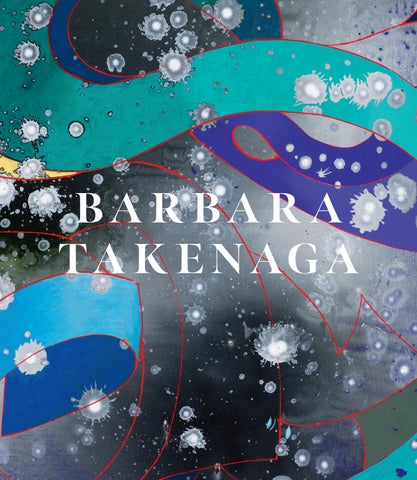
BARBARA TAKENAGA

BARBARA TAKENAGA
PARALLAX
IF YOU HAD ONE QUESTION FOR BARBARA TAKENAGA, WHAT WOULD IT BE?
THIS IS THE QUESTION WE ASKED VARIOUS ARTISTS AND WRITERS. WHO BETTER THAN THIS COMMUNITY TO PROFFER QUESTIONS THAT CUT TO THE QUICK, THAT PROVOKE INTROSPECTION, INSIGHT AND SOMETIMES CONFESSION? TO ENCOURAGE CANDOR AND CURIOSITY, NONE OF THE QUESTIONS WERE ATTRIBUTED TO THEIR ASKER.
For the several decades of watching your work progress, color is a masterful component of how you construct your magic. Deep blues from under the sea. Glowing reds that look like silk damask wall coverings from an old, well-tended castle keep. Light emanating from impossibly distant galaxies in formation. The colors, and their tonal companions always create a symphonic chord of color, nearly musical, that swells, surrounds and seduces us.
Lately there are very strange, dissonant, thrillingly acidic interlopers. Swaths and ribbons of nearly pure Cadmium yellow and orange. Black and white stripes of a Viennese marble floor. Acid turquoise. Hot pink. Visitors from a plastics recycle bin.
The fulminous backgrounds recoil and then reassert themselves. Et voila, we are offered by you an entirely new Takenaga kind of dialogue between the familiar and the alien. In this symphony there are lots of cymbals crashing, gongs ringing, piccolo melodies sailing over the top of it all.
Where are these new thoughts coming from? What are they telling us? And where do you see them going?
What a beautifully written question. I want it to be my answer. Symbols crashing, gongs ringing! My recent, more colorful paintings do have a kind of dancing chaos going on, things mashing up against each other, like in a mosh pit, lots of clanging and jumping and collapsing. I wish I knew where they were going.
I think my palette changed during the Covid pandemic. I was working on a big painted homage to Lee Bontecou, using her palette—browns and ochers, colors I never use. It was lockdown, no one was watching so I just started playing. And when I couldn’t get to the studio, I started these small paintings, riffing on the Japanese prints as found structure. They were by nature colorful, and I
just jumped in, fell in. So everything was jangly and bright. No particular plan, it was Covid time. And, the underground answer to this color question is that I felt more euphoric in my personal life. The world is going to hell outside, but inside is lovely. Go figure. Lucky me.
Is there any “old friend” of an artist or artwork that you have revisited lately that might have sparked new energy?
Sitting on the park bench like bookends—I’ve always loved Japanese wood block prints, and those simple Rajasthan gouache mandalas and yantras. Lately I’ve been using images of mushrooms from the farmers market or clothing from Japanese prints as compositional templates, mirroring, rotating, cropping and distorting. They work as found, existing “orderings” laid over random paint pours—a chance/structure kind of thing. The manipulation takes it out of context and blocks the recognition of naming the image. Like in that art school exercise where if you’re drawing a portrait from a photo, flipping it upside down abstracts the image and reduces it to formal terms. The brain doesn’t recognize the face in a normal way. So kimonos become ambiguous, cartoon-like and sexual (even though, obviously the design and layering of robes is meant to be).
Can you take the Nebraska out of the girl?
To paraphrase Djo’s current pop hit, “End of Beginning:” you take the girl out of the city, not the city out the girl. I loved growing up in Nebraska. Being one of a few Japanese Americans, there was a big desire to fit in, yet also to rebel. When I was a kid, I wanted to stay there forever. I would be a schoolteacher, and my favorite students would be Trixie, Melanie, and Philip. I would take roll call every day and write big letters on the chalkboard. When I left at 18 to go to college in Boulder, Colorado and then to New York, I didn’t look back. But weirdly, oddly, certain things have come back to meet me again and again. Visually, it was the flatness of a horizon, like being microscopic, sitting on top of a giant table. But the Great Plains are in me somewhere.
If you could pick one initial response to your paintings, which would it be, whimsy or the sublime?
Oh, both really. Although those words are difficult for me. Less lighthearted than whimsy, more galumphing or goofy. Less spiritual than sublime, more sciencey like astronomy or natural phenomena.
I’m interested in both aspects at the same time. A lot of the foundations of my thinking were formed in my 20’s—living in Boulder in that era of counterculture, feminism, and eastern philosophy. As an English major, I was drawn to T.S. Eliot’s “...still point of the turning world. Neither from nor towards; at the still point, there the dance is...”
And the English Romantic Movement. All that talk of reconciliation of opposites, finding some middle ground between reason and emotion, nature and civilization, beauty and death. Harmony and wa . I’m not a true believer, but I did wonder about the mechanics of how this is all supposed to work. At some point, I started thinking of this desired middle space as tolerance, a place of possibilities. Like a tennis player, anticipating a serve, you can go forward or to the left or right, you’re open and not narrow. But with an understanding of difference, a kind of empathy or non-verbal intelligence.
So getting back to art? For me it leans into a kind of visual tolerance, an openness to ambiguity and choice. Flipping between positive and negative space—is it a cloud or river? Illusion or a paint mark? The image can be different according to the viewer (parallax!). I like it when an image is almost but not. Serious but also absurd.
What importance does printmaking play in the paintings?
Printmaking looms large. As a lithographer in grad school, I loved the graphic—the flatness of surface and big inky shapes against reticulated tusche washes. And back then, I was a big fan of Sol LeWitt’s work, his systems and seriality—so much kinship with printmaking. Following through with the system being more important than the end product, a kind of antimasterpiece thinking.
There are several paintings in this show that play on that seriality—multiple paintings of the same basic composition, change ups of color, inventing my own systems.
Is it true that your parents took you to see 2001: A Space Odyssey at a formative age and that you wouldn’t leave the theater?
Ha! That’s a better story than the real one—which is that I saw it in a giant movie theater. We were the last ones admitted so we had to sit in the front row. It was mind-boggling at that angle and scale, Keir Dullea’s head was 50’ tall.
Thinking of his giant head, I love the play of scale—that the tiny and large can carry the same information, like a Mandelbrot fractal. A through line that connects the atomic to the cosmic, our long address. Which is very comforting somehow.
Does the painting process dictate the direction or can you bully the process to make it go another direction? Who’s/what’s in charge?
Oh yeah, who IS in charge?? I’m only half in charge. Like many artists, I give up control in terms of paint pours and random chance elements. And then try to rein it in with structure. Chaos and craziness of life being thrown at you—and then the desire to order and make some sense of it. The apocalypse is on the way, but you still want to floss and brush your teeth, change your underwear.
If the world of your paintings was a venue (I’d like to reprise The Exploding Plastic Inevitable!) what music would we hear there?
The music of the spheres! That’s a former dot painter joke. I don’t know. Who can match The Exploding Plastic Inevitable?! Something velvety and something bangy.
In the studio were you thinking about “The Auroras of Autumn,” Wallace Stevens’s long poem about the Northern Lights as “a symbol of imagination and the transition from life to winter.” (These lines in particular, “...how the north is always enlarging.../ With its frigid brilliances, its blue-red sweeps/ And gusts of great enkindlings, its polar green,/ The color of ice and fire and solitude.”)
Well, I wish I had been! Such a wonderful poem. Thank you for bringing this up. From the opening lines: T h is is where the serpent lives, the bodiless.
H i s head is air. Beneath his tip at night
Ey es open and fix on us in every sky.
If your paintings could eavesdrop on viewers, what would they hope to hear people saying?
Maybe…silence? Good silence?
SPECIAL THANKS TO LISA
CORINNE DAVIS, DAVID HUMPHREY, ROBERT KUSHNER, CORINA LARKIN, JIM SHEPARD, JANE SOUTH, KYLE STAVER, ALEXI WORTH, AND ANONYMOUS.


DUET


ACRYLIC ON CANVAS 30 X 48 INCHES


DETAIL ON FOLLOWING SPREAD
LOWLANDS
2026 ACRYLIC ON LINEN 72 X 150 INCHES


PV #1
2025 ACRYLIC ON PANEL 24 X 18 INCHES
PV #2
2025 ACRYLIC ON PANEL 24 X 18 INCHES
PV #3
2025 ACRYLIC ON PANEL 24 X 18 INCHES


LEFT THEN RIGHT


In October 2026, the exhibition Barbara Takenaga: Awestruck will open at the Kemper Museum of Contemporary Art, Kansas City, MO. In 2020, Barbara Takenaga was awarded a John Simon Guggenheim Fellowship in the field of Fine Arts and was commissioned by New York MTA Arts & Design to create a permanent installation for the Metro-North Railroad White Plains Station. She also completed a 30-foot wall mosaic at NYU Langone as part of their permanent art collection. In 2017, Williams College Museum of Art organized a twentyyear survey of Takenaga’s work, curated by Debra Bricker Balken. Other solo presentations of her work include the Bemis Center for Contemporary Arts, Omaha, NE (2018); SPACE | 42 at The Neuberger Museum of Art, Purchase, NY (2017); and a large-scale installation Nebraska (2015–17) at MASS MoCA, North Adams, MA.
Takenaga is represented in many permanent collections, including: The Ackland Art Museum, Chapel Hill, NC; The Crocker Art Museum, Sacramento, CA; The DeCordova Museum, Lincoln, MA; Federal Reserve Board, Washington, DC; Frederick R. Weisman Art Foundation, Los Angeles, CA; Henry Art Gallery, University of Washington, Seattle, WA; Hood Museum of Art, Dartmouth, NH; Kalamazoo Institute of Arts, Kalamazoo, MI; Museum of Nebraska Art, Kearney, NE; National Academy Museum, New York, NY; National Museum of Women in the Arts, Washington, DC; Neuberger Museum of Art, Purchase College, State University of New York, NY; New Jersey State Museum, Trenton, NJ; Pennsylvania Academy of the Fine Arts, Philadelphia, PA; San José Museum of Art, San José, CA; Sheldon Museum of Art, University of Nebraska, Lincoln, NE; Smith College Museum of Art, Northampton, MA; Tang Teaching Museum at Skidmore College, Saratoga Springs, NY; Williams College Museum of Art, Williamstown, MA; Yale University Art Gallery, New Haven, CT; and Zimmerli Art Museum, Rutgers, NJ.
535 WEST 22 STREET NEW YORK NY 10011 DCMOOREGALLERY.COM 212 247-2111
PUBLISHED ON THE OCCASION OF THE EXHIBITION
BARBARA TAKENAGA: PARALLAX
DC MOORE GALLERY MARCH 19–MAY 2 2026 © DC MOORE GALLERY 2026 ISBN: 978-1-965037-02-7
COVER IMAGE: LEFT THEN RIGHT 2026 ACRYLIC ON LINEN 24 X 36 INCHES
DESIGN: REED SEIFER PRINTING: BRILLIANT PHOTOGRAPHY: © STEVEN BATES