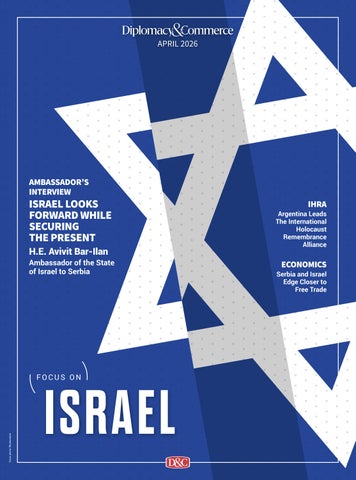
AMBASSADOR’S INTERVIEW
ISRAEL LOOKS FORWARD WHILE SECURING THE PRESENT
H.E. Avivit Bar-Ilan Ambassador of the State of Israel to Serbia
April 2026
Focus on
![]()
AMBASSADOR’S INTERVIEW
ISRAEL LOOKS FORWARD WHILE SECURING THE PRESENT
H.E. Avivit Bar-Ilan Ambassador of the State of Israel to Serbia
April 2026
Focus on
IHRA
Argentina Leads
The International Holocaust Remembrance Alliance ECONOMICS
Serbia and Israel Edge Closer to Free Trade
s trategic partnership with serbia, innovation-led cooperation and a changing regional landscape

In an interview for the special Focus In edition dedicated to Israel, H.E. Avivit Bar-Ilan, Ambassador of the State of Israel to Serbia, discusses the current challenges shaping Israel’s foreign policy, the security context in the Middle East, and Serbia’s role within that framework. The interview also highlights the development of bilateral relations, the economic and innovationdriven potential for cooperation, and the broader political and cultural ties connecting the two countries.
In light of the current developments in the Middle East, how does Israel today define its key foreign policy priorities, and where do you see Serbia’s role within that framework?
the security of its citizens and preventing any existential threat to the state. In recent weeks, Israel has been actively confronting the threat posed by Iran and its regional proxies, to
SERBIA IS SEEN AS A GENUINE AND STEADFAST PARTNER, WITH A LONGSTANDING RECORD OF TRUE FRIENDSHIP TOWARD ISRAEL
In light of the current developments in the Middle East, Israel defines its foremost foreign policy priority as safeguarding
neutralise this danger and restore stability.
Within this context, Serbia is seen as a genuine and steadfast
partner. Over the years, it has consistently demonstrated its true friendship toward Israel, providing a strong foundation for closer cooperation.
Strengthening coordination among like-minded countries in addressing the challenges posed by the Iranian regime can contribute to broader regional stability. Such cooperation may also help create the conditions for expanding frameworks like the Abraham Accords, which offer a pathway toward greater regional integration and dialogue. At the same time, recent attacks on European sites underscore that these threats are not confined to the Middle East alone. The development of long-range ballistic capabilities by Iran highlights the growing threat of these risks to Europe as well, reinforcing the need for coordinated international action. This moment presents not only a challenge, but also an opportunity—to counter immediate threats while advancing a vision of a new, more stable, secure, and cooperative Middle East.
In what ways does the current regional situation influence Israel’s diplomatic activities worldwide, including its relations with countries such as Serbia?
I firmly believe that, as with many crises before it, the current conflict in the Middle East will ultimately catalyse the emergence of stronger, more resilient regional partnerships.
In this evolving landscape, Serbia has a unique opportunity to enhance its strategic connectivity by engaging in multilateral cooperation frameworks such as the India-Middle East-Europe Economic Corridor (IMEC) and similar initiatives, positioning itself as a proactive and forwardlooking partner in shaping future regional and interregional cooperation.

How would you assess the current level of bilateral relations between Serbia and Israel, and in which areas do you see the greatest potential for further development?
Israel and Serbia enjoy strong and friendly bilateral relations, based on mutual respect and cooperation. Those have been demonstrated through a series of high-level visits between the two countries during the last year. Last autumn, Foreign Minister Gideon Saar visited Belgrade. Before that, we had two visits to Israel by high-ranking Serbian officials: one by the president of the Parliament, Ana Brnabić, and the other by the Foreign Minister, Đurić, to Jerusalem.
The shared destiny of our two nations was also reflected in the joint efforts and calls for the release of Alon Ohel, the Israeli citizen who also holds Serbian nationality. We were all deeply gratified to witness the joyous images of his release from Hamas captivity. This moment reaffirmed our common commitment to human life, solidarity and the enduring friendship between Israel and Serbia.
The close friendship between Israel and Serbia was also evident over the past two years, when the Serbian government allowed Israeli sports teams to host their home games in Belgrade. This gesture quickly made the city their “second home.”
Israeli companies are already present in the Serbian market. Which sectors do you consider the most promising for new
THIS MOMENT PRESENTS NOT ONLY A CHALLENGE, BUT ALSO AN OPPORTUNITY TO ADVANCE A MORE STABLE AND COOPERATIVE MIDDLE EAST
investments, and is there interest in expanding business operations in Serbia?
I am happy that the trade exchange has shown an upward trend over the last year, with a total increase of 62 per cent, i.e., the exchange amounted to 325 million euros at the end of the year.
We are confident that with the future signing of a free trade agreement between our two countries,
we will witness further growth in bilateral trade. We look forward to what the future will bring us in this regard.
Last year, we held the firstever MASHAV in-house training, “Empowering Innovation: Strategic Leadership for Science & Technology Park Managers,” aimed at raising the capacities of teams and staff within the Science and Technology Parks

in Niš and Belgrade. The training was organised and successfully implemented in close cooperation with the Ministry of Science, Innovation and Technological Development of Serbia. Round 40 people attended the courses. MASHAV is Israel’s Agency for International Cooperation and Development, which usually organises various training courses in Israel. This was a special occasion, hosting their (MASHAV) experts in Serbia for the first time for this specific course. Last December, at the MCTC centre in Haifa, we had a group of professionals from Serbia on the AI&Cyber for Good course, which we are very proud of. The embassy’s contribution to the evolution of the Serbian innovation ecosystem is ongoing and evident through support for events and conferences related to biotechnology, such as the BIO 4 AI for Life conference, as well as the Digital Forensics Forum. Therefore, if you ask which sectors are most interesting to Israeli business people, they are: cyber, renewable energy, biotechnology, and IT.
Serbia is preparing to host Expo 2027 in Belgrade. How important is participation in such global events for Israel, and what can visitors expect from Israel’s presentation?
The State of Israel attaches great importance to its participation in Expo events in general, and even more so when they are hosted by a friendly country such as the Republic of Serbia. We place particular value on taking part in international forums that allow us to present the true face of the State of Israel. Expo 2027 provides a unique and powerful platform in this respect—a vibrant global celebration that brings together nations and cultures. It enables each country to share its story, identity, and achievements with both local and international audiences. Within this framework, we will showcase Israel’s distinctive accomplishments, first and foremost its position as a global leader in innovation, spanning fields such as medicine, sports, renewable energy, cybersecurity, accessibility, and beyond. At the same time, we will highlight the rich cultural diversity of Israeli society—a dynamic nation of immigrants that serves as a living bridge between East and West—while emphasising the deep, historic, and enduring ties with the Jewish community in Serbia.

Cultural and scientific cooperation often plays a vital role in connecting countries. Are there any particular joint projects or initiatives between Serbia and Israel that you would highlight?
As in all other segments of cooperation between our two countries, we also have beneficial cooperation in this field. Last year, the Cooperation Program between the Government of the Republic of Serbia and the Government of the State of Israel for the period 20252028 in the fields of education, science, culture, youth and sports was signed.
This will enable the continuation of joint projects such as the now-traditional Belgrade dance Festival, which we have been at since its foundation, that is, for 23 years, and in which Israel has been a participant and one of the sponsors. We proudly support Israeli musicians participating in Jazz festivals in Serbia. When it comes to film and the film industry, our embassy has a long–standing tradition of participating in nearly all film festivals, which is both an honour and a pleasure for us. In the publishing industry, we contribute by actively helping the translation and publication of books by Israeli authors in Serbia. We know that the Serbian readership is well acquainted with our writers and that this sensibility appeals to them. You know, I have always thought of the Jewish people as a people of the book and written word, but I now
THE SECTORS THAT ATTRACT THE STRONGEST INTEREST FROM ISRAELI BUSINESSES ARE CYBER, RENEWABLE ENERGY,
IT
realise that the same is true of the Serbian people as well.
It is well known that during your mandate, you have taken the opportunity to travel across Serbia and explore different
parts of the country. Which places have left the strongest impression on you, and what has perhaps surprised or particularly inspired you about Serbia?
Hiking in Serbia is one of the most rewarding ways to truly

experience the country’s natural beauty. What surprises many visitors at first is just how lush and green it is—rolling hills, dense forests, and an abundance of hidden gems waiting to be discovered. One particularly magical route follows the Gradac River, where the trail winds through shallow, crystal-clear water. Walking here feels almost otherworldly, especially as you approach the serene Ćelije Monastery, nestled quietly among the trees. The combination of untouched nature and spiritual heritage creates a peaceful, almost meditative atmosphere. Another standout destination is Povlen Mountain. Its gentle peaks, panoramic viewpoints, and quiet, uncrowded trails make it ideal for hikers looking to disconnect and immerse themselves in nature. The landscapes here shift beautifully with the seasons, offering something unique year-round.
What makes hiking in Serbia especially memorable is the sense of authenticity. Even in the most remote areas, it’s common to stumble upon traditional Etno restaurants—rustic spots serving homemade Serbian dishes prepared with local ingredients. These unexpected culinary stops add warmth and flavour to any hiking adventure.
Altogether, Serbia offers a rare blend of unspoiled nature, cultural richness, and genuine hospitality—making every hike not just a journey through landscapes, but a deeper connection to the country itself.


serbia and Israel move closer to free trade amid strong growth in exports, tourism, and strategic c ooperation
Economic relations between Serbia and Israel are entering a phase of intensified development, marked by several parallel processes – the expansion of trade, strengthening of institutional ties, growing tourism flows, and, most importantly, ongoing negotiations on a Free Trade Agreement. These mutually reinforcing dynamics point to a comprehensive deepening of relations and a clear strategic rapprochement between the two countries.
Over the past four years, Israel has emerged as one of Serbia’s most significant export markets outside Europe. Serbian exports to
SERBIAN EXPORTS TO ISRAEL HAVE INCREASED BY MORE THAN 56 PER CENT IN THE PAST FOUR YEARS, WITH TOTAL TRADE REACHING RECORD LEVELS
Israel have increased by 56.2 per cent, while total trade has reached record levels, estimated at around USD 250 million. Even more striking is that overall trade between the two countries has quadrupled during this period, confirming a stable, long-term upward trend.
The structure of trade indicates considerable potential for further
growth. Serbia primarily exports agri-food products and industrial goods to Israel, while the Israeli market is increasingly interested in high-quality Serbian products. At the same time, Israeli companies are increasingly recognising Serbia as a reliable partner and a potential base for expanding their operations across the region.
It is within this context that the negotiations on a Free Trade Agreement should be viewed, as they represent the central pillar of future relations. The agreement is expected to provide Serbian companies with more favourable access to the Israeli market, including reduced or eliminated tariffs, simplified product certification procedures, and access to defined quotas. For domestic exporters, this would mean a more competitive position and a strong incentive to expand production and investment.
The importance of this agreement is further underscored by the fact that Israel rarely enters
into such arrangements and is highly selective in choosing its partners. For that reason, the negotiations with Serbia carry broader political and economic significance, reflecting a high level of mutual trust and recognition of Serbia as a relevant regional partner.
The Serbian Chamber of Commerce plays a significant role in this process, actively participating in negotiations, supporting the business community, and identifying concrete barriers faced by companies. Through institutional mechanisms and direct communication with Israeli counterparts, the Chamber helps create the conditions for more efficient and dynamic cooperation.
Alongside the negotiations, the institutional framework supporting bilateral relations continues to develop. One of the key steps in this direction is the planned opening of an Israeli business representation office in Serbia. This office is expected to serve as a central hub for connecting companies, facilitating information exchange, initiating joint projects, and strengthening business ties.
The opening of this office represents a natural continuation of existing cooperation mechanisms, including the Serbian Chamber of Commerce’s presence in Jerusalem. Together, these initiatives establish a two-way communication channel that enables faster information exchange, better coordination, and more effective resolution of practical business challenges.
While economic relations deepen at the institutional level, another equally important dimen sion of cooperation is gaining momentum – tourism. Israeli tourists are among the largest non-European visitor groups to Serbia. In 2025, they accounted for more than 95,000 overnight stays, representing an increase of 61.5 per cent compared to the previous year.
This growth is no coincidence. Direct flights between Belgrade and Tel Aviv have ensured conti nuity in both tourist and business travel. At the same time, Serbia, with its combination of urban vibrancy, natural landscapes, and rich gastronomy, has become an increasingly attractive destination for Israeli visitors.
Although Belgrade remains the primary destination, growing interest is also being recorded in mountain and spa resorts.
Zlatibor, Divčibare, and Vrnjačka

THE PLANNED FREE TRADE AGREEMENT IS EXPECTED TO GIVE SERBIAN
conventional bilateral cooperation. Trade, tourism, institutions, and innovation form an integrated system in which each segment reinforces the development of the others.
The forthcoming Free Trade


The First Latin American c ountry to Lead the International o rganisation
Areception marking Argentina’s Presidency of the International Holocaust Remembrance Alliance was held on 26 March at the Ambassador’s Residence in Belgrade, attended by members of the diplomatic corps, representatives of state institutions, and organisations dedicated to the culture of remembrance.
By assuming this role, Argentina has become the first Latin American country to chair the International Holocaust Remembrance Alliance, further highlighting the importance of a global approach to preserving the memory of the Holocaust and combating antisemitism and historical revisionism.
The reception was hosted by the Ambassador of Argentina to
ARGENTINA HAS BECOME THE FIRST LATIN AMERICAN COUNTRY TO CHAIR THE INTERNATIONAL HOLOCAUST
REMEMBRANCE ALLIANCE

Serbia, H.E. Osvaldo Mársico, who addressed the guests on behalf of the incoming Presidency.
The official programme also featured remarks by the Minister for European Integration, Nemanja Starović, the representative of the outgoing Presidency from the Embassy of Israel, H.E. Avivit Bar-Ilan, as well as Holocaust survivor Jozef Baruhović.
Speakers emphasised the importance of international cooperation in Holocaust education, the preservation of historical memory, and the fight against contemporary forms of antisemitism.
The role of personal testimonies in conveying the truth about suffering, as well as the importance of continuous education of younger generations, was particularly highlighted.

serbia’s foreign policy priorities in a shifting global landscape, from EXP o 2027 to E u integration and strategic partnerships

NEVENA JOVANOVIĆ
State Secretary of The Ministry of Foreign Affairs
State Secretary Nevena Jovanović, in a live interview for the show
“Diplomat,” produced by Diplomacy&Commerce magazine in cooperation with Euronews Serbia, reflects on her professional journey and outlines the key priorities of Serbian diplomacy in a complex global environment. The conversation places special emphasis on major initiatives such as EXPO 2027 and the EU integration process, as well as on the ongoing challenge of safeguarding national interests amid shifting geopolitical dynamics.
Can you tell us how your educational background influences your approach to diplomacy and public communication?
calling that let you fight for the common good. Still, later life circumstances led me to diplomacy, offering me the chance to contribute to that public good in a com-
AS A DIPLOMAT, YOU ARE AT THE DISPOSAL OF YOUR STATE 24 HOURS A DAY.
The desire to study at the Faculty of Political Sciences emerged very early and stemmed from my broader interest in socio-political events; the Faculty of Political Sciences is the best place to fulfil those desires and ambitions. I initially wanted to pursue journalism, firmly believing it was a
pletely different way. Studying journalism and communication makes you realise very early on that words are a powerful tool but also a great responsibility, and that is one of the things I brought with me into diplomacy. The opportunity to serve my country through a diplomatic calling is an
exceptional honour and privilege, and I am convinced that lifelong learning is vital for this profession. This is a process that never ends; to serve your country properly, it is important to realise that you must continuously improve yourself and be a little better every day in the job you perform.
You mentioned my background. I finished my schooling in Kragujevac, where I spent a large part of my life. Still, my roots actually go much further to the Gruža region—one of the most beautiful parts of Šumadija, where hardworking and honourable people, good Serbian hosts, still live. Growing up there, I learned the verses of Dobrica Erić very early on: “My dear land, you and your
sisters Truth and Justice”. When you carry that sense of the trinity to strive for from childhood, it somehow defines your path in the future.
During your work at the Ministry of Foreign Affairs, you held numerous positions, the most recent of which was serving as the Ambassador of Serbia to North Macedonia. Looking back at your career, what do you consider to have been your most important professional turning point? Representing your country anywhere in the world is an extraordinary privilege, honour, and, above all, a responsibility. But representing your country in the immediate neighbourhood, in a neighbouring state, our brotherly North Macedonia, was a transformative professional experience for me. I can proudly say that after four years there, we achieved something truly important for the future development of our relations, considering it is one of Serbia’s closest neighbours. I would venture to say that all phases of my professional career have left a mark on my development, but when you ask, what was the turning point? I believe it was the moment I realised that this is not just a job, but a lifelong calling— that when you are a diplomat, you have no working hours; you are at the disposal of your state 24 hours a day. Every gesture, every action, and every word can contribute to defending the interests of your country and its better representation in the eyes of the world. The position of State Secretary is certainly the pinnacle of my career so far, and being part of the team led by Foreign Minister Marko Đurić is an immense honour and an opportunity to raise Serbian diplomacy to a higher level.
You recently met with United Nations representatives regarding EXPO 2027, during which they noted that it is a great opportunity to promote Serbia. Which areas specifically do you plan to promote, and what are the benefits for citizens that they might not be aware of?
EXPO represents a historic chance for Serbia. Hosting the specialised EXPO 2027 next year is a huge opportunity to showcase our potential to the world. It is a major development opportunity, the positive results of which we are already feeling. This is likely the most important event in our
modern history for presenting Serbia on a broader scale. We will present the best of what we have: development potential, wonderful young people, and our achievements in artificial intelligence, where we can match even much larger countries. The fact that we won against strong competition speaks volumes about how much we have progressed as a state.
I am personally involved in the Government’s coordination body for this event.
President Vučić identified EXPO as one of the most important projects in the “Serbia 20302035” Strategy. Last week, we also met with a high-ranking UN official who served as the UN’s Special Representative at EXPO in Osaka. As a Ministry delegation, we had the privilege of visiting our pavilion in Osaka, and we are truly proud that our national pavilion achieved a record number of visitors and even won a silver medal. You can imagine how hard we will work to present ourselves at our best in Belgrade.
The Ministry recently introduced an instrument known as the “Traffic Light,” which classifies countries by travel safety. Do you believe such instruments could increase citizens’ trust in the Ministry’s
recommendations?
The so-called “Traffic Light” for travel recommendations has attracted considerable attention. This is an initiative by Minister Marko Đurić to provide our citizens with guidelines and relevant information on current security conditions. We believe this is our duty as a Ministry. This traffic light, above all, has an advisory role for our citizens, who also have our network of diplomaticconsular missions at their disposal. It is important to note that it was not created as a means of sending political messages, but as an instrument of support for our citizens, based on precise analyses provided by our missions on the ground.
What also drew public attention is that Croatia ended up in the “Orange Zone”. Is this an indicator that there is room to discuss the safety of our citizens with Croatia?
It is a fact that information about Croatia being in the orange category—countries where travel is recommended only in cases of extreme necessity—received the most attention. It is somewhat ironic, given that the topic was actualised due to the crisis in the Middle East and our desire to warn citizens there about the
OF EVERYTHING MAN HAS BUILT IN HIS LIFE’S EFFORT, THERE IS NOTHING MORE IMPORTANT THAN BRIDGES
worsening security situation. While there was some politicisation regarding Croatia, our criteria are based on detailed analyses and on our having witnessed various incidents targeting Serbian citizens or members of the Serbian people living in Croatia. It is our duty to point out potential dangers, especially during holidays or vacations, when commemorations of events take place about which we hold different views.
You have stated several times that Serbia remains on its European path but must develop relations with other partners. How does this reflect on the Ministry’s work, and is it difficult to explain cooperation with the East to Western partners, and vice versa?
EU membership remains one of our most important foreign policy priorities and a central element of our strategic orientation. It is a fact that there is much more to be done on the reform path, just as it is a fact that we have already done a lot without being adequately rewarded by member states and the Brussels administration. If you look at the fact that Serbia has not opened a single chapter since 2022 despite reforms, you realise the process is deeply politically motivated, dictated by the war in Ukraine and subsequent events. Despite everything, we remain firmly committed, as evidenced by the formation of a new “operational team” to accelerate reform processes. Simultaneously, we carefully position Serbia in the new geopolitical reality. This is why


the joint letter signed by President Vučić and Prime Minister Edi Rama regarding our region’s readiness to join the single market even before full membership should not come as a surprise. We believe economic connectivity leads to long-term peace. Serbia pursues an autonomous, independent foreign policy rooted in a long tradition of nurturing relations with key partners: the EU, the USA, the Russian Federation, the People’s Republic of China, and numerous states from the NonAligned Movement. These relations are still very much alive today. They are based on respect for international law, the UN Charter, and territorial integrity—values that are, unfortunately, often questioned through double standards.
In the past, one of your roles in Brussels was monitoring the Belgrade-Pristina dialogue. How does the Ministry view the course of this dialogue, and what could be the ultimate scope of these negotiations?
The dialogue under the auspices of the EU remains the most effective mechanism for reaching a sustainable solution that protects our interests in Kosovo and
Metohija and the rights of the Serbian people. Unfortunately, we have witnessed a stalemate caused by the unilateral and escalatory measures of Albin Kurti’s regime. Our people have faced continuous pressure and attempts to shut down Serbian institutions.
On our part, we are always ready to continue talking as responsible partners. Minister Marko Đurić likes to say that we have turned every one of our embassies into a “small office for Kosovo and Metohija,” and we strive to clearly point out human rights violations to our international partners and seek their support and clear condemnation of unilateral measures.
A recent draft report from the European Parliament expressed concern that Serbia is stagnating on its path to the European Union. How does the Ministry respond?
evacuation of our citizens from crisis areas there. Can you describe that coordination?
Our capacities were fully focused on protecting our citizens and evacuating them back to Serbia. With the support of the Government and the President’s office, we managed to return nearly 2,500 people through organised Air Serbia charter flights. The Ministry worked around the clock, forming a crisis staff to ensure our citizens felt they were not alone. In the early days of the crisis, it was extremely important that citizens could also return from the UAE via commercial flights, made possible by the excellent bilateral relations and the personal relationship between President Vučić and Sheikh Bin Zayed. Serbia remains a country that strongly advocates for peace and diplomatic solutions.
For the end of our conversation, looking into the future, which foreign policy initiatives do you consider key?
Our long-term plan is to strengthen Serbia economically, because we believe that only an economically strong Serbia can defend its vital national interests. Preserving peace and stability remains a key priority, and we strive to present Serbia as a reliable partner standing for international law. Our position at the crossroads offers geostrategic potential that we must use to protect our vital interests.
I feel the need to be more precise. For the fourth consecutive year, Serbia has received a positive recommendation from the European Commission to open Cluster 3, but further progress is stalled by decisions by individual member states. Regarding the European Parliament, it represents a wide range of political groups, and some assessments deeply interfere with the internal political issues of a sovereign state, which is inappropriate. EP recommendations are advisory, not binding; we try to respect them, but when they take on an inappropriate tone, we have the right to say so clearly. Minister Đurić recently received an EP delegation in a constructive atmosphere, confirming our resolve to remain a credible partner. Now it is the EU’s turn to do its part.
The situation in the Middle East continues to escalate. The Ministry conducted an
Minister Marko Đurić is also working to strengthen our diplomatic network by recruiting new staff in the coming months. Our activities will focus on building bridges with our international partners toward a prosperous future for the whole region. As the great Ivo Andrić said, reminding us of the importance of connecting: “Probably of everything man has built in his life’s effort, there is nothing more important than bridges”. We will strive to implement our foreign policy by building those bridges to create a better future for our citizens and generations to come.

25th of MARCH 2026

AMBASSADOR’S INTERVIEW STABILISATION, DIGITAL TRANSFORMATION, OPTIMISM FOR THE FUTURE
H.E. Maria Levanti
The Ambassador of Greece to Serbia

POLITICS
Strengthening Cooperation Between Serbia and Greece
EVENTS
Spring in Belgrade, Greece in the Spotlight
TRADITION
Cutting of the Vasilopita

A shared vision for stability, growth and deeper economic and cultural cooperation in s outheast Europe
H.E. MARIA LEVANTI
Greece is one of the closest countries to Serbia, not only geographically but also culturally and economically, with strong ties
GREECE IS INTERNATIONALLY RECOGNISED AS A RELIABLE INTERLOCUTOR AND A PILLAR OF STABILITY IN A PARTICULARLY SENSITIVE REGION OF THE WORLD
that have endured numerous challenges. Following a decade of austerity, the pandemic and global crises, we speak with H.E. Maria Levanti, Ambassador of Greece to Serbia, about the current state of affairs and bilateral relations.
In today’s increasingly turbulent geopolitical environment, how does Greece perceive its role as a stabilising factor in Southeast Europe and the Eastern Mediterranean? How does this position influence Greece’s diplomatic priorities and regional partnerships? The Eastern Mediterranean is obviously geopolitically significant and faces significant challenges. Aware of the new realities in the international landscape and of the particularities of our immediate neighbourhood, Greek foreign policy remains principled, firmly committed to the unwavering respect for International Law, including the Law of the Sea, the UN Charter, and the UN Security Council Resolutions. We have succeeded in ensuring that Greece is internationally recognised as a reliable interlocutor and a pillar of stability in a particularly sensitive region of the world - a fact reflected, inter alia, in our landslide election to the UN Security Council for the 2025-2026 term. Also, as the region’s oldest European Union member, Greece has always had a vision for the Western Balkans within the European Union family. It was Greece, after all, that pioneered the Thessaloniki Agenda of 2003 for the accession of the Western Balkans to the European Union as the only way to consolidate stability and security in the region.
After more than a decade marked by austerity measures and deep economic restructuring, Greece is often cited as an example of recovery. What were the most difficult lessons learned during this period, and what indicators best illustrate that Greece has truly turned the page? Greece has “navigated the turbulent seas of economic crisis,” and the main obstacles we have encountered have been fiscal consolidation, tax compliance, low consumption, non-performing loans, and a weakened banking sector.
Today, the Greek economy continues to expand even in the current uncertain global environment, outperforming the euro area average. The country is registering satisfactory growth rates, overperformance of fiscal aggregates, a significant decline in the debt-to-GDP ratio (expected to fall below 120% by 2030), and overall resilience of the Greek economy amid global uncertainty. All of these have led

IT WAS GREECE THAT PIONEERED THE THESSALONIKI AGENDA OF 2003 FOR THE ACCESSION OF THE WESTERN BALKANS TO THE EUROPEAN UNION AS THE ONLY WAY TO CONSOLIDATE STABILITY AND SECURITY IN THE REGION.
to further significant upgrades to Greece’s credit rating in 2025. Indicatively, the overall positive fiscal performance led to Greece’s sovereign credit rating upgrade by Fitch Ratings in November 2025 to one notch above the investment-grade threshold. Thus, by now, Greece has obtained that rating from most international rating agencies. Foreign direct investment (FDI) rose markedly in 2024, coming to about 2.5% of GDP, and overall private investment is growing at a rate of 5.7% in 2025 and an estimated 10.2% in 2026.
In this spirit, I must mention the election of Greece’s Minister of National Economy and Finance, Kyriakos Pierrakakis, to the Eurogroup Presidency, marking a significant political and symbolic moment for the country. Maintaining macroeconomic and financial stability and a strong fiscal position are key to sustaining the country’s positive course.
How would you assess the current state of economic cooperation between Greece and Serbia? Are there specific sectors - such as energy, infrastructure, logistics or digital services - where you see the greatest potential for further growth?
Over the last few years, we have achieved trade transactions of over €1b, with signs of further growth in 2026, reflecting our excellent level of cooperation. There are excellent opportunities across multiple sectors, from traditional ones such as tourism, logistics, infrastructure, and agrifood, to new ones such as energy, manufacturing, life sciences, and technology. Greek investments in Serbia are estimated at €1.5 billion, with accumulated capital of €2.5 billion over the last 20 years. Greece is undergoing a profound digital transformation aimed at fully digitising the country. The Information and Communications Technology (ICT) sector plays a
central role in the Greek government’s efforts to reduce bureaucracy, simplify procedures, and boost the country’s digital economy. Greece could be a partner in Serbia’s evolving digital landscape and innovation ecosystem. The potential for partnerships in ICT infrastructure is an important consideration. Greece also has a well-established pharmaceutical and healthcare industry. These are sectors that could offer ample space for collaboration, both institutionally and at the private business level, in addition to the already existing ones. Greece and Serbia are focused on developing our investment relations, and we look forward to further strengthening them through our participation in a national pavilion at EXPO 2027 in Belgrade, an international event we strongly support.
In recent years, both countries have been navigating complex energy and supplychain challenges. Do you see opportunities for closer GreekSerbian cooperation in the fields of energy security and regional connectivity?
Energy is clearly becoming a top priority. Greek companies are increasingly involved in renewable energy projects — particularly solar and wind. Greece has indeed been extremely successful in adding renewables, both
solar and wind, to our energy mix, and we produce more than 50% of our electricity from renewables. Our national energy strategy aims to transform Greece from a net importer to a net exporter of green electricity produced solely by Renewables, in response to growing market demand for clean energy in the EU and the SEE Region. Greece has also emerged as an energy hub for Southeastern Europe. Athens actively promotes the implementation of the “Vertical Gas Corridor”, a network of existing and future natural gas infrastructure projects, greatly enhancing energy security in SEE and across Europe. Furthermore, the inauguration of the Natural Gas Interconnector Greece-Bulgaria (IGB) in Sofia in 2022, as well as the inauguration of the Natural Gas Interconnector BulgariaSerbia (IBS) in December 2023, are game-changers for our region, marking an important era in the diversification of energy security and supplies. Another strategic project of importance to both Greece and Serbia is the Natural Gas Interconnection between Greece and North Macedonia. The construction sector and real estate also continue to draw strong interest, especially with Serbia’s ongoing infrastructure boom. Logistics is another key area, as demand for warehousing, transport, and supply-chain services is growing. At the same time, we have seen a significant interest in technology and innovation, as Serbia is a growing market and an important regional hub.
Tourism remains one of the strongest bridges between Greece and Serbia. How important are Serbian tourists for the Greek tourism sector, and how is Greece adapting its offer to the evolving expectations of visitors from Serbia?
Greek tourism is growing steadily, and the footprint is strongly felt across the economy as a whole, from public finances to businesses in the sector. We are delighted that Greece remains the most desirable vacation spot for travellers from Serbia, and we are grateful for the strong support of our Serbian friends in further developing tourism in Greece. Our effort will continue, focusing on extending the tourist season, opening new destinations, promoting mountain tourism equally, and emphasising new investments and innovative

OUR EFFORTS IN TOURISM WILL CONTINUE, FOCUSING ON EXTENDING THE TOURIST SEASON, OPENING NEW DESTINATIONS, PROMOTING MOUNTAIN TOURISM EQUALLY, AND EMPHASISING NEW INVESTMENTS AND INNOVATIVE ACTIONS.
actions. Greeks are also mesmerised by Serbia’s compelling mix of hospitality, delicious cuisine, vibrant cities, and stunning natural beauty. Greek tourism to Serbia is experiencing a steady rise, driven by an increased interest in city breaks in Belgrade, even for a long weekend, and visits to mountain resorts, to name but a few. I believe that Greece and Serbia share a common vision for the future
of tourism. By joining forces and leveraging our comparative advantages, we can create new opportunities for collaboration, innovation and growth.
Finally, beyond economics and tourism, people-to-people ties play a crucial role in bilateral relations. What initiatives or cultural exchanges do you
believe could further strengthen the already close relationship between the Greek and Serbian peoples?
There is no need to say how close the ties between our two countries are. Our excellent ties are based on the solid friendship between our peoples, and on our common cultural and religious heritage. Greeks and Serbs have always stood by each other, in good and in bad times. We also share our vision of a Europe of security, peace, and prosperity for our countries and for the wider region. There are many things we can do together. It is therefore very important to cherish our ties and underscore our commitment to further strengthening this very close relationship.


Reception in Belgrade marking Greece’s Independence Day, hosted by Ambassador Maria Levanti
Aceremonial reception was held in Belgrade, organised by the Embassy of Greece, to mark Greece’s national holiday, Independence Day, observed on 25 March. The host of the reception was the Ambassador of Greece, H.E Maria Levanti
The event was attended by Serbian officials, members of the foreign diplomatic corps, representatives of the Greek business community, as well as representatives of educational and cultural institutions, together with numerous friends of the Embassy from
25 MARCH STANDS AS ONE OF THE MOST POWERFUL SYMBOLS OF GREEK NATIONAL IDENTITY, MARKING THE BEGINNING OF THE STRUGGLE THAT SHAPED THE MODERN GREEK STATE

both Greece and Serbia. The strong turnout and warm atmosphere characterised this year’s celebration, underscoring the enduring bonds of friendship and cooperation between Greece and Serbia.
Greece’s national holiday is observed on 25 March, commemorating the beginning of the 1821 uprising, which marked the start of the Greek struggle for liberation from the Ottoman Empire and the creation of the modern Greek state. The date stands as one of the most significant symbols of Greek national history and identity.


s trategic Balkan o utward & Bilateral c ooperation Forum held in Belgrade
On the occasion of the visit of the Greek Deputy Minister of the Interior, responsible for the Sector of Macedonia and Thrace, Konstantinos Gioulekas, the “Strategic Balkan Outward & Bilateral Cooperation Forum” was held in Belgrade at the Metropol Palace Hotel
The Forum brought together representatives from the business, tourism, and academic sectors to enhance cooperation between
CONTINUOUS DIALOGUE AND CONNECTIVITY AT ALL LEVELS ARE ESSENTIAL FOR THE STABLE AND SUSTAINABLE DEVELOPMENT OF BILATERAL RELATIONS
Serbia and Greece and strengthen ties among the regional and local authorities of the two countries.
Discussions focused on concrete models for developing
economic partnerships, boosting tourism flows, and deepening academic exchange and institutional cooperation.
Following the opening of the event, Deputy Minister Gioulekas addressed the media, emphasising the importance of continuous dialogue and connectivity at all levels as a key prerequisite for the stable and sustainable development of bilateral relations.
The Forum was organised with the support of the Embassy of Greece in Belgrade, which gathered numerous representatives of the media and relevant institutions on this occasion.

The Hellenic Business Association of serbia marked the beginning of the business year in a traditional way
In the presence of the Ambassador of Greece to Serbia, H.E. Maria Levanti, and the Ambassador of Cyprus to Serbia, H.E. Andreas Fotiu, the Hellenic Business Association of Serbia (HBA) held its traditional annual reception “Cutting of the Vasilopita” for its members, marking the beginning of a successful business year
The event was held on 27 February 2026 at the residence of the Embassy of Greece in Belgrade.
The attendees were addressed by the President of the HBA, Mr Nikolaos Sliusaregko, who emphasised that the Association will continue to support and promote the Greek business presence in Serbia. He underlined that in the coming period, the HBA will continue to align its activities and priorities with the needs of its member companies, through the organisation of various events and initiatives, both in cooperation with institutions and other bilateral chambers of commerce.
The Ambassador of Greece to Serbia, Maria Levanti, welcomed the guests and stated that the Embassy will continue to support
THE ASSOCIATION WILL CONTINUE TO SUPPORT AND PROMOTE THE GREEK BUSINESS PRESENCE IN SERBIA, ALIGNING ITS ACTIVITIES WITH THE NEEDS OF ITS MEMBER COMPANIES THROUGH VARIOUS INITIATIVES AND PARTNERSHIPS
the work of Greek companies in Serbia, highlighting the exceptionally strong and comprehensive relations between the two countries at all levels.
During the evening, the Hellenic Business Association of Serbia traditionally awarded plaques to member companies marking significant anniversaries of long-standing membership.
In recognition of 20 years of membership and support, a plaque was awarded to ALUMIL YU INDUSTRY, one of the Association’s oldest members. For 10 years of membership and contribution, plaques were awarded to GLOBE WILLIAMS and SIAMKO GROUP.
The reception concluded with the traditional cutting of the Vasilopita, during which MINOAN BINDING LAMINATING found the lucky coin in the cake and was awarded the Association’s golden coin.


From Thessaloniki roots to local favourites, Meze by Elliniko blends tradition, flavour, and the joy of gathering
Meze by Elliniko Chef
There is a certain kind of restaurant where a meal quietly turns into a ritual. Plates arrive, conversation lingers, and time loosens its grip just enough for people to remember why they gathered in the first place. At Meze by Elliniko, that ritual has a name—filoxenia—and at its centre stands chef Giorgos Karapetsas, translating tradition into something both precise and deeply human.
In this conversation, he discusses the philosophy behind Greek cuisine, the balance between authenticity and local flavour, and how a restaurant in Belgrade can carry the spirit of Thessaloniki without losing its own voice.
Since when has Meze by Elliniko been in Belgrade?
Meze by Elliniko officially opened in October 2022, after several months of aligning with the detailed standards of the renowned parent restaurant chain “To Elliniko” from Thessaloniki. From day one, our goal has been to be recognised as a synonym for the highest-quality authentic Greek cuisine, and the reception from our guests continues to motivate us to stay dedicated to that goal— just as we were at the beginning.
What dishes are prepared in the restaurant?
All dishes on the Meze by Elliniko menu are prepared in our restaurant without exception—at the highest level of culinary craftsmanship. The flavours and aromas of the finest ingredients and raw materials from Greece and our region—prepared with love and dedication by our chefs—are reflected in a wide selection of favourite recipes from across mainland and island Greece. Some of our regular guests’ favourites include fried zucchini, baked feta wrapped in pastry, fried calamari, Greek salad, and chicken souvlaki.

GREEK CUISINE IS ABOVE ALL ABOUT SIMPLICITY, QUALITY INGREDIENTS, AND THE JOY OF SHARING FOOD
What is traditionally eaten on this day?
A traditional dish served on tables in restaurants and homes across our country, eaten in honour of 25 March—Greek Independence Day—is cod with a spread called “skordalia.” It consists of battered and fried cod served with a puree made from potatoes, bread, and garlic. At Meze by Elliniko, you can also toast with traditional Greek wine—retsina—which is commonly enjoyed on this day.
Greek cuisine is among the best and most popular in the world. How would you describe it? What is the secret?
There are as many answers to this question as there are lovers of Greek cuisine worldwide. In recent years— beyond its already strong and steady popularity—it has also gained a kind of cult status in the most prestigious gastronomic circles.
Greek cuisine is above all extremely healthy, diverse in origin
and flavours, approachable in its format, based on simple recipes, and rooted in the concept of “filoxenia”—the enjoyment of sharing food in good company.
The key ingredients that define Greek cuisine include high-quality feta cheese, Greek yoghurt, olive oil, seasonal vegetables, and fish and seafood. The country’s diverse geography, climate, and cultural heritage have contributed to the creation of a wide range of regional cuisines, each with its own flavours, ingredients, and cooking techniques. Our parent restaurant, “To Elliniko” from Thessaloniki, brought all these influences together decades ago in its rich and diverse menu.