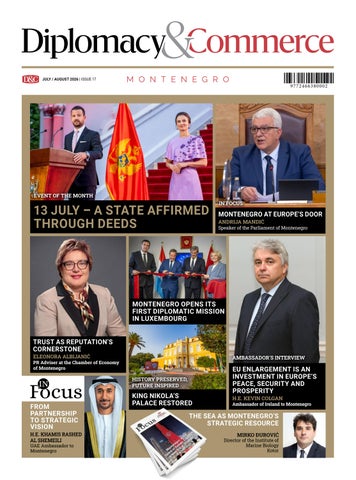
JULY / AUGUST 2026 | ISSUE 17
M O N T E N E G R O
9772466380002
EVENT OF THE MONTH
13 JULY – A STATE AFFIRMED THROUGH DEEDS
IN FOCUS
MONTENEGRO AT EUROPE’S DOOR ANDRIJA MANDIĆ
Speaker of the Parliament of Montenegro
MONTENEGRO OPENS ITS FIRST DIPLOMATIC MISSION IN LUXEMBOURG TRUST AS REPUTATION’S CORNERSTONE ELEONORA ALBIJANIĆ
AMBASSADOR'S INTERVIEW
PR Adviser at the Chamber of Economy of Montenegro
HISTORY PRESERVED, FUTURE INSPIRED
FROM PARTNERSHIP TO STRATEGIC VISION
H.E. KHAMIS RASHED AL SHEMEILI UAE Ambassador to Montenegro
KING NIKOLA’S PALACE RESTORED
EU ENLARGEMENT IS AN INVESTMENT IN EUROPE’S PEACE, SECURITY AND PROSPERITY
H.E. KEVIN COLGAN
Ambassador of Ireland to Montenegro
THE SEA AS MONTENEGRO’S STRATEGIC RESOURCE MIRKO ĐUROVIĆ
Director of the Institute of Marine Biology Kotor
www.odiva.me
FOREWORD
FOLLOW US TO STAY UPDATED
MILOŠ DRAGAŠ CEO dragasm@drafmedia.me
ALEKSANDRA TOMIĆ Editor-in-Chief aleksandra.tomic@drafmedia.me
NATALIJA PEROVIĆ Advertising Director advertising@drafmedia.me
ZORAN DRAGIĆ Design and prepress zoran.dragic@gmail.com
Translation Double L D.O.O. Contributors: Miloš Dragaš Robert Čoban Žikica Milošević
Print BIROGRAF COMP D.O.O. Atanasija Pulje 22 Zemun Republika Srbija
Published by: DRAF Media d.o.o. 81100 Podgorica, Montenegro Karađorđeva 18 VAT: 03542041 Reg. No: 51128768 Office: Karađorđeva 18 81100 Podgorica Phone: + 382 69 220 275
CIP – Katalogizacija u publikaciji Nacionalne biblioteke Crne Gore, Cetinje ISSN 2989 – 2481 = Diplomacy and Commerce Montenegro (Print) COBIS.CG-ID 26760708 International Copyright 2016-2023 Color Media Communications, Novi Sad, Serbia Copyright for Montenegro: 2023 The Media doo, Podgorica, Montenegro
The Diplomacy of Everyday Partnerships Dear Readers, Welcome to the latest issue of Diplomacy magazine, dedicated to the people, institutions and values shaping contemporary Montenegro and its place in the European and international community. This issue comes at a particularly important moment — a time when European integration, institutional development, economic cooperation, national identity and sustainable development are increasingly understood as interconnected elements of Montenegro’s future. Through our interviews and feature stories, we seek to present a broader picture of a country that is evolving while remaining deeply rooted in its identity, heritage and values. Our conversation with Kevin Colgan of the Embassy of Ireland explores the shared European values that connect Montenegro and Ireland, as well as the opportunities to strengthen bilateral cooperation. In our political interview, Andrija Mandić, President of the Parliament of Montenegro, reflects on the role of Parliament in the reform process and the challenges facing Montenegro’s institutional development. We also bring an international perspective through our interview with the Ambassador of the United Arab Emirates, focusing on the potential for deeper diplomatic and economic cooperation. Montenegro’s Statehood Day, celebrated on 13 and 14 July, offers an opportunity to reflect on the meaning of statehood, identity and responsibility towards future generations. Through our special feature, Celebrating Statehood, Strengthening Identity, we look at the values that connect Montenegro’s past with its present and future. This issue also highlights the importance of partnerships between institutions, business and society. Eleonora Albijanić, PR Manager of the Chamber of Economy of Montenegro, discusses the role of communication, trust and cooperation in creating a stronger business environment. Meanwhile, our conversation with Sanja Šišović, Programme Director of NGO CAZAS, reminds us that strong communities are built through partnership, social responsibility and meaningful engagement. Montenegro’s identity is also inseparable from its extraordinary natural heritage. In our Wild Beauty
Call us or send us request on: e-mail: pretplata-dc@color.rs Phone: +381 11 4044 960 Payment Instructions: www.diplomacyandcommerce.rs/subscription
feature, we visit Biogradska Gora, one of the country’s most remarkable natural treasures — a place where time seems to stand still and where preserving nature is ultimately a commitment to the future. The development of local communities is explored through our interview with Stevan Katić, Mayor of Herceg Novi, while our features on fashion and science offer two further perspectives on contemporary Montenegro. Lazar Ilić, fashion designer and stylist, speaks about fashion as a space where identity meets contemporary regional design. Mirko Đurović, Director of the Institute of Marine Biology in Kotor, highlights the essential role of science in understanding and protecting the Adriatic Sea. Although these stories come from different fields, they are connected by one central idea: diplomacy is not limited to relations between states. It is also about the ability to communicate, build trust, connect different interests and create partnerships that benefit society as a whole. We believe that meaningful conversations are essential to understanding Montenegro — its potential, its challenges and the role it is carving out for itself in Europe and the wider world. Thank you for joining us in this issue of Diplomacy.
ONLY
34 €
PER YEAR
Aleksandra Tomić Editor-in-Chief
SUBSCRIBE NOW! IN PRINT AND ONLINE 3
AMBASSADOR'S INTERVIEW
H.E. Kevin Colgan, Ambassador of Ireland
EU Enlargement Is an Investment in Europe’s Peace, Security and Prosperity
H.E. KEVIN COLGAN
Ambassador of Ireland to Montenegro
As Ireland assumes the Presidency of the Council of the European Union, Ambassador Kevin Colgan discusses the Presidency's priorities, Europe's evolving geopolitical landscape, and Ireland's unwavering support for Montenegro's EU accession, describing the country as the leading candidate for the Union's next enlargement. 4
www.diplomacyandcommerce.me
A
t a time when the European Union is navigating an increasingly complex geopolitical environment, strengthening its security architecture and enhancing its global competitiveness, Ireland takes on the Presidency of the Council of the European Union with an agenda centred on unity, resilience and shared values. In this exclusive interview for Diplomacy, H.E. Kevin Colgan, Ambassador of Ireland to Serbia and Montenegro, outlines Ireland's priorities for its Presidency, reflects on the future of EU enlargement, and reaffirms Ireland's strong commitment to Montenegro's European path. He emphasises that enlargement remains one of the Presidency's central priorities and highlights Montenegro's position as the frontrunner among candidate countries, while underscoring that continued reforms will be decisive in bringing the country to the final stage of its accession process. What are the key priorities of Ireland's Presidency of the Council of the EU, and what outcomes do you hope to achieve? Ireland is honoured to hold the Presidency of the Council of the European Union for the eighth time. We take on this responsibility at a particularly important moment for Europe, as we navigate growing geopolitical tensions, economic uncertainty and an evolving security landscape. Throughout our Presidency term, we will act impartially, serving as an honest broker among Member States. Our work will respond to the overall interests and needs of the Union, its Member States, and citizens across Europe. Our Presidency will focus on three closely connected priorities: competitiveness, values and security. Through our agenda on competitiveness, we will strengthen the Single Market, remove barriers to internal trade, help European businesses and SMEs expand across the continent, and enhance their access to finance that will allow them to grow. We will drive the Council’s work to implement the One Europe, One Market Roadmap and make decisive progress in 2026. We will work with partners to achieve the objectives and targets set out in the Roadmap. In the area of security, we know that no country acting alone can address the entirety of
“IRELAND SEES ENLARGEMENT AS AN INVESTMENT IN PEACE, SECURITY, STABILITY AND PROSPERITY ACROSS EUROPE. WE WILL WORK TOWARDS THE COMPLETION OF ACCESSION NEGOTIATIONS WITH MONTENEGRO AND SEEK TO MAKE SUBSTANTIAL PROGRESS IN NEGOTIATIONS WITH ALBANIA, MOLDOVA AND UKRAINE.” existing and emerging security challenges. The Irish Presidency will contribute actively to the ongoing development of the EU’s security and defence. Through our focus on values, we will ensure that we uphold fundamental rights and protect those most in need. We will work to uphold the rule of law across the EU and in candidate countries, and we will place particular emphasis on bolstering the resilience of European democracies. Together, these pillars reflect our ambition to build a stronger, more resilient Europe—one that is economically competitive, steadfast in defending democracy and the rule of law, and capable of responding effectively to contemporary security challenges. How does Ireland view the future of the European Union in the current geopolitical environment? The European Union faces increasingly complex geopolitical challenges. These are challenges that no Member State can tackle alone. Throughout our Presidency, we will work with our European partners to strengthen Europe's resilience, deepen cooperation on security and defence, and improve our collective response to these shared challenges. The Irish Presidency will seek to strengthen the EU’s role as a principled global actor. The EU’s firm commitment to multilateralism, the United Nations, and the international legal order, as well as to the promotion of human rights, democracy and the rule of law, will remain central to our work. We will work to continue the Union’s unwavering support for Ukraine in the face of Russia’s war of aggression by maintaining pressure on Russia and ensuring that Ukraine continues to have access to the support and finance it needs, including to defend itself. The Irish Presidency will also support EU efforts to contribute to peace and security in the Middle East. In support of a more resilient and
secure Europe, the Irish Presidency will ensure a coherent, inclusive and coordinated approach to the Union’s defence and security agenda, supporting the EU’s focus on the development of critical defence capabilities. At the same time, because we believe that strong international partnerships are essential, we will seek to strengthen EU relations with the UK, the US and Canada, while prioritising engagement with partners in Africa, Latin America and the Asia-Pacific region. Against this complex and rapidly evolving global environment, the Irish Presidency will continue to pursue an ambitious trade policy agenda and ensure that the EU’s role as the world’s largest development and humanitarian actor remains in the spotlight. Ultimately, our goal is to help build a Europe that is safer, stronger and better prepared for the challenges ahead. To do this, we have to keep the door open to countries that are ready to join the European Union. Our Presidency motto, Ní neart go cur le chéile, meaning "Strength with Unity," captures this approach. It reflects a simple but enduring belief that Europe is at its strongest when we work together, especially at a time when unity has never mattered more. How important will EU enlargement and support for candidate countries be during Ireland's Presidency? EU enlargement will be at the very centre of Ireland’s Presidency. Ireland has always been a strong supporter of EU enlargement. We held the Presidency during the historic 2004 enlargement, when ten new Member States joined. We see the enlargement process as a key expression of our values and as an investment in peace, security, stability and prosperity across Europe. We welcome the renewed momentum behind enlargement across the European Union, particularly after the successful EU-Western Balkans Summit. The challenge
now is to translate that political momentum into tangible progress. During Ireland's Presidency, we will work closely with our European partners to ensure that enlargement remains a priority and that countries making real progress continue to move forward on their European path. The Irish Presidency has significant work ahead on the enlargement agenda, including preparing the ground for the first accession of new Member States since 2013. We will work towards the completion of accession negotiations with Montenegro and seek to make substantial progress in negotiations with Albania, Moldova and Ukraine. At the same time, we recognise the importance of maintaining public confidence in enlargement. During our Presidency, Ireland will continue to promote a better understanding of the benefits of enlargement, both within the European Union and across the candidate countries, because a successful enlargement process ultimately depends on the support and engagement of citizens on all sides. How do you assess Montenegro's progress towards EU membership, and what reforms remain essential? Montenegro is the clear frontrunner for the next candidate country to join the European Union. The progress achieved so far reflects Montenegro’s strong commitment to its European path and demonstrates what can be accomplished through political will and sustained reform efforts. Joining the EU requires broad societal consensus, and it is encouraging to see that EU membership has become a shared goal across the political spectrum. The EU has always been clear that accession is a merit-based process. Montenegro has already completed a significant amount of the legislative work required to align with the EU acquis. Yet EU accession is an ongoing reform process, and important work still lies ahead. Continued progress will depend on maintaining the pace of reforms and delivering tangible results, particularly in strengthening the rule of law, the independence and efficiency of the judiciary, public administration, and the fight against corruption and organised crime.
5
AMBASSADOR'S INTERVIEW
“MONTENEGRO IS THE CLEAR FRONTRUNNER FOR THE NEXT CANDIDATE COUNTRY TO JOIN THE EUROPEAN UNION. CONTINUED PROGRESS WILL DEPEND ON STRENGTHENING THE RULE OF LAW, THE INDEPENDENCE AND EFFICIENCY OF THE JUDICIARY, PUBLIC ADMINISTRATION, AND THE FIGHT AGAINST CORRUPTION AND ORGANISED CRIME.”
What message would Ireland like to send to the citizens of Montenegro regarding their European future? We would like people in Montenegro to know that Ireland has benefited enormously from EU membership. Since joining in 1973, Ireland has undergone a remarkable transformation. Our society, our influence and our economy have changed for the better. Joining the European Union has improved almost every aspect of our lives, from how we work, travel and study to the quality of our environment and the opportunities available to our businesses and young people. It is because of our own positive experience that we want to keep enlargement high on the agenda, despite numerous other challenges. We want the people of Montenegro to understand the potential benefits of European
6
Union membership by demonstrating just how much Ireland has gained from it. We would like to see the citizens of Montenegro benefit as we have. That is why it is fantastic to see such broad support for European integration across Montenegro. I come from a country with a similarly high level of support for the European Union, with roughly 80% of Irish people continuing to support our long-standing membership. How can a smaller EU Member State such as Ireland contribute to shaping European policies? Throughout our membership of the European Union, Ireland has played a central role in Europe. We help shape the EU through our contribution to foreign, economic and social policies. As a smaller country, Ireland has a proud history of multilateralism and of working with our fellow Member States to improve the lives of European citizens across the continent we all share. The rotating Presidency gives every Member State, regardless of size, the opportunity to help shape the European agenda. Ireland has successfully held the Presidency of the Council of the European Union on seven previous occasions, including during periods of significant change for the Union. As an example of what smaller states can contribute, during our 2004 Presidency we welcomed the largest enlargement in the EU’s history, with ten new Member States joining. As we assume the Presidency once again, we are in the driving seat of the EU agenda, chairing meetings, driving legislative work, and building compromises among Member States. We will act as an honest broker, working impartially to build consensus and help the European Union deliver practical results on the issues that matter
How do you assess Ireland-Montenegro bilateral relations, and where do you see the greatest potential for further cooperation? 2026 marks two decades of bilateral relations between Ireland and Montenegro, and I am pleased to see that our partnership continues to go from strength to strength. Over the past year, high-level exchanges have highlighted this growing connection. President Connolly welcomed President Milatović to Dublin for the first state visit by a President of Montenegro to Ireland. In June, we were pleased to welcome Minister Gorčević to meet with her counterpart, Minister Byrne. Our Taoiseach also attended the recent EU-Western Balkans Summit in Tivat. Across these meetings, Ireland has reaffirmed its strong support for Montenegro’s EU accession and encouraged the continuation of the reforms that will bring the country closer to membership. Expanding our presence in the Western Balkans reflects the importance we attach to our relations with Montenegro and our long-term commitment to strengthening our engagement further. As we have already discussed, Ireland seeks to contribute to Montenegro’s democratic, economic and broader societal development by supporting its European path. Beyond European integration, there is significant potential to strengthen economic ties, promote tourism, and enhance cooperation in research and education. I am optimistic about the future of Irish-Montenegrin relations. As small countries, we share many experiences and values, including our love of storytelling, warm hospitality, and traditional music and dance. I believe that by bringing
our businesses, institutions and people closer together, we can build on the strong foundation that already exists between our two great countries. What would be your message to the people of Montenegro as Ireland assumes the Presidency of the Council of the European Union? My message would be to recognise the hard work Montenegro has done to date on its accession path. As the clear frontrunner, we hope to see Montenegro continue making strong progress. As the Presidency, Ireland supports Montenegro's ambition to close all negotiating chapters by the end of the year. There is every reason to be optimistic, provided the hard work continues. Joining the EU requires cross-societal buy-in, and we welcome the fact that EU membership has become a shared national objective across the political divide. Political debate is a normal part of every democracy. It is a sign of good democratic health. As these debates continue to take place, quite rightly, it is also important to consider the big picture. What matters is that there remains sufficient agreement on the country's strategic direction and on the reforms needed to achieve EU membership. EU membership is ultimately a national project. It succeeds best when it enjoys broad support across political parties, institutions and society. It will be important for Montenegro to build on this unity and deliver further crucial reforms as it approaches the final stretch of the accession process. The Irish Presidency has made clear that we stand ready to assist Montenegro in its accession process in any way we can. We welcome the strong momentum behind enlargement and are committed to building on it. After all, for Ireland, expanding the European Union is about strengthening Europe as a whole. Ní neart go cur le chéile—"Strength with Unity"—is our Presidency motto. www.diplomacyandcommerce.me
Photo: Embassy of Ireland; magnific.com
These are not simply technical requirements—they are fundamental to citizens' confidence in public institutions. Ireland has consistently supported EU enlargement because we believe it makes Europe stronger, more secure and more prosperous. At the same time, Ireland believes that the EU is first and foremost built on a set of values, including democracy, equality, human rights and the rule of law. These shared fundamental values underpin all the Union’s activities, are enshrined in its legal framework, and have been agreed upon by every Member State. That is why it is important for candidate countries to fully implement the legislation they have adopted to align with the EU acquis. It will be important for Montenegro to build on its progress by delivering further crucial reforms as it approaches the final stretch of the accession process.
most to its citizens. We want to facilitate constructive dialogue, drawing on our own experience of the importance of engagement across political divides in building peace on our island.
DIPLOMATIC EVENT
Montenegro Opens its First Diplomatic Mission in Luxembourg
Two Decades Of Partnership As A Foundation The opening of the Embassy of Montenegro in Luxembourg marks a step forward in political, economic and institutional ties between the two countries — and a reaffirmation of Luxembourg’s support for Montenegro’s European integration and of the two allies’ work together within NATO
In his address, Ibrahimović called the opening of the mission an important step in developing bilateral relations and a new platform for intensifying political dialogue, strengthening economic cooperation and bringing the institutions and citizens of Montenegro and Luxembourg closer together. The ceremony, he said, carried symbolic weight, coming in the year that marks twenty years of diplomatic relations between Montenegro and Luxembourg and two decades since Montenegro regained its independence. Over those twenty years, he added, the two countries have built relations based on mutual trust, respect and close partnership — a firm foundation on which to build further.
Ibrahimović thanked Luxembourg for its sustained and strong support for Montenegro’s European integration, describing it as a partner that consistently backs an enlargement policy based on individual merit and recognises Montenegro’s reform progress. “It is encouraging that in Luxembourg we have a reliable partner who believes in Montenegro’s European future,” Ibrahimović said, adding that Montenegro remains fully committed to implementing reforms and to achieving its central foreign policy objective: full membership of the European Union. On the scope for future cooperation, he said there was considerable room to improve economic relations, particularly in energy, tourism and financial services, and to strengthen ties in culture and education. He also emphasised the importance of the two NATO allies acting together amid complex geopolitical challenges to preserve peace and security and to keep multilateral cooperation effective. He singled out the contribution the Montenegrin diaspora in Luxembourg has made to relations between the two countries,
describing Montenegrins abroad as a bridge of friendship, trust and mutual understanding between Montenegro and Luxembourg. The new mission, he said, will be at the disposal of Montenegrin citizens, providing consular and administrative support and strengthening their ties with their home country. In his address, Bettel said he was pleased that Montenegro was the first Western Balkan country to open a diplomatic mission in Luxembourg, which he said demonstrated the value both sides place on strong bilateral relations. He went on to express full support for Montenegro’s European integration, saying he was convinced that, as the most advanced candidate country, Montenegro is also the Union’s next member.
Photo: Bojana Čupić, Government of Montenegro
T
he Deputy Prime Minister and Minister of Foreign Affairs of Montenegro, Ervin Ibrahimović, and the Deputy Prime Minister and Minister for Foreign Affairs of the Grand Duchy of Luxembourg, Xavier Bettel, formally opened the Office of the Embassy of Montenegro to the Kingdom of Belgium, with its seat in Luxembourg. The ceremony underscored a shared commitment to deepening the friendship and partnership between the two countries.
Members of the diplomatic corps attended the opening, along with representatives of the institutions of the Grand Duchy of Luxembourg and of political, business and cultural life, members of the diaspora and friends of Montenegro.
7
POLITICAL INTERVIEW
Stevan Katić, Mayor of the Municipality of Herceg Novi
Herceg Novi: Where Tradition Meets Modern Development From fortresses and festivals to multimillion-euro projects, Mayor Stevan Katić outlines the path to year-round tourism and global recognition 8
www.diplomacyandcommerce.me
HERCEG NOVI IN NUMBERS • More than 120 million euros invested in development projects from the local and state budgets over the past several years • More than 15 traditional festivals and dozens of cultural events annually • The season runs from mid-March to November • Among the ten towns in the region with the highest number of overnight stays by foreign tourists • 89 churches and monasteries within the municipality • Herceg Novi connects sea and mountains in just 30 minutes
S
et at the entrance to the Bay of Kotor, Herceg Novi has undergone intensive development in recent years, confirming its status as one of the most dynamic towns on the Montenegrin coast. Thanks to a blend of rich cultural and historical heritage, natural resources and strategic investment, the town is responding ever more successfully to the demands of contemporary tourism and the international market.In a Diplomacy interview, the Mayor of Herceg Novi, Stevan Katić, discusses the town’s position on the Mediterranean tourism map, major infrastructure projects worth tens of millions of euros, the development of year-round tourism and the strengthening of the investment climate. He places particular emphasis on preserving the town’s authentic identity, valuing its cultural heritage and creating the conditions for Herceg Novi to be not only a desirable tourist destination but also a place to live, work and invest.Through the development of sustainable tourism models, the improvement of infrastructure, and strong cooperation between the public and private sectors, Herceg Novi seeks to further consolidate its position as one of the leading Mediterranean centres, offering a unique blend of tradition, culture, nature, and modern development. How would you assess Herceg Novi’s current standing as a Mediterranean tourist destination? Herceg Novi holds an exceptionally significant place on the Mediterranean tourism map, above all
• Projects worth tens of millions of euros underway — the bus station, the Igalo–Ilinica gondola, the revitalisation of the Španjola fortress and the local bypass
HERCEG NOVI HOLDS AN EXCEPTIONALLY SIGNIFICANT PLACE ON THE MEDITERRANEAN TOURISM MAP, THANKS TO THE DISTINCTIVE COMBINATION OF ITS NATURAL, CULTURAL AND HISTORICAL RESOURCES. ITS FORTRESSES, FESTIVALS AND MEDITERRANEAN WAY OF LIFE SET IT APART FROM MANY DESTINATIONS ALONG THE ADRIATIC thanks to the distinctive combination of its natural, cultural and historical resources. The meeting of diverse civilisational, architectural and cultural influences is evident at every step, attracting many foreign guests. As a result, Herceg Novi is once again on the list of the region's most visited destinations.Its competitive advantage rests equally on the traditional model of its offering and on a diverse offering that encompasses cultural, health, nautical, and event tourism. Herceg Novi is recognised as a town of culture, festivals, and the Mediterranean way of life, which sets it apart from many destinations along the Adriatic. Accommodation capacity has been significantly expanded, both in private households and in the hotel sector — in four- and five-star establishments, including the world’s most prestigious hotel brands — thereby creating the conditions to receive a greater number of guests with different needs and interests throughout the year.Particular value is added to the tourism offer by Herceg Novi’s hinterland — the Orjen Nature Park, with its rich network of hiking trails, an adventure park,
and eco-tourism offerings, which are very appealing to visitors who enjoy an active holiday and time spent in unspoilt nature.Herceg Novi — where you can travel from the sea to the mountains in a 30-minute drive — has exceptional potential to solidify further its position as one of the leading Mediterranean destinations. What are the key development priorities for the municipality in the period ahead? The strate gic development of Herceg Novi rests on the principles of sustainability, improving the quality of life for the local population, and enhancing the competitiveness of the tourism economy. Over the past several years, more than 120 million euros have been invested in projects funded by state and local budgets, indicating that, after decades of neglect, Herceg Novi has embarked on a path of robust development.Municipal and transport infrastructure has been modernised; public spaces, the promenade, parks and playgrounds, and sports infrastructure have been improved; and significant attention has been directed to-
wards the valorisation of cultural heritage, the development of the creative industries, and the creation of conditions for year-round tourism.Particular focus has been placed on developing culture and sport, improving environmental standards, and implementing the principles of the green transition. The long-term goal is for Herceg Novi to be attractive to investors, high-quality for the local community to live in, and competitive in the international tourism market. How does Herceg Novi balance the preservation of its cultural and historical heritage with contemporary tourism development? In Herceg Novi, cultural and historical heritage is not regarded as a constraint on development, but as a strategic resource.The fortresses, old-town quarters, sacred buildings, and rich cultural tradition form the basis of the town’s identity and its greatest comparative advantage. We have put our fortresses to use as summer stages, among the most beautiful on the Adriatic. The house of the Nobel laureate Ivo Andrić is visited by an ever-growing number of tourists, and its garden hosts numerous cultural events. The Old Town is, in one part, the Square of the Book and, in another, the Square of Music. All of these are cultural monuments that represent a great development opportunity for us and tell the story of this region’s history. The Njegoš School in Toplo is a museum, and soon the Topla Komunitad complex will be one as well.
9
POLITICAL INTERVIEW
The medieval fortress Forte Mare has been given ambient lighting and an appearance befitting such an important cultural and historical monument, and this year it will be inscribed on UNESCO's list of protected cultural assets of the Venetian period.Building development is unavoidable, but we are aware that the far more important ability is to preserve the town’s unique character and its truly great cultural wealth. How important is tourism seasonality, and how can the season be extended? Tourism is Herceg Novi’s strongest sector of development, which is why we work continuously to make the town an attractive destination year-round. Through carefully conceived events, we seek to reduce the effects of seasonality and attract visitors outside the main summer season. The results are already visible, as the season begins in mid-March and lasts until November, when hotel occupancy is excellent. The New Year programme, the traditional Mimosa Festival — which draws several thousand guests in February and March — and this year’s two-day programme marking the First of May have shown great interest in Herceg Novi throughout the year.
10
OVER THE PAST SEVERAL YEARS, MORE THAN 120 MILLION EUROS HAVE BEEN INVESTED IN PROJECTS FUNDED BY STATE AND LOCAL BUDGETS, SIGNALLING A PATH OF ROBUST DEVELOPMENT. OUR LONG‑TERM GOAL IS FOR HERCEG NOVI TO BE ATTRACTIVE TO INVESTORS, HIGH‑QUALITY FOR THE LOCAL COMMUNITY TO LIVE IN, AND COMPETITIVE IN THE INTERNATIONAL TOURISM MARKET. Which major infrastructure projects are currently shaping the town’s development? By the end of 2026, the citizens of Herceg Novi can expect the completion — and the tangible effects — of several significant infrastructure projects that will, over the long term, improve the quality of life, transport connectivity, and the town’s tourism offering.One of these is the construction of the bus station and access road, with opening expected this year. This project will bring Herceg Novi the most modern and bestequipped station in this part of Europe — one that, given that we are a border town, will serve as a representative gateway to Montenegro. The investment is worth around 10 million euros.On the Luštica peninsula, exceptionally significant capital projects are underway that will contribute to the area's valorisation, which
represents great potential.As part of the multi-million-euro project to revitalise the Španjola fortress, which we are carrying out with the support of the Ministry of Culture and Media, the first phase of works will be completed by the end of the year, and the fortress will become a regional cultural hub as early as next year. The Horseshoe Tower is also being reconstructed and will be opened to visitors.A further addition to the tourism offer will be the Igalo–Ilinica panoramic gondola, worth around 10 million euros, and the Olympic swimming-pool project — befitting a sporting town such as Herceg Novi — has also been completed.Of significance, too, will be the construction of the local bypass, for which the design has been completed, and which will reduce traffic congestion along the Adriatic Highway. What is your cooperation with
state institutions and the private sector in the field of tourism like? Contemporary tourism development is not possible without a strong partnership among local government, state institutions and the private sector. That is why we work continuously on joint planning, destination promotion and the creation of an investment climate.We have excellent cooperation with the private sector and strive, to the greatest extent possible, to accommodate investors ready to support the town’s tourism development. We are developing a partnership with them. Until about a decade ago, owing to poor privatisations, Herceg Novi could not boast a large number of hotels; now the situation is different, and we can take pride in the fact that this cooperation has resulted in several dozen small, medium-sized, and large hotels. For that reason, Herceg Novi is once again among the ten towns in the region with the highest number of overnight stays by foreign tourists. Which segments of the tourism offer have the greatest potential for further growth? Herceg Novi has exceptional potential for developing several high-value tourism segments — alongside the traditional ofwww.diplomacyandcommerce.me
How important are international festivals and cultural events to Herceg Novi’s recognisability? Cultural events are among the most important elements of Herceg Novi’s identity. We are the town with the most festivals in Montenegro — more than 15 traditional festivals and dozens of cultural events offer something for all generations and a wide range of interests. We are especially pleased that this year the Herceg Novi Film Festival received accreditation from the International Federation of Film Producers Associations (FIAPF), placing it among only about sixty festivals worldwide with such status — a confirmation of its international reputation and significance.The rich festival scene continues throughout the summer. On 26 June, Bryan Adams will perform at Kanli Kula for the first time in Montenegro, while in August, audiences will have the chance to enjoy a performance by the world opera diva DiDonato as part of the Operosa festival. The renowned Guitar Art Summer Fest and the Herceg Novi Comic Festival are celebrating their twentieth anniversaries. We are also very proud of the reggae fes-
IN HERCEG NOVI, CULTURAL AND HISTORICAL HERITAGE IS NOT REGARDED AS A CONSTRAINT ON DEVELOPMENT, BUT AS A STRATEGIC RESOURCE. THE FORTRESSES, OLD‑TOWN QUARTERS AND SACRED BUILDINGS FORM THE BASIS OF THE TOWN’S IDENTITY AND ITS GREATEST COMPARATIVE ADVANTAGE. tival, the Square of the Book, the Days of Music, the Jazz Festival, the Square of the Cyrillic Script, and numerous other events that further confirm that Herceg Novi has the content and energy to be an attractive tourist destination year-round. How do you see the town’s future development in the context of competition in the Adriatic region? For Herceg Novi to maintain its position as one of the most attractive towns on the Adriatic, we must preserve an authentic identity rooted in natural beauty and rich cultural heritage while continually enriching and expanding the tourism offering.I believe that Montenegro’s further progress on its European path will further strengthen Herceg Novi’s position and open new development opportunities. The completion of the capital investments currently underway and the realisation of those planned will improve transport connectivity and the quality of life for citizens.I consider it particularly important to bring back into use the tourism capacity that has been out
of operation for years due to unsuccessful privatisations. The opening of new hotels and the development of additional tourism content will help extend the season and enhance the town’s competitiveness in the regional market.As the largest municipality in the Bay of Kotor, Herceg Novi has the potential to become a modern regional centre. Our goal is to sustain this trend and create the conditions for Herceg Novi to be a town where people come to live, work, invest and rest. What message would you send to investors and tourists considering Herceg Novi as a destination? Herceg Novi is a town — as many artists have written — “to which it is easiest to belong,” one you leave “with a dazzled soul,” unique in many respects. Writers, poets and visual artists worked and lived here; it is the home of our Nobel laureate Ivo Andrić, the place where Bishop Njegoš was educated, and the town of famous counts, sea captains and benefactors. In Herceg Novi, you will feel the Mediterranean atmosphere, the
hospitality, the culture, the nature, and a sense of belonging to a place that has, for centuries, been a meeting point of civilisations. It is precisely in that unique combination of tradition and modernity that the greatest strength and the future of Herceg Novi lie. The town offers stable development potential, growing international recognition, and the opportunity to invest in projects aligned with the principles of sustainability and long-term value. For several years now, it has been attractive to investors because we have managed to create such an environment. I tell them that Herceg Novi remains open to quality investment and concrete projects that contribute to the town’s development.
THE VISION OF HERCEG NOVI “Our goal is for Herceg Novi to be much more than a seasonal tourist destination. We want a town that attracts investors, offers a high quality of life for the local population, and represents a recognisable centre of culture, sport, and sustainable development on the Adriatic.Through the preservation of cultural heritage, the development of modern infrastructure, the extension of the tourist season and the creation of a favourable investment climate, we are building Herceg Novi as a place to which people come to live, work, invest and rest.” Stevan Katić, Mayor of the Municipality of Herceg Novi
Photo: Municipality of Herceg Novi, Vuk Ilić, Miloš Samarsžić
fer, there is health and wellness tourism, thanks to the tradition of the “Dr Simo Milošević” Institute in Igalo and the region’s natural healing resources.There is also significant room for growth in nautical tourism, cultural tourism, the MICE sector (congresses, conferences and business events), and the active-holiday segment, which includes hiking, cycling and sporting activities. That is why we have begun arranging and marking hiking trails with expert guidance, a move that has generated great interest. Likewise, by improving infrastructure, we have created the conditions for the development of sports tourism. There is also growing interest in religious tourism, given that Herceg Novi has 89 churches and monasteries and is the town from which the recently canonised Saint Sebastian (Dabović), Saint Cyril (Cvjetković) and Saint Leopold (Mandić) hail. Today’s travellers increasingly seek authentic experiences, local gastronomy and cultural content, which allows Herceg Novi to develop sustainable and profitable forms of tourism that deliver greater added value.
11
CULTURE EVENT
Podgorica’s New Cultural Heartbeat
Montenegro Takes the Stage
A new theatre building opens as a beacon of creativity, continuity, and international cooperation
W
ith the opening of the new City Theatre building in Podgorica, Montenegro has gained one of the most modern theatre stages in the region. After seven and a half decades of work without a home of its own, this nationally significant cultural institution enters a new chapter — confirming that investment in culture is investment in social development, in European
values and in national identity. The new building was formally opened on Montenegro's Statehood Day, completing one of the most significant cultural infrastructure projects of recent decades. The opening marks the end of a process that has taken years and amounts to far more than the construction of a modern building. What has been created is a space set to become the new centre of artistic life in the
capital, and an important platform for the development of contemporary Montenegrin culture. Over 75 years, the City Theatre has built a reputation as one of the country's most important cultural institutions. For the first time, it now has premises designed to contemporary European standards for the performing arts. Prime Minister Milojko Spajić said the new building represented
far more than an investment in infrastructure. “The City Theatre spent decades creating without a home of its own, yet it never lost its artistic force or the trust of its audience. Today we are opening a space equal to its importance, and confirming that culture holds an important place in the development of modern Montenegro,” Spajić said. He stressed that European integration matters not
THE CITY THEATRE IN NUMBERS • 75 years — of artistic work without a building of its own • 13 July 2026 — the new theatre formally opened • 1 million+ — people have seen City Theatre productions over its history • The most modern theatre stage — the new building is designed to contemporary European standards for the performing arts • Podgorica's new cultural address — a space for domestic productions, international festivals and co-productions
12
www.diplomacyandcommerce.me
only for institutional reform but for building stronger cultural and social institutions that improve the quality of citizens' lives.
of European Youth Capital in 2028, further strengthens its position as a regional centre of contemporary culture through this project.
CULTURE AS DEVELOPMENT POLICY
A HOME THAT ART WAITED A LONG TIME FOR
The new City Theatre building forms part of a wider investment cycle through which Montenegro is upgrading public infrastructure and strengthening the conditions for its creative industries. Modern cultural infrastructure is no longer simply a space for artistic work. It is an important factor in urban development, in international cultural cooperation, and in attracting creative professionals and audiences alike. Across Europe, investment in culture is increasingly seen as investment in social cohesion, in education and in the international profile of cities. Podgorica, which will hold the title
The Director of the City Theatre, Sandra Vujović, said the new stage fulfilled a dream held by generations of artists who spent decades working without premises of their own. Through all those years, she noted, the theatre survived thanks to the dedication of its actors, directors, dramaturges and technical staff, and to a loyal audience that kept the institution alive despite the lack of adequate conditions. The new building is therefore not merely an architectural object. It is a symbol of continuity in cultural life and a recognition of the generations of artists who shaped contemporary Montenegrin theatre.
CULTURAL DIPLOMACY
In contemporary international relations, culture is among the most important instruments of public diplomacy and international cooperation. Theatres, museums and cultural institutions are increasingly becoming places of dialogue, of exchange of ideas, and of national identity made visible. The new City Theatre building opens the way to more intensive international
cooperation — to visiting European companies, to co-productions, and to Montenegro's participation in contemporary cultural currents. The project therefore carries a significance that reaches beyond the local. It confirms that developing cultural infrastructure is an integral part of Montenegro's European path, and an investment in a society building its future on knowledge, creativity and openness.
13
Photo: private archive
MONTENEGRO’S CITY THEATRE FINALLY HAS A HOME — A MODERN STAGE THAT EMBODIES RESILIENCE, IDENTITY, AND EUROPEAN VALUES
EVENT OF THE MONTH
Beyond Institutions, Through People
13 July – A State Affirmed Through Deeds Teachers, doctors, firefighters, scientists and artists embody the values of freedom and responsibility celebrated on Statehood Day
F
rom the highest levels of government to the classroom, hospital, fire station, laboratory and film set, this year’s commemoration of 13 July in Montenegro placed the spotlight on people whose work gives substance to the concepts of statehood, freedom and responsibility. The formal reception hosted by President Jakov Milatović and the presentation of the Thirteenth of July Awards at the Parliament of Montenegro each conveyed, in their own way, the same message: a state is built not only through institutions and declarations, but through people who devote their knowledge, talent and professional integrity at the service of society. This year, Statehood Day in Montenegro was marked in an at-
14
mosphere that sought to bring to the fore what often remains outside the political spotlight – people and their achievements. The presidential reception held to celebrate13 July, in a spirit of gratitude to those who contribute to the community every day, brought together representatives from almost every segment of society. At the same time, at the Parliament of Montenegro, honours were presented to individuals whose contributions have been recognised in the fields of science, literature and film. The two events, different in character and in the institutions organising them, were united by the same idea: Montenegro affirms its statehood not only through dates in its history, but also through the contemporary achievements of its citizens. www.diplomacyandcommerce.me
THE PEOPLE WHO MAKE THE STATE A REALITY
The ceremonial reception hosted by the President of Montenegro, Jakov Milatović, was dedicated precisely to such people. Among the guests were judges and prosecutors, deans, representatives of municipalities, directors of schools and hospitals, representatives of civil society, culture and the media, businesspeople, representatives of veterans’ associations and members of the Montenegrin diaspora. Yet there was particular symbolism in the presence of those whose work is most often taken for granted until the moment comes when it becomes crucial. Firefighters, police officers, scouts, volunteers, nurses and medical technicians, primary school teachers, secondary school teachers and university professors, top-performing students, decorated citizens and celebrated athletes – people whose everyday work creates a sense of security, knowledge, solidarity and belonging. In a way, they presented a picture of Montenegro beyond its political institutions. People who heal, educate, protect, help and create, and who stand by their community when they are needed most, embody a kind of patriotism that requires no grand words. Their contribution is measured in achievements, lives saved, generations educated, medals won, successful projects and hours spent in the service of others. The Office of the President stated that the reception was an expression of respect for all those who affirm statehood and freedom every day – through honest work, care for others and responsibility towards the community. That message
also contains a broader definition of statehood: a state is not only what its institutions represent, but also what its citizens do for others every day.
13 JULY AS A MEETING OF PAST AND PRESENT
The Thirteenth of July holds multiple meanings in Montenegrin history. The date that links the 1941 uprising and Montenegro’s international recognition in 1878 is today also an opportunity to ask what statehood means in contemporary society. If freedom and international legal personality once had to be fought for, today the challenge is to translate that freedom into the quality of institutions, education, healthcare, science, culture and the economy. It is precisely for this reason that this year’s commemoration carries particular symbolic weight. Representatives of
the state and society came together in one place – those who make decisions and those who put them into practice every day. The reception was attended by President of the Parliament of Montenegro Andrija Mandić, Prime Minister Milojko Spajić, members of the Government and MPs, representatives of the diplomatic corps, religious dignitaries, and representatives of trade unions and state institutions. A particular international dimension was added by President of the Republic of Slovenia Nataša Pirc Musar, President of the Republic of Croatia Zoran Milanović and European Commissioner for Enlargement Marta Kos. Their presence conveyed a message about Montenegro’s close ties with its neighbours and European partners, as well as the country’s European perspective. It is precisely this combination
– domestic responsibility and international openness – that constitutes one of the key challenges facing contemporary Montenegro.
WHEN KNOWLEDGE BECOMES A STATE VALUE
If the presidential reception was dedicated to people who serve their community every day, the presentation of the Thirteenth of July Awards was a tribute to knowledge, creativity and achievements of wider significance to society. This year’s laureates received their Thirteenth of July Awards at the Parliament of Montenegro. The honours went to representatives of different fields – literary theory, botany and film. This once again affirmed that state honours are not confined solely to achievements accomplished within the country’s borders.
15
EVENT OF THE MONTH
THIRTEENTH OF JULY AWARDS 2025 • Prof. Dr Sonja Tomović-Šundić For the work The Literary Anthropology of Danilo Kiš A full professor at the University of Montenegro, she received the award for her scholarly and literary-theoretical work dedicated to the oeuvre of Danilo Kiš. The award recognises her contribution to the study of literature and the humanities.
• Prof. Dr Nikola Vukčević For the international promotion of Montenegro and the reception of the film The Tower of Strength in 2025 A film director and university professor, he received the award for his contribution to promoting Montenegro through cinema and for the international reception of the film The Tower of Strength. • The Thirteenth of July Award is one of Montenegro’s most prestigious state honours, recognising outstanding results and achievements of particular significance to the country and society.
They also recognise people whose work represents Montenegro in a broader regional and international context. Professor Sonja Tomović-Šundić, a full professor at the University of Montenegro, received the award for her work The Literary Anthropology of Danilo Kiš. Her book opens up possibilities for a deeper understanding of the literary oeuvre of Danilo Kiš, one of the most significant authors from this region, by connecting literature with anthropological and broader humanities-related questions. Dr Snežana Dragićević and Dr Snežana Vuksanović, both Doctors of Biological Sciences, were recognised for their scientific achievements and contribution to the field of botany in 2025. Their recognition also serves as a reminder
16
that scientific research, although often removed from day-to-day politics and public spectacle, represents one of the most important investments any modern society can make. The third laureate was Professor Nikola Vukčević, a film director and university professor, who received the award for the international promotion of Montenegro and the reception of his film The Tower of Strength (Obraz) in 2025. Through the medium of film, his award takes on an additional dimension – because culture represents one of the most effective ways for a small country to tell the world about itself.
“A DECISION UNAFFECTED BY POLITICS”
The awards were presented by President of the Parliament of Montenegro Andrija Mandić, who congratulated the laureates and thanked the members of the expert jury. Mandić particularly emphasised the independence of the jury’s work, noting that the decision had been reached without political influence. “We have outstanding recipients of the Thirteenth of July Award, as decided by our jury, which this year, as in all previous years, reached its decision in accordance with its own convictions, unaffected by any political considerations,” Mandić said. The President of the Parliament stated that he was proud that Montenegro has people and achievements with which
it can present itself to Europe. This message takes on particular significance when one considers the range of this year’s laureates. Literature, the natural sciences and film may at first glance appear to have little in common, but it is precisely their diversity that speaks to the breadth of society’s potential. A country that seeks to be recognised in Europe cannot build its international standing through diplomatic messages alone. It also builds that standing through its universities, scientific research, art, cultural production and people whose achievements enhance the country’s reputation.
FROM FIREFIGHTER TO SCIENTIST – THE SAME IDEA OF RESPONSIBILITY
In this sense, the two events marking 13 July this year can be seen as two sides of the same story. On one side are people who perform jobs every day on which the lives and quality of life of citizens directly depend. On the other are those whose work pushes the boundaries of knowledge and culture and whose achievements remain an enduring part of the nation’s creative legacy. A firefighter who enters a burning building, a nurse who stays by a patient’s side, a teacher who passes on knowledge to generations, a scientist who spends years researching a plant species, a professor who studies literature, or a director who brings a Montenegrin story to an international audience – in different ways, they
are all doing the same thing: giving substance to the state. That is why this year’s commemoration of 13 July was not merely a ceremonial remembrance of history. It also raised a question about the present – what kind of Montenegro are we building today, and what do we want to be recognised for? The answer offered by this year’s reception and the Thirteenth of July Awards is quite clear. Montenegro is not merely a state of institutions. It is a state of its teachers, doctors, police officers, firefighters, athletes, scientists, artists, professors, students, businesspeople and all those who, through their work, take responsibility for their community. If statehood was once defended through armed and political struggle, today it is affirmed through the quality of the society we are creating. And 13 July, perhaps more than any other date, is an opportunity to remind ourselves that between the historical idea of the state and its life in the present day, there is one crucial bridge – the individual. The individual who works. The individual who knows. The individual who creates. The individual who helps. It was precisely such people who were at the forefront of this year’s 13 July commemorations. Not as mere decoration for a national holiday, but as its most important meaning. www.diplomacyandcommerce.me
Photo: predsjednik.me; Skupština Crne Gore, L. Zeković
• Dr Snežana Dragićević and Dr Snežana Vuksanović For scientific achievements and contributions to the field of botany in 2025 Both Doctors of Biological Sciences, they received the award for their achievements and contribution to the advancement of botanical research, particularly highlighting the value of scientific work in studying and protecting Montenegro’s natural wealth.
ECONOMY
Eleonora Albijanić, PR Adviser at the Chamber of Economy of Montenegro
Trust as Reputation’s Cornerstone
Eleonora Albijanić on the evolution of PR, the challenges of digital communication, and why credibility remains the profession’s greatest strength
A
t a time of increasingly rapid communication and constant public exposure, reputation is becoming one of the key assets of every organisation. PR is therefore no longer merely a support function for business, but an important part of strategic management, built on trust, credibility and responsibility.
I complemented my practical experience with a Master’s degree in this field. PR is my passion, and I enjoy the way it combines creativity, strategic thinking and the daily process of establishing new relationships and maintaining existing ones with various publics. Public relations is diverse, multidisciplinary, creative, dynamic and analytical; it requires knowledge of every sphere of social life and offers no single formula for resolving challenging situations. You can always expect a new challenge, which is why you have to keep learning and adapting.
With more than three decades of experience in communications, Eleonora Albijanić, Public Relations Adviser at the Chamber of Economy of Montenegro, has witnessed the profound changes the profession has undergone – from traditional media to real-time communication and the new challenges posed by digital platforms, artificial intelligence and disinformation. In an interview with Diplomacy, she discusses reputation, crisis communication, strategic PR and the future of the profession, as well as something that, despite all the changes, remains constant – trust as the foundation of every successful relationship with the public. How would you describe your professional journey in the field of public relations and institutional communication? My professional journey began immediately after I completed my economics degree, a little over three decades ago, at a time when there was far less awareness of everything that PR entailed, and it has been focused precisely on this complex and demanding, but above all rewarding, profession. I have been fortunate, through my work in tourism, telecommunications and energy, and in both domestic and international companies, to learn, practise and strategically manage commu-
ELEONORA ALBIJANIĆ PR Adviser at the Chamber of Economy of Montenegro
nications across all areas of PR, from internal communications, media relations, research and analysis, crisis communication, event management, sponsorships and corporate social responsibility, to various types of production, writing, editing, and the development of PR strategies and plans, among other things. I am particularly proud of the CEPI PR School, which has produced ten generations of PR profession-
als, and which I co-founded and where I was part of an excellent team of lecturers. In addition to my professional engagements with the National Tourism Organisation, Telenor, Electric Power Company of Montenegro (EPCG) and now the Chamber of Economy, I am also a certified PR and CSR trainer. I would say that my professional journey has been very dynamic, and somewhere around the halfway point,
What, in your opinion, are the key factors in building credibility and recognition in the PR sector today? Trust is the key word when it comes to building credibility. Actions first, then words – your actions must substantiate what you say. That is why good internal communication, where all communication processes begin, is the fundamental starting point for any effective external communication. The messages being communicated must be aligned with actions, because reputation is built precisely by ensuring that what an organisation says is consistent with what it does. A strategic approach to communications is crucial to building and maintaining an organisation’s image. It involves analysing the current situation, defining the vision, mission and core values, setting communication objectives and defining target publics and messages, selecting communication tools and channels, and finally, monitoring and evaluation. Throughout this process, adherence to professional standards and ethical principles goes without saying. As does the fact that, on this challenging journey, no steps can be skipped.
17
‘ACTIONS FIRST, THEN WORDS.’ Reputation is not built on what an organisation says about itself, but on the relationship between its messages and what it actually does. That is why good external communication begins with good internal communication, while a strategic approach, consistency, professional standards and trust form the foundation of a lasting reputation. ‘Although artificial intelligence may take care of the “technical” aspects of our work, strategic thinking and creativity remain our greatest strengths.’
How has the role of PR professionals changed over the past decade, particularly in the context of digital communication and social media? When I compare the beginning of my career 30 years ago with where we are today, I can say that the PR profession in Montenegro has undergone a significant transformation and experienced some seismic changes. Over the past decade, the PR profession went through a genuine ‘revolution’ during the COVID-19 pandemic, which, in a very short period of time, changed the way organisations communicate with their publics, accelerating processes that would otherwise have taken years to develop. If I were to try to systematise the changes that have taken place over the past decade, in brief, they primarily concern the speed of communication, in the sense that communication now takes place in real time; digital platforms and social media are taking precedence over traditional media; the public is now an active participant in communication, creating, sharing and commenting on content; crisis situations require an immediate response; tools for measuring the impact of communication have become more sophisticated; reputation is much more vulnerable;
18
“TRUST IS THE KEY WORD WHEN IT COMES TO BUILDING CREDIBILITY. ACTIONS FIRST, THEN WORDS – YOUR ACTIONS MUST SUBSTANTIATE WHAT YOU SAY. THAT IS WHY GOOD INTERNAL COMMUNICATION, WHERE ALL COMMUNICATION PROCESSES BEGIN, IS THE FUNDAMENTAL STARTING POINT FOR ANY EFFECTIVE EXTERNAL COMMUNICATION.” the development of artificial intelligence presents us with new challenges; combating disinformation is a new reality; PR today is no longer merely a support function for other areas of business, but an important part of the business decision-making process; and the PR profession has become more widely recognised, with an increasing number of people pursuing education and training in communications. A study of the PR profession in South-East Europe found that the following areas had gained in importance in recent years: digital/social media, internal communications and reputation management, indicating a clear increase in online engagement and organisational cohesion. The greatest threat to the industry is poor practice when it comes to measuring and evaluating our work. However, this also represents an opportunity to demonstrate our contribution
and impact by improving evaluation tools. Yet, regardless of these changes, the essence of the PR profession has remained the same over time and is rooted in two words: trust and credibility. The ability to establish a strong, open and credible relationship with the public remains the foundation of successful public relations. Crisis communication is the most demanding challenge in PR. Does the new era bring new rules in this area as well? Agility is one of the key characteristics of modern public relations today, as PR no longer operates in predictable, slow-moving cycles, but in an environment that is dynamic, fast-paced and often unpredictable. Information spreads in real time, publics react immediately, and organisations are under constant pressure to respond accurately, transparently and promptly. New technologies
and communication trends require continuous learning and adaptation. As the saying goes, ‘It is easy to be good when times are good; true heroes reveal themselves in adversity.’ Everything we (do not)know comes to the fore in a crisis. If sufficient attention is paid to communications and they are managed strategically when there is no crisis, crisis communication itself will be easier to manage. If, in times when there is no crisis, a company develops a crisis management plan and, based on it, a crisis communication plan; if it anticipates and considers potential crisis situations in advance, has scenarios prepared and conducts crisis communication exercises, then a crisis can be viewed as an opportunity rather than as a danger and a threat. A crisis usually erupts when you least expect it and always brings a certain degree of stress, while in PR there is no ready-made solution that can simply be applied to a particular situation. Every crisis is therefore a new adventure and a valuable testing ground for validating and assessing the way you manage communications. And the lessons learned after each crisis represent the greatest added value for PR work. How important is strategic reputation management in the work of the Chamber of Economy and similar institutions? A strategic framework must be followed in any institution when building and maintaining its reputation. In the work of the Chamber of Economy, this is particularly important because it represents and protects the interests of the entire business www.diplomacyandcommerce.me
“AGILITY IS ONE OF THE KEY CHARACTERISTICS OF MODERN PUBLIC RELATIONS TODAY, AS PR NO LONGER OPERATES IN PREDICTABLE, SLOW‑MOVING CYCLES, BUT IN AN ENVIRONMENT THAT IS DYNAMIC, FAST‑PACED AND OFTEN UNPREDICTABLE. INFORMATION SPREADS IN REAL TIME, PUBLICS REACT IMMEDIATELY, AND ORGANISATIONS ARE UNDER CONSTANT PRESSURE TO RESPOND ACCURATELY, TRANSPARENTLY AND PROMPTLY.” intended for micro, small and medium-sized enterprises are therefore organised on a regular basis. The Chamber promotes and supports dual education, recognising the importance of linking education with the labour market, as well as the need for a workforce equipped with specific practical knowledge and skills. Promoting the economy is one of the most important areas of the Chamber’s work. Various activities and campaigns are implemented to support domestic producers and raise awareness of the importance of buying domestic products. Recognising the importance of showcasing domestic quality, the Chamber established the collective trademark GOOD FROM MONTENEGRO, while the Strength Lies in All of Us campaign is conducted on an ongoing basis, together with the BUY LOCAL prize competition. How does personal professional development contribute to success in institutional PR? I have been with the Chamber of Economy for two years now, and I can say with confidence that managing public relations in this institution requires extensive knowledge, experience and a strong sense of responsibility. What I do today in institutional PR represents the culmination of three decades of work and diverse experience in public relations, which I am now able to apply to the fullest extent within the umbrella institution representing Montenegro’s business community. How do you see the future of the PR profession in the region over the next five to ten years? Today, PR is part of an organisation’s integrated communications. It is one piece of the puzzle that contributes to the overall picture. I believe this will remain the case over the next decade, while PR will continue to grow
in importance. According to the latest research in this field, the role of PR and communications is still not sufficiently valued within organisations’ management structures, and even where it is valued, there is a constant need to justify its existence. We can therefore say that we continue to face the challenge of ensuring PR has a sustainable influence within the organisational context, and I hope we will succeed in demonstrating just how important our profession’s contribution is to an organisation’s success. Although artificial intelligence may take care of the ‘technical’ aspects of our work, strategic thinking and creativity remain our greatest strengths. Is there a communication practice or project that you are particularly proud of? It is difficult to single out just a few, but I will try. Establishing the PR department at Promonte is something I am particularly proud of, as are the corporate social responsibility projects we implemented, such as Old Phone, New Life, a forerunner of proper electronic waste disposal, followed by Mobile Phones for Pupils Who Walk to School. During my time at the National Tourism Organisation, I was particularly proud of every good article published in the international media following study visits by journalists to our country, as well as of my involvement in producing the first travel guide to Montenegro following the sanctions, the Bradt Travel Guide. I am also proud of the communication campaigns accompanying the introduction of smart meters at Electric Power Company of Montenegro, as well as the campaigns for the Golden Team loyalty programme and Let’s Share the Burden. At the Chamber of Economy, I am proud of the BUY LOCAL prize competition, which we organised as part of the overarching Strength Lies
in All of Us campaign. I am proud of the CEPI PR School, but also of the first study of the PR landscape in South-East Europe and, in particular, the study focusing specifically on Montenegro, which we secured through the PRCA association. And I almost forgot – as part of the communications team, I am proud to have contributed to the development of the Public Information Strategy on Montenegro’s Accession to the European Union 2014–2018. What advice would you give to those who are just entering the world of public relations? At a time when communication plays a key role in shaping public opinion and building trust, the role of public relations professionals is more important than ever. Above all, I would tell young people who want to pursue a career in public relations and communications that this is a multidisciplinary profession that requires continuous learning and a great deal of responsibility. If they want to pursue this profession, they must be curious and stay informed about everything that is happening in society, because a good communicator must understand the context in which they operate. They must be patient and persistent. A good PR professional should have excellent communication skills, be empathetic, organised and creative, be able to work under pressure and think strategically, be a team player and a diplomat, and be digitally literate and agile. Credibility and integrity go without saying.
19
Photo: Vesela Mišković
community in Montenegro, which makes its role exceptionally important and multifaceted. In its work, the Chamber communicates with numerous and diverse target publics, both in Montenegro and abroad, and it is therefore important, yet at the same time highly complex, to align all objectives and messages and select the appropriate tools and channels for each target public, so that our communications remain consistent at all times and aligned with what we actually do. One example is the Chamber’s active participation in shaping the legislative and regulatory framework, where efforts are focused on removing barriers to business and improving the business environment. This entails continuous communication with the relevant institutions, submitting specific proposals and comments on regulations, as well as analytical initiatives that address issues of importance to the economy. Through its continuous communication with companies, the Chamber identifies the challenges they face in their day-to-day operations. Through the work of its boards, associations and other bodies, initiatives from the business community are gathered and advocated before the relevant institutions, while solutions are proposed that can contribute to reducing administrative barriers, improving the regulatory framework and strengthening the investment climate. The Chamber also provides direct support to companies through training, expert consultations, conferences and programmes aimed at human resource development, digital transformation, innovation and sustainable business practices. The Chamber plays a particularly important role in the internationalisation of business. By organising joint appearances by Montenegrin businesses at international trade fairs, as well as business forums and trade missions, domestic companies are connected with potential partners from the region and around the world, creating new opportunities for exports, investment and business expansion. An important aspect of the Chamber’s work is informing companies about support programmes. In cooperation with the relevant institutions and partners, presentations of support programmes
MONTENEGRO BEAUTY
Biogradska Gora
The Primaeval Forest Where Nature Keeps Its Own Memory
One of Europe's last remaining primaeval forests, it is a natural heritage of international importance and a measure of Montenegro's commitment to conserving biodiversity and to sustainable development
H
idden among the magnificent peaks of the Bjelasica massif, Biogradska Gora is one of the last preserved tracts of primaeval forest in Europe — a place where, for centuries, nature has kept to its own rhythm. Far from the accelerated pace of the modern world, this singular national park is among Montenegro's most significant natural assets. Ancient forests, crystal-clear waters, exceptionally rich biodiversity and untouched mountain landscapes make up an ecosystem of inestimable value — and a powerful reminder of why Europe's natural heritage matters. Biogradska Gora is not merely a protected area. It is an expression of Montenegro's commitment to conserving its natural heritage, and proof that small countries too can play an important part in protecting ecosystems of global significance.
A LIVING ARCHIVE OF NATURE
At the heart of the National Park lies Lake Biograd, one of the most recognisable symbols of Montenegro's natural beauty. Ringed by centuries-old forest and mountain peaks, it forms a harmonious whole in which water, forest and mountain merge into a single landscape. The primaeval forest of Biogradska Gora ranks among the few that survive in Europe. Some of its trees are several hundred years old and constitute a natural archive of a kind, bearing witness to climate change, the development of ecosystems and the unbroken flow of life. Unlike forests shaped by human hands, this one has developed solely according to the laws of nature, which is why it holds such exceptional scientific, ecological and educational value today.
NATURE AS PART OF NATIONAL IDENTITY
Although Montenegro is best known internationally for its Adriatic coastline, Biogradska Gora reveals an equally important part of its identity — the strength of its mountains, the wealth of its biodiversity and the deep connection between people and the natural world.
20
www.diplomacyandcommerce.me
At a time when climate change, biodiversity loss and sustainable development are central to the international agenda, places such as Biogradska Gora acquire a significance that reaches beyond national borders. Conserving them is not solely a matter of protecting nature; it is a contribution to global efforts to preserve natural heritage for future generations. For Montenegro, protecting Biogradska Gora is at once a national priority and part of a wider international responsibility.
MORE THAN A TOURIST DESTINATION
Biogradska Gora offers far more than impressive scenery. It offers an authentic experience of being in nature — through mountain trails, the traditional way of life of local communities, and a preserved natural balance that is ever harder to encounter today. It is precisely here that sustainable tourism acquires its full meaning. The value of a destination is not measured by visitor numbers alone, but by the capacity to preserve the very thing that makes it unique. Travellers today increasingly seek experiences that connect nature, culture and responsible travel. In that sense, Biogradska Gora is an example of sustainable development that gives equal weight to nature and to the local community.
MONTENEGRO'S NATURAL DIPLOMACY
Biogradska Gora is not simply a place to visit. It is a reminder that humanity's greatest riches are precisely those that nature has created and safeguarded over centuries. Wild Beauty is not merely Montenegro's national brand. It is a lasting commitment to preserving the nature that shapes the country's identity and stands as its most valuable recommendation to the world.
21
Photo: Media Biro
Biogradska Gora shelters six glacial lakes and alpine meadows dotted with shepherd huts, preserving a living bond between nature and tradition. Its ridges rise above 2,000 meters, where rare orchids bloom and golden eagles soar. This mountain sanctuary reveals Montenegro’s hidden strength, a wilderness as vital to its identity as the Adriatic coast.
In contemporary international relations, environmental protection is becoming an ever more important strand of cooperation between states. Climate resilience, biodiversity conservation and sustainable development are questions that turn natural heritage into a significant element of international dialogue. Biogradska Gora sends a universal message: conserving nature is an investment in the future. Through its ancient forests, clean waters and exceptional landscapes, Montenegro presents itself to an international public as a country that understands the value of natural capital and the responsibility that comes with preserving it.
CORPORATE
Ljubiša Bošković, Founder of Sistem-MNE
From Kilowatts to Megawatts
Integrating wind, solar, and storage for Montenegro’s next fifty years
Lj
ubiša Bošković, a mechanical engineer, founder of Sistem-MNE discusses with Diplomacy & Commerce Montenegro’s energy future, local engineering skills, and over 20 years of renewable energy development. He has been professionally involved in the energy transition for almost two decades, making it more than just a global trend. Bošković and his team have built local engineering competence to accomplish ambitious energy projects, including the country’s first small-scale solar systems and big wind, solar, and battery storage projects. What began with kilowatt capabilities has developed into a portfolio of hundreds of megawatt-scale projects. In terms of the growth of renewable energy sources in Montenegro, what role do you see sistemmne playing? Sistem MNE started as an engineering company. Our capital from the start was not big financial funds, but expertise, hard work, technical solutions, and the capacity to select a location, analyze its energy potential, and, after a protracted development process, transform it into a meaningful investment project. After more than two decades of work, we can say that we have seen virtually every stage of Montenegro’s renewable energy development, from small stand-alone photovoltaic systems and rooftop solar power plants to the country’s first large wind farms, and now to wind, solar, battery storage, and high-voltage infrastructure projects spanning hundreds of megawatts. What exactly does it take to build a large-scale power plant? The process of developing a largescale power plant begins before the first construction machinery gets on site. The process entails identifying a suitable location, assessing the available energy resource, resolving property and land ownership issues, conducting multi-year measurements, preparing planning, technical, and environmental documentation, ensuring compliance with spatial plans, securing a connection to the power
22
dition of an international investor. The 88 MW Korita Wind Farm highlights the continuation of our efforts on large-scale wind energy projects. These projects have more in common than just the quantity of megawatts involved. Their true value resides in their domestic engineering expertise, which can take a project from essentially nothing to attracting the interest of major international energy firms and investment institutions.
LJUBIŠA BOŠKOVIĆ Founder of Sistem-MNE
"ENERGY IS MORE THAN ELECTRICITY. IT’S A SYSTEM THAT BLENDS ENGINEERING, PLANNING, LAW, AND FINANCE — NO SINGLE DISCIPLINE SUFFICES." grid, and obtaining a variety of approvals and permits. In the case of wind farms, this process can take five to seven years. This is where sistem-mne’s greatest strength lies. Our team includes engineers from several disciplines as well as specialists who realize that energy is more than just providing electricity. It is a complicated system that necessitates the combination of electrical engineering, civil engineering, mechanical engineering, spatial planning, geodesy, environmental protection, law, economics, and finance. On projects of this size, no single discipline suffices. Which projects do you believe are the key references in the development of wind energy? One of Sistem MNE’s key references is our involvement in the development of the Možura Wind Farm, one of Montenegro’s first major wind energy projects. The project highlighted Montenegro’s ability to attract foreign funding and
successfully implement complicated energy developments. Today, we’re transferring the knowledge gathered from previous projects to a completely new generation of advances. Sinjajevina 1 and Sinjajevina 2 stand out, with a total planned capacity of around 488 MW. These projects are on a very different scale than when Montenegro first began developing wind energy. However, Sinjajevina is about much more than wind turbines. Developing an energy complex of this size necessitates new access roads, dozens of kilometers of internal infrastructure, high-voltage substations, a connection to the 400 kV transmission network, and infrastructure that might have far-reaching development implications for northern Montenegro. Another significant project is the 118.8 MW Bijela Wind Farm, which sistem-mne has taken from first wind measurements and project documentation to an advanced level of development and the ad-
In addition to developing wind energy, you have been active in the solar business. How has that adventure progressed? Sistem-MNE has focused on solar energy since its inception. We began designing and installing solar systems for homes, businesses, public buildings, and tourist attractions in 2006. We obtained particularly significant expertise by implementing over 1,000 off-grid systems, many of which were located in remote and difficult-to-access areas without an electricity grid connection. What began as kilowatts is now measured in hundreds of megawatts. Prediš, a solar project in Cetinje with a planned capacity of 227.9 MWp DC/200 MW AC and a connection to the 400 kV transmission network, exemplifies this progression. Prediš demonstrates how significantly the concept of a ‘solar power plant’ has evolved. A modern project of this size is more than just a field of photovoltaic panels. It necessitates extensive high-voltage infrastructure, substations, transmission lines, and complex control systems, as well as the rising use of BESS - Battery Energy Storage Systems. Indeed, energy storage marks the sector’s next important stride forward. Do you see a future for renewable energy in merging various technologies? We do not see the future of renewable energy by examining individual technology in isolation. We see it in their synergy. Solar power generates electricity at specific times of the day, but wind has a different generation profile. Battery storage devices allow you to store some of www.diplomacyandcommerce.me
• 20+ years of expertise with renewable energy • 1,000+ off-grid solar systems delivered • 488 MW the combined planned capacity of the Sinjajevina 1 and Sinjajevina 2 projects • 227.9 MWp DC / 200 MW AC The Prediš solar plant proposed capacity • 118.8 MW Bijela Wind Farm • 88 MW Korita Wind Farm • 80 MW solar + 36 MW wind Planik hybrid energy project in Republika Srpska • 400 kV a grid connection voltage of the new generation of energy projects
that energy and provide it when the power system needs it most. This is why future energy projects will progress from solar plants or wind farms to integrated energy systems. We are already implementing this technique at the regional level by developing the Planik hybrid energy project in Republika Srpska, which combines around 80 MW of solar and 36 MW of wind capacity. This mix of solar, wind, and energy storage, we believe, represents the European energy sector’s future trajectory. What significance will the development of the power transmission grid have for the next phase of the energy transition? Building a power plant is no longer sufficient. One of the most significant hurdles to the future expansion of renewable energy
will be the capacity of the power transmission grid. As a result, sistem-mne has long advocated for a more defined regulatory framework governing grid connections, co-location, and the collaborative development of connecting infrastructure by numerous investors. There is no economic reason for burdening the natural environment with redundant infrastructure when many projects, supported by proper technical and legal procedures, could efficiently employ shared corridors, substations, or grid connection facilities. This will necessitate a new set of regulations. The regulatory framework must strike the appropriate balance between preserving the public interest and creating the conditions for private capital to develop. Montenegro has the capacity to produce far more renewable energy than it needs for domestic consumption. What might this imply for the country’s economy? Over the next decade, Montenegro has a rare potential to generate much more electricity from renewable sources than is required to meet current domestic demand. But that brings up an even more significant question: What will we do with that energy? We can export it. However, we can take the next step and think more strategically. Access to huge amounts of green energy might lay the groundwork for recruiting new companies, data centers, energy storage facilities, and other technology-driven investments that require consistent and competitively priced electricity when deciding where to put their operations. At that time, energy becomes more than just another economic sector. It becomes a tool for the country’s economic and development agenda. How crucial is local knowledge for initiatives of this size, especially when dealing with international investors and large sources of capital? Our experience at sistem-mne has given us another valuable lesson. Developing plants with capabilities of several hundred megawatts demands significant capital. However, capital alone is not sufficient. Local expertise is required. You need experts who understand the topography, the power system, institutions, spatial planning, local populations, and the numerous technical and administrative aspects that ulti-
"WHAT BEGAN AS KILOWATTS IS NOW HUNDREDS OF MEGAWATTS, WITH SOLAR PROJECTS LIKE PREDIŠ REQUIRING HIGH‑VOLTAGE GRIDS AND BATTERY STORAGE." mately determine whether a project remains a concept on paper or begins to generate electricity. That is why we regard our development strategy as collaboration between local engineering talent and international capital. First and foremost, we are engineers. Our biggest value is not the quantity of capital at our disposal, but the ideas we can conceptualize, execute, and bring to completion. After more than two decades in the business, we feel we have proved that a Montenegrin company can compete on equal terms with significant foreign investors and construct projects worth hundreds of megawatts rather than tens. If you were to describe one essential message regarding Montenegro’s energy future, what would it be? The energy shift is expected to take decades. The countries
that flourish will not necessarily have the most sunshine or the strongest winds. Those that can combine natural resources with experience, infrastructure, contemporary legislation, and responsible capital will have an advantage. Montenegro has the natural resources to do just that. We are responsible for building everything else. sistem-mne believes that the future is not about selecting between solar and wind. It is in integrating the two, combining them with energy storage, a strong and resilient power grid, and domestic engineering expertise capable of putting all of these pieces together to form a fully operational energy system. Because the end goal isn’t just to construct another power plant. The goal is to establish energy infrastructure that will generate long-term benefit for Montenegro over the next fifty years.
23
Photo: Sistem MNE
SISTEM-MNE IN NUMBERS
CORPORATE
Suzana Radulović, Secretary General of the Montenegrin Employers Federation (UPCG)
Who Will Work in Montenegro?
The reform of foreign-worker employment raises a far bigger question than how permits are issued: what kind of labour market will Montenegro have a decade from now?
L
abour shortages have become one of the biggest challenges facing Montenegro's economy, especially during the tourist season. The announced reform of the employment of foreign nationals therefore opens a wider question: how to regulate the labour market, protect the domestic workforce and, at the same time, allow businesses to find the workers they lack. Suzana Radulović, Secretary General of the Montenegrin Employers Federation, writes for Diplomacy & Commerce Montenegro. Some problems get called temporary for long enough
24
that one day, almost imperceptibly, they become the new reality. Montenegro's labour shortage is, it seems to me, one of them. For years, particularly in the run-up to the tourist season, we have been having the same conversations: how many workers will be missing, where we will find them, and whether employers will manage to bring them on board in time. At UPCG we discuss this with businesses every day, and before and during the season we work with the relevant institutions to resolve concrete problems as they arise in practice.
Then the season ends and, for a moment, it seems the problem has passed with it. It has not. We have merely postponed it until next year. That is why I believe the announced reform of the system for employing foreign nationals is a chance, this time, not to talk only about how permits will be issued, but to ask a more serious question: who will actually be working in Montenegro in five or ten years? As we at UPCG prepare an analysis of the existing system and the announced directions of its reform, one seemingly simple question
has proved more important than it looks: what do we actually know about the foreign workforce coming to Montenegro? We know how many permits have been issued. But the number of permits is not necessarily the number of jobs actually taken up. Sometimes the worker never enters employment with the employer in question; sometimes the worker pulls out, sometimes the employer does, and sometimes the employment ends very quickly. With seasonal work, this is especially sensitive: if a worker fails to show www.diplomacyandcommerce.me
up, or leaves mid-season, the employer often no longer has time to find a replacement and go through the procedure again. On the other hand, we know how many people are registered as unemployed. But the number of registered unemployed is not the same as the number of people genuinely available for work. An administrative register is not a labour market. A labour market is made up of real people — their skills, their experience, where they live, the jobs they do and do not want to do, and the moment at which an employer needs them.
We approached partner employers' organisations in Austria, Slovenia, Croatia, Poland, Romania, Italy, Slovakia and Bulgaria. Their answers differ — and that may be the most important answer of all. There is no magic “European model” for Montenegro to copy. Countries use different combinations of labour market tests, quotas, shortage-occupation lists and exemptions. The Austrian labour market is not the Romanian one. The Polish is not the Slovenian. And none of them is Montenegro's. Being European does not mean transcribing someone else's solution; it means building a functional system on European principles, around the real needs of your own economy. The announced possibility of introducing a labour market test, with the Employment Agency's consent, raises a legitimate question about protecting
“IF THE MINISTRY OF INTERIOR HOLDS DATA ON ISSUED PERMITS, THE TAX ADMINISTRATION KNOWS WHETHER AND FOR HOW LONG A PERSON WAS REGISTERED AS EMPLOYED, THE EMPLOYMENT AGENCY HOLDS DATA ON THE UNEMPLOYED, AND THE INSPECTORATES HOLD INFORMATION FROM THEIR OVERSIGHT — HOW MUCH SHARPER A PICTURE COULD WE GET IF WE CONNECTED THOSE DATA?” the domestic workforce. If a local worker can and wants to do a given job, it is only natural for the system to give that worker the opportunity first, before labour is sought abroad. But what if there is none? Or, more precisely, what does it mean that such a worker "exists"? Is it enough that the occupation appears in the Agency's records, or must the person be genuinely available, suited to the specific job, willing to accept it and able to start when needed? A labour market test is a useful instrument. A test that finds only a name in a register is not. And this brings us to data. If the Ministry of Interior holds data on issued permits, the Tax Administration knows whether and for how long a person was registered as employed, and the Employment Agency holds data on the unemployed, the inspectorates hold information from their oversight—how much sharper a picture could we get if we connected those data? Digitalisation is not turning a paper form into an electronic one. The real change comes when institutions start exchanging the data
the state already holds and using it for smarter oversight. A better state does not demand more data from citizens and businesses, but one that makes better use of the data it already has. There is one more reason why I would not view this issue only through the lens of the next season. Montenegro is heading towards membership of the European Union, and European integration also means greater mobility of people and more open competition for labour. A Montenegrin employer today no longer competes for a worker only with another employer in Montenegro. Increasingly, they compete with an employer in Croatia, Slovenia, Austria, Germany or another European country. So we also have to talk about how Montenegro can become a market where people want to work—and stay. Administrative policy can regulate who may come. It cannot make anyone stay. That is why I would like the announced reform not to end in just another procedure and one more amendment to the law. It is an op-
portunity to know reliably who is coming, where they work and how long they stay; to establish which occupations we genuinely lack; to distinguish seasonal needs from long-term ones; to activate the domestic workforce where it exists, and to enable timely access to foreign labour where it is objectively needed. UPCG will put these questions on the table in a position paper we are preparing, with the aim of moving the debate away from a single administrative procedure and towards what matters more — what kind of labour market Montenegro wants, and is able, to build. Montenegro is a small market, and it can make some changes faster than larger systems can. We have the data, the business community's experience, and European practice to learn from. We do not have to choose between a market without control and a system that stops businesses from finding the people they need. We can build a smarter system. Perhaps we have spent too long asking how many foreign workers Montenegro needs. It is time to ask the harder question: how many workers will Montenegro have at all — and what are we doing today so that tomorrow there are enough of them? Far more than a single residence and work permit depends on the answer.
25
Photo: Montenegrin Employers Federation (UPCG); pixabay.com
For years I have heard almost the same sentence from employers: “I would hire a local worker if I could find one.” That does not release Montenegro from its obligation to work more seriously on activating the domestic workforce, on education that tracks the needs of the economy, on skills development, and on creating the conditions that will make our people want to build their professional future here. But it would be a mistake to believe that the need for foreign labour will then disappear. Demographic trends, migration, the structure of the economy and pronounced seasonality all suggest that labour migration can no longer be seen merely as a temporary intervention with which we patch the worker shortage each year. If it is becoming a permanent feature of the labour market, then we need more than an efficient permit system. We need a considered labour migration policy.
NGO / CIVIL SOCIETY
Sanja Šišović, Programme Director, CAZAS
Health as Social Capital
I
From the Youth Manifesto to systemic reform, CAZAS advocates for prevention, literacy, and inclusive health policies in Montenegro
n Montenegro, public health is at a crossroads. Chronic diseases, mental health challenges, and lifestyle risks collide with social inequalities, digital misinformation, and declining trust in institutions. Sanja Šišović, Programme Director of CAZAS, argues that the country must move from a reactive system to one rooted in prevention, health literacy, and community support. In this interview, she explains why health should be treated as social capital, how young people are redefining its meaning, and why cooperation across institutions, the civil sector, and the economy is essential for building a healthier future. How would you assess the current challenges in the field of public health in Montenegro? Public health in Montenegro today faces challenges that are at once medical, social and generational. Alongside chronic non-communicable diseases, mental health, and the use of tobacco, alcohol and other psychoactive substances, we increasingly see that health also depends on the availability of information, living conditions, trust in institutions and the ability of citizens — especially young people — to receive support in good time. On one side, we carry the burden of chronic non-communicable diseases, mental health, and the use of tobacco, alcohol and other psychoactive substances, but also the increasingly pronounced consequences of inequality in access to information, prevention and support. On the other hand, the contemporary way of life, the digital environment, economic pressures, and reduced trust in institutions further complicate the public-health response. What is particularly concerning is that health is often considered only once a problem has already arisen. Yet the essence of public health lies precisely in prevention, early response, education and the creation of an environ-
26
SANJA ŠIŠOVIĆ
Programme Director, CAZAS
ment in which healthy choices are easier, more accessible and socially supported. In that sense, Montenegro needs a stronger shift towards prevention, intersectoral cooperation, and policies that treat health not merely as a matter for the health system but as a matter of education, social
protection, the economy, urban development, and human rights. The World Health Organization and the European Observatory on Health Systems note that chronic non-communicable diseases — particularly cardiovascular disease and cancer — are the leading causes of death in Montenegro,
while high blood pressure and tobacco use are among the important risk factors, even as citizens' private spending on health is rising and places us fairly near the top among countries. This is truly a powerful warning to the entire system — not only the health system — to improve how it works. www.diplomacyandcommerce.me
It is especially important to speak and do more about the health of young people. Through the Youth Manifesto for Health (ProGLAS mladih za zdravlje), which emerged from consultations with more than 500 young people from 22 Montenegrin municipalities, we clearly saw that young people do not view health merely as the absence of illness. They speak of mental health, healthy habits, sexual and reproductive health, the digital environment, the living environment and access to services. Their message is very clear: they need more accessible services, more verified information, less stigma, and greater involvement in decisions that affect their lives and health. That is why I believe one of the key challenges in Montenegro is the transition from a reactive system — one that most often acts only after a problem has arisen — to a system that invests in prevention, early support, and communities in which the healthy choice is really the easier choice. What role does education play in the prevention and improvement of public health? Education is one of the most important tools of public health, but only if it is continuous, comprehensible and adapted to the people for whom it is intended. It is not enough merely to convey information. It is necessary to develop health literacy — the ability of people to find, understand, evaluate and apply information important for their health. This is especially important today, when citizens, and young people in particular, are exposed daily to a large amount of content, but not always to accurate, verified, and useful information. In practice, we see that young people often seek answers on the internet, social media, and other digital platforms. Still, they also face disinformation, contradictory advice, and content that is not always grounded in expert sources. That is why health education must be far more than occasional campaigns. It should be part of the school system, youth work, local services, digital platforms, and community work. It is particularly important that education be based not on fear or judgement, but on empowerment, trust and the development of life skills. People change their behaviour more easily when they under-
“THROUGH THE YOUTH MANIFESTO FOR HEALTH, SHAPED BY OVER 500 YOUNG PEOPLE FROM 22 MUNICIPALITIES, THE MESSAGE WAS CLEAR: HEALTH IS MORE THAN THE ABSENCE OF ILLNESS. THEY CALL FOR MENTAL HEALTH SUPPORT, HEALTHY HABITS, SEXUAL AND REPRODUCTIVE CARE, SAFE DIGITAL AND LIVING ENVIRONMENTS, VERIFIED INFORMATION, LESS STIGMA, AND A STRONGER VOICE IN DECISIONS THAT AFFECT THEIR LIVES.” stand the risks, know whom to turn to, and feel that the system does not judge but helps. Prevention begins with information, but is complete only when that information becomes knowledge, a decision, a habit and part of a culture of living. It is precisely for this reason that investing in health literacy is an investment in more responsible individuals, more resilient communities and a healthier future for society. How does CAZAS contribute to raising awareness of important health and social issues? CAZAS has, for many years, worked at the intersection of public health, human rights, education, and community work. Our contribution lies not only in conducting campaigns but also in opening up topics that are often sensitive, suppressed, or insufficiently present in the public space. We work with young people, vulnerable groups, experts, institutions, schools, local communities and international partners. Through the direct provision of preventive health services, education, counselling, fieldwork, public campaigns, digital content, research and advocacy, we strive to bring important health topics closer to citizens in a way that is comprehensible, practical and free of stigma. For us, it is particularly important that public health does not remain an abstract concept. When we speak of health and healthcare, we are, in fact, speaking of quality of life, dignity, safety, and equal opportunities for all people. How significant is cooperation with institutions and international partners in this field? Cooperation is crucial because no single sector can respond to complex public-health challenges on its own. Institutions have the mandate, systemic responsibility, and ability to ensure long-term continuity. In contrast, the civil
sector often has direct contact with the community, flexibility, and the capacity to recognise needs in the field quickly. International partners bring knowledge, standards, innovation, and opportunities to learn from best practices in other countries. The best results arise when there is trust and when partnerships are not reduced to formality, but rest on joint planning, the exchange of data, the coordination of activities and the shared assumption of responsibility. For Montenegro, a small country with limited resources, international cooperation is especially important. It enables us to learn from others' experiences, test new models of work, and align public health policies with European and international standards. What key results would you single out from the organisation’s work to date? CAZAS's most important results are continuity, persistence and a focus on health. In the field of public health, continuity is often as important as innovation because community trust does not arise overnight. Over the years, we have developed programmes of prevention, education, support and advocacy, particularly in the areas of HIV, youth health, addiction disorders, mental health, healthy lifestyles and the protection of vulnerable groups. Amid a sea of sustainability challenges and current events that often divert focus from health, we are proud to have, for almost three decades, persisted in our mission of putting health first and ensuring that our community support services are inclusive, accessible and evidence-based. Through our work, we provide preventive health services each year to at least 1,000 unique users, and the range of services is expanding and adapting. I believe it is also a significant result that we have created our own micro-system in which we can tailor our services
to our users' needs. I would also single out the fact that we have managed to connect direct work with citizens and the advocacy of public policy. This means that experiences from the community do not remain merely at the level of individual stories, but become the basis for recommendations, institutional dialogue and systemic change. An important result is also the large number of young people, experts, activists, representatives of institutions and civil society organisations who have gained knowledge and skills through our programmes. For us, success is when people — after education, support or a joint initiative — continue to act in their own community. Over these thirty years of work, we have certainly spoken to thousands of people who have passed through our programmes. How do you see the role of the civil sector in creating sustainable public policies? The civil sector has an irreplaceable role in creating sustainable public policies, particularly because it is often the first to recognise problems that the system does not yet see clearly enough. Civil-society organisations are close to citizens, work with communities that are often excluded from formal processes, and can bring real-life experience into policy. In the field of public health, this is somewhat specific because the sector's role should be, in part, to mediate between what science and evidence say and the needs of citizens and patients — and to turn all of that into an effective public-health programme, that is, policy. However, the civil sector should not be seen merely as a critic of the system. Its more important role is to be a partner that brings data, recommendations, innovative solutions and the voice of the community. Sustainable policies do not arise behind closed doors. They arise through dialogue, evidence, participation and accountability. For public health, this is especially important. If a policy does not understand the needs of young people, those at risk, patients, families, or local communities, it can hardly be effective. That is why I believe the civil sector is a bridge between citizens and institutions, but also a corrective reminder that public policies must serve people.
27
“WITHOUT HEALTHY PEOPLE, THERE IS NO SUSTAINABLE ECONOMY. EVERY EURO INVESTED IN PREVENTION, EDUCATION, AND MENTAL HEALTH RETURNS THROUGH HEALTHIER CITIZENS, A STRONGER WORKFORCE, AND MORE RESILIENT COMMUNITIES. HEALTH IS BUILT NOT ONLY IN THE HEALTH SYSTEM, BUT IN FAMILIES, SCHOOLS, WORKPLACES, AND PUBLIC POLICIES THAT TREAT IT AS A PRIORITY.”
28
is not merely a space for productivity but also one that can either preserve or undermine health. If employees do not have a sense of safety, respect, belonging and the possibility to speak openly without fear of consequences, then we are speaking of a risk that affects both mental health and the quality of work. That is why investing in a healthy work culture, stress prevention, protection from discrimination, employee support, and a psychologically safe environment must become part of a contemporary approach to public health. My message to the business sector is very concrete: public health is not a topic outside the economy — it is its precondition. Companies that invest in the health of their employees, young people, and the community in which they operate are not investing merely in a good image but in a more resilient society, more stable operations, and a future in which development has a human face. What are the greatest challenges in working with vulnerable groups, and how do you approach them? The greatest challenges are stigma, mistrust, fear of judgement and the insufficient availability of tailored support. Vulnerable groups often do not seek help, not because they do not need it, but because they have
How do you see the development of public health and education in the period ahead? I believe that, in the period ahead, public health will have to become much more proactive, more digital and more oriented towards prevention. The health system cannot be sustainable if we deal predominantly with consequences and too little with causes. That is why investment in health literacy, mental health, the prevention of chronic diseases, early intervention and work with young people will be decisive. Education will have to adapt to new generations. This means less formal lecturing and more interactive work, digital tools, peer education, practical knowledge and space for conversation. Young people do not merely want to listen to messages; they want to participate, ask questions, challenge and create solutions. Even so, it will be important to work on intergenerational differences, because for the first time in history, we have such a gulf in technological literacy between the oldest and the youngest patients. I also expect that public health will increasingly depend on cooperation among dif-
ferent sectors. Health is not created only in the doctor's surgery. It is created in the family, the school, the community, the workplace, the media, on the internet and through public policies. Finally, experts increasingly warn of the importance of targeting the social determinants of health, which are directly linked to other sectors — meaning that the responsibility of the education sector, the economy, and others will increasingly be in the health sector's focus. What message would you send to decision-makers and the international community when it comes to investing in public health? My message is simple: investing in public health is not a cost, but the wisest investment a society can make. Every euro invested in prevention, education, mental health, early support, and reducing inequality returns through healthier citizens, less pressure on the health system, greater productivity, and more stable communities. To decision-makers, I would say that public health must be a political priority, and not merely a sectoral topic for the Ministry of Health. We need data-driven policies, sustainable financing for preventive programmes, the strengthening of local services, and the genuine inclusion of young people and communities in decision-making processes. To the international community, I would say: continue to support Montenegro, but also invest in long-term capacities, and not only in short-term projects. The greatest result arises when international support strengthens local actors, institutions and communities to carry change forward themselves. Health must be a shared responsibility and a shared value. Finally, I would call on every citizen to make their contribution so that, together, we create a society in which the healthy choice is the easy choice. The only system in which an individual can be healthy is one in which the healthy choice is the easy choice. www.diplomacyandcommerce.me
Photo: Private archive
How present is social responsibility in the business sector when it comes to public health? The social responsibility of the business sector exists, but in public health, it is still not sufficiently developed strategically. It often comes down to individual donations or one-off campaigns, which is useful but not enough. Without a healthy individual, there is no healthy economy, no productive teams and no sustainable development. People's health directly affects working capacity, motivation, absenteeism, work quality, and the long-term stability of the community. That is why the business sector must view public health not only through the lens of philanthropy but also as part of a serious development and business strategy. Systems, companies, and corporations around the world are increasingly investing in prevention because they recognise that it is far wiser and more humane to preserve health than to respond later to the consequences. This includes promoting healthy lifestyles, preventing chronic diseases, supporting mental health, protecting the health of young people, and strengthening local services and communities. In particular, we must not forget psychological safety at work, which is still rarely recognised as an important health measure. The workplace
previously experienced rejection, discrimination or a lack of understanding. That is why the first task is to build trust. Our approach is based on respect, confidentiality, non-judgement and working in line with people's real needs. This means that we do not start from the assumption that we know what someone needs; instead, we listen to the community, involve users and build support that is accessible, practical and dignified. In working with vulnerable groups it is important to understand that a health problem is often not isolated. It is connected with poverty, family relationships, education, employment, violence, discrimination or a lack of information. That is why an integrated approach is needed, in which healthcare, social protection, education, the civil sector and the local community work together.
ECONOMIC EVENT
Instant Payments
Montenegro Connects in Seconds With the introduction of the TIPS Clone system, Montenegro has taken another important step towards alignment with European payment infrastructure
C
The Governor of the Central Bank of Montenegro, Dr Irena Radović, described the move as another important step in the process of European financial integration. “Following Montenegro's successful accession to the SEPA system, we are now introducing European standards into domestic payments as well. Citizens and businesses are getting faster, simpler and more affordable payments — a direct benefit of European integration,” Radović said. Prime Minister Milojko Spajić described it as one of the most significant reforms of the domestic payment system, noting
that electronic instant payments of up to €200 will be several times cheaper than before.
EUROPEAN STANDARDS IN PRACTICE
The introduction of the TIPS Clone system continues the process of bringing Montenegro closer to the European financial market, which began with the country's entry into the SEPA area for credit transfers. The President of the European Central Bank, Christine Lagarde, described it as an important milestone in Montenegro's financial integration. She recalled that, following accession to SEPA, the average cost of cross-border payments between Montenegro and the European Union fell by more than 90 per cent, taking the country from one of the most expensive markets for international transfers to one of the most competitive in the region. According to estimates by the Central Bank of Montenegro, the combined effects of SEPA integration and the introduction of instant payments could, over the long term, deliver annual economic benefits worth around 2.3 per cent of gross domestic product.
DIGITAL INFRASTRUCTURE FOR A NEW ECONOMY
Modernising the payment system amounts to far more than technological innovation. More efficient payments improve the business environment, increase liquidity in the economy, reduce transaction costs and contribute to greater financial inclusion. The World Bank's Vice President for Europe and Central Asia, Antonella Bassani, said the modernisation would make financial services more accessible to tens of thousands of citizens, while the Governor of the Bank of Italy, Fabio Panetta, stressed that the project is an example of successful cooperation between European central banks and contributes to greater interoperability of payment systems across the Western Balkans. The project was also supported by the European Central Bank, the European Union and the World Bank, while the system was developed in cooperation with the Bank of Italy, which operates the original European TIPS infrastructure. For Montenegro, the introduction of instant payments is further proof
TIPS CLONE — KEY FACTS • Money arrives within a matter of seconds • The system operates 24 hours a day, seven days a week, 365 days a year • All 11 banks operating in Montenegro are included • For electronic instant payments of up to €200, the fee is no more than €0.05 • Existing mobile and online banking applications are used — no new accounts, no additional software • Montenegro is the first country to implement the TIPS Clone platform in full, with its entire banking sector on board • The project continues Montenegro's financial integration into the European payment area following accession to SEPA
that European integration is not merely an institutional process but a set of concrete reforms that improve citizens' daily lives, raise the competitiveness of the economy and bind the country more closely to the single European financial market.
29
Photo: Central Bank of Montenegro
itizens and businesses can now transfer money in a matter of seconds, 24 hours a day, all year round. At the same time, the new system also represents a significant advance in the digitalisation of the financial sector and in strengthening the country's economic competitiveness. The Central Bank of Montenegro has brought its instant payment system (TIPS Clone) into operation, making Montenegro the first country to have implemented this platform successfully while simultaneously bringing on board its entire banking sector. The system allows funds to be transferred from one account to another within a matter of seconds, regardless of whether the transaction is executed on a working day, at the weekend or during a public holiday. The service is provided by all eleven banks operating in Montenegro, using existing electronic channels, with no need to open new accounts or install additional applications. The new infrastructure also brings significantly lower payment costs. By decision of the Council of the Central Bank, the fee for electronic instant payments of up to €200 is capped at five cents, while for larger amounts the fee may not exceed the price of a standard electronic transfer.
HISTORY
A Date that Speaks Europe’s Conscience
13 July 1941 Freedom Forged in Resistance From uprising to statehood — Montenegro’s enduring message of legitimacy and dignity
13
July holds a special place in Montenegro’s history. It brings together two decisive moments in the formation of Montenegrin statehood: the international recognition of Montenegro at the Congress of Berlin in 1878, and the nationwide uprising against fascist occupation on 13 July 1941. That is why the date stands for more than the struggle for freedom. It is also a reminder of continuity — of statehood, of international recognition, and of Montenegro’s ambition to build its future as an equal member of the international community.
Those who took part came from every social class, every political persuasion, and every part of the country. What they had in common was resistance to the occupation and a refusal to accept any attempt to decide Montenegro’s political fate without Montenegro’s involvement. Italian forces, heavily reinforced, suppressed the uprising after several weeks. But the events of July 1941 marked the beginning of an organised resistance that would last until the end of the Second World War.
30
THE LINE TO TODAY’S FOREIGN POLICY
Historians regard the Montenegrin uprising as one of the earliest mass armed risings against the Axis powers in occupied Europe. Its significance was never purely military. It demonstrated that an occupation cannot be sustained by military force alone when political legitimacy and popular support are absent. That is where its lasting historical value lies.
WHAT THE ALLIES WERE WATCHING
From a diplomatic perspective, the events of 13 July carried greater international weight than is usually acknowledged. Throughout the Second World War, the Allied states closely monitored resistance movements in the occupied countries, assessing how well organised they were, how much political strength they possessed, and how far they could contribute to the common fight against fascism. The uprising in Montenegro became one indication that serious, organised resistance existed in occupied Yugoslavia — and that further strengthened the international standing of the Yugoslav anti-fascist movement.
The summer of 1941 also confirms one of the basic lessons of international relations: political legitimacy cannot be imposed from outside. The occupying authorities’ attempt to construct a new political reality without the population’s support proved unsustainable. The point has lost none of its relevance today, as the international community tries, in one crisis region after another, to strike a balance between political stability, legitimate institutions and the right of peoples to self-determination.
FROM RESISTANCE TO IDENTITY
After the Second World War, the 13 July Uprising became a central symbol of the anti-fascist struggle in Montenegro. Its place in collective memory rests not on military victory but, above all, on the values it embodies: freedom, resistance to occupation, and the defence of human dignity. Those values have become part of Montenegro’s modern identity, and an important element of how the country presents itself abroad. The date took on additional symbolic weight after Montenegro regained its independence in
Montenegrin diplomacy today inherits precisely these values. NATO membership, negotiations towards European Union accession, and active participation in regional initiatives all continue a foreign policy built on peace, cooperation, and respect for the international order. Marking 13 July is therefore not only an act of remembrance; it is an occasion to restate a commitment to the universal principles on which contemporary Europe rests. More than eight decades after the uprising, 13 July remains one of the most powerful symbols in Montenegrin history. It is a reminder that freedom was never granted but won — and that the lasting value of that struggle lies not only in armed resistance but also in the political and diplomatic message it conveys. At a moment when the international order faces new challenges, Montenegro’s 1941 experience confirms how tightly freedom, legitimacy, international recognition and cooperation between states are bound together. That is why 13 July remains not only a significant date in national history but also part of Europe’s wider anti-fascist heritage — and a reminder that lasting peace is built on shared values rather than on force. www.diplomacyandcommerce.me
Photo: Wikipedia
After the Kingdom of Yugoslavia collapsed in the April War of 1941, Montenegro came under Italian occupation. The fascist authorities set out to create a puppet state, believing this would secure both political control and legitimacy for their administration. However, the proclamation of the so-called Kingdom of Montenegro on 12 July provoked strong resentment among the population. The very next day, on 13 July, a nationwide uprising broke out and within a very short time had spread across almost the whole of Montenegro.
2006. As Statehood Day, it unites historical events from different eras into a single narrative of continuous Montenegrin statehood. The international recognition of 1878 and the anti-fascist uprising of 1941 are two fixed points, both confirming Montenegro’s intent to build its statehood on the principles of freedom, sovereignty and international law.
Montenegro
Montenegro: At the Gates of Europe, Entering a New Era of Strategic Partnerships
Photo: Government of Montenegro
- 2026 -
IN FOCUS
Andrija Mandić, Speaker of the Parliament of Montenegro
Montenegro at Europe’s Door
“Our goal is to be a full member of the European Union by 2030”
M
ontenegro stands at a new stage of its European journey — no longer a candidate that negotiates, but a state preparing for membership. All 33 negotiating chapters are open, 18 are provisionally closed, and the European Union has set up a dedicated working group to prepare the Accession Treaty. In this interview for Diplomacy, the Speaker of the Parliament of Montenegro, Andrija Mandić, discusses European integration and Parliament's role in it, parliamentary and economic Diplomacy, regional cooperation, and Montenegro's place in a changing geopolitical landscape. He sees the country's European future as
32
a matter of development, stability and reconciliation — and as a chance for Montenegro to keep its own identity and become an example to the rest of the Western Balkans. Montenegro is often described as the front-runner for European integration in the Western Balkans. As Speaker of the Parliament, how do you assess the current phase of that process, and what do you see as the key next step? Montenegro is now in the most important phase of European integration since the negotiations began. We have opened all 33 negotiating chapters, and by mid-July this year, 18 had been
provisionally closed. An even stronger political signal is the European Union's decision to set up a dedicated working group to prepare Montenegro's Accession Treaty. That means we are no longer talking only about the prospect of membership, but about concrete preparations for the moment our country becomes a member of the European Union. The key next step is to maintain political stability and finish what remains. Parliament has shown in this period that, where there is responsibility and political will, it can put the legislative framework for European reform in place very quickly. Our goal is clear: we are not arriving in the European Union; we are
returning to it — as an old European state, with our heads held high and with pride. Parliament is the foundation of a democratic system. How do you plan to further strengthen its transparency, its efficiency and citizens’ trust in institutions? Trust cannot be legislated — it is earned through work, responsibility and openness. The Parliament of Montenegro already has a strong foundation. On the Regional Openness Index, it met 88.14 per cent of the indicators, the best-ranked Parliament in the region. It matters above all that Parliament is open to everyone — to its members and its staff, and to the citizens whose house it is. www.diplomacyandcommerce.me
Before 2020, unfortunately, that was not the case. That is why, as the politician with the longest service in the current convocation, I have aimed to open our Parliament fully and to show understanding and tolerance towards all — and towards the opposition in particular. In a time of sharp geopolitical change, what role can Montenegro play as a NATO member and a candidate for European Union membership? Montenegro is a small state, but small states are not condemned to small politics. On the contrary — if they are stable, predictable and able to talk to different partners, they can be very useful in international affairs. Our most important foreign-policy goal is membership of the European Union, and I truly believe Montenegro can be a regional beacon of stability and an example of how different national communities can build a better shared future. At the same time, each keeps its own identity and tradition. How important is parliamentary Diplomacy today in building a country's international standing, and what are your priorities in that area? Parliamentary Diplomacy matters a great deal today. Let me remind you that, once all the negotiating chapters are closed, ratification in the EU member states is carried out by their parliaments. When competing interests weigh down relations between states, parliaments can often open doors that conventional Diplomacy finds closed for a time. That is why, from the start of my mandate, I have insisted on intensive contact with the speakers of European and Mediterranean parliaments. I am especially proud that in 2026 Montenegro hosted, in Budva, the first Summit of Speakers and Presidents of Parliament of the member and partner states of the Parliamentary Assembly of the Mediterranean, where we placed dialogue, stability and cooperation at the very centre of the conversation. The priority, of course, is Montenegro's European integration. But I want us to use parliamentary Diplomacy for the economy, investment, the fight against organised crime, energy, education and the exchange of knowledge as well.
cient courts, transparent public procurement and clear tax rules. The fact that in July we provisionally closed Chapter 8, on competition, and Chapter 29, on the customs union, shows how far the European process has come; at the same time, it is an economic one. Montenegro has exceptional potential in energy, tourism, IT, agriculture, logistics and the development of the Port of Bar. We have to make better use of our geographical position on the Adriatic and our links to the Balkan interior. Parliament’s role is to give potential investors stable rules that apply equally to all.
“AN EVEN STRONGER POLITICAL SIGNAL IS THE EUROPEAN UNION’S DECISION TO SET UP A DEDICATED WORKING GROUP TO PREPARE MONTENEGRO’S ACCESSION TREATY. THAT MEANS WE ARE NO LONGER TALKING ONLY ABOUT THE PROSPECT OF MEMBERSHIP, BUT ABOUT CONCRETE PREPARATIONS FOR THE MOMENT OUR COUNTRY BECOMES A MEMBER OF THE EUROPEAN UNION.” Which bilateral relationships do you consider especially important for Montenegro’s future development, and why? First, relations with the member states of the European Union, which can give us political, expert, and economic support in the final phase of integration. Italy, our great Adriatic neighbour, has a special place, as do France and other countries with strong influence on European policy. The United States remains an important ally and partner of Montenegro, and we genuinely believe the current governing majority has begun a new level of relations with Washington through the signing of an intergovernmental agreement. Our relations with the countries around us matter greatly too. Our citizens are bound by exceptionally strong family, cultural, linguistic, spiritual and economic ties, and the states depend on one another in infrastructure and in the economy. That is why I have said before that a better shared future should be built
on a healthy economy and better connections. Montenegro’s European future does not mean moving away from our nearest neighbours. On the contrary — the point of the Balkans’ European integration is that borders matter less, while cooperation and the free movement of people, capital, goods and ideas grow ever greater. And Montenegro, as I said earlier, will be a beacon for the other candidate countries of the Western Balkans. Economic Diplomacy is becoming one of the key instruments of development. How can Parliament contribute to a more stable investment climate? The best economic Diplomacy begins at home. It matters more to an investor to know that the law will apply in the same way today and in five years than to be given ten fine presentations about Montenegro. So Parliament has to guarantee a predictable legal system, protection of property, fair competition, more effi-
The European Union increasingly insists on the rule of law as the basic criterion for accession. Do you believe Montenegro can keep up the pace of reform all the way to full membership? I not only believe it — we have proved that we can, that we want to and that we must, for the future of Montenegro. The key to a better life in Montenegro is the rule of law, built on a single principle — all rights for all — and a determined fight against organised crime and corruption. How do you assess the importance of regional cooperation for the security, economic development and European prospects of the Western Balkans? Regional cooperation is not an alternative to the European Union — it is preparation for it. If we cannot cooperate with our nearest neighbour, we can hardly claim convincingly that we are ready for a community of almost half a billion people. Our region needs more roads and railways, energy links, joint investment and markets — and fewer political barriers. A modernised Bar–Belgrade connection, in the form of a motorway and a reconstructed railway, better links with Bosnia and Herzegovina, Croatia and Albania through the Adriatic–Ionian motorway, and stronger regional energy systems are all questions of quality of life for every citizen of the Western Balkans. The politics of reconciliation matters especially to me. The peoples of the Balkans have far more common interests than reasons for conflict. Precisely because of its national, religious and cultural diversity, Montenegro can be a meeting place.
33
Climate change and the green transition are becoming global priorities. Is Montenegro adapting its legislation to European standards in this field quickly enough? There is progress, most visible in energy, where our national power utility, Elektroprivreda Crne Gore, chaired by Milutin Đukanović, is the outright leader in the green transition. For Montenegro, the green transition is a major development opportunity. We have potential in hydro, solar and wind power, and at the same time we are a country whose tourism depends directly on protecting our landscape and environment. My position is that the green transition must also be socially fair — and that is exactly what we are delivering through the Solari project. Young people increasingly look for opportunities outside the region. What can the state do so that they can build their future in Montenegro? You cannot keep a young person with a patriotic slogan if they cannot find a decent job, buy or build a home of their own, and have no chance to advance in their profession. So policy to-
34
electoral lists to 40 per cent, together with a rule on the ordering of candidates meant to increase the real, and not merely formal, representation of women. Parliament also has a long-standing Women's Parliament; in 2025 it held its seventeenth session. As for the young, we have to open the political system to people who have not spent 20 years working their way up the party hierarchy. I support mechanisms that let young people take part in shaping laws and public policy, but the final measure must be ability. I am especially proud of the generation of young politicians my party has produced, who I firmly believe will achieve great things in this profession — and I can see that other parties have excellent young people too.
"MONTENEGRO IN 2030 IS A FULL MEMBER OF THE EUROPEAN UNION — A SAFE, PROSPEROUS, WELLGOVERNED MEDITERRANEAN STATE OF RECONCILED PEOPLE, IN WHICH NO ONE HAS TO GIVE UP THEIR MONTENEGRIN, SERBIAN, BOSNIAK, ALBANIAN, CROATIAN OR ANY OTHER IDENTITY TO BE FULLY AT HOME IN THEIR OWN LAND AND A FULLY EQUAL CITIZEN OF EUROPE." wards the young has to begin with the economy. We need better-paid jobs, more affordable housing, a stronger link between the universities and the economy, support for entrepreneurship and technology companies, more professional traineeships, and a system in which knowledge pays off. But I want something more. We want to build a Montenegro that young people can leave to study, work, and see the world — and still have a reason to come back. The diaspora is not a loss if the state knows how to stay in touch with it. The greatest defeat is when a young person leaves because they have lost faith that they can succeed here through honest work. How important is it that political dialogue stays above party differences when national interests and the European agenda are at stake? It is decisive. Parties exist to differ, but a state must have certain points around which there is a minimum of national consensus. European integration, the rule of law, economic development and institutional stability have to be among them. Montenegro paid a high price, for a long time,
for divisions that arose 30, 80 or 100 years ago. I think it is time to show that different identities are not a threat to the state — though, as part of that process, certain injustices must also be put right, injustices that were unfortunately, at one point, written into some of our laws and into Montenegro's highest legal act. A European Montenegro should be a state of reconciled people, not of victors and vanquished. I regard that as one of our most important national interests. How do you see the role of women and young people in Montenegro’s future political leadership, and are there mechanisms that need further strengthening? Greater representation of women and young people should not be a matter of political fashion, but of the quality of democracy. When this subject comes up, I often recall that, as a young politician in the early 2000s, I was part of a parliamentary delegation on an official visit to the Finnish Parliament, where women were already dominant in politics. Montenegro is slowly moving in that direction. An important step was taken by raising the quota for the under-represented sex on
In an age of disinformation and accelerated media flows, how can institutions preserve their credibility and the quality of their communication with citizens? The best answer an institution can give to disinformation is not propaganda, but a fact made available in time. Transparency is the key to answering disinformation. The moment you hide something, you leave room for disinformation and manipulation. Institutions also have to learn to communicate in simpler language. A citizen should not have to be a lawyer to understand what Parliament has decided and how that decision affects their life. At the same time, we must not turn the fight against disinformation into an excuse to restrict freedom of opinion or criticism. Democracy includes views that are inaccurate, sharp and uncomfortable. A credible institution does not ask citizens to take it at its word — it gives them enough information to check for themselves what it says. If you had to present Montenegro in 2030 to international partners in a single sentence, what would that message be? Montenegro in 2030 is a full member of the European Union — a safe, prosperous, well-governed Mediterranean state of reconciled people, in which no one has to give up their Montenegrin, Serbian, Bosniak, Albanian, Croatian or any other identity to be fully at home in their own land and a fully equal citizen of Europe. www.diplomacyandcommerce.me
Photo: Parliament of Montenegro / M. Matković, F. Burzanović
Digital transformation is changing how institutions work everywhere. Do you see room to modernise Parliament’s work through new technologies and digital services? I not only see the room — part of the process has already begun. Parliament has an Open Data platform, developed electronic services and e-petitions, and during the reporting period it launched a mobile application that gives citizens easier access to parliamentary business. The European Commission registered that very application as part of the modernisation of parliamentary work. The next phase should be even more ambitious: fully searchable databases of votes and amendments, simpler tracking of a law from proposal to adoption, a better API for the media and researchers, digital consultation with citizens, and the responsible use of artificial intelligence to analyse legislation. But digitalisation has to go hand in hand with cybersecurity. Technology should make institutions more open and efficient—not more vulnerable.
IN FOCUS
H.E. Khamis Rashed Al Shemeili, UAE Ambassador to Montenegro
From Partnership to Strategic Vision
Ambassador Al Shemeili on UAE–Montenegro cooperation in energy, innovation and sustainable growth
R
elations between the United Arab Emirates and Montenegro are entering a new phase, evolving from strong diplomatic ties into a broader strategic partnership encompassing energy, investment, infrastructure, tourism and innovation. Recent high-level engagements and new agreements are creating tangible opportunities for cooperation, with sustainability and long-term economic development at the centre of the agenda. A defining milestone is the partnership between Masdar and Montenegro’s national power utility, EPCG, which aims to develop up to 2 GW of renewable energy capacity across solar, wind, hydropower, battery storage and hybrid solutions. The first 150 MW of solar projects are already advancing towards im-
plementation. In this interview for Diplomacy, Ambassador Al Shemeili discusses Montenegro’s investment potential, the expanding energy partnership, the role of innovation and artificial intelligence, and the UAE’s vision of a forward-looking relationship that can contribute not only to both countries, but also to the wider Balkan region. How would you assess the current state of bilateral relations between the United Arab Emirates and Montenegro? Bilateral relations between the United Arab Emirates and Montenegro are robust and continue to grow stronger, based on mutual trust, respect, and a shared commitment to progress and prosperity. Regular high-level engagements between our leaderships
have significantly advanced our partnership by deepening dialogue and opening new avenues for cooperation across multiple sectors, delivering tangible benefits for both our peoples. This enduring engagement is reinforced by an expanding economic partnership. The positive momentum is evident in a series of agreements and high-level engagements. Notably, the Agreement on Cooperation in the Field of Energy, signed in November 2025, establishes a forward-looking partnership focused on renewable energy sources, modern infrastructure and advanced technologies. Recent interactions, including the productive high-level engagements during Abu Dhabi Sustainability Week in January 2026 and the World Governments Summit in Febru-
ary 2026, have further deepened this collaboration. These discussions have underscored our joint commitment to concrete initiatives in key sectors such as green energy, tourism, infrastructure and innovation. Together, these efforts are generating tangible opportunities that benefit both nations, fostering sustainable growth, enhanced trade and longterm economic ties grounded in shared values and a common vision. The UAE stands as a steadfast partner to Montenegro as it pursues its path towards economic advancement and sustainability. We remain committed to deepening and expanding this collaboration, ensuring that it continues to deliver enduring prosperity, shared progress and lasting mutual benefits for our peoples.
35
IN FOCUS
Which areas of cooperation do you consider to hold the greatest potential in the coming years? The fields holding the greatest potential for partnership include tourism, renewable energy, the green transition, maritime logistics, and smart infrastructure. Furthermore, we see immense growth potential in developing state-ofthe-art digital infrastructure, data hubs and AI. Montenegro’s strategic location, natural beauty, and EU accession path complement the UAE’s expertise in sustainable tourism, clean energy, and smart infrastructure. We are also exploring opportunities in technology transfer, knowledge exchange and capability building. The deepening strategic collaboration between the UAE and Montenegro in the energy sector reflects our shared commitment to sustainable development, enhanced energy security and inclusive economic growth across the Balkans. A flagship achievement of UAE–Montenegro cooperation is the 50/50 joint venture (JV) between Masdar and Montenegro’s national power utility, EPCG, signed in April 2026. The JV will develop up to 2 GW of renewable energy capacity across solar PV, wind, hydropower, pumped hydro, battery storage and hybrid solutions, supporting domestic demand, energy security and future exports to neighbouring European markets. It builds on Masdar’s 2018 investment in the 72 MW Krnovo Wind Farm. During the UAE delegation’s visit to Montenegro on 27 July 2026, led by H.E. Dr Sultan Ahmed Al Jaber, Masdar and EPCG advanced the JV towards project execution through agreements for 150 MW of solar capacity — the 115 MW Štedim and 35 MW Krupac projects — and an FFA to explore more than 400 MW of pumped hydro storage. These are the JV’s first projects. Europe is a key strategic market for Masdar, which targets 100 GW globally by 2030. Its 2025 acquisition of TERNA ENERGY includes the 680 MW Amfilochia pumped hydro project, providing relevant expertise for Montenegro. Masdar’s global portfolio exceeds 65 GW, spanning solar, onshore and offshore wind, battery storage and hybrid solutions. Through this and similar initiatives, the UAE continues to play a constructive role in advancing regional energy security, decarbonisation and job creation in innovative sectors. We are fully committed to strengthening these
36
“A FLAGSHIP ACHIEVEMENT OF UAE–MONTENEGRO COOPERATION IS THE 50/50 JOINT VENTURE BETWEEN MASDAR AND EPCG, SIGNED IN APRIL 2026, TO DEVELOP UP TO 2 GW OF RENEWABLE ENERGY CAPACITY ACROSS SOLAR, WIND, HYDROPOWER, BATTERY STORAGE AND HYBRID SOLUTIONS.” ties for the benefit of both nations and the wider Balkan region, and we look forward to delivering tangible, long-term results alongside our Montenegrin partners. We are pleased to be working alongside the Government of Montenegro to advance the country’s energy transformation and contribute to energy security and sustainable economic growth across the region. How do you view Montenegro's potential as an investment destination for UAE investors? The UAE views Montenegro as a reliable and promising partner in the Balkans. The UAE encourages its private sector to explore these opportunities, supported by strong government-to-government relations and a shared interest in long-term, sustainable investments. UAE investors appreciate the welcoming environment, the country's strategic potential and the ongoing dialogue with Montenegrin authorities. Montenegro continues to demonstrate its determination to facilitate the timely and successful realisation of high-impact investments that respect both economic objectives and the highest standards of sustainability and social responsibility. Our investors remain enthusiastic and committed to long-term, responsible investments that contribute positively to Montenegro's growth. Montenegro has tremendous assets — breathtaking nature, cultural heritage, a talented population and a strategic location — that position it for remarkable progress. Areas such as streamlining processes for sustainable investments, advancing renewable energy integration and enhancing connectivity could help realise this potential. With the strong bilateral framework we are building — including recent energy and investment agreements — the path is clear. The UAE is eager to share its experience in sustainable development and innovation to support Montenegro's journey towards prosperity.
What are the key values that the United Arab Emirates promotes through its contemporary diplomatic approach? The UAE is a champion of dialogue, cooperation, stability and prosperity, and stands as a vital bridge between nations. Guided by the vision of UAE President His Highness Sheikh Mohamed bin Zayed, the UAE is committed to building constructive partnerships that advance mutual understanding, promote sustainable development and drive economic prosperity. Since its founding, the UAE has forged robust relations with countries across the globe, grounded in openness, trust and constructive cooperation. Motivated by the shared goals of international peace, stability and development, the UAE continues to serve as a facilitator of diplomatic dialogue and actively supports global efforts to promote peace, prosperity and the well-being of communities worldwide. Built on a foundation of mutual respect and understanding, the UAE is home to more than 200 nationalities living together in peace and harmony. Over the next 50 years, the UAE will continue to invest in efforts to maintain its status as one of the best countries in the world in which to live and work, based on its future-facing outlook, progressive legal reform and commitment to sociocultural diversity.Through humanitarian action, sustainable development and diplomacy, the UAE seeks to promote peace, strengthen resilience and foster the values of tolerance and coexistence worldwide. Aligned with a longstanding ambition to develop an increasingly resilient, dynamic and knowledge-based economy, the UAE continues to invest in people and knowledge as the most powerful drivers of economic development and diversification. This includes partnering with nations and stakeholders around the world to facilitate trade and investment, promote sustain-
able growth and prosperity and develop the social, educational and entrepreneurial infrastructure that enables individuals and economies to thrive. How does the Embassy contribute to strengthening economic, cultural and educational ties between our two countries? The UAE Embassy in Podgorica serves as an active bridge, working to deepen economic, cultural and educational ties between the UAE and Montenegro. Through organising business forums, cultural events and high-level visits, the Embassy facilitates delegations, promotes people-to-people exchanges and collaborates closely with Montenegrin institutions to identify and advance joint projects in trade, education and culture. Our aim is to translate our close bilateral relations into tangible benefits for the citizens of both nations. We are equally enthusiastic about strengthening our ties with partners such as Montenegro in the humanitarian, economic and cultural spheres to create shared prosperity. Most recently, the Khalifa Bin Zayed Al Nahyan Foundation provided support to equip EdTech laboratories in four schools, advancing digital education and innovation among young Montenegrins. These contributions highlight our desire to stand in solidarity, alleviate hardship and foster enduring friendship and cooperation. How important are innovation, sustainable development and digital transformation within the UAE’s foreign policy agenda? The UAE's remarkable development is the result of visionary leadership, a strategic focus on diversification, investment in human capital, innovation and strong international partnerships. Innovation, sustainable development and digital transformation are priorities within the United Arab Emirates' foreign policy agenda. Far from being purely domestic benchmarks, these pillars define our international relations as we lead the transition towards a global, knowledge-based economy. Guided by visionary long-term frameworks such as the UAE Centennial 2071 and the UAE Green Agenda, our diplomatic apparatus utilises proactive economic diplomacy to cultivate future-ready partnerships. By inwww.diplomacyandcommerce.me
vesting globally in cutting-edge fields such as artificial intelligence and smart government initiatives, the UAE positions itself as a dedicated partner in cross-border modernisation and inclusive growth. Sustainable development stands at the very forefront of our foreign policy, transforming the UAE into a leading international champion of climate finance and the green energy transition. Following the UAE’s historic hosting of COP28 — and the landmark signing of the UAE Consensus by 198 parties — our external strategy heavily emphasises international collaboration to support global sustainability goals and promote climate resilience. We treat the global shift towards a low-carbon, circular economy as a mutual necessity, turning shared environmental responsibilities into resilient pillars of long-term economic stability and bilateral cooperation. We believe that innovation and sustainability are absolutely essential for building resilient societies. By embedding advanced technology and digital capabilities into our bilateral relations, we work alongside nations such as Montenegro to develop stable, forward-looking economies that provide an exceptional quality of life for future generations. With a forward-looking approach to innovation, the UAE seeks to foster an investment ecosystem that pushes the frontiers of technological possibilities. The UAE’s approach to artificial intelligence, backed by strong national support and robust partnerships, underscores a firm commitment to reinforcing the country’s position as a leading partner in technological innovation. The UAE is actively accelerating innovation to enhance productivity and drive significant advancements in the global economy, with a strong commitment to developing responsible and inclusive AI for the benefit of all. The UAE believes that technology can be used to lift millions out of poverty and enhance global prosperity. Collaboration with international partners is at the forefront of this mission, strengthening the UAE’s capabilities and helping to seize emerging opportunities in this fast-evolving sector. We actively share our expertise and best practices with partners such as Montenegro, believing that innovation and sustainability are essential for inclusive and resilient development.
“THE UAE INVITES THE MONTENEGRIN BUSINESS COMMUNITY AND ITS CITIZENS TO VIEW THE UNITED ARAB EMIRATES AS A RELIABLE, LONG-TERM PARTNER. TOGETHER, WE CAN CREATE SUSTAINABLE PROJECTS THAT BRING LASTING BENEFITS TO BOTH OUR NATIONS.” What message would you like to convey to the business community and the citizens of Montenegro regarding opportunities for cooperation with the UAE? I invite the Montenegrin business community and its citizens to view the United Arab Emirates as a reliable, long-term partner. Our collaboration extends far beyond financial investments; we offer advanced knowledge, cutting-edge technology and a gateway to global markets. Together, we can create sustainable projects that bring lasting benefits to both our nations. The UAE is open for business. The UAE also welcomes our partners in Montenegro to explore the vast array of mutual opportunities ahead. Our country offers a highly competitive business ecosystem built on cross-border innovation, diverse economic frameworks and world-class logistics facilities. We encourage entrepreneurs and businesses to fully utilise our institutional frameworks, investment portals and cultural platforms to build enduring commercial ties and achieve even greater levels of economic cooperation and mutual growth. The
UAE remains deeply committed to supporting balanced, inclusive and sustainable endeavours in Montenegro — projects that uplift local communities and reflect our shared values of progress and mutual respect. We are grateful for the warm bilateral ties between our countries, and we look forward to continued collaboration that benefits both our peoples, in harmony with Montenegro's vision for its future. In your opinion, what role does cultural diplomacy play in building long-term partnerships between nations? Cultural diplomacy plays an indispensable role in building long-lasting partnerships by fostering deep mutual understanding and respect between peoples. It serves as a vital tool for building trust, fostering deep mutual understanding and creating authentic people-to-people connections that transcend politics and economics. Through meaningful exchanges in the arts, heritage, academic exchanges, education and sports, we create enduring connections between our peoples. The UAE invests significantly in
these cultural initiatives because we believe they form a resilient foundation for long-lasting partnerships. Historically, we have laid strong foundations through milestones such as Montenegro’s highly memorable participation in Expo Dubai, as well as specialised cultural exchanges hosted in Podgorica, such as the screening of the landmark History of the Emirates documentary series. Looking ahead, our bilateral agenda remains focused on elevating these ties, building directly on cultural frameworks discussed between our respective Ministries of Culture to foster joint museum initiatives, literary exchanges and the protection of shared heritage. Ultimately, these human connections create the goodwill and alignment necessary to sustain our shared political and economic achievements. What is your vision for the future development of relations between the United Arab Emirates and Montenegro? My vision for the future of UAE-Montenegro relations is centred on achieving a dynamic, multi-layered partnership. We aim to further elevate our bilateral ties, translating our strong diplomatic foundations into tangible advances across all sectors. I am confident that our relations will continue to flourish for the benefit of both our peoples through deeper economic cooperation and enhanced people-to-people links.
37
ENVIRONMENT
Mirko Đurović, Director of the Institute of Marine Biology, Kotor
The Sea as Montenegro’s Strategic Resource
The Director of the Institute of Marine Biology on science, climate change, and the fight for Montenegro’s marine future
T
tively, they result in a state of the Adriatic marine ecosystem with which we, as researchers, are not satisfied.
divided into two groups: the first comprises species that have arrived in the Adriatic ecosystem accidentally or deliberately (most often via the ballast water of transoceanic transport vessels); the second comprises species that have colonised the Adriatic, arriving from warmer seas as a result of rising temperatures and the creation of the preconditions for their growth and reproduction. Although the first group of invasive organisms is a direct consequence of their introduction into the Adriatic ecosystem, climate change — that is, the rise in sea temperature — has enabled their growth, development and the establishment of permanent populations along the Adriatic coast and on our seaboard. The speed at which invasive species are detected by the scientists of the Institute of Marine Biology and our colleagues along the eastern and western coasts has, over the past 30 years, been increasing steadily: at first, the detection of invasive species amounted to one discovery every two or three years, whereas today we detect several new species in a single year.
To what extent is climate change already affecting the biodiversity and marine life of the Adriatic? Climate change is, unfortunately, one of the factors that intensify the negative anthropogenic impact, and, through their joint action, they accelerate the transformation of the Adriatic's original marine ecosystem. One of the main consequences of climate change is the rise in average annual sea temperature, which in turn triggers a series of other changes in the marine ecosystem. One of the principal indicators of climate change is the ever-growing number of invasive species, which has already reached more than 50. Invasive species can be
The Institute of Marine Biology has been one of the key scientific institutions in the region for years. Which projects are currently the focus of your team? At present, more than 30 international, national and market-oriented projects are being implemented at the Institute of Marine Biology. The greatest benefit — not only for the Institute but also for the University of Montenegro — lies in implementing projects supported by the European Union through various programmes of inter-state cooperation, the Interreg programme and Horizon 2020. Through these projects, we further develop and upgrade the Institute’s infrastructure
he Montenegrin part of the Adriatic represents far more than tourism potential — it is a complex and sensitive ecosystem whose preservation directly affects the country’s quality of life, economy and sustainable development. At a time when climate change, intensive urbanisation and growing pressures on the coast are becoming ever more pronounced, the role of science and expert institutions takes on particular significance. We spoke with Mirko Đurović, Director of the Institute of Marine Biology in Kotor, about the state of the marine ecosystem, international research projects, the Institute's future priorities, and the need for stronger investment in science. How do you assess the current state of the marine ecosystem in the Montenegrin part of the Adriatic, and what are the greatest challenges we face? The Adriatic ecosystem is shared by six states, with responsibility for its condition proportionate to the length of their coastlines. We are all equally responsible for the state of the marine ecosystem, whether it is Italy, which in essence covers almost half of the Adriatic, or Montenegro, whose share in managing the Adriatic ecosystem is around 5%. As in all the seas and oceans of the world, so too in the Adriatic, the movement of water masses is governed by particular laws, conditioned by a series of factors — primarily climatic — on which many physical and chemical processes in the sea depend, and directly with them the movement of food, the trophic food chains and so on. As one of the most popular tourism destinations in the Mediterranean, the marine ecosystem of the Adriatic — and of our part of it — suffers excessive anthropogenic pressures coming
38
MIRKO ĐUROVIĆ
Director of the Institute of Marine Biology, Kotor
from both land and sea. Although we can still take pride in a sea of very high quality, microbiologically safe for bathing (over 95% is Category A), in other segments of the research carried out by the University of Montenegro – Institute of Marine Biology, we are uncovering signs of the struggle or disappearance of certain species and habitats along our coast. Together with the degradation of the coastal system along many stretches of our shore — most strikingly, the alteration of the coastline’s configuration and the permanent burial of communities of coastal-ecosystem organisms — we, as a society, show a very poor attitude towards perhaps the most valuable resource this country possesses. We are witnesses to the fact that similar problems exist in the neighbouring Adriatic states as well, and that, cumula-
www.diplomacyandcommerce.me
THE NUMBERS THAT SPEAK • More than 95% of Montenegro’s bathing sites have seawater of the highest quality category. • The Institute of Marine Biology employs 17 holders of doctoral degrees across various specialisations. • More than 30 international and national projects are currently being implemented. • More than 50 invasive marine species have been registered in the Adriatic, and their number is continuously rising. • The Institute cooperates with more than 150 international scientific institutions and universities.
and create new employment opportunities for young research candidates, to whom we offer professional development and scientific research aligned with the best practices in marine ecosystem research worldwide. I would single out several projects whose implementation we expect will mark an even greater step forward in our work. The MEDIVERSEATY project, financed under the H2020 programme, engages two doctoral candidates; through it, we are developing our own system of electrified artificial reefs, which will enable the rapid recovery of ecosystems in particularly degraded habitats, as well as the analysis of micro-, meso- and macroplastics along the Montenegrin coast and their socio-economic effects on the coastal population. The BLUECONNECT project will enable the establishment of the first demonstration centre for closed-system fish farming at the Institute of Marine Biology, intended to serve as a place for learning about closed-system farming technology and as an initiator of the commercial expansion of this segment of mariculture in Montenegro. The project to establish NATURA 2000 areas in Montenegro’s marine ecosystem is one of the most challenging from the standpoint of fieldwork; all the Institute’s units are engaged in it, and it will run until the end of 2028, when these areas should be established. The SKILLS project is a strategic project financed under the Interreg South Adriatic programme; within it, the Centre
“OUR COAST STILL BOASTS CLEAN, SAFE WATERS — YET SPECIES AND HABITATS ARE DISAPPEARING UNDER GROWING HUMAN PRESSURE.” for Training in the Blue Economy has been renovated and established at the Institute, and this year we are launching the first Summer School, which will bring together participants from Albania, Italy and Montenegro and provide them with the opportunity to acquire knowledge in the sustainable management of yachting and cruise tourism. To what extent is Montenegro recognised in international scientific and research circles when it comes to marine research? The Institute of Marine Biology currently employs 17 holders of doctoral degrees across several fields and specialisations in marine ecosystem research. The areas in question are fisheries and aquaculture, the study of plant and animal communities, marine microbiology, the study of plankton communities and marine chemistry. Through their scientific development and the international cooperation they have established, the Institute’s scientific staff have managed to break through and find their place within international frameworks, as reflected in both the number of projects implemented and the number of papers published with colleagues from abroad. When we take into account the very modest research conditions and very
limited financial capacity of 20 years ago, from this distance one sees an exceptional advance by all the Institute’s researchers — their international recognition through invitations to serve as project partners, membership in various international bodies, and the achievement of results that are now the standard for all the younger colleagues only now coming of age in the scientific sense. To what extent do the state and the economy recognise the importance of investing in science and the protection of the sea? The European Union has a long-standing benchmark for investment in science, development and education — namely, 3% of GDP annually. Unfortunately, our country is far below this figure (0.36% by my calculations, though I should add the caveat that I do not have sufficiently up-to-date data). Without strong investment in science and development, we can hardly speak of any realistic basis for rapid progress in this field. I believe that in this way young people would be encouraged to commit to one of the areas of marine research, and that we would thereby increase the capacities we will need ever more with each passing year. I say this because our expectation that we will become an
EU member by 2028 brings with it very serious challenges and tasks that our administration must deliver on an annual basis; and when it comes to marine-ecosystem research, our task will certainly be the collection, monitoring and reporting across a great many areas, which in itself entails the need for an increase in scientific and expert staff. As for the economy, here — to my knowledge — we have very few examples of any economic actor recognising the importance of investing in science and the sea. Unfortunately, approaches to the Institute most often come down to moments when a problem arises that disrupts a business’s operations, so we can speak only of “putting out fires.” I think the state, too, could have assessed — or obliged — all investors who use our resources to generate a certain capital or profit, so that some percentage of the investment or earnings be used exclusively for science and research, whether concerning the sea or terrestrial ecosystems. Do tourism development and the urbanisation of the coast represent a threat to the marine ecosystem, and where do you see the balance between development and the preservation of nature? This problem is pronounced across the entire Mediterranean, and so too here. In Montenegro, it is even more acute owing to the short length of the coast and ever-increasing urbanisation, which unfortunately shows no sign of slowing — on the contrary.
39
researchers’ multi-day stays in the years to come, will mean a great deal for our new scientific findings and for higher-quality models of managing this area. The second priority is certainly the introduction of certain artificial intelligence models into our work, as tools that will, over the long term, assist us in scientific research and in modelling early-warning systems for various deviations in the marine ecosystem, in relation to the sensor network that will feed the future artificial intelligence. The realisation of the priority is at the stage of preparing the conceptual design, and I hope that by the summer of 2027, we will have a fully operational biological station.
• Establishment of a Biological Station on Ada Bojana, one of the most significant biodiversity areas of the Adriatic. • Development of an advanced sensor network for monitoring the sea and an early-warning system for changes in the ecosystem. • Application of artificial intelligence in marine research and data processing. • Establishment of NATURA 2000 marine areas in Montenegro by 2028. • Strengthening capacities for educating new generations of researchers through the Centre for Training in the Blue Economy and international cooperation programmes.
The greatest problem is reflected in construction in the contact zone between sea and land, the absence of wastewater-treatment systems along much of the coast, and the dumping of excavated and construction material at sites along the shore, beside streams or springs — after heavy rains, a larger quantity of earth washes back into the sea, which is visible in all the municipalities that have this problem, and so on. The balance between development and sustainable development is, in my view, within the remit of the executive, legislative and local authorities. Unfortunately, to date, no executive or legislative authority has adopted a document of strategic significance that would give guidelines for the development of our society across
40
“RISING SEA TEMPERATURES FUEL THE SPREAD OF INVASIVE SPECIES, WITH MORE THAN 50 NOW ESTABLISHED IN THE ADRIATIC.” all areas (tourism, ecology, agriculture and others) over the next 20 years, and that would give us a roadmap for how to achieve the best possible quality of life and a healthier environment. When, as a society, we obtain such a document, we create the preconditions for planning, development, and all that should accompany a better, more prosperous society. How interested are young people today in science and marine biology, and does the Institute manage to retain expert staff in Montenegro? The Institute of Marine Biology is the only scientific research institution that focuses exclusively on the marine ecosystem of the Montenegrin coast. The significance of the work and the responsibility for scientific research demand an exceptionally rigorous approach and sustained rigour throughout one’s entire career. For that reason, our recruitment criteria are exceptionally high: in addition to securing a grade-point average above 8.5 across undergraduate and master’s studies, we require future candidates to complete rotations through all laboratories and all types of fieldwork over a period of at least one year, so that we may then assess whether the candidates meet the preconditions for further scientific engagement at the Institute. The Institute always has open
positions for new recruitment, and through this channel too, we invite outstanding students of the natural sciences — biology and chemistry above all — to approach us if they are interested in working at our institution. What are your priorities as Director of the Institute in the period ahead? The Institute of Marine Biology and its researchers always strive to keep pace with contemporary scientific trends and solutions for protecting the marine ecosystem. In that sense, there are two very important priorities with which we wish to take a further step towards advancing our research and applying modern solutions to the ecosystem of the Montenegrin coast. The priority is the establishment of a biological station on Ada Bojana, in the Municipality of Ulcinj, the southernmost part of our coast. The entire area of Ada Bojana and Velika Plaža (Long Beach) is designated as one of the biodiversity “hot spots” of the Adriatic, and so additional attention must be devoted to that area. The establishment of a biological station equipped with a modern sensor network that will monitor the quality of the physical and chemical parameters of seawater, fitted with devices and equipment for taking and preparing samples, as well as the possibility of
How important is regional and international cooperation for the future of Adriatic research? Without regional connectivity and rapid information exchange, there can be no timely response when the seas and oceans are so heavily burdened by various negative impacts. In that regard, over a longer period, we have created a network of more than 150 scientific research institutions, universities, cities and regions across Europe, with which we successfully carry out numerous international projects. We are members of all regional research expeditions conducted in the Adriatic and the Mediterranean, which are the best indicators and sources of data, since research is carried out using the same methodology and equipment throughout. One such expedition is MEDITS — the survey of demersal trawl resources in the Mediterranean, which has run since 1999 and is an excellent indicator of the actual movement of biomass among demersal fish species, crustaceans, and other organisms. When we speak of the future of the seas and oceans globally, are you an optimist? Always an optimist. Despite numerous “bad habits,” I think awareness of the importance of preserving the seas and oceans is changing drastically, and that future generations will certainly have a clearer vision for preserving them. It remains for us to pass on the knowledge we have gained, in the hope that it will indeed be so. www.diplomacyandcommerce.me
Photo: Institute of Marine Biology, Kotor
PRIORITIES FOR THE PERIOD AHEAD
CULTURE EVENT
History Preserved, Future Inspired
King Nikola’s Palace Restored
Largest conservation project in decades transforms Montenegro’s cultural symbol
T
he largest conservation project in four decades has returned one of Montenegro's most significant heritage monuments to its historic splendour, and opened a new chapter in how the country makes use of its cultural inheritance. After the largest conservation project in four decades, worth more than €2.3 million, King Nikola's Palace in Bar has reopened its doors to the public — confirming that conserving cultural heritage is an important part of Montenegro's development and of its international cultural standing. One of Montenegro's most significant heritage monuments, King Nikola's Palace in Bar has reopened to the public following a comprehensive reconstruction. The €2.31 million project, financed from the budget of the Municipality of Bar, is the largest restoration of this historic complex in forty years and one of the most significant conservation undertakings carried out in the country. Built in 1885 to a design by the celebrated Dalmatian architect Josip Slade, King Nikola's Palace occupies a particular place in Montenegro's
42
cultural history. Together with the Small Palace, the Court Chapel, the Winter Garden and a Mediterranean park, it forms a singular palace complex protected as cultural property of national importance. Opening the restored building, the Mayor of Bar, Dušan Raičević, said the reconstruction amounted to far more than the completion of building works. “We are not simply opening the doors of a historic building. We are opening a new chapter for one of the most recognisable symbols of Bar, which after this restoration becomes a meeting point of history, culture and the city's future development,” Raičević said.
A CONSERVATION UNDERTAKING
During the reconstruction, specialist teams encountered a series of previously unknown historical layers that required changes to the original design and additional conservation measures. Among the most significant discoveries were original wall decorations concealed beneath later layers of paint and plaster. Restorers uncovered almost 600 square
www.diplomacyandcommerce.me
KING NIKOLA'S PALACE THE FACTS • Year built: 1885 • Architect: Josip Slade • Value of the reconstruction: €2.31 million • Duration of works: approximately two and a half years • Status: cultural property of national importance • The complex comprises: the Palace, the Small Palace, the Court Chapel, the Winter Garden and the historic park
metres of authentic wall painting, with rich ornamental motifs of plants, birds, deer and other decorative elements dating from the period of the royal residence. Of particular value is the fact that the Bar palace is today the only surviving residence of the former Montenegrin royal family in which the original wall painting has been restored and presented as an integral part of the museum display. Alongside the restoration of the interior decoration, the façade has been renewed in its original colours, the wooden joinery reconstructed in full, the ballroom repaired, and the historic terrace returned to its authentic appearance based on archival documentation.
WHY THIS RESTORATION MATTERS • The first comprehensive reconstruction in more than 40 years
Photo: Media biro
• Around 600 m² of original wall painting from the royal period restored • The Palace is the only former royal residence in Montenegro with original wall decoration preserved and presented to the public • The project is an example of contemporary conservation practice and sustainable heritage management
CULTURAL HERITAGE AS DEVELOPMENT POTENTIAL
The restoration of King Nikola's Palace forms part of a wider strategy for making use of Bar's cultural heritage and promoting it more strongly abroad. Contemporary European practice shows that investment in cultural heritage is investment in sustainable development, cultural tourism and the local economy. At the same time, revitalised historic complexes become places of international cultural cooperation, education and public diplomacy. The restored palace takes on a new function — not only as museum space, but as a representative cultural centre capable of hosting international exhibitions, conferences, artistic programmes and cultural events. The Mayor of Bar announced that the reconstruction represents the first phase of a long-term plan to revitalise the entire palace complex, including the park, ancillary buildings and public spaces. With the reopening of the restored King Nikola's Palace, Montenegro confirms that conserving cultural heritage is not solely a matter of protecting the past, but an investment in the future — in identity, in international recognition and in the country's cultural development.
43
FASHION
Lazar Ilić, Fashion Designer and Stylist
Fashion, Identity & Contemporary Design in the Region
A
t a time when fashion transcends the boundaries of aesthetics to become an important form of cultural, social and personal expression, authenticity stands out as the most valuable hallmark of the contemporary creative. Among those whose work contributes to the development of the regional fashion scene is Lazar Ilić, a fashion designer and stylist whose design signature is defined by a blend of elegance, modern sensibility and a clearly articulated identity. Through collections that carry narrative, emotion and character, Ilić is building a distinctive professional path — following global trends while remaining true to his own creative vision. In conversation with Diplomacy Magazine, he discusses his inspiration, the challenges of developing a fashion brand in the region, the role of fashion as a medium of communication, the importance of authenticity in the age of fast fashion, and the prospects for the fashion industry in Montenegro and the wider region.
LAZAR ILIĆ
Fashion Designer and Stylist
44
Your design language is recognised for its authenticity and contemporary sensibility. How would you describe your creative philosophy, and what inspires you most in your work? I believe fashion should have character. I am
less interested in passing trends than in creating pieces that carry emotion, identity and a story. I find inspiration in people — their habits, their travels — and in art, architecture and different cultures. What inspires me most is the possibility of telling a story through design that helps someone feel confident and authentic. How challenging is it to build a fashion brand and a professional identity on the regional fashion scene today? It is challenging, but that is precisely where I see the greatest value. The regional market is not large, but it offers space for clear differentiation. Today, being a talented designer is no longer enough — you need to understand business, marketing, communication and how to build a community around a brand. Fashion has long transcended its aesthetic framework and become a means of communicating identity and social values. To what extent is fashion art for you, and to what extent a social message? For me, fashion is a combination of both. It is art because it allows for free creative expression, but it is also a powerful form of communication.
www.diplomacyandcommerce.me
Do you believe fashion can be an important element of a country’s cultural and creative identity? Absolutely. Fashion is one of the most visible forms of culture and can be a powerful ambassador for a country.
Your creations often exude a blend of elegance, modernity and individuality. How do you approach the process of creating a new collection? Every collection begins with an idea and a story I want to tell. From there, I move on to researching materials, silhouettes, textures, and details that can convey that emotion. How much have travel, culture, and the people you meet influenced your design language? Enormously. Every journey brings a new perspective. Different cultures, customs, colours, architecture and ways of life often become the starting point for new ideas. In an era of fast fashion and mass production, how difficult is it to remain true to authenticity and quality?
It is not easy, but I believe it is the only right path. In the long run, authenticity and quality always prevail because they build trust and customer loyalty. How do you see the fashion industry in Montenegro and the region developing in the years ahead? I believe there is great growth potential. There is no shortage of creative people, but more systemic support, education and international networking are needed. To what extent have digital platforms and social media changed the way fashion communicates with its audience today? They have changed it completely. Today, brands no longer communicate solely through campaigns and fashion shows; they build relationships with their audiences daily.
How important is it for you, through your work, to push boundaries and experiment with new forms and concepts? I believe that growth is impossible without research and experimentation. It is precisely by stepping out of one's comfort zone that new solutions emerge and room for progress opens up. What projects are you currently working on, and what can audiences expect from you in the coming period? I am currently working on several projects, including developing new collections, collaborating with public figures and television productions, and expanding the brand's reach. What advice would you give to young people who want to pursue fashion design and the creative industries? The most important thing is not to try to be a copy of someone who already exists—talent matters, but discipline, perseverance and a willingness to keep learning matter even more.
45
Photo:private archive
“I AM LESS INTERESTED IN PASSING TRENDS THAN IN CREATING PIECES THAT CARRY EMOTION, IDENTITY AND A STORY. IN THE AGE OF FAST FASHION, IT IS NOT EASY TO REMAIN TRUE TO AUTHENTICITY, BUT I BELIEVE IT IS THE ONLY RIGHT PATH. IN THE LONG RUN, IT IS PRECISELY AUTHENTICITY AND QUALITY THAT BUILD TRUST AND CUSTOMER LOYALTY.”
What would you single out as the most important moment or project in your career to date? I would particularly highlight those projects that allowed my work to reach a wider audience and confirmed that an authentic idea can find its place in the market.
HOTELS & TOURISM
Mountain Retreat by Dukley, Kolašin
Montenegro’s New Chapter
After years on the Adriatic, Dukley takes its idea of hospitality up to Bjelasica — a year-round mountain resort above Kolašin
the restaurant, the outdoors, the pool and the spaces for socialising let a business or private event move through several settings in a single day. The formal part of a programme can carry on naturally over lunch, dinner, activities outdoors or cocktails by the pool. For companies, Mountain Retreat is an alternative to the usual city venues. The quiet of the mountain gives meetings a different rhythm, while the professional set-up keeps the logistics simple and workable. The same setting lends private events a different kind of elegance. A wedding in the mountains, a family weekend built around a celebration, an evening reception by the pool — each draws on what matters most here: a landscape that becomes the stage on its own.
K
FROM LOG CABINS TO GLAMPING BUNGALOWS
The range of accommodation lets every guest find their own way to stay. The modern log cabins offer privacy and a home-like feel surrounded by nature, while 32 elegantly furnished apartments pair comfort with panoramic views and direct access to everything on site. Some of the apartments have their own sauna, turning the walk back from the mountain into a small ritual of unwinding. A distinct part of the offer is the luxury-camping bungalows, for guests who want to be closer to nature without giving up their comforts. In the warmer months, the outdoor pool becomes one of the resort's focal points. For guests, it is a place to rest and enjoy sunlit mountain days; for private and business events, it provides a natural,
46
KOLAŠIN FROM A NEW PERSPECTIVE
visually striking backdrop for cocktails, receptions, and evening gatherings. Families are looked after too, with a dedicated area for the youngest guests and a playground that adds a family dimension to Mountain Retreat. Practical touches suit how people travel now, including charging points for electric vehicles. At the culinary heart of the resort is Ember, the restaurant that ties together the daily rhythm of Mountain Retreat. From an unhurried lunch after time on the mountain to dinner, a private celebration, or an event built for the occasion, the food stays central to the experience.
Kolašin is establishing itself, ever more firmly, as a year-round destination — and Mountain Retreat by Dukley is part of that new story of northern Montenegro. Mountain lodges, apartments with private saunas, luxury-camping bungalows, the Ember restaurant, the pool, facilities for families, and the events centre together create a place where you can rest, work, celebrate, and spend time outdoors without having to choose only one. Mountain Retreat by Dukley offers exactly what today’s traveller increasingly looks for: space, nature and the freedom to take the mountain on their own terms.
THE EVENTS CENTRE: A NEW ADDRESS FOR GATHERINGS
Much of what sets Mountain Retreat apart is its Events Centre, which brings Kolašin a modern venue for conferences, business meetings, incentive travel, weddings and private celebrations. A 240-square-metre multipurpose hall adapts to different formats, from business presentations and conferences to gala dinners and formal occasions. Lodging,
Photo:Dukley
olašin is in one of the liveliest stretches of its growth as a resort town, and Mountain Retreat by Dukley belongs to this new picture of northern Montenegro. After years spent honing its craft on the Adriatic coast, Dukley now brings the same standards — of quality, service, and a complete experience — to Bjelasica. Mountain Retreat is built as a year-round mountain destination that brings together, on a single site, modern lodging, dining, things to do, and new spaces for both business and private gatherings. In winter it belongs to snow and skiing. The warmer months open the mountain up to walking, an active kind of rest, long days outdoors and the cool, clean air that, in summer, becomes a luxury in itself.
www.diplomacyandcommerce.me