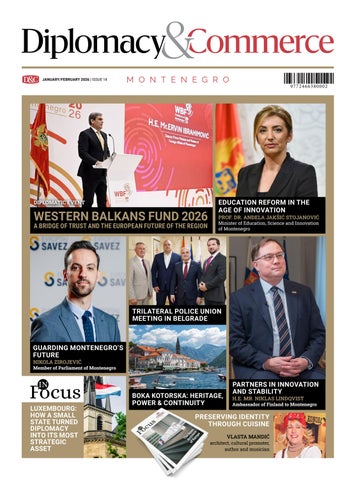
Diplomacy&Commerce Montenegro 14

Page 1


DIPLOMATIC EVENT

WESTERN BALKANS FUND 2026

A BRIDGE OF TRUST AND THE EUROPEAN FUTURE OF THE REGION

GUARDING MONTENEGRO’S FUTURE

NIKOLA ZIROJEVIĆ Member of Parliament of Montenegro

LUXEMBOURG: HOW A SMALL STATE TURNED DIPLOMACY INTO ITS MOST STRATEGIC ASSET

EDUCATION REFORM IN THE AGE OF INNOVATION

PROF. DR. ANĐELA JAKŠIĆ STOJANOVIĆ Minister of Education, Science and Innovation of Montenegro

TRILATERAL POLICE UNION MEETING IN BELGRADE

PARTNERS IN INNOVATION AND STABILITY

H.E. MR. NIKLAS LINDQVIST Ambassador of Finland to Montenegro

PRESERVING IDENTITY THROUGH CUISINE

VLASTA MANDIĆ architect, cultural promoter, author and musician

FOLLOW US TO STAY UPDATED

MILOŠ DRAGAŠ CEO dragasm@drafmedia.me

PETRA ČELEBIĆ Journalist journalist@drafmedia.me

NATALIJA PEROVIĆ Advertising Director advertising@drafmedia.me

ZORAN DRAGIĆ

Design and prepress zoran.dragic@gmail.com

Translation

Double L D.O.O.

Contributors:

Miloš Dragaš

Robert Čoban

Žikica Milošević

Print

BIROGRAF

COMP D.O.O.

Atanasija Pulje 22 Zemun

Republika Srbija

Published by:

DRAF Media d.o.o.

81100 Podgorica, Montenegro

Karađorđeva 18

VAT: 03542041

Reg. No: 51128768

Office: Karađorđeva 18

81100 Podgorica

Phone: + 382 69 220 275

CIP – Katalogizacija u publikaciji

Nacionalne biblioteke Crne Gore, Cetinje

ISSN 2989 – 2481 = Diplomacy and Commerce Montenegro (Print)

COBIS.CG-ID 26760708

International Copyright 2016-2023

Color Media Communications, Novi Sad, Serbia

Copyright for Montenegro: 2023

The Media doo, Podgorica, Montenegro

Commitment, Cooperation, and European Partnership

At the beginning of 2026, with promising developments and increasingly tangible prospects for Montenegro’s accession to the European family, the country stands at a pivotal moment that heralds a bright and prosperous future.

Our work, dedication, and resilience, combined with the natural beauty and vitality of the Adriatic, promise not only to invigorate the citizens of the European Union but also to resonate across the globe. Montenegro has, over the years, become a refuge for people of diverse nationalities, many of whom have faced adversity in their home countries. This reflects the genuine sense of justice, empathy, and solidarity that defines the Montenegrin people.

At the very beginning of the year, I had the privilege of personally participating in and facilitating an initiative in which Montenegro,

Call us or send us request on: e-mail: pretplata-dc@color.rs Phone: +381 11 4044 960

Payment Instructions: www.diplomacyandcommerce.rs/subscription

together with our friends from Serbia and Romania, demonstrated its readiness as a reliable partner by signing a landmark agreement on the Adriatic coast. This milestone underscores our determination to actively engage and contribute meaningfully to the European Union.

As we look forward, D&C Montenegro is committed to building on this momentum— promoting regional cooperation, fostering inclusive initiatives, and strengthening Montenegro’s role as a trusted partner within Europe. Together, we can ensure that the country’s natural beauty, cultural richness, and strategic vision continue to shine, serving as both inspiration and opportunity for the region and the wider world.

Regards, Miloš Dragaš

H.E. Mr. Niklas Lindqvist, Ambassador of Finland to Montenegro

Partners in Innovation and Stability

Finland and Montenegro strengthen political dialogue, Nordic cooperation and economic ties through sustainability, digitalization and multilateral engagement

From Moscow to New York, Brussels to Central Asia — Finland’s Ambassador has seen diplomacy from every angle. Now in Montenegro, he shares how global experience shapes his mission, why NATO and EU integration matter, and how culture, innovation, and green cooperation are opening new doors between the two countries.

Your diplomatic mission in Montenegro began at the end of 2023 when you arrived. Which moments in your career determined your approach to diplomacy, and how did they lead to this situation, where you became the Ambassador of Finland to Montenegro? You know, diplomatic careers of-

IN FINLAND, SOCIETY WORKS TOGETHER ON ALL ISSUES — GOVERNMENT, CIVIL SECTOR, BUSINESS, AND CITIZENS ALIKE. THAT INCLUSIVE APPROACH HAS DELIVERED STRONG RESULTS, AND I BELIEVE IT OFFERS MONTENEGRO A VALUABLE MODEL AS IT ADVANCES TOWARD EU MEMBERSHIP.

ten span many years and involve moving to different places every three or four years. So, in my case, I worked in Helsinki, then in Moscow, then in New York, then again in Helsinki, again in Moscow, and then also in Brussels. For five years I also served as roving Ambassador of Finland to Uzbekistan, Tajikistan and Turkmenistan. You really gain a lot of different

experiences along the way. And that is, in fact, the essence of a diplomatic career—to train for different things, to work on them, and to take responsibility. This is especially useful when you eventually reach a leadership position, such as ambassador, because you are then responsible for all those areas. That’s why you need to know a little about everything.

Have you noticed any significant shifts in relations between Finland and Montenegro during 2024 and 2025?

I think the biggest change is probably that, when I arrived, bilateral visits had been interrupted by the pandemic, which affected the whole world. I am very grateful that during my mandate as Ambassador the Finnish Minister of European Affairs visited Montenegro last year and the Minister of Foreign Affairs of Montenegro visited Finland in 2024. We have also had other visits from Finland: the speaker of parliament, a high level OSCE visit during the Finnish OSCE chairpersonship, and so on. So, there is great interest in developing relations.

Could Finland’s model of cross-sectoral collaboration in public policymaking be applied to Montenegro’s EU accession process, particularly in areas such as environmental law and digital governance?

I think that is truly the core of Finnish society, because we work together on all issues. It is not the state that always plays the leading role; the whole of society is involved. And not just the opposition, but also human rights organizations, the whole civil sector, and our business community. So, everyone is part of that way of working together and developing our society. Therefore, I think this is a good model for Montenegro to develop similar approach, since we have achieved good results in Finland. It’s easy to understand the advantages of that, starting with resources, for example. If the state must do everything itself, then that is a great burden.

How does Finland’s NATO membership affect its diplomatic course in the Western Balkans? That was a truly enormous change for us—joining NATO. That is something that strongly changed public opinion as well. When Russia attacked Ukraine, the Finnish population very quickly shifted to the side of those who supported joining NATO, even though there had been considerable skepticism before about whether it was necessary or not. The citizens truly saw the need for it. In just a few weeks, support for NATO membership rose to over 60 per cent. And so it happened, we entered the alliance. And we are grateful for the support we got from Montenegro in the accession process. Our Embassy in Belgrade is also a Contact Point Embassy for NATO in 2025-2026.

How do you assess Montenegro’s role in Nordic-Balkan cooperation in 2025, especially when it comes to trade and cultural exchange, which is a very important aspect of that cooperation? We work very closely with my Nordic colleagues. The four Nordic embassies have for a long time had joint projects that promote, among other things, the Green Agenda and related issues. We just finished a project called “Nordic Green and Smart Cities- Building Partnership in the Western Balkans”. We promoted

JOINING NATO WAS A PROFOUND CHANGE FOR FINLAND. AFTER RUSSIA’S ATTACK ON UKRAINE, PUBLIC OPINION SHIFTED RAPIDLY, WITH SUPPORT RISING ABOVE 60 PERCENT. WE ARE GRATEFUL FOR MONTENEGRO’S BACKING DURING OUR ACCESSION PROCESS.

the smart city concept, which is not just about technology. Today, there are many technologies that can be used for that purpose. Still, the essence lies in the planning process and in involving the entire population in shaping how the city is designed, to make it a better place to live.

In that sense, I think the Nordic countries have extensive experience and knowledge. We have already done it. We haven’t finished the whole process; we are still working on it, but we have, for example, an area in Helsinki where startups can test new applications and solutions they want to try. Then you can see whether those applications work. And that is precisely what I was talking about earlier: working together with the civil sector, the business community, and city authorities to find something that will improve things. So those are examples of that we are promoting from a Nordic perspective. And I really think we have a lot to share with Monte-

Which cultural or educational exchanges with Montenegro in 2025 or 2026 make you happiest when it comes to the future?

We are always happy to share our experiences when it comes to education. I hope we can do more around this theme in the coming years. On the cultural front, we have been quite active. Last year we celebrated the 80th anniversary of the publication of the first Moomin book by Finnish author Tove Jansson. We organized exhibitions about her life and the Moomins in both Herzeg Novi and Podgorica. In Herzeg Novi this was done in an even larger format of “Finnish Days in Herzeg Novi”. In 2026 we are planning to screen some interesting Finnish films in Montenegro.

How do you see the role of tools such as culture and events in shaping diplomacy?

negro. But not just to share—it’s a two-way process. We need to work together with Montenegro and see where we can learn from each other.

Sustainable development is a priority today. Where do you see the greatest opportunities in the Montenegrin economy for Finnish companies already present on our market, both this year and in the years ahead?

At the Embassy, we have focused particularly on sectors such as information and communication technologies, green and clean technologies, education, and innovations in general. These are areas where, in my opinion, Finland has a lot to offer and where our companies are looking for new markets. That’s why we actively promote those sectors in both Montenegro and Finland: one of our biggest challenges is that Montenegro may not be well enough known in Finland. We are also working on that kind of promotion.

They are extremely important and significant. That is a way to present your country and establish connections with other countries. It is a powerful tool. For example, last year we celebrated the 160th anniversary of our composer Jean Sibelius's birth. Through this we reached an impressive number of people. That’s how those cultural connections are created that you can build upon. And that is always something extremely valuable. This year, we plan to take part in both European Film Festival in Podgorica and the Fortezza Film Festival in Perast. We will also partner with the organizers of The Operosa opera festival in Herzeg Novi.

Looking ahead, how do you see the development of relations between Finland and Montenegro in the coming years, but also during your mandate?

For us it is very encouraging that Montenegro is proceeding towards a membership in the European Union. We are looking forward to welcoming another member. The big winners, however, will be the citizens of Montenegro. The benefit of membership is enormous not only from an economic point of view, but in the strong commitment to rule of law and democracy.

So, I expect our relations to develop in a very positive way and the cooperation between our two countries to grow significantly in the future.

Prof. Dr. Anđela Jakšić Stojanović, Minister of Education, Science and Innovation of Montenegro

Education reform in the age of innovation

From Classrooms to Competitiveness: How Montenegro Is Building Its Future Through Education and Innovation”

Prof. Dr. Anđela Jakšić Stojanović currently serves as the Minister of Education, Science and Innovation of Montenegro, a role she has held since October 2023 as part of the Government of Montenegro led by Prime Minister Milojko Spajić. In her capacity as minister, she is responsible for steering national policy in education, scientific research and innovation, with a focus on modernising Montenegro’s education system and aligning it with contemporary international standards. Her mandate includes overseeing significant infrastructure investments in educational facilities, supporting research initiatives, and advancing strategic reforms designed to strengthen the country’s knowledge economy and innovation ecosystem.

Mrs Jakšić Stojanović, you are the head of a ministry that brings together education, science and innovation. How do you define today the core mission of the Ministry in contemporary Montenegrin society?

As the Minister responsible for a portfolio that integrates education, science and innovation, I define the core mission of the Ministry today as the establishment of a system in which pupils and students are placed at the centre, and in which knowledge, creativity and innovation are acknowledged as the foundations of the sustainable development of Montenegrin society. Our priority is to ensure high-quality, accessible and safe education for all children, alongside strong support for teachers and all employees within the education system. It is precisely for this reason that, since the beginning of the mandate of the current Government, the largest

PROF. DR. ANĐELA JAKŠIĆ STOJANOVIĆ Minister of Education, Science and Innovation of Montenegro

investment cycle in the field of educational infrastructure in contemporary Montenegro has been under way. To date, more than EUR 100 million has been allocated in the reconstruction and adaptation of existing facilities, as well as in the commencement of construction of new buildings at all levels of education – from pre-school, through primary and secondary education, to higher education – and significant capital investments will continue in the coming period.

At the same time, we are placing strong emphasis on the enhancement of research and innovation infrastructure, as well as on providing systematic support to researchers and innovators. Our objective is to further strengthen the educational, scientific research and innovation community, encourage excellence, and develop Montenegro as a country of knowledge, science and innovation.

The education system is often referred to as the foundation of the long-term development of a state. Which reform priorities do you consider to be the most important at this moment, and why?

The education system constitutes the foundation of societal development in every respect. Today, all developed countries have strong education systems, which serve as a driving force for the development of society as a whole, precisely through the holistic upbringing and education of children and young people. At this very moment, it is of paramount importance to strengthen educational infrastructure, modernise existing facilities and construct new objects equipped with the most advanced equipment and teaching resources, in order to create the necessary preconditions for the forthcoming reform of the education system.

The reform steps envisaged by the Education Reform Strategy 2025–2035 include: the adoption of the National Curriculum Framework; alignment of the scope and structure of curricula at all levels of education with best international practices; the development of a methodological framework and quality standards for subject curricula; the development of programmes for cross-curricular themes; the preparation of new subject curricula; as well as the development

OUR MISSION IS TO PLACE PUPILS AND STUDENTS AT THE CENTRE, WITH KNOWLEDGE, CREATIVITY AND INNOVATION AS THE FOUNDATIONS OF MONTENEGRO’S SUSTAINABLE DEVELOPMENT.

of new textbooks. It is precisely these activities that will enable the creation of a high-quality and inclusive education system that will be accessible to every child in Montenegro.

Science and research are inextricably linked to the quality of education. How is the Ministry working to strengthen the relation between educational institutions and the scientific research sector?

Science and research constitute the foundation of educational quality, which is why the Ministry of Education, Science and Innovation is acting in a structured and systematic way to strengthen links between educational institutions and the scientific research community, employing both a strategic and a strongly practice-oriented approach. Through calls for proposals that the Ministry regularly launches in the field of scientific research activity, in line with the Strategy for Scientific Research Activity, the priority area identified is “Science, Education and Culture”. This clearly demonstrates the State’s commitment to ensuring that research processes are directly linked to the improvement of the education system and the development of a knowledge-based society. It is particularly important to emphasise that Montenegro is currently undergoing a comprehensive reform of the education system for the period 2025–2035. In this context, research in the field of education addressing the digitalisation of teaching, lifelong learning, bilingual and dual education, as well as contemporary pedagogical approaches, has been recognised as essential for the formulation of high-quality, empirically grounded education policies.

It is important to highlight that among the postdoctoral research projects for excellence funded by the Ministry, there is also a project in the field of education focused on one of the most upto-date issues in contemporary education – the impact of digital technologies and artificial intelli-

gence on young people’s learning. This project, inter alia, examines and analyses how smartphones and artificial intelligence tools, including ChatGPT, affect the attention and learning outcomes of secondary school students, as well as the ways in which these tools can be responsibly and effectively integrated into the teaching process in Montenegro. The particular value of this research lies in the fact that, for the first time, it systematically analyses the effects of measures such as the ban on smartphones in schools, drawing on empirical evidence relevant to public policy-making.

In parallel, special attention is devoted to work with children and young people. Over the course of the year, the Directorate for Scientific Research Activity also launched a literary competition for primary and secondary school students on the theme “Women in Science – Inspiration for the Future”, with the objective of promoting role models in science, advancing gender equality, and encouraging children’s and young people’s interest in scientific creativity. In addition, within the framework of the Science and Innovation Festival, efforts were made to bring science and innovation closer to primary and secondary school students and to encourage them to consider future careers in these fields. Furthermore, activities such as Girls in ICT Day additionally contribute to breaking down stereotypes and encouraging girls to pursue STEM fields. All of these, together with numerous other initiatives, form part of the Ministry’s integrated approach aimed at strengthening the connection between science, education and society, with the clear objective of ensuring that knowledge, research and innovation serve as drivers of Montenegro’s long-term development.

Innovation has become a key factor in the competitiveness of small states. How can Montenegro develop its innovation potential under conditions of limited resources?

When discussing the competi-

tiveness of small states, we must be realistic. Montenegro does not enjoy the advantages of scale, nor the budgetary capacity available to large economies; therefore, growth can be built exclusively on high-quality and innovative solutions. In this context, investment in innovation is a developmental necessity.

This approach is clearly embedded in the Science and Innovation Programme 2026–2030, which introduces a unified, multiannual framework for investment in research and innovation, with a clear focus on economic competitiveness and the return on invested funds. The Programme envisages an indicative financial framework of over EUR 131 million for the period 2026–2030, of which EUR 90 million is allocated to strengthening the innovation capacities of the economy, and EUR 41 million to the development of scientific infrastructure and human resources. The Reform Agenda of Montenegro 2024–2027 (EU Growth Plan), in particular Reform 1.2.2 “Further development of the research and innovation ecosystem for a knowledge-based economy”, foresees an increase in investment in research and development and the strengthening of the scientific and innovation community in Montenegro. At the same time, in the previous period we have witnessed a clear upward trend in investment in research and innovation. The continuous growth in financial allocations for science, innovation and technological development can be traced back to 2021, when the national research and innovation system began operating under a new framework for the implementation of innovation policy and smart specialisation, and when programme-based budgeting was introduced in Montenegro. The research and development budget followed the trajectory below: in 2021, it amounted to EUR 5,012,422.27; in 2022, it amounted to EUR 7,717,132.78; in 2023, it amounted to EUR 12,562,547.49; in 2024, it amounted to EUR 14,997,925.29; in 2025, it is projected at EUR 15,352,543.66, with an additional increase of EUR 6.9 million from a special economic citizenship programme supporting the development of innovation.

STRONG INFRASTRUCTURE AND MODERN CURRICULA ARE THE PRECONDITIONS FOR BUILDING A HIGH-QUALITY, INCLUSIVE EDUCATION SYSTEM ACCESSIBLE TO EVERY CHILD.

This demonstrates that the system is being built not declaratively, but substantively.

This framework is directly linked to the process of drafting the new Smart Specialisation Strategy 2026–2031, which is currently at an advanced stage of preparation. The first Strategy laid the foundations of the system: institutions were established, financial instruments were introduced, cooperation between science and the business sector was strengthened, and Montenegro’s participation in European programmes increased, including more than EUR 3.8 million secured from Horizon Europe for 28 projects. In addition, during the implementation of the Smart Specialisation Strategy of Montenegro 2019–2024, a total of over EUR 167 million was invested in strengthening innovation and RDI capacities, infrastructure development, and the stimulation of the innovation ecosystem. This figure reflects total investments in the implementation of the Strategy from its adoption in 2019 through to 2024 and represents one of the most significant national investments in the development of research, innovation and competitiveness in recent years.

Today, as a result of the Smart Specialisation Strategy 2019–2024 and the considerable effort invested in establishing a stable national framework for innovation development, we have a more developed innovation ecosystem than several years ago; however, we still face a low level of private investment, amounting to only 0.20% of GDP, and cooperation between science and business at around 33% of the EU average. We are determined to improve this further. This is why the Programme 2026–2030 and the new S3 are oriented towards the same objectives: strategic focus, measurable outcomes and market impact. For a small state, this is the only sustainable route. For this reason, I believe that investment in innovation represents the most rational means for Montenegro to strengthen its competitiveness.

One of the major challenges facing Montenegrin society is the retention of young and educated people. What role do education and science policy play in this process?

The retention of young and educated people is one of the key development issues of contemporary Montenegrin society, and education and science policy play an exceptionally important role in this process. Our strategic commitment is unequivocal – to provide young people with stability and the opportunity to develop scientific research careers in Montenegro, while maintaining openness to international academic mobility and the exchange of knowledge. It is for this reason that the Strategy for Scientific Research Activity of Montenegro 2024–2028 identifies the strengthening of human resources in science as one of its central strategic objectives, and the Ministry of Education, Science and Innovation is implementing this objective through several complementary and carefully designed programmes.

First and foremost, the Programme of Excellence Scholarships for Doctoral Research in Montenegro is aimed at retaining young researchers in the country by providing financial security, high-quality research conditions and strong mentoring support. Through this programme, young doctoral candidates are enabled to develop scientific research careers in Montenegro, while establishing links with international partners and the business sector, thereby helping to create an attractive and sustainable research environment.At the same time, we are aware that international experience is an indispensable component of contemporary scientific careers. For this reason, the Programme of Excellence Scholarships for Doctoral Research Abroad has been established; it does not encourage “brain drain”, but rather promotes the concept of knowledge circulation. This programme enables Montenegrin doctoral candidates at universities abroad to remain strongly con-

nected to the domestic scientific research system and to return the knowledge, skills and international contacts they acquire to Montenegro through cooperation, joint projects and academic engagement.A particularly important link in the retention of young people is also the Programme for Financing Postdoctoral Research for Excellence, which is intended for early-career holders of doctoral degrees. Through this programme, conditions are being created for the very first time in a systematic manner for postdoctoral researchers to lead their own research projects, form research teams and develop independent scientific careers in Montenegro, with a strong international and business component. This sends a clear message that the State recognises and supports excellence, as well as the longterm professional development of young scientists. All of these direct measures, together with numerous other calls that encourage the involvement of young researchers, form a coherent system of science policy that conveys to young people that Montenegro wants, is able, and is willing to invest in its talents. This is not solely about financial support, but about creating an environment in which research careers are recognised, valued and sustainable. It is precisely this very approach that we see as one of the principal mechanisms for retaining young and educated individuals and for the long-term development of a knowledge-based Montenegrin society.

From the perspective of longterm development of the state, to what extent do education, science and innovation represent a strategic commitment of Montenegro for you, rather than merely a sector of public policy?

From the long-term perspective of state development, I do not regard education, science and innovation as merely one of the sectors of public policy, but rather as the cornerstone and strategic direction of Montenegro’s future development. These are areas in which we do not manage only resources, but time itself, because what we invest in knowledge today returns tomorrow in the form of stability, resilience and freedom of choice. For this reason, education, science and innovation constitute a domain where the past and the future encounter – a place where values are well-preserved, while new ideas are born. They determine the kind of institutions we build, the type of economy we develop, and the nature of our relationship with a world undergoing rapid change. Our responsibility is not to remain passive observers of change, but its active architects. By investing in knowledge and innovation, Montenegro chooses development grounded in knowledge and innovation, ethics and creativity, and affirms its commitment not to leave its future to circumstance, but to build it thoughtfully, over the long term, and in line with the values of contemporary society. In this sense, education shapes the character of society, science the depth of society, and innovation its speed and relevance.

Photo:

Trilateral Police Union Meeting in Belgrade

Union of the Police Administration of Montenegro as an impulse to Regional Cooperation and the European Path

From January 23 to 24, 2026, in Belgrade, at the headquarters of the Independent Police Union, a trilateral working visit was held with delegations of the Romanian Police Union and the Trade Union of the Police Administration of Montenegro. The host of the meeting was Mr. Goran Lazić, Chairman of the Presidency of the Independent Police Union, whose engagement and institutional authority gave particular significance to this international gathering and reaffirmed the Union’s openness to strengthening re-

gional and European cooperation.

The delegation of the Romanian Police Union was led by Popa Cristian Eduard , who holds prominent international positions, including serving as President of EUROPOL IGPF, the International Police Association –IGPF, and CNP IGPF (National Corps of Police).

The Trade Union of the Police Administration of Montenegro was represented by its President, Mladen Šuškavčević , who is also a representative of the Council of European Police Unions (CESP), thereby providing the meeting with additional European institutional relevance.

A special dimension to the meeting was added by the presence of media and strategic communications expert Miloš Dragaš, owner of DRAF MEDIA, who was elected Vice President of Prosafe Global Alliance on that occasion, reflecting the trust placed in his role in shaping the international communication and organizational strategy of the future platform.

During the delegations’ stay in Bucharest, the non-governmental organization Prosafe Global Alliance was formally established, with the mission of strengthening family protection, enhancing societal security, and developing international partnerships based on shared values and professional standards.

At the initiative of Mr. Šuškavčević, who was among the first to recognize the strategic importance of regional cooperation and stronger institutional networking, it was agreed that the trilateral agreement would be signed in Montenegro, as the country from which the initiative gained its institutional momentum. In this way, Montenegro is positioned as an important regional pillar of future cooperation and a future member of Prosafe Global Alliance, with the potential to become one of the key drivers of the platform’s development in the Western Balkans.

In the context of Montenegro’s European integration process, this initiative further confirms its commitment to European values, the strengthening of international cooperation, and the development of stable security mechanisms. This step clearly demonstrates the intention not only to remain on the European path, but to actively reinforce it through concrete regional and international initiatives that contribute to the security and stability of society.

Photo:Diplomacy and Commerce Montenegro
MLADEN

Guarding Montenegro’s Future

Mr. Zirojević discusses challenges in national security, the role of institutions, and the path toward prosperity

Nikola Zirojević, one of the youngest Members of the Parliament of Montenegro, speaks about the values that guide his political work, the challenges of youth in politics, and the responsibilities of serving as Deputy Chair of the Security and Defence Committee. In this conversation, he reflects on Montenegro’s path toward European integration, the importance of stability and security, and the need for authenticity and openness in public life.

Mr Zirojević, as a Member of Parliament in the Parliament of Montenegro and a public political figure, how would you briefly describe today your political focus and the values that guide you in your parliamentary work? The values of an independent, civic, European, Euro-Atlantic and antifascist Montenegro are the values that guide me personally, as well as the political entity I represent, in an ideological sense. If we reduce this to fully personal, and less political values, then these are honest and conscientious work in whatever position one may hold, openness towards everyone, immediate contact with citizens, and willingness to accept all forms of criticism and suggestions. I resolutely believe that these are values that are appreciated today and values that Montenegrin society requires, particularly when it comes to people who engage in politics and hold certain positions. In relation to this context, the focus is clear – Montenegro as a modern, civic society, in which there is room for everyone, regardless of one’s name or personal identity; Montenegro as a good neighbour to all, a reliable NATO partner, and Montenegro as the next member state of the European Union. Certainly, at the domestic level, my primary focus is on the economic empowerment of the individual, an improved standard of living for citizens, a safe society and prosperity in every sense, without neglecting any segment.

MONTENEGRO MUST BE CIVIC, EUROPEAN, AND OPEN. FOR ME, POLITICS MEANS HONEST WORK, DIRECT CONTACT WITH CITIZENS, AND READINESS TO ACCEPT CRITICISM.

You are considered one of the younger Members of Parliament in Montenegro. Do you perceive youth in politics as an advantage, a challenge, or an additional responsibility, especially in a sys-

tem long marked by continuity of the same political actors?

The most accurate and sincere answer would be – I perceive youth as a combination of everything you have mentioned. When

we speak of energy, a desire for change, a desire to contribute and to improve society, as well as the fact that young people do not carry the burden of the past unlike our older colleagues, these are undoubtedly advantages. On the other hand, a lack of experience, not only professional but also life experience, can – though does not necessarily have to –represent a serious challenge for someone who enters the world of politics at a young age, a world that is often very harsh and unforgiving of mistakes. Finally, there is certainly an additional responsibility, because those of us who are not associated with anything negative and who are new or relatively new on the political scene are expected to deliver the most, in a positive sense. If we add to this the fact that we are a society long marked by the continuity of the same political actors, that responsibility becomes even greater.

You have been appointed Deputy Chair of the Security and Defence Committee, which also includes participation in the National Security Council. How do you perceive this responsibility, and which security-related issues do you consider a priority for Montenegro?

The fact that I have been elected Deputy Chair of the Security and Defence Committee, and consequently a member of the National Security Council, I perceive as the culmination of my work to date, as it truly is the most serious and responsible position I have held so far. Regardless of the fact that I am relatively young for politics and for this position, I believe that it would represent an equal honour and challenge even for much older colleagues with far more parliamentary experience than I have. However, given that security is an area to which I devote primary focus in my political engagement, this is a position to which I will dedicate myself with

YOUTH BRINGS ENERGY AND FREEDOM FROM THE PAST, BUT ALSO RESPONSIBILITY. WE ARE EXPECTED TO DELIVER THE MOST, AND TO PROVE POLITICS CAN BE CLEAN.

great commitment and passion, and I believe that the results of my work will also serve as an example, in line with such an approach. A fact on which Montenegrin society is generally in agreement is that the security situation in Montenegro is not satisfactory. Just as I have placed the individual at the centre of every role I have undertaken, I apply the same principle to the field of security. On the one hand, you have citizens who generally do not feel safe on Montenegrin streets for various reasons, and on the other hand you have members of the security sector who are largely understaffed and predominantly underpaid. Therefore, in order to improve the security situation in Montenegro, we must improve the status and standard of living of members of the security sector – the Police Directorate, the Armed Forces of Montenegro, and the National Security Agency. In parallel, we must improve their working conditions, as well as the reputation these officers enjoy within society. Only then can we expect full staffing of this sector, which will ultimately lead to a significantly higher level of overall security in Montenegro.

The process of European integration remains Montenegro’s strategic priority. From the parliamentary perspective, what do you consider to be the key challenges on the path towards EU membership, and what is the role of the legislative authority in restoring credibility to this process?

I believe that, at this moment, political instability represents the main challenge on Montenegro’s path towards the European Union. Everything else, I would say, is much more easily attainable. The fact is that the doors of the EU are today wide open to Montenegro and that, for the first time, if not greater, then at least an equal level of readiness and willingness exists on the part of official Brussels for us to become a member state, compared to our own. To such an extent that, I believe, they would even

be willing to turn a blind eye to certain segments in which we may not fully meet expectations. However, if there is no political stability in Montenegro and no clearly expressed readiness of political elites for this country to become the next EU member state, I fear that this could cost us dearly. Therefore, I believe that for accession to the EU, Montenegro needs a stable, fully and genuinely European-oriented parliamentary majority.

In your public appearances, you frequently emphasise the importance of the values upon which the European Union is founded. In your opinion, to what extent are European standards of the rule of law and institutional accountability genuinely integrated into Montenegro’s political system today? I believe that European standards of the rule of law and institutional accountability, as well as numerous other European standards, are not sufficiently integrated into the Montenegrin political and social system, nor into society as a whole. I see this as a serious problem. I am one of those politicians who do not consider Montenegro’s merely formal accession to the EU to be a particularly significant achievement. For me, far more important than formal accession itself are the reforms that we need to implement within our society and state apparatus. It is a fact that Montenegro has a considerable number of good and high-quality legislative solutions; it is also a fact that a significant number of these legislative solutions are fully or predominantly aligned with the requirements and expectations of our European partners. However, the discouraging fact is that these legislative solutions have not been implemented or enforced. For me, this must be the focus during this year and in the years to come, and I would rather wait an additional year or two for full membership if that would entail genuine and substantive implementation of reforms, than formally accede as soon as possible while being fundamentally unprepared for such accession.

It is well known that you have a strong personal connection to music and that you play the accordion, something you have spoken about publicly on several occasions. Does this space outside politics help you maintain a sense of balance, authenticity and connection with people, which politics often distances from the everyday lives of citizens?

Engaging in music, or any other form of art, implies creativity and authenticity. Therefore, I would say that this is indeed true – the fact that, in addition to engineering, for which I was educated, and politics, which I have been professionally engaged in for some time, I also pursue music as a hobby contributes to authenticity, maintaining a sense of balance and, certainly, a connection with people for whom politics is not particularly close. I believe this is very important, as for a long time there has been a prevailing perception in Montenegro of politicians being detached from citizens, and I strive to change that perception. It is best changed through example, by showing citizens that, apart from the different profession we practise, we are in fact entirely the same as they are. I endeavour to do this not only through music, but also through my everyday life and the way I live it.

Finally, what message do you consider most important for young people in Montenegro who approach politics with reservation or distrust, but are considering more active participation in public life?

I always tell young people that their participation in public life is of immense importance for themselves, for society as a whole, and for the state of Montenegro. I am aware that it is not easy to make the decision to “enter the ring”, because the fight is often dirty and goes beyond the boundaries of good taste. I am also aware of the fact that it is generally not opportune, because tomorrow, as a politically labelled individual, it becomes much more difficult to succeed in another profession if one grows tired of politics. Unfortunately, I am also aware of the fact that in Montenegro politics is generally treated as a “dirty” business. Precisely because I believe that Montenegrin politics needs as many clean individuals as possible, regardless of their political affiliation, I believe it is crucial that my generation, younger and future generations contribute as many capable and high-quality individuals as possible, so that this country may progress year after year and become a better place to live for all of us.

Heritage, Power and continuity

A maritime crossroads where geography, empire, and cultural memory shape Montenegro’s enduring influence in the Adriatic

Boka Kotorska (the Bay of Kotor) occupies a singular position on the geopolitical and cultural map of the Mediterranean. Situated on the south-eastern coast of the Adriatic Sea, within the borders of contemporary Montenegro, Boka represents a remarkable synthesis of natural geography, historical power and enduring institutional recollection. Often described as Europe’s southernmost fjord—although geologically it is a river-carved canyon rather than a true glacial fjord—Boka Kotorska consists of four interconnected basins: the Bay of Herceg Novi, the Bay of Tivat, the Bay of Risan and the Bay of Kotor. This intricate maritime system has, for centuries, shaped political authority, trade routes, military strategy and cultural continuity in the region.

From antiquity to the modern era, Boka Kotorska has not functioned as a peripheral coastal zone, but rather as an intermediary nexus between empires, civilisations and legal systems. Its strategic value is grounded in three immutable factors: deep natural harbours, terrain of pronounced defensive advantage and proximity to key Adriatic and Mediterranean routes. These characteristics enabled various states and local communities to develop com-

plex administrative, economic and cultural structures, positioning Boka as a prominent centre of regional influence and power. Historically, the area of the Bay of Kotor was subject to a succession of governing sovereignties, including the Illyrians, Romans, Byzantines, Venetians and the Habsburg Monarchy, as well as brief periods of French and Austrian control during the eighteenth and nineteenth centuries. Each of these phases left a lasting imprint on the urban fabric, architecture and loc al institutions. Cities such as Kotor, Perast, Herceg Novi and Tivat have preserved layered ensembles of fortifications, churches and palaces that testify to the continuous presence of administrative and economic elites over the centuries.

The cultural identity of Boka, particularly within Orthodox, Catholic and Muslim communities, developed through interaction with regional and Mediterranean powers. The city of Kotor, inscribed on the UNESCO World Heritage List since 1979, stands as a symbol of preserved urban continuity, where medieval streets, city walls and ecclesiastical buildings bear witness to a complex blend of local and international influences.

Economically, Boka has historically functioned as a commercial centre owing to its secure harbours and extensive network of maritime connections. Venetian administration, which lasted for almost four centuries (1420–1797), significantly shaped institutional practices, commercial privileges and military organisation, leaving an indelible mark on the administrative culture of the bay.

Contemporary Boka Kotorska represents a convergence of historical heritage and current strategic relevance. Despite its small territorial size, its geopolitical position remains fundamentally important for Montenegro and the broader Adriatic region. The Port of Kotor and the modern Tivat Airport make Boka a strategically important point for international trade, tourism and regional cooperation, while its cultural and natural attractions draw global attention and position the bay as an informal “soft power centre” of Montenegro. Politically, Boka Kotorska and its towns have historically retained a distinct form of local autonomy, as a result of complex legal traditions originating from the Venetian period. Networks of brotherhoods, ecclesiastical institutions and local administrations continue to function as

stabilising forces within the social and political order. Kotor, Perast and Herceg Novi preserve institutional memory that enables continuity of local governance, effectively balancing state authority with local interests.

Economically, Boka Kotorska relies on a combination of maritime capacity, luxury tourism and cultural heritage. The Port of Kotor, one of the deepest and most sheltered natural harbours in the Adriatic, facilitates the reception of international ships and yachts, while the Porto Montenegro infrastructure in Tivat serves as a magnet for global luxury tourism. These factors render the bay economically vital to Montenegro, while simultaneously strengthening regional influence through trade and investment channels. From a diplomatic perspective, Boka Kotorska functions as a natural platform for multilateral initiatives. Its geographical position between the Adriatic Sea and the Balkan hinterland allows Montenegro to balance relations with neighbouring states, EU institutions and international maritime organisations. At the same time, its opulent cultural heritage—including UNESCO protection of Kotor—provides additional symbolic weight in

the international promotion of Montenegro and its Mediterranean identity.

Continuity of power in Boka Kotorska lies not solely in infrastructure or geography, but in the ability of the local community to integrate historical traditions into contemporary administrative and diplomatic functions. This phenomenon can be interpreted as a specific form of “soft power”, whereby cultural capital, historical legacy and strategic position jointly generate long-term stability and regional influence. For Montenegro, preserving this continuity represents a key element in defining national identity, strengthening its international standing and maintaining internal stability.

In conclusion, Boka Kotorska is not merely a natural bay or a cultural heritage site. It is a model of continuity in which history, power and diplomacy intertwine, enabling a small state to maintain global relevance through locally embedded centres of influence. For diplomats and strategists, understanding Boka entails recognising how small territories can shape and balance geopolitical currents, preserving their own autonomy by means of cultural memory and institutional continuity.

At the meeting of sea and stone, a bell tower keeps watch over crimson roofs and quiet waters. The mountains loom like guardians, while the bay mirrors their strength, creating a tableau where history and nature breathe in unison.

Competing on the world stage: discipline beyond the court

Carrying Montenegro’s flag across the world stage, Danka Kovinić reflects on discipline, identity, and legacy

Danka Kovinić has carved her place on the international tennis stage as Montenegro’s most accomplished athlete. From overcoming the challenges of emerging from a small country with limited tennis infrastructure to competing against the world’s best, her career reflects discipline, resilience, and national pride. In this interview, she speaks candidly about the lessons of perseverance, the importance of mental strength, and her enduring commitment to promoting Montenegrin identity through sport.

MENTAL RESILIENCE AND EMOTIONAL STABILITY ARE OFTEN OVERLOOKED, YET THEY ARE DECISIVE IN TENNIS. I PREFER TO FACE CHALLENGES INDEPENDENTLY, USING EXPERT GUIDANCE ONLY AS A REFERENCE TO REGAIN FOCUS AND BALANCE.

Danka, you are active on the international tennis scene and recognised as one of the most successful Montenegrin athletes. How do you perceive your professional role in tennis today? Coming from a small country in which tennis is still underdeveloped was far from straight-

forward and presented considerable challenges. After fifteen years of continuous professional involvement in tennis, I can say that I am content with the level of professional achievement attained so far. After so many years competing on the international professional tennis cir-

cuit, in the years ahead I would like to pass on my knowledge and experience to younger generations of players in Montenegro and, together with others, contribute to the broader promotion and development of tennis.

Throughout your career, you have competed at the most prestigious tournaments and played against the world’s leading tennis players. What has professional tennis taught you about discipline, focus, and personal responsibility? From a very young age, tennis served as a foundation for all the

HAVE ALWAYS BEEN A PROUD REPRESENTATIVE OF MONTENEGRO. ESTABLISHING OUR PRESENCE ON THE INTERNATIONAL TENNIS MAP IS MY PERSONAL CONTRIBUTION TO THE VISIBILITY OF MONTENEGRIN SPORT.

values you have mentioned. At certain moments I was aware of learning a particular lesson, but in most cases this development occurred organically over time, through daily professional and personal commitments, growing responsibilities, and a constant drive for personal and professional advancement. Long-term perseverance and unwavering persistence are perhaps the qualities that played a defining role in shaping me as an athlete.

Tennis is an individual sport in which mental stability is crucial. How do you work on maintaining self-confidence and inner balance during the competitive season?

This is a crucial and often decisive component in tennis and in sport in general. Many coaches, and players as well, tend to overlook the importance of mental resilience and emotional stability. Naturally, I have made use of professional sports psychology support, but always in a measured and balanced manner. I prefer to address and overcome challenges independently, while professional guidance and expert insight served as clear reference points, helping me

regain focus and competitive balance. This approach suited me best, perhaps also because I compete independently on court and prefer to take full responsibility for my own decisions.

You are recognised for strongly emphasising your affiliation with Montenegro and for consistently representing your country with pride. How important is it to you to promote Montenegrin identity internationally through sport? I am pleased if I am perceived and acknowledged in that way by the wider public. I have always been a deeply proud representative of Montenegro and always will be. Establishing Montenegro’s presence on the international tennis map represents my personal contribution to the development and visibility of Montenegrin sport. A particularly telling detail is that, for my debut appearance at a Grand Slam tournament, I was unable to submit my application online, as our country was not listed among the participating nations. Today, a new generation of Montenegrin players will not encounter that obstacle.

How much does the support coming from Montenegro mean to you, and do you feel a special responsibility when competing under the national flag? Unfortunately, tennis offers very limited opportunities to compete directly under national team colours, as is the case in team sports. However, in every match, next to my name, there is the flag of Montenegro, and I always feel a strong sense of responsibility combined with national pride when representing my country on the international sporting stage. That feeling has continued to intensify as the years have passed.

When we speak about professional success in sport, what does success represent for you today? Every single day of training and preparation, personal sacrifice and dedication, tears, competitive victories, and career trophies represents a success. Success ex-

tends far beyond what is presented to the public through televised broadcasts during a final. What I am referring to is something every professional athlete will immediately recognise.

Photo:

Mladen Rakčević, Former Professional Handball Player and Winemaker

Building a brand rooten in tradition and performance

From Handball Courts to Vineyards: A Winemaker’s Story of Tradition and Transformation

Mladen Rakčević’s journey is one of striking contrasts — from the intensity of professional handball to the quiet dedication of winemaking. Born in Cetinje, he grew up in a city where tradition and resilience are woven into everyday life. Years spent competing for the Montenegro national team and international clubs shaped him with discipline, perseverance, and a sense of identity that would later guide his second career. When the time came to retire from sport, Rakčević carried those values back to his family estate in Smokovac, where vineyards and stone walls held the memory of generations before him.

There, he undertook the demanding task of restoring the land, reviving autochthonous grape varieties such as Vranac, and blending them with international ones like Merlot and Cabernet Sauvignon. His approach balances heritage with innovation, creating wines that speak both to local roots and to a global audience. Each bottle from the Rakčević Winery is more than a product — it is a narrative of culture, place, and identity, infused with the same discipline that once defined his life on the court.

Rakčević’s story is not only about wine, but about transformation: the passage from arenas filled with noise and adrenaline to vineyards where patience and silence reign. It is about honoring family legacy while carving out a new path, proving that the rhythm of hard work and love for the land can be just as powerful as the roar of sport.

Behind you is a long professional handball career, including stints with international clubs

LIKE TO SAY THAT PROFESSIONAL ATHLETES ARE LIKE SOLDIERS — ORDER, HARD WORK, AND DISCIPLINE. THESE VALUES SHAPED ME, AND WHAT I WANTED TO TRANSFER INTO MY WINE STORY IS PRECISELY THAT SENSE OF RESPONSIBILITY AND CONTINUOUS WORK ON IMPROVEMENT, OF COURSE ACCOMPANIED BY LOVE FOR WHAT YOU DO.

and the Montenegro national team. Which period of your sporting career left the deepest mark on you, and why? Every period of my career has its own weight, that is, its own role in shaping me both as a player and as a person. Starting with my very first handball steps at

Handball Club Lovćen, followed by my call-up to the first team of Handball Club Lovćen at the age of 17. During that six-year period playing for Lovćen, I also received calls to the cadet and junior national teams of the former Yugoslavia, a call-up to the senior national team of Serbia

and Montenegro, and ultimately the fulfilment of a dream — the call to become a member of the Montenegro national team. Therefore, every club I played for had an important role in my personal and professional development.

Professional sports demand discipline, consistency, and resilience. Which values have you directly transferred from the court to the business you run today?

I like to say that professional athletes are like soldiers. Order, hard work and discipline. Naturally, these values shaped me as well, and what I wanted to

MLADEN RAKČEVIĆ Former Professional Handball Player and Winemaker

transfer into my wine story is precisely that sense of responsibility and continuous work on improvement, of course accompanied by love for what you do.

The decision to end your sporting career and return to Smokovac was a major personal turning point. At that moment, what was the deciding factor that made you turn toward your family land and winemaking?

* That decision did not come suddenly. In fact, I had been dreaming about creating a wine story in my village of Smokovci for around fifteen years before it actually began. I wanted to restore the old house and the vineyards, continue the family tradition, and at the same time position myself exactly there — living with nature and living from nature.

The Rakčević Winery was born on a family estate and has built a recognizable identity. What did the journey look like—from the initial idea to the first harvest and the very first bottle of wine?

Analyses show that it is only the third generation that can truly benefit from a wine story. I would like to emphasise that it was demanding on several levels to restore the house, the estate and the vineyards, as well as to embark on a certain modernisation of the winery and the wine production pro-

cess, while at the same time preserving part of the tradition and the love for heritage and wine.

The names of your wines, such as "Pečalbar" and "Smokovac," carry strong symbolism. What family and personal stories do these names preserve, and why was it important for you to pour those stories into your wine?

Yes, at this moment we have three red wine labels. Pecalbar is inspired by my great-grandfather, who went abroad to work in America at the beginning of the 20th century, working in mines and sending money home so that the present-day house could be built. Smokovac is similarly inspired by the surname our family carried until around 150 years ago. A fourth wine label is planned to be released very soon, to be called Iskra, inspired by the name of my daughter.

In your vineyards, you grow indigenous varieties—primarily Vranac—alongside international ones. How do you strike a balance between honoring tradition and adopting a modern approach to winemaking?

This area is well known for its wine tradition. The dominant varieties traditionally planted were Vranac and Kratošija. I added Cabernet Sauvignon and Merlot — French varieties — while care-

THAT DECISION DID NOT COME SUDDENLY. IN FACT, I HAD BEEN DREAMING ABOUT CREATING A WINE STORY IN MY VILLAGE OF SMOKOVAC FOR AROUND FIFTEEN YEARS BEFORE IT ACTUALLY BEGAN. I WANTED TO RESTORE THE OLD HOUSE AND THE VINEYARDS, CONTINUE THE FAMILY TRADITION, AND AT THE SAME TIME POSITION MYSELF EXACTLY THERE — LIVING WITH NATURE AND LIVING FROM NATURE.

fully preserving our autochthonous ones. In our blends, you can predominantly feel the indigenous varieties, above all Vranac, with its fullness and strength characteristic of this karst terrain, as well as subtle notes of Merlot and Cabernet Sauvignon, which together create an elegant yet distinctive wine.

Your wines have already been recognized and awarded at regional wine festivals. How do you define the success of the Rakčević Winery today—is it through accolades, quality, consistency, or the continuation of a family legacy?

Through our hard work and the quality with which we positioned ourselves on the wine map of Montenegro, we were also fortunate that our wines received prestigious awards at the regional level. Knowing that the wine story is, in essence, a story of generations, we are satisfied with how we have so far penetrated the market. What will continue to define us in the future is hard work, dedication and unconditional love for vineyards and wine. We will continue to listen carefully to our loyal consumers and strive to improve in quality year after year, never allowing production volume to compromise quality or our love for wine. Our winery is limited to an annual production of up to 3,000 bottles, which we consider to be the optimal quantity for maintaining and further improving the overall quality and story.

Western Balkans Fund 2026

A bridge of trust and the European future of the region

Montenegro assumes chairmanship of the Western Balkans Fund, pledging concrete results and stronger regional ties

Deputy Prime Minister and Minister of Foreign Affairs of Montenegro, Ervin Ibrahimović, today inaugurated the event marking the beginning of Montenegro’s chairmanship of the Western Balkans Fund 2026, emphasizing that assuming this responsible role represents both an honor and an obligation for Montenegro toward the region and its European future.

In his address to the attendees, Minister Ibrahimović highlighted that Montenegro has consistently built a reputation over the past two decades as a reliable and responsible partner in the region, committed to political dialogue, good neighborly relations, and stability. “Our European path is clear, steadfast, and unwavering. Today, Montenegro stands at the threshold of the European Union, confirming its role as a leader in the accession pro-

cess,” the Minister underlined. He recalled that the Western Balkans Fund holds particular significance as an authentic regional initiative, focused on people and their needs.

Speaking on the priorities of Montenegro’s chairmanship, the Minister emphasized that the focus will be on achieving concrete results, enhancing the visibility

of the Fund, and strengthening the principles of regional ownership. Special attention will be given to deepening cooperation through inclusive projects, building the capacities of grant recipients for sustainable and measurable impact, and positioning the Fund more strongly within the European and international framework.

Minister Ibrahimović expressed gratitude to the European Commission, the Swiss Confederation, Japan, and the Visegrad Fund for their continuous and principled support of the Western Balkans Fund, noting that their partnership represents a reaffirmation of trust in regional cooperation and the European perspective of the Western Balkans.

Concluding his address, the Minister stressed that the strength of the region is not measured by differences, but by the ability to transform them into advantages. “Our vision is of a Western Balkans rooted in European values, mutual respect, and shared responsibility. Together, we can build a stronger Fund, a more connected region, and a Western Balkans firmly anchored in the European family,” Ibrahimović stated.

A welcoming speech was also delivered by Gjergj Murra , Executive Director of the Western Balkans Fund, highlighting the importance of continuously strengthening regional cooperation through concrete and inclusive projects that connect citizens, institutions, and civil society across the Western Balkans.

As part of the program, MOVE grants were awarded to recipients from Montenegro, further underlining the commitment to empowering mobility, exchange, and cooperation among youth and organizations in the region. During the ceremony, the partnership with the Swiss Agency for Development and Cooperation was renewed for the 2026–2029 period. At the same time, the first Cooperation Agreement between the Federal Republic of Germany and the Western Balkans Fund was signed, further reinforcing a stable, resilient, and interconnected Western Balkans based on mutual respect and a shared European future. The program continued with a panel discussion entitled “Enhancing Regional Cooperation through Strategic Partnerships and Inclusive Approaches,” which featured the participation of representatives from the European Union Delegation, Switzerland, Japan, the Visegrad Fund, and the Center for the Promotion of Sports and Youth.

Photo: Saša Matić, Government of Montenegro

The Quiet Architect of Europe

Diplomacy as Strategy

Luxembourg’s Journey to Power

How a small state turned diplomacy into its most strategic asset

While global dominance is commonly judged by military force, economic power, or population, Luxembourg offers a unique model demonstrating an alternative way to exert influence. As one of the smallest states in Europe, the Grand Duchy has crafted a foreign policy approach where diplomacy stands not as a mere tool of state policy, but as its core strategic asset. Luxembourg’s impact arises not from the power to enforce decisions, but from its consistent presence, relevance, and credibility within international and European institutional contexts.

The influence of historical experience has been pivotal in crafting this approach. Throughout the 20th century, Luxembourg faced the repercussions of major power struggles, enduring occupations during both world wars. The state’s strategic thinking has been deeply shaped by

IN A WORLD WHERE POWER IS OFTEN MEASURED BY ARMIES, ECONOMIES, OR SHEER POPULATION, LUXEMBOURG DEMONSTRATES ANOTHER PATH. BY ELEVATING DIPLOMACY FROM A SUPPORTING ROLE TO A CENTRAL STRATEGY, THE GRAND DUCHY SHOWS THAT INFLUENCE CAN BE EARNED THROUGH CREDIBILITY, CONSISTENCY, AND INSTITUTIONAL PRESENCE RATHER THAN FORCE.

these experiences following 1945. By moving away from a stance of permanent neutrality and engaging with multilateral organisations like the United Nations and NATO, Luxembourg has unmistakably positioned security and international significance as endeavours that are collective in nature, rather than solely focused on national interests.

In this scenario, diplomatic efforts have emerged as the primary tool for safeguarding sovereignty. In the context of a small state, sovereignty transcends

mere isolation; it embodies the capacity to impact the collective norms that define the global framework. Luxembourg has persistently embraced this rationale, particularly through its proactive and robust backing of European integration.

Aligning with the founding members of the European Communities was a calculated move that linked Luxembourg’s future to the evolution of institutional Europe. Luxembourg’s diplomatic capital has been developed over time, marked by a steady approach

and unwavering commitment in its endeavours. Rather than relying on spontaneous efforts or political movements, Luxembourg’s diplomatic approach has evolved into a method characterised by consistency, established protocols, and compromise. This strategy has allowed the nation to establish itself as a trustworthy ally, adept at navigating various interests and playing a role in the stability of global dynamics. This framework places significant emphasis on multilateralism. Luxembourg consistently engages with international organisations, not merely as a formal member, but as a proactive contributor in influencing norms and procedures. Within the European landscape, this is evident in its significant dependence on the European Union’s institutions, providing a platform where smaller states can actively participate in the decision-making process. Luxembourg’s diplo-

LUXEMBOURG’S EXPERIENCE PROVES THAT SMALL STATES NEED NOT REMAIN SPECTATORS IN GLOBAL AFFAIRS. THROUGH MULTILATERAL ENGAGEMENT, TRUSTWORTHINESS, AND A STEADY HAND IN SHAPING INSTITUTIONS, IT HAS TRANSFORMED ITS SIZE INTO STRENGTH. IN TODAY’S UNCERTAIN LANDSCAPE, LUXEMBOURG REMINDS US THAT TRUE POWER LIES NOT ONLY IN DOMINANCE, BUT IN THE ABILITY TO FOSTER CONSENSUS AND STABILITY.

matic efforts focus on fostering collective European solutions rather than highlighting national distinctions.

A crucial aspect of this strategy is the presence of institutions.

The location of the Court of Justice of the European Union and the European Investment Bank in Luxembourg carries both practical significance and a deeper symbolic meaning. It effectively guarantees the country’s ongoing participation in crucial European decision-making activities. Luxembourg embodies the principles of the rule of law, institutional stability, and long-term planning, serving as a cornerstone for the European project.

Luxembourg’s diplomatic approach is characterised by steady, understated efforts rather than grandiose initiatives. Their diplomatic representatives engage in various working groups, committees, and councils, where both technically and politically significant aspects of international policies are frequently crafted. It is in these often-overlooked areas that Luxembourg wields considerable influence.

This method of engaging in international relations indicates a sharp awareness of the limitations that come with it. Luxembourg forges its identity, avoiding the replication of strategies employed by larger countries and concentrating on its specific spheres of impact. The focus on international law, cooperative development, economic stability, and strengthening institutions represents a rational choice that corresponds with its capacities and long term interests. The diplomatic strategy showcases a thoughtful balance of modesty in execution and meticulous attention to potential future consequences.

The initial segment of this examination reveals that Luxembourg's journey toward global prominence has been shaped by

the deliberate evolution of diplomatic efforts into a key instrument of national strategy. Instead of resigning itself to the constraints of its size, Luxembourg has opted to counter these challenges through active institutional involvement, a commitment to multilateralism, and establishing itself as a dependable participant on the global stage.

Luxembourg’s diplomatic strategy showcases how it converts institutional presence into impactful political influence. Rather than pursuing direct influence, Luxembourg highlights the significance of processes — focusing on the domains where policies are crafted, encompassing standards and long-term strategies.

The country’s diplomatic envoys are actively involved in the workings of international and European bodies, where technical discussions and regulatory structures often result in decisions with considerable political consequences.

One of the essential aspects of this strategy is Luxembourg’s capacity to serve as a mediator and foster consensus. Due to its standing as a nation free from dominant aspirations, the diplomacy of Luxembourg is frequently viewed as impartial and trustworthy. This positions it as a credible participant in discussions among diverse stakeholders, particularly in scenarios where the interests of major powers clash. This position as a mediator enhances the nation’s political influence, even though it lacks formal mechanisms of enforcement.

A crucial element of Luxembourg’s diplomatic approach is closely tied to its security policy.

As a NATO member, Luxembourg possesses limited military capabilities; however, it fulfils its security obligations through specialised contributions, collaboration, and a strong political commitment to collective defence. This

affirms the perception of security as a collective benefit, where contributions are evaluated not just by the quantity of personnel or resources, but by trustworthiness and institutional unity.

Simultaneously, Luxembourg has cultivated a unique identity in the realms of development cooperation and humanitarian policy. The country demonstrates its commitment to a diplomacy rooted in principles and ethics by consistently backing multilateral efforts and global institutions. This involvement is not merely an ethical decision; it also serves as a tactical manoeuvre that positions Luxembourg as a significant participant in international discussions that transcend its tangible influence.

Luxembourg’s strategy in diplomacy becomes particularly evident when analysed within the context of the European Union. Through its active involvement with the Council of the EU, the European Commission, the European Parliament, and numerous expert organisations, Luxembourg significantly influences nearly every stage of European decision-making. This complex involvement allows it to influence the development of policies from the beginning, before they become central issues in high-level political conflicts. The consistency in foreign policy enhances the value of this model. Despite shifts in governments or political alliances, the founda-

tional tenets of Luxembourg’s diplomatic approach remain consistent: a dedication to multilateral engagement, European unity, and adherence to international law. This continuity strengthens the credibility of the state and enables long-term planning, which is especially important in international relations marked by uncertainty and change.

From a wider viewpoint, Luxembourg’s experience illustrates that diplomacy transcends mere communication — it can evolve into a strategy in its own right. In a landscape where smaller nations frequently find themselves as mere spectators, Luxembourg exemplifies how enduring impact can be realised through expertise, a strong reputation, and deliberate efforts.

This method does not suggest abandoning national interests; instead, it emphasises expressing them within shared frameworks and regulations.

In the end, Luxembourg’s journey towards global significance hinges on a clear recognition of its own constraints and advantages. Instead of perceiving its size as a disadvantage, Luxembourg has transformed it into a catalyst for crafting a refined diplomatic approach. This instance illustrates that in contemporary global affairs, influence arises not just from sheer power, but also from the capacity to engage within the framework effectively, consistently, and with accountability.

The Architecture of Influence

Small State, Big Power

Beyond its borders, Luxembourg’s mastery of consensus and legal frameworks makes it an indispensable pillar of European governance

At first glance, Luxembourg appears to be an unexpected contender for a pivotal role in the political landscape of the European Union. Home to a population merely exceeding 660,000 and occupying a territory smaller than numerous European regions, the Grand Duchy is often viewed as a peripheral player in the realm of international relations. However, Luxembourg’s role within the European Union is far from insignificant. The central role it plays in European decision-making is not coincidental; rather, it stems from deliberate strategic choices, profound institutional foundations, and a steadfast dedication to the process of European integration. Luxembourg’s influential role in the European Union is deeply rooted in its rich history. Luxembourg played a crucial role as a founding member of the European Coal and Steel Community in 1951 and later the European Economic Community in 1957, contributing significantly to the initial political initiative designed to foster peace, economic recovery, and political stability in post-war Europe. Joining the European Union was viewed by Luxembourg as an opportunity for economic growth and a way to strengthen national security. For a tiny nation positioned among more dominating forces, the delegation of certain functions to international bodies offered a shield against political sidelining and external threats.

This crucial choice has shaped Luxembourg’s position on European matters for an extended period. Instead of taking a cautious or passive approach to integration, Luxembourg has always actively supported the advancement of European integration. The political elites embraced supranationalism not as a diminishment of sovereignty, but as a strategy to amplify their political influence. By opting for active institutional involvement, Luxembourg avoided the typical dilemma smaller nations face: balancing autonomy with relevance.

LUXEMBOURG DEMONSTRATES HOW A SMALL STATE CAN WIELD INFLUENCE THROUGH INTEGRATION RATHER THAN OVERT ASSERTIVENESS. BY EMBRACING SUPRANATIONALISM, ITS POLITICAL LEADERS TRANSFORMED A POTENTIAL LOSS OF SOVEREIGNTY INTO A STRATEGIC TOOL TO AMPLIFY THEIR VOICE AND TRANSCEND GEOGRAPHIC LIMITATIONS.

The tangible presence of major European institutions reinforces Luxembourg’s position as a central player in the realm of European decision-making. The Court of Justice of the European Union, a crucial EU institution, is based permanently in Luxembourg. The Court has significantly influenced the foundational tenets of European Union law through its case-law, emphasising the supremacy of EU law, direct effect, and the consistent application of law across all

Member States. The Court operates autonomously from national governments, yet its influence has profoundly woven Luxembourg into the everyday workings of the Union’s legal and political framework.

In addition to the Court of Justice, Luxembourg hosts important administrative and operational structures of the European Commission, the European Investment Bank, and several other EU entities. The convergence of these institu-

tions has transformed the country into a perpetual meeting point for European officials, legal experts, policymakers, and diplomats to gather. The official ties and everyday intricacies of Luxembourg's involvement in the European Union's decision-making process are both highlighted by the country's close proximity to the EU's institutional framework.

Nonetheless, the mere presence of institutions in Luxembourg does not entirely account for the country’s lasting impact. Its influence also comes from active participation in the EU’s decision-making processes. Over time, Luxembourg has built a reputation for prioritising consensus, mediation, and institutional stability over conflict. During discussions in the Council of the European Union, representatives from Luxembourg frequently align their actions with overarching European interests instead of focusing solely on national agendas, fostering a significant degree of trust among partners. This method holds significant relevance in a political landscape where authority is fragmented and results hinge on the art of coalition formation rather than singular decisions. Luxembourg emphasises a diplomatic culture rooted in lasting relationships, trustworthiness, and a commitment to institutions. Through the avoidance of abrupt political shifts and the preservation of continuity among various administrations, Luxembourg solidifies its reputation as a dependable partner, which directly results in an informal sway during European discussions.

The essential elements of the governance structure in the European Union bolster Luxembourg’s crucial role. The combination of equal representation among member states and a decision-making process that goes beyond simple demographic superiority allows smaller states to retain considerable influence in crucial issues. In matters like tax policy, changes to foundational treaties, and specific elements of foreign policy, mechanisms such

as unanimity or qualified majority guarantee that smaller states are actively involved rather than just passive observers. Luxembourg employs these mechanisms with responsibility, seldom turning to blockades while consistently engaging in the process of crafting conclusive outcomes.

It is crucial to highlight that Luxembourg’s impact is not evident through overt visibility or dominance, but rather through the enduring nature of its presence. Its representatives are involved at every tier of European governance - spanning ministerial councils, expert working groups, and judicial and financial institutions. This complex framework for engagement enables Luxembourg to contribute heavily to shaping agendas, interpreting laws, and coordinating policies, even with its constrained resources.

In this regard, Luxembourg serves as a prime example of how a small state can wield influence through integration rather than through overt assertiveness. This illustrates how sustained involvement with institutions can transcend structural limitations, allowing a small state to not only engage in European decision-making but also to influence it from within.

The political leadership and continuity in Luxembourg have significantly bolstered its standing within the European Union. Throughout the years, officials from Luxembourg have occupied significant roles within European institutions, playing a crucial part in both the execution of policies and the overarching strategic guidance of the Union. This presence stems not from mere statistics or political bravado, but from a wealth of credibility, deep institution -

LUXEMBOURG’S INFLUENCE STEMS FROM A REPUTATION FOR PRIORITIZING MEDIATION AND INSTITUTIONAL STABILITY OVER CONFLICT. BY ALIGNING WITH OVERARCHING EUROPEAN INTERESTS RATHER THAN NARROW NATIONAL AGENDAS, IT HAS SECURED A LEVEL OF TRUST THAT GRANTS IT AN INFORMAL BUT DECISIVE SWAY IN EU DISCUSSIONS.

al understanding, and extensive experience within the European framework. This skill becomes especially apparent during the time when Luxembourg takes on the presidency of the Council of the European Union. The distribution of the rotating presidency among member states may appear equitable, yet its true effectiveness hinges on the administrative capabilities, diplomatic finesse, and political readiness of the nation taking on this responsibility.

Luxembourg has consistently demonstrated its ability to effectively navigate legislative processes, adeptly balancing various national interests while maintaining institutional stability during critical political times. By doing so, it has bolstered its standing as a trustworthy and accountable participant in the European decision-making process. The economic and financial aspect serves as a crucial foundation for Luxembourg’s significance within the European Union. As a prominent financial hub in Europe, Luxembourg holds a crucial position in conversations surrounding financial regulation, investment strategies, and the evolution of capital markets. It is crucial to note that the European Investment Bank’s headquarters is situated in Luxembourg. The European Investment

in linking Luxembourg to the ideals of the rule of law, legal certainty, and institutional consistency. This symbolism strengthens the view of Luxembourg as the protector of the European legal framework.

A crucial aspect of this model of influence is the political culture of Luxembourg, which consistently prioritises multilateralism over unilateral pursuits. Amid the ongoing struggles within the European Union, where national interests often clash with collaborative governance, Luxembourg emerges as a proponent of institutional remedies and unified efforts. The articulation of national interest is not dismissed; instead, it is expressed through shared European objectives and processes.

Examining the situation from a wider angle, Luxembourg’s journey provides important lessons on how smaller nations can make their mark in intricate political landscapes.

Bank plays a central role within the EU’s financial landscape, significantly backing infrastructure projects, fostering innovation, advancing climate strategies, and promoting development, both inside the Union and in neighbouring regions.

Simultaneously, Luxembourg’s economic framework has necessitated a delicate diplomatic equilibrium within the EU. Discussions surrounding tax policy, financial transparency, and regulatory harmonisation have frequently positioned Luxembourg as a focal point in European discourse. Instead of adopting a defensive stance, Luxembourg has progressively adjusted its policies to align with evolving European standards, while also playing a proactive role in influencing their development. This flexibility has allowed the nation to stay competitive while preserving its credibility within the Union.

The normative and legal aspects of European integration play a crucial role in establishing Luxembourg as a central figure within the European framework. The Court of Justice of the European Union, located in Luxembourg, has been instrumental in shaping the European Union as a legal entity. The Court operates independently from national governments, yet its enduring presence has played a significant role

This instance contests the belief that a small area and restricted resources must result in political insignificance. Conversely, it illustrates how deliberate patience, commitment to institutional development, and the cultivation of reputational capital can secure enduring significance.

Amidst a landscape characterised by division, geopolitical unpredictability, and a reevaluation of the trajectory of European unity, the strategy adopted by Luxembourg gains heightened importance. This approach to influence is grounded not in dramatic political manoeuvres, but in steady engagement, consistent presence, and a commitment to institutional responsibility. Luxembourg’s role in European decision-making is defined not by its visibility, but by the extent of its engagement in the processes that sustain the European Union.

Ultimately, Luxembourg’s role at the centre of European decision-making underscores a deeper reality about the dynamics of influence within the European Union. Influence arises not just from scale or political power, but from deep-rooted institutional presence, trustworthiness, and a sustained dedication to a shared endeavour. For Luxembourg, its status as a small nation has never equated to being sidelined. Conversely, this particular reality has served as a significant motivation for it to grasp the system’s regulations — and, by doing so, to continue being an essential component of it.

THE COURT OF JUSTICE OF THE EUROPEAN UNION

Vlasta Mandić, architect, cultural promoter, author and musician

Preserving identity through cuisine: the story of „Bokeška kužina“

Between Song and Flavor: Carrying the Memory of Boka into Tomorrow

Vlasta Mandić is a Montenegrin architect, cultural promoter, author and musician from Kotor, a UNESCO-listed city on the Bay of Kotor. With a lifelong dedication to preserving and celebrating local cultural heritage, she has authored the culinary monograph Bokeška kužina, which documents traditional Bay of Kotor cuisine and Mediterranean culinary identity, and has contributed literary works such as Botunade reflecting local life and dialect. In addition to her work in architecture and writing, Mandić is founder and leader of the female klapa (vocal ensemble) “Bisernice Boke”, with which she has performed widely,

promoting the region’s musical heritage. Her multifaceted activities underscore her commitment to safeguarding and sharing the cultural, musical and gastronomic traditions of the Bay of Kotor.

Your professional and creative path encompasses architecture, culture and gastronomy. How would you briefly introduce yourself to readers and explain what motivates you most in your work?

Throughout my professional and amateur work, architecture has served as the matrix upon which I have built the values developed through a high-quality and broad education at the Kotor Grammar

IN UNESCO-LISTED KOTOR, VLASTA MANDIĆ HAS DEVOTED HER LIFE TO HERITAGE. ARCHITECT, AUTHOR, MUSICIAN, AND CULTURAL PROMOTER, SHE PRESERVES THE BAY OF KOTOR’S IDENTITY THROUGH STONE, SONG, AND FLAVOR

School and Music School. The city of Kotor itself also represented a kind of school to me — a school of architecture, culture, music, aesthetics, the Mediterranean mentality, and more. Gastronomy, as my genetic heritage, has made my life richer in flavour and more joyful. In my work and in the realisation of my various activities, both in the past and today, I have always been driven by creativity, perseverance, responsibility, diligence, and love for what I create.

You were born and raised in Kotor, a city of strong identity and layered history. In what way did this environment influence your personal and professional development?

For my generation, as well as for all others, Kotor represented kind of extended family. Every day we flowed into its walls, played in its streets and small squares, absorbing the almost unreal beauty of the union between nature’s creative uniqueness and the works of the hands of known and unknown

master builders. Quite simply, wherever we went, we went into the city — a city that is architecturally defined and impressive, in which life has unfolded for centuries. Built to a human scale, wise and tolerant, inhabited by families of different nationalities, a city with history in its genes — a world in miniature. Stone palaces, Baroque gardens, balconies, squares, numerous churches, and the St Tryphon’s Cathedral formed part of our living space, which we captivated daily. Becoming an architect was my very early commitment. Naturally, after completing my studies, I returned to my Kotor, and throughout my life I have devoted myself to my city.

The book Bokeška kužina (The Cuisine of the Bay of Kotor) goes beyond the form of a cookbook and represents a testimony to the culture of living in the Bay of Kotor. What prompted you to embark on writing such a book, and what message did you wish to preserve?

VLASTA MANDIĆ architect, cultural promoter, author and musician

In the memories of my childhood there are many recollections connected to my city: the outlines of the figures of Kotor’s gentlemen as well as authentic local originals, the scent of the city, the wit of botunade (good-natured teasing; playful banter), carnivals, the hum from Markat Square and the fish market, the shouts of children kicking a ball in the square in front of the St Tryphon’s Cathedral, the echoes of footsteps on the city’s stone pavements, and the aromas of cooking which the summer maestral (north-westerly summer sea breeze), or bavižela (local Boka name for the summer maestral), carries through the city’s narrow streets and stimulates the senses of passers-by — and much more. Whoever carries all this within their memories, and whose soul is warmed by such recollections, is a fulfilled and happy person. I am one of them. When I reach into the chest of my childhood, an image of my most profound being remains in the palm of my hand — my Boka–Mediterranean identity. Because of that image, which, unfortunately, is increasingly fading as everything changes, I decided to write the book Bokeška kužina. The memorised aromas and flavours from the kitchen of my childhood, my dedication to cooking, my culinary gene, and my fascination with inventing new dishes opened a door which I then pursued wholeheartedly. The photographs of the dishes are of high resolution and highly evocative, giving the impression that they have been prepared at that very instant. Each dish has its own design, garnished with the atmosphere of the Mediterranean–Kotor mentality, making each bite more savoury. This book is my contribution to the promotion

and valorisation of our kitchen — our gastronomy. If we strategically commit ourselves to the development of cultural tourism in environments with historical heritage, Bokeška kužina certainly offers a traditional, local gastronomic selection which, in today’s era of global tourism, every visitor seeks and longs for. A good traditional gastronomic offer can become a souvenir remembered for the quality of its ingredients, its flavour and gušt (pleasure, delight), and the sense of good spirits it evokes.

In the book, you have given certain dishes original authorial names and, through language, shaped a distinctive narrative about the Bay of Kotor. How important is it to you to preserve the spirit of this area through words, just as much as through recipes?

Bokeška kužina contains 101 recipes and is enriched with texts and short dramatic pieces known as botunade, which speak of life in Kotor in times past. The botunade are filled with the wit, satire and humour of the people of Kotor, who are in daily interaction with one another in the squares and small piazzas where they live and work, where they celebrate, argue and reconcile. They are written in Boka localisms, just like the recipes themselves. The book also features outstanding photographic landscapes of the Bay of Kotor, photographs of stone houses, palaces and churches with numerous architectural details of Baroque Boka, as well as historical data on each settlement in the Bay. It represents a kind of gastronomic monograph of the Bay of Kotor. The book has been translated into English and Russian. Each recipe has been given a name written in Boka localisms, inspired by

“ARCHITECTURE GAVE ME STRUCTURE, MUSIC GAVE ME VOICE, AND GASTRONOMY GAVE ME JOY,” SAYS MANDIĆ. THROUGH BOOKS, KLAPA SINGING, AND CULTURAL WORK, SHE KEEPS BOKA’S SPIRIT ALIVE FOR FUTURE GENERATIONS.

tradition, specific historical figures, localities and customs. My intention was for everything to be imbued with good taste, the spirit of Boka, patina and tradition. Recipes simmered within one’s own heritage are a pledge for preserving our distinctiveness. Increasingly, it is precisely this distinctiveness and originality that guide the choice of a tourist destination. I have held promotional events for the book Bokeška kužina in the cities of Zagreb, Belgrade, Podgorica, Rijeka, Pula, Dubrovnik, Tivat, Herceg Novi and Omiš. I also had a very successful promotion in Vienna. One of the reviewers, Mr Veljko Barbieri (Croatia), a gastro-chansonnier, stated: “Your Bokeška kužina is truly a memento to a special environment and to its civilisational tangible and intangible heritage, which is transferred from the kitchen and the plate to the palate and, through its flavours, reveals its own origin and inspiration. Your book is therefore an appropriate cultural work.”

As the founder and leader of the female klapa (ensemble) “Bisernice Boke”, you actively participate in the preservation of musical heritage. How do you see the role of music in transmitting the identity of the Bay of Kotor?

The klapa Bisernice Boke was founded in 1979 and has worked and performed continuously in the country and abroad from that time to the present day. In earthquake-shaken Kotor in 1979, amid the sorrowful and severely damaged face of our city, through sincere enthusiasm, the strength of voice and a shared love for song, the first Bisernice began an adventure which, from awkward and timid beginner’s notes, inscribed the klapa Bisernice Boke in serious letters among the founders of klapa singing in Montenegro. After the 1979 earthquake, the klapa gathered in the devastated squares and small piazzas of the city, where rehearsals transformed into spontaneous concerts. The repertoire of the klapa consists of old and newly com-

posed songs about the sea, ships, captains and carnival, thematically closely connected with tradition and life in the Bay of Kotor. The singing is performed a cappella in four voices. Our repertoire also includes pop and evergreen songs. Over 47 years of existence, the klapa Bisernice Boke has held approximately 1,500 performances in the country and abroad, as well as concert seasons lasting several summer months on ships, sailing vessels and cruise liners. The klapa has recorded 24 television music videos and a CD with 24 songs. The klapa has received numerous awards, among which I would single out the November Award of the City of Kotor.

If you had to single out one value that the Bay of Kotor, through its architecture, music and cuisine, can offer to the world, what value would it be?

Kotor and its natural and cultural area were inscribed on the UNESCO World Heritage List in 1979. The Bay of Kotor became a member of the Club of the Most Beautiful Bays in the World in 2001. In recent years, Kotor has ranked among the most attractive tourist destinations. The world has drawn our attention to the natural beauties bestowed upon us by the Creator, as well as to the beauty of the centuries-long creative and architectural achievements of our ancestors. To answer your question by singling out a single value that the Bay of Kotor can offer to the world is very difficult. Perhaps the answer lies in the development of cultural tourism that would valorise all the beauties of the Bay of Kotor, which naturally complement one another and are arranged like a pearl necklace of the Bride of the Adriatic. If only one pearl is singled out, the necklace will break. It is now up to us to preserve these spaces and the historic cores from aggressive construction of new buildings and from overall concretisation which is already underway and which, if not halted, will cause all the pearls of the necklace of the Bride of the Adriatic to fall apart.

Photo:

Union of Employers of Montenegro

The Voice of the Economy in the European Social Dialogue

From Podgorica to Brussels: Employers Shaping the Future

As Montenegro enters the final stage of negotiations for accession to the European Union, economic matters are increasingly coming into focus of the diplomatic and business community. In this process, a particularly significant role is held by the Union of Employers of Montenegro (UPCG) – an organization which, over the past decade, has developed into a key link between the domestic economy, state institutions, and European business structures. For international partners observing Montenegro through the lens of investment, regulatory reforms, and labour market stability, the UPCG represents a relevant and reliable interlocutor. Its role goes beyond the traditional representation of employers’ interests: it is an institution that actively participates in shaping economic policies and in transposing European standards into the national framework.

One of the fundamental principles of the European socio-economic model is social dialogue – a structured cooperation be-

tween employers, trade unions, and the state. In Montenegro, the Union of Employers of Montenegro (UPCG) is recognized as a representative social partner of employers and an active participant in the work of the Social Council. Through this mechanism, the Union takes part in the drafting of labour legislation, negotiations of collective agreements, and labour market reforms, with a focus on achieving a balance between employee protection and company competitiveness. Such an approach is fully aligned with European practice, where employers’ organizations play a key role in shaping sustainable economic policies.

In the context of Negotiating Chapter 19 – Social Policy and Employment – a functional social dialogue constitutes one of the important conditions for the closure of negotiations. In this regard, the UPCG acts as an institutional partner in the European integration process, contributing to the stability and predictability of the business environment.

A particular dimension of the Union’s activities is reflected in its membership in BusinessEurope – the leading European organization bringing together national employers’ confederations from EU Member States. Through this membership, the Montenegrin economy gains direct access to European consultative processes. This means that the positions of domestic companies may be taken into consideration in the shaping of European business policies, while Montenegrin employers receive timely information on regulatory developments originating from Brussels. For international investors, this represents an important signal: the business community in Montenegro operates in accordance with European standards and is actively integrated into broader European frameworks. At the global level, the UPCG’s membership in the International Organisation of Employers (IOE) further strengthens its institutional capacity. The IOE is a key partner of the International Labour Organization (ILO) and a central

platform for global dialogue on labour standards. Through this engagement, domestic companies are positioned as part of a global business network, which is particularly significant at a time when competitiveness depends on the ability to adapt to international trends.

At the same time, the Union actively works on strengthening the capacities of its members through training programmes, international projects, and the exchange of experience with European partners, thereby assisting companies in preparing for access to the EU Single Market.

PREPARATION FOR EU MEMBERSHIP

Montenegro’s accession to the European Union will bring new opportunities, but also new obligations for the business community. In a period of accelerated integration, the stability and predictability of the economic system become key factors for development. Employers’ organizations in EU Member States play an important role in the European social dialogue, participating in negotiations on policies affecting employment, competitiveness, and social protection. The Union of Employers of Montenegro contributes precisely to these objectives – strengthening competitiveness, improving the labour market, and aligning with European standards.

For the diplomatic and business community, the UPCG represents an institutional bridge between the Montenegrin economy and European processes. Its role in social dialogue, international business networks, and reforms of the business environment confirms that it is an organization actively contributing to Montenegro’s European perspective.

Turn static files into dynamic content formats.

Create a flipbook