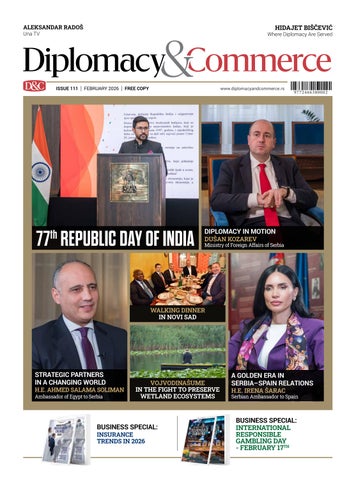
Diplomacy&Commerce magazine #111 February 2026

Page 1


STRATEGIC PARTNERS IN A CHANGING WORLD

H.E. AHMED SALAMA SOLIMAN Ambassador of Egypt to Serbia

DIPLOMACY IN MOTION DUŠAN KOZAREV Ministry of Foreign Affairs of Serbia

VOJVODINAŠUME IN THE FIGHT TO PRESERVE WETLAND ECOSYSTEMS

WALKING DINNER IN NOVI SAD A GOLDEN ERA IN SERBIA–SPAIN RELATIONS H.E. IRENA ŠARAC Serbian Ambassador to Spain

BUSINESS SPECIAL: INSURANCE TRENDS IN 2026

BUSINESS SPECIAL: INTERNATIONAL RESPONSIBLE GAMBLING DAY - FEBRUARY 17TH

CIP

FOLLOW

Director ROBERT ČOBAN robert.coban@color.rs

Editor in Chief DRAGAN NIKOLIĆ dragan.nikolic@color.rs

Journalists MIJAT KONTIĆ ŽIKICA MILOŠEVIĆ

Advertising DRAGAN NIKOLIĆ dragan.nikolic@color.rs

Journalists BOJANA BAČIĆ MIJAT KONTIĆ ŽIKICA MILOŠEVIĆ

DRAGAN VUČEVIĆ dragan.vucevic@color.rs

Advertising DRAGAN NIKOLIĆ dragan.nikolic@color.rs

marketing@color.rs

Photos GORAN ZLATKOVIĆ NEBOJŠA BABIĆ MILOŠ NADAŽDIN STEFAN ĐAKOVIĆ KHARIM NSENGIYUMVA JAKOV SIMOVIĆ SHUTTERSTOCK

DRAGAN VUČEVIĆ dragan.vucevic@color.rs marketing@color.rs

Photos GORAN ZLATKOVIĆ BOJANA STOJMENOVIK SHUTTERSTOCK

Translation COLOR MEDIA EVENTS

Prepress VLADIMIR DUDAŠ C e n t r o b i r o

Contributors ROBERT ČOBAN DUŠKA JOVANIĆ LJILJANA VUJIĆ VIKTOR LAZIĆ

BIROGRAF COMP D.O.O. Zemun, Atanasija Pulje 22

Print COLOR PRINT Novi Sad

Distribution

Distribution PRETPLATA D.O.O. office@pretplata.rs

5

AMBASSADOR’S INTERVIEW STRATEGIC PARTNERS IN A CHANGING WORLD

Ambassador of Egypt to Serbia

8

FEATURED INTERVIEW DIPLOMACY IN MOTION DUŠAN KOZAREV

CIP – Katalogizacija u publikaciji Biblioteka Matice Srpske, Novi Sad 33 Diplomacy & Commerce / glavni i odgovorni urednik: Dragan Nikolić, 2016, (mart)-.-

u publikaciji Biblioteka Matice Srpske, Novi Sad 33

Diplomacy & Commerce / glavni i odgovorni urednik: Dragan Nikolić, 2016, (mart)-.Novi Sad: Color Media Events, 2016 - , -33cm Mesečno ISSN 2466-3808 = Diplomacy & Commerce COBISS.SR-ID 303269895

Copyright

H.E. AHMED SALAMA SOLIMAN

Ministry of Foreign Affairs of Serbia

12

AMBASSADOR’S INTERVIEW PARTNERS IN INNOVATION AND STABILITY

H.E. NIKLAS LINDKVIST

Ambassador of Finland to Serbia

20

AMBASSADOR’S INTERVIEW A GOLDEN ERA IN SERBIA–SPAIN RELATIONS H.E. IRENA ŠARAC

Serbian Ambassador to Spain

23

BUSINESS SPECIAL INSURANCE TRENDS 2026 RESPONSIBLE GAMBLING

30 ECOLOGY SWEDEN’S COMMITMENT TO CLIMATE RESILIENCE IN SERBIA H.E. CHARLOTTE SAMMELIN

Ambassador of Sweden to Serbia

36

MEDIA INTERVIEW TELEVISION BEYOND THE LINEAR AGE ALEKSANDAR RADOŠ

CEO and co-owner of Una TV

Epsteins From Our Neighbourhood

Newly released documents related to the Epstein case suggest that there was hardly a famous or wealthy person from the late 20th and early 21st century who was not, in one way or another, in contact with him: Donald Trump, Bill Clinton, Prince Andrew, Bono Vox, Mick Jagger, Michael Jackson, Diana Ross, Chris Tucker, Kevin Spacey, Naomi Campbell, David Copperfield, Noam Chomsky, Bill Gates, Elon Musk, Sir Richard Branson…

Former UK Ambassador to the United States Peter Mandelson and his partner Reinaldo Avila da Silva allegedly borrowed money from Epstein and disclosed important state secrets of the United Kingdom to him. The same was true of Sarah Ferguson, the former Duchess of York, who reportedly sought loans from Epstein to cover her rent. The files have reached our region as well: Miroslav Lajčak resigned, while Milo Đukanović responded with dark humour after being mentioned in the new documents: “If you meet Epstein before I do, ask him for me!” Names of some girls from Serbia and the region also appeared, along with other individuals who moved in circles of the rich and famous.

Such things have always existed throughout history, but it seems that the late 20th and early 21st century led many of the rich and famous into a state of mind in which they believed that everything was permitted, that nothing would ever be discovered, and that even if it were, no one could touch them.

In our country, there was speculation about a similar case several years ago. However, nothing was ever proven, some of the alleged actors have since died, and the question remains whether someone will ever “open” local files in the future. Considering that some of the highest-ranking church officials have been accused of paedophilia—cases in which victims in some instances committed suicide—and that nothing happened as a result: no court verdicts, no distancing by the Serbian Orthodox Church, the question remains whether our society, in which similar things undoubtedly happened and likely still happen as on “Epstein’s island”, is even capable of opening such a topic and seeing it through to the end.

For the sake of future Epsteins and their victims, the message we in the media must send must never be: “The powerful always get away with it.”

Strategic Partners in a Changing World

Ambassador of Egypt on economic cooperation, regional stability and the future of relations with Serbia

H.E. AHMED SALAMA SOLIMAN

Ambassador of Egypt to Serbia

In an interview for the TV programme TV Diplomata, produced by Diplomacy & Commerce in cooperation with Euronews Serbia, we spoke with H.E. Ahmed Salama Soliman, Ambassador of Egypt to Serbia, about the dynamic development of bilateral relations at what he describes as a “golden age” of partnership.

I want to ask for your first impressions of Serbia and Belgrade since you assumed your duties as Egypt’s new Ambassador to Serbia. Actually, from the first minutes of my arrival, I felt warmth and welcome. I felt how much the Serbian people love Egypt and the Egyptian people —really, at all levels, both

official and popular. At the official level, since my arrival, I have met with numerous officials. They have all expressed their affection, admiration, and respect for Egypt, which I truly appreciate. I genuinely felt it was a great honour to serve in this country and to help advance relations between our two countries.

Could you tell us what personal experiences and values from your diplomatic career you bring to your mandate here in Serbia? During my career, I have served in many countries. I have served in Europe and in the Middle East. Actually, I believe there are several principles—when you are dedi-

THIS IS NOT JUST MEDIATION — FOR EGYPT, IT IS A NECESSITY AND A NATIONAL INTEREST

The Serbian people hold great admiration for Egypt. All their memories of Egypt and their image of it are very good and very beautiful; they love my country. A large number of people visit Egypt, which is something I truly value. I truly believe this contributes to our relationship, both historically and in recent times.

cated to them, they make you different, they make your behaviour different. Of course, discipline, dedication, and striving to earn the other side’s trust make a huge difference. Thank God, some of those principles already exist in Serbia. There is mutual trust between Egyptian and Serbian officials. That helps me very much.

And, of course, dedication. Both sides are dedicated to elevating the relationship and creating more space for cooperation. That is very good, but also not easy, because the principles already exist; I do not have to add many new ones to the relationship between the two countries.

We could say that this trust between the two countries was confirmed in 2025 by our Minister of Foreign Affairs, Marko Đurić, who said that we were entering a golden age of bilateral relations between Egypt and Serbia. That was also reiterated by the previous ambassador, who was here and was a guest on our program. How do you plan to utilise this momentum in the future?

As you mentioned, the previous ambassador, of course, did a very good job. He did not make my

job easier with that, but there is always room to add something. Politically speaking, there are—I would not say identical, but almost identical — positions. There is not much room for improvement. We, both the leadership and the two peoples, understand each other. We support each other in most aspects. But we need to work more on other areas of cooperation: economic cooperation, trade, tourism, and cultural exchange. There are many, many different aspects we need to work on. We must strive to ensure that the free trade agreement, which was recently signed and entered into force on 1 September 2025, bears its fruits. We need to work on that more and more.

Imagine a relationship between our two countries based not only on history and common understanding, but also on common interests, economic interests, and people-to-people interaction. That will contribute more and more to the relationship between our two countries. I believe, and hope, that I can contribute more in that domain. And to return to your remark about the golden age. Yes, this is a golden age. Yes, we must continue working on this relationship. We must make things more operational, more action-oriented. We must have more tangible results of our shared understanding and common positions between our two countries.

Egypt has maintained strong relations with the European Union while preserving its independent foreign policy. Could Serbia perhaps learn something from Egypt’s approach, and what lessons might be relevant for us?

If we try to analyse the reasons for the good relations between Egypt and the EU, we find that they are based on many factors. The main factor is our shared history. We have common interests. We share many values. We share many common positions regarding regional and international situations. And most importantly, we have common interests and trust. I believe those principles are very important in any relationship between any countries and between any two sides in the international community.

As for Serbia and Europe, I believe many of those factors, if not all, already help Serbia. Serbia has a rich shared history. It is part of Europe. There are many interests,

WE MUST MAKE THIS GOLDEN AGE MORE OPERATIONAL AND ACTION-ORIENTED

much trust. So it is not difficult. It is not difficult for Serbia to take its own position within Europe, based on trust, common interests, and, of course, mutual respect.

How do you see Cairo’s role evolving as a peace mediator amid ongoing regional conflicts, particularly in Gaza and Sudan?

Well, you are partially right when you say Egypt is a peace mediator. But I would like to add that in this regard, Egypt is not just a mediator. Egypt has its own special interests, its national interests, and the two crises you mentioned— having a role in those issues is not a luxury. For Egypt, it is a necessity. Egypt plays a very important role. But, if we talk again about

Egypt’s role, I believe it is very prominent simply because Egypt’s position is very well known.

We have a very transparent position on most international and regional conflicts, and on our relations with any international actor. First, we adhere to and are dedicated to international principles and law. We maintain a strategic balance in our relations with various actors in the international community. Such principles have brought Egypt great respect and trust in its role.

Regarding the war in Gaza, Egypt’s role was multifaceted. Of course, as I said earlier, it is in Egypt’s interest to have neighbours who live in peace. But in that specific crisis, there was

also a humanitarian factor. We, as Egyptian leadership and the Egyptian people, cannot turn our heads away from what happened to our Palestinian brothers. We had to support them. We had to provide humanitarian aid for them, while at the same time, thank God, maintaining the ceasefire and striving to preserve a peaceful situation, at least we hope so. Of course, we are doing everything in our power to find a peaceful solution to that problem, which supports and guarantees the rights of the Palestinian people.

On the other hand, regarding the Sudanese crisis, the humanitarian factor is also very important. Sudan’s unity is very important. State institutions, and respect for them, are a very important factor in Egypt’s position. Thanks to these principles, our role is worthy of respect, and all actors recognise it.

Therefore, I believe Egypt will continue to perform its role. Its duty, its interest, is to continue trying to reach a peaceful solution for these crises. And we will not give up on our brothers in Sudan or Palestine. We will always support them and give our all for them.

Egypt has secured major investments in renewable energy, aiming to generate 42% of its electricity from renewables by 2030. How will this shape the country’s energy future, and is there room for cooperation with Serbia?

That is a very nice and good question. Let’s go back to the reasons why we in Egypt are doing this. Of course, as you mentioned, there is increasing investment in that sector in Egypt. The reason is very simple—diversification of our energy resources. That is very important. It is a great need.

Also, we are trying to utilise the resources we have. We have wind, we have sun. We can utilise those resources. Also, we are doing everything we can to mitigate the effects of climate change and the environmental impacts of using fossil fuels. Those are probably, and maybe there are more, the main reasons why Egypt has entered the field of renewable energy.

Where is Serbia in this? I believe this is a huge opportunity for Serbia, for many reasons. And, of course, everyone knows how important energy in general is for Serbia, especially today.

Diversifying Serbia’s energy sources is a strategic goal.

And here I want to broaden the topic a bit, not only to renewable and green energy, but to energy in general. Of course, you know there is a plan to connect Serbia with North Macedonia via an LNG pipeline—liquefied natural gas.

Imagine gas coming from Egypt via Alexandroupolis, Greece, and North Macedonia to Serbia. And not only that, imagine Serbia investing in some of the numerous energy projects in Egypt. Imagine you invest in your own energy, and your energy arrives either through gas or through electricity, given that there are many very favourable studies for connecting the electricity systems between Egypt and Europe.

Imagine you invest in electricity. Imagine you invest in gas. Imagine you invest in your own energy. You would thus own your resources and invest in them. And thereby your independence in that regard.

And in independence, of course. Therefore, I believe it is a huge opportunity. Both our countries need to start discussing such cooperation for mutual benefit.

Another dimension is that we have gained extensive experience in renewable energy, particularly solar and wind. I believe sharing that experience with Serbia will benefit your country, which is our friend. And, of course, increase the common interests between our two countries.

Are there concrete opportunities for Serbian companies in Egypt, and could Cairo serve as a gateway to wider African markets?

Well, of course. Let’s go back to the decision of the Serbian Chamber of Commerce to soon open a representative office in Cairo. I don’t know if I’m allowed to announce it. There are plans for it. There are plans for it. The official ceremony, if I’m not mistaken, should take place in a few weeks or months. That is very important.

Of course, it is very important to open the market for your companies in Egypt, where more than 110 million Egyptians live, as well as an increasing number of foreigners. That is a huge market. But you also open up the African markets for your companies.

Egypt has free trade agreements with many African countries. Yes, as a hub for Serbian companies. We have free trade agreements with COMESA,

EGYPT

CAN SERVE AS A HUB FOR SERBIAN COMPANIES — AND SERBIA FOR EGYPTIAN ONES

ECOWAS, and the East African Community. There is also the African Continental Free Trade Area. All those agreements make African markets open to Serbian companies.

Similarly, I hope Serbia can serve as a hub for Egyptian companies in the Western Balkans. That is mutually beneficial for both our countries, and companies, the private sector, and business people can enjoy the good relations between our countries.

How do major cultural events, such as the Cairo International Book Fair, help strengthen Egypt’s global image and foster connections between countries?

Of course, cultural exchange is very important. It allows you to get to know your friend, the other side, better. It allows you to enjoy the experiences, history, culture, and everything. Thank God Egypt is hosting this book fair. It is a regular annual fair. It is one of the largest in the region. Of course, Serbia is always a welcome guest at those events.

As far as I know, a Serbian writer, I think his name is Boris Miljković, if I’m not mistaken, is

participating in that book fair. That is something we always value and warmly welcome.

Another prominent and important participation of Serbia in one of the largest cultural and tourist events that recently happened in Egypt was the official opening of the Grand Egyptian Museum, GEM, where His Excellency, the Minister of Culture of Serbia, represented Serbia at that official opening.

That is something we are proud of, because such an event reflects the real Egypt. For example, GEM is one of the largest museums in the world dedicated to a single civilisation—the Pharaonic.

In that museum, there are 100,000 pieces from the Pharaonic civilisation. Imagine one such museum and the grand opening that happened in Egypt; how proud we are of that. Of course, we hope more and more people from Serbia will visit this beautiful place, and I am sure they will enjoy it.

Cultural exchange between our two countries is very important and stretches through history. We are very honoured to have such

a relationship with Serbia. The Serbian people are always welcome to us, and we know we are also very welcome in Serbia.

Looking to the future, how do you see the relations between Egypt and Serbia, say in five or ten years?

Well, as much as we already have the foundations for this excellent relationship between our two countries, I believe it will last, but we must not rely solely on that. We must work more and more. As I said, we have the foundations, not only history, but political understanding, common positions, and mutual respect, but we must work more and more.

And, of course, there is the free trade agreement; such agreements are very important. We must work more on that. A relationship is not something static. It must be dynamic.

We need more Egyptians. I want to see more Egyptians here. I want to see more people from Serbia travelling to Cairo. It must be dynamic, and that is what I hope to work on during my next mandate here in Serbia.

You can watch the full interview, originally broadcast on the TV programme Diplomat on Euronews Serbia, by scanning the QR code below

Diplomacy in Motion

How Serbia’s foreign policy is positioning itself for 2026 amid geopolitical shifts, EU integration and a renewed global outreach

DUŠAN KOZAREV

Secretary General of the Ministry of Foreign Affairs of Serbia

As part of our TV programme Diplomata, we spoke with Dušan Kozarev, Secretary General of the Ministry of Foreign Affairs of Serbia, about the priorities and internal dynamics of Serbian diplomacy amid complex global challenges.

The interview was conducted for a show produced by Diplomacy&Commerce magazine in cooperation with Euronews Serbia, offering viewers deeper insight into the Ministry of Foreign Affairs’ operations and strategic direction.

What are the Ministry of Foreign Affairs’ key priorities for 2026, and how will they be

communicated to domestic and international audiences?

As far as communication is concerned, the 21st century involves a wide spectrum of means to reach the public – from media like yours, to statements in the

so we need to use forms through social networks and various related types of communication to convey a clear message and make what concerns them absolutely interesting. Of course, for the widest audience, those traditional

WE HAVE TO EXPECT THE UNEXPECTED BECAUSE THE WORLD IS CHANGING RAPIDLY

classical, old-fashioned sense that we are all used to from earlier periods, and increasingly, in recent times, modern, digital technologies that are particularly appealing to younger generations. It is clear that attention spans are not what they used to be and that young people in particular do not hold their attention for long on everything we do and talk about,

forms remain available – we are there through regular press conferences by the Minister, announcements, and other ways to inform the public daily about what we are doing.

The priorities, of course, besides the constitutional and legal frameworks and the role the Ministry has to represent the interests of the Republic of Serbia abroad and,

above all, to act on the front line of protecting everything that is the elementary interest of our citizens outside the country, are to articulate the goals of our foreign policy and to be, if you will, a kind of translator in a modern way –which is essentially what diplomacy is. Between what is desired, how it is understood elsewhere, and how we work on this, we have noticed that we often agree with partners around the world on some things, yet we may not always understand each other well on certain issues. That is essentially the role of diplomacy and modern diplomacy. We are here to do everything necessary to articulate the state’s policy, the country’s interests, and its citizens’ interests to the world in the best possible way.

In a recent statement, the Minister of Foreign Affairs,

Marko Đurić, said that Serbia’s priorities in 2026 will focus on stability, peace and economic development. What concrete steps will the Ministry take to achieve these goals?

We have to expect the unexpected simply because the world is as it is. As we can see, the year has already begun with unexpected and dramatic events. The geopolitical situation is very dynamic, and events are unfolding rapidly. But that is simply a matter of global circumstances beyond our control. We are a small but proud country with ambitions to remain what we are: independent, especially in our position in the world. Therefore, regardless of events and challenges, we must be clear with ourselves and maintain a consistent line of pursuit of our goals and interests. But we will try to adapt – first, to survive them, then to adapt to the circumstances, and try to use the entire situation in a way that brings benefit to the country and its citizens.

Economic development was mentioned. From that perspective, we are interested in the key steps the Ministry will take through diplomatic efforts and contacts to open markets for Serbia and attract investment to the country.

One – and you observed correctly – one of the essential components of modern diplomacy, which is why in some parts the country has merged foreign policy and trade. So that the economy is articulated as the primary activity of the diplomatic vocation and of work, and the network is maximally focused on bringing economic benefit. Essentially, the economy carries the bulk of what modern life is, what is felt on a daily level – in wallets, in pockets, in the lives of ordinary people. Yes, that is among our priorities: to be incomparably more active in finding new markets for our companies, to make us as an investment destination and as an address for cooperation more interesting globally, especially bearing in mind that EXPO 2027, which comes in less than a year, is already such a big thing – not only for us but globally – with 135 countries having decided to participate and already confirmed so far. When we host the world, it’s not only to show ourselves, to present what we more or less already know as achievements –that we have tripled our economy in the last ten years, from 30 billion in 2012 to 100 billion now and over 100 next year, which is that

OUR ROLE IS TO ARTICULATE SERBIA’S INTERESTS CLEARLY AND CONSISTENTLY TO THE WORLD

symbolic threshold to cross – but also to connect business people, as such world exhibitions usually do—businesspeople, investors, and others from various areas of life. So the economy is absolutely in focus this year, but not only the economy. There is also cooperation in sports, culture, science, and education. So, as the world enters a new era in every possible sense, we are keeping pace with that, because we know that is also in the spirit of national and state tradition.

An operational team for the EU was recently formed to accelerate Serbia’s European path, with priorities including opening Cluster 3 and meeting the interim benchmarks for Chapters 23 and 24. What is the added value of this team, and how will it be more effective than previous mechanisms? The very idea of President Vučić in designing this approach was precisely to accelerate the EU integration process. If you pay attention, we have been facing this kind of challenge for some time now, although, of course, all relevant institutions and the European Union itself consider

the opening of Cluster 3 likely, and at the level of Brussels and the EU administration, it is undisputed that we meet the conditions to start negotiations on the chapters within that cluster. Individual member states have certain reservations. This is a way to show not only readiness but also additional momentum and dedication to this issue, so that what is noted in EU reports and comments from relevant parties in this full membership negotiation process demonstrates that we will devote ourselves to it to the greatest extent. That is why representatives of the departments considered most significant in this area are involved: reforms need to be especially visible, and we also need to clearly explain everything we have done, because much of it is also a matter of perception. So, in that technical and legal sense, although we have already met the conditions, we now need to build public political momentum that will be recognised across member states, so that we can move to a new level of integration.

With the introduction of the EU’s new entry and exit system, including biometric checks

and the upcoming ETIAS travel authorisation, how does the Ministry plan to address these changes and safeguard the freedom of movement of Serbian citizens?

To understand this properly, we first need to disentangle all the questions you raised. First, what the European Union decides for the Schengen area – which now more or less surrounds us when it comes to our neighbours, especially those neighbours who are, of course, EU members – is a matter of their decision, and that decision is not primarily aimed against Serbia, nor against the Western Balkan countries, nor against its closest neighbourhood. There are probably motives behind it, but it is not our place to speculate about their reasons – that they have noticed migratory pressures from some other parts of the world and want to protect themselves in the future. And that is the legitimate right of the European Union and its member states. We have already had the opportunity to see complications, yes, administrative obstacles, especially with the crossing of professionals, such as truck drivers and bus drivers. That is being addressed, and there is a proactive, mutually beneficial approach between the relevant EU bodies and our competent authorities. We have received assurances that we will find a solution to those specific issues, which again concern the free movement

of goods in truck transport, in the very near future.

As for ordinary citizens, the fact is – and we announced this toward the end of last year, when it was projected that the implementation of this new system would begin – that in this initial period, especially up to April, which is roughly half the time from the start of implementation to the deadline for full implementation, there would be certain challenges, complications, technical problems; it is new for them too, and so on – not that we are making excuses for them, but it simply wasn’t unexpected that people would have to be photographed and leave biometric data, especially the first time they cross. After that, the process is expected to become automated the next time they arrive at those crossings. Essentially, this first period brings the highest level of frustration and complications, and later, once it is fully operational, it should be much easier—just a glance at the camera and a cross based on stored biometric data.

As for the announcement of possible charges, you have examples in other countries where the entry system is regulated in specific ways, with prior notification and a symbolic fee for multiple years. If, eventually, someone charges an administrative fee for that, it is again a matter of that party’s sovereign decision. However, in this current period, I think that once the biometric data has been collected from those who travel most frequently, once the databases are filled, and once we reach the level where crossing is done simply by looking into the camera, this part of the frustration will be forgotten.

Minister Marko Đurić has said that 2026 will be a key year in Serbia’s diplomatic efforts regarding Kosovo and Metohija. What makes this year particularly important, and what steps will be taken to strengthen Serbia’s position?

The state of Serbia has a firm commitment – reflected in the policy of President Vučić and the Government of Serbia, and in what Minister Đurić is doing –and not only Minister Đurić but also the team in the Ministry and our diplomats, as well as other ministers in the government and our other institutions – to preserve sovereignty and territorial integrity, and not to give up our clear red lines regarding identity,

THE ECONOMY IS AT THE HEART OF MODERN DIPLOMACY

constitutionality, and what matters most to us, of course. Much of that is not so visible, nor should it be – to return to your first question – be that public, nor be followed live. The fact is that we notice some new momentum from those who would support new unilateral recognitions of the unilaterally declared independence of the so-called Kosovo. But, on the other hand, we are in a not-so-bad position, even if we look at the scoreboard: 28 recognitions in the last ten years, and about five new recognitions in the recent period. That will also be a geopolitical game, clearly, and we are ready for it – that is why we are strengthening our capacities. It is certainly part of all our activities, regardless of the bilateral topics – whether with recognizers or non-recognizers, whether with those we are closest to or those with whom we do not see eye to eye on certain issues, or those we are just getting to know from other parts of the world – one of our most important themes is always the issue of Kosovo and Metohija, and above

all, the treatment of the Serbian and Albanian population, which, under very difficult conditions, especially under the Kurti regime in recent years, in an apartheid of a new era, under great pressure, tries to endure and remain. So, that is always one of the highest priorities.

You mentioned strengthening the Ministry’s capacities, and the year began with the call “Be a Serbian Diplomat.” What is the main objective of this initiative – reinforcing the diplomatic network, modernising public diplomacy, or preparing a new generation for the challenges of contemporary diplomacy? It is very important to say that this is not a competition – and, well, you correctly said it is a call. That is quite an important legal and substantive connotation of everything we had in mind. The idea is to approach it as a kind of service – as it is called in much of the world – a foreign policy service, a calling. So, it is not a profession like any other, in the sense that

you are fixed to a place of living, a place of work, some usual, routine, everyday bureaucratic dynamics. This is, after all, a calling – both personal and life-defining. That is why we issued a call to all interested parties who believe they might contribute to Serbia’s position in the world to apply. If you believe you can help Serbia and our interests worldwide, contact us. We already have several hundred applicants so far this period, and now we have the sweet burden of conducting interviews and special selections. But the idea was precisely to gather all those who, for starters, would be willing to serve their country. But we need more. That means we lack such staff. We need more people, and we need more people who are ready to work and fight for their country.

Absolutely, one follows the other, and there will be more of that. In expecting – in expecting the unexpected – aside from geopolitics, we also have some good news concerning the Ministry of Foreign Affairs and our global activities, including the opening of new embassies and consulates. We also have some specific initiatives that are not characteristic of earlier conservative diplomacy and involve collaboration with friendly countries.

You mentioned shared working space, and recently, a Hungarian consular office was opened within the Serbian consulate in Thessaloniki as a form of joint representation. How can this model strengthen Serbian diplomacy in the future?

It seems that we have such a level of relations with Hungary now, at a historical maximum – and of course it should continue to grow – that mutual trust and cooperation have led to us already having five colocations in the world with Hungarian diplomats. That means that where we are present, perhaps traditionally from the time of Tito’s Yugoslavia, and they are not, or where they are present, and we, for various reasons, do not have our own diplomatic-consular mission, we can send diplomats to each other, and they share the same space. So, a Serbian diplomat in the Hungarian embassy, where we do not have an embassy, works – either as ambassador or chargé d’affaires resident in that country – by being stationed with the Hungarians. And the Hungarians, as you cited – a good example, just a few days ago Ministers Đurić and Szijjártó opened a colocation in Thessaloniki – so, in our beautiful building in the centre of Thessaloniki, the General Consulate of Serbia, Hungary now

has its own consular office. So, when you are with someone at that level of relationship, it becomes a true alliance that is also noticeable in everyday, practical work. So that is a level of trust, collegiality, and cooperation that allows us to appear jointly in the world.

From your perspective as Secretary General, what will be the key areas in which Serbia will be able to strengthen its position and its international standing on the global stage? I think we have many opportunities to affirm ourselves in areas that we, as ordinary citizens, do not appreciate as much each day. If we were to go out on the street now and ask people if they know, for example, that according to UN criteria we are among the seven most advanced countries in the world in the digitalization of public administration, in the accessibility of various types of government services to citizens – I think they would say no, but they somehow take it for granted that in the 21st century you can

get birth certificates, extract from the land registry, certificates, pay taxes and bills online – which is still not a standard everywhere in the world, for various reasons. And you know what? We can be proud, especially of the achievements of the last ten years in that regard. I think we can not only sell that in the world as our success and boast about it, but we now also have some serious, reputable companies that have achieved a lot in that field and, for example, with the United States and the European Union, but also with other parts of the world, exchange products in the fields of software, cybersecurity, artificial intelligence – even in the newest times – which were unimaginable only a decade ago. So, we have already positioned ourselves there. We are small compared to the big world, and the fact that 8 billion people live on the planet. To increase the economic, political, and strategic utilisation of all our resources. I think we can do a lot more – that Serbia has not yet used many of its resources, both natural and human- and

PRESERVING SOVEREIGNTY AND TERRITORIAL INTEGRITY REMAINS ONE OF OUR HIGHEST PRIORITIES

that, when we note all that and establish a clear framework, we can position ourselves better in the world. I think that, if we are to concretize these priorities, they are certainly: the continuation of European integration, but also regional frameworks – especially those concerning the Western Balkan countries that are not EU members but are moving toward membership, that is, our closest neighborhood – we must not neglect that; there we achieve everything that is in our interest and, ultimately, where we stand the best, economically, politically, and in interpersonal relations. To open new niches and new markets, to return to some friends – neither we have forgotten them nor they us – as we noticed in Africa during last year’s travels and some official visits. To explore, even, one might say, worlds quite unknown, even from the time of the former Yugoslavia, such as Latin America, which absolutely represents the future of both North and South America as a continent, but also of that part of the world, economically and demographically. And, again, not to forget traditional partnerships and friendships – to nurture them, preserve them, use all the opportunities we have, and continue with the very successful balancing in our overall positioning in the world.

Partners in Innovation and Stability

Finland and Serbia strengthen political dialogue, Nordic cooperation and economic ties through sustainability, digitalisation and multilateral engagement

H.E. NIKLAS LINDKVIST

Yof Finland to Serbia

our diplomatic mission in Serbia began at the end of 2023 when you arrived. Which moments in your career determined your approach to diplomacy, and how did they lead to this situation, where you became the Ambassador of Finland to Serbia?

You know, diplomatic careers often span many years and involve moving to different places every three or four years. So, in my case, I worked in Helsinki, then in Moscow, then in New York, then again in Helsinki, again in Moscow, and then also in Brussels.

So you really gain a lot of different experiences along the way. And that is, in fact, the essence of

a diplomatic career—to train for different things, to work on them, and to take responsibility. This is especially useful when you eventually reach a leadership position, such as an ambassador, because you are then responsible for all those areas. That’s why you need to know a little about everything.

WE HAVE A LOT TO SHARE WITH SERBIA, BUT IT IS A TWO-WAY PROCESS. WE NEED TO LEARN FROM EACH OTHER

Since you arrived here, have you noticed any significant shifts in relations between Finland and Serbia during 2024 and 2025?

I think the biggest change is probably that, when I arrived, bilateral visits had been interrupted by the pandemic, which affected the whole world. During my predecessor’s term, there were visits, but then there were some years with none. Therefore, I am very grateful that, during my mandate in Serbia, my Minister of Foreign Affairs has already visited Serbia twice. She came in 2024, and

then again now in 2025. We have also had other visits: the foreign policy committee, the speaker of parliament, and so on. So, there is great interest in reopening relations and resuming visits after the pandemic.

Could Finland’s model of crosssectoral collaboration in public policymaking be applied to Serbia’s EU accession process, particularly in areas such as environmental law and digital governance?

I think that is truly the core of Finnish society, because we work together on all issues. It is not the state that always plays the leading role; the whole of society is involved. And not just the opposition, but also human rights organisations, the civil sector as a whole, and our business community. So, everyone is part of that way of working together and developing our society. Therefore, I think this could be a good way to develop such an approach in Serbia further, since we have achieved good results in Finland. It’s easy to understand the advantages of that, starting with resources, for example. If the state has to do everything itself, then that is a great burden.

How does Finland’s NATO membership affect its diplomatic course, not only in Serbia but also in the Western Balkans? That was a truly enormous change for us—joining NATO. That is something that strongly changed public opinion as well. When Russia attacked Ukraine, the Finnish population very quickly shifted to the side of those who supported joining NATO, even though there had been considerable scepticism before about whether it was necessary or not. The citizens truly saw the need for it. In just a few weeks, support for NATO membership rose to over 60 per cent. And so it happened, we entered the alliance. That was, of course, a big change. We actually did not see ourselves as neutral. Before that, we discussed military non-alignment because we were already a member of the European Union. So at that point, we weren’t even talking about neutrality anymore.

And Serbia, although not a NATO member, has certain forms of cooperation with that organisation at various levels. So that is quite understandable. But also considering the global tensions rising in 2024 and 2025, and that they seem likely to continue into the new year, how can smaller countries like Finland and Serbia contribute to stability through multilateral diplomacy?

I think small states are wellsuited to that because the multilateral system, grounded in a rules-based order at the global

level, is crucial for them. We are, in a way, the ones who should be the true advocates of that order and strongly stand up for its defence. Of course, we hope that larger states will do so as well, but for us, it is perhaps even more a question of survival. That’s why this is an area where we must work together. We must be very clear about our goals and the values we stand for, and we must believe those values will endure.

How do you assess Serbia’s role in Nordic-Balkan cooperation in 2025, especially when it comes to trade and cultural exchange, which is a very important aspect of that cooperation?

We work very closely with my Nordic colleagues here in Serbia. The four Nordic embassies have long run joint projects that promote, among other things, the Green Agenda and related issues. This year, we have a project called “Smart Cities.” We are trying to promote the smart city concept, which is not just about technology. Today, we have many technologies that can be used for that purpose. Still, the essence lies in the planning process and in involving the entire population in shaping how the city is designed, to make it a better place to live. In that sense, I think the Nordic countries have extensive experience and knowledge. We have already done it. We haven’t finished the whole process; we are still working on it, but we have, for example, an area in Helsinki where startups can test new applications and solutions they want to try. Then you can see whether those applications work. And that is precisely what I was talking about earlier: working together with the civil sector, the business community, and city authorities to find something that will improve things. So those are the elements we are promoting from a Nordic perspective. And I really think we have a lot to share with Serbia. But not just to share—it’s a two-way process. We need to work together with Serbia and see where we can learn from each other.

Sustainable development is a priority today. Where do you see the greatest opportunities in the Serbian economy for Finnish companies already present on our market, both this year and in the years ahead?

At the embassy, we have focused particularly on sectors such as information and communication technologies, green and clean

THE KEY

IS TO CONNECT COMPANIES FROM SERBIA AND FINLAND AND BUILD PRACTICAL COOPERATION

technologies, education, and innovations in general. These are areas where, in my opinion, Finland has a lot to offer and where our companies are looking for new markets. That’s why we actively promote those sectors in both Serbia and Finland: one of our biggest challenges is that Serbia may not be well enough known in Finland. We are also working on that kind of promotion.

Could joint projects in artificial intelligence, clean technologies, or digital education become a new pillar of future cooperation between Serbia and Finland?

That is something we would strive for. As I said, I think the key is to connect companies from Serbia and Finland. Let’s mention one thing we are currently missing: a direct flight between Helsinki and Belgrade.

The export of IT services from Serbia exceeded three billion dollars in 2024. Do you think potential can be further developed through Finnish-

Serbian partnerships in the digital industry?

That is an area where it is worth further encouraging Finnish companies to cooperate with Serbia. We already have one company, Tietoevry, which is a major IT player in Finland and operates in the local market. We hope to see more cooperation in that direction in the future. From the embassy, we have also tried to support the startup community in Serbia. We host the world’s largest startup conference, SLUSH, which takes place in Finland every autumn. We shared tickets with startups from Serbia.

Which cultural or educational exchanges with Serbia in 2025 or 2026 make you happiest when it comes to the future?

When it comes to education, we had a big conference here in 2023, just before my arrival. So a large part of my work actually related to the activities that followed that conference. I hope there will be more in the coming years, of course. On the cultural front, we

have also been quite active. This year we had two big things. The 80th anniversary of the publication of the first Moomin book was marked. Because of that, the embassy promoted many Moomin stories, as well as the story of their author, Tove Jansson’s life. That was one of the big themes we worked on. The second marked the 160th anniversary of our composer Jean Sibelius’s birth. Because of that, we had a big concert here dedicated to Sibelius’s music and similar events.

How do you see the role of tools such as culture and events in shaping diplomacy?

They are extremely important. They are really very significant. That is a way to present your country and establish connections with other countries. It is a really powerful tool. This year, we also chaired the Organisation for Security and Cooperation in Europe. As part of that, we showed a film about the 1975 Helsinki Summit. That conference brought together leaders from all over the world. And one part of that film, at the very beginning, shows how Helsinki calls Belgrade, journalists call Belgrade. That’s how those cultural connections are created that you can build upon. And that is always something extremely valuable. Next year, we plan to organise a Finnish Film Week every other year, during which we will show Finnish films. Next year we will have that event again, and we hope for a great response from the audience. Last time, we had to organise additional screenings because we couldn’t fit everyone interested into the hall.

Looking ahead, how do you see the development of relations between Finland and Serbia in the coming years, but also during your mandate?

I think we have already started very well during my stay here. I believe we will intensify those contacts even more. As I said, we have already had two visits from our Minister of Foreign Affairs. Next spring, we already have some plans, which are not yet public.

You can watch the full interview, originally broadcast on the TV programme Diplomat on Euronews Serbia, by scanning the QR code below

Serbia Receives New Ambassadors from Japan, Angola, India, and Ukraine

President of the Republic of Serbia Aleksandar Vučić received the letters of credence from four newly appointed ambassadors, officially marking the beginning of their diplomatic mandates in Serbia

The letters of credence were first presented by H.E. Naohiro Tsutsumi, the newly appointed Ambassador of Japan. During the meeting, President Vučić expressed satisfaction with the existing cooperation between the two countries and reaffirmed Serbia’s commitment to further developing comprehensive, mutually beneficial bilateral relations.

The discussion covered current projects and planned investments, with particular attention to the successful organisation of EXPO 2025 in Osaka, which welcomed over one million visitors to the Serbian pavilion. President Vučić emphasised that Serbia will have the honour of hosting the Specialised EXPO 2027 in Belgrade, marking 145 years of diplomatic relations with Japan. It was also noted that economic cooperation continues to grow steadily, particularly in the automotive industry and in energy and environmental protection projects, with Japan remaining Serbia’s second-largest bilateral donor. Ambassador

Tsutsumi conveyed a message from His Majesty Emperor Naruhito, expressing gratitude and support for further strengthening bilateral ties.

President Vučić also received the letters of credence of H.E. Eduardo Octávio, the newly appointed Ambassador of the Republic of Angola. The President expressed confidence that Ambassador Octávio’s mandate will significantly strengthen bilateral relations in all areas of mutual interest. It was noted that Angola ranks among the top 20 destinations for Serbian investment abroad, and particular appreciation was expressed for Angola’s principled stance on Serbia’s territorial integrity and the importance of respecting international law and the UN Charter in today’s global context. President Vučić invited H.E. João Lourenço, President of Angola, to visit Serbia.

H.E. Abhishek Shukla, newly appointed Ambassador of the Republic of India, also presented his letters of credence. The meeting reaffirmed the traditionally friendly relations

between Serbia and India, established during the era of the Non-Aligned Movement. Discussions focused on intensifying political dialogue, increasing trade in goods and services, and cooperation in artificial intelligence and digital technologies. It was emphasised that Serbia considers India a reliable and strategic partner in connecting innovation ecosystems, research centres, and universities, as well as in the exchange of experts, knowledge, and young talent.

Finally, President Vučić received the letters of credence of H.E. Oleksandr Lytvynenko, the newly appointed Ambassador of Ukraine, and extended a warm welcome and best wishes for his mandate. President Vučić underlined Serbia’s readiness to further develop cooperation with Ukraine based on mutual respect, international law, and the maintenance of peace and stability, noting that there is room for economic, multilateral, and sectoral collaboration. Particular emphasis was placed on establishing peace as a key prerequisite for stability and prosperity across Europe.

SELFIE QUEEN

Jadranka Jovanović, opera singer and MP, at the celebration of the 77th Republic Day of India, Hyatt Regency Hotel, January 26

HOME ALONE, 2

The Ambassador of Russia with his wife at the reception held on the occasion of the 77th Republic Day of India, Hyatt Regency Hotel, January 26

LET’S HOPE

TRUMP

DOESN’T KNOW WHERE WE ARE

Ambassadors of Montenegro and Slovakia at the celebration of the 77th Republic Day of India, Hyatt Regency Hotel, January 26

FRENCH CHAMPAGNE, FRENCH EMBASSY, GERMAN SMILES…:

Ambassadors of the French Republic and the Federal Republic of Germany, Florence Ferrari and Anke Konrad, presented the Franco-German Prize for Human Rights and the Rule of Law to Maja Stojanović, Executive Director of the NGO Civic Initiatives, French Embassy, December 18

OLD WORLD –EUROPE, AFRICA & ASIA –NEW PLANT

Ambassadors of Congo, Armenia, Lebanon, IOM and Montenegro at “Lazin salaš” during a Walking Dinner in Novi Sad, December 18 (use the original photo)

YOU ARE NEXT IN THE EU

A cordial greeting between the Ambassadors of Montenegro and Germany at the anniversary of the signing of the Élysée Treaty, Goethe-Institut, January 22

PHOTO STORY

22 JANUARY 2026

French and German Ambassadors Honour Young Participants on the Occasion of the Élysée Treaty

The Goethe Institut in Belgrade hosted a celebration marking the anniversary of the signing of the Élysée Treaty, one of the key documents of post-war European diplomacy.

On this occasion, the Ambassadors of France and Germany to Serbia, Florence Ferrari and Anke Konrad, hosted the ceremony dedicated to Franco-German friendship.

26 JANUARY 2026

During the event, awards were presented to students and teachers who took part in the Franco-German school competition, which promotes cooperation, language learning, and intercultural dialogue. Among the awardees were students and teachers from the primary schools “Učitelj Tasa” in Niš, “Petőfi Sándor” in Bečej, “Knez Lazar” in Lazarevac, “Milorad Labudović-Labud” in Baroševac, and “Vuk Karadžić” in Belgrade.

India Celebrates Republic Day in Belgrade

The Embassy of the Republic of India in Belgrade hosted a ceremonial reception to mark India’s Republic Day, commemorating the entry into force of the Indian Constitution in 1950.

The highlight of the event was the keynote address delivered by H.E. Abhishek Shukla, Ambassador of the Republic of India to Serbia, who welcomed representatives of Serbian institutions, members of the diplomatic corps, and friends of India.

In his address, Ambassador Shukla underlined the historical and constitutional significance of Republic Day, describing the occasion as “an immense pleasure to welcome you to this reception held on the occasion of

the 77th Republic Day of India.” He recalled that the ideals of justice, liberty, equality and fraternity, enshrined in the Constitution, continue to shape India’s democratic ethos and national development.

Reflecting on India’s journey since independence, Ambassador Shukla paid tribute to the sacrifices of generations who contributed to the country’s freedom, achieved in August 1947, and to the collective effort that led to the adoption of the Constitution on 26 January 1950, the world’s longest written constitution.

Turning to contemporary India, the Ambassador noted that the country is today the world’s largest democracy,

The Élysée Treaty, signed in 1963, laid the foundation for reconciliation and a lasting partnership between France and Germany after decades of conflict. The agreement provides for regular consultations at the highest political level, as well as close cooperation and coordination in foreign and security policy, culture, education, and youth exchanges. Among other provisions, it established the FrancoGerman Youth Office (DFJW), which promotes mobility and mutual understanding among young people.

characterised by a diverse and vibrant society and sustained, all-round progress. He emphasised India’s youthful demographic profile, with approximately 65 per cent of the population under 35, and highlighted the country’s position as the fastest-growing major economy, poised to become the world’s third-largest economy in the coming years.

Ambassador Shukla also presented India as a manufacturing powerhouse and an emerging global hub for advanced skills and innovation, playing an increasingly important role in research and development both domestically and in cooperation with international partners.

05 FEBRUARY 2026

Belarusian Ambassador in Belgrade Announces “Slavic Bazaar”: A Festival Connecting Belarus and Serbia

The International Arts Festival “Slavic Bazaar in Vitebsk” will take place this July in the Belarusian city of Vitebsk.

The festival was recently presented in Belgrade.

H.E. Sergey Malinovsky, the Ambassador of Belarus to Serbia, stated that the festival in Vitebsk is “one of the most successful international cultural projects, not only in Belarus but also in the region, with a large number of participants.”

Ambassador Malinovsky emphasised that it is particularly significant that the festival

“serves as one of the most successful examples of cultural interaction between Belarus and Serbia” and expressed hope that Serbian culture will also be represented at the upcoming 35th Slavic Bazaar.

Gleb Lapitsky, Director of the Slavic Bazaar, recalled that Serbia has contributed many participants to the festival, including singers Dušan Svilar, Irina Arsenijević, Filip Žmaher, Svetlana Slavković, and Željko Joksimović.

Among the Serbian participants, Žmaher (1995), Slavković (1997), Joksimović (1999),

Smart Cities and Green Construction: The Swedish Example as Inspiration for Serbia

The conference “Smart Engineering for Urban Development”, held today at the Chamber of Commerce and Industry of Serbia, brought together experts, architects, engineers, and representatives from the construction industry, with the aim of sharing knowledge and experience in the field of smart and sustainable cities

Charlotte Semelin, the Swedish Ambassador to Belgrade, emphasised that today’s topic reflects Sweden’s focus on innovation, sustainability, and partnership.

“Through this project, the Nordic Embassies aim to demonstrate that smart urban development requires collaboration between the public and private sectors, as well as the academic community. Today, we are presenting the Stockholm Royal Seaport as a leading example of Nordic planning for green and smart cities,” Semelin told journalists.

The Ambassador added that these issues are especially important for the Western Balkans, a region facing rapid urban development, green transition, and digitalisation

and Milovan Zimonjić (2001) won the Grand Prix, while Milan Šćepović (1994) and Tanja Banjanin (1998) secured first place.

Lapitsky noted that Joksimović often began interviews by saying his career began in Belarus.

According to him, the goal of the Slavic Bazaar is not only to showcase Slavic culture to the world but also to “be enriched by global culture through creative interaction.”

With approximately 6,000 participants and around 400,000 visitors attending the festival, Lapitsky expressed hope that the 35th anniversary of the Slavic Bazaar in Vitebsk this July will mark “another step toward fulfilling our shared mission.”

in construction. “The construction sector accounts for about five per cent of Serbia’s GDP, so it is crucial to focus on efficiency and transparency in this sector,” Semelin said.

The conference is part of the initiative “Nordic Green and Smart Cities – Building Partnerships in the Western Balkans, organized by the embassies of Denmark, Finland, Norway, and Sweden, with support from the Nordic Council of Ministers. The project aims to present Nordic experiences in developing smart and sustainable cities, encourage technology exchange, and strengthen collaboration between local and Nordic institutions and companies in Serbia and Montenegro.

05 FEBRUARY 2026

Pakistan Embassy in Belgrade Holds Ceremony for Kashmir Solidarity Day

The Embassy of the Islamic Republic of Pakistan in Belgrade held a ceremony yesterday to mark Kashmir Solidarity Day, observed annually on 5 February.

The ceremony was organised by the Embassy and presided over by the Pakistani Ambassador to Serbia, Faraz Zaidi. The

10 FEBRUARY 2026

47th

Igathering focused on expressing support for the people of Kashmir and highlighting the longstanding political and humanitarian issues affecting the region.

Kashmir Solidarity Day is traditionally observed in Pakistan and at diplomatic missions worldwide, serving as a reminder of

Anniversary of the Victory of the Islamic Revolution of Iran

n Belgrade, a formal reception was held under the organisation of the Embassy of the Islamic Republic of Iran, on the occasion of the National Day of Iran and the 47th anniversary of the victory of the Islamic Revolution of 1979

The event brought together numerous ambassadors, heads of diplomatic missions, representatives of Serbian state institutions, and prominent figures from the cultural and media sectors. The host of the gathering was Iran’s Ambassador to Serbia, H.E. Mohammad Sadegh Fazli.

The reception was held to commemorate the events of 1979, when the Islamic Revolution overthrew the Shah’s monarchy and established the Islamic Republic of Iran. In Iran, the revolution is regarded as a symbol of independence, freedom, and justice, and 22 Bahman in the Iranian calendar (around 11 February) is observed as a national holiday celebrating its victory.

The reception was attended by Boris Bratina, Minister of Information and Telecommunications of the Republic of

Kashmir’s unresolved status and the importance of international attention to the matter.

The Belgrade ceremony took place within the framework of the Embassy’s diplomatic activities and was attended by members of the diplomatic corps, institutional representatives, and members of the public.

Serbia, who led the Serbian government delegation.

In addition, attendees included representatives of the Islamic Community Mufti Mevlud ef. Dudić, as well as distinguished guests from society, culture, and the media.

Ambassador Fazli emphasised that the 47th anniversary of the revolution serves as a reminder of the Iranian people’s perseverance in their struggle for freedom and sovereignty, and expressed his wish for further strengthening of bilateral relations in the political, cultural, and economic spheres.

10 FEBRUARY 2026

Mexico and Serbia Celebrate 80 Years of Friendship: Jubilee Kicked Off with “Graphic Visions 8” Exhibition

The “Graphic Visions 8” exhibition opened last night at the Instituto Cervantes gallery in Belgrade, offering the audience an engaging overview of Mexico’s contemporary graphic art scene.

The “Graphic Visions” project is part of nearly five decades of international collaboration between artist Leposava Lepa Milošević Sibinović and Mexico in the field of visual arts. For this, the eighth edition of “Graphic Visions” works by Roberto García Ortega, Coral Revueltas Valle, Eduardo Barrera, Ernesto Alva Franco, and Julia Ahmadeyeva were selected.

“They share a strong focus on line as an expressive element. Lines dominate the graphic field, mapping space, trembling, slowing down and accelerating visual

movement,” said Milošević Sibinović at the exhibition opening. “The selection presented here is not a form of competition; rather, it highlights the value of a contemporary collective approach, emphasising the richness of inspiration and the possibilities of graphic expression.”

H.E. Carlos Félix Corona, Ambassador of Mexico to Serbia, noted that the exhibition marks the beginning of celebrating an important milestone in 2026.

“Mexico and Serbia will celebrate 80 years of diplomatic relations, during which cultural exchange has been one of the most important bonds. While the political dialogue between our countries has had many significant moments, the cultural influence and presence of both states

have been the path that brought our peoples closer, allowing them to share a bilateral cultural heritage,” he said, highlighting examples such as Mexican-Yugoslav music (Yu-Mex), popular telenovelas, and the Day of the Dead celebrations.

“In this context, it is essential to acknowledge the work of the Mexican artists presented today, whose creations cross boundaries, provoke reactions worldwide, and bring joy to the senses of all visitors to this exhibition,” Corona added.

Director of Instituto Cervantes, Iñaki Abad Legina, expressed gratitude to the Mexican Embassy for its continuous and generous support, which is reflected in the joint realisation of this exhibition.

A Golden Era in Serbia–Spain Relations

Marking 110 years of diplomatic ties, Belgrade and Madrid are entering a new chapter of political trust, economic complementarity and cultural closeness

H.E. IRENA ŠARAC

Serbian Ambassador to Spain

As the first in a new series of conversations with Serbian ambassadors worldwide, this interview with the Ambassador of the Republic of Serbia to the Kingdom of Spain marks the beginning of a new chapter for our TV programme Diplomata.

The discussion was broadcast live in cooperation with Euronews Serbia, bringing audiences closer to Serbia’s diplomatic priorities and international initiatives.

You graduated in Chinese Language and Literature from the Faculty of Philology at the University of Belgrade. In what ways has this academic background shaped your diplomatic perspective and informed your approach to intercultural understanding?

I started learning Chinese at the Philological Grammar School as a member of the first cohort of Chinese students. So that greatly influenced my decision about what to study. And it was certainly the choice to study Chinese and its culture that

Why did you decide specifically on a career in diplomacy, and not, for example, in the academic sector or in culture? It was a confluence of circumstances. In fact, life led me on a different path after graduating from the Faculty of Philology. I

OVER THE LAST FEW YEARS, WE HAVE BEEN

GOING

THROUGH THE BEST PHASE IN THE HISTORY OF OUR DIPLOMATIC RELATIONS

significantly influenced my decision to pursue diplomacy. But I must admit that when I was little, my dream was to be a journalist. I think these two professions, journalism and diplomacy, are very close, and in this job, I have actually united these two loves of mine.

was perfecting my Chinese in China for a year, awaiting the completion of some administrative procedure. I was supposed to work for an Italian company in Shanghai. An opportunity arose in the form of a competition for the Ministry of Foreign Affairs, as the process for obtaining the

necessary visa and paperwork was taking too long. And so, it was simply fate that determined my professional path and my engagement in diplomacy.

One good indicator that you made the right choice is a recent award you received. It is the prestigious ‘Master de Oro’ award, granted by the Royal Forum for High Leadership under the patronage of former King Juan Carlos I.

What does this award mean to you, and what kind of success does it represent for Serbian diplomacy in Spain?

Any award certainly represents satisfaction and an indicative sign to each of us that we are doing our job well. For me, this award represents not only a great honour and personal satisfaction but also one for the entire team of our Embassy. Our Embassy in Spain is fully femininely conceived. Spain promotes the role and contributions of women not only in diplomacy but also in foreign policy and across all spheres of society. I am proud to be one—not the first, but one of several women—in this position of Ambassador of the Republic of Serbia to Spain. My predecessor, our colleague Katarina Lalić-Smajević, who is now Assistant Minister for Multilateral Affairs at the Ministry of Foreign Affairs, was also very successful in this position, as were ambassadors before her. I think it is very important, in a country like the Kingdom of Spain, to leave a mark and present ourselves as visibly as possible, given that Serbia is not geographically close to Spain and we do not have a particularly long shared history. Although we have a long history of diplomatic relations, precisely for that reason, I believe it is very important that our representation in this large, important, and friendly EU country be as diverse and positive as possible, and that we are present there in every segment of society.

How would you assess the current state of relations between Spain and Serbia?

What I must emphasize—and we are all very proud of this, with great contributions from my colleagues in the previous period, both in the position of ambassador and, of course, all colleagues who worked at the Embassy of the Republic of Serbia in the Kingdom of Spain—is the fact that over the last few years we have been going through the best phase in

the history of our diplomatic relations. This year, we celebrate a significant anniversary: 110 years of diplomatic relations. Diplomatic relations were established in 1916 with the appointment of Dragomir Janković as Envoy (i.e., Ambassador) of the Kingdom of Serbia to the Kingdom of Spain in October 1916, and his presentation of credentials to King Alfonso XIII in February 1917 marked the official beginning of our diplomatic relations. We are very proud to have such a long tradition of diplomatic relations with such a large and important—and I will emphasise again—friendly country.

One area where these relations stand out, and something Spain is known for, is that it has not recognised Kosovo. How does this fact affect the political dialogue between Serbia and Spain?

The fact is that the Kingdom of Spain has not recognised the unilaterally declared independence of the so-called Kosovo. It is certainly one of the key elements in our relations. Spain, as you mentioned, is one of the five EU member states that do not recognise Kosovo’s unilateral declaration of independence. In Spain’s case, it is not just a declarative moment; this country also supports us in international forums and within the EU.

From your perspective, which sectors in the economic sphere seem the most promising? Is it energy, agriculture, or tourism?

All that you listed, but I would certainly also single out the segment of military-economic cooperation, infrastructure, and culture. Spain is a very successful country. Spain is the fourth-largest economy in the European Union and the 14thlargest in the world, and we have quite complementary economies. What we must work on, and why there is interest from both sides, is the further rapprochement of our two economies.

In September 2025, you participated in the Fruit Attraction fair in Madrid. How much do such events contribute to promoting Serbia as a reliable partner in agriculture and the food industry?

Participation in large, important international fairs is extremely important. You mentioned Fruit Attraction in Madrid, but I would also mention FITUR, the International Tourism Fair, which

is held every January under the patronage of King Felipe VI of Spain. Serbia will participate again this year with a special focus on Belgrade hosting EXPO 2027. Regarding agriculture, our products, our potential in this area—as we all know—are exceptional. The way we presented our offer at the Fruit Attraction fair was very interesting and appealing, and I was personally very satisfied with how we presented our products there last autumn. I think it is very important to be present and recognisable in a demanding market like the Spanish one.

Spain also has a strong cultural scene. Are there plans to strengthen cultural exchange in the fields of film, literature, music, and related arts?

This year, as we mark 110 years of diplomatic relations, we should further enrich the exchange between the two countries with cultural activities. This applies both to the activities of the Spanish Embassy and Spain in general here in Serbia, and to our activities, that is, the activities of Serbia and our Embassy in the Spanish cultural sphere. As we know, the mindsets of our two peoples are very similar, and we should build on that to further promote our culture, arts, cinematography, and music. What I would particularly mention is an interesting thing that pleasantly surprised all of us in the embassy and representatives of the Serbian community living in Madrid and in Spain in general: a performance by the

Spanish theatre troupe Teatro de Fondo titled “Mrs Einstein.” It is dedicated to the life, work, and contribution of Mileva MarićEinstein to scientific creation and, wonderfully, also presents Serbia and everything that characterised our country most beautifully during one lifetime, especially what we are proud of: her contribution to scientific creation, to Einstein, and her personal story.

Mentioning Spain without mentioning its gastronomic scene would certainly be unforgettable in this situation. Are there any customs or tastes from Spain that will always stay with you?

Many customs are probably known here as well, such as people eating 12 grapes at midnight when the New Year is rung in. But certainly, what people associate with Spain are excellent wines, Spanish ham, and paella. What I particularly like are ‘alcachofas’ or artichoke flowers, which here is not a particularly well-known dish that people in a previous life had the chance to try if they haven’t visited this part of the world. But I think our gastronomy can also compete very well with Spanish gastronomy, and we should work much more on that plan because the way we enjoy food and generally the gastronomic ambience, I think, could be very interesting and attractive to them.

What would you like to leave as your legacy in Serbia-Spain relations, and how do you see

SPAIN’S POSITION ON KOSOVO IS NOT MERELY DECLARATIVE. IT SUPPORTS SERBIA IN INTERNATIONAL FORUMS AND WITHIN THE EUROPEAN UNION

the general future of relations between Belgrade and Madrid?

I hope we will mark the two upcoming, very important jubilees in our relations, as I mentioned this year: 110 years of diplomatic relations. That anniversary will be celebrated next year as well, given that the credentials were presented to the Spanish King in February 1917. But also another very important anniversary: 50 years since the mutual opening of Spain’s embassy in Belgrade and the former Yugoslavia’s embassy in Madrid. So, I think with these two jubilees and EXPO, which we will host in 2027, we have three exceptional occasions to elevate our relations further and for that to be a crown in this, our long history of diplomatic relations and cooperation, especially considering the importance we attach to nurturing friendship with Spain and the Spanish people. I do not have a personal desire to leave a personal trace; I have a desire that we all together, as an embassy, as a team working in our embassy in Madrid—but great contributions to all this have also been made by our predecessors in the embassy, both ambassadors and other diplomats, and the entire team—I think this is a job that cannot be done individually. I want history to record this period in our relations as an important precursor to further strengthening friendship and cooperation with the Kingdom of Spain.

You can watch the full interview, originally broadcast on the TV programme Diplomat on Euronews Serbia, by scanning the QR code below

Ambassadors Discover Novi Sad on a Walking Tour

A cultural walk through history, heritage and diplomacy

As part of the “Walking Dinner” concept, traditionally organised for the eighth consecutive year by Color Media with the support of the City of Novi Sad, several foreign ambassadors walked through Novi Sad and explored its landmarks.

The guests were welcomed by Robert Čoban, President of Color Press Group; Ivana Rajinac, Event Manager at Color Media; Mijat Kontić, Editor of the programme Diplomata on Euronews Serbia; and Žikica Milošević, the first Editor-in-Chief of Diplomacy&Commerce magazine.

The event was attended by representatives of the diplomatic corps from Montenegro, Lebanon, Armenia, the Republic of the Congo, as well as the International Organisation for Migration

The visit began at the Pavle Beljanski Memorial Collection, where curator Jasmina Jakšić introduced the guests to the gallery’s significant collection. The ambassadors showed particular interest in the photographic exhibition depicting the life of Pavle Beljanski, who himself was a diplomat. Nebojša Đoković, Ambassador of Montenegro to Belgrade, expressed his satisfaction with the large number

of Montenegrin artists represented in the collection.

The group then continued their walk through Novi Sad, stopping first at the Khachkar Novi Sad, a memorial dedicated to Yugoslav aviators who lost their lives when an aircraft carrying humanitarian aid to earthquake victims in Armenia crashed. Nearby stands the gravestone of the Armenian Chenazi family, marking the site where the Armenian Church once stood, demolished in 1963. At this location, Hayk Khemcyan, Head of Mission of the Armenian Embassy in Serbia, addressed his fellow diplomats.

The ambassadors then continued through the city centre, passing the Novi Sad City Hall and arriving at the Catholic Porta Novi Sad, where they heard about the Church of the Name of Mary and the history of this part of the city. In keeping with tradition, the ambassadors enjoyed Vojvodina specialities and tamburica music at Lazin salaš. On this occasion, Robert Čoban reminded guests that the following week would mark the 100th anniversary of the birth of renowned tamburica musician Janika Balaž, and that Radio Television of Vojvodina would organise a commemorative concert at the Serbian National Theatre The musicians then performed the song Osam tamburaša s Petrovaradina.

The exploration of Novi Sad’s historical heritage continued along Zmaj Jovina Street and past Tanurdžić Palace, before concluding with desserts at Carigrad, one of the city’s oldest confectioneries. As a farewell gift, the guests received traditional Hungarian kürtőskalács (chimney cake) for the journey home.

Serbian Insurance Days Highlight Growth and Untapped Potential

Industry leaders call for stronger household coverage, greater risk awareness and improved road safety measures

Organised by the Association of Serbian Insurers, the ninth “Serbian Insurance Days” were held, a traditional conference dedicated to the insurance industry.

Opening the conference, Vice Governor of the National Bank of Serbia Željko Jović stated that gross domestic product in the third quarter of this year maintained trends similar to those at the beginning of the year, and that the National Bank of Serbia expects growth of 2.1 per cent by the end of this year and 3.5 per cent next year.

“Our projections are based on growth in final consumption, which should result from rising wages and pensions, as well as investments, particularly those related to EXPO. Key risks include international factors – global uncertainty, increasing protectionism and challenges in the energy sector – as well as domestic risks, primarily linked to social and political tensions in the country,” the Vice Governor emphasised.

Jović recalled that insurance premiums at the end of last year amounted to RSD 177 billion, while

NO ONE WILL SAFEGUARD OUR PROPERTY BETTER THAN WE OURSELVES – THE BEST SOLUTION IS TO PURCHASE AN INSURANCE POLICY

total assets stood at RSD 417 billion.

The net result increased by 21.5 per cent year on year. Non-life insurance dominates the structure with a share of 83.7 per cent, he added, stressing that although corporate and household assets are growing at double-digit rates, household

participation in premiums remains very low. This indicates significant room for further development, the Vice Governor noted.

This year’s “Serbian Insurance Days” were held under the slogan “Come on, Jana, let’s insure the house”, which, as UOS Secretary

General Duško Jovanović highlighted, sends a message that no one will safeguard our property better than we ourselves. The best solution is to purchase an insurance policy, Jovanović stated. According to him, a roundtable on the topic confirmed that while growth in this segment is in double digits, there remains strong potential for further development.

Income growth is a prerequisite, but public awareness must also be raised, as citizens often recognise the importance of insurance too late – usually only after suffering damage. Speakers warned of the low level of property insured against fire, despite fire being a frequent cause of total loss. The growth rate of fire insurance is lower than the overall growth rate of non-life insurance and represents a very small share of property insurance. Fire insurance accounts for 6–7 per cent of total non-life premiums, while other property insurance products account for around 16–17 per cent of total nonlife premiums. Basic property risks also include storms and hail, and 2024 marked the fifth consecutive year in which damage from these causes exceeded €100 billion.

Jovanović added that the conference also addressed road safety, an area where statistics remain unfavourable.

Participants heard that more traffic accidents occurred this year than last, with the most common causes being speeding, driving under the influence of alcohol and mobile phone use while driving. It is expected that lawmakers, when amending the Law on Road Traffic Safety next year, will take these data into account and introduce stronger controls and stricter penalties. Reducing the number of accidents, injuries and fatalities is in everyone’s interest, Jovanović stressed.

He also noted that in the near future, a digital exchange of Ministry of Interior traffic accident reports involving elements of criminal offences will be introduced, which should further strengthen public trust. As emphasised, the highest number of traffic accidents continues to occur on Fridays and during weekends.

Serbian Insurance Days is a traditional conference organised by UOS and fully dedicated to the insurance industry. This year’s programme included around twenty lectures delivered by approximately thirty speakers. The conference brought together around 400 participants – representatives of the domestic and regional markets and regulators.

Photo:

Prevention, Trust and Long-Term Capital

How alternative investment funds are reshaping Serbia’s capital market through transparency, innovation and regulatory change

STANISLAVA PETKOVIĆ

Stanislava Petković, CEO of Vista Rica, speaks about the rapid growth of alternative investment funds in Serbia, the role of trust and transparency in building long-term investor relationships, and regulatory changes that are reshaping the domestic capital market.

You closed 2025 with more than €150 million in assets under management, including around €90 million in alternative investment funds, positioning yourself among the most relevant players in the domestic alternative investment fund market. What do you attribute this result to?

In presenting the funds managed by the Company, particular emphasis is placed on investor education and on providing comprehensive and transparent information about the opportunities and characteristics of investing in investment funds. The results achieved since the launch of our first alternative investment fund—especially the returns delivered—confirm a stable, responsible and professional approach to asset management.

Last year, you made a pioneering move on the domestic capital market: for the first time in Serbia, an investment unit became eligible as loan collateral, through the establishment of a pledge over investment units of the Vista Rica Corporate fund in cooperation with a commercial bank. Could you tell us more about this?

A pledge over investment units—in this case, units of the Vista Rica Corporate fund, which is exclusively open to corporate investors—further expands the possibilities for efficient asset use and represents a new form of collateral. It enables investors to access additional liquidity through a loan or a bank guarantee without having to sell their units.

The most significant outcome of this approach is the trust built through long-term cooperation with investors. This trust has led to continuous and substantial growth in assets under management, particularly in the alternative investment fund segment. Our first fund, Vista Rica Invest, achieved an annual return of 11%, while Vista Rica Corporate—the only alternative fund in the domestic market tailored exclusively to corporate investors—returned over 9%. These results place us among the top performers in terms of investment strategy execution.

Could you explain in more detail what alternative investment funds are?

The key characteristics of alternative investment funds, compared with traditional openended investment funds and cash funds, lie primarily in a broader range of investment opportunities and greater flexibility in asset

TRUST BUILT THROUGH LONG-TERM COOPERATION WITH INVESTORS IS THE STRONGEST DRIVER OF SUSTAINABLE GROWTH

management. These funds allow investments across various asset classes, from standard financial instruments such as equities and bonds to real estate, private equity and commodities.

Such diversification enables greater portfolio flexibility and more efficient risk management. Alternative investment funds are designed for investors with a long-term perspective, who, in return, may achieve more attractive returns and improved portfolio diversification.

Investors retain their entitlement to the fund’s returns, while for banks, investment units represent secure, transparent collateral with a value published daily. In this way, both individuals and businesses benefit simultaneously from investment returns and easier access to capital, while banks reduce credit risk and gain a readily marketable collateral instrument.

The formalisation of this process through the Central Securities Depository enhances the attractiveness of fund investments, increases market activity and contributes to overall transparency. In short, investors gain access to capital without divesting their assets, while banks obtain high-quality collateral—strengthening the efficiency and stability of the financial system as a whole.

How do the amendments to the Decision on the Investment of Insurance Funds, which allow insurance assets to be invested in alternative funds, affect the investment fund market?

The amendment to the Decision on the Investment of Insurance Funds allows up to 5% of the technical reserves of non-life insurers to be invested in units of open-ended alternative investment funds. This provides insurers with indirect access to capital market instruments, enables meaningful diversification across multiple asset classes over the long term, and consequently supports risk reallocation.

Alternative investment funds typically hold highly diversified portfolios, implying lower risk compared with individual investments. At the same time, these changes give funds a significant lever for growth, given the potential scale of available assets and the long-term nature of such investments. It is equally important to establish mechanisms that further strengthen local market infrastructure and contribute to the industry’s overall development.

VISTA RICA

Game Specialities at Garaža

kod Rokija in

The first TASTE AWARDS by Carlsberg gathering of the year was held yesterday at Garaža kod Rokija, which received a special award for 2025. Jagoš Lopušina Roki — a hunter, chef, and hedonist — has for years hosted gastronomic events in his garage, centred on game dishes and authentic ingredients from his native region in Montenegro.

Despite the past year being particularly challenging for the hospitality sector, with a record number of restaurants closing across

Batajnica

Serbia, Taste Awards once again confirmed its status as the country’s most influential award, recognising excellence in food quality and hospitality services.

The President of the Jury, Duška Jovanić, also introduced three new members of the jury: Vjera Mujović, Nemanja Velikić, journalist and editor at TV Pink, and Predrag Panić, a member of the Executive Board of Yettel Bank. On this occasion, the new general sponsor of the Taste Awards was also announced — Carlsberg Srbija. by Carlsberg

The World Ahead 2026

- A platform shaping the region’s economic future

A regional forum redefining economic priorities for 2026 and beyond

With strong messages, visionary discussions and the presence of the most influential decisionmakers, this year’s edition of The Economist MeetUp The World Ahead 2026 officially concluded as the most prestigious business and economic conference held in the country this year.

The event, hosted in Skopje, brought together senior government officials, members of the diplomatic corps, leading business figures, financial and industrial experts, and prominent regional guests, positioning the MeetUp as a central platform for dialogue on the future of the economy, technology, and leadership in the region.

ARTIFICIAL INTELLIGENCE AS AN ECONOMIC TOOL

The conference was formally opened by the Minister of Finance, Gordana Dimitrieska-Kočoska, who underlined the role of artifi-

and filling gaps within the system. Our challenge is to ensure that it is used wisely, responsibly, and in the service of people and the economy,” the Minister emphasised.

THE FUTURE IS NO LONGER JUST DISCUSSED — IT IS ANALYSED, CHALLENGED AND ACTIVELY SHAPED

cial intelligence and digitalisation as key instruments for sustainable economic growth.

“As a country facing a shortage of labour, artificial intelligence will be one of the most important tools for replacing certain jobs

PANELS AND KEY DISCUSSIONS

The first panel focused on digitalisation, artificial intelligence, cybersecurity, and human capital, opening a debate on how technology is already redefining the

economy and how companies operate.

The discussion featured Stevčo Risteski, Sales Director at A1 Telekom; Bjanka Katru, Deputy CEO of M Cash; Valentina Taseva, CEO and owner of Semos Education; and Vedran Bajer, Regional Manager for Adria at Wonderful.

The panellists offered different yet complementary perspectives on the future of business in the digital era and on the transformation of the labour market amid the emergence of new skills and roles created by artificial intelligence.

The second panel focused on labour market challenges: talent, technology, and organisational transformation. It was emphasised that trust, organisational

culture and continuous employee development are becoming just as important as investments in technology.

The panel featured Vladimir Stefanovski, Plant Manager at Kiel Macedonia; Toni Jankovski, Director of Development and Innovation at Diners Macedonia; and Pavle Zimbakovski, professional development trainer.

FIRE TALK SESSIONS AND EXCLUSIVE INTERVIEWS

The programme was further enriched with Fire Talk sessions featuring prominent leaders from various industries, including Ivica Karapetrov, Deputy Manager of Buchim Mine; Katerina Boševska, CEO of EOS Matrix; Filomena Pljakovska Asprovska, CEO of

IN 2026, IT WILL BECOME CLEAR WHETHER THE WORLD CHOOSES THE BRIGHT OR THE DARK SIDE OF ARTIFICIAL INTELLIGENCE

Kasis; and Ivan Ivanovski from Prime Capital.

The discussions focused on leadership, trust, security, and decision-making in times of uncertainty, as well as on the digitalisation of the financial sector, trends that will shape 2026, and the need to align with European regulations and directives.

In the final segment of the conference, exclusive interviews were held with Dragan Filipović, CEO of Generali

future is not only discussed but also analysed, challenged, and actively shaped.

In this context, Nataša Božinovska-Mirkova, CEO of Represent Communications Skopje and organiser of the event, highlighted that, under the franchise of the prestigious magazine The Economist, the MeetUp continues its mission to connect the business community in the country and across the region.

“This event offers a platform for dialogue on key trends, innovations and business opportunities that will shape 2026. This year’s edition focuses on four pillars without which the future cannot be imagined: digitalisation, artificial intelligence, finance and the labour market, made up of people,” BožinovskaMirkova emphasised.

Additionally, Aleksandar Nakov, owner of Color Media Plus and co-organiser of the event, reflected on the themes of the new edition of The Economist – The World Ahead 2026, stressing that it goes beyond conventional economic analysis.

Insurance Serbia; Nemanja Marinović, CEO of ArcelorMittal Projects Balkan; and Saša Popović, CEO of Vega IT, who provided a broader regional and global context for the economic and industrial transformations expected in 2026.

A PLATFORM SHAPING THE FUTURE

This year, The Economist MeetUp once again confirmed its value as a place where the

“This is a special edition dedicated to artificial intelligence, but also to the dilemmas it brings. In 2026, it will become clear whether the world embraces its bright or dark side. The edition also addresses issues related to doping in sport, as well as the ‘Ozempic’ phenomenon and the paradoxes surrounding the fight against obesity,” Nakov noted.

With this edition, The Economist MeetUp The World Ahead 2026 has further strengthened its position as the most relevant regional forum for economic vision, ideas and partnerships, setting the agenda for the year ahead – and beyond.

Sweden’s Commitment to Climate Resilience in Serbia

Strengthening biodiversity, restoring wetlands and building climate resilience through long-term international partnership

Photo: UNDP

H.E. CHARLOTTE SAMMELIN

Ambassador of Sweden to Serbia

As part of the project “EU for the Green Agenda in Serbia: Protecting and Investing in Biodiversity and Water for Enhanced Climate Resilience”, Sweden has reaffirmed its strong commitment to environmental protection and sustainable development in Serbia. H.E. Charlotte Sammelin, Ambassador of Sweden to Serbia, discusses the importance of this cooperation and Sweden’s vision to strengthen climate resilience by protecting biodiversity and water resources.

Why is it important for Sweden to support the conservation of wetland habitats in Serbia?

The protection and restoration of wetlands - not only in Serbia but globally - is crucial due to their ability to sustain life, for biodiversity and thus protect our planet. Wetlands are often referred to as nature’s “silent guardians” because they purify and store water, stabilise local and global climates, serve as natural shields against floods and droughts, and sustain incredible biodiversity. Wetlands are vital in combating climate change because they store twice as much carbon as all forests combined. Despite their immense value, wetlands remain among the most overlooked, degraded and least discussed ecosystems. Areas like Tara National Park and Obedska Bara in Serbia face mounting threats from human impact and climate change, underscoring the urgent need for action and resilience. This underscores the continued importance of conserving wetland habitats in protected areas in Serbia.

What do you see as the most significant innovations introduced in nature conservation in Serbia thanks to your support?

Sweden has been a partner of Serbia since 1998, having invested ca EUR 30 million in Environmental Protection since then, and is currently the leading donor in the field of environmental reforms. Over the years, several projects have been initiated that involve innovations and have significantly contributed to nature conservation through this cooperation.

One example is the project “EU for the Green Agenda in Serbia: Protecting and investing in biodiversity and water for enhanced climate resilience”, an initiative that is part of a broader partnership with UNDP,

Switzerland, and the EU – in which Sweden has contributed USD 2 million in support. It funds innovative projects that restore ecosystems, protect species, rehabilitate wetlands, and improve water governance as part of Serbia’s climate adaptation strategy. For example, in the restoration of wetlands in Tara National Park, an innovative “fog

climate policies. A major impact comes from wetland restoration, where innovative measures are helping to rebalance ecosystems, safeguard biodiversity, enhance water quality, and reduce risks from droughts, floods, and invasive species—pressures that particularly affect rural communities. The nature-based solutions implemented

and drained wetlands, provides detailed insights into hydrology, emissions, biodiversity, and risks such as pests—helping policymakers identify the most effective restoration methods.

WETLANDS

ARE VITAL IN COMBATING CLIMATE CHANGE BECAUSE THEY STORE TWICE AS MUCH CARBON AS ALL FORESTS COMBINED

catcher” was used to help reestablish the water regime necessary for the survival of endangered moss species. Also, in the Special Nature Reserve (SNR) Zasavica, drones will be used to monitor and remove invasive vegetation, while in SNR Kraljevac, interventions will be carried out on a section of the watercourse to reconnect separated wetland habitats and protect the habitat of the strictly protected fish species, the European mudminnow (Umbra krameri).

Another example is our project “ePlan4eSpace,” implemented by the Swedish mapping, cadastral, and land registration authority (Lantmäteriet) and the Republic Geodetic Authority (RGZ), which uses technology to aid conservation efforts through better planning. Thanks to the project, geospatial

through the project also bolster resilience to increasingly frequent extreme weather events. Beyond ecological gains, the project enriches community life by creating new opportunities for education, recreation, and public engagement, deepening residents’ connection to their natural surroundings. By involving local stakeholders and promoting sustainable land use and eco-tourism, the initiative supports inclusive development, ensuring that climate resilience, economic opportunity, and environmental benefits are shared across Serbian communities. Last but not least, wetlands help regulate water availability and stabilise local climates. When they deteriorate and water scarcity increases, river flows become less reliable—directly reducing the capacity and efficiency of

BY

ALIGNING SCIENCE, POLICY AND PUBLIC ENGAGEMENT, WETLANDS CAN BECOME A POWERFUL TOOL FOR CLIMATE RESILIENCE

data is used to enable the sustainable management of natural resources and spatial planning that reduces the overall environmental impact of development.

What benefits do investments in biodiversity and water through the project “EU for the Green Agenda in Serbia” bring to local communities?

The Swedish-funded initiative “EU for the Green Agenda in Serbia: Protecting and Investing in Biodiversity and Water for Enhanced Climate Resilience” is significantly strengthening Serbia’s capacity to manage its ecosystems by improving local planning and enforcement of nature, water, and

hydroelectric power generation that depends on steady, predictable water levels.

Are there examples of good practice from Sweden that Serbia could implement to further protect its wetlands

Sweden offers several strong examples of wetland restoration that Serbia could adapt as it advances its Green Agenda. A major driver has been the Återställ Våtmarker (“Restore Wetlands”) movement, which helped elevate wetlands to a national climate priority and secure broad political support. Sweden also relies heavily on scientific evidence to guide restoration. The ReWetFor program, which compares restored

Significant investment in research has further deepened the understanding of wetland ecosystem services. Swedish studies examine how wetlands regulate water flow, recharge groundwater, filter pollutants, mitigate floods, and improve water quality by binding metals. These findings help determine where to create new wetlands and how best to support climate adaptation.

Finally, long-term climate planning reinforces the role of wetlands in achieving Sweden’s 2045 climateneutrality target, highlighting the importance of rewetting drained peatlands and protecting intact ecosystems. Sweden’s integrated governance, shaped by EU policy and national law, also illustrates how hydrology, biodiversity, and community stewardship can be combined to deliver effective restoration. Together, these practices show how aligning science, policy, and public engagement can make wetlands a powerful tool for climate resilience— a lesson highly relevant for Serbia.

In what other ways does Sweden contribute to nature conservation in Serbia?

Sweden also contributes to nature conservation in the following projects: Firstly, through our partner, Young Researchers of Serbia (YRS) and the ECOSYSTEM project, organisations are working to advance environmental protection and sustainable development by engaging youth in research, volunteer programs and international partnerships to raise awareness and increase knowledge of nature conservation. Among them is the Ecological Research Centre Lake Gruza, which organises workshops and training sessions for children from local communities. Through a pedagogical and engaging approach, they learn about ecology, species and nature conservation.

Secondly, our longstanding Environment Accession Project (ENVAP4) aims to support Serbia in meeting the standards of EU negotiation Chapter 27, which governs, among other areas, pollution control and nature protection. The project has, among other things, strengthened the institutional capacity needed for nature conservation, nature financing and investment planning, and identified needs for future nature projects.

Institutions, Science and Local Communities for the Protection of Wetlands

From monitoring to restoration, the project is redefining how nature protection is implemented in Serbia

Portfolio Manager for Environment and Climate at the United Nations Development Programme (UNDP)

In an effort to address the challenges that climate change poses to nature and society in Serbia thanks to support of Sweden, the project “EU for the Green Agenda in Serbia”, has identified the protection of wetlands as one of its key priorities – ecosystems of crucial importance for environmental resilience. These valuable yet highly threatened areas play a vital role in preserving biodiversity, regulating water regimes, and mitigating the impacts of droughts and floods.

By strengthening institutional capacities, implementing naturebased solutions, developing digital tools, and fostering cooperation with the scientific community and local stakeholders, the project contributes to the restoration and long-term protection of these ecosystems.

Zorica Korać, Portfolio Manager for Environment and Climate at the United Nations Development Programme (UNDP), speaks about the project’s goals, results, challenges, and future potential.

Why are wetlands one of the key priorities of the project “EU for the Green Agenda in Serbia”?

The protection of natural and water resources under changing climate conditions is one of the most sensitive challenges Serbian society will face in the years ahead. Wetlands are among the first ecosystems to be affected and

serve as clear indicators of shifts in the quantity and distribution of water, particularly amid increasingly frequent droughts and periodic floods.

As centres of biodiversity, natural water filters, and ecological “sponges”, wetlands rank high on the list of conservation priorities, which lies at the very core of this project.

What are the most concrete and visible results of the project so far? Fortunately, the most significant progress has been highly visible. It relates to active wetland revitalisation measures implemented across eight protected areas in Serbia through six projects. The most notable impact has come from interventions that restored natural water regimes, namely solutions that enabled the natural inflow and presence of water in habitats that had been partially or completely dried out.

In many degraded wetlands,

nature-based solutions have been implemented to prevent further degradation, including installing wicker barriers along riverbanks to reduce erosion and sediment accumulation.

Particularly innovative solutions include fog collectors, which capture atmospheric moisture and convert it into water through condensation, thereby providing moisture for mosses and peatlands deep within coniferous forests. In addition, floating islands have been created to serve as habitats for birds, amphibians and other important animal groups.

The project relies heavily on digital tools and new technologies. How do they enhance the protection of wetlands?

We expect to see the full impact of these advancements in the near future. Our ambition is to reach a level in the field of geospatial data where it becomes possible to over-

HABITAT RESTORATION AND RETURNING SPACE TO NATURE REPRESENT A SIGNIFICANT SHIFT THAT THIS PROJECT BRINGS ABOUT

the problem arises because water can no longer penetrate due to accumulated sediment, silt, organic matter, overgrowth by invasive species, and similar barriers. The physical removal of these deposits, obstacles and invasive species has led to the restoration of wetlands. At the same time,

lay information on biodiversity, habitats and species ranges with data on planned infrastructure, urban development and other projects.

This would enable future planning processes to take place without causing negative impacts on nature.

At the same time, you are working to secure funding for such measures on a broader scale.

To implement active nature protection measures, particularly those concerning wetlands, more widely, we are simultaneously working to identify financial mechanisms that would provide additional resources for largerscale interventions.

Enhancing funding opportunities and strengthening site managers’ capacity to plan and implement active conservation measures represent the greatest potential in the next phase of our work.

How do you assess the project’s long-term impact on nature protection policy and practice in Serbia?

The project is shifting the focus towards a stronger application of active conservation measures. In addition to monitoring biodiversity and protecting it from anthropogenic pressures, proactive action is becoming essential to preserve the remaining natural areas.

Habitat restoration and the return of space to nature represent a significant shift this project brings about, with protected area managers at the forefront of this change. Their capacities have been further strengthened through our support.

In the coming period, the focus will be on completing the implementation of active conservation measures, finalising the national inventory of wetlands, launching a citizen-oriented application for wetland protection, and further improving the regulatory framework.

From Gornje Podunavlje to Obedska Bara

PE "Vojodinašume" in the Fight to Preserve Wetland Ecosystems

Director of PE "Vojvodinašume"

Wetlands play a key role in biodiversity conservation, regulating river flows, and mitigating the impacts of climate change. For many years, Vojvodinašume has managed four of Serbia’s eleven Ramsar sites (Gornje Podunavlje, KoviljskoPetrovaradinski rit, Obedska Bara, and Labudovo Okno), dedicating itself to the protection and revitalisation of these sensitive ecosystems. By combining traditional nature conservation methods with innovative approaches such as artificial intelligence, satellite monitoring, and active engagement of local stakeholders, the enterprise is setting standards for sustainable wetland management.

In an interview with Diplomacy&Commerce, Roland Kokai discusses both the global and local context of wetland protection, the challenges of

cross-sectoral cooperation, the social and economic benefits of restoration projects, and experiences that can serve as examples of good practice beyond Serbia.

Today, wetlands are increasingly viewed through the lens of climate change mitigation, from flood control to biodiversity conservation. How does this global perspective influence the specific decisions and priorities in managing the protected areas overseen by Vojvodinašume?

Climate change and wetland degradation are challenges not only for Serbia; such ecosystems are under threat across Europe and

the world, and their protection is crucial for enhancing global flood resilience and preserving biodiversity.

Wetland degradation results from a combination of natural and anthropogenic factors. River regulation, the construction of embankments and canals, intensive agricultural production, and the lack of wastewater treatment systems have led to eutrophication, overgrowth, and

WETLANDS ARE NOT ONLY BIODIVERSITY HOTSPOTS – THEY ARE NATURAL FLOOD PROTECTION SYSTEMS WHOSE DEGRADATION DIRECTLY INCREASES CLIMATE RISKS FOR COMMUNITIES

biodiversity loss. Climate change further exacerbates these existing problems.

PE "Vojvodinašume" manages four of Serbia’s eleven Ramsar sites: the Special Nature Reserves Gornje Podunavlje, KoviljskoPetrovaradinski rit, Labudovo Okno within the Deliblato Sands, and Obedska Bara. These wetlands, extremely important for biodiversity and natural flood protection, are facing serious degradation.

Our goal is to conserve and revitalise these habitats. The international recognition granted by the Ramsar Bureau for our protected areas places us, as managers, within this global context, as you pointed out. Although these areas are legally protected and internationally recognised, and because they form a network vital to natural processes and biodiversity, we are today confronted with serious threats and ongoing degradation.

Despite the exceptional value of areas such as Gornje Podunavlje, Koviljsko-petrovaradinski rit, or Obedska Bara, their functionality has been severely compromised. Our obligation is to actively preserve and restore the natural processes for which these areas were designated. The question remains: at what speed and with what technical and financial capacities can we achieve this?

Photo: Ivana Lozjanin
by Bojana Bačić

For us, it is extremely important to maintain and restore the capacity of these floodplain areas, not only for the wetlands themselves but also for forests. In fact, all these ecosystems are part of the floodplain system, and improving the condition of wetlands also benefits forest ecosystems. This is one of our management priorities for the protected areas we care for.

Managing large and dynamic wetland ecosystems requires constant coordination with a range of stakeholders, from water management authorities to local governments. How crucial has cross-sectoral cooperation been in this project, and what has proven in practice to be the greatest challenge, and what the greatest advantage, of this approach?

The conservation of such sensitive ecosystems requires communication with numerous institutions and organisations. In professional contexts, we jointly discuss our ideas with representatives from the Ministry of Environmental Protection, the Provincial Institute for Nature Conservation, the Provincial Secretariat for Urbanism and Environmental Protection, scientific research organisations, and other relevant entities.

Collaboration with civil society organisations is also very important to us, particularly with the Young Researchers of Serbia, the Vojvodina Foresters’ Movement, WWF, the Bird Protection and Study Society of Serbia, among others. Some of these organisations are our partners in ongoing or recently completed projects. In recent years, our efforts have also focused on cooperating with local communities to involve them in extensive agricultural practices (e.g., livestock farming).

In practice, collaboration itself is not problematic; on the contrary, this approach produces the greatest effects by reducing the likelihood of conflicts. The greatest unpredictability in practice arises from the context and conditions in which we carry out certain activities. Our work depends on natural conditions, climate, river water levels, and the availability and use of machinery. In the field, one rarely encounters the same combination of factors, such as water levels, temperature, or biodiversity. This represents the main practical challenge.

Finally, perhaps the greatest challenges in practice are

TARGETED, DATA-DRIVEN RESTORATION MEASURES CAN DELIVER VISIBLE IMPROVEMENTS IN WETLAND ECOSYSTEMS WITHIN JUST A FEW YEARS, EVEN UNDER CONDITIONS OF GROWING CLIMATE UNCERTAINTY

coordinating partners’ different capacities, the limited financial framework, and administrative and procedural requirements, especially given the relatively short timeframe for implementing project activities.

Wetland restoration is often viewed exclusively through the lens of nature conservation, but it also has clear social and economic implications. Which specific benefits for local communities and the wider area do you consider most important, and in what ways do they contribute to the long-term sustainability of the enterprise itself?

Wetlands depend on seasonal flooding and the natural circulation of water. When side channels become overgrown or canals are silted up, water can no longer circulate properly, which hampers fish spawning and reduces the abundance of various species, limits recreational opportunities, and diminishes the productive capacity of other ecosystems, such as forests.

The degradation of aquatic and wetland ecosystems is not limited to natural processes. In this way, the retention capacity of these areas is reduced, increasing the risk of flooding. These areas function as natural “filters” for river water and as “basins” within the flood

protection system. Assessments show that during the catastrophic floods of 2014, Obedska Bara received more than 200 million cubic meters of water, during which over 10,000 tons of suspended sediment were transported and deposited.

I would also emphasise that wetlands provide key ecosystem services that directly benefit local communities and the wider area, while also ensuring long-term stability for us as their managers.

PE "Vojvodinašume" is implementing several wetland restoration projects. One of the ongoing projects is supported by a UNDP-implemented initiative EU for Green Agenda and covers multiple sites. In your view, what is the greatest value of this project? How much has been achieved so far, and what is planned to be completed by the end of the project?

The implementation of a series of wetland restoration projects in cooperation with international partners marked the previous period of operations. Through LIFE projects, cooperation with UNDP, and the support of the European Union and Sweden, water has been returned to floodplains, side channels and floodplain forests have been restored, deposited material has been removed, biodiversity has increased, and flood risk has been reduced.

In 2021, the LIFE WildIsland project was launched with a total value of EUR 555,000, focusing on restoring river islands along the Danube. Two years later, the LIFE Restore for Mura–Drava–Danube project was initiated, valued at EUR 1.9 million, to restore water

Photo: Jaroslav Pap
Photo: Jaroslav Pap

flow to the Monoštor floodplain in Gornje Podunavlje, thereby helping protect forests, ponds, and wetland habitats. In 2025, we completed a EU-supported project valued at EUR 49,000, during which 19 water buffalo were introduced to Obedska Bara as a nature-based solution for wetland maintenance.

The most demanding work has already been completed, and a few activities remain until the end of the project. The next steps include the procurement of equipment, specifically an attachment for machinery that will enable mechanical removal of invasive and overgrowing vegetation along the side channels in Gornje Podunavlje, as well as final monitoring and educational activities.

This project combines local community knowledge with modern tools such as satellite monitoring and artificial intelligence. How does PE "Vojvodinašume" perceive the role of such tools in the future adaptive management of wetlands, particularly under conditions of increasing climate uncertainty?

Exactly. Last year, to protect the bank from erosion along the Karlovački Dunavac side channel, we installed woven willow structures, essentially “living fences” that naturally follow the shoreline and help prevent erosion and further collapse. This natural method of bank stabilisation represents a nature-based solution that contributes to ecosystem conservation and the restoration of natural processes in the area. We also installed two artificial floating islands made from natural materials in the Karlovački Dunavac area within the Koviljko-Petrovaradinski rit and at the Obedska Bara site on the Krstonošića Okno.

When money and effort are invested in wetland restoration, the goal is to return water to the floodplain. To compare the state of the habitat before and after restoration, we also use artificial intelligence. It enables us to assess what the ecosystem would look like if the restoration had not been carried out, taking current climatic conditions into account. The AIbased predictive model forecasts the ecosystem’s state without restoration and supports adaptive management of the protected area, enabling optimal, timely decisionmaking and the implementation of measures that help the ecosystem function to its full potential. In

other words, artificial intelligence represents an imagined parallel world that shows us what would have happened if the restoration had not been initiated.

Based on the experience gained through this project, do you consider that the wetland restoration and management models applied by PE "Vojvodinašume" with the financial support of Sweden can serve as examples of good practice beyond the borders of Serbia, and what do you believe is crucial for successfully transferring local experience into a broader, international context?

Experience from projects implemented over the past 20 years across all three reserves shows that the active conservation methods used are effective and measurable.

Within the KoviljkoPetrovaradinski rit alone, numerous interventions have been carried out, including the desilting of several kilometres of channels, the removal of sediment and woody debris, and the restoration of lateral connections with the Danube, which

resulted in improved water flow, an expanded area of wetlands, and the return of characteristic species. In the Special Nature Reserve Obedska Bara, thanks to active measures, more than 300 hectares of wet meadows were cleared, five open water bodies were created, and new microhabitats were established, contributing to the return of species such as the glossy ibis, Eurasian spoonbill, and cattle egret after several decades of absence.

Although the complete revitalisation of ecosystems requires a longer time frame, the results of previous and ongoing activities confirm that visible improvements can be achieved within a relatively short period (3–5 years), especially when targeted interventions are applied at the most critical points.

Therefore, although not all problems can be resolved at once, timely and well-targeted measures, as demonstrated by experience from Gornje Podunavlje, KoviljkoPetrovaradinski rit and Obedska Bara, make it possible to achieve sustainable improvements, restore wetland functionality, and at the same time contribute to the

resilience of local communities to the impacts of climate change. What is crucial for successfully transferring these experiences to an international context is adapting to local hydrological, ecological, and social conditions while applying the same principles of targeted, phased, and data-driven interventions.

The exchange of experience with international partners is of great importance, as it offers “ready-made” solutions and ideas that can be applied in similar areas. We have had the opportunity to present all our activities to numerous partner organisations, who have freely stated that they were impressed by the scale of the works implemented in our areas.

The project “Restoration of aquatic and wetland habitats in three Special Nature Reserves along the Danube and Sava rivers (Obedska bara, Koviljsko-petrovaradinski rit and Gornje Podunavlje)” is implemented by PE “Vojvodinašume”, in cooperation with the associations "Minds Europe – Institute for research excellence and technological advancement" and "Vojvodina Environmental Movement", with financial support from Sweden, i.e. the Swedish International Development Cooperation Agency (SIDA), within the initiative "EU for Green Agenda in Serbia".

This initiative, with technical and financial support from the European Union and in partnership with the Ministry of Environmental Protection, is implemented by UNDP in cooperation with Sweden and the European Investment Bank (EIB), with additional financial resources provided by the governments of Sweden, Switzerland, and Serbia.

Photo: Jaroslav Pap
Photo: Vojvodinašume

Television Beyond the Linear Age

Editorial balance, multi-platform strategy and the future of broadcast media

ALEKSANDAR RADOŠ

CEO and co-owner of Una TV

With nearly three decades in broadcast media, Aleksandar Radoš, CEO and co-owner of UnaTV, shares his perspective on how television is adapting to a multiplatform, digital-first era.

From your early days on Garaža at RTS, through many years at Prva TV, to your current role as director and co-owner of Una TV – how has television in Serbia and the region changed over the nearly three decades you have been part of the scene?

TECHNOLOGY CHANGES THE FORM, BUT NOT THE ESSENCE — GOOD CONTENT WILL ALWAYS FIND ITS AUDIENCE

The changes have been enormous and are virtually incomparable to the situation three decades ago. The internet entered the media landscape like a tsunami and permanently transformed the way content is produced, distributed and consumed. National television channels have moved from being almost exclusive sources of information and entertainment

into an environment of strong, multi-layered competition. Today, we are not competing only with other television stations but also with streaming platforms such as Netflix, digital services, podcasts, and the vast amount of video content available on YouTube. Viewers’ attention is no longer focused on a single screen; it is divided across multiple

channels and devices, completely reshaping audience habits.

That said, certain formats have demonstrated remarkable resilience throughout all these changes. News programmes, major sporting events, quiz shows, music festivals, and high-quality original productions continue to attract strong, loyal audiences. This clearly shows that while technology changes the form, it does not change the essence –the need for reliable information, good entertainment and relevant stories.

Television today operates in a much faster, more demanding environment, but the basic rule remains the same: good content will always find its audience. The difference is that today we have to fight for that attention in a smarter, more adaptive way across multiple fronts simultaneously.

To conclude, television has evolved from a linear window to the world into a digital amusement park with no closing hours – technically flawless, overloaded with content, and with viewers’ attention spans growing ever shorter. At this rate, they may soon be shorter than a jingle.

Which TV formats are you preparing through to the end of 2026, and which existing ones are you most proud of? By the end of 2026, our focus is on further developing formats that have already proven strong and recognisable, while also introducing new projects to further strengthen Una Television’s identity.

I would highlight Holivudiranje, hosted by Nikola Đuričko. The quiz show Jedno pitanje, hosted by Marija Kilibarda, is also very popular, as is the entertainment show hosted by Andrija Milošević, whose energy and authenticity further enrich our entertainment programme.

Our news output enjoys a high level of viewers’ trust – from the main evening news to the programmes Podne and Popodne, which have become a recognised space for balanced and credible dialogue. At the same time, we are significantly strengthening our sports programming through a combination of experience and authority – the collaboration between the new Head of Sports, Milan Bošković, and former basketball player Milutin Aleksić in the role of analyst.

Our film and series programming continues to receive very

Photo: Aleksandar Kujučev

positive audience feedback, confirming that we are thinking longterm and strategically. Looking at the overall picture, I believe we have found a formula in which every segment of the schedule contributes to growth in both viewership and trust – and that is the direction we will continue to develop in the years ahead.

Your TV station’s location is highly symbolic – between the National Assembly and Andrićev Venac, with a terrace overlooking Nikola Pašić Square and everything that has taken place there in recent years. Is it difficult to maintain a balance in editorial policy today?

Our location is indeed symbolic, and over time, that view has become something of a trademark of Una Television. It often appears in our programmes and news broadcasts, and hardly any guest does not want a photograph taken on the terrace. For us, however, that view is not just an attractive backdrop, but a constant reminder of the responsibility that comes with the public word.

From the very beginning of Una Television, a healthy balance has been the backbone of our editorial policy. This is not a declarative statement, but a principle we apply in everyday practice. Being positioned between institutions does not mean taking sides – it means standing firmly on the side of professional standards.

In today’s media environment, balance is certainly a challenge, but not an impossible one. It is not achieved by avoiding topics, but by a willingness to hear different viewpoints without raising tensions or resorting to sensationalism.

I believe this is precisely why viewers perceive Una Television as a space where important social issues are discussed calmly, with arguments and responsibility –regardless of what is happening at any given moment in the square outside our windows.

Una is often seen as a very open television station, giving space to TV personalities who had lost their shows on other channels. What was the motivation behind inviting them?

Una Television is open in the most positive sense of the word – open to quality, experience and professionalism. Today, staff mobility in the media industry is more pronounced than ever; it is simply a market reality, not a

label or a flaw. The people working at Una today bring years of experience, recognisable professional integrity, and credibility built over time.

I have worked with many of them before and hold the highest opinion of their work, sense of responsibility and commitment to the profession. I am genuinely pleased that we are once again under the same roof. Our decisions have never been guided by other organisations’ reasons for ending cooperation, but solely by our assessment of quality and the value these individuals bring to our team and overall success.

Una Television continues to grow month by month – strengthening both its talent base and programme structure, carefully developing content and fostering an environment in which professionals can work freely, yet

responsibly. Quality is our fundamental criterion, and I believe that is precisely why we are seeing a steady increase in viewership and positive feedback – both for our presenters and for the overall programme offering.

From your perspective, how do media freedoms in Serbia look today, and how possible is it, in such an environment, to run a television station that aims to be professional, relevant and open to different viewpoints?

If I did not believe this was possible, I would not have embarked on such a demanding and challenging venture as building a media organisation from the ground up. Media freedom today is not an abstract concept – it is tested daily by professional standards, editorial responsibility, and the clear values you stand by.

TELEVISION IS NOT DISAPPEARING; IT IS BECOMING A MULTI-PLATFORM SERVICE FOR MAJOR EVENTS, LIVE EMOTIONS AND TRUSTED BRANDS

In my case, those parameters have been clear since the very beginning of Una Television: quality in both programme strategy and staffing. That is certainly a more difficult starting point, but it is achievable through hard work, consistency and serious investment in people and content.

At Una Television, we insist on a healthy balance – every programme is a space where different opinions are heard, presented with arguments and without imposing viewpoints. For us, openness means clearly defined standards of professionalism and credibility.

A good example of this is the programme Podne, which received the award for Best Domestic News Programme at the Digital Awards 2025 conference, precisely because of its balanced approach, relevant guests and culture of dialogue. We apply the same principles in Popodne and the news bulletin Una Dan. This is clear confirmation that a professional and open television station is not only possible but also has both an audience and a purpose.

What is the future of television at a time when Generation Z largely consumes content via social media or streaming platforms?

For years, we have been hearing predictions that television is “dying”, yet leading global research shows that it is not disappearing but transforming into a multiplatform medium. Analyses by numerous institutes indicate that younger generations are not turning away from video content – on the contrary, they consume more of it than ever before, but expect it to be available across multiple platforms, in shorter and more dynamic formats, and with greater opportunities for interaction.

This is why the greatest challenge today is to produce content that is simultaneously highquality, relevant and adapted to contemporary viewing habits. Generation Z primarily consumes content on mobile devices and social media, but research also shows that this audience does not reject professional content – rather, it seeks authenticity, dynamism, and the possibility of engagement.

To conclude, television will not disappear – it will simply shift from being a family hearth to becoming a service for major events, live emotions and trusted brands.

NADER BAWANY

Portfolio Manager & Head of Business Development at ECM Partners

Anew development rising on the Adriatic coast is set to redefine the concept of holiday living. Centred on a refined Riviera lifestyle, Mövenpick Kvarner Bay brings together 304 highend residential units and a new Mövenpick hotel, all furnished to the highest standards of the Mövenpick brand, renowned for its strong design ethos, exceptional culinary offering and experiences that celebrate life. Located amid the natural beauty of Kvarner Bay, just outside Novi Vinodolski, the project forms part of Accor, a world-leading hospitality group operating more than 5,700 hotels across over 110 countries. Scheduled to open in 2026, the resort offers a rare blend of seaside living, lush greenery, panoramic views and world-class amenities.

In this interview, Nader Bawany, Portfolio Manager and Head of Business Development at ECM Partners, the project’s developer, speaks with Diplomacy & Commerce about the vision behind Mövenpick Kvarner Bay and its place on the Adriatic luxury map.

Tell us about ECM Partners and the projects you are usually investing in?

ECM Partners is a special situations investment fund manager founded in 2013, operating across Central and Southeastern Europe. We focus on identifying undervalued assets with strong fundamentals but significant untapped potential, particularly in hospitality, leisure, and mixed-use real estate. Our approach is hands-on — we invest capital, expertise, and

Redefining Riviera Living on the Adriatic

How Mövenpick Kvarner Bay is setting new standards for branded residences and year-round coastal living

BRANDED RESIDENCES OFFER THE COMFORT OF A PRIVATE HOME WITH THE SERVICES AND PEACE OF MIND OF AN INTERNATIONAL HOTEL

long-term vision to transform assets into high-quality, sustainable destinations. With several major, highly successful hospitality projects already behind us, our newest development, Mövenpick Hotel & Residences Kvarner Bay, continues this trajectory and aligns with our focus and strategic direction to redefine hospitality standards in the region.

Based on your experience, how would you assess the current climate for foreign investors in the region?

As foreign investors, we feel welcome in Croatia. It pleases me to see that the Adriatic region is taking steps to shift toward higherquality tourism and real estate development. Demand for integrated resorts and professionally managed branded residences is growing, driven by international buyers seeking quality, convenience, and long-term value. The market is maturing, and several large-scale

projects across the coast show strong investor confidence and an increasingly attractive environment for foreign capital. It is a good time to be here.

What has attracted you to Novi Vinodolski as the destination for your newest project?

Personally, I fell in love with the natural beauty, the clean sea, the traditional villages, the vineyards, and the olive groves. It is one of the few places in the Mediterranean that remain preserved and not victims of overtourism. Novi Vinodolski and Kvarner as a whole offer one of the most unique combinations on the Croatian coast: authentic Mediterranean charm, natural beauty, and excellent connectivity to several European capitals.

The site itself is exceptionally rare, with a large, beachfront plot in a natural bay with direct sea access. It is a perfect spot for a fulfilling Riviera lifestyle.

How do you see the development of Kvarner in the next five years?

Kvarner is exceptionally wellpositioned for growth, especially in premium tourism and residential living. The infrastructure is great, and the proximity to Rijeka Airport and major Central European markets makes it both peaceful and highly accessible, a balance that is increasingly difficult to find on the Adriatic. I personally feel Kvarner experienced a lull in foreign investment in premium hospitality projects, but it is now ready for a new chapter. Projects like Mövenpick Kvarner Bay will help re-establish Kvarner as a premium destination and remind everyone of its impressive hospitality tradition.

Which markets are you targeting for your branded residences?

Our core markets are Croatia, Slovenia, Austria, Germany, Hungary, the Czech Republic, and Poland— all regions with a strong tradition of second-home ownership on the Adriatic. We are also pleasantly surprised by the strong interest from other European countries. Our buyers are individuals or families seeking a great lifestyle and professionally managed, high-quality coastal property they can enjoy without the typical maintenance burdens.

How does owning a branded residence differ from owning a “regular” property on the coast?

Branded residences are a concept suited to our modern lifestyles, where we value our time above all else. They offer the best of both worlds: the comfort and privacy of a personal home with the service, amenities, and management of an international hotel. Our residences are designed as elegant coastal homes, with every detail

tailored to the lifestyle we want our guests to experience. Whether it is a one-bedroom apartment or a penthouse, our residents will feel comfortable in their homes, with open sea views, high-quality furniture, and privacy and peace, while enjoying easy access to the liveliness of a resort.

Owners benefit from full access to wellness facilities, pools, restaurants, and concierge services, along with maintenance, housekeeping, and optional rental management handled entirely by the hotel. They know they are being taken care of by our team. This creates a modern, effortless lifestyle that traditional coastal properties rarely provide.

Seasonality is a well-known issue for many hotel owners on the Adriatic coast. How do you plan to make your resort lively for 12 months?

The Mövenpick hotel will operate year-round, with the region’s largest 14,000 m² spa, featuring saunas, indoor pools, and a wide range of signature treatments, set to play a truly central and highly anticipated role in the guest experience. Adding to this vibrant year-round offer are an à la carte restaurant, boutiques, and several bars, all designed to bring an elevated sense of comfort and excitement to every stay. During the colder months, we are especially thrilled about the potential of congress tourism, supported by our brand-new conference centre with remarkable capacity.

With projects being developed along the Croatian coast, what particularities do you see in Mövenpick Kvarner Bay?

There are main elements that make this resort very special. Authenticity: The entire concept is rooted in Croatian culture, local

KVARNER

IS READY FOR A NEW CHAPTER AS A PREMIUM DESTINATION FOR HOSPITALITY AND RESIDENTIAL LIVING

materials, and partnerships with regional producers. We aren’t obsessed with luxury; we want to provide premium products, services, and experiences in everything we offer our guests.

Service and Amenities: Dedicated facilities for residence owners, including an Owner’s lounge, a co-working area, a private swimming pool, a kids’ club, and a padel court. The spa, spanning 14,000 m2, will be one of the largest and most well-equipped in Croatia.

Rare beachfront location: A spacious site directly by the sea in a natural bay, allowing for low-density development with an elegant, calm ambience and plenty of lush greenery.

This combination is unprecedented in this part of the Adriatic,

and the strength of the Mövenpick brand and its partnership with Accor guarantees the highest quality in hospitality.

How important is the support of the local community to you?

Local integration is fundamental to our vision. Beyond sourcing food, wine, and products from local suppliers, we are exploring ways to benefit the community directly – including prioritising local employment and working with youth sports teams in the region. We will offer free swimming lessons in our swimming pool for local children, along with other activities, to ensure Movenpick Kvarner Bay enriches both the local community’s social life and

the destination. Our goal is for the resort to become not just a destination for guests, but a valued part of the community and local economy.

What can you tell us about your partnership with Accor?

Partnering with Accor — one of the world’s leading hospitality groups with over 5700 hotels in more than 110 countries- ensures that Mövenpick Hotel & Residences Kvarner Bay - both with its hotel and residences - operates under globally recognised standards. Mövenpick’s philosophy of quality, sustainability, and focus on premium experiences aligns perfectly with the resort’s vision. The brand occupies a unique niche, combining high hospitality standards with an approachable, human touch. This partnership strengthens our ability to deliver a destination that sets a new benchmark for hospitality and branded living across the Adriatic.

Where Diplomacy Is Served

Politics, Food and Music Behind the World’s Decision-Making Tables

Diplomacy at the Table”, a book by the renowned diplomat Hidajet Biščević, leaves the im pression of an excellent meal. Everything is on the table: politics, diplomacy, food, even music. The author “serves” us an extraordinary kaleidoscope of largely over looked links between food and human history, seasoned with dozens of anecdotal accounts drawn from countless meetings, official lunches and dinners he at tended. Over the years, he collect ed menus from these diplomatic gatherings and transformed them into a cookbook.

The celebrated chef Stevo Karapandža, one of the authors of the foreword, particularly em phasises the book’s added value: namely, that the recipes are in fact insights into cultural backgrounds from different parts of the world, from Mediterranean and Chinese to Arab and American culinary traditions. Dramaturg and theatre scholar Nino Škrabe, in his foreword, highlights the largely neglected “dramatic” aspect of diplomacy and the skill with which the author, through seemingly humor ous descriptions of these diplomatic banquets, also “serves” very serious, and at times genuinely dramatic, political assessments and messages.

Filled with descriptions of numerous encounters and diplomatic lunches or dinners with dozens of leading figures of world politics, the book guides the reader through a kind of “museum of world leaders”: George W. Bush, Pope John Paul II, Süleyman Demirel, Vladimir Putin, Margaret Thatcher, Genscher, Yeltsin, Iranian ayatollahs, Ariel Sharon… indeed, a long list of people who, mostly “at ceremonial tables”, made political decisions that shaped the destinies of nations and countries.

Working in various parts of the world, from Turkey and Russia to Ukraine, Bosnia and Herzegovina and Tajikistan, the author had the opportunity to encounter different cultures and value systems, which

DIPLOMACY IS NOT ONLY CONDUCTED IN CONFERENCE ROOMS – IT IS OFTEN DECIDED AT THE TABLE, WHERE PSYCHOLOGY, CULTURE AND POWER QUIETLY INTERSECT

book with remarkable skill. Above all, he does not neglect another dimension of diplomatic lunches and dinners, most often accompanied by discreet music, revealing yet another “spice” of international diplomacy: music. Just as food –or the lack of it – has influenced the political history of the world, revolutions and wars, so too has music, from classical to rock and roll, accompanied the shifts in international relations.

On the occasion of the book’s release for the Serbian market, we spoke with the author during its Belgrade promotion, in a conversation that unfolded much like the book itself – around ideas, stories and the meaning hidden behind the table.

How misunderstood is diplomacy by the general public? It is usually seen as something concerned exclusively with high politics.

Yet, through this book, you reveal that diplomacy is far more than that and, in fact, much more ordinary than politics alone.

Of course, diplomacy is by its very nature, as part of “political reality”, an extremely serious and demanding profession. In many ways, it brings together all the key elements of political relations: domestic policies, the objectives of individual countries, an understanding of the broader picture of international relations and, ultimately, a great deal of psychology and, inevitably, trade. In other words, I must step into your shoes to understand your goals while also finding a calm and convincing way to achieve my own.

At the book launch, you spoke about cuisine and the way it reflects the world of diplomacy, but you also mentioned music. Your parallels are intriguing. Could you elaborate on them?

Food and music have played an extraordinary and often overlooked role in world political history. I begin, as I do in the book, with Adam and Eve – and one cannot ignore the bite of the apple. Revolutions and wars have been sparked by questions of food… or the lack of it. Diplomatic tables, especially in earlier times, were arenas of rivalry between imperial courts. Colonialism was born out of the struggle for raw materials and foodstuffs – to mention just one striking example, the abduction of millions of Africans to early America to be enslaved on sugar cane plantations because, in an astonishing twist, the import of tea from China led to a dramatic rise in the demand for sugar.

As for music, if I set aside the harps quietly playing behind curtains in imperial courts during those ceremonial dinners, then, as an “old rocker”, I recall how, after the Second World War and the division of Europe, America sought to penetrate the Soviet cultural space by using music as well, from jazz to rock and roll. Imagine the paradox in which, during the time of the Soviet Union, smugglers of then-banned rock LPs suddenly, when communism “collapsed”, became the only citizens with piles of cash… and then went on to buy oil companies in Siberia. Rock and roll and post-communist transition!

Honestly, to what extent do all those protocols in the diplomatic world, which we

FOOD AND MUSIC REVEAL WHAT POLITICS TRIES TO CONCEAL: THE HUMAN INSTINCTS, FEARS AND DESIRES BEHIND DIPLOMATIC DECISIONS

are all accustomed to, fall away once people sit down at the table to eat?

Of course, that depends on the situation, on the relationship between the two delegations at the same table, on their perceptions of their own objectives… Sometimes food is a mirror of success, not to mention pleasure, and sometimes it remains untouched because discussions take on a sharp tone and no one cares about a sea bream or a quail.

To conclude with a philosophical question: if food symbolises biological existence, is it then, both literally and symbolically, the fundamental substrate of all diplomatic activity? In other words, does it confer upon diplomacy the significance of national survival in a harsh world built on the food chain?

Given the state of the world today… allow me a metaphor: food is, when you think about it, pleasure in destruction. As you eat, you are in fact “destroying” roasted potatoes or Viennese schnitzels. Is that not also the point to which today’s world has arrived, a point of enjoying destruction? It is frightening. The media can hardly wait for a city like Aleppo to be destroyed; reports on countless acts of wartime devastation around the world exude a kind of sensationalism and attraction. We have reached a terrible point. Of course, deliciously “destroying” a chicken drumstick is not the same as destroying a city or a human community. But the metaphor remains.

TOP 10 MOST POPULOUS CITIES IN THE WORLD

Blade Runner Is Real!

Lists of the world’s most populous cities are always a slightly slippery terrain. It all depends on whether we are measuring the city proper, the wider urbanised zone, or the metropolitan area. Still, recent rankings have brought an interesting piece of news: Jakarta has, by some criteria, overtaken Tokyo, the long-standing champion of urban overload. Symbolic or not, today’s Top 10 looks like a map of the Global South taking the lead.

Megacities are also indicators of urban transformation. Just 50 years ago, there were only eight megacities, cities with more than 10 million inhabitants. Today, there are 33, most of them in Asia, suggesting a new geography of urban life in the 21st century. Jakarta and Tokyo are two worlds with little in common except extreme density, yet they share one thing: they are in Asia. Tokyo is an organised chaos of high technology and discipline, while Jakarta is a megacity literally sinking under its own weight, both demographic and climatic.

At the top, then, Jakarta has replaced Tokyo, with 41.9 million compared to a “modest” 33.4 million in Tokyo. But Jakarta is not the only city to have leapfrogged the former “main character” of the film Lost in Translation. The wild, entertaining and ultra-organised megalopolis is now only third, behind a wild, somewhat less entertaining and far less organised megalopolis, the capital of Bangladesh. Dhaka is now second, with 36.6 million people and some of the world’s worst congestion, just behind Istanbul, but that is a story for another time.

Next come Delhi (not New Delhi, which is smaller than Novi Sad!) and Shanghai, city-states in miniature where history, industry and migration collide every morning at rush hour. Delhi grows chaotically, Shanghai in a planned manner, but both absorb millions without much sentimentality. Delhi has around 30.2 million inhabitants and is increasingly suffocated by traffic and the air people breathe, as air quality is dreadful. Shanghai, by contrast, has invested heavily in air-cleaning and transport organisation, and with its 29.6 million people, does not feel quite as overwhelming when you are there.

In sixth place is Canton (Guangzhou), in southern China, with 27.6 million, followed by Cairo, from which Egypt’s capital is being relocated to a far less populated, for now, New Administrative Capital, without an official name and nicknamed New Cairo. How many people live in “old” Cairo? 25.6 million residents. Manila, the capital of the Philippines, is the first predominantly Christian city on the list, and it is still in Asia. Some 24.7 million people crowd its streets in search of their fortune. The list closes with Kolkata and Seoul, each with 22.5 million inhabitants, once again reminding us that the world is moving to Asia, and later to Africa. On a future list, we will probably see Lagos and other African capitals, but let us wait a few more years. According to another methodology, however, the world’s largest urban area is the Pearl River Delta, where Foshan, Guangzhou, Shenzhen, Hong Kong and Macau merge into a single urban organism of as many as 72 million people.

If the 20th century was the century of nations, the 21st is the century of megacities. The question is no longer how many people live in them, but how they will be able to continue living at all. In truth, people do not live in them; they survive in them. Contrasts between wealth and poverty are not a social problem there, but an urban constant. These are mostly cities where population growth outpaces infrastructure development—places where space is a luxury, air a resource, and time a relative category. The future of cities is no longer European or North American. It is Asian, African and Latin American, young, overcrowded and brutally real. This shift is not merely a statistical curiosity. It is a symbol of a vast, almost apocalyptic urban transformation the world is undergoing. Urbanisation is no longer a story about the West, London or New York. It is an Asian, almost southern saga of population explosion.

These lists and figures are not just a demographic fascination. They tell us where human energy, migration, economic opportunity and climate change collide most fiercely. Megacities today are epicentres of global growth, but also epicentres of questions about sustainability, quality of life and future planning. In short, the world is urbanising at an ever-faster pace, and its largest urban organisms are no longer Western giants but metropolises growing almost faster than we can pronounce their names. Life in them is often hell for millions of people inside an urban machine that battles daily with traffic, pollution and infrastructural challenges. Blade Runner has arrived.

European Standard on Harm Markers Gains Overwhelming Support

The European Gaming and Betting Association (EGBA) welcomes the positive outcome of the vote on the draft European standard on markers of harm in the European Committee for Standardisation (CEN). An overwhelming majority of national standardisation bodies voted in favour of the standard, representing a significant milestone for player protection in Europe.

National standardisation bodies have voted in favour of the EGBA-proposed initiative to strengthen player protection in Europe. also like to thank all the delegates from national standardisation committees, academics, regulators, operators, and harm prevention experts who contributed their expertise throughout this multi-year collaborative process.

and I want to personally thank all the stakeholders who participated in this process. The result shows what happens when we work together to strengthen player protection.”

identifying risky gambling behaviours, and it will offer an essential building block for effective harm prevention in Europe. The cooperation to develop the standard was extremely valuable, bringing

THE POSITIVE OUTCOME OF THE VOTE IS A REAL TESTAMENT TO THE POWER OF COLLABORATION ACROSS THE SECTOR

“The positive outcome of this vote is a real testament to the power of collaboration across our sector,” said Maarten Haijer, Secretary General of EGBA. “When EGBA first proposed this initiative to CEN, we envisioned creating a commonly agreed standard that would benefit players across Europe. We’re delighted with the support the standard has received,

“After years of driving this project, through its conception and development, seeing the overwhelming support it has received is incredibly rewarding,” said Vasiliki Panousi, Senior Manager of EU Affairs at EGBA. “This will be the first commonly agreed European standard for

together diverse expertise from across the continent.”

EGBA would especially like to thank Dr Maris Catania, who served as the official project leader, and AFNOR – the French standardisation body – which coordinated the project as its Secretariat in CEN. We would

The voting process closed on 25 September. While the vote outcome is a significant milestone, the standard must now undergo the formal CEN finalisation process before it is published. This process can take several months and includes language translations and other procedural requirements.

The finalisation process is expected to be complete by early 2026. Once published, the standard will be available for voluntary adoption by gambling regulators and operators across Europe.

In games of chance, risk often comes from speed, while the consequences become visible only later. That is why responsible gambling today is evolving through innovation in how games are played and through platform design that gives users clarity and control: how easy it is to set limits, how visible time and spending are, and how well the platform can recognise changes in behaviour.

Savo Bakmaz, CEO of MaxBet, says the market is moving towards a model in which player protection becomes an expected minimum. Play Well, the global framework of the Flutter International group, in MaxBet’s practice, means combining technology, clear procedures and continuous team education, with the same objective across all channels: ensuring that play remains under the user’s control.

Risk reduction begins at the moment a user sets up an account. On digital channels, deposit and spending limits, time-outs, and self-exclusion are available, along with an overview of personal activity. Limits are set in advance and apply throughout a session. Bakmaz explains that advanced analytics and artificial intelligence help identify risky patterns earlier by detecting changes in frequency, duration, and amounts spent. This then triggers steps that introduce space between impulse and deposit, provide spending reminders, suggest taking a break, and recommend setting limits. Educational content and self-assessment tests provide users with a neutral framework to evaluate their relationship with play. The goal is for users to always see where they stand in relation to their own limits.

Prevention as the Standard

A New Reality for the Gambling Industry

Control extends to both digital channels and retail locations. In betting shops, the focus is on staff training, visible warnings and strict protection of minors, alongside readiness to steer conversations towards a break or counselling when signs of excessive play are recognised. Bakmaz adds that clear internal rules and consistent communication carry the same weight as digital tools.

PREVENTION WORKS BEST WHEN IT IS BUILT IN BEFORE RISK BECOMES VISIBLE — GIVING USERS CLARITY, CONTROL AND TIME TO CHOOSE.

Regulation in Serbia increasingly emphasises self-limitation and self-exclusion, with mandatory identification at registration and stricter rules on the protection of minors. In October 2025, MaxBet and Mozzart launched the Association of Gambling Operators SPIS to clarify the standards of responsible gambling through guidelines and dialogue with institutions. Bakmaz highlights the need for a shared industry language, consistent terminology for self-exclusion, a minimum level of educational content, and advertising rules that send users clear, aligned signals.

COMMUNITY WELLBEING THROUGH PROGRAMMES THAT ENDURE

Corporate social responsibility gains real weight when its impact can be tracked and repeated. The initiative Life Is Blood, launched in 2017, had, by December 2025, included 85 voluntary blood donation drives and collected 11,190 units of blood, with an estimated contribution to saving more than 33,000 lives. The programme is implemented in cooperation with blood transfusion institutes and the Red Cross, and during 2025, activities were also organised in Montenegro, North Macedonia and Bosnia and Herzegovina.

In 2025, 6,000 trees were planted across Serbia in cooperation with the public enterprise Srbijašume, including the final planting at Košutnjak, and a commitment to caring for the saplings. Prevention also extends to men’s health programmes, with 1,000 vouchers distributed for free ultrasound examinations and consultations with urologists. Support has also been directed to protection and rescue services in the region, as well as to social welfare institutions, through equipment donations for projects requiring immediate assistance.

In the period ahead, MaxBet will continue to focus its efforts on prevention, which encompasses responsible gambling and corporate social responsibility, through mechanisms put in place in advance, clearly measurable results, and programmes that are continuously adapted to the needs of users and the community. The logic is the same in both areas: mechanisms are established before a problem becomes visible, results are monitored through clear indicators, and the system is constantly adjusted to remain practical.

MAXBET

Turn static files into dynamic content formats.

Create a flipbook