The Citizen Against the ‘Swindler’: William Clowes and his untold history of New York Equitable Education By Haley Brown It is almost impossible to think of the history of progressive education in New York State without thinking of Vassar College. With halls wide enough to accommodate hoopskirts and an education to rival that of Harvard and Yale, the college opened as an academic utopia for educated young women in 1865. The place of women in education was highly disputed in the mid-19th century. What little education was offered was typically concerned with artistic and domestic skills, serving as spaces where girls could be trained in etiquette over intellect. Many doctors believed that traditional education would have adverse effects on the physical and reproductive health of young women. Vassar College’s mission of providing education of the same quality as institutions for men turned away from social norms, and was not met without criticism. In order to protect the female body from her new-found collegiate education, founder Matthew Vassar adapted the curriculum to include calisthenics and athletic activity, hoping to quell anxiety in older generations sending their daughters to school. Even with these and other provisions, Vassar’s school was met with fierce local
opposition. The manuscript collection of William Clowes, part of the extensive Hart-Hubbard Collection, expresses one such local reaction of disappointment. Only two months after the college formally opened in September of 1865, Clowes stated that “there is not a greater swindle in the State of New York at least than the Vassar College.” A historian’s heart can be warmed to know that Clowes did not live long enough to see tuition prices as they are today. He goes on to describe Matthew Vassar as not only a cheat, but a knave and a scoundrel. William Jones Clowes (1802 to 1881) was an eccentric figure locally. Frequent readers of our column may recognize him as the father of Caroline Clowes, an established female painter in the Hudson River School, who would ironically go on to study painting with Vassar professors. In his life, he was a lawyer in Dutchess County to some, and a landowner in Orange County to others. He was an avid writer, self-publishing multiple pamphlet and newsletter series sent out across New York State, using the publications to detail elaborate plans and suggestions for civic reformation. At their core, Clowes’ personal papers and publications reveal a life-time goal of bettering society. He took the idea of
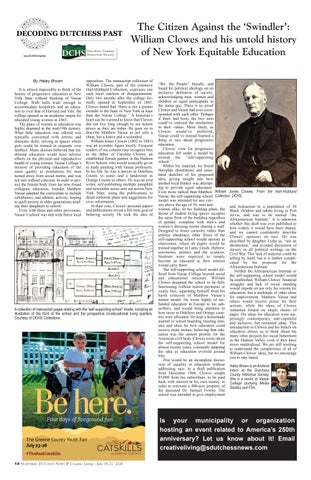
A collection of manuscript pages relating with the “self-supporting school” model, including an illustration of the front of the school and the prospective co-educational living quarters. Courtesy of DCHS Collections.
“We, the People” literally, and based his political ideology on an inclusive definition of society, acknowledging men, women and children as equal participants in the status quo. There is no proof Clowes and Vassar had ever corresponded with each other. Perhaps if there had been, the two men could’ve realized the similarities in their values. More likely, as Clowes would’ve preferred, Vassar could’ve instead learned a thing or two about progressive education. Clowes’ view for progressive education fell under a model he termed the “self-supporting school.” Within his material, we found floorplan illustrations and annotated sketches of his proposed idea, giving insight into how another local thinker was attempting to provide equal education. Even more radical than Matthew William Jones Clowes. From the Hart-Hubbard Vassar, the self-supporting school Collection. DCHS. model was intended for any citizen above the age of 10, men and and instruction to a population of 50 women alike. In his building plans, the Black children and adults living in Port layout of student living spaces occupies Jervis, and was to be named “the the same floor of the building regardless Africamerican Institute.” It is unknown of gender, complete with men’s and whether this draft was ever published or women’s dressing rooms sharing a wall. how widely it would have been shared, Designed to foster curiosity rather than and we cannot confidently describe enforce obedience, other floors of the Clowes’ opinions on race. He was self-supporting school would operate as described by daughter Lydia as, “not an classrooms, where all pupils would be abolitionist,” and avoided discussion of trained together in Latin, Greek, Hebrew, slavery in all political writings on the astronomy, politics and the sciences. Civil War. This lack of material could be Students were expected to simply telling by itself, but it is further complibecome as educated as their interest cated by his proposal for the would carry them. Africamerican Institute. The self-supporting school model difNeither the Africamerican Institute or fered from Vassar College beyond social the self-supporting school model would and educational structure. William be established. William Clowes’ financial Clowes designed the school to be fully struggles and lack of social standing functioning without tuition payments or would impede on not only his visions for yearly fees, separating himself from his education, but a multitude of other ideas harsh criticism of Matthew Vassar’s for improvement. Matthew Vassar and tuition model. He wrote highly of tax- others would receive praise for their funded education in Europe to his sub- actions, while the ideas of Clowes scribers, and would bring attention to remained folded on single sheets of how taxes in Dutchess and Orange coun- paper. His ideas for education were surties were allocated. He kept a homemade prisingly contemporary, anti-capitalist journal of school boarding meeting min- and inclusive, but remained ideas. This utes and ideas for how education could introduction to Clowes and his beliefs on receive more money, believing that edu- education allows us to think about his cation was the utmost priority for the many other projects for social betterment American civil body. Clowes wrote about in the Hudson Valley, even if they have the self-supporting school model for never materialized. We are still working almost twenty years, constantly adapting to understand the complexities of all of the idea as education evolved around William Clowes’ ideas, but we encourage him. you to stay tuned. This would be an incomplete discussion of equality in education without Haley Brown is an Archival addressing race. In a draft publication Intern at the Dutchess from December 1866, Clowes sought County Historical Society. $5,000 from his subscribers, to be paid She is a senior at Vassar back with interest in his own money, in College studying Media order to renovate a 400-acre property of Studies and Film. the deceased Dr. Samuel Fowler. The school was intended to give employment
Is your municipality or organization hosting an event related to America’s 250th anniversary? Let us know about it! Email creativeliving@sdutchessnews.com 14 N ORTHERN D UTCHESS N EWS & Creative Living - July 15-21, 2026