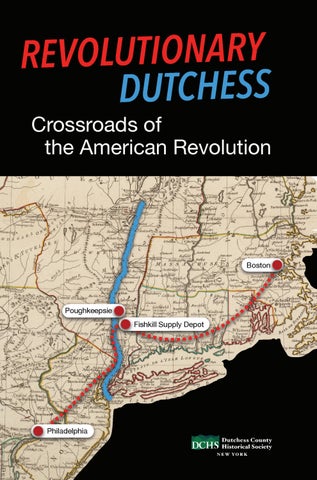
Revolutionary Dutchess: Crossroads of the American Revolution

Page 1


Dutchess County Historical Society 2025 Yearbook – Volume 104

Editors

Aidan Chisamore

Bill Jeffway

Melodye Moore

Advisor

William P. Tatum III, PhD

The Dutchess County Historical Society is a not-for-profit educational organization that collects, preserves, and interprets the history of Dutchess County, New York, from the period of the arrival of the first Indigenous Peoples until the present day. Published annually since the 1914 issue.

The Dutchess County Historical Society Yearbook does not assume responsibility for statements of fact or opinion made by the authors.

©Dutchess County Historical Society 2025

Dutchess County Historical Society

6282 Route 9, Rhinebeck, NY 12572

Email: contact@dchsny.org www.dchsny.org

Properties Group, LLC

Foster's Coach House Tavern, Rhinebeck Elijah & Christiane Bender & staff

The Launch of a Million Journeys to Freedom And Equality: Indigenous Peoples and the Working Class, Part 1

by Bill Jeffway

“The Brave Montgomery:” Major General Richard Montgomery and the Canada Campaign of 1775

by Michael Boden, PhD

“They absolutely did not murmur”: The Hudson Valley Takes Up Arms For King

The Revolutionary War and a Family Broken: The Trauma of Choosing Sides

by John Elliot Braun

The Creek Meeting in Perilous Times: The American Revolution and Early Antislavery Movement

by Cynthia Koch, PhD

“The Losses and Services of the American Loyalist” in Poughkeepsie

by Shannon Butler

ADDENDA

Year in Review

Dear members, supporters and friends of DCHS, Thank you for being part of a historically successful year in advancing the mission we have pursued since 1914: to collect, preserve and share the history of Dutchess County as a way to inform and educate present and future generations.

We benefited from a detailed, three-year strategic plan that was carefully crafted and launched by the DCHS board in 2022. Among other goals, one was to be seen by our varied stakeholders as the most meaningful source of Dutchess County history. Those varied stakeholders (DCHS members, the donors of financial support, collections, and auction items, as well as volunteers, researchers, and the general public) allowed us to transform our financial condition, enjoy a more accessible and flexible location, and perform better on all fronts.

Like any other year in our one-hundred and eleven years of operation, it was only a point, a waystation, in an evolving multi-generational project based on shared values and goals.

The pursuit of historical truth is in our DNA

All our work is firmly embedded in the principles established in 1914 by our founders. One of those principles is reflected in our Helen Wilkinson Reynolds Award, given to an individual who has demonstrated a commitment to the “necessary and accurate pursuit of historical truth.” As you know, this pursuit requires consulting original source material found in collections.

Although often less visible to the public, the care of collections rests on the sacred trust of generations of collections donors who have left items in our perpetual care. We have been able to significantly increase our investment in this area, as is explained later.

A unique capacity for multi-generational stewardship

We believe no other local organization could have helped steward the narrative interpretation, physical preservation of items, and public awareness of Hyde Park’s pre-Civil War free Black community of New Guinea in the way DCHS has. The once-lost voices of the men, women and children of that community continue to grow louder through a combination of the Town of Hyde Park’s town leadership, and collaborations that include DCHS and state-wide professional organizations.

The first profile of the New Guinea community was published eightysix years ago in our 1939 DCHS Yearbook; written by Franklin Roosevelt’s personal lawyer and local history collaborator, Henry Hackett.

In 2001, the town of Hyde Park named DCHS as the legal and financial fiduciary in an archaeological project that was a collaboration of DCHS, the Black History Committee, and Bard College Archaeology. In 2014, the town of Hyde Park assigned all research and physical items to the care of DCHS while retaining legal ownership.

In the most significant publication on the topic since 1939, DCHS greatly expanded the understanding of the community through its 2022 program, Bright Spark in Freedom’s Pursuit, expressed through an archived documentary video and a highly-interactive online digital StoryMap. New findings revealed the importance of the community east of Fredonia Lane, and the successful integration of the formerlyenslaved families into the village center economy as land and business owners.

Today, the site is listed on the National Register of Historic Places and

marked with a Pomeroy historical marker. In 2025, the Town of Hyde park engaged Hartgen Archaeology with a goal of installing educational signs at the site in time for the recognition of the 200th anniversary of the abolition of slavery in New York in 2027. The aptly-named 1799 Gradual Emancipation Act ultimately came to abolish slavery in New York on July 4th, 1827. The Black community has always celebrated that Act on July 5th, as will be the case in 2027.

“Rev250:” The powerful stories of our county from the 1776 Revolution

Significant new research by DCHS, combined with a review of all our prior published findings, allows us to bring fresh insights and relevance to a well-studied topic. Our work demonstrates that the county was a literal military crossroads at the center of the Northern Campaign, as the British attempted to control the entire Hudson River. In addition, the county’s role as a crossroads of diverse people (Indigenous, the very wealthy, the impoverished, enslaved and free Blacks, and Quakers) offers a unique insight into the inspiring journeys of persons working to embrace the freedom and equality promised in founding documents.

DCHS was the beneficiary of funding from the Dutchess County government which supported three major “Rev250” initiatives:

1. DCHS produced two identical sets of a six-panel traveling exhibition that is being loaned out across the county that expresses the narrative just stated. We expect that by the end of 2026 there will have been several thousand viewers of the exhibition.

2. DCHS published teaching aids for 4th, 7th, and 11th grade teachers that include a short video telling the historically-accurate story of the town of Washington’s free Black couple, Tom and Jane Williams. They named their son Lafayette shortly after that Revolutionary War hero’s 1824 local visit. Getting such work adopted by teachers is a long, collaborative process, but within a few months we had engagement with several hundred educators.

3. DCHS printed and digitally published another in our series of DCHS Yearbook Encore Editions. In this instance, we gathered and republished articles from our 1914 Yearbook on the topic of the Revolutionary War. By the end of 2025, there were 530 meaningful online engagements and 200 in printed form.

Because of the county grant, and matching work offered by DCHS, everything described above is available at no cost to the public.

Public engagement is at a record high

Our Virtual Event Space video library viewership has doubled every two years since 2023. During the 2025 calendar year, we had close to 10,000 views (9,853) totaling 967 hours of viewing.

The print version of the 2024 DCHS Yearbook, Firefighting in Dutchess County: A Greater Calling, is sold onsite and through Amazon Books and is free to DCHS members. The free online version has had 724 reads and 30 downloads.

We continue to get very positive feedback on our biweekly column, “Decoding Dutchess Past,” now in its eighth year, in the Northern/ Southern Dutchess News & Beacon Free Press, which has run every two weeks since 2018.

DCHS has grown its membership by 50% in the past two years!

Collections growth

In our long history, we see that certain persons emerge as quiet but highly consequential individuals over decades. One such person is Melodye Moore.

Since her first involvement with DCHS in 1979, Melodye Moore has safely and effectively stewarded collections through the typical ups and downs that any longstanding organization must endure.

As a result, as we achieved our goals of increased financial support for collections in recent years, we were able to make rapid progress that would have otherwise not been possible. This success included the creation of the full-time Collections and Archives Manager position, filled for over two years by a recent graduate of Vassar College, Aidan Chisamore. Chisamore has, in turn, attracted a record number of volunteers and interns that ranged from high school and college students to those in retirement.

Generous donors gave a total of $7,000 so that DCHS could purchase at auction a rare, detailed 1780 map of Janet Livingston Montgomery’s Grasmere Estate in Rhinebeck. The map is now available to researchers and the public at no cost.

Long-term discussions of major collections gifts continue but are too early to be made public. We continue to be pleasantly surprised at the quality and quantity of “new finds” that deserve the kind of care and interpretation that DCHS can uniquely offer.

Awards

The tradition of recognizing good work and best practice through awards, as a way to inspire others, was celebrated at the extraordinary home and barn museum of Dick Lahey in Wappingers Falls. The awardees were as follows: Historic Preservation: Dick Lahey for his unparalleled collection of carriages and subject expertise on horses and carriages. The Dutchess Award for community service: Rob & Sue Doyle. The Business of Historic Distinction Award: Legion Fireworks. The Franklin D. Roosevelt Award for exceptional performance in the study of local history early in one’s career: Aidan Chisamore. The Eileen Mylod Hayden Award for Education: Don Fraser.

Financials in 2025

The generosity of Rob & Sue Doyle was exceeded only by themselves, as they increased their donation (contingent on match) from $100,000

to $150,000. Through the generosity of other donors we raised an additional $115,000 by the end of 2025, leaving only a $35,000 gap. When fully realized, the fund has the potential to generate $12,000 initially and grow annually.

The longstanding (since 2001) Denise M. Lawlor Fund of the Community Foundations of the Hudson Valley generated a gift in 2025 of $12,236. Only the second of its kind after the Lawlor Fund, in 2025, DCHS received the first payment of a perpetual legacy gift from the late Winifred Schulman. The Winifred A. Schulman Charitable Fund of the Community Foundation of Sarasota County, Florida, DCHS provided $21,533.

So aren’t all of DCHS’s financial needs met?

Unprecedented opportunity and challenges

Our unprecedented success is met with unprecedented opportunity and challenges!

Just as the care of collections and archival items has needed increased investment, so, too does securing them. The acquisition of items can no longer be sustained with DCHS simply waiting as a passive repository. We have to actively reach out, and in some instances purchase, important items like the 1780 Janet Livingston Montgomery property map. We are creating a special collections acquisition and care fund for those who wish to support this specific activity.

We are developing more comprehensive finding aids that will search across our three libraries (the Franklin Butts research library and the two more recently acquired: the Arthur and Nancy Kelly genealogical library, and the Stephanie Maurie research library) as well as photographs, documents and ledgers, books, booklets, ephemera, and textiles.

We are now competing in not just a digital world, but a world of powerful artificial intelligence. More now than ever, the history that the

public is exposed to is whatever “history” is online. The need for DCHS to be the most meaningful source of Dutchess County history now requires a complex, but highly creative and rewarding, digital experience. Although in-progress in fundamental ways, we need to greatly accelerate digitization of our collections and finding aids. I choose my words carefully, as we are facing a battle to ensure that a whole, complete, and truthful history is accessible to the public.

Ultimately, we chart our own destiny

Many historical societies have dropped the word society from their name: most notably is the former New-York Historical Society which is now New York Historical. They have done so out of a concern that the word communicates a remote elitism. Personally, I prefer to keep the word in our name, but explain what it means

While strictly working within our vision and mission goals, and working operationally within our bylaws, each year a society of interested persons with a wide variety of interests and things to offer make a decision on what to focus on and how. Under the DCHS board’s leadership and endorsement, some donate money, others donate an auction item, some offer invaluable ideas, and some volunteer their time and skills. Others donate historical items for perpetual care. Members and friends read our books, watch our programs, and see our exhibitions. Researchers, writers and publishers draw from all of our resources to create their own narrative.

The ultimate question of this society of interested persons remains unchanged from our 1914 founding. Do we value the careful preservation of physical items as a foundation for the pursuit of historical truth? Can we attract young talent that will be a bridging generation to the future? Among many others.

Before our next Yearbook is published, we will mark the centennial of Lewis Mumford’s talk to the DCHS annual membership meeting held at Troutbeck on September 15, 1926. Mumford argued that through local history, “the things that we can see and touch awaken

the imagination… the facts of local history become part of a person’s own life to an extent which is rare [if] taken solely out of books and second hand accounts.”

How remarkable to be part of an organization born in a small room at the Pleasant Valley Free Library in April of 1914, whose radical notion at the time was to include women as founders and members. What a wonderful responsibility relative to present and future generations! We encourage your active participation, with a long view, in partnership with this extraordinary society of persons interested in the preservation of local history.

Editor’s Note

In honor of the commencement of the semiquincentennial celebrations in New York State, the 2025 issue of the Dutchess County Historical Society’s yearbook pays special attention to the American Revolution and its legacy. Since our founding in 1914, the DCHS Yearbook has provided a space to deepen public and scholarly understandings of local history. Acting as the first installment of this two-part anniversary series, volume 104–Revolutionary Dutchess: Crossroads of the American Revolution–covers many of the important and often overlooked aspects of military, social, and religious life during and after the war. The guiding theme for this year has been Dutchess County as a “Crossroad.” This all too familiar term might seem, at first, out of place in the study of history, but it allows us to consider the scope of Dutchess’ history through the understanding of the county as a meeting point. Situated geographically between Albany and New York City, between the Hudson River and New England, Dutchess could literally be understood as a center point and crossing place during the Revolution. However, as we will see throughout this issue, the analogy of a “crossroads” should extend much deeper, connecting to the confluence of peoples, movements, beliefs, and ideas.

In his article, DCHS Executive Director Bill Jeffway provides an insightful framework through which we might take a long view of the legacy of the Revolution. Jeffway underscores the varied journeys for freedom that played out in Dutchess County amongst Indigenous and working-class communities. These journeys, often struggles, comprise the tapestry of American history. Likewise, Amenia Town Historian Betsy Strauss teases out the intersection between the harsh truth of slavery and revolutionary service. This all-to-often overlooked aspect of the Revolutionary story helps develop a more nuanced understanding of the fight for freedom. Another area this volume seeks to

explore is women’s history, particularly the distribution of pensions to the wives and families of Revolutionary veterans. Dyan Wapnick, the Town Historian of Pine Plains, details the creation of her impressive play “Widow’s Weeds,” which was performed earlier this year at the Stissing Center. Her written work helps us understand the process and value of creative and interpretive projects to access these often underrepresented histories.

The view of Dutchess County as an intellectual crossroads helps break through the narrative of patriotic univocality locally. The 2025 RevCon keynote speaker, Mr. Todd Braistead, speaks directly to this argument in his essay on Loyalist Provincial troops raised from the Hudson Valley. He highlights the difficulties in determining the extent of Loyalist service locally, and in doing so underscores the role Dutchess County played on both sides of the conflict. Conversely, the Poughkeepsie Historian Shannon Butler provides a comprehensive assessment of the local response to Poughkeepsie Loyalists. Her article helps us understand the subtle and overt interactions between two often conflicting groups. For a more personal account of Loyalism locally, long time family researcher John Braun provides us with a unique family narrative. Braun’s work illustrates the power of personal histories and family accounts in deepening historical insights into the experience of local Loyalists. Cynthia Koch’s important view of Revolutionary Quakerism, similarly, emphasizes the liminality of this distinct religious group. Fears around the neutrality of Quakers often led local people to mistake them for Loyalists in the Revolution, but their early anti-slavery sentiments made them an integral part of the abolitionist movement. In showing this duality, Koch reminds us that the distinctions we so easily draw in our studies were, in reality, not so black and white.Taken together, these disparate articles drive forward our shared understanding of local Revolutionary history and its continued importance in the journey to promised civil freedom. This volume encourages us to view seemingly disconnected stories as part of a complex, interconnected network of voices.

Call for Articles

DCHS Yearbook 2026

The Dutchess County Historical Society has published the annual Yearbook since the organization’s founding in 1914, making it the longest-serving historical journal in New York State. The focus on publishing is a distinct hallmark of DCHS, embraced from the very first organizational meeting held at the Pleasant Valley Free Library in April of 1914. Helen Wilkinson Reynolds was the researching and writing powerhouse of the early days, who established “the pursuit of historical truth” as a central tenet. Her partnership with the professional photographer Margaret DeMott Brown set a high standard for documenting historical facts that are interpreted and published through written words and photographs.

DCHS seeks to promote and interpret local history through the publication of original research and case studies that address personalities, places, businesses, and events in and from Dutchess County, New York, as well as the county’s relationship to national and international events. The Yearbook features three sections: a forum of articles focused on a specific theme, general county history articles, and brief notes. Full articles should be 2,500-5,000 words in length, while notes should be around 800 words in length. The Dutchess County Historical Society Publications Committee actively solicits articles,essays, reports from the field, and case studies that support the historical society’s mission to procure, promote, and preserve the history of Dutchess County.

In honor of the 250th anniversary of the American Revolution, DCHS is seeking articles and notes focusing on the Revolutionary War. This issue continues the theme established in the 2025 Yearbook, centering around revolutionary era people, culture, social structures, and events. Contributors are also encouraged to submit articles that look

to better understand many experiences and stories related to the pursuit of freedom and equality following the Revolution. As always, the DCHS Publications Committee welcomes submissions on all aspects of Dutchess County’s past for consideration

For a full set of submission guidelines or to submit a piece to the DCHS Publications Committee, please contact the editors by email at wtatum@dutchessny.gov or via mail at PO Box 88, Poughkeepsie, NY.

F FORUM

Part 1: Indigenous People & the Working Class

The July 4, 1776, Declaration of Independence announced the creation of a country that was based on a radical premise at the time: that all men are created equal and have unalienable rights to life, liberty, and the pursuit of happiness.1 Such a radical premise could not be realized overnight, but the journeys began.

The long-held European model established a divinely appointed and inherited monarchy against which all other classes or types were ranked and kept in place. Many who at some point felt disadvantaged because of their race, faith, gender, economic hardship, or beliefs heard their right to equality referenced in that phrase.

Archaeologicalstudies revealthatIndigenous peoplesettledin today’s New York State at least 13,000 years ago,2 3 putting the 417-year-old 1609 arrival of Henry Hudson and his claim of a new colony on behalf of the Dutch in perspective.

The colony of New Netherland was seen by the Dutch as a

1 “Declaration of Independence: A Transcription,” National Archives website, retrieved January 31, 2026.

2 Charles L. Fisher, “The Archaeology of Paleoindian Occupations in New York State,” New York State Archaeological Association Bulletin 102 (1991): 1–13; Jonathan C. Lothrop, “Early Human Settlement of Northeastern North America,” Paleo America, Volume 2, 2016, Issue 3.

3 Native American Archaeology Research and Collections, New York State Museum website, retrieved January 2026.

Bill Jeffway

business enterprise, managed through the Dutch West India Company. Settlement was focused on the trading posts of New Amsterdam (New York City) with its access to the Atlantic Ocean and Orange (Albany) with its access to the Mohawk River and routes west.4 5 There was a smaller outpost at Esopus (Kingston). The English took over in 1664 with a view to growing the population through the entire valley. They created and named The Dutchess’s County to honor England’s Dutchess of York, Mary of Modena, in 1683. It was so unpopulated as to remain under Ulster County jurisdiction until 1713.6

County borders changed (see illustration). By the time of the Revolution, the county had lost what is today the southwest corner of Columbia County up to the Roeliff Jansen Kill (1717). This was arranged at the request of the Livingstons who wanted their Manor to be more conveniently located within one county. That area also included the settlement of impoverished German Palatines. The county gained the narrow north/south strip called the Oblong to the east in 1731, which was popular with Quakers. It was only after the Revolution, in 1812, that Putnam County was created from Dutchess.

The American Revolution occurred just two generations after serious settlement began.7 And yet we find a most fertile ground for the wide range of journeys seeking the American promise. We focus largely on the formative years of America’s first century to make such a large undertaking manageable.

The area was predominantly settled by the Wappinger, closely related to the Lenape (Delaware) extending south and southwest to the Delaware River. The area was a crossroads with adjacent communities like the Mahican to the north, the Schaghticoke to the east, and

4 Thomas J. Condon, New York Beginnings; the Commercial Origins of New Netherland, (NYU Press, 1968, p. 93.

5 The Colony of New Netherland. A Dutch Colony in Seventeenth Century America, by Japp Jacobs, (Cornell University Press, 2009).

6 “The Dutchess’s County,” by Helen Wilkinson Reynolds, Dutchess County Historical Society Yearbook, 1922, p. 35.

7 The History of Dutchess County, New York, by Frank Hasbrouck, (S.A. Matthiew, Poughkeepsie, 1909).

Munsee to the west.8 One of the Indigenous journeys that is better documented is that of Daniel Nimham, sachem of the Wappinger, who died at the Battle of Knightsbridge in Westchester County, serving as a captain in the American cause.

Wealthy Europeans settled largely along the more populous river, but also on large estates in rural parts. In the colonial period, prospective owners were asked to prove a legal purchase from “Indians” which could lead to a granting of legal ownership from the Crown. The biggest land disputes involved Indigenous claims that demonstrated that smaller land “sales” were falsified and greatly exaggerated to create the 160,000-acre Livingston Manor at the north, and the 200,000-acre Philipse Patent in the south. The currency of the wealthy was land ownership. Some owned hundreds of thousands of acres.

Wealthy landowners brought enslaved men, women, and children of African descent to every corner of the county.9 The enslaved were housed in separate quarters at larger estates, and more commonly lived under the same roof as the enslaver, in the basement or attic. Very often our records are limited to first names. The journeys of some, like Revolutionary War veteran Andrew Frazier, are better documented, in this case because of his pension application.

At the direction of England’s Queen Anne, several thousand impoverished Protestant German Palatine immigrants arrived in New York in 1710, settling initially at two sites on the east and west banks of the Hudson River. The 6,000-acre “east camp” was in what was northernmost Dutchess County at the time. It was carved out of the larger Livingston Manor and is today known as Germantown.

Piecing together two independent, partial headcounts, we find that between 1711 and 1714 the county had a population of about 437 persons with a sudden influx of around 1,189 impoverished Palatines. This means that the county’s total population of 1,626 was 75%

8 Native Land Digital, Canada, retrieved January 31, 2026. www.native-land.ca

9 US Federal Census Records, Dutchess County, New York, 1790, 1800, 1810, 1820.

impoverished before the northern section was annexed to Albany County in 1717.10 11

The major complaint of the Palatines was that they were tenant farmers. They paid an annual rent which limited their potential for personal economic gain and prevented them from meeting voting rights criteria. This was compounded by the immediate failure of the business they were recruited to perform relating to extracting pitch from pine trees to create tar and “naval stores” for the British Navy. Only a handful of families, like the Rowe (Rau) family, emerged as wealthier, propertied local leaders.

Persecuted New England Quakers sought religious tolerance by settling in isolated spaces in the eastern part of Dutchess County, starting in 1728 with Nathan Birdsall.12 They became one of the largest and most influential Quaker communities second only to Philadelphia. Quakers were resolute pacifists who refused to support any military activity of any kind, putting religious tolerance during the emergency of the Revolution to the test. The promise of religious tolerance was challenged on a larger scale in the 1840s with the decades-long arrival of Irish Catholics.

A split over orthodoxy in 1827 started a decline in the size of the practicing Quaker faithful. Yet, 19th-century Dutchess County was the launching pad for many men and women who became activist voices on the national stage for a wide range of issues. Among the issues they championed were the abolition of slavery, equal treatment and opportunity for women, and fair and equitable treatment of Indigenous people. Among the Quaker journey makers for social change who had local ties were Charles and Amanda Deyo, Lucretia Coffin Mott,

10 “Subsistence of the Palatines,” Documentary History of the State of New York, Vol. III, edited by E. B. O’Callahan, 1850, p 393.

11 “Census of the Palatines” by J. Cast, Documentary History of the State of New York, Vol. III, by E. B. O’Callahan, 1850, p 395.

12 Dell T. Upton, A History of the Quakers in Dutchess County, New York 1728 to 1828, B.A. Degree requirements Colgate University, Hamilton, NY, 1970.

Aaron Powell, Elizabeth Powell Bond, and Julia Wilbur, to name a few.

We find that the stories of various enthusiastic journeys in pursuit of the American promise were sometimes supportive of each other and sometimes in conflict with each other. This offers insight into the complex dynamics of ongoing journeys toward a more perfect union today. Part 1 of this two-part series examines the journeys of Indigenous people and the working class. Part 2 (DCHS Yearbook 2026) will look at the journeys of three groups. Those of African descent fought for the abolition of slavery and then for what turned out to be tentatively won battles for the promise of equality. Religious tolerance was among the earliest issues addressed legislatively in the colonial period. And yet, Quakers and Catholics in particular, found that religious tolerance required a good deal of work. The advocates for women’s equality and equal opportunity worked for two generations to achieve the right to vote nationally in 1920.

Voices of Indigenous People Heard Locally: Sovereignty, identity, self-determination, and land rights have been persistent issues

Broadly speaking, the area that is today Dutchess County was a crossroads of varied, dynamic Indigenous civilizations who settled here over thousands of years.

Historians’ best efforts to draw absolute lines around the tribes have yielded imperfect results due to fluid movements and kinship ties. What remains constant, however, is the central role of waterways in shaping human settlement, migration, and exchange. Indigenous naming was more precise. In the Munsee language, the tidal estuary we today call the Hudson River was known as Muhheacannituck—“the river that flows two ways”—a recognition of its alternating direction governed by lunar cycles.13 Its vast reach, linking the Atlantic Ocean to the Mohawk River corridor, has long supported human flourishing.

13 National Park Service website, Bard Rock, Retrieved January 31, 2026 at https:// www.nps.gov/places/bard-rock.htm.

Though nearly adjacent in northern Dutchess County, the Wappinger Creek and Roeliff Jansen Kill empty into the Hudson some forty miles apart. The Ten Mile River, from northern and eastern Dutchess County flows eventually to Long Island Sound. Together, these waterways have formed a distinctive and consequential crossroads that was present before, and after, European contact.

The impact of 1609 European contact was immediate. The population suffered greatly from the introduction of diseases like smallpox, to which they had no immunity, and the destructive effects of intoxicating spirits.14 Less than a century later, by 1706, aggressive European land claims put legal land ownership within the bounds of the county into the hands of fewer than two dozen European men. This was done through Crown patents, and in the case of Robert Livingston, through a manor and lordship.15 The exception was the one square mile settlement at Shekomeko at today’s Pine Plains which lasted until 1746.16

With some exceptions, like Daniel Nimham, the stories of local Indigenous people are not well documented or told. In the 19th century, the county’s role as an important political center, and large, activist Quaker population, made it a meeting place for national Indigenous leaders’ voices.

At the time of the publication of the Declaration of Independence, expectations of fair treatment, especially related to land rights, had been in the air among Indigenous people as both British and US Patriots sought their military engagement and support.

In the late summer of 1775 “King” Solomon Uhhaunauwaunmut of the Stockbridge Mohicans (Stockbridge, Massachusetts had become a place of Indigenous settlement) spoke at the Treaty of Albany meeting

14 John Quinney, 4th of July speech at Reidsville, New York, 1854, Collections of the State Historical Society of Wisconsin Historical Society, (Madison, Wisconsin, 1906), Vol. IV, p. 313.

15 Dutchess County Historical Society Yearbook, 1914, inset map related to 1779 map by Sauthier.

16 Isaac Huntting, History of Little Nine Partners, of North East Precinct, and Pine Plains, New York, Dutchess County, 1897.

to Patriot leaders. He said, “Wherever you go, we will be by your side… If we are conquered our Lands go with yours, but if we are victorious, we hope you will help us to recover our just rights.”17

“King” Solomon and Dutchess County’s Daniel Nimham both traveled to England in 1766 to argue land rights claims to the British Secretary of State and Lords of Trade involving the Philipse family’s taking of over 200,000 acres in southernmost Dutchess, now Putnam County. Their appeal was turned down.18 19 Solomon died in 1777, and Nimham died in battle in 1778. Had both lived, they no doubt would have faced the same obstacles with the new United States that they faced in trying to have land rights issues resolved with the British.

The literal journeys of important national Indigenous leaders coming to Dutchess County in the 19th century reflect the County’s role as an important political center including a large supportive Quaker community. The limited “sightings” of local Indigenous people occasionally and casually mentioned by 19th-century historians indicates that local Indigenous people were present but scattered as larger communities had relocated to places like Stockbridge, Wisconsin, and other western destinations. We find evidence of intermarriage among Whites, Indigenous people and Blacks in the racially tolerant so-called free Black communities that emerged before the Civil War mentioned by the Black studies academic A.J. Williams-Myers.

Poughkeepsie’s Nathaniel P. Tallmadge was a U.S. Senator from New York from 1833 to 1844 (with a gap of several months in 1839). At the time, over five thousand persons from six Indigenous nations were on the verge of being removed by what came to be seen as a fraudulently obtained 1838 Treaty of Buffalo Creek.

17 “Bidwell Lore: ‘King’ Solomon Uhhaunauwaunmut,” Bidwell House Museum website, accessed January 27, 2026. https://www.bidwellhousemuseum.org/ blog/2021/02/09/

18 Lane Gooding, “Daniel Nimham, Captain, Stockbridge Indian Company,” National Museum of the United States Army website, retrieved January 27, 2026. https://www. thenmusa.org/biographies/daniel-nimham

19 Alden T. Vaughn, Transatlantic Encounters: American Indians in Britain, 15001776, (Cambridge University Press, 2006), p. 177.

Through the Poughkeepsie Hotel register of 1839 (DCHS Collections) we find a January 10 gathering of six of the most important national leaders of Indigenous Peoples at the time in a likely meeting with Tallmadge. The Seneca leaders Jamison (sometimes Jameson), Seneca White, and Little Johnson arrived from Buffalo and were noted as “Indians.” Buffalo would have referred to the 50,000-acre Buffalo Creek Reservation in Erie County that was soon taken over by the Ogden Land Company.

Noted as from Green Bay, Wisconsin, we find Big Bear and the brothers Austin E. Quinney (ca. 1790–1865) and John Wannuaucon Quinney (1797–1855), who were prominent leaders, diplomats, and sachems of the Stockbridge-Munsee Mohican Nation. All three were noted in the ledger as “Indian Chiefs.” These leaders were trying to reverse the goals of the 1838 treaty.

They were aided by Quakers who in 1839 published a significant committee report documenting the overwhelming wish (and right) of the majority Indigenous people to remain on ancestral lands in New York State specifically. We believe at least two of those registered at the hotel at the same time were important Quaker leaders with local ties: William Toffey and Abraham Bell.

Two months after the Poughkeepsie meeting, on the very last day of Tallmadge’s first term as Senator before a several-month gap, he successfully proposed a bill which shifted responsibility of the decision of the validity of the treaty to the US President. This kind of ongoing passive neglect disadvantaged the petitioners. In 1842 the treaty was amended which forfeited some important lands like Buffalo Creek Reservation but saw small victories in the preservation of the Seneca territories of Allegany, Cattaraugus and Oil Springs.20 Those lands are among those that remain Indigenous lands today.

20 Ryan Zunner, “Seneca Nation commemorates pivotal 1842 Buffalo Creek Treaty,” Buffalo Toronto Public Media published May 16, 2025, retrieved January 31, 2026. https://www.btpm.org/local/2025-05-16/seneca-nation-commemorates-pivotal-1842-buffalo-creek-treaty

The Dutchess County Peace Society emerged after the Civil War in 1872 from the significant local Quaker population. The town of Clinton’s husband and wife Charles and Amanda Deyo were the group’s founders and leaders. The Society’s main goal was to stop deadly war but included advocacy for the fair and equal treatment of all people of color including Indigenous people, women, and the working class.

The Peace Society was holding its annual outside gathering on August 1, 1886, at Wiley’s Grove in the town of Clinton.21 With thousands in attendance, Chief Red Cloud (1822-1909), a highly regarded leader of the Oglala Lakota, spoke through a translator. The New York Times described him as “the greatest Chief…about six and a half feet in height, and large in proportion.”22

He was well known at the time for being a performer in Bill Cody’s (Buffalo Bill’s) Wild West Show, which performed locally. That show offered Indigenous people an imperfect choice. By performing they earned money, raised their profile, could speak to their identity, but they did so within the portrayal of their lives in a limited, stereotypical depiction. 23

Chief Red Cloud’s comments that day reflect the challenge of balancing a defense of identity with an assimilation to engage. At Wiley’s Grove he said, “I am glad to come among White folks. I am glad to have White folks visit my people. My boys wanted to taunt White people. I would not let them. Now they don’t want to fight anymore. I came out east to see about my lands. I came with Mr. Cody (Buffalo Bill) not for money alone but to learn.”

Chief Red Cloud is the most photographed Indigenous person of the 19th century. He is also widely quoted, as here, in reference to why he was drawn into war, “The Great Spirit raised both the White man and

21 “For War and For Peace,” Poughkeepsie Eagle-News, August 2, 1886, p. 3.

22 “Red Cloud and His Band,” New York Times, June 2, 1870.

23 “The Indian Citizenship Act at 100 Years Old,” Native American Rights Fund, Legal Review, 2004, Vol #49, No. 1, retrieved January 2026. https://narf.org/the-indian-citizenship-act-at-100-years-old

the Indian. I think he raised the Indian first. He raised me in this land; it belongs to me. The White man was raised over the great waters, and his land is over there. Since they crossed the sea, I have given them room. There are now White people all about me. I have but a small spot of land left. The Great Spirit told me to keep it.”

Local Indigenous people

We hope this emerging list will inspire further study of the many local Indigenous people whose stories are not fully told. Among the reasons for their under-documentation is because many 19th century historians aligned their narrative to the popular and pervasive mythology that the race had become extinct.24 The 1826 launch of the book, The Last of the Mohicans, by James Fenimore Cooper, created a popular, albeit unfounded, belief that persists today. The challenge of having neat and tidy racial distinctions occurs from differences that may occur between self-identity and expression -- and the perception of “outsiders” like historians and census takers.

Shekomeko community. In 1816, the Revolutionary leader Egbert Benson of Red Hook related his 1785 conversation a with member of the German Palatine Rowe family who spoke about the experience of his immigrant parents. Speaking about his father relocating from the Palatine Camp to what today we call Pine Plains, Rowe reported, “… at a place called by the Indians, Stissinck, the [Rowe] family were, as it respected White neighbors, for a long time almost solitary; that their chief intercourse was with the Indians who were still numerous there; that the Indian boys were his play fellows, so that as he grew up, the Indian [language] became as familiar to him as the German, the language of the family.” Rowe went on to say that when deer were scarce locally, Indigenous people hunted with neighboring Indians in southern Dutchess County at Wiccapee and that they referred to the Hudson River as “Sha-te-muc.” 25

24 Jean M. O’Brien, Firsting and Lasting: Writing Indians Out of Existence in New England, (University of Minnesota Press, 2010).

25 Egbert Benson, Memoire Read Before the Historical Society of the State of New York, December 31, 1816, (Jamaica, New York, 1825).

“Indian boy.” We don’t know his name, but in DCHS Collections there is a copy of the New-York Journal of November 22, 1779, under that heading we are told, “Run away on Saturday the 13th in Dover…a thick set Indian boy with long black hair, about 13 years of age.” James Morehouse of Dover who operated an important Revolutionary War era tavern offered a fifty-dollar reward. The boy could have been enslaved or an indentured servant.

Coshire family. The 1919 reporting of the 1887 death of Hannah Coshire at LaGrange aligns to the mythology of the vanished race. The Poughkeepsie Sunday Courier at the time described her as, “the last of the Schaghticoke.” Census records show her father, Jonas Coshire, heading a six-person household (noted as “free persons of color”) in Beekman’s 1800 census. Hannah’s parents Jonas and Lydia, and brother Stephen, appear to have been close with local Quakers as they are all buried in the Quaker burial ground in LaGrange.

Henry Catskill. In his 1909 history of Dutchess County, Frank Hasbrouck describes the free Black community of Baxtertown in Fishkill this way, “It is mostly occupied by negroes, in whom flows blood of the Wappinger Indians. “As the settlers came in and occupied the best of the land, the Indians were relegated to the poorer land…” This relegation happened to Blacks as well. Hasbrouck describes Henry, or “Old Harry,” Catskill as being of the Wappinger, entirely Native in appearance and “a well-built, handsome man, with straight hair.”

In the census records that we have so far found that identify him, Henry Catskill is shown as Black in 1850, 1860, 1870, 1875 and 1880. Starting with the 1850 census, census takers had a choice of “White, Black, or Mulatto.” Mulatto was meant to cover American Indians and mixed-race persons. Because of the complexity of racial distinction mentioned earlier, we may never know why there is discrepancy between a historian’s claim and census records.

Merely to illustrate how profoundly important the distinction of race was at the time, consider the following. We know from newspaper

accounts that by 1870, Henry Catskill was an active leader in the local “colored” Republican Party organizations in support of political campaigns. It appears that Henry Catskill met qualifications to vote as a Black man, because the value of his real estate was $700. If he had been identified as “Indian,” he would not have had that right to vote unless he went through a complicated process denying any association with any group of “Indians.” Indigenous people did not become US Citizens until 1924, at which point they became eligible to vote in New York State.

May family. In his 1897 History of the Little Nine Partners, Isaac Huntting describes the May family as “pure Mohican Shacomeo.” “Some members of the [Black] Frazier family intermarried with a family called May, of pure Indian lineage of the Mohican Shacomeo clan, and were proprietors of land in this vicinity.”26 This might refer to the 1814 marriage of Robert Frazier and Susan May recorded in the ledger of local justice Roswell Hopkins in DCHS Collections. The Hyde Park historian Cyrus Braman described Armenia May of Hyde Park as having “the blood of three races, red, black and white…” She married a former enslaved Black man of Hyde Park, James Purdy. 27

Is it fact, fiction, or folklore?

It is likely impossible to ever fully understand the dynamics behind two 1930s-era New York State historic markers near the former Shekomeko site. They both use the word “last.” They represent the “jostling” for narrative written by White authors as they looked at a multi-racial neighborhood. There are many examples of the erasure of references to the enslavement of Blacks. Signs at the time required no documentation or source material, simply a claim. These two signs were among 100 applied for by one person, Mrs. C.V. Harrison.

The sign reading, “Indian Burial Ground. Chief Crow and other Mohican Shacomecos of Moravian faith buried here. Last burial about 1850,” was erected in Milan in 1935. The local historian Webster Coon

26 Huntting, Little Nine Partners, P.336

27 “The Braman Transcripts,” Archives of the FDR Presidential Library and Museum.

and newspaper accounts in the 1920s document the burial of formerly enslaved Blacks from the Martin family of Red Hook, with the last burial occurring in 1927. Historical evidence of a Chief Crow remains elusive, while the documentation of mixed-race persons is confirmed.

The sign reading, “Site of Mannessah Home. Prince Quack Mannessah of the Mohican Shacomeco clan was the last known Indian resident of Gallatin,” was erected in 1932. The sign likely refers to a man more commonly known as Prince Minisee. The census of 1820, 1830, and 1840 in Stanford, Gallatin, and Pine Plains respectively indicate a free person of color in a household of five or six. After relocating to upstate, then to Michigan, the 1850, 1860 and 1870 census records him as “Black.” Yet Huntting specifically describes Minisee’s face as Indigenous after meeting him in Michigan. Again, we find a discrepancy between a first-person description and census records for reasons we are unlikely to ever know.

Summary

On July 4th, 1854, an aging John Quinney, who we came to know from his 1839 Poughkeepsie stay, spoke at a large gathering at Reidsville, New York, 13 miles southwest of Albany. Over a lifetime of activism, Quinney grappled with the profound dilemma faced by an Indigenous leader: how to navigate the assimilation demanded by those in power while preserving cultural identity and self-determination. He spoke at length about the history of his people, referring to the Muh-hecon-new Nation before Hudson’s arrival as having been composed of 25,000 persons and 4,000 warriors. He decried the introduction of disease and intoxicating spirits by White settlers. He was frank in describing the injustice he saw in broken promises and land dispossession. He said, in part, “…thanks to the fortunate circumstances of my life I have been taught in the schools and been able to read your histories and accounts of Europeans, yourselves and the Red Man; which instruct me that while your rejoicings today are commemorative of the free birth of this giant nation, they simply convey to my mind the recollection of a transfer of the miserable weakness and dependence,

of my race from one great power to another. For myself and my tribe, I ask for justice—I believe it will sooner or later occur—and may the Great and Good Spirit enable me to die in hope. Wannuaucon.”28

Indigenous voices today

The voices and perspectives of the local contemporary Indigenous people can easily be found online and through books and talks.

Christian Ayne Crouch has several leadership roles at Bard College, including Dean of Graduate Studies; Professor of History and American and Indigenous Studies; and Director of the Center for Indigenous Studies. She has been leading the massive “Rethinking Place: Bard-on-Mahicantuck” project, a three-year program funded by the Andrew W. Mellon Foundation.

Bonnie Hartley is an enrolled member of the Stockbridge-Munsee Community and serves as Tribal repatriation specialist as historic preservation manager. Hartley can be found online discussing the return of Papscanee Island, just south of Albany, through efforts of the Open Space Institute. Hartley comments, “Our land is intrinsic to who we are — it’s our identity. The greatest gift is to have our land back.”

Heather Bruegl is a citizen of the Oneida Nation of Wisconsin and first-line descendant Stockbridge Munsee. She is the author of Native to this Land, a History of the Indigenous Rights in North America, from Lerner Publishing and is a frequent speaker and advisor.

Sachem Hawkstorm of the Schaghticoke First Nations (SFN), whose ancestral homelands extend throughout the Hudson River and Harlem Valleys, lives locally. He frequently appears publicly, speaking both locally and regionally, including at TEDxBoston and at universities in New York and Pennsylvania. In partnership with SFN’s GenealogistHistorian, Valerie LaRobardier, and others, he has been leading a major, evolving research project to locate original source material

28 Quinney, 4th of July speech, p.313.

establishing his community’s accurate social and political continuity record over the centuries. This history remains untold.

The Journeys of the Working Class Removing Barriers to Gaining Wealth and Influence

Dutchess County offers a powerful view into the journeys of the poor and working class for several reasons. Among them, the 1710 migration of destitute and impoverished German Protestant Palatines involved the largest migration in human history at that time. The decades-long, vastly larger migration of poor Irish Catholic railroad workers in the 1840s tested both economic fairness and religious tolerance in the new nation.

Just a century after the 1609 arrival of Henry Hudson on behalf of the Dutch, there was a dramatic inversion in population and wealth in the area. The 1706 assignment of the Little Nine Partners Patent (Milan, Pine Plains, and part of North East) put virtually all the county’s land (except the one-square mile Shekomeko settlement) in the hands of fewer than two dozen wealthy European men.

As mentioned earlier, in 1710, around twelve hundred impoverished German Palatine immigrants arrived at what is now Germantown in what was then northernmost Dutchess County, adjacent to Livingston Manor. A smaller number settled on the west side of the Hudson River, making this one of the largest migrations in human history at the time.

Compounding the problem for the poor, the old European feudal system of a landlord and tenant farmer was firmly in place, especially in northernmost and southernmost Dutchess County. This denied the poor a chance at personal economic growth and prevented them from voting, as such rights were based on land ownership.

On top of this, the Palatine settlement’s original economic purpose— producing tar and turpentine from pine trees for the British Navy— failed immediately because the local pines were the wrong species.

Violent tenant uprisings in the 18th century in the Philipse Patent in what was then southern Dutchess (today’s Putnam County) and in both the 18th and 19th centuries at Livingston Manor, reveal just how deep and persistent these grievances were. Although the American Revolution swept away the legal titles of lords and manors, it did not eliminate the landlord–tenant system itself.

At the time the Declaration of Independence was published, expectations of fairness and opportunity had been in the air and expressing themselves for some time. The noted historian Howard Zinn, in his A People’s History of the United States, reports that there were ninety such smaller declarations of independence in advance of Thomas Jefferson’s.

One such example occurs on May 29, 1776, when Lewis Thibou, chairman of the General Committee of Mechanics of New York City (at the time “mechanics” was used broadly to describe the entire working class) presented what became known as the Mechanics’ Declaration of Independence. The document demanded justice from those “whose dominions have been made rich by our commerce.”

In Dutchess County, the last major remnant of landlord and tenant farming survived until 1889, when twenty-eight farms totaling 4,000 acres in Milan and Pine Plains were finally sold at auction by descendants of the original patentee. Many tenant farmers could not afford to buy the farms their families had been on for generations.

It is easy to imagine that the idea that only wealthy, propertied men could vote would be among the most obvious contradictions in the United States. Limited, race-based progress came only in 1821. No doubt with the approaching 1827 abolition of slavery in New York State in mind, New York eliminated all property requirements for White men to vote, through constitutional change. However, a $250 landownership requirement (free and clear of mortgage) for Black men only was maintained. This created one of the clearest examples of race-based suffrage in American history, which lasted until the 1870 adoption of the 15th US Constitutional Amendment.

Andrew Jackson’s presidency from 1829 to 1837 is considered the launch of what came to be called a generation of Jacksonian democracy through the 1850s. In addition to its aggressive and deadly approach to the relocation of Indigenous people through the 1830 Indian Removal Act, the era was characterized by the rising power of the working-class White male.

1831 imprisonment for debt abolished

One of the biggest obstacles for the poor to break out of poverty was imprisonment for debt. Colonial New York operated under the English tradition of jailing persons who could not pay their debts. Controversial even at the time, after the formation of the United States only small steps were taken in New York State to address the issue until it was abolished in 1831.

Through Dutchess County’s extraordinary ancient documents collection, we learn that a local woman, Elizabeth Perry, was imprisoned for debts she could not pay in 1798. On March 9, 1799, she appealed to the court referring the New York State “Act for the relief of debtors with respect to imprisonment of their persons” passed 13th February 1789. The act allowed her to be freed from jail on turning over of any property, except for the clothes on her back, and a bed.

In her petition she confirmed she had never owned real estate. She promised she retained only “wearing apparel and bedding not exceeding twenty pounds in value.” She paid $55.18 and sheriff fees. She promised to deliver to the court at a specified future date the remainder of her possessions, specifically: “One small looking glass, one tea kettle, one iron kettle, one half dozen knives, forks, large pewter spoons, and tea spoons, and one chest, one pen knife, one waistcoat, two pairs of breeches, one greatcoat, one undercoat and one pair of silk stockings.” She noted some debts due to her she would turn over. That same day, March 9, 1799, John Forbus released Elizabeth Perry and delivered her to James Perry.

Equal economic opportunity sought

Early labor reformers in the 1830s, such as Frances Wright, were radical. They argued that inherited wealth should be abolished. Every person should begin life with equal resources, including property ownership and education. Children would be educated uniformly, even removed from their families, to prevent inequality from reproducing itself. These ideas were too extreme for most Americans—but they reveal how deeply some people believed the social order itself needed to be completely rebuilt.

Rhinebeck’s Nathan Darling (1802–1866), cast an important vote in 1830 in the burgeoning labor movement in New York City to push the effort to a more moderate middle ground. Born into deep poverty, Darling moved to New York City and worked as a house painter in the 1820s. In 1830, he became a delegate in the organized mechanics’ labor movement, The Working Man’s Party, at a critical moment. Darling cast a pivotal vote that shifted the movement away from creating its own independent political party to lobbying for achievable political and economic reforms by endorsing certain major party candidates. That moderation allowed the workingmen’s movement to grow rather than fracture. Darling later went on to a successful military career (at the expense of Florida’s Indigenous Seminole people) and launched a successful political career in Washington D.C. A reflection of his success, he built the 1858 Italianate Rhinebeck home that still stands today on West Market Street.

By the 1840s, labor groups were forming locally in Dutchess County. Egbert S. Manning was a national leader for working class reform. He attended an October 6, 1844, meeting in the town of Clinton at Salt Point. He noted the county’s working poor were described as “7,000 landless slaves [with] their numbers augmenting yearly.” 29 While the two main, local speakers agreed on the problem, they differed on the solution profoundly. At the end of the meeting, Manning reported,

29 The Working Man’s Advocate, October 19, 1844

“Thus, after abusing each other for an hour and a half they sat down, each conceiving himself to be the victor.”

In 1845, the author of a letter published in the Working Man’s Advocate declared, as he stood on a hill looking west over what was the former Livingston Manor and northern Dutchess County, “How much land and property, and I have none! The right of an oppressed and down-trodden man to labor and enjoy what he produces, must finally triumph!” The article asked, why do “these savage hovels” stand beside “vast and gorgeous palaces?”

The former 160,000-acre Livingston Manor, by then in Columbia County, had since the prior year become the site of violent “antirenter” protests. Like protesters at the 1773 Boston Tea Party, they dressed (and in the process disguised themselves) in the general costume of American “Indians.” When a sherrif went to a tenant farmer to evict him for non-payment in December of 1844, he was met by 200 “Indians” and 1,500 other residents who compelled him to burn the eviction papers.30

Equal opportunity for childhood education

Fairness and equal access to education became one of the great ambitions of the labor movement.

Although New York State created a “school fund” in 1805 from the sale of public lands, it was not operational until 1812 when an act established common schools. The fund was entirely inadequate in funding education, so schools largely required a paid tuition.31 32

In 1813 the State of New York’s Superintendent of Common Schools reported that each town needed to report the number of children between the ages of 5 and 15 years old, “Slaves are to be included in the enumeration.”

30 Poughkeepsie Journal, December 21, 1822, p. 2.

31 Poughkeepsie Eagle, Mar 11, 1812, p. 3

32 Poughkeepsie Eagle, November 17, 1813, p.

Poughkeepsie emerged as a leader in the state by establishing a free school funded by property tax starting in 1843. The Lancaster School (a popular approach at the time that involved older students taking on teaching roles) was founded when 150 donors gave $15 each to found it and it educated 240 White children and 45 children of color.

The tax-funded idea was controversial, but advocates like Charles Bartlett argued the point in terms of the promise of equality, saying in 1841, “We deprecate and discountenance all aristocracy, whether of wealth or intellect. There might arise an aristocracy of intellect more dangerous and oppressive than that of which wealth was the creator.” He argued that the children of the poor and the rich must meet in an equality, sitting side by side.33 So did Isaac Platt who said the goal was to “devise the best possible means of improving our education system…increasing the benefits enjoyed by the poor.”

In 1849, New York State authorized all local school districts across the state to have a referendum on tax-supported free schools, creating very mixed results. Arguments for and against taking free schools to every town in Dutchess County appeared in local papers.

Also in 1849, Jesse Torrey Jr. announced that Poughkeepsie would serve as the base for his American School Library, a national effort to push away the dominant use of British schoolbooks for American children. The appendix to his 1828 book Mental Museum for the Rising Generation, includes the Declaration of Independence, the US Constitution, and the bylaws he created for free circulating libraries— seeing them as connected parts of the same democratic project.

It was not until 1867 that free public education was mandated state-wide and not until 1874 that attendance became compulsory. Meaningful child labor laws were not implemented until 1886.34

33 Poughkeepsie Eagle, March 31, 1841.

34 F. Perera, “Science as an Early Driver of Policy: Child Labor Reform in the Early Progressive Era,” American Journal of Public Health (2014), noting that “the 1886 New York State Child Labor Law was the first enforceable child labor law in New York State and was followed by similar legislation in other states.”

By the time of the American centennial, progress had been made for the “mechanics” or working class. The removal of property requirements for voting was long and explicitly race-based. The abolition of imprisonment for debt, affordable (free) childhood education, and ongoing experiments to create equal economic opportunity that remain in some form today, reflect the first century’s focus. The number of working hours and working conditions became more important as industry became more intense and pervasive. But the journeys to working-class equality and economic fairness have clear roots in the 1776 American Revolution’s premise of equality.

Author’s addendum

The documenting of the voices and stories of local Indigenous people is an accelerating, but relatively recent exercise that must emerge from those communities themselves. As a result, we encourage your continued attention to this growing knowledge, which may frequently challenge prior assumptions and understanding, including those presented here. Vassar College’s Professor Lucy Maynard Salmon always noted that the Greek Goddess of memory, Clio, stands with a scroll that she suggests her work is endless, given the historian’s most important job is to “rewrite history” in pursuit of greater, more truthful and whole, inclusive historical narrative.

Part 2 will be published in the subsequent DCHS Yearbook of 2026 and will cover racial justice for those of African descent, religious tolerance, and the emergence of women’s roles and rights.

“The

Brave Montgomery”: Major General Richard Montgomery and the Canada Campaign of 1775

In the fall of 1757, a young Ensign in the 17th Regiment of Foot arrived in New York City, at the start of the Seven Years War. He did not realize at the time that this would be the beginning of a long relationship with the colonies. Between his arrival and his death at the end of 1775, Richard Montgomery proved to be a brave and dedicated junior officer, devoted husband, and successful general of colonial forces at a time when victory was rare. Although mostly remembered from his failed assault on Quebec in December, 1775, it should not be forgotten that prior to that attack, he led a small number of troops to multiple successes throughout a very difficult campaign. And, though he perished at Quebec, he gave the people of the colonies not only their first martyr in the cause of independence, but hope.

Richard Montgomery was born in County Dublin, Ireland, to Thomas Montgomery, a baronet and member of the Irish Parliament, on December 2, 1738, into a family that could claim descent from centuries of successful military men, most notably Gabriel de Lorges,

Figure 1: Richard Montgomery (Public Domain)

the Count de Montgomery, the man responsible for the death of King Henri II of France in the prelude to that state’s Wars of Religion. After spending two years studying at Trinity College in Dublin, at the urging of his father and older brother, Alexander, Richard joined the British Army in the 17th Regiment of Foot, a unit with a distinguished and proud history as a loyal Irish organization.1 Within two years, the 17th received orders to go to America as part of the British effort against French forces in the colonies.2

His extensive experiences in the French and Indian War, as the Seven Years War was known in the Americas, proved to be an invaluable learning experience, as well as an opportunity to demonstrate his skills. Between 1758 and 1764, he would see combat in multiple conditions throughout the continent. During the Siege of Louisbourg in 1758, he saw his first combat and was promoted to Lieutenant shortly before the French surrendered the fort. Between the Spring of 1759 and Fall of 1760, he campaigned throughout the Hudson River Valley, from Albany to Il-aux-Nois and back to Crown Point, the same area in which he would lead colonial forces in 1775; the 18 months spent in the region was invaluable to him later in life. In 1761, the 17th was sent to the Caribbean, where he fought in Martinique and, shortly after his promotion to Captain, experienced much heavier fighting at Havana.3

Although successful at Havana, the four years of combat had taken its toll on Montgomery, and he was sent to New York City to recuperate from illnesses conceived in the Caribbean. In the final year of the war, he would participate in a number of initiatives that, while perhaps not as dangerous as some of the combat he experienced, would be of much more value and significance to his life in general. Detached as he was from his regiment, he was ordered to the Mohawk Valley to participate in the subjugation of Pontiac’s Rebellion. On the way north from New York City, in June, 1763, at a brief stop midway between New York

1 Hal T. Shelton, General Richard Montgomery and the American revolution: From Redcoat to Rebel (New York: New York University Press, 1994), 16.

2 Michael P. Gabriel, Major General Richard Montgomery: The Making of an American Hero (Madison: Fairleigh Dickinson University Press, 2002), 20-1.

3 Gaabriel, 24-8; Shelton, 24-30.

City and Albany when his transport ship ran aground on the banks of the Hudson, he met a young lady by the name of Janet Livingston. While at the time there were no outward signs that the meeting was of any significance, a decade later the two would reconnect, undoubtedly remembering this initial, brief encounter.4

Montgomery spent the ensuing year campaigning between Albany and Detroit until in September, 1764, when he was allowed to return to England after seven years away from home, as a courier for the Commander of British troops in America, Major General Thomas Gage. The experiences in Pontiac’s War shaped Montgomery in a number of ways. First, as stated, he met his future wife. More importantly for his military exploits, he was able to see a great part of the North American continent, both frontier and settled land, and become acquainted with the diverse collection of North American colonists. He also spent many days and weeks engaging directly with native tribes of the region, an experience that would give him great insight in the years ahead.5

The subsequent years in Britain were frustrating for Montgomery, finding promotion in a peacetime army slow, without patronage, and unable to afford the higher prices of a Major’s commission that might allow for more rapid ascendancy. In 1769, he was briefly engaged to a young lady in Ireland, an engagement that fell apart after her unfaithfulness.6 In April, 1772, he sold his commission for £1,500 (to the senior Lieutenant in the 17th) and decided to return to America to begin a new life.7 His wartime experiences, as well as his upbringing in Ireland, had instilled in him a set of beliefs which embraced a sentiment supporting colonial independence. He was, for instance, opposed to the growing British influence in his home country, saw parallels with events in the colonies, and was vehemently against the Stamp Act and other British revenue measures of the era.8 He was,

4 Gabriel, 32.

5 Ibid., 34.

6 Ibid., 44.

7 Ibid., 51.

8 Ibid., 44.

politically, a Whig – rather conservative and opposed to many of the British state initiatives.9

Upon his return to North America in November, 1772, he determined to be a gentleman farmer in the colonies. He was fortunate in that he had a small fortune available for this endeavor: the £1500 from selling his commission, and a considerable savings accumulated over the years toward the purchase of a Major’s commission, which amounted to an additional £1100. He had no difficulty finding a farm in the King’s Bridge area of New York, currently part of the Bronx; shortly after his arrival, he remembered the pleasant young lady from the Hudson Valley, and reintroduced himself to Janet Livingston.10

After a brief courtship, the pair were married in July, 1773, and shortly thereafter Montgomery sold his Kings Bridge estate and moved to the Hudson Valley. Upon marriage, the Montgomerys moved to Rhinebeck, where Janet owned property, and began work on their new estate, Grasmere, living in a small house there while construction progressed.11 The next two years were undoubtedly happy ones for the Montgomerys: Richard had married into one of the most influential families in New York, if not in the entire thirteen colonies, and he and Janet were very much aligned in their perspective on life. In addition, Montgomery proved to be a very astute landowner

9 Shelton, 56.

10 Gabriel, 54-6; Shelton, 36.

11 George Washington Cullum, “Major-General Richard Montgomery,” The Magazine of American History, XI:4 (April 1884): 297; Shelton, 39.

Figure 2: Janet Montgomery (womenshistoryblog.com)

and businessman, purchasing several tracts of good land and gaining a reputation as an agricultural innovator in the region.12

Along with this newfound good fortune came civic responsibility. Such sentiment was not foreign to Montgomery, who had been instilled with, and maintained, a very strong sense of obligation to those people and causes he most valued. And, even with Janet writing that her husband believed “politics [was] nothing but noise and vexation,”13 he was attached to his new country and was an early participant in New

12 Gabriel, 62-4.

13 Janet Montgomery to Perkins Magra, June 1, 1775, in Gabriel, 67.

Figure 3: 1780 Survey Map of Janet Livingston Montgomery Properties, Rhinebeck, NY (Dutchess County Historical Society Collection)

York government. The Livingstons were certainly Patriots, but just as certainly not radicals, and Montgomery easily fit that same mold. His responsibilities took him from New York’s Committee of 50 in 1774, to the Committee of 60 the following year, and in May, 1775, he was named one of Dutchess County’s representatives to the Provincial Congress.14

At the Congress, Montgomery was one of the most active members during his brief time there, primarily addressing military matters. He served on committees and made decisions on a variety of issues, many of which would be closely related to his own military endeavors later in the year. Some of these undertakings included the logistical support of Ticonderoga, the development of the Hudson Highlands defenses (to include the creation of Fort Independence on the site of his former King’s Bridge home), the acquisition of tents and equipment for New York militia, and the testing of colonial artillery.15

But his time in the Congress was short, as less than a month after he arrived, he was appointed the New York State Brigadier General, second only to Major General Philip Schuyler. Two weeks later, on June 22, the Continental Congress named 8 colonial Brigadier Generals, and Montgomery was named second in rank of this group. On July 7, he left the Provincial Congress to take up his duties as an officer in the Separate Army north of Albany16 as the second-in-command to Schuyler. He moved to his new position as quickly as possible, not even stopping at his Hudson Valley home en route (although Janet did accompany him as far as Saratoga), arriving in Albany on the 15th . 17 On August 17, he arrived at Ticonderoga, where the frequently-ill Schuyler placed him in command of the troops and returned to Saratoga.18

14 Gabriel, 68-72.

15 Shelton, 62-3.

16 Brendan Morrissey, Quebec 1775: The American Invasion of Canada, Oxford: Osprey Publishing, 2003, 24; the force that entered Canada in 1775 was known as the Separate Army until January 1, 1776, when it was designated the Northern Army.

17 Robert McConnell Hatch, Thrust for Canada: The American Attempt on Quebec in 1775-1776, Boston: Houghton Mifflin Company, 1979, 47.

18 Gabriel, 93-5.

The mission of his army was universally recognized: to invade Canada and defeat the British. There were many reasons for such an undertaking. At the core of the effort was the presence of a hostile foe along a long border, which caused great concern to New York and New England, the prime drivers of action to Canada. In addition, there were a number of “fears” from different sections of the population. Many people feared the passage of the Quebec Act in May, 1775, constituted an indication of future efforts against the lower colonies, and others were angered by the official recognition given to the Roman Catholic Church in Canada. The British were also known to support the local native tribes of the region and were believed, with some justification, to be encouraging those tribes to acts of violence towards the colonists. Finally, even though the British forces were rather understrength in Canada, with only two small regiments (the 7th and 26th Regiments of Foot, with a total of only 557 men), the commander of British forces in Canada, Major General Guy Carleton,19 was conducting initial preparations for an invasion of New York down Lake Champlain, to Albany and the Hudson Valley.20

In his initial actions, we see Montgomery’s qualities manifesting his fitness for high command; there was much to be encouraged by. Between August 17, when he arrived at Ticonderoga, and the 28th , when his force departed north, he actively prepared his army. While certainly his experience over this same terrain 15 years prior was of great benefit, it was more the intangible elements of his leadership that were most effective. He was able to ensure harmonious relations throughout his army, which contained contingents from both New England (mostly Connecticut) and New York, colonial regions that did not always agree on cooperative efforts. He inspired confidence, and prepared his forces to the greatest degree possible. His efforts at gathering intelligence were commendable, gaining a rather accurate picture of the British forces he would face, as well as the disposition of native tribes and the French-Canadians he would encounter (both

19 Carleton was also the Royal Governor of the Province of Quebec.

20 Atkinson, 143.

of these groups would be neutral, or at least mixed, in their support during the coming months).21

His first obstacle on the campaign was the Fort of St. Johns, the British forward staging area, location north of the border between Canada and the rebelling colonies. Montgomery arrived at the forward outpost of Il-aux-Nois on September 2, and was rejoined by Schuyler two days later, if only for a short period of time. An immediate, although unsuccessful, effort under Schuyler was made to capture St. Johns, resulting in a return to Il-aux-Nois, where Schuyler once again took ill, turned command over to Montgomery, and returned to Albany. Now that he was in sole command of the colonial forces in the area, Montgomery departed in another attempt to capture St. Johns on September 16, and completely encircled the British position by the 18th . 22

The siege of St. Johns was Montgomery’s first opportunity at independent command. At the outset, the siege was leaky, and the colonial cause hampered by disease, poor weather, and superior British

21 Gabriel, 96-8.

22 Morrissey, 33, 37.

Figure 4: Map of the Canada Campaign, 1775 (USMA)

artillery (a defect that would haunt Montgomery throughout the entire campaign). Montgomery, though, energetically attempted to remedy the problems facing his small army, conducting nearly continual dialogue with native tribes, the local population, and the various constituents within his own army. Slowly but surely, through the month of October, the ring around St. Johns grew tighter, highlighted by a sudden thrust that captured the small, but well-provisioned, British garrison at Chambly, halfway between St. Johns and Montreal.23

(https://www.tourisme-monteregie.qc.ca)

With the successful completion of the Chambly operation on October 18, Montgomery not only captured a British detachment, but more importantly acquired a great quantity of supplies, including over 6 tons of gunpowder, a short commodity in Montgomery’s army. Chambly also resulted in a strong boost in morale for his troops, and was backed up by successive new batteries that Montgomery emplaced to the Northeast and Northwest of St. Johns, ultimately leading to the untenable nature of the fort. After a relief attempt by Carlton was defeated and pushed back by Colonel Seth Warner’s Green Mountain boys on

23 Morrissey, 41-2; Shelton, 109-10.

Figure 5: Chambly

October 30, the fate of St. Johns was sealed, and the British surrendered on November 3.24

In the aggregate, Montgomery could claim the operations around St. Johns a notable success, as the fort did surrender, resulting in the acquisition of critical supplies, and Montgomery demonstrated some unique skills overcoming obstacles to achieve a victory. And, at a time when colonial fortunes were at low ebb, the capture of St. Johns provided the people of the colonies a much-needed victory to savor. But the surrender took a long six weeks, which gave the British command time to coordinate a more effective defense of the St. Lawrence Valley. In addition, losses to the colonial army were significant. While only about 100 men were lost, killed or wounded, over 1,000 were discharged due to illness and sent back south. The British, on the other hand, lost less than 50 killed or wounded, in addition to the 550 men captured.25

Following St. Johns, Montgomery prepared for the next step of the campaign, a movement against the British headquarters in Canada, Quebec. The first phase of this operation involved the capture of Montreal, which occurred without major challenge on November 13. Once there, Montgomery took the opportunity to rest and refit his army before moving on to Quebec. Another piece of good fortune involved the arrival of Benedict Arnold, and a colonial contingent of 650 men, arriving outside of Quebec on November 9 after an epic journey throughout the Maine backcountry, worthy of the praise it would earn in later years.26 Montgomery left Montreal with 850 men on November 28, met Arnold on the road at Point-aux-Trembles, and continued to Quebec, where he arrived on December 8.

The months of September, October, and November taught Montgomery new lessons and gave cause to him to demonstrate yet more key leadership tendencies. The most significant outcome of his operations so far,

24 Michael Cecere, United for Independence: The American Revolution in the Middle Colonies, 1775-1776, Yardley, PA: Westholme, 2023, 45-7; Atkinson, 148-9; Morrissey, 42.

25 Morrissey, 42; Shelton, 115.

26 Morrissey, 46-51.

though, was not on the man himself, but on the perception of the man in the colonies. Montgomery had given the colonies their first successful campaign. Elsewhere, colonial troops had won skirmishes, and fought courageously at places like Bunker Hill, but Montgomery’s army was achieving offensive victories in sequence, from St. Johns, to Chambly, to the capture of 150 men – and British Brigadier General Richard Prescott, commander of the 7th Regiment – on November 19.27 He was, quite simply, the most successful commander of the war to date, with a name that was becoming well-known throughout the colonies. As demonstration of this high regard, and of the expectation that he would complete a successful campaign by capturing Quebec, the Continental Congress promoted him to Major General on November 18.28

Montgomery continued to demonstrate exceptional abilities of negotiation and diplomacy throughout these months, establishing good relations with his fellow commanders, even Arnold, a man notorious for his inability to get along with his peers and superiors. Schuyler himself said that “I cannot estimate the Obligation I lay under to General Montgomery, for the many important Services he has done and daily does, in which he has had little Assistance from me.”29 In public, and to his superiors, he exhibited an unassuming temperament. He was, though, by nature, a rather fatalistic and pessimistic person, a trait he shared with his wife, but this sentiment was tempered in his official letters, where he remained humble and optimistic about success. Upon arrival outside of Quebec, for instance, he wrote to Schuyler that “Fortune often baffles the sanguine expectations of poor mortals. I am not intoxicated with the Favors I have received at her hands, but I do think there is a fair prospect of success.”30

Occasionally, particularly to his family, he expressed more realistic feelings about his service, especially toward the men of his command. A series of discipline issues plagued his army which, for the most part, Montgomery handled with skill and tact. One of them involved

27 Shelton, 119-120.

28 Gabriel, 150.

29 Philip Schuyler to John Hancock, September 8, 1775, in Gabriel, 99.

30 Richard Montgomery to Philip Schuyler, December 5, 1775, in Gabriel, 146.

the release of a New York militia Captain, Gersham Mott, from confinement for abandoning his post at St. Johns, due to the opposition of fellow New York officers to support the decision to arrest. To his brother-in-law Richard Livingston, he wrote on October 5, the day of Mott’s release, that “The master of Hindustan could not recompense me for this summer’s work and nothing shall ever tempt me again to hazard my reputation at the head of such ragamuffins. Honor, the very soul of the soldier, has no existence among us.”31 Four days later he wrote to Janet that “I am unfit to deal with mankind in the bulk, for which reason I wish for retirement. I feel too sensibly the rascality, Ignorance and selfishness so common among my fellow creatures to deal with them and keep my temper.”32 Even to Schuyler, on the eve of his great success at St. Johns, he wrote that “I have not the talents or temper for such a command. I am under the disagreeable necessity of acting externally out of Character to wheedle, flatter and Lie.”33

Regardless of these internal frustrations, Montgomery was at the gates of Quebec in early December and, despite some critical debilitating factors, feeling cautiously optimistic about upcoming operations. His combined forced number around 1200 men, fewer than the 1800 Carleton had in the city itself for the British.34 He had no heavy artillery, and relatively few fieldpieces at all (compared to the British having 140 along the length of Quebec’s walls). His Army, while still following his command without serious reservation, was without pay, operating in horrible weather, and had quite low morale. To add to the challenge, a great number of his troops’ enlistments would expire on December 31. He did, though, have plenty of ammunition and plenty of winter clothing.35 And, despite the low morale, most of his troops were quite willing to make an effort against Quebec at least once before their enlistments ran out. Given these conditions, he was able to reflect in a note to Schuyler that “Fortune often battles the sanguine

31 Richard Montgomery to Richard Livington, October 5, 1775, in Gabriel, 116; for information on the Mott episode, see Gabriel, 139-40.

32 Richard Montgomery to Janet Montgomery, October 9, 1775, in Gabriel, 105.

33 Richard Montgomery to Philip Schuyler, October 31, 1775, in Gabriel, 126.

34 “Quebec,” American Battlefield Trust, https://www.battlefields.org/learn/revolutionary-war/battles/quebec.

35 Atkinson, 195; Morrissey, 45.

expectations of poor mortals. I am not intoxicated with the Favors I have received at her hands, but I do think there is a fair prospect of success [of capturing Quebec].”36

Figure 6: Quebec, 1775 (battlemaps.us)

His efforts during the month of December at Quebec would be frustrated at nearly every attempt. Twice he sent messages to Carleton and the citizens of Quebec encouraging surrender, but all efforts were rebuffed. Twice he attempted to emplace batteries to engage the city, but those efforts were either ineffective or quickly destroyed by British counterfire. It became clear that if he was to take the city before the enlistments ran out, he would have to do so by an assault. He therefore determined that he would conduct such an assault during the next major snowstorm. A first attempt, on the night of December 27, was aborted after a sudden change in the weather reduced the storm. The next opportunity would come on the night of the 30th when another storm arose.37

Montgomery’s attack would consist of two assaulting columns.

36 Richard Montgomery to Philip Schuyler, December 5, 1775, in Gabriel, 146.

37 Morrissey, 56.

The main effort in the north would be led by Arnold, with 650 men. Montgomery himself would lead the southern column of 300 men. The objective was to be the Lower Town itself, where the two columns would link up. The assault began around 4:00 in the morning on December 31, and was most fiercely engaged in the north, where Arnold experienced initial success, but was wounded in the ankle early in the fighting. The British defenders were not surprised by the American attack and were able to quickly man barricades along the narrow streets and, eventually, surround and defeat the bulk of Arnold’s forces, now led by Daniel Morgan. By 10:00, the fighting was over, with Arnold’s column losing 30 men killed, 42 wounded, and (according to British records) 462 captured.38

38 Atkinson, 211-12; Morrissey, 61-2.

Figure 7: Montgomery’s Attack (Gabriel)

In the south, the attack was a disaster for the colonials from the outset. After successfully capturing the first barricade standing in their path, Montgomery’s troops approached a second barricade. When the column reached within 30 yards of that obstacle, the British defenders unleashed a volley, both musketry and artillery, that killed multiple attackers, to include most of the column’s leadership. Montgomery was one of those killed, being struck in the legs and the head. Without any leadership, with little hope of carrying the barricade, and with shock at the sudden devastation, the southern column retreated, without any notable accomplishments.39

A great deal of debate surrounds Montgomery’s actions at Quebec, and to what extent Montgomery should be criticized for the failed assault. Certainly, it was an ambitious undertaking, which was overcomplicated by the splitting up of American forces to the point that mutual support was not possible. The harsh weather was certainly a factor that hindered the attack itself, as was the overall lack of artillery available, for either exploitation or destruction. Also, as the overall commander, the last place Montgomery should have been was the very front of an attacking column. On the other hand, Montgomery didn’t have many options available, and the troops with him were willing to attack. There were no major voices of dissent either before or after the attack. His plan attempted to take advantage of valid and accepted military practice, such as surprise and massing forces against a particular point, ideas that are incorporated into the modern American military’s principles of war.40

Following the failed attack, the year of 1776 would see a slow retreat of the colonial forces in Canada back to the interior of New York, ultimately stopping at Crown Point and Ticonderoga. The months of January and February were uneventful for both sides, as Carleton was willing to let winter break down the colonists as he awaited reinforcements. Arnold saw no reason to retreat, in the hope of reinforcements himself in the Spring. A series of changes in command in the Spring were disruptive to overall continental action, and by the time British

39 Morrissey, 57.

40 Gabriel, 167-9.

reinforcements arrived – in large numbers – in May, the Northern Army (as the organization was now known) began a slow retreat, abandoning Montreal on June 9, and St. Johns on the 24th. In October, at the Battle of Valcour Island, the continental navy on Lake Champlain was defeated, and subsequently destroyed by the British, who arrived at Ticonderoga in mid-October. Carleton, though, believed that if he remained in position for the upcoming winter his Army would be at a distinct disadvantage, at the end of a long and tenuous supply line, and he withdrew back into Canada, willing to wait until 1777 for the next campaign.41

Although Montgomery’s campaign into Canada remains one of the least-remembered and -studied episodes of the American Revolution, the effects of the campaign cast a long shadow. In the short-term, Montgomery provided the colonies with their only victories in the second half of 1775, a time when such victories were badly needed to support the morale of the cause. Because the British had to defend against an invasion, they were unable to fully mobilize and prepare for offensive operations, providing the northern colonies time to develop both their military forces and their determination, as well as keeping native tribes occupied away from raids and incursions. Militarily, the focus on Canada allowed George Washington to give his entire attention to the British around Boston, and diverted British reinforcements that otherwise might have been devastating if available to Major General William Howe on Long Island and New York in the fall. Even the slow retreat of 1776 was beneficial, as it delayed Carleton just long enough so that the British were unable to finish the campaign by the end of the year, necessitating a retreat to Canada, and ensuring that the ultimate northern campaign would occur in 1777, a delay that proved immensely valuable to the Americans, and would lead, only somewhat indirectly, to Saratoga. Indeed, acclaimed American historian Don Higginbotham claimed that the defeat in Canada was “a blessing in disguise” for the Americans.42

Montgomery’s legacy is one that, while faded from the American

41 For a summary of these events, see Atkinson 177-94; Morrissey, 63-86.

42 Gabriel, 204-5.

landscape in the 21st century, was one of the most vivid recollections of the first generations after the war. His body was discovered where it had fallen the day after the failed assault, and he was buried with honors by the British, some of which (including Carleton) he had served with previously. His remains were undisturbed until 1815, when the New York Legislature authorized the return of his body to be buried in New York City. His “return” to the States in the summer of 1818 was a highlight of the year throughout New England. The body laid in state in Albany for two days before continuing south, stopping briefly on the Hudson River across from his widow Janet’s home, Montgomery Place, where honors were played as his widow watched from the house veranda.43 On July 6, his remains arrived in New York City, and were buried in St. Paul’s Churchyard after a display of public mourning that comprised over 5,000 people, the largest such gathering since the death of George Washington.44

The death of Montgomery was particularly devastating to Janet, as he perished two weeks after her father died, and just three days before her grandfather Henry Beekman died.45 The Montgomerys never had children, and Janet lived the rest of her life as a widow, despite being courted by, and receiving an offer of marriage from, General Horatio Gates in 1784.46 In 1802, she moved into a new home called Montgomery Place, now on the grounds of Bard College in Dutchess County, where she lived until her death in 1828, defending her husband’s legacy and reputation, referring to him as “my general” or “my soldier” on all occasions.47

Montgomery himself was the first true American martyr of the war, along with Joseph Warren who fell at Bunker Hill, although Montgomery’s successes as commander of an army made him the more prominent of the two. He was also the highest-ranking officer

43 Shelton, 180. Upon the departure of the Richmond, the vessel carrying the remains, on its journey south, Janet became so overwhelmed with emotions that she collapsed unconscious on the floor inside the house.

44 Gabriel, 11-12, 186, 194-5.

45 Gabriel, 194.

46 Shelton, 177.

47 Shelton, 175.

to die in combat, although he never received word of his confirmation to the rank of Major General before his death. Many leaders of the colonial cause were outspoken in their grief at his death, to include Washington, who wrote to Schuyler that “In the Death of this Gentleman, America has sustained a heavy Loss, as he had approved himself a steady Friend to her Rights and of Ability to render her the most essential Services.”48 During and shortly after the war, plays and poems and pamphlets were written about him, and one of the most famous paintings of the era, John Trumbull’s “The Death of General Montgomery in the Attack on Quebec, December 31, 1775,” was finished in 1786. A monument to him became the first memorial authorized by Congress, in 1777, and eventually was set at St. Paul’s Church in New York City. Between the Revolution and the American Civil War, he was one of the most prominent American heroes in the growing nation, and 16 states had counties or townships named after him. After the Civil War, however, memory of his exploits faded, as new heroes arose from that more recent conflict until today, when memory of his life is not widely known.49

48

49 Gabriel, 175, 181, 186-91.

George Washington to Philip Schuyler, January 18, 1776, in Shelton, 158.
Figure 8: John Trumbull, “The Death of General Montgomery in the Attack on Quebec, December 31, 1775” (Yale University Art Gallery)

Figure 9: Montgomery Monument, St. Paul’s Church, Manhattan (Public Domain)

50

There are, though, legacies that still exist. His grave and memorial in St. Paul’s in New York City is still prominent when visiting the site, now a landmark made famous as a center of support and recovery in the aftermath of the 9/11 attacks. In Dutchess County, the local chapter of the Daughters of the American Revolution takes their name from him, and maintains the house that he and Janet lived in as a museum, ensuring that the Montgomery history remains alive. One can still walk the grounds and visit the house at Montgomery Place, as well.

In the final analysis, Montgomery deserves to be remembered. He represented many of the attributes that Americans find worthy, and was a dedicated leader of the young rebellion. He was personally very brave, as demonstrated by his actions in not only the French and Indian War, but also the Canada Campaign, when four times – twice outside St. Johns and twice opposite the walls of Quebec – he narrowly escaped a fatal wound before that final attack at Quebec.

Perhaps one of the most surprising things about him is that he repeatedly expressed a desire to leave the military and return to Janet and the life of a gentleman farmer. He was dedicated to the Patriot cause, and felt a deep obligation to serve, but also felt that if this attack into

50 “General Richard and Janet Montgomery House,” Daughters of the American Revolution, https://www.dar.org/national-society/historic-sites-and-properties/general-richard-and-janet-montgomery-house; “Montgomery Place at Bard College,” Hudson River Valley National Heritage Area, https://www.hudsonrivervalley.com/sites/ Montgomery-Place4/details.

Canada was successful, he would have earned the right to retire honorably. Many of his later letters reflect this sentiment. In November, just before leaving Montreal to move on Quebec, he wrote his brother-inlaw Richard Livingston, “I must go home, if I walk by the side of the lake, this winter. I am weary of power and totally want that patience and temper so requisite for such a command.”51 In the last letters written before his death, he continued this theme in letters to Livingston and, particularly, to Janet, writing on December 18 that “I wish most sincerely to sit by my own fire side. Let others by their military talents seek for applause. Give me an inglorious county life….I think myself the most fortunate of men and in nothing so much, as that Malice has not yet attacked my character a circumstance which rarely attends those held up to public view. If they will hold her hand a little longer I think I shall be wise enough to get out of her way.”52 Unfortunately, he never got that chance.

Bibliography

Atkinson, Rick. The British Are Coming: The War for America, Lexington to Princeton, 1775-1777. New York: Henry Holt & Co., 2019.

Cecere, Michael. Spark of Independence: The Revolutionary War in the Northern Colonies, 1775-1776. Yardley, PA: Westholme, 2024.

Cecere, Michael. United for Independence: The Revolutionary War in the Middle Colonies, 1775-1776. Yardley, PA: Westholme, 2023. Cullum, George Washington. “Major-General Richard Montgomery.” In The Magazine of American History, XI:4 (April 1884. 273-299. Gabriel, Michael P. Major General Richard Montgomery: The Making of an American Hero. Madison: Farleigh Dickinson University Press, 2002.

“General Richard and Janet Montgomery House.” Daughters of the American Revolution. https://www.dar.org/national-society/historic-sites-and-properties/general-richard-and-janet-montgomeryhouse.

51 Richard Montgomery to Richard Livingston, November 13, 1775, in Gabriel, 134. 52 Richard Montgomery to Janet Montgomery, December 18, 1775, in Gabriel, 130, 172.

Hatch, Robert M. Thrust for Canada: The American Attempt on Quebec in 1775-1776. Boston: Houghton Mifflin, 1979.

“Montgomery Place at Bard College.” Hudson River Valley National Heritage Area. https://www.hudsonrivervalley.com/sites/ Montgomery-Place4/details.

Morrissey, Brendan. Quebec 1775: The American Invasion of Canada. Oxford: Osprey Publishing, 2003.

“Quebec.” American Battlefield Trust. https://www.battlefields.org/ learn/revolutionary-war/battles/quebec.

Shelton, Hal. T. General Richard Montgomery and the American Revolution: From Redcoat to Rebel. New York: New York University Press, 1994.

Young, Peter. George Washington’s Army. Oxford: Osprey Publishing, 1972.

Zlatich, Marko. General Washington’s Army 1: 1775-1778. Oxford: Osprey Publishing, 1994.

“They absolutely did not murmur”:
The Hudson Valley takes up arms

for King George

Todd

When war broke out in America on 19 April 1775, the British Army was far from being one of the largest armies in the world, as it is often thought. Its 70 regiments of foot totaled less than 34,000 officers and men. Even adding artillery, Guards and cavalry to this number barely brought the force up to 40,000 effectives, with which Great Britain needed to garrison not only its own home islands but all its colonies around the world from possible European aggression. The force in America, Jamaica & the West Indies five months prior to the outbreak of hostilities consisted of less than 6,000 rank & file fit for duty.1

With the British Army bottled up in Boston, opportunities to recruit in America would be extremely limited. Americans had served in all of the colonies’ wars fought on the continent, with thousands serving against the French and their native allies in the previous war. The British still believed this would be the case in 1775 and already had two regiments proposed weeks before hostilities broke out. On 5 April 1775, Lt. Col. Allan MacLean, a French & Indian War veteran of the 114th Regiment of Foot, set sail for America with instructions to organize Scottish emigrants clandestinely into a military regiment, calling them into service should hostilities erupt.2 This idea would become the regiment of Royal Highland Emigrants. A second corps was proposed ten days later, this one by Lt. Col. Joseph Goreham who had commanded a battalion of rangers in the previous war. Their service

1 Return of His Majesty’s Forces, December 1774. Additional Manuscripts, No. 29,259H, page 17, British Library. Hereafter cited as BL.

2 Instructions to Lt. Col. Allan MacLean, April 1775. Thomas Gage Papers, English Series, Volume 28, University of Michigan, William L. Clements Library. Hereafter cited as CL.

was intended for only a limited nature however, as described by Lt. Col. Goreham: “To engage first on the Idea of Defence and on the Principle of supporting Government, Property and Good Order &c.”3 This corps, known as the Royal Fencible American Regiment, spent the bulk of its eight year life garrisoning Fort Cumberland, situated at the very head of the Bay of Fundy, Nova Scotia.

April 21, 1779.

These new troops would be put on the Provincial Establishment, meaning they were raised only for the duration of the conflict. They would receive uniforms, arms, pay, rations, equipment etc. the same as British troops and be under the same discipline. These were embodied troops, not militia serving locally for short periods.

The royal governors of provinces were almost entirely left on their own in the early days of the war, with predictable results. For the most part, they realized the importance and necessity of raising troops to put down the rebellion in their own province and maintain their authority. By December 1775, only Virginia and Nova Scotia were able to raise a few hundred troops, being joined by East Florida the following year.

3 “Proposed to raise a Battalion of Light Infantry or Royal Fensible Americans,” 15 April 1775. Gage Papers, English Series, Volume 28, CL.

Figure 1: The Royal Gazette (New York),

Clearly many more would be needed, and for the British, the place to recruit would be New York.

William Tryon, New York’s royal governor, found himself limited to governing off of the British warship Duchess of Gordon in New York Harbor, although he remained optimistic. He pleaded with the new British commander-in-chief, William Howe, to send 3,000 arms and stores to him to locally raise as many Provincials. “The Counties of West Chester, Dutchess, Kings, Queens and Richmond, have the Bulk of their Inhabitants well affected to Government…They call for Protection, as the Enemies to Government are daily insulting and disarming them, Detachments from Connecticutt have very lately made new incursions into West Chester for that purpose. If we have no aid, for the Friends of Government to associate under this Winter, I dread the impending consequences to those that are friendly to Government and who remain unprotected…”4

On a warm summer’s day in Boston, British commander in chief Lieutenant General Thomas Gage was visited by a New York Loyalist named Alexander Grant, a French and Indian War veteran from the old 77th Highlanders. Grant proposed raising a company of Loyalists from the Hudson Highlands, the area north of New York City adjoining the Hudson River. Grant’s orders, along with Duncan Campbell, a former colonel in the Dutchess County Militia but in June 1775 a captain in the Royal Highland Emigrants, were to “receive on board your Ship such Men, as may be inclined to serve His Majesty…as long as the Service you are upon may require, when you are to Return to this place with all Expedition, bringing as many Volunteers with you as you can procure.”5 In short time, Grant, and another former officer, Archibald Campbell of the 26th Regiment, raised over 125 men from Westchester and Dutchess Counties. Named, for now, the New York Companies, the officers and men were reduced to learning the art of soldiering while sitting aboard the British warships Asia and Lady

4 Tryon to William Howe, Duchess of Gordon, 13 December 1775. Sir Henry Clinton Papers, Volume 12, item 26, CL.

5 Instructions to Duncan Campbell and Alexander Grant, Boston, 18 July 1775. Gage Papers, American Series, Volume 131, CL.

Gage and occasionally doing duty at the Sandy Hook Light House. It was not much, but it did give the British the idea that bigger and better things might come if properly supported. That would soon happen.

Massachusetts Loyalist Edward Winslow, muster-master-general of the provincial troops being raised in America by the British described their early plight: “The first provincial recruits that join’d the army was a party call’d The York Volunteers. They were collected about the North River before the Troops appear’d in that quarter, and (with their leaders [Alexander] Grant & [Archibald] Campbell half pay officers, who had settled in that country & acquired property & influence) they escaped to the King’s Ships at Sandy-Hook, after some months they were forwarded to Hallifax, where they arriv’d a few days before the embarkation of the Troops. There they were review’d & form’d into two companies & Grant & Campbell were appointed Captains. At that time it was say’d that no provision was made, or fund establish’d from which these unfortunate men cou’d be cloathed or accoutred, and they embark’d with the troops, with only the wretched remnant of apparel in which they had escaped from the rebels six or eight months before. In this distress they landed at Staten-Island – a few small articles were bestow’d on them while there – but nothing to relieve ‘em essentially… the two companies serv’d together & distinguished themselves in such a manner as to extort the most particular compliments from the comander in chief. Almost naked & extremely feeble from a long series of fatigues, they absolutely did not murmur, but appear’d to realize that the rebels of the country, were the original causes of all their misfortunes.”6

With the British Army’s arrival at Staten Island at the start of July, 1776, the British could set about commissioning more officers and more regiments. Royal Navy vessels, particularly the Brune, Phoenix, Roebuck, Rose and Tartar, continued to fight their way up the Hudson and receive Loyalists on board.7 The two New York Companies of

6 Winslow to Dr. John Jeffries, c-1781. Winslow Family Papers, Volume 2, No. 40, University of New Brunswick Archives.

7 An examination of the ship muster books of HMS Asia, Brune, Phoenix, Roebuck, Rose and Tartar show no less than 422 Loyalists from the Hudson Valley seeking

Grant and Campbell would take part in the initial fighting of the campaign, landing with the British on Long Island near Gravesend on 22 August 1776. Despite their relatively small numbers, the two companies played a conspicuous part of the fighting that would come five days later, when the army of General William Howe routed Washington’s forces at the Battle of Brooklyn, although their lack of uniforms, as noted by Edward Winslow, would prove fatal to several of them. Their exploits were witnessed by army surgeon Thompson Forster, when he noted “the New Yorkers…merited the confidence the General [Howe] reposed in them by their very gallant Behaviour on this occasion. The only mark of distinction the New Yorkers had to be known from the Enemy in the Field was a Red Cross they wore on their hats or rather caps, this distinction was scarcely sufficient as an accident in this engagement disagreably proved…the Light Infantry and New Yorkers were ordered to dash into the thickest of the wood, by which means they surprised the enemy in the Rear, drew them out absolutely with the Bayonet with great slaughter; the New Yorkers were so hot in the pursuit that they followed them out of the wood on to the Plain, where they were unfortunately mistaken by our Battalion [of Light Infantry] for the enemy, and received one fire before they were known.”

8 A testament to their service was provided by (then)

Sergeant Richard Vanderburgh of Dutchess County, who later recalled “having unfortunately in that day’s Engagement received seven severe and dangerous wounds, he was rendered for a considerable time incapable of serving.”9

Recruiting for new corps had already started by the time of the battle. Splashing upon the scene was the famous and somewhat enigmatic Robert Rogers, the veteran French & Indian War leader whose post-war career had both sides questioning where his loyalties would

protection or enlistment on board those ships of the Royal Navy. Admiralty, Class 36, Volumes 8080, 7755, 8406, 8639, 7948 and 7776, Great Britain, The National Archives. Hereafter cited as TNA.

8 Unpublished Diary of Thompson Forster, Staff Surgeon of His Majesty’s Detached Hospital in North America, transcribed in 1938 from the original in the possession of Robert Ethelstone Thompson Forster, pages 89-91.

9 Memorial of Richard Vanberbugh to the Lords of the Treasury, c-1781. Audit Office, Class 13, Volume 67, folios 386-387, TNA.

Figure 2: The earliest history of the Queen's American Rangers revolved around its commander, Lt. Col. Robert Rogers, until he was removed from command by the British in early 1777. Will, Johann Martin, "Major Robert Rogers, Commander in Chief of the Indians in the back settlements of America" (1776). Prints, Drawings and Watercolors from the Anne S.K. Brown Military Collection Brown Digital Repository. Brown University Library. https://repository.library. brown.edu/studio/item/bdr:233399/

lay in the coming rebellion. After escaping confinement in New Jersey, Rogers made a tender of his services to the British. Howe, well-knowing his history, determined that “a Corps of Rangers may be very usefully employed in obtaining intelligence and otherwise Facilitating the operations now carrying on in America” commissioned Rogers as lieutenant colonel commandant of the new Queen’s American Rangers.10 Rogers would pay little care to the finer points of the military in the 18th Century, placing his trust in those he thought best in raising men throughout New York and the surrounding area. While this would soon come back to haunt him, even a bloody skirmish on 21 October 1776 at Mamaroneck, in which he lost at least three killed and over thirty men taken prisoner, primarily from Captain John Eagles’ Company did not slow him down.11 Eagles was a Westchester Loyalist who had fled from home in March 1776, joining Governor Tryon with fifty-three other Loyalists on the ship Dutchess of Gordon off Bedloe’s Island. While

10 Warrant of Robert Rogers, c-1 August 1776. Simcoe Family Papers, F 47-3-1-1, Correspondence 1768-1776, Archives of Ontario.

11 Muster Roll of Captain Eagle’s Company, East Chester, 24 December 1776. Treasury Solicitor, Class 11, Volume 220, TNA.

the others enlisted in the New York Companies, Eagles turned down a commission as lieutenant, eventually joining Rogers as a captain.12

The consequences that Governor Tryon had early-on dreaded manifested themselves to some degree after the skirmish at Mamaroneck and the more significant Battle of White Plains a week later. The number of Loyalists in Westchester, and particularly in White Plains itself, drew the ire of some of the retreating rebel Army. On 5 November 1776 a party of Continental troops under Major Jonathan Williams Austin of the 16th Continental Regiment burned the court house, tavern and several houses in White Plains. The event embarrassed Washington and outraged the rebel New York Government: “The singular wantonness and cruelty of the persons concerned in burning the public and private buildings at the White Plains, which even a barbarous enemy had left uninjured, has excited a general indignation, and made many careless about the event of our cause who may have reason to apprehend as great evils from the licentiousness of their friends, as from the hostilities of the enemy” said Pierre Van Cortlandt of the rebel 3rd Regiment of Westchester Militia.13

With the capture of Fort Washington at the northern tip of Manhattan on 16 November 1776, and the fall of Fort Lee across the Hudson four days later, the British could better turn their attention to raising Provincial troops. With George Washington retreating across New Jersey, and General Charles Lee soon out of the picture as well, the Hudson Valley was now safer to recruit for His Majesty’s service.

With the close of the New York Campaign of 1776, thousands of Loyalists made their way into the British lines. Warrants to raise corps were immediately given to several of the leading Loyalists by Sir William Howe, the British commander in chief. One to receive such a

12 Ironically, Bedloe’s Island is now the home of the Statue of Liberty. Eagles to the Commissioners for American Claims, Saint John, 10 March 1786. Audit Office, Class 13, Volume 12, folios 353-354, TNA.

13 Van Cortlandt to George Washington, 2 December 1776. The Papers of George Washington, Revolutionary War Series, vol. 7, 21 October 1776–5 January 1777, ed. Philander D. Chase. Charlottesville: University Press of Virginia, 1997, pp. 254–255.

warrant was Edmund Fanning. Fanning was a native of New York but lived for a time in North Carolina, where he was colonel of the Orange County Militia, Register for the same county, and judge of the superior court. In 1772 he followed Governor William Tryon from North Carolina to New York, where Fanning was appointed private secretary to the governor (Tryon), surrogate, and later surveyor general of the province. Fanning was able to maintain his presence in rebellious New York City until 12 February 1776, when he was finally forced to flee on board HMS Asia in the harbor.14 Fanning soon after removed to the Duchess of Gordon, where he was reunited with Tryon.

This fledgling regiment was raised by warrant to Fanning from General Howe dated 11 December 1776.15 The warrant was undoubtedly similar to those issued to others, specifying a regiment of about 600 officers, non–commissioned officers, drummers & privates, divided into ten companies. To raise these companies, additional warrants were issued to prospective captains and junior officers. Their rank would be contingent upon how many men they raised. These warrant officers ranged far and wide in the attempt to collect recruits. Among the first of the new officers was Captain John McAlpine. McAlpine’s Company was formed as early as 3 January 1777.16 He soon after ventured out of the lines to recruit men in Dutchess County, where he was captured and lodged in Poughkeepsie Jail. Nineteen of his recruits in the countryside armed themselves and effected his rescue before a capital trial could be held. After a twenty-six-day journey through the countryside they made their way safely to the regiment on Long Island.17

One large party of men under Jacobus Rose (or Rosa) was typical of the groups trying to make their way to the British. Rose was listed as a private in Captain John Fuge’s Company in 1777.18 He was engaged by

14 “Evidence in the Case of Colonel Edmd. Fanning Lieutenant Governor of the Province of Nova Scotia, 14th December 1785.” Treasury, Class 79, Volume 70, folios 31–34, TNA.

15 Regimental Orders of 18 December 1776. Orderly Book of the King’s American Regiment, CL.

16 Regimental Orders of 3 January 1777. KAR Orderly Book, CL.

17 The New-York Gazette and the Weekly Mercury, March 10, 1777.

18 Muster Roll of Captain John Fuge’s Company, KAR, August, 1777. OS F76, F 7B,

Lieutenant Daniel McGuin in the countryside, and they went together to New York to join the regiment. Rose was sent back into the Hudson Highlands shortly afterwards, where he piloted seventeen men to New York City, five or six of whom enlisted under Fanning.

Early in April, 1777 Rose went back to lead a party of fifty or more from their homes or hiding places to the army. The party started their route to New York from Ulster County. They were in a unique area of the province that provided Loyalist soldiers for both the army in New York City and that headquartered in Quebec. The men were collected by word of mouth mostly. Fathers and sons would enlist and serve together. Brothers would go secretly, the one to the other, to make their way off quietly together.

Rose’s party proceeded to Wallkill, where he personally disarmed a Rebel sentry, leaving him with the promise to remain quiet. They soon after encountered two mounted militia, and in the scuffle, both were apparently dismounted and one, a Lieutenant Terwilliger, was shot in the arm. A Major Strang and his brother were likewise wounded at some point by Rose’s party. They marched from one Loyalist’s house to the next, hiding in the woods by day, traveling through creeks and trails by night. One evening they were even joined by a mysterious one eyed five-foot ten-inch British officer, making his way from Niagara or Quebec to New York with a bundle of dispatches.

News of such a large and dangerous body of Loyalists sent the alarm through the Rebel posts and households in the countryside. Brigadier General James Clinton at Fort Montgomery reported on 29 April 1777 that Colonel Woodhull had caught up with the Loyalists somewhere near New Paltz.19 After a few shots were fired the Loyalists were entirely captured or dispersed. The following day the captives started the process of being tried for their lives by court martial at Fort Montgomery, with no hope of counsel or favorable witnesses. At the first sitting, ten were sentenced to death by hanging, with just one

Collections of the New Brunswick Museum. Hereafter cited as NBM. 19 Clinton to officer commanding at Ramapough, 29 April 1777. Donald F. Clark Collection, # 306, New–York Historical Society.

recommended for mercy.20 Between the 2nd and sixth of May twenty more members of the party, their families, and some who had simply aided them were also tried.

Four were acquitted for want of evidence; eleven were found guilty of “levying war against the United States of America;” and five others guilty of “aiding and assisting [and] giving Comfort” to the enemy. All sixteen found guilty were sentenced to death by hanging, however seven were recommended for mercy.21 There were so many more prisoners to be tried that the guard house could not contain them.22 All the sentences being confirmed by the Convention of York (with the exception of one death sentence being commuted to prison for the duration of the war), Clinton ordered the prisoners sent to Kingston, recommending the sentences be speedily carried out.23 At least two, Jacobus Rose and Jacob Medeagh, were hanged on 13 May 1777, at the cost of nearly £ 12 to the taxpayers of New York.24

On the lower west side of the Hudson lay Orange County, on the New York side of the border with Bergen County, New Jersey. While not as loyal as their New Jersey countrymen to the south, the county would raise its own Provincial battalion, the King’s Orange Rangers. Orange County was the home of one the wealthiest and most influential Loyalists of the Hudson Valley, William Bayard. Bayard owned substantial estates in Kakiat and also at Weehawken in Bergen County. He spent much of 1776 evading arrest, being secreted by friends and neighbors, although leaving his ill wife at Weehawken unattended.

As the British entered New York City in September 1776, Bayard was there to greet them: “That on Sir William Howe’s Coming to Town, Your Memorialist was empowered by him and by Govr. Tryon to give out Protections to the Kings Friends which from his extensive knowledge of, he did to many Hundreds. About this time your

20 Court Martial of Jacobus Rose, et. al., 30 April 1777. The Public Papers of George Clinton, (Published by the State of New York: Albany 1899), I, 749–762.

21 Court Martial of Jacob Davis, et. al., 2 May 1777. Clinton, I, 764–782.

22 George Clinton to the President of the Convention, 2 May 1777. Clinton, I, 783–784.

23 Same to same, 9 May 1777. Clinton, I, 808–810.

24 Frederic G. Mather, (ed). New York in the Revolution as Colony and State Supplement (Published by Oliver A. Quayle: Albany 1901), 150.

Memorialist proposed raising a Brigade, which he is sure he could have Compleated early in the Rebellion, but did not Receive a Warrant for that Purpose ‘till some time after, when the intercourse with the Country began to be shut up, and Men growing scarce he dropt the Brigade and raised a Battalion, which he named (with the Commander in Chiefs Approbation) the Kings Orange Rangers, after the County in which your Memorialist has an Estate…of which Regiment, his Son John Bayard is Lieut. Colonel Commandant…”25

John Bayard’s corps (William merely being the influence behind it) would, like the King’s American Regiment, consist of ten companies, but not as many men. Among those who volunteered was John Ackerson, who typified an older landowner, who envisioned a short war, and therefore a short military stint. He was wrong on the former, leading to his early discharge, no doubt due to being physically unsuited for an active military life… “That your Memorialist at the Commencement of the late rebellion resided at New Hempstead in Haverstraw Precinct, County of Orange and Province of New York. That his Loyalty to his Sovereign and Attachment to the British Government, induced him to embrace the earliest opportunity to get within the British Lines, accordingly join’d his Majesty’s Troops at Hackensack the 2nd of Jany. 1777 and enlisted in a Corps then raising under the Command of Lieut. Colonel Bayard, in which he served as a Private Soldier for about four Months and then was employed in recruiting for said Corps and acting as Guide to the Army…”26

In Dutchess County, John Howard had resided on over 107 acres of land in Charlotte Precinct, on which he adhered “to the Laws of the Goverment in consequence of which he was taken Prisoner on the 8th of June 1776 and on 11th was tryed on a General Character of being Disaffected to their measure and was Sentenced to be Imprisoned…” Leaving behind a wife and seven children, he escaped imprisonment and fled to safety on board HMS Phoenix. While there, he was able to

25 Memorial of William Bayard to the Commissioners for American Claims, c-1784. Audit Office, Class 12, Volume 12, folios 60-69, TNA.

26 Memorial of John Ackerson to the Commissioners for American Claims, Shelburne, 1 May 1786. Audit Office, Class 13, Volume 25, folio 162, TNA.

recruit enough men to form, on 10 November 1776 the “1st Company of Dutchess County Troops.”27 There would not be a second, nor would the first last terribly long, being merged in 1777 into the companies with Grant and Campbell to create the New York Volunteers.

The Guides & Pioneers was a unique corps raised in December of 1776 at New York City. It passed through a succession of commanders, including two foreigners: Captain Andreas Emmerick of Germany, Major Samuel Holland of New York, Captain (Major) Simon Fraser of the 71st Regiment of Foot, Colonel Beverley Robinson of the Loyal American Regiment, and Major John Aldington of New Jersey. The corps never consisted of more than five companies and seldom contained more than 150 men at one time. A large number of the men were from Westchester County, but it included small numbers of men from many of the provinces, including the South.

Sir Henry Clinton, the British Commander in Chief at the time, described the unit in a letter to Lord George Germain: “A Body of [Loyalists] whose Age and information with regard to the Country render their active Services desireable, are formed under a Gentleman of most respectable character (Colonel Robinson) into a Corps of Guides and Pioneers. The service of these persons is frequently called for, and is ever chearfully given: I shall not however disguise to your Lordship that Several Officers are in this Class from whom there is little probability of deriving any advantage. It is often more satisfactory to themselves, and excites less jealousy in others, that they be supposed in real Employment and not receiving a bare Elymosinary Subsidy.”28

Beverley Robinson was one of Dutchess County’s wealthiest men, living on a spacious estate on the Hudson, near West Point. A veteran of the French and Indian War, he was not only a native Virginian but a friend of George Washington as well. In his mid-fifties by the time of the Revolution, Robinson, a colonel in the 1st Regiment Dutchess

27 Declared Accounts of Robert Mackenzie, Paymaster General of Provincial Forces, to 24 Jun 1778. Audit Office, Class 1, Volume 325, Roll 1287, TNA.

28 Clinton to Germain, New York, 15 December 1779. Headquarters Papers of the British Army in America, PRO 30/55/2482, TNA.

Militia and First Judge of the Court of Common Pleas, was not one of those who immediately stepped up and joined the British over the winter of 1776-1777.29 That changed when on 20 February 1777, Robinson was summoned to appear before the feared “Committee for Conspiracies” and explain his perceived lack of zeal for the cause of the United States, and perhaps enquire why his eldest son of the same name had joined the British.30 Within two weeks, the elder Robinson had fled to the British, leaving his wife Susannah and younger children behind. None other than family friend John Jay sought to embarrass or shame Robinson into returning home by appealing to Susannah: “Mr. Robinson has put his own, and the Happiness of his family & Posterity at Hazard – and for what? For the sake of fanciful Regard to an Ideal Obligation to a Prince, who on his Part disdains to be fettered by any obligations – a Prince who, with his Parliament, arrogating the attributes of Omnipotence, claim a Right to bind you & your Children in all Cases whatsoever.”31 By that point, Beverley Robinson had already received a warrant to raise a new corps from Sir William Howe, so there would be no going back.

Robinson “was so successfull in the Recruiting as to be ordered the 13th of May following on duty with his Regiment” now officially named the Loyal American Regiment.32 Robinson’s second in command was Lt. Col. George Turnbull, a Scotsman in his early forties. Turnbull had the advantage, unlike many of his fellow Provincial officers, of extensive duty in the British Army, having served with them twenty years as an officer, lastly in the 2nd Battalion, 60th Regiment of Foot.33 Many of Robinson’s Dutchess County recruits came from tenants on his property. Not owning the land themselves, they still could lose all they had, such as Samuel Tid, who lost, amongst many other things,

29 Memorial of Beverley Robinson to the Commissioners for American Claims, Mortlake, 12 February 1784. Audit Office, Class 13, Volume 116, folio 515, TNA.

30 Lewis Graham to Robinson, Fishkill, 20 February 1777. Audit Office, Class 13, Volume 116, folio 521, TNA.

31 Jay to Susannah Robinson, Kingston, 21 March 1777. Audit Office, Class 13, Volume 116, folios 523-524, TNA.

32 Memorial of Beverley Robinson to the Commissioners for American Claims, Mortlake, 12 February 1784. Audit Office, Class 13, Volume 32, folios 430-431, TNA.

33 Provincial Half-Pay List, c-1784. War Office, Class 65, Volume 165, folio 2, TNA.

two cows, two iron pots, blacksmith tools, 8 chairs, a frying pan, and a “pleasure sleigh,” all worth just over £ 155.34

What started out as one company later evolved into a corps of five infantry companies and two troops of light dragoons. It was the brainchild of a European adventurer, Andreas Emmerick. Emmerick’s was a corps that evolved and took on a new life as it went along. It was organized in 1777 by Captain Andreas Emmerick, a German officer who had earlier that year proposed to raise a corps of 1000 men in Germany. This was rejected by the British. During the 1776 Campaign he had briefly commanded the guides of the army, which went on to become the Guides & Pioneers. He then went to England to solicit leave to raise his thousand men.

After being rejected, he returned to America and apparently convinced Lieutenant General Clinton to give him a small command. In August of 1777 Clinton ordered 100 active marksmen to be drawn from the Provincial Corps at Kingsbridge and rearmed with rifles, under the command of Emmerick.35 These officers and men were drawn from the 2nd Battalion DeLancey’s Brigade, New York Volunteers, Loyal American Regiment, King’s American Regiment and Prince of Wales American Volunteers.36 An additional fifty men from the Independent Companies (Hierlihy’s Corps) acted with the Chasseurs, apparently for bayonet support. In 1778 Emmerick was allowed to expand his corps to both cavalry and infantry, which he set about recruiting with zeal. A unique collection of enlistment papers exists for some of the men recruited at this time, showing 31 of 46 enlistees being natives of Westchester County, indicating a strong Hudson Valley predominance among the new men.37

34 Memorial of Samuel Tid to the Commissioners for American Claims, no date. Audit Office, Class 13, Volume 26, folio 486, TNA.

35 “After Orders 2 OClock August 21st 1777.” Orderly Book of the King’s American Regiment, CL..

36 “Return of Provincial Volunteers, for Captain Emericks Company of Chasseurs, 27th Augt. 1777.” Sir Henry Clinton Papers, Volume 23, item 22, CL.

37 The papers also show 8 of the recruits were natives of elsewhere in America, 7 from England and 1 from Germany. Miscellaneous Manuscripts, No. 3616, New York State Library. Hereafter cited as NYSL.

Figure 3: The October 1777 Hudson River expedition under Sir Henry Clinton involved about 1,000 Hudson Valley Loyalist troops, culminating in the assault and capture of Fort Montgomery. Hills, John, and William Faden. Plan of the attack of the Forts Clinton & Montgomery, upon Hudson's River, which were stormed by His Majesty's forces under the command of Sir Henry Clinton, K.B., on the 6th of Octr. London, Wm. Faden, 1784. Map. https://www.loc.gov/item/gm71002205/

Aside from Provincial recruits, one county was able to muster a militia, part-time soldiers who served locally, generally without uniforms, pay, or other military emoluments. Westchester was unique in

being split between the warring factions, the north being adherents to Congress, the south to the British, with the middle frequently contested over. The head of the Crown’s Loyalist Westchester Militia was the dashing James DeLancey. DeLancey would raise from his militia a troop of light dragoons, described by Governor Tryon as the elite of the county. His actions drew the attention of his enemies and he was captured in his quarters on 28 November 1777. His capture was heralded in the lower Hudson Valley and coastal Connecticut: “JAMES DELANCEY, late sheriff of West-Chester, and Col. of the Enemy’s Militia, was taken last week by one of our scouts; the Colonel was found under a bed, and for better defence had himself surrounded with a bulwark of baskets. He was dragged from his humble redoubt, put under a proper guard and sent to a place, better secured.”38 He would remain a prisoner for the next 26 months.

DeLancey had resumed command of the Westchester regiment after being released from his captivity in February 1780. In his absence, the regiment fell into disorder, particularly since the British held so little of the territory of Westchester. In 1778, the corps was commanded by Major Mansfield Baremore, a former sergeant in the Provincial Guides & Pioneers, and in 1779 was then led by Lt. Col. Isaac Hatfield, a former subaltern in the Queen’s American Rangers.39 Under DeLancey however, the Westchester regiment grew into a formidable force of cavalry, light infantry and rangers, often the focus of attempts against them by militia, state troops, and Continentals. Such was the activity of the corps when compared to the other counties, Westchester lost two captains mortally wounded in just a three month period in 1780, while no other Loyalist New York militia is known to have had any officers killed during the entire conflict.40 A detachment of cavalry under a subaltern, Elijah Vincent, even went so far as to ambush a detachment of the French cavalry from Lauzun’s Legion, killing an

38 The New-York Packet, and the American Advertiser (Fishkill), December 4, 1777.

39 Return of His Majesty’s Forces, December 1774. Additional Manuscripts, No. 29,259H, page 17, British Library.

40 The Royal American Gazette, February 9, 1780 and The Royal Gazette (New York), June 3, 1780. The captains were Hazard Wilcox and Solomon Fowler. Wilcox had commanded a company of pioneers in the 1777 Burgoyne Campaign while Fowler had raised a troop of 30 cavalry before his death.

officer, “a gentleman of very elegant figure and dress.”41 The number of men embodied in the regiment in July 1781 alone was 490.42 The recounting of all the actions of the regiment would fill a volume.

For most of these new corps, the war would start off being stationed in and around Kingsbridge at the northern tip of Manhattan. Even in garrison, new recruits would still flow in. In announcing the British success in the March 1777 attack on Peekskill, it was reported “Above 150 young Men came down in the Ships, and have since entered into the Provincial Corps.”43 At Kingsbridge, the new regiments would finally receive new clothing, just arrived ready-made from England, “Their Uniform is chiefly Green faced with White, and made of the best Materials.”44

All of the units would be actively engaged, even before uniforms were issued. Typical of these occurred on 16 March 1777 at the house of Stephen Ward, nine miles above Kingsbridge. There Captain John Brandon’s Company of Queen’s American Rangers and Archibald Campbell’s New York Company attacked a large party of the enemy who eventually retreated into the house, inflicting and sustaining losses. The Loyalists “desired them to surrender, which they promised to do, but on Capt. Campbell’s going in, the rebels unhumanely murdered him…”45 Campbell was reportedly shot through the heart after entering the house, adding to the loss of seven other men, besides wounded. Twenty-Seven rebels were captured, including two officers, and a number killed. Another detachment of Rangers under Lieutenant James Dunlop the same day took eight prisoners at East Chester.46 Small actions such as these would become the norm over the next few years.

41 The New-York Gazette and the Weekly Mercury, July 23, 1781.

42 “Return of the Number of Men, Women, and Children, of the British and Foreign Regiments, new Levies, and Civil departments, victualed at New York and the Out Posts the 16th July 1781.” Sir Henry Clinton Papers, Volume 165, item 4, CL.

43 The New-York Gazette and the Weekly Mercury, March 31, 1777.

44 The New-York Gazette and the Weekly Mercury, April 14, 1777.

45 Extract of a Letter from New York, brought by the Elizabeth, Capt. Toone. The London Chronicle, from Saturday, May 3, to Tuesday, May 6, 1777.

46 The New-York Gazette and the Weekly Mercury, March 24, 1777.

Changes would soon take place among the corps. The addition of Howard’s Dutchess Company to those of Grant and Campbell to form the New York Volunteers has already been discussed, the last two companies having already joined together on 21 March 1777.47 Alexander Grant would be placed at their head, promoted shortly thereafter to major. It was in the Queen’s American Rangers where the most dramatic changes would occur.

Alarmed by what he thought were irregularities in the Provincial Forces, particularly the Queen’s American Rangers, Sir William Howe on 29 January 1777 commissioned Alexander Innes as lieutenant colonel and Inspector General of Provincial Forces, whose duty was “to inspect into the State of the Soldiers into the Numbers actually recruited, and their fitness for Service, into their Arms, Equipment, Cloathing &c. &c. and to attend to their good order and Discipline…”48 His first order of business would be Robert Rogers. The new inspector general went after the character of Rogers’ officers, and by extension Rogers himself, observing they consisted of mechanics, tavern keepers “and One or Two [who] had even kept Bawdy Houses in the City of New York.”49 In an unprecedented, and legally questionable move, Howe summarily dismissed virtually all the officers in the Queen’s American Rangers, Rogers included, replacing them with those deemed more qualified for His Majesty’s service.50 Rogers would be replaced by a succession of British officers from the Regular Army, culminating with the famous John Graves Simcoe.51 Among the allegations against the officers were withholding bounties and pay from the men, leading to numerous desertions. One return of four companies showed only

47 General Orders, New York, 21 March 1777. Sir William Howe Orderly Book, NYSL.

48 Commission of Alexander Innes, 29 January 1777. Rare Books and Manuscripts, Misc. Acc. 1328, Boston Public Library.

49 Bawdy house being another term for a brothel. Report of Alexander Innes into the claims of the officers of the Queen’s American Rangers, November 9, 1779. Sir Henry Clinton Papers, Volume 75, item 7, CL.

50 “General Orders 31st March 1777 For His Majesty’s Provincial Forces” by Adjutant General James Paterson. Orderly Book of the King’s American Regiment, CL.

51 Christopher French of the 22nd Regiment of Foot would succeed Rogers in command of the Rangers on 30 January 1777. Sir William Howe Orderly Book, NYSL.

52

51 men present of 178 men on the rolls. Two of the four companies in question had but nine men each, of what should have been fifty.

There was only one occasion when the core regiments of the Hudson Valley: the New York Volunteers, Loyal American Regiment, King’s American Regiment and King’s Orange Rangers, along with Emmerick’s Chasseurs, would serve together in a campaign. With Sir William Howe away on the Pennsylvania Campaign, along with the Queen’s American Rangers and Guides & Pioneers, and Lt. Gen. John Burgoyne struggling to advance on Albany from Canada, Sir Henry Clinton was left in the middle, at New York City, with too few troops for major offensive actions. During the last week in September, a fleet under Sir James Wallace arrived at New York from England, carrying a number of senior officers along with almost 3000 recruits for the army.53 Even though the bulk of these men were destined for the army under Howe, Clinton seized on the unexpected opportunity to try and aid Burgoyne by launching an expedition up the Hudson.

Between New York City and Albany lay several major fortifications which would need to be subdued before any thought of meaningful advance could be realized. Clinton assembled an army of about 3,000 British, German and Loyalist troops, of whom about 1150 were from the Hudson Valley Provincial units. Among the latter was 24 yearold Dutchess County Sergeant Henry Nase of the King’s American Regiment. On 3 October 1777, the small army embarked from the northern tip of Manhattan, where Sergeant Nase picks up the story:

“we Recd. Orders, & March’d Accordingly to Spiten Devil, in the evening, embarkd. in flat boats & proceeded to Tarry Town, about 7 in the Evening we Landed, & Marchd. to Young’s House. There a party of Rebels was posted, who Retired on our Approach, leaving their Arms &c. to be destroyed by their Pursuers. We Reimbarked Again, before daylight the next Morning- The next place we landed was Verplank point, where Mr. [Israel] Putnam was posted with some Militia & Continentals - Their Dexterity in running was here Again

52 State of Captain Brandon’s, Griffin’s, Frazer’s and Eagles’ Companies, Queen’s American Rangers, 30 March 1777. Treasury Solicitor, Class 11, Volume 220, TNA.

53 The New-York Gazette and the Weekly Mercury, September 29, 1777.

Experienced, as they Ran away witht. firing a Shot, leaving one Nine Pounder, ready Chargd. & an Ammunition Waggon, which we had the pleasure of Burning.”54 The last-mentioned action may be the incident related in the King’s American Regiment’s regimental orders of 6 October 1777: “Coll. Fanning…wishes particularly to express his Intire Satisfaction with…Ensign [George] Thomas and the Party Detach’d under him for their spirited and persevering exertion recovering from the Rebels possession a 12 Pounder of His Majesty’s Royal Artillery.”55 Here the King’s American Regiment and King’s Orange Rangers would remain for the time being, securing the east side of the Hudson.

Landing on the west side would be Sir Henry with the bulk of his army. The troops disembarked well below the two major fortifications on that side of the rivers, Forts Clinton and Montgomery, both straddling the site of the present Bear Mountain Bridge. Taking a wide circuit to the west, the troops attacked each fort from the landward side. Those destined to attack Fort Montgomery were two British regiments, along with, from left to right, the New York Volunteers, Loyal American Regiment, and Emmerick’s Chasseurs, all under the command of Lt. Col. Mungo Campbell of the British 52nd Regiment of Foot. Sir Henry here relates what happened next: Upon Campbell’s being “unfortunately killed in the first Attack, but seconded by Colonel Robinson of the Loyal American Regiment, by whose Knowledge of the Country I was much aided in forming my Plan, and to whose spirited Conduct in the Execution of it I impute in a great Measure the Success of the Enterprize.”56

The attack on Fort Montgomery had been bloody on both sides. Among the three Provincial units involved, some thirty officers and men were killed, wounded or missing, principally from the New

54 Nase Family Papers, Department of Canadian History, Archives Division, NBM.

55 Regimental Orders, 6 October 1777. Orderly Book of the King’s American Regiment, CL.

56 Clinton to Howe, Fort Montgomery, 9 October 1777. Colonial Office, Class 5, Volume 94, pages 693-697, TNA.

York Volunteers who lost their commander, Major Alexander Grant.57 Beverley Robinson described the scene the following day: “at day light the next Morning I Ordered an Officer with a party to Burry our own dead, and another party to Burry those of the Enemy; The Officer of ye Last party reported to me that he Burried 42 men of the Enemy found dead within the fort & one or two killed without. I also Ordered an Officer to Examine & Count the Prisoners, which to the best of my Remembrance amounted to 180 odd.”58 It was those prisoners who would supply the recruits to replace the losses suffered in the attack, particularly for the Loyal American Regiment. Going through the 174 rank & file prisoners of the 5th New York Regiment and 2nd Artillery, Robinson would enlist 34 of them, primarily from Hudson Valley families.59

It was not just prisoners who provided recruits. Governor William Tryon, along on the expedition, was pleased with their reception among the inhabitants, those at least that were not in arms against them: “The short time we were up the North River (and only on its Banks) I swore in near Three Hundred of the Inhabitants, and about One Hundred listed in the Provincial Corps.”60 The muster rolls of the Loyal American Regiment, King’s American Regiment, New York Volunteers and King’s Orange Rangers show a combined 110 new recruits, exclusive of those captives who had joined up. No less than forty had been taken on board by HMS Diligent 61

Aside from capturing the forts and bringing in recruits, the expedition

57 “Return of the Killed Wounded & Missing of the Troops under the Command of Lt. Genl. Sr. Henry Clinton in the Storm of Forts Clinton & Montgomery on the 6th Octr. 1777.” Colonial Office, Class 5, Volume 94, page 699, TNA.

58 “A General Return of the Killed, Wounded and Missing, att Fort Montgomery 7th Octr. 1777” by Colonel Beverley Robinson. Sir Henry Clinton Papers, Volume 24, item 44, CL.

59 Ascertained by an examination of the rolls of those two corps in the muster rolls of the 5th New York, M246, RG 93, folders 63-68 & 70-71; and Captain J. Brown’s Company of the 2nd Artillery, folder 40, National Archives and Records Administration.

60 Tryon to Lord George Germain, Camp Kingsbridge, 1 December 1777. Colonial Office, Class 5, Volume 1108, folios 167-168, TNA.

61 Ship Muster Book, HMS Diligent, October 1777. Admiralty, Class 36, Volume 8021, TNA.

in the end aided no one. Sir Henry, on 13 October 1777, confided his frustration with Burgoyne in a letter to Lord Percy: “Thinking I should fulfill all that could be expected, and his utmost wish, by even a menace against Fort Montgomery: I was much astonished to find he now expected me with 1000 (what I could spare after guarding the Post I had taken, and others on my communication with N. York) to penetrate to Albany, which he with 7000 men had not been able to effect, not only to penetrate but keep, and that I should give him orders how to act.”62 Clinton did send up a further expedition under General Vaughan to burn Kingston, but no further. General Howe, alarmed at being attacked by Washington at Germantown, demanded all of his newly arrived recruits, and others, from Clinton’s garrison. With Burgoyne having surrendered on 17 October 1777 and Howe demanding a large part of his forces, Clinton had no choice but to abandon the Hudson Valley and retire to New York. The occupation of the Highlands had lasted roughly three weeks.

The five corps would soon go their separate ways. George Turnbull would be transferred from the Loyal American Regiment to take command of the New York Volunteers, which was continuing to expand in companies and strength despite losing both their original commanders. Turnbull’s place in the Loyal American Regiment would be filled by the promotion of Colonel Robinson’s eldest son, Beverley Robinson, Jr. In July 1778, the King’s American Regiment was sent as part of a reinforcement to Newport, Rhode Island, where they would remain for the next year. The King’s Orange Rangers, temporarily without their commander as Lt. Col. Bayard was on trial for the murder of one of his lieutenants, was sent to reinforce Halifax, Nova Scotia, from which place they would never return. The New York Volunteers were part of an eight battalion expedition to capture Savannah, which was easily accomplished. Their next four years in Georgia and South Carolina would prove much less easy. Emmerick’s Chasseurs would greatly expand in size but prove incredibly troublesome in terms of discipline between the officers, leading to their being drafted at the end of August

62 Clinton to Percy, 13 October 1777. Manuscripts of the Duke of Northumberland, Letters and Papers of Hugh, Earl Percy, 1777-1782, Volume 52, Reel 27, Alnwick Castle.

1779. Drafting meant that the men were free to join other corps, from whom a rifle company was added to the New York Volunteers while some others went to the Queen’s American Rangers.63

For their part, the Queen’s American Rangers would thrive under their fourth and final commander, Lt. Col. John Graves Simcoe. Simcoe, a captain in the British 40th Regiment, took the reins in October 1777 and immediately set about expanding the corps to include cavalry, eventually commanding a corps of five troops of horse and eleven companies of infantry. They would serve in numerous theaters of the war before surrendering at Yorktown in 1781. The Guides & Pioneers would change little in size and composition during the war, maintaining five companies and serving in detachment strength with each British expedition.

That left the Loyal American Regiment serving primarily at New York. It would make one final appearance for a time in the Hudson Valley during Sir Henry’s June 1779 northern thrust, securing the posts at Verplanck and Stony Point, covering the King’s Ferry crossing over the Hudson River. During their presence there from June to October 1779, the corps would recruit some 83 men, joined with seven others returned from prison and desertion would have made a significant addition to the corps. However, as the corps lost during that same period 104 men, dead, discharged, deserted and taken prisoner, particularly a company’s strength of men taken at Stony Point on 16 July 1779, meant the corps actually had fourteen men less than they marched north with at the end of May.64

All these regiments (Emmerick’s excepted) would serve for the remainder of the war, from Nova Scotia to Georgia, and in some of the bloodiest battles of the war. They were essential to the British operations, as fewer and fewer troops of the army were available in America.

63 Orders regarding Emmerick’s Chasseurs, New York, 31 August 1779. Sir Henry Clinton Papers, Volume 67, item 1, CL.

64 Examination of the muster rolls of the Loyal American Regiment, 13 August, 7 September and 2 November 1779. RG 8, “C” Series, Volume 1868, Library and Archives Canada.

How many men did the Hudson Valley actually raise for the British though? That answer is impossible to calculate. The regiments covered above, plus 43 Dutchess Loyalists known to have served in the 2nd Battalion of the King’s American Rangers out of Quebec, totaled some 6,500 officers and men. That of course was over the course of seven years, with attrition generally keeping pace with recruitment. For instance, by 15 December 1780, the Loyal American Regiment had enlisted a total of 676 enlisted men; however, of those, 84 were dead, 87 discharged, and a further 112 had deserted. Even of those still carried on the rolls, 69 were prisoners with the rebels, many of whom would never return.65 However, of those 6500, many were not from the Hudson Valley, as these regiments recruited wherever they were stationed, and those recruits included deserters and prisoners from the enemy, who themselves could have come from anywhere. A unit like the Queen’s American Rangers had no fewer than 1846 men pass through their ranks during the war, but after their initial raising, the number of Hudson Valley men became a smaller part of the unit, as new recruits joined from New Jersey, Pennsylvania, Maryland, Virginia, etc. On the flip side, some Loyalists from the Hudson Valley served in corps with no connection to those counties, such as John Hamilton of Dover, Dutchess County who served as a surgeon in the Royal Navy after failing to raise a company in the King’s American Regiment66 or William Harding of Ulster County, who served as a guide, spy and eventually captain in the Loyal Refugee Volunteers, a wood-cutting corps serving in Bergen County, New Jersey.67 It is equally impossible with existing records to quantify this number as well.

Whatever their numbers were, the service of all the Hudson Valley Loyalists was invaluable between 1775-1783, even if mostly forgotten today.

65 “State of All His Majesty’s Provincial Forces in North America, New York 15th December 1780.” War Office, Class 34, Volume 130, folio 2073, TNA.

66 Memorial of Mary Rice, widow of John Hamilton, to the Commissioners for American Claims, 1783. Audit Office, Class 13, Volume 65, folios 490-491, TNA.

67 Memorial of William Harding to the Commissioners for American Claims, New Brunswick, 17 April 1786. Audit Office, Class 13, Volume 13, folios 161–162, TNA.

“Widow's

Weeds”

It is not often that something so perfect just falls into a writer’s lap the way Elihu and Mary Ingalls’ story did for me. It began one day about 15 years ago at a Little Nine Partners Historical Society function, where Susan Droege came to us with her neat white binder of research material on Mary’s 1842 application for Elihu’s Revolutionary War pension, all carefully preserved in clear plastic sleeves. While Susan, a direct descendant of the couple, lived in Germantown in Columbia County, Elihu and Mary had lived in Pine Plains for a good portion of their adult lives and Elihu had served in a Dutchess County militia, hence Susan’s reason for entrusting this part of her family history with us.

The account of Mary’s application difficulties was compelling. By the time she applied in 1842 (having not heard of the “Widow’s Pension,” the Pension Act of 1836, until five years after it had been enacted), she was eighty-four.All Elihu’s original service records had been lost in a fire at the War Department in Washington, D.C. in 1800, and his copies were missing, presumably taken by the individual he had hired to help him with his own pension application in the years before his death in 1823. Gone too was proof of their marriage. Mary had virtually nothing to prove her case except what she remembered, and what various witnesses, most of them elderly soldiers who had fought with Elihu, could provide with oral testimony, or depositions.

Mary, financially insecure and in failing health, had been living with her son John and his family in Gallatin, Columbia County. The day before she gave her deposition, her teenage grandson died, and then Johndiedfourdaysafterherdeposition.Maryherselfsuccumbedalittle over a month later, not living to enjoy the benefits from the pension

she had applied for. It then fell to John’s widow, Mary’s daughter-inlaw, Hannah, who was the executrix of Mary’s estate (including the expected pension) and named in her will as the sole heir, to see the process through.

Ultimately, Mary’s pension application was suspended due to insufficient proof of marriage at time of service. Included with the documents in Mary’s pension application file in the National Archives were letters from the man she had hired to argue her case, Wheeler H. Clarke, a Commissioner of Deeds in Hudson, New York, to James L. Edwards, Commissioner of Pensions at the Pension Bureau in Washington, D.C. The letters show the two sparred over the marriage date, with Clarke using the date from Mary’s deposition while Edwards wanted to use the date of the birth of Elihu’s and Mary’s first child, Huldah, and by extension her conception, as his frame of reference. There was also disagreement on what constituted wartime service: the Pension Office did not accept Elihu’s commissary & forager service, which he fell back on after being injured at the Battle of Saratoga.

How then was Mary’s pension application approved? In her pension file I found two letters from New York Rep. James G. Clinton, who served as chairman of the Committee on Public Expenditures, to the Secretary of War, asking that Mary’s case be reopened. Mary’s application was approved almost immediately thereafter. Not only that, but more time had been added to Elihu’s service record than the Pension Office initially offered, which meant a bigger payout. It certainly begs the question of whether Clinton’s authority had been the deciding factor. That was how I wrote it in the play.

This was a dramatic story that begged to be told. While most Americans know the more famous events and players from the Revolutionary War, few people know anything about what came afterwards for the unnamed surviving soldiers who had valiantly fought for the birth of this country. The Pension Act of 1818 was the first pension act providing life-time pensions to all Revolutionary War veterans. Before then, what pensions there were had come up short, leaving most veterans facing financial hardship and some living in abject poverty. Until the

Pension Act of 1832 militia men were not even entitled to a pension. Since Elihu had served briefly in the Continental Army he was eligible under the earlier pension acts, and according to Mary he applied under either the Act of 1818 or 1820, but for unknown reasons he never received his pension and there is no record of the application even having been made.

Less is known about the plight of Revolutionary War widows. Widows in general have long been a marginalized segment of society, their voices seldom heard. The Pension Act of 1836, which Mary had applied under, was the first national Revolutionary War pension legislation written specifically for widows. A significant expansion of previous widows’ pension benefits, it extended the veterans’ benefits provided by the Pension Act of 1832 to all Revolutionary War widows as long as their marriage occurred prior to the end of the veteran’s last period of service and she had never remarried. It was also not contingent on the veteran already receiving a pension in his lifetime. According to the U.S. Dept. of Veterans Affairs, well over 100,000 women, from the American Revolution through the Spanish-American War, collected some form of widow’s pension from the federal government. These widows’ pensions were among the first social safety nets in our country.

Getting back to Susan Droege’s gift that day to the Society, I must admit that while we knew of its significance, we did not know quite what to do with it. So, the binder was quietly put away in a filing cabinet and there it stayed until many years later when I started building the Society’s new website and was looking for material for a page I called “Pine Plains Went to War.” I remembered Mary, took out the binder, and wrote a brief narrative about her and Revolutionary War pensions for the web page.

I would have liked to see Elihu and Mary featured on the Society’s annual Evergreen Cemetery Lantern Tours that we do every October in Pine Plains. Unfortunately, neither of them is buried in Evergreen Cemetery, a requirement for inclusion on the tours. In hindsight,

perhaps that was a good thing, because a better opportunity was coming.

Fast forward about six years to December 2024 and I am listening to a presentation in which a programming grant for our country’s 250th birthday (“REV250”) is being proposed, to be funded by the county legislature and open to all Dutchess County historical societies. I finally found the perfect way to bring Mary and Elihu’s story to light: I would write a play based on Mary’s pension application experience.

Each of the historical societies was encouraged to write an appeal to their county legislator asking them to support additional funding for this grant in the 2025 Dutchess County Department of History budget. Thankfully, the funding was approved, but time was short. I immediately set about writing an outline and getting the husband-and-wife team, Robert C. Lyons and Lenora Champagne, who directed and cast our cemetery tours, on board to do it. We drew up a budget and then I applied for the grant. We requested $9,375 (of a possible $10K available to each society) which included some additional REV250 programming not related to the play. We were the recipient of a $9,475 grant.

The next thing I had to do was think of a title for the play, a challenge in itself. Then I stumbled on a very old term for widow’s clothing, “widow’s weeds,” which dates from the 16th century. Perfect!

Researching the play was a learning experience and journey of revelations. I went into this knowing very little about military history or pensions and over the next few months immersed myself in academic writings on these topics. I transcribed as best I could the 19th century handwritten documents in Mary’s pension file. I was particularly moved by Elihu’s fellow soldiers who, now in their 80s and 90s, made what must have been arduous trips to the nearest court of record to give depositions in support of his widow. And since a person’s word was their honor in those days, even though they needed someone to vouch for them, their depositions were accepted at face value. The saddest thing for me, though, was the realization that the vital records

which we have quick and easy access to today very often did not exist or could easily get lost in their time, leaving people with nothing to prove who they were or show they had lived after they were gone -except perhaps a tombstone.

Although I had written scripts for our cemetery tours and a novel (unpublished), I had never written a play. This was another challenge that I needed to deal with, but I must say I enjoyed the experience. Our director was a big help. We worked well together, frequently bouncing ideas off each other.

I wanted Elihu to be in the play. The problem was that he died in 1823, and the events in the play took place from 1841-1844. The solution I chose was to make him a ghost of himself as a soldier, who converses with Mary and offers commentary on the depositions. The deposition scene, in fact, was the most difficult to write. I wanted to stick as close to the original wording as possible, but then they were too dry. Instead, I modernized the language somewhat, added color (such as Huldah’s description of a nor’easter and William Woodin’s tale of the potato hole -- only briefly mentioned in the original deposition), and then had Elihu address the audience directly.

To keep production costs down, many of the actors performed dual roles and the staging was kept minimalistic with the actors themselves being the stagehands. Conveniently, the activity of each scene centered around either a kitchen table, office desk, or flat surface where a body could be laid out for a wake, so a simple table was able to stand in for each of these. Clarke and Edwards’ exchange of acrimonious letters was now a heated argument in the same space and time as they traded barbs with each other across the stage.

The wake was one of the first scenes I envisioned. I wanted to convey the oppressive weight of mourning. This was accomplished by having her daughter dress Hannah in her “widow’s weeds” as the medieval “Lyke Wake Dirge” is sung. To complete the effect, there is no dialogue in this scene.

Finally, I wanted the spirit of the young Mary to be reunited with Elihu in the end, because in many ways this is a love story. This is foreshadowed in the first scene when the elderly, black-garbed Mary flirts with her much younger ghost husband and he recalls her as the girl he married, dressed in a pretty blue dress. So, in the final scene she appears in that blue dress, and as they go off the cast comes together (the director’s idea) and sings “In the Sweet By and By.”

Susan Droege and other Ingalls family members were in the audience at the performance, and I can think of no better compliment than when she approached me after the play to thank me for bringing recognition and honor to Elihu and Mary.

Mackey:

Amenia's Forgotten Patriot

Elizabeth Strauss, Town of Amenia Historian

“Mackey,” as he was known by friends and neighbors, was also called “Mink,” which was probably a nickname for his first name, “Domingo.” One could speculate that his kidnapped African ancestors may have come to New York by way of Santo Domingo, but we have no way of knowing that. Domingo’s surname was “Van Dorus,” although in one official document it was misinterpreted as “McVandoore,” pronounced as “Mack Vandoore,” possibly. Just how his Dutch-sounding last name evolved is also unknown. Neither do we know where Domingo Van Dorus was born or when he was added to the household of Capt. Isaac Delamater. However, based on what has been recorded about the Delamater family in Amenia and from what can be pieced together from local history, it is probable that “Mackey” was born around 1750.

Capt. Isaac Delamater, the son of Jacob and Gertrude Delamater, and grandson of the Huguenot immigrant Claude Delamater, was born in 1694 and baptized in Kingston, New York. Isaac married his cousin, Rebecca Delamater, on October 20, 1717.

Capt. Isaac Delamater and his large family lived at Marbletown, near Kingston, for many years, but relocated to “The Oblong” in eastern Dutchess County around 1740, north of what today is the hamlet of Amenia Union. Amenia historian, Newton Reed, stated that Isaac provided farms for each of his sons. John built a house and a mill at what came to be known as the hamlet of Leedsville. Martin inherited the homestead on Leedsville Road. Benjamin built a stone house north

of the homestead farm. And the dwelling built for Isaac, Jr. was later owned by Newton Reed. It is still standing today, as is John’s house.1

Capt. Isaac Delamater was a justice of the peace in Amenia. Although he was known to be eccentric, his integrity and good sense were not questioned. In judicial matters of great importance, it is said that he consulted his wife, who sat beside him in court.2

Another interesting fact, which is of concern to us today, is that Capt. Isaac owned slaves. A bill of sale from “Peter Pratt of Sharon, Connecticut, to Messrs. Isaac de la Matter [sic] and Benjamin Hollister, both of Dutchess County, in the Province of New York, for my negro wench called by the name of Pegg, sold for £200,” was recorded on May 25, 1748, in Vol. 1 of the Sharon Town Records.

According to Newton Reed in his history of Amenia, “The German settlers and the Delamaters had their slaves, who were treated with exemplary kindness, and instructed by them in the facts and duties

1 Newton Reed, Early History of Amenia, (1st edition 1875), 5th edition, Epigraph Books, Rhinebeck, NY, 2012, p. 30.

2 Ibid

The John & Maria Delamater House, built 1761 Sketch by Myron Benton 1861, AHS Archives

of religion.”3 However, we find very few names of enslaved persons listed in the records of the local churches or in the town records, which might indicate that the religious training may only have gone so far.

One ancient document does exist, though. It is a marriage certificate signed by Rev. Ebenezer Knibloe and copied by Amenia Clerk Roswell Hopkins and it states the following: “This may inform all Persons concerned that Dyk Delamater was married with Jude Robinson upon the ninth day of September 9 in the year 1769 by me, Ebenezer Knibloe Minister.”4

Isaac Delamater gained his title as a Captain in the French and Indian War. During the ensuing years, he trained the local militia on his property. Capt. Isaac Delamater died on April 20, 1775, the day after the Battle of Lexington, and was buried in the family burying ground on his farm. His sons, John, Martin and Isaac were among the patriotic citizens of Amenia to sign the Pledge of Association in support of the Continental Congress and the colonial troops in June of 1775. Two of his grandsons, sons of John the miller, Isaac and Benjamin, served throughout the War of Independence.5

Given these details about the Delamater family, is it any wonder that

3 Ibid., p. 110.

4 Amenia Historical Society Archive, 1762 -1800 Clerk’s Record Book, loose page.

5 Philip D. DeLamarter, Connecting with Our Past: A Genealogy of the Descendants of Claude LeMaistre, Vol. 1-3, Otter Bay Books, 2013, p.5.

1769 Marriage Certificate
Dyk Delamater & Jude Robinson, AHS Archives

good-natured Mackey would be willing to risk his life in battle in exchange for the promise of freedom?

At the beginning of the war with the British, Gen. Washington prohibited the enlisting of any “Negros” into the army. However, as the war progressed and there was a desperate need for new recruits, the restrictions were altered. Many states established ways in which slaves could earn their freedom by serving in the military.6

Officers on both sides of the conflict were allowed to have at least one personal servant, or “waiter,” as they were called, to assist them in the camp and on the battlefield. The only stipulation in 1776 was that the servant be neither a young boy nor an old man. In 1779, personal servants were required to go through what might be called basic training and were expected to carry arms in drills and in battle, though in actual fact, this did not necessarily happen.7

For an enslaved man like Domingo “Mackey” Van Dorus to be permitted to accompany an officer in time of war, as a waiter or as a personal servant, he would no doubt have to be chosen and recruited by that officer and then be given permission to leave home by his owner. He would likely desire some guarantee of the promised manumission before enlisting. We can assume that Mackey was patriotic in support of the American struggle for independence and, therefore, was willing to serve. But a more compelling motive would be his own desire for freedom. Freedom from slavery was an even greater reason to consider becoming a servant-soldier in 1777.8

In some instances, enslaved men were asked by their masters to enlist in the army as a substitute for the enslaver or for his son. There was also the award of land bounty rights that the master could claim for

6 Eris G. Grundset, Editor, “Forgotten Patriots : African American and American Indian Patriots in the Revolutionary War,” Daughters of the American Revolution, 2008, p. ii.

7 John Rees, “War as a Waiter: Soldier Servants,” Journal of the American Revolution, April 28, 2015, p. 1.

8 Grundset, op.cit., p. ii.

himself and not have to share with the substitute. In Mackey’s situation, it is doubtful that either was the case. Capt. Isaac Delamater had died and his grandsons were old enough and eager to serve.

About two miles south of the Delamater homestead, was the home and tavern of Capt. William Chamberlain. Typically, country taverns in the 1700s were places that offered bed and board to weary travelers. Taverns were also gathering places for town meetings, for hearing the news of the wider world and for reading the local notices about lost and found livestock, runaway slaves and upcoming events. Of course, the men from the neighborhood welcomed the opportunity to sit down and have a drink of rum or hard cider with a friend. In fact, after the war, there were a few forlorn soldiers who got to be known as “cider tramps,” as they walked from one inn to another.

Image #3 – Map of Amenia Union
Drawn by Elizabeth Strauss

Capt. William Chamberlain was one of four brothers who were deeply involved in the Revolutionary War. Historian Newton Reed wrote that the Chamberlain brothers “were zealous patriots who possessed a large fund of pleasant humor, which is not yet exhausted.” Reed was referring to their reputations in 1775 and to their sons and grandsons a century later, when he recorded these words.9

In 1776, Dr. John Chamberlain, along with a few other men, was assigned to gather guns for the militia and to assess their value. Col. Colbe Chamberlain and his son Conrad both served in the Sixth Regiment of Dutchess County Militia throughout the war. Capt. William Chamberlain was a member of the Committee of Safety in Amenia and served with the militia from the beginning of the war and throughout the years of conflict. In January of 1777, William Chamberlain was commissioned as a Captain in Col. Humphrey’s regiment.10

It was in June of 1777 that British Gen. John Burgoyne set out from Quebec with 8,000 men to invade, divide and destroy the American forces. In anticipation of this invasion, American Gen. Arthur St. Clair realized that his small band of 2,300 troops at Fort Ticonderoga needed a massive infusion of militia troops, if they were to maintain control of Lake Champlain. By early July, Col. Seth Warner and his Green Mountain Boys of Vermont rushed to provide at least 500 men. However, within a few days, St. Clair and Warner realized that they must abandon Fort Ticonderoga and head for Vermont. From there, the call went out for militias from other states to come to the aid of the outnumbered Patriot troops in the north.11

The Dutchess County Militia heard the call and prepared to send a company of men. In Amenia, Capt. William Chamberlain and his newly-acquired personal servant, Domingo (Mackey) Van Dorus, packed their kit bags, donned their uniforms, such as they could assemble, and

9 Reed, op.cit., p. 86.

10 Ibid., pp. 64-68.

11 Richard Polhemus and John Polhemus, Stark: The Life and Wars of John Stark, Black Dome Press, Delmar, NY, 2014, pp. 241-247.

joined the men heading north. Most of these militia men were wearing the same clothes they wore on their farms, homespun shirts, pants coming down just below the knee, and long stockings, with cow hide shoes decorated with large buckles. On their heads, they wore widebrimmed hats. They carried their hunting muskets and a powder horn for loading.12 Certainly, the militia would have looked comical to the British Redcoats.

The journey to Bennington, Vermont with the excitement and confusion of the troops, must have been culturally shocking to Mackey. At that point, no one in the group knew what they would encounter in the days ahead, least of all an enslaved man who had never traveled more than a few miles from his home. He did know, however, that he would have to be quick to respond to the needs of Capt. Chamberlain. Although he was a small man, Mackey was used to carrying heavy loads and working long days on the farm. He also knew how to load a musket and shoot accurately, should he be called upon to do so.

The commander of the Yankee troops gathering near Bennington, Lt. Gen. John Stark, was highly respected by the militias in New England, after his brave and wholehearted participation in the Battles of Bunker Hill, Trenton and Princeton. By early August of 1777, almost 1500 men had signed up to serve under Stark’s command, because of their admiration for him as a leader.13

Lt. Col. Baum, who spoke only German, was chosen to command the 700-plus British expeditionary force, a mixed group of heavily clad and heavily laden German dragoons, British redcoat officers and American Loyalists, plus some Canadians and Native Americans, who were sent by Gen. Burgoyne to drive out the Americans at Bennington and seize the supply depot there.14

For three days, August 14 -16, 1777, Stark’s humbly-dressed militias faced the British forces at the Battle of Bennington. The battlefield

12 Ibid., p. 254.

13 Ibid., p. 249.

14 Ibid., p. 252.

was actually 12 miles west of Bennington, in the state of New York. The number of soldiers had diminished on the side of the British and had increased on the side of the Americans, almost two rebel soldiers to one British soldier. Capt. William Chamberlain and Domingo (Mackey) Van Dorus were ready to show the British and Germans that Patriot farmers were very capable in battle.

By the end of the third day, the British were on the run, heading toward Albany to fall back and regroup. About 200 of their troops had been killed, while only 30 of Stark’s men had died. Col. Warner’s regiment of Green Mountain Boys arrived late in the day, but they were just in time to rout out another British unit that had also arrived late. Stark and his men were exhausted, but confident that they had achieved a modest victory over the British forces. The Battle of Bennington did not end the invasion by Burgoyne’s army, but it seriously set them back and prepared the way for their total surrender at Saratoga some weeks later.15

15 Ibid., p. 267-268.

McVandoore Mink, from New York in the Revolution

Capt. William Chamberlain and Mackey headed home to Amenia, pleased with the outcome of the battle. Mackey must have been thrilled to consider himself a free man.

From Reed’s Early History of Amenia we read, “Captain William Chamberlain was at the Battle of Bennington and with him was Mackey, a small colored man, who had been a slave and gained his freedom by his patriotic services. He lived near Amenia Union in his little home, which was also given him for his service.”16

In 1886, Newton Reed wrote a brief article for the Amenia Times in which he added more information about Mackey.

… That was “Mackey,” a slave of the Delamater family. He was also called “Mink.” He was a very marked character of his day, full of quaint wit and good humor. He entered into the service in the revolutionary war by which he got his freedom. He was the servant of Capt. William Chamberlain, and was with him in the Battle of Bennington. After the war, he married and had a little cottage near the old Winchester home, where he lived the rest of his days. He was buried in the field in front of Samuel Sherman’s house, on a little knoll, separated from the rest of the field by a stream of water. Here are the unlettered graves of many a faithful servant of the same family, and of many other colored friends, whose names used to be repeated with respectful regard by the old inhabitants. Mackey left a son, called “Tim Mack,” well known here and in Kent.17

By way of explanation, Samuel Sherman’s house in 1886, mentioned in the article, was the old Delamater homestead that is now, in 2025, the home of Eric Eschbach. The original brick house burned in 1818. The present house was built upon the same site.

The graves of several Delamaters are across the road from the house, but sadly, the gravestones are in a pile, having been turned up by farm plows more than a century ago.

16 Reed op cit., p. 70.

17Newton Reed, “Mackey,” Amenia Times, April 14, 1886.

Exactly where the slave graveyard is located is a mystery. We have looked for it, but without success. One newspaper article stated that it was a quarter of a mile south of the Delamater family burying ground.

Some details about Mackey’s years following the war can be found in the census data.

In the 1790 Amenia Census, Domingo Van Dorus is listed as living in his own dwelling, as one of five “Free Blacks” in the household. Perhaps that number included him with his wife and three children. His nearest neighbor is Amariah Winchester, the Hatmaker. Martin Delamater is listed just north of Winchester.

In the 1800 Amenia Census, we find the name Mack Van Dorus and three “Free Blacks” in the same location; perhaps that was Mack, his wife and a child.

The 1810 Amenia Census listed Mack Van Dorus in the columns for

Delamater Homestead on Leedsville Road 1903, Kindness Virginia Eschbach

white residents as having one male and one female over age 45 in the household at the same location.

In 1811, Amariah Winchester, neighbor to the Van Dorus family, recorded in his hat business ledger that he had purchased flax from “Mink.”18

The 1820 Amenia Census shows Jane Van Dorus living alone in the Van Dorus home, which suggests that Domingo (Mackey) Van Dorus had passed away during the previous decade. His son, Tim Van Dorus, is recorded as living next door to his mother, with five “Free Blacks” in the household.

In 1830, the Kent (CT) Census lists Timothy Van Dorus as living in a household of seven Free Colored Persons. His neighbors are Erastus Chamberlain and Linus B. Winegar, who both were originally from Amenia Union families.19

As a child, Tim Van Dorus must have heard his father’s stories over and over, about the Battle of Bennington and how he won his freedom. Tim must have proudly told his children the stories, too.

The book Born, Married and Died in Sharon, Connecticut lists three “Van Dore” women, likely daughters of Tim Van Dorus, Melissa, Saphronia and Lorain from Kent, all marrying men from Sharon. Lorain married George Parrott in 1840.20 In the 1900 Sharon Census, Lorain was 80 years old and was living with her son Edward Parrott and his wife Harriet.

Although we are able to piece together a tribute to Domingo (Mackey) Van Dorus from the above mentioned facts about him and his family, it is a shame that it took a century before information was recorded in

18 Dutchess County Historical Society Archives, Amariah Winchester Ledger, “Flax Purchased in 1811,” on the E page of the Index pages.

19Ancestry.com, all of the census data on Domingo (Mackey) Van Dorus and family.

20 Lawrence Van Alstyne, Born, Married and Died in Sharon, Connecticut, printed in 1897, p. 131.

a book and in the newspaper. Where was his obituary? Where was his gravestone that should have had a proper inscription? The gravestone of Capt. William Chamberlain is impressive and stands in the Amenia Union Cemetery, just a short distance from where the little Van Dorus house was located.

The reprehensible disregard for people of color in America throughout the centuries is quite evident by the segregated burying grounds in our towns, by the lack of grave markers with inscriptions and by the neglect of those sacred places.

Gravestone of Capt. William Chamberlain Amenia Union Cemetery, AHS Archives

This year, many historical societies in Dutchess County have placed at the ancient burying grounds Patriot Roadside Markers, which were generously provided by the Pomeroy Foundation and the Sons of the American Revolution. With these markers, we have been able to honor the soldiers who served from our communities. However, it was not possible to place a Patriot Marker at the burying ground of Mackey. Consequently, we, as historians, must mention his name and tell his story.

I am grateful that historian Newton Reed wrote what little he knew about Mackey. He recorded what he had been told by his father and grandfather and by his neighbors.

I am also appreciative of Capt. William Chamberlain and for the kindness he showed to Mackey Van Dorus. As far as we know, Mackey served with Capt. Chamberlain only at the Battle of Bennington. He did not have to serve the three years or more that many enlisted men of color had to endure for their manumission from slavery. Chamberlain went on to fight in the Battle of Saratoga in October of 1777, but Mackey was not with him. I would like to believe that William Chamberlain desired to help Mackey win his freedom and that he took advantage of the opportunity to go to Bennington for that reason. Whatever the reason, it all worked together for good for Mackey, Amenia’s “Forgotten Patriot.”

The Revolutionary War and A Family Broken:

The Elliots of Dutchess County, N.Y. 1775–1781

For my siblings Bill and Karen (deceased).

Monday, January 14, 1726, a half-century before the Colonies would declare their independence from England. Christopher Elliott, a 33-year-old small-time urban grifter, stood with his “wife” Edith before London’s legendary Old Bailey court, facing charges of a sizable weekend theft nine days earlier. Their take? $4,000 worth of fine cottons, linens, and other expensive fabrics from the Wm. Whitaker Warehouse in the Three Cranes wharf district of London, where he had been employed for all of three months. It turns out the two were careless where they stashed their loot; some co-workers had discovered it and turned them in.

It was not the first time Christopher had faced the London judiciary Twelve years earlier, he was out one night drinking with his young friend Thomas at a local pub in Whitechapel, London’s “less fragrant” tannery district. Over their brews they decided it would be a good idea to break into the owner‘s residence directly above. Once upstairs, Chris helpedTom squeeze through the doorway’s overhead transom to unlock the door. Prowling through her place, the young burglars found a pouch with about $2,000 in gold and silver coins, grabbed it, and tiptoed out into the night. When the owner later discovered her door unlocked and her money gone, she suspected the two, went out searching the nearby streets, and found Christopher—alone—clutching her pouch and money. Thomas had disappeared, but the Old Bailey court later heard her case against Christopher and, because he had earlier been found guilty of several other petty thefts, sentenced him—to

death. The sentence was later reduced, likely to a finger branding, because the centuries-old, far-too-frequently-used “bloody code” had been coming under strong and growing public protest . . . and because the owner got her money back.

You would think Christopher would have mended his ways. But now, standing once again before Old Bailey, he was again found guilty of theft. This time however, the court sentenced him not to death, but to “transportation”, i.e. to be shipped out to the colonies, along with 27 other miscreants who were also in trouble with local authorities. And Edith, his presumed “wife?” “By law,” said the judges, “the wife is under the influence and power of her husband, therefore whatever she does in obedience to him . . . must not be attributed to her as criminal.” So the jury acquitted her. It was a sweet outcome for both of them; Edith got her freedom (there is no record of their marriage) and Christopher got free passage to the colonies. Three months later, in Annapolis, Maryland, he disembarked the RMS Supply III, a brand-new armed cargo and prisoner ship, and disappeared into the coastal wilderness.

So who was this Christopher? And why should we -- or anyone -- be interested in him? It turns out he was one of scores of Christopher Elliotts (double “L”, double “T”) born and raised in rural Sussex County, England between 1585 and 1725. He belonged to a huge multi-generational clan of Elliott families and his name—meaning “Christ-bearer”—was more common in Sussex County over that century than in any other county in the entire United Kingdom. And why should we be interested? For two reasons: (1) because he was almost certainly our great-great-great-great-grandfather Elliott, born on March 29, 1692, and (2) because he and his future family were eventually swept up in the violent tensions and crossfires of the American Revolutionary War. This is their story.

Seven months after arriving in Annapolis, Christopher showed up 250 miles northeast, in Stratford, Connecticut. He probably found a job on one of the British coastal schooners trading English goods up and down the east coast and thus eventually found his way to the Fairfield County shore. There, an old church document tells us, on December 6, 1726,

at the newly-completed Christ Episcopal Church of Stratford, he married a 25-year-old woman named Judith Fillow, daughter of John and Sarah Fillow, French Huguenot refugees from Paris who had settled in nearby Norwalk in 1700. John was a weaver and fabric merchant by trade, which may have provided the connection between himself and Christopher — and soon enough between Christopher and Judith.

"Morehouse Tavern" in Smith, Philip Henry. General History of Duchess County, from 1609 to 1876, Inclusive With The Library of Congress. Philip Henry Smith, 1877.

As newlyweds, “Chris” and “Judy” remained in Norwalk for the next 15 years, then resettled with their four children to Dover, New York, near Pawling in Dutchess County, about 50 miles due north of Norwalk. Dover was a tiny hamlet that in 1697 had become part of the so-called Beekman Patent, a very large tract of land “acquired” from the Pequot Indians by the British Crown and granted to Kingston native Col. Henry Beekman who was to manage it for resettlement by English colonists. Despite his likely undisclosed arrival on a British prisoner ship, Christopher’s Sussex accent would plausibly present him as an English settler and therefore qualified for residence in the Beekman Patent. So here in Dover the Elliotts put down their roots. They built a house on the Dover Road north of town, and here raised their 11 children, mostly boys: John (b.1734), twins Judah and Judith (1735), Thomas (1737), Paternella (Nelly -1743), David (1745), Samuel (1749), Christopher Jr. (1750), Daniel (1752), Sarah (1754) and Jacob

(1758). Here all 11 of these kids grew up, absorbing their values and forming their allegiances as the relative mid-century innocence slowly gave way to the fractious partisanship of the growing colonial battle for independence. That battle eventually drew the entire Elliott family into its defining and contentious passions, with long-term effects that decided the course of the family well into the next century.

I should mention that this tale of the Christopher and Judith Elliott family is about the first of two Elliott families that had settled in the Pawling/Dover area in the decades before the Revolutionary War. The other was the Benjamin and Amphelia Elliott family, a more prosperous clan with roots in eastern Massachusetts and one clearly more active in Dutchess County affairs. While the two families likely knew of one another, Christopher’s had arrived several years before Benjamin’s, and it appears the two families had little contact with one another.

By 1770, Christopher Sr. had “declared” himself a Patriot by affiliating with the Dutchess County Militia, which had recently been “better regulated and trained” after the “Militia Regulation Act” was passed in 1755 by the General Assembly of New York. This meant his sympathies were with the American colonial causes in the several prewar skirmishes over such issues as taxation, autonomy, representation and “ownership” of the colonies during and after England’s nine-year French and Indian War (1754-1763). England won that war but afterwards imposed heavy taxes on the colonies, mostly on tea, as reimbursement for the huge wartime expenses it had incurred in protecting themselves lest they fall under hostile French rule. The colonists were not pleased and in 1775 they fought back—first in Massachusetts, then in New York and Virginia, and finally everywhere. Names like Patrick Henry, Paul Revere, Samuel Adams, Thomas Paine, Ethan Allen, George Washington, Richard Montgomery, and Benedict Arnold dominated the headlines—and the Revolutionary War was on

A “militia” was defined back then as an available fighting force of enlisted men, each divided into classes of some 15-20 men. The Dutchess County militia was relatively large, numbering 38 officers

and 300 privates (20 classes) by 1775. Each class was expected to transfer at least one of its members up to the larger N.Y. State 5th Regiment on short notice if called upon. Every able-bodied male between 16 and 50 years of age was required to enroll and be ready for local action as needed, and for such upward transfer if called. Each private was expected to provide his own clothing, gun, flints, ammunition, sword and blanket. Each was paid monthly according to rank, with each colonel entitled to $75 plus 4 pounds of sugar, 6 ounces of tea, and 2 1/2 gallons of rum, while each private was paid $6, plus a pound of sugar, a pound of tobacco, 2 ounces of tea, and no rum. (No rum? But even the chaplains got 2.5 gallons of rum!)

Despite his age, records indicate that Christopher actively participated in the ensuing War for Independence before he died at age 89 in 1781. A roster of names in the large Dutchess County Militia early in the War records him as Christian Ellott (likely a scrivener’s error) and includes two sons of his wife Judith’s family, En and Finius Fillow, as well. But in 1775, this original, single-regiment county militia was reorganized into four new regiments, the 2nd, 3rd, 4th, and 5th. The last was known as the 5th Beekman and it included Christopher Sr. and his two sons Thomas, now 38, and Christopher Jr., now 25, with their three names appearing together on its roster. This reorganization coincided with the creation of the Continental Army on June 14, 1775, under Gen. George Washington, first Commander of the nascent nation’s new standing army. As a confusing result, while the terms “militia” and “regiment” were usually retained by local communities to refer to their smaller, locally-trained, part-time military units, the terms “Company” and “Regiment” were generally used by the state and national military units. The former term identified the smaller, more basic, readily-available fighting force of 90 men and officers, and the latter referred to a larger, better-trained fighting force of eight companies with 728 men and officers.

One looks in vain for the Elliott name in the rosters of the New York 5th Regiment. But in September, 1776, the Continental Congress passed the “Land Bounty Rights” Act that authorized “warrants,” i.e. promises of payments of land to eligible soldiers as either incentives

or awards for their Revolutionary War service. Christopher Sr. and his two sons are named as receiving such warrants—thus also validating their patriotic service at least in the Dutchess County Militia, 5th Beekman Regiment.

In early 1778, Christopher Sr. was also formally registered as an “Associated Exempt” in the Dutchess County Militia. His “exempt” status, authorized by the Continental Congress on April 3, 1778, meant that at 86, he was still eligible to march alongside his two active-duty sons as a proud Dutchess County Patriot. Furthermore, in June, 1782, after his father’s death, Christopher Jr.’s name shows up again but now with the 2nd Artillery Regiment of the Continental Army. And Daniel, Christopher Jr.’s younger Patriot brother, later became a career American soldier, retiring on a veteran’s pension after the War of 1812. Thomas’s name disappears from the rosters, probably because at 42, he retired from the Militia after five years of service.

The Dutchess County Militia, with its four regiments, was one of eight companies forming the 5th Continental Army Regiment of New York, which was organized on January 26, 1777. The 5th Beekman Regiment of Dutchess County, the unit of Christopher Sr., his three sons, and the two Fillow boys, thus became a small “available-for-service” part of “the Line,” i.e. Washington’s Continental Army. Whether any of them actually saw battle is difficult to know for sure; if they kept diaries or wrote letters home, they have not survived. If they did see battle, it would have been in service with the 5th NewYork Regiment, as no wartime battles were ever fought on Dutchess County soil.

The New York 5th is well-remembered for two early and bloody battles against the British in the nearby Hudson River Valley. On October 6, 1777, at two new American forts, Clinton and Montgomery, which faced each other across the Popolopen Gorge on the west side of the Hudson, 600 rag-tag American troops faced 3,000 well-trained British troops. It was a dreadfully uneven match. 75 Americans and 45 British were killed, 263 Americans were taken prisoner, and the two forts were demolished and burned. It was a major defeat for the Americans. The very next day, October 7, in the 2nd Battle of Saratoga some 120

miles further north, Gen. John Burgoyne’s British battalion of 6,600 men was met by Gen. Benedict Arnold’s American army of more than 12,000 men. Vastly outnumbered, Burgoyne surrendered following the 2nd Saratoga battle ten days later, after 1,100 of his men were either wounded or killed. It was a major British defeat and is considered by some war historians to be the turning point for both George Washington’s military career and the Continental Army’s morale in the Revolutionary War. The Elliott Patriot sons may have served as Dutchess County militiamen in either of these battles. If so, they survived and in due time returned to their home on the Dover Road north of Pawling. They are all accounted for in later census records.

Although he was an active American Patriot,an honorable attribute, Christopher Sr. did have some problems with civil law. There are a number of pre-war records that tell us he was often dragged into court as a deadbeat for failure to pay his bills or return borrowed money. For example, a Pawling store owner named Joseph Mabbit filed a civil complaint on December 1, 1753 for unpaid bills rung up by his wife Judith and children Jacob, John, Thomas, and Nelly. Henry Filkins, a neighbor, sued him in 1765 for repayment of a 16-pound ($3,000) delinquent loan. Dutchess County records show at least three other lawsuits filed against him between 1753 and 1759 for debt collection. Perhaps the most threatening one came as a court order dated Oct. 21, 1775, to the Dutchess County sheriff “to safely keep Christopher Elliott, if found within this bailiwick, to be held for appearance before the county court and ordered to repay the loan owing to Johannes Tapper in the amount of 33 pounds [= $6,200].” Whether he was ever picked up and “safely kept” (i.e. imprisoned) is unknown, but this order suggests that he was not always easy to find, perhaps because he was often “on the move” with the Dutchess County 5th Beekman Regiment. It is also an indication that he never really set aside the darker troubled habits evident 50 years earlier in the Criminal Court records in London.

An old manuscript tells a rather disturbing story about a visit to the Elliott family’s home in Dover by none other than a company of George Washington’s troops. By 1770, Dover had become a “hamlet” within

the expanding town boundaries of Pawling, which itself later served as an occasional retreat and command headquarters for Washington, sited halfway between Boston and New York. The visit occurred in late March 1776, five months after the court’s order for Christopher’s arrest, a year after the famous “shot heard ‘round the world’” was fired at Lexington Green (or at the Old North Bridge in Concord, depending on who’s telling the story).

Washington’s army had just successfully broken the British occupation of Boston and forced the evacuation of its 10,000 troops and their families from the city. He then led a contingent of his exhausted men southwest toward Pawling where they set up camp along the Dover Road north of town, just a short distance from the Elliott home. Now everyone back then knew that when colonial troops were passing through, nearby residents were expected to help provide for them. The first to step up to that obligation in this instance was a local Baptist preacher named Samuel Waldo with an offer of food from his larder and milk from his cows. A Patriot by sentiment, he invited the officers into his home, and they helped themselves to whatever they needed from his pantry. Pastor Waldo’s Elliott neighbors, by contrast, were feeling no such generosity toward Washington’s troops. This was quite clearly the homestead of widower Christopher Elliott who had lived there ever since moving to Dover with his young family 35 years earlier. Here he had raised his eleven children and from here he and his three Patriot sons had enlisted and were marching with the Dutchess County 5th Beekman regiment.

What is unknown is who was home that fateful March afternoon. We might reasonably suppose that Christopher Sr. and his sons Thomas, Christopher Jr., and Daniel were posted with the Dutchess County 5th and so were probably not at home. We might also suppose that, for reasons we will see momentarily, his son David, with his British-born pregnant wife Sarah and two toddlers Aaron and Moses were living there, along with David’s younger brother Jacob whose wife Mary had just given birth to a daughter Elizabeth. Other siblings like Martha, Nelly, and Sam may have been home as well. If so, it was a full house and they can be forgiven for wanting to protect their dwindling

provisions in order to feed their own household as the long winter lingered. So one of them, likely David, preemptively approached Washington’s officers and asked if they would be so kind as to keep the troops away from their door. The manuscript describes the officers’ response: “Not a chicken or any other eatable was left about the premises. The troops made a clean sweep of everything the Elliotts possessed, and notwithstanding their earnest entreaties, the officers paid no heed to their complaints.” Though no doubt hungry, the Elliotts survived. But they did not forget, as we shall see.

Judith had died in 1758 at 57 years of age and was buried back in her hometown of Norwalk, Connecticut. Christopher never remarried and lived another 23 years. Death finally “picked him up and safely kept him” in 1781, at his home in Dover. Miraculously, all 11 of his children (three daughters and eight sons) outlived him, though their national loyalties and military services took them in very different— and hostile—directions.

Those last years of Christopher’s life surely were not easy ones for him and his family. Serving as a colonial Patriot with the Dutchess County militia put him and his three Patriot sons in direct conflict with his other five sons who, early in the war, had declared their loyalty not to their father, nor to the American colonial cause, but to the “established” and “lawful” government of England’s King George III. This was not a widely popular thing to do at that time, but understandable if one hoped that the English might yet be the victors in this “revolutionary” war. In late 1777, David and Jacob for sure, and most likely the other three as well, volunteered for military service with the King’s Loyal Rangers of Dutchess Co., under the local command of Col. Robert Rogers. Their cousin Nathan Philo (Fillow) was also a Loyalist, recommended by the Elliott brothers for the Loyal Rangers.

David’s and Jacob’s Loyalist sympathies were evident some time before their enlistment with the Loyal Rangers. In February, 1777, they and 10 other young “king’s men” from Dover secretly hatched a plan to head for Norwalk, Connecticut when the weather warmed up, and from there go by boat across to Long Island where they would

join “the Enemy” encamped there. Jacob and one other named George Mitchell agreed to go ahead of time to “make preparations,” i.e., to hide provisions, find a place to stay a night or two, and procure boats for the Long Island leg of their trip. By early March, all was ready. On the appointed day, the twelve young men quietly slipped out of Dover and reconnoitered that night at the barn earlier arranged for and stocked by Jacob and George. But, as the Scottish poet Robert Burns would put it eight years later, even “the best laid plans of mice and men gang aft agley.” Apparently someone ratted on them because the next day, four of them were apprehended by Capt. Peter Kuhn of the Dutchess County 5th Regiment who marched them right back to Dover. The others scattered but, unable to find one another, eventually returned to Dover as well and to the harsh, disapproving scorn of their Patriot neighbors.

The Loyal Rangers were just one of many militias, large and small, that fought in the war — in support of the British cause. Their members were collectively referred to as United Empire Loyalists, and proudly bore the letters “UE” after their names. The basic issues for them were both practical and philosophical. (1) Is popular “democracy” a good thing, capable of preserving a safe and productive civil order, or a bad thing, inevitably destined to break down into hostile factions and dangerous mob rule? As one Loyalist preacher, Rev. Mather Byles, put it rhetorically, “Which is better—to be ruled by one tyrant three thousand miles away or by three thousand tyrants one mile away?” (2) Are those who take up arms against the country of their birth and citizenship (i.e. England) now disowning their birthright and therefore guilty of treason? (3) As British citizens, were they morally, if not divinely, required to obey the King James Bible’s mandate, set down by Saint Peter himself, to “submit yourselves to...the King...for so is the will of God?”

One can only imagine the passionate conversations around the Elliott supper table in Dover when these issues came up—increasingly lively, contentious, even angry debates pitting father against son, brother against brother, as the bitter lines were drawn. It should be no surprise that under these conditions, the family’s center could not hold.

The three Patriot sons obeyed their passions, inhaling the fervor of the American revolutionary cause that surrounded them. The five Loyalist sons obeyed their conscience, but their UE loyalty was in the end to the lost British cause. After their defeat at Yorktown, VA in October, 1781 and the signing of the Treaty of Paris two years later, the British and many of their American Loyalist allies retreated from New England, heading for Nova Scotia, Quebec, and Ontario. The war was over. But the issues did not go away, nor did the passions subside.

Colonial residents were not kind to these Loyalists. Historian Stewart Wallace writes that after the war, “they are either ignored entirely or else they are painted in the blackest colours.” He tells of a colonial troubadour who wrote a ballad to sing over their graves:

“So vile a crew the world ne’er saw before. And grant, ye pitying heavens, it may [see] no more! If ghosts from hell infest our poisoned air, Those ghosts have entered these base bodies here.”

In Boston, anti-British ruffians robbed, trashed, and then dismantled the grand homes of several wealthy Loyalists. In Pawling, a respectable wealthy citizen named John Kane, who gave up his very nice home as headquarters for Gen. George Washington when he was in town, turned out to be a closet Loyalist. When he was outed as a traitor by Patriot neighbors, he was arrested and tried for treason. His house is now home to the Pawling Historical Society. Elsewhere Patriot mobs destroyed Loyalist barns, stole their livestock, and at times even tortured them with sadistic cruelty. One Loyalist in New Jersey was stripped naked, covered with tar, rolled in feathers, and paraded around town on a horse-drawn wagon. The Rev. Jonathan Boucher, an Anglican preacher and Loyalist in Prince George’s County, Virginia (and a neighbor of George Washington!), kept two loaded pistols next to him in the pulpit every Sunday, “just in case” violence erupted. Even Washington himself reportedly said of the Loyalists after the war that he could see nothing better for them than to commit suicide. To this the armed parson could not keep silent; “You are no longer worthy of my friendship;” he wrote in a long and bitter letter to his

neighbor, “a man of honour can no longer without dishonour be connected with you. With your cause I renounce you.” He gave up his pulpit and returned to England shortly thereafter.

In late 1781, David Elliott’s name appeared on a Dutchess County list of “suspected persons” with “attachments to the enemy.” That was followed in September 1782, when a meeting in the Pawling precinct passed a resolution “that no person whatever that had joined or adhered to the enemies of the United States should ever be suffered to abide in this precinct.” Facing such harsh sentiments and even fearing for their personal safety as patriotic hubris and the American nation-building project replaced the war, two of the Elliott UEL brothers, David and Judah, together with their families, began making plans to get out of town and leave their neighbors’ scorn and rejection behind. Thus in early April, 1785, as winter’s snow and ice were giving way to spring thaws, the two families left their homes in Dutchess County and, with meager possessions on the backs of a couple of packhorses, joined other refugees heading 350 miles north to the safety of British Canada. A few weeks later, as required by a new law just passed on April 22, their Dover property was confiscated and turned over to the state of New York. Their UEL brothers John and Jacob stayed behind but followed them five years later.

vol. #104.

Some 50,000 such refugees from all over New England fled to the well-established areas around Quebec; another 20,000, including the Elliotts, headed for what is now Ontario where they helped settle new English frontier “wards.” These

Troy Refugees on their Way to Canada by Howard Pyle, appears in Harper's Magazine, Dec. 1901,

were large tracts of uninhabited land north of the St. Lawrence River that the British government had “purchased” from the indigenous Iroquois to re-distribute to the displaced Loyalists to help them re-start life as British citizens. The largest of these wards was Elizabethtown Township, an area consisting of several smaller settlements such as Greenbush, Spring Valley, Buell’s Bay, Fairfield, and New Dublin. It was to Buell’s Bay (later Elizabethtown and still later Brockville) that the Elliott brothers took their families in 1785, and where, upon application to the local British officials, they were granted 200 acres (one “lot”) each and some basic starter supplies such as hammers, nails, saws, axes, spades, seeds, clothes, boots, blankets, and a cow as a reward for their loyal wartime service and hardship on behalf of the Crown.

For us, the important name in this piece of the story is 40-year-old David, Christopher and Judith’s sixth child, born in 1745. Why is he important? Because he was our 3rd great grandfather and because he, along with four of his brothers, was shameless about his loyalty to England, the land of their ancestors. Whether his was a genuine loyalty illustrative of the sharply divided politics of the time, or a lingering visceral anger shared with his brothers over the Elliott’s encounter with Washington’s troops at their home in Dover nine years earlier, or a loyalty borne of devotion to his British-born wife Sarah, we will never know.

Perhaps the most unusual outcome of David and Sarah’s flight to Canada is that his posterity (including us) are able to claim with some certainty that we have an ancestor—David’s father Christopher— who marched with the Dutchess County 5th Beekman Regiment as a Colonial Patriot to help secure our fabled American independence in the Revolutionary War. And we have another ancestor—Christopher’s son David—who fought with the British Loyal Rangers of New York, and after the British defeat was forced to flee to Canada as a UE Loyalist “traitor.”

David, along with his brothers John, Jacob, and Jacob’s son Jacob Jr., are all historically-documented United Empire Loyalists and are

included in the official “original Loyalist” lists of the United Empire Loyalist Association of Canada. This listing still carries a recognized cachet for many Canadians, but does not mean much to the average American who has probably never heard of the Empire Loyalists. Which is not to say that the issues they represented are irrelevant or dead issues. They are not. A statement on the UELAC website merits quoting in this regard — for David’s sake: “While the Loyalist period has long since gone, and their descendants make up a very small proportion [10% or so] of the Canadian public, their thinking and their approach to political change continues to affect the thinking and political life of all Canadians.” And, one might add, of Americans too, whose ancestors real or virtual were caught up, as was David and his family, in the militant, often violent, but nationally transformative, antagonisms of their time. For we are today, to say the obvious, once again caught up in a strenuous national debate over the structures, qualities, and obligations of democracy, citizenship, leadership, community, and the responsible path forward, as the opposing possibilities of unbridled mob-rule or autocratic tyranny appear to present themselves once again as alternative claimants on our nation’s future.

United Empire Loyalist Monument by Sydney March, owned by the city of Hamilton, Ontario.

David and Sarah Elliott, our UEL ancestors, never returned to America, the land they left behind. Both died and were buried in Elizabethtown/ Brockville, Ontario in 1824, 40 years after they fled their Dover family home, branded as a vile crew of unwanted traitors.

Requiescat in Pace.

Postscript: Fourteen years after David’s and Sarah’s deaths, their son Benjamin, born in Elizabethtown in 1798 and the youngest of their seven children, boarded one of the new Great Lakes paddlewheel steamers at the city dock in Brockville, as the nasty “Patriot Wars” of 1838 flared up around him. With his wife Anna and their four children, Hiram, Sarah, Asa, and Sammuel, he traveled up the St. Lawrence River, down Lake Ontario, across the Niagara Peninsula, down Lake Erie to Cleveland, and then overland southward, eventually settling on 1,200 acres of farmland that he purchased near the town of Wellington, in Lorain County, Ohio. Thus did our second great-grandfather Benjamin return our Elliott family’s ongoing story to this, our “sweet land of liberty.”

Bibliography

Alexander, Arthur. “Exemption from Militia Service in New York State during the Revolutionary War.” New York History 27, no. 2 (April 1946): 204–212. Ithaca, NY: Cornell University Press. Ancestry.com. Ancestry.com Database. Searches for births, marriages, families, locations, occupations, and deaths of members of the Elliott family tree. Accessed [date].

Boucher, Jonathan. Reminiscences of an American Loyalist, 1738–1789. New York: Houghton Mifflin Co., 1915. Originally published 1870.

Calhoon, Robert M. The Loyalists in Revolutionary America, 1760–1781. New York: Harcourt, Brace & Jovanovich, 1973.

Coldham, Peter. The Complete Book of Emigrants in Bondage, 1614–1775. Baltimore, MD: Genealogical Publishing Co., 1988.

Doherty, Frank. The Settlers of the Beekman Patent. Vol. 4 (D–E).

Pleasant Valley, NY: Self-published, 1990. Accessed [date]. http:// beekmansettlers.com/pages/about-the-project.

FamilySearch.org. “Rosters of Revolutionary War Soldiers, 1775–1783.” Historical Records. Accessed [date].

First U.S. Census. 1790. Washington, DC: National Archives. Accessed [date]. https://www.archives.gov/research/census/1790.

Klinkowitz, Julie, and Cynthia Sweet. David Elliott, Loyalist, and His Descendants. Cedar Falls, IA: Congdon Printing Co., 1995. Accessed [date]. https://www.familysearch.org/library/books/ records/item/48124-david-elliott-loyalist.

Leeds County [Ontario] Settlement Records in Pre-1850 Upper Canada. Compiled by Michael Stephenson. https://www.ontariogenealogy.com/uppercanadaontariopioneerlandsettlementrecords/ Leedscounty-pioneersettlers/leedscountypioneerlandsettlement. html.

McCullough, David. 1776. New York: Simon & Schuster, 2005. Powell, Kimberly. “Bounty Land Warrants.” ThoughtCo. June 25, 2024. https://www.thoughtco.com/bounty-land-warrants-1422328.

Roberts, James A. New York in the Revolution as Colony and State: A Compilation of Documents and Records from the Office of the State Comptroller. 2nd ed. Albany, NY, 1904.

Sapienza, M. “Elliot–Elliott Families—Dutchess County, New York & Canada.” Genealogy.com. Accessed [date].

Stephenson, Michael, comp. Leeds County Settlement Records in Pre1850 Upper Canada. Copyrighted work. Accessed [date].

The Proceedings of the Old Bailey, London’s Central Criminal Court, 1674–1913. Accessed [date]. https://www.oldbaileyonline.org.

United Empire Loyalists’ Association of Canada (UELAC). Accessed [date]. http://www.uelac.org.

United Empire Loyalists’ Association of Canada (UELAC). “Ontario GenWeb Census Project: Elizabethtown Township, 1801–1802.” Accessed [date].

VanHoosear, David. The Fillow, Philo, and Philleo Genealogy: A Record of the Descendants of John Fillow, a Huguenot from France. Albany, NY: J. Munsell’s Sons, 1888. Accessed [date]. https:// ia800304.us.archive.org/14/items/fillowphilophill1888vanh/fillowphilophill1888vanh.pdf.

Wallace, W. Stewart. The United Empire Loyalists: A Chronicle of the Great Migration. Whitefish, MT: Kessinger Publishing Co., 2004.

Reprint of 1915 edition.

The Creek Meeting in Perilous Times:

The American Revolution and Early Antislavery Movement

Introduction

The Creek Meeting House was built in 1777-1780 by members of the Religious Society of Friends (Quakers) in what is now the hamlet of Clinton Corners in the Town of Clinton.1 It was under construction

1 This article is excerpted from the Historic Structure Report for the Creek Meeting House in Clinton Corners, New York by John G. Waite Associates, architects (2025). The report documents the history and architecture of the Creek Meeting House to guide the historical society in its restoration and modernization as a community center. The full report is available on the website for the Town of Clinton Historical Society.

Exterior of Creek Meeting House, built 1777-1780. Clinton Corners, New York. Credit: Carol Pedersen.

during the height of the momentous clashes in New York between the Continental and British armies, as the British sought control of the Hudson River to divide rebellious New England from the MidAtlantic and Southern colonies.

The Creek Meeting House’s construction during the Revolutionary War was marked by frequent delays as members suffered harassment for their pacifist principles. In 1776, two Creek members were imprisoned for refusing to accept Continental currency. In 1777, three Creek members were part of a group returning from a religious meeting behind enemy lines who were imprisoned on suspicion of carrying messages for the British. Another Creek member was jailed in 1779.

Architecturally it is significant as the earliest extant example in New York of the doubled-plan meeting house, which became the standard form for American Quaker meeting houses beginning in 1768 up through circa 1870. Doubled-plan meeting houses have two front doors and interiors divided equally by movable partitions to accommodate separate men’s and women’s business meetings. The Quakers’ practice of gender equality—including women ministers and elders— was unparalleled in early America, and the Creek’s architecture is a physical reminder of the Friends’ principles of gender equality. Girls raised in Quakerism’s culture of equality became leaders in the anti-slavery and women’s rights movements.

Creek members belonged to the Nine Partners Monthly Meeting located in what is today Millbrook, NY. In 1777, they began building their own local meeting house, which would become a monthly meeting in 1782. In 1770, they began meeting in private homes in the Clinton Corners area when they were authorized as a local meeting. By Nine Partners Friends they were referred to as the Friends “over the [Wappinger] Creek,” thus the name. Early minutes from the Creek Meeting are lost, but its history is intertwined with the Nine Partners Monthly Meeting minutes, which document their “sufferings” during the Revolutionary War.

Quakers and theAmerican Revolution

Friends were suspected by both sides for their faith-based refusal to take part directly or indirectly in the hostilities. Their pacificism, the “peace testimony,” was the cause for their difficulties. They believed that the spirituality residing within every person is the “dwelling place of the light within” (that is, God) and it is therefore wrong to take a human life. Yet Quakers’ actions seemed, to many of those sup-porting the Revolution, to favor the Loyalist side. This was because Friends were bound by their faith to support the legally constituted government. Believing that the government was divinely created, they opposed “subversive plotting or cooperation with any activities intended to bring about the downfall of any regime.” According to Quaker historian Arthur J. Mekeel, Friends “advocated and practiced active obedience to secular government when its rule accorded with their convictions and consciences.” When secular governments did not accord with their beliefs, they resorted to “passive disobedience.” In the 17th century, Friends were among the most radical of the reli-gious dissenters against the established Church of England.

Nine Partners Meeting House, built 1780. This brick meeting house still stands south of Millbrook. It replaced a wooden structure built in 1751, which burned in 1778, and an earlier log cabin meeting house built circa 1744. (DCHS Collections).

Among the dissenting religious sects in 17th century England, Quakers adopted extreme actions—such as public nudity—to bring attention to their cause. A detail of Quaker nudity from The Quakers Dream: or, the Devil’s Pilgrimage in England (1655). Credit: Wikimedia Commons.

With memory of their harsh persecution in the 1660s–1680s always in mind, Quakers were willing to suffer for their beliefs and “so bear testimony against what they considered wrong.” In a conundrum that was difficult for many to accept, “Friends believed that they should peacefully protest unjust and oppressive laws and government actions, while at the same time bearing faithful allegiance to it.”2

The structure and religious practices of American Friends were closely intertwined with those of their co-religionists in England, who were also bound to remain neutral in the conflict between Britain and the American colonies. Mekeel describes the extraordinary efforts of leading Quakers in London and Philadelphia to effect a reconciliation, but he also details how their beliefs ultimately required Friends on both sides of the Atlantic to completely withdraw from the world

2 Arthur J. Mekeel, The Quakers and the American Revolution (York, UK: Sessions Book Trust, 1996), p. 3.

of politics and government.3 Because of their peace testimony, New York Friends—like those in other colonies—were persecuted for their refusal to support the war effort on either side.

At the time of the War for Independence, Friends’ pacifism extended beyond a refusal to serve in the military to a range of forbidden activities. Before the Revolution, in many colonies Quakers had been exempt from service in local militias, but with the onset of hostilities laws were passed requiring them to provide substitutes or financial support in lieu of military service. Friends deliberated on these and related issues in their business meetings and determined that any payment in lieu of service was tantamount to advancing the rebellion. They also refused to pay most taxes, viewing them as indirect support for the war. Neither would they pay fines, forcing Revolutionary authorities to take their property by distraint (seizure). Nor would they declare allegiance to the new government, which led them to be viewed by many rebels as Loyalist sympathizers. They would not sell provisions to the warring armies, accept reimbursement for requisitions of goods by either army, or accept payments for the use of their premises for quartering troops. They would not accept Continental currency in their business transactions, believing it advanced the Revolutionary cause.4

The Friends’ peace testimony and refusal to participate in the overthrow of a government led to harassment and gave voice to deepseated bigotry against the Quakers. A notorious and well-documented case, recounted here as an example (albeit extreme) of the temper of the times, involved a group of leading Philadelphia Quakers who were exiled to Virginia after General John Sullivan reported to Congress in August 1777 that papers captured in a raid on Staten Island indicated that New Jersey Quakers—members of the so-called Spanktown Yearly Meeting—were systematically furnishing intelligence to the British concerning the numbers and movements of the American forces. Congress appointed John Adams the head of a committee to investigate the matter, and it recommended that the Supreme Executive Council of Pennsylvania “apprehend and secure the persons” of twelve

3 Ibid., chap. 7.

4 Mekeel, pp. 183–194.

prominent Quakers in Philadelphia, “together with all such papers in their possession as may be of a political nature.”5

Both Sullivan and Adams betrayed deeply prejudiced attitudes towards Quakers (and in Adams’s case against Roman Catholics) in correspondence concerning the incident. In his letter to John Hancock, president of the Continental Congress, Sullivan described Quakers as “the most dangerous Enemies America knows & such as have it in their power to Distress the Country more than all the collected Force of Britain while they are themselves in no kind of Danger being always Covered with that Hypocritical Cloak of Religion under which they have with Impunity So long Acted the part of Inveterate enemies of their Country.”6 Adams, in writing of the incident to his wife Abigail, declared, “We have been obliged to attempt to humble the Pride of some Jesuits who call themselves Quakers, but who love Money and Land better than Liberty or Religion. The Hypocrites are endeavouring to raise the Cry of Persecution, and to give this Matter a religious Turn, but they cant [sic] succeed.”7 Despite remonstrances by leading Friends to Generals Washington and Howe, to Congress, and to authorities in Pennsylvania and Virginia, and the issuance of a widely circulated “testimony” from the Philadelphia Yearly Meeting on the falsity of the charges—the Spanktown Yearly Meeting did not even exist—the Friends languished in exile in Virginia until March 1778, when after the death of two of them the Quakers were released.

The prisoners would have been released earlier were they willing to sign an affirmation of allegiance to the Pennsylvania authorities, but of course they could not. During their confinement, attitudes toward Friends throughout the colonies hardened, especially after the British began their six-month occupation of Philadelphia in September 1777. New England newspapers fueled the animosity against Quakers when they carried accounts that the British were gladly received by Philadelphia Friends. In November it was reported that a spy dressed in Quaker clothing had been sent out by General Howe. The

5 https://founders.archives.gov/documents/Adams/04-02-02-0272.

6 Quoted in Mekeel, pp. 202–203.

7 https://founders.archives.gov/documents/Adams/04-02-02-0272.

Pennsylvania Council of Safety ordered military authorities in Chester County to surveille all Friends meetings and arrest those suspected of subversion.8

This was also the bleak winter of Valley Forge and Quaker farmers’ refusal to sell grain or grind it for the troops, or accept Continental currency, led Washington to urge the Pennsylvania Council of Safety to treat them as the “worst enemies of their country.” Friends, along with other dissidents, were singled out for the confiscation of their produce. Washington also issued orders to prevent Friends from passing the lines into Philadelphia to attend religious meetings, declaring “the plans settled at those meetings are of the most pernicious tendency.” In the heat of war, feelings ran so strong that one general acknowledging receipt of the orders, wrote Washington, “I have ordered . . . if they refuse to stop when haled [sic] to fire upon them, and leave their corpses lying in the road.”9

Quakers in New York During the American Revolution

In July 1776, the largest expeditionary force ever launched by the British Empire began arriving in New York harbor. The fleet numbered five hundred ships, which carried more than 34,000 British regulars and 8,000 Hessian mercenaries. They landed on Staten Island, comprising a massive force to oppose Washington’s army encamped in the fortified heights of Brooklyn, Manhattan, and the New Jersey Palisades. They clashed on August 27 at the Battle of Long Island, with the Continentals suffering a crushing defeat. Despite bitter battles in New York and the Hudson Valley, from that point until November 1783 the British controlled New York City, which became the political and military hub of the British command in North America throughout the war.10

8 Mekeel, pp. 206–207.

9 Ibid., p. 208.

10 Thomas S. Wermuth and James M Johnson, “The American Revolution in the Hudson Valley—An Overview,” Hudson River Valley Review, vol. 20, no.1 (Spring 2004), p. 9.

With the British in control of New York City, Long Island, and neighboring parts of Westchester County, Americans held the remainder of New York beginning in Dutchess County and extending north to Lake Champlain. Northern Westchester County was a no man’s land between the enemy lines. For New York Quakers, the long-term presence of the contending armies made life especially difficult as they attempted to maintain neutrality in the face of two contending wartime governments.

At the time of the War for Independence, Friends were the fifth largest religious group in America, numbering some fifty thousand members. By far, most lived in the greater Philadelphia area, but there were significant populations in New York and New England, and some in the South. Outside the Philadelphia vicinity and southern New Jersey, Dutchess County had the largest concentration of Quakers in North America. Dutchess County was also the most populous of New York’s upriver counties, having experienced, during 1757–1780, a major in-migration of New England Quakers, many fleeing growing hostilities in Nantucket, Dartmouth, and other coastal areas in Massachusetts and Rhode Island.11

In New York, Friends faced the same problems as elsewhere during the Revolution for their refusal to perform military service, affirm allegiance to the Revolutionary government, pay war-related taxes, or accept Continental currency. During the war, Quakers were suspect for their neutrality, but New York was relatively tolerant of their beliefs. Before the Revolution they were subject to fines for their refusal to serve in the militia, with payments usually collected by distraint, but in 1775 the legislature passed a new militia law in which Friends were successful in securing exemption, provided a member produced a certificate signed by six or more members of his meeting. Friends would be subject to military service only in the case of “alarm, invasion, or insurrection.”12

11 Dell Upton in “A History of the Quakers in Dutchess County, New York,” B.A. thesis, Department of History, Colgate University, Hamilton, New York, 1970, p. 15 and Figure 7, p. 61.

12 Mekeel, p. 282.

After the war began, the New York Provincial Congress (the Revolutionary government) passed a similar law with essentially the same provisions. In the new state constitution of 1777, the militia law was amended and all persons subject to military service, exempts included, were to be enrolled by the captain of the militia district where they resided. Those exempted were to be assessed in proportion to the value of their service and their estates. In 1778, a permanent solution to the “Quaker problem” was passed. It exempted from military service all males between the ages of 16 and 55 “who in judgment of law are or shall be the people called Quakers.” In return, Quakers were to pay £10 annually, plus an additional £10 when the militia were called into service. The fees were to be collected by distraint if necessary and offenders were to be jailed until payment was satisfied. The fines were increased fivefold in 1779. A single Friend was arrested in Flushing for refusing to serve, hire a substitute, or pay a fine, but he was released. Historian Mekeel reports only one instance of imprisonment for refusal to perform military service in which younger members of the Purchase Monthly Meeting were jailed until members of the meeting secured their release with proof of membership. Friends’ beliefs were tolerated when Revolutionary authorities issued an order that all inhabitants in a combat zone give a bond for security that they would not let their cattle fall into the hands of the British. Friends, again, could not comply, but there is no evidence that anyone was arrested.13

The question of avowing allegiance to the Revolutionary government presented similar problems. In April 1775 (after the start of the war at the Battles of Lexington and Concord), one hundred delegates to the First Provisional Congress of New York issued the General Articles of Association—which was transmitted to all the counties to be signed by citizens in every town—formalizing the boycott of British goods and requiring attestation of loyalty to the American cause.14 Friends, of course, could not sign the Association pledge. In December 1776, the New York Provincial Congress passed a law requiring all males to sign the Articles of Association, affirming their allegiance to the

13 Ibid., pp. 282–284.

14 https://nyheritage.contentdm.oclc.org/digital/collection/hhs/id/3007/.

American cause. Mekeel reports that the problem was acute in Westchester County because of the large number of British sympathizers there and recounts that a Friend from Oblong (which is in Dutchess County) refused to take the affirmation. The meeting sent a delegation to the Congress, which accepted the Friends’ explanation of their faith-based refusal to take the affirmation but rejected their request for suspension of the requirement. The Friend in the Oblong Meeting ultimately took the affirmation and subsequently apologized for his error. Oblong appealed to the New York Yearly Meeting for guidance; the latter ruled that Friends taking affirmations of allegiance should be disowned, “except they manifest unfeigned repentance.”15

Dutchess County Friends, like those in Philadelphia, were harassed for their refusal to participate in actions supporting the war. Quaker historian Dell Upton has stated, “The location of Dutchess County at the southernmost limit of the control of the New York Revolutionary government throughout most of the Revolution, and its consequent use as a camp and supply base for the Continental Army, offer an opportunity to study the severe test to which that struggle put Friends’ principles of peace.”16 Dutchess County Quakers’ frequent travel across enemy lines to attend religious meetings made them suspect of carrying messages for the British.

Although Dutchess County did not see active fighting, it was a vital crossroads for American forces because the village of Fishkill hosted the primary supply depot for the entire Northern Department of the Continental Army. The Fishkill Supply Depot included barracks, a hospital, storehouse, stables, artillery park and blacksmith shops, housing some 2,000 soldiers and their families. Poughkeepsie, the Dutchess County seat, served as New York’s capital throughout the war, after the burning of Kingston in 1777. In the winter of 1778, Washington made his headquarters in the Quaker Hill in southern Dutchess and the Oblong Meeting House there served as an army hospital. The presence of these important centers of Revolutionary activity greatly impacted the lives of Dutchess County Quakers—including members of the

15 Mekeel, pp. 284–285.

16 Upton, “History,” p. 1.

Creek Meeting, who found themselves the unwilling inhabitants of a war zone.

Oblong Meeting House, built 1764. It stands today in Pawling (Quaker Hill) and replaced an earlier structure dating to 1742. Credit: Rolf Müller (Wikipedia).

Creek Meeting Friends and the American Revolution

Members of the Creek Meeting met locally in members’ homes during the Revolution because the Creek Meeting House was under construction. Creek Friends belonged to the Nine Partners Monthly Meeting, located about eight miles distant from Clinton Corners, in what is today Millbrook, New York. In 1771, they had been approved as a local “preparative” meeting subordinate to the Nine Partners Monthly Meeting. In 1777, they began building the Creek Meeting House. Until 1782, when the Creek Monthly Meeting was authorized, the Creek Meeting was subordinate to the Nine Partners Meeting. The early minutes of the Creek Monthly Meeting are lost, but the Creek Meeting members’ experiences during the War for Independence are intertwined with the Nine Partners Monthly Meeting.

The Nine Partners Monthly Meeting was in turn subordinate to the

quarterly meeting at Purchase, New York, in southern Westchester County. The monthly meetings comprising the Purchase Quarterly Meeting were in both warring camps: meetings in Westchester were mostly in territory under British control, while those in Dutchess and further north and west were governed by New York’s Revolutionary government. The New York Yearly Meeting—which representatives from all New York meetings were required to attend—met in Flushing, an area squarely under British control on Long Island.17

As Philip H. Smith reported in his 1876 history of Dutchess County, construction of the Creek Meeting House during the American Revolution has long been recognized for the troubles its members suffered.

When the church [Creek Meeting House] was in process of construction, which was during the Revolution, the builders on several occasions ran away to avoid being pressed into the ranks of the army. Thus in the midst of toils and dangers was the church nourished and built up; and in the church yard lie the church fathers, calmly resting from all their trials and persecutions.18

A 1970 Dutchess County Historical Society Yearbook article recounts a similar narrative as passed down in the family of Mary [E.] Bedell Burkowske (1896–1983), whose daughter Dorothy Burkowske (1922–2010) was an early member of the Clinton Historical Society. Mary Bedell Burkowske’s account of the construction of the Creek Meeting House was based on family tradition passed down to her grandfather from his grandfather.

Because of their stand against war and violence, they became the target of persecution and harassment. Not only was their worship interrupted by scoffers and enemies of their faith, but bands of Tories and lawless gangs often attacked the builders, driving them away and destroying the work that they had done. Some of the builders left the area to avoid

17 Mekeel, p. 282.

18 Philip H. Smith, A General History of Duchess County (Pawling, NY: self-published, 1877), p. 146.

conscription, some were arrested and fined, and one was imprisoned and banished to Esopus Island.19

The Bedell family has deep roots in Dutchess County.20 Mary E. Bedell Burkowske’s mother was a Hicks and her paternal grandfather a Doty, two redoubtable local Quaker names.21 She was listed as a member of the Clinton Corners Friends Church in 1931, along with her daughter Dorothy A. and husband Henry, and is buried in the Upton Lake Cemetery. Numerous Bedell family members are listed in the monthly meeting minutes of both the Creek Meeting and Clinton Corners Friends Church in the 19th century. 22

The Smith and Burkowske accounts of the construction of the Creek Meeting House during the Revolutionary War are quoted almost verbatim in the Creek Meeting House National Register nomination. But new research corrects some of the traditional narrative and adds more chapters to the story, connecting it to the broader experience of Quakers in Dutchess County and throughout the colonies during the American Revolutionary era.23

19 Mabel K. Burnham, “The Clinton Corners Friends Church,” Dutchess County Historical Society Yearbook, 1970, pp. 66–67.

20 Bedell family names are found among the estates, deeds, and other records in Clifford Buck and William McDermott, comps., Eighteenth Century Documents of the Nine Partners Patent, Dutchess County New York (Baltimore: Gateway Press, 1979).

21 Mary E. Bedell https://www.familysearch.org/tree/person/details/K4BJ-VMZ. The preaching of Elias Hicks, a popular traveling minister from Long Island, precipitated the Hicksite separation among the Quakers in 1828. He had many relatives among local Quakers and was a frequent visitor. Elias Doty was an early member of the Creek Meeting and among other duties served as an overseer in 1780. He is recorded in Nine Partners minutes as having submitted a “discharge” for a “Negro man named Murray” in May 1779.

22 Hazard Index of the New York Yearly Meeting, https://www1.swarthmore.edu/ library/friends/hazard/: Creek Meeting: David C. Bedell (1825), Elizabeth Bedell (1839), Jeremiah Jr. (1844), Elizabeth (1844), Amelia (1860), Henry (1860), Maryam (1866), and Etta H. (1910). Clinton Corners Friends Church: Hewlett Bedell (1852), Thomas (1855) Peter T. (1859), Thomas Henry (1865), Egbert S. (1910), Arthur E. (1922), Walter D. H. (1925), and the following Burkowske family members all in 1931: Dorothy, Anna, Oscar, Mary E., Henry, Irene.

23 For example, it was Paul Upton, Joshua Haight, and John Dean (members of Creek) who were among the seven imprisoned in “Fleet Prison” in an American prison ship—

From the Nine Partners Monthly Meeting Minutes we learn of incidents in which Creek Meeting members were imprisoned, fined, and otherwise harassed during the Revolution. In 1776 three Nine Partners Friends—Jacob Deane, John Hallock, and Solomon Haight—were arrested and imprisoned out of state for refusing to pass Continental currency; two of them (Hallock and Haight) were members of the Creek Meeting. Hallock was held at Exeter, New Hampshire, and Haight in Litchfield, Connecticut.24

The 1777 Yearly Meeting, held at Flushing, was the first one held in British-occupied New York. In June, 20 Dutchess Friends (two of them women) returning from the meeting were detained in Poughkeepsie by the Commission for Detecting and Defeating Conspiracies.25 Their experience was recorded in a 1787 historical summary, which noted that Benjamin Jeecocks [Jacokx, Jaycock], “one of the people called Quakers who had been to Long Island to the Yearly Meeting at Flushing,” had been taken before the Commission for Detecting Conspiracies in Poughkeepsie. He identified 20 Friends who attended the meeting. A few days later, two of the commissioners—Melancton Smith and Peter Cantine—ordered Jonathan Dean, Zophar Green, Paul Upton, Tripp Mosher, Martha (the widow of Aaron Vail), and Martha (the wife of Parshall Brown) confined to the limits of Poughkeepsie. The Commissioners wrote to Pierre Van Cortlandt, chairman of the local Committee of Safety, informing him of the apprehension and noting that they had no evidence to refute the Friends’ statement that

not Elijah Hoag, as recorded in family memory, although Hoag had been imprisoned two years later (see below).

24 Nine Partners Monthly Meeting, Friends Historical Library, Swarthmore College (hereafter Nine Partners MM) 11/22/1776; Hazard Index; Mekeel, pp. 285–286.

25 Continental Congress created the Committee for Detecting and Defeating Conspiracies. John Jay was the informal leader of the committee, conducting hundreds of investigations, arrests and trials involving influential businessmen and political figures loyal to the British Crown. The committee was made up of networks established in New York for the purpose of collecting intelligence, detaining British spies and couriers, and investigating Tory sympathizers. Over the course of its existence, the committee heard more than five hundred cases involving disloyalty and subversion (https://www.dia.mil/News-Features/Articles/Article-View/Article/566983/john-jayfounding-father-and-spy-catcher/). Because of his central role in the committee’s activities, Jay is considered the father of American counterintelligence.

they had been attending a meeting that was strictly for religious purposes. Nevertheless, the Committee ordered six of the Quakers to be “sent under guard to the Fleet Prison at Esopus Creek there to remain at their own expense until further order.”26 Presumably the others were released.

Fleet Prison was a group of Continental Army prison ships anchored in the Hudson River at the mouth of the Esopus River, near Kingston. In May 1777 there were 175 prisoners on board.

Six local Quakers, including Creek members Paul Upton, Jonathan Dean, and Joshua Haight, were imprisoned for four months in the Fleet Prison at Esopus Creek near Kingston. A contemporary British prison ship, the HMS Jersey shown here, was anchored in a similar fleet of British prison ships off the coast of Brooklyn.

The six Quaker prisoners were all from the Nine Partners Monthly Meeting and three of them—Jonathan Dean, Joshua Haight, and Paul Upton—were members of the Creek Preparative Meeting.27 After

26 A. Day Bradley, “Friends in Fleet Prison at Esopus,” Quaker History, vol. 5, no. 2 (Autumn 1966), pp. 114–117; Hazard Index.

27 Hazard Index.

HMS JERSEY British Prison Ship. Credit: U.S. Naval History and Heritage Command.

receiving testimonies from two Friends, assurances from the local militia commander, and a letter from Melancton Smith (one of the Commissioners and an influential Dutchess County Revolutionary leader), the prisoners were ordered released, subject to their taking an affirmation of allegiance to the State of New York and paying “all fees and expense accrued by the confinement and support.” In the words of the 1787 report, they informed the Committee of Safety that they “would not comply [with the order] as they believed the taking of an affirmation to authority while contending for the Authority by the Sword, would be inconsistent with the peaceable principles they professed and endeavored to live in, and apprehending themselves innocent they could not pay the Prison fees.” After four months of appeals, by October 2 all had been released to go home to await orders to return, “which [according to the 1787 report] has not yet been.”28 Mekeel reports, however, that “throughout the remainder of war, the authorities kept a watchful eye on the activities of the Friends.” After January 1781 only those Friends who had recommendations from Captain Honeywel, who was in charge of the Westchester County area, were allowed to attend the Quarterly Meeting at Purchase.29

In 1779 two others, Elijah Hoag and Zacceus Marshall, Hoag being a member of Creek,30 were jailed in Poughkeepsie. The reason for their detention is unclear. “This meeting being informed that our friends Elijah Hoag, Zacceus Marshall, are under confinement at Poughkeepsie therefore the following friends to visit them and enquire why they are held prisoner and make a report to next monthly meeting, viz Reuben Palmer, Benjamin Jaycock and Samuel Hallock.” The committee reported the next month, “the friends appointed to visit Elijah Hoag and Zacceus Marshall and to enquire why they are kept prisoners reported . . . [and] could not find that they had done anything was Dishonest & [should] be at home for a time.”31

The extent to which construction of the Creek Meeting House was

28 Bradley, p. 116.

29 Mekeel, p. 287.

30 Hazard Index.

31 Nine Partners MM 6/16/79, 7/16/79.

of concern during the Revolution is seen in a report in the same June 1779 minutes.

The Meeting added to the Committee appointed to carry on the Creek Meeting House, viz., Jacob Dean, Nathaniel Powel, Samuel Hallock, and Benjamin Worth are still continued in their appointment on account of [unclear ] until next Monthly meeting. They also directed “the friends appointed formerly to take subscriptions and collect money Toward Building the Creek Meeting House are desired to forward them and make a report at the next Monthly meeting.32

Mindful of their precarious political situation, Nine Partners minutes record that Friends were careful to monitor their members’ behavior in order to maintain all appearances of neutrality. In January 1777, the Nine Partners Monthly Meeting was visited by a committee from Oblong in southern Dutchess County asking Nine Partners to join them “relating to soliciting the Provincial Congress on account of redress of Sufferings that are likely to attend Friends.” After the meeting was continued to a second day, Nine Partners members recorded “this meeting have weightily considered the matter feel most easy not to join with them [Oblong] at Present in that Affair.” They would not register a protest to the New York Provincial Congress. Yet at the same meeting, in a remarkable demonstration of evenhandedness, Nine Partners members “read and accepted a paper of Condemnation [against] H. Tripp for talking too much of the Times to much favoring the Parties against the King.” This may have been Hannah Tripp listed in 1760 as a member of the Oblong Monthly Meeting at Nine Partners and in 1761 at Clinton Corners.33

In July 1777, among the regular queries that monthly meetings were required to report to the quarterly meetings, Nine Partners declared, “We know [now] approve that [no one?] Takes oaths pay Priests wages one instance of one bairing [sic] arms Not all cleared of being

32 Nine Partners MM, 6/19/79. At the same time, they named the committee designated to “carry on” construction of the Nine Partners Meeting House, which was destroyed by fire in December 1778.

33 Nine Partners MM 1/17–18/1777; Hazard Index.

concerned in military services we know of None that defraud the King of his dues.”34 In other words, while no one was affirming allegiance to the government or paying fines [Priests wages], one of their members was in military service [“bairing arms”]. Therefore, they were not all “cleared” of being concerned in military services, but they were paying British duties and taxes so as not to “defraud the King of his dues.” The comment on “Priests wages” was a pejorative equating payment to military authorities to forced tithes paid in support of the Church of England. This query is very enlightening about the state of local Quakers’ position toward the war. They were continuing to support the monarchy, seeing it as the legitimate government, while refusing to support the Revolutionary cause. But as the response makes clear, this position was not unanimous.

Two years later, in April 1779, Nine Partners disowned Ebenezer Allin for “going to training.” “The friends appointed to visit Ebenezer [Allen] Reported they have and don’t find him in a Disposition of Mind to make satisfaction he being in the practice of Going to Training. They also inform him they expected he would be disowned, and he said he thought it were no more than he deserved. Therefore, this meeting appoints [a committee] to draw up a testimony against him and produce it at the next Monthly meeting.” Ebenezer was disowned in 1779. His brother Benjamin suffered the same fate in 1780.35 As pointed out by Mekeel, dissent grew as the war wore on and fines for noncompliance with Revolutionary authorities increased. He estimated that nationally as many as 13 percent of Quaker males of military age were disowned—two-thirds for performing military service. Equally, men above military age “could well be guilty of paying war taxes and fines or taking tests of allegiance.” He concludes that considering the lack of minute books for this period, the estimate might increase to as much as 15 percent of the Quaker population having been disowned for reasons related to the war.36 The Free Quakers in Philadelphia, with their counterparts in New England, became active combatants.

34 Nine Partners MM 7/17/1778.

35 Nine Partners MM 4/16/1779; Hazard Index; Nine Partners MM 2/18/1780; https:// ancestors.familysearch.org/en/27CC-MY2/ebenezer-a-allen-1757-1805.

36 Mekeel, p. 382.

Accusations of Friends carrying intelligence for the British found their way to the Dutchess County meetings. In 1781, several Friends who attended the yearly meeting in New York were accused of carrying papers of a political nature and of bringing people through the lines dressed as Quakers. Both Oblong and Nine Partners investigated the matter. In June, Nine Partners recorded, “This meeting being informed that there is reports that some friends have Carried letters and Endeavored to Convey some people under Plain Clothes as they went to the yearly and quarterly meetings—Therefore this meeting appoints the following friends to Inquire into the Truth of this Reports and report at next monthly meeting if they find any gilty [sic] of such Practices. Either then or at any other Time.” The next month the committee reported that it had found no evidence of the charges, “therefore the Committee is Discontinued.” 37

But that does not appear to be the end of the incident. In August, Nine Partners received a report from the Purchase Monthly Meeting informing them that “John Powel [a Nine Partners member] about the time of our Quarterly meeting last winter [discovered] two Lads in Plain appearance [i.e., Quaker dress] who were on their way to Westchester said to be going to Southern parents and apprehended and Taken up at or near the White Plains and then he denied he had any connection with them therefore this meeting appoints the following friends to Labour with him and report at Next monthly meeting.” Paul Upton of Creek Meeting was a member of the committee. In September, the committee reported that it found Powel “in a disposition to make Some Satisfaction. He brought to this meeting an acknowledgment condemning his Conduct in aiding Two Lads and then denying he had any connection with them according to the Complaint of the Purchase monthly meeting against him which he accepted.”38 It appears that his apology was accepted, for there is no record of further action against him.

The Nine Partners Monthly Meeting minutes also deal with the issue of confiscated lands. Like other states, New York enacted confiscation laws against Loyalists that empowered the state to seize and sell

37 Nine Partners MM 6/22/1781, 7/20/1781.

38 Nine Partners MM 8/7/1781, 9/21/1781.

their property. In 1779, New York passed its most aggressive confiscation law, “An Act for the Forfeiture and Sale of the Estates of Persons who have adhered to the Enemies of this State.” Quakers, officially neutral, did not suffer confiscation of their property, but they were forbidden by their own authorities from purchasing such property (which was seen as profiting from the spoils of war). In New York, many of the large estates along the Hudson were sequestered from their Tory owners. One group of Quakers who had been tenants on the Frederick Phillipse Manor—a 200,000-acre estate in southern Westchester County—found themselves in a difficult predicament when the manor was put up for sale in 1784. They sought permission from Quaker authorities to purchase the land they occupied and which they had considerably improved and were given leave to appeal to the state, but the land was sold to others nonetheless. In 1784 Purchase Monthly and Quarterly Meetings learned that some members were purchasing confiscated lands, an action which was condemned by the yearly meeting.39 In 1781, Nine Partners dealt with the issue. “Scott Gardner Produced to this meeting an acknowledgment condemning his Purchasing the Produce of Such Lands as the right owner was kept out of, which is satisfactory to this meeting.”40

By 1781, Nine Partners Friends were looking backward and forward. The theater of the war had moved south in 1778 as the British began their Southern Strategy, a plan to win the war by concentrating their forces in Georgia, South Carolina, North Carolina, and Virginia. At their August 1781 monthly meeting, following direction from the New York Yearly and the Purchase Quarterly meetings, Nine Partners appointed committees to conduct two important inventories. One of them was to “Collect and Inspect Sufferings” [of Friends] and to “Prepare a Book and record all the suffering that have been since the year 1775.”41 A committee of five was appointed—two of them, Elias Doty and Benjamin Worth from Creek Meeting—to collect information on the losses members of Nine Partners suffered as a result of the Revolutionary War. From the reports that were ultimately delivered

39 Mekeel, pp. 369–370.

40 Nine Partners MM 9/321/1781.

41 Nine Partners MM 8/7/1781.

to the yearly meeting we know that the total “sufferings” of New York Friends was £13,280 19s. 9d. Of that amount £988 5s. 7d. were losses due to the British army encamped in and around New York City. But most of the New York Friends’ losses (£12,292) were from property lost by distraint in paying military fines and taxes. Dutchess County Friends alone reported losses £5,792 2s.1d.—nearly half of all Quakers’ total losses to the Revolutionary government in New York.42

Dutchess Friends and the Anti-Slavery Movement

Slavery was common in New York, and Dutchess County Friends were among the earliest to confront the question of abolition.43 In the midst of the Revolution (and while the Creek Meeting House was under construction), Dutchess County Friends were actively contending with the issue that would tear the United States apart nearly a century later. During this period, members of Nine Partners Monthly Meeting emancipated 17 enslaved adults, while three children were held until their majority. The children were freed much earlier and by 1780 the meeting could report that no persons were held in bondage by Nine Partners members.44

In addition to the 1781 inventory of Friends’ losses during the Revolutionary War discussed above, the New York Yearly Meeting members (very much to their credit) were concerned about the well-being of enslaved people manumitted by Friends. In a companion inventory to the “sufferings” of Quakers during the Revolutionary War, the yearly meeting ordered its constituent monthly meetings to assess the material and spiritual condition of those formerly enslaved by their members. Following direction from the yearly meeting, Nine Partners minutes record, “This meeting appoints [a committee] to visit those friends that have set Negroes free at different periods and see if there is not justice due to those Negroes for their Labor also to Pay a

42 Mekeel, p. 294.

43 Research by Peter Bunten of the Mid-Hudson Valley Anti-Slavery History Project identifies 1,649 enslaved persons in the 1790 census for Dutchess County (https:// mhahp.vassarspaces.net/).

44 Dell T. Upton, “Dutchess County Quakers and Slavery, 1750–1830,” Dutchess County Historical Society Yearbook, 1970 (vol. 55), p. 57.

visit to Such Negroes and inquire into their Particular Circumstances and give them such advice so may appear Necessary Both for their Spiritual and Temporal Good and report at monthly meeting next.” An unusually large committee of sixteen men was named, including two Friends from Creek Meeting, Paul Upton and Benjamin Worth.45

As explained by historian Dell Upton, “After the issue of war, slavery was perhaps the most important problem confronting Friends in this era. They came to see that slavery violated the Quaker principle of the Inner Light, ‘that of God in every man,’ by infringing upon the freedom which the presence of God granted to every man, black or white.”46

Friends in America began raising moral objections to the institution of slavery early on, but it was in Dutchess County where the Friends’ Oblong and Nine Partners meetings prompted concrete action. George Fox, the founder of Quakerism, began appealing for better treatment of slaves during a visit to Barbados in 1671 and Quaker colonists there began questioning slavery in the 1670s.

45

46

Nine Partners MM 8/7/1781.
Upton, “Slavery,” p. 55.
English Quakers and Tobacco Planters in Barbados, print, 1726. Credit: New York Public Library (Wikimedia Commons).

It was first openly denounced in North America in 1688 when four German Lutheran settlers and three Quakers issued a protest from Germantown, near Philadelphia. The same year, a question on the justice of slavery was raised as a concern in the Philadelphia Yearly Meeting and, in 1711 the Chester County (Pennsylvania) Quarterly Meeting passed a motion discouraging the further enslavement of Africans by Quakers, but no further action was taken. In the 1740s and 1750s, prominent American Quaker ministers John Woolman, Anthony Benezet, and David Cooper denounced slavery and demanded that Friends cut ties with the slave trade. As a result, beginning in the 1750s Pennsylvania Friends tightened their rules; by 1785 it was effectively an act of misconduct to engage in slave trading. Attitudes against slaveholding itself were spreading, and the New York Yearly Meeting began to receive apologies from slave-owning members in the early 1760s.47 But even among Quakers the determination to follow the Inner Light was at times troubled.

Upton reports on the case of Stephen Haight, a member of Creek Meeting from 1761, who in 1765 took matters into his own hands and “Delivered to this meeting [Nine Partners] an acknowledgement for Buying a Negro man with a proposal of keeping him a slave 10 years from the time he Bought him . . . and then to Let him Free After having obligated [him] to Lay up £2 a Year.” The monthly meeting recorded, “Sd acknowledgment and proposal is By this Meeting thought well of.” But Haight later sold the man and was disowned in 1766.48 In 1782, Nine Partners elders were suspicious when Roulof [Rulaf] White submitted manumission for a Black man, which led the meeting to appoint a committee to look into how White came to possess the man. They determined that White had “Bought said Negro in Charity to him to him in order to obtain his freedom without Sinister view.” White’s explanation was accepted, but the meeting warned that “Friends should not make even these concession [sic] to slaveholding in the future without the advice of the meeting.”49

47 Upton, “Slavery,” p.55; https://en.wikipedia.org/wiki/Quakers_in_the_abolition_ movement.

48 Upton, “Slavery,” p.55; Hazard Index.

49 Upton, “Slavery,” p. 55.

The first legislative body in New York to go on record against slavery was Dutchess County’s Oblong Monthly Meeting, which recorded the following in 1767.

In this meeting the practice of trading in Negroes, or other slaves and its inconsistency with our religious principles was revived, and the inconsiderable difference, between buying slaves, or keeping those in slavery we are already possest [sic] of, was briefly hinted at in a short query from one of our monthly meetings, which is recommended to the consideration of our next yearly meeting; Viz If is not consistent with Christianity to buy and sell our fellow-men for slaves during their lives, and their posterity after them, whether it is consistent with a Christian Spirit to keep these in Slavery that we already have in possession, to purchase, gift, or other ways.50

This action preceded the founding of the Pennsylvania Abolition Society by seven years (the nation’s first abolitionist society, composed mostly of Quakers), which is widely seen as the beginning of America’s antislavery movement.51 It was also decades before New York passed its first gradual emancipation act in 1799. Unfortunately, the New York Yearly Meeting delayed action on the Oblong Meeting’s 1767 query, declaring “at least at this time [a response to the query] . . . manifestly tends to cause divisions and may Introduce heart burnings amongst us.”52

Two years later, in 1769, the Oblong and Nine Partners monthly meetings became the first in New York to free slaves as an official action.53 That same year, Joseph Hustead of Nine Partners was disowned for not attending meetings and “that he allowed his Negro To fiddle for yong [sic] people and Received the pay for it.” Hustead’s violation seems to have been taking money from the work of a man he held in bondage (rather than slave-owning itself), but it indicates an early sensitivity to the immorality of financial gain through the labor of those held

50 Ibid., pp. 55–56.

51 https://en.wikipedia.org/wiki/Pennsylvania_Abolition_Society.

52 Upton, “Slavery,” p. 56.

53 Ibid.

in slavery. Creek members Paul Upton and Jonathan Hoag had been appointed to inform Husted of the decision and of his right to appeal, which was denied. The fact that both were members of Creek Meeting may indicate that Hustead lived near Clinton Corners. A Joseph Hustead was listed in the 1810 census for Clinton and a will for Joseph Husted of Stanford was proved in 1812.54 In 1773, Zebulon Hoxsie of Creek Meeting presented the Nine Partners Monthly Meeting with “an obligation and gift of freedom to Zipro a Negro woman.”55

Records of manumissions are infrequent until the yearly meeting at last issued its guidance in 1775. “Our solid judgment that all in profession with us who hold Negroes ought to restore them to their natural right to liberty as soon as they arrive at a suitable age for freedom.” Thereafter anyone failing to comply would be disowned.56 Manumissions began to appear regularly in the Nine Partners minutes. An unusually large number of people were recorded as freed in the November 17, 1775, minutes—and all of them from Creek Meeting members. Zebulon Hoxsie now “produced six discharges for six Negros Viz Abner, Mingo, Cejas, Prince, Vilot, Hannah.” And Jonathan Hoag and his wife Martha, “produced a discharge” for “their mulatto girl named Rhoda.” Two months later January 19, 1776, Jacob Haight, also of the Creek Meeting, brought a record of “discharge” for “his Negro woman named Dinah.”

In March 1776, Jacob Thorn of Charlotte Precinct recorded the manumission of a Negro man named Primus and a Negro woman Vilote, declaring himself as “being Convinced in my judgment of the Iniquity of Keeping Slaves Do out of tenderness of Conscience and to Render to them their Just Right of freedom do by these Presents manumit free and fully Discharge them.”57

But manumissions slowed, and in August 1776 Nine Partners Friends

54 Nine Partners MM 4/27/1769; Hazard Index; https://ancestors.familysearch.org/en/ LZKK-VC1/joseph-husted-1723-1812.

55 Nine Partners MM 2/19/1773.

56 Quoted in Upton, “Slavery,” p. 57.

57 Quoted in Upton, “Slavery,” p. 60.

appointed a committee to “Labour with [those still owning slaves] for the Discharge of their Negroes.”58 In April 1777, Phebe Haight, daughter of Jacob Haight (of Creek Meeting), produced a “Discharge for a Negro Girl named Jane aged Nine Years last fall.” But the problem of Friends refusing to free those they held in bondage continued, and in the same month, the committee reported, “the Friends appointed to visit those that hold Negroes as slaves have visited them and find that some still hold them undischarged tho’ they are mostly discharged.”59

In September 1777, Nine Partners appointed a new committee “to revisit such as yet hold Negroes in Slavery” and deliver a report to be delivered to the quarterly and yearly meetings.60 By January 1778, Nicolas Holmes and William [Thorn?] presented a “discharge for a Negro woman named Rachel and boy Samson.”61

By the end of 1778, in the same month Nine Partners minutes reported that their wooden meeting house had burned to the ground, they were also able to report, “We know not of any Negroes Imported Bought Sold or otherwise Disposed of So as to keep them in Slavery. Some care taken to Learn the youth to read and otherwise Instructed to fit them for Business.”62 But still, manumissions continued. In May 1779, Elias Doty, another member of Creek Meeting, is recorded as submitting a discharge for a “Negro Man named Murray.”63 And in 1780 we meet Benjamin Allin of Spencertown again, whose brother Ebenezer was disowned in 1779 for “going to [military] training.” In Benjamin’s case the complaint against him included “buying a Negro woman and child and also for Serving as a Military officer and taking an oath.” He was disowned in May 1780, two years after the meeting had declared itself “clear” of members buying slaves and in the same year (1780) that Nine Partners affirmed that none of its members were holding enslaved persons.64 Clearly, Nine Partners Meeting continued

58 Nine Partners MM 8/16/1776.

59 Nine Partners MM 4/18/1777.

60 Nine Partners MM 9/19/1777.

61 Nine Partners MM 1/16/1778.

62 Nine Partners MM 12/22/1778.

63 Nine Partners MM 5/21/1779; Hazard Index.

64 Nine Partners MM 2/18/1780; Nine Partners MM 12/22/1778. Upton, “Slavery,” p. 57.

struggling to rid its membership of the practice of enslavement years after passage of the Yearly Meeting’s 1775 guidance prohibiting the practice.

The yearly meeting’s report on the monthly meetings’ 1781 investigations into the “Spiritual and Temporal Good” of those formerly enslaved by Quakers is worth quoting at length.

We are informed by four Monthly Meetings that a visit hath been performed to most of the friends who have set Negroes free, and also to the Negroes set free, and Inspection has been made into their circumstances, many of whom Appeared Satisfied with what their [former] masters have done for them, tho Some of them Think there is considerable due to them for their past labour which it is apprehended is the case, and some friends appeared willing to Submit to the Judgment of the committee thereto appointed with respect to a Settlement between them but there are others who object to submit to Settlement of the committee appointed to that Service.65

Without consensus the Friends would not move forward to make what today we would call reparations for the harms suffered by those enslaved by people who had been freed by Dutchess County Quakers. But the harms were clearly acknowledged. After nearly 250 years, it is hard to find fault with this report. The remarkable thing is that as early as 1781 the parameters of the national agony of slavery and just reparations were so clearly expressed.

Conclusion

As the bloodletting stopped, some Friends began to feel unburdened by the strictures of their religious authorities and began to pay taxes to their new government to relieve the war debt, but Quaker leaders were clear that such actions—like participation in the purchase of confiscated lands or participation in the slave-based economy—could not be supported by Quaker “Truth.” With the war officially concluded,

65 Quoted in Upton, “Slavery,” p. 57.

Friends fully accepted the outcome of the conflict but doubled down on their policy of separation from politics in any form. In August 1784, New York’s Meeting for Sufferings—which met and governed when the Yearly Meeting was not in session—learned that some Friends had accepted government appointments. It issued a letter to the monthly meetings urging all members to “stand upon their Guard against mixing with the Spirit of this World, which hath a tendency to leaven us into the nature of it.”66

In a process that had begun during the French and Indian War and continued through the War for Independence, American Friends withdrew from public life and especially from government service. But as the nineteenth century dawned, Friends found that in important areas of public concern—especially their principled stand against slavery— they had important roles to play in ameliorating some of their government’s wrongs. In so doing, they became known in some quarters as the “conscience of the nation.”

66 Mekeel, p. 371.

"The Losses and Services of the American Loyalist" In Poughkeepsie

Imagine a time when family, friends, and neighbors who, for many years, had been close and worked well together slowly began to separate, fester, and even fight each other over policies and ideologies. Entire communities, which had been more or less united in a way of thinking and living, suddenly decide that they don’t like those old ways, so they change their tune, and then turn on those who disagree. It doesn’t sound too far off from our current society, does it? History tends to repeat itself in a variety of ways, not just events recurring, but also feelings, tensions, and environments that breed misunderstandings and misinformation. Eventually what we end up with is a full parting of ways or an all-out civil war. That was very much the case here in Poughkeepsie in 1775.

If we look back to the years leading up to the American Revolution, we can see that the people of Poughkeepsie did not question their loyalty to his majesty King George the III, or his predecessor King George

One of the original "Oaths of Allegiance" signed by land holders in Dutchess County Dated 1755. HD-06, Collection of the Local History Room, Adriance Memorial Library, Poughkeepsie, New York.

the II. In fact we find these early land holders signing their names to the Oaths of Allegiance quite regularly. Located in the collections of the Local History Room at Adriance Memorial Library are several of these documents, dating from 1728 until about 1773. We see the signatures of well-known men representing major families and signing these oaths over and over again. What exactly was it that they were agreeing to when they signed these documents?

An Oath of Allegiance served as a combination of three pledges. First was swearing allegiance to the Hanoverian Kings, George the II (1727-1760) and later George the III (1760-1820). The second pledge was declaring that the Stuarts and their heirs had no claims to the throne. The final part was an oath of faith in Protestant beliefs and to agree that all Catholic practices are “Superstitious and Idolatrous.”1 Dutchess County Office holders signed their names (or made their marks) periodically to show their loyalty to the King, who also served as the Head of the Church. For many Dutchess County residents, the idea of reneging on this oath and severing ties with the monarchy was unthinkable. However, by the summer of 1775, changing political viewpoints and tensions among neighbors would cause many free-holding men to change their minds on paper, if not in spirit.

A map of Poughkeepsie in 1770 shows us the area and some of the major land holders who had been signing their names to the oaths for many years. James Livingston owned over 100 acres near the waterfront and he was a member of one of the oldest families to settle in the Hudson River Valley. The Livingston family owned land all the way up the Hudson River for over three centuries, but they would end up becoming major supporters of the Revolution on many levels. Bartholomew Crannell owned several parcels of land along what is now Main Street today. He was a respected attorney and Surrogate of Dutchess County from 1743 until the start of the war. However, he did not feel comfortable parting ways with the government he had served for so long. Lewis Dubois, another major landowner, was a descendant of the original settlers of New Paltz, and he decided to serve in local

1 “Oath of Allegiance - 1771.” HD-06, Local History Room, Adriance Memorial Library, Poughkeepsie, New York.

continental regiments during the Revolution as a captain.2 On the map we also see the estate of the Reverend John Beardsley, who served as the rector of Christ Church and lived in what we now call the Glebe House. He also felt that parting ways with his majesty was not in the best interest of the people.3 Some of these men would end up losing their land, homes, and possessions by the end of the decade, while the others were the ones pushing their neighbors away and in some cases, helping themselves to their neighbors’ former possessions.

“Part of Map of Lands Held Under Sanders & Hermense Patent.” M-0754. Local History Map Files, 1770, Collection of the Local History Room, Adriance Memorial Library, Poughkeepsie, New York.

2 Clark, Jonathon. Saints & Revolutionaries: Essays on Early American History. Edited by David D. Hall, et al., Norton, 1984.

3 “Part of Map of Lands Held Under Sanders & Hermense Patent.” M-0754. Local History Map Files, 1770, Collection of the Local History Room, Adriance Memorial Library, Poughkeepsie, New York.

Some of the signers of the Oaths of Allegiance would later appear on another document, known as the Articles of Association. This was a different pledge that came about after the Battles of Lexington and Concord in Massachusetts in 1775. Here, the signers of this document proclaimed to follow the measures of the newly created Continental Congress, with the hopes that a reconciliation between Great Britain and America could be made. They also pledged to preserve the “peace and good order, and the safety of individuals and private property.”4 But as we will see, they did not always believe in that last part, at least not for everyone. Poughkeepsie’s residents, who appear on both the Oaths of Allegiance and the Articles of Association, include Henry Livingston, James Livingston, Gilbert Livingston, Lawrence Van Kleeck, Matthew Dubois, and Tennis Tappen. That means that at one point, these men were happy to swear to be loyal to their King and then suddenly, the events in the neighboring colony of Massachusetts inspired them to take back that oath, as they felt that their King was no longer being just with his subjects.

We know how things turned out for those who decided to become “patriots.” They kept their land, their homes, their occupations, and after doing what parts they could in the Revolution, they went on with their lives. Some of them played key roles in the formation of a new government, while others just went about living as they had before, only without uttering the words “God save the King.” But for those who remained true to the oaths they took and the King they had always known, their stories are often left untold. In our haste to celebrate the birth of our nation we sometimes forget that not everyone in Poughkeepsie was caught up in the spirit of ‘76 and not every Poughkeepsian wanted the same outcome.5 Some of these men and their families were forced to leave everything they had known behind, by the very neighbors with whom they had lived side by side. Some men took their devotion so seriously that it would cost them their lives. Bartholomew Crannell was the first to feel the wrath of his neighbors. People who had traded with him, or sought legal council from

4 “Articles of Association, 1775.” Roelif J. and Ezekiel Elting Family Papers, New Paltz, Historic Huguenot Street.

5 Ibid, Clark.

him were now threatening his life and property. He later stated that he thought that the Whig party (aka the Patriots) were contemplating independence as early as 1774.6 Crannell was born in New York City in 1721 and came to Poughkeepsie to work as a lawyer. He had served Dutchess County honorably since 1743 and owned a house and a plot of land near the court house in Poughkeepsie, as well as several other properties.7 He had stated that he was not interested in separation from the Crown and had made his feelings known to his neighbors. In 1775, he received an anonymous letter threatening his life. This letter may have come from one of his Patriot neighbors who, as far as he was concerned, were stirring up trouble in the streets of Poughkeepsie.8

In 1776, Congress was determined to build two frigates at Poughkeepsie. These were to be used in the Defense of the Hudson River. Crannell watched this process and became concerned when “a great number of ship builders came from New York who were all violent in support of the rebellion.”9 The two ships that were built at the Poughkeepsie waterfront were named the Congress and the Montgomery, and were both supposed to have over 20 cannons on each. In 1777, even though the ships were not fully finished, they were sent down river to help defend Forts Montgomery and Clinton. The British were making their way north in an attempt to cut off the Hudson River Valley from the rest of the colonies. These ships were unsuccessful in their first and only military endeavor, and were ultimately sunk in the Hudson by the Revolutionary forces to prevent them from being captured by the British.10 Poughkeepsie’s naval contribution to the war turned out to be short-lived, but it still had Loyalists like Crannell worried about the outcome of this Revolution.

In June of 1776, Crannell attended a meeting of Poughkeepsie officials

6 “UK, American Loyalist Claims, 1776-1835.” AO 13: American Loyalists Claims, Series II Piece 012: New Claims C. D. E. F., New York. Ancestry.com. (Crannell’s detailed descriptions of losses)

7 Ibid.

8 Ibid.

9 Ibid.

10 “Naval History and Heritage Command.” 2015, https://www.history.navy.mil/research/histories/ship-histories/danfs/m/montgomery-i.html.

wherein the purpose was to take a poll of the community’s feelings on whether or not to consider declaring independence. Crannell was there to speak in opposition to this, and he very quickly found himself being hurled with so many “violent speeches against him he thought it prudent to withdraw and ran to Orange County.”11 When he got there he was taken before a similar committee and they thought it best to detain him. He spent a couple of nights in the jail until Orange County officials decided to send him back to Poughkeepsie. Since he was not welcomed here, he made a run for it again and headed to the safety of Long Island, which was under British control at the time. While Crannell was on the run, his wife Sarah and family were still in their home on Main Street but were soon banished from town as well, with the exception of his daughter Catherine. Catherine was allowed to stay because she had married Gilbert Livingston, who, like the majority of the Livingston family, turned Patriot. As for the rest of the Crannells, they were pushed out of their home and chased out of Poughkeepsie. In Bartholomew’s statement later on, he said his wife was sent off “without permission to take any other of her property” with the exception of “one negro slave their clothes and necessary bedding.”12 After this event, however, it was determined by Patriot leaders that valuable property such as enslaved individuals could no longer be taken by Tories that were fleeing to British lines. Once Crannell and his family had vacated their home, it would later serve as the temporary residence of Governor George Clinton.13

Crannell was not alone in this sudden departure, as his neighbor experienced a similar treatment. The Reverend John Beardsley was the first person to call the Glebe House on Main Street, his home. Beardsley was born in Connecticut in 1732 and studied at Kings College, now Columbia. In 1761 he sailed to England to be ordained as a priest and came back to preach in Groton. By 1766 he was called to Poughkeepsie and became the rector of Christ Church, which received its Royal Charter in 1773.14 At this time he also preached in Fishkill at Trinity

11 Ibid. UK, American Loyalist Claims.

12 Ibid.

13 Reynold, Helen Wilkinson. “Loyalist Transcripts” Books 1 and 2. LH 920R. 1922

14 Church, Poughkeepsie Christ, and Helen Wilkinson Reynolds. The Records of Christ

Church. After the loss of his first wife, Beardsley married for a second time in 1773, a woman by the name of Gertrude Crannell, his neighbor. She was the daughter of Bartholomew Crannell.15

& white

Rev. Beardsley had served Poughkeepsie as a minister for just a few years when hostilities began. The circumstances for Beardsley were even more challenging than they had been for Crannell. Beardsley was ordained in England and swore allegiance to the King at his ordination. In his heart he must have felt that he could not take back his word. He most likely saw this as a betrayal not only against his King, but against God. This was the case for many Anglican priests during this time. The Christ Church of Poughkeepsie at the time was under the auspices of the Church of England, and not an Episcopal church as we know it today. What was probably most painful for Beardsley was the fact that some of his own flock were turning against him, calling him a Tory and a traitor. These were people he had performed wedding ceremonies for; he had baptized their children and buried

Church, Poughkeepsie, New York: 1; Volume II. Creative Media Partners, LLC, 2023. 15 Fraser, Ian T. “Biography of Loyalist Rev. John Beardsley.” The United Empire Loyalists’ Association of Canada, https://www.uelac.org/Loyalist-Info/extras/Beardsley-John/Rev-John-Beardsley.pdf.

Black
photograph of the Glebe House, the home of Rev. John Beardsley. Photo dated 1903. 565-1PC4, Collection of the Local History Room, Adriance Memorial Library, Poughkeepsie, New York.

their loved ones. In June of 1777 Beardsley appeared before the commission of conspiracies and when asked, he refused to take the oath of allegiance to the State of New York. The commissioners ordered him to “return home and remain on his farm until further order of this Board, with permission to go and Visit the sick & Baptize Infants where requested.”16

By the winter of 1777 things had gotten so bad for Beardsley that he was afraid for his own life. Even local patriots Peter Tappen and Andrew Billings were concerned for their Reverend’s well being as they said “the spirits of the people are up so that I fear they may injure him in his person.”17 In other words, the Patriots were so full of the spirit of ‘76, liberty, and freedom that they might hurt a man of God just to make their point. Both Tappen and Billings believed it best to get Beardsley out of town. However, General Israel Putnam did not like the idea of giving Tories a chance to escape to British lines, no matter how well they had served their community before the war. In a letter to the Committee of Safety, Alexander Mcdougall wrote of Putnam saying, “He is determined to imprison every man within his reach who refuses to take the oath and to give them the same usage that the enemy give to our friends” or basically, to hold them in jails or on prison ships until the end of the war.18

In December of 1777, Billings and Tappen were able to get approval from General George Clinton to remove Beardsley and his family (minus any servants or slaves). The Beardsleys were put on a sloop at Poughkeepsie and made their way to New York City, which would remain in British hands for the remainder of the war. Not long after he arrived, he was approached by another Dutchess County Loyalist who had been forced to vacate his vast holdings in Southern Dutchess County, Colonel Beverley Robinson.19 Robinson had signed the Oaths

16 Minutes of the Committee and of the first Commission for detecting and defeating conspiracies in the state of New York, December 11, 1776-September 23, 1778. New York, 1924. Internet Archive, https://archive.org/details/minutesofcommitt571newy/ page/314/mode/2up?q=Beardsley.

17 Ibid.

18 Ibid.

19 Ibid. Fraser.

of Allegiance to the King many times and held true to his oath. He was one of Beardsley’s parishioners at the church in Fishkill and he asked his old minister if he would be willing to serve as the Chaplin for the newly formed Loyal American Regiment. Beardsley was certainly fed up with the way he had been treated by his once friends and neighbors, so he agreed.20

The Rev. Beardsley, like many other Tories in Poughkeepsie, eventually made his way up to Canada. Having no reverend, Christ Church had no church services for the rest of the war.21 There would be the occasional vestry meetings, but nothing like a normal church service. Anglican priests mostly remained loyal to the King, which forced the end of the Church of England in America, and led to the beginning of the Epsicopal Church after the war. Many of these priests went north to Canada. But Beardsley would not go quietly into that great white north, and wrote home to the vestry long after the war was over, demanding to be reimbursed for land he had purchased for the Church, as well as back pay. The people of Christ Church gave him the run around as they were not terribly interested in his complaints.22

On the 19th of April, 1783, the transport ship ironically named the Union sailed from New York City with 209 Loyalists on board, and landed 14 days later - May 10th - on the rugged rocks of New Brunswick Canada; Beardsley was among them. He ended up becoming the first clergyman of any denomination to serve the people who settled there.23 Also there was his friend and father-in-law Bartholomew Crannell. Two Poughkeepsians who ended up far from home. They were not the only ones; Henry Vandenburgh, another Tory from Poughkeepsie, had made his way up to New Brunswick. John and Eli Emons also had refused to sign the Articles of Association and eventually fled to Canada. Alexander Haire was a Poughkeepsie merchant who ended up being sent to jail during the beginning of hostilities, but he escaped

20 Sabine, Lorenzo. The American Loyalists: Or, Biographical Sketches of Adherents to the British Crown in the War of the Revolution. Cambridge University Press, 2012.

21 Ibid. The Records of Christ Church.

22 Ibid.

23 Ibid. Fraser.

to New York City and then made his way to Canada where he served as a commissary to those Loyalists who were shipped to Cape Breton Island.24

Though many did leave and make their homes elsewhere, some Loyalists decided to keep their heads down and stay in the area. It’s important to understand that in many colonies, but especially here in New York, this was not so much a revolution, as a civil war. There was not a majority of Patriots or a majority of Loyalists. It’s safer to say that one third were patriots, one third were loyalists, and one third did not care either way and just wanted to be left alone. Historian Jonathon Clark wrote that in Poughkeepsie, there was such a thing as the “Occasion Loyalist and the Occasion Patriot,”25 meaning they flipped back and forth when it was convenient for them, depending on what was going to be safe and/or more lucrative. It is hard to overstate just how complicated the feelings were. Peter Van Schaack, a prominent lawyer and land owner in Kinderhook, made his thoughts clear throughout the war, so much so that Patriot leaders believed him to be dangerous, and the state threatened to banish him. Not because he was a tough guy with the capability to raise war, but because his arguments were sound and could threaten the Patriot cause. He wrote that “the only foundation of all legitimate governments, is certainly a compact between the rulers and the people, containing mutual conditions, and equally obligatory on both the contracting parties.” In other words, the King protects you with his Army and Navy, therefore you pay taxes for this protection. He believed that this contract between King and subjects could only be dissolved if the King had evil intent. He believed that the King was misguided, but far from evil.26

There were some known loyalists who were able to keep a low profile and managed to keep their properties. John and Richard Davis are great examples of men who agreed to sign the Articles of Association,

24 Ibid. Clark.

25 Ibid. Clark.

26 Van Schaack, Henry. The life of Peter Van Schaack, LL. D. : embracing selections from his correspondence and other writings during the American Revolution, and his exile in England. New York : D. Appleton & Co., 1842.

but were still known to lean on the side of Loyalists. However, they kept quiet, or as Helen Wilkinson Reynolds put it in her book about the history of Christ Church, “They remained in the background attending to their own business interests, which were large, they being among the prosperous merchants of the town.”27 These men were successful businessmen and were not hurting for money. They were of a certain disposition as to not complain about paying their taxes, so they did not make a stink when the King levied harsher taxes, unlike some of their rebel neighbors.

Forty-year-old Richard Snedeker was a lawyer and land owner here in Poughkeepsie in 1776 and lived right across Main Street from Bartholomew Crannell. His name can be seen on the 1770 map with two plots of land that he owned on Main Street. He was a wellknown Loyalist and as a result of his beliefs the Committee of Safety shipped him off to a prison in New Hampshire with several other local Loyalists. Patriots were afraid that these men would cause trouble. He came back and was arrested again because he was “spreading his baneful influence;” so in other words, he was talking too much. He came back on June 10th 1777 and stood before the committee, where he finally agreed to take the Oath of Allegiance to the State of New York and was discharged.28 Snedeker was lucky and did not lose his land or property. He remained here until his death around 1791.29

William Emmott was 27 in 1775 and a successful saddler here in Poughkeepsie, as well as a member of Christ Church. He refused to sign the Articles of Association in 1775 but changed his mind in 1777 and agreed to pledge his allegiance to the State of New York. However, when he asked General Clinton for a pass to Long Island, which was behind enemy lines, his neighbors got suspicious. Peter Tappen wrote to Clinton telling him not to allow Emmott the pass, saying that he was a “sligh designing fellow and everybody here knows him to be such.”30 Gilbert Livingston and several other people

27 Ibid. The Records of Christ Church.

28 Ibid. Minutes of the Committee, 317.

29 Poughkeepsie Journal, June 7, 1791.

30 New York (State). Governor (1801-1804 : Clinton), et al.. Public Papers of George

also wrote letters to Clinton begging him not to let Emmott leave the area, as they believed him to be a dangerous Tory. As a result of his suspicious neighbors, Clinton denied Emmott his pass. Even though he was considered an “Occasional Loyalist,” Emmott did not cause any other issues during the war; in fact when the war was over he must have done something to earn his neighbors trust, as he went on to receive an appointment as a county treasurer.31 He serves as another example of someone who did not lose their property and remained here even with suspicions against him.

The Van Kleecks had been here longer than any other family, ever since Baltus Van Kleeck built his house on Mill Street in 1702. But by the 1770s, his descendants were rather split on the issue of Loyalism and Patriotism. Twenty-six-year-old Simeon Van Kleeck decided that he could no longer live in a place that persecuted him, his friends, and his family simply for their desire to remain loyal to the King. Things came to a head in 1779 when his wife, Cecely Jaycox, became incredibly distressed because of her brother’s devotion to the King. Nineteen-year-old William Jaycox, instead of flying under the radar like his sister and brother-in-law, decided to do whatever he could do to bring down the rebellion. Jaycox lived and owned property here, as he appears on the list of Poughkeepsie residents whose property was confiscated during the war.32 At some point in 1779, William went behind enemy lines, which was fine if you had previous permission to do so from Governor Clinton, but if you did not, it could be considered a crime. When he was captured they found on him, “a large amount of bogus American banknotes that he intended to place in circulation behind American lines as part of a British plot to subvert the rebel economy.”33 This was a crime punishable by death.

George Clinton, who was then serving as both General and Governor

Clinton, First Governor of New York, 1777-1795, 1801-1804... New York and Albany, 1899-1914. Pg. 543.

31 Poughkeepsie Journal, July 3, 1793.

32 Platt, Edmund. History of Poughkeepsie, 1683-1905. Poughkeepsie, Heart of the Lakes Publishing, 1987.

33 Ibid. Public Papers of George Clinton. Pg. 737.

of New York, was here in Poughkeepsie as this location became the temporary capital of the State of New York after the burning of Kingston just a couple of years before. Clinton received both eye witness accounts from people who saw William Jaycocks’ crimes as well as a letter from his own family members begging the Governor to have mercy on the young man for his foolish deeds. In the letter they wrote that they “humbly beg leave to crave your Excellency’s pardon for him on account of his youth.”34 We see the names of Simeon Van Kleeck and his wife Cicely begging for a pardon. A letter from William Jaycocks himself begged the Governor for a pardon and another letter came to the desk of Clinton on April 21st of 1779 from the Reverend Resdick stating that he wanted the execution to be held off by a day or two so that he could be there to attend the suffering soul of Mr. Jaycocks, who was apparently in desperate need of his priest.

Clinton was not buying it. He wrote back to the Reverend, saying that the guards in the jail here in Poughkeepsie believed that the prisoner showed no such concerns and that he and his friends simply wanted more time to plan his escape. Clinton went on to say that the Poughkeepsie guards had been on duty day and night to prevent his escape and he would hate to burden them with that duty any longer than is absolutely necessary. But Jaycocks did not have to worry about meeting his maker alone, as he was not the only Tory to be hanged here in Poughkeepsie on April 22nd, 1779. Isaac Youngs was “an opportunist who used the crucible of war as a pretext for stealing horses,” and as a result the two men met their end.35

Simeon and Cicely Van Kleeck mourned the loss of William Jaycocks and decided that Poughkeepsie was no longer safe. They were added to the list of Poughkeepsians who left for Canada in 1783 and actually did quite well for themselves. Simeon, like many other loyalists, applied for compensation for land lost and services rendered to the Crown. The British Parliament was urged by the King to treat those Loyalists with “due and generous attention,” and so in July of 1783,

34 Ibid.

35 Hearn, Daniel Allen. Legal executions in New York State: a comprehensive reference, 1639-1963. McFarland, 1997.

a commission of five members was appointed to classify the losses and services of the American Loyalists. These commissioners “are hereby constituted Commissioners for enquiring into the respective Losses and Services of all such Person and Persons who have suffered in their Rights, Properties, and Professions during the late unhappy dissension in America in consequence of their Loyalty to his Majesty, and attachment to the British Government.”36 Many claims were made by ex-Poughkeepsians who had made their way to Canada. Caption: Partial copy of Bartholmew Crannell’s list of losses during the war. “UK, American Loyalist Claims, 1776-1835.” AO 13: American Loyalists Claims, Series II Piece 012: New Claims C. D. E. F., New York. Ancestry.com.

Partial copy of Bartholmew Crannell's list of losses during the war. “UK, American Loyalist Claims, 1776-1835.” AO 13: American Loyalists Claims, Series II Piece 012: New Claims C. D. E. F., New York. Ancestry.com.

Bartholomew Crannell gave a detailed account of all that he had lost. He still had the added benefit of his rebellious daughter and son-in-law living in Poughkeepsie, and they could verify his losses right down to the amount of chickens and candlesticks. As the records in the County Clerk’s Office show, much of his land was confiscated and sold off to

36 Noble, John. “Further Comments on Loyalist Claims.” Loyalist Trails, vol. 201709, 2017, p. 15. United Empire Loyalists’ Association of Canada, https://uelac.ca/ loyalist-trails/loyalist-trails-2017-09/#Claims.

Samuel Cook in 1782,37 even before he had made his way to Canada. Crannell’s list was lengthy, and he made sure not to leave anything out so that Parliament was aware of all that he had given up for King and Country. As a result, he was paid £2,090 for his losses and services.38

Document showing Samuel Cook's purchase of Bartholmew Crannell's land in Poughkeepsie. Dutchess County Clerk’s Office, 1788, Book of Deeds, Volume 8, Abstract of Forfeiture and Sales Act of 1779, Dutchess County, NY

The Reverend John Beardsley had left behind the Glebe house, but that belonged to Christ Church. He had purchased land that he had attached to the property which he wanted the Church to compensate him for. He did end up receiving £375 from the British Government for his losses and his loyalty. He was Chaplain of the “King’s New Brunswick Regiment” from 1793 to 1802, and he actually received a Chaplain’s half pay from the British Government for those services. He ended up organizing the first Masonic Lodge in New Brunswick, and is known as the Founder of Freemasonry in the Province of New Brunswick. In July, 1805, he visited his old missions at Poughkeepsie and Fishkill before his death in 1810 in New Brunswick.39

37 Dutchess County (New York) Clerk’s Office, 1788, Book of Deeds, Volume 8, Abstract of Forfeiture and Sales Act of 1779, Dutchess County.

38 Ibid. UK, American Loyalist Claims.

39 Ibid. Fraser.

Historian Esmund Wright, who was British but focused entirely on American History, said “The loyalist story is one of human suffering and tragedy,” it is a story of people who “lost all – a war, their lands, their status in society, and their place in the world.”40 Many ended up on alien shores starting over from scratch and even those who stayed here were left with an America they did not recognize, a Whig world with a new government being formed right before their eyes. And, ironically, eventually they would all experience more taxes than the King had ever imposed.

40 Wright, Esmond, editor. Red, White and True Blue: The Loyalists in the Revolution. Institute of United States Studies, 1976.

A ADDENDA

Contributors

Bill Jeffway has been the Executive Director of the Dutchess County Historical Society since 2017. His published works include a regular newspaper column, talks, monographs, exhibitions and related catalogues. He serves on the External Advisory Committee of Vassar College's Inclusive History Initiative. He has a degree in American Studies and English from Wesleyan University.

Michael Boden is an associate professor of history at Dutchess Community College. After graduating from West Point in 1988, he served in the US Army for 23 years. In 2011, he started at Dutchess Community College as an associate dean of academic affairs, and in 2015, he moved into a faculty position teaching American History. He holds a PhD from Vanderbilt University.

Todd Braisted is an author and independent researcher specializing in Loyalist studies during the American Revolution. He has published over sixty books and journal articles on a variety of period subjects. He likewise serves as a member of RevolutionNJ, the state’s advisory council for the Semiquincentennial and is editor of the Papers of Francis Lord Rawdon for the South Carolina American Revolution Sestercentennial Commission.

Dyan Wapnick is a lifelong area resident who moved to Pine Plains thirty-nine years ago. She holds a BA in History but never pursued that as a profession, working as a Computer Programmer at IBM for 30 years. Her involvement with the Little Nine Partners Historical Society of Pine Plains has allowed her to return to her first love, history. She is also a writer.

Elizabeth “Betsy” Strauss has served on the board of the Amenia Historical Society for 17 years and is the Amenia Town Historian. Betsy has also served on the Dutchess County Historical Society board of trustees for several years and was honored in 2018 as the DCHS recipient of the Helen Wilkinson Reynolds Award for her in-depth historical research.

John Braun holds a Ph.D. in Rhetoric and Public Address from the University of Michigan, and for 30 years enjoyed a college teaching career in Minnesota. He retired in 2001 and has spent some of the last 25 years pursuing an interest in family genealogy—which of course led directly to this story about his Elliott ancestors and their connections to Dutchess County and the Revolutionary War. He is “a real, live nephew of his Uncle Sam,” and lives happily with his wife in Naples, Florida.

Cynthia Koch, PhD is President of the Town of Clinton Historical Society where she is leading the restoration of the historic Creek Meeting House, built 1777-80. She is also Historian for the Franklin Delano Roosevelt Foundation at Adams House, Harvard University. She was Director of the Franklin D. Roosevelt Presidential Library and Museum in Hyde Park and from 2013-16 she was Public Historian at Bard College.

Shannon Butler has served as the Historian for the Poughkeepsie Public Library District for over six years. She previously worked for the Dutchess County Historical Society, the Roosevelt-Vanderbilt National Historic Sites, and the NYS Office of Parks, Recreation, and Historic Preservation. She is the author of two books and the creator and co-host of the history podcast “All My Favorite People Are Dead.”

DCHS Board of Trustees and Staff

DCHS Board of Trustees 2025

President: Wayne Nussbickel

Vice President: Marcy Wagman

Treasurer: Jack Cina

Secretary: Christine Crawford-Oppenheimer

Jim Brands, Peter Bunten, Tom Cervone, Peter Forman, Eileen

Hayden, Karen H. Lambdin, Wayne Nussbickel, Rick Soedler, Andrew Villani, Ex-officio: William P. Tatum III, Ph.D.

Committee Chairs

Finance: Jack Cina

Collections: Melodye Moore

Development: Wayne Nussbickel

Membership: Karen Lambdin & Marcy Wagman

Programs/Public Relations: Andrew Villani

Publications: Bill Jeffway, Melodye Moore, William P. Tatum III, Ph.D.

Staff

Bill Jeffway, Executive Director

Aidan Chisamore, Archives & Collections Manager

Thanks to our 2025 Volunteers and Interns!

Christopher Augerson

Charlotte Hampton

Lenny Miller

Miles Jenkins

Sharon Sherrod

DCHS Vice Presidents

DCHS has a long tradition of appointing local Vice Presidents who act in non-executive capacity. These individuals are a single point of contact for the cities, towns, and villages across the county.

Amenia: Betsy Strauss

Beacon: Denise Doring Van Buren

Beekman: Vacant

Clinton: Craig Marshall

Dover: Valerie LaRobardier

East Fishkill: Rick Soedler

Fishkill: Carmine Istvan

Hyde Park: Kerri Palermo

Lagrange: Georgia Herring

Milan: Victoria LoBrutto

Washington & Millbrook: Alison Meyer

North East & Millerton: Ed Downey & Jane Rossman

Pawling: Bob Reilly

Pine Plains: Dyan Wapnick

Pleasant Valley: Eileen Wesolowski

Poughkeepsie: Michael Dolan

Red Hook: Elisabeth Tatum

Rhinebeck Town: David Miller

Rhinebeck Village: Michael Frazier

Stanford: Kathy Spiers

Union Vale: Fran Wallin

Wappinger: Beth Devine

County

Local Historians and Historical Societies, 2025

Dutchess County Historian

William P. Tatum III 22 Market Street

Poughkeepsie, New York 12601 845-486-2381 - fax 845-486-2138

wtatum@dutchessny.gov

Dutchess County Historical Society

Bill Jeffway, Executive Director 6282 Route 9 Rhinebeck, New York 12572 bill.jeffway@dchsny.org

Cities

Beacon

Historical Society: Denise VanBuren Post Office Box 89 Beacon, New York 12508 845-831-1514 dvb1776@gmail.com

beaconhistorical.org

Historian: Vacant

Poughkeepsie

Historian: Tom Lawrence

Poughkeepsie Public Library District 93 Market Street

Poughkeepsie, New York 12601

845-485-3445 x 3306 tlawrence@poklib.org

Towns and Villages

Amenia

Historian: Betsy Strauss

Amenia Town Hall 4988 Route 22

Amenia, New York 12501 strausshouse72@gmail.com

Historical Society: Maureen Moore Post Office Box 22

Amenia, New York 12501 mmoore1776@aol.com

Beekman

Historian: Patricia Goewey 4 Main Street

Poughquag, New York 12570

845-724-5300 historian@townofbeekmanny.us

Clinton

Historian: Craig Marshall

820 Fiddlers Bridge Road Rhinebeck, New York, 12572

845-242-5879

craigmarshall266@aol.com

Historical Society: Cynthia Koch

Post Office Box 122

Clinton Corners, New York 12514 cynthiakoch@optonline.net clintonhistoricalsociety.org

Dover

Historian: Valerie LaRobardier

845-849-6025 valarobardier@gmail.com

Historical Society: Marilyn Van Millon PO Box 767

Dover Plains NY 12522 LandUse@doverny.us 914-204-6428

East Fishkill

Historian: Rick Soedler rjsoedler@gmail.com

Historical Society: Rick Soedler Post Office Box 245 Hopewell Junction, New York 12533 845-227-5374 rjsoedler@gmail.com

Fishkill (Town)

Historian: Robert Buccheri

Fishkill Town Hall 807 NY Route 52

Fishkill, NY 12524

845-831-7854 ext.3309 rbuccheri1776@gmail.com tofhistorian@fishkill-ny.gov

Historical Society: Alexis Lynch

Post Office Box 133

Fishkill, New York 12524

914-525-7667 fhsinfo@yahoo.com

Fishkill (Village)

Historian: Antonia Houston

Local History Librarian

Blodgett Memorial Library 37 Broad Street

Fishkill, New York 12524 vofishkillhistorian@gmail.com

Hyde Park

Historian: Carney Rhinevault

4383 Albany Post Road

Hyde Park, New York 12538 carneytatiana@yahoo.com

Historical Society: Kerri Palermo

Post Office Box 182

Hyde Park, New York 12538

845-229-8225

hydeparkhistoricalsociety1821@gmail.com https://hydeparkhistoricalsociety1821.org

LaGrange

Historian: Georgia Trott-Herring

845-452-2911

lagrangenyhistory@gmail.com

Historical Society: George Wade III

Post Office Box 112

LaGrangeville, New York 12540

845-489-5183

lagrangehistoricalsociety@gmail.com https://www.lagrangenyhistoricalsociety.org/

Milan

Historian: Vicky LoBrutto

Milan Town Hall 20 Wilcox Circle

Milan, New York 12571 victorialobrutto@gmail.com

Millbrook (Village) & Washington (Town)

Historian: Peter Devers tierfalc@aol.com

Historical Society: Robert McHugh Post Office Box 135

Millbrook, New York 12545 robertmchugh60@gmail.com

Millerton/North East

Town Historian: Ed Downey PO Box 496

Millerton, NY 12546 eddowney12@gmail.com

Historical Society: Ed Downey Post Office Box 727

Millerton, New York 12546 518-789-4442 eddowney12@gmail.com

Pawling (Historical Society of Quaker Hill and Pawling)

Historian (town): Robert Reilly

160 Charles Colman Blvd

Pawling, New York 12564

845-855-5040

sc31redsky@gmail.com

Historian (village): Vacant

Historical Society: Nancy Hopkins Reilly

Post Office Box 99

Pawling, New York 12564

PawlingHistory@gmail.com

Historical Society: Nancy Hopkins Reilly

Post Office Box 99

Pawling, New York 12564

PawlingHistory@gmail.com

Pine Plains

Historian: Vacant

Historical Society: Dyan Wapnick

Post Office Box 243

Pine Plains, New York 12567

518-398-5344

dyan.wapnick@gmail.com

Pleasant Valley

Historian: Charles Hulsizer 94 Sherow Rd

Pleasant Valley, New York 12569 ecoair9897@aol.com

Historical Society: Suzanne Horn 1554 Main Street

Pleasant Valley, NY 12569 cedarcrestfarm@gmail.com

Poughkeepsie (Town)

Historian: John R. Pinna 1 Overocker Road

Poughkeepsie, New York 12603 845-485-3646 townhistorian@townofpoughkeepsie-ny.gov

Red Hook

Historian (town): Emily Majer 7340 South Broadway Red Hook, New York 12571 emily.majer@gmail.com

Village Historian: Sally Dwyer-McNulty 7467 South Broadway Red Hook, New York 12571 sally.dwyer-mcnulty@marist.edu

Historical Society: Elisabeth Tatum PO Box 397

Red Hook, New York 12571 director@historicredhook.com

Rhinebeck

Historian (town): Susan Kelly Fitzgerald 80 East Market Street Rhinebeck, New York 12572 fitzgeralds1116@gmail.com

Historian (village)/Deputy Historian (town): Michael Frazier 845-876-7462 michaelfrazier@earthlink.net

Historical Society: David Miller

Post Office Box 291

Rhinebeck, New York 12572 845-750-4486 dhmny@aol.com

Stanford

Historian: Kathie Spiers

Post Office Box 552

Bangall, New York 12506 845-868-7320 lakeendinn@aol.com

Historical Society: contact Kathie Spiers

Tivoli

Historian: Emily Majer 7340 South Broadway Red Hook, New York 12571 emily.majer@gmail.com

Union Vale

Historian: Fran Wallin 249 Duncan Road LaGrangeville, New York 12540 Town Office 845-724-5600 franw821@hotmail.com

Historical Society: Cassandra Redinger unionvalehistorical@gmail.com https://www.unionvalehistorical.org

Wappinger/Wappingers Falls

Historian (town): Joseph D. Cavaccini

Town Hall: 20 Middle Bush Road

Wappingers Falls, NY 12590

Town Office 845-297-4158 ext 107 jcavaccini@townofwappingerny.gov

Historian (village): Brenda VonBurg

845-297-2697

Historical Society: Beth Devine

Post Office Box 174

Wappinger Falls, New York 12590

845-430-9520 info@wappingershistorialsociety.org

DCHS Awards and Recipients

2025 Historic Preservation & Awards Recipients

Historic Preservation: Dick Lahey

The Dutchess Award: Rob & Sue Doyle

Business of Historic Distinction: Legion Fireworks

Franklin D. Roosevelt Award: Aidan Chisamore

Eileen Mylod Hayden Award for Education: Don Fraser

DCHS Awards and Prior Recipients

The Historic Preservation Award

The Historic Preservation Award honors the individual, group, or organization that represents the best practices of historic preservation.

Castella family at the Collins Estate ~ The Hill Family at Locust Grove

The Helen Wilkinson Reynolds Award

The Helen Wilkinson Reynolds Award goes to an individual who has demonstrated a commitment to the “necessary and accurate pursuit of historical truth.”

Adriance Memorial Library Local History Team ~ Dr. Myra Young

Armstead ~ Virginia Buechele ~ Jack Conklin ~ Mary Lou Davison ~ Olive H. Doty ~ Dr. Harvey K. Flad ~ David Jon Greenwood ~ Dr. Clyde Griffen ~ Eileen Mylod Hayden ~ Emily Johnson ~ Col. Jim Johnson ~ Arthur & Nancy Kelly ~ Dr. James H. Merrell ~ MidHudson Anti-Slavery History Project ~ Dr. Alison Mountz ~ Helen Cole Netter ~ Dr. Sandra Opdycke ~ Evan Pritchard ~ Jim & Joan

Smith ~ Betsy Strauss ~ Irena Stolarik ~ Thomas S. Wermuth ~ Dr. Louis C. Zuccarello

The Dutchess Award

The Dutchess Award is given for “exceptional contributions in preservation, history & education.”

Ralph & Doris Adams ~ J. Winthrop Aldrich ~ Myra Young Armstead ~ Barbara & Robert Bielenberg ~ D. David Conklin ~ Elizabeth A. Daniels ~ Frank Doherty ~ Edward E. Downey ~ Margaretta Downey ~ Rob & Sue Doyle ~ Jesse Effron ~ Frances Fergusson ~ John J. Gartland, Jr. ~ Joyce C. Ghee ~ Burton Gold ~ John & Gloria Golden ~ Frederica S. Goodman ~ Clyde Griffen ~ James F. Hall ~ Ada Scism Harrison ~ Bernard & Shirley Handel ~ E. Stuart & Linda Hubbard ~ Larry Hughes ~ Bradford H. Kendall ~ Michael Korda ~ Lou & Candace Lewis ~ Bill & Mary Lunt ~ Melodye K. Moore ~ Robert Murphy ~ Dennis J. Murray ~ Joseph N. Norton ~ Walter Patrice ~ Ruth Stafford Peale ~ Alice Provensen ~ Frances S. Reese ~ Caroline Reichenberg ~ Lorraine M. Roberts ~ Gretta Tritch Roman ~ Albert M. Rosenblatt ~ Fred Schaeffer ~ Dr. Sam Simon ~ Willa Skinner ~ Elizabeth Smith ~ Roger Smith ~ Marie Tarver ~ Gretta Tritch Roman ~ Denis D. VanBuren ~ Barbara Van Itallie ~ Norma W. VanKleeck ~ Kay Tremper Verilli ~ Mary Kay Vrba ~ Richard K. Wager ~ Kenneth Walpuck ~ Thomas S. Wermuth

The Business of Historic Distinction Award

The Business of Historic Distinction Award is given for longstanding tradition of service & commitment to Dutchess County residents.

Adams Fairacre Farms ~ Central Hudson ~ Children’s Home ~ EFCO ~ Marshall & Sterling ~ McCabe & Mack LLP ~ N&S Supply ~ Page Park Associates ~ Poughkeepsie Journal ~ Poughkeepsie Rural Cemetery ~ Rhinebeck Bank ~ Saint Francis Hospital ~ N&S Supply ~ Vassar Brothers Medical Center ~ Vassar-Warner Senior Residence~ Zimmer Brothers

The Eileen Mylod HaydenAward

The Eileen Mylod Hayden Award for teachers who impart a love of local history on students.

Neil Murray ~ Henry Frischknecht ~ Jeff Ubrin

The Franklin D. RooseveltAward

The Franklin D. Roosevelt Award for an individual early in their career showing great interest, scholarship and enthusiasm for local history.

Joseph D. Cavaccini

TheAward of Special Recognition

The Award of Special Recognition honors anyone or any organization that has made profound and lasting contributions to local history over a lifetime.

Walter Patrice

DCHS Members and Supporters

Lifetime Members

Rev. Herman Harmelink

Michael Levin

Amy Lynch

Peter & Deborah Krulewitch

Lou & Candace Lewis

W.P. McDermott

Melodye Moore & Lenny Miller

Sheila Newman

Joan Sherman

Norma Shirley

Mr. & Mrs. C.B. Spross

2025 Members, Donors, Supporters

Wint & TracieAldrich

RaymondAndrews

NajaArmstrong

VictoriaArrrick

John &AnneAtherton

Nancy Bachana

Stuart Baker

Harry Baldwin

Phebe Banta

Deborah Barber

Jacqueline Bardini

John Barlow

John Bartelstone

Anil Beephan

Elijah & Christiane Bender

Nancy & Kenneth Bendiner

Donna Betts

Richard Birch

Joan & Charles Blanksteen

DeeAnn Blumberg

Michael & Connie Boden

Marcia Boyce

Lynn Breyfogle

Lucinda Brower Foss

Kathleen Bruce

J.Vincent Buck

David Bulkeley

Duke Bunce II

Peter Bunten

Dorothea Burgess

Eileen Burton

Shannon Butler

Rosemary M. Butts

Jack Campisi

Patrick Carroll

Joan Carter

Cassandra Castle

Joseph D. Cavaccini

Mary Jane & Clifford Chapin, III

Nina Chapple

Aidan Chisamore

John & ToriAnn Cina

Owen Clarke

Miriam Cohen

Anthony Coluccio

Dan Coluccio

Natalie & Christopher Condon

John Conklin

Denise Costa

Sharon Coughlan

William Cox

Chrstine Crawford-Oppenheimer

Michael Crimi

Sally J Cross

Joseph Dahlem

Deborah Daughtry

Chena Dederian

David & Dennis Dengel

Janet Desaulniers

Beth Devine

Marcia DeVoe

Frank Dierze

Chez & Roseanne DiGregorio

Roger Donway

Kimberly Doyle

Patricia Doyle

Rob and Susan Doyle

Deborah DuBock

Margaret G. Duff

John & Abby Dux

Jack Effron

Steve & Amy Effron

Stephen & Karen Ehlers

Michael & Judith Elkin

Mary & Robert Elwell

Robert Erickson

AnnMarie Faust

Linda Fischer

Jean Fisher

Susan Fitzgerald

Margaret Fletcher

Peter & Anne Forman

Jim Forrester

Michael & Cecily Frazier

Russ Frehling & Debra Blalock

Stephen & Anne Friedland

Brian Gerber

Ros Geuss

Natalie Gilbert

Robert Gosselink

Nan Greenwood

Nancy Greer

Carla Gude

Vicki Haak

John Habich & Andrew Solomon

Marcie Hadden

Kathy Hammer & A. Seelbinder

Barbara Hampton

Shirley Handel

Hauver Household

Eileen Hayden

Sarah K. Hermans

John C. Hicks

Harry H Hill

Lara Hiller

Karen Hopple

Jennifer Horner

Muriel Horowitz

John Houston

Debbie Howarth

Linda Hubbard

Allen Hunting

Norman Imperati

Bill Jeffway & Chris Lee

Chris Johnston

Brent Jones

Daniel andAnita Jones

Sarah Judson

Peter Jung

Beverly Kane

Brody Karn

Susan Kavy

Nancy &Arthur Kelly

Brad & Barbara Kendall

Robert Kerrigan Dennis

Killmer George

Kimmerling Karen King

Tammy Kirshon

Brenda Klaproth

Bill Kleppel

Martin J. Kline

Claudine & Chris Klose

Cynthia Koch

Kimberly Koenig

Betsy Kopstein Stuts

Doris Krohn Harrington

Jason Krzeminski

Virginia LaFalce

Richard Lahey

Lawrence Laliberte

Karen H. Lambdin

Tyler Landsman

Steven & Linda Lant

Diane Lapis

Stephen Lawson

Rick and Diane Levitt

Lou & Candace Lewis

Maude Lewis

Gretchen Lieb

Jennifer Lind

Victoria LoBrutto

MaryAnn Lohrey

Brian Longfield

Peter Lumb

Stephen Lumb

David & Linda Lund

Stacey Lynch-Adnams

Martha V Lyon

Lawrence R Magill

Gary Manning

Ralph & Nancy Marinaccio

Melanie Marks

Paul Maroney

Craig Marshall

Scott Martorano

Antonia Mauro

Patricia Mayo

Robert & Patricia McAlpine

Sarah McBride

Tom & Gail McGlinchey

Mary McGowan

Robert McHugh

Patrick McKeown

Dianne McNeil

James Merrell

Alison Meyer

Christian Meyer

Joanne A. Meyer

Bonnie L. Miller

Mary Mistler

John Moirey

Holly Ferris & Kirk Moldoff

Melodye Moore & Lenny Miller

Carolyn Moran

Jeffrey Morgan

Leslie Smith

Mark K. Morrison

Kathleen Moyer

Mark Naumowicz

James & Margaret Nelson

John Newton

Wayne & Brigid Nussbickel

Matthew Nyman

Patrick O'Hara

Erica Obey

Karen Olson

Karen Page

Gwen & Michael Peets

Jessica Petersen

Franca Petrillo

Susan Pianka

Laura Beth Place

Barbara Post

Jill L. Potter

Seymour Preston, Jr.

Elise Quasebarth

Michael Quinlan

Ryan Quinlan

Viggo Rambusch

Mary Rappa

Jeffrey Raynor

William Rooney

Albert & Julia Rosenblatt

Martin Rosenblum

Charles Rowe

Mary Sagar

Michael Sasse

Michael Saxton

Joann Schmidt

David Schwartz

Jim & Diane Sedore

Celia & Arnie Serotsky

Sharon Sherrod

Ann Shershin

Trilby Sieverding

Chip & Karen Simon

Joan Smith

Patricia Smith

Nevill & Karen Smythe

Rick Soedler

Becket Soule

Cathy Stark

Sheldon & Michele Stowe

Betsy & Julian Strauss

Barbara Sweet

Mark Tallardy

Roberta Theiss

Gwendolyn Tibbals

Veronica Towers

Joan Traver

Wendy Triano

Mary Tuohy

Daniel and Joseph Tutoni

Toby Usnik

Peter Van Kleeck

Illiana Van Meeteren

Janet Van Why

Frank Van Zanten

Denise VanBuren & Christopher Barclay

Phillip & Barbara VanItallie

Maureen Vickner

Andrew Villani

Mark Villanti

Marcy Wagman

Gregg Wagman

Fran Wallin

Brett Walsh

Rodney Ward

Michael Weber

Ann K Wentworth

Mary Westermann

Deborah Wettels

Kelly White

Robert Wills

Denese Wilson

Robert Wydro

Jorge & Eileen Yajure

Myra B. Young Armstead

Tim and Nina Zagat

Businesses, Organizations & Funds

AbsoluteAuction & Realty, Inc.

Adriance Memorial Library

Andrews Family Charitable Fund

Arnoff Moving & Storage

Bannerman Castle Trust

Chancellor Livingston Chapter DAR

Community Foundation of Sarasota County

CR Properties Group LLC

Denise M. Lawlor Fund

Fishkill Historical Society, Inc.

Foster's Coach House Tavern

Friends of Robert S Faust

Friends of William H. Beale

Harry H. Hill Fund In memory of Helen DeLaporte

HartgenArcheologicalAssociates Inc

Hudson River Ice Yacht Preservation Trust

Mark K Morrison LandscapeArchitecture PC

Mid-HudsonAntislavery History Project

Minuteman Press

Patrick F. MooreAttorney

Peter and Ermina Van Kleeck Family Fund

WinifredA. Schulman Charitable Fund of the Community Foundation of Sarasota County

STAIR Galleries

Town of Union Vale

White Clay Kill Preservation, LLC

Endowment Growth

$300,000

Rob & Sue Doyle

$200,000 Endowment Campaign Endowment Campaign

The successful conclusion in 2025 of Rob and Sue Doyle’s historic and transformational $100,000 matching gift (yielding a $200,000 endwoment) prompted their further generosity. The donors added $50,000, again as a matching challenge. $35,000 remains to be raised. Help us close the gap! The endowment at the Community Foundations of the Hudson Valley has the potential to generate 4% annually ($12,000) with a growing princpal.

$150,000

Rob & Sue Doyle

$25,000 &Above Martin J. Kline

$10,000 &Above

Newington-Cropsey Foundation

Michael & Connie Boden in Memory of MarciaA. Boden

$5,000 to $9,999

Wayne and Brigid Nussbickel

Lillian Cumming Streetscape Fund at the Rhode Island Foundation

Peter & Ermina Van Kleeck Family Fund

David Schwartz

$1,000 to $4,999

Al & Julia Rosenblatt

David & Nan Greenwood

Marcy Wagman

Jim & Margaret Nelson

Perpetual Legacy Gifts Received in 2025

The Denise M. Lawlor Fund of the Community Foundations of the Hudson Valley, $12,236.

Inaugural year: WinifredA. Schulman Charitable Fund of the Community Foundation of Sarasota County, $21,533.

DCHS Membership, Donations, Business Sponsorship

Please contact any board member, or Bill Jeffway at bill.jeffway@ dchsny.org, if you will consider supporting the preservation and sharing of our local history. There are a variety of ways that include short-term and longer-term approaches. Each year, the “society” of members, donors, business sponsors and friends sets the particular focus of activities in support of our unwavering mission.

More information at: www.dchsny.org

Turn static files into dynamic content formats.

Create a flipbook