Dutchess County Historical Society (NY) Bylaws 2011

Page 1


Dutchess County Historical Society

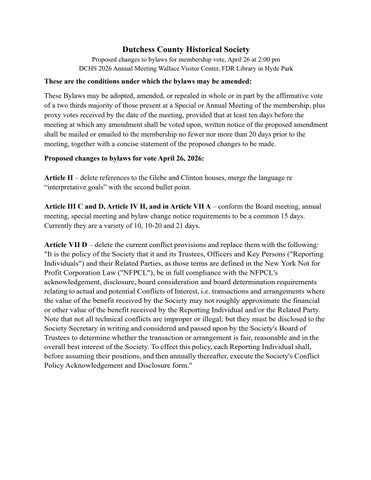
Proposed changes to bylaws for membership vote, April 26 at 2:00 pm

DCHS 2026 Annual Meeting Wallace Visitor Center, FDR Library in Hyde Park

These are the conditions under which the bylaws may be amended:

These Bylaws may be adopted, amended, or repealed in whole or in part by the affirmative vote of a two thirds majority of those present at a Special or Annual Meeting of the membership, plus proxy votes received by the date of the meeting, provided that at least ten days before the meeting at which any amendment shall be voted upon, written notice of the proposed amendment shall be mailed or emailed to the membership no fewer nor more than 20 days prior to the meeting, together with a concise statement of the proposed changes to be made.

Proposed changes to bylaws for vote April 26, 2026:

Article II – delete references to the Glebe and Clinton houses, merge the language re “interpretative goals” with the second bullet point.

Article III C and D, Article IV H, and in Article VII A – conform the Board meeting, annual meeting, special meeting and bylaw change notice requirements to be a common 15 days. Currently they are a variety of 10, 10-20 and 21 days.

Article VII D – delete the current conflict provisions and replace them with the following: "It is the policy of the Society that it and its Trustees, Officers and Key Persons ("Reporting Individuals") and their Related Parties, as those terms are defined in the New York Not for Profit Corporation Law ("NFPCL"), be in full compliance with the NFPCL's acknowledgement, disclosure, board consideration and board determination requirements relating to actual and potential Conflicts of Interest, i.e. transactions and arrangements where the value of the benefit received by the Society may not roughly approximate the financial or other value of the benefit received by the Reporting Individual and/or the Related Party. Note that not all technical conflicts are improper or illegal; but they must be disclosed to the Society Secretary in writing and considered and passed upon by the Society's Board of Trustees to determine whether the transaction or arrangement is fair, reasonable and in the overall best interest of the Society. To effect this policy, each Reporting Individual shall, before assuming their positions, and then annually thereafter, execute the Society's Conflict Policy Acknowledgement and Disclosure form."

Revised 3-30-2026 J. Nelson

Bylaws of the Dutchess County Historical Society

Article I: NAME, AUTHORIZATION, GOVERNANCE.

A. The name of the organization shall be the Dutchess County Historical Society (hereinafter “The Society”), as founded in 1914 and incorporated in 1918 and as given its absolute charter in 1983 by the New York State Board of Regents.

B The Society shall not be operated for profit, and its entire properties, assets, and facilities shall be devoted to the purposes for which it is organized.

Article II: MISSION STATEMENT AND GOALS.

The Society is a not-for-profit educational organization that collects, preserves, and interprets the history of Dutchess County, New York, from the period of the arrival of the first Native Americans until the present day.

Furthermore, The Society aims:

• To collect, catalogue, and preserve artifacts that make visual and tangible connections to the history of Dutchess County.

• To create permanent and temporary exhibitions, programs and publications to stimulate interest in the history of Dutchess County.

• To develop program partnerships with other historical, educational, and governmental groups to promote community involvement with the history of Dutchess County.

• To administer Clinton House and Glebe House so as to meet The Society’s educational and interpretive goals as well as to preserve the structures and landscape thereof.

• To serve the needs of researchers, educators, students, DCHS members, and members of the general public who wish to study and use the collection

Article III: MEMBERSHIP AND DUES.

A. Eligibility. Any person or organized group supportive of the purposes of The Society who applies for membership in any classification of membership as may be established by the Board of Trustees of The Society, and who pays the approved dues shall, at the discretion of the Board

of Trustees, be a member. Each member, regardless of classification, shall have one vote at the annual meeting.

B. Dues. The Board of Trustees shall approve dues schedules and fees annually prior to budget preparation. Announcements of any changes in schedules, fees or privileges will be made at the Annual Meeting.

C. Annual Meeting. There shall be one general membership meeting, the Annual Meeting, of The Society during the spring of each year for the purpose of hearing reports and the election of Officers. Members shall be notified at least three weeks in advance Twenty members of The Society shall constitute a quorum.

D. Special Membership Meetings. Special meetings of the membership may be called by the President, the Executive Committee or upon request of ten voting members of the Society. The day and place of the meeting shall be chosen by the Board of Trustees. All members shall be notified of the meeting and its purpose by the board at least two weeks in advance.

Article IV: BOARD OF TRUSTEES.

A. Election and Powers.

The Board of Trustees shall have custody, control, and direction of The Society as well as its collections, property, and other assets. Trustees shall be elected annually by the membership, or in the event of a vacancy, an interim appointment may be made at a regularly scheduled meeting of the Board, to be approved at the next meeting of the membership. Each Trustee so appointed shall serve until his or her successor is elected, unless the trusteeship has been vacated by resignation, death, removal, or otherwise. All Trustees must be members in good standing of The Society.

All trustees will assume at least one committee responsibility.

A trustee may serve two full terms of three years each, and three full terms if at the start of the third term the Trustee is also an officer One year must elapse before a former member who has completed a full number of terms may be again elected to the board.

A trustee initially appointed to the board to complete the term of a former board member is eligible to serve the full terms to which he/she is elected

B. Number.

The number of Trustees, including officers, constituting the entire Board of Trustees, shall not be fewer than five nor more than 25, and shall be fixed by resolution of the Board of Trustees. The Board of Trustees, by a two-thirds vote of all members of the Board, may resolve to increase or decrease the number of Trustees provided that no decrease shall shorten the term of any incumbent Trustee, said action to be approved at the next membership meeting.

C. Classes.

Each Trustee shall serve a term of three years, except as provided hereafter in this paragraph. For the purpose of staggering their terms of office, the Trustees shall be divided into three classes, as nearly equal in numbers as may be, and the term of office of one class shall expire each year in regular rotation. In case the number of Trustees in any class becomes unequal to the other classes, the Board may elect one or more Trustees to terms of one or two years, as may be deemed most practical, said action to be approved at the next membership meeting. No Trustee may serve more than two consecutive terms, except as provided above

D. Vacancies.

In case of any vacancy in the Board of Trustees, the Nominating Committee may propose a successor candidate for election by a majority of the remaining Trustees to fill the unexpired term, and to serve until his or her successor shall have been duly elected. In the event of an increase in the number of Trustees, additional Trustees may be elected by the Board to terms of one, two or three years as may be necessary to maintain equality in numbers among the classes of Trustees, said action to be approved at the next membership meeting.

E. Absences.

If any Trustee shall fail to attend three consecutive meetings of the Board without excuse accepted as satisfactory by the Board, such Trustee shall be deemed to have resigned and the vacancy shall be filled.

F. Removal.

At any meeting of the Board of Trustees duly called, any Trustee may, by vote of two-thirds of the entire Board, be removed from office and another may be appointed by the Board to fill the unexpired term of the Trustee so removed.

G. Meetings.

Regular meetings of the Board of Trustees shall be held at least six times a year, on call by the President, or by the Secretary on the request in writing of any three members of the Board.

H. Notice of Meetings.

Notice of the time and the place of every meeting of the Board shall be mailed to each Trustee or e-mailed not less than ten nor more than 20 days before the meeting.

I. Waiver of Notice.

Notice of a meeting need not be given to any Trustee who submits a signed written waiver thereof, whether before or after the meeting, or to any Trustee who attends the meeting without protesting, prior thereto or at its commencement, the lack of notice to him or her.

- 3 -

J. Quorum.

A majority of the entire Board of Trustees shall constitute a quorum at any meeting of the Board, and except as otherwise provided by law or herein, a majority in number of such quorum shall decide any question that may come before the meeting. A majority of the Trustees present at any regular or special meeting, although less than a quorum, may adjourn the same from time to time, without notice other than announcement at the meeting, until a quorum shall be present. At such adjourned meeting at which a quorum shall be present, any business may be transacted which might have been transacted at the meeting as originally called.

K. Action Without a Meeting.

Any action required or permitted to be taken by the Board of Trustees or any committee thereof at a duly held meeting maybe taken without a meeting if all members of the Board of Trustees or the committee consent in writing or via e-mail to the adoption of a resolution authorizing the action. Such resolution and the written or e-mailed consents thereto by the members of the Board or committee shall be filed with the minutes of the proceedings of the Board of Trustees or committee.

L. Executive Committee.

The Executive Committee shall have responsibility for management of the society and shall consist of the President, Vice President, Secretary and Treasurer. A quorum for the Executive Committee shall be three voting members. The President shall be the Chair of the Executive Committee. The Executive committee will deal with issues that call for immediate action before a scheduled trustee meeting. The Executive Committee shall review, at least annually, the performance and effectiveness of the Executive Director, shall recommend the compensation and benefits of the Executive Director, and shall make recommendations to the board (Original bylaws p. 7) on all personnel matters. The Executive Committee shall report all its actions to the next meeting of the Board. Any reference in these Bylaws to the Board of Trustees shall include the Executive Committee unless the context or express provision otherwise provides. The Executive director shall be a non-voting member of the Executive Committee.

M. Committees.

The standing committees are: Nominating, Finance, Development, Programs, Membership, Collections, Public Relations, Publications, and Facilities

As soon as practicable each year following the Annual Meeting of the membership, and upon recommendation of the President, the Board may appoint ad hoc committees, Committee Chairs may be non-trustee members but shall regularly report to the Executive committee. In making these appointments, the President of the Board shall designate the Chair of each committee other than the Executive, Nominating and Finance Committees.

The Finance Committee shall recommend policy and be responsible for the supervision and direction of the care and custody of all assets of The Society. The Finance Committee shall seek the advice of the Executive Director in the preparation of the budget for the fiscal year, which shall

be presented annually to the Board of Trustees for adoption. The Treasurer shall serve as Chair of the Finance Committee. This committee shall meet at least quarterly to review the Society's financial status.

Article V: OFFICERS.

A. Election of Officers.

The membership shall elect a President, a Vice President, a Secretary, and a Treasurer, who shall be members of the Board of Trustees or the prior years’s Board of Trusteess. The Board of Trustees, in its discretion, may elect such other officers as may be deemed necessary for the functioning of The Society The President shall serve for a term of two years. Each other officer shall serve for a term of one year. Any vacancy in the above offices shall be filled by interim appointment by the Board of Trustees as soon as possible.

B. Removal.

At any meeting of the Board of Trustees duly called, any officer of The Society may, by a vote of two-thirds of the entire Board, be removed from office and another may be elected by the Board in the place of the Officer so removed, to serve until the next meeting of the membership.

C. President. . . .

The President shall be the presiding officer of the Board of Trustees with the power and duty to exercise general supervision over the affairs and operations of The Society. He or she may serve on all committees as an ex-officio (non-voting) member, except the Nominating Committee, in addition to appointed members. The President shall have other powers and duties, as may be designated by the Board.

D. Vice President.

At the request of the President or in his or her absence or during his or her disability, the Vice President shall perform the duties and exercise the functions of the President. The Vice President shall have such other powers and duties, as may be designated by the Board of Trustees or the President.

E. Secretary.

The Secretary shall be responsible for keeping the minutes of all meetings of the Board of Trustees and all meetings of the Executive Committee and shall request of each active committee a brief written record of meetings and recommendations sent to the board for society files. Minutes shall include time, date and place of meeting, members present and excused, the wording of all resolutions passed, the names of those who moved and seconded them. The Secretary shall be responsible for the custody of the records of such meetings and have such powers and duties, as may be designated by the Board

F. Treasurer.

The Treasurer shall have full responsibility for funds and securities under the stewardship of the Board of Trustees. The Treasurer shall present, at each meeting of the Board and at the Annual Meeting, a fiscal statement clearly reporting the ‘financial condition of The Society and of all the funds of The Society.

Article VI: EXECUTIVE DIRECTOR.

A. Executive Director.

The Board of Trustees may appoint and employ a chief administrator designated as Executive Director.

B. Duties of Executive Director.

The Board of Trustees may delegate to the Executive Director the responsibility and authority for carrying out the policies and purposes set forth in the Societies authorizing and governing documents as well as such other policies that have been adopted and approved by the Board. The Executive Director shall be the chief operating officer of The Society and shall appoint, supervise and, when necessary, discharge individuals who occupy paid staff positions authorized by the Board. The Executive Director shall have such powers and duties as may be designated by the Board. The Executive Director shall report to the President of The Society.

Article VII: AMENDMENTS AND OTHER PROVISIONS.

A. Amendments.

These Bylaws may be adopted, amended or repealed in whole or in part by the affirmative vote of a two thirds majority of those present at a special or annual meeting of the membership, plus proxy votes received by the date of the meeting, provided that at least ten days before the meeting at which any amendment shall be voted upon, written notice of the proposed amendment shall be mailed or emailed to the membership no fewer nor more than 20 days prior to the meeting, together with a concise statement of the proposed changes to be made.

B. Conduct of Meetings.

Except as otherwise provided in these bylaws, by applicable laws or by resolution of the Board of Trustees, all meetings of the Board and the membership shall be conducted in conformity with Robert’s Rules of Order, Revised, as amended from time to time.

C. Indemnification.

The Society shall indemnify any person made or threatened to be made a party to any action or proceeding by reason of the fact that such a person, or such person’s testator , is or was a Trustee

or Officer of The Society and any Trustee or Officer of The Society who served any other corporation of any type or kind, or any partnership, joint venture, trust, employee benefit plan, or other enterprise, association, or entity in any capacity at the request of The Society, in the manner and to the maximum extent permitted by the Not-for-Profit Corporation Law of New York, as amended from time to time, and The Society may, in the discretion of the Board of Trustees, purchase and maintain insurance pursuant to such indemnification and indemnify all other personnel to the extent permitted by law (See Section 726 Not-For-Profit Corporation Law of New York State).

D. Conflicts of Interest of Trustees and Officers.

Each Trustee and Officer of the Society shall disclose in writing to the Board of Trustees any conflict of interest which he or she believes may arise in connection with his or her service as a Trustee or an Officer of The Society. No contract or other transaction between The Society and any corporation, firm, association, or other entity in which one or more of its Trustees or Officers are directors or officers, or have a substantial financial interest, shall be either void or voidable for this reason alone or by reason alone that such Trustee or Trustees or Officer or Officers are present at the meeting of the Board or of a committee thereof, which authorizes such contract or transaction, or that their votes are counted for such purposes if the material facts as to such common directorship, officership, financial or other interest are disclosed in good faith or known to the Board or committee, and if the Board or committee authorizes such contract or transaction by a vote sufficient for such purpose without counting the vote or votes of such interested Trustee or Officer. (See Section 715 Not-For-Profit Corporation Law of New York State.)

E. Electronic Communications and Proxies.

Any one or more members of the Board or any committee thereof may participate in a meeting of such Board or committee by means of a conference telephone or similar communications equipment allowing all persons participating in the meeting to hear each other at the same time. Participation by such means shall constitute presence in the meeting.

Any communications with or among Trustees, provided for by mail under these bylaws, may be made by email over the internet or via facsimile transmission, to the extent that the Trustee has furnished the Board, the President, or the Secretary with such an email address or a fax number.

Every member entitled to vote at the Annual Meeting of Members may authorize another person or persons to act for him or her by proxy. Every proxy must be executed by the member or his/her attorney-in-fact. The proxy shall be valid only for that Annual Meeting for which it is utilized and shall not continue thereafter. The proxy shall be signed and dated within 30 days of the Annual Meeting. Every proxy shall be revocable at the pleasure of the member executing it.

ARTICLE VIII: IRS PROVISIONS: DISSOLUTION.

Section 1. Notwithstanding any other provision of these articles, The Society is organized for the charitable, educational purposes specified in Section 501-c (3) of the most current Internal Revenue code and shall not carry on any activities forbidden by that code.

Section 2. In the event of its dissolution, following satisfaction of all debts, distribution of the remaining assets of The Society will be determined by the appropriate courts of New York State.

Adopted by the Membership as revised April 27, 2023

Turn static files into dynamic content formats.

Create a flipbook