DCHS: FDR's Letters to Local Man Touch on Big Issues
By Bill Jeffway
The recent acquisition of personal letters that range in date from 1913 to 1944 between Franklin D. Roosevelt and Beacon’s Morgan Hoyt reveal the extraordinary capacity of FDR to lead the world through a global economic depression and World War -- and maintain meaningful local contacts.
Hoyt was the newspaper publisher of the only Dutchess County paper that leaned Democratic. He was a political supporter of FDR from his first 1910 campaign for NYState Senator when Hoyt introduced him in Beacon. FDR asked Hoyt to introduce him at all his subsequent campaign speeches in Beacon through and including this successful race for Governor and four U.S. Presidential campaigns.
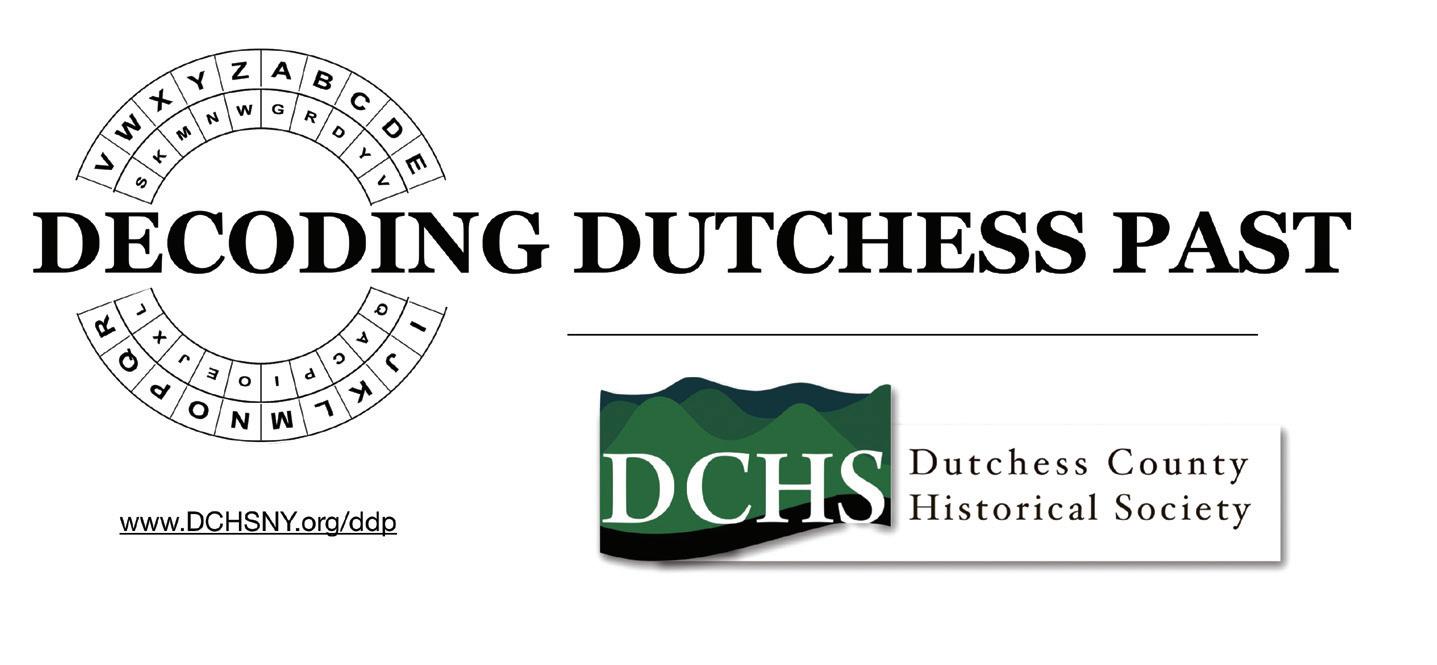
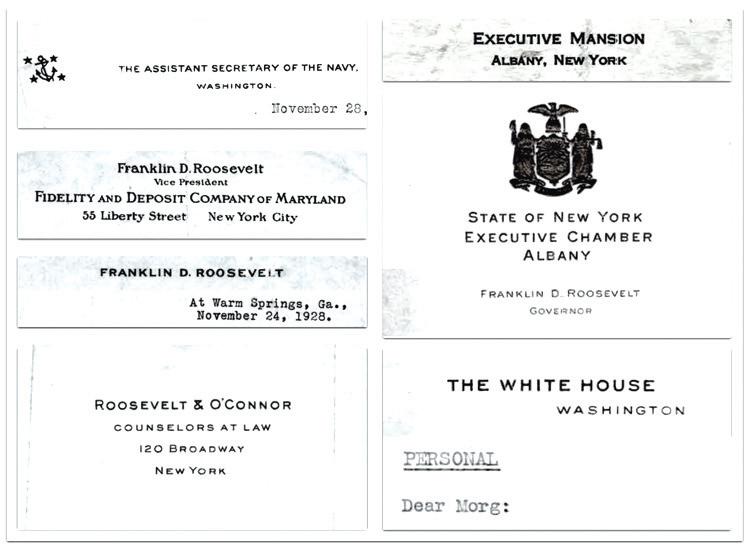
The letterhead and dates of the letters reveal all the major stages of FDR’s political life, from time as Assistant Secretary to the Navy, to his polio recovery years when he worked in his law office, to the Governor's mansion, to the White House and time at Warms Springs, Georgia.
This provides a quick snapshot of some of the letters and context for the
FDR’s private letters touch on larger issues
time. The letterhead and date are in italics. FDR’s words in quotation marks.
The Assistant Secretary of the Navy, Washington, D.C., November 28, 1913: “Dear Morg, The matter of the post office at Beacon is giving me considerable concern, but I hope before we get through with it, we will be able to get it fixed up the way it should be. Much obliged for the information you gave me, which will be of considerable service when we come to fight the matter out.”
Beacon had just become a city in 1913, combining the villages of Fishkill Landing and Matteawan, as well as a small portion of the hamlet of Glenham from the town of Fishkill. At the time, Beacon residents were lobbying for a new federal Post Office to be built for $50,000. It is notable that the Assistant Secretary of the Navy was taking an interest in the local building of the post office, as this is well outside the remit of that position. This reveals the thoroughness of FDR’s complex relationships. Hoyt was not only an important newspaper publisher, but a proud Irish Catholic Democratic, an important constituency for FDR. Anew post office was not built until 1937 for a cost of $100,000. By
then, FDR was able to painstakingly oversee its historically sensitive design and construction, as he did in Wappingers Falls, Hyde Park and Rhinebeck.
Fidelity and Deposit Company of Maryland, 55 Liberty Street, New York City. January 6, 1926. “I am delighted to hear of your newspaper at Mount Dora, the copy of which has not yet come, but I feel certain that with your long experience, you will build up a successful and popular paper. I wish I could get to Mount Dora when I am in Florida this winter, but will have to spend all of my time on a small houseboat along the keys south of Miami.”
The fact that Hoyt bought a newspaper in Florida was important for FDR politically in 1926. As subsequent letters reveal, FDR was spending a good deal of time in Florida campaigning for NY Governor Al Smith’s Presidential run. Hoyt was helpful by having the Florida newspaper publish FDR’s letters of support for Smith.
Roosevelt & O’Connor, Counselors at Law, Broadway, New York City [letterhead], 49 East 65th Street [typed home address], December 22, 1928. “Many thanks for your letter and the account of the meeting of the Franklin D. Roosevelt Club. I wish I could have been with you. Phil Mylod has just sent me your list of friends whom you wish to have sent invitations to the reception at Albany.”
The Franklin D. Roosevelt Club was a club of local supporters that formed to ensure a warm local reception for the Governor, then President. It is well known that FDR never carried Dutchess County, whose voters were strongly Republican and opposed not only to the Democrat, but his policies including the New Deal. Phil Mylod was the son of John Mylod (of Poughkeepsie), who was an early supporter of FDR who was active in the Irish Catholic community.
Undated handwritten note. Likely 1928. “I am off on Monday for Warm Springs, Georgia for 2 weeks – address
me there if anything turns up. I have prepared two other articles and will send them in a few days.” This refers to FDR’s articles in support of Alfred Smith for President mentioned earlier.
The Executive Mansion, Albany, November 17, 1932. “Now that the election is over our entire efforts must be devoted to the reestablishment of a better ordered economic life and in this happy task of restoration I invite and shall be deeply grateful before your cooperation yours.”
This is an interesting articulation of FDR’s intention to shift from a posture of campaigning – to governing – a distinction often pointed out as distinctly different by successful politicians.
The White House, October 31, 1933. “Dear Morg, You are certainly entitled to a letter not only in your capacity as the first casualty of the Sheehan fight in 1911, but also as one of my oldest friends in Dutchess County. Someday when you are in Washington you must run in, shake my hand and see the executive offices. I am delighted to know that things are going well in Beacon and I shall look forward to the news on November 8th.”
The Sheehan reference is notable because immediately after taking the oath of office for his first political responsibility, as NYState Senator he nominated Hoyt to be a clerk in a committee FDR served on. This was one of the fewer instances where FDR lost to pressure from the political machine known as Tammany, that FDR had taken on as an “insurgent.” It was indeed good news on November 8th as the local election in Beacon was a sweep for Democrats.
The White House, January 17, 1939. “That is a mighty interesting letter of yours and I greatly appreciate your very generous suggestion about those letters of mine which I have been writing you over a period of years. It would be a grand thing if the new library at Hyde Park could have those letters because they fill
The range of letters reveal the full course of FDR’s political life, with the exception of his term in 1911 and 1912 in the NYState assembly; although FDR references events from that period in his 1933 letter to Hoyt. Courtesy of DCHS
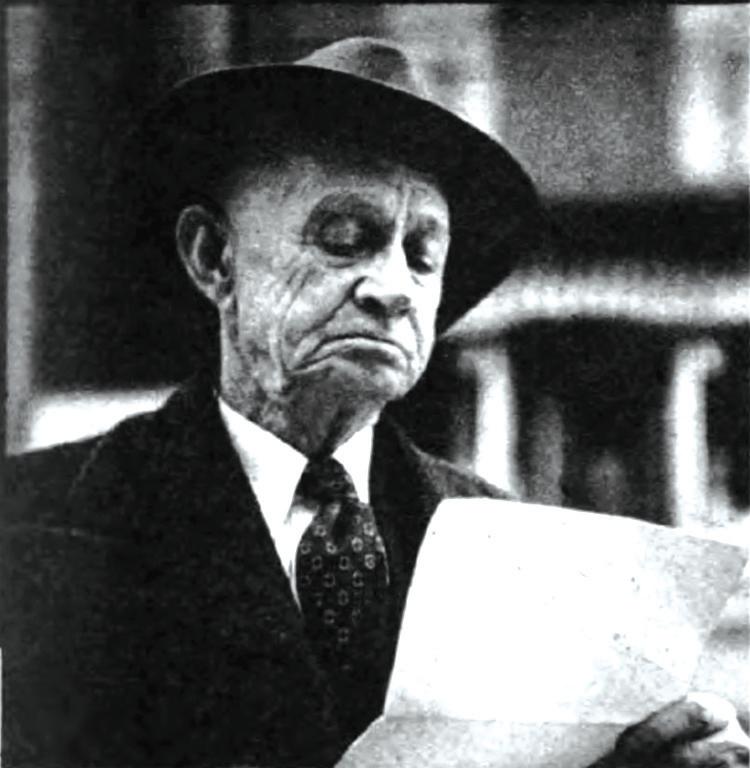
Under the heading “Morgan Hoyt reads a letter from friend FDR,” Yank magazine published a profile of local mourners in Beacon as FDR’s funeral train passed through that included this photo. Yank magazine, May 11, 1945.
Two of Us Productions to present modern take on classic sleuthing partnership
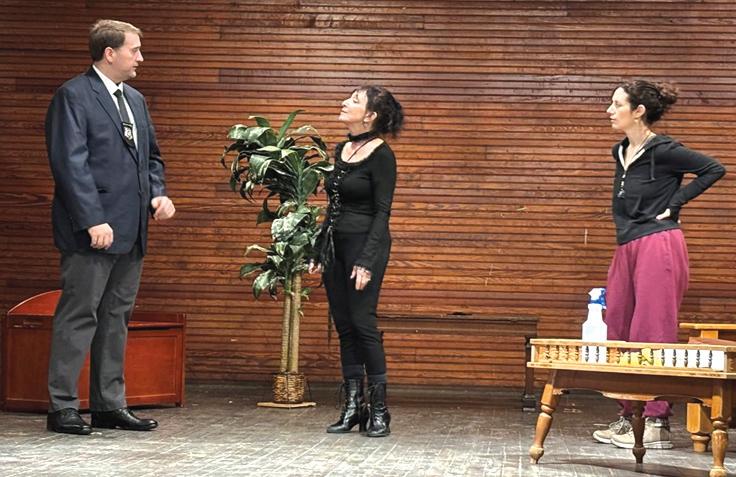
COPAKE – The Two Of Us Productions, the award-winning theater company based in Copake, will present “Ms. Holmes & Ms. Watson – Apt. 2B,” a thoroughly modern take on the classic Holmes & Watson sleuthing partnership. Performances will take place FridaySunday, March 20-22 and 27-29.
“Ms. Holmes & Ms. Watson – Apt. 2B” is an irreverent, darkly comic, modern take on Sir Arthur Conan Doyle’s famous sleuth and sidekick. This fastpaced romp re-examines the world’s most famous detective story with a bold new feminist lens. In this highly theatrical, small-cast escapade, oddball female roommates Sherlock (yes, it’s also a girl’s name—wait, is it a girl’s name? Is it even a name?) Holmes and Joan Watson join forces to emerge from pandemic fog as a deeply codependent, quasi-dysfunctional Odd Couple adventure duo – solving mysteries and kicking butts, until they come face to face with a villain who seems to have all of the answers.
This fast-paced production of “Ms. Holmes & Ms. Watson – Apt. 2B” features Constance Lopez as the hyper-intelligent Sherlock Holmes, Leigh FisherTroch as Dr. Joan Watson, Karissa Payson as the villainous Irene Adler, Diane Boice Yorck as the anxious Mrs. Hudson and the oddly composed Mrs. Drebber, Mason Lowe as the techno-billionaire Elliot Monk, and Benjamin Kirk as Inspector Lestrade and others.
Friday and Saturday performances are at 7:30 p.m. and Sunday matinees are at 3 p.m., at the Copake Grange Hall, 628 Empire Road in Copake, right around the corner from the clock tower in the center of town. Tickets are $20 for adults, $15 for students & seniors (call for group rates). For advance reservations, visit www.TheTwoOfUsProductions.org or
call (518) 329-6293.
Notes on the production, provided by Stephen Sanborn and Constance Lopez: This year we decided to find an interesting twist in theater and that led us to ‘Ms. Holmes and Ms. Watson – Apt. 2B.’ This is a recent play by Kate Hamill and presents the iconic duo of Holmes and Watson as two women sharing an apartment in modern-day London, grappling with and navigating through their dysfunctional, codependent relationship and ultimately solving a dastardly criminal challenge. This is a fast-paced comedy blending physical comedy and contemporary themes. Not only is it a fresh look at gender dynamics, but also the many changes we’re all grappling with in the digital age. And of course, there’s a villain who seems to outsmart them at every turn.
We are fortunate to have a cast that is up to the challenge of presenting this new work with fresh eyes and a sense of humor. One of the interesting challenges in this play is the various dialects of the characters.
Holmes, Lestrade, Mrs. Hudson and Irene are British. Watson is a New Yorker and Elliot Monk is a Texan. While our Watson (Leigh Fisher Troche) is a native New Yorker and our Monk (Mason Lowe) has had some exposure to a Texan dialect, neither Holmes (Constance Lopez), Lestrade (Ben Kirk), Mrs. Hudson (Diane Boice Yorck), or Irene (Karissa Payson) are British.
We were lucky enough to know a few experts on British dialects. Enter Liz and Alan Perkins, natives of Ye Olde Merry England. Liz and Alan recount that they met Connie and Steve (Sanborn) on their 25th wedding anniversary cruise (which is coincidentally the same cruise on which
Connie & Steve were married). They were living in Whitstable, UK at the time, but after returning home from the cruise, they accepted a job offer to run a company in the USA. They moved to New Jersey, then Pennsylvania eventually becoming US citizens in 2010. All during that time, they remained friends with Connie and Steve and celebrated annual Thanksgiving adventures here in snowy New York State. Their daughter eventually joined them here and is now married, living in Charleston, SC with a daughter of her own. Liz is also the author of a book of poetry “Waves of Creativity” which is graced with the photography of Alan. So, what to do now that Liz and Alan are living in Florida. Why, Zoom, of course (Ah, modern technology; just don’t tell Holmes)! They joined the cast on two Zoom rehearsals in which they read the cast’s lines themselves. Our cast
was able to record the lines and practice their dialects as they were learning their lines. Then we were able to have another rehearsal in which the cast delivered their lines in their attempts at dialect with Alan and Liz listening in to help tweak and refine the performances. They were able to give us detailed corrections that we were able to incorporate not only in what we were delivering at the time, but in the development of the rest of the material. I know whenever I go to approach one of my monologues, I can see Liz, nodding or indicating I might want to try it again. This has been invaluable to me and I so appreciate my friends from “across the pond”, although at this point they are “down the road.”
I always appreciate how wonderful it is to team up with and learn from people who are from different backgrounds than ourselves.
Decoding Dutchess’
continued from page 14
in what are undoubted gaps and because they were personal letters, I doubt whether any copies of them were kept in my correspondence. I am asking several friends who have similar letters to look through them and see if there is anything of real interest which would help make the collection more complete. We hope to get the building underwritten and started next spring and I know you will watch its progress with interest. I hope to see you in person when I get back to Hyde Park. As ever yours.”
DCHS is just beginning to review another set of personal letters from FDR to a local cousin, in which we find FDR’s extraordinary attention to detail to his new Presidential library. In one letter he explains that he will be writing explanatory descriptions that will be shown next to certain objects in the library. We hope to be able to share more news about those letters later in the year.
The White House, May 18, 1944 “Dear Morg, Many thanks for your note. It is grand about Jim Forrestal. Do you realize that two of my Cabinet come from southern Dutchess? I hope to see you one of these days, My best, to you, as ever yours…”
Hoyt would have known well that the newly appointed Secretary of the Navy, James Forrestal, was from Beacon as Forrestal had worked for Hoyt in the local newspaper publishing business. Hoyt
Past
would have also known that Secretary of the Treasury, Henry Morgenthau was from Fishkill.
The White House, November 30, 1944. This is the last letter in the series in DCHS Collections. FDR thanked Hoyt for sending him a letter and a newspaper article which FDR said he had read and found valuable.
Although not part of the DCHS collection, there were published reports of FDR’s last letter to Hoyt when FDR returned from Yalta in February of 1945. FDR died two months later. As always, DCHS keeps an eye out for items that help us piece together the local aspects of this global leader’s most amazing life and contributions.
In 2022, DCHS published Band of Locals which launched at the FDR Presidential Library & Museum which can be found online: dchsny.org/band-oflocals. As we develop a better understanding of these letters and new acquisitions related to FDR’s local relationships, we will keep this page updated.
Bill Jeffway is the Executive Director of the Dutchess County Historical Society and can be reached at bill.jeffway@ dchsny.org or (845) 293-7711.
Cast members of “Ms. Holmes & Ms. Watson – Apt. 2B” rehearses for their upcoming production set March 20-22 and 27-29 in Copake. Courtesy photo