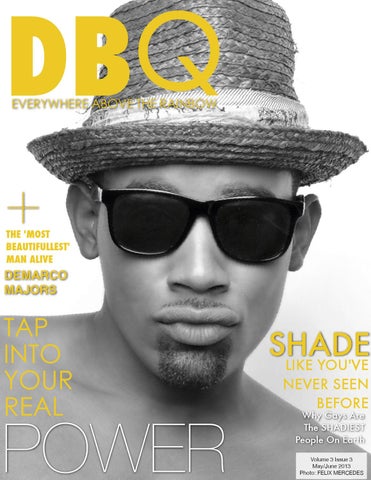
DBQ EVERYWHERE ABOVE THE RAINBOW
+ THE 'MOST BEAUTIFULLEST' MAN ALIVE
DEMARCO MAJORS
TAP INTO YOUR REAL
POWER
SHADE LIKE YOU'VE NEVER SEEN BEFORE Why Gays Are The SHADIEST People On Earth Volume 3 Issue 3
May/June 2013
Photo: FELIX MERCEDES
DBQ EVERYWHERE ABOVE THE RAINBOW
+ THE 'MOST BEAUTIFULLEST' MAN ALIVE
DEMARCO MAJORS
TAP INTO YOUR REAL
POWER
SHADE
LIKE YOU'VE NEVER SEEN BEFORE
Why Gays Are The SHADIEST People On Earth Volume 3 Issue 3
May/June 2013
Photo: FELIX MERCEDES
I
t's Summertime and I predict that it will be so hot and sunny that we all will need a little shade to get us through it. This issue we want to address a subject so popular in our community that it often doesn't get talked about (Why are gays so shady?) It is important that we talk about what shade is and what it looks like from different perspectives in the gay community. Shade Like You Have Never Seen Before, Pg 18.
This year I selected sexy brilliant out athlete DeMarco Majors as our 2013 'Most Beautifullest' Man Alive. He shares his journey and lesson with us on Pg 11.
Contributing writer Rob Smith shares the significance of Jason Collins being black and gay in 2013 on Pg 6. Also, we have an exclusive excerpt from Stanley Bennett Clay's new novel, "Aching For It", as well as, ballroom rock star Twiggy Garçon sharing his Kiki movement with the House of Puccui. Lastly, in the very back of this issue, I share what I've come to know in my life.
It's Summertime people, it's hot. We need shade, the healthy kind; but above all let's grow and evolve into our greatest selves.
Here We Go!
CONTRIBUTORS DaShawn Usher is a native New Yorker. He focuses most of his time and talents in Public Relations, health and the nonprofit sector. His passion is creative writing. He is managing editor at DBQ.
Riko A. Boone hails from Washington, D.C. and Maryland. He received a B.A. in Community Health from Brown University; he also has Master level education in Social Work and Public Health from Columbia University. Riko has lived in New York for almost thirteen years, where he works in the areas of youth development, adolescent and young adult health. Rob Smith is a gay Iraq war veteran, writer, lecturer, and LGBT activist. He has written for The Huffington Post, The Advocate, Metro Weekly, and CNN.com, among others. His memoir, "Closets, Combat, and Coming Out: Coming of Age as a Gay Man in the 'Don't Ask, Don't Tell' Army" will be released in February 2014 via Blue Beacon Books.
Editor-In-Chief / Publisher David A. Bridgeforth Jr. Senior Editor/ Executive Administrator Jacqui Tanner Contributing Editor Stanley Bennett Clay Consulting Cover Editor Reggie Wells Managing Editor/ Copy Editor
Dashawn Usher Entertainment Editor Matthew Barrett Ballroom Editor Pony Zion Makeup Reggie Wells Photography/ Retouch Felix Mercedes Editorial Assistant Kiara Peterson Clothing Stylist Dorian Richburg
DBQ Magazine is a nationally distributed bimonthly lifestyle publication. Published and printed in Indianapolis, Indiana. For more information on advertisement, circulation, or articles please visit us at www.DBQMAG.com Or call 317.500.4327 or 908.656.6218.
DBQ David Bridgeforth Quarterly
May/June 2013 FOLLOW US ON TWITTER @DBQMAG / DBQMAG.COM
EVERYWHERE ABOVE THE RAINBOW
P. 11
P.6
P.23
SHADE 5. Behind The Scenes 6. Jason Collins: A Reflection of us 9. "Aching For It" by Stanley Bennett Clay 11. The 'Most Beautifullest' Man Alive/ DEMARCO MAJORS
DBQMAG.COM | @DBQMAG
23. BALLROOM/ Twiggy Pucci
17. The Love List / FIVE THINGS WE EMPHATICALLY ENDORSE 18. SHADE Like You've Never Seen Before
DBQ Magazine
Like P.18 You've Never Seen Before
May/Jun 2013
Garçon VOGUEcabulary by PONY ZION 25. What I've Come To Know / Real Power
Page 4
[
Behind the Scene
]
Follow Dave's Life on INSTAGRAM
@BRIDGEFORTH
FELIX MERCEDES PHOTOGRAPHY
Felix Mercedes is the man responsible for many of the amazing covers and photos in DBQ Magazine. Contact the NYC photographer to book your shoot today.
fmercedesnyc@gmail.com
www.fm-photographer.com
3
1 4 Page 5
2
1. Mr. Bridgeforth and Dr. Pat Payne (after he spoke to hundreds of educators on introducing LGBT afďŹ rming curriculum into public schools in Indianapolis, Indiana. 2. Dave and his friend (celebrity makeup artist) Merrell Hollis hanging together in Harlem. 3. Popular Midwest Drag Queen Sizzlin Sondra. 4. People reading DBQ Magazines in a bar in Indianapolis.
DBQ Magazine
May/Jun 2013
DBQMAG.COM | @DBQMAG
[ ] JASON
COLLINS:
A REFLECTION OF US
DBQMAG.COM | @DBQMAG
DBQ Magazine
May/Jun 2013
Page 6
Jason Collins: A Reflection of Us Words/ Rob Smith
A
s I write this, it has been just a few days since NBA veteran Jason Collins came out, turning the sports world on its head and instantly becoming the most prominent black gay person that we've seen in a very, very long time. I wrote a piece on the mainstream politics and commentary website Salon.com within a few hours of the news, and it was loaded with the pride I felt at that very moment mixed with my utter elation that Jason Collins was a black, gay man.
their-lives drag queens. They go viral while telling everyone to "hide ya kids," and the rest of us know that their "success" is built on the fact that they are, more or less, a sideshow act for mainstream America, not to be taken seriously politically, socially, or culturally. To be clear, I'm not one of those black gay men who is obsessed with some idea of "masculinity," it's just that these types don't generally reflect what I see in my own life, which are black gay men who are all of these things, but also lawyers, doctors, actors, producers, and many, many other professions.
"I wanted Jason Collins to be black, because I knew what it would mean to black gay youth in this country…I wanted Jason Collins to be black because I know exactly what it’s like to be a gay teenager with dark brown skin who comes out but cannot find anyone gay who looks like you on television. Or in magazines. Or on the news," I wrote, trying to put into words for a mainstream audience a feeling that those of us who read magazines like DBQ are all too familiar with.
Five years ago, I was a young military veteran fresh out of college and brand new to New York City when I was selected to be on the first season of VH1's "I Want to Work For Diddy." It was not a great experience, but it did teach me the power of the images of us that are projected to the masses. Even though my brief two episodes on the show were more or less a disaster, it didn't matter to the black gay boys that were emailing and facebooking me because they'd seen this presence that was so different than anything else that was on television at the time. To this day, I'm still recognized from that show. That is the power of the media. That is the power of the images that are portrayed.
Most black gay men in the media are shoved to the margins and placed in very stereotypical roles. They are hairstylists or makeup artists or sidekicks for the Real Housewives or lipsynching-for-
Page 7
In the Salon article I wrote: "We need role models like Jason Collins, because being black and gay is tricky business,” and I should possibly underline the fact that is the trickiest of business. While it is true that the power of Jason Collins’ coming out cannot be emphasized enough for mainstream America, it is doubly so for us, young black gay men who faced with such a dearth of images that represent who we truly are that it is easy for us to take on the role of the bitchy queen, the “rough trade” brotha, or the straight girl’s fashionforward sidekick. We are so much more than any of these things, but sometimes even we can’t see it.
Not only are we sometimes weighed down by societal expectations of what a Black man is supposed to be, those of us that choose to be out are weighed down by expectations in the Black community of what gay is or isn’t supposed to be. Most times, our mothers, fathers, and pastors either rebuke us or begrudgingly (and silently) accept us. The more masculine among us wear their “discretion” like a badge of honor, those who are simply too fabulous to be “discreet” act out in ways designed to seek attention, and both are victims of a society that has forced gay men who look like them in the shadows for far too long.
With Jason Collins, we have just the latest in a line of some very prominent people coming out of the closet in the past few years, from Don Lemon to John Amechi to, yes, Frank Ocean. As someone who’s been operating within mainstream spaces as well as black gay spaces for at least the past 5 years, I must say that there is an electricity in this moment that I’ve never felt before. These men, their difference, and their success is an piquing an interest and fascination in the Black gay experience. Thanks to Jason Collins and his poise, confidence, intelligence, talent, strength, bravery, and utter pride in who he is, we have another reflection of us that we can be proud of. I know that there are more reflections of us to come, and I personally cannot wait to see the.
DBQ Magazine
May/Jun 2013
DBQMAG.COM | @DBQMAG
DBQMAG.COM | @DBQMAG
DBQ Magazine
May/Jun 2013
Page 8
An excerpt from:
ACHING FOR IT
The new ebook novel By Stanley Bennett Clay Book One of his five-book Dominican Heat Series
I didn’t want to believe it, and neither did he, but it was love at first sight when Étienne and I met at the little shop called Bodega Colonial in Santo Domingo where he worked. Even though neither one of us verbalized what was in our hearts, our meeting was ostensibly business. I was simply a professional photographer from the States asking a handsome young Dominican man to model for me. He was a young bodega counter worker gladly jumping at the chance to make one hundred American dollars just for posing and being photographed all around the city. But suddenly we couldn’t help ourselves, couldn’t keep our feelings to ourselves. In a matter of days, we both confessed our love for each other. And yes, I almost lost Étie once he found out through a chance encounter with Sylvester Winfrey, one of my sexcursion vacation mates, and Sylvester’s personal bugarrone of choice, Edgar, that I was just another john at House of John, the notorious whorehouse gay Americanos frequented for the purpose of sexually exploiting Étie’s fellow countrymen. His surprise when he saw Edgar with Sylvester, my surprise when I realized Edgar was Étie’s ex he’d left when Edgar became a sex-worker, a bugarrone, was the shocking and near fatal dénouement that threatened to smother our infant love before it was able to fully breathe. But love did indeed claim a conquest. When Étie realized I had abandoned my sexploitations even before meeting him, and I fell in love with his country and had fallen in love with him, he forgave me. I checked out of House of John and into the Santo Domingo Hilton, where we shared our first and final night of intimacy before I returned to the States. And what a night it was. I didn’t know if it was real or just some wonderful, magical dream.
Page 9
DBQ Magazine
Was I suddenly kissing him? Sweetly stunned by the taste of his warm, probing tongue exploring my wanton mouth, teasing my hunger to have any part of him inside of me, and me in him? Was the running of my fingers through his raven hair, then touching his handsome face with the beautiful scar underneath his right eye, a desire fantasized or a distinct occurrence? Was my twenty-four-year-old new Latin lover really naked in my thirty-eight-year-old arms? Was his thick stiff young dick really cradled against mine? Was the hot thrill of him against me too unreal to be real? No. It was as real as our new and mighty love. Our lovemaking was proof positive. When we gave each other oral pleasure to the point of near explosion, pulling away simultaneously, forcing our passionate gluttony to hold back some for what was to come, then we knew, that our love was so much more than a dream. When he teased and then entered my hungry asshole ever so gently with his pulsing dick and built his rhythm inside me into a frenzy of unbearable pain and pleasure, I shuttered with the deliciousness. I slammed my begging hole into his hot lap of lust and luxury. My wicked grimaces, my heedless wailings as he fucked me with a masterful ravish, on my stomach, on my back, then doggystyle, were my beggings for more and then more. He lathered my bucking back with his moist and warm kisses and his sweet musty sweat. I desperately tried to bury and muffle my unbearable ecstasy in the pillow beneath my chin. But the thrill couldn’t be tamed. So I neighed, part into the pillow I now chewed on, and part into the bed sheets I clutched for dear life, until we both exploded, he inside the condom inside my grateful rectum, me in gushes wild and splattering without me ever touching myself.
May/Jun 2013
DBQMAG.COM | @DBQMAG
And then we collapsed into each other’s arms again. We kissed each other, tasted each other like spouses desperate the night before one of us would be deployed to some distant unsure battlefield. In fact, I indeed would be deployed back to my Southern California home in less than ten hours. Our time together before my departure was short and precious. So before we knew it, we were at it again. He was on his back. His legs were on my shoulders, Both our dicks bobbed and weaved and shuddered with the weight of their bone readiness. And then we collapsed into each other’s arms again. We kissed each other, tasted each other like spouses desperate the night before one of us would be deployed to some distant unsure battlefield. In fact, I indeed would be deployed back to my Southern California home in less than ten hours. Our time together before my departure was short and precious. So before we knew it, we were at it again. He was on his back. His legs were on my shoulders, Both our dicks bobbed and weaved and shuddered with the weight of their bone readiness. “I love you so much, baby,” I whispered softly, bending down to him kissing the crown of his precious pecker, sparkling and beautifully mushroomed from the loose foreskin I’d pulled back down to his shaft with one cupped hand, while my other hand toyed furiously with my own naked-headed hard-rock cock, pre-cum erupting from its slit. And suddenly, I couldn’t keep myself from sucking that golden stick of joy of his, with a gluttony barely restrained, until I had spread his shouldered legs and found his other treasure. The sight of his glistening hole made me tremble. The sweet, sweaty pucker of his slightly hairy ass was an aphrodisiac. My nose scouted with earnest his dizzying manroma. And then my tongue bumrushed and feasted hungrily upon the entrance to nirvana. “Oh yes, Papi, yes…” he moaned as my anxious tongue found its way inside him. His hunger, as ravenous as mine, was desperate for a feeding. “Yes, Papi, yes…it is all yours.”
DBQMAG.COM | @DBQMAG
He found the condom by touch, tore open the package with his teeth, and with one hand, slipped it on me and rolled it down my nervous shaft. I lubed him gently between his legs. One finger, then two, found their way inside his warm and pleading ass. He writhed up and kissed me. His tongue dug deep into my mouth. He then arched himself and found my throbbing dick with his ass. He teased himself upon me; impaled himself with a stinging delight that caused him to gasp, to hold his breath, then let with a baby’s whimper. The pleasure dizzied me. The warmth of his tight and moist insides consumed me. He gently grabbed my cakes and guided me into a rhythm in step with his own. In little time, the grinding and the pumping was marvelously desperate. Our kisses and holding each other became frenzied. Our passion threw us to the floor, against the wall, in positions impromptu and invented by lust and love. “Fuck me, Papi,” he begged in desperation. On a mission, I obeyed. His hard and chiseled body, all six feet of him, was splayed against the wall he fucked while I fucked him. He reached up and clawed that wall. He reached back and clawed my ass. He jammed me deeper into the ass I now knew completely belonged to me. “Yes! Yes! Yes! Por favor! He begged and screamed and demanded as his nursing hole tightened and flexed and choked my pounding penis. I panted breathlessly and licked his neck whorishly. Desperately I rode him and kissed him. I twisted stiff nipples on hardflexing pecs with abandon. We were lost into each other, in the righteous ether of the nasty, profane and profound, until at once we exploded—me inside of him, him splattering the wall and his six-pack torso with a double load of thick white man cream—with hosanna-like screams and matching cries of jubilation that shattered tranquility and threatened to summon the law. That’s when I knew I had found my love mate.
DBQ Magazine
May/Jun 2013
Page 10
[ ] FRONT ROW
Aqua Blue Swim Shorts TasteeTreasures.com Retail: $22.99
Page 11
DBQ Magazine
May/Jun 2013
DBQMAG.COM | @DBQMAG
The 'Most Beautifullest'
Man Alive
DEMARCO MAJORS
(
[Most Beatuifullest]
)
The word I use to describe a person who has a little bit everything brains, talent, sex appeal, popularity, a meaningful contribution to our world, and a huge bag of good looks. It doesn't particularly mean that they are beautiful in the superďŹ cial sense [their bone structure lines up perfectly and they are so pretty] its beyond that. It is that they are full of beauty in which their internal and external align to make them fuller and greater than a cute face and a nice body. When I experience an energy and beingness such as this I call them the 'Most Beautifullest'.
DBQMAG.COM | @DBQMAG
Words/ David Bridgeforth Editor/ Stanley Bennett Clay Photos/ Felix Mercedes
DBQ Magazine
May/Jun 2013
Page 12
The
'MOST BEAUTIFULLEST'
Man Alive
D
eMarco Majors is many things with a variety of delicious morsels on his plate. He's a hot and hunky actor and reality show personality seen on screen in the show“Shirts & Skin." Recently he appeared in the stage adaptation of James Earl Hardy's iconic novel “B-Boy Blues," and he'll return to the small screen in the upcoming reality show“The Brick.”An openly gay, black athlete before John Amaechi or Jason Collins stepped out of their closets, and an individual who has struggled with drugs and the homophobic black church, DeMarco insists on being exactly who he is. Here's a peek into that selfexamination. DBQ: What made you want to do the TV show Shirts&Skin? DEMARCO: For several years, a friend of mine Bill Kendall, my cousin, and a couple other guys would sit around Alex Herrera’s house laughing and joking. One time Alex turned on the camera and we watched the footage. We were funny as hell! So we thought, a lot of people could benefit from something like this, watching a group of openly gay men enjoying this great funny friendship and going through life together. Maybe we could try to get this on television.
for an ABA team. Bill started following me around, shooting footage and editing it, and putting music behind it. Then he shot footage that included all the new guys— Jamel, Mike, Simon, and Peter—and created a new trailer, which was beautifully done. Then LOGO, MTV, Viacom picked it up. DBQ: How long did the show air? DEMARCO: Actually it still comes on from time to time, but we only got to do 6 episodes.
DBQ: You sold it to LOGO.
DBQ: Is it hard being an openly gay athlete?
DEMARCO: It took a long time. Bill Kendall —we call him Uncle Bill—was the driving force. I decided to go back to basketball after I got hurt trying out for a pro team stateside. I went over to Hawaii to try out
DEMARCO: To be perfectly honest with you, to be an athlete is hard in general, and being a professional athlete is even harder. These men in the NFL/ NBA are also college graduates. Not only do you have to
Page 13
DBQ Magazine
May/Jun 2013
be smart and physical, you have to be mentally stable to do these jobs. Add to that the challenge of being gay in the specter of the black church and attitudes, yeah it can be hard. DBQ: How old where you when you came out? DEMARCO: There were two [coming out] incidences for me. I actually come out when I was 26-27 years old. But I was 24 when I had my first experiences within the [gay] community. Joe Hawkins, founder and operator of the event Blatino Oasis out in Oakland, used to come to the bar where I was bartending. I got to know him and his partner, and so I started going to his events. One day he asked me ‘what do you do?’; I said ‘I play basketball,’ and so he asked if he could interview me. I didn’t know that was my ‘coming out.’ It was just me telling my story.
DBQMAG.COM | @DBQMAG
Clark Plaid Trunk HCS by Melvin Browne HCSwimwear.com DBQMAG.COM Retail: $65.00 | @DBQMAG
DBQ Magazine
May/Jun 2013
Page 14
The 'MOST BEAUTIFULLEST' Man Alive DBQ: You came out, and fell in love after that? DEMARCO: Not having experiences until your mid-20’s, and then coming out in the community with a boyfriend is different than exploring the community first, and then finding someone. I came into the community already dating, so I didn’t understand what love was. That was part of the reason why I left the church when I was 23. I knew that I was never going to experience love the way I see everybody else experiencing love; love between a man and a woman. I felt that in my heart. And that was hard. Here I am at this church with all these people all the time every single day, and I watch them learn to love each other. I watched couples read the bible, read scriptures together, hang out together, and then they have this love. And here I am. They keep trying to set me up on dates with women, but I don’t feel it. I don’t have that attraction or temptation. It was heartbreaking at first. I felt like something had to be completely wrong with me, that something was evil in me. That’s why I needed to walk away. DBQ: How did you overcome addiction? DEMARCO: It’s not something that you can completely overcome. I’m still trying to. It wasn’t that long ago for me, I’m not one to brag and boast about it. It was hard but you know what? You fight hard every single day. You take one day at a time, and I’m learning you do it with your family. To learn how to overcome things, some people have that type of will. For me it just takes opening up and not being ashamed of who you are or what you’ve done, because you are not those things.
DBQ: You have two upcoming projects, the reality show Brick , and the stage adaptation of B-Boy Blues. Tell me about them.
and being directed by Stanley Bennett Clay. I’m playing the exact character that I felt I was like. I’m telling you, people need to go
I didn't understand what love was... I knew that I was never going to experience love the way I see everybody else experiencing love; love between a man and a woman... DEMARCO: I hope people get out there and see B-Boy Blues. I don’t care what they do. You don’t have to go buy a make-up kit or shoes this week. Put your money in this milestone project. Being from Evansville, Indiana, my cousin went to the local library and found this book, B-Boy Blues. I wasn’t going to read it. I hated reading. But she came down to the steps two days later and was looking around like, OMG you have to read this book. I started reading in the kitchen and it was talking about men being with men. I got scared somebody must be talking about me, or told somebody and they must think what I think. I went to the corner of the basement where it was dark, got under the covers with my flashlight, and I’m reading this book. It’s talking about all these things, and introducing me to all kinds of things. Now twenty years later I get to be on stage saying James Earl Hardy’s words,
out and purchase a ticket. I don’t care if I’m not in it anymore. Go watch this play, because the actors are phenomenal. It’s an emotional roller coaster. There are so many guys in the play who are very accomplished. They bring the characters from the book so alive. The Bricks is going to be something really great too. It’s about a group of young black men in New York trying to make it in the world of entertainment, media and professional sports. We have actors, models, rappers, journalists, and then me. When you get to know each person’s story you’re going to be really touched. It’s very empowering just hearing the circumstances behind each of their lives, and the challenges. You see the triumphs regardless of their economic status. You see people trying to make it happen. That’s why I wanted to be a part of The Brick.
DBQ Page 15
DBQ Magazine
May/Jun 2013
DBQMAG.COM | @DBQMAG
Side Buckle Speedo TasteeTreasures.com Retail: $18.99
DBQMAG.COM | @DBQMAG
DBQ Magazine
May/Jun 2013
Page 16
THE LOVE LIST
1
SIDE BUCKLE SPEEDO
[ ] 5
THINGS WE EMPHATICALLY ENDORSE THIS ISSUE
My new favorite swimwear for this summer is the side buckle speedo by TasteeTreasures [TasteeTreasures.Com]. It retails for $18.99 and is perfectly simple, sexy, with a little bit of summer fun. The buckle on the side that closes the speedo gives it a uniquely interesting touch. I am looking forward to wearing this piece of swimwear, while lying on the beach under some summer sun.
3
Mark Otto
2
A teacher, an administrator, an out, gay man, and cofounder of the Facing History School, Mark Otto is running for City Council in the open 7th District, which extends from West 96th St. up into Washington Heights. Mark has devoted the last ten years to teaching, helping, and opening the minds of the next generation of New Yorkers. “Nothing less than the future of our city is at stake,” said Mark. “Everything facing us is interrelated – poor quality education, a lack of affordable housing and rising rents, discriminatory policing practices which are devastating a generation, a lack of support and services for LGBT youth uptown. We can’t fix one without fixing the others.”
Page 17
NO SHADE is a LGBT dramedy, based in NYC and follows the life of Noel Baptise a socially awkward artist from Brooklyn who’s learning to be comfortable with his sexuality and slowly embrace his new attractions. Noel navigates his journey with the help of his three young, eccentric city dreaming friends, Eric, Kori and Danielle. (www.YouTube.com/BluntedMuse)
-- HUFFPOST GAY VOICES
4
Mark continually points out the lack of LGBT services uptown and in the outer boroughs—one of the biggest things he says will tackle in the City Council; and he has already supported the LGBT community as he did after Hurricane Sandy by quickly switching his campaign into help mode, raising money and donations to help rebuild the Ali Forney Center to make sure kids weren’t pushed out into the streets.
5
If “NO SHADE” could be compared to anything, it would be a fictional mash-up between “Paris Is Burning” and Nelson Sullivan’s videography capturing the New York gay scene of the 1980s.”
NO SHADE
Edwards Truth Skincare
GUN HILL ROAD
Edwards Truth Skincare (Edwardstruth.com) is a refreshing and amazing line of products created by Texas aesthetician, Marktavious Edwards. His passion and love for skincare drove him to start a line that generates healthy skin and enhances people’s beauty. I started using these products four months ago, and I am absolutely in love with the Radiant-C Moisturizer, which leaves my skin with a natural glow and feeling soft and nurtured.
Gun Hill Road is a 2011 drama film starring Esai Morales. Titled after the Bronx neighborhood of the same name, the film chronicles the story of an ex-con who returns home after a three year bid in prison to discover his family in transition, his estranged wife and his teenage son (“Michael”, played by a real transgender person, Harmony Santana) who is exploring his sexual and gender transformation in an intolerant and judgmental world. The impact of Michael’s coming of age on his relationship with his parents and his identity development comprise the centerpiece of this film. Written and directed by Rashaad Ernesto Green, Gun Hill Road was a finalist for the esteemed Jury Award at the 2011 Sundance Film Festival, and it was screened at film festivals globally in Spring 2011. This is a must see film for everyone, especially people within the LGBT community.
DBQ Magazine
May/Jun 2013
DBQMAG.COM | @DBQMAG
SHA DE Like You've Never Seen Before Why Gays Are The SHADIEST People On Earth Written by Riko Boone Editorial Director: David Bridgeforth
DBQMAG.COM | @DBQMAG
DBQ Magazine
May/Jun 2013
Page 18
SHADE For those who may not be as familiar with gay nomenclature as others of us, the term "shade" is one that has a particular history and place in gay culture, especially Black gay culture. Beyond the common usage of the term "shady" referring to one's actions or character being perceived as sketchy, scheming or otherwise unsavory, for many Black gay men, "shade" is just one of the many skills that we develop to navigate an often harsh, dangerous and oppressive world. We can probably all relate to being shady at some point in our lives.
Some examples might include: 1) When we pass right by that horrific "date" on the street or in the club either with no acknowledgment or a subdued nod because we don't want others to know that we "had up" with each other; 2) The side eye (other verbal or physical codes) that we share with our BFFs when we want to sneakily talk about others —e.g. the side eye that we give when we witness a fashion faux pas in a public space. 3) The instances when we smile in people's faces, while unbeknownst to them and with delayed impact, we simultaneously unearth onto them a litany that is laced with all sorts of insults masked by big or uncommonly used words.
Here we examine the purpose and unique role of shade in the lives of Black gay men through the perspectives of a few people I interviewed. I hope that by breaking down the concept of "throwing shade" through a critical lens, we can learn
Page 19
to find new uses for shade that are positive and uplifting bridges to one another, rather than a means for excluding ourselves from one another.
Let's begin with a definition: What exactly is shade? The seminal film Paris is Burning (1990), directed and produced by Jennie Livingston, documented the vibrantly rich ancestral beginnings of the now century-old house-ball/ballroom culture that grew out of the Harlem Renaissance and has flourished in New York, nationally, and now globally. In the film "shade" is described by Ballroom Legend Dorian Corey: "Shade is, I don't tell you you're ugly, but I don't have to tell you because you know you're ugly. And that's shade...That's the idea, knock 'em out if you can, get 'em any way, hit 'em below the belt." Basically, in its simplest form shade is an honest and sometimes unspoken or indirect method of telling someone off— typically displayed as a ‘silent but deadly’ disrespect. Six years after Paris is Burning, the titular book SHADE (1996) was published, the very first anthology devoted exclusively to fiction by Black gay men. Edited by Bruce Morrow and Charles H. Rowell, this pioneering endeavor included the works of twenty-two authors from the United States, Africa and the Caribbean. In Samuel R. Delany's introduction to this compilation, he poignantly describes what he calls the benchmark response to the casting of shade: It is when the person being shaded is forced to ask himself: "He couldn't have said what I thought he
DBQ Magazine
May/Jun 2013
said...?" If you ever have to ask yourself that question during an interaction with someone, then yes my dear, you have been shaded. In the spirit of self-sacrifice for the purpose of exemplifying the stealth-like nature of shade, allow me to offer this personal anecdote: My close friends and those who happen to be connected to me on Facebook, who have seen my doting photos and status updates all know that there is a new love in my life. As of Christmas 2012, I am the proud new father of an adorable, though feisty 4-pound miniature pinscher named Amber. The first day that I brought Amber home was by far one of my happiest, signaling a new chapter of self-imposed responsibility and meaning in my life. That very same night, my roommate came home accompanied by a mutual acquaintance, and they met Amber for the first time. As the mutual acquaintance attempted to greet Amber whilst bending down to pet her (much to her chagrin, of course), he commented to me that she was so cute, and he said (with a smile, mind you), "that's a 'MinPin', right? Wow, that's like a $1500.00 dog! How did you manage to do that?" I found this curious inquiry from someone who obviously does not know me that well to be somewhat off-putting, and to it I quickly replied with a simple, yet tacit statement: "I was lucky." Then I promptly scooped Amber up into my arms and together we made our gracious exit, retreating to our abode. Amber later vindicated us both by pissing right outside of my roomie's door the next morning.
DBQMAG.COM | @DBQMAG
will admit that in the moment, while I definitely "caught the shade", as we say, from the moment the words surreptitiously spewed from the guy's mouth, it was not until much later in the evening that my internal quizzical reflex was replaced by a visceral response to me being successfully shaded by someone, and inside of my own my home to boot! After about an hour of replaying the exchange over and over in my head, it hit me and I finally asked myself: "Did he really just ask me that?" Though I really didn't need to confirm the obvious--that I had just been shaded--my next instinct was to call a few friends to recount the exchange to them and get their feedback. They all affirmed what I had already known: "yes, chile he tried you!" they told me. His questioning was essentially the
I
As Kid Fury of TheFuryTV notes in his YouTube video entitled "Inadequate Shade", when it comes to shade, "it's all about the delivery - you have to fight shade with shade; because the thing about shade is, shade is slick. Shade is sly. Shade is quiet and underhanded. Sometimes you won't always catch it; it's like a thief in the [sic] night. Shade is just a sinister, yet peaceful mode of attack...and the point of shade is to get your opponent riled up, and upset and angry, while you sit unbothered, quiet and pleased with your [sic] self." I would argue that the healthiest way of responding to shade is to simply let it go and release its sting, thereby not allowing it to have any power over you whatsoever. What better way to get under a shady (butch)queen's skin than to simply ignore her, or "pay her dust" and proceed unbothered. Oh, but if it were only so easy.
Shade is the defense mechanism that we have developed as Black gay men to survive in a very shady world, and it's an art form that has been passed down through generations of Black gay men. equivalent of walking into someone's home and seeing a new 70-inch SONY flatscreen LED television and then asking the homeowner: "How could you possibly afford that?" Thankfully, I have since reconciled this close encounter with shade; and because I harbor no ill feelings toward this gentleman I will not call him out by name (since that, of course, would be a very shady thing of me to do...)
DBQMAG.COM | @DBQMAG
Some would say that shade is all about perception: it is thrown when someone perceives another to be inferior; or it is a way for us to command a space, to demand respect from others, or to inflate other people's perception of ourselves to boost our own self-esteem. Of course it may also just be our innate response to the unabridged foolishness, ignorance or audacious words and actions of others.
DBQ Magazine
May/Jun 2013
Certainly one purpose of throwing shade is to "read someone" or "tell someone about him/herself", so to speak; but in actuality throwing shade really says just as much about the person who is throwing it. At times a person's inclination toward throwing shade is precisely indicative of a displeasure or discontent within oneself; a tell-tale sign of envy or some other vulnerability. This key attribute of shade was echoed by the brothers that we interviewed, such as Andre St. Claire-Thompson, an Ivy League-educated Master level performance artist whose testimony is featured in the groundbreaking compilation, FOR COLORED BOYS WHO HAVE CONSIDERED SUICIDE WHEN THE RAINBOW IS STILL NOT ENOUGH, edited by Keith Boykin. "At the end of the day," says Andre, "shade is often based in some semblance of truth; and it is just one of the tools that we use to protect ourselves. A person's truth, or reality, may be that because someone is truly unhappy with himself, he may erroneously believe that throwing shade conveys a sense of power or control, when in actuality he knows better and is secretly yearning for affection, respectful recognition, or protection." Protection from what exactly? Darnell Moore and Wade Davis converse with one another on the topic of shade among Black gay men in one installment of "Tongues Untied", their series of dialogues in the Huffington Post ("Shade Culture--Throwing Shade, Reflecting Light", 3/29/13). They describe the best shade as that which travels in stealth, and they note that Black gay men are inclined to resort to being shady as a result of pent up anger, hurt and frustration. Darnell attributes shade to the "pain that has been inflicted upon us by intimates and strangers; the pain of homophobia; the pain of racism; the pain that comes as a result of the restrictive gender boxes that constrain us; the pain of rejection, dismissal, invisibility, spiritual and physical violences...shade is an exact, cutting and implicit response to another's exact, cutting and explicit foolishness." From this standpoint, while throwing shade can be reactionary to a degree, an instinctual knee-jerking retort to someone else's snide comment, for example, it can also be a proactive posture that erects a facade, a wall that we build up around ourselves that prevents us from openly receiving love from one another. In this way, "shade can be both offensive and defensive," notes Darnell. In other words, as celebrity choreographer, creative consultant and Ballroom Legend, Pony Zion CDG so eloquently paints it: "let me read these girls before they read me."
Page 20
W
hat we often fail to realize is that by confronting each other and the world with the thorny exterior that we call "shade"--the crust that encases our sweet pie insides (how one of the gay youth that I work with described it to me)--we are at once limiting ourselves even further in a society that already places seemingly insurmountable limits on our own potentials and identities. In many ways, shade merely acts to further distance ourselves from one another, rather than help us to locate the strength in our commonalities, or draw wisdom from our differences, while nurturing and motivating one another to be our better selves. Aisha Diori is a Ballroom Legend and colleague of Wade Davis and Darnell Moore at the Hetrick-Martin Institute, an organization that serves the needs of LGBT youth in NYC. In 2011, Aisha and her fellow youth service partners created the "No Shade" anti-violence campaign to address what they identified to be an urgent lesson for youth and young adults in the house/ball scene and the 'Kiki' ballroom scene: a need to combat violence and unfairness. "It was a message created by various 'Kiki Houses' so that they can show a unified front and zero-tolerance for individuals who make the ballroom scene unsafe," says Aisha. Sean Anthony, the principal producer of the new YouTube drama/ comedy web series also entitled NO SHADE describes shade as a passive-aggressive way of dealing with someone that is rooted in a fear of rejection or judgment, a fear of being vulnerable, or a fear of being direct. Sean created NO SHADE as a medium through which he shares the stories of the young Black gay men who he has met over the years; he sees his project as a publicservice announcement of sorts, a reflection through a comedic filter that reveals and critiques the vicious manner in which some Black gay men treat each other. "Shade is really a self-defense mechanism," says Sean. "Sometimes it can be necessary, but sometimes it's really over the top." Growing up in New York City and discovering the Village and Christopher Street at the age of 15, Sean recalls that he was completely oblivious to those early instances when another kid was being shady toward him; and it was not until later when a friend would often pull him to the side and bring it to his attention: "You know he just came for you, right?" Recognizing and dishing shade would eventually become a skill that Sean later himself developed, as just a jokey and fun way of bantering back and forth with other kids. "But as I got
Page 21
older," Sean says, "people began to take it so seriously and shade became much more hurtful." Some of those who I interviewed believe that shade is not unique to gays nowadays--that "straight" society has appropriated the idea of shade (much like other aspects of Black gay cultural creativity). But it's the sheer brutality of gay shade, reflects Ryan Drake, formerly of the ADTV web series, that is what he believes makes gay shade much more powerful. "Gay shade is just so brutal and unnecessary" Ryan says. "Shade is always unnecessary because it can hurt feelings and break up friendships,” as it did with a friend who Ryan recalls just stopped talking to him out of the blue: “I learned to let it go, but I revisited it, questioned myself, let it go
Our closest friends have the potential to be the shadiest because they also have the privilege of having a unique familiarity with us that makes us vulnerable. and revisited it again” because it was so hurtful that the friend just stopped reaching out. “I don’t consider myself to be a shady person,” Ryan says, “because like our mommas used to say ‘if you don’t have nothing nice to say, don’t say nothing at all. But I’ve learned to voice my opinion when it’s asked for—sometimes I’m just too real for some people and they get upset because my opinion isn’t what they really want to hear.” In true Ryan fashion, he shared a recent instance when he ripped into a friend who was in a car accident in which other friends of his were also in the vehicle. The driver of the car told Ryan that he wasn't really sure how the accident happened, to which Ryan responded: "Of course you don't know what happened because your ass fell asleep!" Some would take that as a
DBQ Magazine
May/Jun 2013
shady comment, Ryan's not-so-subtle attempt to communicate the seriousness of the matter to his friend, which seems like a pretty necessary usage. Of course, he instead could have offered a less aggressive teachable moment by engaging in a heartfelt conversation with his friend. But when we are faced with an opportunity to either get all touchy-feely with the ones we love, or unleash a dose of brutal shade, all too often we rely on the latter to avoid a difficult or uncomfortable conversation. A similar outlook on shade as Sean Anthony's was shared by Amir Dixon, the creative producer and director of the film "Friend of Essex" which debuts in NYC on June 9, 2013 at ISSUE Project Room through a collaboration between his production company, Nu Nation Productions; The Door, a multi-service agency that also works with LGBT youth; the Hetrick-Martin Institute; the “Vogue’ology Collective” and the LGBT Faith Leaders of African Descent. Amir produced the film to pay homage to Essex Hemphill, whose writings inspired him when he was coming out (if you don't know this name, Google it immediately). Amir believes that there can be a troubling byproduct of casting shade: though initially it can start out as a benign form of playful dissing with jovial intentions, it often crosses over into viciousness. Amir reminisces on the times when he was coming out at 17 years old and being wowed by the catty manner in which older Black gay men would bicker back and forth, hurling shady comments at each other during the "let out" after the nightclubs--and without fail, these exchanges would often lead to physically violent altercations, sometimes even between the best of friends. After all, our closest friends have the potential to be the shadiest because they also have the privilege of having a unique familiarity with us that makes us vulnerable. Amir agrees that some moments simply require a shady reply, such his reaction in a meeting to an ignorant comment made by a woman who said she doesn't see the need for there to be community-based organizations in Boston that focus solely on the needs of people of color. "I turned my chair completely around, looked out the window, played with my nails, and then resumed my position when she was finished speaking, and I asked her 'are you done now?' before I then shared my own thoughts on the matter. All the other Black people in the room definitely caught the shade", he recalls. While it may have been a tad unprofessional, Amir saw this as a very opportune and necessary moment to be shady.
DBQMAG.COM | @DBQMAG
P
ony Zion CDG believes that most of the time it is unnecessary to be shady, and that when shade is borne from someone's insecurities and is laced with an underlying internalized hatred or homophobia, that is when it has potential to become vicious. For Pony there is a clear distinction between being "shady" and being "fierce", which the latter he sees as just plain, blunt, unnecessary disrespect; whereas shade makes you think about it and fill in the blanks for yourself later. Says Pony, "shade is when your girlfriend THE TOP 10 MOST knows that SHADY PEOPLE ON the category TELEVISION calls for an all-red effect, 1. Sophia Petrillo – but she tells you that the The Golden Girls category calls 2. Dorothy Petrillo – for an all-pink The Golden Girls effect; and 3. Stewie – Family you don't Guy realize what 4. Karen – Will & went wrong Grace until you've 5. “LaBelleOfTheBall been 2” – Creator of the chopped, Got 2Be Real while she's YouTube Parody gotten her 10's and Variety Show she's headed 6. Nene Leakes – to the final Real Housewives battle." The of Atlanta difference 7. Mellie Grant, the between First Lady – being shady Scandal and being 8. Wendy Williams – fierce is much The Wendy like saying to Williams Show someone, 9. Mariah Carey – 'you must have had a American Idol really LONG 10. President Barack night boo!,' Obama – There’s as opposed something to be admired about how to saying outright, he eloquently, 'man, you diplomatically and look a hot, sometimes silently dirty, stinking, embarrasses his haggard opponents. mess today!' Where, after all, is the stealth in that? Meanwhile, "the REAL shade," Pony believes, "is that while we're so busy trying to tear each other down with shade, we ignore other priorities like the fact that research estimates that almost half of Black gay men [in major U.S. cities] are HIV-positive
[and many are not aware of their HIV status.] The REAL shade is that many gay youth go to balls seeking validation and value, and actively seeking the judgment of others, while we are judged every day in a society that completely ignores the real-life tragedies that affect all of us as Black gay men." You might find yourself wondering: Are there are any positives to shade? Wade Davis believes that there are instances when shade can be positive, such as when he uses it as a way for him to build rapport with the gay youth with whom he works. He uses shade as a way for him to make light of himself and demonstrate that shade does not always need to have malicious intent or consequences. Now that he is older and wiser, Pony is thankful for the shade that his gay mother, Sinia Ebony, threw his way when he was 16 years old and would have tantrums because she would not allow him to come along with her to the clubs. “She pulled me to the side,” he remembers, “and she told me ‘it’s not your turn.’ I took that as shade, but it was not until I got older that I realized what that really meant—I was just a child, I wasn’t supposed to be at a club with grown men.” According to Pony, Sinia’s philosophy has always been ‘I’m gonna say it because no one else will say it, and I’m not gonna camouflage it—I can, but I won’t!’ “And I have always respected that about Sinia” says Pony, who also believes that understanding and responding civilly to shade comes from a place of wisdom, experience and comfort with oneself. Shade can also be absolutely necessary and positive when you cast it as a way to stand up for another person, or to support an important cause that is near and dear to your heart. For instance, in "When I Dare To Be Powerful", his contribution to the book FOR COLORED BOYS, Keith Boykin describes a time when he shaded a woman who accosted him and a group of his Black male friends in a hotel lobby about what she perceived to be their wrongness. What she was really struggling with finding an effective way to communicate and support with facts or specific Biblical citations was her belief in so-called "traditional marriage" (between one man and one woman); so instead she offered an unwelcomed and paper-thin promise to pray for them, and she then attempted to dash away. In response to this Keith kneeled before her, beseeching her to join him in prayer for God's love. Keith writes, "She rolled her eyes and walked away while I continued my theatrical stunt on my knees in front of the concierge." Now that was definitely some shade at its best! Another example of shady protest similar to Keith's is how Aaron Jackson threw shade by purchasing a home
directly across the street from the compound of the notoriously anti-gay Westboro Baptist Church in Topeka, Kansas. He named the project "Equality House" and then painted its exterior in bright rainbow colors. Now wasn't that just plain shady? So you see shade can indeed be powerful when thrown with positive intentions. My educational and professional training as a social worker teaches me that everyone develops a set of defenses to navigate this unfriendly world that we share with one another. These defenses not only influence how we interact with others, but also how we respond--internally and externally--to the stimuli we take in from others and from our environments. Shade is the defense mechanism that we have developed as Black gay men to survive in a very shady world, and it's an art form that has been passed down through generations of Black gay men. As a clinical social worker, it's my ethical responsibility not to strip people of their defenses unless I also in turn help to replace them with more healthy and effective skills, attitudes and beliefs. My charge is also to help the LGBT youth that I work with learn how to reframe their bad experiences, converting them into empowering and enlightening positives that allow these youth to reach their maximal potential and hopefully find their happy places in life. So to conclude in that spirit, I offer two positive reframes for shade: In the words of one of the gay youths with whom I work, "Where there is no light, there can be no shade." Therefore, we could simply take shade as people’s way of telling us that they admire something about us or see something in us that they may or may not also see in themselves. By making a conscious effort to illuminate our own lives and the lives of others with positivity, the negative impacts of shade are less likely to take hold of us or spill over into viciousness and violence. The second alternative that I'll offer is to encourage us all to "FLY": that is, before resorting to throwing shade, First Love Yourself. We should all prepare ourselves to fight shade by recognizing our own selfworth, even in the face of an unjust world--or in the face of that tacky (butch)queen who comes out of her mouth sideways to you for no apparent reason. Always walking with your head held high and aware of your strength is not only the best way to combat shade; it is also a more responsible way to light the path for those who will come after us, such as the thousands of LGBT youth who are watching how we behave and desperately seeking our lessons in resilience, whether we choose to believe it or not.
DBQ DBQMAG.COM | @DBQMAG
DBQ Magazine
May/Jun 2013
Page 22
[
]
Ballroom Culture
A
lthough he's one of two people in charge of the educational department at FACES NY, the city's oldest minority run HIV service center, 23 year old Twiggy has a passion for ballroom. Starting at a very young age, in defiance of church, family and fair-weather friends, he pursued his dream. He continues to follow his dream, and challenge others to follow theirs. DBQ: Tell me about your work ? Twiggy: We do ballroom presentations at colleges and behavioral interventions like 3MV and the WIZ. The WIZ means We Intervene Zealously. It’s the first community level intervention made for the ballroom scene by people within the ballroom scene. Aside from that, the most recent project I took on about a year and a half ago was Dexter, a documentary feature film. I’m also co-producing a trans media project with my partner Sarah J. The film is going to be a full length feature on the negative and positive sides of the Kiki ballroom scene.
Ballroom ROCKSTARS
TWIGGY PUCCI GARÇON
literally as a Kiki. It evolved when the youth at that time took it into their own hands, along with some of the leaders who were all working at various agencies, and made it its own scene. Then there are houses like Pucci, Juicy, and Pink Lady that have taken the Kiki scene and influenced it to grow as large as it is. My house Pucci is the largest house in the Kiki scene. Other houses like Juicy Couture and Pink Lady have helped the scene to spread throughout the New York and New Jersey areas. Now it’s kind of become a scene of its own, but still always respectful of the main stream scene.
DBQ: The Kiki ballroom scene? I’m not familiar with it.
DBQ: What is the difference for you as creative founder of House of Pucci, versus being a part of House of Garcon?
Twiggy: The main stream ball room scene is varsity. The Kiki is junior varsity. It’s really the training ground for the younger people within the scene, consisting of 14-24 year old African American and Latino LQBTQ in New York City. It started about 10 years ago,
Twiggy: I’m one of the original members of The House of Garcon, so to see and be a part of the creations of a new house in the main stream scene, after being in two legendary houses in the main stream scene which are Chanel and Mugler, was exciting. I
Page 23
DBQ Magazine
May/Jun 2013
feel like it worked hand and hand for me because I used structural things in Garcon as examples. One of the major differences is that my Kiki house is not just a Kiki house, we are actually pursuing a non-profit status. Pucci is not just named after the label. It stands for Peers United for Community Causes Initiative. Within my Kiki house there are four-time-a-year mandatory community service initiative that all our members have to be a part of. We just had our house ball, which was a fundraiser for our annual scholarship Pucci fund. Each year we will be giving out two scholarships within the Kiki scene to pursue their higher education. Another difference from my mainstream Kiki house, I’m the management and creative directions of what’s going on in the house in the logistical things. I don’t really walk for the Kiki balls anymore, but through the mainstream scene I’m still an active walker. I took a break because of work. In both, I take leadership. I’m more on the board of my Kiki house. At the end of the day they work and balance each other out.
DBQMAG.COM | @DBQMAG
DBQ: Tell me what is your personal mission? Twiggy: I want people to realize their value, and that it’s important to pursue the dreams they have. When I was coming up in the scene I started walking when I was 14. I’m from the South—Virginia—and I got a lot of static about my sexuality and walking in balls, especially because I started so young. So many people told me no. My church told me no. I almost got kicked out for being gay when I was 15. My family told me no. They didn’t want me to dance and pursue the career I wanted to pursue. Also my school and my peers told me no. They didn’t think I
was going to be able to apply to school out of state and move to New York. But all those things have been a yes for me. I really want people to realize no one should stop you from doing what you believe, whether it be about you being LGBTQ, whether it’s about your status. You can do absolutely anything you set your heart to do. I was able to accomplished things that I never would have thought I would accomplished at my age. That’s really what it’s about for me; to help people make their dreams come true. DBQ: So what’s next you?
Twiggy: Well in October I was part of the Paper Magazine nightlife shoot. The photographer was Timothy G, who was the producer of HBO’s “The Black List” and the “Latino List.” About a month after the shoot, he called about a new project, “The Out List.” It’s the same concept, but featuring prominent people in the LGBTQ community. He interviewed me for the first volume. It comes out in June, as an HBO documentary. Also, there are two reality shows in the works for me. I haven’t told many people about. But I guess after this story comes out it’s going to be public knowledge.
Words/David Bridgeforth Photo/Twiggy Garçon
[VOGUE]CABULARY Reflection
R Words/ PONY ZION Photo/ Cory Malcolm I am a true believer that every person in our lives are here so that we can see who we truly are through each other. I notice everyday more and more that the mirror of my being lies in the reflection of my brothers eyes. We may have different astrology signs, ethnicities, backgrounds, financial income, education, religion, health issues, perspectives, or circumstances. No two people will ever be exactly the same but that doesn't change the possibility that we are all one with God. I feel like the more God shows us through the universe that we are not separate from one another the more we won't allow our own self doubt, ego, and fears to disconnect and segregate us from one another. We will feel
DBQMAG.COM | @DBQMAG
DBQ Magazine
DBQ
more and more lost and alone from God if we keep saying that God is over there or up there in the light and we are here in the darkness, in the shadows of religion, in the corner of forgiveness, and in the back of the line of worthiness.The other day I had a break down with one of my closest friends, I began to feel used as if I was taken for granted. I felt like because he knew I would say yes to whatever he asked without question that now he was taking my kindness as an opportunity. After telling him how I felt, I then decided to share the situation with my brother for support. Surprisingly enough my brother felt that I had done something similar to him that made him feel the same way that my friend had made me feel. I asked my brother, "why haven't you shared this with me?" He replied, "Sometimes it's hard for someone to see the change they need to make if it isn't directly hurting me". Many times I don't know if I am hurting a person unless they tell me, but now if someone is in my space, I look to see what I can learn from who they are because I may be showing up in a way that I'm not aware of. I could be with any group of gay friends and we will see another group of gay men coming down the street, or clock a trans or a homo thug walking by and immediately one of my friends has something smart to say. "Look at this queen, she is cunt and paying it girl (laughs and gives a hi-fives to another friend in our group)". And it doesn't matter if the queen in our opinion looks great or a fool, someone has to read, laugh or stare with unconditional shade. The funniest part is that I can see those same people on the street giving the same drama to us. As I grew older I begin to wonder why this automatic behavior always seem to happen when passing gay queens; now that I'm much older it's easier to understand. It's a reflection of ourself. We see who we are. As much as we accept being black and gay, some of us still feel like we are wrong or going to hell because of it. Maybe some of us have been told we were worth nothing by the people that we thought loved us, we may have then ran away from home rebelliously, living each day to prove our worth and to prove them wrong. Maybe it is because everywhere we turn, whether us fighting for marriage equality, or the right to be open about our sexual preference while serving our country; we are told no, gay is not right or we are in need of someone else's permission to be ourselves. I've been at balls and listened to girls not only read and speak negative about the people in the venue but also read the ball itself and not leave, stay there angry, while calling one girl sick and another girl late. All of this is our reflection of one another. So many beliefs about who we are that we deflect our own inner pain on each other in a way to hide our fears. You would be surprised why our souls call forth certain people in our space. I believe the soul is here to learn its self through others. I don't believe in coincidence, people are here to show us who we could be. When we come to it, we are all for one and It's all about learning to love one another, and loving ourself in the process. The more I see the God in me and realize my own born perfection and aim to reach my own excellence, I no longer go out hurting or hating because I realize there is only room for love. It's time to see our own love in the mirror of our brother's eyes.
May/Jun 2013
Page 24
What I've Come To
Know
I
Power is being told you're not loved and not being destroyed by it. -Madonna
the least bit. She said she had to -so to speak- go to the edge of the earth and call it the center; she had to call her work mainstream, and let everyone else in the world make their way over and agree with her.
lost myself. I tripped and fell off a mountaintop, rolling harshly down the steep side into a valley so low that when I came to I didn't know who I was or how to utter my full name.
Ever since I can remember I've had a strong sense of self and who I wanted to be. Living in (small pond) Indianapolis I didn't seek approval or need permission to be who I was or to do the work that I felt I needed to do in the world.
In the spot light of my work something happened to me; I became famous. I was glamorized and commercialized and my priorities changed; what I should have cared about most became the least of my worries.
I moved to Washington, DC to build 'DENIM', the first empowerment center for young gay men of color. I felt like Oprah building her girls' school in Africa. What was different was that I was in a bigger pond. And now the players were different and though people knew me, I was no longer on that mountaintop; I was rolling down the side.
What I realized was I didn't become great because everyone liked, loved, accepted, or approved of me; I became great because they didn't. Still, with the power within, I believed that I had work to do in the world that was bigger than me and everyone around me. I realized that my courage to call the edge of something the center, despite the lack of support around me, is what made me great. I now no longer seek for the fab girls in New York to accept me and the 'Nots' to 'live' for me. I no longer need shade to shield my powerlessness.
What I've come to know... is that real internal power is the courage to not be destroyed by the lack of others love or acceptance. If we can get in touch with that courage there would be no need for shade for we would be powerful, really. And, with that power and courage we can get about the business of creating something greater than ourselves... that work that defines our divinity.
After successfully opening the DENIM Center, I moved to New York City and that was when I hit the bottom of the valley. In light of the national success of DBQ, I forgot who I really was. I began to believe that what made me great was the fact that everyone knew who I was, that they read my words, and that everyone liked me. I got to New York and awoke on a dusty dirt floor and couldn't pronounce my name.
I remember hearing Nobel Prize author Toni Morrison sharing that at the beginning of her career how her writing wasn't mainstream in
Page 25
DBQ Magazine
Follow Me On Twitter
@DBRIDGEFORTH
May/Jun 2013
DBQMAG.COM | @DBQMAG