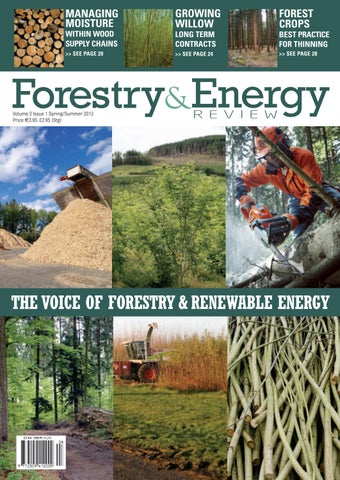
F&E Spring Cover 2012
23/03/2012
10:45
Page 1
MANAGING MOISTURE
GROWING WILLOW
FOREST CROPS
WITHIN WOOD SUPPLY CHAINS
LONG TERM CONTRACTS
BEST PRACTICE FOR THINNING
>> SEE PAGE 20
>> SEE PAGE 24
>> SEE PAGE 28
Forestry&Energy Volume 2 Issue 1 Spring/Summer 2012 Price €3.95. £2.95 (Stg)
R E V I E W
THE VOICE OF FORESTRY & RENEWABLE ENERGY
F&E Spring 2012
23/03/2012
12:58
Page 2
F&E Spring 2012
23/03/2012
12:58
Page 3
Foreword/Contents/Credits
Forestry&Energy R E V I E W
Volume 2 Issue 1 Spring/Summer 2012
24
Foreword
20 MANAGING MOISTURE TO DEVELOP COST-EFFECTIVE WOOD SUPPLY CHAINS
W
elcome to the 3rd Edition of Forestry and Energy Review Magazine. These are exciting times for the Industry which has seen a 57% increase in the volume of applications for the forestry establishment grant in the first two months of 2012,according to Forestry Minister Shane McEntee.The new applications for 3,120 hectares in January and February are additional to financial approvals by the Department of Agriculture for 4,760 hectares for this year’s planting programme. In this issue,Marie Doyle,UCD Forestry explains Forest Certification and the EU Timber Regulation which comes into force in March 2013, while D–Plant Horticulture continues their series on Eucalyptus – Short Rotation Forestry. Tom Kent,Course Leader – Forestry at Waterford Institute of Technology offers invaluable advice on the management of moisture in timber,while John Finnan from Teagasc Crops Research Centre explains that Willow is an ideal energy crop which can supply biomass to meet Ireland's ambitious requirements. Also, Ronan Madigan (JHM Crops) explains that Miscanthus is fast becoming the most popular energy crop grown. Elsewhere in this issue,Ciaran Nugent of The Forest Service advises that the Forestry Sector must organise to stamp out Forest Fires as hundreds of hectares of forest plantation are needlessly destroyed by fire each year. We also provide a selection of profiles including Husqvarna,Dermot Casey Tree Services,Western Forestry Co–operative, Bioequipment Ltd and FTEI. Looking ahead,pack your suitcase for the APF, which is the UK's largest Forestry, Woodland and Arboricultural Exhibition and this year returns to the wonderful venue that is Ragley Estate in Warwickshire from September 13th–15th,2012. We trust you enjoy reading this publication which will continue to provide a voice for the Forestry and Energy sectors. You can also download this latest edition electronically to your computer,iPad and smartphone.Simply type in the following url:www.selectmedialtd.com/feremag.html
Biomass, along with wind has been identified as a renewable energy source with significant promise writes,Tom Kent (Waterford Institute of Technology).
24 GROWING WILLOW FOR ENERGY Willow is as an ideal energy crop which can supply biomass to meet Ireland’s ambitious requirements. John Finnan (Crops Research Centre,Teagasc) reports.
28
28 THE PRACTICE OF THINNING FOREST CROPS Niall Farrelly (Teagasc Forest Research) answers seven commonly asked questions about thinning forest crops.
32 MISCANTHUS Miscanthus is fast becoming the most popular energy crop grown in Ireland,writes Ronan Madigan (JHM Crops).
34 SUSTAINABLE FOREST MANAGEMENT & FOREST CERTIFICATION Forest certification is an independent verification that forest management practices conform to a predefined standard, writes Marie Doyle (UCD Forestry).
32
40 FORESTRY SECTOR MUST ORGANISE TO STAMP OUT FOREST FIRES The annual pattern has become repetitive,almost predictable. Every spring in Ireland, hundreds of hectares of forest plantation are needlessly destroyed by fire, writes Ciaran Nugent (Forest Service).
48 EUCALYPTUS – HOME GROWN ENERGY SHORT ROTATION FORESTRY D-Plant Horticulture offers some practical advice on Eucalyptus.
Profiles 4 &19 HUSQVARNA
46
Until the next time………
Husqvarna have launched the 560 XP® – new professional chainsaw with integrated microprocessor and RevBoostä technology and also the new 550 XP®/545 chainsaws.
36 DERMOT CASEY TREE SERVICES Dermot Casey Tree Care is a family run business providing a Nationwide Service.
44 WESTERN FORESTRY CO–OPERATIVE With confidence growing in the Farm Forestry Sector we profile the work of the Western Forestry Co-operative.
46 FORESTRY TRAINING & EDUCATION IRELAND (FTEI)
The Publishers Forestry & Energy Review Publishers: Denis Lane and Robert Heuston Enquiries: Editorial: Denis Lane Advertising: James Small Design: John Barrett Production: Emma Meade
Features
Training and Education is fudamental to the Sustainable Development of the Forestry Industry. Contributors: Mr. Tom Kent, Course Leader – Forestry, Waterford Institute of Technology & Project Co-ordinator–Forest Energy 2010–14 John Finnan (Crops Research Centre, Teagasc) Niall Farrelly (Teagasc), Marie Doyle (UCD) Ronan Madigan (JHM Crops) Ciaran Nugent (The Forest Service)
Distribution: Easons,Newspread,WNS Published by: Select Media Ltd, 19 Clare Street, Dublin 2, Ireland Tel. + 353 1 6622266 Fax. + 353 1 6624981 Email. info@selectmedialtd.com
All material contained in this edition is copyright of Forestry and Energy Review 2012 and may not be reproduced or electronically stored without the permission of the publisher. However items may be freely reproduced provided the source is acknowledged. Content and views expressed in the publication do not necessarily represent those of the publishers.
3
F&E Spring 2012
23/03/2012
12:58
Page 4
COMMERCIAL FEATURE
HUSQVARNA – FOR DESIGN, POWER & PERFORMANCE www.husqvarna.ie Husqvarna 560 XP® – new professional chainsaw with integrated microprocessor and RevBoostä technology. he 560 XP® chainsaw is one of Husqvarna's latest and most advanced professional chainsaw, particularly effective for felling and limbing. Maximal power combined with low weight results in an aggressive and ergonomic machine with several new properties. A microprocessor and RevBoost ™ technology give Husqvarna a big lead in chainsaw innovation as it enters the new decade. Husqvarna recently launched the 560 XP® chainsaw to meet the needs of professional chainsaw users and individuals who want the very best. In addition to an optimized power-to-weight ratio, the chainsaw is a revolution in ergonomics and manoeuvrability. Its new design takes Husqvarna XP® saws to new heights. The low 5.4kg weight and advanced user-friendliness make the machine an effective tool. “Husqvarna 560 XP ® is the most innovative and completely professional saw on the chainsaw market today. We compromised nothing when developing this product,” says Andy Walsh, head of Service & Warranty for Husqvarna Ireland. Regular forestry work requires an easy-to-handle and ergonomic chainsaw that still has a high rate of power. At the same time, the machine must be able to accelerate quickly to work well during tasks such as limbing. With the launch of 560 XP ®, Husqvarna revolutionized the market in meeting these demands. RevBoost™ technology makes the chainsaw perfect for limbing and AutoTune™ optimizes engine performance for all conditions.
As with all Husqvarna chainsaws, a lot of attention has been paid to ergonomics. This led to the machine's centre of gravity being shifted closer to the handle to make the machine easier to manoeuvre.Thanks to a reduction in the weight and diameter of the flywheel, gyro forces have been greatly reduced. Handle vibrations have been reduced thanks to LowVib® technology and the Automatic Stop Return function means that the machine always returns to starting mode.
REVBOOST™
USER–FRIENDLY SOLUTIONS
T
AN ERGONOMIC INNOVATION
To improve chainsaw performance, Husqvarna is the first chainsaw With the help of a fuel pump, the chainsaw is easy to start when manufacturer in the world to integrate RevBoost™ technology in the engine is cold.To make servicing, such as chain replacement, chainsaws.The function causes the chain to run at a high rpm for possible regardless of the surroundings, the machine's blade nuts
“Husqvarna 560 XP® is the most innovative and completely professional saw on the chainsaw market today.We compromised nothing when developing this product” a short period of time, which is an important property when removing limbs.The RevBoost™ function, together with extremely rapid acceleration, makes the saw extremely effective for limbing.
AUTOTUNE™ – AN INTEGRATED MICROPROCESSOR Husqvarna 560 XP® has the distinction of being the first massproduced chainsaw ever to have an integrated microprocessor. AutoTune™ is a processor-controlled carburettor which automatically optimizes engine performance.This causes the chainsaw to find the optimal air mixture based on different fuel mixtures, eliminating the need to spend time adjusting the carburettor. AutoTune™ also compensates for factors such as humidity, temperature, altitude and clogged air filter.This serves to create an optimal air mixture so the engine can perform at its best regardless of the conditions.
MAXIMUM POWER With Husqvarna's new X-torq® technology, the engine is more powerful than ever in relation to the weight of the machine.The power-to-weight ratio has increased from 0.57 to 0.65 compared to the earlier model (Husqvarna 357 XP®).At the same time, fuel consumption has been reduced by up to 20 percent and emissions have been decreased by up to 75 percent.
4
are held in place with a collar that makes them impossible to lose. A fuel level window and “boot grip” (a grooved part of the rear handle that prevents you from losing your grip when starting the saw) are additional solutions that the user will appreciate. For more information on the Husqvarna 560 XP or any other Husqvarna Products, visit www.husqvarna.ie or Tel: +353 1 824 2600.
F&E Spring 2012
23/03/2012
12:58
Page 5
F&E Spring 2012
23/03/2012
12:58
Page 6
FORESTRY & ENERGY REVIEW
NEWS
OVER 350 PEOPLE ATTEND TEAGASC’S FORESTRY CLINICS nationwide series of One-2-One Forestry Clinics organised by the Teagasc Forestry Development Department proved to be very popular. Well over 350 people attended one of the 45 Clinics held throughout Ireland over a two week period at the end of February. Farmers and landowners seeking independent advice and up-to-date information on planting and managing forestry and trees availed of a one-to-one consultation with an experienced Teagasc forestry adviser. Investigating the possibility of planting some land and preparing for thinning were the two most common queries raised by landowners attending these Clinics. Many people also appreciated a financial analysis of such decisions. Landowners are investigating the benefits of afforestation. Issues that came up during the Clinics related to grants and premiums, eligibility for farmer premium, interaction with other farming forestry clinics throughout the country. He commented,“These schemes, environmental restrictions as well as financial benefits One-2-One Clinics are a very welcome initiative by the Teagasc and implications. Forestry Development Department as they provide an invaluable Many queries also related to thinning. It is clear that an increasing opportunity for forest owners to get targeted, specific advice in number of private forest owners are now preparing to thin. relation to the management of his/her forest which is appropriate Questions raised related to timber prices, how to thin, building a to the particular stage of the forest itself.” forest road, applying for a felling licence and who will carry out the harvesting and buy the timber. Shane McEntee, TD, Minister of State at the Department of Agriculture, Food and the Marine welcomed the roll-out of the his year’s main focus is on the marketing of timber and the need
A
TEAGASC FORESTRY’S 2012
PROGRAMME OF EVENTS
T
to actively manage plantations to realise their full commercial potential. Have a look at the programme below and check back regularly on www.teagasc.ie/forestry for dates, contact and venue details. Scan this QR code with your smartphone to view Teagasc Forestry 2012 events. Date
Event
19 April
Tending and Thinning of Broadleaves Bioenergy 2012 Launch of Future Trees Trust (FTT) (formerly BIHIP) Demonstration of Seed Orchard Establishment Small Scale Thinning and Harvesting Workshop for Forest Owner Groups Teagasc Forestry at the Tullamore Show Small Scale Thinning and Harvesting Teagasc Forestry at the Ploughing Tending and Thinning of Broadleaves
25 April Early May
16 May 7 June 12 August 13 September 25-27 September 10 October
Location Kerry South East
Loughgall, Co Armagh Mayo / Roscommon Tipperary Tullamore South East Wexford Midlands
To find out more… Contact your local Forestry Development Officer, visit www.teagasc.ie/forestry or scan this QR code with your smartphone to find out more. You can also contact your local Teagasc office.
6
F&E Spring 2012
23/03/2012
16:00
Page 7
F&E Spring 2012
23/03/2012
12:58
Page 8
FORESTRY & ENERGY REVIEW
NEWS
TALKING TIMBER
Opportunities for forest owners to meet foresters, harvesting contractors and timber buyers. eagasc ran four Regional Timber Marketing Days during March 2012 in counties Cavan, Laois, Galway and Cork.The purpose of these Regional Timber Marketing Days was twofold: to give forest owners the opportunity to make contact with foresters, harvesting contractors and timber buyers and to provide forest owners with answers to the following questions: How do I get into contact with potential buyers? Is my forest ready for thinning? I would like to chat about this with other forest owners in my area? Are there such groups near me? How do I secure the best possible price for my timber while optimising my forestry investment into the future? Do I need a felling licence to cut my trees? What is certification? Is it important to me? How will the timber be sold – standing,at roadside or delivered to sawmill? Will the timber be sold by weight or by volume? Do I have to pay VAT when selling timber? Is VAT charged on timber harvesting? How do I market my timber? How will the thinning operation be carried out?
T
8
Each event started with presentations providing answers to the above questions by representatives from Teagasc, the Irish Forestry Contractors Association (IFCA), the Association of Irish Forestry Consultants (AIFC), the Forest Management Companies Group and the Irish Timber Growers Association (ITGA). Local private forest owners also gave their perspective of the thinning process and shared their experiences. Presentations were followed by viewing of stands of numerous local timber buyers and contractors. The four Regional Timber Marketing Days proved to be a great opportunity for private growers to meet with potential buyers and harvesting contractors. Research conducted by Teagasc indicates that if only 50% of private forest owners thin their plantations, the output from farm forestry first thinnings alone would exceed 200,000m3 each year. Coillte Teo is currently the main supplier of roundwood to the sawmilling / processing industries; however COFORD estimates that the private sector’s market share could rise from approximately 10% at present to 23% by 2015.
F&E Spring 2012
23/03/2012
12:58
Page 9
F&E Spring 2012
23/03/2012
12:58
Page 10
FORESTRY & ENERGY REVIEW
NEWS
THE ART OF HURLEY MAKING ‘FROM ASH TO CLASH’ A new DVD called The Art of Hurley Making – ‘From Ash to Clash’ has been produced by the GAA,Teagasc and the Irish Guild of Ash Hurley Makers. he DVD, which was launched in Croke Park tells the story of Irish hurley making, from the planting of the ash tree, through the crafting of the hurley, to being used on the field of play in Croke Park. Present to launch the 24 minute video, were Minister of State at the Department of Agriculture, Food and the Marine, Shane McEntee TD; Uachtarán Chumann Lúthchleas Gael Criostóir Ó Cuana; Director of Teagasc, Prof. Gerry Boyle; and the President of the Irish guild of Ash Hurley makers,Willie McAuliffe. The video was directed and produced by Pat Comer (previous productions include the Naked Election and In the Name of the Fada) and celebrates the story of the Irish Ash Hurley and its place in Irish sporting culture.The craft of Hurley making is an indigenous, rural industry resulting in the sustainable and renewable manufacture of hurley sticks. The DVD will play in the GAA Museum at Croke Park and is available to view on the three organisations’ websites. Speaking at the launch, the GAA President said:“It’s hard to think of anything more symbolically Irish than our hurleys and these carefully crafted pieces of ash represent far more than just a sporting accessory. I laud this project which aims to highlight the tradition and expertise that goes hand in hand with what is a highly respected
T
10
From L to R: Mr Willie McAuliffe, President of the IGAHM; Mr Shane McEntee, TD, Minister of State at the Department of Agriculture, Food and the Marine; Professor Gerry Boyle, Director of Teagasc and Mr Christy Cooney, President of the GAA.
craft and I acknowledge the coming together of the three organisations and the support of Minister of State Shane McEntee TD.”Teagasc Director, Professor Gerry Boyle, said:“Our forests are an important national asset, contributing not just to the economic activity in the country and to a sustainable environment, but in the case of our ash plantations, to our important sporting culture.Teagasc are delighted to have worked with the Irish Guild of Ash Hurley Makers and the GAA on this DVD. ” Minister McEntee added:“Forestry and the GAA are a winning combination. By growing the necessary ash for making hurleys our forest owners and farmers – many of them GAA members – are providing a sustainable and renewable supply of raw material for another indigenous, rural industry – hurley making.” “The production of this DVD is timely because it goes back to basics – from the careful management of ash plantations to provide the raw material, to the unique skills required to create the eventual hurley. Because of the investment that was put in place in earlier years, I am glad to say that some home grown ash is already coming on stream for hurley making and I expect a significant volume of ash for making hurleys to become available from 2014 onwards.” The story of hurling starts by applying best practice in relation to woodland establishment and management.The video underlines the importance of good quality ash trees if you want to produce good quality hurleys and therefore play hurling. It traces that piece of ash wood, through the skilled hands of hurley makers as it’s crafted into a finely balanced piece of sporting equipment, for use on sporting fields in GAA clubs right around the country. You can view the “From Ash to Clash” video as well as other forestry related videos on YouTube and also on the Video Gallery of the Teagasc Forestry website. To watch this video: visit www.teagasc.ie/forestry. Scanning this QR code will take you directly to the Video Gallery.
F&E Spring 2012
23/03/2012
12:58
Page 11
F&E Spring 2012
23/03/2012
12:58
Page 12
FORESTRY & ENERGY REVIEW
NEWS SILKY SAWS IRELAND BE-GE SEATING www.silkysawsireland.com www.be-ge.co.uk S B ince 1996 the company have imported Silky Saws into Ireland.Now they are the main importers and sell the Silky Saws throughout Ireland. Silky Saws maintain that it is the most professional pruning saw in the world. The saws are made in Japan, where they spend a lot of time and money on research and are constantly upgrading the product. Their philosophy is that the saw is very well–balanced, lightweight and that it stays razor sharp for a very long time, so you can saw effortlessly.The teeth are impulse hardened.At Lawderdale House they stock a large range of saws: folding saws, fixed handsaws in a scabbard and telescopic pole saws up to 6.3 metre.They also stock all the spare blades and spare parts. Along with the saws they stock professional seceteurs and loppers. All saw products and loppers have been tested in our own forests. Now they also stock the elephant Trunk Harness, which puts an end to aching arm, back and shoulder muscles,when using a hedge trimmer for a long time. You can order by phone, email and on the following website www.silkysawsireland.com where you also can see our range of saws etc. For further information contact: Eltjo and Marion Van der Laan, Lawderdale House, Ballinamore, Co. Leitrim. Tel: 071-9644436 Mobile 087-91249392 Email: marionvandelaan@eircom.net
12
e-Ge Seating AB are pleased to announce the new appointment of Gary Shaw as General Manager of Be-Ge Seating UK Ltd. Gary joined the Be-Ge group 6 years ago responsible for our M1 passenger seat market, mainly dealing with the “Blue Light Sector” supplying passenger seats in Ambulances, Police and Fire vehicles. Before joining Be-Ge he worked for the Port Container handling company Valmet and the Forklift manufacturer Linde. Gary Shaw explains “Our 3000 seat has now being introduced by three major forestry machine OEM’s as their high end option seat, to cater for the growing demand of a luxury seat with excellent vibration properties, we also offer a wide range of armrest/joystick controls, Isolation dampers both 2 and 4 way which can be adjusted on 6 levels.” “We can also offer as an option our Our HealthVib®inSeat which is built into the seat and interfaces with our Vibindicator™ together they provide a warning system for measuring and indicating body vibration exposure in accordance with the EU Directives 2002/44EG concerning vibrations in the workplace.” For further information contact: Be-Ge Seating UK Ltd, Unit 3, The Fulcrum, Lows Lane, Stanton, Derbyshire, DE7 4QU, UK. Tel: 0844 800558 Fax: 0844 800559 Gary Shaw, General Manager of Email: gary.shaw@be-ge.co.uk Be-Ge Seating UK Ltd Website: www.be-ge.co.uk
F&E Spring 2012
23/03/2012
12:58
Page 13
F&E Spring 2012
23/03/2012
12:59
Page 14
FORESTRY & ENERGY REVIEW
NEWS
PREDATOR LAUNCHES NEW WORLD-BEATING TRACKED COMPACT STUMP GRINDER www.predator-mfg.com * Combines power and versatility in uniquely compact package * Grinds out stumps to a depth of 18 inches – slew of 4.5 ft * Quiet and smooth operation – effortless 26-inch gap navigation revolutionary new tracked compact stump grinder combining extremely high power and verstaility in a package that grinds out stumps to a depth of 18 inches with a slew of 4.5 ft has been launched by Predator Power. The new Predator P38X provides effortless, quiet, economical and incredibly smooth grinding. Like it's P28X predecessor, it fits easily through a 26-inch gap with track retraction achieved by a single hydraulic lever action. It weighs just 1,000 kilos.The new machine provides 35 per cent more power than the P28X, has an economical and low-emission lean burn petrol engine, and offers uprated hydraulics to give faster and smoother tracking and also movement. Other features include a Multi-Tip x 6 cutter wheel and a radio control option with fully proportional controls allowing smooth and precise operation in tight locations.The P38X combines the latest overhead valve technology with a variable speed mechanical governor to deliver maximum power with exceptional fuel economy and smooth performance, regardless of power requirements. Priced at £20,995 + vat, the new machine is available for a limited introductory period at £15,995 + vat – the same price as the current
A
14
P28X model. A finance package is also available. For example, a 10% deposit and 48 payments of £342 over four years. Details are available on the company's website at www.predator-mfg.com Tel: 0845 4021756 or Email:max@predator-mfg.com
F&E Spring 2012
23/03/2012
12:59
Page 15
F&E Spring 2012
23/03/2012
12:59
Page 16
FORESTRY & ENERGY REVIEW
NEWS APF EXHIBITION 2012 – FULL STEAM AHEAD
PRESENTED BY APF INTERNATIONAL FORESTRY MACHINERY EXHIBITION LTD.
September 13th–15th,2012 here are now just 4 months to go until the UK’s largest forestry, woodland, trees and timber exhibition, APF 2012, takes place on the 13/14/15th September at Ragley Estate,Alcester,Warwickshire, courtesy of the Marquess Of Hertford.Already over 160 companies have booked space and over 2400m of demonstration frontage has been sold,that’s over 1.5 miles of working woodland machinery. 250 exhibitors and 20,000 visitors are expected over the three days of the show. There is a wide range of fantastic competitions to see including the Husqvarna World 25m poleclimbing championships, the A.W As the exhibition gets bigger it becomes harder to do it all in a Jenkinson and UPM Tilhill European Chainsaw Carving championships, day. Information on accommodation can be found on the visitor The European Horse Logging Championships, the World Log to Leg section of the website as can a list of exhibitors, up to date maps, Polelathe championships, the UK Forwarder Driving Championships, competition entry forms as they become available and you can an extensive woodland crafts area with demonstrations of everything buy advance tickets online from clog making to charcoal burning, pole lathe turning to oak swill APF 2012 will be bigger and better than ever and is undoubtedly baskets, displays of working vintage forestry equipment, tree climbing the place to visit this year to check out and buy new machinery, and axe throwing competitions. catch up on the latest industry developments, meet old friends We are currently working with the Forestry Commission to hold and watch some world class competitions and have a go if you seminars in a variety of current topics especially wood fuel, bio- are brave enough! energy and plant health and you will be able to see best practice Put the dates in your diary now. We look forward to seeing you demonstrations of bio-security for dealing with Phytophthora. all in September. The site Ragley is looking good and those exhibitors who have For further information contact: Exhibition Secretary: seen it have commented on how good the layout is. As organisers Ian Millward, 10 Warren Road, Reigate, Surrey RH2 0BN. we feel it is one of the best sites we have ever had and hope you Tel: 01737 245081. Fax: 01737 225619. will agree. It is very conveniently located from whatever part of the UK Email: info@apfexhibition.co.uk you live and only 25 miles from Birmingham International Airport. Website: www.apfexhibition.co.uk
T
CLEARY & SONS AUCTIONEERS Thinking of selling JAMES www.ForestSales.ie your Forest?
Thinking of buying S a Forest? Log onto www.ForestSales.ie – the new dedicated website for Forest Sale throughout Ireland Contact: Paul Lafferty {BAgr. Sc Forestry, BSc. Hons Property} James Cleary & Sons Specialist Forestry Auctioneers, Castlerea Co. Roscommon.
Telephone: 09496-20540 / 09496-20011 or Mobile: 086-2599189. Email: forestsales.ie@gmail.com. For further details please log on to www.forestsales.ie 16
ince its establishment in September 2011, www.ForestSales.ie has become the No. 1 choice as a method for buying or selling forests and forest lands throughout Ireland. Paul Lafferty who is both a fully qualified Auctioneer and Forester, reports a high demand for good quality forests typically pure Sitka Spruce, plantations over 20 years of age which are just after being thinned or are due for thinning. Alternatively, there is good demand for good quality, diverse plantations with a number of years’ premium to run. www.ForestSales.ie is also looking for land from upwards of 20 Acres which would be suitable for the plantation of forestry throughout Ireland. Paul Lafferty is delighted with the success of www.ForestSales.ie since its launch and recommends that anyone who is interested in the purchase or sale of forest lands to log onto www.ForestSales.ie and check out the complete list of properties available. Please note that the website is being updated on a regular basis and all necessary information such as interactive maps, directions, species maps will be contained on www.ForestSales.ie and are listed in such a manner to be extremely “User-Friendly”. Paul Lafferty would also like to thank everyone who has checked out www.ForestSales.ie thus far.
F&E Spring 2012
23/03/2012
12:59
Page 17
F&E Spring 2012
23/03/2012
12:59
Page 18
FORESTRY & ENERGY REVIEW
NEWS
FELL TREES THE EASY WAY USING A TREE SHEAR
www.treeshears.co.uk
ymax Tree Shears can be mounted on Excavators or Skid Steer Loaders, converting your machine into a highly efficient tree harvester in a matter of minutes. Dymax Tree Shears can easily fell in a day what it would take 5–6 days by chainsaw, and do it more neatly and safely. The shear operator can choose where to place cut trees and stacking for a whole tree chipper is easy, and speeds up the chipping process.The most common size of tree shear is the Timberwolf 14” which fits on a 13t+ excavator or large skid steer loader.This is mass produced in the US and offers excellent value for money.
D
A smaller 10” model suits 7–10t excavators, and larger 16”, 18” and 20” models suit large excavators. Optional Rotation is available on all models allowing more precise cutting when working on coppice, waterways, utility clearance, etc. Dymax have been manufacturing market leading Tree Shears for over 30 years and are considered to be the market leaders in the US. For further information contact: Alastair Beddall, Dymax Tel. 0044 1295 690011, Email: sales@treeshears.co.uk Website: www.treeshears.co.uk
18
F&E Spring 2012
23/03/2012
12:59
Page 19
COMMERCIAL FEATURE
NEXT GENERATION LIMBING – AND MORE www.husqvarna.ie Husqvarna launches the new 550 XP®/545 chainsaws.
ight-weight, extremely ergonomic and lightning fast acceleration when needed. Husqvarna’s new pro-range chainsaws, optimized for precision cutting, are about to make limbing and felling tasks smoother than ever. But that’s far from all. The unique mix of power and easy handling make them two of the most versatile products in the range, says Andy Walsh, head of Service and Warranty for Husqvarna Ireland. Regardless whether you are a professional logger, a demanding landowner or a pro-aspiring consumer the new addition to Husqvarna’s 500 series pro-range chainsaws will have a lot to offer. Based on the same platform the two models share several features, the most visible one being the aggressive, compact and light-weight design.This makes them, and especially the 550 XP®, exceptionally responsive in fast-moving situations where the centre of gravity plays an important part. In order to make a saw with this combination of power and weight move steadily in operation several aspects have to be considered.The centre of gravity for example is vital when gyro forces come into play.The key to balance and low vibration is to · Optimized ergonomics: Light-weight body, minimized gyro force minimize weight and width of every moving part, which is exactly impact and upgraded handle design. what we’ve managed to do. Adding even better performance in · AutoTune™: Instant optimal settings. Compensating for fuel, the process, says Andy Walsh. altitude, humidity, etc. = perfect performance at all times.
L
“The key to balance and low vibration is to minimize weight and width of every moving part, which is exactly what we’ve managed to do” Balance doesn’t solely affect the work result though. It has a · TrioBrake ™: Husqvarna’s instant safety stop. Allows the chain noticeable positive ergonomic impact too, an area that has been brake to be activated automatically by the inertia release improved in other ways as well.The handles, for instance, have mechanism – or mechanically by your left or right hand. been rearranged for more intuitive movement. Also, both models · Fuel level window: Gives an instant view of the fuel level. have been equipped with AutoTune™ – Husqvarna’s own system For more information on the Husqvarna 550XP Chainsaw to optimize saw settings – thereby saving both time and work for or any other Husqvarna products, Tel: +353 (0)1 824 2600 any operator. or find your local Husqvarna Agent on the following Apart from being about 0,2 kg lighter than the closest competing website: www.husqvarna.ie product another two features tend to stand out. Husqvarna’s RevBoost™, which maximizes engine acceleration when needed, and the X-Torq™ technology. Making the product as powerful and efficient as can be – lowering both fuel consumption and emission at the same time.
THESE ARE THE NEW 550 XP®/545 PRORANGE CHAINSAWS: · Outstanding power–to–weight ratio. · RevBoost™: Rapid acceleration and higher chain speed. (550 XP® only) · X-Torq™: Up to 20 per cent less fuel consumption, and up to 75 per cent less emission compared to traditional two-stroke engines.
19
F&E Spring 2012
23/03/2012
12:59
Page 20
BIOMASS FEATURE
MANAGING MOISTURE TO DEVELOP COST-EFFECTIVE WOOD FUEL SUPPLY CHAINS
Biomass, along with wind has been identified as a renewable energy source with significant promise for reducing dependence on imported energy. Tom Kent of the Waterford Institute of Technology finds out more.
he use of renewable energy has been widely expounded as a solution to the challenges of global energy security and climate change. In addition to rising fossil fuel costs and enhanced environmental concerns, Ireland currently imports 90% of its energy needs and is very vulnerable to supply disruptions as well as price changes.To relieve Ireland’s dependence on the import of energy, and increase its energy security, the Irish government has established sustainable energy goals that will see a significant increase in the use of renewable energy by 2020. Biomass, along with wind, has been identified as a renewable energy source with significant promise for reducing dependence on imported energy. Woody biomass, in particular, has the potential to play a major role in Ireland’s national bioenergy strategy. About 10 percent of Ireland is covered by forests. A COFORD study carried out by Mr. Henry Phillips on behalf of the Department of Agriculture has estimated that the potential availability of wood fibre for energy in Ireland is currently over one million m3 per year. The Forest Energy Research Programme 2010–2014 aims to High production and transportation costs, relative to market investigate cost-effective wood fuel supply chains to meet the values, can be economic barriers to the widespread utilization of growing demand for indigenous, renewable, carbon-neutral energy. woody biomass for energy production.The net calorific value of This research project is focused on farm forestry first thinnings wood fuel is mainly determined by the amount of water contained in need of this first intervention to secure the future financial within. Moisture management, through storage and drying in the optimisation of these stands. Further, the programme is investigating supply chain between harvesting and utilization, is key to improving supply chains from logging residues from clearfelling.The whole both transportation costs and market values. supply chain from forest to end-user is being investigated.The Wood is approximately 50 percent water by weight. Reducing project team is made up of Waterford Institute of Technology, the amount of water, through drying, reduces transportation costs University College Dublin and the Danish Forestry Extension.The as more wood and less water can be delivered per load; increases team is grateful for the support of Coillte, Bord na Mona and the combustion efficiency as less energy is required during combustion private forestry sector in securing trial sites, machinery and to evaporate water; and reduces the potential for wood fuel to methods for testing.The team is working with the Department decay from fungal decomposition during storage. Investigating Agriculture, Food & Fisheries/COFORD, the Forest Service and methods for managing moisture along the wood fuel supply Teagasc in disseminating project results and in organising chain is one of the main objectives of the Forest Energy research demonstration events.The project team acknowledge the support project.
T
20
F&E Spring 2012
23/03/2012
12:59
Page 21
BIOMASS FEATURE change. By September, the moisture content had reduced to 31%. of the COFORD Forest Research Programme in the Department of Agriculture, Fisheries & Food.This project is funded under the A further six loads were delivered into the storage terminal in November 2011 and stacked in the same manner. This trial will National Development Plan 2007–13. continue through to August 2012 in order to gain a comprehensive Determining the moisture content of woodfuel and assessing understanding of the drying rate of roundwood stored at a terminal how the moisture content changes from standing tree to delivered and to investigate the factors which promote fastest and most fuel are central themes of the project and investigations into wood effective drying. moisture are part of each work package. WIT are characterising the energy parameters of six commercial tree species in Ireland: Sitka spruce, Norway spruce, lodgepole pine, ash, birch and alder. Previous COFORD studies have shown that moisture content in standing trees changes over the year, being lower in winter and higher around time of flushing in April, May and June.Trees from trial sites in Waterford, Offaly, Roscommon and Donegal are being sampled for moisture content and other energy parameters through 2012. Accurate, relevant information on the physical and chemical properties of these species will be useful for specifying fuel by the end-user and describing fuel by the supplier. Harvesting, transport, storage, quantifying for payment purposes and combustion are all affected by these properties.A database of results will be prepared and made available through COFORD. UCD are developing a truck productivity and costing model for conventional forest products and energy products and will link the model to a GIS-based Irish road transportation network that provides travel distances, by road type, for a user defined route.
“Previous COFORD studies have shown that moisture content in standing trees changes over the year, being lower in winter and higher around time of flushing in April, May and June” A storage trial of 857 residue bundles was created on a Coillte clearfell site in March 2010 in Co. Kilkenny made up of two stacks of green bundles and six stacks of brown bundles. Eight treatments were used: green versus brown, covered versus uncovered, single width stacks versus double width stacks, and exposed versus sheltered location.The initial weight and moisture content of all stacks was measured. In August 2010 each stack was transported separately to Medite Europe Ltd. and weighed.The bundles from each stack were be chipped separately and moisture content samples were taken. The green stacks were found to have lower initial moisture content than the brown stacks, at 51% and 54% moisture content respectively and also experienced a greater reduction in moisture over time. It was also found that covering the stacks significantly improved moisture content reduction in the green stacks, but not in the brown. The lowest mean stack moisture content at the end of the storage period of 29.3% was found in the green covered bales after five months.The results of the trial also showed that the reduction of moisture content was not affected significantly by using double width stacks, or stacking within a sheltered environment in the forest. During storage all stacks experienced a reduction in weight from the reduction in moisture content. In total across the eight treatments the stacks reduced in weight from 302 tonnes to 240 tonnes. In all cases the energy content of the In a joint study with Coillte six loads of Sitka spruce pulpwood stacks increased, suggesting that any dry matter loss during procured from a recently harvested first thinning site were delivered storage is sufficiently offset by the increase in energy content into a terminal at Co. Cork in March 2011. Each load was stacked from lower moisture content. on a prepared gravel surface. Logs were placed under the stacks These observation storage trials, which have demonstrated that to raise the logs above ground. One load was stacked separately wood will dry in Irish climatic conditions when stored correctly, and left uncovered as a control.The other five loads were stacked are supplemented by an experimental trial that aims to develop together and covered.The initial moisture content was 61% and climate-based predictive models for drying wood fuel. A model every two months one load was resampled for moisture content which predicts change in moisture content over time based on Weight is generally the limiting factor in wood transportation, whereby the maximum weight limit is reached while there may still be additional volume capacity on the truck. Moisture has a huge impact on timber weight.Typically, Sitka spruce roundwood may be 60% moisture content so a 26 tonne load will contain just 10.4 tonnes of wood and 15.6 tonnes of water. With this in mind, the project team has initiated several studies to investigate how best wood fuel may season during storage prior to transport and processing.
21
F&E Spring 2012
23/03/2012
12:59
Page 22
BIOMASS FEATURE as a percentage of the total initial weight. Moisture content is tested destructively in this way and, for large wood fuel quantities, a good estimation requires intensive point sampling. Extracting many samples from a stack or truck may be impractical and sampling in wet weather can lead to inaccurate estimates. For these reasons, WIT is testing a number of different moisture meters on roundwood, firewood, woodchip and residue bundles.This work aims to determine the accuracy and range of each meter and develop standard procedures, sample sizes and sampling intensities to facilitate the use of meters for commercial trade of wood fuel along the supply chain. The rainfall and evapo-transpiration has been developed for Sitka spruce commercial application of accurate moisture meters roundwood.This model is currently being validated and expanded could provide a quick, for lodgepole pine and Eucalyptus nitens. Attempting to predict reliable and inexpensive the change in wood fuel moisture content during storage required alternative to costly and that the development of storage frames on load cells to accurately weigh wood continuously as moisture evaporated or was reabsorbed time-consuming destructive testing of moisture content. Moisture into the wood.These storage frames were manufactured in partnership meters may be particularly suitable for woodfuel suppliers to with Bord na Mona and are now hosted at Medite Europe Ltd. In carry out moisture checks on wood fuel in storage as part of addition to facilitating the drying model development these storage their quality management practices. In overview, the Forest trials have concluded that spruce roundwood will dry to 30% Energy project is working moisture content, suitable for commercial woodchip after 16 weeks storage during summer or 26 weeks storage during winter on models to predict moisture content changes & spring. It was found that while top covering stacks did not accelerate drying, covers did ensure more even moisture content in wood fuel during storage, throughout the stack. Maybe most interestingly, it was found that describing the conditions required to efficiently dry Sitka spruce did not reabsorb moisture once dry. woodfuels and the tools to monitor and measure moisture content quickly and accurately. From a commercial viewpoint, optimal storage method, location and drying time are economic decisions as well as technical processes. The benefits obtained from such factors as increased combustion efficiency and price, and reduced transportation costs must be weighed against increased handling costs, for example machines having to return to the forest after drying to chip logs or alternatively the intermediate transport to an off-forest storage yard and opportunity costs of capital being tied up in drying material. Certainly, better operational decisions can Moisture management is central to wood fuel quality management. be made by better understanding of the processes that control moisture content of wood and the conditions that encourage The European CEN Standardisation Agency has developed solid seasoning. biofuel quality standards, one of which describes the reference Efficient supply chains and quality-managed wood fuel should method for determining moisture content. In this oven drying be the drivers for the expansion of the wood energy sector in method, a sample is weighed and then dried to constant weight Ireland. and reweighed, the weight of evaporated moisture is expressed
22
F&E Spring 2012
23/03/2012
12:59
Page 23
F&E Spring 2012
23/03/2012
12:59
Page 24
WILLOW FEATURE
GROWING WILLOW FOR ENERGY SRC willow as an energy crop exploits the vigorous juvenile growth associated with Salix and its ability to coppice or re-sprout from the stool that remains after harvest. John Finnan (Crops Research Centre,Teagasc) reports.
he crop is established from cuttings prepared from oneyear-old wood produced by specialist nurseries.The cuttings are inserted into the ground in spring and at the end of the first growing season they are cut to ground level (coppiced) to encourage the development of the multi-stemmed stool. Growth is rapid after cut back and can be as much as 2–3 meters in the first year increasing to 6–8 metres at harvest in three years (short rotation) following cutback. A willow coppice may be harvested six to eight times on a three-year cycle giving the plantation a life of 19–25 years allowing for the first or establishment year. Shorter harvesting cycles (every 2 years) are currently being considered to facilitate the recycling of sewage sludge.The coppice can then be removed and the land returned to conventional cropping. A wide range of yields can be expected depending on site, weather conditions and all the other factors which normally determine yield from conventional crops but can be expected to be in the range 7–12 tonnes dry matter (tDM) per hectare per year (21–36t DM on a three-year harvest cycle).
T
PLANTING
Since SRC Willow will be in the ground for up to twenty-five years, thorough site preparation is essential. Pre-ploughing herbicide application is required when weeds are still actively growing Glyphosate (e.g. Roundup at 4.0 – 5.0l/ha). On grassland or setaside sites an application of Chlorpyrifus (e.g. 3.0 l/ha Dursban) will provide leatherjacket control. The planting season extends from early spring – February/March, when weather conditions allow soil preparation, to late May and even June using cold stored cuttings. Early planting will give early establishment and a longer growing season for the establishing crop with a lower risk of water stress from a late spring dry period. Current commercial practice is to plant 18,000 cuttings per hectare to give a final established crop of 15,000 per hectare.There are two breeding programmes, which have produced improved varieties for planting. The European Breeding Programme now based at Rothamsted and the Swedish programme initiated by the Swedish University of Agricultural Sciences in Uppsala and continued by a commercial company, Svalof Weibull AB. Both programmes have produced varieties with significantly increased yield potential. Melampsora, a foliar rust disease, is the primary limiting factor to SITE SELECTION Willow is not a demanding species in terms of its site requirements. sustainable production of SRC Willow in Ireland, principally because It will flourish on a wide range of soil types and environmental the disease is favoured by the cool moist maritime type climate. The use of varietal mixtures has been particularly effective against conditions and in common with other crops productivity will rust.Therefore it is recommended that all commercial SRC Willow be determined by site fertility, temperature, and availability of plantations should contain at least six varieties to ensure maximum water and light. • Soils: most agricultural soils with pH in the range 5.0–7.0 will genetic diversity, and they should be planted in as intimate and random mixture as practically possible. produce satisfactory coppice growth. Several types of mechanical planters have been used but the • Water availability: Willow coppice requires more water for its growth than any other conventional agricultural crop and hence dedicated Step Planter designed in Sweden by Salix Maskiner has become the industry standard in Ireland.This planter plants two requires a good moisture retentive soil. • Temperature: Willow in its native environment is a northern double rows at a pass and automatically makes the cuttings from temperate zone plant and consequently temperatures in Ireland rods inserted into the planting heads.Establishment should, in good conditions, be in excess of 90%. are unlikely to be an issue. After planting, the site should be rolled to consolidate the surface • Elevation: Elevated sites can result in exposure problems as well and provide the best possible conditions for the application of a reduction in the number of growing days per year. • Access: Harvesting is carried out in winter in the period December residual herbicides to be effective. to April and whilst the root system of the growing coppice will support the harvesting and extraction equipment on the coppice POST – PLANTING ESTABLISHMENT Management of the crop post-planting up to cutback is crucially site, hard access is required to the site. Slopes in excess of 13% important, particularly in terms of weed control. A post-planting will provide difficulty for harvesting machinery, particularly in application of a pre-emergent residual herbicide is necessary to wet conditions and should be avoided.
24
F&E Spring 2012
23/03/2012
12:59
Page 25
F&E Spring 2012
23/03/2012
13:01
Page 26
WILLOW FEATURE keep the crop clean during the establishment phase –There are a number of residual herbicides which can be used but a mixture of pendimethalin (e.g. Stomp at 3.3 l/ha) and Isoxaben (e.g. Flexidor at 1.0l/ha) has been found to be an effective mix on a range of sites.The residual herbicide should be applied within fourteen days after planting. During the first growing season, the inserted cuttings will produce 1–3 shoots with a maximum height of 2.0 –3.0m.These are cutback as close as practically possible to ground level using a reciprocating type mower, which should produce a clean cut. Other types of swathers or flail mowers can cause excessive damage.This cutback will encourage the established cutting to produce multiple shoots often eight to ten depending on variety. Re-growth is rapid and vigorous with ground cover/canopy closure being achieved by mid-summer in the year following planting. Following cutback, the coppice enters its cropping cycle of between two and four years. At harvest, the coppice will have attained a maximum height of 7–8m and only the most vigorous of the shoots produced at cutback will survive to this point, the weaker ones having been shaded out. After cutback, a further herbicide application will be necessary to keep the crop weed free until it achieves canopy closure, usually in mid-summer of the second growing season.The use of the contact herbicide amitrole (e.g. Weedazol (Not available in ROI at time of print) at 10–20l/ha), together with an additional application of residual herbicide – pendimethalin (e.g. Stomp at 3.3l/ha), will provide the necessary control and should be applied before significant flushing but delayed sufficiently after cutback to allow for wound sealing.
In common with most fungal diseases, control can be achieved using fungicides. However, in the case of SRC Willow, this is not considered a practical solution for a number of reasons.A successful alternative is to grow several varieties as a mixture.Where individual components of the mixture become susceptible to the disease over time and make increasingly smaller contribution to yield, it has been NUTRITION & FERTILISATION shown that in a mixture of ten varieties, the loss of up to 30% of As with any crop, fertiliser, from whatever source, should only be applied as the result of formal soil analysis and consideration component varieties can be fully compensated for and the potential yield loss avoided. Willow beetles (Chrysomelids): represent the of other inputs in perennial crops such as internal recycling of major economic pest problem in SRC in Ireland. There are three nutrients in the leaf litter.The nutrient requirements of willow are modest compared to other crops, the necessary nutrients can species of willow beetle involved - brassy or green (Phratora vitellinae), be applied in the form of chemical fertilizer, manure or slurry as blue (Phratora vulgatissima) and brown (Galerucella lineola).The well as in the form of sewage sludge. Fertiliser application is not blue and brown species are more prevalent. recommended on most sites in the first growing season because HARVESTING the nutrient capital is generally adequate for establishment, and The harvesting window for SRC Willow is from leaf fall to bud the crop will not have developed the necessary root system for burst/flushing in the spring. In normal conditions, this gives a effective uptake. Additionally, it is in the establishment year that weed control is likely to be most difficult and fertiliser application three to three and a half month period from December to mid March. In Irish conditions, soil trafficability is at its worst in may well exacerbate the problem. Many soils are well supplied with phosphate and potash and it this period and hence the need for hard access to the cropping is not likely that additional P or K will be necessary, at least in site. There are a number of approaches to harvesting, direct chip the earlier rotations. Consequently, fertiliser applications whether harvesting and whole rod harvesting are the most popular harvesting in the form of organic wastes or mineral fertilisers should only be techniques. In direct chip harvesting, the crop is cut and chipped in calculated following soil analysis and generally should only be a single pass and the resulting material must be dried artificially applied to balance removals.There is the potential on soils with a immediately following harvest, to prevent deterioration. Most low P index, when recycling organic wastes such as sewage sludge, of the machinery developed for this type of operation has been designed to harvest the double row in a single pass and are essentially to apply P in excess of removal in the understanding that the P modified harvesting heads fixed to standard forage harvesters. status of the soil will rise over time. In these circumstances the With whole rod harvesting, the crop is harvested as entire rods. The soil index 2 for P should not be exceeded. harvested rods are stacked on a hard standing area where they As a guide, to be confirmed with soil analysis and expected yield, nutrient application should not exceed the equivalent of will dry naturally over a period of time without any deterioration after which they can be chipped. 120–150kg nitrogen, 15kg–40kg phosphorus (see above), and 40kg potassium per hectare per year. Unfortunately, due to the nature of the crop and the available equipment, the application of CONCLUDING REMARKS Willow grows well under Irish conditions and is an ideal energy fertiliser in whatever form is not practically possible in commercial plantations except following harvest and before re-growth prevents crop which can supply biomass to meet Ireland’s ambitious Bioenergy requirements. Almost 1000ha of willow have been the access of machinery. established in Ireland over the last few years and contracts for PESTS AND DISEASE growing willow are available from several companies. Leaf Rust (Melampsora spp.) is the most important fungal pathogen Further information on growing willow can be obtained in of SRC Willow and potentially the most limiting to sustainable the Teagasc Willow Best Practise Guidelines. cropping, particularly in the cooler maritime type of climate in You can download a pdf from the following website: Ireland, which favours the development of the disease. www.teagasc.ie/publications/2011/314/WillowBestPractice.pdf
26
F&E Spring 2012
23/03/2012
13:01
Page 27
F&E Spring 2012
23/03/2012
13:01
Page 28
TEAGASC FORESTRY
THE PRACTICE OF THINNING FOREST CROPS Niall Farrelly, Teagasc Forest Research, answers seven commonly asked questions about thinning forest crops. 1. HOW DO TREES GROW IN FORESTS? Typically, a large number of trees are initially planted in forests, usually 2,500 stems per hectare. Competition and natural selection will reduce the number of trees over time, as the taller vigorous trees will overshadow the smaller weaker trees.The most vigorous trees are better at competing for light, moisture and nutrients and are most likely to survive.The weaker trees become overcrowded by their taller neighbours, their crowns become restricted and these trees eventually die (figure 1). Figure 1: Growth and development of trees in a typical forest plantation.
Unthinned stand, age 42 years, high mortality Therefore the weakest trees in the plantation are progressively suppressed and the stronger trees take up a leading position in the plantation.
Unless these trees are removed in thinning operations, trees will be suppressed and eventually die.
The most vigorous trees are most likely to survive. The weaker trees become overcrowded and their crowns become restricted.
Competition starts as trees compete for light, moisture and nutrients.
Typically forest plantations start life with a large number of small trees, usually 2,500 stems per hectare.
Thinned stand, age 42 years, no mortality Figure 2: Forests that remain unthinned have a high degree of mortality, thinning salvages timber before it dies.
2. WHAT IS THE DIFFERENCE BETWEEN THINNED AND UNTHINNED FORESTS?
3. WHEN DO I CONSIDER THINNING?
Thinning removes surplus trees to concentrate timber production on a limited number of the best trees in the plantation resulting in increased diameter growth and producing more valuable larger diameter trees. If forests are left unthinned, there is a high incidence of mortality in the forest i.e. trees will progressively die, leading to a reduction in total timber volume production. If these trees are removed by thinning operations, a proportion of the timber volume can be salvaged resulting in an increase in volume production over similar unthinned stands (figure 2).
Thinning needs to be considered once the trees are utilising all the available growing space. As a general rule of thumb, thinning of conifers should take place when trees are between 10 and 12 metres tall, provided that the forest is fully stocked.A more detailed assessment of thinning readiness can be assessed by measuring the diameter of the trees at breast height (1.3 metres above ground) in order to calculate the area taken up by each tree in a plot. These measurements calculate the basal area per hectare of the stand and are an indication of whether all the available growing space in the stand has been fully utilised. The Thinning Ready
28
F&E Spring 2012
23/03/2012
13:01
Page 29
TEAGASC FORESTRY
Figure 3: Thinning “Ready Reckoner” to decide when to thin a forest
The most commonly used thinning system involves systematically removing lines of trees to provide access for a harvesting machine and subsequent removal of selected trees between the lines Reckoner produced by Teagasc uses growing stock (number of stems per hectare) as a guide to the assessment of thinning readiness (figure 3).The Thinning Ready Reckoner uses a combination of stems per hectare and mean dbh (diameter at breast height) to decide if a plantation is ready to be thinned. For example, a stand with 2,300 trees per hectare with an average dbh of 15 cm is given a green colour and is considered suitable for thinning. A combination that results in a light orange colour is considered not suitable for thinning. This Thinning Ready Reckoner is available from the Teagasc Forestry website: www.teagasc.ie/forestry.
and subsequent removal of selected trees between the lines.This system has evolved over the years to accommodate the harvesting machinery used in Ireland (Figure 4).Thinning is carried out by removing lines of trees (for example 1 line in 7); this removes 14.5% of the crop.The remainder of the volume is achieved by removing all the lower canopy trees (i.e. suppressed and subdominant trees) between lines, while removing some competing co-dominant trees to reduce competition and a few of the rougher dominant trees.This helps to stimulate the growth of the remaining trees and leaves a fairly uniform crop.
4. HOW DOES THE THINNING OPERATION TAKE PLACE? The most commonly used thinning system involves systematically removing lines of trees to provide access for a harvesting machine
Line thinning and selection Figure 4: First thinning in Sitka spruce showing removal of line and selection of stems between lines.
Photo: First thinning in Sitka spruce showing removal of line and selection of inferior trees between lines leaving the larger trees to produce more valuable timber.
29
F&E Spring 2012
23/03/2012
13:01
Page 30
TEAGASC FORESTRY
5. HOW OFTEN DO I THIN? It depends on individual circumstances, the size of the plantation, the risk of windblow and timber prices. However, thinning tends to take place every 3 to 5 years. For smaller plantations, thinning every 5 years probably makes more financial sense. For larger plantations or when there is a risk of windblow, a 3 year cycle could be considered. This means that fewer trees are removed in each thinning, leaving fewer gaps in the canopy and reducing the risk of wind blow.The volume of wood removed in a 5 year cycle is much greater than the volume of wood removed in a 3 year cycle.
6. HOW MUCH VOLUME DO I REMOVE? There is a limit to the volume of timber removed in thinning: forest crops should only be thinned to a level that will not affect timber quality or volume production.This is often referred to as Marginal Thinning Intensity (MTI). Removing too many trees could reduce the ability of the stand to recover and start growing vigorously again after thinning,whereas removing the bigger trees reduces the long term timber production from the stand.Table 1 gives the maximum volume to be removed in any one operation from a Sitka spruce crop for 3 year and 5 year thinning cycles. Depending on the growth rates of the trees, between 29 – 50 m3/ha of the volume can be removed for 3 year cycles, while between 49 – 84 m3/ha can be removed for 5 year cycles without affecting future volume production (Table 1).
HEIGHT (M)
AGE (YEARS)
12.1
18
12
YIELD CLASS (m3/ha/yr)
7. WILL THINNING INCREASE THE PROFITABILITY OF MY FOREST? The short answer is yes. It is important to maximise the revenue potential of the crop with a long term investment such as forestry. Thinning will increase the value of the crop, as the average tree size is increased and there is a larger proportion of valuable sawlog produced over the rotation than in unthinned plantations. In addition, the value of the crop is released at periodic intervals over the crop rotation in thinning operations, giving periodic income generation, compared with all the value of the crop being realised at a later stage in the no thinning scenario. Financial analysis carried out by Teagasc indicates that thinned crops are more profitable with yield increases of up to 12% more than unthinned crops. In general, thinned crops are more productive and have a higher proportion of more valuable large timber (i.e. sawlog) at clearfell stage than unthinned stands. Other factors such as the increase in wind risk associated with thinning will play a key role in the overall decision of whether to thin or not. Markets, location, road access and the availability of machinery may affect the profitability of thinning.Where possible, growers should consider thinning their plantations.
FURTHER READING Edwards, P.N. and Christie, J.M. 1981.Yield Models for Forest Management, Forestry Commission Booklet 48, HMSO, London. Rollinson,T.J.D. 1999.Thinning control. Forestry Commission Field Book 2, HMSO, London. Farrelly, N., and Hynes, S. 2007.To thin or not to thin? TResearch,Vol 2 (4) 22-24.
3 YEAR CYCLE (m3/ha)
5 YEAR CYCLE (m3/ha)
24
50
84
19
22
46
77
11.7
20
20
42
70
11.3
21
18
38
63
10.6
22
16
34
56
10.2
23
14
29
49
Table 1: Approximate height and age of first thinning in Sitka spruce for a range of yield classes with the volume per hectare to be removed in thinning based on a 3 and 5 year cycles (After Edwards and Christie 1981)
30
F&E Spring 2012
23/03/2012
13:01
Page 31
F&E Spring 2012
23/03/2012
13:02
Page 32
MISCANTHUS FEATURE
MISCANTHUS –THE FUEL OF THE FUTURE Miscanthus is fast becoming the most popular energy crop grown in Ireland, writes Ronan Madigan (JHM Crops).
ince the first commercial crop was planted here in 2004, approximately 6,000 acres have been established with the support of the Bioenergy Scheme administered by the Department of Agriculture. While there are several markets for the product including briquette making and animal bedding, the majority of the cane crop harvested annually is co-fired with peat for electricity generation. Many other private sector markets are now opening up with the implementation of the new REFIT (Renewable Energy Feed In Tariff) by the Irish Government. Miscanthus-also known as Elephant Grass – is a fast growing, perennial woody type grass that originated in South East Asia. Already familiar as a flowering plant, the non - flowering forms of the plant are of interest agriculturally as they grow rapidly, have low nutrient requirements, produce high yields, suffer from no known pests or diseases, are environmentally friendly and may be harvested every year after the first two years. Miscanthus Giganteus grows to a height of 2.5 to 3 metres and is harvested in cane form every spring. Once established the crop does not require fertilizers, disease control or weed control. The crop sheds its leaves over the winter during senescence and they fall to the ground forming a covering that soaks nutrients into the soil, replenishing it. The crop grows to such a height and thickness that it prevents substantial growth of weeds or other grasses once it is in its established form.This low level of maintenance plus the fact that it remains in the ground for 20–25 years yielding a crop every year after the initial two years has made it a popular choice with farmers. It has been shown to be very suited as an energy crop to the Irish climate and soils and a yield of 6–7 tons per acre can be achieved from the fourth year onwards. Miscanthus is one of the most efficient and environmentally friendly means of producing sustainable biomass for renewable energy and other markets. It produces biomass three times more
S
32
efficiently than wheat, yielding a quality product that can be used across a range of markets. With more stringent environmental regulations and biodiversity laws coming online in the next few years, energy crops such as Miscanthus provide farmers who require a steady return from their land with an alternative land-use option.
PLANTING Miscanthus is planted in the springtime of the year. Ground preparation is crucial to achieve successful establishment. Land is initially sprayed off with Glyphosate (Round-Up) to kill off all vegetation. Ideally ground is left for 3–4 weeks after spraying to ensure a successful kill into the roots.At this stage,where possible, a liberal amount of organic nutrient (slurry) should be applied. This 'slow-release' nutrient will enhance establishment.The land is then ploughed to a depth of eight inches and is then left for 2–3 weeks.This allows the soil to dry. Immediately prior to planting the land is power harrowed.This may have to be done twice to ensure adequate breaking up of the soil.The rhizomes are then planted into the soil at a rate of at least 10,000 rhizomes per hectare.They are planted at a depth of 4–6 inches below the surface. Once planted,the land must be ringrolled to ensure all rhizomes are covered by soil as any rhizomes exposed to the air will dry out and die. The first shoots will emerge 6–8 weeks after planting.The crop will continue to grow until late autumn,when the first frost will cause the crop to 'go to sleep' for the winter.The cane is topped at the end of year one to encourage tillering and provide mulch cover on the ground.The crop will sprout multiple shoots when growth commences in the spring.This multiplication will continue usually up to the fourth year when the crop reaches maturity. Crops are usually harvested annually from the second year onwards and will continue to grow for 15 to 20 years.
F&E Spring 2012
23/03/2012
13:02
Page 33
MISCANTHUS FEATURE
MAINTENANCE Grass and weed control in the first two years is critical to the successful establishment of the crop as competition from grass will slow down the maturity of the plantation. Spraying the crop in accordance with agronomy advice is crucial to suppress grass. Once this is achieved the crop is maintenance free from the third year onwards as the canopy of the crop won't allow any further grass growth. Experience indicates that money spent on grass control in the first two years significantly increases crop yield and accelerates the profitability of the crop.
HARVESTING The crop is harvested in the springtime of each year,usually from the end of February to mid April. During this period the moisture levels are at their lowest in the crop because re-growth hasn't commenced. Cane can be harvested at approximately 20% moisture.There are a number of ways to harvest the crop, including mowing and baling. However in recent years the most cost-effective way has been by 'direct-chipping' using a 'maize head'.This typically costs €70 to €75 per acre. As the peat burning power stations are the main market for cane at the moment, this method of harvesting conforms with their specifications.
BIOENERGY SCHEME This scheme,run by the Department of Agriculture,pays a grant of €1,350 per hectare towards the cost of crop establishment. This is aimed to cover approximately 50% of the overall costs.
when the new round of payments commences in 2014.There is no necessity to stack entitlements,as is the case with forestry.
ECONOMICS/RETURNS Planting the crop of Miscanthus is a long-term investment.The cost of establishment is approximately €1,200 per acre.The payable grant is €540 per acre (€1,350/2.5) so the net outlay is in the region of €660 per acre. Once a crop reaches maturity by the fourth year,average yields would be six tonnes per acre. Currently,the price being paid for cane is €60 per tonne at 20% moisture,so a typical crop will return €300 per acre annually net of harvesting costs. Some crops are yieding 7.5-8 tonnes per acre which significantly boosts returns. The price per tonne would also be expected to rise with more competition in the market for biomass,and with more locally based end users coming on stream. These would include CHP (Combined Heat & Power) facilities and high heat demand users such as hotels,leisure centres and nursing homes etc.
OUTLOOK The current annual harvest yield of Miscanthus in Ireland is approximately 30,000 tonnes. Existing markets could consume up to 250,000 tonnes annually. Private sector facilities are expected to add another 3–400,000 tonnes of demand for biomass in the next two years alone. With the speed of growth in the market and the positive affect this competition will have on price,the outlook for growing Miscanthus looks very positive.
“The first shoots will emerge 6-8 weeks after planting.The crop will continue to grow until late autumn,when the first frost will cause the crop to 'go to sleep' for the winter” The scheme requires pre-planting approval by the Department and this must be secured before ground preparation commences. The grant is paid in two instalments: 75% of the allocation is paid at the end of the year the crop was planted and the remaining 25% is paid at the end of the following year.
FARM PAYMENTS The Single Farm Payment is payable on ground growing Miscanthus with no restrictions. REPS is also payable to a limit of 10 hectares or 25% of your holding,whichever is greater. If you qualify for Disadvantaged Area Compensation this is also payable on up to 10 hectares. Because the crop has such a positive affect on biodiversity, it is hoped that this will be of benefit to growers
33
F&E Spring 2012
23/03/2012
13:02
Page 34
UCD FORESTRY
SUSTAINABLE FOREST MANAGEMENT & FOREST CERTIFICATION Forest certification is an independent verification that forest management practices conform to a predefined standard, writes Marie Doyle (UCD Forestry).
WHAT IS FOREST CERTIFICATION?
CERTIFICATION SCHEMES
Forest certification is an independent verification that forest management There are two major global certification initiatives – the Forest practices conform to a predefined standard. It has emerged as a market- Stewardship Council (FSC) and the Programme for the Endorsement of driven incentive to encourage best practice in the management of Forest Certification (PEFC). Some observers consider the former to be forests and in the production of forest products and services. much more environmentally focussed and the latter has struggled to Certification first appeared in the 1990’s in response to concerns at shed the image of a grower-led initiative. However, a number of the continuing deforestation of tropical forests and the failure to achieve independent studies, many conducted on behalf of those western a formal convention on forests at the United Nations Conference on governments that have implemented comprehensive green procurement Environment and Development in 1992 (the Rio Earth Summit).Essentially, policies,have concluded that the two schemes offer equivalent guarantees forest certification is a rubber stamp of approval that Sustainable Forest of SFM.There are several other certification schemes in existence including Management (SFM) is being practised.A definition of SFM agreed at the the Sustainable Forest Initiative in the USA, the Canadian Standards Ministerial Council for the Protection of Forests in Europe (MCPFE) in Association, and the Malaysian Timber Certification Scheme, all of which 1993 (the ‘Helsinki definition’) is “The stewardship and use of forests are endorsed by PEFC. and forest land in a way and at a rate that maintains their biodiversity, Both operate in essentially similar ways – the entity seeking certification productivity, regeneration capacity, vitality and their potential to fulfil, approaches an accredited certifying body (an auditor).The process of now and in the future,relevant ecological,economic and social functions, assessing the forest/company for its compliance with the appropriate at local, national and global levels and does not cause damage to other defined standard then begins. Full certificates are issued for five year ecosystems”. periods but annual audits are also required.The full cost of the certification The need to move towards sustainable and holistic management of process is borne by the applicant. the global forest resource had been long recognised and was to be Forest management certification certifies the management process achieved through regulation, support measures and education. Making applied to a forest area. Forest owners can apply for certification of their progress towards SFM includes recognising the relevance of and forest area as an independent entity or a number of owners can come enhancing the extent of forest resources, their biological diversity, health together and apply for ‘group certification’. and vitality. It also requires that productive, protective and socio-economic Certifying the outputs of a forest is a separate stream of certification functions of forested lands are safeguarded.The United Nations (UN) called ‘chain of custody’.This verifies that the raw material used in the has acknowledged that achieving SFM on a global scale can contribute certified product (for example, timber, paper, furniture, or milk cartons) to meeting several of the eight Millennium Development Goals which has originated from a sustainably managed forest. It is necessary for centre on eliminating poverty, hunger and illness and ensuring every link in the chain that modifies or takes legal ownership of the environmental sustainability. product to become certified in order for a certified product to reach the Practising SFM does not require forest certification however, forest end user.As there is currently no cross recognition between the two certification provides a method by which managers of forested lands global schemes, the production of a PEFC labelled end product requires can demonstrate that they are practising SFM, at least according to the the input of a PEFC certified forest resource. definition of the certification scheme applied. It also affords consumers According to the latest UN reports, there are now in excess of 375 the opportunity to choose sustainably produced goods and services in million hectares of certified forests.The expansion in certified forest preference to those that do not carry this form of ‘eco-labelling’. Initially, area has slowed significantly in recent years and the distribution is it was suggested certified products could command a price premium at uneven across the world (Graph 1).The global economic downturn and market but this has largely proved unfounded and the advantages subsequent collapse in demand for timber products had a direct effect on accruing to certified companies are more in the way of maintaining market certification as some entities switched demand from certified products share,positive corporate image and the possibility of accessing new markets. to legally verified products.This effect was short lived and forest certification
34
F&E Spring 2012
23/03/2012
13:02
Page 35
UCD FORESTRY has continued to expand in the past two years.The majority of managed certification – it also indicates that the timber used in these products or forests in the northern hemisphere are now certified and the outlook processes is all imported as there is, as yet, no PEFC certified forest areas for the future expansion of certification is largely confined to the Russian in Ireland. The private forest estate in Ireland has expanded significantly over the Federation and the tropical forests of the southern hemisphere. last 30 years and now accounts for just under 50% of the national forest estate.There has been a concerted effort to encourage active management REGULATORY SYSTEMS and appropriate silvicultural interventions to ensure a marketable end Ireland is a member of the UN and the MCPFE – through both of these initiatives, Ireland is committed to SFM.This commitment has crop from these state-subsidised forests.While private growers are been ‘translated’ from an international and European level to local level hearing about forest certification, the demand for certification in the through the Irish National Forest Standard (INFS) published by the private sector has been low.There is an acceptance that small local mills do not require certified timber and that the current allowances for Forest Service in 2000.The INFS (supported by a Code of Best Forest mixing of certified and non-certified timber will ensure a market for Practice and a series of Environmental Guidelines) reflects the criteria and indicators established in the MCPFE process and sets out a series of non-certified timber.This is the case currently but when the private forest estate matures and a larger proportion of final crop material quantitative and qualitative measures by which progress towards SFM emanates from this sector and the allowances made for the proportion can be assessed in Irish forestry.The INFS is about modifying and enhancing management practices in Irish forestry to safeguard the of non-certified material are tightened, it is expected that certification of social, environmental and economic benefits of the forest resource - it is the private estate will become an important issue. It is interesting to note that in many cases, the initial demand for not a certification standard.It is generally accepted that while Governments may support certification as a tool towards achieving SFM, Government certified material originated at corporate level rather than at consumer level as the importance of ‘corporate social responsibility’ has grown. endorsement of individual certification schemes is not the norm. The EU Timber Regulation comes into force in March 2013.This aims Until recently,demand from final consumers was considered to be relatively
“The EU Timber Regulation comes into force in March 2013.This aims to prevent trade in illegal wood and wood products in the EU market.Wood and wood product traders will have to ensure due diligence in the sourcing of legally produced material” to prevent trade in illegal wood and wood products in the EU market. Wood and wood product traders will have to ensure due diligence in the sourcing of legally produced material.This Regulation has evolved following the EU Forest Law Enforcement Governance and Trade (FLEGT) Action Plan which was produced in 2003.The aim of the Action Plan is to support developing nations in regulating the sale of tropical timber products and it operates through a series of Voluntary Partnership Agreements. In 2008, the UN launched the Reducing Emissions from Deforestation and Forest Degradation (REDD) programme.This is aimed at supporting developing countries in reducing CO2 emissions and has since been expanded to include achieving progress towards SFM (REDD+). Ireland is a part of the EU REDD+ initiative and has recently committed €150,000 to the process.All of these initiatives point towards tighter regulations and monitoring of wood and wood products. It has been suggested that these initiatives may act as an accelerant for forest certification because a basic element of any certification scheme is the legality of the timber source. It may also, however, act as a driver for the development of some form of ‘certification-lite’ as the requirements for full certification go far beyond those that demonstrate legal sourcing.
low.This was seen as a weakness of the major certification schemes which did not engage in communication campaigns to highlight their brands and what they signify.The infrequent use of 'on-product' logos by certified entities in business-to-business transactions has also been cited as a missed opportunity for promoting certified products. More recently, the FSC and PEFC logos, along with an explanation of what they represent,are appearing on a range of every day products (kitchen roll,milk cartons, etc) and research has indicated a growing recognition of these brands.The bottom line seems to be that forest certification will continue to grow and this needs to be addressed in all aspects of Irish forestry.
IRELAND, CERTIFICATION AND MARKETS In 1999, the process to develop an FSC standard for Irish forests began.What ensued was a somewhat prolonged process and an agreed standard was produced in 2011.This standard was informally endorsed by FSC International in 2012 and full official endorsement is awaited. Steps to develop a PEFC standard for Ireland were initiated in 2008 and an agreed standard was finalised in 2011.This standard was endorsed by PEFC International in December 2011. In the meantime, Coillte sought and achieved FSC certification in 2001 and has recently celebrated 10 years of continuous certification. Achieving FSC certification was considered a necessity for Coillte and also for the primary processors in Ireland due to the dependence on the UK market where demand for (FSC) certified products has been high, at least at a corporate level. Currently, there are three joint forest management and chain of custody FSC certificates in Ireland as well as 115 chain of custody certificates (a large number of these are registered to individual processing units of the same corporate entity). Despite the absence of PEFC certified forests in Ireland, a number of processing companies hold PEFC chain of custody certification.This implies that demand for their specific products entails having PEFC
● Most managed forests in the northern hemisphere are now certified - this represents c. 25% of global roundwood production. ● Tropical deforestation was a driver behind the development of forest certification but only 2% of these forests are currently certified while over 290 million ha have been deforested in the past 20 years. ● The development of green building codes & timber procurement policies will increase demand for certified products. ● More end products are bearing certification logos and an explanation of what the logo represents – it is likely that this will increase consumer-level demand. ● B&Q, Marks and Spencer, Boots, MBNA, Homebase, Sainsbury’s,Tetra Pak - all major players in the retail market - have all committed to increasing their usage of certified material in wood and wood-based products, office paper, catalogues etc. ● From 1992 to 2008, 99.7% of sawn softwood exported from ROI was sold to NI and the UK and c. 82% of wood panels produced in Ireland is exported - certification is a key element to market access in these jurisdictions.
Sources: UNECE/FAO & IFFPA
35
F&E Spring 2012
23/03/2012
13:02
Page 36
DERMOT CASEY TREE CARE
DERMOT CASEY TREE SERVICES Dermot Casey Tree Care is a family run business providing a Nationwide Service. Company has grown steadily since its establishment and now employs over 100 people at a purpose built premises since the year 2000, headquartered in Mallow, Co. Cork.
OUR SERVICES An extensive range of services are provided including tree surgery,tree removal, tree pruning, tree trimming, mulching, chipping, crown reduction and stump grinding. The Company also carries out tree surveys, planning reports, bridge maintenance and site clearance.
OUR EQUIPMENT Constantly upgrading their equipment and fleet Dermot Casey Tree Care were the first company in Ireland to introduce insulated platform equipment for working safely around live power lines and the self propelled AHWI RT400 mulching machine which has been used on major infrastructure operations in the country over the last decade as well as site clearance & land reclamation contracts for the forestry and agricultural sectors. Dermot Casey’s crews use the STIHL range of chainsaws on a daily basis and the company work closely with STIHL to ensure that their high safety standards are met. All chainsaws are checked on an ongoing basis and repaired by the Company’s service team.
OUR STAFF Dermot Casey Tree Care take great pride in having the most competent, qualified staff in the industry. As the work is very specialised, it is necessary for Dermot Casey Tree Care staff to update and refresh their skills on an ongoing basis. Staff are trained to the highest arboricultural and safety standards and use the most up-to-date methods and equipment.As the crews
ermot Casey Tree Care has a Head Office in Mallow, Co. Cork and has established depots in Cork, Kerry,Tipperary, Waterford & Limerick. In more recent times the Company has opened depots in Clare, Galway & Dublin. The company provides a professional service to a number of Irelands leading businesses including state & semi-state bodies as well as private landowners. The Company’s wide customer base includes, ESB Networks, Eircom and Bord Gais, Irish Rail, City and County Councils, Government Departments,The Office of Public Works, Hotels, Golf Clubs, Landscape Architects and Landscapers as well as 1000’s of private home owners. The loyal customer base built up over many years is testament to the quality of service provided & many homeowners return year after year for their tree care needs.
D
HISTORY Dermot Casey started his business in 1972, when he left school and became involved in forestry, supplying timber to Clondalkin paper mills and sawmills in Tipperary & Mountshannon. Having established the Plant Hire & Sales Company in 1972, he recognised a niche in the market for tree care and established Dermot Casey Tree Care a few years later from premises in Mallow, Co. Cork.The
36
F&E Spring 2012
23/03/2012
13:02
Page 37
DERMOT CASEY TREE CARE
Dermot Casey Tree Care take great pride in having the most competent, qualified staff in the industry.As the work is so specialised, it is necessary for Dermot Casey Tree Care staff to update and refresh their skills on an ongoing basis work Nationwide, all certification is checked and monitored by supervisors and an in-house training programme for all employees ensures that all skills are up-to-date at all times. An in-house Safety Officer is also employed by the Company to carry out ongoing audits of crews, equipment checks and safety briefings.
TRAINING CENTRE
A Tree Care Company should have Insurance which should adequately describe the work it carries out, not landscapers Insurance or some other type just because it is a cheaper, less expensive policy. Only an Insurance policy which adequately describes the tree care work carried out will cover a claim in the event of an accident. Landowners should always insist on an insurance certificate and if in any doubt of the certificates validity, should call the Insurer or Insurance Broker directly to confirm.
It was this attention to detail and the importance of training that led to the opening of an accredited forestry and arboricultural training facility which offers a wide range of courses. The training CHALLENGING TIMES centre offers (ITA) integrated training and assessment courses or In the economic downturn, the Company recognises the need for a professional course an independent NPTC assessment is available. to be competitive, without compromising on quality and service. The extensive range of courses vary from 1-day basic chainsaw Strong management has ensured that the Company is growing maintenance to specialist arboricultural and equipment & machinery through these challenging times. Health & Safety is always a necessity courses as well as refresher courses and tailor made courses. Courses and customer satisfaction a priority. can be tailor made to suit individual or groups particular needs. The training centre has, in recent times, also extended its training Dermot Casey Tree Care offer Free, No Obligation quotations by services to include the forestry industry, local authorities, public their expert Tree Surgeons Nationwide. bodies and private sector.
INSURANCE Landowners are aware of the importance of employing a company with certified personnel, specialised equipment and the appropriate Arboriculture Insurance cover.
To arrange a visit or for more information Call Save 1850 330 000, visit www.dermotcasey.com or email: treecare@dermotcasey.com
37
F&E Spring 2012
23/03/2012
13:02
Page 38
COMMERCIAL FEATURE
BIOEQUIPMENT LTD Bioequipment Ltd supplies the forestry and bioenergy industries with complete equipment and machinery resources. and has a team of professionals with over 50 years experience of supplying and supporting all forms of harvesting and processing machinery to a wide range of clients and challenging applications.
one of the secrets behind the outstanding lateral and longitudinal stability of the 1050H. Other assets are the low centre of gravity and the ideal load distribution in longitudinal direction. Gremo 1050F forwarder is equipped with GreControl which allows the operator to modify a lot of functions depending on style of handling, type of crane and task.The compact size and high tractive ability allows this forwarder to outperform bigger competitors. Hence you have the possibility to reduce fuel consumption and further increase profits. The Gremo 1350VT forwarder is equipped with variable speed hydrostatic transmission.This transmission allows the forwarder to run at 0-25 km/h without being interrupted by gear shift and with maximum pulling force. The crane pump is electronically controlled allowing operator to choose different flow rates at ioequipment that has secured the exclusive distribution pre-determined speed to suit different working tasks, boom types rights for premium suppliers such as Gremo, Fecon and and ways of driving. Badger Shredders. The Besten driverless final felling system.This new method of FECON operation allows two forwarders to alternately operate the "Besten" Fecon, Inc. was established in 1992 to meet the growing needs harvester.The fuel consumption is low, the system is flexible, different of clients in the R.O.W, land clearing, firebreaks, pasture restoration, numbers of forwarders can be utilized depending on the felling invasive species and wildlife restoration markets. Fecon’s product situation.Therefore productivity is high as the felling is continuing line includes Bull Hog Mulchers, FTX Track Carriers, Bio-Harvesting without interruption. Equipment,Tree Shears, Grapples and Stump Grinders. Fecon has grown into one of the leading international suppliers of vegetation BADGER SHREEDERS management equipment and boasts the number 1 selling mulcher Badger Shredding Manufactures a wide range of Shredding machines. These machines are designed to process various materials from in the United States with the Bull Hog. biomass material to concrete with rebar, and everything in between. Fecon FTX600 tractor brings the best combination of cutting The Badger Slow Speed High Torque Shredding machines are available in performance, track power, ground pressure and serviceability in sizes from 200 HP up to 600HP in electric or diesel powered and the 600hp class of mulching machines. FTX600 can achieve 98" in stationary or mobile units.The processing chamber is what cutting height and 32" below ground.The FTX600 is ideal for a sets the Badger apart from other slow speed machines with its wide range of applications including pipeline and power line right of way clearing, large scale vegetation management and site replaceable blade system that allows the blades to be changed individually rather than having to change the whole assembly or preparation. New for 2012 is the FTX100 LGP mulching tractor which provides having to weld on broken off blades as you would have to do with other slow speed units. impressive cutting power and traction capabilities for all job conditions. The unique sizing screen system for the production produced The FTX100 LGP provides 4.4 psi ground pressure.With the standard allows effective particle control to be achieved in one pass through quick attach mounting system the FTX100 LGP can be equipped the grinder without disruption to performance of product flow. to utilize several forestry and construction attachments. Fecon Bio-Harvester is a machine that simultaneously Fells, Chips, The product range offered by Bioequipment Ltd facilitates that and Collects Small Diameter Woody Biomass.The Bio-Harvester is harvesting and processing of the complete range of biomass products from virgin or residual sources in the most cost effective and ideal for pre-commercial and commercial thinning applications, non-merchantable timber and brush.The FTX440 is also capable productive methods possible. For Further Information contact: Bioequipment Ltd, of towing and powering an agricultural dump wagon to collect material. Mobile Bio-Mass Chipper System the RTC-22 is designed to chip Unit 15, Milland Rd Industrial Estate, Neath, South Wales, and collect bio-mass. Designed to be installed on a forwarder chassis, Tel: +44 1 639635123. Email: info@bioequip.co.uk the one step in woods process offers a high production rate of up to 30 tons per hour.The RTC-22 features a 22” capacity Chipper powered by a 365hp diesel engine making it ideal for bio-mass collection.
B
GREMO Gremo have been manufacturing forestry forwarders and harvesters since the1960’s and produce machines that have continually surpassed owner’s expectations. Gremo has in many respects always been an innovative forerunner. The Gremo 1050H is a reliable harvester ideal for thinning and final cutting. The new engine, together with high performance hydraulic system produces sufficient hydraulic power for any imaginable situation.The automatically actuated bogie locks are
38
F&E Spring 2012
23/03/2012
13:02
Page 39
F&E Spring 2012
23/03/2012
13:02
Page 40
THE FOREST SERVICE
FORESTRY SECTOR MUST ORGANISE TO STAMP OUT FOREST FIRES The annual pattern has become repetitive, almost predictable.Every spring in Ireland, hundreds of hectares of forest plantation are needlessly destroyed by fire, writes Ciaran Nugent (Forest Service).
ach hectare of forest lost to fire represents lost opportunities, lost time, lost raw materials and lost jobs downstream in our thriving forest industries. In addition to forest losses, tens of thousands of hectares of valuable upland habitats are needlessly destroyed. We have recently reached the point where fire not only poses a threat to forestry and habitats, but now represents a direct threat to the safety of rural communities in many areas. In the past two seasons, the issue of wildfire in our
E
40
rural landscapes has degenerated further; culminating in the catastrophic fires witnessed in Co. Donegal and Co. Mayo last May, and in landscapes of these types, wildfire now presents a significant Civil Protection issue and is an increasing source of concern to residents. At the root of these fires is a complex combination of weather, fuel and social factors, at this point in the fire season, we do not have time to dwell on these. Suffice to say that Wildfire in Ireland is not simply an issue related to reckless land management practice or malicious intent by a few, it concerns a variety of geographic, demographic and land management policy factors that have developed gradually over time, and as such, resolving the issues involved may take many years if the issue is to be addressed meaningfully. Mitigation of fire as it affects forestry demands an understanding first of all of the underlying issues relating to the forests themselves, in particular forest design and management issues. Fire is not a new challenge to forest management in Ireland, but it can be argued that the private forest sector, in particular smaller individual owners, has been slow to adopt the organised fire protection culture required to mitigate against the threat from fire. Urgent efforts are required to implement fire mitigation measures in the areas where they are most needed, particularly in our upland landscapes, and in the counties along the west coast. It can be argued that private forests are at much greater risk from fire due to their relatively young age and small average block size relative to state owned parcels.This small block size (the average is around 9ha) means that private blocks have a longer edge, relative to area, and in many cases, these edges are
F&E Spring 2012
23/03/2012
13:02
Page 41
THE FOREST SERVICE Access: Have you good clear access to your plantation? Clear tracks and roads if available, and ensure forest entrances and access routes are not blocked by parked vehicles or other obstacles, especially where visitors or recreational users may be present. Suitable signage to this effect should be displayed on gates or barriers. Fire Breaks: If a fire risk is deemed to exist on adjacent lands, are suitable vegetation free firebreaks in place capable of dealing with any likely fire? 6m wide fire breaks, scraped back to mineral soil are generally recommended but remember that effective firebreaks should be at least 2.5 times the expected flame length from burning vegetation.Taller flammable vegetation such as Gorse should be cut, flailed or crushed flat to reduce likely flame length. Brashing the lower branches of edge trees may greatly reduce the risk of fire transmission to the canopy from burning surface vegetation. Fire breaks can be further reinforced using protective burning techniques, but these techniques should only be attempted by trained and experienced operators. Insurance: Forest crops should be insured against losses by fire, particularly as there is no longer a grant scheme which covers the cost of replanting or reconstituting woodland after fire. In the event of a fire destroying a forest area, the owner would have to replant this area at his/her own cost or face repaying all past grants/ premiums for this area to Forest Service.
“It can be argued that private forests are at much greater risk from fire due to their relatively young age and small average block size relative to state owned parcels” adjacent to unenclosed or uncultivated lands with a high fire risk. As such, small private forests are more vulnerable to fire ingress from outside. Fragmentation of ownership presents a further major challenge to the development of an organised fire management system in the private estate analogous to that operated by Coillte; however the shared threat of fire may offer a strong catalyst for cooperation between owners that may pay dividends in other areas of forest management, particularly harvesting. As such, cooperation between forest owners in sharing the burden of fire protection is worth pursuing in the long term.
THE RISK AND THE DANGERS OF FIRE ARE VERY REAL AND FOREST MANAGERS, OWNERS AND INVESTORS SHOULD URGENTLY CONSIDER THE FOLLOWING TEN ITEMS:
Cooperate with neighbours: Cooperation between neighbouring landowners is critical to successful fire prevention. Forest owners should discuss their concerns about fire with local landowners in advance of fire season. Providing assistance to farmers wishing to carry out legal prescribed burning earlier in the season is a useful way of developing good working relationships with neighbours, as well as ensuring that operations are conducted safely. Forest owners should cooperate with fire planning and share the burden of fire patrols and vigilance during high risk periods. DAFM prescribed fire guidelines are available at http://www.agriculture.gov.ie/ media/migration/forestry/landandforestfires/CofPPrescribedBurni ngFinal90212.pdf
Risk assessment: Have you recently assessed your property with regard to fire risk and mitigation factors? Is there a risk of fire or presence of hazardous fuel vegetation on neighbouring lands? Is there a history of land burning in the vicinity of your investment? Are access routes adequate to the task? Plan Ahead: Fire Plans should be developed for all plantations, including a map showing access routes and assembly points for fire fighting personnel and equipment and potential sources of water. The plan should also include contact details for the emergency services, local private and Coillte foresters, neighbouring landowners and forest owners in order to summon help should the need arise. Have fire-fighting tools such as beaters and knapsack sprayers to hand and ready to use. If you do not live in reasonable proximity to your woodland a local caretaker or forest neighbour should be employed and should also have a copy of the fire plan with your and all the above contact numbers.
41
F&E Spring 2012
23/03/2012
13:02
Page 42
THE FOREST SERVICE Be Vigilant: Forest owners should be particularly vigilant following prolonged dry spells. Less than 24 hours is sufficient to dry out dead moorland vegetation following rain, where windy conditions exist. Where fire is seen in or within the general proximity of any forest area the local Garda and your local private and Coillte foresters should be notified. Weather is critical to fire risk and Met Eireann operate a Fire weather index that will indicate the fire risk in your area over a five day forecast. See the following link http://www.teagasc.ie/forestry/docs/met_eireann/fire_index_fore cast.html for the latest index. Be particularly vigilant at Bank Holiday weekends where high risk weather is forecast. Forest owners should share the burden of vigilance with neighbouring owners and other concerned parties such as local residents groups etc Obey the Law: It is an offence to cut, grub, burn or otherwise destroy any vegetation growing on any land not then cultivated between 1st day of March and 31st day of August in any year. Report suspicious or illegal activity to Gardai immediately. Landowners wishing to carry our prescribed burning within the legal period for doing so, must notify in writing all Forest owners within one mile, and the local Garda station between 7 and 35 days in advance of the burning operation. Landowners found burning illegally could face fines, imprisonment and Single Farm Payment penalties, where applicable. Report Fires Immediately: If you see a fire, do not delay; report it to the emergency services straight away. Do not wait for somebody else to make the call. Dial 999 or 112. Give clear details as regards location, where at all possible using a national grid reference and any other useful information such as the size of the fire, wind direction, proximity to dwellings or forestry etc.You will not be billed by the fire service or local authority for making the call. Do not attempt to tackle fires alone or without adequate training or protective equipment. Report all losses: If your plantation is damaged or destroyed, report this loss as soon as possible to the Gardai and the Forest Service. Report losses to report.fires@agriculture.gov.ie. or in Writing to Forest Service, Johnstown Castle Estate, Wexford.
42
A greatly improved fire management culture is required in Irish forestry, especially among the private sector. Losses such as those experienced in 2010 and 2011 simply cannot be sustained by the sector as a whole, and the costs of fire suppression and opportunities foregone have yet to be fully reckoned. Many time honoured forest fire management techniques and skills have been forgotten in the development of the new private forest estate, and it is imperative that owners relearn these skillsets and more importantly learn to cooperate together to apply them and reduce losses to fire. As a starting point, working with neighbours to apply the 10 points above will go some way towards reducing the immediate risks this year. Have a safe fire season.
BE PREPARED, BE VIGILANT, STAMP OUT FOREST FIRES
F&E Spring 2012
23/03/2012
13:02
Page 43
F&E Spring 2012
23/03/2012
13:02
Page 44
WESTERN FORESTRY CO–OPERATIVE
WESTERN FORESTRY CO-OPERATIVE
With confidence growing in the Farm Forestry Sector we profile the work of the Western Forestry Co-operative.
CHAIRMAN REFLECTS ON CO–OP
CO-OPERATIVE FORESTRY IN MAYO
The emergence of forestry on western farms is another interesting East Mayo Forestry Co-operative is one of 20 forestry co-operatives story in cooperative innovation.When ICOS and Western Creamery set up by Western Forestry Co-operative in its campaign to promote Co-operatives first lobbied government in 1980 to have afforestation farm forestry from the late 80’s. From the start it was closely aligned grants included in the Western Package, there were few supporters to Connacht Gold and Kiltimagh IRD Company who saw the potential and even less enthusiasm for the project from any side.The initial of private forestry in terms of sustainable local employment. pioneering work carried out in the early 80’s by the co-operatives, Although farmer forestry was a new concept in the area, the coably assisted by the Forest Service (FWS), made slow but steady operative process was not and this together with the dedication progress.The setting up of the (federal) Western Forestry Co-operative and commitment of the co-operative foresters soon showed results. and its 20 satellite farmer forestry co-operative eventually secured Today 17 years on the co-operative has 700 members (forest owners). farmer involvement.The problems associated with small scale farm The foresters, in addition to an active forest establishment programme, forestry were, in many instances, overcome through the organisational skills of the co-operatives in canvassing neighbouring farmers to have now embarked upon the new challenge of harvesting. Members with forests nearing thinning stage require support with issues, plant part of viable block sizes. Encouraging the involvement of farming organisations, state advisory bodies and commercial interests such as site preparation, presentation, organising rota for harvesting was important. machinery, harvesting, sales and utilisation plans. East Mayo is a What has emerged is extremely satisfying.The area of the private great example of the “tried and trusted” co-operative approach of sector estate has overtaken that of the state forest sector and each providing both collective strength and organisation to small and year from now the private sector will have an ever increasing large woodland owners.To maintain the ambitious objectives set influence on timber sales. by the co-operative and its partners for improved farm income Western Forestry’s role in this development has been immense and sustainable local employment, a steady flow of new plantations and I take great pride in my own involvement. As I stated earlier, being established is essential.This is now the ongoing challenge it is a great story one that requires telling. My own co-operative for the co-operative. Connacht Gold – a founder member – is delighted with the benefits farm forestry has provided for its own members. Our interest led to our THE CO-OPERATIVE APPROACH involvement in the processing end and now through ECC we Farmers who afforested land in the past, in Western counties, own the 2nd largest mill in the country.This extends our farmers were probably encouraged to do so by Western Forestry Coinvolvement in forestry from planting right through to processing operative. The farmer relied on the cooperative to organise all and to the export market. aspect of establishment and deal with any problems that arose. As a farmer director I would strongly recommend any person Today a farmer is bombarded with press and radio advertisements, considering a forestry option for their land to contact the Western Forestry Co-operative. brochures and even approached on visits to the mart by prospective
44
F&E Spring 2012
23/03/2012
13:02
Page 45
WESTERN FORESTRY CO–OPERATIVE (c) Forestry grant payments are now closely inter connected with other agricultural schemes (Area Aid, Single Farm Payment etc), and with conservation issues.The co-operative has the multi disciplinary skills to deal with these matters from the start, and so to avoid difficulties for the farmers at a later stage. (d) The track record of the co-operative foresters, in assisting farmers with administrative or legal problems, speaks for itself. (e) The Western Forestry Co-operative has negotiated a most favourable forest insurance package for its members through FDB Brokers. (f) The confidence for a farmer of having his work carried out by a co-operative is important, especially if its board is controlled by the main creamery co-operatives in the region (e.g. Connacht Gold, Lakeland Dairies, Monaghan Co-operative).
FORESTRY IN 2012 The 2012 planting season is in full swing at the moment with Western Forestry Co-op and confidence in the farm forestry sector is growing all the time. With timber prices strengthening since the recession began in 2007 and with 80% of our timber being exported as a finished product, the industry is thriving. Western Forestry Co-op are very happy with the commitment to contractors.Against this background the Western Forestry co-operative forestry shown in the budget and will result in 6,500 to 7,000 – a non-profit making society – has tended to use its scarce financial hectares being planted in the 2012 season which will ensure a resources in providing a service to farmers rather than on advertising, continued supply of a sustainable resource to the industry.The financial commitment by the government is a clear indication of though we are well aware that advertising works. Despite this, we are confident many farmers will see the wisdom how important forestry is to the Irish economy now and in the of retaining the co-operative process in forestry development, future. Now has never been a better time to consider farm forestry as in other farm enterprise development.
“With timber prices strengthening since the recession began in 2007 and with 80% of our timber being exported as a finished product, the industry is thriving” with the closing of REPS and an inadequate AEOS scheme forestry (a) The Western forestry Co-operative is a non profit making society set up to assist farmers to afforest part of their farm and may sit your farm. With up to €515 per hectare of premium available for 20 years to manage their plantation in a sustainable manner. (b) To represent and lobby on individual (farmer) issues as well planting some of the less productive pars of your farm may be a as on overall forestry policy issues. In this regard the society can very viable option to consider. rely on its own standing or that of the parent co-operatives, on its If you would like to know more about planting or first membership of IFFPA (body representing the entire forest industry) thinning Please contact Victor Barber on Tel: 071 9161458 Sligo office or Tel: 086 8289926. or on its membership of Irish Timber Growers Association.
45
F&E Spring 2012
23/03/2012
13:02
Page 46
FORESTRY TRAINING & EDUCATION IRELAND (FTEI)
FORESTRY TRAINING & EDUCATION IRELAND (FTEI) Development of a Funded Forestry Training Programme.
TRAINING & EDUCATION – FUNDAMENTAL TO THE SUSTAINABLE DEVELOPMENT OF OUR INDUSTRY An industry served by a well educated and suitably skilled workforce will ensure that optimal benefits accrue from the considerable investments that have been made in the Irish forestry sector to date. The maintenance of a skilled forestry workforce, capable of working to a defined specification safely, efficiently and with due regard to environmental standards, requires on-going investment in education and skills training activities. In general terms, all parties involved in the Irish Forestry Sector agree that education and skills training play a fundamental role in the sustainable development of our industry.
FTEI – PROMOTING AND SUPPORTING FORESTRY TRAINING & EDUCATION In 2005 a diverse range of organisations and representative bodies across the Irish forestry sector came together to address the rapidly developing gap in training needs within the industry as a result of low levels of government funding and uncoordinated training
46
activities.The group, which represented a broad range of training providers and requirers, planned for the sustainable provision of training and education within the sector, resulting in the formation of Forestry Training and Education Ireland (FTEI) in late 2006. FTEI is governed by nine board members, spanning a cross section of the forest industry, with broad representation from training requirers and training providers.As well as its on-going role in delivering Forest Service funded training programmes, FTEI has a wide remit including the promotion of forestry education & training, the development of standards in forestry education & training and the longer term, strategic planning of forestry education & training provision to meet the changing needs of the forest industry. Operating under an open procurement process, all training service requirements are tendered out, allowing all suitably qualified trainers the opportunity to compete for the delivery of training services to the forest industry. To date, FTEI has been funded by the government through the Forest Service in the Department of Agriculture, Food and the Marine, under the National Development Plan 2007–2013. FTEI is now charged with the administration and management of the nationally approved forestry skills training programme, and has administered a comprehensive training programme over the past five years, based on the defined needs of the industry. State forest monitoring systems have indicated a significant reduction in both accident and incident rates since the commencement of the current skills training funding cycle in 2006. However, recent constraints to government funding have resulted in a significant reduction in skills training courses being funded through FTEI over the past three years. FTEI’s training budget has fallen from a high of €720,000 in 2008 to a low of €234,000 in 2011, with an associated decline in training activities.
F&E Spring 2012
23/03/2012
13:02
Page 47
FORESTRY TRAINING & EDUCATION IRELAND (FTEI)
TRAINING NEEDS ANALYSIS – 2011 As previously reported in Forestry & Energy Review (Vol. 1, Issue 2), FTEI conducted a detailed training needs analysis on behalf of the Irish forest industry in 2011, investigating current training & education needs within the industry and reviewing existing training and education resources and activities.A detailed report of this analysis is available on FTEI’s website at www.ftei.ie. The 2011 training needs analysis has identified some specific skills training needs which require priority attention if potential skills shortages are to be addressed within the developing Irish forestry sector. Most notably, the on-going and forecast growth in the timber harvesting sector is generating demand for additional manpower capacity and new skill sets, particularly in relation to thinning operations, where an increasing proportion of harvesting operations are now occurring.Timber harvesting is a highly specialist operation requiring skilled machinery operators trained to a high standard in machine operation, efficient work planning, health & safety protocol, silvicultural practice and environmental awareness.
The potential for a new traineeship/apprenticeship programme for forestry operatives is been given strong consideration as a means to address developing skills shortages and to develop a more defined path for individuals who wish to enter and develop a career within the Irish forestry sector and participate in a structured and progressive training programme while in employment.
DEVELOPMENT OF A FUNDED TRAINING PROGRAMME Forestry Training & Education Ireland (FTEI) are currently engaged in the planning and development of a funded skills training and education programme for the 2012/2013 period, based on key findings from the training needs analysis. This programme development process will focus on particular training needs that have been identified through the training needs analysis and have since been highlighted as priority areas by forestry sector stakeholders.The process aims to develop a more structured and longer term approach to forestry skills training delivery and
“Timber harvesting is a highly specialist operation requiring skilled machinery operators trained to a high standard in machine operation, efficient work planning, health & safety protocol, silvicultural practice and environmental awareness” While many of the identified training needs relate to skills and knowledge areas within specific industry sectors, and most notably the developing timber harvesting sector, strong consideration has been given to how skills training should be structured in future, in order to create a more formal and progressive approach to developing and maintaining the skill base of our industry work force. Modifications to the systems of education and skills training currently operating within the Irish forestry sector have been proposed, with the objective of developing a more strategic approach to the delivery of education and skills training initiatives, focused on supporting individuals through a structured training system in order for them to be equipped with the right skill sets to operate under minimal supervision in a safe, productive, efficient and environmentally aware manner.
funding and match training activities with specific funding sources. Most notably it is striving to develop a wider and more sustainable funding basis incorporating key stake holders within the forestry sector, the Forest Service and other non-forestry sector government bodies.To this end, FTEI have initiated a process of consultation with key industry stake holders and other potential funding bodies to determine specific training requirements which should be prioritised for delivery during the next 12 to 18 months and to explore how training initiatives to meet these requirements might be funded from sources across the forestry sector along with non-forestry sector funding from government bodies such as FÁS. To find out more about this initiative or to engage in the consultation process please contact FTEI at the following email: secretary@ftei.ie
47
F&E Spring 2012
23/03/2012
13:02
Page 48
EUCALYPTUS FEATURE
EUCALYPTUS – HOME GROWN ENERGY
SHORT ROTATION FORESTRY D–Plant Horticulture offers some practical advice on Eucalyptus. Eucalyptus Parvula 18 months from transplant 2.2m Survived -16.5 degrees
e have learned a lot over the last few years about growing Soil Preparation: • Lightly tilled soil along the planting row will give good root Eucalyptus in Ireland. The winters of 2009 – 2010 and establishment to newly planted trees. 2010 – 2011 defined what varieties we should grow and • Ripping can be used if desired where you have reasonable soil should not grow. The most recent mild winter has shown the condition, e.g. if planting into cereal stubble. potential for Eucalyptus to grow year-round if temperatures are • Mounding is another useful method on wetter sites to allow good above 6C.Trial plots at D–Plant Horticulture in Co.Wexford have root establishment owing to the extra drainage from the elevated shown approximately 15 to 20cm (6 to 8”) of growth between planting position. October and March. So far the biggest interest in growing Eucalyptus in Ireland for wood fuel has come from the domestic market. Plantations of half an PLANTING PROCESS acre upwards have been planted by individuals to supply their own • Planting time:April–June. ‘Home Grown’ wood fuel.Taking the energy value of Eucalyptus and • Plant density at 2M x 2M spacing is 2500 plants per hectare. Eucalyptus young plants the growth rate potential into account, a rule of thumb is that 0.6 acres of Eucalyptus would replace an annual consumption of 1000 litres of oil. With an average of 3 harvests over 24 years, your Eucalyptus crop could displace the use of 12,000 litres of oil, assuming an efficient wood-burning system is in place.This interest in ‘Home Grown’ firewood should sound alarm bells for the possibilities for commercial wood fuel producers and suppliers. Eucalyptus should be fit to harvest after 8 years and will re-grow (coppice) and produce 2 more crops at 8 year intervals (a potential 3 crops in 24 years).This system is not set in stone and the growing term can be altered to suit market prices, convenience of harvesting etc.The point is, if you need to wait until year 10 or 12 for your first harvest, the only side effect is that your yield will be higher but no more difficult to harvest.With flexibility we believe Eucalyptus could be an exceptional opportunity as a pension investment.
W
CULTURAL INFORMATION Soil type: • Eucalyptus requires soil with reasonable fertility. • It will grow well on heavy soils but will not tolerate wet soils. • Soil pH 5.5 – 7
48
F&E Spring 2012
23/03/2012
13:02
Page 49
EUCALYPTUS FEATURE • Planting is mostly done by hand using a regular spade. • Eucalyptus plants are modular grown which makes them very easy to plant compared to other bare root forestry trees. • A mechanical planter (something like a cabbage planter) can be used but this usually means a great deal of soil preparation. • Ultimately our trials have shown that reasonably well prepared soil makes for easy planting and good root establishment.
MANAGEMENT REQUIREMENTS 30 Year Old Ash (Left) • Weed control in the first two years is essential. 8 Year Old Eucalyptus (Right) • Eucalyptus doesn’t compete well with weeds as small plants in the 11 inches/28 cm in diameter early stages of growth can be severely stunted. • Eucalyptus is a clean straight stemmed tree with few lower branches and • Chemical weed control with Glysophate (Roundup) works well not much lop and top. but it is important that the chemical doesn’t come in contact with ACTION AFTER FIRST HARVEST the Eucalyptus foliage or stems.This can be achieved by the use of • The ability of Eucalyptus to coppice (with the exception of E. Tree Guards or a narrow strip of polythene such as silage wrap. nitens) gives the opportunity to obtain a second and third crop • Pre-emergence chemical weed control will be trialed shortly and is without the need to re-plant. expected to give good results. • Once the first crop has been harvested the stumps will coppice • An application of 50g of a balanced tree fertilizer per tree (not too producing multiple stems which must be thinned. close to the stem) has shown to improve establishment and increase • Depending on your end market you can leave from one to three vigor. stems per stump. • At 2M x 2M spacing if plants are kept weed free for the first two
In a nutshell we have one of the best biomass growing climates in Europe and plenty of land suitable for growing it. We have an expanding market for wood fuel, biomass and wood fibre years, the canopy will usually have closed and no further action • Some weed control may be necessary but because the coppice will be required. will have the support of a large root system and establish quickly • There is no pruning or training requirement for Eucalyptus. this weed control will be unlikely. • The trees grow as straight single stem plants with little or no lower branches. VARIETIES GROWN IN IRELAND • Generally Eucalyptus is unpalatable to mammals such as hares, • E. nitens – vigorous but does not copice reliably (-12c to -13c) deer and rabbits so fencing is usually unnecessary. • E. denticulata – will coppice (-11c to -12.5c) • E glaucescens – will coppice (-15to -17) HARVESTING • E urnigera – will coppice (-15c to -17c) • Harvesting can be done by the traditional method using chainsaws. • E. brookeriana – will coppice (-11c to -12c) Suitable for wetter sites. • The use of mechanical harvesting machines is optional and is usually determined by the availability of the machine, the location • E. johnstonii – will coppice (-12c to -14c) of the plantation, the size of the plantation etc. Because this machinery • E. subcrenulata – Will coppice (-14c to – 17c) is expensive to hire, the practicality of using it comes down to the • E. coccifera – will coppice (-14c to -16c) economics. • E. camphora – will coppice (-12c to -13c) Suitable for wetter sites. Ability to coppice after felling
49
F&E Spring 2012
23/03/2012
13:03
Page 50
EUCALYPTUS FEATURE • E.parvula – will coppice (-14c to -16c) • E. rodwayi – will coppice (-13c to -15c) Suitable for wetter sites. • E. cordata – will coppice. Usefull for costal shelter. (-12c to -14c)
30 month old E. Glaucescens
VARIETIES AVAILABLE THIS SEASON FROM D-PLANT HORTICULTURE • E glaucescens – will coppice (-15to -17) • E urnigera – will coppice (-15c to -17c) • E. rodwayi – will coppice (-13c to -15c) Suitable for wetter sites • E. subcrenulata – Will coppice (-14c to – 17c) • E. cordata – will coppice. Usefull for costal shelter. (-12c to -14c)
EUCALYPTUS MARKETS Traditionally firewood has come from by-products of conventional forestry, fallen or unwanted trees and trimmings from hedgerows. With the lack of commercial wood fuel forestry in Ireland, there is a real opening for Eucalyptus to be grown as a wood fuel both on large scale plantations and small domestic self-sufficiency plantations. In Spain and Portugal small plantations of Eucalyptus to supply wood fuel to the owners own home is commonplace. This concept could easily be adopted in Ireland. Large industrial and commercial ventures have invested in biomass burners and combined heat and power units (CHP) in recent years. The need to secure supplies of fuel into the future is a must for these ventures. Contract growing of local supply of fuel is the only long term answer to this need. Eucalyptus grown by contract within a 40-50 mile radius of the end user would make economical sense. Transport over a long distance with any bulky biomass fuel will burn up the value of the fuel on the road rather than in the burner. Eucalyptus locally grown, dried, chipped and delivered will help sustain local business and employment.What makes Eucalyptus a versatile crop for anyone considering SRF is:
SUMMARY
In a nutshell we have one of the best biomass growing climates in Europe and plenty of land suitable for growing it. We have an expanding market for wood fuel, biomass and wood fibre.The peat burning power stations must offset peat burning by 30% by the year 2015.This alone amounts to one million tonnes of biomass per year. Projections to 2020 would indicate that to meet government targets a biomass supply of approximately four million green tonnes per annum would be required.At present it is unlikely that the • It can be planted with a spade and harvested with a chainsaw. No forestry sector – given its current and predictable future capacity – need for specialised equipment although it is available if the scale would be able to supply more than half of the required volume. justifies its use. Eucalyptus has the ability to produce large volumes of biomass in a • The wood is suitable for wood chip,wood pellet, firewood logs or short space of time.This would give us the opportunity to reach fibre board. these targets.We are less than nine years away from 2020 – just long • The crop time scale is not critical if you don’t want to harvest it on enough to take the first harvest from a crop of Eucalyptus planted in a particular year, its yield will have increased the following year and 2012. will be no more difficult to harvest. D–Plant Horticulture in Wexford are specialist propagators of Eucalyptus. • Eucalyptus is suitable for both large scale and small scale planting. They have put a lot into their research and development of Eucalyptus • The timber air dries quickly, cracking and splitting as it dries.This as a biomass crop.The plant production takes approximately 10 months. opens up the timber and speeds up the drying time. If Eucalyptus for SRC is a crop you would be interested in growing you should place your order for plants a year in advance.This In the 1970’s and 1980’s large amounts of our native trees in the ensures that you will have your plants on time and will give you woodlands and hedgerows around the country side were cut down for time to have your site suitably prepared for planting. wood fuel as a result of increased oil prices.Today we are seeing the For more information contact: same clearance of trees around the countryside. Firewood suppliers Brendan Doyle, D –Plant Horticulture are finding it difficult to secure timber supplies.The demand for Borelia, Glenbrien, Enniscorthy, Co. Wexford, firewood is increasing annually and yet there is no planting of purpose Tel: 053 9236516 Mobile 087 2861221, grown firewood. Email: dplant@eircom.net, www.dplant.ie A crop of Eucalyptus could return firewood within 8-12 years with the possibility of thinning within 4-6 years in some crops. Fossil fuel prices are on an upward trend and would seem set to continue that way. Future supply of oil is in question and government targets to reduce carbon emissions all point the way to wood fuel. Eucalyptus ticks all the boxes.
50
F&E Spring 2012
23/03/2012
13:03
Page 51
F&E Spring 2012
23/03/2012
13:03
Page 52