F&E Spring
13/03/2013
10:41
Page 1
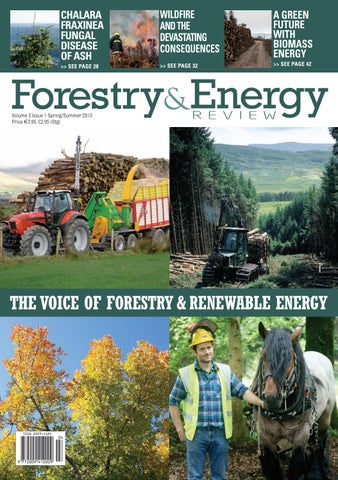
CHALARA FRAXINEA FUNGAL DISEASE OF ASH
WILDFIRE AND THE DEVASTATING CONSEQUENCES
A GREEN FUTURE WITH BIOMASS ENERGY
>> SEE PAGE 28
>> SEE PAGE 32
>> SEE PAGE 42
Forestry&Energy Volume 3 Issue 1 Spring/Summer 2013 Price €3.95. £2.95 (Stg)
R E V I E W
THE VOICE OF FORESTRY & RENEWABLE ENERGY
F&E Spring
13/03/2013
10:41
Page 2
F&E Spring
13/03/2013
10:41
Page 3
Foreword/Contents/Credits
Forestry&Energy R E V I E W
Volume 3 Issue 1 Spring/Summer 2013
28
Features
Foreword
28 ASH DIEBACK (CHALARA)
W
elcome to the new edition of Forestry and Energy Review Magazine. In this issue, we preview the second Irish Forestry,Woodland and Bio Energy Show which will take place at Stradbally Hall Estate, County Laois on May 10th and 11th. Forestry and Energy Review Magazine will be there so call over and visit our stand. Inside, the Department of Agriculture Food and the Marine explore a wide range of symptoms associated with Chalara fraxinea known as ash dieback disease which is a relatively new fungal disease of ash. Also,Teagasc Forestry report on the uncontrolled wildfires which have had devastating consequences over the past few years. On February 21st last,the Irish BioEnergy Association held their 12th annual conference on BioEnergy. The event sponsored by Coillte attracted over 140 delegates from Ireland and abroad. A brief summary of conference speakers is outlined inside. We also deal with Timber Haulage.There are approximately 300 timber trucks operating throughout Ireland delivering ‘cut to length’logs to the various sawmills and pulp mills.At present and since 2011 ‘the haulier’ is struggling to keep up with very high monthly fuel bills, tachograph regulations and most of all, to maintain to legal standards,the ageing fleet of trucks and trailers leaving our woods on poor secondary roads each day. This edition also offers a selection of profiles including:Husqvarna, John Deere Forestry, Aspen, Dermot Casey Treecare and Forestry Services, Oakleaf Forestry, www.ForestSales.ie,Wood-Mizer, BioEquipment and D–Plant Horticulture. We trust you enjoy reading this publication which will continue to provide a voice for the Forestry and Energy sectors. You can also download this latest edition electronically to your computer, iPad and smartphone. Simply type in the following link www.selectmedialtd.com/feremag.html
Chalara fraxinea known as ash dieback disease is a relatively new fungal disease of ash.
30 HAULING TIMBER IN IRELAND CAN IT GET ANY TOUGHER? There are approximately 300 timber trucks operating all over Ireland delivering ‘cut to length’ logs to the various sawmills & pulp mills.
30
The IRBEA held its 12th annual conference on BioEnergy in Lyrath Estate, Kilkenny.
38 DERMOT CASEY TREE CARE SERVICES
32
Editorial: Denis Lane Advertising: James Small Design: John Barrett Production: Emma Meade
You can and should regularly inspect the trees on your property. If you notice any abnormalities or are concerned about the condition of the trees – consult expert advice, writes Noel Lane.
42 COILLTE AND ASTELLAS SECURE A GREEN FUTURE WITH ‘BIOMASS’ENERGY Coillte are underpinning the future energy supply of one of Irelands leading pharmaceutical plants.
46 DERMOT CASEY FOREST SERVICES So, what is there to be got out of this forestry business? I have been asked this question a thousand times over my long career in Forestry, writes Noel Lane.
42
The Publishers Forestry & Energy Review
Enquiries:
Uncontrolled wildfires have had devastating consequences over the past few years. The Forestry Development Department, Teagasc reports.
36 NATIONAL BIOENERGY CONFERENCE
Until the next time………
Publishers: Denis Lane and Robert Heuston
32 WILDFIRE:DEVASTATING CONSEQUENCES
Contributors: Department of Agriculture Food and The Marine The Forestry Development Department,Teagasc The Irish BioEnergy Association Noel Lane MSIF, Certified Arborist, H.Dip. Forestry Paul Lafferty (www.forestsales.ie) Coillte Brendan Doyle (D–Plant Horticulture) Front Cover Image (Trojan Horses) who will be demonstrating at the Forestry Show Stradbally
50 EUCALYPTUS–HOME GROWN ENERGY SHORT ROTATION FORESTRY D-Plant Horticulture offers some practical advice on Eucalyptus.
Profiles 4 Husqvarna 6 John Deere Forestry 22 Aspen 26 Oakleaf Forestry 41 www.ForestSales.ie 44 Wood–Mizer 49 Bio–Equipment Distribution: Easons, Newspread,WNS Published by: Select Media Ltd, 19 Clare Street, Dublin 2, Ireland Tel. + 353 1 6622266 Fax. + 353 1 6624981 Email. info@selectmedialtd.com
All material contained in this edition is copyright of Forestry and Energy Review 2013 and may not be reproduced or electronically stored without the permission of the publisher. However items may be freely reproduced provided the source is acknowledged. Content and views expressed in the publication do not necessarily represent those of the publishers.
3
F&E Spring
13/03/2013
10:41
Page 4
COMMERCIAL FEATURE
GOLD, SILVER AND BRONZE Husqvarna tops the 2012 World Logging Championships.
he World Logging Championship 2012,WLC, turned out to be a very exciting competition and a great success for Husqvarna.All medallists used the Husqvarna chainsaw 576 XP.Alexandr Sokolov from Russia won the gold medal and can now entitle himself the world’s best chainsaw operator. Jukka Perämäki from Finland claimed the silver and Urs Amstutz from Switzerland got the bronze. The prestigious 30th WLC took place on the August 23rd–26th and gathered 111 contestants from 28 countries – and a cheering audience of about 3500. And, the excitement certainly lived up to the expectations.Approaching the dreaded limbing, Johann Raffl from Italy had the chance to secure the overall gold medal. But instead, after one irritating mistake, he ended up in fourth place.
T
professional chainsaw features X-Torq® technology, providing high torque over a very wide rpm range,combined with low fuel consumption and low exhaust emission levels. Improved ergonomics reduces fatigue and Air Injection optimizes power, which also makes the saw run for longer periods of time. It was the best chainsaw in the World Logging Championship 2012, judging by the positions of the loggers who used it, the gold medallist one of them. “I have always used Husqvarna chainsaws. I really like the performance of the 576 XP and I use it with great pleasure. It is more powerful and has higher turnover, which provides the additional speed needed for winning a championship”, says Alexandr.
“The Husqvarna 576 XP, used by the top four contestants in this year’s WLC, is an advanced saw for demanding professional use” Urs Amstutz from Switzerland managed to beat Johann by just four points, giving him the bronze medal and a final score of 1639. Excitement was in the air when gold medallist Alexandr Sokolov and silver medallist Jukka Perämäki ended up with the exact same score, 1645 points. “Before the last discipline, I knew I was 6 points behind Jukka.A few strong guys, in particular Johann Raffl, were also very close to me.Therefore the main task before limbing was not to lose the second place, which I managed. But of course I thought about having the chance to compete for gold”, says Alexandr. After their performance in the final discipline no one knew who the winner was, as the judges actually went back to re–examine the limbing logs. However, no new mistakes were found and the tree felling result was used as a tiebreaker instead.A discipline that Alexandr had won by 654 points against Jukka’s 650. “I don’t think that I have realized it yet. I look at my gold medal, but I can’t explain what it means to be a world champion”, says Alexandr. The Husqvarna 576 XP, used by the top four contestants in this year’s WLC, is an advanced saw for demanding professional use. This
4
The next WLC will be held in Switzerland 2014.We asked the world champion if his plan is to defend his title: “I hope so! I will definitely try again to win the qualifying competition and hope to travel to Switzerland in two years.They say that winning the title is more complicated than defending it – we will see about that!” Congratulations to the medallists and the rest of the Husqvarna loggers for a great performance!
F&E Spring
13/03/2013
10:41
Page 5
F&E Spring
13/03/2013
10:42
Page 6
COMMERCIAL FEATURE
JOHN DEERE HARVESTERS 1270E IT4 AND 1470E IT4
Innovation, productivity and power converge in John Deere’s New E–Series wheeled harvesters.
ohn Deere 1270E and 1470E harvesters are now equipped with Finally, Level Three shifts to full power performance for harvesting new features and enhancements that give loggers more power, exceptionally large and heavy timber. greater productivity and higher uptime, and allow them to maintain An intermittent Level Three may be activated for one–stem processing. lower daily operating costs. This boost level can be activated when a single large stem is The new 1270E and 1470E Harvesters feature an advanced twin– encountered.The intermittent mode is deactivated when stem pump hydraulic system that utilizes two open–loop pumps, one for processing is finished, returning the machine to fuel–efficient operations. harvester head and transmission control and one for head and boom Operators simply need to press a convenient button on the left– control.These features give operators highly efficient, simultaneous hand side keypad to change the levels.The new software comes steering and increased boom and wood–processing control.This standard in 1270E IT4 and 1470E IT4 harvesters. hydraulic power solution also includes a new power management The 1270E IT4 and 1470E IT4 harvesters are equipped with a feature that anticipates the engine load and responds with an fuel–efficient and powerful John Deere 6090 PowerTech™ Plus appropriate power surge for improved fuel economy and total series turbo–charged 6–cylinder 9.0L engines, delivering high productivity, which ultimately helps to reduce daily operating costs. torque at low RPM. Cut–to–length forestry machine operators will see a number of Additionally, the exclusive John Deere TimberLink™ monitoring improvements in productivity and daily operating costs with the system – an integrated suite of information services for optimizing new upgrade to John Deere’s TimberMatic™ control systems.All E– equipment and total productivity – now features an operator report Harvesters, including the 1270E and 1470E models, are now offered with even more detailed differences with built–in information to
J
“Additionally, the exclusive John Deere TimberLink™ monitoring system – an integrated suite of information services for optimizing equipment and total productivity – now features an operator report with even more detailed differences with built-in information to other harvester operators working under similar conditions” with new TimberMatic H–12 program version giving loggers more efficient equipment from the inside out.
other harvester operators working under similar conditions.The system also provides the operator with individual guidance for working method development. THE NEW TIMBERMATIC PROGRAM INCLUDES The JDLink™ machine and fleet management system is designed FIVE MAIN UPDATES. HIGHLIGHTS INCLUDE: to remotely connect machine owners and service personnel to · Processing Power Control – Created to improve the productivity their equipment by providing real–time alerts and machine and fuel economy in John Deere Harvesters, PPC is a software–based information needed, such as location, utilization, fuel consumption control system that delivers three different power levels depending and maintenance data. JDLink™ also enables automatic engine on workload.An operator can simply select one of the power levels software updating and improved service support. With JDLink™, to meet his desired balance between productivity and fuel economy the TimberMatic™ control system and forest machine control modules transmit machine information through a wireless MTG depending on what is needed at any given time. (Modular Telematics Gateway) and a cellular connection to the The three PPC levels range from an energy saving mode to a JDLink™ server. boost mode, with a middle level in between.While in Level One energy saving mode, machine performance is optimized with regard to maximum fuel economy. Operators can use this first level FOR FURTHER INFORMATION PLEASE CONTACT: when full machine power is not needed, such as during operator Ed Power, John Deere Forestry (Irl) Ltd training or thinning. Level Two adjusts machine performance for Ballyknocken, Glenealy, Co Wicklow high production and good fuel economy, which is ideal for operating Mobile Tel: 087 2542 570, Tel. 0404 44969 at its nominal timber size. Website: www.johndeere.ie
6
F&E Spring
13/03/2013
10:42
Page 7
F&E Spring
13/03/2013
10:42
Page 8
FORESTRY & ENERGY REVIEW
NEWS TEAGASC’S FORESTRY CLINICS 2013: OVERWHELMING SUCCESS More than double the anticipated number of landowners availed of a one to one consultation with a Teagasc Forestry Adviser. These consultations were organised as part of a nationwide series of forestry clinics. Most of these nearly 600 landowners are considering planting forestry on their farm. Dr. Nuala Ni Fhlatharta, head of Teagasc’s Forestry Development Department said;“We had initially organised 38 forestry clinics across the country and we estimated that approximately 250 landowners would be interested in attending a one to one consultation. However, we didn’t expect this level of interest.To deal with this level of interest, we added several additional consultation days.A few of these forestry clinics are still ongoing.We estimate that we will have dealt with close to 600 landowners.”
Frances McHugh, Forestry Adviser commented “It is interesting to note that at least 80% of all queries related to planting forestry on the farm.Topics discussed included land suitability,environmental compatibility, interaction of forestry with other farm schemes, and potential returns on investment.” She continued “Forestry grant aid application procedures were discussed in great detail at these consultations.All Forestry Advisers handed out many copies of the List of Registered Foresters who can process the forestry grant application on behalf of their clients.We therefore anticipate a substantial increase in queries to forestry consultants and companies over the next few months as a result of these Teagasc Forestry Clinics.” These consultations are important because making an informed decision on forestry as an enterprise starts with becoming familiar with the issues involved. Planting land can have many attractions, but you need to know if it is appropriate for you. During these consultations, Teagasc forestry advisers provided information on financial returns from forestry. They are key to decision making for many landowners. The information provided can help to guide decisions about forestry as a viable enterprise and future forest management options. These Teagasc forestry clinics provided the information, expertise and advice necessary to assist in the decision making process in considering forestry on the farm. All details on forestry grant schemes are available from the Teagasc Forestry website: www.teagasc.ie/forestry
MAXIMISING TIMBER PRODUCTION – FIRST THINNING OPTIONS This event highlighted Teagasc research and took place last September. The event provided forest owners with valuable practical information on the reasons for, and timing of, thinning a Sitka spruce crop and how different thinning regimes can impact on crop development. This thinning field day in Co Roscommon was organised by Teagasc and the Forest Service and focused on thinning options to maximise timber production. It also explained how different thinning regimes can impact on crop development. Noel Kennedy, Teagasc Forestry Development Officer explained: “Many farm forests planted in the early to mid nineties now require thinning.Thinning is a critical forestry operation to improve the quality and value of the timber crop and maintain good forest health.” Dr Niall Farrelly, Forestry Researcher with Teagasc gave more details: “We have thinned the crop using a range of different regimes and assessed the impact before and after thinning.The focus of the thinning trials is to observe the effect of different thinning intensities on the growth and development of the crop, and to identify the most suitable regimes to maximise the production of valuable sawlog material in the shortest possible time while maintaining crop stability and sustainability.” This was a great opportunity for forest owners to learn about the latest thinning research and how to get the best out of their own forests.
Participants of the Field Day "Maximising timber production – First thinning options" near Frenchpark, Co Roscommon are briefed by Dr Niall Farrelly and Matt O'Grady on their research into conifer productivity and thinning
8
F&E Spring
13/03/2013
10:42
Page 9
F&E Spring
13/03/2013
10:42
Page 10
FORESTRY & ENERGY REVIEW
NEWS This event was of major interest to all broadleaf woodland owners, and particularly important for those with plantations at or near the age of first thinning. Teagasc organised a National Forest Owners’ Group Workshop last The event was also very beneficial to owners in general who want September. This was the fourth national workshop and as the number to envisage how the thinning operation can be carried out and how of forest owner groups continues to grow, it is an important forum for timber can be extracted from their own wood. group members to share their experiences, discuss the day–to–day Frances McHugh explains "Interest is growing rapidly among forest issues they encounter and learn from one another. Forest owner groups are playing an increasingly important role in the development of a owners to manage their own forests.Although large scale harvesting sustainable and vibrant farm forestry sector. and extraction forestry machines have an important role to play in Irish The success to date of many of the groups in helping their forestry, many of our forests are too small for such large machinery. members to talk, thin and market timber is a great encouragement to Other options have to be considered particularly (but not exclusively) other forest owners to consider joining their local group or set on broadleaf sites. If forest owners wish to manage their own forest, up their own group. they need to arm themselves with the know how before any harvesting Find out from your Teagasc Forestry Development Officer about commences." joining a forest owner group near you. Dr Ian Short,Teagasc Research Officer and principal researcher of the COFORD–funded B–SilvRD Project explained that the demo site is a THINNING OF BROADLEAVES EVENT IN large ash plantation which is in need of thinning. “Timely thinning COUNTY KILKENNY improves overall quality of trees on the site.” he said. “It allows for the Over 200 people attended the removal of diseased and suppressed trees and lets the best quality trees Thinning of Broadleaves Event in grow unhindered. County Kilkenny. This event was Thinning usually is a combination of taking out some lines (allowing realised thanks to the co–operation for access) and selectively thinning the inferior trees.This demo between research and advisory addresses the correct procedure in selecting the best trees in staff of the Forestry Development your forest and in turn shows how to select the trees to be removed. Department. This event was Over 200 people attended the The demo showed various methods of getting thinned trees out to the Thinning of Broadleaves Event in organised by Frances McHugh Co Kilkenny. This event was realised road efficiently especially on smaller sites." and Dr. Ian Short,Teagasc in thanks to the co–operation This event was organised by Frances McHugh and Dr. Ian Short, association with the Forest Service, between research and advisory Department of Agriculture, Food staff of the Forestry Development Teagasc in association with the Forest Service, Department of Department. Agriculture, Food and the Marine and COFORD. and the Marine and COFORD.
NATIONAL FOREST OWNERS’ GROUP WORKSHOP
10
F&E Spring
13/03/2013
10:42
Page 11
F&E Spring
13/03/2013
10:42
Page 12
FORESTRY & ENERGY REVIEW
NEWS
WATCH OUT FOR ASH DIEBACK (CHALARA FRAXINEA) What is it? Ash dieback is a serious disease of ash trees caused by the fungal pathogen Chalara fraxinea (Hymenoscyphus pseudoalbidus). It has spread rapidly across much of Europe.The disease can affect ash trees of any age and in any setting. The disease can be fatal, particularly among younger trees. The Department of Agriculture, Food and the Marine has confirmed a number of findings of the disease (Chalara fraxinea) in Ireland.As a result, the Department is carrying out a number of measures.
Forestry training at Teagasc College Ballyhaise Teagasc College Ballyhaise provides training in forest management and skills
FORESTRY TRAINING AT TEAGASC COLLEGE BALLYHAISE Ever thought about a career in forestry, or wished to complete short courses in different aspects of forest management or skills? Teagasc College Ballyhaise provides training to FETAC Level 5 with the option to progress to Level 6 (equivalent to the green cert). Candidates may also progress to the Bachelor Degree in Forestry at WIT – Year 2. Applicants must be over 17 years on January 1 following entry to the course. Mature students are welcome. For more details contact Teagasc College Ballyhaise, County Cavan, Tel: 049–433 8108, or visit www.teagasc.ie/forestry
12
What does it look like? The wide range of symptoms associated with ash dieback includes: G foliage wilt – black/brown leaves may be retained; G shoot dieback with brownish to orange discolouration, often multiple shoots; and, G elongated angular stem lesions, often diamond shaped. How can it spread? Many details associated with the biology of Chalara fraxinea still remain unclear. However, it is likely that plants for planting and wood are pathways for spread over long distances and the disease may be introduced into Ireland through the imports of ash plants and wood, including firewood, from continental European countries. What to do? Forest and land owners are asked to be vigilant for the disease and to report (with photographs,if possible) any sites where they have concerns
F&E Spring
13/03/2013
10:42
Page 13
F&E Spring
13/03/2013
10:42
Page 14
FORESTRY & ENERGY REVIEW
NEWS
about unusual ill health in ash, to the Forest Service, Department of Agriculture, Food and the Marine: by email (forestprotection@agriculture.gov.ie); or, by phone (01–607 2651). Please do not remove any plant material from a site containing suspect trees.Also, please observe the following hygiene measures on sites where the disease is suspected or where an ash survey is being carried out to help avoid its potential spread: G footwear: wash off all soil and plant debris from boots. Spray your boots with disinfectant and dispose of any used water onto an area where the water will not run into a watercourse; G clothing: check all clothing for any plant material; and, G tools and equipment: wash off all soil and plant debris, and disinfect and dispose of any used water onto an area where the water will not run into a watercourse. When visiting a forest: do not remove any plant material from the site; and G clean clothes and footwear of any plant material, including leaves, before leaving the forest. Further information G Contact your local Forestry Adviser or Forestry Inspector G Visit: www.teagasc.ie/forestry and www.agriculture.gov.ie G Follow us on Twitter @teagascforestry for Chalara updates G Subscribe for Teagasc Forestry e–News: forestry news emailed directly to you. G
14
DATES FOR YOUR DIARY These are the events planned for the remainder of 2013.All events are held in association with the Forest Service, Department of Agriculture, Food and the Marine. Have a look at the programme below and check back regularly on www.teagasc.ie/forestry for dates, contact and venue details. Scan this QR code with your smartphone to view Teagasc Forestry 2013 events. Teagasc’s Forestry Programme of Events for 2013 is of great interest to new and existing forest owners.The Programme of Events listed on page 16 will be updated regularly so keep an eye on the Teagasc Forestry website at the following address: www.teagasc.ie/forestry for up–to–date event details where you can subscribe to our new e–Newsletter service to have event details emailed to you. You can also follow us on Twitter @teagascforestry for the latest forestry news. Nuala Ni Fhlatharta, Head of Teagasc’s Forestry Development Department said:“In 2013,Teagasc is focusing on promotion and training in relation to afforestation, forest management and thinning. It will see a continuation of the development of Forest Owner Groups and timber supply chains around the country. Forestry advisers will advise and support forest owners in building knowledge around forest management, thinning and developing structures to harvest and market their timber.Ongoing promotion of the Afforestation and Native Woodland Schemes will continue.”
F&E Spring
13/03/2013
10:42
Page 15
F&E Spring
13/03/2013
10:42
Page 16
FORESTRY & ENERGY REVIEW
NEWS DATES FOR YOUR DIARY April 19th Conifer Thinning Research Trials for members of the Society of Irish Foresters, Frenchpark, Co Roscommon. May Joint Forest Service / Teagasc Chalara fraxinea (ash dieback) information meetings, 12 venues nationwide. May 10th – 11th Irish Forestry,Woodland & Bioenergy Show, Stradbally, Co Laois. TBC Teagasc Bioenergy Conference, Midlands. June Broadleaf Management Event. Focus on broadleaf mixtures and CCF, Tipperary. July Ash & Hurling Conference / Workshop. In association with Guild of Hurley Makers & GAA,TBC. August 11th Tullamore Show, Forest & Energy Village, Offaly. September Timber Marketing Events. In association with Forest Industry Northwest, Southwest. September 24th – 26th National Ploughing Championships, Ratheniska, Co Laois. October Broadleaf Management Event. Focus on remedial action – poor performing sites, Mayo. November National Forest Owner Groups Workshop. In conjunction with forest owner groups,TBC.
VISIT THE TEAGASC FORESTRY WEBSITE The website provides information on upcoming events (including travel directions), up–to–date and detailed info on forestry grant schemes, forestry staff contact details, details on forestry courses, cutting edge forestry research info, contact details for Registered Foresters, etc. A nationwide contact list for timber buyers and harvesting contractors can also be accessed on this website. Discover the Teagasc Forestry website at: www.teagasc.ie/forestry.
KEEP UP–TO–DATE WITH TEAGASC FORESTRY E–NEWS BY HAVING FORESTRY NEWS EMAILED DIRECTLY TO YOU Teagasc Forestry e–News is a new free email service provided by Teagasc’s Forestry Development Department. This new service keeps subscribers informed by email of the latest forestry news, give details of upcoming forestry events and provide management tips. It also allows subscribers to access quickly and easily our popular PDF download section. Visit the Teagasc Forestry website (www.teagasc.ie/forestry) where you can subscribe to this new free email service and have the latest forestry news emailed directly to you keeping you up to date.
ROBINSON DISTRIBUTION LTD www.robinsondistribution.ie
ith a strong history in the timber field and a good knowledge of timber machinery and timber haulage equipment, brothers Ross and Scott Robinson formed the company Robinson Distribution in 2002.The company based in Portnahinch House, Portarlington, Co. Laois was set up to supply and service forest machinery and timber haulage handling equipment, the company gained many leading agencies such as Loglift, Logmax,Alucar, Kesla, Ala-Talkkari, Iggesund and numerous others. It was from their roots in this field that the company decided in 2004 to produce their first timber carrying trailer.With a good following and a good customer base the company has since designed and built many new projects and with some large projects in the pipe line the future looks promising. The company’s policy is to provide quality,innovation and competiveness for their customers. Robinson Distribution can be contacted at the following: Robinson Distribution, Portnahinch House, Portarlington, Co. Laois. Tel: +353 57 8624832 Fax: +353 57 8679621, Web: www.robinsondistribution.ie Email: scott@robinsondistribution.ie
W
16
F&E Spring
13/03/2013
10:42
Page 17
F&E Spring
13/03/2013
10:42
Page 18
COMMERCIAL FEATURE
IRELAND’S NATIONAL FORESTRY SHOW MAY 2013, STRADBALLY HALL,Co. LAOIS Following its success as Ireland’s first major forestry show in many years in May 2011, the second Irish Forestry,Woodland & Bio Energy Show will take place at Stradbally Hall Estate, Co. Laois on Friday May 10th and Saturday May 11th, 2013.
he industry is responding well to the national, bi-annual, Friday working day plus Saturday structure of an event specific to an Irish industry sector that has an annual economic output of over €2 billion. The 2011 show proved very rewarding for both exhibitors and visitors. The exhibitor sites were fully booked in advance and industry feedback was extremely positive.The number of repeat bookings this year is evidence of that and bookings at this early stage are 20% up on the 2011 show. Strong demand is emanating in particular from the machinery and advisory sectors with confirmed exhibitors including John Deere Forestry, Komatsu, Lely Ireland, Marshall, M.Large, Liffey Distributors – Husqvarna and Oregon, Murray Timber, and Teagasc, AIFC, and Coford. Komatsu are sponsoring the demo arena and featuring the first forwarder competition in Ireland. The 2013 show will capitalise on the solid foundation of the 2011 show, maintaining its strong industry focus and its dual role of show casing industry products and services and providing ‘cutting
T
indigenous forestry and bio mass industries, and their commercial, cost base, recreational and environmental significance. One of the central features is The ITGA Yearbook conference centre which will host a number of high profile speakers over both days. Brendan Lacey, ITGA Chairman stated “It is a natural fit for the ITGA to be at the forefront of involvement with the Forestry Show as ITGA is a significant and high profile provider of information services to growers and the sector.” The late Minister Shane McEntee was a strong supporter of the show, speaking at the first show in Birr and enthusiastically welcoming the second “Given that the forestry and bio energy sectors are playing an increasingly important role in our economy as well as on the environmental platform, an industry specific show such as this provides a vital boost to our national and international position in these fields.” Preparations have begun on the beautiful parkland setting of Stradbally Hall. It is lending itself well to such an event with its
“The show has a strong educational aspect providing the industry and public with a valuable opportunity to obtain information on the indigenous forestry and bio mass industries, and their commercial, cost base, recreational and environmental significance” edge’ information and educational resources, whilst expanding certain aspects , such as bio energy, and also introducing new elements such as nursery and garden related industries.The ethos of the 2013 show continues to be all encompassing in the sense that it embraces the rather wide range of industry and quasi state bodies which are characteristic of the forestry sector, most if not all attending, with a resultant pooling of resources for the advancement of the industry as a whole. The show is aimed at a broad spectrum and will be of interest and value to a wide range – timber growers, landowners considering the potential of investment in forestry, timber buyers and processors, contractors, tree surgeons, landscapers, gardeners, forest and bio energy machinery and equipment manufacturers, timber artisans, nurseries, conservationists and basically, anyone with an interest in woodland and the wider countryside. In relation to this spread, the show will feature woodland crafts as well as wildlife and conservation bodies. The show has a strong educational aspect providing the industry and public with a valuable opportunity to obtain information on the
18
mixed age and species diverse woodland, including the commercial forestry or mixed conifers suitable for forest machinery demonstration purposes.The estate also boasts a good network of hard roadways suitable for all types and weights of machinery. The show site pivots around a copse which is a natural gathering point with mature oaks ideal for the second Irish National Tree Climbing Championships.Also, Stradbally’s midland position, just under an hour from Dublin, is very convenient for both Irish and international exhibitors.
F&E Spring
13/03/2013
10:42
Page 19
F&E Spring
13/03/2013
10:43
Page 20
FORESTRY & ENERGY REVIEW
NEWS
THE EUROPEAN LOLER PROJECT www.loler.co
to the project, get involved and let the LOLER TEAM know on the he full name of the project is ‘Development of European project website:www.loler.co or on the blog www.lolerproject.blogspot.ie occupational training & assessment standards for registered Independent LOLER inspectors in the workplace’, abbreviated as THE PRIMARY AIMS AND OBJECTIVES OF THE LOLER PROJECT ARE: LOLER. Lifting Operations & Lifting Equipment Regulations are clearly indicative of European Work at Height Regulations adopted • To gain an overview of the participating countries’inspection standards. • To ensure that people using safety equipment for lifting operations or by the UK to be transferred within the EU. working at heights have appropriate inspections undertaken & LOLER is a 24–month long project focused on creating new inspection meet the requirements of European law. techniques to examine lifting equipment in order to prevent accidents • To examine, develop new techniques and test work equipment and fatalities in the workplace complying with the European Work suitable for LOLER inspections via non-destructive methods. at Height Regulations: For example in the UK this is interpreted as; • To develop credible European LOLER training and assessment standards. the Lifting Operations & Lifting Equipment Regulations 1998–LOLER. That is important because many of the accidents that occur due • To ensure that operator and inspector competence is recognised at the European level. to equipment failure could have been preventable if equipment had • To ensure that LOLER inspectors are competently trained and been thoroughly examined prior to use.This equipment includes examined in testing lifting equipment. ropes, harnesses, connection devices, mobile platforms, ladders etc and is initially focussing on the Tree Care Industries. In order to • To create & maintain a register of European LOLER inspectors to include a system for updating & CPD. enhance thorough examination beyond the current scope of visual • The project is funded by the European Commission, DG Education assessment Kevin Birchall of Tree Care Ireland is currently re–writing and Culture under the Lifelong Learning Leonardo da Vinci the assessment criteria used as a framework for inspector qualifications. It is proposed that there will be additional structure to the qualifications Programme. in order to introduce a higher level of competence for independent The partners: The LOLER project is being implemented by inspectors and an operator based qualification,for more frequent checks. a partnership of 5 countries and 6 partners. Continuing industry consultation is a key objective of the project • A1 Arborists (UK) Project Manager and as work progresses communication of information to the • Forest Sciences Centre of Catalonia (CTFC) (Spain) industry will be maintained. NDT test methods currently under • Mendel University (Czech Republic) consideration include X-rays, Ultrasound,Thermal images, Magnetic • Tree Care Ireland (Ireland) resonance and Capillary action. If you have experience of failure or • MWMAC (UK) problems with work at height equipment and wish to contribute • Fito-Consult (Italy)
T
20
F&E Spring
13/03/2013
10:43
Page 21
F&E Spring
13/03/2013
10:43
Page 22
COMMERCIAL FEATURE
DO YOU KNOW WHAT USING NORMAL PETROL IN SMALL MACHINERY COULD BE DOING TO YOUR HEALTH?
o you know what using normal petrol in small machinery could be doing to your health? Did you know that 1 modern lawnmower (4–speed) running on normal unleaded 95 octane (RON) petrol, emits just as much benzene per hour as 3 modern cars running on the same fuel? Did you know that 1 modern chainsaw running on normal 95 octane (RON) petrol is equivalent to 57 modern cars running on unleaded 95 Octane petrol? Shocking, isn’t it? Ordinary petrol, like what you use in your car, lawnmower, hedge trimmer, tractor, chainsaw, strimmer etc, is produced through the refining of crude oil where various fractions are treated in different ways and then combined. Petrol is thus not a homogenous substance, but a mixture of several. Ordinary petrol, such as that purchased at petrol stations, actually contains around 100 different substances, all with different properties as regards performance, effect on health and environmental impact. Many components are extremely hazardous to humans and our environment. Just some of the hazardous substances found in ordinary petrol include:
D
According to research on the subject,Aspen Alkylate Petrol was initially developed for work health reasons in Sweden, where forestry and farming make up a large part of the countries primary sector. Alkylate is produced synthetically from the clean gases released when refining crude oil.The result is a very clean petrol, which only consists of around ten substances, and is therefore largely naturally free from the hazardous constituent components found in normal petrol.Aspen contains virtually no harmful substances such as Benzene, aromatic hydrocarbons, poly–aromatic hydrocarbons or olefins. It comes in two forms,Aspen 2 and Aspen 4.Aspen 2 is a ready–mixed alkylate petrol for chainsaws, clearing saws, hedge– trimmers, mopeds, strimmers and other land–based 2–stroke engines. Aspen 2 improves machine performance and ensures a longer engine life.The cleaner petrol means a cleaner engine with fewer deposits.While ordinary petrol deteriorates in storage after 3 to 5 months,Aspen 2 can be stored for up to 5 years without any deterioration in quality whatsoever.Aspen 4 is an alkylate petrol for lawnmowers, rotary cultivators, snow blowers, boats and other
“Relatively new in Ireland, but very well–established in Sweden and across Europe and America,Aspen Alkylate Petrol seems to offer a perfectly good alternative to regular petrol” Olefins – these react in the body and form substances that can cause cancer. Olefins are highly reactive and contribute to high concentrations of ground–level ozone or ‘smog’ as its more commonly known. Olefins also form resins and reduce the storage durability of fuel. Benzene – this substance causes cancers such as leukaemia and is regarded as the most harmful single substance in petrol and exhaust gases. Benzene becomes concentrated in all living organisms. Aromatic Hydrocarbons – These can cause chronic nerve damage, among other things.Aromatic Hydrocarbons also contribute to ‘smog’ and becomes concentrated in living organisms. Sulphur – this substance contributes significantly to the acidification of our lakes. Ground–level ozone (smog) – this extremely aggressive toxic gas can reduce lung function and cause coughing, chest pains and breathing difficulties. Smog attacks forests and crops and may be the cause of tree death. When you take all of this into consideration, one might wonder why so many people still use regular petrol in their small machinery, where they are breathing in the emissions of such a dangerous substance. The most recent advance in tackling this issue comes in the form of Aspen Alkylate Petrol. Relatively new in Ireland, but very well– established in Sweden and across Europe and America,Aspen Alkylate Petrol seems to offer a perfectly good alternative to regular petrol.
22
4–stroke engines.Aspen 4 keeps valves and pistons cleaner, which gives the engine a longer service life and greater operational reliability. Similar to Aspen 2,Aspen 4 can be stored for a long time without any deterioration in quality. We all know how irritating it is when you want to start your lawnmower that first time after the winter or summer and it becomes incredibly difficult because the petrol has been lying dormant in the machine for a short period of time.Aspen Alkylate Petrol retains its quality, making this process so much easier. Anyone who has tried Aspen has never looked back – Aside from the obvious benefits to your own health, the benefits to the environment of using Aspen over ordinary petrol will undoubtedly persuade you to give it a go!
F&E Spring
13/03/2013
10:43
Page 23
F&E Spring
13/03/2013
10:43
Page 24
FORESTRY & ENERGY REVIEW
NEWS
WOOD–MIZER SPONSORS PRESTIGIOUS UK FORESTRY AWARD The Royal Forestry Society (RFS) has warmly welcomed Wood–Mizer as the Gold Sponsor of the RFS Excellence in Forestry Small Woodlands Awards 2013.
ndrew Woods, chairman of the management committee at The RFS Excellence in Forestry awards are the most prestigious RFS, said:“As a world leader in mobile and stationary sawmills, in England,Wales and Northern Ireland.The Small Woodlands Award Wood–Mizer is known for quality and expert workmanship, includes farm woodlands and is one of five woodland categories. and many woodland owners have reason to be proud of using their It rewards projects where smaller woodlands are managed on a products. multipurpose basis with clearly stated objectives.Woodlands may “The RFS Excellence in Forestry Awards throw a spotlight on best be recent or old, but must have been established for at least 10 years practice in a region so that others may follow their example. Small and be of a maximum size of 20 hectares. woodlands are increasingly being brought back into management Entries are invited from woodland owners and farmers, or from for wood fuel and other timber products, and their wise management managers from the private,public or voluntary sectors.The award is aimed is essential to maximise benefits for timber production, bio–diversity, principally at the hands-on owner and it is expected that the day–to–day leisure and many other purposes”. management will be done by the owner, or under their direct guidance. “In the UK, these groups are important customers for Wood–Mizer, both directly and through their employment of mobile sawmill contractors who use our machines”, said David Biggs, general manager of Wood–Mizer UK. “Privately–owned woodlands are a large and important part of the country’s forest infrastructure and we are proud to show our support to the sector by sponsoring this Award that encourages and recognises good management practices.We believe that a first principle is that felled trees should be used for wood products first and foremost – so that the carbon taken in by the growing tree remains locked in the wood.Wood is the only renewable natural resource, and whether used in construction, furniture, fencing and garden products, pallets and packaging and board products, provides a strong, versatile and attractive material that is more environmentally sound than competitor materials. Wood should only be burnt as biofuel (when C02 will be released back into the atmosphere) at the end of its ‘product’ life or when it is not suitable for converting into wood products. “Private woodland owners need to achieve maximum value from their resource so that they have income to invest in managing their land.Wood–Mizer sawmills offer a genuine solution to this need. Our pioneering thin–kerf narrow band technology makes the equipment less costly to purchase, easier to install and easier and cheaper to maintain. Less energy is required to power the machines, saving money for the customer as well as reducing the need for fossil fuels, and the sawmills cut accurately with a good surface finish.The thin–kerf means they produceless sawdust and more wood–an important economic benefit for owners and also to the environment since higher yield means less waste from each log and fewer logs required”. For more information contact Wood–Mizer (Tel: 01622 813 201; Email: info@woodmizer.co.uk) or visit the Royal Forestry Society at the following website www.rfs.org.uk
A
24
F&E Spring
13/03/2013
10:43
Page 25
F&E Spring
13/03/2013
10:43
Page 26
COMMERCIAL FEATURE
QUICK, SIMPLE AND SMART – THIS IS THE FUTURE OF PRIVATE FORESTRY Oakleaf Forestry offers the market leading and complete product range of modern low–impact forestry machinery. Tough, reliable, fuel-efficient and service-friendly machines that are as easy on the operator as they are on the forest.
imek are based in Sweden and produce a range of mini– forwarders and harvesters which have the all benefits of hydraulic loaders and all-wheel drive forwarders and harvesters but none of the draw backs found in their larger counterparts. This type of equipment is attractive because of much lower capital outlay with a fraction of the running costs. It allows the contractor to operate in woodlands that would not permit the use of large conventional harvesters and forwarders. Mini–forwarders are ideal for serving small woods and estates where low impact systems are preferred.They are easily transported between sites using a 4x4 and trailer yet have terrain capability equal to larger purpose built units. In a world where big is normally considered better, smaller and lighter is the natural progression for modern forestry. Vimek’s harvesters have a dual turning function.The harvester turns both in the waist and the front axle.This gives extreme manoeuvrability that allows the operator to adapt the driving to the forest instead of the other way around. It’s even possible to position the machine so that the rear and front wheels do not run in the same tracks, thereby conserving the ground. The Vimek forwarder is solely designed for timber extraction. It is constructed to the same basic design as large purpose built forwarders. Two chassis sections are connected by a universal joint which allows for hydraulic powered steering and vertical rotation to tackle any rough terrain. The front section carries the engine, main transmission components and the cab with the loader controls.The rear section in the forwarder model carries the loader and timber carrying bunk. The 606TT forwarder is only 1.8m wide, which normally eliminates the necessity of removing unmarked trees to allow access to the timber landing. Speed delivered through the variable mechanical gearbox is 0–20km/h.The payload is 3000kg, and can be increased with Vimek’s additional trailer where conditions are suitable. The lifting capacity of the 606TT’s Mowi 2046 crane is 440kg at 4 metres. The forwarder is fitted with the newly designed Vimek TL016 grapple. Its tilting feature allows produce to remain under complete control as it is aligned before being placed on the bunk and also prevents bark damage to standing trees by swinging timber.
V
26
The larger Vimek 608.2 forwarder has an increase in load area which allows a payload of 4.5 tonnes to be carried with an increase in width of only 10cm.A slightly higher ground speed and improved traction to the rear bogie, as well as pump and hydraulic motor upgrades, further improves the efficiency of this latest Vimek forwarder. Oakleaf Forestry plan to demonstrate these machines at this year’s Irish Forestry and Woodland Show in Portlaoise May 10th– 11th,2013. A series of demonstrations are also planned around the same time across Ireland and you are invited to contact Oakleaf Forestry if you have a suitable site and are willing to host a demonstration event in your area. More information on the Vimek range and other Forestry & Firewood Machinery can be found at www.oakleafforestry.com
F&E Spring
13/03/2013
10:43
Page 27
F&E Spring
13/03/2013
10:44
Page 28
DEPARTMENT OF AGRICULTURE FOOD AND THE MARINE
ASH DIEBACK (CHALARA) Chalara fraxinea known as ash dieback disease is a relatively newly described fungal disease of ash which was first named in 2006 although dieback symptoms in ash had been first noted in Poland in the early 1990’s.
he harmful reproducing stage of the fungus, a new species, Hymenoscyphus pseudoalbidus was later discovered in 2010.The disease has spread rapidly across much of Europe, with the majority of European countries where ash is present now reporting the disease. Common ash (Fraxinus excelsior) is susceptible to Chalara ash dieback disease, as are a number of other species of ash.The disease can affect ash trees of any age and in any setting. Death of the trees can occur, with younger trees (less than 10 years old) succumbing more rapidly.
T
THE WIDE RANGE OF SYMPTOMS ASSOCIATED WITH CHALARA ASH DIEBACK DISEASE INCLUDES: • Necrotic lesions and cankers along the bark of branches or main stem • Foliage wilt • Foliage discolouration (brown / black discolouration at the base and midrib of leaves) • Dieback of shoots, twigs or main stem resulting in crown dieback • Epicormic branching or excessive side shoots along the main stem • Brown / orange discolouration of bark (Note: The symptoms described above are not exclusive to Chalara fraxinea and may be attributable to a number of other causal agents or factors, e.g. frost.)
28
It is likely that plants for planting that are imported from other European countries are the highest risk pathway for spread into Ireland. Wood, including firewood, is also likely to be a pathway. On 12th October 2012 the Department of Agriculture Food and the Marine confirmed Ireland’s first case of Chalara fraxinea infection in a young forestry plantation in County Leitrim which had been planted with imported trees.The trees on this site and on all ten other sites planted with the same batch of trees were subsequently destroyed under Department supervision. Following this first finding
CONFIRMED FINDINGS
F&E Spring
13/03/2013
10:45
Page 29
DEPARTMENT OF AGRICULTURE FOOD AND THE MARINE fraxinea or ash dieback. In total there are now 46 confirmed cases of the disease. Of these 26 are in forestry plantations in Counties Carlow, Cavan, Clare, Galway, Kildare, Kilkenny, Leitrim, Longford, Meath,Tipperary and Waterford. There are 14 Horticultural Nurseries that have tested positive for the disease, three samples from roadside landscaping have tested positive as well as one Garden Centre, one private garden and one farm. In addition to the confirmed findings other samples have been submitted on an ongoing basis to the laboratory and the results are awaited. Minister Coveney said “My Department have extended the scope of the survey work to cover ash plantations planted since 1992 and are also surveying AEOS and REPS plantings.” He added “I am
Minister Coveney said “My Department have extended the scope of the survey work to cover ash plantations planted since 1992 and are also surveying AEOS and REPS plantings” the Department of Agriculture Food and the Marine has undertaken a conscious that this situation has presented difficulties for those major survey of ash. that have had to remove and destroy ash plants but I believe The table below describes the current situation regarding confirmed that taking decisive action now on imported ash product is the findings.The Department of Agriculture Food and the Marine continues to correct approach to prevent the establishment of this disease in Ireland.” In conclusion he stated:“I am pleased with the progress on the survey for this disease in forestry plantations, nurseries, roadsides, Chalara Control Strategy being jointly prepared with our colleagues farms etc. Forest owners, forest nursery staff and members of the public in DARD in Northern Ireland and I would welcome feedback on are asked to be vigilant for the disease and report (with photographs, this document from interested stakeholders when the draft is if possible) any sites where there are concerns about unusual ill published in the coming weeks” health in ash, to the Forest Service, Department of Agriculture, INFORMATION ON CHALARA FRAXINEA ASH Food & the Marine, by e-mail forestprotection@agriculture.gov.ie DIEBACK DISEASE or by phoning 01-607 2651.Your report will be followed up by a Chalara fraxinea is not a regulated disease under the EU Plant Health Forestry Inspector. Directive (Council Directive 2000/29/EC). A Ministerial Order In addition, nursery stock producers should direct queries to your local Plant Health Inspector immediately. Alternatively, was introduced on November 6th, 2012 to restrict the queries can be sent by e-mail to plantandpests@agriculture.gov.ie, movement of ash plants and seed into Ireland. The provisions by fax to 01–627 5994 or by contacting the Department’s Offices also include restrictions on ash wood imports. This order on Tel: 01–505 8885. provides for measures to prevent the spread of Chalara fraxinea
MINI STER COVENEY GIVES UPDATE ON ASH DISEASE Minister for Agriculture, Food and the Marine, Simon Coveney TD, gave an update regarding the findings of the ash disease Chalara
in the genus Fraxinus L. Similar legislation was introduced in Northern Ireland at the same time.
29
F&E Spring
13/03/2013
10:45
Page 30
TIMBER HAULAGE
HAULING TIMBER IN IRELAND
CAN IT GET ANY TOUGHER? There are approximately 300 timber trucks operating all over Ireland delivering ‘cut to length’ logs to the various sawmills & pulp mills.
t present and since 2011,‘the haulier’ is struggling to keep up with very high monthly fuel bills, tachograph regulations & most of all, to maintain to legal standards, the ageing fleet of trucks & trailers leaving our woods on poor secondary roads every day. The fleet of timber trucks & trailers currently on our roads has reached an alarming age because since the credit crunch/bank crisis of 08 & 09, the investment into new replacement vehicles has been in the single % figures. The following example outlines the average kilometres for a common truck/trailer combination: A 2007 6x4 rigid with a crane & 3 axle drag trailer would have a legal GVW of 44 tonnes and an average payload of 26,000 kgs. This typical type of vehicle would now have 600,000 kilometres ‘on the clock’ as well as the wear & tear of hundreds of loading hours which, all combined give us a ‘tired old girl’ who really should be stepped down to a lesser workload with fewer demands.
A
These trucks on average work 5.5 days per week and definitely work 46 of the annual 52 week calendar. The danger for the haulier with an ageing vehicle or vehicles is that breakdowns can happen at any stage throughout a day, week or month and when he is trying to run a business and manage cash flow these unexpected or unforeseen parts replacements play havoc with the current account. Credit has been reduced dramatically or even revoked by the majority of component suppliers thus meaning that if the parts are to be replaced then the money must be there to pay first.
THE MAIN AREAS FOR CONCERN WITHIN TIMBER HAULAGE ARE AS FOLLOWS: G Limited funding available to change trucks & trailers. G 1 – 2 year haulage contracts not enough to convince lenders,
3 to 5 year contracts would be more favourable to all.
30
F&E Spring
13/03/2013
10:45
Page 31
TIMBER HAULAGE
“The fleet of timber trucks & trailers currently on our roads has reached an alarming age because since the credit crunch/bank crisis of 08 & 09, the investment into new replacement vehicles has been in the single % figures” G Some maintenance items being pushed out until next month,
G Increase ‘loaded kilometres’ per truck per day – more efficiency
so as to regulate cash flow but in turn jeopardising road safety. G Older trucks use more fuel. The average fuel consumption of the current fleet of timber trucks is 5.5 miles per gallon or 51.6 litres per 100 kms.
G Encourage co–operation between hauliers to share dedicated
loading trucks thus reducing the capital expense of individual cranes. G Modern brands of trucks all boast better fuel efficiencies along
with safer braking systems & stability control. G Driver & Crane operator training should be mandatory to all engaged in timber haulage.Training programmes promote safety, environmental awareness and always add a more professional approach to the task.
Published in 2012, the All–Ireland Roundwood Production Forecast 2011–2028 by Henry Phillips, clearly outlines that Ireland’s forest production capacity of 2011; 3.79 million cubic metres will rise to 7 million cubic metres by 2028. This will only mean that for the future we will have more timber LEVEL OF INVESTMENT REQUIRED: trucks & trailers on the road and of course the problems that will G New 6 x 2 tractor unit (450 hp approx.) to timber specifications: €95,000 + VAT go with them. G New 3 axle 4 bay semi – trailer with ABS / EBS, stability control, Our priority should be to implement a structured timber certified alloy / steel bunks, type approval: €35,000 + VAT haulage model which takes the following important issues G New Forestry crane fitted on trailer with weighing system into consideration: €42,000 + VAT G Maximum payloads on certified & tested trucks & trailers G Combination total: €172,000 + 23% VAT
31
F&E Spring
13/03/2013
10:45
Page 32
TEAGASC FORESTRY
WILDFIRE: DEVASTATING CONSEQUENCES
Uncontrolled wildfires have had devastating consequences over the past few years. The Forestry Development Department,Teagasc reports.
GRIM WILDFIRE STATISTICS National • 10 wildfire related deaths in past 15 years • 16,000 hectares, mostly valuable habitat, destroyed by wildfires in 2011, costing €20 million. • 3000 hectares of productive forestry destroyed in 2010 /2011
Local • Hospital in the Southwest threatened, HSE consider evacuating patients, Fire Brigade extinguish fire threat (Feb 2010) • Families in Galway forced to flee their homes (May 2010) • 561 (36%) callouts by Kerry Fire Service in response to Wild Fires (2010) • Fire Service attend 425 separate wildfire incidents in Donegal over a 5 day period (April/May 2011) ne only has to consider some grim statistics at local and national level during 2010 and 2011. Many rural dwellers in the Northwest and other areas must still have vivid memories from 2011, when fire fronts of up to 4 km wide, spread across large areas, eventually leaving almost 7% of the landscape blackened. Some fires were substantial to the extent that their locations and hot spots were picked up by MODIS satellite imagery, operated by the European Forest Fire Information System. While the incidents of wildfire were lower by comparison in 2012, significant wildfires have occurred and there is no room for complacency. Prolonged periods of wet weather have restricted the opportunity for controlled burning of hill vegetation.This vegetation, when combined with drying winds under favourable conditions, has the potential to become the fuel source for highly destructive wildfires similar to those in previous years. We are now in the prohibited period for the burning of growing vegetation (March 1st to August 31st).All members of rural communities can assist and share responsibility for the protection of our countryside, forest resource and property.Awareness of the real threat from fire, forward planning, co–operation and effective prevention mechanisms are critical elements to achieve this.
O
32
PUBLIC AWARENESS AND PREVENTION A range of initiatives both at national and local level have been deployed in recent years to raise awareness and help prevent future wildfire incidents. The Department of Agriculture, Food and the Marine has led sustained media awareness campaigns. An Garda Síochána and The Fire Service have issued regular alerts and appeals. Organisations such as Coillte and the Irish Forest and Forest Products Association have also been to the fore.The latter hosted a multi–stakeholder engagement to address the issues around wildfire in 2012.A number of local Wildfire Inter–Agency Groups have also come together to tackle wildfire issues. Teagasc continues to promote best practice with regard to fire risk, forestry and the management of land resources in an environmentally sustainable manner. Met Éireann’s Fire Weather Index can be consulted on Teagasc’s forestry website: www.teagasc.ie/forestry. This index provides information on the fire risk in different areas throughout Ireland taking into account current and past weather conditions. It also provides a forecast index for five days ahead. This Fire Weather Index is updated daily.
F&E Spring
13/03/2013
10:45
Page 33
TEAGASC FORESTRY Teagasc Forestry tweets (@teagascforestry) also provide regular updates during periods of high fire risk. The Forest Service piloted two pilot fire suppression courses in Killarney for hill–farmers, forest owners, advisers and managers in December. Multi–agency training events have been held in Laois and Louth.The Forest Service has also launched a Prescribed Burning Code of Practice which provides advice on planning and preparing burning operations, risk assessment, contingency planning and guidance for safe, controlled burning.While controlled burning has long been used as a land management tool, such activity requires expert skill and experience.The vision for prescribed burning in the future would be a co–ordinated approach among local landowners, availing of training and up–skilling and working to a predetermined plan with sufficient resources during legally permitted times of the year.
1. FIRE PLAN Ensure you have a current and accurate fire plan for each forest. Such a fire plan should include a map showing access and assembly points for fire fighting personnel and equipment and potential sources of water. Also include contact details for the emergency services,relevant forest management companies, forest owner groups, neighbouring landowners and forest owners in order to summon help should the need arise. Have fire–fighting tools such as beaters, buckets, knapsack sprayers and pumps to hand and ready to use.
2. WORK WITH NEIGHBOURS Co–operation is vital to achieve successful fire prevention. Explain your concerns regarding fire risk to your neighbours. The shared threat from fire can present an ideal opportunity for CASE STUDY, WEST CORK WILDFIRE forest owners to work together. INTERAGENCY GROUP This is already happening in relation to forest management and The West Cork Wildfire Inter–Agency Group was set up in 2012 to address the increasing number of Wildfires that were occurring in harvesting operations. Owners of adjoining and neighbouring the West Cork area. It was decided to bring the various stakeholders plantations can and should develop joint fire plans and share responsibility together in a group in order to discuss how the burning of mountain for guarding against fire.
“A range of initiatives both at national and local level have been deployed in recent years to raise awareness and help prevent future wildfire incidents.The Department of Agriculture, Food and the Marine has led sustained media awareness campaigns” vegetation could be done in a safe way while working within the legislative framework that currently exists. Previous wildfires in West Cork had stretched resources of the Emergency Services to the limit, diverting them from their main business of saving lives and property. Participating agencies to date include An Garda Síochána,The Fire Service, National Parks and Wildlife Service,The Forest Service, Teagasc,The IFA, and Coillte. Contact has also been made with the Local Authority and the Department of Agriculture in relation to issues that may arise concerning burning of scrub and waste. Last year the Group launched a media campaign using local papers, radio and meetings as a way of reaching landowners and informing them of call out charges by the fire brigades, the increased number of Garda investigations and the legislative frame works that all parties have to work within. The emphasis was on cooperation between the landowners and the agencies as well as developing a shared understanding of the issues and opportunities to work together. The Group regards 2012 as a great success.The number of callouts by the An Garda Síochána was down 50% on the previous year while call outs by the Fire Service was down approximately 75%. It is recognised that the weather may have played a major part in this too.The group has already met this year and a similar media campaign this year is being organised.
MEASURES FOR FOREST OWNERS The value and multiple benefits of forestry are now widely recognised. Huge resources have been invested, both in terms of land committed by private owners and financial incentives by the State.At this time of year, forest owners should take appropriate measures to minimise the threat to their plantations from wildfires during the current high risk season. The following simple, cost effective steps can go a long way towards reducing the risk of damage to your valuable forest resource:
33
F&E Spring
13/03/2013
10:45
Page 34
TEAGASC FORESTRY
3. BE VIGILANT Forest owners should be particularly vigilant following dry spells which will occur, despite recent weather patterns.A period of 24–48 hours is sufficient to dry out dead moorland vegetation following rain, where windy conditions exist.Where dry conditions persist, experience suggests that forest owners should be particularly vigilant at weekends, and at evening times, when land burning is most likely to take place. If fire is detected, do not delay, summon help immediately and activate fire plan (see above). Do not rely on others to call the Fire Service. 4. CHECK FIRE BREAKS AND ACCESS ROUTES Where fire breaks are required, ensure that they are inspected regularly prior to the fire season and kept vegetation free. Fire breaks should be at least 6 metres wide. Also ensure access routes to your plantation are maintained in good order. 5. INSURE YOUR CROP The Forest Service requires beneficiaries of planting grants and premiums to maintain and protect their forests.This includes an obligation to replant where a forest is damaged by fire. Since 1st June 2009, a Reconstitution of Woodland grant is no longer available for plantations damaged by fire. It is therefore strongly recommended that forest owners assess their plantation and the risks involved. Ensure there is adequate insurance cover, including replanting costs. Re–establishment costs vary depending on the age and species of the forest but are often in the region of €3000 per hectare.Timber values increase with age and the annual insurance premium will
34
reflect this increasing timber value. Fire brigade call out charges can be substantial and adequate cover for this should be also considered within any insurance policy. 6. REPORT LOSSES If a plantation is destroyed or damaged by fire, the incident should be reported to the nearest Garda Station and to the Forest Service. Your local forestry inspector can advise on reinstatement measures.
F&E Spring
13/03/2013
10:45
Page 35
F&E Spring
13/03/2013
10:45
Page 36
IRBEA NATIONAL BIOENERGY CONFERENCE
REPORT FROM THE IRBEA NATIONAL BIOENERGY CONFERENCE On February 21st, the Irish BioEnergy Association held its 12th annual conference on BioEnergy in Lyrath Estate, Kilkenny.The event, sponsored by Coillte attracted over 140 delegates from Ireland and abroad.
Minister Fergus O’Dowd, Des O’Toole - Coillte,Tom Bruton IrBEA President, Bill Stanley - Coillte
A BRIEF SUMMARY OF THE CONFERENCE SPEAKERS IS OUTLINED BELOW
Bill outlined that a targeted incentive would encourage many companies to invest in this renewable technology and stimulate the emergence of a indigenous energy supply chain that benefits Fergus O’Dowd T.D. Irish manufacturing and also helps us get back on track to reach Minster for New Era opened the conference by outlining Irelands over reliance on imported fossil fuels, and the potential of bioenergy our renewable energy targets. Bill outlined how the recent installation of a biomass boiler in to contribute to Irelands cost competitiveness and reducing Astellas Pharmaceutical has reduced fuel costs by 45%, helped Irelands dependence on expensive imported energy sources, secure new product lines and helped secure the jobs of all those indeed the state having funded afforestation for over 20 years is working at the plant. now poised to benefit greatly from that long term investment by having our own native renewable fuel source.The government Philip Lee Managing Partner, Philip Lee Solicitors has introduced a number of measures in the past 12 months to Mr Lee, who is Chairman and founding member of the Irish Green assist in the development of renewable energy, including the 2012–2020 Renewable Energy Strategy and introducing two new Building Council outlined his firms involvement in the development of Energy Supply Contracts (ESCO) for the public sector, essentially ranges of Renewable Energy Feed InTariffs (REFIT) to support an ESCO is where a company will commit to supplying all the renewable electricity. heat needs to a building – all the building owner need to do is Marie Donnelly pay a heat bill. ESCO’s are very popular for biomass heating as Marie C. Donnelly is Director for renewable sources of energy the contractor manages the heating equipment and fuel supply, in the European Commission Directorate General for Energy. In leaving the customer to concentrate on their core activities. SEAI her very informative presentation she outlined how Ireland has External view – modern biomass energy plant to go from 5.8% renewable energy in 2010 to 16% in 2020, a mammoth task, Irish people have the largest average homes in the whole of the EU, and that our emissions per m2 / square foot are the highest in the EU. Interestingly she identified bureaucracy as the key barrier to the development of renewable energy in the EU and that biomass and forestry must have overarching Sustainability Criteria – preferably drawing from existing systems like PEFC or FSC. Bill Stanley – Coillte Bill outlined how great potential exists for renewable heat in Ireland if suitable incentives are put in place to stimulate the market.Renewable heat has the potential to transform Irish manufacturing, reducing both costs and carbon emissions and eliminating exposure to the volatility of fossil fuel prices. In many cases, initial capital costs can prevent projects from progressing.
36
F&E Spring
13/03/2013
10:45
Page 37
IRBEA NATIONAL BIOENERGY CONFERENCE have supported the development of ESCO’s by Philip Lee Solicitors, Modularised fuel storage utilising pre-fab concrete panels the resulting contracts and guidance noteswill be available by the end of April. Michael Spellman – ROSCOMHEAT ROSCOMHEAT is a co–operative company set up to develop a district heating system in Roscommon town.The district heating will be fuelled by locally produced woodchip, thus retaining revenue in the region, the project will also reduce the cost of heating for consumers and will also hedge against fuel price volatility. Michael outlined the project, the main buildings to be heated, fuel supply, local support & ‘buy–in’, and the challenges met in developing the project. One of the main challenges met was being able to contractually sell heat to local public service buildings and the lack of any legislation around district heating. David Palmer–Campbell Palmer Partnership David is one of the UK’s leading experts in sizing, designing and specifying biomass boiler systems and is responsible for the development of the CIBSE Biomass Heating Application Manual (BHAM) and the Biomass Boilers System Sizing Tool (BBSST) which will soon be available free of charge. Both of these tools are excellent not only for planning a system but in specifying basic requirements for any biomass boiler tenders for procurement. He outlined the need to be able to effectively size and integrate biomass correctly into existing systems utilising fuel specifications, boiler types, buffer stores, and fuel storage.
Alan Fox – HDS HDS manufacture industrial biomass boilers in Kells, Co. Meath. Alan started by presenting the recently commissioned 9 megawatt Boyd Bedding plant in Omagh which produces top quality dried straw used for bedding thoroughbred horses, he also outlined a number of key projects ongoing in Ireland at present such as Connacht Gold, PowerChron, Shamrock Renewables and BioTricity. HDS estimates there are potentially 25 Dairy Co–Operative sites in Ireland that are suitable for large scale biomass boilers to supply process heat.
Derek Milton– Fehily Timoney IrBEA and Fehily Timoney with funding from RX3 (Department Alan Keogh – DALKIA of Environment) set out to develop a draft digestate standard for Alan gave a very good presentation on the maturity of biomass Irish anaerobic digesters. Digestate is a by–product of decomposing as a fuel across Europe, Dalkia currently utilize in excess of 3.7 organic material to release methane gas, digestate is recognised million tonnes of biomass in 379 facilities around the world, with as valuable fertiliser and mechanism to recycle nutrients from a concentration in France and Central Europe. Understandably waste foodstuffs, however to date no standard for this material most projects are of industrial scales measured in megawatts. exists in Ireland. With the assistance of an elected steering group France has one of the highest afforestation levels in Europe, and has a draft proposed standard was produced and put out to consultation, capitalized on its resources with a plan to have 10,000 megawatts by 2020. the resulting proposed standard will now be test run against digestion plants in Ireland before being recommended to the Gerry Darcy – Údarás Na Gaeltachta Minister as an Irish Standard (IS). Údarás Na Gaeltachta employs 82 staff and is responsible for Economic and Social development in the Gaeltacht, in 2012 they Dr Elaine Groom – Queens University commissioned a new 300kw biomass boiler to heat its head office Dr Grooms presentation centred around the proven concept of buildings, the boiler replaced an existing 700kw oil boiler. UNaG bio refineries linked to biofuel production. In a recent visit to installed the boiler on a supply and fit contract and have issued Ethanol production facilities in Iowa it was noted that ethanol an ESCO contract for the maintenance and running (including was produced from maize, while still producing large quantities fuel supply) of the boiler system. Fuel costs are expected to drop of animal feed – therefore ensuring that there was not a food v’s from €22,000 per year to €8,000 and the capital investment is fuel resource conflict. In addition they are developing processes expected to be recovered through cost savings in as little as 3.5 years. to extract useful biochemical from maize before ethanol production, Rear view of above plant, showing fuel delivery point these high value biochemicals are produced as feedstocks for biotech industries such. Dr Groom went on to explain how Ireland with its extensive grass resource could emulate the above by producing biochemicals alongside grass anaerobic digestion plants.The potential to produce high value products to support the biotech sector cannot be ignored. Vicky Heslop – Methanogen Digestate Trials For the past 3 years under an RX3 funded project Methanogen has been working with UCD to study using Digestate as a fertiliser, using 4 on farm trial sites digestate has been compared with chemical fertiliser, slurry and compost for its effect on growth rates and yields. Digestate has proven itself a very useful fertiliser, however the cost of transport will always ensure that digestate can only be utilised close to source.
37
F&E Spring
13/03/2013
10:45
Page 38
DERMOT CASEY TREE CARE SERVICES
DERMOT CASEY TREE CARE SERVICES You can and should regularly inspect the trees on your property. If you notice any abnormalities or are concerned about the condition of the trees – consult expert advice, writes Noel Lane MSIF, Certified Arborist, H.Dip. Forestry.
t is imperative that the company you contract to survey and work on your trees have full insurance cover and have professionally trained and certified staff to carry out all Tree Care operations. Nothing is more annoying than to see beautiful trees cut down or topped by people that do not understand or appreciate their beauty and amenity value.Too often lack of knowledge leads people to be afraid of trees and to this unnecessary felling.
I
Benefits of Trees: Trees moderate local climate, reduce air pollution and stabilise soil. Trees have a positive impact on many stress related illnesses.Trees are
the key to many ecosystems, supporting wildlife, providing an attractive relaxing setting for recreation and work, strengthening neighbourhoods and increasing property value. Trees also help to control pollution.They absorb carbon dioxide. They improve our environment.They cause rainfall and protect water resources under the ground.They prevent floods and droughts. Many common tree species live for hundreds of years, the older they become the more their environmental value increases.They become a unique and rare wildlife habitat in addition to being things of beauty and wonder in themselves.
Arboriculture: Arboriculture is the professional management and care of trees for amenity and public safety. Management begins with a tree inspection and if necessary followed by a detailed Tree Survey.Good management is about knowing what trees you have, and using your money effectively to conserve and enhance their safety, health and beauty.You don’t have to wait for problems to present themselves – have your trees inspected while still young and healthy.A little remedial work at an early stage can prevent problems later and sometimes leading to huge expense. The primary component of any tree inspection is hazard assessment – how dangerous is the tree and what can be done about it? All trees have the potential to fail. Identify the targets such as public, property, and power lines. Inspections/surveys are most rewarding in August & September, when the fruit bodies are most active or indeed any time after extreme weather conditions such as frost, storm or flooding.
38
F&E Spring
13/03/2013
10:45
Page 39
F&E Spring
13/03/2013
10:45
Page 40
DERMOT CASEY TREE CARE SERVICES
Tree Care: Typical tree work operations include pruning, crown reduction, crown thinning, crown cleaning, crown raising or dangerous branch removal.The species type, size, condition and location will determine the required treatment. Proper tree work requires great skill and judgement Severe and irreparable damage can be done to semi mature and mature trees by mal practices during any of the above operations.The form and health of trees can be destroyed by indiscriminate lopping and topping resulting in ugly specimens with future safety problems. Trees are also susceptible to various diseases most of which can be effectively treated but in extreme cases may result in decay and ultimately death. Funny enough mature trees can often be in excellent health and yet be extremely dangerous. On the other hand very old decayed trees may represent little or no hazard and are often specimens of immense wildlife and/or historical value.
Emergency Tree Care
Storms may cause limbs or entire trees to fall, often landing on other trees, homes and other structures, or cars. The weight of storm-damaged trees is great, and they can be dangerous to remove or trim. An arborist Pruning An arborist can determine the type of pruning necessary to maintain can assist in performing the job in a safe manner, while reducing further or improve the health, appearance, and safety of trees.These techniques risk of damage to property. include: TREE HAZARD CHECKLIST: ● Eliminating branches that rub each other removing limbs that interfere with wires, building facades, gutters, roofs, chimneys, or Consider these questions: ● Are there large dead branches in the tree? windows, or that obstruct streets or sidewalks. ● Are there detached branches hanging in the tree? ● Removing dead or weak limbs that pose a hazard or may lead to decay. ● Removing diseased or insect-infested limbs creating better structure ● Does the tree have cavities or rotten wood along the trunk or in to lessen wind resistance and reduce the potential for storm damage major branches?
Example of Some Services That Arborists Can Provide
“Many common tree species live for hundreds of years, the older they become the more its environmental value increases.They become a unique and rare wildlife habitat in addition to being things of beauty and wonder in themselves” ● Training young trees.
● Are mushrooms present at the base of the tree?
● Removing limbs damaged by adverse weather conditions
● Are there cracks or splits in the trunk or where branches are attached?
● Removing branches, or thinning, to increase light penetration.
● Have any branches fallen from the tree?
● Improving the shape or silhouette of the tree.
● Have adjacent trees fallen over or died? ● Has the trunk developed a strong lean?
Removal Although tree removal is a last resort, there are circumstances when it is necessary. An arborist can help decide whether a tree should be removed. Arborists have the skills and equipment to safely and efficiently remove trees. Removal is recommended when the tree: ● Is dead or dying. ● Is considered irreparably hazardous. ● Is causing an obstruction that is impossible to correct through pruning. ● Is crowding and causing harm to other trees. ● Is to be replaced by a more suitable specimen. ● Is located in an area where new construction requires removal.
40
● Do many of the major branches arise from one point on the trunk? ● Have the roots been broken off, injured, or damaged by lowering the soil level, installing pavement, repairing sidewalks, or digging trenches? ● Has the site recently been changed by construction, raising the soil level, or installing lawns? ● Have the leaves prematurely developed an unusual color or size? ● Have trees in adjacent wooded areas been removed? ● Has the tree been topped or otherwise heavily pruned?
If you answered “yes to any of the questions” to in the tree hazard checklist your tree should be examined by an ISA Certified Arborist. Trees are assets to your home and community and deserve the best possible care.
F&E Spring
13/03/2013
11:10
Page 41
COMMERCIAL FEATURE
MAXIMISING THE MARKETABILITY OF YOUR FOREST Forester and Specialist Forestry Auctioneer Paul Lafferty of www.forestsales.ie speaks to Forestry and Energy Review about maximising the market value and marketability of forest property. ACCESS Other issues that cause concern are access. With recent changes in conveyancing laws, any property that is accessed by a road, laneway or track that is NOT in charge of a local authority such as the Co. Council must have a Registered Right of Way. Prior to this, the registered Right of Way was not necessary as a Common Law or existing Use Right of Way was acceptable. However, nowadays, each Right of Way must be recorded in Land Registry and in local parlance, have the “Yellow Line” on the Land Registry map. Forest owners in this position should contact their solicitor to get the right of way registered as if this has to be done at contract stage it can cause lengthy delays and a great risk of the buyer pulling out. orest properties are no different from any other property that is offered for sale and must be marketed properly. Forestry by its very nature can be difficult to assess. Therefore, landowners and forest owners must present their property so that it can easily be assessed by potential buyers.The aim of presenting any forest to the market is to reduce doubt and provide accurate information.
F
SPECIES MAP The presentation of good quality, readable species map is essential. A good quality species map will show where and when the different species are planted.The forest service hold a species map for each grant aided forest and can send it to the forest owner by request.This removes the doubt from a purchasers’ mind of the extent and quantity of the different species in the forest. A forest presented without a species map creates doubt in the mind of the purchaser and invariably the potential purchaser will err on the side of caution in making their assessment and offer.
FELLING LICENCE If the plantation is due for thinning within the next five years, a Felling Licence should be sought and granted. A general felling licence is easy to apply for and lasts for 5 years. Again it is one less thing for the buyer to worry about and creates more confidence and removes doubt.
ROADS If the plantation is due for thinning within two years a road grant may be available. In some case where an new entrance has to be made onto the public road planning permission may be have to be sought. These should be applied for and approved. It is NOT essential to make the road unless you are going to thin the forest.
CONCLUSION
When marketing a forest the aim is to present the information accurately and precisely and remove the doubt and inspire confidence in the buyer to buyer you forest. If the forest is due for thinning get it ‘sawdust ready’ by having it the road grant and felling licence FOREST PREMIUM STATUS in place. A copy of the most recent premium payment is vital to assure It should be noted that it is not necessary to have these items the potential buyer of the level of premium and the number of in place, but the properties that have these are more marketable, years remaining. And again this removes doubt. sell quicker and a for better price. On www.forestsales.ie, we aim to present the properties in a format that foresters and investors INSPECTION PATHS Once a species map is to hand the potential buyer must be able require – giving the full information and has proved to be successful formula in the marketing of forests throughout the country. to get in to view the plantation Paul Lafferty BSc Agr. Forestry, BSc. (Hons) Property can To allow this the forest should be presented with adequate inspections be contacted on 086 2599189 or 094 9620540 or paths which are essential in assessing plantations and allow foresters and investors to access it properly safely and measure it as accurately as email: forestsales.ie@gmail.com or by visiting the following website www.forestsales.ie they can. See us at The Irish Forestry, Woodland & Bio Energy Show If a potential buyer gets wet needles down the back Stradbally Hall Estate Co. Laois on May 10th –11th, 2013.
and a slap in the face from a branch of your prickly Sitka spruce, it won't endear the customer!
Inspection paths should be designed to give a good overall view of the forest and should where possible allow access to each species plot. In general they should be 50m to 100m apart and if possible provide a circular route to bring the buyer back to where they started. A noisy chainsaw is not necessary and it does not have to be done all in one day. A garden saw (not a bowsaw) can do the job cut the branches both sides of the line just above head height (no need to move them from where they fall). The work can begin as soon as the crop reaches thicket stage and it can be a rewarding relaxing and addictively pleasant job in the peace of your forest!
41
F&E Spring
13/03/2013
10:45
Page 42
COILLTE
COILLTE AND ASTELLAS SECURE A GREEN FUTURE WITH ‘BIOMASS’ ENERGY C oillte are underpinning the future energy supply of one of Irelands leading pharmaceutical plants. In 2012, Coillte secured a five year biomass fuel supply agreement with Astellas Ireland Ltd in Killorglin, Co. Kerry to supply the plant with all of its biomass renewable energy requirements. Now twelve months on, Coillte is successfully delivering both ‘security of supply’ and reduced energy costs for Astellas. Astellas Ireland Ltd operates a modern pharmaceutical finishing facility in Killorglin, Co. Kerry.The facility serves the world–wide market as the production base for the formulation and packaging of Prograf and Advagraf drug’s used in the treatment of organ rejection in transplant surgery. Approximately 300 people are employed at the plant. Astellas place a high value on sustainability and corporate social responsibility and as a result in 2010 the company began to evaluate the potential for biomass as an alternative to fuel oil as the main source of energy for the operation of the production plant. Management at the plant prioritised their commitment to good environmental practice and as a result planning permission was approved in 2011 for the installation of a new 352m2 utilities building comprising a 1.6MW WEISS biomass boiler and ancillary biomass fuel store.The wood chip boiler was designed to supply the base steam demand for the facility with the existing oil fired boiler acting in standby/ assist mode. Design and build works for the 1.6MW biomass boiler and ancillary infrastructure was directly managed by Astellas and the project was successfully commissioned in Feb 2012. Forest harvesting
Astellas plant showing wind turbine
SECURITY OF SUPPLY FROM COILLTE Coillte operates its local biomass fuel supply depot in Cahirciveen,Co Kerry to supply the Astellas plant.The depot comprises of a large secure log storage yard and storage sheds and is operated under contract by Michael Quirke of South Kerry Wood Chip. Michael is responsible for the day to day running of the depot.The main elements of this service include: • The provision of a suitable secure log storage and wood fuel processing depot • The general management of the processing depot • Storage and drying of logs that are sourced,supplied and delivered by Coillte • The chipping, grading and quality control of wood chip to the contract specification • Storage of wood chip in suitable covered buildings • Testing of wood chip for qualities such as weight, moisture content, particle size and percentage fines • The haulage and delivery of wood chip to the clients fuel store • A general administration function,including the production of sampling and quality test reports,delivery dockets and haulage notes Pulpwood logs are sourced and delivered on a pre-planned basis from both private and Coillte supplies several months in advance.The logs are systematically stacked for open air drying down to 40% moisture content.In tandem with adopting industry standard stacking procedures for the pulpwood logs;the key to ensuring quality wood chip at the correct moisture content is to manage stock rotation and replenishment and to ensure suitable air flow through the stacks.Each depot will have its own specific characteristics and seasonal variations in moisture need to be planned and controlled with great care.This can only be gained through experience and by having a strong partnership with your contractor. All wood chip will be produced strictly in accordance with quality specifications set out in I.S. CEN/TS 14961 : 2005. Moisture content samples are taken in pre-approved aluminium sampling trays for testing by the oven dry method and/or using pre-approved and calibrated moisture testing devices. Particle size is controlled during the chipping process by the provision of the correct size screens on the chipper feed. Regular testing will be undertaken to assess the percentage of fines.The client is invoiced per Giga Joule of energy delivered. Des O’Toole, Biomass Business Development Manager for Coillte explains ‘’ In today’s economic climate, Irish businesses cannot afford to ignore the high cost of energy. Natural gas is not available in the South West and many businesses are exposed to the volatile nature of traditional oil based fossil fuel prices. Unlike oil or gas; biomass is carbon neutral and Coillte offers long term supply contracts at energy rates typically 50% lower than current oil prices. For many businesses, this offers substantial annual energy savings and also provides a local economic stimulus through employment and the ancillary services required’’ .
42
F&E Spring
13/03/2013
10:45
Page 43
COILLTE Chipping pulpwood in Kerry
BIOMASS TECHNOLOGY IN THE PHARMACEUTICAL SECTOR The biomass boiler uses wood chips with an average annual moisture content of 40% (acceptable range 30%–50%) as fuel for steam production used for process control and climate control in the production facilities. The flue gas is cleaned by means of the latest techniques used in filter systems. Using the WEISS boiler means Astellas fulfils all national and local emission requirements. One of the major advantages of the Weiss system is that its operation is fully automatic and manned only in the working hours.At nights and weekends the system is run automatically which results in substantial savings related to labour costs.
Following detailed negotiations, Coillte was selected as the preferred biomass fuel supplier for the project. Biomass feedstocks are sourced from Coillte’s own forest resources and private sources in the Kerry region. Coillte is committed to a biomass strategy that matches renewable energy requirements with local biomass supply and local private forest growers. Wood chip fuel to an agreed specification is delivered in 90m 3 Coillte moving floor trailers and dropped into a below ground delivery storage pit where it is then transferred by an automated overhead crane grab to a larger main fuel storage area. Upon demand, the crane then collects and drops the fuel into a high level hopper feed system where it is fed by a push feed mechanism into the boiler. The plant has now operated successfully for 12 months and Micheál Cassidy, Energy Manager at Astellas is very pleased with its operation.“This project provides Astellas with significant annual energy savings combined with the additional benefits of a reduced carbon footprint; in addition, the project will have a positive impact on the local community and the South Kerry economy. Astellas prioritises energy security and have also erected an 800kW wind turbine on site for auto-production. Both projects represents a milestone development in the pharmaceutical sector and in the biomass energy sector in the Kerry region’’.
Fuel arriving : Moving floor trailer at weigh bridge
PROJECT FACTS Boiler supplier System design Commencement year Fuel Moisture content System size Power generation Fuel consumption Steam production Operating hours yearly Operational pressure Efficiency
WEISS M.E.P, Cork 2012 Wood chips 30 -50 % acceptable range 1,6 MW (Thermal) N/A 0,8 t/h 2,5 ton / hour 8.000 hours 10 bar 79% without economizer
“Pulpwood logs are sourced and delivered on a pre-planned basis from both private and Coillte supplies several months in advance.The logs are systematically stacked for open air drying down to 40% moisture content”
43
F&E Spring
13/03/2013
10:45
Page 44
WOOD–MIZER FEATURE
WOOD–MIZER EUROPE Wood–Mizer, is the world's leading producer of thin kerf band sawmills and ancillary wood processing equipment. Denis Lane reports from his recent visit to Poland.
eflecting quality and expert workmanship, over 40,000 of its machines operate worldwide as they range from small, simple, attractively priced sawmills for farmers, estate owners and craftsmen through mid–range 'workhorse' mills for entrepreneurs or private businesses to industrial scale sawmills. The industrial mills, in particular slash by half the cost of conventional sawmills but achieve the same output. Most Wood– Mizer customers' income derives from the broad selection of sawmills, equipment and blades which continue to help individuals launch their own wood processing businesses. Worldwide (in 220 countries) timber mills, wood–processing plants and other wood–industry companies place their trust in Wood–Mizer. Wood–Mizer is the only sawmill producer making its own blades. It soon became evident when it began manufacturing sawmills that improvements in blades quality and performance were needed. Result: revolutionary development in thin kerf, narrow band technology. More lumber, less sawdust, faster cutting, using less power. Lower energy costs, less noise and pollution, less maintenance. Wood–Mizer continues to enhance blade manufacture,developing its own CBN grinder and computerised setter. Recently, dedicated blades manufacturing lines in its European and American manufacturing centres were increased. Wood–Mizer's WM1000 is designed to saw large, heavy hardwood and softwood logs, including tropical species. Durable and easy to use, this mill features a wide throat saw head that moves along a twin–rail frame. With the capacity to saw 1.7m diameter logs in the centre, the WM1000 uses thin–kerf narrow bandsaw blades (50mm to 75mm width) that cut less sawdust for increased material recovery.The oversize blade wheels reduce stress on the blade and the long blade length gives longer cutting time between sharpenings. With the WM1000, logs can be sawn in half or into quarters, or cut
R
44
into manageable cants for resawing.The operator safely controls all cutting functions while standing on a platform that moves with the head and includes computerised Setworks. Strongly built for long service life in industrial applications, and with low installation costs, the WM1000 easily integrates into existing operations. Many years ago Wood–Mizer pioneered the use of patented narrow band technology for the processing of small logs into pallet wood, battens and boards, with the development of the Small Log Processing (SLP) line. The profitable conversion of small logs depends on several key factors:
Low initial capital cost Wood–Mizer’s proven cutting technology does not require massive construction or cast iron components. Narrow band technology allows the company to save on manufacturing costs that are not directly relate to the cutting process.
Low installation cost Wood–Mizer equipment does not require expenditure on expensive foundations – money spent, that has no future return. In many cases it costs almost as much to remove expensive concrete foundations as it does to make them in the first place. A level concrete floor is preferable, but the company’s sawmills can be installed on almost any firm surface.
Flexibility In the fast pace of the modern world, wood processors need to be able to respond quickly to the changing pressures of market demand and raw material supply. Wood–Mizer’s SLP line has been designed to be modular and flexible. It can be run from a generator
F&E Spring
13/03/2013
10:45
Page 45
WOOD–MIZER FEATURE and therefore operate away from conventional power sources, the line can be located close to the source of logs and easily relocated if that source changes to minimise expensive road haulage of small logs, and the layout of the sawmill can be quickly and easily adapted to different product requirements.
Sawn Recovery It is difficult to achieve high sawn recovery from small logs. However, Wood–Mizer’s narrow band blades allows customers to obtain maximum yield of boards and battens out of a small log, thus reducing raw material costs to a minimum.
Powered by a 0.75 kW (2820 rpm) main motor which runs an 8in” (203 mm) CBN wheel (4280 rpm), all functions of the sharpener are controlled from the operator panel. There is an inspection window in the cover and internal LED lighting. Wood–Mizer’s tests indicate that the new motor and larger diameter CBN wheel and precise feeding system of the new sharpener doubles the speed of sharpening in comparison to its smaller brother.
Blades
Soon after Wood–Mizer had pioneered the portable sawmill business,it became evident that improvements were needed in the quality and performance of blades. After having limited success with Low Energy Costs The efficiency of the engineered construction, coupled with the other manufacturers, the company decided to make its own. thin–kerf, high performance blades, allows Wood–Mizer to use lower Today, Wood–Mizer is still the only sawmill manufacturer that horsepower motors without compromising cutting performance. produces its own blades. A team of blade researchers rigorously tests the steel used in the blades.The best equipment available is Material Handling used to manufacture them, including Wood–Mizer’s own CBN Efficient material handling is crucial to maximize productivity grinder and sophisticated computerised setter, and all blades are and minimize labour costs, and the SLP line is available with a subject to rigorous Quality Control processes.This technology range of material handling options – from log decks to cross– brings greater accuracy and longer life to every blade that leaves transfer decks that allow customers to strike the best balance the company. between labour costs and capital costs. Wood–Mizer blades come in three distinct brands: RazorTip, DoubleHard and SilverTip. They are available in a wide variety Reliability Careful design and robust construction using durable components of lengths and profiles to suit the most common applications as well as more specialised cutting needs, and are supplied for use are the key to a long and trouble–free production life.Wood–Mizer is renowned in the industry for the dependability and longevity on the company’s own sawmills as well as other makes of sawmill. of its products: many of the first sawmills, built over 25 years ago, are still operating in the field.
FOR FURTHER INFORMATION CONTACT:
Sharpening To ensure optimum performance of the sawmills, it is essential that the blades are correctly maintained.Wood–Mizer has developed setting and sharpening machines to help customers keep their blades in optimum condition. The latest development is the Industrial sharpener, which has been designed from the beginning to suit the requirements of bigger sawmills. It is equipped with a system for easy installation and removal of the blade, and the new sharpener has an electronic tooth counter as standard, which can be pre–set and will then automatically turn off the sharpening process after the full cycle.
Wood–Mizer UK Ltd Hopfield Barn Kenward Road Yalding, Maidstone, Kent ME18 6JP Tel: +44 1622 813 201 Fax: +44 1622 815 534 Email: info@woodmizer.co.uk www.woodmizer.co.uk
45
F&E Spring
13/03/2013
10:45
Page 46
DERMOT CASEY FARM FORESTRY SERVICES
CASH CROP FROM A FIELD OF RUSHES
So, what is there to be got out of this forestry business? I have been asked this question a thousand times over my long career in Forestry, writes Noel Lane.
ost farmers can gauge what their income will be from participating in REPS, claiming A.E.O.S. Payments, etc. The latest livestock prices, milk, fertilizer and feed prices are also readily available. So most farmers have a fair idea of what their income will be from remaining in agriculture.
M
BUT WHAT IS A CROP OF TREES WORTH? In attempting to answer this question let me refer to a crop of pure Sitka Spruce, planted in 1977 that was recently felled for a private plantation owner in Co Galway.The soil type is a heavy mineral gley which was covered in rushes pre planting.The land would be regarded locally as heavy marginal agricultural land, very difficult to farm particularly in wet years. Thinnings
46
The farmer did the unthinkable at the time by even considering forestry as a viable land use. The farmer was influenced at the time by an adjoining State forestry plantation and his friendship with the local forester. His father and his grandfather before him had reclaimed the land many times and despite their best endeavors the ground always reverted back to growing rushes. The farm was four miles from his home and he was finding it difficult to manage and look after his stock. After much soul searching he decided to go ahead and plant the land. At the time there was a very small grant available, so he had to fund the larger part of the establishment costs. The crop was planted in 1977 on a 15.1 hectare (37 acre) site.
F&E Spring
13/03/2013
10:45
Page 47
DERMOT CASEY FARM FORESTRY SERVICES
TABLE 1 Species: Sitka Spruce. Planting Year: 1977 Yield Class 24. All timber was sold standing in the Forest.
YEAR
OPERATION
TOTAL VOLUME/M3
1992
First thin
700
RATE/M3 STANDING -
1997
Second thin
790
€8
€6,320
2002
Third thin
843
€20
€16,800
2006
Fourth thin
910
€25
€22,750
2009
Clearfell
1721
€43.71
€75,240
2010
Clearfell
1804
€43.71
€78,860
2011
Clearfell
1750
€43.71
€76,500
2012
Clearfell
1610
€43.71
€70,360
Total
TIMBER REVENUE Nil*
€346,830
10,127m3
*The revenue from the first thinning covered the operational cost. Currently the first €80,000 income per individual from Forestry on any one year is exempt from income tax.
conditions here in Ireland. In farming terms it is equivalent to a Dairy Farmer having Friesian cows or a Beef Farmer having Limousine livestock. I believe forestry is a viable enterprise, especially if one looks at production levels and the outcome of timber sales, such as the Co. Galway example, which is typical of the sites now being planted. Today forestry is even a more attractive proposition than it was in 1977 as WHY SHOULD A FARMER CONSIDER THE the farmer can now fund FORESTRY OPTION TODAY? When a farmer contemplates forestry, he is looking to weigh up the full establishment his options. This is understandable as over 50pc of farmers are costs by partaking in the current afforestation now part-time farmers. Particularly farmers reaching retirement age are looking grant scheme. Another massive at options that will reduce their workload, especially where incentive is that this their immediate next of kin have no interest in carrying type of land will attract on the business. a forest premium of Heavy mineral soils growing rushes are very productive for growing €427 per hectare per Sitka Spruce, arguably the most productive tree species of all. Mature Sitka Spruce due for clearfell annum for 20 years. Sitka Spruce is a rapid timber producer and is ideal for growing It was thinned in 1992, 1997, 2002 and 2006 and clearfelled in the period 2009 – 2012. The first thinning broke even at the time which is normal. The income from the second and subsequent thinning’ was €45,870.The crop yielded 456m3 per hectare at clearfell and returned a standing price of €43.71 per m3. (See table 1)
TABLE 2 Current Forest Premium Rates applicable for planting 15.1ha – Farmers rate.
AREA (HA)
GPC 3 (TREE SPECIES)
FOREST PREMIUM RATES (FARMER)
ANNUAL INCOME
TOTAL INCOME FOR 20 YEARS
15.1ha
Sitka Spruce, including 10% Diverse
€427 / ha
€6,447.70
€128,954
Sitka Spruce is a rapid timber producer and is very suitable for our Irish Climatic conditions
ALL PREMIUM PAYMENTS ARE TAX FREE UNDER CURRENT LEGISLATION It is only possible to achieve these returns where a plantation is established and managed to the highest standards throughout the life of the crop. The generous EU grants and forest premia combined with the timber sales make forestry a very attractive option. The Irish climate and soil types give us a distinct edge in growth rates over any other country in Europe. So next time you find yourself looking into a field of rushes, consider the options as the decision you make will shape your destiny. Forestry will provide you with a substantial tax free income as well as a secure pension fund for you and your family.
Dermot Casey Farm Forestry Services Meet our professional sales team
Frank Donlon Tel: 086 253 2309
Michael Ward Tel: 086 250 2577
Noel Lane Tel: 086 388 8503
Larry Phelan Tel: 086 388 8962
Richard Sweetnam Tel: 086 249 3222
For further information visit the Website www.dermotcasey.com or Call Save: 1850 330 000 47
F&E Spring
13/03/2013
10:45
Page 48
F&E Spring
13/03/2013
10:46
Page 49
COMMERCIAL FEATURE
BIOEQUIPMENT LTD Bioequipment Ltd supplies the forestry and bioenergy industries with complete equipment and machinery resources and has a team of professionals with over 50 years experience of supplying and supporting all forms of harvesting and processing machinery to a wide range of clients and challenging applications.
one of the secrets behind the outstanding lateral and longitudinal stability of the 1050H. Other assets are the low centre of gravity and the ideal load distribution in longitudinal direction. Gremo 1050F forwarder is equipped with GreControl which allows the operator to modify a lot of functions depending on style of handling, type of crane and task.The compact size and high tractive ability allows this forwarder to outperform bigger competitors. Hence you have the possibility to reduce fuel consumption and further increase profits. The Gremo 1350VT forwarder is equipped with variable speed hydrostatic transmission.This transmission allows the forwarder to run at 0-25 km/h without being interrupted by gear shift and with maximum pulling force. The crane pump is electronically ioequipment has secured the exclusive distribution rights controlled allowing operator to choose different flow rates at pre–determined speed to suit different working tasks, boom types for premium suppliers such as Gremo, Fecon and Badger and ways of driving. Shredders. The Besten driverless final felling system.This new method of FECON operation allows two forwarders to alternately operate the "Besten" Fecon, Inc. was established in 1992 to meet the growing needs harvester.The fuel consumption is low, the system is flexible, different of clients in the R.O.W, land clearing, firebreaks, pasture restoration, numbers of forwarders can be utilized depending on the felling invasive species and wildlife restoration markets. Fecon’s product situation.Therefore productivity is high as the felling is continuing line includes Bull Hog Mulchers, FTX Track Carriers, Bio-Harvesting without interruption. Equipment,Tree Shears, Grapples and Stump Grinders. Fecon has grown into one of the leading international suppliers of vegetation BADGER SHREEDERS management equipment and boasts the number 1 selling mulcher Badger Shredding Manufactures a wide range of Shredding machines. These machines are designed to process various materials from in the United States with the Bull Hog. biomass material to concrete with rebar, and everything in between. Fecon FTX600 tractor brings the best combination of cutting The Badger Slow Speed High Torque Shredding machines are available in performance, track power, ground pressure and serviceability in sizes from 200 HP up to 600HP in electric or diesel powered and the 600hp class of mulching machines. FTX600 can achieve 98" in stationary or mobile units.The processing chamber is what sets cutting height and 32" below ground.The FTX600 is ideal for a the Badger apart from other slow speed machines with its replaceable wide range of applications including pipeline and power line right of way clearing, large scale vegetation management and site blade system that allows the blades to be changed individually rather than having to change the whole assembly or having to preparation. New for 2012 is the FTX100 LGP mulching tractor which provides weld on broken off blades as you would have to do with other slow speed units. impressive cutting power and traction capabilities for all job conditions. The unique sizing screen system for the production produced The FTX100 LGP provides 4.4 psi ground pressure.With the standard quick attach mounting system the FTX100 LGP can be equipped allows effective particle control to be achieved in one pass through the grinder without disruption to performance of product flow. to utilize several forestry and construction attachments. The product range offered by Bioequipment Ltd facilitates that Fecon Bio–Harvester is a machine that simultaneously Fells, Chips, and Collects Small Diameter Woody Biomass.The Bio–Harvester is harvesting and processing of the complete range of biomass products ideal for pre–commercial and commercial thinning applications, from virgin or residual sources in the most cost effective and also non–merchantable timber and brush.The FTX440 is also capable productive methods possible. For Further Information contact: Bioequipment Ltd, Unit 17, of towing and powering an agricultural dump wagon to collect material. Hirwaun Industrial Estate, Hirwaun, South Wales CF44 9UP Mobile Bio–Mass Chipper System the RTC–22 is designed to Tel: 01685 810148. Email: info@bioequip.co.uk chip and collect bio–mass. Designed to be installed on a forwarder chassis, the one step in woods process offers a high production rate of up to 30 tons per hour.The RTC–22 features a 22” capacity Chipper powered by a 365hp diesel engine making it ideal for bio-mass collection.
B
GREMO Gremo have been manufacturing forestry forwarders and harvesters since the1960’s and produce machines that have continually surpassed owner’s expectations. Gremo has in many respects always been an innovative forerunner. The Gremo 1050H is a reliable harvester ideal for thinning and final cutting. The new engine, together with high performance hydraulic system produces sufficient hydraulic power for any imaginable situation.The automatically actuated bogie locks are
49
F&E Spring
13/03/2013
10:46
Page 50
EUCALYPTUS FEATURE
EUCALYPTUS–HOME GROWN ENERGY
SHORT ROTATION FORESTRY D-Plant Horticulture offers some practical advice on Eucalyptus.
Eucalyptus Parvula 18 months from transplant 2.2m Survived -16.5 degrees
fuel might be in 8 years, I will put the following to you. On one ow that we are into 2013 we see further growth in the acre you would have approximately 1,000 trees.At the end of 8 interest in growing Eucalyptus.There has been a steady increase in the number of people undertaking the plantation years you could expect them to be approximately 40–50 feet in height with a DBH (diameter at breast height) of 8 – 11 inches.Now,1,000 of Eucalyptus for wood fuel, firewood logs in particular. D–Plant Horticulture is dedicated to the development of Eucalyptus trees like that on one acre would surely be worthwhile – you do the math! as a future source of wood fuel in Ireland. 2012 has seen approximately 60 new growers from around the country planting eucalyptus – VARIETIES GROWN IN IRELAND: projects ranging from small self–sufficiency plantations to larger • E. nitens – vigorous but does not copice reliably (–12c to –13c) commercial forests. • E. denticulata – will coppice (–11c to –12.5c) With the increase in the popularity of solid fuel stoves being installed • E glaucescens – will coppice (–15to –16) in homes in recent years, there is a concern as to where the • E urnigera – will coppice (–15c to –16c) future supply of firewood will come from. There is a rising cost • E. rodwayi – will coppice (–12c to –14c) Suitable for wetter peaty sites. of fossil fuels and increasing pressure on the firewood supply • E. johnstonii – will coppice (–12c to –14c) market due to the compulsory requirement for smokeless fuel • E. subcrenulata – Will coppice (–14c to –16c) in urban areas, coupled with competition for traditional forest • E. coccifera – will coppice (–14c to –16c) resources from fibre board, wood chip and pellet products. This • E. camphora – will coppice (–12c to –13c) Suitable for wetter sites. is putting pressure on the firewood supply market. The need to Year Old Eucalyptus (Right)1nches/28 cm in diameter bridge this gap is becoming more apparent each year. • E.parvula – will coppice (–14c to –16c) Eucalyptus is an ideal crop for this purpose. A purpose grown • E. cordata – will coppice. Useful for coastal shelter. (–12c to –14c) wood fuel crop ideally suited for the firewood log market as well as the other wood fuel products like chip and pellet. VARIETIES AVAILABLE THIS SEASON FROM The entry level to start growing Eucalyptus is suitable for the D-PLANT HORTICULTURE: large or small grower alike. Because it is planted with a spade and • E glaucescens – will coppice (–15to –17) harvested with a chainsaw, small plantations can be easily handled • E urnigera – will coppice (–15c to –17c) by an individual. Likewise, larger commercial plantations can avail • E. rodwayi – will coppice (V13c to –15c) Suitable for wetter sites
N
Eucalyptus is an ideal crop for this purpose. A purpose grown wood fuel crop ideally suited for the firewood log market as well as the other wood fuel products like chip and pellet of conventional forestry machinery for planting and harvesting. Eucalyptus can be grown on an 8 year rotation giving 3 crops over 24 years due to its ability to coppice. Now, you are in no way confined to this 8 year rotation, and if you need to leave it to 9–10 years it just gets bigger. Eucalyptus grows at the rate of approximately 14 tonnes per hectare per year and increases in height by 6–8 feet (2–2.5m) per year. Generally, Eucalyptus is planted at a 2m x 2m spacing giving a density of 1,000 plants per acre (2,500 per hectare).The key to achieving a crop of timber up to this standard in 8 years is weed control in the plantation in the first 3 years. Failing to do this could mean taking 12 years to produce what you could get in 8 years. I cannot emphasise how important it is for Ireland to have its own purpose grown firewood crops.There is little or no forest which is planted for the sole purpose of firewood in this country. There is such an opportunity for landowners, investment groups, foresters or even someone who wants to invest in their own pension plan to take advantage of this. Now, while I am not going to predict what the price of wood
50
• E. subcrenulata – Will coppice (–14c to –17c) • E.parvula – will coppice (–14c to –16c) • E. cordata – will coppice. Useful for coastal shelter. (–12c to –14c) For More information contact: Brendan Doyle, D–Plant Horticulture, Borelia, Glenbrien, Enniscorthy, Co. Wexford, Tel: 053 9236516, Mobile 087 2861221, Email: dplant@eircom.net, www.dplant.ie
30 Year Old Ash (Left) 8 Year Old Eucalyptus (Right) 11 inches/28 cm in diameter
F&E Spring
13/03/2013
10:46
Page 51
F&E Spring
13/03/2013
10:46
Page 52