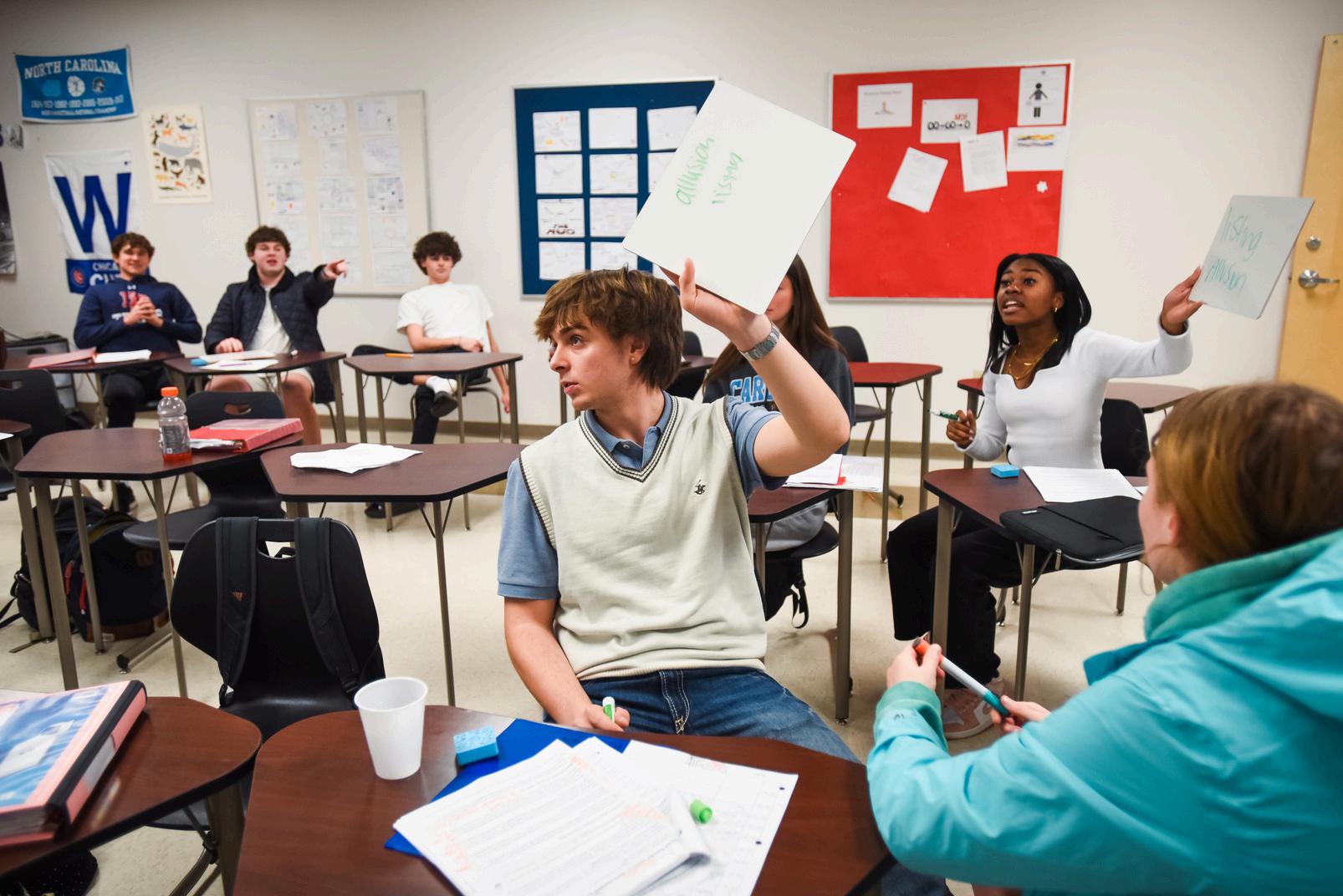
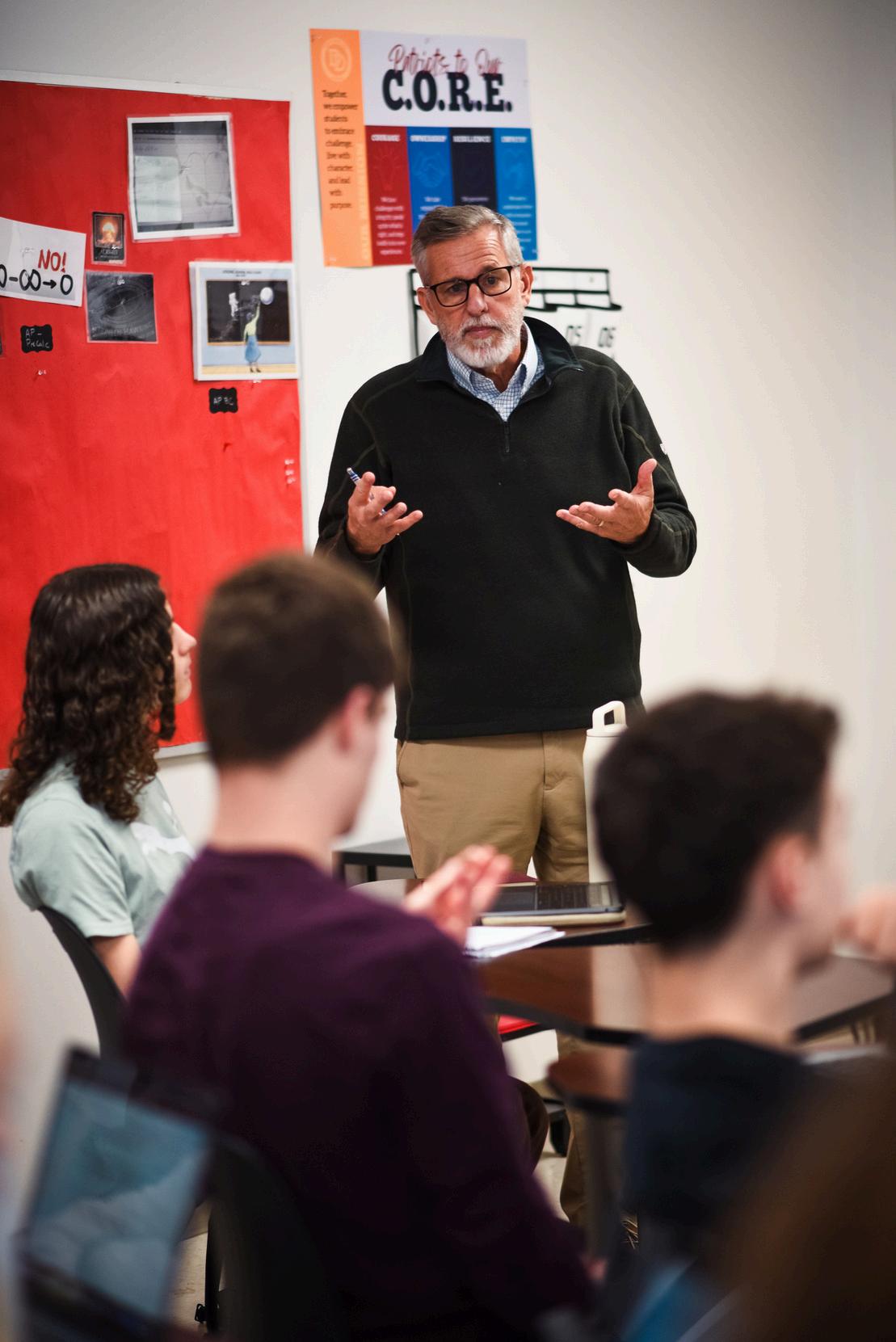
Together, we empower students to embrace challenge, live with character, and lead with purpose.
Davidson Day's values:
COURAGE. We face challenges with integrity, speak up for what is right, and step boldly into new experiences.
OWNERSHIP: We take responsibility for our learning, our actions, and the impact we have on our community.
RESILIENCE: We persevere through adversity with resourcefulness, learning from setbacks to grow stronger.
EMPATHY: We seek to understand others with compassion and commit ourselves to acts of kindness and service.
Davidson Day graduates are:
Critical thinkers who are enthusiastic problem solvers
Engaged students who take intellectual risks
Independent thinkers who articulate their ideas with confidence
Lifelong learners who chart their own paths in college and in life
Respectful, ethical citizens who are adept at addressing global challenges
Advocates for themselves and others.
C O N T E N T S
7-12
COURSE SELECTION
Course Registration Information - 7
Minimum Graduation Requirements - 8
Course Selection - 9
Honors: Challenge & Motivation - 10
Advanced Placement: College-Level Work - 11
Clarification on Credits - 12
Eighth Grade Credits - 12
13-19
20-25
NEW DIPLOMA TRACKS
Global Studies - 14-15
STEMM-16-17
Business and Civic Engagement-18-19
ENGLISH
English I/English I Honors - 21
English II/English II Honors - 22
English III Honors/English IV Honors- 23
Creative Writing- 23
AP English Language and Composition - 24
AP English Literature and Composition - 24
Introduction to Yearbook -25
Yearbook Honors-25
MATHEMATICS
26-31
32-37
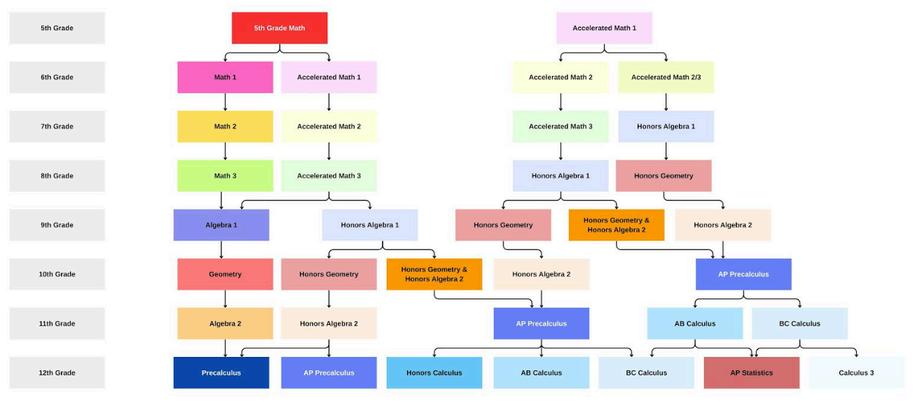
Upper School Mathematics: Course Progression - 28
Algebra I - 29
Geometry/Geometry Honors - 29
Algebra II/Algebra II & Trigonometry (Honors) - 29
AP Statistics - 29
Pre-Calculus - 30
AP Pre-Calculus - 30
Honors Calc-30
AP Calculus AB - 31
AP Calculus BC - 31
Calculus III (Post-AP) Honors - 31
HISTORY & SOCIAL SCIENCES
Civics/Civics Honors - 33-34
Anthropology Honors - 34
AP World History (Modern) - 35
U.S. History Honors - 35
AP U.S. History - 36
AP Microeconomics/AP Macroeconomics - 36
AP European History - 37
AP Psychology - 37
AP United States Government & Politics - 37
C O N T E N T S
38-43
SCIENCE
Conceptual Physics/Physics Honors - 39
AP Physics 1 - 40
AP Physics 2 - 40
Chemistry/Chemistry Honors - 41
AP Chemistry - 41
Biology/Biology Honors - 42
AP Biology - 42
AP Environmental Science - 42
Human Anatomy and Physiology Honors - 43
44-49
WORLD LANGUAGES
French I - 45
French II -45
French III Honors - 45
French IV Honors - 45
French V Honors - 46
AP French Language and Culture - 46
Spanish I - 47
Spanish II - 47
Spanish III/Spanish III Honors - 48
Spanish IV /Spanish IV Honors - 48
Spanish V Honors: Cultural Topics- 49
Spanish V Honors (Pre-AP)/AP Spanish Language and Culture - 49
AP Spanish Literature and Culture - 49
50-57
PARTICIPATION IN THE ARTS
Visual Arts - 52
Photography I - 52
Photography II - 53
Photography III - 54
Portfolio - 54
Studio 1 -54
Studio 2 -54
AP Studio Art - 54
Music and Performing Arts - 55
Performance Ensemble - 56
Contemporary Ensemble - 56
Modern Music - 57
Film and Production - 57
C O N T E N T S
TECHNOLOGY AND COMPUTER SCIENCE
Introduction to Computer Coding - 60
AP Computer Science Principles - 60
AP Computer Science A - 60
PHYSICAL EDUCATION
Weight Training - 62
intro to Sports Medicine-62 61-62
ELECTIVES
Honors Financial Literacy-63
AP Business w/Personal Finance-63
Honors Social Entrepreneurism-63
AP W/ WE Service-64
Middle School TA-64
ONLINE AND INDEPENDENT STUDY
Online Courses - 65
Other Courses - 65
Independent Study - 65
INTERNATIONAL RESEARCH PROJECTS: AFAR
Belize - 67
Spain - 67
Portugal - 67
TTO THE STUDENT:
This booklet provides information about course selection and registration. Please acquaint yourself with the graduation requirements and review the descriptions of courses available to you based on your grade level and your completion of the necessary prerequisites.
Give your course selection careful thought and seek the advice of your teachers, advisor, and parents as you design your schedule The Davidson Day Upper School student experience encompasses more than academics; please carefully consider your other priorities and commitments (i.e., participation in athletics, performing arts, community service, etc.) as you decide on an overall course load that will challenge you yet not overwhelm you.
This course guide is intended to give a total picture of the curricular offerings available at Davidson Day School Not every course will be offered in every academic year Refer to the course registration sheets distributed to students each spring for a full list of the courses that will be offered in the upcoming academic year
MINIMUM GRADUATION REQUIREMENTS
COURSES
Students must be enrolled in a core English class (English I/II/III/IV, AP English Language, or AP English Literature) each year of Upper School
At minimum: Algebra I, Geometry, Algebra II, and one class beyond Algebra II (typically Pre-Calculus).
Three years of laboratory science are required: Physics, Chemistry, and Biology
Three years of History are required. Students must take Civics (or Big History if enrolled in the Upper School before 2024-2025), World History (or Anthropology if enrolled in the Upper School before 2024-2025), and U S History
Students must earn at least 2 credits in the same language; at least 2 of those credits must be earned in Upper School.
FRESHMEN are required to take English I (or Honors), Civics (or Honors) (or Big History if enrolled in the Upper School before 2024-2025), and either Conceptual Physics or Physics Honors. Students should consult their 8th-grade teachers and the curriculum guide to choose the math, world language, and elective courses that best fit their needs. In total, freshmen should be enrolled in eight courses, including five academic classes and no more than one study hall.
SOPHOMORES are required to take English II (or Honors), World History (or Honors or AP) (or Anthropology if enrolled in the Upper School before 2024-2025), and Chemistry. Students should consult their freshman-year teachers, college counselors, and the curriculum guide to choose the math, world language, and elective courses that best fit their needs. In total, sophomores should be enrolled in eight courses, including five academic classes and no more than one study hall
JUNIORS are required to take English III (or Honors), U.S. History (or Honors or AP), and Biology (or Honors). AP Language and Composition may be substituted for English III. Students should consult their sophomore-year teachers, college counselors, and the curriculum guide to choose the math, world language, and elective courses that best fit their needs In total, juniors should be enrolled in eight courses, including five academic classes and no more than one study hall However, students enrolled in two or more AP-level courses may choose to take a second study hall.
SENIORS are required to take English IV (or Honors); AP Language and Composition or AP Literature and Composition may be substituted for English IV Students should consult their junior-year teachers, college counselors, and the curriculum guide to choose the math, science, history/social science, world language, and elective courses that best fit their needs; rising seniors must take particular care to ensure that they have met the minimum requirements for graduation. In total, seniors should be enrolled in eight courses, with five academic classes and no more than one study hall However, students enrolled in two or more AP-level courses may choose to take a second study hall.
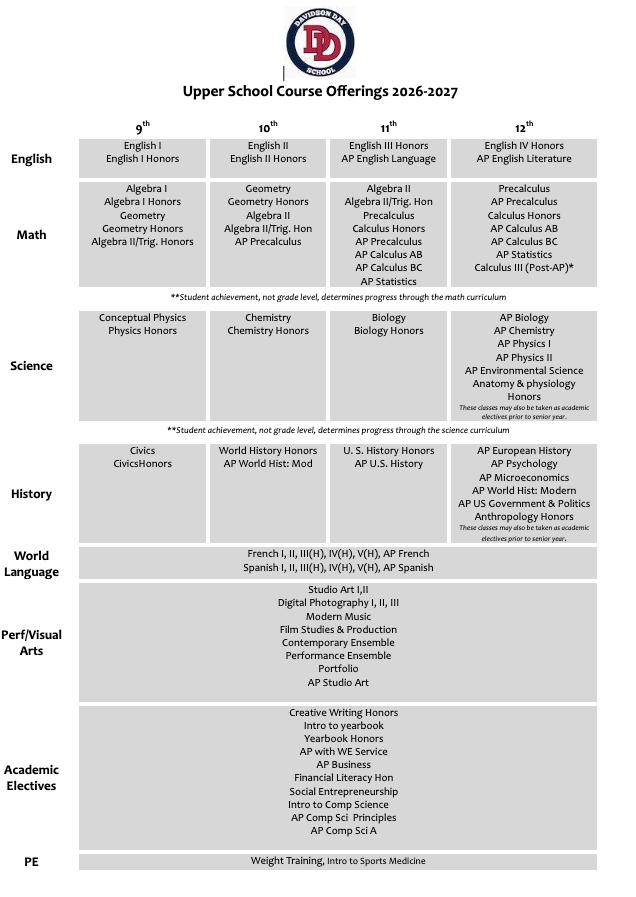
Students’ course registration will be processed once they have officially enrolled for the next academic year. Please note that some courses fill up quickly due to high demand See chart on page 70 for a full list of courses available to students at each grade level
H O N O R S : C H A L L E N G E & M O T I V A T I O N
CChallenging Honors courses are offered to students who have demonstrated the aptitude, work ethic, and previous academic performance to be successful. In order to enroll in an Honors course, a student must satisfy its academic requirements and be recommended by the appropriate department. Interested students should consult with their current teachers about appropriate course placement.
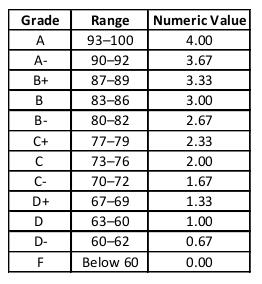
Students who wish to enroll in an Honors course must have finished the nonHonors prerequisite with a minimum final grade of A-. In order for students to remain in an Honors course of study from year to year, they must maintain at least a B- (final grade). Honors courses receive a .50 weighting when GPA is calculated.
Students who choose to enroll in Advanced Placement (AP) courses are often motivated by a passion for and intellectual interest in the subject matter of the course Student success in AP courses is usually driven by a strong aptitude for the subject matter, combined with excellent preparation and a willingness to do all of the work associated with the course. AP courses require a significant commitment in terms of workload, maturity, and classroom presence, so students should consider carefully whether they can manage these responsibilities alongside their other commitments in and out of school Please note that some AP courses also require summer work prior to the start of the school year
Advanced Placement courses follow College Board-approved curriculum and prepare students for the College Board Advanced Placement exams in May. AP courses are the equivalent of college-level courses and the scholastic demands they place on students are similar to those they are likely to encounter in an introductory college course All students taking an AP course are expected to take the corresponding exam in May; this takes the place of a final exam in the course. AP courses receive a 1.0 weighting when GPA is calculated.
Students who wish to enroll in an AP course must have finished the Honors prerequisite with a minimum final grade of A- and must have departmental approval They must also complete an AP Contract for each Advanced Placement course they request (see pages 61-62). Departmental approval is contingent on a review of prior achievement in prerequisite courses, teacher recommendations, AP Contract, and/or placement testing. The relevant department head has the final say in approving students for AP courses and will consider the abilities, goals, and best interests of each student in giving or withholding approval
APEnglishLanguageandComposition
APEnglishLiteratureandComposition
APPreCalculus
APCalculusAB
APCalculusBC
APStatistics
APBiology
APEnvironmentalScience
APPhysics1
APPhysics2
APChemistry
APWorldHistory(Modern)
APWithWEService
APU.S.History
APEuropeanHistory
APMacroeconomics*2027-2028
APMicroeconomics*2026-2027
APPsychology
APUSGovernmentandPolitics
APSpanishLanguageandCulture
APSpanishLiteratureandCulture
APFrenchLanguageandCulture
APStudioArt
APComputerSciencePrinciples
CLARIFICATION ON CREDITS
A year-end grade lower than C- in an academic course may necessitate summer school or another form of remediation. Failure to follow the School’s recommendations may require repetition of the entire course in the following school year
If a student repeats an academic course for which credit has been granted, the grade will be reflected on the transcript and calculated in the GPA, but the course will not be counted twice toward the credits required for graduation.
Credits from courses taken at other accredited schools are transferable and applicable to Davidson Day School graduation requirements if approved by the appropriate department chair and by the Head of Upper School. Courses taken at other schools (including accredited online programs) will be listed separately and attached to the Davidson Day School transcript. At no time will a grade point average from another school be calculated into the Davidson Day GPA.
EIGHTH GRADE CREDITS
Students who earn a Math (Algebra I and/or Geometry) or World Language credit prior to ninth grade, either at Davidson Day School or at another accredited school, may apply those credits toward course completion and graduation requirements However, if placement testing or subsequent performance indicates that a student does not have the requisite preparation to succeed in the next-level math or language course, that student may be asked to repeat the course. Eligible courses taken in middle school are not calculated into the cumulative upper school GPA, but are listed on the transcript
DIPLOMA DISTINCTIONS
DIntellectualDepth.Real-WorldReach.
Many schools offer advanced coursework. Fewer offer meaningful transformation. At Davidson Day, the Diploma Distinctions are defined not by the number of AP courses completed, but by the habits of mind and character cultivated along the way. Through immersive practicum experiences, sustained scholarly inquiry, and structured ethical dialogue, students are challenged to confront complexity rather than avoid it They move beyond certainty into disciplined investigation and discover that leadership requires more than expertise; it requires judgment
Here, Davidson Day’s C.O.R.E. values become lived experience: Courage— embracing challenge and pursuing ambitious questions. Ownership taking responsibility for intellectual growth and scholarly integrity.
Resilience persisting through challenge, complexity, and critique.
Empathy— recognizing the human impact of ideas and decisions
By integrating rigorous academics with real-world immersion and ethical inquiry, the Diploma Distinctions prepare students to lead with clarity, humility, and purpose ready to contribute thoughtfully in complex and evolving environments
DIPLOMA TRACK #1: GLOBAL STUDIES
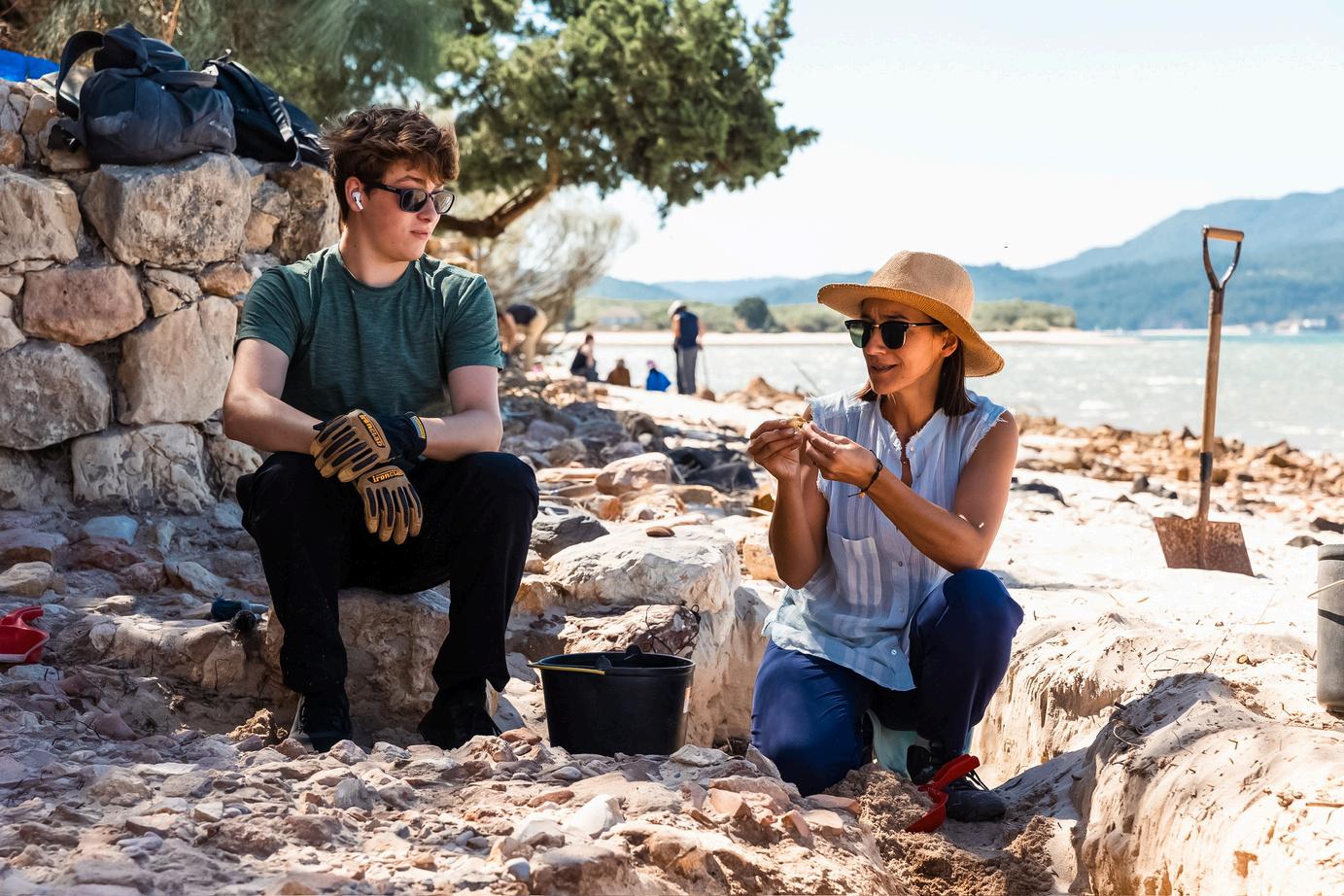
The Global Studies Diploma Distinction prepares students to navigate an increasingly interconnected world with intellectual sophistication and cultural fluency. This Diploma Distinction has existed at Davidson Day School since 2021, with most students taking advantage of the AFAR research trips to Spain, Portugal, and Belize to ground their research in collegiate-level archaeological research and international travel experience As the Global Studies pathway matures, students will have additional opportunities to participate in international service trips, language immersion programs, or find their own international opportunities to ground their research and explore their interests.
Through advanced coursework in history, economics, environmental studies, psychology, and world languages, students examine the systems, cultures, and forces that shape global relationships Language competency and international experiences are central to the program, not supplemental. Students are challenged to move beyond surface-level awareness toward genuine cultural understanding developing the ability to interpret context, appreciate complexity, and engage across difference with humility and curiosity.
Practicum experiences often including international travel, research initiatives, language immersion, or cross-cultural service become the foundation for sustained academic inquiry. Through their Capstone research, students investigate questions that emerge from lived global experience, whether in areas such as international development, environmental sustainability, archaeology, cultural identity, or global public health
Graduates of the Global Studies Distinction leave not only informed about the world, but equipped to participate in it thoughtfully bringing cultural competency, intellectual rigor, and principled judgment to international and intercultural contexts.
DIPLOMA TRACK #1: GLOBAL STUDIES
Pre-requisite:
Honors Anthropology
Choose 3 of the following electives:
AP World History or AP European History, AP Environmental Science, AP Psychology, AP Macroeconomics, AP with WE Service Recognition,AP Spanish Language and Culture, or AP French Language and Culture
Language Competency:
Completion of level IV or 3 levels in the same language in Upper School
Practicum
Approved international travel program (at least two weeks)
Quarterly Ethics Labs
Scholars Research Program
Research Methods Honors (junior year)
Capstone Research Honors (senior year)
Senior Capstone Research Project
2026-2027 school year The class of 2027 remains eligible for the Global Studies Diploma only, they are not eligible to add another Diploma Distinction
Research Methods Honors
Research Methods Honors is a foundational component of the Diploma Distinctions program and is automatically scheduled for students who are accepted into the program. Listed on the transcript as an honors-level course, Research Methods is designed to equip students with the skills necessary to conduct sustained, formal academic research in preparation for the senior Capstone project Through biweekly seminars, students learn how to read and analyze scholarly articles, evaluate sources, develop research questions, and engage with academic discourse across disciplines Students apply these skills independently during a designated study hall period, where they begin conducting guided research
In the second semester, students narrow their focus toward a prospective Capstone topic, complete a literature overview within their chosen field, and prepare intentionally for their practicum experience, which is typically undertaken during the summer before senior year, though it may occur during the academic year. The culminating project for Research Methods Honors is the development of a formal Capstone abstract, demonstrating clarity of purpose, familiarity with existing scholarship, and a well-defined plan for sustained independent inquiry This course serves as the intellectual bridge between academic coursework and the senior Diploma Distinction Capstone experience.
Prerequisites: Application for Diploma Distinctions (Grade 11)
DIPLOMA TRACK #2: STEMM
The STEMM (STEM and Medicine) Diploma Distinction challenges students to pursue scientific and mathematical inquiry with depth, discipline, and imagination. Grounded in advanced laboratory sciences and rigorous mathematics, the program cultivates strong analytical reasoning and problem-solving skills. Yet the focus extends beyond technical mastery. Students are encouraged to explore the broader implications of scientific discovery considering how innovation shapes society, advances human health, and addresses global challenges.
Practicum experiences may include medical shadowing, laboratory internships, engineering placements, computational research, or applied scientific investigation These immersive opportunities expose students to the realities of scientific and medical work where precision, collaboration, and perseverance matter
Through their Capstone research, students pursue original questions emerging from these experiences. Whether investigating biomedical advancements, environmental systems, technological innovation, psychological science, or datadriven problem solving, students learn to design research, analyze findings, and communicate conclusions at a collegiate level.
Graduates of the STEMM Distinction leave with more than technical expertise. They develop intellectual resilience, ethical awareness, and the capacity to apply scientific knowledge in ways that meaningfully improve lives.
DIPLOMA TRACK #2: STEMM
Core: Choose 1 of the following
Anatomy & Physiology Honors
Forensics & Zoology Honors
AP Physics I
AP Statistics
Choose three of the following electives:
AP PreCalc, AP Calculus (AB or BC), AP Biology, AP Chemistry, AP Physics I, AP Physics II
AP Psychology, AP Computer Science A
Competencies:
4 lab science courses taken at the Honors or AP Level
4 courses in mathematics taken at the Honors or AP level
Practicum
Approved internship (at least 100 hours) or approved collegiate program
Quarterly ethics labs
Scholars Research Program
Research Methods Honors (junior year)
Capstone Research Honors (senior year)
Senior Capstone Research Project
Research Methods Honors
Research Methods Honors is a foundational component of the Diploma Distinctions program and is automatically scheduled for students who are accepted into the program. Listed on the transcript as an honors-level course, Research Methods is designed to equip students with the skills necessary to conduct sustained, formal academic research in preparation for the senior Capstone project. Through biweekly seminars, students learn how to read and analyze scholarly articles, evaluate sources, develop research questions, and engage with academic discourse across disciplines Students apply these skills independently during a designated study hall period, where they begin conducting guided research
In the second semester, students narrow their focus toward a prospective Capstone topic, complete a literature overview within their chosen field, and prepare intentionally for their practicum experience, which is typically undertaken during the summer before senior year, though it may occur during the academic year The culminating project for Research Methods Honors is the development of a formal Capstone abstract, demonstrating clarity of purpose, familiarity with existing scholarship, and a well-defined plan for sustained independent inquiry. This course serves as the intellectual bridge between academic coursework and the senior Diploma Distinction Capstone experience
Prerequisites: Application for Diploma Distinctions (Grade 11)
DIPLOMA TRACK #3: BUSINESS & CIVIC
ENGAGEMENT
The Business and Civic Engagement Diploma Distinction prepares students to understand how markets, institutions, and communities function and how they can be strengthened through principled leadership and entrepreneurial initiative Through coursework in economics, government, history, statistics, business, financial literacy, and social entrepreneurship, students gain a foundation in both the mechanics of economic systems and the responsibilities of civic participation. They examine public policy, market behavior, institutional design, and the ethical dimensions of decision-making.
Equally central to this pathway is the cultivation of an entrepreneurial mindset Students are encouraged to identify problems worth solving, recognize opportunity in complexity, and design innovative solutions that create value whether in private enterprise, nonprofit organizations, or public institutions. They learn to think creatively, assess risk, iterate, and adapt
Practicum experiences may include internships with business leaders, engagement with startup ventures, participation in nonprofit initiatives, or sustained civic involvement tied to a research project. The Capstone research, rooted in these realworld experiences, ultimately defines the student’s distinction exploring topics such as economic innovation, public policy reform, nonprofit impact, sustainable enterprise, or civic leadership
Graduates of this pathway emerge with both analytical skill and initiative: prepared not only to participate in existing systems, but to improve and reimagine them.
Core:
DIPLOMA TRACK #3: BUSINESS & CIVIC
ENGAGEMENT
Financial Literacy OR Social Entrepreneurship
Choose four of the following electives:
AP US History, AP Microeconomics, AP Macroeconomics, AP US Government and Politics, AP with WE Service, AP Business, AP Statistics, Davidson DCI Programming (at least 2 semesters of participation)
Practicum
Approved internship (at least 100 hours), approved volunteer opportunity (at least 100 hours), or approved collegiate program
Quarterly ethics labs
Scholars Research Program
Research Methods Honors (junior year)
Capstone Research Honors (senior year)
Senior Capstone Research Project
Research Methods Honors
Research Methods Honors is a foundational component of the Diploma Distinctions program and is automatically scheduled for students who are accepted into the program Listed on the transcript as an honors-level course, Research Methods is designed to equip students with the skills necessary to conduct sustained, formal academic research in preparation for the senior Capstone project Through biweekly seminars, students learn how to read and analyze scholarly articles, evaluate sources, develop research questions, and engage with academic discourse across disciplines Students apply these skills independently during a designated study hall period, where they begin conducting guided research
In the second semester, students narrow their focus toward a prospective Capstone topic, complete a literature overview within their chosen field, and prepare intentionally for their practicum experience, which is typically undertaken during the summer before senior year, though it may occur during the academic year. The culminating project for Research Methods Honors is the development of a formal Capstone abstract, demonstrating clarity of purpose, familiarity with existing scholarship, and a well-defined plan for sustained independent inquiry. This course serves as the intellectual bridge between academic coursework and the senior Diploma Distinction Capstone experience.
Prerequisites: Application for Diploma Distinctions (Grade 11)
EThe English curriculum introduces students to a wide range of ideas and human experiences while developing strong reading, writing, and critical thinking skills English classes are seminar-style, discussion-based, and writing-intensive.
Literary analysis, argumentative writing, and personal narrative are taught at all levels and students learn to deconstruct increasingly sophisticated texts and to construct increasingly sophisticated arguments as they progress All core English courses assign summer reading which must be completed prior to the start of the school year.
Enrollment in Honors and Advanced Placement courses requires departmental approval; these courses are academically intensive, proceed at a faster pace, and cover material in more depth than traditional (college prep) level courses
To fulfill graduation requirements, students must earn four credits of English; must pass Composition; and must be enrolled in a core English class each year of upper school
ENGLISH I ENGLISH I HONORS
In English I, students will gain exposure to a wide range of literary genres and formats, such as novels, short stories, and plays. The primary texts that students will read and analyze are Arthur Miller’s The Crucible, Shakespeare’s Romeo and Juliet, and John Steinbeck’s Of Mice and Men, while supplementary texts will pull from from various time periods and cultures, including Greek and Native American mythology, Washington Irving’s The Legend of Sleepy Hollow, and Jack London’s To Build a fire.
In addition to these readings, students will gain plenty of experience with academic writing through a series of smaller writing assignments and academic papers These written submissions will be supplemented by in-class writing workshops and a unit focused on grammar and writing skills
Students will be recommended for English I or English I Honors after consultation with their eighth-grade teachers.
ENGLISH II
Similar to English I, this course aims to give students an opportunity to engage with a wide array of texts The primary texts that students will engage with include the epic poem Beowulf, Shakespeare’s Othello, and George Orwell’s Animal Farm Between these major works will be smaller works for units on short stories and poetry, including Shakespearean sonnets and modern poetry To hone their analytical skills, emphasis will be placed on the deeper meaning and implications behind the text being read
Alongside the typical exams and academic papers, class assignments will encompass journal entries, reading questions, and creative writing Students will also be expected to think critically about the texts, meet the appropriate writing standards, and participate regularly in class discussions
ENGLISH II HONORS
In English II Honors, students read fiction and nonfiction that may include A Long Way Gone, Much Ado About Nothing, Predictably Irrational, and a choice read They will also be introduced to selected poetry and will continue to receive instruction and practice in vocabularybuilding and standard English grammar.
Students will learn to properly annotate fiction and nonfiction texts while building their overall writing skills through scaffolded ACE responses.
Students in English II Honors learn and extend the skill sets of English I1 as they complete additional reading and writing assignments, including both personal writing and analyses of complex aesthetic texts. Students who succeed in English II Honors may consider taking AP Language and Composition in their junior year.
Prerequisites: Successful completion of English I or English I Honors and an instructor recommendation.
Open to sophomores
ENGLISH III HONORS
English III Honors is a literature-based course focusing on short fiction, novels, drama, creative nonfiction and poetry
Students will read novels such as 1984, The Stranger, The Great Gatsby, The Old Man and the Sea, and Frankenstein; plays such Fences; and short stories by Ernest Hemingway, F Scott Fitzgerald, and James Baldwin
Students develop as writers and thinkers by focusing on the skill sets of literary analysis and argument construction. While a grammar review is a component of the course, these skills are for the mostly taught in context. The course ’ s literary analysis, prepares students interested in taking an Advanced Placement English class in their senior year.
Prerequisites: Successful completion of English II or English II Honors
ENGLISH IV HONORS
The course ’ s first semester explores the southern United States’ literary voice, and will include authors, such as by William Faulkner, Alice Walker, Carson McCullers, Thomas Wolfe, and Ferrol Sams. This course will also include contemporary voices from the modern American South, such as Jesmyn Ward, Ron Rash, and Tayari Jones. Students will practice close reading skills and analytical writing, as well as extensive research into a southern author of their choice.
This course ’ s second semester will explore many of Shakespeare’s comedies, including As You Like It, Much Ado About Nothing, Twelfth Night, and more. This is not a course for spectators; the seminar format will encourage students to take an active role in the close reading and interpretation of the work.
Prerequisites: Successful completion of honors English 3 and teaching recommendation.
CREATIVE WRITING HONORS
In this Honors English elective, students will learn about and practice the genres of poetry, life writing, and fiction.
The aim of this course is to create a supportive workshop environment in students work with their instructor, with each other, and independently to produce quality writing through multiple revisions. Students will be encouraged to work toward publishing or otherwise sharing their work with a larger audience. They will be evaluated based on their participation in workshop and structured writing activities, on portfolios of finished work in several genres, and on the quality and scope of a final, self-designed project.
This is an elective and does to count towards the English requirement Open to all grades
AP ENGLISH LANGUAGE AND COMPOSITION
E N G L I S H
AP English Language and Composition is a writing- and reading-intensive course that makes demands equivalent to those of a full-year introductory college course The course focus is the study of rhetoric, which means that students will learn the various ways in which an effective argument can be presented.
AP ENGLISH LITERATURE AND COMPOSITION
AP English Literature and Composition provides students with a course in composition and literary analysis that makes demands equivalent to those of a full-year introductory college course
E X P L O R I N G E U R O P E
OUR JOURNEY THROUGHOUT 25 CITIES
Students will gain the ability to discern what an argument’s strengths and weaknesses are without dipping into the realm of mere opinion. They will also learn to use rhetorical strategies themselves in their own writing.
All writing and instruction in this course, then, has the purpose of making and defending an argument, or of explaining how the authors read go about making and defending their arguments. The primary course text is www.americanrhetoric.com, which is supplemented by various additional political, social, and personal writings.
Through the close study of literary works of multiple genres, as well as selected critical and scholarly essays, students will sharpen their awareness of language and their understanding of the writer’s craft while developing critical standards for appreciating and evaluating literature. They will also explore the cultural, social, and historical aspects of individual works.
The course examines representative British and American novels and plays from the 16th century to contemporary times, such as The Scarlet Letter, The Importance of Being Earnest, Their Eyes Were Watching God, Hamlet and Oryx & Crake. Poetry and short fiction will be chosen to supplement our study of the longer works.
Prerequisites: English II Honors, English III
Honors, and/or AP English Literature and Composition. Open to juniors or seniors with departmental approval.
In addition to critical reading and discussion of the assigned works, instruction and practice in writing is a major component of the course: students will write several in-class timed writings which mirror the expectations outlined on the May exam.
Prerequisites: English II Honors, English III
Honors, and/or AP English Language and Composition. Open to seniors with departmental approval
E N G L I S H
INTRODUCTION TO YEARBOOK
Students in this class produce the Davidson Day yearbook, Revolution. In the process, they are introduced to the vocabulary, sentence structure, tone, and tense of traditional journalistic writing and develop the skills necessary to create captions and short articles based on school activities and events.
The class is structured like a business, with an Editor in Chief, Editors, and a Financial Manager. Staff members practice skills like journalistic photography, journalistic writing, interviewing, selling business ads, organizing fundraisers, and working under deadlines. Students taking this class will be expected to complete some photo sessions and layout assignments outside of class.
Prerequisite: recommendation from an English teacher This course is an elective and does not fulfill the English class requirement This class may be used as an Arts elective
YEARBOOK HONORS
Students in this class produce the Davidson Day yearbook, Revolution.
In Advanced Yearbook, students further the skills developed in Introduction to Yearbook and assume leadership roles in the areas of staff training, management, organization, and design.
Advanced Yearbook students choose the annual theme of the yearbook; develop its content and layout; determine the organization of photos, fonts, text, and advertising; direct the training of new staff; edit spreads; and advise staff members on content and spread development. They coordinate business and senior ad campaigns, the school-wide distribution of the yearbooks, and the Family Photos fundraiser.
Prerequisites: Journalism: Introduction to Yearbook and instructor approval This course is an elective and does not fulfill the English class requirement This class may be used as an Arts elective Editor positions are assigned by the adviser
MTraditional, Honors, and Advanced Placement courses in Mathetmatics meet the learning needs, interests, and aptitude of each student Enrollment in Honors and Advanced Placement courses requires departmental approval; these courses are more academically intensive, proceed at a faster pace, and cover material in more depth than traditional level courses
To fulfill graduation requirements, students must earn four credits of Math and must complete at least one course beyond Algebra II Students should be enrolled in a Math class each year of upper school
M A T H E M A T I C S
ALGEBRA I
ALGEBRA 1 HONORS
Algebra I introduces students to the fundamental concepts of algebra and their multiple representations Topics include linear equations and inequalities, quadratic equations, polynomial expressions, and the elementary properties of functions
Critical thinking and problem-solving skills, modeling and solving real-world problems, and the use of a graphing calculator are integral parts of the course
Algebra 1 Prerequisite: Math 3 or Prealgebra
Algebra 1 Honors Prerequisite: Accelerated Math 3 or Honors Prealgebra
GEOMETRY
GEOMETRY HONORS
Geometry introduces students to classical Euclidean geometry, lines, angles, circles, polygons and areas, and their associated relationships. Topics include congruence, similarity, solid geometry (surface area and volume), analytic geometry, and right triangle trigonometry.
Both courses emphasize inductive and deductive reasoning and proofs. Geometry Honors is more academically intensive, proceeds at a faster pace, and covers material in more depth.
Prerequisite: Algebra I
Honors Prerequisite: Honors Algebra I and Departmental Approval
ALGEBRA II
ALGEBRA II/TRIGONOMETRY (HONORS)
Both courses begin with a short review of the fundamental algebraic concepts and go on to cover polynomial functions in depth and to introduce rational, square root functions, and complex numbers
Transcendental functions like logarithms and exponential models are covered at both levels, with trigonometric functions discussed at the Honors level. Graphs and transformations of graphs, solving equations, modeling with functions, and the use of a graphing calculator are integral parts of the course
Prerequisite: Geometry
Prerequisites: Geometry Honors and Additional Summer Work
AP STATISTICS
This course introduces students to the major concepts and tools for collecting, analyzing, and drawing conclusions from data There are four themes evident in the content, skills, and assessment in the AP Statistics course: collecting and exploring one- and two-variable data; sampling and experimentation; probability and simulation; and statistical inference
Students use technology, investigations, problem solving, and writing skills as they build conceptual understanding AP students should have the intellectual maturity needed to work independently and use higher-level thinking skills to work out complex problems
Prerequisites: Algebra II/Trigonometry Honors and Departmental Approval
PRECALCULUS
Precalculus combines the concepts of trigonometry, geometry, and algebra that are necessary to prepare students for the study of calculus The course strengthens students’ conceptual understanding of algebraic and transcendental functions by discussing them in greater depth The main functions included are polynomial functions; rational and radical functions; exponential and logarithmic functions; and trigonometric functions Solving complex equations, manipulating trigonometric and algebraic expressions, modeling, and the use of a graphing calculator are integral parts of the course
Prerequisites: Algebra II
AP PRECALCULUS
AP Precalculus is a college-level course aligned with College Board standards that prepares students for success in calculus and other advanced mathematics courses. Students explore a deep understanding of functions, including polynomial, rational, exponential, logarithmic, and trigonometric functions, with an emphasis on modeling, representation, and transformation.
The course focuses on mathematical reasoning, problem solving, and the application of concepts to real-world situations. Students are prepared to take the AP Exam for the opportunity to earn college credit and/or placement.
Prerequisites: Honors Algebra II with Trigonometry
HONORS CALCULUS
Honors Calculus is an advanced mathematics course designed for students with a solid foundation in algebra, geometry, and precalculus Topics include Limits and Continuity, Derivatives, the Fundamental Theorems of Calculus, and Techniques of Integration This course emphasizes the application of calculus techniques and problem-solving strategies necessary for success in higher-level STEM courses
Prerequisite: Precalculus
AP CALCULUS AB
AP Calculus AB is a college-level course aligned with College Board standards that introduces students to the fundamental concepts of differential and integral calculus. Students explore limits, derivatives, and definite integrals, and apply these concepts to analyze change, motion, and accumulation in real-world contexts. The course emphasizes multiple representations of functions (graphical, numerical, analytical, and verbal), along with strong reasoning, modeling, and communication skills. Successful completion prepares students for the AP Exam and the possibility of earning college credit and/or placement
Prerequisites: AP Precalculus with departmental approval and additional summer work
AP CALCULUS BC
AP Calculus BC is a college-level course aligned with College Board standards that extends the content of AP Calculus AB. In addition to limits, derivatives, and integrals, students study advanced topics such as parametric, polar, and vector functions, as well as sequences and series.
The course emphasizes conceptual understanding, multiple representations, and the application of calculus to realworld problems. Students develop strong analytical and problem-solving skills and are prepared to take the AP Exam for the opportunity to earn college credit and/or advanced placement.
Prerequisites: AP Calculus AB, or AP Precalculus with departmental approval, and additional summer work.
MULTIVARIABLE
AND LINEAR ALGEBRA
These semester courses include calculus concepts into higher dimensions Students learn about functions in these new higher dimensional spaces Differential and integral calculus are discussed from this new multivariable approach Students learn how to find tangent lines and planes, gradients, Lagrange multipliers, and length of three dimensional curves as well as volumes underneath surfaces Linear Algebra topics include the study of vectors and vector spaces as well as matrix applications and transformations Students are also exposed to proofs and logic to give them a solid foundation for college-level mathematics Because this “post-AP” courses makes demands similar to those of an AP course, it receives a 1 0 weighting when GPA is calculated
Prerequisites: AP Calculus BC
M A T H E M A T I C S
HStudents in History courses learn to interpret primary and secondary sources, to think critically, and to write analytically through assignments based on research, analysis, synthesis, inquiry, and critical thinking in order to develop a deeper understanding of the past and its connections to the present
All core History/Social Sciences courses assign summer reading which must be completed prior to the start of the school year Enrollment in Honors and Advanced Placement courses requires departmental approval; these courses are more academically intensive, proceed at a faster pace, and cover material in more depth than traditional courses
Three years of History are required Students must take Civics (or Big History if enrolled in the Upper School before 20242025), World History (or Anthropology if enrolled in the Upper School before 20242025), and U.S. History.
CIVICS
Civics and Deliberative Democracy serves as a foundational humanities course that prepares students for advanced study in history, government, and English Rooted in constitutional principles and key moments in American history, the course emphasizes close reading and critical analysis of primary texts alongside the development of clear, persuasive academic writing.
Through research, position papers, structured debates, and collaborative projects, students engage with complex and often politically divisive issues. The course is intentionally designed to help students understand diverse perspectives, articulate their own views thoughtfully, and engage in civil, evidence-based discussion. By modeling the practices of civic discourse and deliberative democracy, students develop the habits of mind and communication skills essential for informed participation in a democratic society
CIVICS HONORS
E N G L I S H
Civics and Deliberative Democracy Honors builds upon the foundational goals of the standard course while introducing a higher level of analytical rigor and academic expectation. Rooted in constitutional principles and historical inquiry, the course emphasizes close reading and interpretation of primary source documents, with particular attention to sourcing, context, and argumentation Students develop advanced persuasive writing skills through frequent, structured analytical essays
E X P L O R I N
ANTHROPOLOGY HONORS
G E U R O P E
Anthropology is the science of mankind in its entirety. These courses provide students with a systematic overview of the field of Anthropology through an analysis of its four subfields: cultural anthropology, physical anthropology, archaeology, and linguistics.
OUR JOURNEY THROUGHOUT 25 CITIES
In addition to research projects, position papers, and structured debates, students regularly practice AP-style writing prompts to strengthen their ability to synthesize multiple sources into coherent, evidencebased arguments. Students engage thoughtfully with politically divisive issues, examining diverse perspectives while articulating their own views with clarity and civility. By modeling deliberative democracy in both discussion and writing, the course prepares students for the demands of AP World History and other upper-level humanities courses.
Students will visit different parts of the world through readings, lectures, and film, allowing them to observe a variety of worldviews, norms, and values. They will develop an effective knowledge of basic concepts in anthropology, important findings in the field, research methods, as well as an overview of the cultures of the world. Because of the broad spectrum of the subject matter in the field of anthropology, almost every subject that man has dealings with is a possible choice for discussion.
Students will engage with one of anthropology's central questions: what it means to be human. This exploration will examine humanity from both a biological perspective, considering our evolution, anatomy, and variation, and a cultural perspective, focusing on the beliefs, practices, and social systems that uniquely shape human life. Through comparative analysis across different societies and historical periods, students will identify both the shared traits that unit us as a species and the diverse expressions that distinguish human groups across time and space. This dual approach encourages critical thinking about human diversity while fostering a deeper understanding of our common humanity
Prerequisites: Civics or Civics Honors, and instructor approval
AP WORLD HISTORY (MODERN)
AP World History (Modern) is a college-level survey of world history from approximately 1200 CE to the modern era. Topics covered include the causes and processes of global cultural and economic integration; industrialization and its consequences; the spread and collapse of Western colonialism; and the great worldwide ideological conflicts of the twentieth century This course will push students to think, write, and work like historians. They will learn the practice of history by explicitly developing historical thinking skills as they learn about the past
The reading load for this course is significant; the course textbook will be supplemented by a wide variety of both primary and secondary source documents. In-class activities include discussions, lectures, group projects, and debates.
Prerequisites: Civics Honors and departmental approval
U.S. HISTORY HONORS
This course surveys United States history from the peopling of North America to the present. In order to appreciate the complexity of the United States and its people, students will consider this history from diverse points of view and trace social, political, economic, environmental, and cultural continuities and changes over time. The course begins with the arrival of humans in North America and progresses through the pre-Columbian period; European colonization; the Revolution; the creation of a new republic; territorial and democratic expansion; sectionalism and the Civil War; industrialization and the Progressive Era; America’s emergence on the world stage; Depression and the New Deal; the World Wars; the Cold War and American international hegemony; and societal changes from the 1950s to the present day.
Students will be required to demonstrate mastery of basic historical thinking and analytical skills. Class activities include res, group projects, and debates about some of ns of American history. ecome skilled at using material to develop and arguments.
acher recommendation nors
AP US HISTORY
AP U.S. History is a college-level survey of United States history. This course will push students to think, write, and work like historians. They will learn the practice of history by explicitly developing historical thinking skills as they learn about the past.
Reading requirements in this course are significantly greater than in the other U.S. History courses; assigned readings include primary-source documents, textbook readings, political cartoons, maps, data sets, and pictures Class time is spent in discussions, lectures, activities, and debates
Prerequisites: open to juniors with departmental approval
AP MICROECONOMICS
Economics examines the processes that determine the production and consumption of goods and services. It is the study of how humans cope with scarcity: the combination of potentially unlimited wants and limited resources with which to meet them.
Microeconomics focuses on the principles of economics as applied to individual decision makers, both producers and consumers, within an economic system
Macroeconomics focuses on the principles of economics as applied to the economic system as a whole
Students considering either course should be able to work independently as they read, practice, and study for mastery of the economic concepts presented
Offered in alternate years to juniors and seniors with departmental approval Macroeconomics will be offered during the 2027-28 school year.
AP PSYCHOLOGY
Psychology is the systematic and scientific study of human behavior and thought processes to understand the internal and external aspects of human experience
AP Psychology covers psychological concepts such as learning, motivation, memory, neuroanatomy, and the function of the nervous system
In preparing students for the AP exam, this course will go beyond a lecture style of learning to foster critical thinking skills through projects, models, group work, and guided discussion
Students will engage in active learning by analyzing, interpreting, and designing experiments to provide a deeper understanding of problem solving, language acquisition, creativity, attention, intelligence, testing, and social dynamics They will compare and contrast experiments, correlational studies, naturalistic observations, and case studies as means to gather data Students taking this course must be prepared to read and work on sophisticated projects both in and out of the classroom
This course is open to juniors and seniors with departmental approval
AP GOVERNMENT AND POLITICS
Students cultivate their understanding of U S government and politics through analysis of data and text-based sources as they explore topics like constitutionalism, liberty and order, civic participation in a representative democracy, competing policy-making interests, and methods of political analysis
This course is open to juniors and seniors with departmental approval
AP EUROPEAN HISTORY
AP European History, students investigate significant events, individuals, developments, and processes from approximately 1450 to the present This includes but is not limited to the Renaissance, Reformation, Absolutism, Napoleonic Era, Industrialization, Imperialism, and 20th-century global conflicts Throughout the course, students will analyze primary and secondary sources; developing historical arguments; making historical connections; and utilizing reasoning about comparison, causation, and continuity and change over time The course will utilize a variety of learning methods including but not limited to note-taking, presentations, geographical development, essay writing, and debates to assist students in their analytical development.
This course is open to juniors and seniors with departmental approval
S C I E N C E
SIn science courses, students learn the fundamental principles of science and the processes by which scientists acquire knowledge: observation, classification, experimentation, analysis, and application All science courses include laboratory activities that support classroom work. Enrollment in Honors and Advanced Placement courses requires departmental approval; these courses are more academically intensive, proceed at a faster pace, and cover material in more depth than traditional-level courses.
To fulfill graduation requirements, students must complete at least one credit each of Physics, Chemistry, and Biology
CONCEPTUAL PHYSICS
PHYSICS HONORS
Both Physics courses begin the year with an exploration of waves, sound, and light; then cover the fundamental concepts of mechanics: forces, linear motion, projectile motion, energy and momentum; and finally close the year with an introduction to electric circuits.
Physics provides students with the opportunity to take their learning of science to the next level, not just recalling facts, but truly understanding concepts and connecting their understanding of various models of the physical world developed in the course. Models are representations of physical phenomena that take the form of 1) graphical relationships between variables; 2) mathematical equations derived from analysis of the graphs; 3) diagrammatic representations of physical phenomena; or 4) narrative descriptions of physical phenomena. These models have broad application and predictive power.
As students continue to deepen their conceptual understanding of each model, they are able to translate fluently between different forms of the model and use the models they develop to solve complex problems. In Conceptual Physics, the mathematical models are limited to concepts covered in Algebra 1; Honors Physics adds concepts covered in Geometry
Students will be recommended for Conceptual Physics or Physics Honors after consultation with their eighth-grade teachers Co-requisite for Physics Honors: enrollment in Geometry or higher
AP PHYSICS 1
AP Physics 1 is an algebra-based, introductory college-level physics course. Students cultivate their understanding of physics through hands-on laboratory work and inquiry-based investigations as they explore kinematics; dynamics; circular motion; energy; momentum; torque and rotational motion, gravitation; simple harmonic motion; and fluids.
AP Physics 1 is the equivalent of a firstsemester introductory college course in algebra-based physics.
Laboratory exercises in this course focus on experimental design and provide students with opportunities to demonstrate the foundational physics principles and apply science practices.
Prerequisites: departmental approval; Physics Honors is strongly recommended Co-requisite: enrollment in Pre-Calculus Honors or higher.
AP PHYSICS 2
AP Physics 2 is an algebra-based, introductory college-level physics course. Students cultivate their understanding of physics through hands-on laboratory work and inquiry-based investigations as they explore fluids; thermodynamics; electrical force, field, and potential; electric circuits; magnetism and electromagnetism; geometric and physical optics; and topics in modern physics.
AP Physics 2 is the equivalent of a secondsemester introductory college course in algebra-based physics.
Laboratory exercises in this course focus on experimental design and provide students with opportunities to demonstrate advanced physics principles and apply science practices, including data analysis, modeling, and evidence-based reasoning.
Prerequisites: Successful completion of AP Physics 1 or departmental approval
Co-requisite: Enrollment in Pre-Calculus Honors or higher.
CHEMISTRY
CHEMISTRY HONORS
This course presents the fundamental principles and concepts of chemistry: properties of matter; nomenclature; atomic structure; chemical reactions; stoichiometry; gases; thermochemistry; chemical bonding; solids, liquids, and solutions; acids and bases; and kinetics and equilibrium.
Laboratory work emphasizes quantitative measurement and develops students’ investigative techniques and their ability to interpret results. At the Honors level, strong emphasis is placed on critical thinking, independent laboratory investigations, and writing.
Students are expected to master basic concepts independently; to draw general conclusions from particular cases; and to demonstrate their understanding not only conceptually, but also mathematically.
The Honors course is designed to prepare students for future advanced science coursework, such as AP Chemistry, and is faster paced, more rigorous, and requires more outside time for preparation and completion of assignments than the traditional Chemistry course.
An instructor recommendation is required for Honors
AP CHEMISTRY
The AP Chemistry course provides students with a college-level foundation to support future advanced coursework in chemistry.
Following a curriculum outlined by the College Board, students cultivate their understanding of chemistry through classroom demonstrations, lectures, and inquiry-based investigations
Students develop competency in the typical laboratory skills of a college course. Course content includes atomic structure, intermolecular forces and bonding, chemical reactions, kinetics, thermodynamics, and equilibrium
Prerequisites: Chemistry Honors, Algebra II/Trigonometry Honors, and departmental approval S C I E N C E
BIOLOGY HONORS
These courses provide an introduction to the major principles of modern biology: the organization of life; the interaction of organisms with other organisms and with their environments; and the change in organisms over time.
Major topics include cell structure and function; cell division; DNA replication; protein synthesis; genetics; evolution; phylogeny; the anatomy and physiology of plants and animals; ecology; and biological diversity.
Students use research, classroom discussion, and laboratory activities to acquire an understanding of the dynamic world of living organisms and their place in that world.
In addition to exploring with greater depth and rigor the content covered in traditional Biology, students in Biology Honors will also be exposed to learning through inquiry, using relevant and current research data and through independent experiment design.
The focus in this course is on integrating complex concepts and applying creative thought to problem-solving for issues like population growth, genetic modification of organisms, and epidemiology.
An instructor recommendation is required for Honors
AP BIOLOGY
The AP Biology course provides students with a college-level foundation to support future advanced coursework in biology.
Following a curriculum outlined by the College Board, the topics in this course are organized into three broad areas: molecules and cells; individual organisms; and populations
Students cultivate their understanding of biology through inquiry-based investigations as they explore topics like evolution, energetics, information storage and transfer, and system interactions.
AP Biology is more in-depth and is taught at a much faster pace than Biology or Biology Honors Students will be asked to integrate complex concepts and to use logic and creative thought to work through problems; a significant amount of independent work is required
In AP Environmental Science, students cultivate an understanding of the interrelationships of the natural world through inquiry-based laboratory investigations and collaborative research.
The course topics are organized around four big ideas: energy transfer; interactions between earth systems; interactions between different species and the environment; and sustainability
The use of models and exploration of current global research enhances students’ appreciation of how these big ideas converge in the field of Environmental Science.
Prerequisites: Physics Honors, Biology Honors, Chemistry, and departmental approval.
HUMAN ANATOMY AND PHYSIOLOGY
HONORS
Students in Human Anatomy and Physiology Honors learn through inquiry using medical case studies and laboratory exercises. The course provides a comprehensive study of the structure and function of the human body.
Topics include anatomical terminology, homeostasis, cytology, and histology, as well as the integumentary, skeletal, muscular, nervous, cardiovascular, respiratory, renal, digestive, immune, and reproductive systems.
Students will develop an integrated understanding of biological concepts and will apply that understanding to solve problems Microscopy and dissection are major components of the laboratory work in this course
Prerequisites: Biology or Biology Honors; this course is open to juniors and seniors with an instructor recommendation This course is offered in alternating years.
E N G L I S H
W O R L D L A N G U A G E S
WThe World Languages Department helps students achieve increasing levels of proficiency in the four language skill areas: listening, speaking, reading, and writing.
Upon matriculation in the upper school, students are placed in the appropriate World Languages course(s) based on past performance and/or proficiency testing.
To fulfill graduation requirements, students must successfully complete three credits in the same language; the completion of four years of language study in Upper School is encouraged.
FRENCH I
French I is designed for beginning students of French The course guides students to use the four language skill areas listening, speaking, reading, and writing within culturally appropriate contexts
Students learn to describe themselves, their families and homes, and their preferences in terms of school and pastimes Students look outward to communicate about their communities, their relationships, and travel in the French-speaking world There is an emphasis on interpretive skills (listening and reading) before students are expected to articulate their own thoughts in French
FRENCH II
French II exposes students to French vocabulary through topics based on friends and family relations, education, food and shopping, travel, and typical daily routines These topics allow students to communicate about their present-day lives and to express their experiences of the past and expectations for the future
The course has an emphasis on acquiring vocabulary outside of a textbook through conversations in the classroom and uses authentic resources to provide this input
Prerequisite: Successful completion of French I / proficiency exams may be used to determine appropriate level for incoming students
FRENCH III HONORS
In French III Honors, students work on applying their interpersonal, presentational and interpretive skills in the areas of reading, writing and speaking through a variety of authentic resources such as texts, songs and videos Students begin to also look at experiences of those in the French speaking community and compare and contrast the French community with the students own culture in the target language. Students are also expected to participate in the target language on a daily basis.
Throughout the course, students are expected to communicate using previously taught concepts and apply those to the new concepts that are introduced throughout the year. Making a personal connection to the language and culture, rather than rely on predetermined vocabulary, is an essential part of French III honors.
New vocabulary and grammar will be taught in a concrete fashion and will allow students to communicate on matters related to their future plans, healthcare, travel, fairy tales and culinary life in France.
Prerequisite: Successful completion of French II.
FRENCH IV HONORS
E N G L I S H
French IV Honors students continue to work on applying their interpersonal, presentational and interpretive skills in the areas of reading, writing and speaking through almost exclusively authentic resources.
AP FRENCH LANGUAGE AND CULTURE
The AP French Language and Culture course is a culmination of French studies that emphasizes communication via interpersonal, interpretive, and presentational skills rather than grammar and targeted vocabulary.
E X P L O R I N G E U R O P E
Students continue to improve the skill of comparing the culture of the French speaking community to their own culture in the target language. The expectation of communicating in French is still present, and students work towards communicating exclusively in French, with as little English as possible.
OUR JOURNEY THROUGHOUT 25 CITIES
The course is based around six themes: Families and Communities; Personal and Public Identities; Beauty and Aesthetics; Science and Technology; Contemporary Life; and Global Challenges. These themes are explored through contemporary and historical contexts with a focus on French as a worldwide language.
French IV honors students are also expected to communicate with all the concepts taught in their previous French course and apply those to the new concepts to help them express their own ideas. Along with more advanced grammatical structures, students will delve into the world of the French speaking community outside of Europe, exploring the African Francophone world.
Prerequisites: Successful completion of French III Honors.
FRENCH V HONORS
French V Honors is typically taken as preparation for AP French Language and Culture in the following year The two courses are taught in a two-year rotation, with similar content covered in French V honors and AP French but with assignment structure differing by level
Prerequisities: French IV Honors
W O R L D
L A N G U A G E S
The course is taught almost exclusively in French and relies upon various texts, films, articles, music, podcasts, and television episodes.
AP French Language and Culture is an intensive course, requiring greater linguistic control, and deeper analysis of the relationships between cultural products, practices and perspectives.
Prerequisites: French IV Honors.
Students beginning Spanish study for the first time or those who need to reinforce their basic language skills start with this introductory course. The class encompasses thematic units including introductory dialogues, common questions, and organization by grammatical theme and word families before shifting to more culturally centered topics from around the Spanish-speaking world. Students will learn to read, write, listen, and produce Spanish, achieving a novice level of memorized and produced speech during the course of this class. Exposure to authentic materials include popular songs, short stories, videos, and games. Grammatical structures covered in the course include articles, nouns, adjectives, and verb conjugations in the present tense. The class will be taught in English and Spanish, transitioning to being taught increasingly in Spanish by the end of the academic year.
The Spanish II course is designed to further expose students to Spanish vocabulary through thematic units centered around education, friends and family relations, daily life, technology, clothes, travel, and traditions. These topics allow students to communicate about their present-day lives as well as to express their experiences of the past and expectations of the future. Students will also explore cultural norms and traditions from twelve Spanishspeaking countries. The course has a communicative focus that aims to develop students’ ability to narrate about familiar topics in both speech and writing. Students are expected to use Spanish to communicate during class time. The instructor uses Spanish a majority of the time when interacting with students, but may use English when introducing new grammar points.
Prerequisite: Successful completion of Spanish I / proficiency exams may be used to determine appropriate level for incoming students.
SPANISH III HONORS
Students taking Spanish III Honors will expand upon their previous knowledge and understanding of the Spanish language to sharpen their listening, speaking, reading, and writing skills. Students will study thematic units that cover pastimes, travel and leisure, relationships, concepts of beauty and fashion, and health and medicine while learning advanced grammar, idiomatic expressions, and topical vocabulary contextualized historically and culturally. Daily work emphasizes speaking, reading, and writing exercises as students are encouraged to communicate more in the target language. Spanish III Honors covers academically intensive topics, explores analysis through cross-cultural comparisons, has a robust pacing and covers a variety of materials.
Prerequisites: Successful completion of Spanish II
SPANISH IV HONORS
Spanish IV begins more in-depth cultural study in Spanish using authentic resources and the building of academic vocabulary. Students explore products, practices and perspectives from Spanish-speaking countries in relation to the visual arts, human geography, extreme weather conditions, nutrition, food safety and the economy, and the impact of access to education on career goals and opportunities. Conversational skills are emphasized, and written compositions are assigned to develop the ability to express complex ideas and compare cultural differences.
Honors requires more in-depth exploration of these topics through amplified vocabulary study, analysis and cross-cultural comparisons and proceeds at a faster pace in terms of what students are expected to be able to produce in the language in speaking and writing
Prerequisites: Spanish III Honors
SPANISH V HONORS
Spanish V Honors explores in-depth cultural themes through materials created for language learners, as well as authentic popculture and academic sources and prepares students to further develop an intermediate level of proficiency. Through exposure to authentic fiction and non-fiction readings, films, and documentaries students gain practical knowledge and advanced oral practice to improve their navigation of the Spanish-speaking World. This course is taught almost exclusively in Spanish and students are expected to use the language at all times to converse with their peers as well as with their teacher. Students will cover thematic units that reflect personal and religious beliefs, identity, global citizenship, different ways of life, social consciousness, and discoveries and inventions encountered in Latin America.
Prerequisites: Spanish IV Honors and an instructor recommendation.
AP SPANISH LANGUAGE AND CULTURE
The AP Spanish Language & Culture course strives not to overemphasize grammatical accuracy at the expense of communication. To best facilitate the study of language and culture, the course is taught almost exclusively in Spanish. The AP Spanish Language & Culture course engages students in an exploration of culture in both contemporary and historical contexts. The course further develops students’ awareness and appreciation of cultural products (e.g., tools, books, music, laws, conventions, institutions); practices (patterns of social interactions within a culture); and perspectives (values, attitudes, and assumptions).
AP Spanish Language and Culture is an academically intensive course, requiring greater linguistic control, and deeper analysis of the relationships between cultural products, practices and perspectives
AP Prerequisite: Completion of Spanish IV Honors .
AParticipation in the arts is central to Davidson Day School’s core mission of fostering creativity and cultural appreciation, and to the project of cultivating well-rounded students
To graduate, students must complete at least one full credit in the arts.
Students at Davidson Day routinely graduate with four or more credits in the Visual and/or Performing Arts
Beginning art courses emphasize skills, making the student aware of past works and the importance of accurate observation.
For the more advanced student artist, choice of subject, imagery, and medium provide opportunities for individual creativity and artistic growth.
PHOTOGRAPHY I
Photography I introduces students to the fundamentals of photography and the camera It covers visual basics including composition, layering, light, and the decisive moment Camera basics include how to use a digital camera (off of automode) and how to use the exposure triangle to achieve the best exposure Adobe Lightroom is the professional software used for image management and post-production
P A R T I C I P A T I O N
V I S U A L A R T S
Students in this course also learn about content, story, and what makes a great photograph They are encouraged to develop their own point of view, their own vision, and to recognize what it is that makes them and their way of seeing unique Numerous photography projects are balanced with written assignments and presentations At the end of the year, students create a final portfolio of their best images
PHOTOGRAPHY II
Photography II introduces students to the fundamentals of photography and the camera It covers visual basics including composition, layering, light, and the decisive moment. Camera basics include how to use a digital camera (off of automode) and how to use the exposure triangle to achieve the best exposure. Adobe Lightroom is the professional software used for image management and post-production
Students in this course also learn about content, story, and what makes a great photograph They are encouraged to develop their own point of view, their own vision, and to recognize what it is that makes them and their way of seeing unique. Numerous photography projects are balanced with written assignments and presentations At the end of the year, students create a final portfolio of their best images.
Prerequisite: Completion of Photo 1
PHOTOGRAPHY III
Photography III is for serious student photographers who want to challenge themselves as they further their ability to tell stories with images. They master the intricacies of the digital SLR, take their editing skills to the next level, and continue to craft their own photographic style.
Students must be able to work independently, create and execute their own project proposals, and make good use of their class time to explore different disciplines of photography and choose an area of concentration. Students produce and maintain their own websites to showcase their work and finish the year with a final portfolio.
Prerequisites: Photography I and II
Portfolio provides an opportunity for upperclassmen to do more in-depth work with a medium or subject of their choice. In place of group lessons, students develop an individualized project plan in conversation with the instructor and work throughout the year to complete it.
Past projects have ranged from impressionist landscape painting to abstract expressionist collage: the focus can be as flexible as the imagination of the student artist.
This class is commonly used as a steppingstone to AP Studio Art, but it may also serve as a standalone class for students who want to develop a portfolio of original works
STUDIO I
Studio I introduces students to the foundational concepts, skills, and processes across multiple disciplines within the visual arts. Through hands-on projects, students explore both two- and three-dimensional artmaking, developing their ability to translate ideas from initial sketches into finished works. Emphasis is placed on observational drawing, composition, line, value, form, color theory, and spatial thinking.
Students work with a wide range of traditional and digital media, including graphite, charcoal, paint, clay, and digital illustration tools. Projects include handbuilt ceramic forms, two-dimensional drawings and paintings, and digitally constructed illustrations that combine image and text. Across all units, students are encouraged to experiment, refine technique, and develop visual problemsolving skills, providing a strong foundation for more advanced study in the visual arts
STUDIO II
Studio II Honors builds on the skills introduced in Studio I and is designed for students ready to pursue more advanced work. Students deepen their understanding of both two- and threedimensional processes while refining technical skills, conceptual thinking, and personal visual voice. Projects emphasize purposeful design, experimentation, and revision, encouraging students to move beyond skill acquisition toward intentional artistic decision-making.
Working across traditional and digital media, students engage in longer-term projects that require planning, sustained focus, and self-reflection Regular critique and written artist reflections support students in analyzing their work and articulating artistic intent Studio II Honors serves as a key preparatory course for AP Studio Art, while also offering a rigorous, stand-alone experience for students seeking advanced studio practice
Prerequisites: Studio Art I, Photo I, Ceramics, Drawing and Painting, or Digital Illustration (grades 10-12)
AP STUDIO ART
Students work under the direction of the instructor to develop a portfolio for submission to the College Board Advanced Placement judges
Each student proposes, and develops over the course of the year, a series of artworks representing a sustained investigation into a common visual theme Students are required to create works that document their own artistic growth while working within a consistent visual thesis
While work in this course is largely selfdirected, class time will include both individual guidance and group critiques
Prerequisite: departmental approval
MMusic and performing arts courses marry technique and continued development of fundamental skills with an intense exploration of creative expression as it relates to the human experience
Many music and performing arts courses have a required performance component, and rehearsals and performances for those courses may be scheduled beyond the academic day
PERFORMANCE ENSEMBLE
As members of a select company of actors, students in Theatre Performance Ensemble research, rehearse, and perform thought-provoking, challenging theatre while honing fundamental skills and collaborating with other ensemble members
The course explores the ways in which theatre inspires, educates, increases awareness, and instigates social change
Students encounter innovative playwrights and theatre companies whose work has impacted broader social, cultural, and global collective consciousness
The majority of class time will be spent in rehearsal or working on specific pieces for performance, with occasional after-school rehearsal leading up to performance.
As advanced actors, Performance Ensemble students will also participate in Davidson Day Theatre productions, the Improv Comedy show, the Musical Review, and/or collaborations with local theatre companies
New students (not previously enrolled) interested in being considered for Performance Ensemble must audition
CONTEMPORARY ENSEMBLE
Contemporary Ensemble is Davidson Day School’s very own “School of Rock”! These ensembles allow students to learn and perform contemporary music, primarily in the pop and rock style, with a dash of jazz, blues, and funk
Contemporary Ensemble is open to students at any level, from those with a great deal of experience and musical background to those who are just beginning. Repertoire and individual parts are adjusted to the level of each student, with an emphasis on providing a challenge that is still within reach.
All instruments and vocalists are welcome; no audition required Students are allowed and encouraged to explore instruments other than their primary instrument
They are required to perform publicly with the ensemble at least once per quarter during scheduled performances.
Required: Guitars, electric bass, keyboards, and drums are available in the classroom, but students are required to have an instrument at home on which to practice
MODERN MUSIC
E N G L I S H
A blend of history, musicology, popular culture, and the arts, Modern Music focuses on the musical artists, songs, and styles of the last hundred years in genres including but not limited to rock, pop, R&B, jazz, country, blues, funk, soul, folk/bluegrass, and classical
FILM STUDIES & PRODUCTION
This course teaches students how to appreciate the art form of motion pictures.
E X P L O R I N G E U R O P E
Students can expect listening exams as well as presentations and projects Making use of digital technology, they will create music using loops, samples, and computer-generated sounds Projects include creating an original song using the recording software GarageBand
Course topics include the history of film; film genres; the elements of a film; film's power as a communication medium, its potential cultural and historical impact; and how to critically view and understand a film
OUR JOURNEY THROUGHOUT 25 CITIES
Students will watch a number of films, from The Godfather to Memento, and they can expect to write essays on several of them In addition to learning how to "read" a film, students will begin to learn the process of digital film creation and editing
Students will also create a new soundtrack of sequence music and audio effects for a chase sequence from a popular movie
There is no performance requirement for this course
Students also learn about the concepts of digital video editing and gain an understanding of entry-level digital editing software
There is no performance requirement for this course
T E C H N O L O G Y & C O M P U T E R S C I E N C E
TTechnology and computer science classes teach design, logical reasoning, and computational problem solving skills
Beyond computer literacy, these courses introduce students to the possibility of creating and adapting new technologies, helping students learn to become technology innovators.
T E C H N O L O G Y & C O M P U T E R S C I E N C E
T E C H N O L O G Y & C O M P U T E R
S C I E N C E
Introduction to Computer Coding provides students with a foundational introduction to computer programming using the Python language. Designed for students with little or no prior coding experience, the course introduces core programming concepts such as variables, conditionals, loops, functions, and basic data structures, while developing computational thinking and problem-solving skills.
This course is offered as an independent study, with students working through structured lessons and coding exercises at an individualized pace. A faculty mentor monitors progress, provides feedback, and supports students as they apply programming concepts to increasingly complex tasks
AP COMPUTER SCIENCE PRINCIPLES
AP Computer Science Principles introduces students to the foundational ideas of computer science with an emphasis on creativity, problem-solving, and the real-world impact of computing Students explore key topics including computational thinking, algorithms, data and information, the internet, and the ethical and societal implications of technology Programming is used as a tool for exploring and expressing these concepts through structured coding tasks and projects
This course is offered as an independent study, with students progressing through College Board–aligned units at an individualized pace A faculty mentor monitors progress, provides feedback, and supports students in preparing for AP assessments, including performance tasks and the end-of-course exam
AP Computer Science Principles is designed for students with varying levels of prior experience and serves as a strong foundation for further study in computer science, including AP Computer Science A and advanced STEM coursework.
Departmental Permission and completion of Algebra I (grades 9-12)
AP COMPUTER SCIENCE A
AP Computer Science A is a college-level course focused on object-oriented programming and algorithmic problemsolving using the Java programming language Students study core computer science concepts including classes and objects, control structures, methods, arrays and array lists, recursion, and program design Emphasis is placed on writing clear, efficient code and developing logical strategies to solve complex problems
This course is offered as an independent study, with students progressing through College Board–aligned content at an individualized pace A faculty mentor monitors progress, provides feedback, and supports students in preparing for AP-style programming questions and the end-ofcourse exam AP Computer Science A is designed for students with prior coding experience and builds upon foundational coursework such as Introduction to Computer Coding or AP Computer Science Principles, preparing students for advanced study in computer science and related STEM fields
Prerequisites: Departmental permission Experience with computer science or coenrollment with at least Honors Algebra II recommended
H Y S I C A L E D U C A T I O N
PWith the overall goal of student wellness, all students at Davidson Day are required to participate in interscholastic sports and/or physical education while in Upper School.
One credit of physical education is required to graduate. A student may request physical education credit for participating in varsity athletics, theatre, or another approved outside activity.
St d t i W i ht T i i i th
E L E C T I V E S
FINANCIAL LITERACY HONORS
Financial Literacy introduces students to the foundational concepts and skills they will build upon in the AP Business with Personal Finance course Students explore how businesses operate and compete within markets, with particular attention to financial markets such as stocks, mutual funds, and a broader understanding of equities markets Additionally, students will participate in Wharton’s Global High School Investment Competition The course also provides an overview of marketing principles, management structures, and strategic decision-making within organizations
In addition, students develop practical personal finance skills, including budgeting, saving, and understanding basic financial statements and accounting concepts. Through discussions, case studies, and applied activities, students strengthen their ability to analyze financial choices, evaluate risk and opportunity, and make informed economic decisions in both personal and business contexts.
AP BUSINESS w/ PERSONAL FINANCE
AP Business provides students with a comprehensive introduction to business principles and personal finance while emphasizing analytical thinking, problemsolving, and real-world application. The course explores key topics including market structures and competition, financial markets such as stocks, bonds, and equity markets, marketing, business finance and accounting, management strategies, and personal financial planning.
Students develop advanced skills through case studies, research projects, and applied simulations, learning to analyze business decisions, evaluate risk, and propose evidence-based solutions In addition, students practice AP-style writing and problem-solving, preparing them for the expectations of College Board assessments and for continued study in economics, finance, and business at the upper school level
Prerequisites: Departmental Permission, completion of Algebra II, Financial Literacy, or Social Entrepreneurship encouraged (grades 11-12)
HONORS SOCIAL ENTREPRENEURSHIP
Social Entrepreneurship explores how business principles can be applied to address social, environmental, and community challenges. Students study the foundations of entrepreneurship with particular emphasis on nonprofit organizations, social enterprises, and mission-driven business models. Core topics include identifying community needs, designing sustainable solutions, fundraising and resource development, marketing for impact, and measuring social outcomes.
Through project-based learning and guided community engagement, students connect classroom study with real-world service experiences. Students collaborate with local organizations, develop and implement service initiatives, and reflect on the ethical responsibilities of socially conscious leaders. While not a prerequisite, Social Entrepreneurship is designed to complement and support the skills and experiences emphasized in AP with WE Service, preparing students to engage thoughtfully and effectively in service-oriented leadership.
AP WITH WE SERVICE
AP with WE Service combines collegelevel academic study with sustained, field-based service learning in partnership with local nonprofit organizations. Students engage deeply with issues affecting their community, applying research, analysis, and problem-solving skills to real-world challenges. The course integrates rigorous academic content with hands-on service experiences, emphasizing leadership, collaboration, and measurable impact.
The course focuses on ongoing field work with local nonprofits Students work directly with community partners to assess needs develop and implement
MIDDLE SCHOOL TA (Teacher’s Assistant)
The Middle School TA (Teacher’s Assistant) program provides upper school students with the opportunity to serve as instructional partners in middle school classrooms Students are paired with a middle school teacher in a subject area of interest and assist with daily classroom activities, such as facilitating small group instruction, supporting individual students, and helping prepare materials and learning tasks
In addition to classroom support, students participate in monthly “lunch and learn” seminars focused on pedagogy the study of how teaching and learning occur where they explore instructional strategies, classroom management, lesson design, and student development
Throughout the year, Teaching Assistants design and lead brief mini-lessons under faculty supervision, gaining firsthand experience in planning and delivering instruction This course is particularly well suited for students interested in education, leadership, or working with young people Participants must demonstrate maturity, self-control, and a consistent ability to model the school’s core values, serving as positive role models within the middle school community.
Prerequisites: Application (Grades 10-12)
E L E C T I V E S
ONLINE AND INDEPENDENT STUDY
ONLINE COURSES
In rare cases, a student may supplement Davidson Day’s curricular offerings with an online class Davidson Day School, as a member of the North Carolina Association of Independent Schools, partners with Fuel Education (www fueleducation com) to provide accredited online options when alternative or additional coursework is deemed necessary
Online coursework is treated as a transfer credit and is not factored into the student’s Davidson Day School GPA There may be an additional fee for enrolling in an online course
OTHER COURSES
Other courses offered by NCAIS-accredited schools must be reviewed and approved by the appropriate department head to ensure that they align with the Davidson Day School curriculum before credit is awarded
In addition, a minimum final grade of 80 percent must be earned to receive credit The School reserves the right to administer an additional proficiency exam before credit is awarded
INDEPENDENT STUDY
Davidson Day School offers a wide variety of curricular options, including electives in each academic department At times, however, a student may have a sincere passion for a subject not offered by the school, or may wish to explore in more depth some facet of a subject first encountered in a regular class
Students in good academic standing may apply for an Independent Study in the spring of the preceding year In order to have an Independent Study approved, a student must choose a faculty supervisor and design a course of study
The student must then submit an abstract and full syllabus for the proposed study, including a list of materials and possible assessments, to the Director of Independent Studies and the Curriculum Committee for approval
Students in Independent Study courses check in regularly with their faculty supervisors while working independently through the course material The final grade, awarded on a Pass/Fail basis, reflects the student’s satisfactory or unsatisfactory completion of the course of study described in the Independent Study proposal
A F A R
AThe AFAR Program at Davidson Day, offers students the opportunity to participate in accredited, expert-led archaeological fieldwork projects abroad Through immersive, hands-on research experiences, students develop critical skills in analysis, problem-solving, collaboration, and crosscultural communication. While rooted in archaeology, the program provides broad academic and personal value, making it highly beneficial for students interested in fields such as history, science, international studies, and beyond.
At the Maya site of Cahal Pech in Belize, students participate in active excavations, part of a project that has been ongoing for over twenty years that contribute to continuing research into ancient Maya political and cultural life.
In Spain, students work at the medieval castle of Zorita de los Canes, uncovering remains tied to the Order of Calatrava and the dynamics of medieval warfare and religion The experience integrates excavation with historical analysis, helping students reconstruct how the fortress functioned within its broader sociopolitical landscape.
At the Roman site of Tróia in Portugal, students investigate the remains of a major fishprocessing complex that once supported extensive trade across the Roman Empire. This project emphasizes industrial archaeology and economic systems, offering insight into everyday life and large-scale production in the ancient world
CThe growth and development of each Davidson Day School student culminates in the college search process The goal of the College Counseling Office is to guide and empower students so they are prepared to identify colleges that are the best fit for their interests, strengths, and goals, and to move confidently into the next phase of their educational journey
College counselors assist students and families in all aspects of the college planning process, including researching colleges, building a balanced college list, planning for standardized testing, developing application essays, navigating the financial aid process, exploring interests, and evaluating final college choices. In addition to extensive one-on-one counseling, the office provides a structured program throughout high school that helps students better understand themselves and the college admission process. Programs include College Nights for each grade level, campus visit opportunities for sophomores and juniors, College Counseling seminars for all grade levels, a Summer Application Boot Camp and Fall Application Workshop for seniors, and the annual Case Studies program, where students and families observe a mock admission committee to better understand how colleges build a class.
Our college counselors maintain strong professional relationships with admission counselors throughout the country. They present at national conferences, are active in professional admissions organizations, and regularly visit college campuses to stay informed about institutional culture, curriculum, and admission policies Each fall, Davidson Day hosts a wide range of admissions representatives on campus to meet directly with students, and the College Counseling Office leads an Admissions Experts Advisory Board composed of current college admission professionals who provide ongoing insight into evolving admission practices and trends These relationships help ensure that our students receive accurate, current, and thoughtful guidance throughout the college search process
Grading Scale:
GPA CALCULATOR
Honors courses are weighted 0.5 quality point and AP courses are weighted 1 0 quality point Independent Study classes are not factored into the GPA; they are graded as either Pass (P) or Fail (F).