
Davidson-Davie Emergency Services College Booklet | 2026
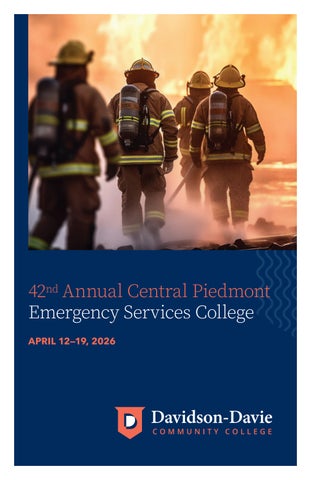
Page 1


Letter from the President

Welcome to Davidson-Davie for the 42nd Annual Central Piedmont Emergency Services College!

We are grateful to all of you who keep our communities safe.

This year’s Emergency Services College offers a comprehensive schedule of certification and professional development opportunities across fire, rescue, EMS and leadership disciplines. In this booklet, you will find detailed course descriptions, dates and times, instructor information and certification requirements for programs. We are also proud to host several National Fire Academy leadership courses focused on supervision, professional growth and health and safety program management.

Thank you for your commitment to your own education, and for supporting the training of those who work alongside you. Together, we have the people, skills, and education to help our local communities be the places we all want to live.

Sincerely,

Agenda & Class Start Times

SUNDAY April 12 8 a.m.

MONDAY April 13 8 a.m.

Fire Officer 1 #79239

Leadership in Supervision: Growth #79253

Driver Operator: Aerial Apparatus Series #79247

Fire Instructor 1 #79242

TUESDAY April 14 8 a.m.

WEDNESDAY April 15 6 p.m.

8 a.m.

THURSDAY April 16

Leadership in Supervision: Perspective #79254

Large Animal Rescue Technician #79246

Fire Instructor 2 #79243

Leadership in Supervision: Framework #79255

6 p.m. Fire Officer 2 #79241

FRIDAY April 17 6 p.m. NIMS ICS-300 #79248

SATURDAY April 18 8 a.m.

BLS Instructor #79252

EMS Vehicle Operator Safety (EVOS) #79251

NFA: Health and Safety Manager #79257

TR Rope Rescue Awareness #79250

Law & Administration #79249

DMICO #79258

Courses FIRE OFFICER

Fire Officer 1 – 2020 Ed #79239

Instructor: Curtis Teague | April 12, 13, 14, 15 | Sunday, Monday, Tuesday, Wednesday, 8 a.m.–6 p.m. | April 16 | Thursday, 8 a.m.–3 p.m. | 42 hours

Candidates for Fire Officer Certification must meet all requirements to be eligible to take the Fire Officer Certification Exam. These requirements are located at www.ncdoi.com.

Requirements for Fire Officer I

• 21 years of age

• Firefighter Level II certified for three years

• INSTI or INST2 or INST3 certified (must be a minimum of INSTI certified)

• High school education or GED

This certification-related course covers the knowledge, skills and requirements referenced in the National Fire Protection Association (NFPA) 1021 Standard, 2020 edition, for Fire Officer I training. Topics include officer roles and responsibilities, budgets, fire cause determination, inspections, education, leadership, management, public relations and other requirements. Upon completion, students should be able to demonstrate an understanding of relevant NFPA standards as required for state Fire Officer I certification. Effective date: January 1, 2022. Textbook: IFSTA Fire & Emergency Services Company Officer 6th Edition, ISBN: 978-0-87939-650-3. Class begins Sunday, April 12, 8 a.m.

FIRE OFFICER

Fire Officer 2 – 2020 Ed #79241

Instructor: Curtis Teague | April 16 | Thursday, 4 p.m.–10 p.m. April 17, 18, 19 | Friday, Saturday, Sunday, 8 a.m.–6 p.m. | 33 hours

Candidates for Fire Officer Certification must meet all requirements to be eligible to take the Fire Officer Certification Exam. These requirements are located at www.ncdoi.com.

Requirements for Fire Officer 2

• 21 years of age

• Firefighter Level 2 certified for five years

• Fire Officer 1 certified

• INSTI or INST2 or INST3 certified (must be a minimum of INSTI certified)

• High school education or GED

This certification-related course covers the knowledge, skills and requirements referenced in the National Fire Protection Association (NFPA) 1021 Standard, 2020 edition, for Fire Officer 1 training. Topics include officer roles and responsibilities, budgets, fire cause determination, inspections, education, leadership, management, public relations and other requirements. Upon completion, students should be able to demonstrate an understanding of relevant NFPA standards as required for state Fire Officer 1 certification. Effective date: January 1, 2022. Textbook: IFSTA Fire & Emergency Services Company Officer 6th Edition, ISBN: 978-0-87939-650-3. Class begins Thursday, April 14, 4 p.m.

FIRE INSTRUCTOR

Fire Instructor 1 #79242

Instructor: CJ Dwiggins | April 13, 14, 15 | Monday, Tuesday, Wednesday, 8 a.m.–6 p.m. | 27 hours

Candidates for Instructor Certification must meet all requirements to be eligible to take the Instructor Certification Exam

Requirements for Fire Instructor 1

• 21 years of age

• High school education or GED

• Firefighter Level 2, FLSE Rescuer or Driver Operator certified for three years

This course will present the Instructor 1 candidate with the knowledge, skills and ability to satisfy the requirements of NFPA 1041: Standard for Fire and Emergency Services Instructor Professional Qualifications (2019 edition: Chapter 4). Textbook recommended: Fire and Emergency Services Instructor, 9th Edition, ISBN: 979-0-87939-696-1. Class begins Monday, April 13, 8 a.m.

Fire Instructor 2 #79243

Instructor: CJ Dwiggins | April 16, 17, 18 | Thursday, Friday, Saturday, 8 a.m.–7 p.m. | April 19 | Sunday 8 a.m.–5 p.m. | 38 hours

Candidates for Instructor Certification must meet all requirements to be eligible to take the Instructor Certification Exam

Requirements for Fire Instructor 2

• Fire Instructor 1 certified

This course will present the Instructor candidate with the knowledge, skills and ability to satisfy the requirements of NFPA 1041: Standard for Fire and Emergency Services Instructor Professional Qualifications (2019 edition: Chapter 5). Textbook recommended: Fire and Emergency Services Instructor, 9th Edition, ISBN: 979-0-87939-696-1. Class begins Thursday, April 16, 8 a.m.

TECHNICAL RESCUE

TR Rope Rescue Awareness #79250

Instructor: Tim Eldredge | April 18 | Saturday, 8 a.m.–7 p.m. | 10 hours

This certification-related course in rope rescue (awareness level) will present the Technical Rescuer (TR) with an introduction to rope rescue, size-up, hazards associated with rope rescue, supporting the operations, initiating a response, and technical level rescue incident. This course should be offered consistent with the most current NC Fire and Rescue Commission guidelines. Class begins Saturday, April 18, 8 a.m.

DRIVER OPERATOR

Driver Operator: Aerial Apparatus Series #79247

Instructor: Justin McIntyre | April 13, 14, 15, 16, 17, 18, 19 | Monday, Tuesday, Wednesday, Thursday, Friday, Saturday, Sunday, 8 a.m.–6 p.m. | 63 hours

This course will present the Driver Operator with information related directly to aerial operations and all other information required to meet the knowledge, skills and abilities to satisfy the key requirements of NFPA 1002: Standard for Fire Apparatus Driver/Operator Professional Qualifications (2017 edition). FIP-3626 transfers the complete series, in its entirety, to the Office of State Fire Marshal (OSFM). Student will need helmet, gloves and protective shoes. Class begins Monday, April 13, 8 a.m.

NATIONAL FIRE ACADEMY

Students Taking NFA Courses

A National Fire Academy SID (student identification) number is required for all National Fire Academy courses. Students must have SID number with them when attending NFA courses.

To obtain a SID:

• Register at cdp.dhs.gov/femasid

• Select “Need a FEMA SID”

• Follow the instructions to create an account

• Student will receive an email with SID. Student must bring number to class.

Leadership

in Supervision: Creating

Environments

for Professional Growth (F0646) #79253

Instructor: Mark Schmitt | April 12, 13 | Sunday, Monday, 8 a.m.–5 p.m. | 16 hours

This course provides the supervisor with the basic leadership skills and tools needed to perform effectively in the fire service environment. The course includes concepts related to a successful transition to supervisory and leadership roles, including adaptive leadership, change management, active followership, effective communication including difficult conversations and advocacy-inquiry based dialogue, ethics, authority, power, decision-making and active engagement through development of a personal plan. Class begins Sunday, April 12, 8 a.m.

NATIONAL FIRE ACADEMY

Leadership in Supervision: Perspectives in Thinking (F0647) #79254

Instructor: Mark Schmitt | April 14, 15 | Tuesday, Wednesday, 8 a.m.–5 p.m. | 16 hours

This course provides the supervisor with the conceptual foundation and framework for success in leadership roles by exploring creative, analytical, political and critical thinking perspectives. The course addresses skills needed for assessing situations from multiple perspectives, making critical decisions, fostering creativity and innovation, and using persuasion. Class begins Tuesday, April 14, 8 a.m.

Leadership in Supervision: Frameworks to Success (F0648) #79255

Instructor: Mark Schmitt | April 16, 17 | Thursday, Friday, 8 a.m.–5 p.m. | 16 hours

This course provides the supervisor with the knowledge and skills to perform successfully in the Fire and Emergency Medical Services environments. The course addresses professionalism, resilience, emotional intelligence and situational awareness, as well as managing conflict, delegating, mentoring, coaching, empowering, and building collaboration and synergy for professional growth. Class begins Thursday, April 16, 8 a.m.

NFA: Health and Safety Program Manager #79257

Instructor: Mark Schmitt | April 18, 19 | Saturday, Sunday, 8 a.m.–5 p.m. | 16 hours

This two-day course will provide fire and emergency medical services department personnel and other related emergency responders with the aptitudes and abilities necessary to manage the duties and responsibilities of the Health and Safety Program Manager (HSPM) within their respective organizations. Successful completion of this course will enable participants to: (1) Adapt the HSPM roles and responsibilities while applying risk-management health and safety concepts within their organization to determine system-wide needs and to develop support to institutionalize opportunities to meet the needs assessment; (2) Evaluate and prioritize health-and safety-related strengths and weaknesses within their organizations; (3) Evaluate the environmental barriers affecting the implementation and impact of the organization’s safety and health programs; (4) Evaluate and integrate the organization’s and individual’s responsibility to impact health and wellness positively. Class begins Saturday, April 18, 8 a.m.

SPECIALTY

Large Animal Rescue Technician #79246

Instructor: Scottie Emerson | April 15, 16 | Wednesday, Thursday, 6 p.m.–10 p.m. | April 17 | Friday, 8 a.m.–5 p.m. | 16 hours

This course covers the ins and outs of rescue situations involving large animals. Type I and III Teams are required to have Animal Rescue Technician as part of their requirements for typing. Students will gain experience in handling various trapped animals as well as techniques for freeing these animals from harmful situations. This course covers NFPA 1670 Chapter 9: Awareness and Operations Objectives. Class begins Wednesday, April 15, 6 p.m.

NIMS ICS-300 #79248

Instructor: Robert Reece | April 17 | Friday 6 p.m.–10 p.m. | April 18, 19 | Saturday, Sunday 8 a.m. – 5:30 p.m. | 21 hours

This course provides greater description and details of the Incident Command System (ICS) organization and operations, including application of essential principles and description of air operations. There are five modules: Organization and Staffing, Organizing for Incidents and Events, Resources Management, Air Operations and Incident and Event Planning. This course includes a final exam. Prerequisites: ICS100, ICS-200, and ICS-700. This course must follow all current Federal Emergency Management Agency (FEMA) guidelines. Class begins Friday, April 17, 6 p.m.

DMICO: Decision Making for Initial Company Officers #79258

Instructor: Jonathan Sowers | April 18, 19 | Saturday, Sunday, 8 a.m.–5 p.m. | 16 hours

This course is designed to develop the decision-making skills needed by Company Officers (CO’s) to accomplish assigned tactics at structures fires. All activities and scenarios used in this course are based on structure fires. With the real possibility of being the first to arrive at an incident, the CO’s initial decisions will have an impact throughout the entire incident. It is vital that CO’s be able to make good management decisions that have a favorable impact on the eventual outcome. In addition to a possible role as the initial Incident Commander, the CO may be assigned a subordinate position within the Incident Command System organization. CO’s need to have a clear understanding of the system, the position that they are assigned to, and their role in the organization if they are to function effectively and help make the system work. Class begins Saturday, April 18, 8 a.m.

Law and Administration #79249

Instructor: Alan Coxie | April 18, 19 | Saturday, Sunday, 8 a.m.–5 p.m. | 16 hours

The code enforcement Law and Administration course is an overview of NC’s building regulation system and is designed for the education and training of building, electrical, mechanical, plumbing and fire prevention code enforcement officials. Topics include the structure of federal, state and local governments, the history of the NC State Building Code, relevant General Statutes, and the enforcement responsibilities of local inspection departments. Course standards are set by the Code Officials Qualification Board and administered by the Engineering and Codes Division of the NC Department of Insurance/Office of State Fire Marshal. Successful completion of this course along with others specified by the Qualification Board qualifies participants to take state inspector certification exams. Class begins Saturday, April 18, 8 a.m.

MEDICAL SPECIALTY

EMS Vehicle Operator Safety (EVOS) #79251

Instructor: Sam Olshinski | April 18, 19 | Saturday, Sunday, 8 a.m.–5 p.m. | 16 hours

This course addresses the knowledge gap that leads to injuries and deaths, and focuses on the specific behaviors that need to be changed to create a culture of safe driving. Drawing on the most current research about the behaviors and other hazards that lead to crashes, EVOS features case studies and analyses of both common and catastrophic collisions. EVOS challenges EMS practitioners to reconsider their preconceptions about safe vehicle operations. Instructors can easily incorporate local laws, rules and policies into the curriculum. Topics covered: making driving safety a priority, legal aspects of EMS vehicle operation, maneuvering an EMS vehicle, vehicle inspection and maintenance, mental, emotional and physical preparedness, emergency response, crash prevention, driving skills, technological aids, simulation training. EVOS is appropriate for EMS practitioners at all levels. EVOS is accredited by CAPCE and recognized by NREMT. Students must pay the NAEMT certification fee of $15 on the first day of class. A portion of this class will be held off campus. Class begins Saturday, April 18, 8 a.m.

MEDICAL SPECIALTY

BLS Instructor #79252

Instructor: Richard Green | April 18 | Saturday, 8 a.m.–5 p.m. | 8 hours

This course is designed to certify individuals to teach the Basic Life Support (BLS) provider course as well as Heartsaver provider courses according to the American Heart Association guidelines. This course teaches instruction skills in general, as well as specific CPR teaching skills. Prerequisites: BLS Online Instructor Essentials completion certificate, documentation of affiliation with an AHA Training Center, valid, up-to-date, BLS Provider card. Class begins Saturday, April 18, 8 a.m.

BLS Instructor Required Materials/Pre-Course Work

Below is required and must be brought to class.

Course Completion Certificate

This is the online portion of the course. Must be completed and certificate brought to class. 20-1420 | $42.65 www.elearning.heart.org/course/801

AHA BLS Provider card

Must hold a current, in date, AHA BLS Provider card. A copy must be brought to class.

BLS Instructor packet

All instructors must purchase and bring the 2025 BLS Instructor manual to class. It is cheaper to buy the Instructor packet than each individual item. Links to purchase are below. There are 3 different options.

Only choose 1 and the best one that works for you. For example…if you want a digital video to teach your classes then purchase that package.

OPTION 1

20-1104 | BLS Instructor Package—DVD | $170.55 www.shopcpr.heart.org/bls-instructor-package-dvd

OPTION 2

20-1137 | BLS Instructor Package—Digital Video | $157.80 www.shopcpr.heart.org/bls-instructor-package-digital-video

OPTION 3

20-1157 | BLS Instructor Package—USB | $170.55 www.shopcpr.heart.org/bls-instructor-package-with-course-videos-on-usb

There are three options for the instructor package. Students only need to choose one of the above. Instructor manuals must be brought to class.

The BLS Instructor Package includes all tools needed to teach a BLS provider course. BLS Online Essential course must be completed BEFORE class. A copy of Certificate of Completion must be brought to BLS Instructor Class.

Attendance/Testing

Attendance will be taken twice on each day of class. To be eligible to take the certification test, students must complete 80 percent of class hours. Students will be notified by mail if they do not pass the certification test.

General Information

Transportation

Students must provide their own transportation to off-campus classes.

Inclement Weather Notice

In case of inclement weather, the president or an authorized representative may close the school or begin classes at a later hour. Information on school closing or delayed starting times will be announced on the college website, DavidsonDavie.edu, by message on the campus switchboard (336.249.8186), and on the following television and radio stations:

Television

WGHP-TV, Channel 8, High Point | WXII-TV, Channel 12, Winston-Salem

WFMY-TV, Channel 2, Greensboro | WXLV-TV, Channel 45, Winston-Salem

Radio

WLXN, 1440 AM, Lexington | WFDD, 88.5 FM, Winston-Salem

WMAG, 99.5 FM, Lexington | WTQR, 104.1 FM, Winston-Salem

WKZL, 107.5 FM, Greensboro

ASHEBORO

Minimum Age Requirements

The minimum age for participation in the Central Piedmont Emergency Services College is 16 years.

Tuition for out-of-state students and those not fee-waived:

Class hours 1–24 $70 | Class hours 25–50 $125 | Class hours over 51 $180 Some courses have additional certification fees and/or recommended textbooks. Students may enroll for multiple classes as long as schedules do not conflict or overlap. All classes must be listed on the registration form.

Registration and Check-In

The purpose of the school is to make quality training available to as many dedicated emergency responders as possible. Every effort has been made to accommodate maximum participation in the course of registration. Affirmation Statement does not apply for medical courses.

Students who do not pre-register for Emergency Services College must report to the 2nd floor of the J. Bryan Brooks Student Center to register for a class before it starts. Office hours will be Monday–Thursday, 8 a.m.–5 p.m. and Friday, 8 a.m.–12 p.m.

Refunds will be issued only if the college cancels classes due to low enrollment. Most classes will be held on campus. Pre-registered students will receive an email within one week to confirm class title, dates/times and room location. Please note the requirements for each course and bring appropriate equipment needed to complete the class.

Questions?

Visit davidsondavie.edu/emergency-services-college for additional information, registration forms and class listings. You may also contact us at firecollege@davidsondavie.edu or 336.224.4599.

Briggs Technology Building

• Electrical Engineering

• Classrooms

• Video Conferencing Classroom

• Study Rooms

Brinkley Building

• Brinkley Gym & Fitness Center

• Cosmetology

Brooks Student Center

• Business Office

• Human Resources

• Information Desk

• Security

• Storm Cellar Cafe

• Student Life Office

• SGA Office & Student Lounge

Campus Support Center

• Copy Center & Mailroom

• Records

Finch Building

• Classrooms

Fire Tower

• Fire/Rescue Training

Gee Building

• Auditorium & Classrooms

• Computer & Science Labs

• Student Lounges

• Lactation Room (5106)

Kirk Child

Development Center

• Childcare/Preschool

Love Building

• Accessibility, Counseling & Health Services

• Learning Commons & Tutoring

• Library & Digital Production Studio

• Study Rooms

• Single Stop

• TRIO Student Support Services

Mendenhall Building

• President’s Suite

• Student Success Center

• Enrollment

• Financial Aid

• Academic Advising

• Career Development Center

• TRIO Talent Search

• TRIO Upward Bound

Public Safety Services Building

• Classrooms

Reich Building

• Auditorium

• Early College

Rittling Conference Center

• Lecture Hall

• Meeting Rooms

• Small Business Center

Sinclair Building

• Advanced

Manufacturing Lab

• Aquarium Science Lab

• Welding

Smith Building

• Classrooms

• Health Science Labs

• Therapeutic Massage

• Esthetics

Transportation

Tech Building

• Automotive Labs

• Classrooms

Turn static files into dynamic content formats.

Create a flipbook