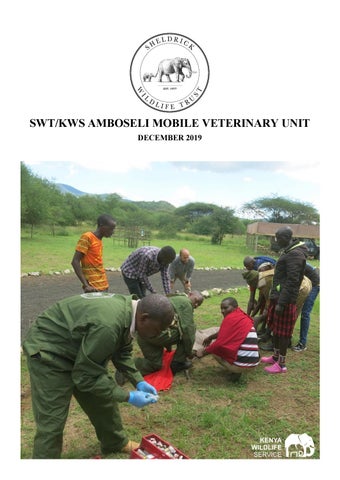
SWT/KWS AMBOSELI MOBILE VETERINARY UNIT DECEMBER 2019
Introduction
3 Cases in December
1 Lion Case
67% Success
December Report by Dr. Edward Kariuki During December 2019, Amboseli Mobile Veterinary Unit (AMVU) attended to 3 cases that required veterinary intervention. An emaciated lioness that had porcupine quills in its body and a lame lesser Kudu were treated during the month. Death of 3 sables at Shimba hills National Park was investigated and all were independent of each other. The sable deaths occurred at different times during a period of more than 6 months. And were not infectious or of any threat to the parent population. In addition, a Hippo that suffered fight wounds at Amboseli National Park could not be treated due to massive floods during the month, however, it has been observed to have improved and healed tremendously. A male lion reported sick at Dida Harea area in Tsavo East National Park was also attended but could not be traced even after a daylong search on the ground, it has not been sighted thereafter. Acknowledgement We thank Sheldrick Wildlife Trust (SWT) for material support and Mobile Unit funding, KWS for logistical support and security. Amboseli Park, Kuku and Tsavo East rangers for reporting and monitoring of the distressed animals.
Case Details Species
Area Found
13-Dec-19
Lion
Tsavo East NP
Natural Causes
16-Dec-19
Lesser Kudu
Tsavo West NP
Natural Causes
The leg had an old fracture that formed abnormally with extra bone tissue
17-Dec-19
Sable Antelope
Shimba Hills Reserve
Postmortem
The carcass was old (about 10 or more days after death) and found lying on the left lateral position
Date
Reason for Intervention The Management of Tsavo East National Park reported a lioness that had been sighted with porcupine quills embedded into its body
Outcome Successfully Treated Successfully Treated Died
SWT/KWS Amboseli Mobile Vet Unit Treatment Locations December 2019
Case 1 – 13th December 2019 Lion
Natural Causes
Voi, Tsavo East National Park
The Management of Tsavo East National Park reported a lioness that had been sighted with porcupine quills embedded into its body. The AMVU team prepared to attend and were airlifted to the location of via a SWT aircraft. Immobilisation, examination and treatment The lioness was approached with a vehicle and darted using 280mg Ketamine and 5 mg Medetomidine. The lioness responded well to the drug combination and was fully immobilized after 15 minutes. The lioness was located under a bushy tree in an area adjacent to the Voi airstrip. The lioness was inactive and looked severely emaciated. Four porcupine quills were removed from its body but had caused a minimal or insignificant injury. Additional, the lioness suffered laceration wounds on its body. The lioness was given 30ml Amoxycillin, ivermectin and Catasol. Prognosis The prognosis was fair. A major concern for this lioness would mostly emanate from the unspecific cause of emaciation, which most likely is the reason behind the lioness trying to adapt to unusual prey like porcupines.
. Case
2 – 16th December 2019
Lesser Kudu
Natural Causes
Tsavo West National Park
Report of a lame Lesser kudu was received from Maasai Wilderness Conservation Trust Team on the 14th December 2019. The kudu’s history indicated that the male had at least two other fractures in the past. The kudu was lame and walked with an abnormal gait.
Immobilisation, examination and treatment The male kudu was immobilized using a combination of Etorphine and Azaperone. The kudu responded well to the drug combination and went down on lateral recumbency after 10 minutes. The leg had an old fracture that formed abnormally with extra bone tissue. He was treated with 25ml of Amoxycillin and 20ml of a multivitamin. 15 ml Dexamethasone was injected to cover for the inflammatory reaction. Revival and Prognosis The lesser Kudu recovered in two minutes after an injection of 12mg Diprenorphine. It fed well after treatment and had good access to pasture and water, therefore the prognosis was determined as good.
Case 3 – 17th December 2019 Sable Antelope
Post-mortem
Shimba Hills
KWS-management at Shimba hills National Park reported death of a Sable antelope to AMVU on 16th December 2019. Examination and Findings The carcass was old (about 10 or more days after death) and found lying on the left side. Body tissues were fully decomposed and eaten by predators. No injuries established on the carcass. Age was estimated to be old. No information was available on the sable before death. History of another two cases of deaths found in the last six months was unrelated to this particular death. The carcass was open and all internal organs were eaten and removed. The abdominal organs were scavenged and eaten by maggots. The maggots had pupated and none were found on the carcass. There were no fluids on the ground. A few Beetles were found, but with most or all cartilaginous tissue exhausted. Cause of Death Non-conclusive, However, since the sable dentition formula clearly indicated that the female was advanced in age, death is likely to have been natural or related to old age.