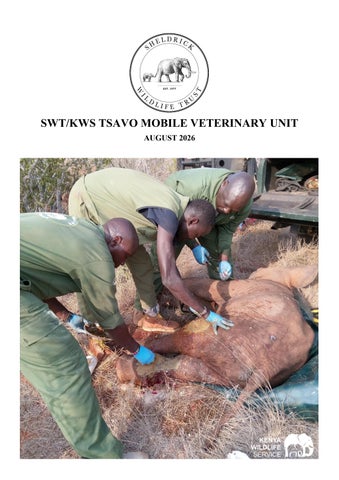
SWT/KWS TSAVO MOBILE VETERINARY UNIT AUGUST 2026
Introduction
17 Cases in August 2026
7 Poaching Cases
13 Elephant Cases
August Report by Dr. Campaign Limo The Conservation Area did not receive any rainfall during August. The vegetation is slowly drying up, and water pans are fewer and not as full. However, most of the animals are still in good body condition regardless of the oncoming drought. Despite this there have been an increase in cases this month, predominately involving elephants with spear or arrow wounds, a snare and a predation wound as well as 2 postmortems. Acknowledgement TMVU team would like to appreciate all the stakeholders who assisted in reporting all the cases that required veterinary intervention. Special thanks to KWS for the technical assistance and Sheldrick wildlife trust for the continuous facilitation to the unit.
SWT/KWS Tsavo Movile Vet Unit Treatment Locations August 2026
Case Details Date
Species
Area Found
7-Aug-26
Elephant
Tsavo East NP
8-Aug-26
Elephant
10-Aug-26
Reason for Intervention
Outcome
Natural Causes
The calf had deep septic bite wounds on the right joint
Successfully Treated
Kaluku
HWC
A problematic elephant had strayed from the park and was disturbing the residents
Task Successful
Elephant
Tsavo West NP
HWC
A stray elephant was intruding farms and causing disturbance
Task Successful
12-Aug-26
Lion
Taita Ranches
Collared
TMVU team was requested to help in collaring a lioness in Taita Sanctuary area
Task Successful
12-Aug-26
Lion
Taita Ranches
Natural Causes
The wounds were suspected to be inflicted during a fight with rival males.
Successfully Treated
21-Aug-26
Elephant
Tsavo East NP
Natural Causes
The calf had a penetrating, septic injury from a predation attempt
Successfully Treated
21-Aug-26
Elephant
Taita Ranches
Postmortem
The animal died as a result of rectal impaction
Died
22-Aug-26
Leopard
Tsavo East NP
Snared
Trapped with a tight cable snare around his waist with one end fixed to a pole
Successfully Treated
24-Aug-26
Elephant
Voi
Natural Causes
The predation wounds on the hind limbs still had some sepsis
Successfully Treated
24-Aug-26
Elephant
Lake Jipe
Postmortem
Cause of death was septic shock due to the chronic fibrinous peritonitis
Died
26-Aug-26
Elephant
Galana Ranch
Spear
The entire right forelimb was swollen with a deep penetrating injury
Prognosis Poor
26-Aug-26
Elephant
Taita Ranches
Snared
There was a deep tightly bound cable wire snare on the left tarsal joint
Successfully Treated
27-Aug-26
Elephant
Tsavo East NP
Arrow
A hard swelling on the left side of the abdomen caused by an arrow
Successfully Treated
27-Aug-26
Elephant
Tsavo East NP
Arrow
A hard swelling in the abdomen from which a poisoned arrow was removed
Successfully Treated
27-Aug-26
Elephant
Tsavo East NP
Spear
A deep septic wound on the right forelimb. The injury was spear inflicted
Successfully Treated
29-Aug-26
Leopard
Tsavo East NP
HWC
A leopard that was roaming and causing havoc outside the park
task Successful
31-Aug-26
Elephant
Galana Ranch
Spear
An elephant that was attended earlier with a spear and the prognosis was poor
Poaching Death
Case 1 – 7th August 2026 Elephant
Natural Causes
Tsavo East National Park
A report was made by KWS patrol team about a limping elephant calf in Bachuma area.
Immobilisation, examination and treatment For safe handling of the calf, both calf and the mother were immobilized using 1.5 mg and 20 mg Etorphine. Darting was done from a vehicle, and it took 7 minutes for both to attain full anaesthesia. The calf was brought close to the mother before treatment. Examination revealed that the calf had deep septic bite wounds on the right tarsal joint at the lateral and medial aspect and in the left tarsal joint on the medial aspect. There was also a septic wound on the left knee joint that had an opening on the lateral side. All the wounds affected the soft tissues only. The injuries were suspected to be predator inflicted. The abscesses were all drained out and the wounds cleaned thoroughly with water, flushed with Hydrogen peroxide, rinsed with water, dried with swabs and then infused with tincture of Iodine. They were thereafter packed with antibiotic pessaries and green clay, and a topical antibiotic spray applied. In addition, he was given Amoxicillin antibiotics and Flunixin anti-inflammatories. Prognosis The anaesthetic was reversed and they both rose and walked away together. Prognosis is good.
.
Case 2 – 8th August 2026 Elephant
Human-Wildlife Conflict
Kaluiku, Tsavo
A complaint of a problematic elephant that had strayed from the park and was disturbing the residents of Lukenya area was raised by the locals. Immobilisation, examination and relocation He was successfully immobilized using 20mg Etorphine hydrochloride delivered remotely in a 3 cc Dan inject dart from a SWT helicopter and it took 7 minutes for the drugs to attain full anaesthesia. He was then lifted on to a crane truck and transported safely back to Tsavo East National Park where he was lifted down. Prognosis He was reversed successfully using 220mg Naltrexone hydrochloride administered intravenously via a prominent ear vein and he rose after 3 minutes and walked away. He should do well in this protected enivroment.
Case 3 – 10th August 2026 Elephant
Human – Wildlife Conflict
Tsavo West National Park
A report was made by the community members of a stray elephant with an injured eye that was intruding their farms and causing disturbance to the community members.
Immobilisation, examination and treatment He was successfully anaesthetised using 20mg Etorphine hydrochloride from a SWT helicopter. Examination revealed that the right eye that was injured, by an arrowhead and the elephant had completely lost vision. The arrowhead was surgically removed and the eye cleaned with normal saline, flushed with Hydrogen peroxide, rinsed with normal saline, dried with swabs and infused with tincture of Iodine. Antibiotic pessaries were packed into the wound and Amoxicillin antibiotics and Flunixin meglumine antiinflammatories were administered. After treatment, he was loaded onto a crane truck and transported carefully with close monitoring to Komboyo in Tsavo West National Park. Prognosis Prognosis is good. He is expected to respond well.
Case 4 – 12th August 2026 Lion
Collared
Taita Ranches
TMVU team was requested to help in collaring a lioness in Taita Sanctuary area. This will help to monitor the lion and her pride in the area that is prone to human-wildlife conflict. Immobilisation, examination and collaring This lioness was successfully immobilized using a combination of 4.8mg Medetomidine and 200mg Ketamine delivered in a 3cc Dan inject dart. Darting was done from the vehicle, and it took 10 minutes for the drugs to achieve its full effect. The lioness was in good body condition. The GPS/VHF enabled collar was adjusted and secured to fit the girth of her neck with sufficient allowance for free movement of the collar. Prognosis The lioness was revived from anaesthesia using 25mg of Atipamezole given intramuscularly. She rose and walked away to join her pride 10 minutes later.
Case 5 – 12th August 2026 Lion
Natural Causes
Taita Ranches
Tourists spotted a lion that was walking gingerly and reluctant to move even on agitation on the road near Salt lick and reported.
Immobilisation, examination and treatment The lion was successfully anaesthetised using a combination of 5.8mg Medetomidine and 220mg Ketamine. It was darted from a vehicle and took 11 minutes for the anaesthesia to be achieved fully. On examination, he had some fresh chip wounds on the footpads of the left forelimbs and right hind limb. He also had a puncture wound on the right shoulder. The wounds were suspected to be fight inflicted by rival males. The wounds were cleaned with water, dried using swabs and infused with tincture of Iodine. A topical antibiotic spray was then applied. In addition, he was given Amoxicillin antibiotics and Meloxicam antiinflammatories, both administered parenterally. Prognosis Good- the wounds were fresh and he had good body condition.
Case 6 – 21st August 2026 Elephant
Human – Wildlife Conflict
Kaluku, Tsavo
The SWT team on watering points patrols spotted a limping elephant calf in Dida Harea area and alerted the TMVU team. Immobilisation, examination and treatment Both the mother and the calf were immobilized to provide safe treatment of the calf. The elephants were darted from a vehicle with 18 mg and 1.5mg Etorphine, and it took 7 minutes to achieve full anaesthesia. Examination of the calf revealed a penetrating, septic injury to the left stifle joint featuring entry and exit openings on the medial and lateral aspects. This is likely an attempted predation related injury. The wound was cleaned thoroughly with water, flushed with Hydrogen peroxide, rinsed with water, dried with gauze swabs and then infused with tincture of Iodine. Antibiotic pessaries were then packed in the wound and a topical antibiotic spray applied. In addition, Amoxicillin antibiotics and Flunixin meglumine antiinflammatories were administered parenterally. Prognosis Mother and calf were reunitd after treatment. Prognosisn is good- The injury was just on surface of soft tissues and the calf had good body condition. With the intervention given, he is expected to respond well.
Case 7 – 21st August 2026 Elephant
Postmortem
Taita Ranches
A report was made of an elephant carcass in the Izera area. TMVU team was requested to go determine the cause of the death. Postmortem examination The significant findings included; •
The age of the carcass was between 24-48 hours
• • • • •
The carcass was on left lateral recumbency The carcass was entirely bloated No signs of struggling on the ground No faeces on the surrounding area No faeces along the rectum on rectal palpation
Cause of death The animal died as a result of rectal impaction.
Case 8 – 22nd August 2026 Leopard
Snared
Voi, Tsavo East National Park
A leopard trapped in a snare outside the park near Voi wildlife lodge was reported by KWS, PAC team.
Immobilisation, examination and treatment He was successfully immobilized using a combination of 1.5mg Medetomidine and 120mg Ketamine delivered remotely from a vehicle, and it took 7 minutes for the anaesthesia to achieve full effect. Examination revealed that he was trapped with a tight cable snare around his waist with one end fixed to a pole. He had fresh injuries at the base of the tail likely caused by poking using sharp objects. The wire snare was cut loose using a wire cutter. The wounds were cleaned thoroughly using water and infused with tincture of Iodine. A topical antibiotic spray was then applied. He was also given Amoxicillin antibiotics and Meloxicam anti-inflammatories before being transported to Tsavo East National Park where he was to be released. Prognosis Good- he was in good body condition and the wounds on the tail area were not of major concern.
Case 9 – 24th August 2026 Elephant
Natural Causes
Voi, Tsavo East
This was a repeat treatment of an elephant calf with predation wounds that was rescued earlier and brought to Voi stockade for close monitoring. Immobilisation, examination and treatment She was immobilized successfully using 1.5mg Etorphine hydrochloride administered through a hand injection. Examination revealed that the wounds on the left and right hind limbs at the metatarsal joints still had some sepsis. The wounds were cleaned thoroughly with water, debrided with Hydrogen peroxide, rinsed with water, dried with gauze swabs and infused with tincture of Iodine. A topical antibiotic spray was the applied. In addition, she was given Amoxicillin antibiotics and Flunixin anti-inflammatories both administered parenterally. Prognosis Prognosis is good as the wound was showing good signs of improvement since the last treatment.
Case 10 – 24th August 2026 Elephant
Postmortem
Lake Jipe
The TMVU was requested to examine the carcass of a male elephant which was found dead near Lake Jipe. Postmortem examination A full postmortem examination was conducted and the following were the significant findings. • •
The carcass was fresh (Less than 24 hours) and on right lateral recumbency He had not defecated and there was muco-haemorrhagic discharge from the anus
•
There was a large volume of intraperitoneal fluid which was serosanguineous, had fibrin strips and adhesions and a foul smell There was marked peritonitis There was a perforation in the caecum There was generalized marked congestion in the visceral organs
• • •
Cause of death The peritonitis was caused by slow seepage of the ingesta into peritoneal space from the perforated caecum due to old age.
Case 11 – 26th August 2026 Elephant
Spear
Galana Ranch
A report was made by SWT/KWS team based in Galana about a bull elephant that was struggling to move with a fully swollen right forelimb in Galana area.
Immobilisation, examination and treatment He was darted from a vehicle with a dart containing 18mg Etorphine and it took 8 minutes for the drugs to achieve its effects. The examination revealed that the entire right forelimb was swollen with cellulitis and a deep penetrating injury on the medial right elbow joint – most likely a spear injury. The wound was cleaned thoroughly using water, flushed with Hydrogen peroxide, rinsed with water, dried with gauze swabs and then infused with tincture of Iodine. Antibiotic pessaries were then packed into the wound and a topical antibiotic spray applied. The elephant also received shots of Amoxicillin antibiotics and Flunixin meglumine anti-inflammatories parenterally. Prognosis Poor - The injury had affected the entire limb, and the elephant had significant lost body condition.
Case 12 – 26th August 2026 Elephant
Snared
Taita Hills
The Taita Hills Wildlife Sanctuary management saw an elephant that was limping and appeared to have a snare on his hind limb. Immobilisation, examination and treatment He was successfully immobilized using 10mg Etorphine delivered remotely from a vehicle and it took 9 minutes for the anaesthetic to achieve full effect. Examination revealed that there was a deep tightly bound cable wire snare on the left tarsal joint. The snare had cut deeply in the soft tissues inflicting septic injuries. The snare was carefully loosened and removed successfully and the wounds cleaned thoroughly with water, flushed with Hydrogen peroxide, rinsed with water and infused with tincture of Iodine. It was then packed with green clay and a topical antibiotic spray applied. In addition, he was administered with Amoxicillin antibiotics and Flunixin meglumine antiinflammatories parenterally. Prognosis Good- He was in good body condition and the injury was only to the soft tissues. With the management given, he is expected to respond well.
Case 13 – 27th August 2026 Elephant
Arrow
Ithumba, Tsavo East National Park
Ithumba Stockade management reported 3 injured elephants in their herd. Among the injured ones was this wild bull elephant that joined the stockade herd that was reported to have had the persisting swelling at the abdomen for some time.
Immobilisation, examination and treatment The bull was immobilized successfully using 20mg Etorphine delivered remotely through a 3cc Dan inject dart from a vehicle and it took 7 minutes for him to be fully immobilized. Examination revealed a hard swelling on the left side of the abdomen with an opening that had a little pus exudate. The wound was shallow with granulation. This was an old arrow wound. The wound was cleaned thoroughly using water, flushed with Hydrogen peroxide, rinsed with water, and then infused with tincture of iodine. Antibiotic pessaries were then packed in to the wound and a topical antibiotic spray applied. In addition, he was administered with Amoxicillin antibiotics and Flunixin meglumine anti-inflammatories. Prognosis Good- The wound was only on the surface and already healing.
Case 14 – 27th August 2026 Elephant
Arrow
Ithumba, Tsavo East National Park
This bull was among the three injured elephants at Ithumba Stockade. He was reported to have a swelling on the left abdominal side with pus exudates on the opening. Immobilisation, examination and treatment The bull was darted and successfully anaesthetised with 18mg Etorphine hydrochloride Darting was done from a vehicle and it took 8 minutes for the bull to be fully immobilized. Examination revealed that there was an opening on the proximal aspect of the hard swelling in the abdomen that had pus exudates. An incision was made deeply on the hard swelling and thick pus with a poisoned arrowhead was found. The arrowhead was pulled out successfully then the wound was cleaned with water, Hydrogen peroxide and Iodine then antibiotic pessaries were packed into the wound and a topical antibiotic spray applied. The bull was also given Amoxicillin antibiotics and Flunixin meglumine anti-inflammatories to fight infection and reduce pain and inflammation. Prognosis Prognosis is good as the animal was in good body condition.
Case 15 – 27th August 2026 Elephant
Spear
Ithumba, Tsavo East National Park
This was the 3rd case of the injured elephants at Ithumba Stockade for the day. He was reported to be limping on the right fore limb with a septic wound on the proximal aspect of the limb.
Immobilisation, examination and treatment He was approached with a vehicle and darted with 17mg Etorphine delivered remotely through a 3cc Dan inject dart. it took 7 minutes for the anaesthesia to achieve full effect. Examination revealed he had a deep septic wound on the right forelimb at the triceps that touched the humerus. The injury was spear inflicted. The wound was cleaned thoroughly using water, flushed with Hydrogen peroxide, rinsed with water, dried with gauze swabs and then infused with tincture of Iodine. Antibiotic pessaries were then packed into the wound and a topical antibiotic spray applied. To prevent infection and inflammation he was also given Amoxicillin antibiotics and Flunixin meglumine anti-inflammatories. Prognosis Prognosis is good as the animal was in good body condition.
Case 16 – 29th August 2026 Leopard
Arrow
Voi, Tsavo East National Park
A report was made by the community members about a leopard that was roaming and causing havoc outside the park near Voi wildlife lodge. TMVU was requested to assist capture and relocate the animal. Immobilisation, examination and relocation He was successfully anaesthetised using a combination of 1.5mg Medetomidine and 120mg Ketamine. He was darted from a vehicle at a safe distance it took 8 minutes for the anaesthetics to achieve full effect. Examination revealed he had a swollen head and appeared to be starving. The injuries were suspected to be fight inflicted which possibly caused him to be ousted from his normal territory. He was given intravenous fluids to boost energy and rehydration. He was then carefully loaded onto a vehicle and relocated back safely to Tsavo East National Park. Inside the park, he was reversed successfully from anaesthesia and within 10 minutes he regained total consciousness and he then sauntered away into the nearby bushes.
Case 17 – 31st August 2026 Elephant
Spear
Galana Ranch
This was a case of an elephant that was attended earlier with a spear wound on the medial right elbow joint and the prognosis was poor. His health deteriorated further collapsed and remained recumbent. Postmortem examination His condition had worsened and he was euthanised on grounds of animal welfare. A postmortem examination was then conducted and severe cellulitis was noted on the affected limb. Cause of death The spear wound had caused severe damage to the limb resulting in cellulitis, reducing the elephants ability to move to find forage and water resulting in poor body condition.