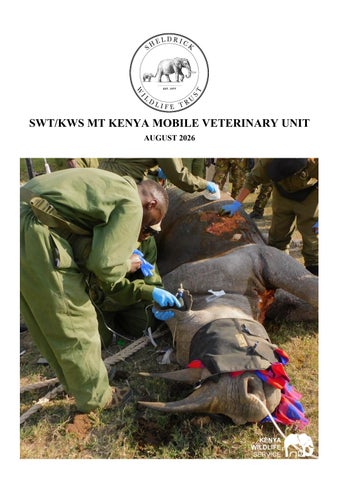
SWT/KWS MT KENYA MOBILE VETERINARY UNIT AUGUST 2026
Introduction
11 Cases in August 2026
2 Poaching Cases
2 Elephant Cases
August Report by Dr. Poghorn The Mountain Conservation area experienced hot and dry weather conditions with only a few sporadic rainfalls resulting in feed and water stress across the ecosystem. During August the Mt Kenya Veterinary Unit attended to 11 cases mainly comprising of clinical interventions, disease surveillance, and animal capture for translocation. The Unit was pivotal in the assistance of the Northern White Rhino Biorescue Program and carried out a male sterility check, a pregnancy check on a surrogate Southern White rhino female who had previously undergone embryo transfer, a breeding soundness on a potential Southern White rhino female surrogate, and ovum pick up and reproductive examination on 2 Northern White rhinos. Acknowledgement Sincere appreciations are extended to the Sheldrick Wildlife Trust for generous logistical and material support. Thank you to all the various stakeholders and conservancies for collaboration and coordination ensuring timely and effective veterinary interventions when required. We thank the Kenya Wildlife Service for continued stewardship which makes our work possible.
Case Details Date
Species
Area Found
Reason for Intervention
Outcome
2-Aug-26
Elephant
Laikipia
Natural Causes
Crepitus and abnormal limb instability, suggestive of a complete femoral fracture
Died
3-Aug-26
Hippo
Rift Valley Lake District
Postmortem
Found dead, following a territorial confrontation with another hippo
Died
6-Aug-26
Rhino White
Laikipia
Technical Cases
A routine periodic male sterility check of a Southern White rhino teaser bull
Task Successful
6-Aug-26
Rhino White
Laikipia
Technical Cases
A pregnancy check was indicated to monitor progress
Task Successful
7-Aug-26
Rhino White
Laikipia
Technical Cases
Escaped at the side of the road next to the reserve
Task Successful
8-Aug-26
Rhino White
Laikipia
Technical Cases
Southern white rhino female potential surrogate underwent a reproductive check
Task Successful
9-Aug-26
Rhino White
Laikipia
Technical Cases
Transrectal ovum pickup from Fatu
Task Successful
9-Aug-26
Rhino White
Laikipia
Technical Cases
A health assessment on a geriatric Northern White Rhino female
Task Successful
11-Aug-26
Rhino Black
Laikipia
Postmortem
The immediate cause of death was cardiovascular failure
Died
27-Aug-26
Giraffe
Laikipia
Spear
observation showed a traumatic injury caused by a spear
Prognosis Poor
29-Aug-26
Elephant
Laikipia
Bullet Wound
It was observed that there was a puncture wound from a bullet
Prognosis Poor
SWT/KWS MT Kenya Mobile Vet Unit Treatment Locations August 2026
Case 1 – 2nd August 2026 Elephant
Natural Causes
Mugies Ranch, Laikipia
A lone male elephant had been reported to be lame at Mugie Wildlife Conservanc,y It was noted on distant examination that the patient had severe non-weight bearing lameness of the left hindlimb. Immobilisation and examination The elephant was darted from the vehicle using 20mg Etorphine hydrochloride. Physical examination revealed a puncture wound on the left hind limb with active oozing of blood. Crepitus and abnormal limb instability are strongly suggestive of a complete femoral fracture, Prognosis and postmortem Given the severity of the injury, poor prognosis, and inability of an elephant to recover from a complete femoral fracture in the field, the patient received a poor prognosis. Humane euthanasia was recommended and a necropsy was performed to confirm diagnosis. The post-mortem confirmed a complete compound fracture of the left femur. The associated puncture wound showed haemorrhage extending into the surrounding soft tissues. The elephant sustained a complete fracture of the left femur with an associated puncture wound.
Case 2 – 2nd August 2026 Hippo
Postmortem
Lake Nakuru
A subadult male hippopotamus was found dead, lying in left lateral recumbency following a suspected territorial confrontation with an adult male. The carcass was recovered approximately 48 hours before the post-mortem examination. Postmortem examination The carcass was in good body condition with progressed autolysis and evidence of partial scavenger activity. External examination revealed two deep puncture wounds, one on the dorsum at the lumbar area and the other on the left flank. The two deep puncture wounds, extended into the peritoneal cavity. There was extensive haemorrhage around the puncture wounds at the intramuscular areas. On opening the abdomen, the peritoneum was markedly inflamed, with abundant fibrinous exudate and turbid peritoneal fluid, consistent with severe diffuse fibrinous peritonitis. The serosal surfaces of the abdominal organs were covered by fibrin deposits, and the abdominal organs were diffusely congested. Cause of death The wounds were consistent with penetrating bite injuries, most likely inflicted by the canine teeth of another hippopotamus during a territorial fight.
Case 3 & 4 – 6th August 2026 White Rhino
Technical Cases
Ol Pejeta Conservancy
As part of the Northern White Rhino Biorescue Breeding Program, a routine periodic male sterility check of a Southern White rhino teaser bull was carried out as well as a pregnancy check up on a female Southern White Rhino that had previously undergone an embryo transfer as a surrogate. Immobilisation and examination Juma, the male teaser bull, was immobilised with 40mg Medetomidine 40mg and 100mg Butorphanol followed by a second dart containing 100mg Butorphanol and 100mg Ketamine, both from a helicopter. Once the drugs took effect, the rhino received 500mg Ketamine from a blow pipe. The rhino was monitored consistently though the procedure to ensure a stabilised plane of anaesthesia as well as Ringers lactate and Oxygen supplementation. Following transfer of a Northern white rhino embryo to Amo, a Southern White rhino female surrogate on 19th June 2026 as part of the Northern White Rhino Biorescue Breeding Program, a pregnancy check was indicated to monitor progress. She was also darted from the helicopter using 35mg Medetomidine, 100mg Butorphanol. A blowpipe was then used to administer 500mg Ketamine. Patient monitoring was maintained during anaesthesia by use of a portable pulse oximeter, intra-arterial blood pressure monitoring, i-STAT blood analysis and manual monitoring of respiration. Ringers lactate and Oxygen supplementation were also administered. Conclusion The teaser bull was electro ejaculated and three fractions of ejaculate collected amounting to a total of 7- 8 ml which was viscous and clear. Microscopy revealed no sperm cells. Ultrasonography revealed that the left side epididymis where it was scarred was still intact however on the right-side signs of healing were showing therefore a sterility check will be needed in October to check his status. He was confirmed to be sterile, and he was fitted with a monitoring bracelet on the left forelimb. From external examination it was noted that Ano had bloody discharge on the vulva. An ultrasonography revealed there was presence of mucus on the vagina and further examination confirmed a functional corpus luteum on the right ovary which was smaller, firm and vascular which shows she thinks she’s pregnant. Free fluid was present in the right uterine horn. No scarring was present on the uterine lining. There were signs of possible early pregnancy, but no implantation occurred. She was confirmed not pregnant.
There are no pictures for this case.
Case 5 – 7th August 2026 White Rhino
Translocation
Solio Ranch
One adult male Southern White rhinoceros was reported to have breached the Solio Game Reserve fence and escaped at the side of the road next to the reserve. A decision was made to relocate the rhinoceros back at the reserve later that day by the Capture and Veterinary Unit.
Immobilisation and relocation The rhinoceros was chemically immobilised by darting from a vehicle using a Dan inject rifle, and a dart loaded with 5.5mg Etorphine and 60mg Azaperone. The anaesthesia was partially reversed using 1mg Diprenorphine to stabilise the respiration rate and ensure the rhino was calm enough to stand for loading into the crate. The rhino was then stimulated electrically to stand then ropes were placed around the head and hind limbs to guide the animal into the loading crate. Once in the loading crate, an extra dose of 12mg Diprenorphine was given intravenously. This second dose of partial reversal ensured the rhinoceros was able to stand during the transportation to the release site. The rhinoceros was transported by road on a truck back to the reserve and regularly monitored while on transit. It was off-loaded from the truck at the release site, near a watering point. The full anaesthesia reversal was administered intramuscularly using 110 mg Naltrexone. The entire operation went smoothly, and the rhino should flourish in its new habitat.
Case 6 & 7 – 8th – 9th August 2026 White Rhino
Technical Cases
Ol Pejeta Conservancy
A Southern white rhino female (Amaze,) who is a potential surrogate, underwent a reproductive checkup and a ovum pick up procedure was carried out on a Northern White rhino female (Fatu) as part of the Northern White Rhino Biorescue Breeding Program Immobilisation and examination Amaze was darted from a vehicle with 2 darts containing Midazolam, Butorphanol and Ketamine. During sedation the animal was monitored and given further drugs as needed to maintain a stable plane of anaesthesia. Ringers lactate, multivitamins and oxygen supplementation was also administered. Fatu’s companion was first sedated by a blow dart to allow for their separation. Fatu was then moved into a different enclosure alone where the rhino was immobilized by blow darting. The patient was manipulated and placed into sternal recumbency. Anaesthesia was then stabilized to facilitate required veterinary interventions with the patient position being periodically changed from left lateral, sternal and right lateral recumbencies as appropriate to the intervention being carried out and to ensure Fatu’s wellbeing by maintaining adequate respiration and limb perfusion. Rectal evacuation, flushing and disinfection was done followed by ultrasound-guided transrectal ovum pickup by needle aspiration. The aspirate was then processed in a field laboratory to filter out and preserve the ova in a transport medium ready for transportation to the main laboratory for embryo production. Conclusion Amaze was noted to have poor body condition, and lucerne supplementation was advised. She was also noted to have bloody discharge from the vulva, which was attributed to ticks present in the mucosa of the vulva. The vulva labia was wider than normal and she had mucus in the vagina which might suggest a new cycle. An ultrasound revealed that the left ovary had no corpus luteum. The right ovary had 5 – 10 follicles which were small in size. She is expected to cycle within 5 - 10 days. She was also fitted with a bracelet on the left forelimb to help with monitoring. Fatu’s operation was successfully completed with 19 ova collected.
There are no pictures for this case.
Case 8 – 9th August 2026 White Rhino
Technical Cases
Ol Pejeta Conservancy
A health assessment was carried out at Ol Pejeta on Najin, a geriatric Northern White rhino female. Immobilisation and examination Najin was given Detomidine and Butorphanol by hand injection which was then topped up following sedation to maintain smooth immobilisation in accordance with the physiological response and sedative parameters of the animal. The anaesthesia was monitored by evaluating respiratory rate (RR) through observation of thoracic excursions, as well as corneal and palpebral reflexes. Conclusion Both eyes have severe cataracts. The iris is attached to the pupil, and the pupil reflex are not fully functional and both pupils are opaque. The cornea was intact. Visual impairment was at 60%. An ultrasound showed the left ovary had a cystic tumour measuring 12cm by 12cm. Three tumours measuring 3cm by 3cm were present in the cervix. There were cysts in the endometrium. Oedema and ascites were observed in the perineal area which is suspected to be due to the oestrus. The right ovary had follicles showing its still functional.
Case 9 – 11th August 2026 Black Rhino
Postmortem
Ol Pejeta Conservancy
On the 9th August 2026, the rhino was treated by the Mountain Vet Unit and the Ol Pejeta Vet team but remained recumbent after reversal. She was supplemented using fluids but didn’t make it. Postmortem examination The carcass was found on left lateral recumbency. There was presence of filarial wounds on the chest, flanks and legs and there was froth coming from the nostrils. There was extensive gelatinization of the sub cutis fat layer and around the heart. The small Intestines mesenteric lymph nodes were enlarged and haemorrhagic and watery fluid but no food content was noted in most parts of the small intestines. There was marked haemorrhage of the serosal and mucosal layers in some areas. There was a large infestation of pin worms was seen in the colon. The liver had normal texture but upon incision had a cooked appearance. The thoracic cavity had copious amount of fluid and fat gelatinization. The trachea had extensive froth, and the lungs were congested and had froth in the airways. Cause of death The immediate cause of death was cardiovascular failure secondary to prolonged downer syndrome. The rhino remained recumbent for an extended period and was unable to rise despite veterinary intervention. The horns were processed under the OPC and KWS retrieval protocol
Case 10 – 27th August 2026 Giraffe
Technical Cases
Naibunga Community Conservancy
The Mt Kenya Vet Unit and the Loisaba Conservancy Vet Unit attended to an injured giraffe that was located by a drone deployed by Loisaba within a small herd. The clinical observation showed a traumatic injury caused by a spear impalement that was visible on the left flank. Immobilisation, examination and treatment The giraffe was darted from a vehicle with 15mg Etorphine. Once sedation set in the giraffe was guided into lateral recumbency with the help of the experienced ground personnel using ropes to prevent injury. The giraffe was quickly revived with 300mg Naltrexone then manually restrained by pinning his head and neck. Examination confirmed a penetrating 30cm deep spear wound on the left flank, piercing through the soft tissues to the rumen, with ruminal ingesta oozing out of the wound. The wound was contaminated and heavily infected with maggots and secondary infections. The spear was retrieved and the wound thoroughly cleaned with saline and Iodine, packed with Cloxacilllin ointment and Betadine clay then sprayed with Oxytetracycline. The giraffe was given Fluxin and Amoxicillin to address inflammation, pain and infection. Prognosis Prognosis is guarded and continuous monitoring was advised in case a repeat treatment is necessary.
Case 11 – 29th August 2026 Elephant
Bullet Wound
Mutara Ranch, Laikipia
From a distant examination the patient had severe weight bearing lameness of the left hindlimb. Asymmetry of the hind limbs was observed with distension noted at the metatarsal area of the left hindlimb. Immobilisation, examination and treatment The elephant was darted from the vehicle using 20mg Etorphine hydrochloride. It went down on the left side and was manipulate to the right side to allow access to the wound. Close examination confirmed there was a puncture wound at the metatsal area of the left hindlimb. The wound was explored and determined to be deep, extending to the joint and likely caused by a bullet wound. The wound was debrided with Hydrogen peroxide, lavaged with Iodine and packed with medical grade green clay. In addition, the elephant was given Flunixin as an anti-inflammatory agent. Amoxicillin to provide prophylactic infection cover and Catasol as a metabolic stimulant. Prognosis Prognosis is guarded due to the severity of the injury. It was recommended the elephant remain under constant monitoring to evaluate his progress.