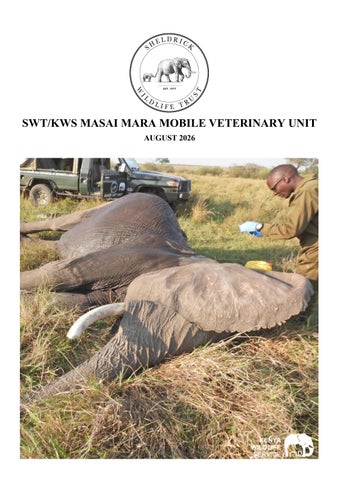
SWT/KWS MASAI MARA MOBILE VETERINARY UNIT AUGUST 2026
Introduction
7 Cases in August 2026
3 HWC Cases
3 Elephant Cases
August Report by Dr. Aminga Duncan August was characterized by predominantly dry conditions across the Mara Ecosystem, with vegetation in many areas gradually turning golden brown as the dry season progressed. The roads remained dusty, while water levels in several water pans quickly declined. Elephant sightings also appeared to decrease during the month, possibly due to the movement of herds towards areas with better availability of forage and water. During the month, the SWT/KWS Mara Mobile Veterinary Unit responded to seven wildlife cases, three of which involved elephants. There was a decrease in poaching related incidents, with more natural or Human – Wildlife Conflict cases. Acknowledgement The Mara Mobile Veterinary Unit sincerely acknowledges the generous and continued support of Elizabeth Scarlett and the Sheldrick Wildlife Trust, to the Mara Vet Unit. We also extend our appreciation to the Kenya Wildlife Service for its continued leadership, coordination, and administrative support through the Assistant Director, Narok County, and the Head of Veterinary Services. Our sincere gratitude also goes to the rangers and partner organizations whose timely reporting, and field support remained critical to the success of the various wildlife veterinary operations during the month. Their continued collaboration enabled the Unit to respond efficiently to wildlife emergencies and contribute meaningfully to the conservation and welfare of wildlife within the Mara ecosystem.
Case Details Date
Species
Area Found
8-Aug-26
Elephant
Masai Mara NR
8-Aug-26
Elephant
Siana Postmortem Conservancy
11-Aug-26
Elephant
Siana Conservancy
17-Aug-26
Giraffe
17-Aug-26
Reason for Intervention
Outcome
An adult female elephant had a suspected spear wound on the neck
Successfully Treated
Death was considered likely to have resulted from natural causes
Died
Natural Causes
An old female elephant that was sighted to be weak and in poor body condition
Prognosis Poor
Ripoi
HWC
An adult female giraffe and her calf had become trapped within an electrically fenced parcel of land
HWC Death
Giraffe
Ripoi
HWC
Rescue of the giraffe calf trapped in a fenced piece of land after the mother didn’t survive
Task Successful
19-Aug-26
Other
Masai Mara NR
Natural Causes
The calf was next to its deceased mother, who had multiple puncture wounds
Task Successful
25-Aug-26
Buffalo
Mara North
HWC
Became resident within a camp, posing a safety risk to both guests and camp staff
Task Successful
Spear
SWT/KWS Mara Mobile Vet Unit Treatment Locations August 2026
Case 1 – 8th August 2026 Elephant
Spear
Mara Triangle
An SWT pilot encountered an adult female elephant with a suspected spear wound on the neck. The Vet Unit were fortunately nearby and after an extensive search and assessment of several elephant herds in the area, the injured elephant was located within a herd of approximately 40 individuals. Her position within the herd and the heightened protective behaviour of the other elephants strongly suggested that she was the matriarch. A direct approach to the injured animal was particularly challenging so additional support was requested from the Mara Triangle team, who deployed a drone to assist with managing the herd.
Immobilisation, examination and treatment The herd was located in a dense area, and with assistance from the drone team, they were gradually guided into an open area. The elephant was cautiously approached by vehicle and darted. The remaining herd members were immediately pushed away to establish a safe working environment. Examination revealed a deep penetrating spear wound on the right side of the neck that was infected with purulent exudate and a second wound on the rump caused by an arrow. Both were thoroughly debrided with Hydrogen peroxide and Iodine, then infused with antibiotic pessaries, covered with an antibiotic aerosol and packed with green clay. Intramuscularly, she received 15,000mgs Amoxicillin and 3,000mgs Flunixin. Prognosis The prognosis for full recovery was considered good.
Case 2 – 8th August 2026 Elephant
Postmortem
Siana Conservancy
The Mara Mobile Veterinary Unit received a report regarding the sighting of an adult male elephant carcass in Nkomunisho Village, Naikara Ward, Narok West Subcounty. Postmortem examination The carcass was found in sternal recumbency in an advanced stage of decomposition. The elephant was in fair body condition, characterized by moderate musculature, no prominent ribs, and adequate subcutaneous fat reserves. Extensive tissue loss was observed, particularly around the cranial/frontal region and ventral abdomen. Most of the internal organs were in advanced stage of liquefaction, consistent with severe postmortem decomposition. The extensive tissue loss was further attributed to post-mortem scavenging, most likely by hyenas. Examination of the cutaneous system revealed no evidence of ante-mortem trauma or other external injuries. Prognosis Given the absence of identifiable ante-mortem injuries and considering the carcass was found in sternal recumbency, the elephant is suspected to have died from asphyxiation following collapse. This is considered likely to have resulted from natural causes.
Case 3 – 11th August 2026 Elephant
Natural Causes
Siana Conservancy
The SWT/KWS MaraVet Unit received a report regarding an old female elephant that was sighted to be weak and in poor body condition. She was reportedly sighted to have collapsed twice while in Siana Conservancy. Examination The elephant was found in a dense area, which limited a close physical examination. However, the team approached on foot to a safe distance and conducted a visual assessment. She was identified as a geriatric female based on her prominent tusks and a tail with markedly reduced hair tufts, consistent with advanced age. The conservancy rangers reported that she had not been observed defecating for several days, and no recent faecal deposits were identified in the surrounding area. The elephant also showed difficulty chewing, with partially chewed vegetation observed on the ground, suggesting significant dental wear. Prognosis The elephant was assessed to be experiencing age-related complications, compounded by the prevailing dry conditions. The ground team was advised to facilitate easier access to water by providing a trough near her location. Recent reports indicated her condition had improved, with the prognosis being considered as favourable. Continued monitoring was recommended.
Case 4 & 5 – 8th August 2026 Giraffe
Human-Wildlife Conflict
Ripoi Conservancy
The Mara Mobile Veterinary Unit received a distress report from the Elephant Aware team concerning an adult female Maasai giraffe and her calf that had become trapped within an electrically fenced parcel of land near Mara Ripoi Conservancy with limited access to water. While the Elephant Aware team was attempting to guide the giraffes out, the adult female collapsed and died shortly before the veterinary team arrived.
Immobilisation and relocation Post-mortem examination revealed poor body condition, prominent pelvic bones, severe dehydration, and pale mucous membranes. The likely cause of death was aspiration pneumonia secondary to regurgitation and aspiration of gastric contents. Following the loss of the mother, a decision was made to relocate the calf to a convenient area to improve its chances of survival. The calf was physically restrained using ropes and blindfolded before being carefully guided out of the enclosure through a series of fenced sections into Mara Ripoi Conservancy. He was successfully released in an area occupied by other giraffes, with adequate access to forage and water. The calf was a well-developed juvenile, capable of independent browsing and was therefore released to associate with other giraffe groups. Following release, close monitoring was recommended to assess his feeding behaviour, social integration, mobility, and general body condition. Subsequent sightings indicated that the calf had integrated with other giraffes and his continued association with the herd is expected to enhance his prospects for survival.
Case 6 – 19th August 2026 Hippo
Natural Causes
Masai Mara
The Mara Veterinary Unit received a distress report concerning an orphaned hippo calf in the Mara River Lookout area. The calf, was suspected to be approximately 1 year old, was found resting next to its deceased mother, who had multiple puncture wounds on the flanks and severe haemorrhage from the oral cavity. Examination The calf also had superficial abrasion wounds on the limbs. Based on the pattern of the injuries and field circumstances, it was suspected that the mother could have sustained fatal injuries during an aggressive encounter with an adult male hippo, possibly while attempting to defend the calf. Given the calf's young age and loss of maternal protection, its ability to survive independently in the wild was considered poor. A rescue operation was therefore planned for the following morning to assess and capture the calf for rehabilitation. The Unit visited the area early morning, but by the time the team returned to the area, the calf had disappeared with hyenas observed around the mother's carcass. A thorough search of the surrounding area was conducted, but the calf could not be located. Subsequent reports suggested that the calf may have joined another hippo pod in a different pool. If this occurred, association with an established pod would significantly improve its chances of survival by providing social protection and access to suitable habitat. The calf will therefore remain subject to opportunistic monitoring, with further intervention if necessary.
Case 7 – 25th August 2026 Giraffe
Human-Wildlife Conflict
Ripoi Conservancy
The Mara Veterinary Unit received a report concerning two rogue adult male buffaloes that had become resident within Elewana Elephant Pepper Camp in Mara North Conservancy, posing a potential safety risk to both guests and camp staff. Despite repeated attempts by the camp team to drive the buffaloes away from the premises, the animals remained within the campgrounds.
Immobilisation and relocation The two adult male buffaloes were found in good body condition and resting together. They were approached by vehicle and each darted with 8mgs Etorphine and 80mgs Azaperone. The first buffalo responded rapidly to the immobilizing drugs, while the younger bull showed a slower induction and subsequently received an additional 50mgs Ketamine intramuscularly. Once safely immobilized, both animals were blindfolded and carefully lifted using a wheel loader onto a transport truck provided by Mara North Conservancy. They were secured with straps and transported towards the boundary with Olare Motorogi Conservancy. During transportation, supplemental intramuscular Ketamine was administered when necessary to maintain adequate sedation and prevent the animals from attempting to stand. The buffaloes were safely unloaded at a suitable release site with good access to forage, water, and a natural salt lick. Both animals recovered uneventfully, regained their footing, and walked away with a good prognosis. The two bulls are expected to settle well in the new area without posing further risk to guests or camp staff.