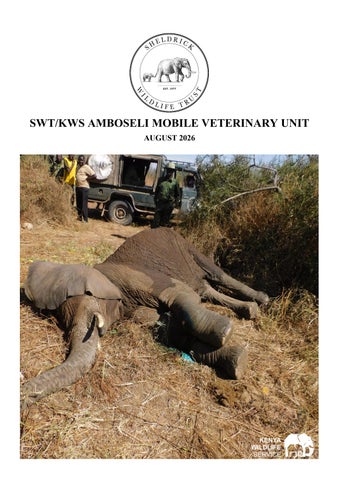
SWT/KWS AMBOSELI MOBILE VETERINARY UNIT AUGUST 2026
Introduction
14 Cases in August 2026
4 HWC Cases
11 Elephant Cases
August Report by Dr. Kariuki Edward The Southern Conservation Area and the Amboseli Ecosystem experienced a dry and hot period in August A total of 14 cases were attended to. The cases were dominated by elephants that were examined for various reasons. Other cases included displaced giraffes in Rombo, a suspected rabid hyena and an eland that was found injured. All the cases attended to demonstrated a broad aspect of Human Wildlife Conflict. Acknowledgement We thank Sheldrick Wildlife Trust (SWT) for material support and Mobile Unit funding. KWS Staff, ATE, BLF, KUKU, and Kiteden Conservancy Rangers for the field support and the monitoring of distressed wildlife are highly acknowledged and appreciated.
Case Details Date
Species
Area
Reason for Intervention
Outcome
1-Aug-26
Elephant
Amboseli Environs
Natural Causes
An elephant in physical compromise and inability to stand
Died
3-Aug-26
Elephant
Amboseli NP
Natural Causes
The caudal region had a large, fluctuant abscess localized to the perineal area
Successfully Treated
9-Aug-26
Elephant
Kimana Sanctuary
HWC
The cause of death remained inconclusive but likely due to HWC/poisoning
HWC Death
10-Aug-26
Elephant
Kimana Sanctuary
Natural Causes
The calf was found collapsed without its maternal herd nearby
Died
12-Aug-26
Elephant
Porini Conservancy
Natural Causes
The team successfully extracted a piece of wood from the leg
Successfully Treated
12-Aug-26
Elephant
Amboseli NP
HWC
Central neurological presentation, toxicosis; suspected cyanide poisoning
HWC Death
13-Aug-26
Baboon
Amboseli NP
Collared
Eight baboons were immobilised, sampled, and five were fitted with SP collars
Task Successful
17-Aug-26
Elephant
Amboseli NP
Postmortem
Bloody fluid discharging from both the trunk and the oral cavity
Died
23-Aug-26
Elephant
Kitenden Conservancy
HWC
The eland had failed to jump over a boundary fence and was injured
HWC Death
25-Aug-26
Elephant
Amboseli NP
Collared
The collar was successfully severed and completely removed from the animal
Task Successful
25-Aug-26
Elephant
Amboseli NP
Postmortem
Cause of death was inconclusive
Died
25-Aug-26
Elephant
Amboseli NP
Natural Causes
Diagnosis of severe joint ankylosis. likely involving a fracture or major joint trauma
Successfully Treated
27-Aug-26
Hyena
Amboseli Environs
Natural Causes
Completely lacked normal flight response and demonstrated signs of rabies
Died
28-Aug-26
Giraffe
Rombo
HWC
3 giraffes had been found dead likely due to HWC because of overpopulation
HWC Death
SWT/KWS Amboseli Mobile Vet Unit Treatment Locations August 2026
Case 1 – 1st August 2026 Elephant
Natural Causes
Amboseli Environs
The Amboseli Unit was called to the Lemomo to attend Ezbienta. On arrival, the female elephant was found in sternal recumbency and in a severely debilitated state. She was accompanied by her calf and two adult elephants who were actively attempting to assist Ezbienta to stand by physically pushing and lifting her. Examination, treatment and postmortem Examination she was physically compromised, characterized principally by inability to stand. Ezbienta was conscious, responsive and repeatedly kicked her limbs in an attempt to stand. The animal's inability to support her weight despite repeated voluntary attempts raised concern for severe systemic circulatory failure, metabolic compromise, muscular dysfunction or a combination of these processes. Given the circumstances and the possibility of an acute toxic or metabolic insult, immediate supportive therapy was initiated. The treatment administered comprised of 50ml of 50% glucose, 1,500 ml Ringer's lactate solution and 15mg Hydroxocobalamin (vitamin B12A). These were given to combat energy deficit, provide intravascular support. Restoration of tissue and management of certain acute toxic exposures, including cyanogenic toxicosis. Despite the intervention, her condition continued to deteriorate and she succumbed. Based on examination and postmortem findings death was attributed to cardiopulmonary and cardiovascular collapse associated with severe systemic shock possibly related to severe haemorrhagic gastroenteritis.
Case 2 – 3rd August 2026 Elephant
Natural Causes
Amboseli National Park
Field observers from the Amboseli Elephant Trust noted an elephant identified as “Bryony” with active purulent exudation from the perineal region when the elephant was in motion. Immobilisation, examination and treatment To facilitate safe clinical examination and surgical management of the perineal lesion, chemical immobilization was undertaken and she was darted from a vehicle. An examination revealed a large, abscess localized to the perineal area. A small fistulous opening was present immediately caudal to the anus and was actively discharging purulent material, confirming communication between the abscess cavity and the external surface. A surgical cut was made to establish adequate drainage and facilitate resolution of the localized infection. A vertical incision was made on the most ventral aspect of the abscess to establish dependent drainage. Following incision, a large volume of purulent was removed then the pocket was thoroughly cleaned. Antimicrobial and anti-inflammatory therapy was administered intramuscularly to address the infectious and provide perioperative analgesia and control of inflammation. Prognosis Prognosis was good following the intervention and she should make a full recovery.
Case 3 – 9th August 2026 Elephant
Human-Wildlife Conflict
Kimana Sanctuary
Big Life Foundation Rangers reported a dead adult female elephant found at Lion Hill within the Kimana Sanctuary. Based on the rangers’ detailed monitoring of the local herds, they strongly suspected that the elephant belonged to the resident “TC” family group. Postmortem examination Based on the extensive generalized emphysema, heavy fly colonization and tissue breakdown, the carcass was estimated to have been approximately 2-3 days old. Signs of a violent perimortem struggle were present, characterized by deep digging and churning of the soil adjacent to the limbs. Opportunistic postmortem scavenging was also observed. Putrefactive, blood-tinged exudation was present from the mouth and the scavenged areas. Advanced autolysis and putrefaction had progressed rapidly, resulting in extensive tissue degradation and loss of normal cellular and gross anatomical architecture. Upon opening the body cavities, the internal organs were found to be decomposed which prevented a comprehensive postmortem. The necropsy protocol was directed toward diagnostic sampling. Samples of the kidney and liver, pooled blood and stomach contents, were collected for subsequent laboratory toxicological analysis Cause of death The cause of death was inconclusive but due to recent poisonings in the area, this could be another victim.
Case 3 – 10th August 2026 Elephant
Human-Wildlife Conflict
Kimana Sanctuary
The Rangers from the Maasai Wilderness Conservation Trust reported an elephant calf in severe distress near Esambu Camp. The calf was found collapsed without its maternal herd nearby, although Range
rs reported the family group had been sighted earlier that morning before abandoning the compromised calf. Examination, treatment and po
Case 4 – 10th August 2026 Elephant
Natural Causes
Kimana Sanctuary
The Rangers from the Maasai Wilderness Conservation Trust reported an elephant calf in severe distress near Esambu Camp. The calf was found collapsed without its maternal herd nearby, although Rangers reported the family group had been sighted earlier that morning before abandoning the compromised calf. Examination, treatment and postmortem Upon arrival, a clinical assessment revealed the calf had poor body condition, indicating that it had likely been affected by an underlying disease process long before the collapse. The calf was severely dehydrated and had markedly congested conjunctival mucous membranes, suggestive of systemic shock and/or toxemia. Aggressive supportive therapy was immediately including 1,500 ml Ringer's Lactate and 1,000 mL of 10% Glucose for rapid fluid restoration and correction of any energy deficit. Systemic medical support included 15 ml Amoxicillin and 5mL Dexamethasone to address infection, physiological stress, systemic inflammation, and shock. Nutritional support was attempted; however, the markedly lethargic calf was reluctant to suckle from a bottle, and formula milk was carefully administered orally using a syringe. Following administration of fluids and medications, the veterinary team assisted the calf to stand, and the calf made weak and uncoordinated attempts to ambulate. The prognosis was considered guarded and the calf died shortly after. The cause of death was systemic shock caused by septicaemia and/or toxaemia and suspected poisoning.
Case 3 – 10th August 2026 Elephant
Human-Wildlife Conflict
Kimana Sanctuary
The Rangers from the Maasai Wilderness Conservation Trust reported an elephant calf in severe distress near Esambu Camp. The calf was found collapsed without its maternal herd nearby, although Rangers reported the family group had been sighted earlier that morning before abandoning the compromised calf. Examination, treatment and postmortem Upon arrival, a clinical assessment revealed the calf had poor body condition, indicating that it had likely been affected by an underlying disease process long before the collapse. The calf was severely dehydrated and had markedly congested conjunctival mucous membranes, suggestive of systemic shock and/or toxemia.
Case 5 – 12th August 2026 Elephant
Natural Causes
Porini Conervancy
Porini camp attendants reported a sub-adult female elephant in distress. Camp staff had observed the elephant lingering near a local watering hole and noted a painful limp affecting the left forelimb.
Immobilisation, examination and treatment To safely evaluate the source of the lameness and treat the affected limb, chemical immobilization was required. The veterinary team approached the elephant and successfully darted her with 15 mg Etorphine. A thorough physical examination revealed that the elephant was maintaining a good overall body condition despite the lameness. The source of the pain was identified as a deep, actively purulent puncture wound located on the left forelimb. Careful probing and exploration of the painful tissue tract revealed an embedded foreign body. The team successfully extracted a piece of wood measuring approximately 8 cm in length. Wound management was immediately initiated. The purulent exudate was manually evacuated, and the necrotic cavity was flushed with hydrogen peroxide, water and Iodine, then 4 Oxytetracycline pessaries were inserted deep into the puncture tract, and topical Oxytetracycline spray was applied. To address infection, tissue inflammation and pain, 100 ml of Amoxicillin and 20ml Dexamethasone were administered. Relocation, revival and prognosis The prognosis was good since the foreign body was removed, wound treated and she was in good condition.
.
Case 6 – 12th to 17h August 2026 Elephant
Human Wildlife Conflict
Oldepe, Kitenden
A local herdsman reported hearing a heavy fall and discovered a male elephant collapsed. The elephant's family immediately gathered around and made several unsuccessful attempts to lift him back to his feet.
Immobilisation, examination and treatment The veterinary team found the young bull on his side, fully conscious and periodically making vigorous, desperate attempts to get up by kicking and thrashing his limbs. However, these efforts resulting only in the elephant rotating in circles and digging deep trenches into the surrounding soil. Over the course of six consecutive days, the AMVU team remained on-site to administer intensive, multimodal emergency field therapy. The team immediately initiated a targeted antidotal and fluid resuscitation protocol which was continued over the days. The elephant received Ringer’s Lactate, Dextrose, Sodium Thiosulfate, Glucose, Amoxicilli, Catosal and Normal saline. Suspecting cyanide toxicosis, Hydroxocobalamin was administered During this time, the team attempted to mechanically support the elephant into sternal recumbency, but the animal lacked the neuromuscular strength to support himself. Prognosis Based on postmortem and history of a sudden collapse without an obvious traumatic etiology, combined with the weakness and central neurological presentation, toxicosis, cyanide poisoning was suspected.
.
Case 7- to 17h August 2026 Baboon
Collaring
Kitirua, Amboseli National Park
A research permit was issued to Amboseli Baboon Research Project by KWS and WRTI. The project was allowed to dart a maximum of 40 and collar a maximum of 20 baboons for this permit year.
Immobilisation, examination and treatment Telazol (Tiletamine and Zolazepam) helped in the restraint of eight baboons. All baboons attained full immobilisation in 3-8 minutes. Eight baboons were immobilised, sampled, and five were fitted with SP collars. Data collected included body mass, long bone measurements, tooth casts, hair samples, and blood samples for genetic analysis. Three VHF collars were deployed on three females. The immobilised baboons appeared in good body condition and weighed within the normal range. The dental formulae and examined lymph nodes were of normal size, though a few were slightly enlarged. Enlarged lymph nodes were attributed to females during active menstrual periods. These conditions confirmed the health and suitability of the baboons for collaring with VHF and GPS devices. Blood, skin, and hair samples were collected for further testing. Cardiac monitoring devices were implanted subcutaneously in five female baboons. Prognosis Task was successful, all 13 baboons recovered with no problems.
.
Case 8 – 17th August 2026 Elephant
Natural Causes
Kimana Sanctuary
The Local herdsmen conducting routine grazing activities in the Intemua area discovered the carcass of a 14year-old female elephant, later positively identified as "Philippi" Postmortem examination The carcass was found on its side with a body condition score of 3 out of 5 prior to death. Rigor mortis was fully established, and moderate postmortem bloat was present. An environmental assessment revealed lack of struggle marks in the surrounding soil or vegetation, indicating a sudden collapse. On external examination there was the presence of bloody fluid discharging from both the trunk and the oral cavity. The adipose tissue exhibited generalized wasting and both peripheral and epicardial fat reserves showed distinct gelatinization. The lymph nodes were oedematous and congested or haemorrhagic. The lungs were markedly enlarged and congested. Extensive haemorrhaging was also observed within the bronchial airways. The heart appeared rounded with a thickened myocardium and accumulation of pericardial fluid. The epicardium, myocardium and the endocardium as well as the spleen were all had ecchymotic haemorrhages. The liver exhibited rounded edges and presented with a distinctively friable, necrotic, cooked appearance. Cause of death The definitive cause of death was acute cardiopulmonary failure and vascular collapse secondary to a highly virulent systemic infection
Case 3 – 10th August 2026 Elephant
Human-Wildlife Conflict
Kimana Sanctuary
The Rangers from the Maasai Wilderness Conservation Trust reported an elephant calf in severe distress near Esambu Camp. The calf was found collapsed without its maternal herd nearby, although Rangers reported the family group had been sighted earlier that morning before abandoning the compromised calf. Examination, treatment and postmortem Upon arrival, a clinical assessment revealed the calf had poor body condition, indicating that it had likely been affected by an underlying disease process long before the collapse. The calf was severely dehydrated and had markedly congested conjunctival muc
Case 9 – 23rd August 2026 Eland
Postmortem
Kitenden Conservancy
The KWS Problem Animal Control team reported a sub-adult female eland that had attempted to jump over a boundary fence to enter a local community farm. She failed to clear the barrier safely and was injured. Examination She was discovered stranded and immobile on the farm side of the fence. She was in good overall body condition. As we approached to assess her, she was alert and clearly motivated to rise but was completely unable to support her own weight. Neurological and musculoskeletal examination revealed the severity of her injuries. Although she retained partial ability to lift her head and neck, she had completely lost motor function in the right forelimb. Careful palpation along the cervical spine localized the source of the neurological deficit, with a fracture of the cervical vertebrae detected. This catastrophic spinal injury was considered to have resulted from the high-impact trauma sustained when she collided with the fence. Cause of death In a large, free-ranging antelope species, a cervical vertebral fracture accompanied by severe neurological deficits carries a definitively poor prognosis. Field surgical intervention or prolonged conservative rehabilitation for a wild prey animal with this degree of spinal trauma would have been impractical and ethically unjustifiable. For these reasons the animal was humanely euthanised.
Case 3 – 10th August 2026 Elephant
Human-Wildlife Conflict
Kimana Sanctuary
The Rangers from the Maasai Wilderness Conservation Trust reported an elephant calf in severe distress near Esambu Camp. The calf was found collapsed without its maternal herd nearby, although Rangers reported the family group had been sighted earlier that morning before abandoning the compromised calf. Examination, treatment and postmortem Upon arrival, a clinical assessment revealed the calf had poor body condition, indicating that it had likely been affected by an underlying disease process long before the collapse. The calf was severely dehydrated and had markedly congested conjunctival muc
Case 10 – 25th August 2026 Elephant
Collared
Amboseli National Park
Amboseli Trust for Elephant regarding a 22-year-old male elephant named Pakwach. He had been fitted with a telemetry collar in 2019 for a behavioural tracking study that had since concluded. Male elephants in their late teens and early twenties undergo significant physical maturation, rapidly increasing their body mass and neck circumference. Field monitors noticed that the collar was becoming dangerously uncomfortable as he grew, creating a very real risk of strangulation or severe friction wounds. Immobilisation and de-collaring We approached Pakwach and darted him with 20mg Etorphine. He was monitored closely from a safe distance as the opioid took effect. He experienced a smooth and steady induction. As soon as he was secured, we conducted a rapid physical assessment. Pakwach was in excellent overall body condition, which was consistent with what would be expected in a healthy, growing bull. Consistent with the field monitors’ concerns, the collar had become tight around his expanding neck. Fortunately, the intervention was undertaken at an appropriate time. Examination of the thick folds of skin beneath and around the collar revealed no evidence of pressure necrosis, friction lacerations or strangulation injuries. To decommission the unit, we used a heavy-duty hand saw to manually cut through the thick, reinforced belting material. The collar was successfully severed and completely removed from the animal.
Cause of death In a large, free-ranging antelope species, a cervical vertebral fracture accompanied by severe neurological deficits carries a definitively poor prognosis. Field surgical intervention or prolonged conservative rehabilitation for a wild prey animal with this degree of spinal trauma would have been impractical and ethically unjustifiable. For these reasons the animal was humanely euthanised.
Case 3 – 10th August 2026 Elephant
Human-Wildlife Conflict
Kimana Sanctuary
The Rangers from the Maasai Wilderness Conservation Trust reported an elephant calf in severe distress near Esambu Camp. The calf was found collapsed without its maternal herd nearby, although Rangers reported the family group had been sighted earlier that morning before abandoning the compromised calf. Examination, treatment and postmortem
Case 11 – 25th August 2026 Elephant
Postmortem
Amboseli National Park
KWS ranger spotted a large group of vultures circling and descending, signalling a significant mortality event in the bush. The rangers investigated the site and found an elephant carcass. Postmortem examination We found the remains of a young female elephant but unfortunately, it was immediately clear that we were too late to get a pristine look at what had happened to her. The harsh environmental heat had accelerated the decomposition process. The carcass was bloated and her tissues were heavily emphysematous. Opportunistic scavengers had already thoroughly claimed the site. Dark, bloody fluids were oozing from these scavenged margins, which is a common postmortem change as tissues begin to liquefy and blood pools. Between the overwhelming foul odor, the heavy colonization of flies, the severe tissue degradation and the extent of the scavenger damage, we estimated that she had been dead for at least 3-4 days prior to our arrival. Through a process called autolysis, the internal organs rapidly break down and essentially melt into an unrecognizable state. Furthermore, because scavengers had already heavily breached and destroyed her abdominal cavity, we made the decision to forgo opening the carcass for an internal examination. Cause of death Cause of death was inconclusive due to decomposition and scavenger damage. Cause of death In a large, free-ranging antelope species, a cervical vertebral fracture accompanied by severe neurological deficits carries a definitively poor prognosis. Field surgical intervention or prolonged conservative rehabilitation for a wild prey animal with this degree of spinal trauma would have been impractical and ethically unjustifiable. For these reasons the animal was humanely euthanised.
Case 3 – 10th August 2026 Elephant
Human-Wildlife Conflict
Kimana Sanctuary
The Rangers from the Maasai Wilderness Conservation Trust reported an elephant calf in severe distress near Esambu Camp. The calf was found collapsed without its maternal herd nearby, although Rangers reported the family group had been sighted earlier that morning before abandoning the compromised calf. Examination, treatment and postmortem
Case 12 – 25th August 2026 Elephant
Natural Causes
Amboseli National Park
The Amboseli Trust for Elephants observed a known 23-year-old female elephant named Natalie exhibiting a pronounced, persistent limp that heavily favoured her right forelimb. Immobilisation, examination and treatment We approached Natalie and darted her with 15mg Etorphine. Natalie was in overall poor body condition, and the carpal joint was visibly inflamed and enlarged. However, as we palpated the joint deeply, we did not feel the soft, fluctuant swelling that would be expected from an acute injury or an active abscess. Instead, we felt a massive, rock-hard accumulation of bony callus tissue. To definitively rule out a deep, encapsulated infection, we performed a diagnostic needle aspiration of the area. Only whole blood, with no signs of pus or purulent material was retrieved. These findings confirmed a diagnosis of severe joint ankylosis. At some point in the past, Natalie had suffered a catastrophic injury to the carpus, likely involving a severe fracture or major joint trauma. The body attempted to stabilize the joint on its own, resulting in poorly aligned bony callus formation that permanently fused the joint together. To help ease the localized inflammation and infection she was given systemic analgesic, anti-inflammatory support and antibiotics. Prognosis Her overall prognosis was considered good as the original injury had completely healed.
Case 13 – 25th August 2026 Hyena
Natural Causes
Amboseli Environs
The KWS Problem Animal Control (PAC) team at Serenkei received a report of an adult male hyena breaching a community boma around 7:00 PM to attack sheep. The herdsmen actively defended their livestock and speared the hyena, but the animal completely lacked a normal flight response. Instead of retreating or attempting to escape the physical trauma, it simply stood its ground, showing an absolute loss of natural fear. Unfortunately, it was killed by the community members. Postmortem examination Wild carnivores displaying unprovoked aggression combined with a total loss of self-preservation instincts, a central neurological infection, specifically the rabies virus, is among the diagnostic differential lists. To definitively diagnose or rule out rabies, blood tests or tissue swabs cannot be relied upon. The central veterinary laboratory requires intact brain tissue to perform a Fluorescent Antibody Test (FAT). To secure this vital diagnostic sample, the PAC team safely and carefully severed the head of the hyena, which was properly packaged and retained for secure transport to the laboratory. Cause of death This incident was treated as a high-priority suspected rabies case. The secured head was transported to the laboratory and we are currently awaiting the definitive results. Rabies is a universally fatal zoonotic disease, meaning that
protecting the local community and the surrounding ecosystem is of highest priority. To prevent any potential viral transmission to humans, domestic dogs or wild scavengers that might feed on the remains, stringent environmental biosecurity measures were implemented immediately. The remaining carcass was carefully disposed of.
There are no pictorials for this case.
Case 14 – 28th August 2026 Giraffe
Human-Wildlife Conflict
Rombo Area
A report of distressed giraffe population was received from the Warden Rombo. Three giraffes had been found dead with spear wounds, pointing toward a sudden and violent escalation in Human-Wildlife Conflict. Assessment Upon arrival in Rombo and examination of the giraffe remains; we were confidently able to exclude obvious infectious disease outbreak based on the gross field findings. To understand the circumstances surrounding these mortalities, it was necessary to assess the broader ecological landscape. The giraffe population in Rombo was observed to be highly scattered and geographically isolated, with the animals occurring outside the protected boundaries. The giraffes are attempting to survive within an international border landscape characterized by extensive human settlement and intensive agricultural cultivation increasing the frequency and intensity of human-wildlife interactions. The mortalities demonstrated the severe consequences of wildlife attempting to persist in an increasingly human-dominated agricultural landscape. Recommendation The prognosis for this isolated population is guarded without effective intervention. Giraffe movements should be monitored and animals deterred from entering farm. In the long term, translocation of some of the giraffes should be considered to more suitable and secure sites.