Rebuilding Kenya’s Black Rhino Population
Dear Friend of Sheldrick Wildlife Trust,
Growing up in Tsavo, the black rhino was just part of the landscape. Every game drive was punctuated by their prehistoric, hulking silhouettes — and more than once, punctuated literally, as a vehicle tyre met a rhino’s horn! They were everywhere. Then, within a single generation, they were gone.
Poaching very nearly destroyed the species. Between 1970 and the early 1990s, Africa’s black rhino population plummeted 96 percent. Tsavo, once home to more than 8,000 black rhinos, was left with a shadow population of 20 or so survivors. It is difficult to reconcile that, within my own lifetime, these extraordinary animals were almost entirely erased — not just from Kenya, but from the world.
But today, that story is changing. Kenya is now home to more than 1,000 black rhinos — representing more than threequarters of the global Eastern black rhino population. That recovery didn’t happen by chance. It is the result of decades of painstaking work by dedicated conservationists, rangers, veterinarians, and supporters like you. The Sheldrick Wildlife Trust has been part of this effort from the very beginning, helping to establish Kenya’s earliest rhino sanctuaries in the 1980s, including Ngulia, Lake Nakuru, and more recently, Meru Rhino Sanctuary, along with the infrastructure that underpins impactful conservation.
Rhino conservation is a cornerstone of our work. We are active across six key rhino landscapes in Kenya: Meru, Laikipia, the Rift Valley, Tsavo, the Maasai Mara, and Nairobi National Park. Our SWT/KWS Mobile Vet Units have attended to more than 1,200 rhinos to date — responding to emergencies, supporting translocations, and conducting notching and radio identification operations that allow field teams to monitor individual animals.
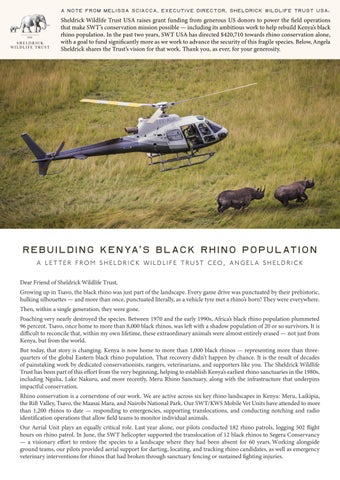
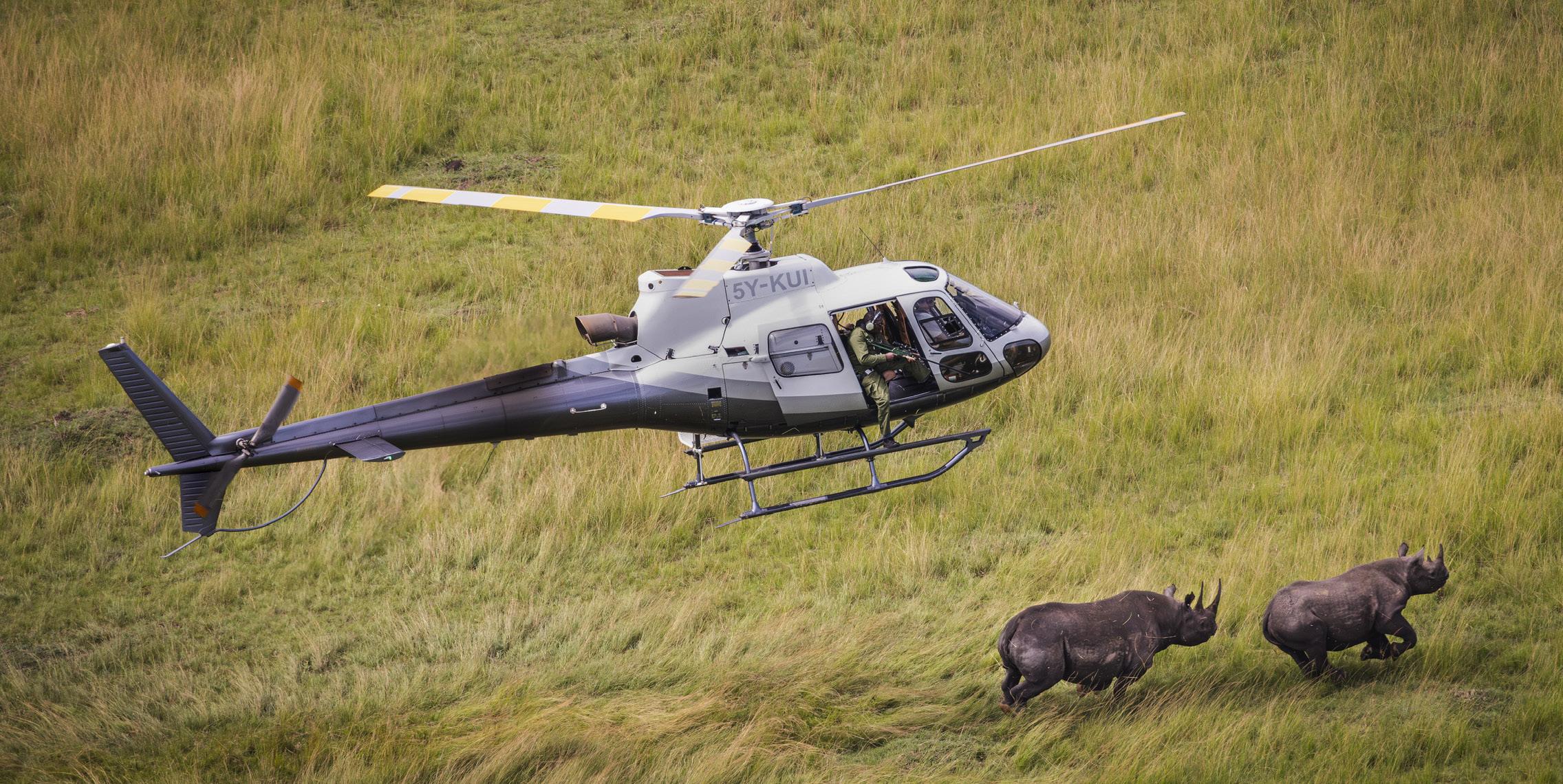
Our Aerial Unit plays an equally critical role. Last year alone, our pilots conducted 182 rhino patrols, logging 502 flight hours on rhino patrol. In June, the SWT helicopter supported the translocation of 12 black rhinos to Segera Conservancy — a visionary effort to restore the species to a landscape where they had been absent for 60 years. Working alongside ground teams, our pilots provided aerial support for darting, locating, and tracking rhino candidates, as well as emergency veterinary interventions for rhinos that had broken through sanctuary fencing or sustained fighting injuries.
49 years committed to rhino conservation
20
orphaned black rhinos successfully raised
1,200 rhinos attended by swt/ kws mobile vet units
500 hours flying rhino patrols anually
In the Maasai Mara, the Aerial Unit supported a two-year effort to ear-notch and fit selected individuals with low-impact radio tags that allow field teams to track their movements, successfully darting 27 rhinos across the operation. They also played a key role in Kenya’s largest-ever notching operation, where 90 black rhinos in Tsavo West were darted from the air, ear-notched, and fitted with trackers.
Partnering with the Kenya Wildlife Service, our newest innovation is a dedicated Drone Unit to bolster our anti-poaching operations. Flying day and night with thermal imaging technology, the teams extend our patrol capability into terrain and hours that were previously out of reach. Already, our drone teams have located two rhinos in Tsavo that had long eluded field teams — just one example of the enhanced monitoring this new technology makes possible.
Conservation is only as effective as the people doing the work on the ground. This year, we invested significantly in those people and the infrastructure supporting them. We completely revamped the Tsavo East Rhino Monitoring Headquarters, giving KWS personnel a stateof-the-art facility from which to conduct their operations in Kenya’s largest national park. We donated vehicles for rhino rangers working in the Mara and rebuilt their bases. We also replaced 18,000 meters of a deteriorating fence at Meru Rhino Sanctuary with a reinforced 14-strand fence line, adding to the 48-kilometre fenceline we have already completed there. We fund the ongoing maintenance of this ‘wild border,’ which protects both the rhinos within the sanctuary and the communities beyond from marauding wildlife.
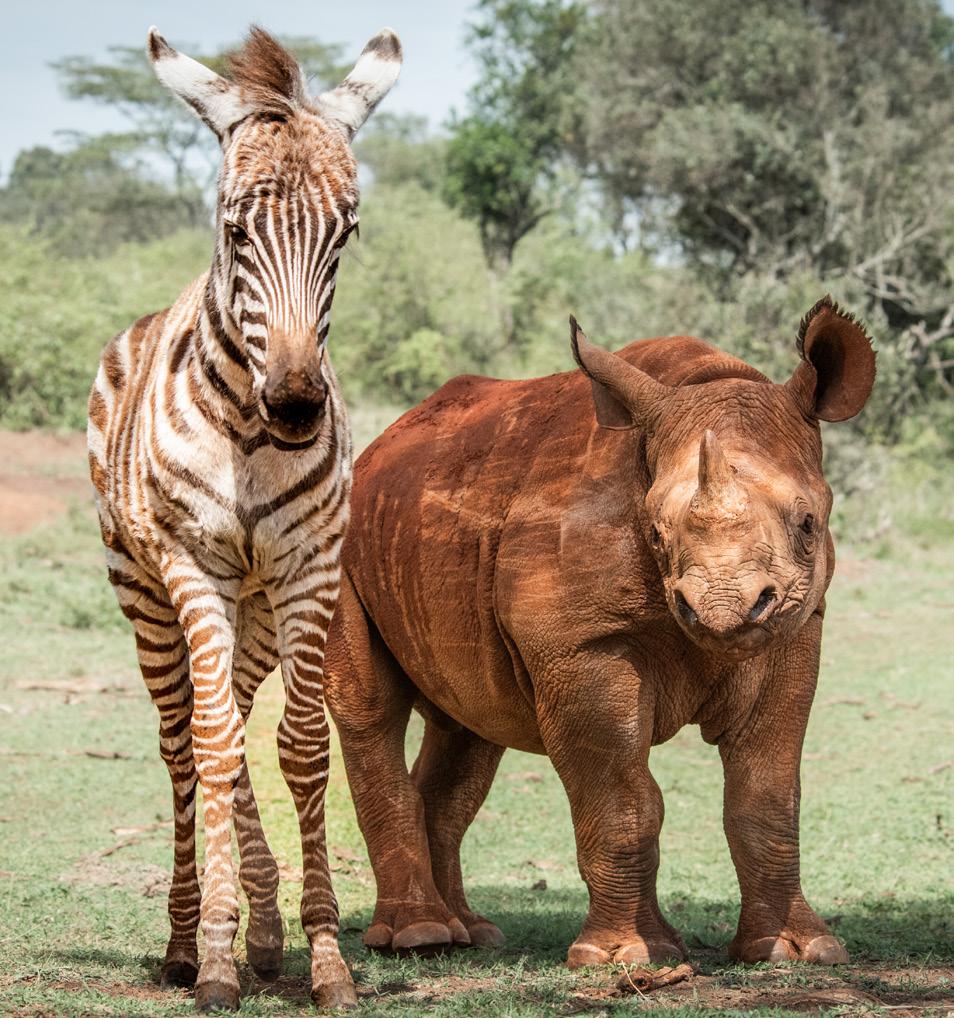
Meanwhile, we are nurturing the next generation through our Orphans’ Project. We currently have four orphaned black rhinos in our care. Maxwell, who is blind and will have a forever home with us, has become a beloved ambassador for his species. Apollo, now an impressive seven-year-old, is working his way back to the wild. Twoyear-old Chamboi will soon follow in his footsteps. Little Tytan, who was only rescued in September, is just beginning his journey. They join a lineage of success: Our most recent graduate, Solio, now lives in Nairobi National Park and is a mother to two wild calves.
In December, we supported KWS and stakeholders in the creation of the Tsavo West Rhino Sanctuary, the world’s largest rhino sanctuary. It unites the populations of Ngulia and the Tsavo West Intensive Protection Zone into a single protected landscape. This was a full circle moment: Tsavo is where I watched rhinos flourish and then disappear. It is where we helped establish the very first rhino sanctuary due to the poaching crisis back in the 1980s. Now, it is where we are helping bring the species into a new phase of recovery.
Few organisations have been part of Kenya’s rhino story as long as we have. We have the expertise, resources, and long-term field presence to support their revival. Kenya’s Black Rhino Recovery and Action Plan sets an ambitious target: a national population of 2,000 black rhinos by 2037. Achieving that goal will require serious commitment and sustained investment in technology, ranger training and equipment, veterinary care, aerial operations, fencing, and monitoring.
The recovery of black rhino is one of Kenya’s great conservation stories — but the story is far from over. With your support, we can continue building on the successes we have already achieved for this fragile species, and keep their recovery moving forward.
Most sincerely,
Angela Sheldrick ceo, sheldrick wildlife trust
tytan the orphaned black rhino, with his best friend notty the zebra