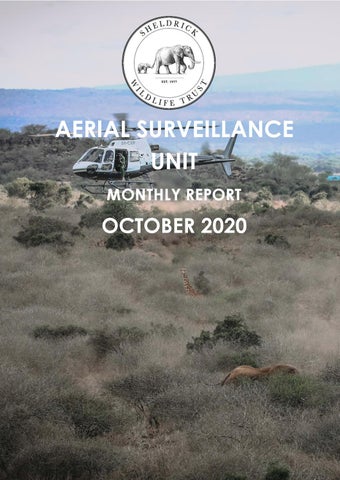
AERIAL SURVEILLANCE UNIT MONTHLY REPORT
OCTOBER 2020
AERIAL STATISTICS
OCTOBER 2020
154 HOURS FLOWN
20,711 KMS COVERED
AREAS PATROLLED
Tsavo East and West, South Kitui National Reserve, Rukinga Ranch, Kishushe Ranch, Lualenyi Ranch, Amboseli, KARI Ranch
OCTOBER 2020
MONTHLY AERIAL PATROL MAP
MONTHLY AERIAL SUMMARY October marked the end of the dry season in Tsavo, and we hope the end to the fire season that has plagued the entire ecosystem for over 3 months. Fires in the Chyulu Hills National Park reached their peak in October, with several widespread fires getting into lava forests where they proved impossible to fight effectively. Fortunately, these fires burned relatively slowly and did not cause a huge amount of damage. Larger grass fires burned on opposite ends of Tsavo East as well as on Kishushe Ranch. In total, over 14 hours were spent by fixed wing aircraft in service of fires in October alone as well as 11 hours by helicopter.
.
As conditions worsened towards the end of this dry season, 2 abandoned elephant calves were discovered and rescued during the month with assistance from the helicopter. The emaciated calf found first was wandering alone by a tractor driver near Galdessa Camp in Tsavo East. After confirming that there were no elephant herds nearby, the calf was secured and flown by helicopter to the Sheldrick Wildlife Trust Nursery in Nairobi for care. The calf has since been named Shaka and is doing well considerin its ordeal although it is still very weak. The second abandoned calf was observed by local rangers over the space of ten days on Lualenyi Ranch. Once reported to SWT, our helicopter flew down to assist in its search and potential rescue. Once the calf was found, it was confirmed that it was definitely too large to be carried in the helicopter, and so with some difficulty it was loaded into a Land Cruiser and transported to Voi to be cared for at the stockades there, but sadly passed away due to severe parasitic infection.
Very little poaching activity or signs of poaching activity were observed from the air in October. In fact, only one recent campfire was seen, and apart from that the only evidence of poaching was an elephant treated with assistance from the Voi Vet on Rukinga Ranch, for an arrow wound on his front leg. Unfortunately, due to the location of the infection in and around a joint, the elephant was given a poor prognosis for recovery. As of the time of this report, the elephant is believed to still be alive (3 weeks after treatment), and so when he is sighted next, the vet will be able to perform a follow-up treatment, and this will hopefully give the bull a more positive prognosis. Another elephant treatment took place relating to poaching, with the Vet Unit managing a spear wound at Kimana Conservancy. A beautiful bull elephant was also treated in Tsavo East for an old arrow injury that had flared up. In this case, a vet was flown in from Amboseli with help from SWT aircraft. Fortunately, the wound, which from a distance appeared to be a new injury and badly infected, turned out to be a relatively shallow, and once cleaned of pus and antibiotics administered, it was expected to heal completely.
A third darting was conducted on a bull elephant seen in Tsavo West near Manyani. He was sighted by one of our ground teams with a severe limp, and after being re-located by fixed wing aircraft was darted and inspected by the Amboseli Vet who happened to be on his way back from a job in Lamu county. With assistance from the aircraft overhead, the vet was led in on foot to dart the elephant. Unfortunately, upon closer inspection, it was discovered that the elephant suffered from a permanent disfigurement and treatment was not an option. It is believed to be an elephant that has had this condition for a number of years and appears to be surviving despite significant disability. Another vet job that was conducted with assistance from the Aerial Unit was for the removal of a leopard from a goat boma near Ithumba. A young leopard had snuck into the goat enclosure at night and found itself trapped in a small inner enclosure. With the risk this posed to both the lives of the leopard and the occupants of the homestead, our fixed wing pilot wasted no time rushing to Amboseli to collect the vet so that the leopard could be safely darted and removed without injury. The final veterinary case attended to with assistance from SWT’s Aerial Unit was for a bull elephant seen at the Trust’s Umani Lodge with a bad limp and swollen foot. On this occasion, the Voi vet was back on duty, so could be quickly ferried to the scene with help from a fixed wing. Once on the ground at a nearby airstrip, the vet was collected by SWT helicopter and flown directly to the lodge to dart and treat the elephant, which was found with severely torn ligaments on the lower joint of one of his legs. Prognosis for this young bull was unfortunately guarded, due to the nature of the injury and the poor condition of the elephant.
Charcoal operations were surveyed both in South Kitui National Reserve and the north-eastern corner of Tsavo East. Unfortunately, KWS is severely understaffed in South Kitui NR and charcoaling here has proven difficult to contain. During October, this activity spilled over into the Park and a multi-day operation was required to eliminate all of the illegal camps and charcoal kilns inside the Park. Several fixed wing patrols were conducted with a progressive reduction in the number of charcoal kilns until none were observed. There was a moderate reduction in livestock numbers in both Tsavo East and Tsavo West NPs, with the exception of the Ziwani, Old Rombo areas of Tsavo West, where only a small reduction was observed, despite some pressure on the ground by KWS teams. On KARI Ranch, Kiboko, a largescale operation was conducted to remove all livestock from the ranch, since the new SWT elephant exclusion fence was yet to be completed. The best highlight of October was undoubtedly the arrival of the first showers of the rainy season and the end of the worst fire season in recent memory. Pilots were also treated to several spectacular lion, cheetah and wild dog sightings.
Photographs copyright © 2020 The David Sheldrick Wildlife Trust