AERIAL SURVEILLANCE UNIT MONTHLY REPORT
JULY 2020
AERIAL STATISTICS
HOURS FLOWN
KMS COVERED
AREAS PATROLLED
JULY 2020
171.63
22,839
Tsavo East, Tsavo West, Chyulu Hills, Kishushe Ranch, KARI Ranch Kiboko, South Kitui National Reserve, Galana Ranch, Kulalu Ranch
JULY 2020
MONTHLY AERIAL PATROL MAP
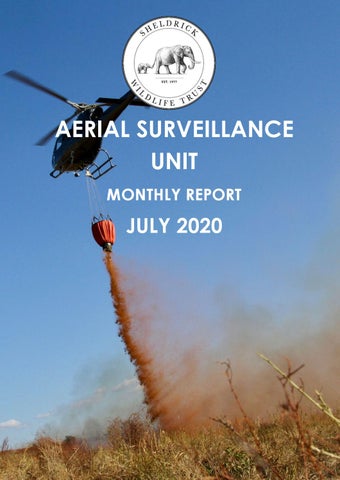
MONTHLY AERIAL SUMMARY The threat of fire loomed large in July and occupied much of our pilots’ time. A helicopter was deployed to suppress fires in the Chyulu Hills National Park (CHNP) on 3 separate occasions using our Bambi Bucket, making a total of 26 water drops to quench critical portions of the fire while ground teams fought the rest. The helicopter also assisted by dropping off rangers ahead of another fire in Tsavo East so that they could backburn along a road to prevent the fire from spreading further into the Park from where it originated on the highway. The largest fire occurred in Southern Tsavo West, originating on Lualenyi Ranch and burning an area roughly 103,000 acres in size before a concerted effort of more than 300 people representing KWS, SWT, Taita Estate, Tsavo Trust, Finch Hatton’s Lodge and the National Youth Service, managed to bring it under control. Our aircraft assisted by providing over 30 hours of aerial coverage, helping to direct teams on the ground and alerting them when the fire had jumped over backburned firebreaks or the Taveta highway.
.
Poaching activity observed by the Aerial Unit was surprisingly sparse. Although 4 breaches in the CHNP fence were observed during the month, these are thought to have mostly been connected to logging activity as opposed to poaching. One recent elephant carcass was found, with tusks removed, near the Athi River and assumed to be the victim of poaching. However, the carcass was too old to confirm a cause of death. Although no poachers’ hideouts were found during the month, one old campfire was discovered near the Tsavo River. One area of concern that was monitored closely was Kulalu Ranch, where security is minimal and large concentrations of elephant had moved more than 30km away from the Park boundary. A positive development, which followed over a week of extensive ground patrols in the Umbi area, at the northernmost extent of Tsavo East, was a dramatic decrease in logging activity. Ordinarily, this area is crisscrossed with bicycle tracks leading to pockets of cut trees; however, this month, our aircrafts were unable to sight any fresh bicycle tracks on any of their patrols. This is because SWT has opened up the road network in this area making access for the ground security patrols possible now. In CHNP, however, evidence of logging was identified on 2 occasions, with follow-ups carried out by ground teams
Livestock continues to be a problem in Tsavo West, where cattle, goats and bomas are regularly found in several areas along the Western and Southern boundaries. There was an increase in livestock along the Rombo and Ziwani Rivers, which had been relatively under control for the last few months. The herdsmen and their cattle pose a very serious fire threat as well. In Tsavo East there was also a medium influx of livestock, especially sheep and goats along the Tiva River where it exits Tsavo East. The majority of these were swiftly dealt with by KWS, however as of the end of the month there were still small incursions coming a few kilometres into the Park. Across the rest of Tsavo East, the Aerial Unit only noted small incursions of livestock along the boundaries, where they are being herded into the Park during the day for grazing. There were very few instances of livestock bedding down in the Park itself.
Cases of Human Wildlife Conflict continued in July but were reduced from previous months as water sources dried up and elephant distribution contracted back into the core of the protected areas. In fact, only two cases of Human Elephant Conflict were attended to by helicopter in July. One of the Trust’s helicopters did also assist in a search for a lion that had been reported in the community near Ithutha which lies outside of the Park near Ithumba. Unfortunately, the lion could not be found, despite tracks being identified on the ground. There were several veterinary cases assisted by the Aerial Unit in July. The first of these was a callout to help dart and treat a buffalo with a snare around its neck on Rukinga Ranch. The snare was successfully removed. The helicopter also assisted in the darting of an elephant found on Galana Ranch with an arrow injury on its rear right leg. Although the arrow did not appear to be poisonous, it had entered the leg extremely near to a joint which had led to a dangerous infection. For this reason, the vet gave the large bull elephant a guarded prognosis. We will continue to monitor the elephant from the air in case a follow-up treatment is required. Nearby, earlier in the month, a fixed wing assisted in the search for another injured elephant with a snare around its leg. Although this individual was never located, another elephant with a similar injury was, and coordinates were quickly relayed to the Voi Vet for follow-up on the ground.
One of the Trust’s helicopters also assisted in the rescue of a young elephant calf that had been separated from its mother. After a stressful attempt was made to reunite the calf with the herd that it was believed to belong to, it was determined that a rescue was necessary. Unfortunately, the calf was very weak and succumbed shortly after being rescued. Several unique sightings in July were of interest to the pilots, including multiple sightings of leopard, and wild dog, as well as lion and striped hyena
Photographs copyright © 2020 The David Sheldrick Wildlife Trust