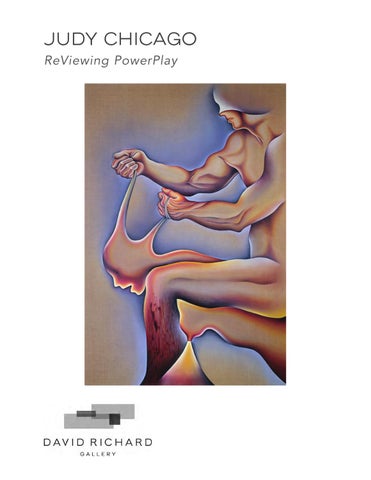
Judy Chicago ReViewing PowerPlay
Judy Chicago ReViewing PowerPlay
David Richard Gallery 544 South Guadalupe Street, Santa Fe, NM 87501 | p (505) 983-9555 www.DavidRichardGallery.com | info@DavidRichardGallery.com
ISBN: 978-0-9839312-3-2 Price $25.00
FRONT COVER Judy Chicago, Crippled By the Need to Control/Blind Individuality, 1983 Sprayed Acrylic and oil on canvas (primed with rabbit’s skin glue and matte media), 108" x 72" TITLE PAGE Judy Chicago, Driving the World to Destruction, 1985 Acrylic and oil on Belgian Linen, 108" x 168"
REFERENCES Edward Lucie-Smith references from: Lucie-Smith, Edward. Judy Chicago: An American Vision. New York: Watson-Guptill Publication, 2000, p 112, 113. Paula Harper references from: ACA Galleries. Judy Chicago, POWERPLAY [Essay by Paula Harper]. New York, ACA Galleries, 1986, p 2.
ACKNOWLEDGMENTS THREE FACES OF MAN, 1985, Sprayed acrylic and oil, 54" x 108" Collection of Ruth Lambert and Henry Harrison POWER HEADACHE, 1986, modified Aubusson Tapestry, 24" x 20" Collection of Camille and David Lyons WOE/MAN 1, 1986, Lost wax cast bronze bas-relief with multi-colored patinas, 48" x 36" x 5" Collection of Elizabeth A. Sackler
Published on the occasion of the exhibition: Judy Chicago, ReViewing PowerPlay June 29 – August 11, 2012, David Richard Gallery, Santa Fe, NM Published by: David Richard Gallery, LLC, Santa Fe, NM Catalogue ©2012 David Richard Gallery, LLC, Santa Fe, NM Essay ©2012 Jonathan D. Katz, Buffalo, NY Art ©1982-1986 Judy Chicago, Belen, NM Photos of Judy Chicago art by: Donald Woodman, Belen, NM Photos of Motorcycle with Rider 25 and Three Faces of Man Composite by: Herb Lotz Design by: Julie Meridy, NY and David Eichholtz, Santa Fe, NM Printed by: GHP Media, West Haven, CT Special thanks to: Jonathan D. Katz for writing such a terrific essay that provides both historic reflections and contemporary context to Judy Chicago’s series, PowerPlay. Donald Woodman for beautiful photography, organization, management and above all, patience, support and love. Elizabeth A. Sackler, NY for lending from her collection Woe/Man 1, 1986. Julie Meridy Design, NY for embracing this project with such passion and enthusiasm.
In memory of Paula Harper who wrote the first catalogue essay for PowerPlay
Judy Chicago’s PowerPlay and the Irony of Masculinity BY Jonathan D. Katz
Judy Chicago had lousy timing when she first exhibited her
antiquity that the male nude had reemerged as the
monumental series PowerPlay in 1986. By this point, she
dominant subject in Western art, but also, and perhaps of
could claim perhaps the most sustained and committed
greater import, this reemergence thus at least temporarily
practice of an art of social protest in all of American art. Yet
spared the traditional female subject the allegorical,
the series was greeted with something that was entirely
erotic and emotional weight it had largely been forced to
new to Chicago’s very public career: silence. As the artist
bare solo throughout the long centuries of the Western
herself noted in the second volume of her autobiography,
tradition. In PowerPlay, men are not only vested with
following the opening of the PowerPlay (circa 1982-86)
the allegorical import long the province of the female
series at New York’s ACA gallery, she was chagrined “to
nude, they are equally made over into representative
discover that there had been almost no sales at the gallery
figures, for these paintings are never of specific men, but
and, curiously, a near-total silence in terms of articles and
of masculinity as typology. Deploying variations on the
reviews, the first time such a thing had ever happened
Renaissance’s heroically-scaled male nude, she began
to me.” For the creator of The Dinner Party, a work that
work on a series of over-life size paintings that would
catalyzed—and was catalyzed by—feminism, perhaps the
cast a critical eye on the construction of masculinity as
dominant US social movement of its time, critical and
a defensive posture, one conceived in order to mark out
popular silence was a foreign territory. But in restoring
the obverse from what was taken as feminine, marking
Chicago’s PowerPlay to the context of its creation and
gender out as performative almost a decade before the
first exhibition in the 1980s, we can better understand not
early works of queer theory began to advance similar
only why this work failed to produce its expected impact,
claims. For Chicago, the fact that men were born of, and
but also follow its lead into a broader understanding of
in an indicative relationship to, the feminine was at the
defining shifts in the profile and purpose of an art of social
root of much male repressive violence.3 Thus in one fell
protest in the United States—shifts we now, with the
swoop, Chicago inverted that familiar Biblical genealogy
arrogance of the present, wrongly assume to have always
in which the female, Eve, was born of the male, of Adam’s
characterized a dissident American art.
rib, and reconceived that relation of priority such that it
1
2
was now masculinity born out of the feminine—literally PowerPlay, though more or less coterminous with Chicago’s
and symbolically—and thus always haunted by the
better-known Birth Project, represents an unprecedented
prospect of the feminine within it.
departure in her work. Its most obvious difference, the emergence of men as the denoted subject (denoted,
There is not better evidence of this than those works
because all of Chicago’s work connotatively address men
from PowerPlay that directly reference the feminine, as
as the necessary pole of a gendered binary) is wedded to
in Trying to Kill the Woman Inside Him or Struggling with
another significant variation in her usual working method—
the Womanly Feelings in His Heart. In working to blur any
many of the images have roots in Italian Renaissance
definitive outline between the male and female, on both
painting. Chicago traveled to Italy for the first time in 1982,
a formal and ideological level, these paintings and their
and extensively studied major works in Rome, Florence,
related drawings notably swim against the modernist
Venice, Naples and Ravenna—an art lover’s standard
elevation of form over content by making form and
first trip to Italy itinerary. The emergence of PowerPlay
content one. In PowerPlay, the crook of a man’s elbow
was keyed to that Italian trip not only because the Italian
can become a woman’s breast, his hand metamorphoses
Renaissance represented the first time since classical
into her head, his hands become hers. Everything is
3
Trying to Kill the Woman Inside Him, 1983 Prismacolor on paper, 26" x 19"
Curiously, despite the structural and thematic ambiguity
4
that animates these works, they still fell flat when they were initially shown. The first half of the 1980s—when Chicago conceived and executed PowerPlay—would emerge as ground zero for a seismic shift in the profile of protest in the American art world, and she unwittingly got caught in the middle of a changing of the guard. What changed? In a word, it was the return of irony as the favored mode of political dissent in art. By virtue of its indirect, equivocal nature, irony proved increasingly more palatable as a means of resistance in the Reaganite 1980s. Remember that this was the time that engineered the advent of what both sides would call the culture wars, when a revolutionary social and political art and the most phobic vision of social change retailed by conservative politics were about to become sworn enemies, and antiavant-garde antipathy would become deployed as an instrument of state.4 dynamic change, unstable distinctions, a constant flipping
In contrast, the 1970s, with its manifold social upheavals
back and forth between opposing gendered signifiers so
from feminism, to lesbian and gay liberation (and lesbian
as to finally underscore their fundamental imbrication.
separatism) to incendiary protests over our invasions
Chicago furthers this conceptual and formal merging
of Vietnam, Cambodia and Laos and our clandestine
of male and female through the careful shading of
support of right-wing dictatorships in Latin America such
boundary lines to minimize any sharp transitions or clear
as Pinochet’s brutal rule in Chile, assured that irony could
demarcations. In the prismacolor pencil on paper 1983
scarcely register among the manifold explosions of the
Trying to Kill the Woman Inside Him legs, arms, bodies,
decade. As yet unnoticed by social conservatives, the art
breasts shuffle back and forth until the man and woman
world in the 1970s moved unchecked, blissfully unaware
reveal yet a third figure, a woman in profile composed of
of any overlords save money and fame. It was hardly
the shadowed negative space between his legs. Chicago
uniformly progressive—the conjunction of big money and
found she could even meld male and female through
high value commodities in a market economy mitigated
careful manipulation of simple outline drawing. In It Hurt
against that—but it had also not yet become colonized
So Much It Made a Coward Out of Him the elbows of a
by a tendency to recast non-conformity from a social or
man grasping his head in anguish does double duty as
political term to a purely formal or aesthetic phenomenon.
pendulous breasts, turning a man into a woman and back
Most centrally for my purposes, until the early 1980s
with minimal sleight of hand. Even the title of the series
identity politics were in full swing and a host of newly
cultivates ambiguity, for PowerPlay connotes both the
audible voices opened the art world to differences in race,
definitive, brutal exercise of power and, at the same time,
sexuality and gender. As a result, social protest as a form
a performative, anxious relation to it.
of art making was in no way unusual or remarkable, and
even big, powerful institutions tied to the establishment
Whereas an art of social protest accurately echoed the
got into the act. Chicago first showed The Dinner Party
tumultuous disturbances and dislocations of the 1970s,
at The San Francisco Museum of Modern Art, and Hans
by the beginning of the 1980s, this newly conservative
Haacke even got MoMA to agree to his 1970 installation
ethic sweeping the country fueled ever more vicious
MoMA Poll, in which he asked museum visitors to vote
attacks on an art of aggressive dissent, culminating, in
whether then NY Governor—and powerful MoMA Board
the late 80s, with Republican attempts to defund the
member—Nelson Rockefeller’s refusal to denounce Nixon
National Endowment for the Arts and instrumentalize the
over the invasion of Vietnam would cause them not to
posthumous Robert Mapplethorpe exhibition The Perfect
vote for the Governor in his coming re-election. (Though
Moment to go after any art that addressed social protest.
by a two to one margin museum visitors said they would
Senator Jesse Helms’ rhetoric is indicative, as in this
not vote for him, he was re-elected anyway, evidence that
typically unnuanced bit of his Senate floor oratory: “It is
the split between the art loving public and mainstream
an issue of soaking the taxpayer to fund the homosexual
politics was in evidence even then.) I doubt whether either
pornography of Robert Mapplethorpe, who died of
work would have made it out of any curatorial committee
AIDS while spending the last years of his life promoting
in the land during the 1980s.
homosexuality.”5 As a result of these strong-arm tactics, the art of the 1980s moved increasingly towards forms of indirect resistance through sarcasm and a performative insincerity—the cultivation of an ironic mien. A quick review of other high watermarks for the deployment of irony in the art of the 20th Century reveals a similar advance at moments of rising conservative reaction, as evinced in the cultivation of Dada as the Third Reich consolidated power or the rise of that closeted post Abstract Expressionist generation of so called Neo-Dadaist—figures like John Cage, Robert Rauschenberg and Jasper Johns—amidst the excesses of the McCarthy era. This revalidation of a strategically deployed irony would adversely affect the reception of PowerPlay, and to a lesser extent, Chicago’s work as whole. In contrast to much art, even feminist art, of the 1980s, PowerPlay, despite its careful cultivation of multiple forms of ambiguity, seemed almost embarrassingly earnest, declarative and filled with conviction. A new generation of feminist artists in the early 1980s, figures such as Cindy Sherman, Barbara Kruger, and Jenny Holzer, would instead
It HURT SO MUCH IT MADE A COWARD OUT OF HIM, 1983 Prismacolor and acrylic, 28.5" x 22.5"
prove more in synch with the times in their archly ironic appropriation of aspects of male dominance. Of course,
5
6
one of the dangers of irony is its resemblance to that which
and in some sense have since the eighties, routinely finds
it opposes, and thus its potential for misreadings—and in
a 1970’s style incitement to political collectivity (not least
fact, some early critics didn’t at all register the feminist
as accomplished in Chicago’s work) to be mere illusion—a
content of Sherman, Kruger and Holzer’s work, reading it
nostalgia ridden exercise in papering over our manifold
as more fundamentally concerned with the operations of
distinctions in an endlessly lengthening list of our smaller
meaning-making in general than any particular meanings
and smaller differences—it can’t supply any new model
made.6 Nonetheless, whatever their success or failure
or alternative for collective action. In place of a once
politically, a more ironic feminist art certainly caught the
rock solid collective identification, be it feminist, queer,
mood of the times. Judy Chicago, though only six years
working class, whatever, we now wade in the swamp of
older than the oldest of the three seemed instead to be
small differences, our identities diffused, but still longing
of a different generation and even today, her work is
for that once coherent collectivity that made our sense
rarely addressed in the same context as theirs. It’s just
of otherness at least useful, active and powerful. Our
too different; hers is a protest art, a message art, with an
response to our own patent nostalgia for what we tell
emphasis on communicating directly to the viewer without
ourselves was a mistake in the first place is irony.
need of an apprenticeship in the theoretical byways of contemporary practice: there is nothing that seems arch
This tendency to favor the ironic as a means of dissent has
or ironic about it.
thus proven enduring; even today, decades later, we continue to prefer our art of protest lightened with irony,
And yet Chicago’s art was the necessary ground for this
with the seductive prospect that whatever is meant is, in
latter, ironic generation to work its charge. Without her
the final analysis, up to us to name. Forms of direct and
feminist example, the ironic performances of Sherman
un-ironic protest art necessarily seem now to carry the
or the underlined clichés of Kruger would have not have
whiff of that earlier social moment—a markedly un-
been visible as in some powerful way other to what they
contemporary one consisting of faded images of pickets
literally denoted, which is to say they would not have
and rallies in black and white. These earlier images now
registered as ironic. Their irony is made visible qua irony in
speak in terms of adherence to a unifying creed, of mass
part against the presumption born of artists like Chicago,
marches, and unions and strikes, perhaps even, for older
that femininity isn’t a natural state, but a policed one. Had
Americans, of clandestine Communist party meetings and
we not already “known” this to one extant or another,
an all-together too earnest sense of rectitude. By contrast,
Sherman’s careful catalog of feminine postures wouldn’t
we postmoderns feel more comfortable defying the
have registered as dissident, but merely have been made
collective than working within it. In our art, we cultivate an
an artifact of, and transparent to, her gender. In some
ironic take on power, seeking dominance but never using
sense then, irony is enabled by a larger, constantly shifting
its terms. To forthrightly protest, to counter power with
socio-historical perspective that allows us to understand
power, seems to make a categorical error, for it reinscribes
that what we once believed to be merely “natural” is
a dynamic of dominance at precisely the place where it
in fact not natural at all, but the product of changing
should be most challenged. Rather than figure power’s
historical forces. In this sense, irony is every bit as much
game of musical chairs, in which the only thing that
an historical artifact—a product of its times—as Chicago’s
changes are the butts in the seats, not the seats themselves,
style of straight-out, confrontational protest art in the
we’d do better, we hold, to recast the representation of
1970s. But whereas the historical moment we now occupy,
power under the sign of irony.
And the trope par excellence for the abandonment of a
work today as if they were seeing the artifacts of an
collective power politics is irony. Irony sidles up to domi-
older, more powerful civilization, one that perhaps knew
nation, allowing you to address it while not talking to it,
itself better—or was at least more honest about what it
about it, or against it. As a consequence, irony is funda-
knew—and had as a result canons of representation for
mentally geared to the individual not the collective—irony
showing what we can only indicate through meaningful,
is what I read, what I see, not what we, as united front,
sidelong glances.
want or believe. As a result of its spectral individualism, irony is seductive and narcissistic, a trope of seeming
The fact remains that feminism as a social movement
complicity: it offers the viewer the gratification not only of
wasn’t born of irony, nor propelled by it. Fueled instead
determining the final or “real” meaning of the artwork,
by anger, it was a mass pressure group akin to earlier
but moreover of doing so in tacit sympathy with the artist.
resistance movements, a contest of opposing interest
Irony invites us in, claims we’re special, gifted with unusual
and creeds far less concerned with the dynamics of power
powers of discernment. How seductive, we think, to arrive
than with who had it and how it was to be used. Nor was
at a sophisticated understanding that we’ve made fully
irony in any way a useful response to organizing for real
our own, as opposed to the banality of reading a message,
and permanent social change, what we used to mean
which anyone with even a rudimentary grasp of the
when we said, without irony, “the revolution.” But a few
alphabet can do! So flattered are we, that we forget that
years prior to Chicago’s first development of what would
the work was not authored by us, but by another, one
become PowerPlay, the Equal Rights Amendment (ERA)
who truly deserves the name author, and we have just
went down in flames, scuttled by three states’ refusal to
danced to a tune we didn’t call, nonetheless thinking the
ratify what seemed to many a purely logical extension of
music our own.
constitutional protections to women but which quickly became embroiled in an early version of the dissimulating
Yet, protest as a social act is hardly dead in America, for all
scare tactics now routinely employed by the radical right
its rarity in our art. The art world may sniff at images born
(in this instance, the ERA, it was said, would eliminate
of committed resistance and find ideology representable
sex-segregated bathrooms). With the receding prospect
only at the brink of parody, but as I write this the Occupy
of revolution, irony became the means through which we
Protest has spilled thousands onto streets, parks and
could feel powerful and autonomous—even when we
plazas from one coast to the other, major state battles are
knew we weren’t.
being fought over immigration and same sex marriage, as warmongers, anti-choice zealots, and Tea Party extremists
Irony does not, perhaps cannot, seed social change—the
threaten the meager social gains of the last few years.
best it can do is confirm an internal dialog, but internal
That there is a profound disconnect between our culture
dialogs are, by dint of being internal, rarely productive
of protest and the suave unflappability of our art world is
of social change. Thus a gulf has sprung up between
obvious, but of course it’s hardly new: even as the decade
collective social movements like feminism and the art
of protest art dawned, Andy Warhol was producing his
that addresses or thematizes these social movements.
now famous Flower Paintings as the dead from the Kent
To protest male dominance directly and unambiguously
State Massacre on May 4, 1970 were being buried. But
has become so complicated and fraught that when the
this disconnect has grown over the intervening years to
feminist collective The Guerrilla Girls have sought to do
the point that my college-age students view Chicago’s
so, they don gorilla suits, obscuring their identities not
7
8
only lest their protest seem too nakedly self-interested—
terms. Towards making sense of these diverging accounts
on behalf of their careers, rather than women in general—
of her art, PowerPlay is indicative, in part for being so
and thus too enamored of power for its own sake, but
exceptional. And the first thing to notice about it is how
also because the act of protest itself is just so outré that
curiously misunderstood it has been. Here is a work that
anonymity protects them from any negative repercussions
in fact places at least several forms of irony, including
in the art world itself.
ambiguity and appropriation, at the very center of its project. It takes the transcendental Renaissance male
Thus, it is through the lens of irony that we can finally
nude, the one who lives outside of time and the social, and
square Chicago’s reputation as the outstanding feminist
disfigures him, giving him the red eyes of a man crying (as
artist of our time with the fact that her mode of art
in Study for Disfigured Head 2) or contorting his face with
making is distinctly out of favor in the art world today.
emotional extremes, as in Really Sad/Power Mad where
Not only is it probable that more people have seen her
these ostensibly polar emotions are instead expressively
Dinner Party than any other single work of feminist art,
linked, such that only a rivulet of tears distinguishes
but of all the feminist artists at work, her oeuvre is the one
sadness from fury. Man becomes suddenly men, and there
most identified with the politics of social change, most
is a world of difference between the two. In the Shadow
resonant and moving as an account of what happens
of the Handgun, Chicago even appropriates perhaps the
when women seek to figure their perceptions in collective
most defining of all Renaissance nudes, Michelangelo’s
REALLY SAD/POWER MAD, 1986, Prismacolor and pastel, 27.5" x 39.25"
STUDY FOR DISFIGURED HEAD 2, 1984 Prismacolor and graphite on paper, 12" x 9"
the pectoral muscles hangs slack and feminine—thereby reintroducing at least the shadow of the female into the scene. Tellingly, in her Beyond the Flower autobiography Chicago recalls wielding a borrowed handgun in order to frighten a persistent, masturbating peeping tom, and thus comes to recognize that the gun’s power isn’t necessarily always gendered male. In the final large-scale painting, the negative space bordering the “handgun’s” eruption also coalesces into Chicago’s signature upturned female face in profile, a face literally forged by the handgun’s eruption into violence. New, too, in these works is the use of oil paint (perhaps the defining Renaissance technique) over Chicago’s more familiar airbrushed surface. Whereas a fully hand brushed and expressive surface would work to index the artist, to make her hand expressive, a striking aspect of In the Shadow of the Handgun is the way the expressive brush and the literally mechanical spray painting cancel each other out. This is significant because one of the defining difficulties with Chicago’s work in the era of irony is its assumed declarative, authorial or expressive character, and thus her long engagement with airbrushing, and PowerPlay’s flirtation with oil, have not been given their due as a self-conscious attempt to make more complex and open-ended the question of the autographic touch. In Crippled by the Need to Control/Blind Individuality, numerous authors have noted the male figure riding the female and gripping her hair like a horse’s bridle. But again, the work is much more ambiguous than has IN THE SHADOW OF THE HANDGUN 2, 1983 Prismacolor and acrylic on rag paper, 22" x 30"
been generally credited, since the woman’s profile is not only indistinguishable from the man’s but he is moreover depicted as missing the upper half of his face. Is she, in
famed Creation on the Sistine Ceiling (a work which, rather
short, a distinct and autonomous figure he’s riding, or is
counter-intuitively, succeeds in eliminating the female
she an aspect of the male, even his very eyes, and one,
from the act of creation) and turns that famously poised
which he desperately seeks to master? She is opened
finger into a visual pun on the term handgun. But note
mouthed, nearly horizontal and her breasts radiate
how even here, the shadow of the arm betrays, beneath
generative potential like a beneficent hovering angel,
the figure’s armpit, yet another elbow/breast—and one of
while he is close mouthed, constrained and vertical. It
9
Crippled by the Need to Control/Blind Individuality, 1983 Sprayed acrylic and oil on canvas, 108" x 72"
itself that proved relevant. The second wave feminist
10
movement, begun in the 1960s, succeeded in making the outlines of feminism as an ideology and a political program broadly familiar, if still misunderstood. In its wake, major legal and legislative victories like Title IX and Roe vs Wade permanently changed the face of this country. But despite its victories, by the mid 1980s a growing discomfort with second wave feminism was common in university circles, spurred in part by the publication in 1981 of the anthology This Bridge Called My Back: Writings by Radical Women of Color, a feminist anthology edited by Cherríe Moraga and Gloria E. Anzaldúa. The book’s critique of second wave feminism centered on what it argued were universalizing or essentalizing tropes of a feminine identity too indebted to the experience of middle-class white women, with correspondingly little to no attention to the intersectional identities of women of color, women for whom gender, race and/or ethnicity and class were inseparable categories. From this theoretical and social historical grounding, a new, third wave of feminism developed, offering a sustained critique of what seems in no way clear, at least to me, why this can’t in
it deemed to be too reductive categories of identity,
fact be a scene of a self divided. The abrasions evident on
beginning with the most basic ones—like man and woman.
his bloodied riding leg amplify this reading, suggesting
Instead this third wave posited that neither man nor
that his attempts at self-control are wounding. And the
woman was a useful category except in polemical terms,
title, Crippled by the Need to Control/Blind Individuality,
for the two terms are locked in a necessary mutuality,
perhaps underscores that the necessary analog of mastery,
defined against the other, constituted as the sum of what
whether mastery of the self or of another, is a profound
the other is not.
loneliness, a failure to grasp the web of connections through which most of us realize ourselves, for identity is
By the last years of the 1980s, this third wave critique
always relational; a self elaborated only through a relation
had spawned a corresponding recognition that gay and
to itself—one uninterested in the cold bath of otherness
straight were similarly locked in an unyielding polarity—
cannot leave the orbit of its own limitations and hence
one that, paradoxically, like the terms man and woman,
becomes blind.
reinscribed and reinforced the dominance of the first term of the binary, i.e., “straight” and “man,” every
So far, I’ve emphasized how factors more or less external
time its devalued polar opposite sought to challenge its
to feminist politics help us understand why and how
secondary status. In short, under a third wave critique,
PowerPlay has been misunderstood, but there were
queer theory, following feminism, came to realize that to
also some notable shifts in the construction of feminism
rally under the label female or gay was to win the battle
but lose the war, for the binaries male/female or straight/
side, but doesn’t color the image as a whole. Chicago,
gay left unchallenged the real oppression, which is the
again echoing the terms of what would be a subsequent
very idea that male and straightness can only achieve
queer theory, thereby implicates sexuality in any account
coherence against the devalued other, that we can only
of gender, such that fear of gayness become the border
describe what we are by reference to what we are not.
patrol on the gender divide, quick to police and prevent any crossing of that putative border through the merest
I hope the final irony of PowerPlay’s critical inattention in
insinuation that to do so would be read as gay. The result
an era of ironic resistance is now obvious. For Chicago, a
for the figure is the pure pathos of his subconscious plea.
product of second wave feminism, had in fact anticipated
In the bronze relief Woe/Man a heavily muscled, bull-like
the defining critique of third wave feminism, namely that
neck, the fortified neck of macho performance, is tilted up
the easy binarizing of identification through reference to
in a gesture of openness and offering, but the figure’s tight
a devalued other will never escape the ominous contest,
grimace and wary eyes suggest that this performance of
the ceaseless push and pull, that the two terms, locked
vulnerability is not entirely easy nor comfortable. Chicago
in battle, reproduce again and again. Woman alone, as
suggests the potential consequences of this vulnerability
a term, an ideology or a politics, can’t free us from male
in making the rope-like muscles of the neck do double
domination, for woman necessarily cites man every time it
duty as labial folds.
seeks to describe itself. The defining terms of PowerPlay therefore aren’t simply “male,” despite the obvious gendering of its protagonists, but rather how man, as a category, achieves coherence and significance only in and through its self-repression of qualities it has devalued as female. Thus Chicago’s men are always caught at some point in the act of defending themselves against a threatening other that is, they know, actually themselves; they are caught in the act of freezing out one part of themselves as an act of self-preservation, only to find the process leaves them cold. Thus we see in PowerPlay repeated evocations of the twinned identities that a masculine performance requires. From Really Sad/Power Mad to the punning Woe/Man, Chicago excavates a masculinity at war with itself and even the doubled titling echoes the terms of this conflict. With one eye staring out in an expression of preemptory challenge and the other eye tearing up, Lavender Double Head/Hold Me #5 further places the words “hold me” in the figure’s mouth. The color lavender, long associated with effeminacy and thus marked out as gay, shades the far outlines of the figure’s face and predominates in his crying
Lavender Doublehead/Hold Me 5, 1986 Sprayed acrylic and oil on hand cast paper, 51" x 39.5" x 3"
11
Woe/Man 1, 1986, Lost wax cast bronze bas-relief with multi-colored patinas, 48" x 36" x 5"
this anti-essentializing tide. But here Chicago, having lived
12
this theoretical perspective, offers a useful corrective or middle path. Masculinity, as Chicago knows well, may be a gender performance adopted by any biological sex, but only those disinherited by masculinity—women, children, queers, the effeminate of all genders—understand the performance of masculinity as just that, a performance. And understanding masculinity as a performance entails understanding the difference between a performance and a natural attribute. Attributes are permanent, but performances, as any performer knows, constantly change. I put my hope in performers. 1 Judy Chicago, Beyond the Flower: 198. 2 In 1979, the year the Dinner Party premiered in San Franscico’s
In appropriating a tradition of heroic masculinity in order
Museum of Modern Art, the Equal Right Amendment failed ratification by three states.
to dissect and undercut a tradition of heroic masculinity,
3 This was also a perspective common to lesbian separatism of
Chicago thus makes irony her handmaiden, the very
the 1970s—see for example the December, 1973 issue of Cowrie,
irony that was, at the time these works were first shown,
which plays with the terms woman, women and wombman, and
increasingly in evidence as a means of resistance across
wombmen to drive home a similar claim. 4 In fact, in December of 1981, Nancy Reagan could be on the
the art world at large. Why then was PowerPlay not
cover of Andy Warhol’s Interview magazine, having granted that
viewed as a prime exemplar of this newly ironic critical
very queer publication her first in-depth interview since occupying
tradition, as opposed to the outlier it has since become?
the White House. She shared that issue’s pages with photographs
I think it’s because a third wave, newly deconstructive
of Robert Mapplethorpe out on the town, homoerotic photographs
feminism was wary of any attribution of gender coding as the property of one or the other biological sex. Following the anti-essentializing thrust of this theory of gender
by George Platt Lynes, Herbert List and an illustrated interview with Prince, the singer provocatively posed as an upright, full-length odalisque in the shower, dressed only in a low cut thong with his pubic hair curling over and a crucifix dominating the wall behind
performance to its logical conclusion, “maleness” and
him. Prince’s pubic hair and a crucifix, Nancy Reagan and Robert
“femaleness” as gender performances, and a male body
Mapplethorpe, all in Andy Warhol’s magazine—the battle lines for
and a female body, as biological entities, bear, it was said,
the coming culture wars had clearly not yet been definitively drawn.
no necessary relationship. A female could just as well engage the performance of masculinity as any man, with
See Interview, vol. 11, no. 12 (December 1981). 5 Senate Congressional Record, 101st Congress, 1st session, vol. 135, issue no 127, Proceedings of September 28, 1989.
similar symptoms and consequences. Judy Chicago, by her
6 See Hal Foster, Subversive Signs, in Recodings: Art, Spectacle
own admission in her autobiographies, did just that, early
and Cultural Politics. (Seattle: Bay Press, 1985).
on adopting a masculine swagger and tough guy persona to, as a female, make herself visible as a serious artist and run with the boys. Thus, the implication in PowerPlay that masculine performance is a male problem swims against
DETAIL: Rainbow Man, 1984, Sprayed acrylic and oil on Belgian Linen, Panel 2: 108" x 84"
13
Rainbow Man, 1984, Sprayed acrylic and oil on Belgian Linen, 108" x 252" Three panels: 108" x 72", 108" x 84", 108" x 96"
14
15
What happens if one tries to place these huge, ambitious compositions in the general context of 20th-century art? [ . . .] I have pointed to connections, especially among the preparatory drawings, with works by Picasso, Léger, and Gris—that is to say, with aspects of cubism. I think, however, that their most direct ancestry can be found in the work of the major Mexican and North American muralists of the 1920s, 1930s and 1940s. In particular one thinks of aspects of Diego Rivera, José Clemente Orozco (1883-1949), and Thomas Hart Benton. All of these artists looked for ways in which to democratize modernism and make it accessible to large audiences. [ . . . ] Edward Lucie-Smith, 2000
Pissing on Nature, 1984, Sprayed acrylic and oil on Belgian Linen, 108" x 72"
16
Crippled by the Need to Control/Blind Individuality, 1983, Sprayed acrylic and oil on canvas, (primed with rabbit's skin glue and matte media), 108" x 72"
17
[ . . . ] the title, Crippled by the Need to Control/Blind Individuality, perhaps underscores that the necessary analog of mastery, whether mastery of the self or of another, is a profound loneliness, a failure to grasp the web of connections through which most of us realize ourselves, for identity is always relational; a self elaborated only through a relation to itself— one uninterested in the cold bath of otherness—cannot leave the orbit of its own limitations and hence becomes blind. Jonathan D. Katz, 2012
Driving the World to Destruction, 1985, Acrylic and oil on Belgian Linen, 108" x 168"
18
Images of men as destructive or power mad are not new in the history of art. [ . . . ] But women artists have rarely painted men in an unflattering light. [ . . . ] The tradition seems to demonstrate that women are more willing to portray themselves as victims than men as perpetrators. [ . . . ] Chicago, in her determination to present her view of men in as forthright a way as men have depicted women, is an audacious innovator. Paula Harper, 1986
In the Shadow of the Handgun, 1983, Sprayed acrylic and oil on canvas, 108" x 144"
19
In the Shadow of the Handgun, Chicago even appropriates perhaps the most defining of all Renaissance nudes, Michelangelo’s famed Creation on the Sistine Ceiling (a work which, rather counter-intuitively, succeeds in eliminating the female from the act of creation) and turns that famously poised finger into a visual pun on the term handgun. Jonathan D. Katz, 2012
The Three Faces of Man, 1985, Sprayed acrylic and oil, 54" x 108"
20
21
Disfigured by Power 2, 1984, Oil on canvas, 10" x 14" Disfigured by Power 7/Goo-Gaa Disfigured Heads, 1984, Oil on canvas, Diptych, installed size: 15.75" x 21.75" x 2.5"
22
Disfigured by Power 1, 1984, Oil on canvas, 14" x 10"
23
Judy Chicago [ . . . ] treads dangerously close to what has been forbidden territory for women artists in these images of men; their faces are grotesque, distorted by anger or disfigured by powermania. They control women, distain nature, equate guns and sexuality, risk nuclear destruction of the planet, all in the name of manhood. [ . . . ] “Why do they act like this?”. She answers herself—in these ultimately compassionate pictures—by depicting men helplessly imprisoned in their violence, dominance and despair. Paula Harper, 1986
Disfigured by Power 3, 1984, Oil on canvas, 14" x 10"
24
Disfigured by Power 5, 1984, Oil on canvas, 14" x 10"
25
Woman alone, as a term, an ideology or a politics, can’t free us from male domination, for woman necessarily cites man every time it seeks to describe itself. The defining terms of PowerPlay therefore aren’t simply “male,” despite the obvious gendering of its protagonists, but rather how man, as a category, achieves coherence and significance only in and through its selfrepression of qualities it has devalued as female. Jonathan D. Katz, 2012
Malehead 2, 1983, Sprayed acrylic and oil on canvas, 14" x 10"
26
Malehead 9, 1983, Sprayed acrylic and oil on canvas, 14" x 10"
27
Malehead 4, 1983, Sprayed acrylic and oil on canvas, 10" x 14" Malehead 5, 1983, Sprayed acrylic and oil on canvas, 14" x 10"
28
Malehead 3, 1983, Sprayed acrylic and oil on canvas, 14" x 10"
29
[ . . . ] hers is a protest art, a message art, with an emphasis on communicating directly to the viewer without need of an apprenticeship in the theoretical byways of contemporary practice: there is nothing that seems arch or ironic about it. Jonathan D. Katz, 2012
Woe/Man 1, 1986, Lost wax cast bronze bas-relief with multi-colored patinas, 48" x 36" x 5"
30
PowerPlay does not consist solely of allegorical compositions. A number of the works included in the series are of male heads seen close-up. They are executed in a variety of materials [. . . ] They depict the faces members of the male sex present to the world, as well as the vulnerability that men will not or cannot allow themselves to show. Chicago locates the seat of vulnerability at the base of the throat, an observation supported by studies made by professional zoologists. Edward Lucie-Smith, 2000
Woe/Man with Blue Eye 9, 1986, Sprayed acrylic and oil on hand cast paper, 51" x 39.5" x 5"
31
DOUBLEHEAD 1, 1986, Lost wax cast bronze bas-relief with multi-colored patinas, 48" x 36" x 5"
32
Lavender Double Head / Hold Me 5, 1986, Sprayed acrylic and oil on hand cast paper, 51" x 39.5" x 3"
33
Power Headache, 1986, Modified Aubusson Tapestry, 24" x 20"
34
Malehead 1, 1986, Lost wax cast bronze bas-relief with multi-colored patinas, 30" x 22" x 3"
35
Study for Doublehead 3, 1986, Ink and pastel on paper, 29.5" x 21" Weeping Maleheads: If Only They Would/Could, 1985, Prismacolor on paper, 27.5" x 36.5"
36
Four Studies for Driving the World to Destruction, 1985, Prismacolor on paper, 27.5" x 36.5" MOTORCYCLE WITH RIDER 25, photo, ca 1985
37
Male Ness, 1983, Pastel and oil crayon on Arches, 30" x 22"
38
In place of a once rock solid collective identification, be it feminist, queer, working class, whatever, we now wade in the swamp of small differences, our identities diffused, but still longing for that once coherent collectivity that made our sense of otherness at least useful, active and powerful. Jonathan D. Katz, 2012
Study for Lights Out, To Donald, 1984, Pencil and pastel, 35" x 23"
39
Chicago’s [ . . . ] oeuvre is the one most identified with the politics of social change, most resonant and moving as an account of what happens when women seek to figure their perceptions in collective terms. [ . . . ] PowerPlay is indicative, in part for being so exceptional. And the first thing to notice about it is how curiously misunderstood it has been. Jonathan D. Katz, 2012
Study for Three Faces of Man: “Weeping is Womanly”, 1985, Mixed media, 26" x 36" MALEHEAD INSERT 5, photo, ca 1985
40
Study for Three Faces of Man: “Real Feelings are Covered Up”, 1985, Mixed media, 26" x 36" THREE FACES OF MAN COMPOSITE, photo, ca 1985
41
Rather Rage Than Tears, 2009, Landfall Press, Lithograph on paper, 24" x 24" STUDY FOR Malehead 3, 1984, Prismacolor and graphite on paper, 12" x 9"
42
Masculinity, as Chicago knows well, may be a gender performance adopted by any biological sex, but only those disinherited by masculinity—women, children, queers, the effeminate of all genders—understand the performance of masculinity as just that, a performance. Jonathan D. Katz, 2012
PISSING ON NATURE 2, 1982, Mixed media on rag paper, 22" x 30" STUDY FOR PISSING ON NATURE, 1983, Mixed media, 22" x 14"
43
HE COULDN'T STOP THE BLOOD HE'D SHED FROM SHOWING ALL OVER HIM, 1983, prismacolor and acrylic, 28.5" x 22.5"
44
JUDY CHICAGO AT SHIDONI FOUNDARY, photo, 1986
45
JUDY CHICAGO Born July 20, 1939 – Chicago, IL
46
Judy Chicago is an artist, author, feminist, educator,
Sexual Politics: Judy Chicago’s Dinner Party in Feminist
and intellectual whose career now spans five decades.
Art History. Curated by Dr. Amelia Jones at the UCLA
Her influence both within and beyond the art
Armand Hammer Museum, this show was accom-
community is attested to by her inclusion in hundreds
panied by an extensive catalog published by the
of publications throughout the world. Her art has
University of California Press. In 2007, The Dinner Party
been frequently exhibited in the United States as
was permanently housed at the Brooklyn Museum as
well as in Canada, Europe, Asia, Australia, and New
the centerpiece of the Elizabeth A. Sackler Center for
Zealand. In addition, a number of the books she has
Feminist Art, thereby achieving Chicago’s long-held
authored have been published in foreign editions,
goal. In conjunction with the permanent location,
bringing her art and philosophy to thousands of
Chicago published a final and updated accounting,
readers worldwide.
The Dinner Party: From Creation to Preservation
In the early seventies after a decade of professional art
(Merrell, 2007).
practice, Chicago pioneered Feminist Art and art
From 1980 to 1985, Chicago worked on the Birth Project.
education through a unique program for women at
Having observed an absence of iconography about
California State University, Fresno, a pedagogical
the subject of birth in Western art, Chicago designed
approach that she has continued to develop over the
a series of birth and creation images for needlework
years. In 1974, Chicago turned her attention to the
which were executed under her supervision by 150
subject of women’s history to create her most well-
skilled needleworkers around the country. The Birth
known work, The Dinner Party, which was executed
Project, exhibited in more than 100 venues, employed
between 1974 and 1979 with the participation of
the collaborative methods and a similar merging of
hundreds of volunteers. This monumental multimedia
concept and media that characterized The Dinner
project, a symbolic history of women in Western Civi-
Party. Exhibition units from the Birth Project can be
lization, has been seen by more than one million
seen in numerous public collections around the country
viewers during its sixteen exhibitions held at venues
including the Albuquerque Museum where the core
spanning six countries.
collection of the Birth Project has been placed to be
The Dinner Party has been the subject of countless
made available for exhibition and study.
articles and art history texts and is included in innu-
While completing the Birth Project, Chicago also
merable publications in diverse fields. The impact of
focused on individual studio work to create PowerPlay.
The Dinner Party was examined in the 1996 exhibition,
In this unusual series of drawings, paintings, weavings,
47
cast paper, and bronze reliefs, Chicago brought a critical
In addition to a life of prodigious art making, Chicago
feminist gaze to the gender construct of masculinity,
is the author of numerous books: Through the Flower:
exploring how prevailing definitions of power have
My Struggle as a Woman Artist, 1975 (subsequently
affected the world in general — and men in particular.
published in England, Germany, Japan, Taiwan, and
The thought processes involved in PowerPlay, the
China); The Dinner Party: A Symbol of Our Heritage,
artist’s long concern with issues of power and power-
1979; Embroidering Our Heritage: The Dinner Party
lessness, and a growing interest in her Jewish heritage
Needlework, 1980 (also published in a combined
led Chicago to her next body of art.
edition in Germany); the Birth Project, 1985 (Anchor/
The Holocaust Project: From Darkness Into Light, which premiered in October 1993 at the Spertus Museum in Chicago, traveled to museums around the United States until 2002, and selections from the project continue to be exhibited. The Holocaust Project involved eight years of inquiry, travel, study, and artistic creation; it is comprised of a series of images merging Chicago’s painting with the innovative photography of Donald Woodman, as well as works in stained glass and tapestry designed by Chicago
Doubleday); Holocaust Project: From Darkness into Light, 1993; The Dinner Party / Judy Chicago, 1996; Beyond the Flower: The Autobiography of a Feminist Artist, 1996 (Viking Penguin); Fragments from the Delta of Venus, 2004 (powerHouse Books) and Kitty City: A Feline Book of Hours, 2005 (Harper Design International). She published a final book on The Dinner Party: From Creation to Preservation, 2007 (Merrell Publishers) in conjunction with the permanent housing of this icon of twentieth century art, now
and executed by skilled artisans.
featured in Janson’s, A Basic History of Western Art.
Resolutions: A Stitch in Time was Judy Chicago’s last
For over five decades, Chicago has remained steadfast
collaborative project. Begun in 1994 with skilled needle
in her commitment to the power of art as a vehicle
workers with whom she had worked for many years,
for intellectual transformation and social change and
Resolutions combines painting and needlework in a
to women’s right to engage in the highest level of
series of exquisitely crafted and inspiring images
art production. As a result, she has become a symbol
which—with an eye to the future—playfully reinterpret
for people everywhere, known and respected as an
traditional adages and proverbs. The exhibition opened
artist, writer, teacher, feminist and humanist whose
in June 2000 at the Museum of Art and Design, New
work and life are models for an enlarged definition
York, NY, and toured to seven other venues around
of art, an expanded role for the artist, and women’s
the United States and Canada.
right to freedom of expression.
Jonathan D. Katz 48
Jonathan D. Katz is co-curator with David Ward of
Fellow at London’s Courtauld Institute of Art. As an
Hide/Seek: Difference and Desire in American
associate professor at Yale University (2002-06), he
Portraiture, the first queer exhibition ever mounted
was founding director of its Lesbian and Gay Studies
at a major US museum. Hide/Seek received the 2011
Program, the first in the Ivy League. A pioneering
Best National Museum Show award from the U.S
scholar, in 1990, he was the first full-time American
section of the International Association of Art Critics
academic to be tenured in the field of gay and lesbian
and a Stonewall Award from the American Library
studies and founded and chaired both the Harvey
Association for its accompanying book. He directs the
Milk Institute, the largest queer studies institute in
doctoral program in Visual Studies at the University at
the world, and the Queer Caucus for Art of the
Buffalo and is presently completing a new book, The
College Art Association. He also co-founded Queer
Silent Camp: Jasper Johns, Robert Rauschenberg and
Nation, San Francisco, and the Gay and Lesbian Town
the Cold War, to be published by the University of
Meeting, the organization that successfully lobbied
Chicago Press. His next major exhibition, entitled
for queer anti-discrimination statutes in the city of
ArtAIDSAmerica, will travel to four museums nation-
Chicago. He is the president and chief curator of the
ally in 2015-16, funded in part by a Warhol Foundation
new Leslie Lohman Museum of Gay and Lesbian Art
grant. Previously, Katz was a Terra Foundation Senior
in New York City.
David Richard gallery 544 South Guadalupe Street, Santa Fe, NM 87501 | p (505) 983-9555 www.DavidRichardGallery.com | info@DavidRichardGallery.com